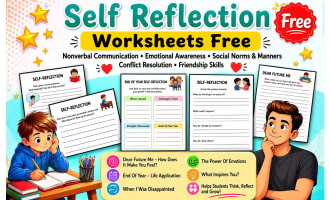
Nonverbal Communication and Empathy Worksheets Bundle


About This Product
Social Skills Worksheets Bundle Nonverbal Communication, Empathy
⭐ Children do not acquire social skills by memorization of definitions. They gain knowledge by practicing, making errors, and figuring out what went wrong. That reality is the foundation of this worksheet set.
It covers topics that are actually discussed in counseling sessions and classrooms, such as interpreting body language, controlling anger, recognizing when a friendship has become toxic, and resolving conflicts amicably. Matching tasks, thought-provoking questions, and scenarios that resemble actual circumstances rather than textbook examples are among the activities.
⭐ The worksheets are intentionally linked. Conflict resolution is influenced by empathy work. Conversational abilities are linked to body language. Instead of treating each ability as a distinct subject, students begin to grasp how these things link together.
⭐Every task is intended to provoke thought rather than merely fill in the spaces. They are prompted to think about their own responses with reflection questions. They are placed in scenarios where they must make decisions. That disconnect between understanding a rule and putting it into practice? The goal of these worksheets is to close it.
Excellent for small groups, pull-out counseling sessions, SEL blocks, and any classroom topic that requires a structured anchor.
Teachers have used it with students in many grade levels; the scenarios are adaptable based on how they are framed.
Resource Tags
0 Reviews
Check out these other great products