Equivalent Expressions – 6th Grade Handout & Match
- Grades
- Grades 6–8, Middle School
- Pages
- 6
- File type
- Answer key
- Included


- Subject
- Life Studies, Finance, Home Economics, Math, Algebra, Money, Common Core
- Topic
- expressions, equivalent expressions
- Resource types
- Worksheets & Printables, Worksheets
- Answer key
- Included
About this resource
What's inside this resource
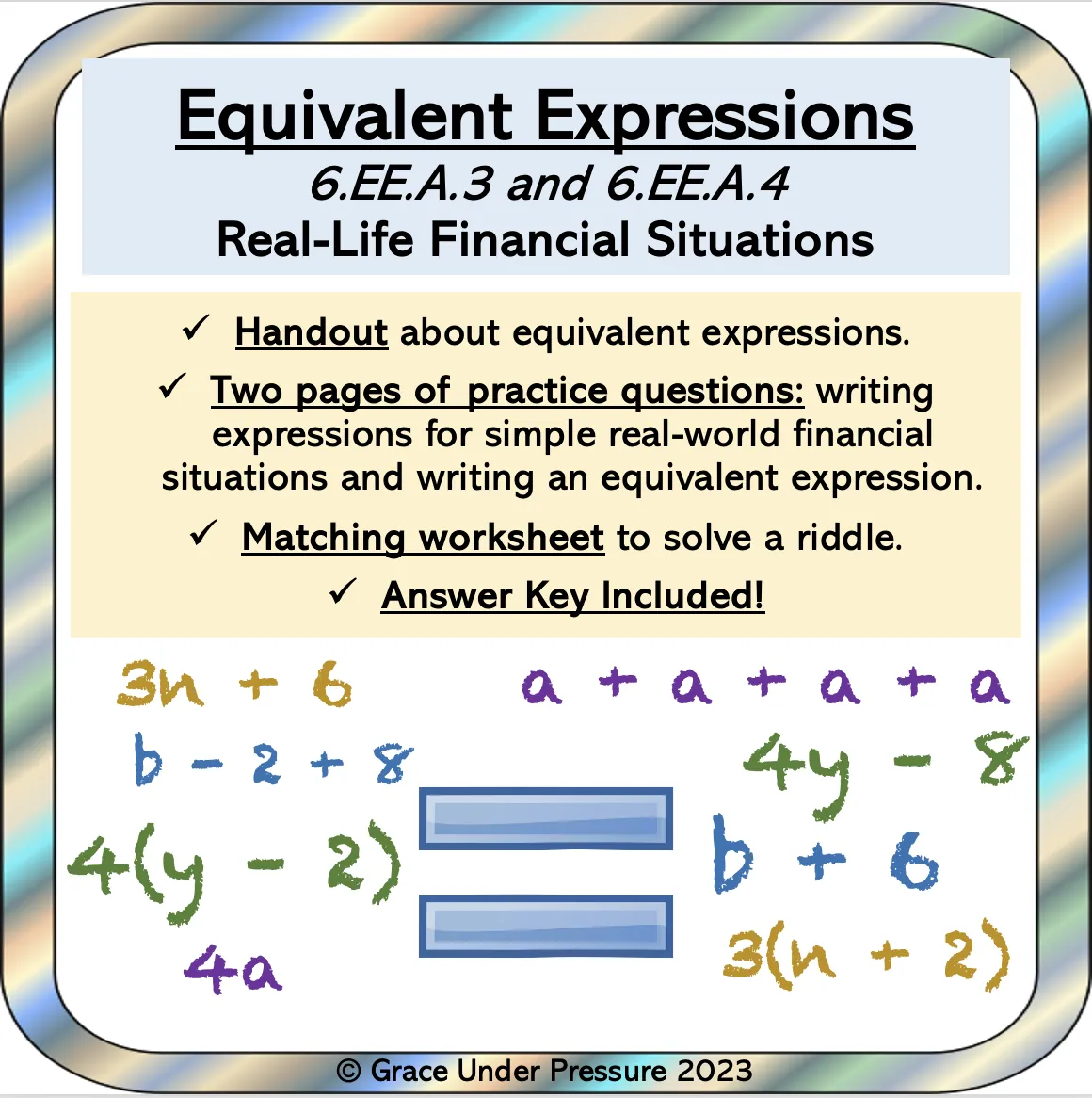
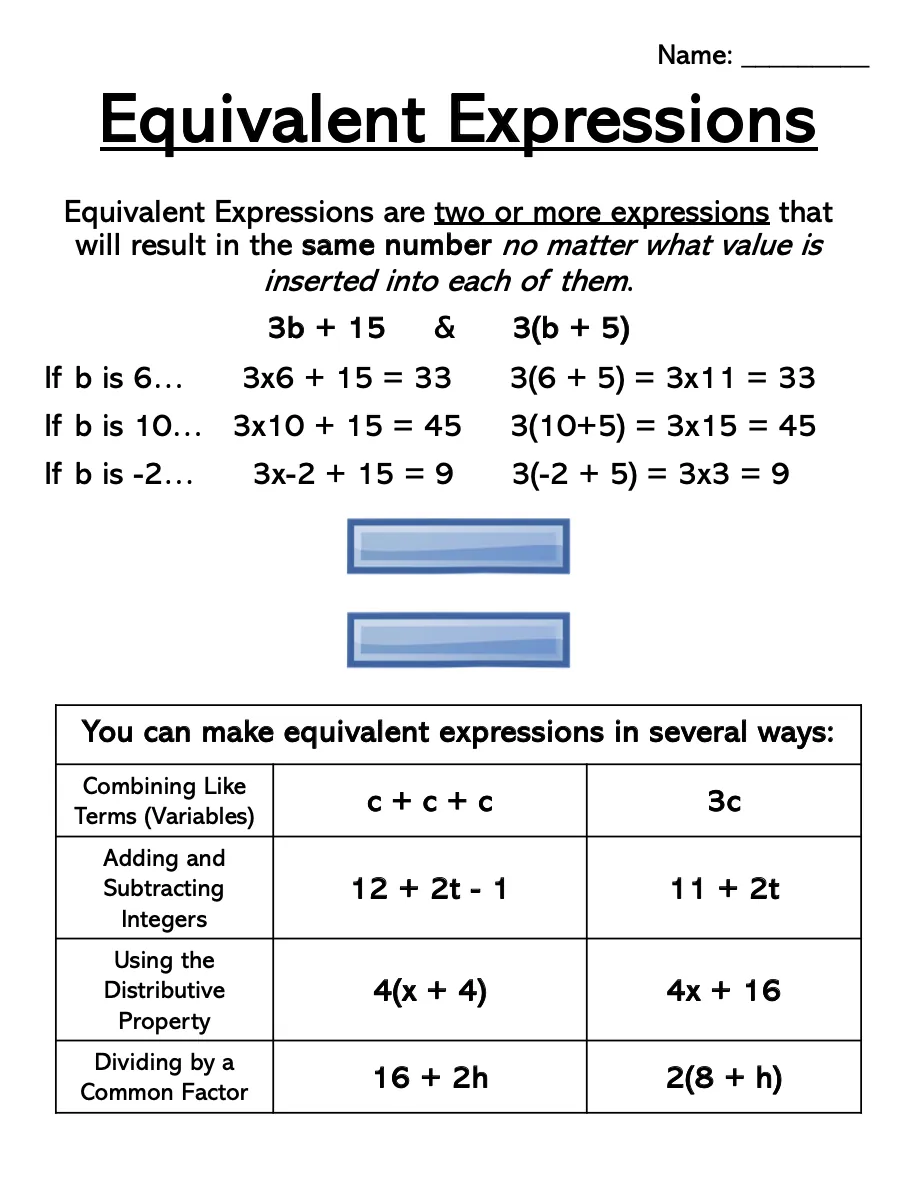
Here's a ready to go lesson to target 6th grade math expressions and equations standards 6EE.A.3 and 6EE.A.4
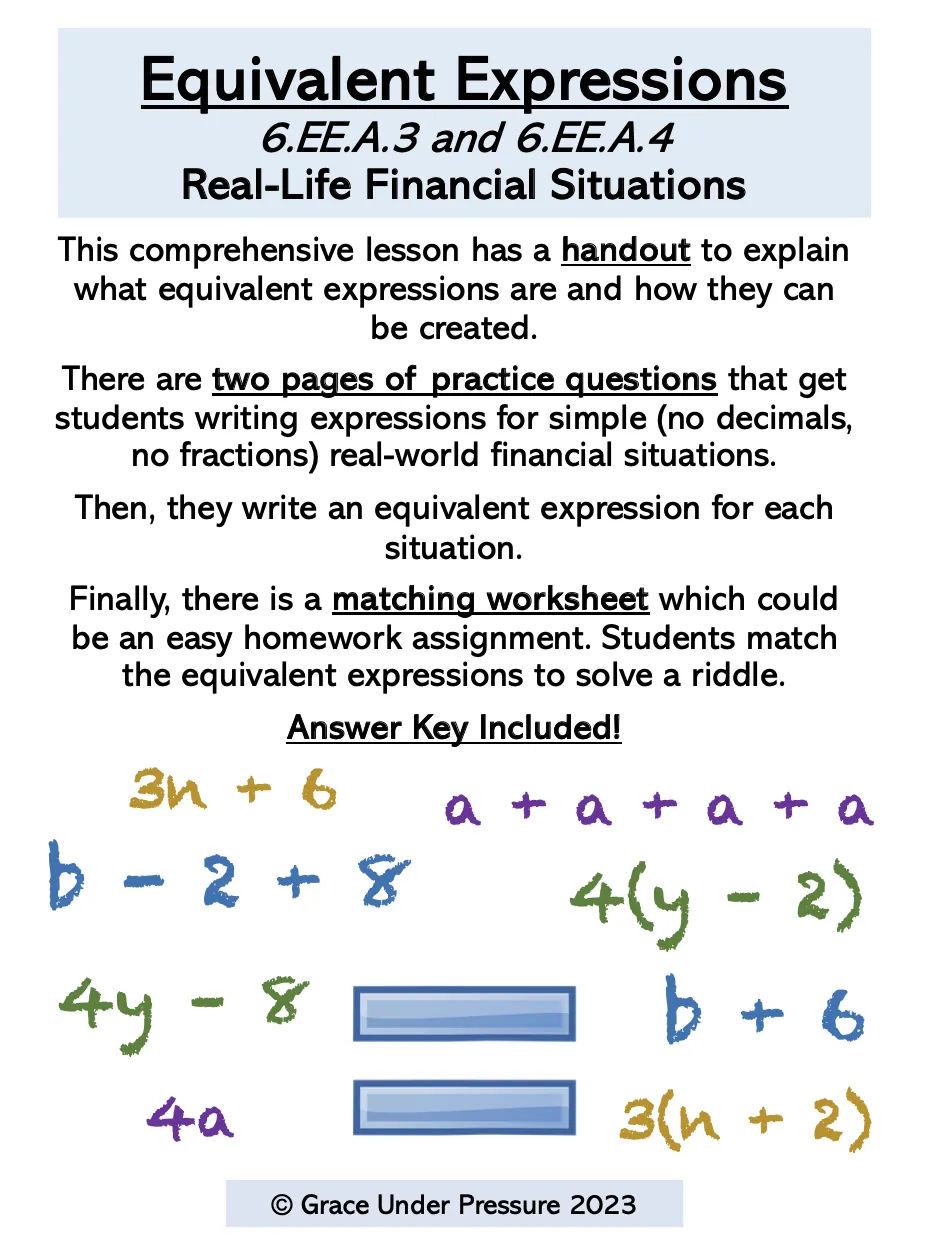
1) First there is a simple and clear handout that explains to students what equivalent expressions are. There are sample equivalent expressions included and explanations of how to make them using different math techniques (combining like terms, adding and subtracting integers, using the distributive property, and finding a common factor).
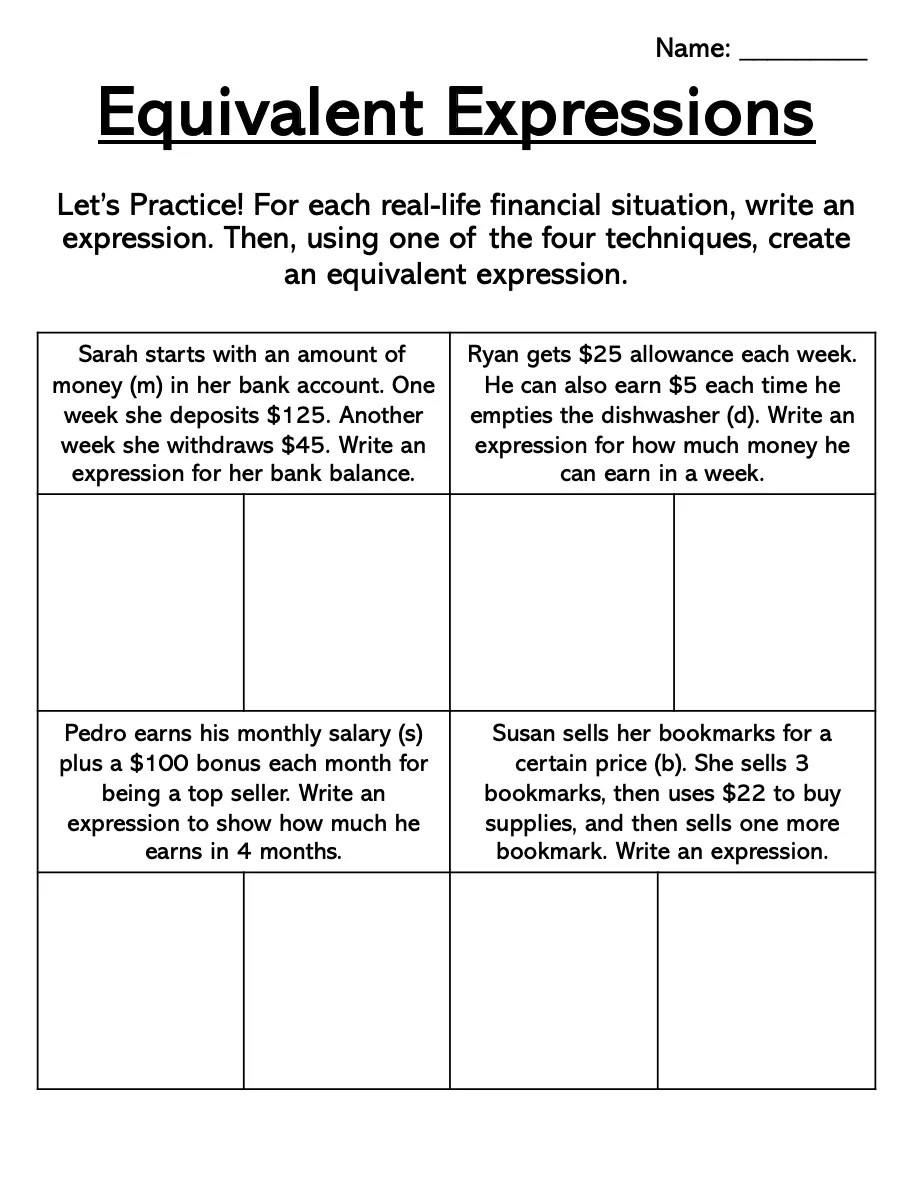
2) Next, there are two pages of real life financial scenarios that students need to write equivalent expressions for. For example: "Ryan gets a $25 allowance each week and can earn $5 each time he empties the dishwasher." This could be represented by 25 + 5d which students could then factor to be 5(5 + d).
3) Finally, there is a matching worksheet with two columns of expressions. Students have to match the equivalent ones to solve a very corny riddle. I would assign this for homework after the lesson.
Grades to Use With:
This lesson is designed for students in 6th grade math classes to target Common Core State Standards in the 6th grade curriculum. It could also be used as a review in grades 7 and 8 or in high school special education classrooms.
If you enjoy this algebra activity, check out others in my store. I always strive to show students how the math they are learning about at school is helpful in everyday life!
Pre-Algebra Problem: The Wave Pool: Expressions, Tables and Graphing
Algebra: Modelling Equations: Visual Balance Scale Worksheet
Exponent Board Game: A Fun Way to Practice Math Skills
Independent and Dependent Variables in Grade 6 Math: Hockey Math
Systems of Equations: Real-World Algebra Problems Using Substitution
Writing and Solving Two Step Equations from Real Life Situations
Related resources
More resources teachers may find useful
24 related resources were found using this product's title, contributor, categories and tags.

In the classroom
Teaching tips & learning objectives

Learning objectives
Translate a financial situation into an algebraic expression
Identify expressions that represent the same quantity
Justify an expression match using the quantities in its financial context

Teaching tips
Read each financial situation before comparing its expression choices.
Ask students to identify the repeated quantity and operation that make a matched pair equivalent.

Skills covered
Expression interpretation — students connect algebraic forms to financial situations.
Equivalence reasoning — students match different expressions representing the same quantity.
Context modelling — quantities and operations are identified from six real-world situations.

No reviews yet
Downloaded this resource? Tell other teachers how it went.
Curriculum
Standards, concepts & topics
Standards
 Standards
- 6.EE.A.3 — Apply the properties of operations to generate equivalent expressions. For example, apply the distributive property to the expression 3 (2 + x) to produce the equivalent expression 6 + 3x; apply the distributive property to the expression 24x + 18y to produce the equivalent expression 6 (4x + 3y); apply properties of operations to y + y + y to produce the equivalent expression 3y
- 6.EE.A.4 — Identify when two expressions are equivalent (i.e., when the two expressions name the same number regardless of which value is substituted into them). For example, the expressions y + y + y and 3y are equivalent because they name the same number regardless of which number y stands for
Core concepts
 Core concepts
Equivalent expressions
Financial situations
Algebraic modelling
 Topics
Explore more
Categories this resource belongs to
Explore related searches
More to explore
You may also like