24 related resources

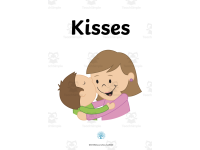
Kisses Social Story

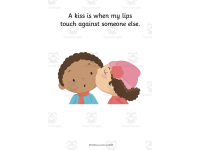
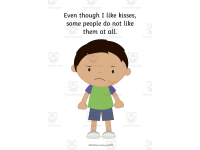
"I must not kiss my teachers", "I will remember to give people personal space" and "I will save my kisses for mommy and daddy" are among seventeen one-sentence pages in an illustrated first-person story about where kissing belongs, supplied in American and British spellings alongside an earlier eleven-page edition.
Grades
Not Grade Specific
Pages
19
File type
PDF
Preparation
Print ready

Updated Jan 10, 2024

Subject
Special Resources, Social Skills
Topic
social story, autism
Preparation
Print ready

About this resource

What's inside this resource

The Kisses Social Story uses a reassuring tone and visual supports to teach children about appropriate kissing behavior. Some children have difficulty understanding when and where kissing is allowed. This story explains that kisses can make people feel happy and loved. However, not everyone likes kisses. The story guides children to ask first before kissing someone and to respect if the answer is no. The narrative and images provide perspective taking around personal space and consent.

This story delivers social skills instruction in a manner autistic and neurodiverse learners can comprehend. Social stories clearly outline situational expectations and common responses to reduce anxiety around social confusion.

Teachers, counselors, and parents can read this story to prepare children for real-world encounters. It builds awareness of personal boundaries and helps prevent inappropriate actions. The story first defines kissing and models asking for consent. Then it demonstrates calm acceptance if kissing is declined. This practical resource turns an abstract social concept into concrete steps children can follow. Social stories foster self-regulation, communication skills, and thoughtful behavior.

The Kisses Social Story proactively teaches children to navigate intimate interactions with empathy and respect.

These books should be used over and over to reinforce the point so I would suggest either putting the pages into a display book or laminating and binding them.

Clipart images courtesy of Kari Bolt.


In the classroom

Teaching tips & learning objectives

Learning objectives

  • Name what a kiss is and where it belongs — with family at home rather than with anyone at school

  • Recognise that other people may not want to be touched, and that a kiss can leave someone uncomfortable, sad or angry

  • Use the phrase personal space to describe what to give other people

  • Choose a high five or holding hands as a way of showing a friend you like them

Teaching tips

  • Follow the tips page: read it through twice at first, then keep returning to it, since the story is written to be repeated rather than read once

  • Pick the spelling edition before printing — mom and mommy in one, mum and mummy in the other — because those words appear in the two most personal pages of the story

  • The tips page warns against reading the story as a punishment; if it is used at the moment the behaviour happens, keep the tone the same as every other reading

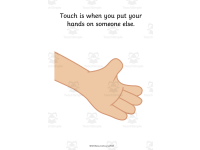
  • The seventeen-page edition adds two opening pages defining touch and kissing, which is worth using with a child who needs the concept named before the rule is given

  • Laminate or bind the pages so the story survives repeated readings, which is what the contributor recommends and what the tips page assumes

Skills covered

  • Understanding personal space — the story names it twice, telling the child that some people do not enjoy being touched and that giving space is what to do instead.

  • Reading other people's feelings — three consecutive pages set out that kissing at school may make someone feel uncomfortable, sad, or angry with the child.

  • Distinguishing settings — the story separates home from school explicitly, allowing kisses for mom or dad and ruling them out for teachers, friends and anybody at school.

  • Substituting an acceptable behaviour — rather than stopping at the rule, the story offers a high five and holding hands as named alternatives for showing a friend affection.

  • Adult delivery of a social story — the tips page gives the adult a method: no distractions, two readings at first, regular revisiting, a place in the daily schedule and consistent praise.

Good to know

Questions teachers ask about this resource

Which alternatives does the story offer instead of kissing?

Two, both named on their own pages: "I can high five" and "I can hold hands". They follow the page that reads "If I want to show my friends how much I like them, there are some touches that are OK", so the story moves from the rule to a replacement rather than ending on a prohibition.

Which spelling does the story use for the words for parents?

Both are supplied. One edition reads "I can kiss my mom or dad" and closes on "I will save my kisses for mommy and daddy"; the other reads mum and mummy in the same two places. Everything else in the two editions is identical, so the choice is made at printing.

What does the tips page recommend for an adult sharing the story?

Four things: remove distractions so it is just the adult and the child; read it through twice to begin with and then revisit it regularly, since repetition is what makes the difference; find a place for it in the child's daily schedule; and keep it positive, never letting it be taken as a punishment.

No reviews yet

Downloaded this resource? Tell other teachers how it went.

Resource details

Concepts & topics

Core concepts

  • Social story

  • Personal space

  • Appropriate touch

  • Emotional awareness

  • Autism support

Explore related searches

More to explore

You may also like