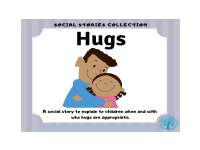
Hugs Social Story

- Grades
- Not Grade Specific
- Pages
- 23
- File type
- Preparation
- Print ready


- Subject
- Special Education Needs (SEN), Social Skills
- Topic
- Hugs, Personal boundaries
- Preparation
- Print ready
Product description
From the author
Social stories use a patient and reassuring tone to teach children about social situations in a way that can be easily understood. Social stories are particularly useful for children on the autistic spectrum for whom social cues can be challenging and who often suffer anxiety if they do not know what to expect from a situation however social stories can also be useful for any child who is struggling to understand a situation or concept or needs help to understand a social skill or social cue, expectations, perspectives, common responses or is troubled about an upcoming event.
This social story is about hugging, explaining to children that hugs are not always appropriate and that some people do not like to be hugged.
These books should be used over and over to reinforce the point so I would suggest either putting the pages into a display book or laminating and binding them.
Clipart images courtesy of Kari Bolt.
Related resources
More resources teachers may find useful
24 related resources were found using this product's title, contributor, categories and tags.



In the classroom
Teaching tips & learning objectives

Learning objectives
Recognize that people differ in their comfort with touch.
Practice asking before a hug and respecting the answer.
Understand that other forms of touch also need agreement.

Teaching tips
Choose the mom or mum version that fits your students’ vocabulary.
Practice asking and accepting either yes or no.
Explain that a high five or holding hands also requires agreement.

Skills covered
Recognizing personal boundaries
Asking before physical contact
Listening to and respecting another person’s answer
Good to know
Questions teachers ask about this resource
How should I discuss the other gestures in the story?
The story mentions high fives and holding hands. Explain that these also need the other person’s agreement, and practice accepting no without pressure.

No reviews yet
Downloaded this resource? Tell other teachers how it went.
Resource details
Concepts & topics
Core concepts
 Core concepts
Personal space
Consent
Social story
Physical touch boundaries
Topics
 Topics
Explore related searches
More to explore
You may also like