



2,677 products added recently
Page 82 - Fun Activities For High School Students
Incorporate fun and interactive activities into your high school classroom to boost engagement and enthusiasm. These resources include team-building exercises, creative projects, and thought-provoking challenges. Use them to foster a positive learning environment and strengthen student connections.

 Show filters

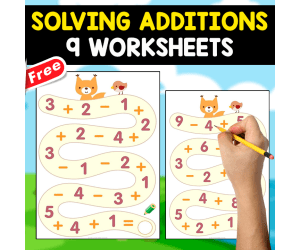
SOLVING ADDITIONS AND SUBTRACTIONS | 9 FREE WORKSHEETS
Math, Addition and Subtraction, Addition, Subtraction, Early Learning, Elementary, High School, Homeschool Resources, Middle School, Not Grade Specific, Pre-K, Adult Education, Activities, Worksheets & Printables
SOLVING ADDITIONS | FREE RESOURCE INTRODUCTION: HELLO! WELCOME TO THE EDITORIAL ARENAS EDUCATIVAS RESOURCE STORE! This time we bring you these fantastic resource for you! Your children's afternoons will no longer be boring thanks to these fantastic resource. MAIN INFORMATION: 1. Product name: You can use this educational resource in the primary education classroom. 2. Number of pages: This document contains the following number of pages. 3. Is it editable or not? This educational document is not editable, because this way you can use it better and you will not have any problem with the composition or design undergoing any variation. 4. Theme: This educational resource contains a topic for the primary education of children. 5. Document version: This educational document is available in PDF version, size A4. COMPLEMENTARY INFORMATION: 6. Is it available in color or black/white? This document and/or set of educational sheets is available in color and also in certain parts contains black and white, however it is generally suggested that the teaching material be designed in color so that it is much more attractive for your students, awakening their attention and interest. 7. In what version is it available? This document is available in PDF version, A4 size, because we consider that this size is the original and most common standard. 8. Editable/Non-Editable: This educational document and/or set of educational sheets is not editable, because this way you will be able to use it much more easily. 9. Age at which it can be applied: This educational resource can be applied to children of all ages, that is, students from 3 to 12 years old, who must acquire some basic knowledge that thanks to this document they will be able to address. 10. Tags or keywords that describe the content: didactic material, teaching sheets, material for children, printable educational material, printable material. 11. Ways to print: I suggest you print this document in A4 format, and check if your printer has enough ink for the printout to be of quality and so that your students can complete their worksheet without any problem. 12. Ways to apply it in class: You can apply this document both individually and as a group, it all depends on your criteria.
Author EDITORIAL LAURA EDUCA
Tags ADDITIONS, ADDITION, FREE, FREE RESOURCES, MATH, MATH RESOURCES
Story of Stuff (2007): Complete Video Guide & Processing Activity
Science, Earth and Environmental Sciences, Earth Sciences, Environmental Science, Grade 6, 7, 8, 9, 10, Activities
The Story of Stuff (2007): Complete Video Guide & Processing Activity This comprehensive teaching resource provides a thorough breakdown of an impactful documentary that critically evaluates the lifecycle of consumer goods. This film shines a spotlight on environmental and social impacts resulting from our economic models of production and consumption. Insights into Modern Linear Systems The film explores the linear system, in which raw materials are turned into goods, used, and finally discarded as waste. It raises awareness around alarming issues including pollution, deforestation, and depletion of natural resources connected to this prevalent system. Furthermore, it delves into social costs such as workplace exploitation and usage of hazardous chemicals throughout production process. Systemic Sustainability: A Question Mark? In 'Story of Stuff', sustainability is questioned while advocating for a transition to more equitable systems. The film concludes on an optimistic note emphasizing conscious consumption and urging support for policies that promote sustainability alongside social justice. The role communities play in initiating change is also underscored. An engaging Teaching Resource: Grades 6-10 This resource encourages students from Grade 6 through Grade 10 to contemplate their environmental footprint by reconsidering their consumer habits. Inclusive Learning Approach: A visually appealing guide that simplifies student engagement during Earth Sciences or Environmental Science lessons - applicable for whole class discussions or small focus groups; it can also be assigned effortlessly as homework due to its straightforward format. Complete with Teacher Key & Reference Chart : This guide includes a teacher key for facilitation during interactive sessions along with stimulating scientific discussions amongst students. The package comes with a material economy reference chart for easier understanding of economic transactions involving material goods, thereby making comprehension easy regardless of science proficiency levels among learners. Educator and Student Version Available: This package includes versions for both the teacher and student. This ensures a seamless blend of information source and processing activity to study. An intensive introductory reading further provides educators with the necessary background information - truly proving itself as an invaluable tool in making Environmental Science engaging and approachable!
Author EduPal Learning
Tags Consumer Goods Lifecycle, Environmental Impacts, Social Costs, Conscious Consumerism, Community Actions

Magnets and Electromagnets 42 Question Board Game
Science, Physics, Grade 5, 6, 7, 8, 9, Activities, Games
With 42 question cards on permanent magnets and electromagnets this is an enjoyable and challenging board game for up to six players per set. It is suitable for all abilities. It can be played at the end of a module on electricity and electromagnets but is also a very useful test prep tool. This game is so much fun, pupils will forget they are learning! What You Get Game board (color and black and white) 42 question cards with questions of varying degrees of difficulty Answer sheet Instruction sheet. Rules for Play The player who throws the highest score starts and play proceeds in a clockwise direction. Students take turns and work their way around the board following the instructions in the squares. Some squares tell the student totake a question card from the face down pile. If correct they move on 2 spaces. If a player thinks an answer given by an opponent is incorrect they can challenge. If the challenge is correct the challenger moves forward 2 spaces. If the challenge is wrong the challenger moves back two spaces. In the event of a challenge, pupils are encouraged to consult their books but the teacher has a quick-check answer sheet. Prior Knowledge Required Composition of Magnets: Magnets are constructed using magnetic materials. Common materials include Iron, Cobalt, Nickel, and their corresponding alloys. Pole Interactions: Magnets have two types of poles - North and South. When two like poles (e.g., North and North) come close to each other, they repel. Conversely, when opposite poles (e.g., North and South) are brought together, they attract each other. Magnetic Fields: Surrounding every magnet is an invisible force field known as the magnetic field. This field can be visualized through field lines. Field Line Density: The density of these field lines determines the strength of the magnetic field. A region with closely spaced field lines indicates a stronger magnetic field than a region where they're spread out. Visualization of Field Lines: It's essential to understand and recognize the pattern of field lines around two bar magnets, especially when they have the same or opposite poles facing each other. Field Strength at Poles: The magnetic field is strongest at the poles of a magnet due to a higher concentration of field lines. Distance and Field Strength: The strength of the magnetic field diminishes as one moves farther from the magnet. Direction of Field Lines: Field lines emanate outward from the magnet's south pole and point inward toward the north pole. Magnetization Process: When a non-magnetized magnetic material becomes a magnet, the tiny regions within it called domains, which were initially oriented in random directions, align themselves to point uniformly in the same direction. Earth's Magnetic Properties: The Earth behaves like a large magnet. Interestingly, there appears to be a south-type magnetic pole near the Earth's geographic North Pole and a north-type magnetic pole near the Earth's geographic South Pole. Application in Devices: It would be beneficial to have a basic understanding of how magnets and magnetic fields operate within certain devices. Familiarize yourself with the structure and functioning of electric bells, relays, and circuit breakers, as they use these principles. See more Elf Off the Shelf resources on this topic and many others.
Author Elf off the Shelf Resources
Tags Magnets, Electromagnets, Magnetic Materials, Magnetic Fields, Earths Magnetism , Electric Bell, Electric Relay, North And South Poles, Magnetic Fileld Lines, Magnetism Game

Sharecropping and Tenant Farm Game
Science, Earth and Environmental Sciences, Life Sciences, Nature & Plants, Grade 9, 10, Activities, Games
This is a Sharecropping and Tenant Farming Game. National Curriculum Standards: Learners will understand how scarcity and uneven distribution of resources result in economic decisions, and foster consequences that may support cooperation or conflict Specific Objective: Students will be able to evaluate the systems of sharecropping and tenant farming, to see whether they were fair and equitable systems by which freedmen and women could have a sustainable life. Materials: Budget worksheets provided Lesson: After you have covered the bulk of Reconstruction, you can then touch on how the land was distributed among freedmen and women. There were basically two ways in which it was done. Since the vast majority of freedmen and women had practically nothing, they had to somehow rent the land and tools in order to farm. Those that did not have neither, would be sharecroppers. The owner of the land would allow them to use the land and also lend them tools but they would typically have to pay half the profits to the landlord. For those fortunate enough to have their own tools, they could rent the land for a fixed price. They were typically known as tenant farmers. After this has been explained, tell your students that they will experience firsthand how the system worked or (not worked). Divide the class into two groups: tenant farmers and sharecroppers. Also, divide them into pairs within each group. Tell them that they are a married couple trying to make ends meet. Then to half the class give the sharecropper budget worksheet and to the other half, the tenant farmer budget worksheet. Tell them that for each year, they will have to fill out the budget sheet. At the beginning of each year, they will have to select a crop to plant on their little parcel of land. They will have three choices: corn, wheat and cotton. (They may not choose a combination, but they can change their selection each year). Each year, each crop will perform differently depending on the weather and market forces. But they don’t know how each crop will do until the round starts. They’ll just have to guess and try to make it through. Also, for each year, make sure they understand to deduct payments to the landlord, and a fixed living expense.
Author Creative Educator
Tags Sharecropping, Farming, Farm Game, Tenants, Sharecroppers, Farmers, Economic Decisions, U.S. History, Small Group Games, Social Studies, Sharecropping Vs Tenant Farming, Tenant Farming Vs Sharecropping, What Are Tenant Farmers And Sharecroppers, What Were Tenant Farmers And Sharecroppers, Sharecropping And Tenant Farming, Sharecroppers Or Tenant Farmers
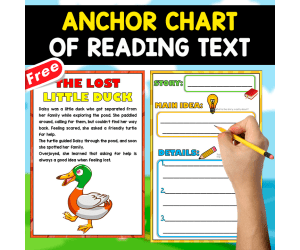
FREE ANCHOR CHART | THE DUCK
ELA, Reading, Writing, Adult Education, Early Learning, Elementary, High School, Homeschool Resources, Middle School, Not Grade Specific, Activities, Worksheets & Printables
ANCHOR CHART | THE DUCK INTRODUCTION: We are EDITORIAL ARENAS EDUCATIVAS, a publisher dedicated to designing educational resources for primary school children approximately between the ages of 3 and 12 who are learning mathematics, literacy, as well as worksheets for learning Spanish and some brain exercises. MAIN INFORMATION OF THE PRODUCT: 1. Product name: You can use this educational resource in the primary education classroom. 2. Number of pages: This document contains the following number of pages. 3. Is it editable or not? This educational document is not editable, because this way you can use it better and you will not have any problem with the composition or design undergoing any variation. 4. Theme: This educational resource contains a topic for the primary education of children. 5. Document version: This educational document is available in PDF version, size A4. 6. Color or black/white: This educational product is designed in color because we believe that this will be much more attractive for your children. COMPLEMENTARY AND SECONDARY INFORMATION: 7. In what version is it available? This document is available in PDF version, A4 size, because we consider that this size is the original and most common standard. 8. Editable/Non-Editable: This educational document and/or set of educational sheets is not editable, because this way you will be able to use it much more easily. 9. Age at which it can be applied: This educational resource can be applied to children of all ages, that is, students from 3 to 12 years old, who must acquire some basic knowledge that thanks to this document they will be able to address. 10. Tags or keywords that describe the content: didactic material, teaching sheets, material for children, printable educational material, printable material. 11. Ways to print: I suggest you print this document in A4 format, and check if your printer has enough ink for the printout to be of quality and so that your students can complete their worksheet without any problem. 12. Ways to apply it in class: You can apply this document both individually and as a group, it all depends on your criteria. 13. Will they need extra items to use this worksheet? Yes, perhaps your students will need a pencil, markers, etc., it all depends on the creativity of the teacher. This file is for personal use only. It is not allowed to be resold or shared with others.
Author EDITORIAL LAURA EDUCA
Tags ANCHOR CHART, FREE, FREE RESOURCES, READING, COMPREHENSION
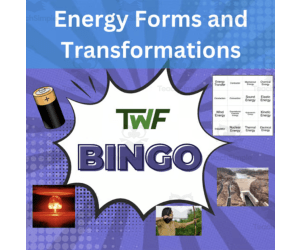
Energy Forms and Transformations Science BINGO Activity
Science, Physics, Grade 6, 7, 8, 9, 10, 11, Activities
Your students will love this engaging science review activity. Everyone loves BINGO and it makes for a great review activity that is fun and competitive. This interactive game reinforces key scientific concepts and theories, ensuring curriculum relevance and accuracy. The game package includes 36 unique 4x4 bingo cards featuring essential terms and concepts from Energy Forms and Transformations, a set of call-out cards with clear and concise definitions tailored to the students' level, and detailed gameplay instructions. To play, simply distribute the bingo cards to your students along with markers or chips. Read out the definitions from the call-out cards in a random order, and have students place a marker on the corresponding term on their card. The first student to complete a row or column exclaims "Bingo!" and emerges victorious. Following the game, engage in a discussion of the terms to reinforce understanding and clarify any misconceptions. The beauty of this game is that it allows for multiple rounds of learning and review. Teachers will appreciate the game's ability to encourage active participation and engagement in the classroom setting, catering to various student learning styles and promoting differentiated learning. By matching definitions to terms on their bingo cards, students actively engage with the material, enhancing their retention and comprehension of complex scientific theories. Here is a sample from the instructions. BINGO – Instructions, Terms, and Descriptions Cut out and distribute the BINGO cards to your students. Each student will get a unique card. Students can use markers or chips to cover squares that have been called. Print out and cut out each term/description below – these are the call-out cards. Fold each call-out card and place in a hat or box and remove one at a time. After you’ve read the call-out card description, your students are to place a marker on the term associated with the description located on their card. The first student to get 4 in a row horizontally or vertically, wins. Ensure accuracy by checking marked terms on student card to the called-out descriptions.
Author Teach With Fergy
Tags Science Bingo, Bingo Activity, Energy Forms, Energy Transformations
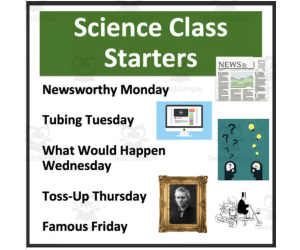
Science Ignition: 200 Days of Engaging Starters for Grades 6-12
Science, Basic Science, Life Sciences, Biology, Chemistry, Physics, Grade 6, 7, 8, 9, Activities
Teachers, wanna transform those sleepy, zombie-like morning classes? Get your students engaged from the get-go with these out-of-this-world science warm-ups! We've got 200 different 5-7 minute activities to kickstart middle & high school lessons. Talk about variety! From current events to hypothetical scenarios to videos, these interactive challenges will get those teen brains fired up to learn. The topics are straight up awesome - new discoveries, wild inventions, legendary scientists, real-world issues. Stuff your students can actually relate to, ya know? Really connects science to their everyday lives. And the prompts are designed for all levels - 6th graders to 12th graders. No prior knowledge needed, so no one feels lost. But older kids can really take the critical thinking up a notch. Here's a taste of what's on the menu: Mondays - Find a gnarly new science story in the news and dish out the deets with the class. Tuesdays - Watch some rad YouTube videos about science and chat about what you learned. Wednesdays - Get creative with some "what if" scenarios...like what if you could travel at the speed of light? Whoa! Thursdays - Explore insane new inventions, learn about rockstar scientists, research weird science careers. The variety is wild! Fridays - Dive deep on legendary scientists like Einstein, Curie, Darwin. Our science idols! You'll get a digital workbook, posters , answer keys - the whole shebang. Just hand it out and go - prep is easy peasy. Get ready for hands shooting up to answer, thoughtful discussions, and serious excitement for science. Your students will thank you!
Author Teach With Fergy
Tags Science Class Starters
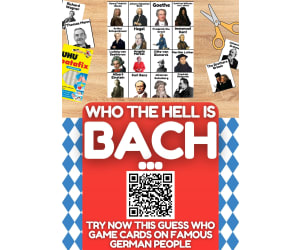
Germany Country Study – Famous Germans Guess Who
Social Studies, Geography, History, History: Europe, Grade 6, 7, 8, 9, 10, 11, 12, Activities, Games
Country Study on Germany - Guess Who Game on famous German People This Teaching Resource is an fun Guess Who Game PDF Presentation (1 slide, 20 cards) on Famous German People. This Printable Resource can be great for Geography, European History and Social Studies Classes. Suitable Learners for this kind of lesson are students from 6th Grade to 12th Grade. This Geography + Social Studies Guess Who Game on Famous People from Germany (Country Study) aims to introduce learners to Germany and its most famous people (leaders, kings, philosophers, writers etc.). Little Preparation is needed for this Social Studies + Geography Activity. Some of the German People selected for this Geography + Social Studies + European History Country Study on Germany are: the Brothers Grimm Thomas Mann Richard Wagner Johannes Brahms Johann Sebastian Bach Goethe Gottfried Wilhelm con Leibnitz Arthur Schopenhauer Hegel Immanuel Kant Ludwig van Beethoven Otto von Bismarck Angela Merkel Martin Luther and many more! a very fun and engaging way to play this "Guess Who on Famous People from Germany" (country study on Germany) game can be the following: all Learners sit on the floor in a circle every Learner has a Flash Card on their face every Learner/player asks a question about their Flash Card's famous German character This Social Studies + Geography Country Study on Germany PDF Printable Teaching Resource (1 slide, 20 cards for 20 Famous People from Germany) can be great for learners from 6th grade to 12th grade to introduce Germany and its Culture through its most important and celebrated people. Learning with Alan is a Brand New Teaching Resource/Educational Material Store whose aim is to help Teachers, Educators and Tutors to achieve their teaching objectives while creating a fun and stimulating environment. Never Forget! If you want to browse more of my Teaching Resources, click here Learning with Alan!
Author Learning with Alan
Rating
Tags Germany, Europe, European History, Social Studies, Geography, Printable, Cards, Guess Who, Culture, Game

"Life in the Middle Colonies" - A History Play
Social Studies, History, History: World, Grade 9, 10, 11, 12, Activities
Life in the Middle Colonies - A History Play: An Engaging Teaching Tool The product Life in the Middle Colonies - A History Play offers an engaging method of teaching high school social studies students about the unique characteristics and historical events of the Middle Colonies era. Crafted as a play, this teaching tool transforms history into an unforgettable narrative that captures young minds. This 3-page Microsoft Word document can be tailored to fit your lesson plans either as an introduction or as reinforcement of previously covered content. The presentation is designed to engage students actively, encouraging them to consider important aspects while also enjoying humor creatively incorporated throughout. Ideal for Grades 9-12 Social Studies Curriculum Focusing on World History, this resource contains comprehensive coverage of salient points concerning the Middle Colonies: Inclusive diversity and instances like former slaves and citizens cohabiting cities with consequential competition ensuing in Philadelphia and New York City. Vivid depiction of religion's role allowing tolerance amongst different religious groups at that time. Vital elements like prevalent trades during those times alongside wheat/grain production and grist mills bringing authenticity to this tale. Critical dialogue about slavery is encouraged effectively allowing for discussions regarding societal issues not just from then but their continued relevance now too. Broadening Learning Possibilities This dynamic resource could be used for whole classroom activities such as live performances or readers' theater scenario enactments which empower interpretive historical viewpoints exploration dramatically enhancing student understanding whilst tapping into creative talents more so should costumes/props be used! Also, it works perfectly within smaller group dynamics facilitating active engagement & sparking deep discussions around these societal dynamics. Incorporating Humor and Creating Debates Using humor without trivializing serious issues shows radical differences between then versus now constituting a central part within stimulating debates regarding these issues persistence now, albeit in modern contexts. Encouraging an interactive learning approach is certain to foster a love for history and a deeper understanding of societal constructs from centuries ago which are still pertinent to today's world.
Author BCM Creations
Tags Middle Colonies, History Play, Social Studies, Diversity, Slave Trade
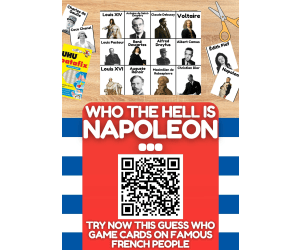
Country Study on France - Guess Who Game Cards on Famous French People
Social Studies, Geography, History, History: Europe, Grade 6, 7, 8, 9, 10, 11, 12, Activities, Games
Country Study on France - Guess Who Game Cards on Famous French People This Teaching Resource is an fun Guess Who Game PDF Presentation (2 slides, 40 cards) on Famous French People. This Digital Resource can be great for Geography, European History and Social Studies Classes. Suitable Learners for this kind of lesson are students from 6th Grade to 12th Grade. This Geography + Social Studies Guess Who Game on Famous People from France (Country Study) aims to introduce learners to France and its most famous people (leaders, kings, fashion designers, philosophers, writers etc.). Little Preparation is needed for this Social Studies + Geography Activity. If you need a little help to introduce your students and learners to France and French Culture, try this: Country Study Presentation on France Some of the French People selected for this Geography + Social Studies + European History Country Study on France are: Charles de Gaulle Coco Chanel Napoleon Victor Hugo Jeanne d'Arc Claude Monet Gustave Eiffel Louis XIV Voltaire Marie Antoinette Édith Piaf Charlemagne Maximilien de Robespierre Christian Dior Jean-Paul Gaultier Yves Saint Laurent Astérix Jules Verne Simone de Beauvoir Jean-Paul Sartre and many more! a fun and engaging way to play this "Guess Who" game can be the following: all Learners sit on the floor in a circle every Learner has a Flash Card on their face every Learner/player asks a question about their Flash Card 's famous French character This Social Studies + Geography Country Study on France PDF Digital Teaching Resource (2 slides, 40 cards for 40 Famous People from France) can be great for learners from 6th grade to 12th grade to introduce France and its Culture through its most important and celebrated people. Learning with Alan is a Brand New Teaching Resource/Educational Material Store whose aim is to help Teachers, Educators and Tutors to achieve their teaching objectives while creating a fun and stimulating environment. Never Forget! If you want to browse more of my Teaching Resources, click here Learning with Alan!
Author Learning with Alan
Tags France, European History, Europe, Geography, Guess Who, Cards, Game, Printable, Culture, Social Studies

"How The Great Age of Exploration Began: The Crusades" - A History Skit
Social Studies, History, History: World, Grade 9, 10, 11, 12, Activities
How The Great Age of Exploration Began: The Crusades - A History Skit The How The Great Age of Exploration Began: The Crusades - A History Skit is an engaging educational resource that creatively blends compelling history with the excitement of theatre. An ideal teaching tool, it introduces students to the intricate historical links between trade networks established during the Crusades and their influence on sparking the landmark era of exploration. This skit presents how locations in the Middle East and certain Italian city-states prospered from these developments. Venice stands out as a hub of bustling markets fueled by expanding trade patterns triggered by the Crusades. Its presentation merges light-hearted humor with deep knowledge, ensuring high student engagement levels while maintaining learning effectiveness. About this Product: The material includes a structured 2-page Word document appropriate for one lesson or activity. A classroom dramatization rendition requires some rehearsal for proper mastery and delivering an engaging performance. The content suits high school students in grades 9 through to 12 very well but allows flexibility in instructional methods based on student capabilities. Applications: This resource is particularly beneficial within Social Studies curriculums that feature World History sections. Tutors could consider it for homework assignments when combined with other supplementary materials ensuring after-school learning reinforcement. In conclusion, this skit not only fulfils curriculum needs but also ensures student focus through its captivating emphasis on 'The Crusades'. It breathes life into history lessons on 'The Great Age of Exploration' without sacrificing entertainment factor nor student subsequent involvement!
Author BCM Creations
Tags Exploration, Crusades, Trade Relationships, Venice, Dramatization

Archetype Web Quest
ELA, Literature, Grade 7, 8, 9, 10, 11, 12, Activities
Archetype Web Quest: An Interactive Educational Resource Archetype Web Quest is a dynamic teaching resource designed for educators working with students from grade 7 to grade 12. This innovative activity aims to help students understand various archetypal characters and themes available in literature—making it an ideal tool for Language Arts and Literature classes. In this interactive quest, each student would need computer access as they explore online resources while concurrently identifying different archetypes. The web quest integrates technology and teaching, making active learning easier for tech-savvy students. A Transformation Beyond Traditional Classrooms The Archetype Web Quest transforms every school or home into an interactive learning environment, making it a perfect fit for conventional school settings and homeschooling families alike. Sustains Structure & Content Without Compromise The web quest maintains structure and content rich experiences despite its digital approach towards education. It consists of 17 pages filled with tasks accompanied by detailed instructions, ensuring young learners stay on track throughout their journey. Included answer key: Comes complete with an answer key which aids teachers during assignment evaluations—saving them considerable time preparing separate answer scripts while also ensuring uniform grading across all participants. Mastery based progression: Advancement depends on mastery not simply time spent on each task. This allows teachers considerable flexibility — the activities can be assigned during class hours or even given as homework over the weekend. In Conclusion (do not include) evoke your pupils today using sophisticated digital tools like this pioneering Archetype Web Quest—a combination bound to appeal strongly amidst our current digitally inclined generation! Enjoy enabling your students to seamlessly blend technology and education fostering an interactive, engaging yet thorough learning experience.
Author Educate and Create
Tags Interactive Learning, Archetypal Characters, Literature Education, Independent Thinking, Technology Integration, The Quest Archetype Examples
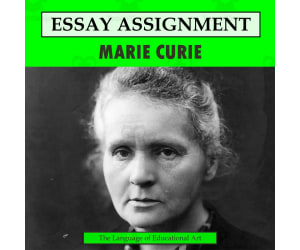
Research Organizer & Essay Assignment: Marie Curie
Social Studies, ELA, History, History: Europe, Science, Physics, Grade 8, 9, 10, 11, 12, Activities, Projects, Worksheets & Printables, Worksheets
Few scientists are more celebrated than Marie Curie, the first women to win a Nobel Prize. This resource provides your students with the opportunity to independently learn about and summarize the life of the "mother of radioactivity" with this engaging research planner and essay assignment. This carefully scaffolded and easy-to-assign-AND-assess resource has been designed to guide student learning from Marie Curie fact-collection to the careful development of a five-paragraph research essay. Teaching this resource could not be easier! Start by handing out the background research and note-taking worksheet (you could also ONLY hand this out if you want a shorter lesson!). Once students have found their facts and sources, provide them with the essay outline activity, which guides them step-by-step through the requirements of a short research essay. From there, drafting their essay, using the provided peer review checklist, and submitting their final draft will be no problem at all. And then you can assess their work with the provided Common Core rubric! Use this entire resource as a complete research lesson or just part of it as a short research activity or sub plan! This TeachSimple download includes: - A Marie Curie essay writing assignment with directions, requirements, research essay writing tips, a peer review checklist, and Common Core-tied grading rubric - An editable rubric, provided as a link, that lets you make adjustments to the grade values and guidelines. This link is provided as as Google Sheet specifically built for integration into Google Classroom, although you can also modify it for use in other Learning Management Systems (LMSs) - A Marie Curie biography and note-taking worksheet that will guide your students through information gathering. This straightforward two-page handout includes instructions for background research, a fun drawing section, and an area to cite quality sources and organize conducted research - A research essay outlining worksheet, so students build on their Marie Curie notes in a clear and simple manner as they build their work towards a draft and final paper - All 6-pages of this lesson are provided in full-color and B&W versions Although this resource can be fitted for any secondary Language Arts classroom, it has been carefully designed to work best in grades 8 through 11. The included rubric is subtly but specifically tied to Common Core ELA Standards for Language (3) and Writing (2 and 7). This resource is provided as a print-ready, bookmarked, and adjustable PDF file. The rubric is also included as an editable Google Sheet. This resource contains 6 pages and 1 Google Sheet.
Author The Language of Educational Art, LLC
Tags Research, Essay, Notetaking, Outlining, Marie Curie

"How The Great Age of Exploration Began" - A History Play
Social Studies, History, History: Europe, Grade 9, 10, 11, 12, Activities
Are you in search of a lively and engaging method to teach your students about the origins of the Great Age of Exploration and the decline of Feudalism in Europe? Look no further! Our entertaining and educational skit from TeachSimple, titled "How The Great Age Of Exploration Began - A History Play," is an inventive digital resource tailor-made to complement any lesson on these captivating historical periods. It's designed with your students' attention and learning experience in mind. This 2-page Word document includes a light-hearted script suitable for 4-5 students (with one being a narrator) highlighting how towns, trade, and even the Black Death significantly influenced Europe's journey towards exploration. As an interactive teaching aid, it encourages active student participation through performance, discussion, and debriefing. With just 15 minutes allocated for acting plus an additional 5-10-minute debriefing session (incorporating journaling and Q&A), your class will be effectively immersed in this intriguing historical narrative. We believe that such immersive experiences contribute to more effective learning retention among young learners. Go ahead! Enhance your collection of digital educational resources with TeachSimple's "How The Great Age Of Exploration Began – A History Play" for more vibrant lessons down the line!
Author BCM Creations
Tags History Play, World History, Age Of Exploration, Europe, Feudalism

All About Me Science Activities Beginning of the Year
Science, Pre-K, Not Grade Specific, Middle School, Homeschool Resources, High School, Elementary, Early Learning, Adult Education, Teacher Tools, Worksheets & Printables, Classroom Decor, Activities
This school is a great way to combine Science skills with self-expression at the beginning of the year. Perfect, back-to-school activities for Science centers, or receiving you receive submits. All these are perfect for the beginning of the workheet school year attached to me, help students express themselves while teachers learn more about each child. These printbals are designed to encourage self-confidence, creativity and class community building It can be used at all levels of primary and primary school. Encourage creativity by allowing students to paint their own profiles.All about Science is a great tool for the first week of "posters of school!About me, back to school, the body biography project is filled with all, you need to kick first day and all the posters about me about that boring that you give year -you year -old! It is really unique, high quality vector graphics, and an autobiography is the most inclusive independent project for studies.
Author LAMO
Rating
Tags Activities, Back To School, Centers, Printables

Colorize Photoshop Activity
Science, Technology, Grade 7, 8, 9, 10, Activities
Students will work with digital tools in the Colorize Photoshop Activity . Students will take a simple black and white image and add some color to it. Step by step directions are included.
Author OK Products
Tags Colorize Activity, Photoshop, Photopea, Technology, Science, Digital Tools, Graphic Design, Design Concepts
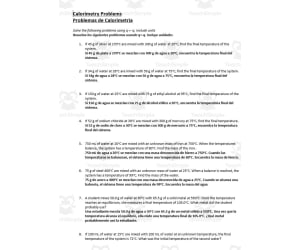
Calorimetry Practice ESL: Spanish version
Science, Chemistry, Grade 8, 9, 10, 11, 12, Activities
Calorimetry Practice ESL: Spanish Version is a chemistry teaching resource that provides Spanish translation to help English language learners. This science activity includes 10 practice problems covering calorimetry calculations using the formula q=mcΔT. Students will solve for temperature change, mass, specific heat, and more variables. The questions can be edited to fit lesson plans . Answer keys with step-by-step solutions are provided to check student work. A former AP Spanish student translated each question into Spanish to increase comprehension for native speakers. Please contact the creator with any translation issues. Use this standalone resource for individual practice or small groups. Assign select problems for homework. Review as a whole class using projected questions. Modify questions to align with current instruction. Calorimetry Practice ESL: Spanish Version provides chemistry practice for English and Spanish speakers in grades 8-12.
Author Schrim's Chem
Tags Calorimetry Practice, ESL, Chemistry Spanish, Calorimetry Calculations

Lakes Fact File Activity
Social Studies, Geography, Grade 3, 4, 5, 6, 7, 8, 9, 10, Activities
Activity Introduction An amazing activity designed for the students to learn more about famous places in different countries. Lakes Fact File What do you know about these places? Do you know in which part of the world they are? Have you ever visited this place? If yes, can you tell us more about your adventure, and what do you like the most about this place? Do you like reading about Geography? What is your favorite country in the whole world? If you are going on a trip where it will be? Which country? What you are going to see there? Does this country has a famous place to visit? Lakes Fact File Activity The activity is perfect for encouraging the researching skills for the students, while learning more about this fantastic place. Lakes Fact File This friendly designed worksheet is suitable for students at school, homeschooling, and as a group activity. Instructions What is a lake? What is the largest lake in the world? And where is it located? Format Available in a PDF format.
Author Educational Voice
Tags Lakes Fact File Activity, Lakes Fact File, Lakes Facts, Lakes Facts For Kids, Lakes, Lake, Geography, Geography Facts, Geography Facts For Kids, Earth

Immune System Activity
Science, Life Sciences, Human Body, Grade 3, 4, 5, 6, 7, 8, 9, 10, Activities
Activity Overview The human body is full of fascinating wonders to learn. This activity is created to help the students recognize the anatomy and the job of the human body. Immune System Every part and organ in our human body is vital so let's see how important they are. Have you ever imagined how we look like if we didn't have a skeleton? Did you know that because we have our amazing muscles we can stand! Do you know how many teeth do we have? Have you ever wondered about the food journey inside our body? Can you name all the glands in our body? Why do we have skin? Our nervous system is really good at sending signals. Can you tell us more about it? Are you really good at Mathematics, painting, or any other thing? You should really thank your brain about it! The famous five senses are really doing a great work? Can you explain how every sense works? Immune System Activity The activity is perfect for encouraging the researching skills for the students, while learning more about our fantastic human body. Immune System This friendly designed worksheet is suitable for students at school, homeschooling, and as a group activity. Instruction Draw yourself. Cut along the dotted lines. Glue page 1 on top of page 2. Open gently to see the organs inside. Which organs belong to the immune system? Write them down. Format Available in a PDF format.
Author Educational Voice
Tags Immune System Activity, Immune System, Immune System Facts, Immune System Facts For Kids, Human Body, Human Body Facts, Human Body Facts For Kids, Human Body Activity

Activity on Oliver Comwell
Social Studies, History, History: Europe, Grade 9, 10, 11, 12, Activities
Activity on Oliver Cromwell This interactive teaching resource is designed for students in grades 9-12, particularly those studying Social Studies with a focus on European History. It provides an comprehensive perspective into the life and controversial leadership of Oliver Cromwell during the time of the English Civil War. The primary aims are to: Inspire critical thinking amongst students Promote cooperative group work Encourage individual tasks related to historical analysis Group Sessions and Individual Tasks In groups, students explore both positive and negative aspects of Cromwell's leadership. Following this collective exercise, they will then engage independently with the wider historical context about Cromwell, encouraging them to move beyond simplistic characterizations. Critical Analysis The primary goal here is not simply depicting him as a 'hero' or 'villain'. Instead, it motivates students to critically examine historical facts, leading them towards articulating informed opinions concerning his influence in English history. Focused Writing Exercise To promote further comprehension, students will then decide—based upon their evaluated evidence—if they perceive him favorably or otherwise. Each student is required to write out their concise viewpoints by crafting a well-rounded defense for their conclusive choice. Note: This Activity on Oliver Cromwell comes as easy-to-adapt Word Document format—allowing customization based on distinctive classroom needs. This product abandons conventional black-and-white narrative understandings while embracing complexity—it encourages debate and promotes crucial analytical thinking skills valuable for young minds venturing into historical academia.
Author Jason Stein
Tags Oliver Cromwell, European History, Analytical Thinking, Debate Facilitation, Critical Examination
The Scientific Method Science BINGO Activity
Science, Earth and Environmental Sciences, Earth Sciences, Grade 6, 7, 8, 9, 10, 11, Activities
Your students will love this engaging science review activity. Everyone loves BINGO and it makes for a great review activity that is fun and competitive. This interactive game reinforces key scientific concepts and theories, ensuring curriculum relevance and accuracy. The game package includes 36 unique 4x4 bingo cards featuring essential terms and concepts from The Scientific Method, a set of call-out cards with clear and concise definitions tailored to the students' level, and detailed gameplay instructions. Here is a sample from the instructions. BINGO – Instructions, Terms, and Descriptions Cut out and distribute the BINGO cards to your students. Each student will get a unique card. Students can use markers or chips to cover squares that have been called. Print out and cut out each term/description below – these are the call-out cards. Fold each call-out card and place in a hat or box and remove one at a time. After you’ve read the call-out card description, your students are to place a marker on the term associated with the description located on their card. The first student to get 4 in a row horizontally or vertically, wins. Ensure accuracy by checking marked terms on student card to the called-out descriptions.
Author Teach With Fergy
Tags Science Bingo, Bingo Activity, Scientific Method, Scientific Method Activity
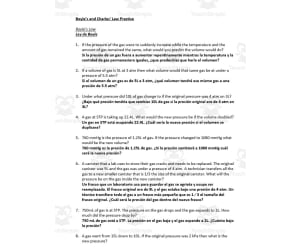
Boyles and Charles Law Practice Problems ESL: Spanish version
Science, Chemistry, Grade 8, 9, 10, 11, 12, Activities
Boyles and Charles Law Practice Problems ESL: Spanish Version This chemistry resource provides 20 practice problems for calculating using the important gas laws of Boyles and Charles. It includes 10 problems focused on Boyles Law (P1V1 = P2V2) and 10 problems applying Charles Law (V1/T1 = V2/T2). The complete worked solutions are provided after the set of practice problems so students can check their understanding. To support English Language Learners, a Spanish translation is included under each question. The translations were done by a native bilingual student to ensure accuracy. This resource can help Spanish-speaking students better comprehend the questions. This supplemental practice set is well suited for individual practice, warm-ups or homework. Using these real-world calculation problems will help students master the concepts of gas laws and applications of Boyles and Charles Laws. Editable in Word to meet diverse classroom needs. Suitable for grades 8-12 chemistry or physical science.
Author Schrim's Chem
Tags Boyles And Charles, Boyles And Charles Law, Practice Problems, ESL, Chemistry Spanish, Boyle's Law Practice Problems
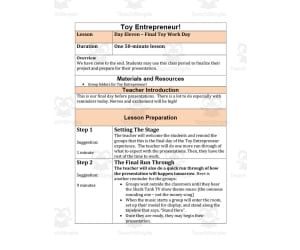
Toy Entrepreneur | A Simulation
Social Studies, Economics, Grade 7, 8, 9, 10, Activities
Title: Toy Entrepreneur | A Dynamic Simulation Experience the captivating simulation of entrepreneurship with the interactive teaching resource known as 'Toy Entrepreneur'. This comprehensive program stands tall amongst other resources, providing robust content that is sure to enlighten grade 7 to 10 students on the complexities of business development and economics. Introduction Initially showcased at NCSS Boston in 2014, Toy Entrepreneur encapsulates a complete unit on entrepreneurship. It incorporates versatile aspects that offer educators full leniency to tailor it according to their teaching methodologies. Whether opting for an integrated approach or cherry-picking key lessons, this facilitative tool provides unmitigated adaptability. Main Features & Learning Aspects: Critical Thinking and Problem Solving: Students actively engage in creating a novel toy concept which they would subsequently pitch to a board of Sharks, inspired by the renowned TV show 'Shark Tank'. This process not only stimulates ingenuity but also drives home the importance of persuasion, fostering an effective communication skill set within students both orally and in writing. Data Analysis & Market Research: Students delve into marketing via creating relevant market surveys distributed among elementary school children. Gathering these primary research data aids them refine their invention additionally leading towards valuable lessons about data analysis. Naming & Branding: As future entrepreneurs should embody all facets necessary for start-up development, students also get involved in brainstorming unique names and logos for their hypothetical businesses exploring yet another crucial aspect - branding. Promotion & Advertising:The exploration continues as participants learn about advertising by creating promotional commercials augmenting presentation skills while concurrently understanding how impactful advertising can be for a business 's success. Inclusion of an 'Entrepreneur Workbook' Complementing this activity-based learning is an ‘Entrepreneur Workbook’ where four distinct lessons expound on entrepreneurs' significance opening up broader perspectives towards transformative economic roles. To Summarize Toy Entrepreneur stands out as an inclusive educational package nurturing essential life-skills like collaboration, initiative taking abilities alongside sparking curiosity and imagination. It offers real-world scenarios cultivating an entrepreneurial spirit, making it a worth-adding tool for any teacher's arsenal. Be it for large groups, small groups, regular classes or homework assignments, Toy Entrepreneur aptly caters all needs making learning economics truly enthralling!
Author BCM Creations
Tags Entrepreneurship, Business Development, Economics Education, Problem-solving Skills, Marketing

Sheep Heart Dissection Lab ~ Anatomy and Physiology
Science, Life Sciences, Human Body, Grade 9, 10, 11, 12, Activities
This lab will cover 15 anatomical structures in the heart as well as 20 other discussion questions. This lab is very flexible as it will work for any level student from English Learner - EL - to more advanced students.
Author The Teacher Team
Tags Science Lab, Anatomy, Physiology, Biology, ELL, Labeled Sheep Heart Dissection, Heart Dissection Lab, Sheep Heart Dissection Guide, Sheep Heart Dissection Lab, Sheep Brain Dissection Guide Answer Key, Sheep Dissection Lab