



2,743 products added recently
Page 9 - Reading Activities
Discover a variety of reading activities designed to inspire and engage your students. From guided reading sessions to interactive reading journals, these resources support the development of comprehension and critical thinking skills. Tailored for different grade levels, these activities can help you create a dynamic literacy environment that fosters a lifelong love of reading.

 Show filters

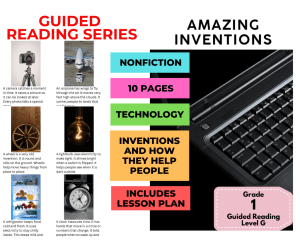
Guided Reading Level G - Amazing Inventions (with Lesson Plan)
ELA, Resources for Teachers, Reading Comprehension, Reading, Science, Engineering, Technology, Language Development, Pre-Reading, Vocabulary, Grade 1, 2, 3, Worksheets & Printables, Worksheets, Teacher Tools, Centers, Activities, Literacy Readers, Quizzes, Quizzes and Tests, Assessments, Lesson Plans
This Guided Reading Book - Amazing Inventions (Level G) with lesson plan includes: Guided Reading Color Label (front cover x1) This is a quick way to match the book’s demands to what students can generally handle.. The overall goal is to use the level/color to pick books for several smaller groups. To qualify for a certain level, a student is expected to read a book from that level with about 90–94% accuracy. If a student is consistently accurate and understands, move up a level. If the student is struggling at that level, drop down and add more support. Each student will improve at completely different rates, but it is generally one of the best ways to check progress across the class. DOWNLOAD THE CATALOG TO VIEW ALL GUIDED READING BOOKS AVAILABLE (SORTED LEVELS A-Z) Pre-Reading Question (x1) Teacher asks the prompt aloud, can be while showing the cover or first page. Students share what they already know, or make educated guesses from the cover. Prompt them to use the target vocabulary. Write some of their responses on the board to look back at during the reading. Vocabulary Words (x5) Introduce the five words, best doing it one at a time. Start by saying it, while students repeat and then see if anyone knows what it means before reading further. Read through the meaning and try to briefly connect each word to a picture or gesture so it’s meaningful. Ask students to flip through the book pages and point to where they see each of the vocabulary words. While reading the book pause upon coming across one of the vocab words or read the sentence twice to make sure students understand the word has appeared. Optional: Ask students to raise hands whenever they see/hear one of the new words. Guided Reading Pages (x10) Check the book snapshot (below) for: primary topic - do you need to prep extra reading or intro materials on this? what is taught best - decide on 1-2 bullets to focus on, use the prompt or words provided here for best results. learning goals - what you are checking for students to be able to do after the session, elicit answers using prompts or words provided. key vocabulary (see section above). questions overview - so you know what is coming up and if you need to prep extra materials to assist understanding. Run the lesson You may have already looked at a few of the pages together, but you can show them some of the pictures again first to set meaning. Depending on how much time you have and how familiar your students are with guided reading class, you may want to read the book aloud first with the group first. Students whisper or partner read, while you listen in. If time, do it as a group, one student reading a page each. Use the guided page’s prompts to coach: “Check the picture / does it make sense?” “Point under the words / try the first sound” “Reread the sentence smoothly”. Try to focus more on one student per session (rotating every time), so you can work out if they are ready to move up or need to move down a level. Comprehension Questions (back cover x3) This is your way to check that students didn’t just say the words, but actually understood the text. First, let students answer by pointing to the page/picture and saying a short sentence. After any answer, follow with: “Show me where you found that in the text.” In bigger groups, have partners answer first (10–20 seconds), then call on 2–3 students to share. Differentiation tips: Emerging speakers/struggling readers: oral + pointing On-level: oral in a full sentence Higher: one written sentence or draw + label Book Snapshot Title: Amazing Inventions Genre: Nonfiction (informational text) Subject: Science/Technology + Reading (Informational Text) Primary Topic: Inventions and how they help people Estimated Guided Reading Level (A–Z): G What This Book Teaches Best Introduces common inventions (wheel, lightbulb, telephone, computer, camera, airplane, refrigerator, clock, robot) and what each one does. Explains how inventions help people in everyday life (moving heavy things, seeing in the dark, connecting over distances, doing work quickly, keeping food cold, telling time, doing chores). Builds understanding of technology as something that changes, with “new things… invented every day to help people.” Supports describing key details from short informational passages paired with clear photos. Learning Goals Identify several inventions named in the book and tell what each helps people do. Describe how a wheel helps move heavy things from place to place. Explain how a lightbulb helps people see when it is dark outside. Tell how a telephone connects people who are far apart. Describe one way computers help people work quickly and what they can do. Explain what the book says about technology changing and new inventions helping people. Key Vocabulary From the Text invention — something made for the first time to help people. electricity — power that runs lights and machines. distances — how far apart places are. refrigerator — a machine that keeps food cold. sensors — parts that help a machine notice what is around it. Discussion Prompts Pre-reading question: What inventions do you use, and how do they help you? Comprehension questions: How do wheels help move heavy things from place to place? Comprehension questions: What does a lightbulb help people do when it is dark outside? Comprehension questions: What does the book say about new technology and how it helps people? Printing Tips 1. Best Printing Method (Recommended) “Booklet” Printing (Best if Available) If your printer or PDF viewer supports Booklet Printing , use this. Settings to use: Print mode: Booklet Paper size: Letter or A4 (either works) Orientation: Landscape Print on both sides: Yes Flip on: Short edge Scaling: Fit to printable area Booklet subset: First test: Front sides only Then: Back sides only This will automatically: Pair pages correctly Put the cover on the outside Align everything for folding After printing, fold in half and staple along the spine . 2. If “Booklet” Printing Is NOT Available You can still print this correctly with manual duplex printing . Step-by-step: Open the PDF. Choose Print . Set: Orientation: Landscape Pages per sheet: 1 Print on both sides: Yes Flip on: Short edge Print all pages . Because each PDF page already contains two facing book pages, the result will still fold cleanly into a book. Thousands of Cored Education products are included with your TeachSimple membership. Download links and encyclopedia index available here.
Author Cored Education
Rating
Tags Reading Comprehension, Reading Passages, Reading, Guided Reading, Guided Reading Lesson Plan, Guided Reading Activity, Pre-reading, Science Lesson Plans, Technology, Engineering
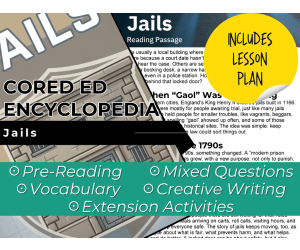
Jails Reading Comprehension Passage - Cored Ed Encyclopedia
ELA, Reading Comprehension, Reading, Pre-Reading, Language Development, Vocabulary, History, Social Studies, Law, Spelling, Grade 2, 3, 4, 5, Worksheets & Printables, Worksheets, Teacher Tools, Centers, Activities, Writing Prompts, Assessments, Quizzes and Tests, Quizzes, Lesson Plans
This Jails reading comprehension with lesson plan includes: Visualization (on the front cover) Start your lesson by taking a minute to think and share something about the topic. Read the script aloud (slowly), perhaps prepare some music or sound effects. Student close their eyes and let their imaginations wander. Students open their eyes, read the question aloud and give them a few minutes to complete. Ask a few students to share or keep answers until the end to compare with what they learn in the passage. Quick pause—thousands of Cored Education products are included with your TeachSimple membership. Download links and encyclopedia index available here. Pre-Reading Trivia Students will write down one thing they already know about the subject and then read five more facts and discuss. These facts are fun, and the students will enjoy learning about the subject before reading more. Give 1 minute for students to write what they already know (no pressure—best guess is fine). Read the five facts together. After each fact, do ask a student for their opinion, was it surprising? Set a purpose by asking students to highlight/underline one fact they want to learn more about during the reading. Reading Passage The text is a high-interest reading passage with set paragraphs, roughly three to four paragraphs long. It contains a variety of themes about the topic, anywhere from history to technology. The passage is between 250 and 350 words in length. First, ask students to look at the headings and see what they’ll learn about today. What do they know about the topic/heading? First read options: Teacher read-aloud (best for support). Partner reading (paragraph by paragraph). While reading, students underline important details, and vocabulary words they think may come up in the questions section. Mixed Questions The first question page contains four multiple-choice questions, each with a choice of four answers, and three written response questions that require a sentence or two from the student. Students complete the mcqs first independently, then review quickly as a class. For the 3 written responses, try to get students giving the answer with some form of evidence: “I think ___ because the text says ___.” If students get stuck, send them back to check the passage. Vocabulary Questions Practice seven key words from the text in this section across two activities. First section is scrambled words where students will unscramble three words given a clue for each. The second section is a word to meaning matching activity. Before starting, have some students read out words they underlined in the passage. Ask students to say the word and read aloud the sentence(s) around each word. Ask students to do scrambled words and the matching exercise in pairs then go through answers as a class. For the scrambled spelling task, get four pairs to come up to the board and write the words for extra practice with the other student reading out the clue. For the matching task, prompt students to give full sentences: “I matched ___ with ___ because ___.” Creative Writing In this question, the student will be required to write a five to eight sentence paragraph on a question related to the topic. Before starting, ask students write down 3 key ideas they are going to include in their piece. Ask students for ideas to share around the class to help those struggling. Pro writing expectations: 5–8 sentences At least 2 facts or details from the passage At least 2 vocabulary words from the previous page Students read their paragraphs while classmates listen for facts and vocabulary words. Extension Activities This page is optional for fast finishers or to take home. There are several activities, each one requiring a different skill. Do some, do none, do all, completely optional - but you will feel reassured knowing every possibility is planned for. Includes summary writting question and additional facts. Answer Key There are answers for the multiple-choice questions, written response questions have sample answers, vocabulary answers and if there is a summary question then a sample summary will be provided as well. Lesson Plan Included Customized lesson plan for this lesson is included. Lesson Snapshot Title: Jails Genre: Nonfiction (informational text) Subject: Social Studies (Civics) / Reading (Informational Text) Primary Topic: What jails are and how they differ from prisons Estimated Guided Reading Level (A–Z): S What This Lesson Teaches Best Explains what a jail is and why people may be there for a short time (waiting for a court date or serving short sentences). Uses history to show how jails were used long ago (England, 1166) and why the spelling “gaol” appeared. Clarifies the difference between “jail” and “prison” in formal American and Canadian English (pretrial custody/shorter sentences vs. longer sentences). Connects jails to community routines and civic values (rules, safety checks, fairness, harm prevention, justice). Builds understanding of how word choice and definitions matter when discussing systems and government roles (counties vs. state/federal). Learning Goals Describe what a jail is and give two reasons people may be held there. Explain how early jails in England were used and what “gaol” means in the passage. Explain what changed in the 1790s in the United States, according to the text. Compare a jail and a prison using details from the passage. Identify examples of routines and rules in jails and explain why they matter. Key Vocabulary From the Text booking — recording a new person in jail. cells — small rooms where people are held. trial — a court process to decide a case. convicted — found guilty of a crime. reform — help someone change for the better. FULL CATALOG OF DOWNLOAD LINKS AND ENCYCLOPEDIA INDEX HERE
Author Cored Education
Rating
Tags Vocabulary, Reading Comprehension, Reading Passages, Lesson Plans, Ela Lesson Plans, Reading Comprehension Lesson Plans, Pre-reading, Social Studies Lesson Plans, History, Jails

Guided Reading Lesson Plan & Activities for Grade 5
Reading, ELA, Grade 5, Activities, Lesson Plans, Teacher Tools
Teaching guided reading in 5th grade is one of the most rewarding aspects of teaching this grade. The standards and text levels are more rigorous than in primary grades, and the students are much more independent. The books they read are more engaging, making the teaching experience enjoyable. When actively in the classroom, use a flexible approach that promotes student choice and variety, paired with explicit instruction and engaging reading practice. Try to teach reading in a way that promotes discussion and enjoyment of reading. Focus on three key areas: 1. Learning to Read: Developing or growing skills to decode and comprehend grade-level texts. 2. Reading to Learn: Acquiring the skills needed to extract details and information from a text or story and synthesizing it. 3. Reading to Analyze: Building on reading to learn by focusing on specific skills and then being able to write about them. This ebook contains a detailed 90-minute lesson plan and activities for your Grade 5 students. Suggested answers are provided as well.
Author Bright Classroom Ideas Marketplace
Tags Guided, Reading, Lesson, Plan, Activities, Language, Grade 5
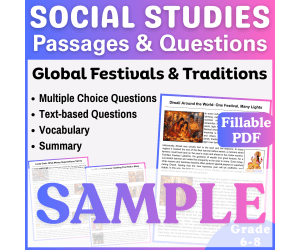
Diwali: SAMPLE Social Studies Reading Passage (Fillable PDF)
ELA, Reading, Reading Comprehension, Strategies, Resources for Teachers, Social Studies, Psychology, Sociology, Grade 6, 7, 8, 9, Writing Prompts, Worksheets & Printables, Centers, Activities, Teacher Tools, Assessments, Quizzes and Tests, Quizzes, Tests
This is a ONE PASSAGE SAMPLE. The following is the description of the FULL resource and the downloading links: Social Studies Reading Comprehension Passages: Global Festivals and Traditions (Fillable PDF) This resource introduces a collection of Social Studies reading comprehension passages about Global Festivals and Traditions. The passages are carefully designed to bridge the gap between social studies and literacy through strengthening reading comprehension and sparking knowledge curiosity in middle school students. Each passage blends English Language Arts skills with accurate social studies content. Ideal for interdisciplinary learning in ELA and Social Studies. Suitable for Grade 9 review, too! These worksheets are designed as fillable PDFs , which means students can type their answers directly into the document on any computer or tablet . Each page includes highlighted text fields that show them exactly where to type! What Is Included in this Collection? There are three informational passages (with full answer keys): Diwali Around the World: One Festival, Many Lights Traditional Costumes: Clothing That Tells a Story Lucky Cash: What Money Superstitions Tell Us For Each Passage, students will have multiple tasks to complete as follow: 5 multiple-choice questions targeting main idea, key details, inference, vocabulary in context, and use of evidence 5 vocabulary matching items with clear, student-friendly definitions 5 text-based questions that require citing specific lines or facts 1 summary prompt that asks students to condense central ideas accurately Available Formats for this Resource PDF Word Docs Google Docs FULL CATALOG OF DOWNLOADING LINKS HERE For more Social Studies Reading Passages, check the following Links: Ancient Civilizations PDF Fillable PDF Word Docs Google Docs Early Empires and Trade Networks PDF Fillable PDF Word Docs Google Docs The Founding of the United States PDF Fillable PDF Word Docs Google Docs Language, Culture, and Meaning PDF Fillable PDF Word Docs Google Docs Psychology and Society PDF Fillable PDF Word Docs Google Docs Global Festivals and Traditions PDF Fillable PDF Word Docs Google Docs Extreme Environments and People PDF Fillable PDF Word Docs Google Docs Food, Culture, and Preservation PDF Fillable PDF Word Docs Google Docs Global Food Customs PDF Fillable PDF Word Docs Google Docs Media, Communication, and Popular Culture PDF Fillable PDF Word Docs Google Docs Human Impact on the Environment PDF Fillable PDF Word Docs Google Docs Civic Action and Social Change PDF Fillable PDF Word Docs Google Docs Fashion, Society, and Power PDF Fillable PDF Word Docs Google Docs People, Places, and Unusual Histories PDF Fillable PDF Word Docs Google Docs How to Use These PDFs Click on the highlighted area to start typing your answer. Move to the next question by clicking in the next highlighted box. When you are finished, close the document and select SAVE so your answers stay recorded. If you want to keep a blank copy for later, choose Save As and give your completed version a new name. Product Details Length: 14 pages total Grades: 6–8, also suitable for Grade 9 review Use cases: close reading, stations, homework, intervention, test prep, and sub plans Why Teachers Choose This Set Authentic social studies content paired with rigorous literacy practice Consistent task structure across all passages for easier planning and smoother student routines Clear, age-appropriate writing that builds confidence without oversimplifying Use this set to reinforce ELA skills in social studies, to add literacy to your lessons, and to support independent work. The passages strengthen main idea, evidence use, vocabulary in context, inference, cause and effect, and summary writing. With ready-to-use assessments and complete answer keys, you can provide focused practice that is simple to run and fast to review.
Author CORED Education - Middle & High School
Rating
Tags Middle School, Reading Comprehension, Reading Strategies, ELA, Centers, Reading Passage, Assessments, Vocabulary, Social Studies, Global Festivals And Traditions
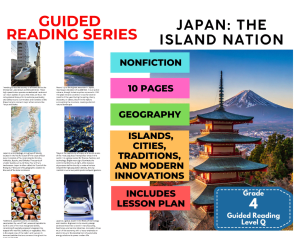
Japan The Island Nation: Guided Reading Level Q with Lesson Plan
ELA, Resources for Teachers, Reading Comprehension, Reading, Science, Geography, Social Studies, History, Earth and Environmental Sciences, Technology, Grade 3, 4, 5, Worksheets & Printables, Worksheets, Teacher Tools, Centers, Activities, Literacy Readers, Quizzes, Quizzes and Tests, Assessments, Lesson Plans
This Japan: The Island Nation (level q) guided reading book with lesson plan includes: Guided Reading Color Label (front cover x1) This is a quick way to match the book’s demands to what students can generally handle.. The overall goal is to use the level/color to pick books for several smaller groups. To qualify for a certain level, a student is expected to read a book from that level with about 90–94% accuracy. If a student is consistently accurate and understands, move up a level. If the student is struggling at that level, drop down and add more support. Each student will improve at completely different rates, but it is generally one of the best ways to check progress across the class. DOWNLOAD THE CATALOG TO VIEW ALL GUIDED READING BOOKS AVAILABLE (SORTED LEVELS A-Z) Pre-Reading Question (x1) Teacher asks the prompt aloud, can be while showing the cover or first page. Students share what they already know, or make educated guesses from the cover. Prompt them to use the target vocabulary. Write some of their responses on the board to look back at during the reading. Vocabulary Words (x5) Introduce the five words, best doing it one at a time. Start by saying it, while students repeat and then see if anyone knows what it means before reading further. Read through the meaning and try to briefly connect each word to a picture or gesture so it’s meaningful. Ask students to flip through the book pages and point to where they see each of the vocabulary words. While reading the book pause upon coming across one of the vocab words or read the sentence twice to make sure students understand the word has appeared. Optional: Ask students to raise hands whenever they see/hear one of the new words. Guided Reading Pages (x10) Check the book snapshot (below) for: primary topic - do you need to prep extra reading or intro materials on this? what is taught best - decide on 1-2 bullets to focus on, use the prompt or words provided here for best results. learning goals - what you are checking for students to be able to do after the session, elicit answers using prompts or words provided. key vocabulary (see section above). questions overview - so you know what is coming up and if you need to prep extra materials to assist understanding. Run the lesson You may have already looked at a few of the pages together, but you can show them some of the pictures again first to set meaning. Depending on how much time you have and how familiar your students are with guided reading class, you may want to read the book aloud first with the group first. Students whisper or partner read, while you listen in. If time, do it as a group, one student reading a page each. Use the guided page’s prompts to coach: “Check the picture / does it make sense?” “Point under the words / try the first sound” “Reread the sentence smoothly”. Try to focus more on one student per session (rotating every time), so you can work out if they are ready to move up or need to move down a level. Comprehension Questions (back cover x3) This is your way to check that students didn’t just say the words, but actually understood the text. First, let students answer by pointing to the page/picture and saying a short sentence. After any answer, follow with: “Show me where you found that in the text.” In bigger groups, have partners answer first (10–20 seconds), then call on 2–3 students to share. Differentiation tips: Emerging speakers/struggling readers: oral + pointing On-level: oral in a full sentence Higher: one written sentence or draw + label Book Snapshot Title: Japan: The Island Nation Genre: Nonfiction Subject: Social Studies (Geography/Culture) Primary Topic: Japan’s islands, cities, traditions, and modern innovations Estimated Guided Reading Level (A–Z): Q What This Book Teaches Best Explains Japan’s geography as an archipelago , naming the four main islands and describing its location off East Asia. Highlights Tokyo as a major metropolitan area , describing its role and features of city life. Describes transportation and technology through the Shinkansen (bullet train), including its speed, safety, and punctuality. Connects landforms and natural features to Japan’s identity by describing Mount Fuji, snow cover, and spring sakura blossoms. Builds understanding of culture and history through Shinto and Buddhism, matsuri festivals, and the Edo period (shoguns, samurai, and castles like Himeji). Learning Goals Students will explain what an archipelago is and name Japan’s four main islands. Students will describe Tokyo’s importance and identify details the text gives about the city. Students will explain how the Shinkansen helps people travel and identify key features the text highlights (such as speed or punctuality). Students will describe Mount Fuji using details from the text, including its height and volcanic history. Students will identify key ideas about Japanese traditions from the text (religions, shrines/torii, cuisine, or festivals). Students will explain how Japan’s climate varies and describe the text’s example of the “snow monkey” in winter. Key Vocabulary From the Text archipelago — a group of islands. metropolitan — related to a very large city area. punctuality — being on time. terraced — built in step-like levels on a hillside. geothermal — heat that comes from inside the Earth. Discussion Prompts Pre-reading question: What places, traditions, or inventions do you expect to learn about in Japan? Comprehension questions: What four main islands does the text name as part of Japan? Comprehension questions: What does the text say the Shinkansen is known for? Comprehension questions: How does the text say the “snow monkey” adapts to cold winters? Printing Tips 1. Best Printing Method (Recommended) “Booklet” Printing (Best if Available) If your printer or PDF viewer supports Booklet Printing , use this. Settings to use: Print mode: Booklet Paper size: Letter or A4 (either works) Orientation: Landscape Print on both sides: Yes Flip on: Short edge Scaling: Fit to printable area Booklet subset: First test: Front sides only Then: Back sides only This will automatically: Pair pages correctly Put the cover on the outside Align everything for folding After printing, fold in half and staple along the spine . 2. If “Booklet” Printing Is NOT Available You can still print this correctly with manual duplex printing . Step-by-step: Open the PDF. Choose Print . Set: Orientation: Landscape Pages per sheet: 1 Print on both sides: Yes Flip on: Short edge Print all pages . Because each PDF page already contains two facing book pages, the result will still fold cleanly into a book. Thousands of Cored Education products are included with your TeachSimple membership. Download links and encyclopedia index available here.
Author Cored Education
Rating
Tags Reading Comprehension, Reading Passages, Reading, Guided Reading, Guided Reading Lesson Plan, Guided Reading Activity, Pre-reading, Social Studies, Geography, History
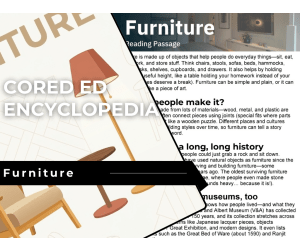
Furniture Reading Comprehension Passage - Cored Ed Encyclopedia
ELA, Language Development, Resources for Teachers, Reading Comprehension, Reading, Pre-Reading, Writing, Science, Technology, Strategies, Grade 2, 3, 4, 5, Worksheets & Printables, Worksheets, Teacher Tools, Centers, Activities, Writing Prompts, Assessments, Tests, Quizzes and Tests, Quizzes
This furniture reading comprehension contains the following: Pre-Reading Trivia Students will write down one thing they already know about the subject and then read five more facts and discuss. These facts are fun, and the students will enjoy learning about the subject before reading more. Reading Passage The text is a high-interest reading passage with set paragraphs, roughly three to four paragraphs long. It contains a variety of themes about the topic, anywhere from history to technology. The passage is between 250 and 350 words in length. Mixed Questions The first question page contains four multiple-choice questions, each with a choice of four answers, and three written response questions that require a sentence or two from the student. Creative Writing In this question, the student will be required to write a five to eight sentence paragraph on a question related to the topic. Extension Activities This page is optional for fast finishers. If there are five to ten minutes left at the end of the lesson, the student can choose one of three activities, each one requiring a different skill. Answer Key There are answers for the multiple-choice questions and three written response questions have sample answers. FULL CATALOG OF DOWNLOAD LINKS AND ENCYCLOPEDIA INDEX HERE Snapshot Genre: Nonfiction (informational text) Subject: Reading Primary Topic: What furniture is, how it’s made, and history Estimated Guided Reading Level (A–Z): Q What This Lesson Teaches Best Defines furniture by what it helps people do (sit, eat, sleep, work, store things) and gives examples of common items. Explains how furniture is made , including common materials and how makers connect parts using joints . Builds background knowledge about furniture across time , from using natural objects to evidence of built furniture long ago and stone furniture at Skara Brae. Shows how museums use objects as evidence of how people lived, including examples from the Victoria and Albert Museum (V&A) collection. Learning Goals Students will be able to explain what furniture is and list everyday tasks it helps people do. Students will be able to identify examples of furniture named in the passage and describe what each might be used for. Students will be able to describe how furniture can be made, including common materials and how joints connect pieces. Students will be able to describe key points in the history of furniture mentioned in the text (natural objects, carving/building, Skara Brae stone furniture). Students will be able to explain why museums collect furniture and name at least one example of an item mentioned from the V&A collection. Key Vocabulary From the Text joints — special fits that lock furniture parts together. archaeologists — people who study the past using evidence. cupboards — furniture for storing things behind doors. centuries — periods of one hundred years. lacquer — a shiny coating used on some objects. Cored Ed Encyclopedia Overview The Cored Ed Encyclopedia is a weekly series of lessons that you can pick up and use right away. These short readings fit into whatever time you have available. Each one includes a warm-up, a reading, and a set of questions, but it’s flexible — you can do just the reading, the full lesson, or skip the writing section if you need to. Each lesson focuses on a single topic so students don’t get lost. The writing is clear but never childish, making it perfect for grades two through five. Topics range from animals and science to history, inventions, and everyday things. No matter the level of the student, everyone should take away at least one new idea or fact from each lesson. The materials are easy to print, easy to explain, and require no setup. They work well for whole-class teaching, partner work, or independent study.
Author Cored Education
Rating
Tags Vocabulary, Spelling, Reading Comprehension, Reading Passages, Reading, Creative Writing, Reading Strategies, Writing Prompts, Technology, Furniture

Cats in Ancient Egypt: SAMPLE Social Studies Reading Passage (Word)
ELA, Reading, Reading Comprehension, Strategies, Resources for Teachers, Social Studies, History: Ancient, History, Grade 6, 7, 8, 9, Writing Prompts, Worksheets & Printables, Centers, Activities, Teacher Tools, Assessments, Quizzes and Tests, Quizzes, Tests
This is a ONE PASSAGE SAMPLE. The following is the description of the FULL resource and the downloading links: Ancient Civilizations: Social Studies Reading Passages (Word) This very engaging collection of Social Studies reading passages about Ancient Civilizations is designed to bridge the gap between social studies and literacy through strengthening reading comprehension and sparking knowledge curiosity in middle school students. Each passage blends English Language Arts skills with accurate social studies content. Ideal for interdisciplinary learning in ELA and Social Studies. Suitable for Grade 9 review, too! What Is Included? There are - (3) - informational passages: Sacred Whiskers: Cats in Ancient Egypt Mesopotamia: The First Urban World The Inca: Empire in the Clouds Student Tasks for Each Passage: 5 multiple-choice questions targeting main idea, key details, inference, vocabulary in context, and use of evidence 5 vocabulary matching items with clear, student-friendly definitions 5 text-based questions that require citing specific lines or facts 1 summary prompt that asks students to condense central ideas accurately Full answer key for every section Available Formats for this Resource PDF Fillable PDF Google Docs FULL CATALOG OF DOWNLOADING LINKS HERE Reading Passage Links: Ancient Civilizations PDF Fillable PDF Word Docs Google Docs Early Empires and Trade Networks PDF Fillable PDF Word Docs Google Docs The Founding of the United States PDF Fillable PDF Word Docs Google Docs Language, Culture, and Meaning PDF Fillable PDF Word Docs Google Docs Psychology and Society PDF Fillable PDF Word Docs Google Docs Global Festivals and Traditions PDF Fillable PDF Word Docs Google Docs Extreme Environments and People PDF Fillable PDF Word Docs Google Docs Food, Culture, and Preservation PDF Fillable PDF Word Docs Google Docs Global Food Customs PDF Fillable PDF Word Docs Google Docs Media, Communication, and Popular Culture PDF Fillable PDF Word Docs Google Docs Human Impact on the Environment PDF Fillable PDF Word Docs Google Docs Civic Action and Social Change PDF Fillable PDF Word Docs Google Docs Fashion, Society, and Power PDF Fillable PDF Word Docs Google Docs People, Places, and Unusual Histories PDF Fillable PDF Word Docs Google Docs Product Details Length: 15 pages total Grades: 6–8, also suitable for Grade 9 review Use cases: close reading, stations, homework, intervention, test prep, and sub plans Why Teachers Choose This Set Authentic social studies content paired with rigorous literacy practice Consistent task structure across all passages for easier planning and smoother student routines Clear, age-appropriate writing that builds confidence without oversimplifying Use this set to reinforce ELA skills in social studies, to add literacy to your lessons, and to support independent work. The passages strengthen main idea, evidence use, vocabulary in context, inference, cause and effect, and summary writing. With ready-to-use assessments and complete answer keys, you can provide focused practice that is simple to run and fast to review.
Author CORED Education - Middle & High School
Rating
Tags Middle School, Reading Comprehension, Reading Strategies, ELA, Centers, Reading Passage, Assessments, Vocabulary, Social Studies, Ancient Civilization

EN Words Matching Mats
ELA, Language Development, Phonics, Reading, Reading Comprehension, Preschool, Grade 1, Activities, Centers
Students can practice reading comprehension skills with these EN word family mats. Students can practice reading EN words in isolation and in the context of sentences. The words in this set follow a CVC or CCVC spelling pattern. Included in this resource: This resource includes one word mat and one sentence mat, both for reading EN words in insolation and in context. There are also picture cards that correspond with each word and sentence. To complete this activity, students will read each EN word or sentence on the mat and then match the corresponding pictures. Students can work independently or with a partner to complete this activity. How to Use these EN word Family Mats: The students can simply lay the images on top of the word or sentence. They can be placed in a file folder utilizing hook and loop fasteners to attach the images. A magnetic activity can be created by using a baking sheet and magnets to affix the images. Students will love the hands-on nature of this activity. The bold and colorful images will capture students' attention, and the easy to recognize pictures are sure to keep students engaged in learning. These literacy activities allow students to practice target words both in the context of sentences and in isolation. Where can these mats be used? Literacy Center - Students can work independently or with a partner to read these words Morning Tub or Basket - The cards can be placed in a morning bin for students to work on as students arrive to class. Small Group Activity - The teacher can choose a small group of students or a specific group of words for students to work on in a small group setting with the teacher. Hands On Assessment - The teacher can use these to test students on reading the target words in context or in isolation. Skills assessed through this activity: Reading EN words in context of a sentence and in isolation Reading comprehension The low-prep nature of this EN words matching mats activity makes it an easy to assign activity. The mats simply need to be printed out, while the matching cards need to be printed and cut. Lamination is optional for increased durability. Once created, this resource can be used repeatedly in literacy centers or small group activities, providing ongoing support for students' learning journey.
Author The Connett Connection
Tags Literacy Center, Phonics Activity, Kindergarten Literacy, Matching Mats, Simple Sentences, Reading Comprehension, CVC Words, EN Words, EN Word Family
Reading Comprehension Fiction Set 4 Sample: Funny Photos (Slides)
ELA, Reading, Language Development, Common Core, ESL, Reading Comprehension, Creative Writing, Writing, Resources for Teachers, Grade 4, 5, Teacher Tools, Presentations, Tests, Quizzes and Tests, Assessments, Activities
Reading Comprehension Passages Fiction Set 4 Sample Overview No prep reading comprehension lessons, with enjoyable stories and topics. Each lesson has a blend of post-reading activities. Mixed questions to check overall understanding. Vocabulary activities, plus a writing section. Lessons also contain a bonus extension exercise at the end. Some you may like, some you may not, either way they are there if you wish to use them. Full answer keys are provided. Passage Included 4.Funny Photos: Darlene and her class have a good idea for their funny photos. Slides Version This is the Slides editable and fillable version. This download is available in GOOGLE Docs, GOOGLE Forms, GOOGLE Slides. PDF, PPT, WORD. FULL CATALOG OF DOWNLOAD LINKS HERE Grade 4/5 Links Fiction Set 1 - Animals Google Docs Google Forms Google Slides PDF PPT Word Guided Reading Materials Fiction Set 2 - Family Google Docs Google Forms Google Slides PDF PPT Word Guided Reading Materials Fiction Set 3 - Friends Google Docs Google Forms Google Slides PDF PPT Word Guided Reading Materials Fiction Set 4 - School Google Docs Google Forms Google Slides PDF PPT Word Guided Reading Materials Fiction Set 5 - Sports Google Docs Google Forms Google Slides PDF PPT Word Guided Reading Materials Nonfiction Set 1 - Birds Google Docs Google Forms Google Slides PDF PPT Word Guided Reading Materials Nonfiction Set 2 - Insects Google Docs Google Forms Google Slides PDF PPT Word Guided Reading Materials Nonfiction Set 3 - Mammals Google Docs Google Forms Google Slides PDF PPT Word Guided Reading Materials Nonfiction Set 4 - Nature Google Docs Google Forms Google Slides PDF PPT Word Guided Reading Materials Nonfiction Set 5 - Sea Animals Google Docs Google Forms Google Slides PDF PPT Word Guided Reading Materials Reading Passages Overview Each passage is especially written for Grade 4-5 students, including key vocabulary required for this age group. Topics are varied and are accompanied by colorful graphics. Topics are meant to educate, yet entertain the modern student. These passages are perfect for the modern classroom. Whereas textbooks can become outdated in no time, any changes to technology or the world will result in updates to this product. Mixed Questions The mixed questions section of each lesson includes a variation of five comprehension, vocabulary and math questions. In addition, key reading strategies are frequently covered including cause & effect, summarizing, compare & contrast and making conclusions. Two or three of the questions will be MCQs and other questions will require a written response of some kind. Full answers and example responses appear at the end of the lesson. Spelling & Vocab Each reading passage contains a variety of words and phrases designed for Grade 4-5 students. Spelling and vocab activities provide the opportunity to build fluency with these words. As it can become quite mundane doing the same activities over and over, each lesson in a set will contain a different spelling and vocab activity . Activities include: spelling games, sentence match-ups, mixed-up text and decoding words from the lesson. Writing Prompts Writing prompts are designed to continue the theme or lessons learned in the story. Students are persuaded to write in a variety of ways and each prompt includes several cues to help. As with the spelling/vocab section, writing prompts will vary. This includes research pieces, reading responses, poetry and creative writing prompts. Full Answer Keys Full answer keys and sample responses are provided so no matter how busy you are, you know you're covered! Mixed question answers provide evidence from the text, math questions contain the relevant workings. Answers are designed for use by the teacher, but also suitable as a handout to the student. Just for Fun Each lesson will have a bonus extension exercise. This is something fun to extend the lesson with. You can find these at the end of each lesson, titled Just for Fun. Just for Funs are optional. Some you may like, some you may not. Either way, they are there to do with as you wish. For similar downloads and other frees, do check out Cored Group on TeachSimple.
Author Cored Education
Tags Elementary, Reading, Comprehension, Vocabulary, Answers, Ccss, Common Core, Spelling, Writing, Passages

World Book Day Reading Comprehension Passage and Questions
Reading, ELA, Elementary, Read Alouds, Activities
World Book Day is an annual celebration of books, reading, and authors, observed on April 23rd. Established by UNESCO in 1995, it promotes literacy and encourages a love for reading worldwide. Many schools, libraries, and bookstores host events, and children often receive free or discounted books. Are you looking for a fun and engaging way to celebrate World Book Day? This reading passage is a great resource for celebrating World Book Day while practicing reading skills. This educational resource features simple, kid-friendly pages designed to make learning both enjoyable and interactive. Great for homeschooling, classroom education, or extra practice. Number of pages: 10 pages (5 BW + 5 COLOR) Format PDF file size: 8.5*11 Inches If you and your students or your children enjoy using this educational and engaging resource. please rate it and follow my store to be the first to know about my new teaching resources and freebies. Enjoy!
Author Wonderland School
Tags World Book Day, Read Across America Day, Read Across America, World Book Day Reading, World Book Day Coloring Pages, Reading Passage, Reading, World Book Day Craft, Craft

Close Reading Comprehension Practice Papers (The Computer Game) 9-12 years
ELA, Reading, Grade 4, 5, 6, Games, Activities
Close Reading Comprehension Practice Papers (The Computer Game) for 9-12 years A vibrant series of practice sheets targeting comprehension testing for children aged 9 to 12, spans across 48 meticulously prepared pages. This high-quality teaching resource serves as a versatile tool to enhance children's reading comprehension skills. Usefulness in Educational Settings This educational resource is an exceptional asset to public school teachers and homeschool educators teaching Language Arts. The product primarily caters to students in Grades 4 through Grade 6. It is well suited for incorporation into full class activities, smaller study groups, individual reading sessions or as homework take-away tasks. Main Features of the Practice Papers Fosters Identification of Critical Details: This key emphasis helps children master extracting crucial details from the text. Inferencing Skills Development: The resources aid with this area by enabling students make predictions using evidence from the passages directly. Vocabulary Expansion: The Comprehension Practice Papers are an excellent means to expand your child's vocabulary base. Distinguishing Aspect of Close Reading Comprehension Practice Papers (The Computer Game) This program sets itself apart due its striking resemblance with actual examination texts - making it significantly useful when preparing students for formal assessments . Accompanied with these practice papers are suggested answers – which serve as key reference points when evaluating a student’s performance or in guiding them towards accurate responses. Purchase your copy today!. In Conclusion...P>Selecting Close Reading Comprehension Practice Papers yields worthwhile benefits among various educational tools due to their broad coverage of key reading comprehension components. Furthermore, it's adaptability across various teaching formats is commendable. And lastly, they come in manageable PDF files for easy accessibility anytime for educators .
Author Guinea Pig Education
Tags Close Reading, Comprehension Practice, Vocabulary Development, Inferencing Skills, Exam Preparation

Reading Comprehension Passages Fiction Set 6 - Family (PDF)
ELA, Reading, Reading Comprehension, Common Core, Children’s Literature, Literature, Vocabulary, Language Development, Spelling, Writing, Grade 2, 3, Worksheets & Printables, Worksheets, Assessments, Teacher Tools, Tests, Quizzes and Tests, Writing Prompts, Centers, Activities
Reading Comprehension Passages Fiction Set 6 Overview Fascinating reading comprehension passages, each with an array of activities included. Stories are written for the modern classroom and topics are designed to promote enthusiasm from each student. Each lesson contains a mixed questions section to check understanding, a vocabulary or spelling activity to help remember key language introduced, and a writing exercise. Full answer keys are provided. For a more detailed overview, check the section under the links at the bottom of this description. Passages Include 1.Molly's Home Carnival: It looks like Molly will miss the carnival. Until... 2.Big Bro's Big Idea: Noah's big brother does his best to cheer him up. 3.Denny's Car Wash: Denny wants a new game, but does he get the money for it? 4.Tessa's Grandma: Emma misses her grandma, but Tessa has a great idea. 5.Tom's Canadian Mom: The most important person from Canada is...Tom's mom! 6.Big Brother Woes: Big Brother gets to do whatever he wants. It's just not fair! 7.Tell Us a Story, Grandpa: Grandpa's tales are true family treasures. 8.My Weekend: Read about the author's fun weekend in this interesting story. 9.All in the Picture: Learn how the author has changed in the last 22 years. 10.California 'Coaster: Find out how this author spends his summer vacation. Additional File: Big Bro's Big Idea: Cork Boat Instructions PDF Version This is the PDF uneditable version. This download is available in GOOGLE Docs, GOOGLE Forms, GOOGLE Slides. PDF, PPT, WORD. FULL CATALOG OF DOWNLOAD LINKS HERE Grade 2/3 Links Fiction Set 1 - Nature Google Docs Google Forms Google Slides PDF PPT Word Guided Reading Materials Fiction Set 2 - Animals Google Docs Google Forms Google Slides PDF PPT Word Guided Reading Materials Fiction Set 3 - Food Google Docs Google Forms Google Slides PDF PPT Word Guided Reading Materials Fiction Set 4 - School Google Docs Google Forms Google Slides PDF PPT Word Guided Reading Materials Fiction Set 5 - Friends Google Docs Google Forms Google Slides PDF PPT Word Guided Reading Materials Fiction Set 6 - Family Google Docs Google Forms Google Slides PDF PPT Word Guided Reading Materials Fiction Set 7 - Sports Google Docs Google Forms Google Slides PDF PPT Word Guided Reading Materials Nonfiction Set 1 - Technology Google Docs Google Forms Google Slides PDF PPT Word Guided Reading Materials Nonfiction Set 2 - Nutrition Google Docs Google Forms Google Slides PDF PPT Word Guided Reading Materials Nonfiction Set 3 - Animals Google Docs Google Forms Google Slides PDF PPT Word Guided Reading Materials Reading Passages Overview Each passage is especially written for Grade 2-3 students, including key vocabulary required for this age group. Topics are varied and are accompanied by colorful graphics. Topics are meant to educate, yet entertain the modern student. These passages are perfect for the modern classroom. Whereas textbooks can become outdated in no time, any changes to technology or the world will result in updates to this product. Mixed Questions The mixed questions section of each lesson includes a variation of fivecomprehension, vocabulary and math questions. In addition, key reading strategies are frequently covered including cause & effect, summarizing, compare & contrast and making conclusions. Three of the questions will be MCQs and two will require a written response of some kind. Full answers and example responses appear at the end of the lesson. Spelling & Vocab Each reading passage contains a variety of words and phrases designed for Grade 2-3 students. Spelling and vocab activities provide the opportunity to build fluency with these words. As it can become quite mundane doing the same activities over and over, each lesson in a set will contain a different spelling and vocab activity . Writing Prompts Writing prompts are designed to continue the theme or lessons learned in the story. Students are persuaded to write in a variety of ways and each prompt includes several cues to help. As with the spelling/vocab section, writing prompts will vary. This includes research pieces, reading responses, poetry and creative writing prompts. Full Answer Keys Full answer keys and sample responses are provided so no matter how busy you are, you know you're covered! Mixed question answers provide evidence from the text, math questions contain the relevant workings. Answers are designed for use by the teacher, but also suitable as a handout to the student. Additional File One lesson will have an additional file. This is something fun to extend the lesson with. For similar downloads and other frees, do check out Cored Group on TeachSimple.
Author Cored Education
Rating
Tags Elementary, Reading, Comprehension, Vocabulary, Answers, Spelling, Writing, Passages, Reading Centers, Reading Comprehension Assessment
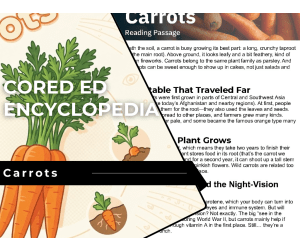
Carrots Reading Comprehension Passage - Cored Ed Encyclopedia
ELA, Language Development, Resources for Teachers, Reading Comprehension, Reading, Pre-Reading, Writing, Life Sciences, Science, Nature & Plants, Grade 2, 3, 4, 5, Worksheets & Printables, Worksheets, Teacher Tools, Centers, Activities, Writing Prompts, Assessments, Tests, Quizzes and Tests, Quizzes
This carrots reading comprehension contains the following: Pre-Reading Trivia Students will write down one thing they already know about the subject and then read five more facts and discuss. These facts are fun, and the students will enjoy learning about the subject before reading more. COMPANION VIDEO NOW AVAILABLE (EMBEDDED AFTER PREVIEW PICTURES IN PRODUCT DESCRIPTION) Reading Passage The text is a high-interest reading passage with set paragraphs, roughly three to four paragraphs long. It contains a variety of themes about the topic, anywhere from history to technology. The passage is between 250 and 350 words in length. Mixed Questions The first question page contains four multiple-choice questions, each with a choice of four answers, and three written response questions that require a sentence or two from the student. Creative Writing In this question, the student will be required to write a five to eight sentence paragraph on a question related to the topic. Extension Activities This page is optional for fast finishers. If there are five to ten minutes left at the end of the lesson, the student can choose one of three activities, each one requiring a different skill. Answer Key There are answers for the multiple-choice questions and three written response questions have sample answers. FULL CATALOG OF DOWNLOAD LINKS AND ENCYCLOPEDIA INDEX HERE Cored Ed Encyclopedia Overview The Cored Ed Encyclopedia is a weekly series of lessons that you can pick up and use right away. These short readings fit into whatever time you have available. Each one includes a warm-up, a reading, and a set of questions, but it’s flexible — you can do just the reading, the full lesson, or skip the writing section if you need to. Each lesson focuses on a single topic so students don’t get lost. The writing is clear but never childish, making it perfect for grades two through five. Topics range from animals and science to history, inventions, and everyday things. No matter the level of the student, everyone should take away at least one new idea or fact from each lesson. The materials are easy to print, easy to explain, and require no setup. They work well for whole-class teaching, partner work, or independent study.
Author Cored Education
Rating
Tags Vocabulary, Spelling, Reading Comprehension, Reading Passages, Cored Encyclopedia, Facts, Reading, Creative Writing, Carrots, Life Science

Reading Comprehension Passages Fiction Set 2 - Family Presentable PDF
ELA, Reading, Reading Comprehension, Common Core, Writing, Children’s Literature, Literature, Language Development, Spelling, Vocabulary, Grade 4, 5, Worksheets & Printables, Worksheets, Writing Prompts, Assessments, Teacher Tools, Quizzes and Tests, Tests, Centers, Activities
Reading Comprehension Passages Fiction Set 2 Snapshot Title: Title not stated Genre: Fiction anthology (family-themed short stories, plus a few informational-style passages) Subject: Reading (ELA) Primary Topic: Family relationships, traditions, and everyday challenges Estimated Guided Reading Level (A–Z): Q What This Teaches Best Family relationships and empathy (siblings, cousins, parents, grandparents, and an aunt: disappointment, jealousy, pride, teasing, and appreciation are shown through dialogue and actions). Accepting differences and changing your mind (a character worries about being embarrassed by a cousin, then learns others see her as “awesome”). Problem/solution thinking in realistic situations (money limits, fear of bugs, conflicts with an older kid, and handling busy family plans). Reading for information inside a narrative (dates and customs for Mother’s Day, Father’s Day, and Children’s Day; health terms and “healthy lifestyle” rules explained in dialogue). Skill practice with support pages (mixed questions, vocabulary tasks, sequencing, and short writes; QA note: some “Secret Trails” words don’t appear in the “Healthier Lifestyle” story text). Learning Goals Retell key events from a story in correct order using details from the text. Describe a character’s feelings or traits and point to evidence in the story. Explain how a problem starts and how it is solved in a passage. Use context clues to figure out the meaning of unfamiliar words in the text. Identify important facts presented in an informational-style passage and explain them in your own words. Passages Include 1.Birthday Lessons: Lois wanted a horse for her birthday. What did he get instead? 2.Funny Cousin: Britney's cousin can be a little much. Read about their day. 3.Favorite Aunt: Raquel is helping her aunt get ready for a new arrival. 4.Grandma Can Dance: Tracie learns something new about her grandma. 5.Sisterly Love: Kyle did want a big brother. How does he feel after today though? 6.A Not So Relaxing Hike: Jordan's scared of bugs. Read how he gets over his fear. 7.On the Coaster: Sid talks about his experience on a roller coaster. 8.Grandma's Tulips: Read about Grandma's passion of tulips in this story. 9.Father's Day: Maria learns about Father's Day and other holidays in this passage. 10.Healthier Lifestyle: The twins' doctor teaches them how to live a healthier lifestyle. PRESENTABLE PDF VERSION Run it like a slide show straight from a PDF, with no PowerPoint or extra software needed, just open, project, and teach. Other versions are available in the links list below or in the full catalog. FULL CATALOG OF DOWNLOAD LINKS HERE For similar downloads and other frees, do check out Cored Group on TeachSimple.
Author Cored Education
Rating
Tags Elementary, Reading, Comprehension, Vocabulary, Answers, Spelling, Writing, Passages, Reading Centers, Reading Comprehension Assessments

Noah's Ark Bible Story Foldable Mini Book Grade 1 2 3 READING
Common Core, ELA, Literature, Children’s Literature, Reading, Reading Comprehension, Strategies, Grade 1, 2, 3, Activities, Worksheets & Printables, Writing Prompts, Projects, Crafts, Workbooks
Guide your young learners on this amazing journey to discover one of the classic and timeless Bible story of Noah’s Ark through this Noah’s Ark Foldable Mini Book Set! Created for 1st, 2nd, and 3rd Grade learners, homeschoolers, and EFL / ESL students, this enchanting tale is a perfect engaging and meaningful reading classes and Bible lessons! Contained in this set are the following: 1. Noah’s Ark colored mini-book 2. Noah’s Ark black and white mini-book with story tracing activities 3. Noah’s Ark picture-fill mini-book for sequencing test or exercise 4. Noah’s Ark black and white mini-book for story re-tell and writing exercise 5. Noah’s Ark blank mini-book pages for story re-tell, writing and drawing exercises 6. Noah’s Ark sample lesson plan The vivid depiction of the Noah’s Ark tale encourages the students’ imagination and creativity, and the simple presentation of the story gives flexibility to any curriculum preparations. The activities in this resource are made to support the students’ reading comprehension, writing, creative interpretation skills, not to mention instilling the important moral of the Noah’s Ark tale of obedience, faith and hope.
Author It's Teacher L
Tags Noah's Ark, Bible Story, Reading Comprehension, Bible Reading Comprehension, Bible Lessons
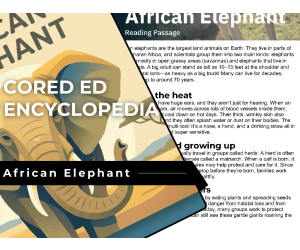
African Elephant Reading Comprehension - Cored Ed Encyclopedia
ELA, Language Development, Resources for Teachers, Reading Comprehension, Reading, Pre-Reading, Animals, Life Sciences, Science, Strategies, Grade 2, 3, 4, 5, Worksheets & Printables, Worksheets, Teacher Tools, Centers, Activities, Writing Prompts, Assessments, Tests, Quizzes and Tests, Quizzes
This African Elephant reading comprehension contains the following: Pre-Reading Trivia Students will write down one thing they already know about the subject and then read five more facts and discuss. These facts are fun, and the students will enjoy learning about the subject before reading more. COMPANION VIDEO NOW AVAILABLE (EMBEDDED AFTER PREVIEW PICTURES IN PRODUCT DESCRIPTION) Reading Passage The text is a high-interest reading passage with set paragraphs, roughly three to four paragraphs long. It contains a variety of themes about the topic, anywhere from history to technology. The passage is between 250 and 350 words in length. Mixed Questions The first question page contains four multiple-choice questions, each with a choice of four answers, and three written response questions that require a sentence or two from the student. Creative Writing In this question, the student will be required to write a five to eight sentence paragraph on a question related to the topic. Extension Activities This page is optional for fast finishers. If there are five to ten minutes left at the end of the lesson, the student can choose one of three activities, each one requiring a different skill. Answer Key There are answers for the multiple-choice questions and three written response questions have sample answers. FULL CATALOG OF DOWNLOAD LINKS AND ENCYCLOPEDIA INDEX HERE Cored Ed Encyclopedia Overview The Cored Ed Encyclopedia is a weekly series of lessons that you can pick up and use right away. These short readings fit into whatever time you have available. Each one includes a warm-up, a reading, and a set of questions, but it’s flexible — you can do just the reading, the full lesson, or skip the writing section if you need to. Each lesson focuses on a single topic so students don’t get lost. The writing is clear but never childish, making it perfect for grades two through five. Topics range from animals and science to history, inventions, and everyday things. No matter the level of the student, everyone should take away at least one new idea or fact from each lesson. The materials are easy to print, easy to explain, and require no setup. They work well for whole-class teaching, partner work, or independent study.
Author Cored Education
Rating
Tags Vocabulary, Spelling, Reading Comprehension, Reading Passages, Cored Encyclopedia, Facts, Reading, Elephants, Animals, Life Science
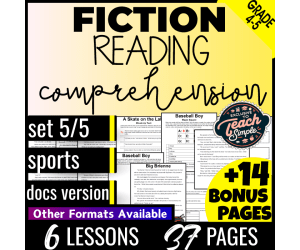
Reading Comprehension and Questions Fiction Set 5 - Sports (Docs)
ELA, Reading, Common Core, ESL, Language Development, Spelling, Vocabulary, Reading Comprehension, Writing, Resources for Teachers, Grade 4, 5, Worksheets & Printables, Worksheets, Writing Prompts, Centers, Activities
Reading Comprehension Passages Fiction Set 5 Overview No prep reading comprehension lessons, with enjoyable stories and topics. Each lesson has a blend of post-reading activities. Mixed questions to check overall understanding. Vocabulary activities, plus a writing section. Lessons also contain a bonus extension exercise at the end. Some you may like, some you may not, either way they are there if you wish to use them. Full answer keys are provided. Passages Include 1.Olympics: Lauren and her class get excited when talking about the Olympics. 2.Tryouts: Max is getting himself ready for the basketball tryouts. 3.Big Brienne: Kitty has the game of her life against Big Brienne. 4.A Skate on the Lake: Aimee has a nice evening at the lake with her dad and friends. 5.Baseball Boy: Mitch goes to watch the Chicago Hitters. Read about his day. 6.Running: An informative, yet light piece about running. Docs Version This is the Docs editable and fillable version. This download is available in GOOGLE Docs, GOOGLE Forms, GOOGLE Slides. PDF, PPT, WORD. FULL CATALOG OF DOWNLOAD LINKS HERE Grade 4/5 Links Fiction Set 1 - Animals Google Docs Google Forms Google Slides PDF PPT Word Guided Reading Materials Fiction Set 2 - Family Google Docs Google Forms Google Slides PDF PPT Word Guided Reading Materials Fiction Set 3 - Friends Google Docs Google Forms Google Slides PDF PPT Word Guided Reading Materials Fiction Set 4 - School Google Docs Google Forms Google Slides PDF PPT Word Guided Reading Materials Fiction Set 5 - Sports Google Docs Google Forms Google Slides PDF PPT Word Guided Reading Materials Nonfiction Set 1 - Birds Google Docs Google Forms Google Slides PDF PPT Word Guided Reading Materials Nonfiction Set 2 - Insects Google Docs Google Forms Google Slides PDF PPT Word Guided Reading Materials Nonfiction Set 3 - Mammals Google Docs Google Forms Google Slides PDF PPT Word Guided Reading Materials Nonfiction Set 4 - Nature Google Docs Google Forms Google Slides PDF PPT Word Guided Reading Materials Nonfiction Set 5 - Sea Animals Google Docs Google Forms Google Slides PDF PPT Word Guided Reading Materials Reading Passages Overview Each passage is especially written for Grade 4-5 students, including key vocabulary required for this age group. Topics are varied and are accompanied by colorful graphics. Topics are meant to educate, yet entertain the modern student. These passages are perfect for the modern classroom. Whereas textbooks can become outdated in no time, any changes to technology or the world will result in updates to this product. Mixed Questions The mixed questions section of each lesson includes a variation of five comprehension, vocabulary and math questions. In addition, key reading strategies are frequently covered including cause & effect, summarizing, compare & contrast and making conclusions. Two or three of the questions will be MCQs and other questions will require a written response of some kind. Full answers and example responses appear at the end of the lesson. Spelling & Vocab Each reading passage contains a variety of words and phrases designed for Grade 4-5 students. Spelling and vocab activities provide the opportunity to build fluency with these words. As it can become quite mundane doing the same activities over and over, each lesson in a set will contain a different spelling and vocab activity . Activities include: spelling games, sentence match-ups, mixed-up text and decoding words from the lesson. Writing Prompts Writing prompts are designed to continue the theme or lessons learned in the story. Students are persuaded to write in a variety of ways and each prompt includes several cues to help. As with the spelling/vocab section, writing prompts will vary. This includes research pieces, reading responses, poetry and creative writing prompts. Full Answer Keys Full answer keys and sample responses are provided so no matter how busy you are, you know you're covered! Mixed question answers provide evidence from the text, math questions contain the relevant workings. Answers are designed for use by the teacher, but also suitable as a handout to the student. Just for Fun Each lesson will have a bonus extension exercise. This is something fun to extend the lesson with. You can find these at the end of each lesson, titled Just for Fun. Just for Funs are optional. Some you may like, some you may not. Either way, they are there to do with as you wish. For similar downloads and other frees, do check out Cored Group on TeachSimple.
Author Cored Education
Rating
Tags Elementary, Reading, Comprehension, Vocabulary, Answers, Common Core, Spelling, Writing, Digital Centers, Vocabulary Assessments

Science Reading Comprehension 25: Nervous System PPT
Science, Life Sciences, Biology, Common Core, Language Development, ELA, Vocabulary, Reading Comprehension, Reading, Human Body, Grade 5, 6, 7, Teacher Tools, Presentations, Activities, Tests, Quizzes and Tests, Assessments
Free Reading Passage on Nervous System for Life Science What's inside this free product? Science Reading Comprehension Passage: Nervous System Independent PPT Version: This is the independent PPT version containingone lesson. Product Info: 43 SLIDES (US English with Answers) PPT Version Teaching Duration: 90 Minutes Science Reading Comprehension Outline: Introducing a comprehensive resource tailored for 5th and 6th graders, this product offers enriching reading passages supplemented with illustrative pictures and graphs to clarify key concepts. Aligned with the Common Core State Standards (CCSS), it offers a hassle-free approach to teaching, given that the bulk of the preparation is already done for you. The passages present a diverse set of questions – from multiple choice to data analysis and fill-in-the-blanks. This ensures a rich blend of high-interest content and fundamental curriculum-based science themes. With its versatility, you can seamlessly integrate these lessons into various classroom settings, whether it's whole class discussions, morning exercises, independent desk tasks, small group engagements, contingency plans for substitute teachers, regular homework assignments, or even themed activities for holidays. FULL CATALOG OF DOWNLOAD LINKS HERE Grade 5/6 Links: Physical Science Part 1 - Physical and Chemical Properties Google Docs/Slides/Forms PDF PPT Word Free Supplementary Pack Accompanying Videos Physical Science Part 2 - Motion and Energy Google Docs/Slides/Forms PDF PPT Word Free Supplementary Pack Accompanying Videos Physical Science Part 3 - Electricity and Magnets Google Docs/Slides/Forms PDF PPT Word Free Supplementary Pack Accompanying Videos Life Science Part 1 - Cells, Reproduction and Genetics Google Docs/Slides/Forms PDF PPT Word Free Supplementary Pack Accompanying Videos Life Science Part 2 - Human Body Systems Google Docs/Slides/Forms PDF PPT Word Free Supplementary Pack Accompanying Videos Life Science Part 3 - Plant Parts and Ecosystems Google Docs/Slides/Forms PDF PPT Word Free Supplementary Pack Accompanying Videos Earth Science Part 1 - Plate Tectonics and Rock Cycle Google Docs/Slides/Forms PDF PPT Word Free Supplementary Pack Accompanying Videos Earth Science Part 2 - Ocean Exploration and Natural Resources Google Docs/Slides/Forms PDF PPT Word Free Supplementary Pack Accompanying Videos Earth Science Part 3 - Weather and Solar System Google Docs/Slides/Forms PDF PPT Word Free Supplementary Pack Accompanying Videos For similar products and other frees, do check out Cored Group on TeachSimple .
Author Cored Education
Tags Science, Elementary, Reading, Comprehension, Vocabulary, Answers, Physics, Physical Science, Ccss, Common Core
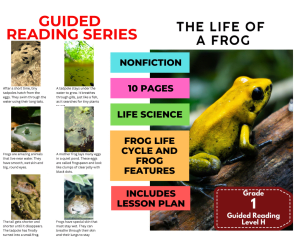
Guided Reading Level H - The Life of a Frog (with Lesson Plan)
ELA, Resources for Teachers, Reading Comprehension, Reading, Science, Animals, Life Sciences, Pre-Reading, Language Development, Vocabulary, Grade 1, 2, 3, Worksheets & Printables, Worksheets, Teacher Tools, Centers, Activities, Literacy Readers, Quizzes, Quizzes and Tests, Assessments, Lesson Plans
This Guided Reading Book - The Life of a Frog (Level H) with lesson plan includes: Guided Reading Color Label (front cover x1) This is a quick way to match the book’s demands to what students can generally handle.. The overall goal is to use the level/color to pick books for several smaller groups. To qualify for a certain level, a student is expected to read a book from that level with about 90–94% accuracy. If a student is consistently accurate and understands, move up a level. If the student is struggling at that level, drop down and add more support. Each student will improve at completely different rates, but it is generally one of the best ways to check progress across the class. DOWNLOAD THE CATALOG TO VIEW ALL GUIDED READING BOOKS AVAILABLE (SORTED LEVELS A-Z) Pre-Reading Question (x1) Teacher asks the prompt aloud, can be while showing the cover or first page. Students share what they already know, or make educated guesses from the cover. Prompt them to use the target vocabulary. Write some of their responses on the board to look back at during the reading. Vocabulary Words (x5) Introduce the five words, best doing it one at a time. Start by saying it, while students repeat and then see if anyone knows what it means before reading further. Read through the meaning and try to briefly connect each word to a picture or gesture so it’s meaningful. Ask students to flip through the book pages and point to where they see each of the vocabulary words. While reading the book pause upon coming across one of the vocab words or read the sentence twice to make sure students understand the word has appeared. Optional: Ask students to raise hands whenever they see/hear one of the new words. Guided Reading Pages (x10) Check the book snapshot (below) for: primary topic - do you need to prep extra reading or intro materials on this? what is taught best - decide on 1-2 bullets to focus on, use the prompt or words provided here for best results. learning goals - what you are checking for students to be able to do after the session, elicit answers using prompts or words provided. key vocabulary (see section above). questions overview - so you know what is coming up and if you need to prep extra materials to assist understanding. Run the lesson You may have already looked at a few of the pages together, but you can show them some of the pictures again first to set meaning. Depending on how much time you have and how familiar your students are with guided reading class, you may want to read the book aloud first with the group first. Students whisper or partner read, while you listen in. If time, do it as a group, one student reading a page each. Use the guided page’s prompts to coach: “Check the picture / does it make sense?” “Point under the words / try the first sound” “Reread the sentence smoothly”. Try to focus more on one student per session (rotating every time), so you can work out if they are ready to move up or need to move down a level. Comprehension Questions (back cover x3) This is your way to check that students didn’t just say the words, but actually understood the text. First, let students answer by pointing to the page/picture and saying a short sentence. After any answer, follow with: “Show me where you found that in the text.” In bigger groups, have partners answer first (10–20 seconds), then call on 2–3 students to share. Differentiation tips: Emerging speakers/struggling readers: oral + pointing On-level: oral in a full sentence Higher: one written sentence or draw + label Book Snapshot Title: The Life of a Frog Genre: Nonfiction (informational life cycle) Subject: Life Science + Reading (Informational Text) Primary Topic: Frog life cycle and frog features Estimated Guided Reading Level (A–Z): H What This Book Teaches Best Explains where frogs live and describes basic frog traits (smooth, wet skin; big, round eyes; living near water). Teaches the frog life cycle in clear steps: eggs (frogspawn) → tadpoles → legs grow → tail disappears → small frog. Shows how a tadpole lives and grows in water, including breathing through gills and eating tiny plants. Describes how frogs breathe (through skin and lungs) and how they get food (long, sticky tongue catching insects). Connects body parts to movement (strong back legs help frogs hop and jump high). Learning Goals Students will describe where frogs live and name physical traits the text mentions. Students will explain what frog eggs are called and describe what they look like. Students will retell the main stages of a frog’s life from eggs to a small frog. Students will describe how tadpoles move, breathe, and find food in the water. Students will explain how the frog’s body changes as legs grow and the tail disappears. Students will use text details to describe how a frog hunts and how it jumps. Key Vocabulary From the Text frogspawn — frog eggs that look like jelly. tadpoles — baby frogs that live in water and have tails. gills — body parts that help an animal breathe underwater. lungs — body parts used for breathing air. insects — small animals a frog can catch and eat. Discussion Prompts Pre-reading question: What changes do you think happen as a tadpole grows into a frog? Comprehension questions: Where does a mother frog lay many eggs, according to the text? Comprehension questions: What do tiny tadpoles use to swim through the water? Comprehension questions: What happens to the tadpole’s tail as it turns into a small frog? Printing Tips 1. Best Printing Method (Recommended) “Booklet” Printing (Best if Available) If your printer or PDF viewer supports Booklet Printing , use this. Settings to use: Print mode: Booklet Paper size: Letter or A4 (either works) Orientation: Landscape Print on both sides: Yes Flip on: Short edge Scaling: Fit to printable area Booklet subset: First test: Front sides only Then: Back sides only This will automatically: Pair pages correctly Put the cover on the outside Align everything for folding After printing, fold in half and staple along the spine . 2. If “Booklet” Printing Is NOT Available You can still print this correctly with manual duplex printing . Step-by-step: Open the PDF. Choose Print . Set: Orientation: Landscape Pages per sheet: 1 Print on both sides: Yes Flip on: Short edge Print all pages . Because each PDF page already contains two facing book pages, the result will still fold cleanly into a book. Thousands of Cored Education products are included with your TeachSimple membership. Download links and encyclopedia index available here.
Author Cored Education
Rating
Tags Reading Comprehension, Reading Passages, Reading, Guided Reading, Guided Reading Lesson Plan, Guided Reading Activity, Pre-reading, Science Lesson Plans, Animals, Frog Life Cycle
Reading Comprehension Fiction Set 3 Sample: Funland (Slides)
ELA, Reading, Language Development, Spelling, Common Core, Children’s Literature, Literature, Reading Comprehension, Creative Writing, Writing, Grade 4, 5, Teacher Tools, Presentations, Assessments, Tests, Quizzes and Tests, Activities
Reading Comprehension Passages Fiction Set 3 Sample Overview No prep reading comprehension lessons, with enjoyable stories and topics. Each lesson has a blend of post-reading activities. Mixed questions to check overall understanding. Vocabulary activities, plus a writing section. Lessons also contain a bonus extension exercise at the end. Some you may like, some you may not, either way they are there if you wish to use them. Full answer keys are provided. Passage Included 5.Funland: Not such a fun day at Funland for the author in this story. Slides Version This is the Slides editable and fillable version. This download is available in GOOGLE Docs, GOOGLE Forms, GOOGLE Slides. PDF, PPT, WORD. FULL CATALOG OF DOWNLOAD LINKS HERE Grade 4/5 Links Fiction Set 1 - Animals Google Docs Google Forms Google Slides PDF PPT Word Guided Reading Materials Fiction Set 2 - Family Google Docs Google Forms Google Slides PDF PPT Word Guided Reading Materials Fiction Set 3 - Friends Google Docs Google Forms Google Slides PDF PPT Word Guided Reading Materials Fiction Set 4 - School Google Docs Google Forms Google Slides PDF PPT Word Guided Reading Materials Fiction Set 5 - Sports Google Docs Google Forms Google Slides PDF PPT Word Guided Reading Materials Nonfiction Set 1 - Birds Google Docs Google Forms Google Slides PDF PPT Word Guided Reading Materials Nonfiction Set 2 - Insects Google Docs Google Forms Google Slides PDF PPT Word Guided Reading Materials Nonfiction Set 3 - Mammals Google Docs Google Forms Google Slides PDF PPT Word Guided Reading Materials Nonfiction Set 4 - Nature Google Docs Google Forms Google Slides PDF PPT Word Guided Reading Materials Nonfiction Set 5 - Sea Animals Google Docs Google Forms Google Slides PDF PPT Word Guided Reading Materials Reading Passages Overview Each passage is especially written for Grade 4-5 students, including key vocabulary required for this age group. Topics are varied and are accompanied by colorful graphics. Topics are meant to educate, yet entertain the modern student. These passages are perfect for the modern classroom. Whereas textbooks can become outdated in no time, any changes to technology or the world will result in updates to this product. Mixed Questions The mixed questions section of each lesson includes a variation of five comprehension, vocabulary and math questions. In addition, key reading strategies are frequently covered including cause & effect, summarizing, compare & contrast and making conclusions. Two or three of the questions will be MCQs and other questions will require a written response of some kind. Full answers and example responses appear at the end of the lesson. Spelling & Vocab Each reading passage contains a variety of words and phrases designed for Grade 4-5 students. Spelling and vocab activities provide the opportunity to build fluency with these words. As it can become quite mundane doing the same activities over and over, each lesson in a set will contain a different spelling and vocab activity . Activities include: spelling games, sentence match-ups, mixed-up text and decoding words from the lesson. Writing Prompts Writing prompts are designed to continue the theme or lessons learned in the story. Students are persuaded to write in a variety of ways and each prompt includes several cues to help. As with the spelling/vocab section, writing prompts will vary. This includes research pieces, reading responses, poetry and creative writing prompts. Full Answer Keys Full answer keys and sample responses are provided so no matter how busy you are, you know you're covered! Mixed question answers provide evidence from the text, math questions contain the relevant workings. Answers are designed for use by the teacher, but also suitable as a handout to the student. Just for Fun Each lesson will have a bonus extension exercise. This is something fun to extend the lesson with. You can find these at the end of each lesson, titled Just for Fun. Just for Funs are optional. Some you may like, some you may not. Either way, they are there to do with as you wish. For similar downloads and other frees, do check out Cored Group on TeachSimple.
Author Cored Education
Tags Elementary, Reading, Comprehension, Vocabulary, Answers, Ccss, Common Core, Spelling, Writing, Passages

Antarctica Reading Comprehension Passage - Cored Ed Encyclopedia
ELA, Language Development, Reading Comprehension, Reading, Social Studies, Writing, Pre-Reading, Vocabulary, Geography, History, Grade 2, 3, 4, 5, Worksheets & Printables, Worksheets, Teacher Tools, Centers, Activities, Writing Prompts, Assessments, Quizzes and Tests, Quizzes, Lesson Plans
This Antarctica reading comprehension with lesson plan includes: Visualization (on the front cover) Start your lesson by taking a minute to think and share something about the topic. Read the script aloud (slowly), perhaps prepare some music or sound effects. Student close their eyes and let their imaginations wander. Students open their eyes, read the question aloud and give them a few minutes to complete. Ask a few students to share or keep answers until the end to compare with what they learn in the passage. COMPANION VIDEO NOW AVAILABLE (EMBEDDED AFTER PREVIEW PICTURES IN PRODUCT DESCRIPTION) Quick pause—thousands of Cored Education products are included with your TeachSimple membership. Download links and encyclopedia index available here. Pre-Reading Trivia Students will write down one thing they already know about the subject and then read five more facts and discuss. These facts are fun, and the students will enjoy learning about the subject before reading more. Give 1 minute for students to write what they already know (no pressure—best guess is fine). Read the five facts together. After each fact, do ask a student for their opinion, was it surprising? Set a purpose by asking students to highlight/underline one fact they want to learn more about during the reading. Reading Passage The text is a high-interest reading passage with set paragraphs, roughly three to four paragraphs long. It contains a variety of themes about the topic, anywhere from history to technology. The passage is between 250 and 350 words in length. First, ask students to look at the headings and see what they’ll learn about today. What do they know about the topic/heading? First read options: Teacher read-aloud (best for support). Partner reading (paragraph by paragraph). While reading, students underline important details, and vocabulary words they think may come up in the questions section. Mixed Questions The first question page contains four multiple-choice questions, each with a choice of four answers, and three written response questions that require a sentence or two from the student. Students complete the mcqs first independently, then review quickly as a class. For the 3 written responses, try to get students giving the answer with some form of evidence: “I think ___ because the text says ___.” If students get stuck, send them back to check the passage. Vocabulary Questions Practice seven key words from the text in this section across two activities. First section is scrambled words where students will unscramble three words given a clue for each. The second section is a word to meaning matching activity. Before starting, have some students read out words they underlined in the passage. Ask students to say the word and read aloud the sentence(s) around each word. Ask students to do scrambled words and the matching exercise in pairs then go through answers as a class. For the scrambled spelling task, get four pairs to come up to the board and write the words for extra practice with the other student reading out the clue. For the matching task, prompt students to give full sentences: “I matched ___ with ___ because ___.” Creative Writing In this question, the student will be required to write a five to eight sentence paragraph on a question related to the topic. Before starting, ask students write down 3 key ideas they are going to include in their piece. Ask students for ideas to share around the class to help those struggling. Pro writing expectations: 5–8 sentences At least 2 facts or details from the passage At least 2 vocabulary words from the previous page Students read their paragraphs while classmates listen for facts and vocabulary words. Extension Activities This page is optional for fast finishers or to take home. There are several activities, each one requiring a different skill. Do some, do none, do all, completely optional - but you will feel reassured knowing every possibility is planned for. Includes summary writting question and additional facts. Answer Key There are answers for the multiple-choice questions, written response questions have sample answers, vocabulary answers and if there is a summary question then a sample summary will be provided as well. Lesson Plan Included Customized lesson plan for this lesson is included. Lesson Snapshot Title: Antarctica Genre: Nonfiction (informational passage) Subject: Science / Geography (Polar environments; exploration & research) Primary Topic: Exploration, South Pole, treaty, and ice core science Estimated Guided Reading Level (A–Z): S Support pages noted in the PDF: visualization and pre-reading trivia (pp. 1–2), mixed questions (p. 4), vocabulary activities (p. 5), creative writing (p. 6), extension activities + summary box (p. 7), answer key (p. 8). Support-page QA notes: The vocabulary activity includes “Expedition,” which does not appear in the passage; one mixed question asks why compasses “spin strangely,” which the passage does not explain. What This Lesson Teaches Best How Antarctica went from a blank spot on maps to a confirmed icy continent described by explorers. Key physical features of the continent: cold, dry, windy conditions; little inland snow; land “high above sea level” like a “frozen plateau.” A short exploration timeline using dates and evidence (1820 reports of ice shelves; 1895 people stepped onto the continent). How journeys toward the South Pole were described (sleds, dogs, strange compasses) and what happened in December 1911 and afterward. Why international science cooperation matters there, including the International Geophysical Year, the Antarctic Treaty, and what ice cores can reveal through layers. Learning Goals Students will describe why early mapmakers could not point to land far south “with certainty.” Students will identify details that describe Antarctica’s inland climate and land shape (dry, windy, little snow; “frozen plateau”). Students will retell key events from the passage’s timeline using dates (1820, 1895, 1911, 1959). Students will explain what ships reported seeing in 1820 and how the author describes the coastal environment. Students will describe what happened when Roald Amundsen reached the South Pole and what Robert Falcon Scott found later. Students will explain what the passage says nations promised in 1959 and why ice cores are compared to a “frozen calendar.” Key Vocabulary From the Text certainty — being sure something is true. plateau — a high, flat area of land. shelves — wide, flat sheets of ice. treaty — an agreement between countries. supplies — needed materials stored for later use. FULL CATALOG OF DOWNLOAD LINKS AND ENCYCLOPEDIA INDEX HERE
Author Cored Education
Rating
Tags Vocabulary, Reading Comprehension, Reading Passages, Lesson Plans, Ela Lesson Plans, Reading Comprehension Lesson Plans, Pre-reading, Geography, Geography Lesson Plans

How Words Shape Our Minds: Social Studies Reading Passage Fillable PDF
ELA, Reading, Reading Comprehension, Strategies, Resources for Teachers, Social Studies, Psychology, Grade 6, 7, 8, 9, Writing Prompts, Worksheets & Printables, Centers, Activities, Teacher Tools, Assessments, Quizzes and Tests, Quizzes, Tests
How Words Shape Our Minds: Social Studies Reading Comprehension Passage (Fillable PDF) This resource introduces a unique Social Studies reading comprehension passage with questions about How Words Shape Our Minds. The passage is carefully designed to bridge the gap between social studies and literacy through strengthening reading comprehension and sparking knowledge curiosity in middle school students. Each passage blends English Language Arts skills with accurate social studies content . Ideal for interdisciplinary learning in ELA and Social Studies. Suitable for Grade 9 review, too! This resource is designed as a fillable PDF , which means students can type their answers directly into the document on any computer or tablet . Each page includes highlighted text fields that show them exactly where to type! Student Tasks throughout the passage: 5 multiple-choice questions targeting the following skills: main idea, key details, inference, vocabulary in context, and use of evidence 5 vocabulary matching items with clear, student-friendly definitions 5 text-based questions that require citing specific lines or facts 1 summary prompt that asks students to condense central ideas accurately Full answer key for every section Available Formats for this Resource: PDF Word Docs Google Docs FULL CATALOG OF DOWNLOADING LINKS HERE Social Studies Reading Comprehension Collection Links: 1. Ancient Civilizations PDF Fillable PDF Word Docs Google Docs 2. Early Empires and Trade Networks PDF Fillable PDF Word Docs Google Docs 3. The Founding of the United States PDF Fillable PDF Word Docs Google Docs 4. Language, Culture, and Meaning PDF Fillable PDF Word Docs Google Docs 5. Psychology and Society PDF Fillable PDF Word Docs Google Docs 6. Global Festivals and Traditions PDF Fillable PDF Word Docs Google Docs 7. Extreme Environments and People PDF Fillable PDF Word Docs Google Docs 8. Food, Culture, and Preservation PDF Fillable PDF Word Docs Google Docs 9. Global Food Customs PDF Fillable PDF Word Docs Google Docs 10. Media, Communication, and Popular Culture PDF Fillable PDF Word Docs Google Docs 11. Human Impact on the Environment PDF Fillable PDF Word Docs Google Docs 12. Civic Action and Social Change PDF Fillable PDF Word Docs Google Docs 13. Fashion, Society, and Power PDF Fillable PDF Word Docs Google Docs 14. People, Places, and Unusual Histories PDF Fillable PDF Word Docs Google Docs Product Details: Length: 5 pages Grades: 6–8, also suitable for Grade 9 review Use cases: close reading, stations, homework, intervention, test prep, and sub plans Why Teachers Choose This Passage: Authentic social studies content paired with rigorous literacy practice Consistent task structure for easier planning and smoother student routines Clear, age-appropriate writing that builds confidence without oversimplifying Use this passage to reinforce ELA skills in social studies, to add literacy to your lessons, and to support independent work. The passage strengthens main idea, evidence use, vocabulary in context, inference, cause and effect, and summary writing. With ready-to-use assessments and complete answer keys, you can provide focused practice that is simple to run and fast to review.
Author CORED Education - Middle & High School
Rating
Tags Middle School, Reading Comprehension, Reading Strategies, ELA, Centers, Reading Passage, Assessments, Vocabulary, Social Studies, Pschology

Texas Independence Day Reading Comprehension Passage and Questions
Reading, ELA, Elementary, Read Alouds, Activities
Texas Independence Day, celebrated on March 2nd, marks the adoption of the Texas Declaration of Independence in 1836. On this day, Texas declared its independence from Mexico, leading to the establishment of the Republic of Texas. The day is observed with ceremonies, reenactments, and educational events honoring Texas history and heritage. Are you looking for a fun and engaging way to celebrate Texas Independence Day? This reading passage is a great resource for celebrating Texas Independence Day while practicing reading skills. This educational resource features simple, kid-friendly pages designed to make learning both enjoyable and interactive. Great for homeschooling, classroom education, or extra practice. Number of pages: 10 pages (5 BW + 5 COLOR) Format PDF file size: 8.5*11 Inches If you and your students or your children enjoy using this educational and engaging resource. please rate it and follow my store to be the first to know about my new teaching resources and freebies. Enjoy!
Author Wonderland School
Tags Texas Independence Day Reading Comprehension, Texas Independence Day, Texas Independence Day Coloring Pages, Texas Independence Day Craft, Texas, March Reading Passage, Spring Reading Passage, Spring, Read Across America, Dr. Seuss

Reading Comprehension Passages Fiction Set 7 - Sports (Google Forms)
ELA, Reading, Language Development, Vocabulary, Common Core, Spelling, Children’s Literature, Literature, Writing, Grade 2, 3, Assessments, Teacher Tools, Tests, Quizzes and Tests, Activities, Centers
Reading Comprehension Passages Fiction Set 7 Overview Fascinating reading comprehension passages, each with an array of activities included. Stories are written for the modern classroom and topics are designed to promote enthusiasm from each student. Each lesson contains a mixed questions section to check understanding, a vocabulary or spelling activity to help remember key language introduced, and a writing exercise. Full answer keys are provided. For a more detailed overview, check the section under the links at the bottom of this description. Passages Include 1.Catch It, Dan: Dan is at the ball game and wants to catch a foul ball. 2.Feeling Left Out: Polly isn't invited bowling by her friends and wants to knowwhy. 3.Ian's Friday Nights: Ian wants to be anywhere but the bleachers on Friday nights. 4.Aimee's Dilemma: Soccer or cheerleading? That is the question. 5.A Great Team: Adam & Justin both want to play first base. How will they sortit? 6.Ana's Swimming Party: Jodie can't swim and doesn't want her friends to find out. 7.Touchdown Pythons: Serena loves her first football game. 8.Sam's Passion: Sam talks about his passion for Karate in this passage. 9.Where's My Board: Kerry spends all the story looking for her skateboard. 10.Lacey the Runner: Lacey has dreams to run in the Olympics. Read to find out more. Additional File: Ana's Swimming Party: Invitation Templates Google Forms Version This is the Google Forms editable and fillable/self grading version. This download is available in GOOGLE Docs, GOOGLE Forms, GOOGLE Slides. PDF, PPT, WORD. FULL CATALOG OF DOWNLOAD LINKS HERE Grade 2/3 Links Fiction Set 1 - Nature Google Docs Google Forms Google Slides PDF PPT Word Guided Reading Materials Fiction Set 2 - Animals Google Docs Google Forms Google Slides PDF PPT Word Guided Reading Materials Fiction Set 3 - Food Google Docs Google Forms Google Slides PDF PPT Word Guided Reading Materials Fiction Set 4 - School Google Docs Google Forms Google Slides PDF PPT Word Guided Reading Materials Fiction Set 5 - Friends Google Docs Google Forms Google Slides PDF PPT Word Guided Reading Materials Fiction Set 6 - Family Google Docs Google Forms Google Slides PDF PPT Word Guided Reading Materials Fiction Set 7 - Sports Google Docs Google Forms Google Slides PDF PPT Word Guided Reading Materials Nonfiction Set 1 - Technology Google Docs Google Forms Google Slides PDF PPT Word Guided Reading Materials Nonfiction Set 2 - Nutrition Google Docs Google Forms Google Slides PDF PPT Word Guided Reading Materials Nonfiction Set 3 - Animals Google Docs Google Forms Google Slides PDF PPT Word Guided Reading Materials Reading Passages Overview Each passage is especially written for Grade 2-3 students, including key vocabulary required for this age group. Topics are varied and are accompanied by colorful graphics. Topics are meant to educate, yet entertain the modern student. These passages are perfect for the modern classroom. Whereas textbooks can become outdated in no time, any changes to technology or the world will result in updates to this product. Mixed Questions The mixed questions section of each lesson includes a variation of fivecomprehension, vocabulary and math questions. In addition, key reading strategies are frequently covered including cause & effect, summarizing, compare & contrast and making conclusions. Three of the questions will be MCQs and two will require a written response of some kind. Full answers and example responses appear at the end of the lesson. Spelling & Vocab Each reading passage contains a variety of words and phrases designed for Grade 2-3 students. Spelling and vocab activities provide the opportunity to build fluency with these words. As it can become quite mundane doing the same activities over and over, each lesson in a set will contain a different spelling and vocab activity . Writing Prompts Writing prompts are designed to continue the theme or lessons learned in the story. Students are persuaded to write in a variety of ways and each prompt includes several cues to help. As with the spelling/vocab section, writing prompts will vary. This includes research pieces, reading responses, poetry and creative writing prompts. Full Answer Keys Full answer keys and sample responses are provided so no matter how busy you are, you know you're covered! Mixed question answers provide evidence from the text, math questions contain the relevant workings. Answers are designed for use by the teacher, but also suitable as a handout to the student. Additional File One lesson will have an additional file. This is something fun to extend the lesson with. For similar downloads and other frees, do check out Cored Group on TeachSimple.
Author Cored Education
Rating
Tags Elementary, Reading, Comprehension, Vocabulary, Answers, Common Core, Spelling, Writing, Digital Centers, Self Assessment