



Page 151 - Newest Teaching Resources

 Show filters

Summer Crab Shell Flash Cards Number Beach Centers Preschool Math End
Number Lines, Math, Addition and Subtraction, Preschool, Kindergarten, Grade 1, 2, Flashcards, Worksheets & Printables, Posters, Classroom Decor, Centers, Activities
Introduce some beach-inspired fun in your math centers with these Summer Crab Shell Number Flash Cards (1–10). With a variety of brightly illustrated crab shells for kids to count, these fun flashcards are ideal for summer, ocean themes, or when teaching numbers to little ones. What’s Included: 10 colorful flash cards with numbers (1–10), both in color and B&W What’s on Each Card: The numeral (1-10), the corresponding number word, and crab shells to count Use These To: Support math centers themed for summer or the ocean, teach counting and one-to-one correspondence, morning tub activities, task box teaching, small groups, individual centers, or for at-home math practice Features: Colorful ocean-themed graphics, bright summer numbers and number words for kids to learn, print-and-go, laminating friendly, and a great way to engage young learners with counting and numbers Great For: Preschool, Pre-K, and kindergarten kids learning their numbers 1–10 using the fun summer crab shells.
Author Whizzy Wonders
Rating
Tags Summer, Endofyear, Numberto10, Math, Counting, Crab, Shell

Country Study Presentation - Niger - Geography - West Africa
Social Studies, Economics, Geography, History, History: African, Grade 7, 8, 9, 10, 11, 12, Presentations, Teacher Tools
Country Study Presentation - Niger - Geography + Social Studies - West Africa Try this Teaching Resource on Niger (Introductory Presentation Lesson - PDF Printable), designed for Geography + African History (West Africa) + Social Studies lessons. Suitable for Grades 7–12 (Middle school and High School students), this Introductory PDF Presentation offers a ready to use lesson that requires little to no preparation. Geography and Social Studies students will learn about Niger ’s geography, history, culture, language and economy — making it perfect for classroom instruction, homeschooling, or online learning. 📘 Teachers can find the following topics in this Social Studies and Geograhy Teaching resource ✅ Greetings in Hausa ✅ Geography of Niger (West Africa) – Key facts, borders, and an interactive Google Maps link to its location. ✅ Quick Facts – Population, capital city, currency and other essential details. ✅ Languages of Niger : Hausa - introduction in the languages spoken + basic vocabuary ✅ History Overview – A concise summary of the most important events in the history of Niger (West Africa) ✅ Geography & Environment – Details about the country’s land area, regions, and climate zones. ✅ Niger's Economy – paragraph on Niger ’s industries, exports, currency and economic strengths (West Africa) ✅ Niamey – Explore the capital city of Niger , its famous landmarks, and cultural highlights. ✅ Other Major Cities – A map showcasing additional important cities in Niger (West Africa) ✅ Niger's Culture & Traditions – A look at the customs and values that define Niger (West Africa) ✅ Farewell in Hausa 🎯 This Geography and Social Studies Teaching Resource can be perfect for: Geography classes Social Studies lessons World cultures units Country study projects Substitute teacher toolbox Digital learning In-class or online teaching 📂 Resource Details Format: PDF Digital Presentation Grade Levels: 7th–12th Grade (Middle School and High School students) Learning with Alan is an educational resource store created to help teachers, educators, and tutors reach their teaching goals while building a fun, engaging, and stimulating learning environment . Because learning should always be meaningful—and fun! 🎓✨ If you want to browse more of my Teaching Resources, click here Learning with Alan!!
Author Learning with Alan
Rating
Tags Country Study, Social Studies, Geography, Niger, Africa, West Africa, Hausa, Lesson, Presentation, History

ESL TV Series Activity - Avatar: The Last Airbender - Season 2
ELA, Language Development, ESL, Vocabulary, Writing, Creative Writing, Formal Writing, Grade 7, 8, 9, 10, 11, 12, Worksheets & Printables, Worksheets, Writing Prompts
ESL TV Series Activity Worksheets - Avatar: The Last Airbender - Season 2 This ESL teaching resource is a 2-page printable PDF TV Series activity for "Avatar: The Last Airbender - Season 2" (Netflix TV Series) designed to support English as a Second or Foreign Language (ESL EFL) learners. This resource can be great for post TV Series activities and is ideal for Middle School and High School students , ranging from 7th to 12th grade . It's a versatile tool suitable for newcomers and any English language learners, making it an excellent choice to use in ESL classrooms, language centers, or by tutors worldwide. This "Avatar: The Last Airbender - Season 2" (Netflix TV Series) TV Series Activity is ideal for intermediate advanced ESL students . It provides a structured way for learners to engage with the film while developing their English language skills. The guide includes several activities that encourage students to interact with the series' content in meaningful ways: A section for general information about "Avatar: The Last Airbender - Season 2" (Netflix TV Series) such as the actors, genre, and other key details. A space for new vocabulary learned while watching this TV Series, helping students expand their English lexicon. A part dedicated to each the TV Series' Timeline A section for students to describe and review their favorite episode from the series and explain why they liked it, fostering personal connection and critical thinking. A creative writing task where students imagine themselves as one of the characters and write three diary entries from that character’s perspective, encouraging deeper engagement with the characters and plot. This "Avatar: The Last Airbender - Season 2" (Netflix TV Series) TV Series Activity is designed to create an enjoyable and stimulating learning experience for intermediate advanced ESL learners. Learning with Alan is a Teaching Resources Store whose aim is to help English as a Second or foreign Language (ESL EFL) Teachers, Educators and Tutors around the world (be it online or offline) to achieve their teaching objectives while creating an enjoyable and stimulating learning environment. Never Forget! Learning is fun, So should English! Always If you want to browse more of my ESL, EFL, TESOL Teaching Resources, click here Learning with Alan!
Author Learning with Alan
Rating
Tags ESL, English Second Language, English, TV Series, Worksheets, Avatar, Netflix, Writing Activity, Teens, Printable
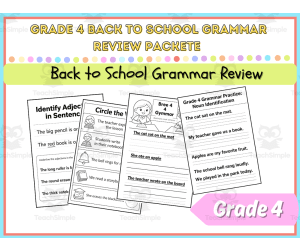
Grade 4 Grammar Review Packet | Back to School Worksheets
ELA, Language Development, Grade 4, Worksheets & Printables, Flashcards
My Grade 4 grammar review packet was created to help students practice important language skills at the beginning of the school year. I designed these worksheets to give students extra review with nouns, verbs, adjectives, punctuation, capitalization, and sentence correction in a simple and organized format. This PDF includes 12 printable pages that can be used for independent work, morning work, homework, literacy centers, or classroom review activities. The exercises are straightforward and easy for students to follow without complicated instructions. I created this resource for teachers who want quick grammar practice activities that are ready to print and use in class. The worksheets work well for back-to-school review and extra grammar reinforcement throughout the year. Included in this packet: Nouns practice Verbs activities Adjectives review Sentence correction exercises Punctuation practice Capitalization activities Mixed grammar review pages This resource is designed for Grade 4 students and can also support ESL learners or homeschool instruction. File Type: PDF Pages: 12
Author LuminaPrint
Rating
Tags Grade 4 Grammar, Back To School, Grammar Worksheets, Sentence Correction, Punctuation Practice, Capitalization, Nouns Verbs Adjectives, ELA Activities, Printable Worksheets, Language Arts

Multiplication Mystery Picture Puzzle | 3rd 4th Grade Math Worksheet
Math, Calculus, Addition and Subtraction, Subtraction, Addition, Multiplication and Division, Division, Multiplication, Resources for Teachers, Grade 3, 4, Activities, Teacher Tools, Worksheets & Printables, Workbooks, Worksheets, Centers
🪟 Engage your students in multiplication practice with the help of our Multiplication Puzzle Mystery Picture Worksheet! This worksheet will encourage children to master math facts by solving multiplication problems and completing problem-solving activities. Your kids will get lots of practice working on a math mystery picture that is to be uncovered. Engaging visual elements and interactive tasks will help children become more proficient in multiplying numbers by providing additional practice with math facts. Worksheet Contents: • Multiplication fact practice problems • A task of coloring by numbers to uncover a mystery picture • Word problems for practicing multiplication • True or False questions to check understanding of multiplication facts • Bonus multiplication problem for advanced students • A student-friendly format • Designed for US Letter Size Paper (8.5" x 11") Skills Developed: • Multiplication fact fluency • Mastering math facts • Problem-solving strategies • Developing number sense • Working independently • Assessing knowledge • Reviewing math facts Ideal for: 📚 Grade 3 Math 📚 Grade 4 Math 📚 Math Centers 📚 Morning Work 📚 Homework Assignments 📚 Fast Finishers 📚 Sub Plans 📚 Homeschool Learning 📚 Small Group Lessons Students will enjoy discovering multiplication facts as they solve the mystery picture in our Multiplication Puzzle Mystery Picture Worksheet!
Author BrightPrintsNY
Rating
Tags Multiplication Mystery Picture Worksheet, Math Puzzle Worksheets For 3rd Grade, Fun Multiplication Activities For Kids, Mystery Picture Math Worksheets Printable, 4th Grade Multiplication Practice Sheets, Multiplication Color By Code Puzzles, Printable Math Mystery Picture Activity, Multiplication Worksheets For Classroom Fun, Puzzle Math Worksheets For Elementary Students, Engaging Multiplication Practice For 3rd 4th Grade
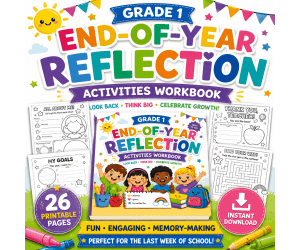
Grade 1 End of Year Memory Book | Reflection Activities Workbook
Special Resources, Resources for Teachers, Creative Arts, Montessori, Social Studies, Grade 1, 2, Activities, Worksheets & Printables, Workbooks, Worksheets, Teacher Tools
Get ready to wrap up another awesome school year in an exciting way with this great Grade 1 End-of-Year Reflection Activities Printable Pack! The perfect addition to your classroom, homeschool, summer review, and memories. Filled with bright, child-friendly activities, this workbook will keep children busy at school while reflecting and writing about their best times of the year in a fun and enjoyable manner. ✨ Inside This Set: • Writing reflection prompts • Pages to create memory books • Fun coloring pages • Word search & mazes • Emotions activities related to SEL • Cut & paste activities • Worksheets for goal setting • Educational games related to school • Pages to write thank you messages to teachers • Cover & answer sheets included ⭐ Ideal For: • Grade 1 Classes • End-of-year reflections • Daily morning work practice • Early finishers & centers • Home schooling • Keeping the summer learning fun • Substitute teachers plans ✔ Easy print US letter pages ✔ Black & white saving pages for ink ✔ Great premium covers included ✔ Fun yet educational activities Let your children reflect and learn in one pack!
Author BrightPrintsNY
Rating
Tags Grade 1 Memory Book, End Of Year Reflection Activities, First Grade Workbook Printable, Fun Worksheets For Grade 1 Students, End Of School Year Activities, First Grade Reflection Journal, Printable Memory Book For Kids, Grade 1 End Of Year Worksheets, Classroom Reflection Activities Grade 1, First Grade End Of Year Workbook

ESL Vocabulary Flashcards - Work & Business - Pictures
ELA, Language Development, ESL, Vocabulary, Not Grade Specific, Middle School, High School, Adult Education, Worksheets & Printables, Worksheets, Flashcards
ESL Vocabulary Flashcards - Work & Business - Pictures This high quality English language teaching resource is designed for students learning English as a second or foreign language . It includes 4 printable PDF pages featuring vocabulary flashcards and worksheets centered around the theme of "Work & Business" This ESL Vocabulary Flashcards on "Work & Business" Worksheets Activity can be ideal for Beginner level ESL - EFL - TESOL learners, including newcomers and English language learners of all ages. 🌟 What's Included? In this ESL Vocabulary Flashcards Activity on " Work & Business ", there are provided: ✅ 36 Printable Flashcards (4 Printable PDF worksheets) ✅ Essential vocabulary and phrases in English ✅ Engaging icons and emojis on select flashcards to support comprehension and vocabulary retention (not all flashcards) 🏫 Who Can Benefit from This Resource? 📌 Beginner ESL - EFL students looking to improve their English vocabulary 📌 Newcomers & English Language Learners (ESL - EFL - TESOL -TEFL) in schools, tutoring sessions, or self-study 📌 Teachers and tutors looking for fun and engaging vocabulary building activities 📌 Language centers, homeschool educators, and ESL programs 🎯 How Does this ESL Teaching Resource Help you and your Students? ✨ Strengthens essential English communication skills ✨ Provides English vocabulary (ESL - EFL - TESOL - TEFL) for better understanding ✨ Encourages engaging learning with printable flashcards that can be used in various ESL - EFL (English Second or Foreign Language) class activities Whether you're an ESL teacher or an English tutor these ESL Vocabulary Flashcards on " Work & Business " are a valuable and fun resource to improve basic conversation skills in English. Start learning today and make English introductions simple, engaging, and effective ! ESL with Alan is a Teaching Resources Store whose aim is to help English as a Second or foreign Language (ESL EFL TESOL) Teachers, Educators and Tutors around the world (be it online or offline) to achieve their teaching objectives while creating an enjoyable and stimulating learning environment. Learning is fun, So should English! Always If you want to browse more of my ESL, EFL, TESOL Teaching Resources, click here right ESL with Alan!
Author Learning with Alan
Rating
Tags ESL, English Second Language, English, Flashcards, Vocabulary, Work, Business, Activity, Printable, Worksheets

Verb Phrases: Main Verbs and Helping Verbs Worksheets
Vocabulary, Language Development, ELA, Not Grade Specific, Worksheets & Printables
Introduction Verb phrases trip up a lot of students — even ones who are pretty good at finding verbs. They can underline runs or jumped no problem, but ask them to pick out the helping verb in has been running and things get fuzzy fast. That's exactly why I made this resource. It gives students enough hands-on repetition with helping verbs and main verbs that the concept actually sticks. Objective Students practice identifying helping verbs and main verbs, work with complete verb phrases in context, spot and fix errors, and finish sentences using appropriate verb phrases. What's Included 7 exercise sections — printed and ready to hand out A good mix of activity types: underlining, fill-in-the-blank, multiple choice, sentence rewriting, error correction, and sentence completion Focus throughout on verb phrases and how helping verbs and main verbs work together Answer key included Grades / Ages Works best for Grades 3–6 and beginner ESL/EFL students Format Printable PDF, non-editable No prep needed — just print and go Works for classwork, homework, early finishers, or a quick grammar review
Author MultiLingual Grammar Lab
Rating
Tags Verb Phrases: Main Verbs , Helping Verbs Worksheets

ESL Book Report Activity - The Climate Book - Greta Thunberg
ELA, Language Development, ESL, Vocabulary, Reading, Writing, Formal Writing, Grade 7, 8, 9, 10, 11, 12, Worksheets & Printables, Writing Prompts, Worksheets
ESL Book Report Activity Worksheets - The Climate Book - Greta Thunberg This ESL - EFL - TESOL (English Second or Foreign Language) teaching resource is a comprehensive Book Report Activity worksheet activity (2 printable PDF pages; Worksheets) focused on "The Climate Book" (Collective non-fiction book edited by Swedish climate activist Greta Thunberg - Climate Change - Environment). This Book Report Activity worksheets on "The Climate Book" (Collective non-fiction book edited by Swedish climate activist Greta Thunberg - Climate Change - Environment) is tailored for middle and high school ESL students (7th – 12th grade) and provide a variety of thought provoking and language building activities. Whether you're teaching English as a Second Language (ESL), English as a Foreign Language (EFL), or in a TESOL context, this resource is classroom-ready and easy to use. Within this ESL Book Report Activity on "The Climate Book" (Collective non-fiction book edited by Swedish climate activist Greta Thunberg - Climate Change - Environment; 2 printable PDF worksheets pages), English Second or Foreign Language (ESL - EFL - TESOL - TEFL) teachers can find the following activities: 1 part dedicated to General Information (Author's name, Genre and publishing date) 1 part dedicated to New Vocabulary Learned 2 writing activities Rating + Review This English Second or Foreign Language (ESL - EFL) Book Report Activity Worksheets on "The Climate Book" (Collective non-fiction book edited by Swedish climate activist Greta Thunberg - Climate Change - Environment) can be ideal for learners from 7th grade to 12th grade (middle school + High School Students + Adult learners + University Students) ESL with Alan is a high-quality ESL teaching resources that inspire both teachers and students. Our goal is to make learning English fun, interactive, and meaningful. Discover more English Second or Foreign Language activities by visiting our store – because learning English should always be fun! If you want to browse more of my Teaching Resources, click here ESL with Alan!
Author Learning with Alan
Rating
Tags ESL, English Second Language, English, Book Report, Climate Change, Environment, Writing Activity, Activity, Printable, Worksheets

Text Reading Comprehension Nonfiction Passages for 2nd Grade
Children’s Literature, Literature, ELA, Reading Comprehension, Reading, Grade 1, 2, Quizzes and Tests, Teacher Tools
Support reading comprehension development with this nonfiction passage activity pack designed for 2nd grade students. This resource includes printable informational texts and comprehension exercises focused on age-appropriate reading skills. Students read short nonfiction passages covering a variety of topics while practicing vocabulary recognition, identifying key details, and understanding informational text structures. The passages are written with simple language and organized layouts suitable for developing readers. This resource includes comprehension questions that guide students in responding to the text through multiple-choice, short-answer, and detail-based activities. The worksheets can be used during literacy lessons, reading centers, independent work, or homework practice. Ideal for classroom instruction, reading review, or small group activities, this no-prep resource provides structured nonfiction reading practice for elementary learners. What’s Included: Nonfiction reading comprehension passages Multiple-choice and short-answer questions Vocabulary-focused activities Printable student worksheets Student-friendly reading layouts Ideal For: Reading comprehension practice Informational text activities Literacy centers and small group work Independent reading assignments Classroom or homeschool use Provide students with structured nonfiction reading comprehension practice using these printable passages and reading activities for 2nd grade learners.
Author Bright Education
Rating
Tags Reading Comprehension, Nonfiction Passages, Homework

Country Study Presentation - Mauritania - Geography - West Africa
Social Studies, Economics, Geography, History: African, History, Grade 7, 8, 9, 10, 11, 12, Teacher Tools, Presentations
Country Study Presentation - Mauritania - Geography + Social Studies - West Africa Try this Teaching Resource on Mauritania (Introductory Presentation Lesson - PDF Printable), designed for Geography + African History (West Africa - Sahara Desert) + Social Studies lessons. Suitable for Grades 7–12 (Middle school and High School students), this Introductory PDF Presentation offers a ready to use lesson that requires little to no preparation. Geography and Social Studies students will learn about Mauritania ’s geography, history, culture, language and economy — making it perfect for classroom instruction, homeschooling, or online learning. 📘 Teachers can find the following topics in this Social Studies and Geograhy Teaching resource ✅ Greetings in Arabic ✅ Geography of Mauritania (West Africa - Sahara Desert) – Key facts, borders, and an interactive Google Maps link to its location. ✅ Quick Facts – Population, capital city, currency and other essential details. ✅ Languages of Mauritania : Arabic - introduction in the languages spoken + basic vocabuary ✅ History Overview – A concise summary of the most important events in the history of Mauritania (West Africa - Sahara Desert) ✅ Geography & Environment – Details about the country’s land area, regions, and climate zones. ✅ Mauritania's Economy – paragraph on Mauritania ’s industries, exports, currency and economic strengths (West Africa - Sahara Desert) ✅ Nouakchott – Explore the capital city of Mauritania , its famous landmarks, and cultural highlights. ✅ Other Major Cities – A map showcasing additional important cities in Mauritania (West Africa - Sahara Desert) ✅ Mauritania's Culture & Traditions – A look at the customs and values that define Mauritania (West Africa - Sahara Desert) ✅ Farewell in Arabic 🎯 This Geography and Social Studies Teaching Resource can be perfect for: Geography classes Social Studies lessons World cultures units Country study projects Substitute teacher toolbox Digital learning In-class or online teaching 📂 Resource Details Format: PDF Digital Presentation Grade Levels: 7th–12th Grade (Middle School and High School students) Learning with Alan is an educational resource store created to help teachers, educators, and tutors reach their teaching goals while building a fun, engaging, and stimulating learning environment . Because learning should always be meaningful—and fun! 🎓✨ If you want to browse more of my Teaching Resources, click here Learning with Alan!!
Author Learning with Alan
Rating
Tags Country Study, Social Studies, Geography, Africa, Arabic, West Africa, Mauritania, Sahara Desert, Lesson, Presentation
Coding Logic & Algorithm Design (No-Code) Practice Sheets
Science, Technology, Computer Science, Engineering, STEM, Special Resources, Life Skills, Research, Resources for Teachers, Classroom Management, Grade 3, 4, 5, 6, 7, 8, 9, Worksheets & Printables, Workbooks, Worksheets, Word Searches, Teacher Tools, Assessments, Lesson Plans, Quizzes and Tests, Quizzes, Tests
By teaching the logic of code, you'll be able to unlock the true power of programming!!! This comprehensive curriculum has been created specifically for students in grades four through seven and will provide them with a strong foundation in Computational Thinking using a completely screen-free method—all without writing a single line of code. Are you interested in teaching Computer Science fundamentals but unable to cross the barrier of Syntax and software? Introducing Computer Science’s Fundamentals with an „Unplugged Coding” unit is the perfect solution. Students will learn to think about problems and create solutions like Engineers, Problem Solvers, and Innovators through real-world examples and well-designed worksheets. Instead of just providing another set of puzzles, this four-week, ready to go, complete unit will teach your students to convert abstract concepts into concrete skills. Once students have mastered this Architecture of Thought, they will be ready for any programming languages they may encounter in the future. THIS RESOURCE CONTAINS 40 PAGES OF MATERIAL, INCLUDING: 1) A comprehensive guide & theoretical framework that will help teachers (or older students) get a basic understanding of each of the four pillars of computer science: 1) Sequencing and Precision (anatomy of an algorithm) 2) Conditionals and Branching (logic at the crossroads) 3) Loops and Iteration (how to use repetition effectively) 4) Debugging and Optimization (the art of fixing things) 2) A fun, hands-on workbook that contains 10 different worksheets, each based on using the theoretical concepts in real-world situations. | Worksheet #1 = The Architecture of Sequence (Deep-Sea Drone Mission) Worksheet #2 = Conditional Pathways (Mars Rover Logic) Worksheet #3 = The Power of Iteration (Automated Greenhouse) Worksheet #4 = Variables and State (Retro Arcade Game) Worksheet #5 = Boolean Logic Gates (High-Tech Security Vault) Worksheet #6 = Function Design (Drone Light Show) Worksheet #7 = Debugging and Logical Errors (Theme Parks Ride) Worksheet #8 = Pattern Recognition and Abstraction (Alien Puzzle Box) Worksheet #9 = Algorithm Optimization (Robotic Postal Service) Worksheet #10 = System Design (Intelligent Vending Machine) Teacher Resources and Visuals: Everything You Need to Implement This Unit With Confidence - 3 High-Resolution Visual Anchor Charts to Display in the Classroom (Algorithm Design Process, Control Structures, Debugging Protocol). - Detailed Teacher Implementation Guide: pedagogical philosophy, 4-week pacing/deployment strategy, and differentiation tips. - "Logic E.D.G.E." Evaluation Rubric: One-of-a-Kind Methodology Assessment Tool As An Assessment Tool For Methodologies Not Only Right or Wrong Answers. - Comprehensive Answer Key: Easily Check Student Work. This resource is ideal for middle school computer science, STEM or STEAM electives, coding clubs, homeschool co-ops and/or gifted & talented upper elementary programs. Student empowerment = Master Problem Solvers! Download today to build the foundation for a lifetime of logical thinkers! Keywords: Unplugged Coding, Coding Without a Computer, Computational Thinking, Algorithm Design, Logic Puzzles, STEM, STEAM, Middle School Computer Science, Hour of Code, Screen-Free Activities, 4th Grade, Fifth Grade, Sixth Grade, Seventh Grade, Homeschool, Digital Resource Reasons Why Educators/Parents Appreciate The Program: Develops Real Skills at the Fundamental Level: It does not only have educational value as a game, but allows learners to see the logic of computer programming - students begin to see how computers function in the digital world. Completely Hand-Emphasis On Learning: In this modern world where we have become over-reliant on technology, the unplugged curriculum offers an hands-on means to integrate computer science into the lives of children while promoting critical thinking skills as well as reducing screen times. Everything Needed for Teachers to Implement Unit: All of the components required for teacher/educator to successfully implement the 28-day unit are included - Teacher’s Guide - Worksheets - Visuals - Answer Key with all included One-Time Prep for Teacher, however is Minimal. Fun, Imagination Driven Learning Through Unplugging: This unit assists educators in the "math" of coding and programming by allowing them to eliminate the frustration of syntax errors and develop understanding without the use of device and apparatus. Interesting but simple scenarios (Example - Program a Mars rover) keep students engaged and excited about learning. Development of Resilience and Problem Solving: The incredible focus and emphasis on NEAT Debugging Concepts, allow students to experience and understand that errors are both normal and will continue to happen during the learning journey while building analytic skills and resiliency. Intended Audience for Student: According to the PDF's recommendations and its degree of complexity, the target audiences are: Primary Target: Grades 4 through 7 (Aged 9 through 13) Secondary Target: 3rd grade: Gifted and Talented Program 8th grade: Introduction or remedial courses Families that are home-schooled with a structured STEM curriculum After-school coding clubs that would like an introduction to the fundamentals. Copyright/Terms of Use This book has been published by Syed Hammad Rizvi and is intended for personal use only. Any alteration, redistribution or sale of this resource is strictly prohibited. For example, you cannot place this resource on the internet in any way that someone might find it and download it. If you would like to share this resource with others you work with, please go to Teachsimple and purchase the appropriate number of licenses. Thank you for your consideration of these terms of use. This product is proudly produced by Syed Hammad Rizvi
Author Creative Book Store
Rating
Tags STEM, Coding, ComputerScience, EdTech, Education, CriticalThinking, ProblemSolving, TeachersOfInstagram, TechForKids, Coding Worksheets

ESL Documentary Activity - I am Greta - Environmental Activity
ELA, Language Development, ESL, Vocabulary, Writing, Creative Writing, Formal Writing, Grade 7, 8, 9, 10, 11, 12, Worksheets & Printables, Writing Prompts, Worksheets
ESL Documentary Activity Worksheets - I am Greta - Environmental Activist - Climate Change This English Second or Foreign Language (ESL - EFL - TESOL - TEFL) teaching resource is a 2 page printable PDF Documentary Activity guide for "I am Greta" (2020 documentary on Swedish Environmental Activist Greta Thunberg - Climate Change) is designed to help English as a Second Language (ESL - EFL - TESOL - TEFL) learners. This teaching resource can be ideal for post documentary activities and is ideal for Middle School and High School students , from 7th to 12th grade . This ESL EFL TESOL (English Second or Foreign Language) Documentary Activity Guide can be great for newcomers and any English language learners, making it an amazing teaching toolbox to use in ESL EFL classrooms, language centers, or by tutors around the World. Within this ESL EFL Documentary Activity Guide on "I am Greta" (2020 documentary on Swedish Environmental Activist Greta Thunberg - Climate Change), ESL EFL TESOL teachers can find the following English Second or Foreign Language (ESL - EFL - TESOL - TEFL) documentary guide activity: General Information – Students fill in key details about the documentary, including the director, themes and release year etc. Vocabulary Builder – An activity dedicated to new words and phrases , to improve ESL EFL students’ English vocabulary 2 Writing Activities (best part + what I have learned) 1 part dedicated to the documentary's rating 1 part dedicated to the documentary's review This "I am Greta" (2020 documentary on Swedish Environmental Activist Greta Thunberg - Climate Change) documentary activity guide is designed to create an enjoyable and stimulating learning experience for intermediate advanced ESL - EFL students. ESL with Alan is an amazing Teaching Resources Store which aims to support English as a Second or foreign Language (ESL - EFL - TESOL - TEFOL) Teachers, Educators and Tutors around the globe (be it online or offline) to achieve their students' learning objectives while creating an enjoyable and stimulating learning environment. Never Forget! Learning is fun, So should English! Always If you want to find more ESL - EFL - TESOL - TEFL (English Second or Foreign Language) Teaching Resources and Educational Material click here Learning with Alan!
Author Learning with Alan
Rating
Tags ESL, English Second Language, English, Greta Thunberg, Climate Change, Environment, Documentary, Activity, Writing Activity, Vocabulary

Friendship Worksheets for Kids : Social Emotional Learning Activities
Life Skills, Special Resources, Social Emotional Learning (SEL), Social Skills, Not Grade Specific, Worksheets & Printables
Friendship Worksheets for Kids : Social Emotional Learning Activities ⭐ Even for young children, friendships can be complex. In fact, especially for young children. I put this pack together because the conversations I was having with my students about friendship kept coming up with the same topics: kids who wanted to be better friends but really didn't know where to begin, kids who weren't sure if what was happening to them was normal, and kids who didn't know how to fix something after a fight. These discussions gave rise to these worksheets. ⭐ This is not a lecture. Children are asked to think, sketch, sort, write, and perhaps just sit with a thought for a minute as part of these activities. What constitutes a trustworthy person is a mystery. a reflection page detailing a moment when they felt excluded and what they will do differently in the future. Cut-and-paste sorting exercises that distinguish between positive and negative friendships. Things that do more than just fill in the blanks to get kids talking. ⭐ It is useful for morning work, small counseling groups, classroom SEL blocks, and parents who need a planned activity to perform at home after a difficult recess. Print what you require. Ignore what you don't. The only tools needed are a printer and possibly some scissors, and the pages are neat, black and white. intended for children aged 5 to 10. It is most effective when an adult is present to follow the conversation wherever it goes, as it typically goes somewhere worthwhile. Friendship is an art. Kids can practice it on these pages.
Author life skills learning store
Rating
Tags Life Skills, Social Emotional Learning, School Counseling Sessions, Mental Health, Positive Self-talk, Building Confidence, Friendship, Social Skills
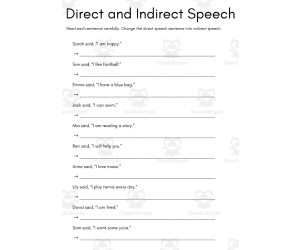
direct and indirect speech worksheet for grade 4
Grammar, Language Development, ELA, Grade 4, Worksheets & Printables
Introduction If you’re teaching direct and indirect speech and your students are having a hard time changing sentences correctly, this resource was made to give them extra practice in a simple and clear way. I created these exercises after noticing that many students understand the basic idea of reported speech but still struggle when changing pronouns, verbs, and commands correctly. So the goal here is just to give them enough repetition to feel more confident. Objective: Students will practice and reinforce their understanding of direct and indirect speech by working through a variety of straightforward grammar activities. What’s Included: 5 no-prep grammar exercise sections Practice with direct speech and indirect speech Practice changing commands into reported speech A mix of activities such as sentence rewriting, multiple choice, and fill in the blanks Answer key included Grades / Ages: Best suited for Grade 4 students or beginner English learners Implementation Format: Printable PDF Non-editable Easy to print and use for classwork, homework, or review Works well for independent practice or whole-class activities
Author MultiLingual Grammar Lab
Rating
Tags Direct And Indirect Speech, Worksheet For Grade 4

ESL Vocabulary Flashcards - Jobs - Pictures
ELA, Language Development, ESL, Vocabulary, Middle School, Not Grade Specific, High School, Adult Education, Worksheets & Printables, Flashcards, Worksheets
ESL Vocabulary Flashcards - Jobs - Pictures This high quality English language teaching resource is designed for students learning English as a second or foreign language . It includes 4 printable PDF pages featuring vocabulary flashcards and worksheets centered around the theme of "Jobs" This ESL Vocabulary Flashcards on "Jobs" Worksheets Activity can be ideal for Beginner level ESL - EFL - TESOL learners, including newcomers and English language learners of all ages. 🌟 What's Included? In this ESL Vocabulary Flashcards Activity on " Jobs ", there are provided: ✅ 40 Printable Flashcards (4 Printable PDF worksheets) ✅ Essential vocabulary and phrases in English ✅ Engaging icons and emojis on select flashcards to support comprehension and vocabulary retention (not all flashcards) 🏫 Who Can Benefit from This Resource? 📌 Beginner ESL - EFL students looking to improve their English vocabulary 📌 Newcomers & English Language Learners (ESL - EFL - TESOL -TEFL) in schools, tutoring sessions, or self-study 📌 Teachers and tutors looking for fun and engaging vocabulary building activities 📌 Language centers, homeschool educators, and ESL programs 🎯 How Does this ESL Teaching Resource Help you and your Students? ✨ Strengthens essential English communication skills ✨ Provides English vocabulary (ESL - EFL - TESOL - TEFL) for better understanding ✨ Encourages engaging learning with printable flashcards that can be used in various ESL - EFL (English Second or Foreign Language) class activities Whether you're an ESL teacher or an English tutor these ESL Vocabulary Flashcards on " Jobs " are a valuable and fun resource to improve basic conversation skills in English. Start learning today and make English introductions simple, engaging, and effective ! ESL with Alan is a Teaching Resources Store whose aim is to help English as a Second or foreign Language (ESL EFL TESOL) Teachers, Educators and Tutors around the world (be it online or offline) to achieve their teaching objectives while creating an enjoyable and stimulating learning environment. Learning is fun, So should English! Always If you want to browse more of my ESL, EFL, TESOL Teaching Resources, click here right ESL with Alan!
Author Learning with Alan
Rating
Tags ESL, English Second Language, English, Flashcards, Vocabulary, Jobs, Worksheets, Printable, Activity, Picture Cards
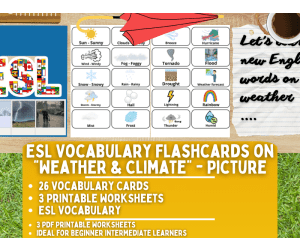
ESL Vocabulary Flashcards - Weather & Climate - Pictures
ELA, Language Development, ESL, Vocabulary, Middle School, High School, Adult Education, Worksheets & Printables, Worksheets, Flashcards
ESL Vocabulary Flashcards - Weather & Climate - Pictures This high quality English language teaching resource is designed for students learning English as a second or foreign language . It includes 3 printable PDF pages featuring vocabulary flashcards and worksheets centered around the theme of "Weather & Climate" This ESL Vocabulary Flashcards on "Weather & Climate" Worksheets Activity can be ideal for Beginner level ESL - EFL - TESOL learners, including newcomers and English language learners of all ages. 🌟 What's Included? In this ESL Vocabulary Flashcards Activity on " Weather & Climate ", there are provided: ✅ 26 Printable Flashcards (3 Printable PDF worksheets) ✅ Essential vocabulary and phrases in English ✅ Engaging icons and emojis on select flashcards to support comprehension and vocabulary retention (not all flashcards) 🏫 Who Can Benefit from This Resource? 📌 Beginner ESL - EFL students looking to improve their English vocabulary 📌 Newcomers & English Language Learners (ESL - EFL - TESOL -TEFL) in schools, tutoring sessions, or self-study 📌 Teachers and tutors looking for fun and engaging vocabulary building activities 📌 Language centers, homeschool educators, and ESL programs 🎯 How Does this ESL Teaching Resource Help you and your Students? ✨ Strengthens essential English communication skills ✨ Provides English vocabulary (ESL - EFL - TESOL - TEFL) for better understanding ✨ Encourages engaging learning with printable flashcards that can be used in various ESL - EFL (English Second or Foreign Language) class activities Whether you're an ESL teacher or an English tutor these ESL Vocabulary Flashcards on " Weather & Climate " are a valuable and fun resource to improve basic conversation skills in English. Start learning today and make English introductions simple, engaging, and effective ! ESL with Alan is a Teaching Resources Store whose aim is to help English as a Second or foreign Language (ESL EFL TESOL) Teachers, Educators and Tutors around the world (be it online or offline) to achieve their teaching objectives while creating an enjoyable and stimulating learning environment. Learning is fun, So should English! Always If you want to browse more of my ESL, EFL, TESOL Teaching Resources, click here right ESL with Alan!
Author Learning with Alan
Rating
Tags ESL, English Second Language, English, Flashcards, Worksheets, Printable, Weather, Climate, Vocabulary, Activity
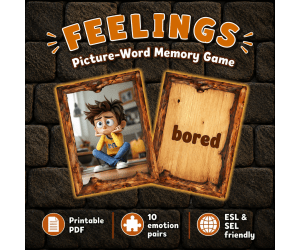
Feelings Picture-Word Memory Game | Printable SEL & ESL Activity
Vocabulary, Language Development, ELA, Not Grade Specific, Flashcards, Worksheets & Printables, Games, Activities
This Feelings Picture-Word Memory Game was created to help children practice emotions in a simple and hands-on way. Players match emotion pictures with the correct feeling words while building vocabulary, memory, and emotional recognition skills through play. The game includes 10 emotion pairs with expressive illustrations and matching word cards. The cards are easy to prepare — simply print, cut, and use for classroom games, partner activities, centers, or home learning. This resource works well for: • social-emotional learning activities • ESL and EFL lessons • vocabulary practice • matching games • memory games • speech and communication activities • small group work • learning centers • homeschool activities Included emotions: happy, sad, angry, bored, cold, hot, scared, tired, hungry, thirsty What’s included: • 5 printable PDF pages • 10 picture-word matching pairs • printable card backs • ready-to-print format The cards can be used in different ways depending on the age and level of the learners. Some students enjoy traditional memory games, while others use the cards for speaking practice, emotion discussions, or simple vocabulary review activities. This activity is especially useful for preschool, kindergarten, early elementary learners, ESL students, and children working on emotional awareness and communication skills.
Author English with Rita
Rating
Tags Feelings Game, Memory Game, Matching Game, SEL Activity, ESL Activity, Picture Word Game, Emotion Recognition, Vocabulary Activity, Printable Cards, Social Emotional Learning

4-Week High School Acounting Data Modeling & Payroll Compliance Unit
Math, Addition and Subtraction, Decimals, Fractions, Graphing, Money, Multiplication and Division, Percentages, Research, Resources for Teachers, Homeschool Resources, High School, Teacher Tools, Activities, Worksheets & Printables, Writing Prompts, Word Problems
As a homeschool mom and curriculum creator, this 4-week unit actually began at my kitchen table. My teenage daughter wanted to understand how real businesses manage money behind the scenes, but every resource I found felt overly complicated or painfully dry. So instead of settling for another boring textbook, I created this hands-on business simulation myself. In this unit, your teen will step into the role of a corporate data auditor and learn how to build responsive spreadsheet systems completely from scratch. Along the way, they will connect real-world business skills with practical math and professional software applications in a way that finally makes sense. INCLUDED IN THIS RESOURCE: Step-by-step corporate accounting office scenarios PowerPoint presentations with notes Instructor teaching objectives Complete grading tools TOPICS COVERED: Break-even modeling Payroll regulations and corporate procedures Advanced compensation Internal auditing Rather than assigning repetitive worksheets and busywork, this unit encouraged my daughter to think like capable young professional and problem solve by solving real confidence using spreadsheets in authentic business scenarios. My own daughter learned these exact spreadsheet systems, and watching her develop practical, real-world skills was incredibly rewarding. She was able to articulate what adjustments needed to be made and why she made them. Because of that experience, I wanted to create something that would give other homeschool families the same sense of accomplishment and growth. If you and your homeschooler enjoy this resource, I would truly appreciate you leaving a review. Thank you so much for your support, and I hope this unit becomes a valuable part of your homeschool journey! Tina - Big Easy Homeschooling Mom Please note: All resources are digital products and nothing physical will be sent to your home. © Big Easy Homeschooling Mom, 2024 to present. All rights reserved. This resource is for personal classroom/homeschool use only by the original purchasing teacher/homeschool parent. It may not be distributed, shared, or used by others. Additional licenses are required for multiple users or classrooms/homeschools.
Author Homeschool with Big Easy Homeschooling Mom
Rating
Tags High School Accounting Curriculum, Excel Payroll Project, Homeschool Business Elective, Secondary Financial Literacy, Teen Bookkeeping Course, Spreadsheet Design Lab, Student Budgeting Project, Business Lesson Plans Teen, High School Finance Lab, Teen Life Skills Finance
Data Literacy & Statistics Interpretation Worksheets
Math, Addition and Subtraction, Addition, Subtraction, Algebra, Decimals, Early Math, Basic Operations, Fractions, Money, Homeschool Curriculum, Homeschool Templates, Grade 9, 10, 11, 12, Worksheets & Printables, Workbooks, Worksheets, Word Searches, Teacher Tools, Assessments, Lesson Plans, Quizzes and Tests, Quizzes, Tests
Would you like to help your students change from passive number crunchers into well-reasoned and critical thinkers? Move beyond rote memorization of the formulae and do it with this comprehensive curriculum on Data Literacy and Statistics for the 21st century designed to develop true analytical abilities. In an age of information overload, misinformation and distorted graphs, being statistically literate is no longer just a luxury; it is now an important life skill. This resource, designed as an all-in-one digital resource for high school and beginning college courses will give you everything needed to assist you in taking your students on a journey beginning with core theory and continuing on through to real-life application. This curriculum is not just another packet of math problems; it is a model for thoughtful analysis. Through engaging and relevant examples (from e-sports to medical research) and very rigorous examples, students will go beyond "what" to "why" by learning to ask the right questions about data, being aware of bias, breaking down faulty or misleading visuals and understanding the key differences between “correlation” and “causation.” Overall, this unit will help to develop and solidify the most abstract ideas into something tangible and recognizable. WHAT'S IN THE PACKAGE (A 45 PAGE PDF Document): The Basic Content/Information/Theory through the First Phase of the Course consists of: A 14-page "textbook" style document outlining the theoretical basis for the terms used to describe data. The Anatomic Scale of Data: Qualitative, Quantitative, Discrete, Continuous) includes Levels of Measurement The Descriptive Norm: Mean, Median, Mode, Variance, Standard Deviation, Interquartile Range Data visualisation and misrepresentation (Example of Anscombes Quartrant Analysing the Measurement by Each Year) Uses of Truncated Axes, The Bubble Fallacy, Probability Correlation (and Causation) Spurious Correlations Confounding Variables Phase 2: Student Workbook: Contains 10 interactive/interactive-question workbooks, 20 pages total, allows for students to apply theory Includes: Categorical vs Quantitative Data Contextualising Mean/Median/Mode Variance/Spread/Dispersion Histograms/Boxplots Correlation vs. Causation Probability/Expected Value Sampling Methodology/Bias Normal Curve (68-95-99.7 Rule)/Z Scores Margins of Error/Confidence Interval Ethics of Metrics/Misleading Statistics Visuals and Resources for the Teacher Phase 3: - Three high quality conceptual images (SVG) [of the PPDAC cycle, shapes of distributions, confounding variables]. Ideal for displaying in the classroom or giving to students as handouts. - A seven (7) page teacher answer key that not only provides the answers, but also includes pedagogical rationales for each answer to facilitate effective classroom discussions and increase comprehension of all students. This product is applicable for use in conjunction with a full unit of study for a statistics course; supplement for an Algebra 2 or Pre-Calculus class; an AP statistics review; or a homeschool curriculum. Support your students’ development of statistical literacy as a defence against data manipulation! With this product, you can help to increase the statistical literacy of your students, contributing to a data savvy world! Order now to begin creating a data savvy generation! Key Words: Data Literacy, Statistics Worksheets, AP Statistics, High School Math, Mean Median Mode, Correlation Causation, Normal Distribution, Z-Scores, Data Visualization, Critical Thinking, Real World Data, Statistics Project, Answer Key Included, Digital Resource, Printable PDF, Descriptive Statistics and Sampling Bias. Parents/Schools appreciate this product for: Real-World Critical Thinking: The curriculum helps students become good consumers of information. Students learn how to recognize deceptive story lines in reporting, flawed research, or deceptive advertising, which is critical to success in the 21st century. Everything in One Product: All of the material has been provided in one package, including theory, student worksheets, visual aids, and a teacher answer key. The result is significant time savings for teaching (by providing everything you need), while still allowing student use of all materials during class time. Making the Connection between Math and Real Life: This product uses relevant, current examples (i.e., E-Sports, crime rates, and medical research) to answer the age-old question of students, "When will I ever use this?" Promoting Deep Levels of Understanding: The curriculum pushes students to think beyond simple math calculations and instead challenges them to interpret, analyze, and justify their work. By focusing on the "why," students have a deeper understanding of the concepts, which is longer lasting. Intended Audience as Related to Statistical Concepts: Statistical Concepts such as (Z Score, Confidence Interval, Simpson's Paradox), Target Grades: Grades 10-12 - Target Grades (AP Statistics, Pre Calc, Advanced Algebra II with a Statistics Unit), would also be an excellent choice for standalone Honors Statistics Course Intro College Students - Target College Students for a STAT 101 or another introductory Statistic Courses for non-Math Majors in the social science, Business or Health Science fields Advanced Home School Students - Parent Home Schooling their High School Children would find this curriculum complete & thorough. Copyright / Terms of Use for Content : The copyrighted licensing for this book is owned by Syed Hammad Rizvi, for singular and non-commercial use only. No alterations or sales of this item or use of any part of the content on the internet is allowed. If it is necessary, then you can purchase multiple licenses from TpT to provide to your members and colleagues who are working with you as an employee, but you cannot place anything on the internet and allow it to become publicly accessible for downloading and/or use. If you would like to share this resource with other teachers, please go to Teachsimple to purchase additional licenses. Thank you for your respect of the copyright and for supporting the above terms of use. This product and resources are provided to you by Syed Hammad Rizvi.
Author Creative Book Store
Rating
Tags Statistics, DataLiteracy, APStatistics, Stats, HighSchoolMath, DataAnalysis, StatisticalAnalysis, DataScienceForStudents, Math, MeanMedianMode
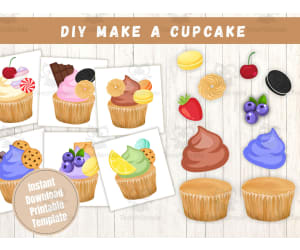
Paper games - Make your own Cupcake DIY activity
Art, Creative Arts, Montessori, Early Learning, Pre-K, Activities, Games
Build their memory and play some games with this make your own cupcake game activity. This is such an easy printable activity. All you need to do is print it out, cut and play. As simple as ABC. You get to enjoy several ways to play this game such as: Make it a memory activity Make it a sell and buy activity Make it a order in activity Make it a free and easy activity Make it a be creative activity What you will get: 2 PDF files with 8 pages of the ready to cut make a cupcake template in A4 size and US letter. 1 JPEG folder 1 SVG folder 1 PNG folder Extra Info: If you gonna print using a cutting machine, please use the option flatten or print then cut as this SVG files is not the layered SVG files. When you upload the SVG file into your software, it may shrink the file as well. To maintain the size, you can choose to use PNG file which save you much time to resizing it. Recommendation: Suggested to use thick paper weighted 120-160gsm for this craft Laminated the cut out images for a longer usage Takes about - Approx. 30-40 mins for the whole creation Suitable for children aged 4 and above Happy creating...
Author Jenstrokeandstyle
Rating
Tags Paper Games, Cupcake Making, DIY Cupcake, Cupcake Games, Paper Craft For Kids, Make A Cupcake Puzzle, Cupcake Activity, Screen Free Activity, Printable Games, DIY Project
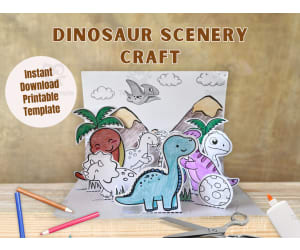
Dinosaur Colour and Play Scene Printable activity
Creative Arts, Grade 1, 2, Activities, Crafts, Games, Coloring Pages, Worksheets, Worksheets & Printables
This is such a fun and engaging activity as you get to color, cut then glue the dinosaur on to the scenery card that make kids learn more about dinosaur. With this print, colour, cut and story telling scenery activity, kids get to stay away from screen and have time to be creative and enjoy the time together as family or with friends. What you will get: 2 PDF files with 6 pages of the template in A4 size and US letter. Recommendation: Suggested to use paper weighted 80-100gsm for this template Takes about - Approx. 20-30 mins for the whole creation Suitable for children aged 7 and up but younger kids may need help from an adult to cut, and assemble it for them What do you need: You need printer to print the template Scissor to cut Crayon or colour pencils Glue or double sided tape When you decided to download this activity, you will receive a zip folder and in the zip folder, you get to choose what file you want to print on your printer. The file is in PDF format. Happy colouring and creating.
Author Jenstrokeandstyle
Rating
Tags Dinosaur, Dinosaur Colouring, Paper Toys, Dinosaur Play Scene, Color And Play Activity, Screen Free Activity, Classroom Craft, Craft For Kids, Printable Craft, Craft Making
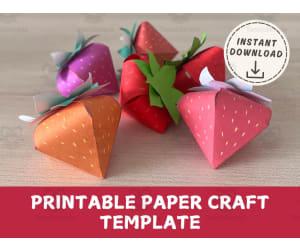
Make your own 3D strawberry paper toys, craft activity
Art, Creative Arts, Montessori, Not Grade Specific, Activities, Crafts, Classroom Decor
This is such a fun and engaging paper craft. Not only that it's pretty in color, cute in looking, it's pretty easy to make as well. Just download, print and color the strawberry follow with folding and glue them, then you have yourself a 3D fruit strawberry. What you will receive: 1 PDF files with 4 pages of the Strawberry craft template in A4 and US letter size. 1 SVG folder 1 JPEG folder 1 PNG Folder Include video tutorial in PDF files For your info: If you gonna print using a cutting machine, please use the option flatten or print then cut as this SVG files is not the layered SVG files. When you upload the SVG file into your software, it may shrink the file as well. To maintain the size, you can choose to use PNG file which save you much time to resizing it. Recommendation: Suggested to use paper weighted 80-100gsm for this craft Takes about - Approx. 20-30 mins for the whole creation Suitable for children aged 7 and up but younger kids may need help from an adult to cut, and assemble it for them
Author Jenstrokeandstyle
Rating
Tags Strawberry , Strawberry Craft, Fruit Craft, Craft For Kids, DIY Strawberry , Paper Craft, DIY Craft, Screen Free Activity, Indoor Activity

DIY Make your own Cake Slice Paper craft and toys
Art, Creative Arts, Montessori, Elementary, Pre-K, Not Grade Specific, Activities, Crafts
When it comes to cake, everyone love to have one slice of Cake. So, why not make your own Paper Cake as one of the fun screen free activity bonding time. This is an easy DIY 3D Cake Slice paper craft that are suitable for any ages and prefect for classroom or home decor.. All you need to do is download, print, color, cut and assemble it. What you will get: 1 PDF files with 7 pages of the template (Include the strawberry template) 1 SVG folder 1 JPEG folder 1 PNG Folder Video tutorial is included in PDF file Note: If you are cutting this with a cutting machine, please use the option, flatten or print then cut as this is not designed as a layered SVG but a print then cut kind of SVG. So make everything easier, you can use the PNG file as well. More info: The paper weighted 80-100gsm are recommended The whole craft may take up to - Approx. 20-30 mins Suitable for Ages 7 and up, however, younger kids may need you to help them to cut the template
Author Jenstrokeandstyle
Rating
Tags DIY Project, Cake Slice, Paper Craft, Craft For Kids, Cake Making DIY, Coloring Craft, Craft Activity, Screen Free Activity, Cut And Paste , Indoor Activity