



2,706 products added recently
Page 4 - Science Assessments
Provide comprehensive science assessments covering biology, chemistry, physics, and Earth science. This collection includes lab reports, concept checks, and experimental evaluations. Foster a deeper understanding of scientific principles by using targeted assessments.

 Show filters

Television Reading Comprehension Passage - Cored Ed Encyclopedia
ELA, Language Development, Reading Comprehension, Reading, Pre-Reading, Science, Technology, Engineering, History, Social Studies, Grade 2, 3, 4, 5, Worksheets & Printables, Worksheets, Teacher Tools, Centers, Activities, Writing Prompts, Assessments, Quizzes and Tests, Quizzes, Lesson Plans
This television reading comprehension includes: Visualization (on the front cover) Start your lesson by taking a minute to think and share something about the topic. Read the script aloud (slowly), perhaps prepare some music or sound effects. Student close their eyes and let their imaginations wander. Students open their eyes, read the question aloud and give them a few minutes to complete. Ask a few students to share or keep answers until the end to compare with what they learn in the passage. Quick pause—thousands of Cored Education products are included with your TeachSimple membership. Download links and encyclopedia index available here. Pre-Reading Trivia Students will write down one thing they already know about the subject and then read five more facts and discuss. These facts are fun, and the students will enjoy learning about the subject before reading more. Give 1 minute for students to write what they already know (no pressure—best guess is fine). Read the five facts together. After each fact, do ask a student for their opinion, was it surprising? Set a purpose by asking students to highlight/underline one fact they want to learn more about during the reading. Reading Passage The text is a high-interest reading passage with set paragraphs, roughly three to four paragraphs long. It contains a variety of themes about the topic, anywhere from history to technology. The passage is between 250 and 350 words in length. First, ask students to look at the headings and see what they’ll learn about today. What do they know about the topic/heading? First read options: Teacher read-aloud (best for support). Partner reading (paragraph by paragraph). While reading, students underline important details, and vocabulary words they think may come up in the questions section. Mixed Questions The first question page contains four multiple-choice questions, each with a choice of four answers, and three written response questions that require a sentence or two from the student. Students complete the mcqs first independently, then review quickly as a class. For the 3 written responses, try to get students giving the answer with some form of evidence: “I think ___ because the text says ___.” If students get stuck, send them back to check the passage. Vocabulary Questions Practice seven key words from the text in this section across two activities. First section is scrambled words where students will unscramble three words given a clue for each. The second section is a word to meaning matching activity. Before starting, have some students read out words they underlined in the passage. Ask students to say the word and read aloud the sentence(s) around each word. Ask students to do scrambled words and the matching exercise in pairs then go through answers as a class. For the scrambled spelling task, get four pairs to come up to the board and write the words for extra practice with the other student reading out the clue. For the matching task, prompt students to give full sentences: “I matched ___ with ___ because ___.” Creative Writing In this question, the student will be required to write a five to eight sentence paragraph on a question related to the topic. Before starting, ask students write down 3 key ideas they are going to include in their piece. Ask students for ideas to share around the class to help those struggling. Pro writing expectations: 5–8 sentences At least 2 facts or details from the passage At least 2 vocabulary words from the previous page Students read their paragraphs while classmates listen for facts and vocabulary words. Extension Activities This page is optional for fast finishers or to take home. There are several activities, each one requiring a different skill. Do some, do none, do all, completely optional - but you will feel reassured knowing every possibility is planned for. Includes summary writting question. Answer Key There are answers for the multiple-choice questions, written response questions have sample answers, vocabulary answers and if there is a summary question then a sample summary will be provided as well. Lesson Plan Included Customized lesson plan for this lesson is included. Lesson Snapshot Title: Television Genre: Nonfiction (informational text) Subject: Science (Technology) Primary Topic: How television changed from mechanical to digital Estimated Guided Reading Level (A–Z): S What This Lesson Teaches Best How an invention changed over time, from a “spinning disk” experiment to modern screens and signals. Key milestones in television’s development (1925 Selfridges demo, 1927 Farnsworth, 1936 BBC service, late 2000s flat-panels). How pictures can be broken into lines/signals and sent by wire, radio, antenna, cable, or internet. The shift from black-and-white to color broadcasts and how viewers experienced that change over decades. Comparing analog and digital signals as two different ways information travels. Learning Goals Students will describe how early television used a spinning Nipkow disk to scan pictures into lines. Students will identify key people, places, and dates from the passage (Baird, Farnsworth, Selfridges, Alexandra Palace). Students will explain how television changed from mechanical parts to all-electronic systems that made clearer pictures. Students will summarize how TV viewing changed from bulky cathode-ray tubes to flat-panel screens and high-definition images. Students will compare analog and digital signals using details from the text. Key Vocabulary From the Text scan — break a picture into lines to send it. signals — messages that carry picture or sound information. broadcasting — sending TV so many people can receive it. analog — a smooth, continuous wave way of sending. digital — coded bits that travel more cleanly. FULL CATALOG OF DOWNLOAD LINKS AND ENCYCLOPEDIA INDEX HERE
Author Cored Education
Rating
Tags Vocabulary, Reading Comprehension, Reading Passages, Lesson Plans, Ela Lesson Plans, Reading Comprehension Lesson Plans, Pre-reading, History, Social Studies, Social Studies Lesson Plans
Arctic Reading Comprehension Passage - Cored Ed Encyclopedia
ELA, Language Development, Resources for Teachers, Reading Comprehension, Reading, Pre-Reading, Strategies, Science, Geography, Social Studies, Grade 2, 3, 4, 5, Worksheets & Printables, Worksheets, Teacher Tools, Centers, Activities, Writing Prompts, Assessments, Tests, Quizzes and Tests, Quizzes
This Arctic reading comprehension contains the following: Pre-Reading Trivia Students will write down one thing they already know about the subject and then read five more facts and discuss. These facts are fun, and the students will enjoy learning about the subject before reading more. VIDEO NOW AVAILABLE (EMBEDDED AFTER PREVIEW PICTURES IN PRODUCT DESCRIPTION) Reading Passage The text is a high-interest reading passage with set paragraphs, roughly three to four paragraphs long. It contains a variety of themes about the topic, anywhere from history to technology. The passage is between 250 and 350 words in length. Mixed Questions The first question page contains four multiple-choice questions, each with a choice of four answers, and three written response questions that require a sentence or two from the student. Creative Writing In this question, the student will be required to write a five to eight sentence paragraph on a question related to the topic. Extension Activities This page is optional for fast finishers. If there are five to ten minutes left at the end of the lesson, the student can choose one of three activities, each one requiring a different skill. Answer Key There are answers for the multiple-choice questions and three written response questions have sample answers. FULL CATALOG OF DOWNLOAD LINKS AND ENCYCLOPEDIA INDEX HERE Cored Ed Encyclopedia Overview The Cored Ed Encyclopedia is a weekly series of lessons that you can pick up and use right away. These short readings fit into whatever time you have available. Each one includes a warm-up, a reading, and a set of questions, but it’s flexible — you can do just the reading, the full lesson, or skip the writing section if you need to. Each lesson focuses on a single topic so students don’t get lost. The writing is clear but never childish, making it perfect for grades two through five. Topics range from animals and science to history, inventions, and everyday things. No matter the level of the student, everyone should take away at least one new idea or fact from each lesson. The materials are easy to print, easy to explain, and require no setup. They work well for whole-class teaching, partner work, or independent study.
Author Cored Education
Rating
Tags Vocabulary, Spelling, Reading Comprehension, Reading Passages, Cored Encyclopedia, Facts, Reading, Geography, Arctic, Science
High School The Living Cell: Energy, Structure, and Function Bundle
ELA, Reading, Writing, Research, Resources for Teachers, Science, Biology, Life Sciences, Homeschool Resources, High School, Teacher Tools, Assessments, Lesson Plans, Quizzes and Tests, Worksheets & Printables, Writing Prompts
This comprehensive High School The Living Cell: Energy, Structure, and Function Bundle is more than just a collection of readings; it is a meticulously curated learning experience designed to empower your high school student/homeschooler. By integrating these interconnected topics—cellular structure, photosynthesis, and cellular respiration—students/homeschoolers will develop a holistic understanding of how life functions at its most fundamental level. This deep dive into core biological processes not only fosters a genuine appreciation for the complexity of living systems but also provides an invaluable academic advantage for college prep, laying a robust groundwork for! future science courses and assessments. It is my hope that these resources will inspire curiosity and cultivate a lifelong love for science in your student/homeschooler, preparing them for academic excellence. INCLUDED IN THIS RESOURCE: Three comprehensive reading passages covering key biological topics. Engaging Question & Answer sections to reinforce understanding. Five note-taking sheets per resource, designed for active learning. A complete bundle of essential high school biology concepts. TOPICS COVERED: The intricate chemistry of photosynthesis and its vital role in life. Cellular respiration, detailing how cells extract energy for survival. An in-depth exploration of cell structure and the functions of organelles. Fundamental processes that define life at the cellular level. What sets this High School The Living Cell: Energy, Structure, and Function Bundle apart is how thoughtfully everything connects together. Rather than teaching these topics in isolation, I have woven cellular structure, photosynthesis, and cellular respiration into a cohesive learning experience that shows students/homeschoolers how life actually works at the cellular level. Through my own journey homeschooling, I have learned that when students see these connections, biology suddenly makes sense in a way it never did before. This is not just about passing tests—though it certainly prepares students/homeschoolers well for assessments and future science courses. It is about building that genuine curiosity and understanding that will serve your student/homeschooler throughout their academic journey and beyond. I truly believe these resources can spark a love for science that lasts a lifetime. If you and your students/homeschoolers, enjoyed this resource, please leave a review. Thank you for your support! Tina - Big Easy Homeschooling Mom
Author Homeschool with Big Easy Homeschooling Mom
Rating
Tags High School Biology Curriculum For Homeschool, Understanding Photosynthesis And Cellular Respiration, Detailed Guide To Cell Structure And Function, Teaching Cellular Processes To High Schoolers/homeschoolers, Explore The Building Blocks Of Life High School, Essential Biology Concepts For Advanced Study, Photosynthesis Steps And Importance, Homeschool Science Curriculum High School, Foundational Biology For Future Studies, High School Science Curriculum Suppor
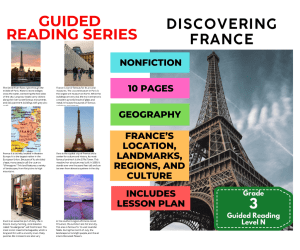
Discovering France: Guided Reading Level N with Lesson Plan
ELA, Resources for Teachers, Reading Comprehension, Reading, Science, Language Development, Vocabulary, Geography, Social Studies, Technology, Grade 2, 3, 4, Worksheets & Printables, Worksheets, Teacher Tools, Centers, Activities, Literacy Readers, Quizzes, Quizzes and Tests, Assessments, Lesson Plans
This Discovering France (level n) guided reading book with lesson plan includes: Guided Reading Color Label (front cover x1) This is a quick way to match the book’s demands to what students can generally handle.. The overall goal is to use the level/color to pick books for several smaller groups. To qualify for a certain level, a student is expected to read a book from that level with about 90–94% accuracy. If a student is consistently accurate and understands, move up a level. If the student is struggling at that level, drop down and add more support. Each student will improve at completely different rates, but it is generally one of the best ways to check progress across the class. DOWNLOAD THE CATALOG TO VIEW ALL GUIDED READING BOOKS AVAILABLE (SORTED LEVELS A-Z) Pre-Reading Question (x1) Teacher asks the prompt aloud, can be while showing the cover or first page. Students share what they already know, or make educated guesses from the cover. Prompt them to use the target vocabulary. Write some of their responses on the board to look back at during the reading. Vocabulary Words (x5) Introduce the five words, best doing it one at a time. Start by saying it, while students repeat and then see if anyone knows what it means before reading further. Read through the meaning and try to briefly connect each word to a picture or gesture so it’s meaningful. Ask students to flip through the book pages and point to where they see each of the vocabulary words. While reading the book pause upon coming across one of the vocab words or read the sentence twice to make sure students understand the word has appeared. Optional: Ask students to raise hands whenever they see/hear one of the new words. Guided Reading Pages (x10) Check the book snapshot (below) for: primary topic - do you need to prep extra reading or intro materials on this? what is taught best - decide on 1-2 bullets to focus on, use the prompt or words provided here for best results. learning goals - what you are checking for students to be able to do after the session, elicit answers using prompts or words provided. key vocabulary (see section above). questions overview - so you know what is coming up and if you need to prep extra materials to assist understanding. Run the lesson You may have already looked at a few of the pages together, but you can show them some of the pictures again first to set meaning. Depending on how much time you have and how familiar your students are with guided reading class, you may want to read the book aloud first with the group first. Students whisper or partner read, while you listen in. If time, do it as a group, one student reading a page each. Use the guided page’s prompts to coach: “Check the picture / does it make sense?” “Point under the words / try the first sound” “Reread the sentence smoothly”. Try to focus more on one student per session (rotating every time), so you can work out if they are ready to move up or need to move down a level. Comprehension Questions (back cover x3) This is your way to check that students didn’t just say the words, but actually understood the text. First, let students answer by pointing to the page/picture and saying a short sentence. After any answer, follow with: “Show me where you found that in the text.” In bigger groups, have partners answer first (10–20 seconds), then call on 2–3 students to share. Differentiation tips: Emerging speakers/struggling readers: oral + pointing On-level: oral in a full sentence Higher: one written sentence or draw + label Book Snapshot Title: Discovering France Genre: Nonfiction Subject: Social Studies (Geography/Culture) Primary Topic: France’s location, landmarks, regions, and culture Estimated Guided Reading Level (A–Z): N What This Book Teaches Best Geography basics about France , including where it is located and how its shape leads to a nickname. Key places and landmarks in Paris , such as the Eiffel Tower, the Seine River, and the Louvre Museum. Regional features of France by describing Provence, the French Alps, the French Riviera, and the Loire Valley. French culture and daily life , especially food traditions like boulangeries, baguettes, and croissants. Modern transportation in France , focusing on the TGV high-speed train and what it allows people to do. Learning Goals Students will identify where France is located and explain why it is called “L’Hexagone.” Students will describe at least two facts about Paris, including details about the Eiffel Tower. Students will explain how the Seine River is described and what people can see from boats on the river. Students will describe characteristics of at least two French regions (Provence, the Alps, the Riviera, or the Loire Valley) using details from the text. Students will describe examples of French culture from the text, including food and museums. Students will explain what the TGV is and how it changes travel across France. Key Vocabulary From the Text landmark — a famous place many people recognize. massive — very big. coastline — the land’s edge next to the sea. lavender — a purple plant/flower that can smell sweet. transportation — ways people travel from place to place. Discussion Prompts Pre-reading question: What do you already know about France, and what would you like to learn? Comprehension questions: Where does the text say France is located, and what nickname do some people give it because of its shape? Comprehension questions: What does the text tell you about the Eiffel Tower (such as when it was built or how tall it is)? Comprehension questions: Choose one region from the book (Provence, the French Alps, the French Riviera, or the Loire Valley) and describe two details the text gives about it. Printing Tips 1. Best Printing Method (Recommended) “Booklet” Printing (Best if Available) If your printer or PDF viewer supports Booklet Printing , use this. Settings to use: Print mode: Booklet Paper size: Letter or A4 (either works) Orientation: Landscape Print on both sides: Yes Flip on: Short edge Scaling: Fit to printable area Booklet subset: First test: Front sides only Then: Back sides only This will automatically: Pair pages correctly Put the cover on the outside Align everything for folding After printing, fold in half and staple along the spine . 2. If “Booklet” Printing Is NOT Available You can still print this correctly with manual duplex printing . Step-by-step: Open the PDF. Choose Print . Set: Orientation: Landscape Pages per sheet: 1 Print on both sides: Yes Flip on: Short edge Print all pages . Because each PDF page already contains two facing book pages, the result will still fold cleanly into a book. Thousands of Cored Education products are included with your TeachSimple membership. Download links and encyclopedia index available here.
Author Cored Education
Rating
Tags Reading Comprehension, Reading Passages, Reading, Guided Reading, Guided Reading Lesson Plan, Guided Reading Activity, Pre-reading, Social Studies, Geography, Technology
Reading Passages on Weather and Solar System (PPT)
ELA, Reading, Reading Comprehension, Science, Earth and Environmental Sciences, Earth Sciences, Common Core, ESL, Language Development, Vocabulary, Grade 5, 6, 7, Teacher Tools, Presentations, Assessments, Tests, Quizzes and Tests
Reading Passages on Weather and Solar System for Earth Science Weather and Solar System: Reading Passages Earth Science - Elevate your teaching approach with these well-crafted reading comprehension worksheets, tailored to enhance your students' grasp of scientific concepts. Boasting diverse question formats and engaging articles, these resources allow for a seamless integration into your curriculum , providing peace of mind that the majority of the prep work has been expertly handled on your behalf. Dive deep into captivating subjects such as the sun, the enigmatic moon, and the ever-changing dynamics of weather, offering students a comprehensive and intriguing learning experience. What's inside? Part 3 - Weather & Solar System Reading Passage 1: Earth Moon and Sun Reading Passage 2: Weather Measurement Causes and Changes Reading Passage 3: Classification of the Sun and Other Stars Reading Passage 4: Inner and Outer Solar System Product Info: 147 Slides (US English with Answers) Teaching Duration: 2 Weeks Science Reading Comprehension Outline: Introducing a comprehensive resource tailored for 5th and 6th graders, this product offers enriching reading passages supplemented with illustrative pictures and graphs to clarify key concepts. Aligned with the Common Core State Standards (CCSS), it offers a hassle-free approach to teaching, given that the bulk of the preparation is already done for you. The passages present a diverse set of questions – from multiple choice to data analysis and fill-in-the-blanks. This ensures a rich blend of high-interest content and fundamental curriculum-based science themes. With its versatility, you can seamlessly integrate these lessons into various classroom settings, whether it's whole class discussions, morning exercises, independent desk tasks, small group engagements, contingency plans for substitute teachers, regular homework assignments, or even themed activities for holidays. FULL CATALOG OF DOWNLOAD LINKS HERE Grade 5/6 Links: Physical Science Part 1 - Physical and Chemical Properties Google Docs/Slides/Forms PDF PPT Word Free Supplementary Pack Accompanying Videos Physical Science Part 2 - Motion and Energy Google Docs/Slides/Forms PDF PPT Word Free Supplementary Pack Accompanying Videos Physical Science Part 3 - Electricity and Magnets Google Docs/Slides/Forms PDF PPT Word Free Supplementary Pack Accompanying Videos Life Science Part 1 - Cells, Reproduction and Genetics Google Docs/Slides/Forms PDF PPT Word Free Supplementary Pack Accompanying Videos Life Science Part 2 - Human Body Systems Google Docs/Slides/Forms PDF PPT Word Free Supplementary Pack Accompanying Videos Life Science Part 3 - Plant Parts and Ecosystems Google Docs/Slides/Forms PDF PPT Word Free Supplementary Pack Accompanying Videos Earth Science Part 1 - Plate Tectonics and Rock Cycle Google Docs/Slides/Forms PDF PPT Word Free Supplementary Pack Accompanying Videos Earth Science Part 2 - Ocean Exploration and Natural Resources Google Docs/Slides/Forms PDF PPT Word Free Supplementary Pack Accompanying Videos Earth Science Part 3 - Weather and Solar System Google Docs/Slides/Forms PDF PPT Word Free Supplementary Pack Accompanying Videos For similar products and other frees, do check out Cored Group on TeachSimple .
Author Cored Education
Rating
Tags Science, Elementary, Reading, Comprehension, Vocabulary, Answers, Common Core, Reading Comprehension Presentations, Earth Science, Earth Science Presentations

Reading Comprehension: Properties of Objects and Materials (Word File)
ELA, Reading, Science, Physics, Common Core, ESL, Language Development, Vocabulary, Chemistry, Grade 2, 3, 4, Worksheets, Worksheets & Printables, Assessments, Teacher Tools, Tests, Quizzes and Tests
Reading Comprehension: Properties of Objects and Materials for Physical Science This comprehensive package Properties of Objects and Materials: Reading Passages Physical Science enables your students to practice reading strategies and learn essential science topics for the week. All of this is made easier by the fact that the bulk of the work is already completed for you. Physical properties and states of matter are the focus of the reading materials. What's inside? Part I Passage 1: Observable Physical Properties of Objects & Materials Passage 2: Measuring Physical Properties Passage 3: Classification of Matter Passage 4: States of Matter Passage 5: Change of Phase Product Info: 28 pages Teaching Duration: 2 Weeks Science Reading Comprehension Outline: Targeted for students in 3rd and 4th grades, these reading passages are enhanced with illustrations and graphs to elucidate critical points. Each lesson aligns with the Common Core State Standards, allowing you to integrate science reading practice effortlessly, knowing that minimal preparation is needed on your part. Each passage comes with a variety of questions in different formats, including multiple-choice formats, data analysis, and fill-in-the-blanks. The topics covered strike a balance between engaging content and core curriculum-based science subjects. Versatile in application, these lessons are suitable for a variety of settings such as whole-class instruction, morning activities, independent desk work, small group discussions, contingency plans for substitute teachers, homework assignments, or even special holiday-themed tasks. FULL CATALOG OF DOWNLOAD LINKS HERE Grade 3/4 Links: Physical Science Part 1 - Properties of Objects and Materials Google Docs/Slides/Forms PDF PPT Word Free Supplementary Pack Accompanying Videos Physical Science Part 2 - Position and Motion of Objects Google Docs/Slides/Forms PDF PPT Word Free Supplementary Pack Accompanying Videos Physical Science Part 3 - Light, Heat, Electricity, Magnetism Google Docs/Slides/Forms PDF PPT Word Free Supplementary Pack Accompanying Videos Life Science Part 1 - Characteristics of Organisms Google Docs/Slides/Forms PDF PPT Word Free Supplementary Pack Accompanying Videos Life Science Part 2 - Life Cycles of Organisms Google Docs/Slides/Forms PDF PPT Word Free Supplementary Pack Accompanying Videos Life Science Part 3 - Organisms and Environments Google Docs/Slides/Forms PDF PPT Word Free Supplementary Pack Accompanying Videos Earth Science Part 1 - Properties of Earth Materials Google Docs/Slides/Forms PDF PPT Word Free Supplementary Pack Accompanying Videos Earth Science Part 2 - Changes in the Earth and Sky Google Docs/Slides/Forms PDF PPT Word Free Supplementary Pack Accompanying Videos Earth Science Part 3 - Objects in the Sky Google Docs/Slides/Forms PDF PPT Word Free Supplementary Pack Accompanying Videos For similar products and other frees, do check out Cored Group on TeachSimple .
Author Cored Education
Rating
Tags Science, Elementary, Reading, Comprehension, Vocabulary, Physics, Physical Science, Reading Comprehension Assessments, Science Assessments, Vocabulary Assessments

Drone Data Detectives:Mastering UAVs for Environmental Mapping
Research, Community Building, Resources for Teachers, Science, Earth and Environmental Sciences, Earth Sciences, Environmental Science, Geology, Space, Life Sciences, Grade 2, 3, 4, 5, 9, 10, 11, 12, Activities, Centers, Experiments, Labs, Assessments, Teacher Tools, Graphic Organizers, Lesson Plans, Outlines, Literacy Readers
Get ready for the ultimate in drones and environmental science with "Drone Data Detectives: Mastering UAVs for Environmental Mapping & Climate Monitoring." The comprehensive high school STEM book on drones deepens the knowledge of teens into the world of Unmanned Aerial Vehicles, making them drone pilots, data analysts, and environmental stewards. This key resource covers everything needed to take raw drone data and develop actional insights in support of climate change monitoring, conservation, agriculture, and disaster response-from the basics in drone piloting and safety regulations to planning flights, and from the advanced sensors that capture aerial data, such as thermal imaging and multispectral cameras, to LiDAR. Packed full of real-world missions, ethical considerations, GIS analysis techniques, machine learning applications, and project-based learning, it is a no-brainer for aspiring scientists interested in remote sensing, photogrammetry, vegetation health metrics, and sustainable technology. This is an ideal textbook for grades 9-12 classrooms, great for homeschooling, or self-study, this book aims to fire up the theoretical teaching with practical skills in order to inspire the next generation of eco-innovators. Keywords: drone education for teens, UAV environmental mapping, climate monitoring drones, STEM books high school, data analysis environmental science, drone piloting guide, remote sensing technology, Why Parents/Schools Love It: Hands-On STEM Activities: Blends theoretical concepts with hands-on drone operations, developing critical thinking and real-world problem-solving capabilities, especially in environmental sectors such as climate change and biodiversity. Future Ready Career Preparation: It delves into areas such as conservation using drones, data science, which matches global career requirements in the field of Green Technology, sustainable development, among others. Encourages Environmental Awareness: Emphasizes responsible use of drones and awareness of global issues that encourage teens to play a role in protecting the planet with technology. Thorough and Readily Available: This text consists of 100 chapters perfectly suited for a classroom setting as it covers topics ranging from fundamental to advanced levels. Safe & Responsible Focus: It is more bent on rules, safety, and risk management, offering reassurance for educational UAV operations. Target Audience : After analyzing the content of the book in entirety—right from the introduction about basic components of drones to aerodynamics, followed by intermediate levels of topics such as sensors and data acquisition, advanced topics of machine learning and analysis of space, to practical implementations in conservation and climate observation—the book has been written for students in grades 9-12 (14-18 years of age), aiming at students expressing interest in the science of tech but gradually increasing in content across: For grade 9 and 10 students, one may focus on the fundamental chapters related to the history of drones, its parts, and the basics of piloting a drone. Grade 11/12 students: Engage with advanced topics such as multi-spectral indices, GIS integration, and photogrammetry. Designed for students who are deeply interested in environment/earth science, technology, and data sciences, and for students of STEM streams such as those in robotics and science clubs. Not designed for middle-school students due to technical complexity such as operations in the electromagnetic spectrum and calculations for NDVI, and nor for college students who would be doing research and hence would require research detail. Copyright/Terms of Use : This book is copied and adapted from Syed Hammad Rizvi. This Work/Way is intended Solely for Private Use. Neither the text nor any part of this Work/Way shall be copied, distributed, or sold. This means that no part of this Work/Way shall be placed on the Internet where it could be publicly accessed. If you want to Share it with your fellow teachers, you can buy additional licenses from Teachsimple. Thank you for Using Responsibly. “This product is happily brought to you by Syed Hammad Rizvi”
Author Creative Book Store
Rating
Tags DroneDataDetectives, MasteringUAVs, EnvironmentalMapping, ClimateMonitoring, UAVTechnology, DroneEducation, STEMBooks, HighSchoolSTEM, EnvironmentalScience, DronePiloting
Physical Science Reading Passages: Electricity & Energy (FILLABLE PDF)
Science, ELA, Reading, Reading Comprehension, Strategies, Resources for Teachers, Physics, Grade 6, 7, 8, 9, Writing Prompts, Worksheets & Printables, Centers, Activities, Teacher Tools, Assessments, Quizzes and Tests, Quizzes, Tests
Electricity and Energy: Physical Science Reading Comprehension Passages and Questions (PDF) This very engaging and fillable collection of physical science reading passages about electricity and energy is designed to bridge the gap between science and literacy through strengthening reading comprehension and sparking scientific curiosity in middle school students. Each passage blends English Language Arts skills with accurate science content that supports NGSS classroom practice. Ideal for interdisciplinary learning in ELA and Science. Suitable for Grade 9 review, too! These worksheets are designed as fillable PDFs , which means students can type their answers directly into the document on any computer or tablet . Each page includes highlighted text fields that show them exactly where to type! What Is Included? There are (3) informational passages: The Lightning Rod: Turning Fear into Safety Eel Power: A Holiday Surprise Electricity: From Source to Socket Student Tasks for Each Passage: 5 multiple-choice questions targeting main idea, key details, inference, vocabulary in context, and use of evidence 5 vocabulary matching items with clear, student-friendly definitions 5 text-based questions that require citing specific lines or facts 1 summary prompt that asks students to condense central ideas accurately Full answer key for every section Available Formats for this Resource Word Docs Google Docs FULL CATALOG OF DOWNLOADING LINKS HERE Reading Passage Links: Astronomy & Space Science PDF Word Docs Google Docs Volcanoes, Rocks, & Mountains PDF Word Docs Google Docs Rock Cycle, Soil, & Sinkholes PDF Word Docs Google Docs Mars, Glaciers, & Antarctica PDF Word Docs Google Docs Water Cycle, Acid Rain, & Wastewater PDF Word Docs Google Docs Insects, Animals, & Ecosystems PDF Word Docs Google Docs Bioluminescence & Insects PDF Word Docs Google Docs Animal Skin, Cats, & T. Rex PDF Word Docs Google Docs Human Body and Senses PDF Word Docs Google Docs Health & Applied Bioscience PDF Word Docs Google Docs Waves, Light, & Imaging PDF Word Docs Google Docs Electricity & Energy PDF Word Docs Google Docs Motion & Materials PDF Word Docs Google Docs Chemistry and Materials Science PDF Word Docs Google Docs How to Use These PDFs Click on the highlighted area to start typing your answer. Move to the next question by clicking in the next highlighted box. When you are finished, close the document and select SAVE so your answers stay recorded. If you want to keep a blank copy for later, choose Save As and give your completed version a new name. Product Details Length: 14 pages total Grades: 6–8, also suitable for Grade 9 review Use cases: close reading, stations, homework, intervention, test prep, and sub plans Standards support: reinforces informational-text skills and supports NGSS-style sense making through observation, modeling, and clear use of claim, evidence, and reasoning Why Teachers Choose This Set Authentic science content paired with rigorous literacy practice Consistent task structure across all passages for easier planning and smoother student routines Clear, age-appropriate writing that builds confidence without oversimplifying Use this set to reinforce ELA skills in science, to add literacy to your lessons, or to support independent work. The passages strengthen main idea, evidence use, vocabulary in context, inference, cause and effect, and summary writing. With ready-to-use assessments and complete answer keys, you can provide focused practice that is simple to run and fast to review.
Author CORED Education - Middle & High School
Rating
Tags Middle School, Reading Comprehension, Reading Strategies, ELA, Centers, Reading Passage, Assessments, Vocabulary, Physical Science, Physics

Nests Reading Comprehension Passage - Cored Ed Encyclopedia
ELA, Language Development, Resources for Teachers, Reading Comprehension, Reading, Pre-Reading, Science, Writing, Animals, Life Sciences, Grade 2, 3, 4, 5, Worksheets & Printables, Worksheets, Teacher Tools, Centers, Activities, Writing Prompts, Assessments, Tests, Quizzes and Tests, Quizzes
This nests reading comprehension contains the following: Visualize on the Cover (Teacher Read Aloud Script) Start your lesson by taking a few moments to visualize the topic and share thoughts or feelings about it. COMPANION VIDEO NOW AVAILABLE (EMBEDDED AFTER PREVIEW PICTURES IN PRODUCT DESCRIPTION) Pre-Reading Trivia Students will write down one thing they already know about the subject and then read five more facts and discuss. These facts are fun, and the students will enjoy learning about the subject before reading more. Reading Passage The text is a high-interest reading passage with set paragraphs, roughly three to four paragraphs long. It contains a variety of themes about the topic, anywhere from history to technology. The passage is between 250 and 350 words in length. Mixed Questions The first question page contains four multiple-choice questions, each with a choice of four answers, and three written response questions that require a sentence or two from the student. Vocabulary Questions Practice seven key words from the text in this section across two activities. First section is scrambled words where students will unscramble three words given a clue for each. The second section is a word to meaning matching activity. Creative Writing In this question, the student will be required to write a five to eight sentence paragraph on a question related to the topic. Extension Activities This page is optional for fast finishers or to take home. There are several activities, each one requiring a different skill. Do some, do none, do all, completely optional - but you will feel reassured knowing every possibility is planned for. Includes summary writting question. Answer Key There are answers for the multiple-choice questions, written response questions have sample answers, vocabulary answers and if there is a summary question then a sample summary will be provided as well. FULL CATALOG OF DOWNLOAD LINKS AND ENCYCLOPEDIA INDEX HERE Lesson Snapshot Title: Nests Genre: Nonfiction Subject: Life Science (animal behavior & habitats) Primary Topic: How animals build nests to protect young Estimated Guided Reading Level (A–Z): N What This Lesson Teaches Best Explains the purpose of nests as “a special place” animals make to protect eggs or young. Shows that nests aren’t only for birds—some fish, insects, and mammals make nests too. Describes how nests are built from nearby materials (twigs, dry grass, leaves, soft feathers), and how some birds use mud or sticky spider silk. Compares different nest types and locations (smooth cups, simple scrapes, tree holes, burrows, hanging woven bags, domes with entrance tunnels). Connects nesting to safety and care: nests help hide eggs, block harsh weather, hold warmth while parents brood, and staying litter-free helps wild nests stay safer. Learning Goals Define a nest using details from the passage. Explain that many kinds of animals (not only birds) make nests. Identify materials the passage says nests can be made from. Describe at least two different nest shapes or structures mentioned in the text. Explain how nests help eggs and young stay safe and warm, using evidence from the passage. Describe one way people can help keep wild nests safer, based on the passage. Key Vocabulary From the Text Cliffs — steep rocky sides of land. Burrows — holes in the ground used as homes. Scrape — a shallow dip in sand or soil. Instinct — a natural feeling that guides what to do. Brood — sit on eggs to keep them warm. Cored Ed Encyclopedia Overview The Cored Ed Encyclopedia is a weekly series of lessons that you can pick up and use right away. These short readings fit into whatever time you have available. Each one includes a warm-up, a reading, and a set of questions, but it’s flexible — you can do just the reading, the full lesson, or skip the writing section if you need to. Each lesson focuses on a single topic so students don’t get lost. The writing is clear but never childish, making it perfect for grades two through five. Topics range from animals and science to history, inventions, and everyday things. No matter the level of the student, everyone should take away at least one new idea or fact from each lesson. The materials are easy to print, easy to explain, and require no setup. They work well for whole-class teaching, partner work, or independent study.
Author Cored Education
Rating
Tags Vocabulary, Spelling, Reading Comprehension, Reading Passages, Reading, Creative Writing, Reading Strategies, Writing Prompts, Nests, Life Science
California CAASPP Practice Tests Bundle for Grade 11
Math, ELA, Science, Grade 11, Assessments, Teacher Tools, Tests, Quizzes and Tests, Worksheets & Printables
Prepare your students for success with this Grade 11 CAASPP Practice Tests Bundle . This complete resource includes Reading, Math, Science, College Readiness, and English Proficiency practice tests. It helps students build confidence and prepare for high-stakes assessments. It is clear, structured, and easy to use. The bundle includes multiple full-length practice tests that mirror CAASPP format and rigor. Students practice advanced reading and writing, algebra and problem solving, scientific reasoning, and academic language skills. The questions support critical thinking and college readiness. Each test includes an answer key for quick and accurate grading. All materials are printable and ready for classroom use. Teachers can use this bundle for full test simulations, review lessons, small group intervention, or independent practice. It also works well for homework, assessment days, or sub plans. Students build skills across all major subject areas while becoming familiar with test expectations. Just print and use. This Grade 11 CAASPP bundle makes test prep simple and helps students feel confident, prepared, and ready to succeed.
Author Bright Classroom Ideas Marketplace
Rating
Tags California, Caaspp, College Readiness, State Test, Math, Reading, Science, English Proficiency
Keys Reading Comprehension Passage - Cored Ed Encyclopedia
ELA, Language Development, Resources for Teachers, Reading Comprehension, Reading, Pre-Reading, Writing, Strategies, Science, Technology, Grade 2, 3, 4, 5, Worksheets & Printables, Worksheets, Teacher Tools, Centers, Activities, Writing Prompts, Assessments, Tests, Quizzes and Tests, Quizzes
This keys reading comprehension contains the following: Visualize on the Cover (Teacher Read Aloud Script) Start your lesson by taking a few moments to visualize the topic and share thoughts or feelings about it. Pre-Reading Trivia Students will write down one thing they already know about the subject and then read five more facts and discuss. These facts are fun, and the students will enjoy learning about the subject before reading more. Reading Passage The text is a high-interest reading passage with set paragraphs, roughly three to four paragraphs long. It contains a variety of themes about the topic, anywhere from history to technology. The passage is between 250 and 350 words in length. Mixed Questions The first question page contains four multiple-choice questions, each with a choice of four answers, and three written response questions that require a sentence or two from the student. Vocabulary Questions Practice seven key words from the text in this section across two activities. First section is scrambled words where students will unscramble three words given a clue for each. The second section is a word to meaning matching activity. Creative Writing In this question, the student will be required to write a five to eight sentence paragraph on a question related to the topic. Extension Activities This page is optional for fast finishers or to take home. There are several activities, each one requiring a different skill. Do some, do none, do all, completely optional - but you will feel reassured knowing every possibility is planned for. Includes summary writting question. Answer Key There are answers for the multiple-choice questions, written response questions have sample answers, vocabulary answers and if there is a summary question then a sample summary will be provided as well. FULL CATALOG OF DOWNLOAD LINKS AND ENCYCLOPEDIA INDEX HERE Lesson Snapshot Title: Keys Genre: Nonfiction (informational text) Subject: Science & Technology / Reading (Informational Text) Primary Topic: How keys work, key history, and modern “keys” Estimated Guided Reading Level (A–Z): O What This Lesson Teaches Best Explains what a key does: it tells a lock “yes” so something can open (door, box, or bike). Describes how the shapes on a key (bumps, grooves) match hidden parts inside a lock, including pins or pieces that must be lifted. Introduces the idea of a “master” key that can open several doors in big buildings. Summarizes how locks and keys changed over time (ancient wooden locks, Romans using metal keys, and later improvements). Shows that some modern “keys” aren’t metal (keycard, code, fingerprint) and connects keys to ideas like trust and belonging. Learning Goals Students will explain what a key does and what it can help open, using details from the text. Students will describe how a key’s shapes help it work inside a lock (bumps, grooves, pins/pieces). Students will identify what a “master” key is and why it can be helpful. Students will recount key changes “through time” mentioned in the passage (ancient, Roman, later improvements). Students will name at least one non-metal kind of “key” used today, based on the text. Students will explain how giving someone a key can show trust, using the passage’s wording/ideas. Key Vocabulary From the Text keyway — the opening a key slides into. grooves — long cut-in lines on a key. pins — tiny parts inside some locks that must lift. locksmiths — people who make or copy keys. electronic — using technology, not only mechanical parts. Cored Ed Encyclopedia Overview The Cored Ed Encyclopedia is a weekly series of lessons that you can pick up and use right away. These short readings fit into whatever time you have available. Each one includes a warm-up, a reading, and a set of questions, but it’s flexible — you can do just the reading, the full lesson, or skip the writing section if you need to. Each lesson focuses on a single topic so students don’t get lost. The writing is clear but never childish, making it perfect for grades two through five. Topics range from animals and science to history, inventions, and everyday things. No matter the level of the student, everyone should take away at least one new idea or fact from each lesson. The materials are easy to print, easy to explain, and require no setup. They work well for whole-class teaching, partner work, or independent study.
Author Cored Education
Rating
Tags Vocabulary, Spelling, Reading Comprehension, Reading Passages, Reading, Creative Writing, Reading Strategies, Writing Prompts, Keys, Technology

Human Body & Senses: SAMPLE Life Science Reading Passage (Google)
Science, ELA, Reading, Reading Comprehension, Strategies, Resources for Teachers, Life Sciences, Human Body, Grade 6, 7, 8, 9, Writing Prompts, Worksheets & Printables, Centers, Activities, Teacher Tools, Assessments, Quizzes and Tests, Quizzes, Tests
This is a ONE PASSAGE SAMPLE. The following is the description of the FULL resource and the downloading links: Human Body and Senses: Life Science Reading Comprehension Passages (Google) This very engaging collection of life science reading passages about Contact Lenses, Goosebumps, and Skin is designed to bridge the gap between science and literacy through strengthening reading comprehension and sparking scientific curiosity in middle school students. Each passage blends English Language Arts skills with accurate science content that supports NGSS classroom practice. Ideal for interdisciplinary learning in ELA and Science. Suitable for Grade 9 review, too! What Is Included? There are (3) informational passages: Clear Vision: The Story of Contact Lenses: Early lenses were hard, bulky, and uncomfortable, but the idea was simple: correct vision right on the eye. Modern soft lenses let oxygen in, stay in place, and give people clear sight without glasses. Goosebumps: A Chilly Reminder of Our Past: When you get cold or scared, tiny muscles pull on each hair and make bumps. It once helped our hairy ancestors look bigger and hold heat, so today it’s mostly a leftover reflex. Skin: Your Protective Shield: Skin keeps germs out, moisture in, and helps your body stay at a steady temperature. With nerves and blood vessels close to the surface, it also lets you feel and heal. Student Tasks for Each Passage: 5 multiple-choice questions targeting main idea, key details, inference, vocabulary in context, and use of evidence 5 vocabulary matching items with clear, student-friendly definitions 5 text-based questions that require citing specific lines or facts 1 summary prompt that asks students to condense central ideas accurately Full answer key for every section Available Formats for this Resource PDF Word Docs FULL CATALOG OF DOWNLOADING LINKS HERE Reading Passage Links: Astronomy & Space Science PDF Word Docs Google Docs Volcanoes, Rocks, & Mountains PDF Word Docs Google Docs Rock Cycle, Soil, & Sinkholes PDF Word Docs Google Docs Mars, Glaciers, & Antarctica PDF Word Docs Google Docs Water Cycle, Acid Rain, & Wastewater PDF Word Docs Google Docs Insects, Animals, & Ecosystems PDF Word Docs Google Docs Bioluminescence & Insects PDF Word Docs Google Docs Animal Skin, Cats, & T. Rex PDF Word Docs Google Docs Human Body and Senses PDF Word Docs Google Docs Health & Applied Bioscience PDF Word Docs Google Docs Waves, Light, & Imaging PDF Word Docs Google Docs Product Details Length: 14 pages total Grades: 6–8, also suitable for Grade 9 review Use cases: close reading, stations, homework, intervention, test prep, and sub plans Standards support: reinforces informational-text skills and supports NGSS-style sense making through observation, modeling, and clear use of claim, evidence, and reasoning Why Teachers Choose This Set Authentic science content paired with rigorous literacy practice Consistent task structure across all passages for easier planning and smoother student routines Clear, age-appropriate writing that builds confidence without oversimplifying Use this set to reinforce ELA skills in science, to add literacy to your lessons, or to support independent work. The passages strengthen main idea, evidence use, vocabulary in context, inference, cause and effect, and summary writing. With ready-to-use assessments and complete answer keys, you can provide focused practice that is simple to run and fast to review.
Author CORED Education - Middle & High School
Rating
Tags Middle School, Reading Comprehension, Reading Strategies, ELA, Centers, Reading Passage, Assessments, Vocabulary, Life Science, Human Body
Science Reading Passage: SAMPLE Glaciers, & Antarctica (FILLABLE PDF)
Science, Space, Earth and Environmental Sciences, ELA, Reading, Reading Comprehension, Strategies, Resources for Teachers, Environmental Science, Grade 6, 7, 8, 9, Writing Prompts, Worksheets & Printables, Centers, Activities, Teacher Tools, Assessments, Quizzes and Tests, Quizzes, Tests
This is a ONE PASSAGE SAMPLE. The following is the description of the FULL resource and the downloading links: Mars, Glaciers, and Antarctica: Reading Comprehension Passages (FILLABLE PDF) This very engaging and fillable collection of science reading passages about Mars, Glaciers, and Antarctica (Earth and Space Environments) is designed to bridge the gap between science and literacy through strengthening reading comprehension and sparking scientific curiosity in middle school students. Each passage blends English Language Arts skills with accurate science content that supports NGSS classroom practice. Ideal for interdisciplinary learning in ELA and Science. Suitable for Grade 9 review, too! These worksheets are designed as fillable PDFs , which means students can type their answers directly into the document on any computer or tablet . Each page includes highlighted text fields that show them exactly where to type! What Is Included? There are (3) informational passages: Antarctica: Science at the End of the Earth From Earth to Mars: What Life Would Require Ice Age Leftovers: From Glaciers to Sea Ice Student Tasks for Each Passage: 5 multiple-choice questions targeting main idea, key details, inference, vocabulary in context, and use of evidence 5 vocabulary matching items with clear, student-friendly definitions 5 text-based questions that require citing specific lines or facts 1 summary prompt that asks students to condense central ideas accurately Full answer key for every section Available Formats for this Resource Word Docs Google Docs FULL CATALOG OF DOWNLOADING LINKS HERE Reading Passage Links: Astronomy & Space Science PDF Fillable PDF Word Docs Google Docs Volcanoes, Rocks, & Mountains PDF Fillable PDF Word Docs Google Docs Rock Cycle, Soil, & Sinkholes PDF Fillable PDF Word Docs Google Docs Mars, Glaciers, & Antarctica PDF Fillable PDF Word Docs Google Docs Water Cycle, Acid Rain, & Wastewater PDF Fillable PDF Word Docs Google Docs Insects, Animals, & Ecosystems PDF Fillable PDF Word Docs Google Docs Bioluminescence & Insects PDF Fillable PDF Word Docs Google Docs Animal Skin, Cats, & T. Rex PDF Fillable PDF Word Docs Google Docs Human Body and Senses PDF Fillable PDF Word Docs Google Docs Health & Applied Bioscience PDF Fillable PDF Word Docs Google Docs Waves, Light, & Imaging PDF Fillable PDF Word Docs Google Docs Electricity & Energy PDF Word Docs Google Docs Motion & Materials PDF Word Docs Google Docs Chemistry and Materials Science PDF Fillable PDF Word Docs Google Docs How to Use These PDFs Click on the highlighted area to start typing your answer. Move to the next question by clicking in the next highlighted box. When you are finished, close the document and select SAVE so your answers stay recorded. If you want to keep a blank copy for later, choose Save As and give your completed version a new name. Product Details Length: 15 pages total Grades: 6–8, also suitable for Grade 9 review Use cases: close reading, stations, homework, intervention, test prep, and sub plans Standards support: reinforces informational-text skills and supports NGSS-style sense making through observation, modeling, and clear use of claim, evidence, and reasoning Why Teachers Choose This Set Authentic science content paired with rigorous literacy practice Consistent task structure across all passages for easier planning and smoother student routines Clear, age-appropriate writing that builds confidence without oversimplifying Use this set to reinforce ELA skills in science, to add literacy to your lessons, or to support independent work. The passages strengthen main idea, evidence use, vocabulary in context, inference, cause and effect, and summary writing. With ready-to-use assessments and complete answer keys, you can provide focused practice that is simple to run and fast to review.
Author CORED Education - Middle & High School
Rating
Tags Middle School, Reading Comprehension, Reading Strategies, Reading Passages, ELA, Centers, Reading Passage, Assessments, Vocabulary, Earth Science

Human Body & Senses: SAMPLE Life Science Reading Comprehension (PDF)
Science, ELA, Reading, Reading Comprehension, Strategies, Resources for Teachers, Life Sciences, Human Body, Grade 6, 7, 8, 9, Writing Prompts, Worksheets & Printables, Centers, Activities, Teacher Tools, Assessments, Quizzes and Tests, Quizzes, Tests
This is a ONE PASSAGE SAMPLE. The following is the description of the FULL resource and the downloading links: Human Body and Senses: Life Science Reading Comprehension Passages (PDF) This very engaging collection of life science reading passages about Contact Lenses, Goosebumps, and Skin is designed to bridge the gap between science and literacy through strengthening reading comprehension and sparking scientific curiosity in middle school students. Each passage blends English Language Arts skills with accurate science content that supports NGSS classroom practice. Ideal for interdisciplinary learning in ELA and Science. Suitable for Grade 9 review, too! What Is Included? There are (3) informational passages: Clear Vision: The Story of Contact Lenses: Early lenses were hard, bulky, and uncomfortable, but the idea was simple: correct vision right on the eye. Modern soft lenses let oxygen in, stay in place, and give people clear sight without glasses. Goosebumps: A Chilly Reminder of Our Past: When you get cold or scared, tiny muscles pull on each hair and make bumps. It once helped our hairy ancestors look bigger and hold heat, so today it’s mostly a leftover reflex. Skin: Your Protective Shield: Skin keeps germs out, moisture in, and helps your body stay at a steady temperature. With nerves and blood vessels close to the surface, it also lets you feel and heal. Student Tasks for Each Passage: 5 multiple-choice questions targeting main idea, key details, inference, vocabulary in context, and use of evidence 5 vocabulary matching items with clear, student-friendly definitions 5 text-based questions that require citing specific lines or facts 1 summary prompt that asks students to condense central ideas accurately Full answer key for every section Available Formats for this Resource Word Docs Google Docs FULL CATALOG OF DOWNLOADING LINKS HERE Reading Passage Links: Astronomy & Space Science PDF Word Docs Google Docs Volcanoes, Rocks, & Mountains PDF Word Docs Google Docs Rock Cycle, Soil, & Sinkholes PDF Word Docs Google Docs Mars, Glaciers, & Antarctica PDF Word Docs Google Docs Water Cycle, Acid Rain, & Wastewater PDF Word Docs Google Docs Insects, Animals, & Ecosystems PDF Word Docs Google Docs Bioluminescence & Insects PDF Word Docs Google Docs Animal Skin, Cats, & T. Rex PDF Word Docs Google Docs Human Body and Senses PDF Word Docs Google Docs Health & Applied Bioscience PDF Word Docs Google Docs Waves, Light, & Imaging PDF Word Docs Google Docs Product Details Length: 14 pages total Grades: 6–8, also suitable for Grade 9 review Use cases: close reading, stations, homework, intervention, test prep, and sub plans Standards support: reinforces informational-text skills and supports NGSS-style sense making through observation, modeling, and clear use of claim, evidence, and reasoning Why Teachers Choose This Set Authentic science content paired with rigorous literacy practice Consistent task structure across all passages for easier planning and smoother student routines Clear, age-appropriate writing that builds confidence without oversimplifying Use this set to reinforce ELA skills in science, to add literacy to your lessons, or to support independent work. The passages strengthen main idea, evidence use, vocabulary in context, inference, cause and effect, and summary writing. With ready-to-use assessments and complete answer keys, you can provide focused practice that is simple to run and fast to review.
Author CORED Education - Middle & High School
Rating
Tags Middle School, Reading Comprehension, Reading Strategies, ELA, Centers, Reading Passage, Assessments, Vocabulary, Life Science, Human Body

Reading Passages on Weather and Solar System (PDF)
ELA, Reading, Reading Comprehension, Science, Earth and Environmental Sciences, Earth Sciences, Common Core, ESL, Language Development, Space, Grade 5, 6, 7, Worksheets, Worksheets & Printables, Assessments, Teacher Tools, Tests, Quizzes and Tests, Diagrams, Centers, Activities
Reading Passages on Weather and Solar System for Earth Science Weather and Solar System: Reading Passages Earth Science - Elevate your teaching approach with these well-crafted reading comprehension worksheets, tailored to enhance your students' grasp of scientific concepts. Boasting diverse question formats and engaging articles, these resources allow for a seamless integration into your curriculum , providing peace of mind that the majority of the prep work has been expertly handled on your behalf. Dive deep into captivating subjects such as the sun, the enigmatic moon, and the ever-changing dynamics of weather, offering students a comprehensive and intriguing learning experience. What's inside? Part 3 - Weather & Solar System Reading Passage 1: Earth Moon and Sun Reading Passage 2: Weather Measurement Causes and Changes Reading Passage 3: Classification of the Sun and Other Stars Reading Passage 4: Inner and Outer Solar System Product Info: 33 PAGES (PDF Version: US English with Answers) Teaching Duration: 2 Weeks Science Reading Comprehension Outline: Introducing a comprehensive resource tailored for 5th and 6th graders, this product offers enriching reading passages supplemented with illustrative pictures and graphs to clarify key concepts. Aligned with the Common Core State Standards (CCSS), it offers a hassle-free approach to teaching, given that the bulk of the preparation is already done for you. The passages present a diverse set of questions – from multiple choice to data analysis and fill-in-the-blanks. This ensures a rich blend of high-interest content and fundamental curriculum-based science themes. With its versatility, you can seamlessly integrate these lessons into various classroom settings, whether it's whole class discussions, morning exercises, independent desk tasks, small group engagements, contingency plans for substitute teachers, regular homework assignments, or even themed activities for holidays. FULL CATALOG OF DOWNLOAD LINKS HERE Grade 5/6 Links: Physical Science Part 1 - Physical and Chemical Properties Google Docs/Slides/Forms PDF PPT Word Free Supplementary Pack Accompanying Videos Physical Science Part 2 - Motion and Energy Google Docs/Slides/Forms PDF PPT Word Free Supplementary Pack Accompanying Videos Physical Science Part 3 - Electricity and Magnets Google Docs/Slides/Forms PDF PPT Word Free Supplementary Pack Accompanying Videos Life Science Part 1 - Cells, Reproduction and Genetics Google Docs/Slides/Forms PDF PPT Word Free Supplementary Pack Accompanying Videos Life Science Part 2 - Human Body Systems Google Docs/Slides/Forms PDF PPT Word Free Supplementary Pack Accompanying Videos Life Science Part 3 - Plant Parts and Ecosystems Google Docs/Slides/Forms PDF PPT Word Free Supplementary Pack Accompanying Videos Earth Science Part 1 - Plate Tectonics and Rock Cycle Google Docs/Slides/Forms PDF PPT Word Free Supplementary Pack Accompanying Videos Earth Science Part 2 - Ocean Exploration and Natural Resources Google Docs/Slides/Forms PDF PPT Word Free Supplementary Pack Accompanying Videos Earth Science Part 3 - Weather and Solar System Google Docs/Slides/Forms PDF PPT Word Free Supplementary Pack Accompanying Videos For similar products and other frees, do check out Cored Group on TeachSimple .
Author Cored Education
Rating
Tags Science, Elementary, Reading, Comprehension, Vocabulary, Reading Centers, Science Assessments, Reading Comprehension Assessments, Vocabulary Assessments, Earth Science

Florida (FAST) Pack of 3 Science Tests for Grade 5
Science, Grade 5, Assessments, Teacher Tools, Tests, Quizzes and Tests, Worksheets & Printables
Make science test prep simple and effective with this Grade 5 Science Practice Test. This resource helps students build confidence and master key science concepts before test day. It includes one full-length practice test with 50 multiple-choice questions. All questions are standards-aligned and follow the format of the real state assessment. The materials are printable and easy to use. A complete answer key with clear explanations and a teacher guide are included. You can use this test in many ways. Use it as a full test simulation or as a diagnostic assessment. Assign sections for targeted review by science domain. Track student progress and identify learning gaps with ease. Students go over Earth and Space, Physical Science, Life Science, and Nature of Science. They work on using scientific reasoning, evaluating evidence, and reading questions. Because it doesn't require any preparation and saves time, teachers adore this resource. Clear grading and targeted reteaching are also supported by it. Make use of it to boost your students' self-esteem and prepare them for their science test.
Author Bright Classroom Ideas Marketplace
Rating
Tags Florida, Fast, State Test, Science

Reading Passage 3: Physical and Chemical Changes in Matter PPT
Science, Physics, Common Core, ESL, Language Development, ELA, Reading Comprehension, Reading, Resources for Teachers, Grade 5, 6, 7, Teacher Tools, Presentations, Activities, Assessments, Tests, Quizzes and Tests
Free Reading Passage on Physical and Chemical Changes in Matter for Physical Science What's inside this free product? Science Reading Comprehension Passage: Physical and Chemical Changes in Matter Independent PPT Version: This is the independent PPT version containingone lesson. Product Info: 38 SLIDES (US English with Answers) PPT Version Teaching Duration: 90 Minutes Science Reading Comprehension Outline: Introducing a comprehensive resource tailored for 5th and 6th graders, this product offers enriching reading passages supplemented with illustrative pictures and graphs to clarify key concepts. Aligned with the Common Core State Standards (CCSS), it offers a hassle-free approach to teaching, given that the bulk of the preparation is already done for you. The passages present a diverse set of questions – from multiple choice to data analysis and fill-in-the-blanks. This ensures a rich blend of high-interest content and fundamental curriculum-based science themes. With its versatility, you can seamlessly integrate these lessons into various classroom settings, whether it's whole class discussions, morning exercises, independent desk tasks, small group engagements, contingency plans for substitute teachers, regular homework assignments, or even themed activities for holidays. FULL CATALOG OF DOWNLOAD LINKS HERE Grade 5/6 Links: Physical Science Part 1 - Physical and Chemical Properties Google Docs/Slides/Forms PDF PPT Word Free Supplementary Pack Accompanying Videos Physical Science Part 2 - Motion and Energy Google Docs/Slides/Forms PDF PPT Word Free Supplementary Pack Accompanying Videos Physical Science Part 3 - Electricity and Magnets Google Docs/Slides/Forms PDF PPT Word Free Supplementary Pack Accompanying Videos Life Science Part 1 - Cells, Reproduction and Genetics Google Docs/Slides/Forms PDF PPT Word Free Supplementary Pack Accompanying Videos Life Science Part 2 - Human Body Systems Google Docs/Slides/Forms PDF PPT Word Free Supplementary Pack Accompanying Videos Life Science Part 3 - Plant Parts and Ecosystems Google Docs/Slides/Forms PDF PPT Word Free Supplementary Pack Accompanying Videos Earth Science Part 1 - Plate Tectonics and Rock Cycle Google Docs/Slides/Forms PDF PPT Word Free Supplementary Pack Accompanying Videos Earth Science Part 2 - Ocean Exploration and Natural Resources Google Docs/Slides/Forms PDF PPT Word Free Supplementary Pack Accompanying Videos Earth Science Part 3 - Weather and Solar System Google Docs/Slides/Forms PDF PPT Word Free Supplementary Pack Accompanying Videos For similar products and other frees, do check out Cored Group on TeachSimple .
Author Cored Education
Tags Science, Elementary, Reading, Comprehension, Vocabulary, Answers, Physics, Physical Science, Ccss, Common Core

Reading Passages on Light Heat Electricity Magnetism (Google Drive)
Science, Physics, Common Core, ESL, Language Development, ELA, Vocabulary, Grade 2, 3, 4, Assessments, Teacher Tools, Tests, Quizzes and Tests, Centers, Activities, Presentations, Diagrams, Worksheets, Worksheets & Printables
Reading Passages on Light Heat Electricity Magnetism for Physical Science Light Heat Electricity Magnetism: Reading Passages Physical Science is a versatile package of science reading lessons offering an engaging way to practice and learn science concepts. Each passage is followed by a set of questions that demand a variety of skills, ensuring that every reader is challenged and engaged. With topics covering light, heat, and electrical circuits, the lessons provide a comprehensive and enjoyable approach to mastering these essential scientific principles. What's inside? Part 3 - Light, Heat, Electricity & Magnetism. Reading Passage 1: Characteristics of Light: Reflection and Refraction Reading Passage 2: Heat, Sources of Heat, and Heat Conduction Reading Passage 3: Electricity, Electrical Circuits, and Energy Reading Passage 4: Symbols and Electric Circuits Reading Passage 5: Magnets Magnetism and Electromagnetism This resource comes in 27 PAGES (Docs Version: US English with Answers) & 5 FORMS (Self-Grading) 143 SLIDES The average teaching duration using this resource is 2 Weeks Science Reading Comprehension Outline: Targeted for students in 3rd and 4th grades, these reading passages are enhanced with illustrations and graphs to elucidate critical points. Each lesson aligns with the Common Core State Standards, allowing you to integrate science reading practice effortlessly, knowing that minimal preparation is needed on your part. Each passage comes with a variety of questions in different formats, including multiple-choice formats, data analysis, and fill-in-the-blanks. The topics covered strike a balance between engaging content and core curriculum-based science subjects. Versatile in application, these lessons are suitable for a variety of settings such as whole-class instruction, morning activities, independent desk work, small group discussions, contingency plans for substitute teachers, homework assignments, or even special holiday-themed tasks. FULL CATALOG OF DOWNLOAD LINKS HERE Grade 3/4 Links: Physical Science Part 1 - Properties of Objects and Materials Google Docs/Slides/Forms PDF PPT Word Free Supplementary Pack Accompanying Videos Physical Science Part 2 - Position and Motion of Objects Google Docs/Slides/Forms PDF PPT Word Free Supplementary Pack Accompanying Videos Physical Science Part 3 - Light, Heat, Electricity, Magnetism Google Docs/Slides/Forms PDF PPT Word Free Supplementary Pack Accompanying Videos Life Science Part 1 - Characteristics of Organisms Google Docs/Slides/Forms PDF PPT Word Free Supplementary Pack Accompanying Videos Life Science Part 2 - Life Cycles of Organisms Google Docs/Slides/Forms PDF PPT Word Free Supplementary Pack Accompanying Videos Life Science Part 3 - Organisms and Environments Google Docs/Slides/Forms PDF PPT Word Free Supplementary Pack Accompanying Videos Earth Science Part 1 - Properties of Earth Materials Google Docs/Slides/Forms PDF PPT Word Free Supplementary Pack Accompanying Videos Earth Science Part 2 - Changes in the Earth and Sky Google Docs/Slides/Forms PDF PPT Word Free Supplementary Pack Accompanying Videos Earth Science Part 3 - Objects in the Sky Google Docs/Slides/Forms PDF PPT Word Free Supplementary Pack Accompanying Videos For similar products and other frees, do check out Cored Group on TeachSimple .
Author Cored Education
Rating
Tags Science, Elementary, Reading, Comprehension, Vocabulary, Physics, Physical Science, Reading Comprehension Assessments, Science Assessments, Vocabulary Assessments

Science Reading Passages on Changes in the Earth and Sky Fillable PDF
Science, Earth and Environmental Sciences, Earth Sciences, Common Core, ESL, Language Development, ELA, Reading Comprehension, Reading, Space, Grade 2, 3, 4, Tests, Quizzes and Tests, Teacher Tools, Assessments, Worksheets, Worksheets & Printables, Diagrams, Centers, Activities
Science Reading Passages on Changes in the Earth and Sky Snapshot Genre: Nonfiction Subject: Science (Earth Science / Space Science) Primary Topic: Earth changes, weather, and motion in space Estimated Guided Reading Level (A–Z): R What This Teaches Best It helps students compare slow Earth changes such as weathering and erosion with fast changes such as volcanoes, landslides, and earthquakes. It explains cause and effect in Earth systems, including how magma forms volcanoes and how faults can lead to earthquakes. It teaches key weather concepts such as air pressure, wind, humidity, air masses, and fronts. It introduces scientific tools and measurements by showing how thermometers, barometers, hygrometers, and seismographs are used. It builds understanding of motion in space through rotation, orbit, period, distance, and the scale of the solar system. Learning Goals Students will compare slow changes and fast changes to Earth’s surface. Students will explain how volcanoes, earthquakes, and landslides can change Earth quickly. Students will describe how differences in air temperature and air pressure affect weather. Students will identify the tools used to measure temperature, air pressure, humidity, and movement in Earth’s crust. Students will explain the difference between Earth’s rotation and Earth’s orbit. Students will use text information to describe the size and motion of the solar system. Part 2 - Changes in the Earth and Sky Reading Passage 1: Slow Changes to the Earth's Surface Reading Passage 2: Fast Changes to the Earth's Surface Reading Passage 3: The Atmosphere and Weather Reading Passage 4: Measuring Temperature, Air Pressure, and Humidity Reading Passage 5: The Motion of Objects in the Universe FILLABLE PDF VERSION Worksheet-style pages, but with type-in answer boxes so students can complete and save their work digitally. Other versions are available in the links list below or in the full catalog. FULL CATALOG OF DOWNLOAD LINKS HERE Grade 3/4 Links: Physical Science Part 1 - Properties of Objects and Materials Google Docs/Slides/Forms PDF PPT Word Free Supplementary Pack Accompanying Videos Physical Science Part 2 - Position and Motion of Objects Google Docs/Slides/Forms PDF PPT Word Free Supplementary Pack Accompanying Videos Physical Science Part 3 - Light, Heat, Electricity, Magnetism Google Docs/Slides/Forms PDF PPT Word Free Supplementary Pack Accompanying Videos Life Science Part 1 - Characteristics of Organisms Google Docs/Slides/Forms PDF PPT Word Free Supplementary Pack Accompanying Videos Life Science Part 2 - Life Cycles of Organisms Google Docs/Slides/Forms PDF PPT Word Free Supplementary Pack Accompanying Videos Life Science Part 3 - Organisms and Environments Google Docs/Slides/Forms PDF PPT Word Free Supplementary Pack Accompanying Videos Earth Science Part 1 - Properties of Earth Materials Google Docs/Slides/Forms PDF PPT Word Free Supplementary Pack Accompanying Videos Earth Science Part 2 - Changes in the Earth and Sky Google Docs/Slides/Forms PDF PPT Word Free Supplementary Pack Accompanying Videos Earth Science Part 3 - Objects in the Sky Google Docs/Slides/Forms PDF PPT Word Free Supplementary Pack Accompanying Videos For similar products and other frees, do check out Cored Group on TeachSimple .
Author Cored Education
Rating
Tags Science, Elementary, Reading, Comprehension, Reading Centers, Science Assessments, Reading Comprehension Assessments, Vocabulary Assessments, Earth Science

Farm Animals: Guided Reading Level P with Lesson Plan
ELA, Resources for Teachers, Reading Comprehension, Reading, Science, Language Development, Social Studies, Life Sciences, Economics, Pre-Reading, Grade 2, 3, 4, Worksheets & Printables, Worksheets, Teacher Tools, Centers, Activities, Literacy Readers, Quizzes, Quizzes and Tests, Assessments, Lesson Plans
This Farm Animals (level p) guided reading book with lesson plan includes: Guided Reading Color Label (front cover x1) This is a quick way to match the book’s demands to what students can generally handle.. The overall goal is to use the level/color to pick books for several smaller groups. To qualify for a certain level, a student is expected to read a book from that level with about 90–94% accuracy. If a student is consistently accurate and understands, move up a level. If the student is struggling at that level, drop down and add more support. Each student will improve at completely different rates, but it is generally one of the best ways to check progress across the class. DOWNLOAD THE CATALOG TO VIEW ALL GUIDED READING BOOKS AVAILABLE (SORTED LEVELS A-Z) Pre-Reading Question (x1) Teacher asks the prompt aloud, can be while showing the cover or first page. Students share what they already know, or make educated guesses from the cover. Prompt them to use the target vocabulary. Write some of their responses on the board to look back at during the reading. Vocabulary Words (x5) Introduce the five words, best doing it one at a time. Start by saying it, while students repeat and then see if anyone knows what it means before reading further. Read through the meaning and try to briefly connect each word to a picture or gesture so it’s meaningful. Ask students to flip through the book pages and point to where they see each of the vocabulary words. While reading the book pause upon coming across one of the vocab words or read the sentence twice to make sure students understand the word has appeared. Optional: Ask students to raise hands whenever they see/hear one of the new words. Guided Reading Pages (x10) Check the book snapshot (below) for: primary topic - do you need to prep extra reading or intro materials on this? what is taught best - decide on 1-2 bullets to focus on, use the prompt or words provided here for best results. learning goals - what you are checking for students to be able to do after the session, elicit answers using prompts or words provided. key vocabulary (see section above). questions overview - so you know what is coming up and if you need to prep extra materials to assist understanding. Run the lesson You may have already looked at a few of the pages together, but you can show them some of the pictures again first to set meaning. Depending on how much time you have and how familiar your students are with guided reading class, you may want to read the book aloud first with the group first. Students whisper or partner read, while you listen in. If time, do it as a group, one student reading a page each. Use the guided page’s prompts to coach: “Check the picture / does it make sense?” “Point under the words / try the first sound” “Reread the sentence smoothly”. Try to focus more on one student per session (rotating every time), so you can work out if they are ready to move up or need to move down a level. Comprehension Questions (back cover x3) This is your way to check that students didn’t just say the words, but actually understood the text. First, let students answer by pointing to the page/picture and saying a short sentence. After any answer, follow with: “Show me where you found that in the text.” In bigger groups, have partners answer first (10–20 seconds), then call on 2–3 students to share. Differentiation tips: Emerging speakers/struggling readers: oral + pointing On-level: oral in a full sentence Higher: one written sentence or draw + label Book Snapshot Title: Farm Animals Genre: Nonfiction (informational) Subject: Life Science Primary Topic: How common farm animals live and help people Estimated Guided Reading Level (A–Z): P What This Book Teaches Best Describes key traits and behaviors of farm animals (for example, cows digest tough grasses; pigs use mud to regulate temperature; goats climb steep surfaces). Explains how different farm animals support people , such as animals raised for milk, meat, eggs, wool, or work (pulling plows, transporting goods). Builds understanding of animal groups and social behavior , including flocks and a “pecking order” (social hierarchy). Highlights physical features linked to survival , such as sheep’s wide field of vision to spot predators and donkeys’ large ears helping them stay cool and hear well. Introduces science vocabulary tied to the text’s concepts, including domesticated, ruminants, keratin, descendants, and hierarchy . Learning Goals Students can describe how at least three farm animals are raised or used, using details from the text. Students can explain what the text says makes cows ruminants and what their digestive system allows them to do. Students can explain why the text says pigs use mud and what mud helps them do. Students can describe how chickens live in groups and what “pecking order” means in the text. Students can identify animal body parts mentioned (hooves, feathers, webbed feet, horns) and describe what the text says they help the animal do. Students can compare two animals from the book by stating one similarity and one difference based on text evidence. Key Vocabulary From the Text ruminants — animals that chew food again and digest grass. hierarchy — an order that shows who is in charge. keratin — a hard material that makes hooves and fingernails. descendants — animals that come from earlier animals in a family line. domesticated — animals raised by people, living with or near humans. Discussion Prompts Pre-reading question: What farm animals do you already know, and what do you think they do on a farm? Comprehension questions: What does the text say cows’ digestive system helps them do that some other animals cannot do? Comprehension questions: Why does the text say pigs use mud? Comprehension questions: What does the text say llamas can do because of their height and alert nature? Printing Tips 1. Best Printing Method (Recommended) “Booklet” Printing (Best if Available) If your printer or PDF viewer supports Booklet Printing , use this. Settings to use: Print mode: Booklet Paper size: Letter or A4 (either works) Orientation: Landscape Print on both sides: Yes Flip on: Short edge Scaling: Fit to printable area Booklet subset: First test: Front sides only Then: Back sides only This will automatically: Pair pages correctly Put the cover on the outside Align everything for folding After printing, fold in half and staple along the spine . 2. If “Booklet” Printing Is NOT Available You can still print this correctly with manual duplex printing . Step-by-step: Open the PDF. Choose Print . Set: Orientation: Landscape Pages per sheet: 1 Print on both sides: Yes Flip on: Short edge Print all pages . Because each PDF page already contains two facing book pages, the result will still fold cleanly into a book. Thousands of Cored Education products are included with your TeachSimple membership. Download links and encyclopedia index available here.
Author Cored Education
Rating
Tags Reading Comprehension, Reading Passages, Reading, Guided Reading, Guided Reading Lesson Plan, Guided Reading Activity, Pre-reading, Science Lesson Plans, Life Science, Economics
Insects, Animals, & Ecosystems: SAMPLE Reading passage (FILLABLE PDF)
Science, ELA, Reading, Reading Comprehension, Strategies, Resources for Teachers, Life Sciences, Animals, Insects, Nature & Plants, Grade 6, 7, 8, 9, Writing Prompts, Worksheets & Printables, Centers, Activities, Teacher Tools, Assessments, Quizzes and Tests, Quizzes, Tests
This is a ONE PASSAGE SAMPLE. The following is the description of the FULL resource and the downloading links: Insects, Animals, & Ecosystems: Reading Comprehension Passages (FILLABLE PDF) This very engaging and fillable collection of life science reading passages about Insects, Animals, & Ecosystems is designed to bridge the gap between science and literacy through strengthening reading comprehension and sparking scientific curiosity in middle school students. Each passage blends English Language Arts skills with accurate science content that supports NGSS classroom practice. Ideal for interdisciplinary learning in ELA and Science. Suitable for Grade 9 review, too! These worksheets are designed as fillable PDFs , which means students can type their answers directly into the document on any computer or tablet . Each page includes highlighted text fields that show them exactly where to type! What Is Included? There are (3) informational passages: Ecosystems: Webs of Life and Change Insects: Small Creatures, Giant Impact Unique Animals of the Rainforest Student Tasks for Each Passage: 5 multiple-choice questions targeting main idea, key details, inference, vocabulary in context, and use of evidence 5 vocabulary matching items with clear, student-friendly definitions 5 text-based questions that require citing specific lines or facts 1 summary prompt that asks students to condense central ideas accurately Full answer key for every section Available Formats for this Resource Word Docs Google Docs FULL CATALOG OF DOWNLOADING LINKS HERE Reading Passage Links: Astronomy & Space Science PDF Fillable PDF Word Docs Google Docs Volcanoes, Rocks, & Mountains PDF Fillable PDF Word Docs Google Docs Rock Cycle, Soil, & Sinkholes PDF Fillable PDF Word Docs Google Docs Mars, Glaciers, & Antarctica PDF Fillable PDF Word Docs Google Docs Water Cycle, Acid Rain, & Wastewater PDF Fillable PDF Word Docs Google Docs Insects, Animals, & Ecosystems PDF Fillable PDF Word Docs Google Docs Bioluminescence & Insects PDF Fillable PDF Word Docs Google Docs Animal Skin, Cats, & T. Rex PDF Fillable PDF Word Docs Google Docs Human Body and Senses PDF Fillable PDF Word Docs Google Docs Health & Applied Bioscience PDF Fillable PDF Word Docs Google Docs Waves, Light, & Imaging PDF Fillable PDF Word Docs Google Docs Electricity & Energy PDF Word Docs Google Docs Motion & Materials PDF Word Docs Google Docs Chemistry and Materials Science PDF Fillable PDF Word Docs Google Docs How to Use These PDFs Click on the highlighted area to start typing your answer. Move to the next question by clicking in the next highlighted box. When you are finished, close the document and select SAVE so your answers stay recorded. If you want to keep a blank copy for later, choose Save As and give your completed version a new name. Product Details Length: 14 pages total Grades: 6–8, also suitable for Grade 9 review Use cases: close reading, stations, homework, intervention, test prep, and sub plans Standards support: reinforces informational-text skills and supports NGSS-style sense making through observation, modeling, and clear use of claim, evidence, and reasoning Why Teachers Choose This Set Authentic science content paired with rigorous literacy practice Consistent task structure across all passages for easier planning and smoother student routines Clear, age-appropriate writing that builds confidence without oversimplifying Use this set to reinforce ELA skills in science, to add literacy to your lessons, or to support independent work. The passages strengthen main idea, evidence use, vocabulary in context, inference, cause and effect, and summary writing. With ready-to-use assessments and complete answer keys, you can provide focused practice that is simple to run and fast to review.
Author CORED Education - Middle & High School
Rating
Tags Middle School, Reading Comprehension, Reading Strategies, ELA, Centers, Reading Passage, Assessments, Vocabulary, Life Science, Insects

Horses Reading Comprehension Passage - Cored Ed Encyclopedia
ELA, Reading Comprehension, Reading, Pre-Reading, Language Development, History, Social Studies, Geography, Life Sciences, Science, Grade 2, 3, 4, 5, Worksheets & Printables, Worksheets, Teacher Tools, Centers, Activities, Writing Prompts, Assessments, Quizzes and Tests, Quizzes, Lesson Plans
This horses reading comprehension with lesson plan includes: Visualization (on the front cover) Start your lesson by taking a minute to think and share something about the topic. Read the script aloud (slowly), perhaps prepare some music or sound effects. Student close their eyes and let their imaginations wander. Students open their eyes, read the question aloud and give them a few minutes to complete. Ask a few students to share or keep answers until the end to compare with what they learn in the passage. Quick pause—thousands of Cored Education products are included with your TeachSimple membership. Download links and encyclopedia index available here. Pre-Reading Trivia Students will write down one thing they already know about the subject and then read five more facts and discuss. These facts are fun, and the students will enjoy learning about the subject before reading more. Give 1 minute for students to write what they already know (no pressure—best guess is fine). Read the five facts together. After each fact, do ask a student for their opinion, was it surprising? Set a purpose by asking students to highlight/underline one fact they want to learn more about during the reading. Reading Passage The text is a high-interest reading passage with set paragraphs, roughly three to four paragraphs long. It contains a variety of themes about the topic, anywhere from history to technology. The passage is between 250 and 350 words in length. First, ask students to look at the headings and see what they’ll learn about today. What do they know about the topic/heading? First read options: Teacher read-aloud (best for support). Partner reading (paragraph by paragraph). While reading, students underline important details, and vocabulary words they think may come up in the questions section. Mixed Questions The first question page contains four multiple-choice questions, each with a choice of four answers, and three written response questions that require a sentence or two from the student. Students complete the mcqs first independently, then review quickly as a class. For the 3 written responses, try to get students giving the answer with some form of evidence: “I think ___ because the text says ___.” If students get stuck, send them back to check the passage. Vocabulary Questions Practice seven key words from the text in this section across two activities. First section is scrambled words where students will unscramble three words given a clue for each. The second section is a word to meaning matching activity. Before starting, have some students read out words they underlined in the passage. Ask students to say the word and read aloud the sentence(s) around each word. Ask students to do scrambled words and the matching exercise in pairs then go through answers as a class. For the scrambled spelling task, get four pairs to come up to the board and write the words for extra practice with the other student reading out the clue. For the matching task, prompt students to give full sentences: “I matched ___ with ___ because ___.” Creative Writing In this question, the student will be required to write a five to eight sentence paragraph on a question related to the topic. Before starting, ask students write down 3 key ideas they are going to include in their piece. Ask students for ideas to share around the class to help those struggling. Pro writing expectations: 5–8 sentences At least 2 facts or details from the passage At least 2 vocabulary words from the previous page Students read their paragraphs while classmates listen for facts and vocabulary words. Extension Activities This page is optional for fast finishers or to take home. There are several activities, each one requiring a different skill. Do some, do none, do all, completely optional - but you will feel reassured knowing every possibility is planned for. Includes summary writting question and additional facts. Answer Key There are answers for the multiple-choice questions, written response questions have sample answers, vocabulary answers and if there is a summary question then a sample summary will be provided as well. Lesson Plan Included Customized lesson plan for this lesson is included. Lesson Snapshot Title: Horses Genre: Nonfiction (informational text) Subject: Life Science / Social Studies (human–animal history) Primary Topic: Horse features, domestication, and partnership with people Estimated Guided Reading Level (A–Z): R What This Lesson Teaches Best Describes horses as domesticated equines (Equus ferus caballus) with single hard hooves. Explains how horse ancestors changed over millions of years from many-toed to one-toed runners. Uses archaeology clues (tooth wear from a bit; Botai culture evidence) to explain early domestication. Shows how trained horses affected human travel and power, including chariots and the development of different breeds. Highlights horse social behavior and communication (ear turns, tail swishes, shifts of weight) as part of partnership. Learning Goals Identify key physical features of horses described in the passage (hoof, muscle, equine). Describe how horse ancestors changed over time, using details from the text. Explain what clues archaeologists found that suggest humans guided horses with a bit. Describe how horses helped people with travel and power long ago (such as chariots). Explain how people created different breeds by choosing traits like strength, speed, or calm temperaments. Describe how horses communicate and stay watchful using body signals mentioned in the passage. Key Vocabulary From the Text domesticated — tamed to live and work with people. equine — related to horses. ancestors — family members from long ago. archaeologists — scientists who study the past using evidence. temperaments — typical behaviors, like calmness or energy. FULL CATALOG OF DOWNLOAD LINKS AND ENCYCLOPEDIA INDEX HERE
Author Cored Education
Rating
Tags Vocabulary, Reading Comprehension, Reading Passages, Lesson Plans, Ela Lesson Plans, Reading Comprehension Lesson Plans, Pre-reading, Social Studies Lesson Plans, Life Science, Science Lesson Plans
Rock Cycle, Soil, & Sinkholes: Reading Comprehension Passages (PDF)
Science, Earth and Environmental Sciences, ELA, Reading, Reading Comprehension, Strategies, Resources for Teachers, Geology, Earth Sciences, Grade 6, 7, 8, 9, Writing Prompts, Worksheets & Printables, Centers, Activities, Teacher Tools, Assessments, Quizzes and Tests, Quizzes, Tests
Rock Cycle, Soil, & Sinkholes: Reading Comprehension Passages (PDF) This engaging collection of earth science reading passages about Rock Cycle, Soil, and Sinkholes is designed to bridge the gap between science and literacy through strengthening reading comprehension and sparking scientific curiosity in middle school students. Each passage blends English Language Arts skills with accurate science content that supports NGSS classroom practice. Ideal for interdisciplinary learning in ELA and Science. Suitable for Grade 9 review, too! What Is Included? There are (3) informational passages: Soil: The Life Beneath Our Feet Explore how minerals, organic matter, water, and air build layered soil, and see how texture and structure affect roots, drainage, clean water, and healthy habitats. The Science of Sinkholes Understand how dissolving rock creates underground voids, what can trigger subsidence or collapse, and how mapping and prevention reduce risk in vulnerable areas. The Rock Cycle: How Rocks Form and Change Follow rock material as it melts, crystallizes, weathers, compacts, and transforms under heat and pressure, then connect these processes to examples in nature and everyday life. Student Tasks for Each Passage: 5 multiple-choice questions targeting main idea, key details, inference, vocabulary in context, and use of evidence 5 vocabulary matching items with clear, student-friendly definitions 5 text-based questions that require citing specific lines or facts 1 summary prompt that asks students to condense central ideas accurately Full answer key for every section Available Formats for this Resource Word Docs Google Docs FULL CATALOG OF DOWNLOADING LINKS HERE Reading Passage Links: Astronomy & Space Science PDF Word Docs Google Docs Volcanoes, Rocks, & Mountains PDF Word Docs Google Docs Rock Cycle, Soil, & Sinkholes PDF Word Docs Google Docs Mars, Glaciers, & Antarctica PDF Word Docs Google Docs Water Cycle, Acid Rain, & Wastewater PDF Word Docs Google Docs Insects, Animals, & Ecosystems PDF Word Docs Google Docs Bioluminescence & Insects PDF Word Docs Google Docs Animal Skin, Cats, & T. Rex PDF Word Docs Google Docs Product Details Length: 15 pages total Grades: 6–8, also suitable for Grade 9 review Use cases: close reading, stations, homework, intervention, test prep, and sub plans Standards support: reinforces informational-text skills and supports NGSS-style sense making through observation, modeling, and clear use of claim, evidence, and reasoning Why Teachers Choose This Set Authentic science content paired with rigorous literacy practice Consistent task structure across all passages for easier planning and smoother student routines Clear, age-appropriate writing that builds confidence without oversimplifying Use this set to reinforce ELA skills in science, to add literacy to your lessons, or to support independent work. The passages strengthen main idea, evidence use, vocabulary in context, inference, cause and effect, and summary writing. With ready-to-use assessments and complete answer keys, you can provide focused practice that is simple to run and fast to review.
Author CORED Education - Middle & High School
Rating
Tags Middle School, Reading Comprehension, Reading Strategies, Reading Passages, ELA, Centers, Reading Passage, Assessments, Vocabulary, Earth Science
Virginia SOL Practice Tests Bundle for Grade 8
ELA, Math, Science, Social Studies, Grade 8, Assessments, Teacher Tools, Tests, Quizzes and Tests, Worksheets & Printables
Prepare your students for success with this Grade 8 Virginia SOL Math, Reading, Science, and History & Social Science Practice Tests Bundle . This comprehensive, standards-aligned resource helps students build confidence while strengthening essential skills across all tested subjects using a realistic SOL format. This bundle includes full-length practice tests for Math, Reading, Science, and History & Social Science, all aligned to Virginia SOL standards. Students practice linear equations, functions, and problem-solving in math, develop reading comprehension and evidence-based responses, strengthen scientific reasoning and data analysis, and build historical analysis and critical thinking skills through rigorous, test-style questions. Complete answer keys are included for quick and easy grading. The printable, classroom-ready format makes this resource simple to implement with no prep required. Teachers can use this bundle for test prep, benchmark assessments, small group intervention, or independent practice. It is also ideal for homework, review cycles, full test simulations, and sub plans. Students build familiarity with SOL test structure and expectations while improving accuracy, stamina, and confidence across all subjects. Just print and use. This Grade 8 SOL bundle makes test prep simple, thorough, and effective—helping your students feel confident and ready to succeed on test day.
Author Bright Classroom Ideas Marketplace
Rating
Tags Virginia, Sol, Reading, Math, Science, Social Science, State Test