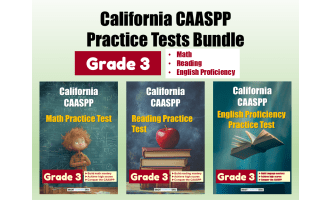
California CAASPP Practice Tests Bundle for Grade 11


- Grades
- Grade 11, High School
- Pages
- 134
- File type
- Answer key
- Included


- Subject
- Math, ELA, Science
- Topic
- california, caaspp
- Resource types
- Assessments, Teacher Tools, Tests, Quizzes and Tests, Worksheets & Printables
- Answer key
- Included
- Standards
- HSN-CN.C.8 HSF-IF.C.7 +1
About this resource
What's inside this resource
Prepare your students for success with this Grade 11 CAASPP Practice Tests Bundle. This complete resource includes Reading, Math, Science, College Readiness, and English Proficiency practice tests. It helps students build confidence and prepare for high-stakes assessments. It is clear, structured, and easy to use.
The bundle includes multiple full-length practice tests that mirror CAASPP format and rigor. Students practice advanced reading and writing, algebra and problem solving, scientific reasoning, and academic language skills. The questions support critical thinking and college readiness.
Each test includes an answer key for quick and accurate grading. All materials are printable and ready for classroom use.
Teachers can use this bundle for full test simulations, review lessons, small group intervention, or independent practice. It also works well for homework, assessment days, or sub plans.
Students build skills across all major subject areas while becoming familiar with test expectations.
Just print and use. This Grade 11 CAASPP bundle makes test prep simple and helps students feel confident, prepared, and ready to succeed.
Related resources
More resources teachers may find useful
24 related resources were found using this product's title, contributor, categories and tags.


In the classroom
Teaching tips & learning objectives

Learning objectives
Apply Algebra II/Pre-Calculus skills — complex numbers, polynomial zeros, rational/radical/exponential functions, trigonometric identities, sequences and series, and statistics — to multiple-choice and open-response items.
Read grade-11-level literary and informational passages and answer claim-aligned ELA/Literacy items, including a read-aloud listening comprehension section.
Respond to open-response test items with full written justification, matching the scoring criteria used in the model answers.

Teaching tips
Read the listening-comprehension passage aloud exactly once, at a natural pace, as the college-readiness teacher's guide instructs, rather than letting students read it silently.
Use the partial-credit criteria in each open-response model answer to score student work consistently rather than an all-or-nothing rubric.
Administer the five subject tests separately across multiple sessions rather than in one sitting, since each is a full-length practice test in its own right.

Skills covered
Algebra II/Pre-Calculus problem-solving — students work with complex numbers, polynomial functions, logarithms, and trigonometric identities across 25-30 scored items.
Open-response mathematical justification — students show full work for multi-part problems such as factoring a cubic and finding a half-life from an exponential model.
Grade-11 reading comprehension — students answer claim-based ELA items tied to literary and informational passages, including one delivered as a read-aloud listening section.
Good to know
Questions teachers ask about this resource
How is partial credit awarded on the two-point open-response math questions?
Each open-response question awards 2 points for complete, correct work on all parts, 1 point for substantial correct work with only a minor error or one missing part, and 0 points for a blank or wholly incorrect approach, as detailed in the scoring notes beneath each model answer.

No reviews yet
Downloaded this resource? Tell other teachers how it went.
Curriculum
Standards, concepts & topics
Standards
 Standards
- HSN-CN.C.8 — Extend polynomial identities to the complex numbers. For example, rewrite x2 + 4 as (x + 2i)(x – 2i).
- HSF-IF.C.7 — Graph functions expressed symbolically and show key features of the graph, by hand in simple cases and using technology for more complicated cases. a. Graph linear and quadratic functions and show intercepts, maxima, and minima. b. Graph square root, cube root, and piecewise-defined functions, including step functions and absolute value functions. c. Graph polynomial functions, identifying zeros when suitable factorizations are available, and showing end behavior. d. Graph rational functions, identifying zeros and asymptotes when suitable factorizations are available, and showing end behavior. e. Graph exponential and logarithmic functions, showing intercepts and end behavior, and trigonometric functions, showing period, midline, and amplitude.
- HSF-LE.A.2 — Construct linear and exponential functions, including arithmetic and geometric sequences, given a graph, a description of a relationship, or two input-output pairs (include reading these from a table).
Core concepts
 Core concepts
Algebra II
Trigonometric functions
Statistics and probability
Reading comprehension
Test-taking / assessment practice
 Topics
Explore related searches
More to explore
You may also like