



2,762 products added recently
Page 73 - 7th Grade Activities
Enhance your seventh-grade curriculum with activities that stimulate curiosity and intellectual growth. These resources cover diverse subjects and include projects that promote inquiry and analysis. Incorporate them to keep students motivated and invested in their learning.

 Show filters


Ancient Egypt Houses Activity
Social Studies, History, History: African, History: Ancient, History: World, Grade 3, 4, 5, 6, 7, 8, 9, Activities
Activity Introduction An amazing activity designed for the students to learn more about history. Ancient Egypt Houses Do you like history? Which topic do you really enjoy about history? Have you ever read an interesting facts about the Vikings? If yes, can you mention them? What do you like most about the Victorian era? Can you name all the Tudors? Have you ever wondered how people used to live in ancient Japan and ancient China? Do you know any interesting facts about ancient Egyptians and the Pharaohs? Have you ever visited South America? What do you know about Incas and Aztecs? Celtic culture was really one of a kind, can you name any of the places that Celts used to live in? Imagine yourself living during the ancient Roman empire, how your life will look like? Ancient Greece was an amazing place to live in. What do you know about ancient Greek life? Ancient Egypt Houses Activity The activity is perfect for encouraging the researching skills for the students, while learning more about history. Ancient Egypt Houses This friendly designed worksheet is suitable for students at school, homeschooling, and as a group activity. Instructions Make a comparison between the houses of wealthy people and the houses of the poor in ancient Egypt. Format Available in a PDF format.
Author Educational Voice
Tags Ancient Egypt Houses Activity, Ancient Egypt, Egyptian Houses, Ancient Egypt Facts, Ancient Egypt Facts For Kids, History, History Facts, History Facts For Kids
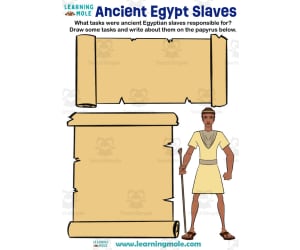
Ancient Egypt Slaves Activity
Social Studies, History, History: African, History: Ancient, History: World, Grade 3, 4, 5, 6, 7, 8, 9, 10, Activities
Activity Introduction An amazing activity designed for the students to learn more about history. Ancient Egypt Slaves Do you like history? Which topic do you really enjoy about history? Have you ever read an interesting facts about the Vikings? If yes, can you mention them? What do you like most about the Victorian era? Can you name all the Tudors? Have you ever wondered how people used to live in ancient Japan and ancient China? Do you know any interesting facts about ancient Egyptians and the Pharaohs? Have you ever visited South America? What do you know about Incas and Aztecs? Celtic culture was really one of a kind, can you name any of the places that Celts used to live in? Imagine yourself living during the ancient Roman empire, how your life will look like? Ancient Greece was an amazing place to live in. What do you know about ancient Greek life? Ancient Egypt Slaves Activity The activity is perfect for encouraging the researching skills for the students, while learning more about history. Ancient Egypt Slaves This friendly designed worksheet is suitable for students at school, homeschooling, and as a group activity. Instructions What tasks were ancient Egyptian slaves responsible for? Draw some tasks and write about them on the papyrus below. Format Available in a PDF format.
Author Educational Voice
Tags Ancient Egypt Slaves Activity, Ancient Egypt Slaves, Ancient Egypt Slaves Facts , Ancient Egypt Slaves Facts For Kids, Ancient Egypt, Ancient Egypt Activity, Ancient Egypt Facts, Ancient Egypt Facts For Kids
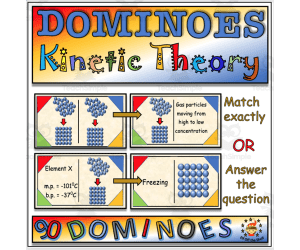
Kinetic Theory of Matter, States of Matter, Change of State Dominoes Game for Middle School
Science, Physics, Grade 5, 6, 7, 8, 9, Activities, Games
A dominoes game with questions and statements on the kinetic theory of matter including change of state, gas pressure and diffusion. Prior Knowledge > Three states of matter are solid, liquid and gas. > Arrangement of particles in solids, liquids and gases. > Properties of solids, liquids and gases in terms of the arrangement of their particles. > Change of state including sublimation. > Pressure in gases and the effect of increasing the number of particles and temperature and decreasing volume. > Diffusion What You Get > 90 dominos > Animated PowerPoint explaining the rules and how to play. Rules of the Game > Each player selects seven dominos from the top of the face-down pile and holds them in their hand like playing cards. > The player whose surname begins with a letter closest to the letter A starts and play proceed in a clockwise direction. > Dominos can be matched exactly, or a name can be matched with a symbol or descriptions, sketches and circuit diagrams can be matched. > If a player thinks a match is wrong, they can challenge. If the challenger is correct, they give a card from their own hand to the challenged player. If the challenged player is correct, they give a card from > their hand to the challenger. Pupils are encouraged to check their books for the correct answer and consult their teacher if a consensus is not reached. > If a player cannot play a domino, they pick up from the face down pile and can play if possible or add it to their hand. See more Elf Off the Shelf resources on this topic and many others
Author Elf off the Shelf Resources
Tags Solids Liquids And Gases, Melting, Boiling, Diffusion, Pressure In Gases, States Of Matter Interactive Games
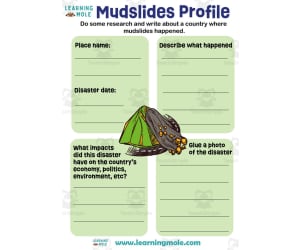
Mudslides Activity
Social Studies, Geography, Grade 3, 4, 5, 6, 7, 8, 9, Activities
Activity Introduction An amazing activity designed for the students to learn more about famous places in different countries. The Mudslides What do you know about this place? Do you know in which part of the world it is? Have you ever visited this place? If yes, can you tell us more about your adventure, and what do you like the most about this place? Do you like reading about Geography? What is your favorite country in the whole world? If you are going on a trip where it will be? Which country? What you are going to see there? Does this country has a famous place to visit? Mudslides Activity The activity is perfect for encouraging the researching skills for the students, while learning more about this fantastic place. Mudslides This friendly designed worksheet is suitable for students at school, homeschooling, and as a group activity. Instructions Do some research and write about a country where mudslides happened. Format Available in a PDF format.
Author Educational Voice
Tags Mudslides Activity, Mudslides, Mudslide, Geography, Geography Facts, Geography Facts For Kids, Kids Activity

"The Ancient Ones, A Play about the Anasazi" - A History Play
Social Studies, History, History: Ancient, Grade 7, 8, 9, 10, Activities
The Ancient Ones, a Play about the Anasazi An incredible teaching resource that offers interaction with the fascinating history of Pre-Columbian civilizations. Designed for grades 7-10, this material connects Social Studies and History, concentrating on ancient times. Its primary purpose is to spark students' curiosity in examining America's rich history before Columbus. This play lasts around 10-15 minutes. Coupled perfectly with traditional taught lessons, it provides splendid reinforcement and hands-on knowledge application regarding the Anasazi civilization - one notable tribe during pre-Columban times. Essentially integrating drama into pedagogical methods thus enhancing student engagement. Uses: Structured delightfully for distribution among all learners instead of just potential actors. It allows each student to participate as they solidify their understanding through excellent role-play or attentive observation while highlighting acquired key words from prior discussions and assignments. A fantastic feature of this 3-page Word document resource is its adaptability; ideal for use in whole class activities, small group interactions or even an exciting homework that encourages parent participation! Plus Points: All learners can participate as they reinforce their understanding by role-playing or attentively observing and pointing out key words." Repeated usage encouraged acting as an effective study aid in future – facilitating long-term retention concerning dictionaries related to the Anasazi people. Focusing on middle schoolers (Grade 7) up until high school sophomores (Grade 10), The Ancient Ones caters towards diverse learning styles by combining visual (written content), auditory (reading aloud), and kinesthetic methods(moving around while acting). Promoting interaction amongst peers throughout enriches social skills development along-with seamlessly acquiring crucial historical insights! Grab this opportunity to provide your students with not just another history lesson but rather a unique journey back in time – inviting them to experience life as The Ancient Ones.
Author BCM Creations
Tags Anasazi Civilization, Pre-Columbian History, Interactive Learning, Role-play, Educational Resource

St. Augustine Research Organizer & Essay Assignment
Social Studies, ELA, Biographies, History, History: World, History: Ancient, Grade 7, 8, 9, 10, Activities, Projects, Worksheets & Printables, Worksheets
St. Augustine was theologian from the earlier period of Christianity whose writing greatly influenced medieval society. This resource provides your students with the opportunity to independently explore and write about the life of the "patron saint of theology" with this engaging research planner and essay assignment. This carefully scaffolded and easy-to-assign-AND-assess resource has been designed to guide student learning from St. Augustine fact-collection to the careful development of a five-paragraph research essay. Teaching this resource could not be easier! Start by handing out the background research and note-taking worksheet (you could also ONLY hand this out if you want a shorter lesson!). Once students have found their facts and sources, provide them with the essay outline activity, which guides them step-by-step through the requirements of a short research essay. From there, drafting their essay, using the provided peer review checklist, and submitting their final draft will be no problem at all. And then you can assess their work with the provided Common Core rubric! Use this entire resource as a complete research lesson or just part of it as a short research activity or sub plan! This TeachSimple download includes: - A St. Augustine essay writing assignment with directions, requirements, research essay writing tips, a peer review checklist, and Common Core-tied grading rubric - An editable rubric, provided as a link, that lets you make adjustments to the grade values and guidelines. This link is provided as as Google Sheet specifically built for integration into Google Classroom, although you can also modify it for use in other Learning Management Systems (LMSs) - A St. Augustine biography and note-taking worksheet that will guide your students through information gathering. This straightforward two-page handout includes instructions for background research, a fun drawing section, and an area to cite quality sources and organize conducted research - A research essay outlining worksheet, so students build on their St. Augustine notes in a clear and simple manner as they build their work towards a draft and final paper - All 6-pages of this lesson are provided in full-color and B&W versions Although this resource can be fitted for any secondary Language Arts classroom, it has been carefully designed to work best in grades 8 through 11. The included rubric is subtly but specifically tied to Common Core ELA Standards for Language (3) and Writing (2 and 7). This resource is provided as a print-ready, bookmarked, and adjustable PDF file. The rubric is also included as an editable Google Sheet. This resource contains 6 pages and 1 Google Sheet.
Author The Language of Educational Art, LLC
Tags Essay, Rubric, Research, Notetaking, Outlining
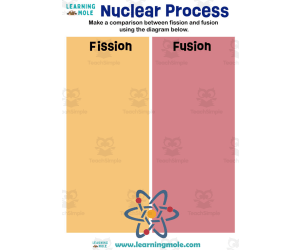
Nuclear Process Activity
Science, Earth and Environmental Sciences, Environmental Science, Grade 3, 4, 5, 6, 7, 8, 9, 10, 11, Activities
Activity Introduction An amazing activity designed for the students to learn more about STEM subjects. Nuclear Process Do you like STEM subjects? what is your favorite one? Have you ever tried to plant a seed? If yes, tell us more about it. Or have you ever tried to invent something? If yes, tell us more about it. And how do you think it will help us? Have you ever seen a microorganism under a microscope? What was it? And how it looked like? Mathematics is a marvelous subject. Let' sharpen our brains and solve some equations. Do you like timetable tricks? What is your favorite one? Do you know how to code? Have you ever created an app or a game before? If yes, how was it like? Nuclear Process Activity The activity is perfect for encouraging the researching skills for the students, while learning more about this topic. Nuclear Process This friendly designed worksheet is suitable for students at school, homeschooling, and as a group activity. Instructions Make a comparison between fission and fusion using the diagram below. Format Available in a PDF format.
Author Educational Voice
Tags Nuclear Process, Nuclear Process Activity, Nuclear Process Facts, Nuclear Process Facts For Kids, STEM, STEM Facts, STEM Facts For Kids, Science, Science Facts
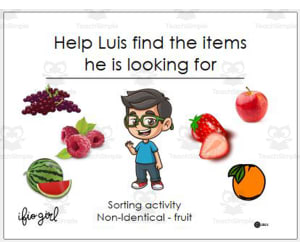
Sorting/grouping Non Identical fruit
Special Resources, Special Education Needs (SEN), Speech Therapy, Math, Early Math, Kindergarten, Preschool, Grade 1, 2, 3, 4, 5, 6, 7, 8, 9, Activities
In the "Sorting Non-Identical Fruit" activity , students will have the opportunity to improve their visual discrimination and categorization skills. The activity consists of a set of fruit activity cards, each depicting a different type of fruit, and six corresponding sorting cards for each fruit. Each sorting card will feature a picture of the same type of fruit, but with subtle differences in color, size, and shape. Students will need to carefully examine the sorting cards and use their critical thinking skills to sort them into the correct group based on the corresponding fruit activity card. This activity is not only fun and engaging, but also provides an early math foundation by introducing sorting and grouping concepts. By engaging in hands-on sorting and grouping of non-identical fruits, students can develop important cognitive skills such as attention to detail, observation, and reasoning. The "Sorting Non-Identical Fruit" activity is a great way to encourage students to work together and practice their communication and problem-solving skills while having fun. This activity can be easily adapted for different ages and levels of ability, making it a versatile and useful tool for any classroom or learning environment. There is also a SPANISH version identical to this activity . It pairs nicely when working with children who have English as their second language or with children interested in learning Spanish words through a tasked based learning activity . The pages are clear of visual distractions which helps the learner focus on the task. This activity is also easy to create and assemble - Print and laminate all cards, cut out the individual sorting cards and velcro to the corresponding activity mat. You can hole punch the mats and place them in a binder for many years of teaching and learning. Enjoy, IFIO girl I'll Figure It Out
Author IFIO girl - I'll Figure It Out
Tags Visual Discrimination, Non-identical Items, Sorting, Sorting Fruits, Categorization, Occupational Therapy, Grouping Fruit, ABLLS-r, Problem Solving, Early Critical Thinking, Apple Sorting Activity

Applying Properties to Add & Subtract Rational Numbers PRACTICE
Math, Numbers, Grade 7, Activities
Applying Properties to Add & Subtract Rational Numbers PRACTICE is an educational resource designed specifically for 7th-grade students. The primary focus is providing practical assistance as students work towards mastering the process of adding and subtracting rational numbers—related to the 7th-grade number systems standards(CCSS.MATH.CONTENT.7.NS.A.1.D). This unique practice resource emphasizes advancing mental math abilities, thereby reducing the need for calculators significantly among learners. This approach fosters a deeper understanding of numbers and streamlines computational skills. The package includes a comprehensive review on addition properties—a key preparatory area before delving into applying these properties to rational number operations. An answer key provided allows educators an efficient way of monitoring progress and guiding improvements when necessary. The product can be used in various teaching setups: traditional classrooms, homeschooling environments, or small tutorial groups. Specifically crafted keeping 🧮 grade-7 math enthusiasts in mind—it can be effectively implemented during class hours, reinforcement sessions, or as homework assignments allowing self-paced learning. In summary,this PDF formatted teaching resource offers an innovative approach towards handling rational numbers—enhancing comfort level as well as confidence through regular practice sessions delivered engagingly yet comprehensively.
Author The Math Cafe
Tags Mental Math, Addition Properties, Rational Numbers, Number Systems, Practice

Periodic Table, Atoms, and Elements Science BINGO Activity
Science, Chemistry, Grade 6, 7, 8, 9, 10, 11, Activities
Your students will love this engaging science review activity. Everyone loves BINGO and it makes for a great review activity that is fun and competitive. This interactive game reinforces key scientific concepts and theories, ensuring curriculum relevance and accuracy. The game package includes 36 unique 4x4 bingo cards featuring essential terms and concepts from and Periodic Table, Atoms, and Elements, a set of call-out cards with clear and concise definitions tailored to the students' level, and detailed gameplay instructions. The included terms encompass a wide range of topics, such as; Period, Group, Metal, Nonmetal, Metalloid, Atomic Number, Atomic Mass, Element, Compound, Electron, Proton, Neutron, Chemical Symbol, Alkali Metal, Halogens, Noble Gases To play, simply distribute the bingo cards to your students along with markers or chips. Read out the definitions from the call-out cards in a random order, and have students place a marker on the corresponding term on their card. The first student to complete a row or column exclaims "Bingo!" and emerges victorious. Following the game, engage in a discussion of the terms to reinforce understanding and clarify any misconceptions. The beauty of this game is that it allows for multiple rounds of learning and review. Teachers will appreciate the game's ability to encourage active participation and engagement in the classroom setting, catering to various student learning styles and promoting differentiated learning. By matching definitions to terms on their bingo cards, students actively engage with the material, enhancing their retention and comprehension of complex scientific theories. Here is a sample from the instructions. BINGO – Instructions, Terms, and Descriptions Cut out and distribute the BINGO cards to your students. Each student will get a unique card. Students can use markers or chips to cover squares that have been called. Print out and cut out each term/description below – these are the call-out cards. Fold each call-out card and place in a hat or box and remove one at a time. After you’ve read the call-out card description, your students are to place a marker on the term associated with the description located on their card. The first student to get 4 in a row horizontally or vertically, wins. Ensure accuracy by checking marked terms on student card to the called-out descriptions.
Author Teach With Fergy
Tags Science Bingo, Bingo Activity, Periodic Table, Atoms, Elements
Reading Comprehension Passages Nonfiction Set 1 (Google Forms)
ELA, Reading, Language Development, Vocabulary, Common Core, Spelling, Reading Comprehension, Writing, Creative Writing, Resources for Teachers, Grade 6, 7, Assessments, Teacher Tools, Tests, Quizzes and Tests, Activities
Reading Comprehension Passages Nonfiction Set 1 Overview Reading comprehension lessons, especially written for Grade 6-7, providing the chance to read interesting and engaging passages. Each lesson has a mix of questions to check understanding, a vocabulary or spelling activity to help remember key language introduced, and a writing exercise. Full answer keys are provided. Passages Include 1.American Bison: Find out more about North America's heaviest land animal. 2.Brown Bears: Featuring brown bears and Kodiak bears. 3.Elephant Seals: Fact: Elephant Seals spend 2 months a year on the beach! 4.Visayan Pigs: Punk rock pigs? Discover more about this endangered species. 5.Seahorses:Terrible swimmers but beautiful creatures all the same. 6.Pandas: Read about China's national symbol then write about America's. 7.Wolves: What does a wolf's howl mean? This article features that, and more! 8.Blue Jays: Can imitate other bird calls and feast on other birds' eggs! 9.Iceland: An amazing country, find out everything there is to know in this one. 10.Yogurt: Healthiest treat? Learn how yogurt is made & how it's good for us. 11.Karate: Who? How? When? Where? Did Karate all begin? 12.Clean Air: A longer article but the most important of subjects. Google Forms Version This is the Google Forms fillable/self grading and editable version. This download is available in GOOGLE Docs, GOOGLE Forms, GOOGLE Slides. PDF, PPT, WORD. FULL CATALOG OF DOWNLOAD LINKS HERE Grade 6/7 Links Fiction Set 1 Google Docs Google Forms Google Slides PDF PPT Word Guided Reading Materials Fiction Set 2 Google Docs Google Forms Google Slides PDF PPT Word Guided Reading Materials Nonfiction Set 1 Google Docs Google Forms Google Slides PDF PPT Word Guided Reading Materials Nonfiction Set 2 Google Docs Google Forms Google Slides PDF PPT Word Guided Reading Materials Reading Passages Overview Each passage is especially written for Grade 6/7 students, including key vocabulary required for this age group. Topics are varied and are accompanied by colorful graphics. Topics are meant to educate, yet entertain the modern student. The majority of these short stories contain an important message - a way of developing these young learners further. Mixed Questions The mixed questions section of each lesson includes a variation of five to six comprehension, vocabulary and Math questions. In addition, key reading strategies are frequently covered including cause & effect, summarizing, compare & contrast and making conclusions. Mixed questions require a written response (no MCQ's), full answers and example responses appear at the end of the lesson. Spelling & Vocab Each reading passage contains a variety of words and phrases designed for Grade 6/7 students. Spelling and vocab activities provide the opportunity to build fluency with these words. Activities provide clues to help assist students. Vocabulary activities include extra questions where students must write a synonym, an antonym or a sentence using a certain word. Writing Prompts Writing prompts are designed to continue the theme or lessons learned in the story. Students are persuaded to write in a variety of ways and each prompt includes several cues to help. The main focus in this product, is the student. Prompts will require the student to relate to past experiences and encourage them to discuss feelings and ways to improve. Full Answer Keys Full answer keys and sample responses are provided so no matter how busy you are, you know you're covered! Mixed question answers provide evidence from the text, Math questions contain the relevant workings. Answers are designed for use by the teacher, but also suitable as a handout to the student. For similar downloads and other frees, do check out Cored Group on TeachSimple.
Author Cored Education
Rating
Tags Elementary, Reading, Comprehension, Vocabulary, Answers, Common Core, Spelling, Writing, Passages, Self Assessment

Middle School Math Stations or Centers: Factors, Multiples, Prime, Composite
Math, Fact Families, Multiplication and Division, Division, Numbers, Multiplication, Grade 4, 5, 6, 7, Centers, Activities
This ready-to-go set of 5 stations will supplement a unit about factors, multiples, prime and composite numbers. Math stations or centers are a great way to get students engaged as they move about the room and work collaboratively with their peers. Even when students are in middle school or the intermediate grades, they benefit from a variety of teaching strategies including the use of stations or centres! But they are a lot of work to prepare! Let me do the work for you! Station 1: Students solve 4 riddles/word problems involving factors and multiples. (optional: set out white boards for students to use) Station 2: Students play a game using 10-sided dice. (supplies needed: pairs of dice) Station 3: Students choose two numbers to investigate and learn about common factors and multiples. (optional: set out an anchor chart about factors vs multiples) Station 4: Students review prime and composite numbers and make prime factor trees. (optional: set out laptops or tablets for the online game extension) Station 5: Students apply what they have learned to a real-life problem, and practice writing and drawing about their mathematical thinking. (optional: set out counters for students to use) Ways to Use: You can break your class into 5 groups and have them rotate one at a time through the centres, giving them 10-20 minutes at each one. Or, start students at certain centres and then allow them to move around at their own pace as long as no one centre gets too full. I find these are a great resource as you are finishing your unit and preparing for the unit test. Grades to Use With: These stations work well in grades 4-7 classes or high school special education. Standards: CCSS4.OA.B.4 Find all factor pairs for a whole number in the range 1-100. Recognize that a whole number is a multiple of each of its factors. Determine whether a given whole number in the range 1-100 is a multiple of a given one-digit number. Determine whether a given whole number in the range 1-100 is prime or composite. CCSS6.NS.B.4 Find the greatest common factor of two whole numbers less than or equal to 100 and the least common multiple of two whole numbers less than or equal to 12. Use the distributive property to express a sum of two whole numbers 1–100 with a common factor as a multiple of a sum of two whole numbers with no common factor. For example, express 36 + 8 as 4 (9 + 2). If you like these math stations, check out the others in my store: 5 Stations for Adding/Subtracting Integers 5 Stations for Early Algebra Concepts 5 Stations for Area, Perimeter, and Volume
Author Grace Under Pressure
Tags Math Centers, Math Stations, Factors, Multiples, Word Problems, Prime , Composite, Middle School Math, Hands-on Math, Factor Trees, How To Teach Factors, How To Teach Factors And Multiples

Alien Project Photoshop Activity
Science, Technology, Grade 7, 8, 9, 10, Projects, Activities
Students will work with digital tools in the Alien Project Photoshop Activity. Students will turn a normal photo of themselves into a freaky photo of an alien. Step by step directions are included.
Author OK Products
Tags Photoshop, Photopea, Mobile Applications, Technology, Computer Science, Computer Project, Science, Graphic Design, Aliens, Alien Photoshop

Middle School TEKS Team-Building Challenge: 11-Station Journey
Science, Basic Science, Physics, Grade 6, 7, 8, Activities
Middle School TEKS Team-Building Challenge: 11-Station Journey Introducing a dynamic way to kick off the school year or shake up the classroom routine with our Middle School TEKS Team-Building Challenge. This collection includes 11 interactive station activities tailored to align with the Texas Essential Knowledge and Skills (TEKS) for middle school. These stations come ready for easy implementation both in-person and online, complete with fully formatted Google versions for digital access. Every station is designed to promote cooperation, setting a tone for the semester and/or offering a refreshing change of pace from regular class activities. Your Comprehensive Package Includes: A suite of 11 Interactive Stations available in PowerPoint , Google, and PDF formats A point-based system where students earn rewards for task completion, emphasizing teamwork An engaging method to establish a positive class culture at the term's outset An environment ripe for fun and cooperative learning experiences How to Use Them: Put your students into groups of 2-4 Place the 11 stations around the room and instruct the groups to move from station to station completing the activities Great way to create a fun and inclusive learning environment I've used these stations in my classroom to great success. It gets my students out of their seats, engaging in science, and learning to work together.
Author Teach With Fergy
Tags Start Of Year, Team Building
Spare Parts (2015): Complete Movie Guide
STEM, Science, Technology, Grade 6, 7, 8, 9, 10, Activities
The movie follows four Latino teenagers living in a low-income area of Phoenix, Arizona, who attend Carl Hayden Community High School. The school is known for its low test scores and lack of resources, but the students are determined to overcome these obstacles and pursue their passion for science and engineering. With the help of their new substitute teacher, Fredi Cameron (George Lopez), the students form a robotics club and decide to compete in a prestigious underwater robotics competition against teams from MIT and other top universities. They face numerous challenges along the way, including lack of funding, limited resources, and skeptical school officials. Despite these challenges, the students work tirelessly to build a robot that can perform complex tasks underwater. Along the way, they also learn important lessons about teamwork, determination, and the power of believing in oneself. After months of hard work, the team travels to Santa Barbara, California, to compete in the competition. They face off against some of the best and brightest minds in the country, but ultimately emerge victorious, shocking everyone with their innovative design and technical prowess. The movie ends with the students being recognized for their achievements, and with Fredi Cameron accepting a full-time teaching position at the school. The students are left with a newfound sense of pride and accomplishment, and the knowledge that they can achieve anything they set their minds to. This is a powerful movie that will help your students learn about perseverance and about science. This movie is the "Stand and Deliver" of 2015. This 24-question viewing guide will help your students get the most out of this movie. This produce comes with a completed teacher key. Ready to print and ready to use. You can watch the trailer here: Spare Parts Trailer Thumbnail clipart by Prince Padania
Author EduPal Learning
Tags STEM, STEAM, Science, Robotics, Movie Guide, Video Guide, Fredi Cameron, Watch Spare Parts 2015
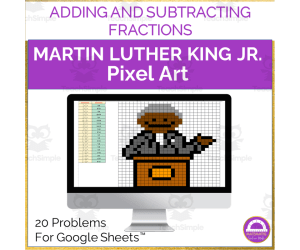
Black History Month | Adding and Subtracting Fractions Pixel Art Activity Google Sheet
Math, Fractions, Grade 5, 6, 7, Activities
Black History Month Fraction Pixel Art Activity Educate students about Black History Month with this engaging no-prep math activity. Students will practice adding and subtracting fractions with unlike denominators by completing 20 operations in a Google Sheet. As students correctly solve each problem, portions of a mystery pixel art image are revealed, maintaining excitement and motivation. This self-checking resource allows students to get immediate feedback as they strengthen their understanding of fraction operations. Use it for individual practice, partner work, small groups, or even a substitute lesson plan. Suitable for grades 5-7, this combining Black History Month and math crosses curricular boundaries for a meaningful educational experience.
Author Matemaths
Tags Matemaths, Black History Month, Fractions, Adding, Subtracting, Pixel Art, Google Sheet
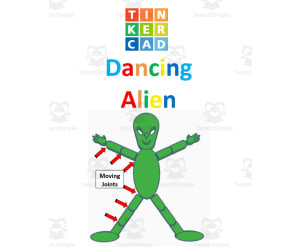
TinkerCAD step-by-step instructions for Dancing Alien
Special Resources, Science, Technology, Engineering, Computer Science, Grade 5, 6, 7, 8, 9, 10, 11, 12, Activities, Projects
TinkerCAD step-by-step instructions for Dancing Alien. Students only need to know the bare basics to complete this. I tested this with a fifth-grade class and most could complete it with no help. Designed to print with no supports for easy printing. Include TinkerCAD tool guide! Has a content page. Great beginners’ tool for learning to make 3D models and learn TinkerCAD. TinkerCAD is a free online program that makes 3D model that work on 3D printers, laser etching machines, water jets, plasma cutters and many more!! Tinkercad is an easy-to-use, browser-based computer-aided design (CAD) software developed by Autodesk. It is primarily used for creating and designing 3D models, particularly in the field of 3D printing. Tinkercad is popular among beginners and hobbyists due to its intuitive interface and simplified tools. Here are some key features and uses of Tinkercad: 1) 3D Modeling: Tinkercad allows users to create 3D models by combining basic shapes and manipulating them using tools such as scaling, rotating, and moving. It provides a wide range of primitive shapes like cubes, spheres, cylinders, and more, which can be customized to create complex designs. 2) Design Customization: Users can apply various modifications to their designs, including resizing, rounding edges, adding text, creating holes, and aligning objects. These tools help in refining the models and making them suitable for specific purposes or fitting them with other components. 3)Import and Export: Tinkercad supports the import of existing 3D models in STL and OBJ formats, allowing users to modify and incorporate them into their designs. It also offers export options to save the designs as STL files, which are widely used in 3D printing. 4) Collaboration and Sharing: Tinkercad provides features for collaboration, allowing multiple users to work on the same project simultaneously. It enables real-time sharing and editing, making it convenient for team projects or educational purposes. 5) Electronics Integration: One notable aspect of Tinkercad is its integration with electronics. It offers a range of electronic components, including resistors, LEDs, motors, and microcontrollers, which can be used to create interactive models and prototypes. Users can simulate circuit connections and test their designs before implementation. 6) Educational Tool: Tinkercad is widely used in educational settings, particularly for teaching students about 3D design, modeling, and prototyping. Its simple interface and beginner-friendly tools make it accessible to users of all ages and skill levels. Overall, Tinkercad is a versatile and user-friendly CAD software that allows individuals to create and customize 3D models. Whether you're a hobbyist, student, or professional, Tinkercad provides a valuable platform for designing, prototyping, and exploring the world of 3D printing and modeling. Total pages: 74 pages Commands to be learned: Group Ungroup Align Mirror Duplicate Holes Solids Rotate Move Drop Subjects: Geometry Engineering Career and technical education Types: Projects Handouts Printables
Author MontyWorks
Tags TinkerCAD, 3D Printing, 3D Printer, Projects
Making Inferences Activities: The Eras of Rap | Nonfiction Passage with Questions
ELA, Strategies, Grade 5, 6, 7, Activities
Making Inferences with Rap Song Lyrics Engage students while they practice making inferences using the lyrics of popular rap songs as reading passages. These printable activities can be used for independent practice or whole class instruction to improve comprehension skills. Students will enjoy reading the lyrics and making inferences about vocabulary words and content. The multiple choice questions and included answer keys make grading simple. Use these versatile resources during small group instruction, center work, or assign as homework. By stepping away from traditional inference worksheets and incorporating relevant music, students will find fresh excitement in reading comprehension. Recommended for grades 5-7.
Author Rap Opera for Kids!
Tags Making Inferences Activities, Reading Inferences, Eras Of Rap Reading Passage, Nonfiction Passage, Reading Comprehension, Rap Reading Strategy, Language Arts Raps
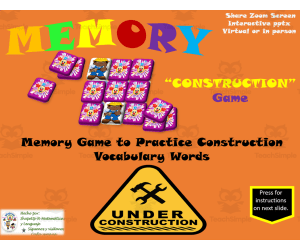
Free Construction Interactive Memory Game to Practice Vocabulary
Life Studies, Career, Grade 7, 8, 9, 10, 11, 12, Games, Activities
Construction Vocabulary Words to Review and Reinforce Definitions of the CTE curriculum . Students will learn and practice Construction terms through definitions and characteristics. The engaging activity promotes collaboration and class discussion as students review terms of Construction tools, machinery, and more with multiple visuals and learning formats like multiple choice questions, memory games, hang-man, and others. This versatile resource can be used for whole-group instruction, small-group practice, or independent work, just practice the words and then review them by choosing the correct matching cards, until you flip all matching cards, exercising visual memory and concentration. If the cards don't match, they flip them back over and try again. Once all matches are made, press the "start again" button for more vocabulary practice. This self-checking activity can be played independently or as a whole class game projected on a smartboard. The vibrant slideshow stimulates engagement while building classification skills. Differentiate by allowing lower grades to match pictures only and upper grades to match vocabulary words. Practice Construction Vocabulary with this Free Interactive Game Introduce young learners to a variety of tools and machinery with this entertaining digital game. Students will see the names and images of different tools; exercising visual memory and concentration. This self-checking activity can be played independently or as a whole class game projected on a smartboard. The vibrant slideshow stimulates engagement while building construction classification skills. students will build their knowledge of important terms and definitions while having fun playing games. This activity stimulates intelligence, builds concentration, reinforces letter recognition, improves spelling and pronunciation, and engagingly expands vocabulary. It's a perfect supplement for any Construction lesson. Check our shop, material, and products for more interactive construction vocabulary reviews covering other topics like human microbiome, metabolism, and more grade levels in science and Spanish language arts. Download this versatile 14-slide PowerPoint today!
Author ShapeUp-N-Matematicas y Lenguaje
Tags Construction Vocabulary, Interactive Activity, Small Or Whole Group, Games, Construction

Gregor Mendel - The Father of Genetics - A Famous Scientist Reading
Science, Basic Science, Grade 7, 8, 9, 10, Activities
Gregor Mendel - The Father of Genetics - A Famous Scientist Reading - Disciplinary Literacy. This reading is a comprehensive look at the life, the troubles, and the triumphs of Mendel. It also includes a set of Reading Comprehension and Extension questions along with the answer key. This no-prep resource is suitable for high school students as well as strong middle-school students. Tackle literacy and science by having your students read and answer questions from a scientific article. Questions include knowledge (direct from the paper), thinking, connecting and open-ended varieties. In the extension question section, I've also incorporated a video via a link as well as a QR code from which multiple questions are derived. The incorporation of these questions is optional (the resource is fully editable) but it does provide an excellent opportunity for students to utilize their devices. This resource covers the following topics: - Overview - His Life - Struggles - What He Accomplished - Law of Segregation & the Law of Independent Assortment --> Mendel's Laws of Inheritance - Controversy Google Classroom and Distance Learning Ready This resource is perfect for in-class or distance learning and integrates seamlessly with Google Classroom. Automatically creates a copy of the reading and puts it directly into your Google Drive with a single click. Purchase --> Open --> Click --> Assign to your students The reading also includes a Microsoft Word and PDF version. Having all three options allow you to assign the reading to your students without worrying about formatting issues as all the work has already been done for you. It also allows you, as well as your students, to access everything no matter where you are or what kind of equipment is being used. The Problem You Face - Not having the time to properly teach scientific literacy (disciplinary literacy) or improve your students reading comprehension and analysis skills. The Solution This fully editable, NO PREP reading comprehension article is composed of relevant, applicable and engaging reading activities which can be used to: • introduce your topic • improve your students reading comprehension and scientific literacy skills • improve your students' analysis skills • provide an extension activity to students who move at a faster pace • provide extra credit to students in need • measure your students' literacy skills --------------------------------------------------- This resource will take your students between 50-75 minutes to complete and includes some open-ended questions. An answer key is also included for your reference. ----------------------------------------------- Furthermore, this resource works very well as an emergency substitute plan as it will keep your students on task and focused while you are away. This resource is suitable for high school students as well as strong middle-school students. Tackle literacy and science by having your students read and answer questions from a scientific article. Questions include knowledge (direct from the paper), thinking, connecting, and open-ended varieties. It comes in both Word and PDF formats. No Prep, no formatting, no issues. Simply download, print (or upload to your class site) and you're all set. You might also be interested in the following Famous Scientists: • Albert Einstein • Niels Bohr • Sir Isaac Newton • Neil deGrasse Tyson • Rosalind Franklin • Gregor Mendel • Nikola Tesla • Marie Curie • Stephen Hawking • Carl Sagan • Leonardo da Vinci • Galileo Galilei • Amedeo Avogadro • Robert Hooke • Thomas Edison • Edwin Hubble ---------------------------------------------------------------------------------------------- Each summary is rich with age-appropriate content (grades 8 and up) and is 5-6 pages long (13-font). Following each is a list of 8-13 questions along with the answer key, which will help guide your students understanding. How this product will help your students: - Improve their scientific and disciplinary literacy skills - Improve their reading comprehension and scientific knowledge - Give them insights into important scientific concepts - Provide an extension activity for your faster moving/more gifted students How this product will help you: - Allow you to meet the NGSS, TEKS and Common Core Standards - Provide you with a concise introduction to your topic - Provide you with an engaging and easy to leave substitute plan which will keep your students engaged and on task - Prove you a means of measuring your students' literacy skills We don't spend enough time teaching scientific literacy to our students. This is either because we don't have the resources to do so effectively or we don't have the time. However, teaching our students to become scientifically literate is vital if we want them to succeed in life. We need them to know about the world they live in and about the issues they face. Even issues as simple as the common cold are misunderstood and can lead to the misuse of antibacterial drugs eventually rendering them ineffective. It can be used as a tool in your teaching arsenal on a regular basis, an extension activity for your faster learners, left for a substitute in an emergency or planned absence or as an extra bit of information for a topic.
Author Teach With Fergy
Tags Gregor Mendel, Genetics

Virtual Jersey Patch Photoshop Activity
Science, Technology, Grade 7, 8, 9, 10, Activities
Students will work with digital tools in the Virtual Jersey Patch Photoshop Activity . Students will take an ordinary image and make it look like a patch sewn on a virtual journey. Step by step directions are included.
Author OK Products
Tags Technology, Science, Computer Class, Jersey Patch, Sports, Photoshop, Digital Tools, Mobile Applications, Photopea, Virtual

Decimal Place Value Reference Strips - ONES
Math, Decimals, Place Value, Grade 4, 5, 6, 7, Activities
Decimal Place Value Reference Strips - ONES As a powerful teaching tool, the Decimal Place Value Reference Strips - ONES are designed to assist students from fourth to seventh grade in understanding decimal place values. Available in two variations, these strips display whole number places (from thousands to ones) and decimal places (from tenths through to millionths). Designed with color differentiation principle seen in Montessori's place value colors, the entire visual aid utilizes varying intensities of colors depending on the value. Brighter shades embody whole numbers while lighter shades delineate decimals segregating into smaller divisions. Educators can utilize this sturdy learning tool during lessons as a simpler way of explaining complex mathematical concepts. The strips also come handy as reference points during practice work sessions. Beyond classroom use, these resourceful cut-outs can also be inserted inside student notebooks for easy access and repeated reference. Teachers find this teaching aid significantly helpful due to its appealing yet child-friendly instructional methods for subjects such as Math and related areas like Decimals and Place Value. Product Details: The product is categorized under Activities implying varied uses across different educational scenarios. Purchase & Usage: Ready-to-download PDF format allowing immediate access post purchase.
Author Virtually Montessori
Tags Decimal Place Value, Reference Strips, Visual Guide, Math Education, Teaching Tool
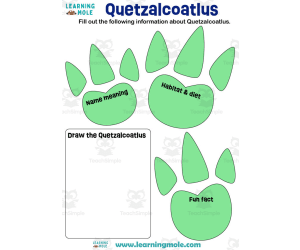
Quetzalcoatlus Activity
Social Studies, History, History: Ancient, Grade 3, 4, 5, 6, 7, 8, 9, Activities
Activity Introduction An amazing activity designed for the students to learn more about animals in different countries. Quetzalcoatlus Do you like dinosaurs? what is your favorite one? Do you own a pet? If yes, tell us more about it, like what its name? And what do you like most about it? Do you think that your pet has been evolved from a dinosaur? Can you write down the characteristics of your favourite dinosaur like it's shape, their rivals, where did it use to live and what was their favourite food? What is the largest and the smallest dinosaur that ever found? Why is the T-rex is so famous? Have you ever read any interesting facts about it? Can you name any of the carnivores or herbivores dinosaurs? Quetzalcoatlus Activity The activity is perfect for encouraging the researching skills for the students, while learning more about this fantastic animal. Quetzalcoatlus This friendly designed worksheet is suitable for students at school, homeschooling, and as a group activity. Instructions Fill out the following information about Quetzalcoatlus. Format Available in a PDF format.
Author Educational Voice
Tags Quetzalcoatlus Activity, Quetzalcoatlus, Quetzalcoatlus Facts, Quetzalcoatlus Facts For Kids, Dinosaur, Dinosaurs, Dinosaurs For Kids, Dinosaurs Facts, Dinosaurs Facts For Kids

Electricity Generation – Lab Station Activity
Science, Technology, Engineering, Grade 7, 8, 9, 10, Labs, Experiments, Activities
Educators seeking an engaging, hands-on resource to teach the principles of electricity generation will find the Electricity Generation - Lab Station Activity to be an invaluable teaching tool. This product is a fully editable lab station activity designed to actively engage students in learning about electricity production. This robust product offers seven distinct lab stations with unique and engaging activities. Students have opportunities at each station to test their understanding of different methods of electricity production—such as renewable and non-renewable sources, fossil fuels, nuclear power, wind energy, hydroelectric power and future technologies in interactive ways. The resource includes practically no-prep for educators - just print the cards and lay them out around the classroom! Bonus activities: An added advantage is bonus activities such as word scrambles and word searches related to the topic. These orchestrated interjections ensure there is no idle time between transitioning from one action-packed station activity to another! The toolkit can be used during laboratory sessions or serves well for review tasks prior tests or quizzes. This resource also promotes independent thinking skills by requiring students to research specific aspects relating to electricity generation on their own devices or a classroom computer at 'research' stations. It encourages expression as students write down opinions on questions surrounding how electricity gets produced. Designed for multi-modal learners from 7th-10th grade studying science with subtopics in engineering; this package can also be sent home as extensions/homework tasks after lessons end. Overall teachers will appreciate how effortlessly it blends learning assessment while ensuring student engagement! Note: An answer key is provided where applicable so educators can quickly and accurately grade student work and offer feedback on their learning progress. In summary, this unique collection of station activities facilitates a complete immersion into understanding electricity generation while ensuring students remain stimulated and engaged throughout their exploration. As they navigate through each station activity – either in small groups or individually – students strengthen their grasp over the subject matter.
Author Teach With Fergy
Tags Electricity Generation, Lab Station, Hands-on Learning, Renewable Energy, STEM Education