



2,726 products added recently
Page 40 - Reading Activities
Discover a variety of reading activities designed to inspire and engage your students. From guided reading sessions to interactive reading journals, these resources support the development of comprehension and critical thinking skills. Tailored for different grade levels, these activities can help you create a dynamic literacy environment that fosters a lifelong love of reading.

 Show filters


Any Song (Animated Music Video)
ELA, Reading, Preschool, Kindergarten, Grade 1, 2, Songs, Activities
This product, The ANY Song (Animated Music Video), is a great way for students to learn and recognize the sight word ANY. The video is fun and engaging, and will help build reading speed and fluency.
Author Have Fun Teaching
Tags Counting
Inca Empire Reading Comprehension Passage - Cored Ed Encyclopedia
ELA, Reading Comprehension, Reading, History, Social Studies, Science, Geography, Technology, Pre-Reading, Language Development, Grade 2, 3, 4, 5, Worksheets & Printables, Worksheets, Teacher Tools, Centers, Activities, Writing Prompts, Assessments, Quizzes and Tests, Quizzes, Lesson Plans
This Inca Empire reading comprehension with lesson plan includes: Visualization (on the front cover) Start your lesson by taking a minute to think and share something about the topic. Read the script aloud (slowly), perhaps prepare some music or sound effects. Student close their eyes and let their imaginations wander. Students open their eyes, read the question aloud and give them a few minutes to complete. Ask a few students to share or keep answers until the end to compare with what they learn in the passage. Quick pause—thousands of Cored Education products are included with your TeachSimple membership. Download links and encyclopedia index available here. Pre-Reading Trivia Students will write down one thing they already know about the subject and then read five more facts and discuss. These facts are fun, and the students will enjoy learning about the subject before reading more. Give 1 minute for students to write what they already know (no pressure—best guess is fine). Read the five facts together. After each fact, do ask a student for their opinion, was it surprising? Set a purpose by asking students to highlight/underline one fact they want to learn more about during the reading. Reading Passage The text is a high-interest reading passage with set paragraphs, roughly three to four paragraphs long. It contains a variety of themes about the topic, anywhere from history to technology. The passage is between 250 and 350 words in length. First, ask students to look at the headings and see what they’ll learn about today. What do they know about the topic/heading? First read options: Teacher read-aloud (best for support). Partner reading (paragraph by paragraph). While reading, students underline important details, and vocabulary words they think may come up in the questions section. Mixed Questions The first question page contains four multiple-choice questions, each with a choice of four answers, and three written response questions that require a sentence or two from the student. Students complete the mcqs first independently, then review quickly as a class. For the 3 written responses, try to get students giving the answer with some form of evidence: “I think ___ because the text says ___.” If students get stuck, send them back to check the passage. Vocabulary Questions Practice seven key words from the text in this section across two activities. First section is scrambled words where students will unscramble three words given a clue for each. The second section is a word to meaning matching activity. Before starting, have some students read out words they underlined in the passage. Ask students to say the word and read aloud the sentence(s) around each word. Ask students to do scrambled words and the matching exercise in pairs then go through answers as a class. For the scrambled spelling task, get four pairs to come up to the board and write the words for extra practice with the other student reading out the clue. For the matching task, prompt students to give full sentences: “I matched ___ with ___ because ___.” Creative Writing In this question, the student will be required to write a five to eight sentence paragraph on a question related to the topic. Before starting, ask students write down 3 key ideas they are going to include in their piece. Ask students for ideas to share around the class to help those struggling. Pro writing expectations: 5–8 sentences At least 2 facts or details from the passage At least 2 vocabulary words from the previous page Students read their paragraphs while classmates listen for facts and vocabulary words. Extension Activities This page is optional for fast finishers or to take home. There are several activities, each one requiring a different skill. Do some, do none, do all, completely optional - but you will feel reassured knowing every possibility is planned for. Includes summary writting question and additional facts. Answer Key There are answers for the multiple-choice questions, written response questions have sample answers, vocabulary answers and if there is a summary question then a sample summary will be provided as well. Lesson Plan Included Customized lesson plan for this lesson is included. Lesson Snapshot Title: Inca Empire Genre: Nonfiction (informational passage) Subject: Social Studies (History) / Reading (Informational Text) Primary Topic: Cusco, roads, quipu records, terraces, legacy Estimated Guided Reading Level (A–Z): S What This Lesson Teaches Best How Cusco grew from a small kingdom into a larger Inca state in the 1400s under a leader named Pachacuti, and how the state was called Tawantinsuyu (the Realm of the Four Parts). How Inca engineers built a wide road system with stairs cut into rock and bridges, plus storehouses and resting places that helped the empire spread across western South America. How the Inca kept records without an English-like alphabet by using a quipu (cords with knots and colors for counts and notes). How terraces were used on hillsides to hold soil and water for crops like potatoes and corn, and how work was organized by the state as a kind of tax. How the empire ended after conflict and Spanish conquest, while people and culture continued (Quechua still spoken; terraces and stone places remain). Learning Goals Describe how Cusco changed in the 1400s and name the Inca state described in the passage. Explain how roads, bridges, and storehouses helped the Inca move messages, supplies, and armies. Explain what a quipu is and what it could record, based on the text. Describe what terraces are used for and how they helped farming on hillsides. Identify what happened in the 1500s that led to the end of the empire and one way Inca life continued afterward. Key Vocabulary From the Text Tawantinsuyu — the Inca state called the Realm of the Four Parts. chasquis — runners who carried messages from stop to stop. quipu — cords with knots and colors for records. terraces — flat steps that hold soil and water. storehouses — places along routes that kept needed supplies. FULL CATALOG OF DOWNLOAD LINKS AND ENCYCLOPEDIA INDEX HERE
Author Cored Education
Rating
Tags Vocabulary, Reading Comprehension, Reading Passages, Lesson Plans, Ela Lesson Plans, Reading Comprehension Lesson Plans, Pre-reading, History, Social Studies Lesson Plans, Geography
Main Idea and Details Activities: The History of Hip Hop | Nonfiction Passage with Questions
ELA, Reading, Reading Comprehension, Grade 5, 6, 7, Activities
Hip Hop History Passages and Main Idea Activities Engage students with the history of hip hop while practicing critical reading skills. These activities use rap song lyrics as reading passages to teach main idea and supporting details in an enjoyable way. Students will stay focused as they read the passages and answer multiple choice questions. Everything is included to easily implement these activities into independent work or whole class lessons. Answer keys are provided for easy grading. Students will: - Read rap song lyrics as nonfiction passages - Identify the main idea and key details of passages - Increase comprehension of song lyrics - Expand vocabulary of hip hop terms - Enjoy practicing critical reading skills These activities are perfect for grades 5-7 language arts classes. Make reading skills fun by letting students analyze rap lyrics to find the main idea and supporting details.
Author Rap Opera for Kids!
Tags History Of Hip Hop Main Idea, History Of Rap Reading Comprehension, Nonfiction Passage Supporting Details, Nonfiction Passage Main Idea
Yachts Reading Comprehension Passage - Cored Ed Encyclopedia
ELA, Language Development, Reading Comprehension, Reading, Science, History, Social Studies, Technology, Engineering, Pre-Reading, Grade 2, 3, 4, 5, Worksheets & Printables, Worksheets, Teacher Tools, Centers, Activities, Writing Prompts, Assessments, Quizzes and Tests, Quizzes, Lesson Plans
This yachts reading comprehension with lesson plan includes: Visualization (on the front cover) Start your lesson by taking a minute to think and share something about the topic. Read the script aloud (slowly), perhaps prepare some music or sound effects. Student close their eyes and let their imaginations wander. Students open their eyes, read the question aloud and give them a few minutes to complete. Ask a few students to share or keep answers until the end to compare with what they learn in the passage. Quick pause—thousands of Cored Education products are included with your TeachSimple membership. Download links and encyclopedia index available here. Pre-Reading Trivia Students will write down one thing they already know about the subject and then read five more facts and discuss. These facts are fun, and the students will enjoy learning about the subject before reading more. Give 1 minute for students to write what they already know (no pressure—best guess is fine). Read the five facts together. After each fact, do ask a student for their opinion, was it surprising? Set a purpose by asking students to highlight/underline one fact they want to learn more about during the reading. Reading Passage The text is a high-interest reading passage with set paragraphs, roughly three to four paragraphs long. It contains a variety of themes about the topic, anywhere from history to technology. The passage is between 250 and 350 words in length. First, ask students to look at the headings and see what they’ll learn about today. What do they know about the topic/heading? First read options: Teacher read-aloud (best for support). Partner reading (paragraph by paragraph). While reading, students underline important details, and vocabulary words they think may come up in the questions section. Mixed Questions The first question page contains four multiple-choice questions, each with a choice of four answers, and three written response questions that require a sentence or two from the student. Students complete the mcqs first independently, then review quickly as a class. For the 3 written responses, try to get students giving the answer with some form of evidence: “I think ___ because the text says ___.” If students get stuck, send them back to check the passage. Vocabulary Questions Practice seven key words from the text in this section across two activities. First section is scrambled words where students will unscramble three words given a clue for each. The second section is a word to meaning matching activity. Before starting, have some students read out words they underlined in the passage. Ask students to say the word and read aloud the sentence(s) around each word. Ask students to do scrambled words and the matching exercise in pairs then go through answers as a class. For the scrambled spelling task, get four pairs to come up to the board and write the words for extra practice with the other student reading out the clue. For the matching task, prompt students to give full sentences: “I matched ___ with ___ because ___.” Creative Writing In this question, the student will be required to write a five to eight sentence paragraph on a question related to the topic. Before starting, ask students write down 3 key ideas they are going to include in their piece. Ask students for ideas to share around the class to help those struggling. Pro writing expectations: 5–8 sentences At least 2 facts or details from the passage At least 2 vocabulary words from the previous page Students read their paragraphs while classmates listen for facts and vocabulary words. Extension Activities This page is optional for fast finishers or to take home. There are several activities, each one requiring a different skill. Do some, do none, do all, completely optional - but you will feel reassured knowing every possibility is planned for. Includes summary writting question. Answer Key There are answers for the multiple-choice questions, written response questions have sample answers, vocabulary answers and if there is a summary question then a sample summary will be provided as well. Lesson Plan Included Customized lesson plan for this lesson is included. Lesson Snapshot Title: Yachts Genre: Nonfiction (informational text) Subject: Social Studies (history of technology) / Informational Reading Primary Topic: What yachts are, their history, and how they changed Estimated Guided Reading Level (A–Z): Q What This Lesson Teaches Best Describes what a yacht can look and sound like at a marina, and explains that yachts may move by sails or by a motor beneath the deck. Explains how people use yachts for pleasure, such as cruising along a coast, spending a night onboard, or racing across open water, and notes that many yachts have a cabin where someone can sleep and stay dry. Traces how the word “yacht” began in Netherlands from a Dutch word meaning “hunt,” and how early yachts were quick ships used to chase pirates and scout ahead before becoming boats for travel and fun. Shows how yacht racing grew in Europe in the 1600s and how a race in 1851 helped launch the America’s Cup, influencing yacht designs for speed and handling. Explains how yachts changed over time (new materials like fiberglass, larger yachts using steel or aluminum, and engines arriving from steam to modern fuel engines), including very large “superyachts” that may need a hired crew. Learning Goals Students will identify two ways yachts can be powered using details from the text. Students will describe what the passage says people do on yachts for pleasure. Students will explain how the meaning and use of “yacht” changed over time in the passage. Students will describe how racing influenced yacht design, using the passage’s examples. Students will describe at least two changes in yacht materials or engines mentioned in the text. Key Vocabulary From the Text marina — a place where boats dock. cabin — a room where someone can sleep and stay dry. hulls — the outer bodies of boats. fiberglass — a newer material used instead of wood. crew — a hired group to run a yacht. FULL CATALOG OF DOWNLOAD LINKS AND ENCYCLOPEDIA INDEX HERE
Author Cored Education
Rating
Tags Vocabulary, Reading Comprehension, Reading Passages, Lesson Plans, Ela Lesson Plans, Reading Comprehension Lesson Plans, Pre-reading, History Lesson Plans, Science Lesson Plans, Engineering

Jugglers Reading Comprehension Passage - Cored Ed Encyclopedia
ELA, Reading Comprehension, Reading, Language Development, History, Social Studies, Geography, Pre-Reading, Vocabulary, Spelling, Grade 2, 3, 4, 5, Worksheets & Printables, Worksheets, Teacher Tools, Centers, Activities, Writing Prompts, Assessments, Quizzes and Tests, Quizzes, Lesson Plans
This Jugglers reading comprehension with lesson plan includes: Visualization (on the front cover) Start your lesson by taking a minute to think and share something about the topic. Read the script aloud (slowly), perhaps prepare some music or sound effects. Student close their eyes and let their imaginations wander. Students open their eyes, read the question aloud and give them a few minutes to complete. Ask a few students to share or keep answers until the end to compare with what they learn in the passage. Quick pause—thousands of Cored Education products are included with your TeachSimple membership. Download links and encyclopedia index available here. Pre-Reading Trivia Students will write down one thing they already know about the subject and then read five more facts and discuss. These facts are fun, and the students will enjoy learning about the subject before reading more. Give 1 minute for students to write what they already know (no pressure—best guess is fine). Read the five facts together. After each fact, do ask a student for their opinion, was it surprising? Set a purpose by asking students to highlight/underline one fact they want to learn more about during the reading. Reading Passage The text is a high-interest reading passage with set paragraphs, roughly three to four paragraphs long. It contains a variety of themes about the topic, anywhere from history to technology. The passage is between 250 and 350 words in length. First, ask students to look at the headings and see what they’ll learn about today. What do they know about the topic/heading? First read options: Teacher read-aloud (best for support). Partner reading (paragraph by paragraph). While reading, students underline important details, and vocabulary words they think may come up in the questions section. Mixed Questions The first question page contains four multiple-choice questions, each with a choice of four answers, and three written response questions that require a sentence or two from the student. Students complete the mcqs first independently, then review quickly as a class. For the 3 written responses, try to get students giving the answer with some form of evidence: “I think ___ because the text says ___.” If students get stuck, send them back to check the passage. Vocabulary Questions Practice seven key words from the text in this section across two activities. First section is scrambled words where students will unscramble three words given a clue for each. The second section is a word to meaning matching activity. Before starting, have some students read out words they underlined in the passage. Ask students to say the word and read aloud the sentence(s) around each word. Ask students to do scrambled words and the matching exercise in pairs then go through answers as a class. For the scrambled spelling task, get four pairs to come up to the board and write the words for extra practice with the other student reading out the clue. For the matching task, prompt students to give full sentences: “I matched ___ with ___ because ___.” Creative Writing In this question, the student will be required to write a five to eight sentence paragraph on a question related to the topic. Before starting, ask students write down 3 key ideas they are going to include in their piece. Ask students for ideas to share around the class to help those struggling. Pro writing expectations: 5–8 sentences At least 2 facts or details from the passage At least 2 vocabulary words from the previous page Students read their paragraphs while classmates listen for facts and vocabulary words. Extension Activities This page is optional for fast finishers or to take home. There are several activities, each one requiring a different skill. Do some, do none, do all, completely optional - but you will feel reassured knowing every possibility is planned for. Includes summary writting question and additional facts. Answer Key There are answers for the multiple-choice questions, written response questions have sample answers, vocabulary answers and if there is a summary question then a sample summary will be provided as well. Lesson Plan Included Customized lesson plan for this lesson is included. Lesson Snapshot Title: Jugglers Genre: Nonfiction (informational text) Subject: Reading (Informational Text) / Social Studies / Arts Primary Topic: Juggling across history and repeating patterns Estimated Guided Reading Level (A–Z): S What This Lesson Teaches Best Traces juggling through time and places (ancient Egypt, China, Greece/Rome, Europe, and today). Uses a historical example (an Egyptian tomb painting) to explain evidence of early juggling and what it suggests about audiences. Highlights performance skills jugglers show—control, timing, courage—and how crowds can understand the act “without any words.” Explains change over time: juggling’s reputation in Europe after the Roman Empire weakened, and how modern circuses brought it into the spotlight. Emphasizes the repeating pattern at the heart of juggling (throw, wait, catch, repeat) and connects it to learning rhythm with patience. Learning Goals Describe what the Egyptian tomb painting shows and why the passage calls it an early picture of toss juggling. Explain how juggling was used to impress or amaze people in different cultures mentioned in the text. Describe how some people in Europe viewed jugglers later and explain what the skill did instead of disappearing. Identify the basic juggling pattern named in the passage and explain why it matters. Compare where a juggler might perform today (stage, circus ring, sidewalk) and explain what stays the same. Key Vocabulary From the Text tomb — a place where someone is buried. audiences — groups of people watching a performance. festivals — celebrations with events and crowds. rhythm — a steady beat or timing pattern. wrongdoing — doing something people believe is wrong. FULL CATALOG OF DOWNLOAD LINKS AND ENCYCLOPEDIA INDEX HERE
Author Cored Education
Rating
Tags Vocabulary, Reading Comprehension, Reading Passages, Lesson Plans, Ela Lesson Plans, Reading Comprehension Lesson Plans, Pre-reading, Social Studies Lesson Plans, History, Geography
Boats Reading Comprehension Passage - Cored Ed Encyclopedia
ELA, Language Development, Resources for Teachers, Reading Comprehension, Reading, Pre-Reading, Creative Writing, Writing, Physics, Science, Grade 2, 3, 4, 5, Worksheets & Printables, Worksheets, Teacher Tools, Centers, Activities, Writing Prompts, Assessments, Tests, Quizzes and Tests, Quizzes
This boats reading comprehension contains the following: Pre-Reading Trivia Students will write down one thing they already know about the subject and then read five more facts and discuss. These facts are fun, and the students will enjoy learning about the subject before reading more. COMPANION VIDEO NOW AVAILABLE (EMBEDDED AFTER PREVIEW PICTURES IN PRODUCT DESCRIPTION) Reading Passage The text is a high-interest reading passage with set paragraphs, roughly three to four paragraphs long. It contains a variety of themes about the topic, anywhere from history to technology. The passage is between 250 and 350 words in length. Mixed Questions The first question page contains four multiple-choice questions, each with a choice of four answers, and three written response questions that require a sentence or two from the student. Creative Writing In this question, the student will be required to write a five to eight sentence paragraph on a question related to the topic. Extension Activities This page is optional for fast finishers. If there are five to ten minutes left at the end of the lesson, the student can choose one of three activities, each one requiring a different skill. Answer Key There are answers for the multiple-choice questions and three written response questions have sample answers. FULL CATALOG OF DOWNLOAD LINKS AND ENCYCLOPEDIA INDEX HERE Cored Ed Encyclopedia Overview The Cored Ed Encyclopedia is a weekly series of lessons that you can pick up and use right away. These short readings fit into whatever time you have available. Each one includes a warm-up, a reading, and a set of questions, but it’s flexible — you can do just the reading, the full lesson, or skip the writing section if you need to. Each lesson focuses on a single topic so students don’t get lost. The writing is clear but never childish, making it perfect for grades two through five. Topics range from animals and science to history, inventions, and everyday things. No matter the level of the student, everyone should take away at least one new idea or fact from each lesson. The materials are easy to print, easy to explain, and require no setup. They work well for whole-class teaching, partner work, or independent study.
Author Cored Education
Rating
Tags Vocabulary, Spelling, Reading Comprehension, Reading Passages, Cored Encyclopedia, Facts, Reading, Creative Writing, Physics, Boats

Internet Reading Comprehension Passage - Cored Ed Encyclopedia
ELA, Language Development, Resources for Teachers, Reading Comprehension, Reading, Pre-Reading, Writing, Science, Technology, Strategies, Grade 2, 3, 4, 5, Worksheets & Printables, Worksheets, Teacher Tools, Centers, Activities, Writing Prompts, Assessments, Tests, Quizzes and Tests, Quizzes
This Internet reading comprehension contains the following: Pre-Reading Trivia Students will write down one thing they already know about the subject and then read five more facts and discuss. These facts are fun, and the students will enjoy learning about the subject before reading more. Reading Passage The text is a high-interest reading passage with set paragraphs, roughly three to four paragraphs long. It contains a variety of themes about the topic, anywhere from history to technology. The passage is between 250 and 350 words in length. Mixed Questions The first question page contains four multiple-choice questions, each with a choice of four answers, and three written response questions that require a sentence or two from the student. Vocabulary Questions Practice seven key words from the text in this section across two activities. First section is scrambled words where students will unscramble three words given a clue for each. The second section is a word to meaning matching activity. Creative Writing In this question, the student will be required to write a five to eight sentence paragraph on a question related to the topic. Extension Activities This page is optional for fast finishers or to take home. There are several activities, each one requiring a different skill. Do some, do none, do all, completely optional - but you will feel reassured knowing every possibility is planned for. Answer Key There are answers for the multiple-choice questions, written response questions have sample answers, vocabulary answers and if there is a summary question then a sample summary will be provided as well. FULL CATALOG OF DOWNLOAD LINKS AND ENCYCLOPEDIA INDEX HERE Lesson Snapshot Title: Internet Genre: Nonfiction (informational text) Subject: Reading (Informational Text) / Technology Primary Topic: How the Internet works and how it began Estimated Guided Reading Level (A–Z): Q What This Lesson Teaches Best Defines the Internet as a worldwide system of connected computer networks that use shared rules (TCP/IP) to communicate. Explains how messages travel by being split into small chunks called packets that can take different routes and arrive out of order. Describes what routers do: forward packets between networks by choosing paths toward the right destination. Builds background knowledge about early Internet history (ARPANET, the 1969 “lo” message, and the 1983 switch to TCP/IP). Clarifies the difference between the Internet and the World Wide Web, introducing hypertext and using a browser to view linked pages. Learning Goals Students can explain what the Internet is using details from the passage. Students can describe how a message is broken into packets and why packets can arrive out of order. Students can identify what a router does when packets travel between networks. Students can summarize key early-history facts about ARPANET, including the 1969 message and the 1983 switch to TCP/IP. Students can describe one difference between the Internet and the World Wide Web based on the passage. Key Vocabulary From the Text TCP/IP — shared rules networks use to communicate. packets — small chunks of a message that travel separately. routers — devices that forward packets between networks. ARPANET — an early packet-switched network before today’s Internet. hypertext — linked pages you view with a browser. Cored Ed Encyclopedia Overview The Cored Ed Encyclopedia is a weekly series of lessons that you can pick up and use right away. These short readings fit into whatever time you have available. Each one includes a warm-up, a reading, and a set of questions, but it’s flexible — you can do just the reading, the full lesson, or skip the writing section if you need to. Each lesson focuses on a single topic so students don’t get lost. The writing is clear but never childish, making it perfect for grades two through five. Topics range from animals and science to history, inventions, and everyday things. No matter the level of the student, everyone should take away at least one new idea or fact from each lesson. The materials are easy to print, easy to explain, and require no setup. They work well for whole-class teaching, partner work, or independent study.
Author Cored Education
Rating
Tags Vocabulary, Spelling, Reading Comprehension, Reading Passages, Reading, Creative Writing, Reading Strategies, Writing Prompts, Internet, Technology
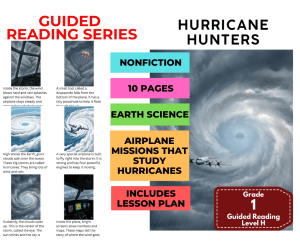
Guided Reading Level H - Hurricane Hunters (with Lesson Plan)
ELA, Resources for Teachers, Reading Comprehension, Reading, Science, Engineering, Technology, Earth and Environmental Sciences, Geography, Social Studies, Grade 1, 2, 3, Worksheets & Printables, Worksheets, Teacher Tools, Centers, Activities, Literacy Readers, Quizzes, Quizzes and Tests, Assessments, Lesson Plans
This Guided Reading Book - Hurricane Hunters (Level H) with lesson plan includes: Guided Reading Color Label (front cover x1) This is a quick way to match the book’s demands to what students can generally handle.. The overall goal is to use the level/color to pick books for several smaller groups. To qualify for a certain level, a student is expected to read a book from that level with about 90–94% accuracy. If a student is consistently accurate and understands, move up a level. If the student is struggling at that level, drop down and add more support. Each student will improve at completely different rates, but it is generally one of the best ways to check progress across the class. DOWNLOAD THE CATALOG TO VIEW ALL GUIDED READING BOOKS AVAILABLE (SORTED LEVELS A-Z) Pre-Reading Question (x1) Teacher asks the prompt aloud, can be while showing the cover or first page. Students share what they already know, or make educated guesses from the cover. Prompt them to use the target vocabulary. Write some of their responses on the board to look back at during the reading. Vocabulary Words (x5) Introduce the five words, best doing it one at a time. Start by saying it, while students repeat and then see if anyone knows what it means before reading further. Read through the meaning and try to briefly connect each word to a picture or gesture so it’s meaningful. Ask students to flip through the book pages and point to where they see each of the vocabulary words. While reading the book pause upon coming across one of the vocab words or read the sentence twice to make sure students understand the word has appeared. Optional: Ask students to raise hands whenever they see/hear one of the new words. Guided Reading Pages (x10) Check the book snapshot (below) for: primary topic - do you need to prep extra reading or intro materials on this? what is taught best - decide on 1-2 bullets to focus on, use the prompt or words provided here for best results. learning goals - what you are checking for students to be able to do after the session, elicit answers using prompts or words provided. key vocabulary (see section above). questions overview - so you know what is coming up and if you need to prep extra materials to assist understanding. Run the lesson You may have already looked at a few of the pages together, but you can show them some of the pictures again first to set meaning. Depending on how much time you have and how familiar your students are with guided reading class, you may want to read the book aloud first with the group first. Students whisper or partner read, while you listen in. If time, do it as a group, one student reading a page each. Use the guided page’s prompts to coach: “Check the picture / does it make sense?” “Point under the words / try the first sound” “Reread the sentence smoothly”. Try to focus more on one student per session (rotating every time), so you can work out if they are ready to move up or need to move down a level. Comprehension Questions (back cover x3) This is your way to check that students didn’t just say the words, but actually understood the text. First, let students answer by pointing to the page/picture and saying a short sentence. After any answer, follow with: “Show me where you found that in the text.” In bigger groups, have partners answer first (10–20 seconds), then call on 2–3 students to share. Differentiation tips: Emerging speakers/struggling readers: oral + pointing On-level: oral in a full sentence Higher: one written sentence or draw + label Book Snapshot Title: Hurricane Hunters Genre: Nonfiction (informational, sequence of events) Subject: Earth Science + Reading (Informational Text) Primary Topic: Airplane missions that study hurricanes Estimated Guided Reading Level (A–Z): H What This Book Teaches Best Defines hurricanes as big storms with lots of wind and rain. Describes how a special airplane flies into a hurricane to learn about the weather. Explains key parts of the storm, including the center called the “eye,” and what it is like. Introduces tools and information-gathering (a “dropsonde,” maps, numbers) used to understand wind and rain. Connects the airplane’s weather information to helping people stay safe on the ground. Learning Goals Students will describe what hurricanes are like using details from the text. Students will explain what the special airplane does to learn about a hurricane’s weather. Students will identify what happens when the plane reaches the center of the storm (the eye). Students will describe how a dropsonde and parachute are used during the flight. Students will explain how the information from the airplane helps people on the ground. Key Vocabulary From the Text hurricanes — very big storms with strong wind and rain. runway — long strip where a plane speeds to take off. dropsonde — small tool that falls from a plane. parachute — cloth that opens to slow something as it falls. eye — the center of the storm. Discussion Prompts Pre-reading question: What do you think a “hurricane hunter” airplane might do during a storm? Comprehension questions: What does the book say hurricanes bring with them? Comprehension questions: What is the eye of the storm like in the text? Comprehension questions: How does the airplane’s information help people on the ground? Printing Tips 1. Best Printing Method (Recommended) “Booklet” Printing (Best if Available) If your printer or PDF viewer supports Booklet Printing , use this. Settings to use: Print mode: Booklet Paper size: Letter or A4 (either works) Orientation: Landscape Print on both sides: Yes Flip on: Short edge Scaling: Fit to printable area Booklet subset: First test: Front sides only Then: Back sides only This will automatically: Pair pages correctly Put the cover on the outside Align everything for folding After printing, fold in half and staple along the spine . 2. If “Booklet” Printing Is NOT Available You can still print this correctly with manual duplex printing . Step-by-step: Open the PDF. Choose Print . Set: Orientation: Landscape Pages per sheet: 1 Print on both sides: Yes Flip on: Short edge Print all pages . Because each PDF page already contains two facing book pages, the result will still fold cleanly into a book. Thousands of Cored Education products are included with your TeachSimple membership. Download links and encyclopedia index available here.
Author Cored Education
Rating
Tags Reading Comprehension, Reading Passages, Reading, Guided Reading, Guided Reading Lesson Plan, Guided Reading Activity, Pre-reading, Science Lesson Plans, Technology, Geography

Nonfiction Reading comprehension
ELA, Reading, Reading Comprehension, Grade 1, 2, 3, 4, Activities
This under-the-sea reading comprehension contains 5 nonfiction reading passages. Each passage is presented four times in different complexities; starting from a simple version of the passage using multiple choice questions (picture-based) and moving on to a more complex passage that uses written questions. All questions to the passages test the student's comprehension of the passage through various questions. The objective of this activity is to help students practice their reading skills as well as their comprehension skills by using these short nonfiction passages. The teacher will have to: * Choose the level of comprehension the student can best complete. * Print out a worksheet for the relevant student. The student will have to: * Read the relevant comprehension * Answer the questions to the best of their abilities. Suggestion: * The passage can be accompanied as an activity while learning about nonfiction. * These passages can be used as a guided reading activity. These passages are best suited for a variety of age groups depending on reading level. However can be used in Grades 1, 2, 3 and 4. The best format this activity can be used in is as a printed-out worksheet. There is an answer sheet provided. Sea creatures included: Sea turtles Orca whales Dolphins Starfish Jellyfish If you are looking for lessons to accompany this exercise, find the link below to our under-the-sea nonfiction lessons, which are great to use as an introduction lesson or as a recap lesson as they are short and sweet. There are 23 pages. Nonfiction lessons: Nonfiction captions and labels Nonfiction Glossary Nonfiction table of contents Nonfiction title Nonfiction title page Nonfiction index Use: You are free to use and modify the material. Non-commercial use only You may not resell the material.
Author Ezee 101
Tags Nonfiction, Reading, Comprehention, Passages, Under The Sea

Social Studies Reading Comprehension Passages: Food and Culture (Docs)
ELA, Reading, Reading Comprehension, Strategies, Resources for Teachers, Social Studies, Sociology, Grade 6, 7, 8, 9, Writing Prompts, Worksheets & Printables, Centers, Activities, Teacher Tools, Assessments, Quizzes and Tests, Quizzes, Tests
Social Studies Reading Comprehension Passages and Questions: Food and Culture (Docs) This resource introduces a collection of Social Studies reading comprehension passages with questions about Food, Culture, and Preservation. The passages are carefully designed to bridge the gap between social studies and literacy through strengthening reading comprehension and sparking knowledge curiosity in middle school students. Each passage blends English Language Arts skills with accurate social studies content . Ideal for interdisciplinary learning in ELA and Social Studies. Suitable for Grade 9 review, too! What Is Included in this Collection? There are three informational passages (with full answer keys): Homemade Cottage Cheese: Food, Family, and Local Trade Salty Traditions: How Salami and Kimchi Stay Safe to Eat From Grasslands to Grill: The Foods of South America For Each Passage, students will have multiple tasks to complete as follow: 5 multiple-choice questions targeting main idea, key details, inference, vocabulary in context, and use of evidence 5 vocabulary matching items with clear, student-friendly definitions 5 text-based questions that require citing specific lines or facts 1 summary prompt that asks students to condense central ideas accurately Available Formats for this Resource PDF Fillable PDF Word Docs FULL CATALOG OF DOWNLOADING LINKS HERE For more Social Studies Reading Passages, check the following Links: Ancient Civilizations PDF Fillable PDF Word Docs Google Docs Early Empires and Trade Networks PDF Fillable PDF Word Docs Google Docs The Founding of the United States PDF Fillable PDF Word Docs Google Docs Language, Culture, and Meaning PDF Fillable PDF Word Docs Google Docs Psychology and Society PDF Fillable PDF Word Docs Google Docs Global Festivals and Traditions PDF Fillable PDF Word Docs Google Docs Extreme Environments and People PDF Fillable PDF Word Docs Google Docs Food, Culture, and Preservation PDF Fillable PDF Word Docs Google Docs Global Food Customs PDF Fillable PDF Word Docs Google Docs Media, Communication, and Popular Culture PDF Fillable PDF Word Docs Google Docs Human Impact on the Environment PDF Fillable PDF Word Docs Google Docs Civic Action and Social Change PDF Fillable PDF Word Docs Google Docs Fashion, Society, and Power PDF Fillable PDF Word Docs Google Docs People, Places, and Unusual Histories PDF Fillable PDF Word Docs Google Docs Product Details Length: 14 pages total Grades: 6–8, also suitable for Grade 9 review Use cases: close reading, stations, homework, intervention, test prep, and sub plans Why Teachers Choose This Set Authentic social studies content paired with rigorous literacy practice Consistent task structure across all passages for easier planning and smoother student routines Clear, age-appropriate writing that builds confidence without oversimplifying Use this set to reinforce ELA skills in social studies, to add literacy to your lessons, and to support independent work. The passages strengthen main idea, evidence use, vocabulary in context, inference, cause and effect, and summary writing. With ready-to-use assessments and complete answer keys, you can provide focused practice that is simple to run and fast to review.
Author CORED Education - Middle & High School
Rating
Tags Middle School, Reading Comprehension, Reading Strategies, ELA, Centers, Reading Passage, Assessments, Vocabulary, Social Studies, Food And Culture
Tea Customs: Social Studies Reading Comprehension Passage (Word)
ELA, Reading, Reading Comprehension, Strategies, Resources for Teachers, Social Studies, Sociology, Grade 6, 7, 8, 9, Writing Prompts, Worksheets & Printables, Centers, Activities, Teacher Tools, Assessments, Quizzes and Tests, Quizzes, Tests
Tea Customs: Social Studies Reading Comprehension Passage (Word) This resource introduces a unique Social Studies reading comprehension passage with questions about Tea Drinking Customs The passage is carefully designed to bridge the gap between social studies and literacy through strengthening reading comprehension and sparking knowledge curiosity in middle school students. Each passage blends English Language Arts skills with accurate social studies content . Ideal for interdisciplinary learning in ELA and Social Studies. Suitable for Grade 9 review, too! Student Tasks throughout the passage: 5 multiple-choice questions targeting the following skills: main idea, key details, inference, vocabulary in context, and use of evidence 5 vocabulary matching items with clear, student-friendly definitions 5 text-based questions that require citing specific lines or facts 1 summary prompt that asks students to condense central ideas accurately Full answer key for every section Available Formats for this Resource: PDF Fillable PDF Google Docs FULL CATALOG OF DOWNLOADING LINKS HERE Social Studies Reading Comprehension Collection Links: 1. Ancient Civilizations PDF Fillable PDF Word Docs Google Docs 2. Early Empires and Trade Networks PDF Fillable PDF Word Docs Google Docs 3. The Founding of the United States PDF Fillable PDF Word Docs Google Docs 4. Language, Culture, and Meaning PDF Fillable PDF Word Docs Google Docs 5. Psychology and Society PDF Fillable PDF Word Docs Google Docs 6. Global Festivals and Traditions PDF Fillable PDF Word Docs Google Docs 7. Extreme Environments and People PDF Fillable PDF Word Docs Google Docs 8. Food, Culture, and Preservation PDF Fillable PDF Word Docs Google Docs 9. Global Food Customs PDF Fillable PDF Word Docs Google Docs 10. Media, Communication, and Popular Culture PDF Fillable PDF Word Docs Google Docs 11. Human Impact on the Environment PDF Fillable PDF Word Docs Google Docs 12. Civic Action and Social Change PDF Fillable PDF Word Docs Google Docs 13. Fashion, Society, and Power PDF Fillable PDF Word Docs Google Docs 14. People, Places, and Unusual Histories PDF Fillable PDF Word Docs Google Docs Product Details: Length: 4 pages Grades: 6–8, also suitable for Grade 9 review Use cases: close reading, stations, homework, intervention, test prep, and sub plans Why Teachers Choose This Passage: Authentic social studies content paired with rigorous literacy practice Consistent task structure for easier planning and smoother student routines Clear, age-appropriate writing that builds confidence without oversimplifying Use this passage to reinforce ELA skills in social studies, to add literacy to your lessons, and to support independent work. The passage strengthens main idea, evidence use, vocabulary in context, inference, cause and effect, and summary writing. With ready-to-use assessments and complete answer keys, you can provide focused practice that is simple to run and fast to review.
Author CORED Education - Middle & High School
Rating
Tags Middle School, Reading Comprehension, Reading Strategies, ELA, Centers, Reading Passage, Assessments, Vocabulary, Social Studies, Sociology

FREE MINIBOOK OF THE ABC | LITERACY
ELA, Reading, Writing, Early Learning, Elementary, Pre-K, Activities, Worksheets & Printables
FREE MINIBOOK OF THE ABC INTRODUCTION: Hello! I thank you infinitely for your interest in my educational store! I am a teacher who strives every day to produce these great educational resources for children, so I thank you because with your downloads you are helping a lot to promote my personal and professional work. MAIN INFORMATION: 1. Product name: You can use this educational resource in the primary education classroom. 2. Number of pages: This document contains the following number of pages. 3. Is it editable or not? This educational document is not editable, because this way you can use it better and you will not have any problem with the composition or design undergoing any variation. 4. Theme: This educational resource contains a topic for the primary education of children. 5. Document version: This educational document is available in PDF version, size A4. 6. Color or black/white: This educational product is designed in color because we believe that this will be much more attractive for your children. 7. Aimed at children of ages: This educational document is specifically aimed at children in primary education. 8. Area: This educational document may be used in some area of primary education for children. SECONDARY INFORMATION: 9. Do I need any extra elements to apply it? Yes, perhaps your students need pencils, colors, markers and even sometimes scissors and erasers. 10. Is it in color or black and white? This educational document has been designed mostly in color so that it is highly attractive to students. 11. Is this resource free or do you have to pay to use it? This document is available for free, so take advantage of the opportunity to download it now. 12. Does it have an answer key attached? No, it does not contain an answer key attached. This file is for personal use only. It is not allowed to be resold or shared with others.
Author EDITORIAL LAURA EDUCA
Tags FREE, FREE RESOURCE, ALPHABET, ABC, LITERACY

Jewelry Reading Comprehension Passage - Cored Ed Encyclopedia
ELA, Reading Comprehension, Reading, Language Development, History, Social Studies, Science, Physics, Life Sciences, Earth and Environmental Sciences, Grade 2, 3, 4, 5, Worksheets & Printables, Worksheets, Teacher Tools, Centers, Activities, Writing Prompts, Assessments, Quizzes and Tests, Quizzes, Lesson Plans
This Jewelry reading comprehension with lesson plan includes: Visualization (on the front cover) Start your lesson by taking a minute to think and share something about the topic. Read the script aloud (slowly), perhaps prepare some music or sound effects. Student close their eyes and let their imaginations wander. Students open their eyes, read the question aloud and give them a few minutes to complete. Ask a few students to share or keep answers until the end to compare with what they learn in the passage. Quick pause—thousands of Cored Education products are included with your TeachSimple membership. Download links and encyclopedia index available here. Pre-Reading Trivia Students will write down one thing they already know about the subject and then read five more facts and discuss. These facts are fun, and the students will enjoy learning about the subject before reading more. Give 1 minute for students to write what they already know (no pressure—best guess is fine). Read the five facts together. After each fact, do ask a student for their opinion, was it surprising? Set a purpose by asking students to highlight/underline one fact they want to learn more about during the reading. Reading Passage The text is a high-interest reading passage with set paragraphs, roughly three to four paragraphs long. It contains a variety of themes about the topic, anywhere from history to technology. The passage is between 250 and 350 words in length. First, ask students to look at the headings and see what they’ll learn about today. What do they know about the topic/heading? First read options: Teacher read-aloud (best for support). Partner reading (paragraph by paragraph). While reading, students underline important details, and vocabulary words they think may come up in the questions section. Mixed Questions The first question page contains four multiple-choice questions, each with a choice of four answers, and three written response questions that require a sentence or two from the student. Students complete the mcqs first independently, then review quickly as a class. For the 3 written responses, try to get students giving the answer with some form of evidence: “I think ___ because the text says ___.” If students get stuck, send them back to check the passage. Vocabulary Questions Practice seven key words from the text in this section across two activities. First section is scrambled words where students will unscramble three words given a clue for each. The second section is a word to meaning matching activity. Before starting, have some students read out words they underlined in the passage. Ask students to say the word and read aloud the sentence(s) around each word. Ask students to do scrambled words and the matching exercise in pairs then go through answers as a class. For the scrambled spelling task, get four pairs to come up to the board and write the words for extra practice with the other student reading out the clue. For the matching task, prompt students to give full sentences: “I matched ___ with ___ because ___.” Creative Writing In this question, the student will be required to write a five to eight sentence paragraph on a question related to the topic. Before starting, ask students write down 3 key ideas they are going to include in their piece. Ask students for ideas to share around the class to help those struggling. Pro writing expectations: 5–8 sentences At least 2 facts or details from the passage At least 2 vocabulary words from the previous page Students read their paragraphs while classmates listen for facts and vocabulary words. Extension Activities This page is optional for fast finishers or to take home. There are several activities, each one requiring a different skill. Do some, do none, do all, completely optional - but you will feel reassured knowing every possibility is planned for. Includes summary writting question and additional facts. Answer Key There are answers for the multiple-choice questions, written response questions have sample answers, vocabulary answers and if there is a summary question then a sample summary will be provided as well. Lesson Plan Included Customized lesson plan for this lesson is included. Lesson Snapshot Title: Jewelry Genre: Nonfiction (informational text) Subject: Reading (Informational Text) / Social Studies Primary Topic: Jewelry history, materials, meaning, and sparkle Estimated Guided Reading Level (A–Z): R What This Lesson Teaches Best Explains that people made and wore jewelry long ago using shells, teeth, and bone, and includes evidence archaeologists found (seashells with holes worn smooth). Shows how new tools changed jewelry-making by shaping gold into beads, bracelets, and pieces worn close to the skin. Introduces where gems come from (hard minerals from the earth and some from living things, like pearls and amber). Describes how cutting gems into flat faces called facets increased sparkle and how factories later made fake gems. Emphasizes that jewelry can matter because of symbols, faith, celebrations, and memories—not only because it is bright or rare. Learning Goals Describe evidence the passage gives that very old shell beads were worn as jewelry. Explain how tools helped people shape gold into jewelry long ago. Identify where different gems can come from (earth minerals or living things) using details from the text. Explain how facets changed the way gems looked and why they started to “dance and flash.” Describe reasons people wear jewelry today (faith, celebration, marking life moments, memories). Key Vocabulary From the Text archaeologists — scientists who study the human past. ceremonies — special events held for a purpose. minerals — natural, nonliving materials from the earth. facets — flat faces cut on a gemstone. amber — hardened sticky tree sap used as a gem. FULL CATALOG OF DOWNLOAD LINKS AND ENCYCLOPEDIA INDEX HERE
Author Cored Education
Rating
Tags Vocabulary, Reading Comprehension, Reading Passages, Lesson Plans, Ela Lesson Plans, Reading Comprehension Lesson Plans, Pre-reading, Science Lesson Plans, Earth Science, Physics
Eating Insects: Social Studies Reading Comprehension Passage (Docs)
ELA, Reading, Reading Comprehension, Strategies, Resources for Teachers, Social Studies, Sociology, Grade 6, 7, 8, 9, Writing Prompts, Worksheets & Printables, Centers, Activities, Teacher Tools, Assessments, Quizzes and Tests, Quizzes, Tests
Eating Insects: Social Studies Reading Comprehension Passage (Docs) This resource introduces a unique Social Studies reading comprehension passage with questions about Eating Insects in some cultures and possible future eating trends. The passage is carefully designed to bridge the gap between social studies and literacy through strengthening reading comprehension and sparking knowledge curiosity in middle school students. Each passage blends English Language Arts skills with accurate social studies content . Ideal for interdisciplinary learning in ELA and Social Studies. Suitable for Grade 9 review, too! Student Tasks throughout the passage: 5 multiple-choice questions targeting the following skills: main idea, key details, inference, vocabulary in context, and use of evidence 5 vocabulary matching items with clear, student-friendly definitions 5 text-based questions that require citing specific lines or facts 1 summary prompt that asks students to condense central ideas accurately Full answer key for every section Available Formats for this Resource: PDF Fillable PDF Word Docs FULL CATALOG OF DOWNLOADING LINKS HERE Social Studies Reading Comprehension Collection Links: 1. Ancient Civilizations PDF Fillable PDF Word Docs Google Docs 2. Early Empires and Trade Networks PDF Fillable PDF Word Docs Google Docs 3. The Founding of the United States PDF Fillable PDF Word Docs Google Docs 4. Language, Culture, and Meaning PDF Fillable PDF Word Docs Google Docs 5. Psychology and Society PDF Fillable PDF Word Docs Google Docs 6. Global Festivals and Traditions PDF Fillable PDF Word Docs Google Docs 7. Extreme Environments and People PDF Fillable PDF Word Docs Google Docs 8. Food, Culture, and Preservation PDF Fillable PDF Word Docs Google Docs 9. Global Food Customs PDF Fillable PDF Word Docs Google Docs 10. Media, Communication, and Popular Culture PDF Fillable PDF Word Docs Google Docs 11. Human Impact on the Environment PDF Fillable PDF Word Docs Google Docs 12. Civic Action and Social Change PDF Fillable PDF Word Docs Google Docs 13. Fashion, Society, and Power PDF Fillable PDF Word Docs Google Docs 14. People, Places, and Unusual Histories PDF Fillable PDF Word Docs Google Docs Product Details: Length: 4 pages Grades: 6–8, also suitable for Grade 9 review Use cases: close reading, stations, homework, intervention, test prep, and sub plans Why Teachers Choose This Passage: Authentic social studies content paired with rigorous literacy practice Consistent task structure for easier planning and smoother student routines Clear, age-appropriate writing that builds confidence without oversimplifying Use this passage to reinforce ELA skills in social studies, to add literacy to your lessons, and to support independent work. The passage strengthens main idea, evidence use, vocabulary in context, inference, cause and effect, and summary writing. With ready-to-use assessments and complete answer keys, you can provide focused practice that is simple to run and fast to review.
Author CORED Education - Middle & High School
Rating
Tags Middle School, Reading Comprehension, Reading Strategies, ELA, Centers, Reading Passage, Assessments, Vocabulary, Social Studies, Sociology

FREE ALPHABET MINIBOOK | MAZES THEMED
ELA, Language Development, Reading, Writing, Handwriting, Early Learning, Elementary, Homeschool Resources, Not Grade Specific, Pre-K, Worksheets & Printables, Activities, Classroom Decor
FREE ALPHABET MINIBOOK | MAZES THEMED HOW TO USE THIS PRODUCT? This product have 26 free mazes of the alphabet, this is a perfect funny activity for your kids. INFORMATION OF THE AUTHOR: EDITORIAL ARENAS EDUCATIVAS is dedicated to providing high-quality educational content to help children learn efficiently and with joy. Check out our full store to find materials focused on reading, writing, math, and Spanish. We're excited to be part of your learning experience! DESCRIPTION OF THIS PRODUCT: 1) How can this material support children's learning or development? This material will help our students learn in an educational way. It will support your students by guiding them in a much more playful way to achieve easy and rapid learning. 2) What specific skills are developed using this resource? Students will be able to develop their attention, concentration, creativity, and imagination skills. It will also allow students to develop their cognitive skills such as comprehension, analysis, and others. 3) Who is the ideal audience for this document? This document and/or teaching resource is primarily intended for young students, meaning those between the ages of 5 and 12, in other words, students in early childhood and/or primary education. However, it can also be used by the general public if required. SECONDARY AND COMPLEMENTARY DESCRIPTION OF THIS EDUCATIONAL PRODUCT: 1) What is the title of this resource? This resource is titled "Educational Resource for Better Learning" developed by EDITORIAL ARENAS EDUCATIVAS. 2) How many pages does the file contain in total? This educational document contains enough pages to make this resource ideal for promoting fun and successful learning. 3) Does this material allow for custom editing? This educational document is available in PDF format, so you cannot edit it. You simply need to download and then print it. 4) What main topic does the resource cover? This document has been developed to address a basic topic that children in kindergarten through elementary school should master. This document will also be helpful to the general public who want to learn.
Author EDITORIAL LAURA EDUCA
Rating
Tags FREE, FREE RESOURCES, ALPHABET, ABC, ABC MINIBOOK, TRACING, TRACING LETTERS, HANDWRITING

The Song Thrush Phonetic Reading Book
ELA, Language Development, Phonics, Reading, Grade 1, 2, Songs, Activities
This Song Thrush easy reading book is an easy phonetic reader for children who are just beginning to read longer texts. The child is supported to read fluently as the book only uses commonly taught sight words and all other words are decodable. This gives the child much-needed confidence to read. This book, although fiction contains factual information about the Song Thrush. Therefore, children will learn to learn as they read! It can be used as part of a topic on birds, or as a stand-alone reading book. It can be used with any programme once a child has learned the basic digraphs and trigraphs. This includes after Phase 5 of Letters and Sounds and after RWI Speed Set 3. Who is it for? It is ideal for use in the classroom, for ESL/EFL, for home education and for special education needs. Parents teachers and private tutors can use it - anyone who needs it! Main features: Phonetic language It is written in a clear font. New vocabulary that is most likely to need practising is listed at the beginning of the book for practice before the book is read. It features original artwork and photo. How can it be used? This Song Thrush easy reader can be used with individual students, for guide reading with small groups, or shared with pupils online. It can be sent home with children for home-learning. It can be blown up large for guided reading with a whole class or group It can be used alongside a project on minibeasts, or as a stand-alone reader What is included? 1 pdf 8 pages only uses 2 sheets of paper Print as a booklet, side fold This book is one of a series. You can find more of such books in the Lilibettes Resources Store: https://teachsimple.com/contributor/lilibettes-resources Frogs Rook Snails Lifecycle of an apples Tree
Author Lilibette's Resources
Tags Easy Reading Book, Phonetic Reading Book, Decodable Reading Book, Song Thrush Readin GBook, Song Thrush Reading Book

Candy Reading Comprehension 1 Lesson Sample Formal Assessments
ELA, Language Development, Resources for Teachers, Vocabulary, Spelling, Reading Comprehension, Reading, Common Core, Grade 2, 3, 4, 5, Teacher Tools, Centers, Activities, Assessments, Tests, Quizzes and Tests, Quizzes, Word Problems, Worksheets & Printables, Writing Prompts
THIS IS A ONE LESSON FREE SAMPLE OF THE FOLLOWING PRODUCT: Themed Reading Comprehension Passages Series - Candy This reading comprehension series is built for grades 2 to 5 and keeps things simple, clear, and easy to use. Every title follows a fun, kid-friendly theme and comes with two passage levels, one written for grades 2 to 3 and a more challenging version for grades 4 to 5. Students then work through a mix of follow-up pages that check understanding in different ways: multiple-choice questions, short written responses, scrambled words, a quick summary, and a theme-based word problem. Answer keys are included, so prep stays minimal. Each resource also comes in nine classroom-friendly formats, so you can choose what fits your setup: print or digital, editable or ready to go, and even self-grading options. Because the layout stays consistent, it is easy to plug into whole-class lessons, small groups, literacy centers, morning work, fast finisher tubs, sub plans, or home learning. It is a straightforward way to build comprehension, practice reading skills in context, and strengthen written responses without adding extra steps for you. Candy Lesson List Note: This product has titles different to those in the rest of the themed series. 1. Candy Types 2. Candy Flavors 3. Candy Shapes and Colors 4. Candy Ingredients 5. Candy Fun Facts FORMAL ASSESSMENT VERSION Formal, test-style pages for quick grading, progress checks, and clear results. Other versions are available in the links list below or in the full catalog. How to Use These Lessons Perfect for: Morning work or early-finisher bins Guided reading blocks or comprehension warmups Literacy centers or small-group rotations Holiday/seasonal review lessons Independent stations, sub plans, or take-home enrichment More Candy Themed Products CROSSWORDS WORDSEARCHES MAZES FULL CATALOG OF DOWNLOAD LINKS HERE Themed Reading Links Addition Animals Around the Home Birthday FORMATS: -FORMAL ASSESSMENT VERSION -PRESENTABLE PDF -PPT -SLIDES - PDF -FILLABLE PDF -WORD -FORMS -DOCS SUPPLEMENTARY MATERIALS (COMING SOON): -VISUAL READING PASSAGE VIDEO -GUIDED LEARNING VIDEO -LESSON PLANS Candy FORMATS: -FORMAL ASSESSMENT VERSION -PRESENTABLE PDF -PPT -SLIDES -PDF -FILLABLE PDF -WORD -FORMS -DOCS SUPPLEMENTARY MATERIALS (COMING SOON): -VISUAL READING PASSAGE VIDEO -GUIDED LEARNING VIDEO -LESSON PLANS Christmas Cinco de Mayo Clothes Colors Days and Months Division Earth Day Easter Easy Mazes Fall Father's Day Food Geography (Set 1) Geography (Set 2) Geography (Set 3) Graduation Health History (Set 1) History (Set 2) History (Set 3) Human Body Kindness Life Skills Mother's Day Multiplication Science (Set 1) Science (Set 2) Science (Set 3) Shapes Social Skills Spring Sports St. Patrick's Day Subtraction Summer Thanksgiving Transport Valentine's Day Winter Free One Lesson Themes Chinese New Year Lunar New Year Halloween Pink Shirt Day Independence Day Juneteenth President's Day Groundhog Day Readings in Depth Structure Each resource is built around a focused sub-theme within the broader topic. Students read two leveled passages (Grades 2–3 and Grades 4–5), then move through a short, consistent sequence of activities that checks understanding and keeps momentum: multiple-choice, brief written responses, a scrambled-words review, a compact summary task, and a light theme-linked word problem. The flow is predictable for students, but varied enough to feel fresh across topics. Each completed resource includes: Two differentiated reading passages (lower and upper level) A multiple-choice comprehension page Short written-response questions A scrambled-words or quick vocabulary check A brief summary activity A simple, theme-connected word problem Answer keys for fast marking and easy self-checking Nine classroom-friendly formats, including print, editable, digital, and self-grading options Themes Included These readings span a wide range of age-appropriate, high-interest topics, such as: Seasons and celebrations Real-world science and nature Community, character, and life skills Everyday high-frequency themes students already enjoy Each title connects to familiar experiences while strengthening comprehension, vocabulary in context, and clear written expression. Easy extensions (optional): Read twice: first for gist, second to highlight key details Write two “right there” questions and swap with a partner Create a 3-bullet fact list or mini mind map Turn the summary into a 3-sentence retell using sequence words Add one extra math question connected to the topic Compare the two levels: what details appear in both? Differentiation tips: Pre-teach 2–3 key words with quick examples Offer sentence starters for written responses Use partner reading: one reads aloud, one tracks evidence Allow highlighting or underlining before answering questions Provide a shorter chunking option for students who need breaks Encourage confident readers to justify answers with a quoted detail For similar downloads and other frees, do check out Cored Group on TeachSimple.
Author Cored Education
Rating
Tags Vocabulary, Spelling, Candy, Candy Activities, Writing Prompts, Word Problems, Reading Comprehension, Candy Reading, Candy Passages, Reading Passages

Pre-Primer Sight Words, Color by Sight Words Practice Game - SET 9 (a)
ELA, Reading, Language Development, Spelling, Vocabulary, Kindergarten, Preschool, Activities
Pre-Primer Sight Words This set is designed to make sight words practice more fun and engaging for young learners. It is perfect for children in kindergarten, first grade, or anyone who is learning to read. The Color By Sight Words activity is an excellent resource for improving sight word recognition and comprehension. Each worksheet features a collection of boxes and a list of sight words at the top. The sight words are written in different colors, which correspond to the colors of the boxes in the worksheet. To complete the activity, students need to color each box with the color that matches the sight word written on the top of the page. This is an effective way to practice sight words, as it helps students recognize words in context and reinforces the relationship between words and their meanings. The Color By Sight Words activity is perfect for students who are visual learners, as it provides a visual cue for each sight word. The color-coding helps students remember the sight words more easily and associate them with the appropriate color. The Color By Sight Words activity is a great resource for teachers and parents who are looking for ways to make sight words practice more engaging and effective. It is also an excellent tool for homeschoolers and tutors who want to help children develop their reading skills at home. In addition to improving sight word recognition, the Color By Sight Words activity can also help students develop their fine motor skills. Coloring is a great way to improve hand-eye coordination, fine motor control, and concentration. It can also be a relaxing and enjoyable activity for students, which can help them stay engaged and focused on their learning. Overall, Set 9a of Sight Words Worksheets is an excellent resource for anyone who wants to help young learners develop their reading skills. Words Included: a, and, away, big, blue, can, come, down, find, for, funny, go, help, here, I, in, is, it, jump, little, look, make, me, my, not, one, play, red, run, said, see, the, three, to, two, up, we, where, yellow, you
Author TeacherYouWant
Tags Pre-k, Color By Sight Words, Sight Words Coloring, Fun Activity, 1st Grade, Game, Color, Coloring, Rainbow

The Graveyard Book Theme, Symbolism, & Quote Extension Activities
ELA, Reading, Reading Comprehension, Literature, Grade 4, 5, 6, 7, Activities
This product provides engaging extension activities to deepen students' understanding of Neil Gaiman's The Graveyard Book. These activities are crafted to enhance critical thinking skills and support enriched class discussions and writing exercises. Both printable PDF and digital Google Slides formats are included! The activities are designed to develop and strengthen higher-order thinking skills, focusing on abstract concepts such as theme, symbolism, perspective, and character analysis. ⭐️This Resource Includes:⭐️ Printable PDFs and Digital Versions: Both formats are provided for all activities. Digital Student Activities: A Google Slides version with all listed activities is available, along with instructions for accessing and sharing it with students. Overcoming Obstacles: Students use a T- Chart to list and describe physical, emotional, or mental obstacles faced by characters and their responses to these challenges. Character Summary (Bod): Students summarize Bod's character, detailing challenges, responses, flaws, positive traits, and creating a timeline of five key events. Character Summary (Silas): Students summarize Silas's character with a focus on challenges, responses, flaws, positive traits, and a timeline of five key events. The Perfect Playlist: Students create a soundtrack for the story with a playlist of four songs representing major themes and design an album cover symbolizing the story's theme. Graveyard on the 'Gram: Students create an Instagram post to depict an event from the story. Theme Analysis: Students analyze various themes in the novel and answer related questions. Themes include: "It takes a village to raise a child," "Our identity is shaped by those who guide and care for us," "Life's adventures and experiences give it meaning," and "Appearances can be deceiving." Story Element Quote Connections: Students select quotes related to story elements and explain their significance, providing textual evidence. Quote Pair Up: Students compare and contrast chosen quote cards. Quote Inspired Hoodie Design: Students design a hoodie based on a significant quote from the novel, reflecting its themes, characters, or emotions. Personality Quote Pairs: Students select quotes that they believe match the personalities of four characters from the novel and explain their choices. Important Quotes: Students choose three significant quotes from the story and explain their importance to the plot. 8-Quote Connections: Students read provided quotes and respond thoughtfully using the story, personal experiences, background knowledge, and opinions. Quote Cards (60 Miscellaneous Quotes & Proverbs): These quotes are used for various analysis activities, writing prompts, or discussion starters. Both digital and printable versions are included. Quote Cards (37 Quotes from the Book): Quotes from the book are used for analysis, writing prompts, or discussions. Both digital and printable versions are included. Symbolism: Students identify and analyze symbols in the story, including Sleer's brooch, the graveyard, Jack's knife, Liza's headstone, the lady on the grey, and the Macabray dance (Includes ANSWER KEY).
Author Creatively Gifted
Tags Theme Study, Small Group, Partner Work, The Graveyard Book, Novel Study Guide, Book Companion, Middle School, Writing Prompts, Symbolism
Arbor Day Reading Comprehension Passage and Questions
Reading, ELA, Elementary, Read Alouds, Activities
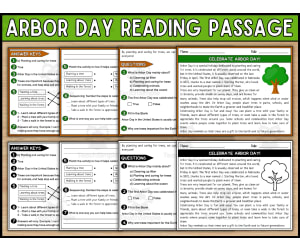
Arbor Day is a special day dedicated to planting, caring for, and appreciating trees. It is celebrated in many countries, with the U.S. observing it on the last Friday in April. The day encourages environmental awareness and conservation efforts. Schools, communities, and organizations plant trees to promote a greener future. Are you looking for a fun and engaging way to celebrate Arbor Day? This reading passage is a great resource for celebrate Arbor Day while practicing reading skills. This educational resource features simple, kid-friendly pages designed to make learning both enjoyable and interactive. Great for homeschooling, classroom education, or extra practice. Number of pages: 8 pages (4 BW + 4 COLOR) Format PDF file size: 8.5*11 Inches If you and your students or your children enjoy using this educational and engaging resource. please rate it and follow my store to be the first to know about my new teaching resources and freebies. Enjoy!
Author Wonderland School
Tags Arbor Day, Reading, Reading Passage, Reading Comprehension, Arbor Day Coloring Pages, Earth Day, Earth Day Coloring Pages, Coloring Pages, Arbor Day Craft, Earth Day Crafts

Penguin's Cozy Hat Cored Literacy Readers Level D
ELA, Resources for Teachers, Reading Comprehension, Reading, Common Core, Library, Children’s Literature, Literature, Social Emotional Learning (SEL), Special Resources, Kindergarten, Grade 1, 2, Worksheets & Printables, Worksheets, Teacher Tools, Centers, Activities, Writing Prompts, Literacy Readers
Book Snapshot Title: Penguin’s Cozy Hat Genre: Fiction Primary Topic: Persevering through a windy challenge Estimated Guided Reading Level (A–Z): D What This Book Teaches Best Perseverance / determination: Percy keeps holding on until his hat stayed put , showing real determination. Cause and effect: A small puff of wind turns into a stronger wind that tugged at his hat. Problem-solving with actions: Percy changes his body position— wiggles , squats low , and holds steady —to keep the hat on. Descriptive language: Words like crisp , icy cold , and roared help readers feel the setting. Learning Goals Students will: retell the main events from the story describe why Percy loved his hat using details from the text explain how the wind affected Percy’s hat and what Percy did in response identify words and phrases that describe the cold, windy setting explain how Percy feels at the end and support the idea with text evidence Key Vocabulary From the Text waddled — walked with short, side-to-side steps crisp — cold and fresh feeling tugged — pulled hard on something squatted — bent down very low determination — not giving up when it’s difficult FULL CATALOG OF DOWNLOAD LINKS AND ENCYCLOPEDIA INDEX HERE Printing Tips 1. Best Printing Method (Recommended) “Booklet” Printing (Best if Available) If your printer or PDF viewer supports Booklet Printing , use this. Settings to use: Print mode: Booklet Paper size: Letter or A4 (either works) Orientation: Landscape Print on both sides: Yes Flip on: Short edge Scaling: Fit to printable area Booklet subset: First test: Front sides only Then: Back sides only This will automatically: Pair pages correctly Put the cover on the outside Align everything for folding After printing, fold in half and staple along the spine . 2. If “Booklet” Printing Is NOT Available You can still print this correctly with manual duplex printing . Step-by-step: Open the PDF. Choose Print . Set: Orientation: Landscape Pages per sheet: 1 Print on both sides: Yes Flip on: Short edge Print all pages . Because each PDF page already contains two facing book pages, the result will still fold cleanly into a book. Literacy Readers Overview This product is perfect for small group instruction, such as guided reading, strategy groups, or interventions. It could also be used for independent reading, homework, or holiday work. It could also be used for literacy stations, read-aloud practice, or sub plans. Extension Ideas There are several ways to extend the lesson, including reading twice—first for understanding, and the second time to find the key details. Perhaps you can highlight or underline a detail that answers the comprehension questions. You can also turn it into a writing activity: What did you learn, or retell the story using first, next, then, finally. You could even choose a vocabulary word, draw it, with a caption from the text. For more advanced learners, perhaps you can compare this to another text they have read recently. Differentiation Tips For differentiation, if the words are hard, then perhaps you can preview some of them before you begin. For responses, perhaps you can give the students the first few words, for example, “In the book…”. You can also pair up the students, which normally leads to one of them helping the other. You can read it through again for fluency. Perhaps you can read two or three pages at a time and then come together as a group and analyze. For similar downloads and other frees, do check out Cored Group on TeachSimple.
Author Cored Education
Rating
Tags Vocabulary, Reading Comprehension, Reading Passages, Literacy Readers, Storybooks, Penguins, Fiction, Leveled Reading, Sel, Ela
Powered Phonics Rule Detectives Gamified Micro-Quests for K-2
Reading, ELA, Literature, Children’s Literature, Mental Health, P.E. & Health, Mindfulness, Health, Research, STEM, Homeschool Curriculum, Grade 1, 2, 3, 4, 5, Activities, Games, Projects, Experiments, Assessments, Teacher Tools, Lesson Plans, Literacy Readers, Presentations, Rubrics
Unleash the Potential of Literacy with this Full, AI-Supported Phonics Learning Program for Grade K-2 Students! "AIPowered Phonics Rule Detectives: Gamified Micro-Quests for K-2 Word Building - Phonics Rules Buildable Grade K-2nd Edition" features 45 pages of interactive digital lesson material that can turn conventional phonics lesson delivery into an incredibly fun and fascinating detective hunt mystery series for kids. A full range of interactive elements, digital AI advisory tools for adaptive content delivery, worksheets for kids, teacher support material, images, and solution keys have been included in this resource tools package for teachers and home schooling parents for effective decoding, reading, and spelling skill development for kids in Grade K-2. Based on a strong systematic and explicit phonics and synthetic background, the "buildable" sequence in the curriculum includes the following skills for each grade level: Kindergarten—basic CVC words and letter sounds, Grade 1—digraphs, blends, CVCE (or "magic e"), and long vowels, Grade 2—vowel teams, r-controlled vowels, diphthongs, syllables, soft C/G, and silent letters. Use the power of Artificial Intelligence to generate unlimited differentiated scenarios, sentences, and activities for remediation, on-grade, or enrichment purposes, and add gamification components such as role-playing, stories, points, badges, and feedback. Why Parents/Schools Love It: Engage Gamification Increases Motivation: Converts phonics lessons into enjoyable 'detective missions' involving stories, badges, & micro-quests, keeping children eager & preventing burnout, underpinning theories such as Self-Determination Theory & Behaviorism. AI-Enabled Personalization: Saves Time “Teachers use prompt cards to create endless differentiated learning material instantly, serving all children, from struggling to advanced learners, without consuming teaching hours.” Established Effectiveness with Data-Driven Insights: Comes with personalized student data indicating an 60-85% proficiency rate for essential rules, as well as assessment and tracking for literacy gains. Complete Ready-to-Use Resources: The all-inclusive resources are available as a single PDF that includes theory lessons, activity sheets, and answer keys and ethics guidelines related to AI that are suitable according to literacy best practices. It Helps Develop Lifelong Reading Confidence: This scaffolding approach leads children to gain a strong conceptual foundation regarding phonics rules, which results in their fluent reading skills, ability to master spelling concepts, as well as developing their lifelong love Target Classes/Students : On the basis of a comprehensive analysis of the PDF document, which includes the flow of the document, developmental phases, categories of rules, worksheets, as well as examples, the following groups of students can be targeted by it: Kindergarten (Emergent Readers): Emphasis on basic components including letter/sound association, vowel concepts, CVC words, and initial/final sounds. This is to promote cognitive balance in the content. Grade 1: Focuses on mastery of CVC words, introduction to digraphs (sh, ch, th, wh), blends (bl, fr, st), CVCE, magic 'e', Long Vowel teams - ai, ee, oa. Grade 2 (Developing Readers) Focuses on complex long vowel combinations, complex pairs of vowels in a word or syllable (ou, oy, ie), r-controlled combinations of letters and vowels (ar, er, ir, or, ur), diphthongs, inflectional suffixes, syllables, and silent letters Its K-2 continuum is "buildable," in that the rules ramp up cumulatively, and it is therefore ideal for mixed-age, intervention, or enrichment settings in the early grades of schooling. Copyright/Terms of Use : «This Book was copyrighted by Syed Hammad Rizvi.» You cannot modify it or give it or any part of it away or resell it. That means you cannot put it on the Internet where it might be downloaded by anyone who wants it. However, if you need to share this resource with colleagues, just purchase more licenses from Teachsimple. Thanks for following the terms of use! This product has been very proudly presented to you by Syed Hammad Rizvi
Author Creative Book Store
Rating
Tags AIPoweredPhonics, PhonicsRuleDetectives, GamifiedMicroQuests, K2WordBuilding, PhonicsRulesK2, BuildablePhonicsCurriculum, KindergartenPhonics, Grade1Phonics, Grade2Phonics, EarlyLiteracyDevelopment
Reading Comprehension Nonfiction Set 2 Sample: What a Smell (Forms)
ELA, Reading, Language Development, Vocabulary, Common Core, ESL, Reading Comprehension, Writing, Literature, Children’s Literature, Grade 4, 5, Centers, Activities, Assessments, Teacher Tools, Tests, Quizzes and Tests
Reading Comprehension Passages Nonfiction Set 2 Sample Overview No prep reading comprehension lessons, with enjoyable articles and topics. Each lesson has a blend of post-reading activities. Mixed questions to check overall understanding. Vocabulary activities, plus a writing section. Lessons also contain a bonus extension exercise at the end. Some you may like, some you may not, either way they are there if you wish to use them. Full answer keys are provided. Passage Included 2.What a Smell: How does the stink bug protect its children? Find out in this lesson. Forms Version This is the Forms editable and fillable/self grading version. This download is available in GOOGLE Docs, GOOGLE Forms, GOOGLE Slides. PDF, PPT, WORD. FULL CATALOG OF DOWNLOAD LINKS HERE Grade 4/5 Links Fiction Set 1 - Animals Google Docs Google Forms Google Slides PDF PPT Word Guided Reading Materials Fiction Set 2 - Family Google Docs Google Forms Google Slides PDF PPT Word Guided Reading Materials Fiction Set 3 - Friends Google Docs Google Forms Google Slides PDF PPT Word Guided Reading Materials Fiction Set 4 - School Google Docs Google Forms Google Slides PDF PPT Word Guided Reading Materials Fiction Set 5 - Sports Google Docs Google Forms Google Slides PDF PPT Word Guided Reading Materials Nonfiction Set 1 - Birds Google Docs Google Forms Google Slides PDF PPT Word Guided Reading Materials Nonfiction Set 2 - Insects Google Docs Google Forms Google Slides PDF PPT Word Guided Reading Materials Nonfiction Set 3 - Mammals Google Docs Google Forms Google Slides PDF PPT Word Guided Reading Materials Nonfiction Set 4 - Nature Google Docs Google Forms Google Slides PDF PPT Word Guided Reading Materials Nonfiction Set 5 - Sea Animals Google Docs Google Forms Google Slides PDF PPT Word Guided Reading Materials Reading Passages Overview Each passage is especially written for Grade 4-5 students, including key vocabulary required for this age group. Topics are varied and are accompanied by colorful graphics. Topics are meant to educate, yet entertain the modern student. These passages are perfect for the modern classroom. Whereas textbooks can become outdated in no time, any changes to technology or the world will result in updates to this product. Mixed Questions The mixed questions section of each lesson includes a variation of five comprehension, vocabulary and math questions. In addition, key reading strategies are frequently covered including cause & effect, summarizing, compare & contrast and making conclusions. Two or three of the questions will be MCQs and other questions will require a written response of some kind. Full answers and example responses appear at the end of the lesson. Spelling & Vocab Each reading passage contains a variety of words and phrases designed for Grade 4-5 students. Spelling and vocab activities provide the opportunity to build fluency with these words. As it can become quite mundane doing the same activities over and over, each lesson in a set will contain a different spelling and vocab activity . Activities include: spelling games, sentence match-ups, mixed-up text and decoding words from the lesson. Writing Prompts Writing prompts are designed to continue the theme or lessons learned in the story. Students are persuaded to write in a variety of ways and each prompt includes several cues to help. As with the spelling/vocab section, writing prompts will vary. This includes research pieces, reading responses, poetry and creative writing prompts. Full Answer Keys Full answer keys and sample responses are provided so no matter how busy you are, you know you're covered! Mixed question answers provide evidence from the text, math questions contain the relevant workings. Answers are designed for use by the teacher, but also suitable as a handout to the student. Just for Fun Each lesson will have a bonus extension exercise. This is something fun to extend the lesson with. You can find these at the end of each lesson, titled Just for Fun. Just for Funs are optional. Some you may like, some you may not. Either way, they are there to do with as you wish. For similar downloads and other frees, do check out Cored Group on TeachSimple.
Author Cored Education
Tags Elementary, Reading, Comprehension, Vocabulary, Answers, Ccss, Common Core, Spelling, Writing, Passages
Delaware State Flipbook (Capital, Bird, Flower, Flag, Animal)
Creative Arts, Art, Social Studies, ELA, History, History: USA, Geography, Reading, Reading Comprehension, Grammar, Language Development, Spelling, Writing, Grade 2, 3, 4, Activities
Delaware State Flipbook This effective teaching resource provides a fun and hands-on approach to learning about the iconic state of Delaware and its rich history and symbols. Motivate your students towards learning With this interactive activity, children get hooked on learning while having fun. Five Symbols of Delaware Capital city: Dover State bird: Blue Hen Chicken The state flower: Peach Blossom An image of the Delawerean flag Official animal: Grey Fox Ideal for Grades 2-4 The hands-on nature of the project makes it seamless for all students across grades 2-4 participate actively. User-friendly Designs for Teachers Too! This product is designed with educators' priorities in mind too! We provide two printing styles; one that requires cutting, another print-ready version keeping things simple. There are two design varieties within these sets; one features pictures while another comes without images offering room for imaginations run free! Inspiring Topics Included: Facts on Geographical Deatils, A Detailed Map Exercise, KWL(Know-Want-Learn) exercise. A Multitude Subject Resource Mini-set: Includes Art & Music (through drawing & coloring ), Social Studies (enhancing knowledge around History: USA alongside controlled exposure over Geography), Language Arts(Clear comprehension expressed through Grammar exercises). A Gem Amongst Resources - Simple to Use Anywhere! The Delaware State Flipbook does a laudable job of providing engaging content as an ideal choice in different pedagogical contexts - grouped towards centralized attention or disseminated across small teams or even for a student's home assignment.
Author Heather Huhman
Tags Delaware State Flipbook, Delaware Symbols, Dover, Blue Hen Chicken, Peach Blossom