



2,657 products added recently
Page 51 - Reading Comprehension Activitites
Support your students in developing strong reading comprehension skills with a variety of engaging activities. This collection includes worksheets, graphic organizers, and discussion questions designed to help students understand and analyze texts. By integrating these resources into your teaching, you can enhance students' ability to interpret information and draw meaningful conclusions.

 Show filters


Guided Reading Level N - Manchester (with Lesson Plan)
ELA, Resources for Teachers, Reading Comprehension, Reading, Social Studies, Geography, Earth and Environmental Sciences, Science, History, Economics, Grade 2, 3, 4, Worksheets & Printables, Worksheets, Teacher Tools, Centers, Activities, Literacy Readers, Quizzes, Quizzes and Tests, Assessments, Lesson Plans
This Guided Reading Book - Manchester (Level N) with lesson plan includes: Guided Reading Color Label (front cover x1) This is a quick way to match the book’s demands to what students can generally handle.. The overall goal is to use the level/color to pick books for several smaller groups. To qualify for a certain level, a student is expected to read a book from that level with about 90–94% accuracy. If a student is consistently accurate and understands, move up a level. If the student is struggling at that level, drop down and add more support. Each student will improve at completely different rates, but it is generally one of the best ways to check progress across the class. DOWNLOAD THE CATALOG TO VIEW ALL GUIDED READING BOOKS AVAILABLE (SORTED LEVELS A-Z) Pre-Reading Question (x1) Teacher asks the prompt aloud, can be while showing the cover or first page. Students share what they already know, or make educated guesses from the cover. Prompt them to use the target vocabulary. Write some of their responses on the board to look back at during the reading. Vocabulary Words (x5) Introduce the five words, best doing it one at a time. Start by saying it, while students repeat and then see if anyone knows what it means before reading further. Read through the meaning and try to briefly connect each word to a picture or gesture so it’s meaningful. Ask students to flip through the book pages and point to where they see each of the vocabulary words. While reading the book pause upon coming across one of the vocab words or read the sentence twice to make sure students understand the word has appeared. Optional: Ask students to raise hands whenever they see/hear one of the new words. Guided Reading Pages (x10) Check the book snapshot (below) for: primary topic - do you need to prep extra reading or intro materials on this? what is taught best - decide on 1-2 bullets to focus on, use the prompt or words provided here for best results. learning goals - what you are checking for students to be able to do after the session, elicit answers using prompts or words provided. key vocabulary (see section above). questions overview - so you know what is coming up and if you need to prep extra materials to assist understanding. Run the lesson You may have already looked at a few of the pages together, but you can show them some of the pictures again first to set meaning. Depending on how much time you have and how familiar your students are with guided reading class, you may want to read the book aloud first with the group first. Students whisper or partner read, while you listen in. If time, do it as a group, one student reading a page each. Use the guided page’s prompts to coach: “Check the picture / does it make sense?” “Point under the words / try the first sound” “Reread the sentence smoothly”. Try to focus more on one student per session (rotating every time), so you can work out if they are ready to move up or need to move down a level. Comprehension Questions (back cover x3) This is your way to check that students didn’t just say the words, but actually understood the text. First, let students answer by pointing to the page/picture and saying a short sentence. After any answer, follow with: “Show me where you found that in the text.” In bigger groups, have partners answer first (10–20 seconds), then call on 2–3 students to share. Differentiation tips: Emerging speakers/struggling readers: oral + pointing On-level: oral in a full sentence Higher: one written sentence or draw + label Book Snapshot Title: World Cities: Manchester Genre: Nonfiction (informational text) Subject: Social Studies (Geography) Primary Topic: Manchester’s location, waterways, climate, and growth Estimated Guided Reading Level (A–Z): N What This Book Teaches Best How Manchester’s location and landform (a bowl-shaped plain) help describe where the city sits and what surrounds it. How waterways shape a city’s geography, including the River Irwell as a border and nearby rivers that join it. How people changed transportation and trade by building the Manchester Ship Canal to connect the inland city to the Irish Sea. How weather and climate connect to land features, including nearby hills trapping clouds and creating frequent grey skies and light rain. How Manchester has changed over time, from textile mills in the 1800s to a skyline with new skyscrapers in recent years. Learning Goals Students will identify where Manchester is located in England using details from the text. Students will describe how Manchester’s rivers and waterways affect the city’s geography. Students will explain why the Manchester Ship Canal was built and what it connects to. Students will describe Manchester’s temperate maritime climate using evidence from the text. Students will explain how damp air influenced textile mills in the 1800s, according to the text. Students will describe one way Manchester’s city center or skyline has changed, using text details. Key Vocabulary From the Text waterways — rivers or channels that water flows through. terrain — what the land is like. maritime — connected to the sea or ocean. municipal — belonging to a city or town. skyscrapers — very tall buildings with many floors. Discussion Prompts Pre-reading question: How might rivers, hills, and weather shape what a city becomes like? Comprehension questions: Where does the text say Manchester is located in England? Comprehension questions: What did the Manchester Ship Canal connect Manchester to? Comprehension questions: According to the text, how did damp air help cotton threads in the 1800s? Printing Tips 1. Best Printing Method (Recommended) “Booklet” Printing (Best if Available) If your printer or PDF viewer supports Booklet Printing , use this. Settings to use: Print mode: Booklet Paper size: Letter or A4 (either works) Orientation: Landscape Print on both sides: Yes Flip on: Short edge Scaling: Fit to printable area Booklet subset: First test: Front sides only Then: Back sides only This will automatically: Pair pages correctly Put the cover on the outside Align everything for folding After printing, fold in half and staple along the spine . 2. If “Booklet” Printing Is NOT Available You can still print this correctly with manual duplex printing . Step-by-step: Open the PDF. Choose Print . Set: Orientation: Landscape Pages per sheet: 1 Print on both sides: Yes Flip on: Short edge Print all pages . Because each PDF page already contains two facing book pages, the result will still fold cleanly into a book. Thousands of Cored Education products are included with your TeachSimple membership. Download links and encyclopedia index available here.
Author Cored Education
Rating
Tags Reading Comprehension, Reading Passages, Reading, Guided Reading, Guided Reading Lesson Plan, Guided Reading Activity, Pre-reading, Geography, Social Studies Lesson Plans, History
Insects, Animals, & Ecosystems: SAMPLE Reading passage (Word)
Science, ELA, Reading, Reading Comprehension, Strategies, Resources for Teachers, Life Sciences, Animals, Insects, Nature & Plants, Grade 6, 7, 8, 9, Writing Prompts, Worksheets & Printables, Centers, Activities, Teacher Tools, Assessments, Quizzes and Tests, Quizzes, Tests
This is a ONE PASSAGE SAMPLE. The following is the description of the FULL resource and the downloading links: Insects, Animals, & Ecosystems: Reading Comprehension Passages (Word) This very engaging collection of life science reading passages about Insects, Animals, & Ecosystems is designed to bridge the gap between science and literacy through strengthening reading comprehension and sparking scientific curiosity in middle school students. Each passage blends English Language Arts skills with accurate science content that supports NGSS classroom practice. Ideal for interdisciplinary learning in ELA and Science. Suitable for Grade 9 review, too! What Is Included? There are (3) informational passages: Ecosystems: Webs of Life and Change See how living things and their surroundings fit together. Follow energy from producers to consumers to decomposers, and notice how fires, floods, or people can disturb a system and how it can recover. Insects: Small Creatures, Giant Impact Meet the helpers that pollinate, recycle waste, and feed countless animals. Learn how simple body parts and smart behaviors let insects thrive almost everywhere. Unique Animals of the Rainforest Visit a forest bursting with life, from Hyacinth Macaws and pink river dolphins to golden lion tamarins and poison dart frogs. Understand why protecting habitats keeps these remarkable species alive. Student Tasks for Each Passage: 5 multiple-choice questions targeting main idea, key details, inference, vocabulary in context, and use of evidence 5 vocabulary matching items with clear, student-friendly definitions 5 text-based questions that require citing specific lines or facts 1 summary prompt that asks students to condense central ideas accurately Full answer key for every section Available Formats for this Resource PDF Google Docs FULL CATALOG OF DOWNLOADING LINKS HERE Reading Passage Links: Astronomy & Space Science PDF Fillable PDF Word Docs Google Docs Volcanoes, Rocks, & Mountains PDF Fillable PDF Word Docs Google Docs Rock Cycle, Soil, & Sinkholes PDF Fillable PDF Word Docs Google Docs Mars, Glaciers, & Antarctica PDF Fillable PDF Word Docs Google Docs Water Cycle, Acid Rain, & Wastewater PDF Fillable PDF Word Docs Google Docs Insects, Animals, & Ecosystems PDF Fillable PDF Word Docs Google Docs Bioluminescence & Insects PDF Fillable PDF Word Docs Google Docs Animal Skin, Cats, & T. Rex PDF Fillable PDF Word Docs Google Docs Human Body and Senses PDF Fillable PDF Word Docs Google Docs Health & Applied Bioscience PDF Fillable PDF Word Docs Google Docs Waves, Light, & Imaging PDF Fillable PDF Word Docs Google Docs Electricity & Energy PDF Word Docs Google Docs Motion & Materials PDF Word Docs Google Docs Chemistry and Materials Science PDF Fillable PDF Word Docs Google Docs Product Details Length: 14 pages total Grades: 6–8, also suitable for Grade 9 review Use cases: close reading, stations, homework, intervention, test prep, and sub plans Standards support: reinforces informational-text skills and supports NGSS-style sense making through observation, modeling, and clear use of claim, evidence, and reasoning Why Teachers Choose This Set Authentic science content paired with rigorous literacy practice Consistent task structure across all passages for easier planning and smoother student routines Clear, age-appropriate writing that builds confidence without oversimplifying Use this set to reinforce ELA skills in science, to add literacy to your lessons, or to support independent work. The passages strengthen main idea, evidence use, vocabulary in context, inference, cause and effect, and summary writing. With ready-to-use assessments and complete answer keys, you can provide focused practice that is simple to run and fast to review.
Author CORED Education - Middle & High School
Rating
Tags Middle School, Reading Comprehension, Reading Strategies, ELA, Centers, Reading Passage, Assessments, Vocabulary, Life Science, Insects
Rock Cycle, Soil, & Sinkholes: SAMPLE Reading Passage (PDF)
Science, Earth and Environmental Sciences, ELA, Reading, Reading Comprehension, Strategies, Resources for Teachers, Geology, Earth Sciences, Grade 6, 7, 8, 9, Writing Prompts, Worksheets & Printables, Centers, Activities, Teacher Tools, Assessments, Quizzes and Tests, Quizzes, Tests
This is a ONE PASSAGE SAMPLE. The following is the description of the FULL resource and the downloading links: Rock Cycle, Soil, & Sinkholes: Reading Comprehension Passages (PDF) This very engaging collection of earth science reading passages about Rock Cycle, Soil, and Sinkholes is designed to bridge the gap between science and literacy through strengthening reading comprehension and sparking scientific curiosity in middle school students. Each passage blends English Language Arts skills with accurate science content that supports NGSS classroom practice. Ideal for interdisciplinary learning in ELA and Science. Suitable for Grade 9 review, too! What Is Included? There are (3) informational passages: Soil: The Life Beneath Our Feet Explore how minerals, organic matter, water, and air build layered soil, and see how texture and structure affect roots, drainage, clean water, and healthy habitats. The Science of Sinkholes Understand how dissolving rock creates underground voids, what can trigger subsidence or collapse, and how mapping and prevention reduce risk in vulnerable areas. The Rock Cycle: How Rocks Form and Change Follow rock material as it melts, crystallizes, weathers, compacts, and transforms under heat and pressure, then connect these processes to examples in nature and everyday life. Student Tasks for Each Passage: 5 multiple-choice questions targeting main idea, key details, inference, vocabulary in context, and use of evidence 5 vocabulary matching items with clear, student-friendly definitions 5 text-based questions that require citing specific lines or facts 1 summary prompt that asks students to condense central ideas accurately Full answer key for every section Available Formats for this Resource Word Docs Google Docs FULL CATALOG OF DOWNLOADING LINKS HERE Reading Passage Links: Astronomy & Space Science PDF Fillable PDF Word Docs Google Docs Volcanoes, Rocks, & Mountains PDF Fillable PDF Word Docs Google Docs Rock Cycle, Soil, & Sinkholes PDF Fillable PDF Word Docs Google Docs Mars, Glaciers, & Antarctica PDF Fillable PDF Word Docs Google Docs Water Cycle, Acid Rain, & Wastewater PDF Fillable PDF Word Docs Google Docs Insects, Animals, & Ecosystems PDF Fillable PDF Word Docs Google Docs Bioluminescence & Insects PDF Fillable PDF Word Docs Google Docs Animal Skin, Cats, & T. Rex PDF Fillable PDF Word Docs Google Docs Human Body and Senses PDF Fillable PDF Word Docs Google Docs Health & Applied Bioscience PDF Fillable PDF Word Docs Google Docs Waves, Light, & Imaging PDF Fillable PDF Word Docs Google Docs Electricity & Energy PDF Word Docs Google Docs Motion & Materials PDF Word Docs Google Docs Chemistry and Materials Science PDF Fillable PDF Word Docs Google Docs Product Details Length: 15 pages total Grades: 6–8, also suitable for Grade 9 review Use cases: close reading, stations, homework, intervention, test prep, and sub plans Standards support: reinforces informational-text skills and supports NGSS-style sense making through observation, modeling, and clear use of claim, evidence, and reasoning Why Teachers Choose This Set Authentic science content paired with rigorous literacy practice Consistent task structure across all passages for easier planning and smoother student routines Clear, age-appropriate writing that builds confidence without oversimplifying Use this set to reinforce ELA skills in science, to add literacy to your lessons, or to support independent work. The passages strengthen main idea, evidence use, vocabulary in context, inference, cause and effect, and summary writing. With ready-to-use assessments and complete answer keys, you can provide focused practice that is simple to run and fast to review.
Author CORED Education - Middle & High School
Rating
Tags Middle School, Reading Comprehension, Reading Strategies, Reading Passages, ELA, Centers, Reading Passage, Assessments, Vocabulary, Earth Science

Guided Reading Level Q - The Living Rainforest (with Lesson Plan)
ELA, Resources for Teachers, Reading Comprehension, Reading, Animals, Life Sciences, Science, Nature & Plants, Earth and Environmental Sciences, Physics, Grade 3, 4, 5, Worksheets & Printables, Worksheets, Teacher Tools, Centers, Activities, Literacy Readers, Quizzes, Quizzes and Tests, Assessments
This Guided Reading Book - The Living Rainforest (Level Q) with lesson plan includes: Guided Reading Color Label (front cover x1) This is a quick way to match the book’s demands to what students can generally handle.. The overall goal is to use the level/color to pick books for several smaller groups. To qualify for a certain level, a student is expected to read a book from that level with about 90–94% accuracy. If a student is consistently accurate and understands, move up a level. If the student is struggling at that level, drop down and add more support. Each student will improve at completely different rates, but it is generally one of the best ways to check progress across the class. DOWNLOAD THE CATALOG TO VIEW ALL GUIDED READING BOOKS AVAILABLE (SORTED LEVELS A-Z) Pre-Reading Question (x1) Teacher asks the prompt aloud, can be while showing the cover or first page. Students share what they already know, or make educated guesses from the cover. Prompt them to use the target vocabulary. Write some of their responses on the board to look back at during the reading. Vocabulary Words (x5) Introduce the five words, best doing it one at a time. Start by saying it, while students repeat and then see if anyone knows what it means before reading further. Read through the meaning and try to briefly connect each word to a picture or gesture so it’s meaningful. Ask students to flip through the book pages and point to where they see each of the vocabulary words. While reading the book pause upon coming across one of the vocab words or read the sentence twice to make sure students understand the word has appeared. Optional: Ask students to raise hands whenever they see/hear one of the new words. Guided Reading Pages (x10) Check the book snapshot (below) for: primary topic - do you need to prep extra reading or intro materials on this? what is taught best - decide on 1-2 bullets to focus on, use the prompt or words provided here for best results. learning goals - what you are checking for students to be able to do after the session, elicit answers using prompts or words provided. key vocabulary (see section above). questions overview - so you know what is coming up and if you need to prep extra materials to assist understanding. Run the lesson You may have already looked at a few of the pages together, but you can show them some of the pictures again first to set meaning. Depending on how much time you have and how familiar your students are with guided reading class, you may want to read the book aloud first with the group first. Students whisper or partner read, while you listen in. If time, do it as a group, one student reading a page each. Use the guided page’s prompts to coach: “Check the picture / does it make sense?” “Point under the words / try the first sound” “Reread the sentence smoothly”. Try to focus more on one student per session (rotating every time), so you can work out if they are ready to move up or need to move down a level. Comprehension Questions (back cover x3) This is your way to check that students didn’t just say the words, but actually understood the text. First, let students answer by pointing to the page/picture and saying a short sentence. After any answer, follow with: “Show me where you found that in the text.” In bigger groups, have partners answer first (10–20 seconds), then call on 2–3 students to share. Differentiation tips: Emerging speakers/struggling readers: oral + pointing On-level: oral in a full sentence Higher: one written sentence or draw + label Book Snapshot Title: The Living Rainforest Genre: Nonfiction (informational text) Subject: Life Science / Reading (Informational Text) Primary Topic: Rainforest layers, cycles, and why they matter Estimated Guided Reading Level (A–Z): Q What This Book Teaches Best Rainforest location and climate patterns: Tropical rainforests are near the equator and stay warm and rainy year-round. Structure of a rainforest ecosystem: The text explains distinct vertical layers (forest floor, understory, canopy, emergent layer) and what makes each layer different. Earth science connection (water cycle): Transpiration is described as a process that helps form clouds and rain over the forest. Biodiversity and ecosystem balance: Rainforests hold a huge variety of life, and organisms play roles that keep the ecosystem balanced. Why rainforests matter globally: The book connects rainforests to photosynthesis, oxygen/carbon dioxide exchange, carbon storage, rainfall patterns, and climate. Learning Goals Students will describe where tropical rainforests are located and what their climate is like. Students will explain how the rainforest is organized into layers and compare the conditions in at least two layers. Students will describe what happens on the forest floor when leaves, seeds, and fruits decompose. Students will explain transpiration and how it helps create rain over the rainforest. Students will summarize why rainforests are called the “lungs of the planet,” using details from the text. Students will identify reasons the text gives for preserving tropical rainforests. Key Vocabulary From the Text ecosystems — living things and their environment working together. decompose — break down and rot into smaller parts. understory — plant layer below the canopy. transpiration — plants release water vapor from leaves. biodiversity — many different living things in one place. Discussion Prompts Pre-reading question: How might the different rainforest layers change where plants and animals can live? Comprehension questions: What makes the forest floor dark and damp, according to the text? Comprehension questions: How does the text describe transpiration helping rain form over the rainforest? Comprehension questions: Why does the text call rainforests the “lungs of the planet”? Printing Tips 1. Best Printing Method (Recommended) “Booklet” Printing (Best if Available) If your printer or PDF viewer supports Booklet Printing , use this. Settings to use: Print mode: Booklet Paper size: Letter or A4 (either works) Orientation: Landscape Print on both sides: Yes Flip on: Short edge Scaling: Fit to printable area Booklet subset: First test: Front sides only Then: Back sides only This will automatically: Pair pages correctly Put the cover on the outside Align everything for folding After printing, fold in half and staple along the spine . 2. If “Booklet” Printing Is NOT Available You can still print this correctly with manual duplex printing . Step-by-step: Open the PDF. Choose Print . Set: Orientation: Landscape Pages per sheet: 1 Print on both sides: Yes Flip on: Short edge Print all pages . Because each PDF page already contains two facing book pages, the result will still fold cleanly into a book. Thousands of Cored Education products are included with your TeachSimple membership. Download links and encyclopedia index available here.
Author Cored Education
Rating
Tags Reading Comprehension, Reading Passages, Reading, Guided Reading, Guided Reading Lesson Plan, Guided Reading Activity, Pre-reading, Science Lesson Plans, Animals, Plants
Reading Passage 31: Invertebrates (Google Slides)
ELA, Reading, Reading Comprehension, Common Core, ESL, Language Development, Spelling, Life Sciences, Science, Resources for Teachers, Grade 5, 6, 7, Teacher Tools, Presentations, Activities, Tests, Quizzes and Tests, Assessments
Free Reading Passage on Invertebrates for Life Science What's inside this free product? Science Reading Comprehension Passage: Invertebrates Independent Google Slides Version: This is the independent Google Slides version containingone lesson. Product Info: 37 SLIDES (US English with Answers) Google Slides Version Teaching Duration: 90 Minutes Science Reading Comprehension Outline: Introducing a comprehensive resource tailored for 5th and 6th graders, this product offers enriching reading passages supplemented with illustrative pictures and graphs to clarify key concepts. Aligned with the Common Core State Standards (CCSS), it offers a hassle-free approach to teaching, given that the bulk of the preparation is already done for you. The passages present a diverse set of questions – from multiple choice to data analysis and fill-in-the-blanks. This ensures a rich blend of high-interest content and fundamental curriculum-based science themes. With its versatility, you can seamlessly integrate these lessons into various classroom settings, whether it's whole class discussions, morning exercises, independent desk tasks, small group engagements, contingency plans for substitute teachers, regular homework assignments, or even themed activities for holidays. FULL CATALOG OF DOWNLOAD LINKS HERE Grade 5/6 Links: Physical Science Part 1 - Physical and Chemical Properties Google Docs/Slides/Forms PDF PPT Word Free Supplementary Pack Accompanying Videos Physical Science Part 2 - Motion and Energy Google Docs/Slides/Forms PDF PPT Word Free Supplementary Pack Accompanying Videos Physical Science Part 3 - Electricity and Magnets Google Docs/Slides/Forms PDF PPT Word Free Supplementary Pack Accompanying Videos Life Science Part 1 - Cells, Reproduction and Genetics Google Docs/Slides/Forms PDF PPT Word Free Supplementary Pack Accompanying Videos Life Science Part 2 - Human Body Systems Google Docs/Slides/Forms PDF PPT Word Free Supplementary Pack Accompanying Videos Life Science Part 3 - Plant Parts and Ecosystems Google Docs/Slides/Forms PDF PPT Word Free Supplementary Pack Accompanying Videos Earth Science Part 1 - Plate Tectonics and Rock Cycle Google Docs/Slides/Forms PDF PPT Word Free Supplementary Pack Accompanying Videos Earth Science Part 2 - Ocean Exploration and Natural Resources Google Docs/Slides/Forms PDF PPT Word Free Supplementary Pack Accompanying Videos Earth Science Part 3 - Weather and Solar System Google Docs/Slides/Forms PDF PPT Word Free Supplementary Pack Accompanying Videos For similar products and other frees, do check out Cored Group on TeachSimple .
Author Cored Education
Tags Science, Elementary, Reading, Comprehension, Vocabulary, Answers, Physics, Physical Science, Ccss, Common Core

Main Idea and Details Concentration Game
ELA, Reading, Reading Comprehension, Grade 2, 3, 4, Activities, Games
This resource is a Main Idea and Details Concentration Game. All you have to do is print, laminate and cut to prepare this game! Students will match a main idea and detail card to win. Answer key included.
Author Literacy Life
Tags Main Idea, Supporting Details, Concentration Game, Comprehension, Literacy Centers, Concentration Topics Game, Topics For Concentration Game

Motion & Materials: SAMPLE Physical Science Reading passage (PDF)
Science, ELA, Reading, Reading Comprehension, Strategies, Resources for Teachers, Physics, Grade 6, 7, 8, 9, Writing Prompts, Worksheets & Printables, Centers, Activities, Teacher Tools, Assessments, Quizzes and Tests, Quizzes, Tests
This is a ONE PASSAGE SAMPLE. The following is the description of the FULL resource and the downloading links: Electricity and Energy: Physical Science Reading Comprehension Passages and Questions (PDF) This very engaging collection of physical science reading passages about electricity and energy is designed to bridge the gap between science and literacy through strengthening reading comprehension and sparking scientific curiosity in middle school students. Each passage blends English Language Arts skills with accurate science content that supports NGSS classroom practice. Ideal for interdisciplinary learning in ELA and Science. Suitable for Grade 9 review, too! What Is Included? There are (3) informational passages: Sweet Science: How Heat Shapes Candy Baseball Science: From Bat to Ball Electric vs. Gasoline Cars: The Road Ahead Student Tasks for Each Passage: 5 multiple-choice questions targeting main idea, key details, inference, vocabulary in context, and use of evidence 5 vocabulary matching items with clear, student-friendly definitions 5 text-based questions that require citing specific lines or facts 1 summary prompt that asks students to condense central ideas accurately Full answer key for every section Available Formats for this Resource Word Docs Google Docs FULL CATALOG OF DOWNLOADING LINKS HERE Reading Passage Links: Astronomy & Space Science PDF Fillable PDF Word Docs Google Docs Volcanoes, Rocks, & Mountains PDF Fillable PDF Word Docs Google Docs Rock Cycle, Soil, & Sinkholes PDF Fillable PDF Word Docs Google Docs Mars, Glaciers, & Antarctica PDF Fillable PDF Word Docs Google Docs Water Cycle, Acid Rain, & Wastewater PDF Fillable PDF Word Docs Google Docs Insects, Animals, & Ecosystems PDF Fillable PDF Word Docs Google Docs Bioluminescence & Insects PDF Fillable PDF Word Docs Google Docs Animal Skin, Cats, & T. Rex PDF Fillable PDF Word Docs Google Docs Human Body and Senses PDF Fillable PDF Word Docs Google Docs Health & Applied Bioscience PDF Fillable PDF Word Docs Google Docs Waves, Light, & Imaging PDF Fillable PDF Word Docs Google Docs Electricity & Energy PDF Word Docs Google Docs Motion & Materials PDF Word Docs Google Docs Chemistry and Materials Science PDF Fillable PDF Word Docs Google Docs Product Details Length: 12 pages total Grades: 6–8, also suitable for Grade 9 review Use cases: close reading, stations, homework, intervention, test prep, and sub plans Standards support: reinforces informational-text skills and supports NGSS-style sense making through observation, modeling, and clear use of claim, evidence, and reasoning Why Teachers Choose This Set Authentic science content paired with rigorous literacy practice Consistent task structure across all passages for easier planning and smoother student routines Clear, age-appropriate writing that builds confidence without oversimplifying Use this set to reinforce ELA skills in science, to add literacy to your lessons, or to support independent work. The passages strengthen main idea, evidence use, vocabulary in context, inference, cause and effect, and summary writing. With ready-to-use assessments and complete answer keys, you can provide focused practice that is simple to run and fast to review.
Author CORED Education - Middle & High School
Rating
Tags Middle School, Reading Comprehension, Reading Strategies, ELA, Centers, Reading Passage, Assessments, Vocabulary, Physical Science, Physics
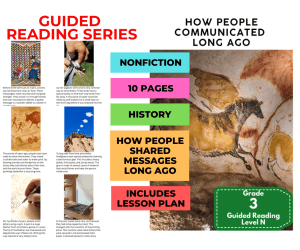
Guided Reading Level N - How People Communicated (with Lesson Plan)
ELA, Resources for Teachers, Reading Comprehension, Reading, Science, Pre-Reading, Language Development, Technology, History, Social Studies, Grade 2, 3, 4, Worksheets & Printables, Worksheets, Teacher Tools, Centers, Activities, Literacy Readers, Quizzes, Quizzes and Tests, Assessments
This Guided Reading Book - How People Communicated (Level N) with lesson plan includes: Guided Reading Color Label (front cover x1) This is a quick way to match the book’s demands to what students can generally handle.. The overall goal is to use the level/color to pick books for several smaller groups. To qualify for a certain level, a student is expected to read a book from that level with about 90–94% accuracy. If a student is consistently accurate and understands, move up a level. If the student is struggling at that level, drop down and add more support. Each student will improve at completely different rates, but it is generally one of the best ways to check progress across the class. DOWNLOAD THE CATALOG TO VIEW ALL GUIDED READING BOOKS AVAILABLE (SORTED LEVELS A-Z) Pre-Reading Question (x1) Teacher asks the prompt aloud, can be while showing the cover or first page. Students share what they already know, or make educated guesses from the cover. Prompt them to use the target vocabulary. Write some of their responses on the board to look back at during the reading. Vocabulary Words (x5) Introduce the five words, best doing it one at a time. Start by saying it, while students repeat and then see if anyone knows what it means before reading further. Read through the meaning and try to briefly connect each word to a picture or gesture so it’s meaningful. Ask students to flip through the book pages and point to where they see each of the vocabulary words. While reading the book pause upon coming across one of the vocab words or read the sentence twice to make sure students understand the word has appeared. Optional: Ask students to raise hands whenever they see/hear one of the new words. Guided Reading Pages (x10) Check the book snapshot (below) for: primary topic - do you need to prep extra reading or intro materials on this? what is taught best - decide on 1-2 bullets to focus on, use the prompt or words provided here for best results. learning goals - what you are checking for students to be able to do after the session, elicit answers using prompts or words provided. key vocabulary (see section above). questions overview - so you know what is coming up and if you need to prep extra materials to assist understanding. Run the lesson You may have already looked at a few of the pages together, but you can show them some of the pictures again first to set meaning. Depending on how much time you have and how familiar your students are with guided reading class, you may want to read the book aloud first with the group first. Students whisper or partner read, while you listen in. If time, do it as a group, one student reading a page each. Use the guided page’s prompts to coach: “Check the picture / does it make sense?” “Point under the words / try the first sound” “Reread the sentence smoothly”. Try to focus more on one student per session (rotating every time), so you can work out if they are ready to move up or need to move down a level. Comprehension Questions (back cover x3) This is your way to check that students didn’t just say the words, but actually understood the text. First, let students answer by pointing to the page/picture and saying a short sentence. After any answer, follow with: “Show me where you found that in the text.” In bigger groups, have partners answer first (10–20 seconds), then call on 2–3 students to share. Differentiation tips: Emerging speakers/struggling readers: oral + pointing On-level: oral in a full sentence Higher: one written sentence or draw + label Book Snapshot Title: How People Communicated Long Ago Genre: Nonfiction (Informational) Subject: Social Studies (Past and Present) / Reading Primary Topic: How people shared messages long ago Estimated Guided Reading Level (A–Z): N What This Book Teaches Best How people shared information long ago using cave wall paintings made from crushed rocks and water. How messengers (runners) delivered spoken messages or wooden tablets across forests and mountains. Different tools for sending messages, including carrier pigeons , letters , and the printing press for making many copies quickly. How inventions changed communication over time—from telegraph (Morse code) to telephone to near-instant messages today. Quality check note: One page includes text about firefighters’ turnout gear that does not match the book’s communication topic, and the vocabulary list includes firefighter terms (“protective,” “turnout”). Learning Goals Students will describe at least three ways people communicated long ago using details from the text. Students will explain how carrier pigeons carried letters according to the text. Students will describe how the printing press changed how books were made. Students will explain how the telegraph sent messages and name “Morse code” as described. Students will compare older communication methods to today’s communication described in the book. Key Vocabulary From the Text messengers — people who carry messages or news. invention — something new created for the first time. telegraph — machine that sent messages using electricity. envelope — paper cover that holds a letter. instantly — right away, with almost no waiting. Discussion Prompts Pre-reading question: What are some ways people might share information when they are far apart? Comprehension questions: How did people use cave walls to share information thousands of years ago? What did carrier pigeons carry, and where was it attached? According to the text, how can a message travel around the world today in just a few seconds? Printing Tips 1. Best Printing Method (Recommended) “Booklet” Printing (Best if Available) If your printer or PDF viewer supports Booklet Printing , use this. Settings to use: Print mode: Booklet Paper size: Letter or A4 (either works) Orientation: Landscape Print on both sides: Yes Flip on: Short edge Scaling: Fit to printable area Booklet subset: First test: Front sides only Then: Back sides only This will automatically: Pair pages correctly Put the cover on the outside Align everything for folding After printing, fold in half and staple along the spine . 2. If “Booklet” Printing Is NOT Available You can still print this correctly with manual duplex printing . Step-by-step: Open the PDF. Choose Print . Set: Orientation: Landscape Pages per sheet: 1 Print on both sides: Yes Flip on: Short edge Print all pages . Because each PDF page already contains two facing book pages, the result will still fold cleanly into a book. Thousands of Cored Education products are included with your TeachSimple membership. Download links and encyclopedia index available here.
Author Cored Education
Rating
Tags Reading Comprehension, Reading Passages, Reading, Guided Reading, Guided Reading Lesson Plan, Guided Reading Activity, Pre-reading, Vocabulary, History Lesson Plans, Technology
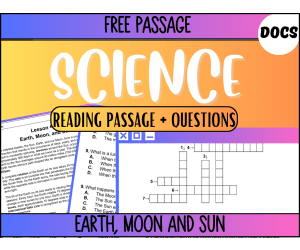
Reading Passage 42 Earth, Moon and Sun (Google Docs)
ELA, Reading, Reading Comprehension, Science, Earth and Environmental Sciences, Earth Sciences, Common Core, ESL, Language Development, Vocabulary, Grade 5, 6, 7, Centers, Activities, Assessments, Teacher Tools, Tests, Quizzes and Tests
Free Reading Passage on Earth, Moon and Sun for Earth Science What's inside this free product? Science Reading Comprehension Passage: Earth, Moon and Sun Independent Google Docs Version: This is the independent Google Docs version containingone lesson. Product Info: 8 PAGES (US English with Answers) Google Docs Version Teaching Duration: 90 Minutes Science Reading Comprehension Outline: Introducing a comprehensive resource tailored for 5th and 6th graders, this product offers enriching reading passages supplemented with illustrative pictures and graphs to clarify key concepts. Aligned with the Common Core State Standards (CCSS), it offers a hassle-free approach to teaching, given that the bulk of the preparation is already done for you. The passages present a diverse set of questions – from multiple choice to data analysis and fill-in-the-blanks. This ensures a rich blend of high-interest content and fundamental curriculum-based science themes. With its versatility, you can seamlessly integrate these lessons into various classroom settings, whether it's whole class discussions, morning exercises, independent desk tasks, small group engagements, contingency plans for substitute teachers, regular homework assignments, or even themed activities for holidays. FULL CATALOG OF DOWNLOAD LINKS HERE Grade 5/6 Links: Physical Science Part 1 - Physical and Chemical Properties Google Docs/Slides/Forms PDF PPT Word Free Supplementary Pack Accompanying Videos Physical Science Part 2 - Motion and Energy Google Docs/Slides/Forms PDF PPT Word Free Supplementary Pack Accompanying Videos Physical Science Part 3 - Electricity and Magnets Google Docs/Slides/Forms PDF PPT Word Free Supplementary Pack Accompanying Videos Life Science Part 1 - Cells, Reproduction and Genetics Google Docs/Slides/Forms PDF PPT Word Free Supplementary Pack Accompanying Videos Life Science Part 2 - Human Body Systems Google Docs/Slides/Forms PDF PPT Word Free Supplementary Pack Accompanying Videos Life Science Part 3 - Plant Parts and Ecosystems Google Docs/Slides/Forms PDF PPT Word Free Supplementary Pack Accompanying Videos Earth Science Part 1 - Plate Tectonics and Rock Cycle Google Docs/Slides/Forms PDF PPT Word Free Supplementary Pack Accompanying Videos Earth Science Part 2 - Ocean Exploration and Natural Resources Google Docs/Slides/Forms PDF PPT Word Free Supplementary Pack Accompanying Videos Earth Science Part 3 - Weather and Solar System Google Docs/Slides/Forms PDF PPT Word Free Supplementary Pack Accompanying Videos For similar products and other frees, do check out Cored Group on TeachSimple .
Author Cored Education
Tags Science, Elementary, Reading, Comprehension, Vocabulary, Answers, Physics, Physical Science, Ccss, Digital Centers

Reading Comprehension Passage: Sugar Addiction (PDF SAMPLE)
ELA, Reading, Reading Comprehension, Strategies, Resources for Teachers, Social Studies, Sociology, Grade 6, 7, 8, 9, Writing Prompts, Worksheets & Printables, Centers, Activities, Teacher Tools, Assessments, Quizzes and Tests, Quizzes, Tests
This is a ONE PASSAGE SAMPLE. The following is the description of the FULL resource and the downloading links: Social Studies Reading Comprehension Passages and Questions: Global Food Customs (PDF) This resource introduces a collection of Social Studies reading comprehension passages with questions about Global Food Customs. The passages are carefully designed to bridge the gap between social studies and literacy through strengthening reading comprehension and sparking knowledge curiosity in middle school students. Each passage blends English Language Arts skills with accurate social studies content . Ideal for interdisciplinary learning in ELA and Social Studies. Suitable for Grade 9 review, too! What Is Included in this Collection? There are three informational passages (with full answer keys): On the Menu: Why Some Cultures Eat Insects More Than a Drink: Tea Customs Sweet Cravings: Understanding Sugar “Addiction” For Each Passage, students will have multiple tasks to complete as follow: 5 multiple-choice questions targeting main idea, key details, inference, vocabulary in context, and use of evidence 5 vocabulary matching items with clear, student-friendly definitions 5 text-based questions that require citing specific lines or facts 1 summary prompt that asks students to condense central ideas accurately Available Formats for this Resource Fillable PDF Word Docs Google Docs FULL CATALOG OF DOWNLOADING LINKS HERE For more Social Studies Reading Passages, check the following Links: Ancient Civilizations PDF Fillable PDF Word Docs Google Docs Early Empires and Trade Networks PDF Fillable PDF Word Docs Google Docs The Founding of the United States PDF Fillable PDF Word Docs Google Docs Language, Culture, and Meaning PDF Fillable PDF Word Docs Google Docs Psychology and Society PDF Fillable PDF Word Docs Google Docs Global Festivals and Traditions PDF Fillable PDF Word Docs Google Docs Extreme Environments and People PDF Fillable PDF Word Docs Google Docs Food, Culture, and Preservation PDF Fillable PDF Word Docs Google Docs Global Food Customs PDF Fillable PDF Word Docs Google Docs Media, Communication, and Popular Culture PDF Fillable PDF Word Docs Google Docs Human Impact on the Environment PDF Fillable PDF Word Docs Google Docs Civic Action and Social Change PDF Fillable PDF Word Docs Google Docs Fashion, Society, and Power PDF Fillable PDF Word Docs Google Docs People, Places, and Unusual Histories PDF Fillable PDF Word Docs Google Docs Product Details Length: 14 pages total Grades: 6–8, also suitable for Grade 9 review Use cases: close reading, stations, homework, intervention, test prep, and sub plans Why Teachers Choose This Set Authentic social studies content paired with rigorous literacy practice Consistent task structure across all passages for easier planning and smoother student routines Clear, age-appropriate writing that builds confidence without oversimplifying Use this set to reinforce ELA skills in social studies, to add literacy to your lessons, and to support independent work. The passages strengthen main idea, evidence use, vocabulary in context, inference, cause and effect, and summary writing. With ready-to-use assessments and complete answer keys, you can provide focused practice that is simple to run and fast to review.
Author CORED Education - Middle & High School
Rating
Tags Middle School, Reading Comprehension, Reading Strategies, ELA, Centers, Reading Passage, Assessments, Vocabulary, Social Studies, Food And Culture
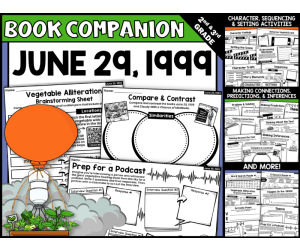
June 29, 1999 by David Wiesner Interactive Read-Aloud Activities
ELA, Reading, Reading Comprehension, Grade 2, 3, 4, Read Alouds, Activities
Enhance your students' reading experience with this comprehensive companion for June 29, 1999, by David Wiesner. Featuring 38 ready-to-use activities, this resource is perfect for customizing learning to meet your students' needs and academic abilities. Designed to save you time and engage students effectively, these activities foster higher-level thinking skills and encourage textual evidence-based responses. Students will enjoy interactive and educational activities, while you appreciate having high-quality resources at your fingertips. INCLUDED IN THIS RESOURCE: Making Predictions Judging by the Cover Story Elements Sequencing Airborne Vegetal Event Recalling Events in Chronological Order Summary Story Event Sort Problem & Solution Minor Problems & Solutions Making Connections Making Inferences Character Traits (2 Traits) Character Traits (4 Traits) Character Inside & Out Character Feelings Character Development Character Change Overcoming Obstacles Sketch a Scene From the Story Setting the Scene Thinking About the Text Thinking Beyond the Text 3-2-1 Vegetable Alliteration Veggies on the ‘Gram Theme Author's Message 2 - Crossword Puzzles 2 - Word Search Puzzles Wait... There's More! Book Review Compare and Contrast Acrostic Poem Dear Diary Prep for a Podcast This resource is for extension read-aloud activities only. The book is not included.
Author Creatively Gifted
Tags Reading Comprehension, Reading, Upper Elementary Reading, Picture Book , Read-aloud Activities, Interactive Read-aloud Activities, Book Companion, ELAR

Funny Dad Jokes for 4th Grade Reading, Spelling, Inference, Homonyms
ELA, Language Development, Spelling, Vocabulary, Reading, Reading Comprehension, Grade 4, 5, 6, Activities
52 Funny Dad Jokes Guessing Game What's the FUNniest way for your kids to practice and improve their reading, spelling, and inferencing skills while focusing on the funny aspects of, homonyms, homophones and homographs? Play the Dad Jokes Guessing Game, of course! This 31-page printable PDF package has all you need to play (except for 2 kids, a printer, a pencil and scissors): A directions sheet for the kids to read and follow - the familiar hangman letter by letter guessing game format makes it easy to "get the hang" of the game 52 favorite Dad jokes and riddles, printed 2 per page - you need the scissors to cut each page in half While playing this simple hangman-style game (where nobody gets hanged, by the way!), kids get plenty of practice reading directions, jokes, hints and answers, as well as writing and spelling the answers letter by letter. Each joke card includes the answer as well as hints that the sharp guesser (i.e. excellent inferencer) can use to infer the answer more quickly. There's also a page of blank joke cards if you or the kids want to add even more of your own jokes and riddles. The game is easy and fun to play and can be short or long, depending on how many joke cards are used. Designed as a pairs activity, the game works well with a group divided into pairs and then playing in a round robin format. Store the directions and joke cards in a resealable bag or envelope, replenish the joke cards periodically, and add it to a literacy center and your personal collection of fun English language learning resources. Kids might even want to start their own joke and riddle collections. Suggested grade level: 4th grade or higher Common Core English Language Arts Standards: L4.4, L4.5, L4.1G, L5.5
Author WorksheetsPlus
Tags Homonyms, Homophones, Inference, Jokes, Reading, Homograph, Game, Riddles, Worksheets, Printable

Prehistoric Archaeology: Social Studies Reading Passage (Word)
ELA, Reading, Reading Comprehension, Strategies, Resources for Teachers, Social Studies, History: Ancient, History, Grade 6, 7, 8, 9, Writing Prompts, Worksheets & Printables, Centers, Activities, Teacher Tools, Assessments, Quizzes and Tests, Quizzes, Tests
Prehistoric Archaeology: Social Studies Reading Comprehension Passage (Word) This resource introduces a unique Social Studies reading comprehension passage with questions about Prehistoric Archaeology: How Archaeology Explains Prehistory. The passage is carefully designed to bridge the gap between social studies and literacy through strengthening reading comprehension and sparking knowledge curiosity in middle school students. Each passage blends English Language Arts skills with accurate social studies content . Ideal for interdisciplinary learning in ELA and Social Studies. Suitable for Grade 9 review, too! Student Tasks throughout the passage: 5 multiple-choice questions targeting the following skills: main idea, key details, inference, vocabulary in context, and use of evidence 5 vocabulary matching items with clear, student-friendly definitions 5 text-based questions that require citing specific lines or facts 1 summary prompt that asks students to condense central ideas accurately Full answer key for every section Available Formats for this Resource: PDF Fillable PDF Google Docs FULL CATALOG OF DOWNLOADING LINKS HERE Social Studies Reading Comprehension Collection Links: 1. Ancient Civilizations PDF Fillable PDF Word Docs Google Docs 2. Early Empires and Trade Networks PDF Fillable PDF Word Docs Google Docs 3. The Founding of the United States PDF Fillable PDF Word Docs Google Docs 4. Language, Culture, and Meaning PDF Fillable PDF Word Docs Google Docs 5. Psychology and Society PDF Fillable PDF Word Docs Google Docs 6. Global Festivals and Traditions PDF Fillable PDF Word Docs Google Docs 7. Extreme Environments and People PDF Fillable PDF Word Docs Google Docs 8. Food, Culture, and Preservation PDF Fillable PDF Word Docs Google Docs 9. Global Food Customs PDF Fillable PDF Word Docs Google Docs 10. Media, Communication, and Popular Culture PDF Fillable PDF Word Docs Google Docs 11. Human Impact on the Environment PDF Fillable PDF Word Docs Google Docs 12. Civic Action and Social Change PDF Fillable PDF Word Docs Google Docs 13. Fashion, Society, and Power PDF Fillable PDF Word Docs Google Docs 14. People, Places, and Unusual Histories PDF Fillable PDF Word Docs Google Docs Product Details: Length: 5 pages Grades: 6–8, also suitable for Grade 9 review Use cases: close reading, stations, homework, intervention, test prep, and sub plans Why Teachers Choose This Passage: Authentic social studies content paired with rigorous literacy practice Consistent task structure for easier planning and smoother student routines Clear, age-appropriate writing that builds confidence without oversimplifying Use this passage to reinforce ELA skills in social studies, to add literacy to your lessons, and to support independent work. The passage strengthens main idea, evidence use, vocabulary in context, inference, cause and effect, and summary writing. With ready-to-use assessments and complete answer keys, you can provide focused practice that is simple to run and fast to review.
Author CORED Education - Middle & High School
Rating
Tags Middle School, Reading Comprehension, Reading Strategies, ELA, Centers, Reading Passage, Assessments, Vocabulary, Social Studies, Ancient Civilization
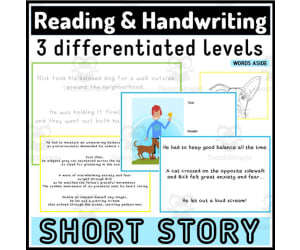
Reading Handwriting Short Story Differentiated Levels
ELA, Reading, Reading Comprehension, Handwriting, Writing, Grade 2, 3, 4, Centers, Activities, Workbooks, Worksheets & Printables
Strengthen your students’ reading skills and boost their handwriting confidence with this Differentiated Short Story of three ( 3 ) progressive levels . This versatile resource ensures that every student in your classroom has the opportunity to engage with a similar material, providing an environment of peer-to-peer learning . Ideal for targeted instruction, these stories work nicely in small group settings and literacy stations . They promote independent learning and can serve as a valuable resource for sub plans . Each level includes both READING and HANDWRITING practice through tracing the text, for students to enhance their motor skills . This pdf resource encourages students to create and illustrate their own printed books, with a front and back cover . This can ignite their imagination and pride in their work . As they read and understand the content, they are more likely to participate in discussions, share their ideas, and develop connections with their teacher and classmates . Also, the exposure to rich new adjusted vocabulary enhances students’ language development . Whether implemented in small reading groups, during whole class lessons, or as part of independent work, these differentiated passages offer flexibility in your teaching strategy . They are specifically designed to effectively address a variety of learning styles and abilities, enabling you to tailor your teaching approach to meet the various needs of your students . This resource facilitates differentiated instruction but also promotes a supportive and inclusive classroom atmosphere, where every student feels valued and capable of achieving literacy success . For more P D F materials and educational and therapy resources on language, special education, numeracy, basic math and pictorial / manipulative approach to teaching and learning, you can click WORDS ASIDE Included : one file with 5 4 pdf pages of a leveled short story to use through elementary grades .
Author WORDS ASIDE
Tags Short Stories, Leveled Reading, Booklet, Mini Book, Literature Circle, Independent Work, Homework, Handwriting, Elementary Reading, Literacy Skills

Nebraska State Flipbook (Capital, Bird, Flower, Flag, Animal)
Creative Arts, Art, Social Studies, ELA, History, History: USA, Geography, Reading, Reading Comprehension, Grammar, Language Development, Spelling, Writing, Grade 2, 3, 4, Activities, Projects
Introduce the Heartland state of Nebraska to students with this engaging flipbook project. Perfect for elementary classrooms and homeschools, this low-prep resource teaches the Cornhusker State's symbols including its capital, bird, flower, flag, and animal. Two printing options—with and without cutting—and two design choices—with and without clip art—provide flexibility. The reading passages, writing prompts, coloring pages, and activities like mapping Nebraska appeal to visual, auditory, reading/writing, and kinesthetic learners. Use to supplement social studies units on the Midwest or U.S. states. The cross-curricular nature incorporates art, reading, writing, geography, grammar, history, science, and more. Click the shop link to explore similar state flipbook projects.
Author Heather Huhman
Tags Nebraska, Lincoln, Nebraska State Bird, Nebraska State Flower, Nebraska State Flag, Nebraska State Animal, Geography, Flipbook, Us States, United States, Nebraska State Bird And Flower, Nebraskas State Flower, Nebraska's State Flower, What Is Nebraska's State Flower

BIOGRAPHY + 3 COMPREHENSION QUESTIONS | MARTIN LUTHER KING
Reading Comprehension, Reading, ELA, Strategies, Creative Writing, Writing, History, Social Studies, History: USA, Adult Education, Elementary, Early Learning, High School, Homeschool Resources, Middle School, Not Grade Specific, Projects, Activities, Teacher Tools, Quizzes and Tests, Assessments
BIOGRAPHY + 3 COMPREHENSION QUESTIONS | MARTIN LUTHER KING THIS RESOURCE HAVE 1 BIOGRAPHY + 3 COMPREHENSION QUESTIONS OF THE TEXT. INFORMATION OF THE AUTHOR: EDITORIAL ARENAS EDUCATIVAS is dedicated to providing high-quality educational content to help children learn efficiently and with joy. Check out our full store to find materials focused on reading, writing, math, and Spanish. We're excited to be part of your learning experience! MAIN INFORMATION: 1) What main topic does this file cover? The topic of this document contains one basic topic that all kindergarten and elementary school children should master. 2) What age ranges is this resource designed for? This document is designed for children in pre-kindergarten and elementary school. It is simply intended for children in elementary school, but it is also freely available to other grades who may need this document. 3) What version or edition does this material correspond to? This document is designed in PDF format so you can print and use it much more quickly. 4) What is the recommended printing method for this resource? I recommend printing this document in PDF format so you won't experience any errors when printing. SECONDARY AND COMPLEMENTARY INFORMATION: 1) Is the material designed in color or black and white? This document has been designed in color (if required) or is sometimes created in black and white to make your learning experience easier. 2) What age range is appropriate for this resource? Our publishing company is dedicated to creating resources for young children between the ages of 3 and 12, as well as for older students or anyone who needs them. 3) What keywords best describe this resource? We can tag this product with keywords such as: teaching resource, resources, materials, teaching materials, worksheets, educational worksheets, worksheets for children. 4) What instructions should I follow for proper printing? I recommend that you first download this document, then check if your printer is capable of printing, and also verify that you have the appropriate document size.
Author EDITORIAL LAURA EDUCA
Rating
Tags FREE, FREE RESOURCES

Human Body System and Some Main Organs Lapbook
ELA, Reading, Reading Comprehension, Science, Life Sciences, Human Body, Biology, Research, Grade 4, 5, 6, Activities, Projects
Human Body System and Some Main Organs Lapbook is a project for lessons on body systems and / or main organs of the body. It can be a supplemental work and assessment tool for Science lessons on these topics that is aimed to showcase what the learners learn through this creative medium. This file contains two sets of lapbooks for male and female body systems. This project features a distinctive representations of the body systems and main organs that are easy to distinguish and understand. Each component of the lapbook is designed to be entertaining and engaging that will surely keep your young minds active and occupied!
Author It's Teacher L
Tags Assessment, Homework, Lapbook, Science Lapbook, ELA, Research Project

The Honey Makers by Gail Gibbons Interactive Read-Aloud Activities
ELA, Reading, Reading Comprehension, Language Development, Vocabulary, Grade 2, 3, 4, Read Alouds, Activities
This picture book companion is a complete supplemental resource for the book The Honey Makers by Gail Gibbons. With 25 print-and-go reading activities to choose from, this resource is ideal for customizing learning to your student's specific needs and academic abilities. Students will apply listening and note-taking skills, investigate different species of bees, compare & contrast, make inferences and connections, learn and apply new vocabulary, identify and gain information using text and graphic features, answer questions that require them to think beyond the text, and so much more! Students will love the engaging and fun activities, and you will appreciate the time saved hunting for high-level resources to teach reading concepts that students frequently struggle with. The activities provided are designed to enable students to apply higher-level thinking skills, encourage them to provide text evidence to support their thinking, and challenge them to express their own thoughts and/or perspectives. ⭐️This Resource Includes:⭐️ Making Predictions: Before reading, students will make predictions about the book. “The Honey Makers” Student Notes Booklet: Students will take notes in their booklets while reading the story. This activity includes 14 half pages (ANSWER KEY included). Print the cover single-sided and print notes pages of the booklet double-sided and select the printing option Flip on the short side. Honeybee Diagram: Students will label the honeybee diagram using the words in the word bank (ANSWER KEY INCLUDED). Honeybee Lifecycle (2 versions included): Students will explain what they learned about each stage of the honeybee’s life cycle. A cut-and-paste version is also included as an option for differentiation (ANSWER KEY INCLUDED). Word Scramble: Students use the details from the book to unscramble the words (ANSWER KEY INCLUDED). Who Am I?: Students will match the words in the word bank to the descriptions and draw and color a picture of each bee(ANSWER KEY INCLUDED). Fact or Fiction: Students determine whether the details are facts from the story or made-up (ANSWER KEY INCLUDED). True or False (bubble answers ONLY): Students read the statements and determine whether they are true (ANSWER KEY INCLUDED). True or False (bubble answers and correct the false statement): Students determine if the statements are true or false, and rewrite the false statements to make them true (ANSWER KEY INCLUDED). Cause & Effect: Students match up the causes to the effects (ANSWER KEY INCLUDED). 3-2-1: Students record three details they learned about the queen honeybee, describe jobs that a worker bee has during their lifetime, and choose one word that best describes honeybees and explain why. Thinking About the Text: Students will answer the questions about the story & include examples from the text to support their answers. Thinking Beyond the Text: Students answer questions about or related to the story & include examples from the text to support their answers. A Beekeeper’s Yearbook: Students record one detail for each month of the of the Beekeeper’s Yearbook. Word Search Puzzle: Students use the clues to fill in the puzzle. Words can go across or down. Letters are shared when the words intersect (ANSWER KEY INCLUDED). Crossword Puzzle: Students use the clues and the word bank to fill in the crossword puzzle (ANSWER KEYS INCLUDED). Honeybee ABCs: Students write words or phrases that begin with each letter of the alphabet to show what they learned about honeybees. Research Activities: Students or teachers can choose from the following research activities and graphic organizers to use while conducting research to learn more about bees. KWL graphic organizer Honeybee - CAN - HAVE -ARE Honeybee - WHO - WHAT -WHERE - HOW Fun Facts about Honeybees New Vocabulary Honeybee Research Report: key points, picture, and summary Honeybee Research One-Page Report: Students conduct research to learn more about honeybees and complete a one-page report with facts regarding the habitat, features, diet, movement, and interesting facts. Honeybee Roll & Research: Students roll a die to see what type of bee they will research. Then, they research using teacher-approved websites and informational texts to find information to answer the questions. This resource is for extension read-aloud activities only. The book is not included.
Author Creatively Gifted
Tags Fountas And Pinnell, Second Grade, Elementary Ela, Reading, Nonfiction, Science, The Honey Makers By Gail Gibbons, Honeybees, Insects, Life Cycle

Free Reading Passage: Heredity (Google Forms)
ELA, Reading, Reading Comprehension, Science, Life Sciences, Biology, Common Core, ESL, Language Development, Resources for Teachers, Grade 2, 3, 4, Teacher Tools, Assessments, Centers, Activities, Tests, Quizzes and Tests
Free Reading Passage on Heredity for Life Science What's inside this free product? Science Reading Comprehension Passage25 : Heredity Independent Google Forms Version: This is the independent Google Forms version containingone lesson with full answer keys. Word files are fully editable and formatted for that very purpose. Product Info: 1 form (US English with Answers) Google Forms Version Teaching Duration: Approximately 90 Minutes Science Reading Comprehension Outline: Targeted for students in 3rd and 4th grades, these reading passages are enhanced with illustrations and graphs to elucidate critical points. Each lesson aligns with the Common Core State Standards, allowing you to integrate science reading practice effortlessly, knowing that minimal preparation is needed on your part. Each passage comes with a variety of questions in different formats, including multiple-choice formats, data analysis, and fill-in-the-blanks. The topics covered strike a balance between engaging content and core curriculum-based science subjects. Versatile in application, these lessons are suitable for a variety of settings such as whole-class instruction, morning activities, independent desk work, small group discussions, contingency plans for substitute teachers, homework assignments, or even special holiday-themed tasks. FULL CATALOG OF DOWNLOAD LINKS HERE Grade 3/4 Links: Physical Science Part 1 - Properties of Objects and Materials Google Docs/Slides/Forms PDF PPT Word Free Supplementary Pack Accompanying Videos Physical Science Part 2 - Position and Motion of Objects Google Docs/Slides/Forms PDF PPT Word Free Supplementary Pack Accompanying Videos Physical Science Part 3 - Light, Heat, Electricity, Magnetism Google Docs/Slides/Forms PDF PPT Word Free Supplementary Pack Accompanying Videos Life Science Part 1 - Characteristics of Organisms Google Docs/Slides/Forms PDF PPT Word Free Supplementary Pack Accompanying Videos Life Science Part 2 - Life Cycles of Organisms Google Docs/Slides/Forms PDF PPT Word Free Supplementary Pack Accompanying Videos Life Science Part 3 - Organisms and Environments Google Docs/Slides/Forms PDF PPT Word Free Supplementary Pack Accompanying Videos Earth Science Part 1 - Properties of Earth Materials Google Docs/Slides/Forms PDF PPT Word Free Supplementary Pack Accompanying Videos Earth Science Part 2 - Changes in the Earth and Sky Google Docs/Slides/Forms PDF PPT Word Free Supplementary Pack Accompanying Videos Earth Science Part 3 - Objects in the Sky Google Docs/Slides/Forms PDF PPT Word Free Supplementary Pack Accompanying Videos For similar products and other frees, do check out Cored Group on TeachSimple .
Author Cored Education
Tags Science, Elementary, Reading, Comprehension, Vocabulary, Answers, Physics, Physical Science, Ccss, Digital Centers

Activity: Stream of Consciousness
ELA, Reading, Reading Comprehension, Literature, Language Development, Vocabulary, Writing, Grade 9, 10, 11, 12, Activities
Activity: Stream of Consciousness This is a valuable teaching resource that aims to impart the essence of stream of consciousness writing—a technique adopted by literary giants like James Joyce and Virginia Woolf. It caters to high school students in Grades 9 through 12. This material, located within the field of Language Arts, encompasses Literature, Vocabulary, Comprehension, and Writing. Rather than viewing writing simply as a sequence of words, this study guide encourages students to perceive it as an intimately connected conversational narrative with distinctly defined trains of thought. Educational Implementation In whole group instruction: Educators can reveal and explore each segment together to foster a collective understanding among all learners. In small groups: Peer-to-peer discussions may trigger deep insights into complex narratives. As homework: It could be repurposed into constructive homework keeping pace with ongoing class teachings. Also suited for independent study modules guiding self-paced learning efforts at home. Leveraging Technology for Accessible Learning The Word document format ensures universal access across diverse digital devices making it devoid of any technology-associated limitations potentially impacting smooth classroom functioning. The Core Purpose 'Activity: Stream-of-Consciousness' aids in providing comprehensive insight into how disjointed sentences thread coherently into a well-articulated story. It's more than merely an era-specific literary technique; it sheds light on human nature's inherent tendency to draw connections among seemingly unrelated life elements.
Author The Education Lab
Tags Stream Of Consciousness, Teaching Resource, Personal Narratives, Literature, Writing
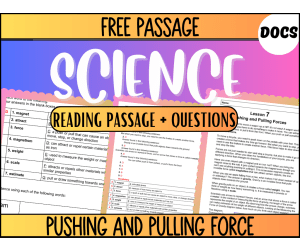
Free Reading Passage: Pushing and Pulling Forces (Google Docs)
ELA, Reading, Science, Physics, Common Core, ESL, Language Development, Vocabulary, Reading Comprehension, Resources for Teachers, Grade 2, 3, 4, Centers, Activities, Assessments, Teacher Tools, Tests, Quizzes and Tests
Free Reading Passage on Pushing and Pulling Forces for Physical Science What's inside this free product? Science Reading Comprehension Passage7 : Pushing and Pulling Forces Independent Google Docs Version: This is the independent Google Docs version containingone lesson with full answer keys. Product Info: 5 PAGES (US English with Answers) Google Docs Version Teaching Duration: 90 Minutes Science Reading Comprehension Outline: Targeted for students in 3rd and 4th grades, these reading passages are enhanced with illustrations and graphs to elucidate critical points. Each lesson aligns with the Common Core State Standards, allowing you to integrate science reading practice effortlessly, knowing that minimal preparation is needed on your part. Each passage comes with a variety of questions in different formats, including multiple-choice formats, data analysis, and fill-in-the-blanks. The topics covered strike a balance between engaging content and core curriculum-based science subjects. Versatile in application, these lessons are suitable for a variety of settings such as whole-class instruction, morning activities, independent desk work, small group discussions, contingency plans for substitute teachers, homework assignments, or even special holiday-themed tasks. FULL CATALOG OF DOWNLOAD LINKS HERE Grade 3/4 Links: Physical Science Part 1 - Properties of Objects and Materials Google Docs/Slides/Forms PDF PPT Word Free Supplementary Pack Accompanying Videos Physical Science Part 2 - Position and Motion of Objects Google Docs/Slides/Forms PDF PPT Word Free Supplementary Pack Accompanying Videos Physical Science Part 3 - Light, Heat, Electricity, Magnetism Google Docs/Slides/Forms PDF PPT Word Free Supplementary Pack Accompanying Videos Life Science Part 1 - Characteristics of Organisms Google Docs/Slides/Forms PDF PPT Word Free Supplementary Pack Accompanying Videos Life Science Part 2 - Life Cycles of Organisms Google Docs/Slides/Forms PDF PPT Word Free Supplementary Pack Accompanying Videos Life Science Part 3 - Organisms and Environments Google Docs/Slides/Forms PDF PPT Word Free Supplementary Pack Accompanying Videos Earth Science Part 1 - Properties of Earth Materials Google Docs/Slides/Forms PDF PPT Word Free Supplementary Pack Accompanying Videos Earth Science Part 2 - Changes in the Earth and Sky Google Docs/Slides/Forms PDF PPT Word Free Supplementary Pack Accompanying Videos Earth Science Part 3 - Objects in the Sky Google Docs/Slides/Forms PDF PPT Word Free Supplementary Pack Accompanying Videos For similar products and other frees, do check out Cored Group on TeachSimple .
Author Cored Education
Tags Science, Elementary, Reading, Comprehension, Vocabulary, Answers, Physics, Physical Science, Ccss, Common Core

San Jacinto Day
Social Studies, ELA, History, History: USA, Reading, Reading Comprehension, Grade 1, 2, 3, Activities
About This Product San Jacinto Day If you're looking to enrich your lessons on states or key holidays, let's talk about San Jacinto Day, a First Grade Level G resource. Although teaching history to first graders can be a bit tricky, this text tells factual information in an engaging way. It delves into the Battle of San Jacinto back in 1836, highlighting the resilience and determination that led Texas to its freedom from Mexico. Spread across a succinct 4 pages, this resource is designed with young learners in mind. It's just the right mix of history and narration, tailored to ignite curiosity while ensuring comprehension, making your teaching sessions interactive and lively. As educators, we value resources that are not just informative but also adaptable. The layout is structured yet flexible, encouraging discussion, promoting critical thinking, and inviting reflection. Targeted concepts, vocabulary, and sight words are listed on the first page of the text to help with instruction. Whether you're in a traditional classroom setup or guiding homeschoolers, this tool is versatile for individuals as well as groups. San Jacinto Day reminds our students of the sacrifices made and the values upheld for the sake of freedom. It helps paint a vivid picture of a day that changed Texas forever. The leveled book is a great resource that incorporates Common Core Standards and the National Curriculum Standards for Social Studies.
Author Sue Peterson
Tags Reading, Vocabulary, Texas, Mexico, Reading Comprehension

The Have a Good Day Cafe Read Aloud Book Companion Activities for IRA
ELA, Reading, Reading Comprehension, Grade 2, 3, 4, Read Alouds, Activities
The Have a Good Day Cafe Read Aloud Book Companion Activities for IRA: Overview This educational supplement, designed to complement The Have a Good Day Cafe by Frances and Ginger Park, is a resource that brings together twenty-four interactive reading activities suitable for students of distinct academic needs. Primarily targeting grades two to four language arts subjects, this guide aims at boosting comprehension skills while maintaining student interest in reading. It emphasizes the exploration of characters, identification of story elements, theme interpretation and planning story events. Moreover it encourages comparing and contrasting elements throughout the novel along with investigating cause-and-effect scenarios and making thoughtful forecasts. Benefits of Using This Resource Promotes examination of text evidence supporting students' ideas Fosters confidence in articulating perspectives Incorporates diverse exercises like creating food cart flyers or theorizing on story continuity Makes learning seem enjoyable rather than burdensome homework Highlighted Activities Include: 'Story Event Sort': Encourages deep connection with the narrative 'Character Inside & Out': Designed specifically for Mike & Grandma characters to aid understanding their development An activity identifying how setting influences plot progression ensuring comprehensive understanding of storytelling components Creative Integration & Comprehension Assessment Tools: Apart from discussions, comprehension is also gauged using recollection tasks involving sketches or writing reviews; thereby integrating literary content with artistic expression. Furthermore these tasks resemble real-world practices, offering valuable experience to learners. Note on Formats Available: The PDF format offered ensures ease-of-use digitally as well as in physical classrooms; easy-to-print before class or homeschool lessons if required. In Conclusion, The Have a Good Day Cafe Read Aloud Book Companion Activities for IRA not only provides educators with an array of lively and thought-provoking activities to supplement their language arts curriculum but also equips students with the skills to think critically. It can be tailored for group or individual tasks depending on the teaching context.
Author Creatively Gifted
Tags Comprehension Skills, Character Development, Story Elements, Critical Thinking, Creative Expression

ACK Words Sentence Reading Comprehension with Picture Matching
ELA, Reading, Reading Comprehension, Preschool, Grade 1, Activities
Sharpen your students' reading fluency and comprehension with this interactive ACK word family sentence and picture matching activity. Designed with phonics-based learning in mind, this reading exercise includes decodable sentences and corresponding images for sorting, all featuring the ending digraph CK. Included in this ACK Words Sentence Reading Comprehension with Picture Matching resource: - Sentence cards encompassing ACK words and simple sight words - Picture cards that correspond to each sentence - In this literacy activity, kindergartners and first graders read the sentences and match them with the appropriate picture. This ACK Words Sentence Reading Comprehension with Picture Matching resource serves as an excellent literacy center for students learning ACK words, ending digraphs, and honing their reading comprehension skills. Ways to Implement: As part of Morning Tubs or Morning Baskets Within a Literacy Center During Small Group Instruction As a Matching Game As a Partner Activity These sentence and picture literacy cards provide a hands-on approach to practicing reading comprehension and the ACK word family. The engaging, tactile nature of this activity ensures students enjoy and stay absorbed as they work through it. Students can complete this literacy center independently or collaboratively. Alternate Uses: By attaching magnets to the back of each card, these literacy cards can be used with baking sheets for a sorting exercise. Affixing hook and loop fasteners and using a file folder can transform these into a file folder matching game. Skills Evaluated: - Reading ACK Words - Reading Sight Words - Reading Comprehension This phonics-based ACK Words Sentence Reading Comprehension with Picture Matching learning center activity demands minimal prep. Teachers simply need to print and cut apart each piece. If desired, laminating the cards can make for a reusable center . All pieces can be stored conveniently in a pencil box for easy setup, use, and clean up.
Author The Connett Connection
Tags Ack Words, Reading Comprehension, Sentence Reading Comprehension, Literacy Center, Ending Digraphs