



2,803 products added recently
Page 59 - Worksheets & Printables
Discover a wealth of worksheets and printables to supplement your teaching. Covering multiple subjects and grade levels, these resources provide activities that reinforce learning objectives. Incorporate them into your lessons to offer hands-on practice and enrich your curriculum.

 Show filters

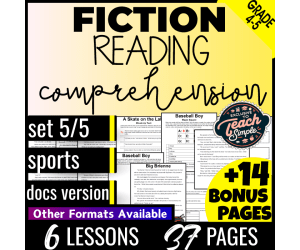
Reading Comprehension and Questions Fiction Set 5 - Sports (Docs)
ELA, Reading, Common Core, ESL, Language Development, Spelling, Vocabulary, Reading Comprehension, Writing, Resources for Teachers, Grade 4, 5, Worksheets & Printables, Worksheets, Writing Prompts, Centers, Activities
Reading Comprehension Passages Fiction Set 5 Overview No prep reading comprehension lessons, with enjoyable stories and topics. Each lesson has a blend of post-reading activities. Mixed questions to check overall understanding. Vocabulary activities, plus a writing section. Lessons also contain a bonus extension exercise at the end. Some you may like, some you may not, either way they are there if you wish to use them. Full answer keys are provided. Passages Include 1.Olympics: Lauren and her class get excited when talking about the Olympics. 2.Tryouts: Max is getting himself ready for the basketball tryouts. 3.Big Brienne: Kitty has the game of her life against Big Brienne. 4.A Skate on the Lake: Aimee has a nice evening at the lake with her dad and friends. 5.Baseball Boy: Mitch goes to watch the Chicago Hitters. Read about his day. 6.Running: An informative, yet light piece about running. Docs Version This is the Docs editable and fillable version. This download is available in GOOGLE Docs, GOOGLE Forms, GOOGLE Slides. PDF, PPT, WORD. FULL CATALOG OF DOWNLOAD LINKS HERE Grade 4/5 Links Fiction Set 1 - Animals Google Docs Google Forms Google Slides PDF PPT Word Guided Reading Materials Fiction Set 2 - Family Google Docs Google Forms Google Slides PDF PPT Word Guided Reading Materials Fiction Set 3 - Friends Google Docs Google Forms Google Slides PDF PPT Word Guided Reading Materials Fiction Set 4 - School Google Docs Google Forms Google Slides PDF PPT Word Guided Reading Materials Fiction Set 5 - Sports Google Docs Google Forms Google Slides PDF PPT Word Guided Reading Materials Nonfiction Set 1 - Birds Google Docs Google Forms Google Slides PDF PPT Word Guided Reading Materials Nonfiction Set 2 - Insects Google Docs Google Forms Google Slides PDF PPT Word Guided Reading Materials Nonfiction Set 3 - Mammals Google Docs Google Forms Google Slides PDF PPT Word Guided Reading Materials Nonfiction Set 4 - Nature Google Docs Google Forms Google Slides PDF PPT Word Guided Reading Materials Nonfiction Set 5 - Sea Animals Google Docs Google Forms Google Slides PDF PPT Word Guided Reading Materials Reading Passages Overview Each passage is especially written for Grade 4-5 students, including key vocabulary required for this age group. Topics are varied and are accompanied by colorful graphics. Topics are meant to educate, yet entertain the modern student. These passages are perfect for the modern classroom. Whereas textbooks can become outdated in no time, any changes to technology or the world will result in updates to this product. Mixed Questions The mixed questions section of each lesson includes a variation of five comprehension, vocabulary and math questions. In addition, key reading strategies are frequently covered including cause & effect, summarizing, compare & contrast and making conclusions. Two or three of the questions will be MCQs and other questions will require a written response of some kind. Full answers and example responses appear at the end of the lesson. Spelling & Vocab Each reading passage contains a variety of words and phrases designed for Grade 4-5 students. Spelling and vocab activities provide the opportunity to build fluency with these words. As it can become quite mundane doing the same activities over and over, each lesson in a set will contain a different spelling and vocab activity . Activities include: spelling games, sentence match-ups, mixed-up text and decoding words from the lesson. Writing Prompts Writing prompts are designed to continue the theme or lessons learned in the story. Students are persuaded to write in a variety of ways and each prompt includes several cues to help. As with the spelling/vocab section, writing prompts will vary. This includes research pieces, reading responses, poetry and creative writing prompts. Full Answer Keys Full answer keys and sample responses are provided so no matter how busy you are, you know you're covered! Mixed question answers provide evidence from the text, math questions contain the relevant workings. Answers are designed for use by the teacher, but also suitable as a handout to the student. Just for Fun Each lesson will have a bonus extension exercise. This is something fun to extend the lesson with. You can find these at the end of each lesson, titled Just for Fun. Just for Funs are optional. Some you may like, some you may not. Either way, they are there to do with as you wish. For similar downloads and other frees, do check out Cored Group on TeachSimple.
Author Cored Education
Rating
Tags Elementary, Reading, Comprehension, Vocabulary, Answers, Common Core, Spelling, Writing, Digital Centers, Vocabulary Assessments
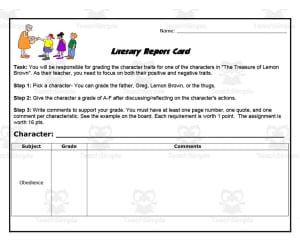
Lemon Brown Story Activity Pack
ELA, Reading, Grade 9, 10, 11, 12, Workbooks, Worksheets & Printables
This resource is a Lemon Brown Story Activity Pack. There are 4 different PDFs full of worksheets to go alongside this story! All you have to do is print and go. Included: - Story grammar chart & writing extension - Literary report card - Vocabulary - Semantic map
Author Time Thrifty Teacher
Tags Lemon Brown, Grammar, Semantic Map, Vocabulary Words, Report Card, Teacher Lemon Story
"I Survived The Attacks of September 11, 2001" Book Study Unit
ELA, Literature, Grade 4, 5, 6, Novel Studies, Worksheets & Printables
This "I Survived The Attacks of September 11, 2001 Book Study Unit is packed with over 100 pages of engaging resources for students. Included: - Chapter comprehension worksheets - Mystery match vocabulary words - Exit quizzes - Group work - Summative assessment & so much more. All you have to do is print and go! Answer keys included.
Author TrilogyTeacher
Tags Book Study, Novel Study, 9/11, Comprehension, Exit Quiz
Learn Final Consonant Blends
ELA, Language Development, Phonics, Preschool, Kindergarten, Grade 1, 2, Worksheets & Printables, Worksheets
Final Consonant Blends Teaching Resource Featuring an exciting educational tool perfect for fostering literacy skills, the Final Consonant Blends teaching resource is a standout for educators and homeschoolers alike. Story-based Learning The centerpiece of this program lies in 44 phonetic sounds woven into tales about Sam, an adorable character your pupils will easily connect with. The aim is to encourage linguistic challenges and discovery within the intricate stories, which can help decipher up to 80% of words in the English language. In advanced stages, compatible books like Roald Dahl's 'Georges Marvellous Medicine' and 'Fantastic Mr Fox', accompany their learning journey prodding them gently towards independent reading. More fun with Sam awaits in stories such as 'The Bouncing Castle', and'The Famous Cousin From The Country.' Diverse Activities Cutout practice pages stimulate word-to-picture or phrase memory connections. The interactive layout includes accessible text paired with beautiful color sketches. Progressing Phonetics Skills This resource sets off its focus on consonant blend syllables (like sn, sp, dr), fitting perfectly for early learners from age 3. However older children or ESL students may equally find these materials beneficial! Inclusive Worksheets The varied instructions cater each learner according to their needs: communal sessions inspire collective progress while intimate groups provide personalized guidance. A versatile tool that can be assigned as home recapitulation lessons or even adopted into flipped classroom settings where children explore first before discussions ensue. Guided Practice Is Key Users are encouraged to repeat each presented sound in intervals, eventually blending final sounds seamlessly until familiarity is reached. Deeply-rooted within the pack is a structure that unfolds from introducing initial blends towards more complex phonetic patterns (prefixed and suffixed). Easily Accessible Formats The worksheets distributed in universally printable formats make this resource handy. Furthermore, digital-friendly PDF files are compatible across multiple devices - bringing convenience at your fingertips.
Author Guinea Pig Education
Tags Phonics, Literacy Skills, Reading Comprehension, Blended Sounds, Interactive Learning

Let's Write Formal And Informal Letter (7-11 years)
ELA, Writing, Grade 3, 4, 5, Worksheets & Printables, Worksheets
Let's Write Formal And Informal Letters (7-11 years) An invaluable educational resource designed for teachers, focusing on teaching writing of coherent and persuasive formal and informal letters. This comprehensive package is primarily targeted at students aged between 7 to 11 years making it a superb tool within grade 3, grade 4, and grade 5 sectors. Purpose The tool deals majorly with language arts especially in the subsection of writing hence can be utilized in language lessons. Main Goals The immediate goal is guiding students on how to effectively express their points in a formal letter. The package teaches pupils appropriate salutations like 'Dear Sir or Madam' or 'Dear Mr... or Mrs...' along with suitable concluding remarks such as 'Yours faithfully' or 'Yours sincerely'. The kit enables pupils understand point-evidence-explanation structure for paragraphs aiding them produce well-crafted arguments through topic sentences that introduce viewpoints. Additionally, This resource gets learners acquainted with crafting counterarguments - an essential skill beyond academics but also socially. Moreover as an educator using this resource, you will have access to ample examples meant to inspire creativity among learners. The Resource Package Also Covers; Writing personal letters leveraging conversational English - informal communication skills development. Included are sample prompts meant assist your students draft engaging content revolving around themes such as appreciation notes among others. In terms of flexibility; both during structured classroom sessions (both whole group or small groups), during individual learning moments at school – perhaps in computer lab sessions where the pdf file format becomes crucial – plus when tasking homework all these environments are suitable for this resource. To Summarise The ultimate target is to cultivate a love for writing among students and boost their confidence in airing thoughts, ideas, complaints and appreciation through letters. A perfect tool for educators seeking to save on lesson planning time without sacrificing effectiveness; this handy yet exhaustive worksheets kit fits the bill.
Author Guinea Pig Education
Tags Formal Letters, Informal Letters, Writing Skills, Persuasive Writing, Language Arts
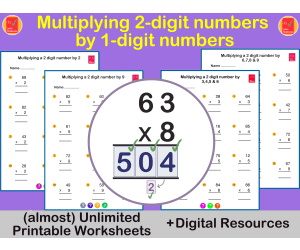
Multiply a 2-digit by a 1-digit number using the Standard Algorithm
Math, Common Core, Multiplication and Division, Grade 4, 5, Worksheets & Printables, Worksheets
These ( almost unlimited) worksheets provides practice with multiplying a 2-digit number by a 1-digit number with the standard algorithm. You have worksheets dedicated to one of the multipliers from 2 to 9 plus also worksheets with a mix of multipliers which cold be used to assess where your students need to practice more or as assessment tool after completing work on the individual multipliers At the click of a button you have a new worksheet - in fact (almost) unlimited. The benefits of these automatically generated worksheets are numerous. They allow students to practice key skills as often as needed throughout the year. The Interactive Teaching Pages for whole class teaching on a whiteboard or one-to-one tuition on a computer lets you proceed through the standard algorithm step by step. You start by selecting the multiplier (2, 3, 4, 5, 6, 7, 8, or 9) and then press a buttons to change the multiplicand. As you enter each digit of the answer line you get immediate feedback if correct or not. You have unlimited examples to practice with. These printables require no preparation on your part. Just print and use anytime. With answers automatically generated every time you create a new worksheet it makes them ideal for substitute teachers on short notice. Give your students the repetition they need to master alll the topics contained in this resource. These no-frills worksheets will help them build a critical foundation for math success. Lastly, it's essential to note that these resources are compatible PDF documents. They operate seamlessly with the official Adobe Acrobat Reader on both Windows and Mac. You may also find the following useful: Divide 2-digit numbers by 1-digit numbers with & without remainders Divide 3-digit by 1-digit numbers with or without remainders Divide 4-digit by 1-digit numbers with or without remainders Multiply a 3-digit by a 1-digit number using the Standard Algorithm Multiply a 4-digit by a 1-digit number using the Standard Algorithm
Author Jeff's Notebooks
Rating
Tags Worksheets, Jeff's Notebooks, Math, Place Value, Number Names, Reading Numbers, Writing Numbers, Standard Format, Grade 4

How to Make Snow Cream | Early Writing and Sequencing Activity
ELA, Writing, Kindergarten, Preschool, Grade 1, Worksheets & Printables, Worksheets
How to Make Snow Cream | Early Writing and Sequencing Activity | Informational or Expository Writing Resource This teaching material is a priceless gift for teachers aiming to enhance their students' skills in writing, sequencing and creativity. It takes emphasis on learning how snow cream is made — an exciting topic specially structured for preschoolers, kindergarteners or first graders. This resource packet comes with a remarkable collection of printable worksheets that teachers can use in varied ways like group discussions , small gatherings or even as individual homework assignments. It starts with introducing the concept of 'How-to writing' through a vibrant anchor chart which simplifies the concept. This resource kit also includes transition words anchor charts that assist students in making more effective sentences. Included Material: Two levels of editing checklists helpful in nurturing students' grammatical accuracy and writing fluency Sequencing cards (Colorful & black/white versions) Vocabulary word strips Envelope template This versatile set includes numerous variations of writing prompts providing countless opportunities for children to practice what they have learned about expository within the fun context of making snowy desserts. Making pictorial-based booklets? No worries! Templates are also included! The complete package comes with: 51 pages Invaluable instructional tools All delivered in an easy downloadable PDF format ready to stir your class into engaged learning while having fun at the same time!
Author Simply Schoolgirl
Tags Expository Writing, Sequencing, Snow Cream, Informational Writing, Early Writing
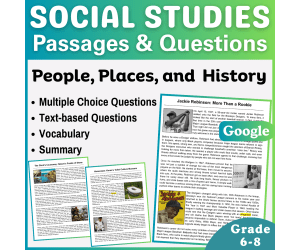
Social Studies Reading Passages: People, Places, and History (Docs)
ELA, Reading, Reading Comprehension, Strategies, Resources for Teachers, Social Studies, Geography, History: USA, History, Grade 6, 7, 8, 9, Writing Prompts, Worksheets & Printables, Centers, Activities, Teacher Tools, Assessments, Quizzes and Tests, Quizzes, Tests
Social Studies Reading Comprehension Passages and Questions: People, Places, and History (Docs) This resource introduces a collection of Social Studies reading comprehension passages with questions about People, Places, and History. The passages are carefully designed to bridge the gap between social studies and literacy through strengthening reading comprehension and sparking knowledge curiosity in middle school students. Each passage blends English Language Arts skills with accurate social studies content . Ideal for interdisciplinary learning in ELA and Social Studies. Suitable for Grade 9 review, too! What Is Included in this Collection? There are three informational passages (with full answer keys): Jackie Robinson: More Than a Rookie Haewoojae: Korea’s Toilet Culture Museum The Giant’s Causeway: Nature’s Puzzle of Stone For Each Passage, students will have multiple tasks to complete as follow: 5 multiple-choice questions targeting main idea, key details, inference, vocabulary in context, and use of evidence 5 vocabulary matching items with clear, student-friendly definitions 5 text-based questions that require citing specific lines or facts 1 summary prompt that asks students to condense central ideas accurately Available Formats for this Resource PDF Fillable PDF Word Docs FULL CATALOG OF DOWNLOADING LINKS HERE For more Social Studies Reading Passages, check the following Links: Ancient Civilizations PDF Fillable PDF Word Docs Google Docs Early Empires and Trade Networks PDF Fillable PDF Word Docs Google Docs The Founding of the United States PDF Fillable PDF Word Docs Google Docs Language, Culture, and Meaning PDF Fillable PDF Word Docs Google Docs Psychology and Society PDF Fillable PDF Word Docs Google Docs Global Festivals and Traditions PDF Fillable PDF Word Docs Google Docs Extreme Environments and People PDF Fillable PDF Word Docs Google Docs Food, Culture, and Preservation PDF Fillable PDF Word Docs Google Docs Global Food Customs PDF Fillable PDF Word Docs Google Docs Media, Communication, and Popular Culture PDF Fillable PDF Word Docs Google Docs Human Impact on the Environment PDF Fillable PDF Word Docs Google Docs Civic Action and Social Change PDF Fillable PDF Word Docs Google Docs Fashion, Society, and Power PDF Fillable PDF Word Docs Google Docs People, Places, and Unusual Histories PDF Fillable PDF Word Docs Google Docs Product Details Length: 14 pages total Grades: 6–8, also suitable for Grade 9 review Use cases: close reading, stations, homework, intervention, test prep, and sub plans Why Teachers Choose This Set Authentic social studies content paired with rigorous literacy practice Consistent task structure across all passages for easier planning and smoother student routines Clear, age-appropriate writing that builds confidence without oversimplifying Use this set to reinforce ELA skills in social studies, to add literacy to your lessons, and to support independent work. The passages strengthen main idea, evidence use, vocabulary in context, inference, cause and effect, and summary writing. With ready-to-use assessments and complete answer keys, you can provide focused practice that is simple to run and fast to review.
Author CORED Education - Middle & High School
Rating
Tags Middle School, Reading Comprehension, Reading Strategies, ELA, Centers, Reading Passage, Assessments, Vocabulary, Social Studies, People Place And History

Word Recognition and Fluency Printable Workbook
ELA, Language Development, Vocabulary, Grade 1, 2, 3, Workbooks, Worksheets & Printables
Get ready for a fantastic, teacher-approved 2nd Grade Reading & Writing Printable Workbook designed specifically for building word recognition and fluency skills! Created by experienced educators who understand the importance of meeting grade-level standards and using up-to-date teaching techniques, this 19-page digital resource has all you need to support your child's growth and development. The workbook's printable nature gives you the flexibility to create multiple copies - so your little learner can keep practicing until they're proficient in their newfound skills. Inside, you'll find helpful Parent Tips that offer guidance on effective teaching methods and even more learning ideas along with engaging Hands-On Activities aimed at making your child's educational journey enjoyable. With our comprehensive digital resource, kids will be mastering consonant blends, R-controlled vowels, vowel sounds, and silent letters like never before. Invest in this essential tool today; witness how it transforms both reading abilities and writing aptitude among young learners. Visit teachsimple.com now for a revolutionary take on improving word recognition mastery!
Author Twin Sisters Digital Media
Tags Reading, Writing, Word Recognition, Short Story, Fluency

Historical Visual Writing Prompts | Photo Ideas | Writing Project
ELA, Writing, Grade 2, 3, 4, 5, Writing Prompts, Worksheets & Printables
This engaging literacy resource transforms enigmatic historical images into creative writing inspiration suited for diverse classroom applications targeting grades one through five. Twenty-six evocative grayscale photographs challenge students to weave imaginative narratives, captions, or analytical observations based on visual cues and instinct. Rather than contrived prompts disconnected from relevance, these striking archival scenes provide an springboard for open-ended interpretation and personal connections. Young writers assess mood, era, relationships and potential themes conveyed through candid moments frozen in time. Pictures span whimsical subjects like children playing hand games to a bustling old-timey Main Street. While some offer a slice of presumed background context, other images drop students into a decisive split-second lacking orientation to allow inference-drawing. Teachers guide critical thinking by asking students what’s happening in images and requesting evidence for claims from visual elements. This strengthens comprehension, evaluation and reasoning abilities beyond basic description. The collection includes four scaffolded writing templates per photo tailored to skill level. Emerging writers invent humorous photo captions or basic descriptive phrases. Advanced students draft multi-paragraph short stories or historical fiction accounts integrating setting, plot and societal issues reflected in scenes. This differentiated range accommodates wide spectrums of ability. Emphasizing lasting universal themes and timeless imagery, these evocative prompts nourish skills vital for academic and lifetime success. Analyzing visual narratives, questioning assumptions, synthesizing perspectives, and articulating subjective reactions in writing carry Utility far beyond language arts domains. This versatile kit sparks engagement through promoting creativity, critical thought and reflective writing around impactful historical photos. Take a Look at Other Writing Resources: How to Make an Apple Pie Writing and Sequencing Activity Postcards of Europe Geography Unit Baby Birds Nonfiction Early Reader Animals of Australia Geography Unit All About Turtles Animal Science Unit Bark, George Picture Book Study Check out other resources from my store: Simply Schoolgirl! I can be contacted for questions and concerns at simplyschoolgirl1@gmail.com
Author Simply Schoolgirl
Tags Writing Project, Historical Photos, Visual Writing, Writing Prompts, Photo Ideas, Writing Templates, Early Writer, Small Group Discussion, Photograph, Picture

Short u Vowel Sound Words - Vocabulary Lists, Tests, BINGO, and Flash Cards
ELA, Language Development, Phonics, Kindergarten, Preschool, Grade 1, Flashcards, Worksheets & Printables
Want to start practicing the short U sound? This resource is all you need. So what's inside this wonderful resource? Digital Flashcards: Let students explore short vowel words at their own pace with these easy-to-use digital flashcards. Printable Word List (Short "u" Sounds): Introduce 20 key short "u" words in a clear and simple format. Printable Word List (All Short Vowels): Expand their knowledge with a comprehensive list of 100 short vowel words. Printable Quiz (Short "u" Sounds): Assess their understanding of those 20 "u" words with a focused quiz. Printable Mixed Short Vowel Quiz: Challenge them with a fun fill-in-the-blank quiz that covers all the short vowels. BINGO Bonanza!: Get ready for some serious fun with 10 picture BINGO boards, 10 text-only boards, and a blank one for customization. Flashcards Galore!: We've included a variety of flashcards with two levels and different corner options – perfect for games like Taboo and Memory! Who Will Benefit? This resource is perfect for any student starting their short vowel journey. It's also a fantastic tool for those who need a little extra help. Turn short vowel practice into a joyful experience, whether in the classroom or at home, and watch those struggling readers catch up and soar! The Fun Factor: Get students excited about learning with engaging games like Taboo and Memory using the flashcards. They'll be familiar with the words before they even know it, making the rest of the activities a breeze! Aligned to Standards: Supports Common Core Standards (CCSS) RF.K.2, RF.K.2d, RF.K.3, and RF.K.3d. Want More Short Vowel Goodness? Check out the complete 100 Short Vowel Sound Words bundle! [link to bundle] Questions? Comments? We'd love to hear from you! Email us at toms.talk.resources@gmail.com . Happy teaching!
Author Tom's Talk
Tags Short U, Short Vowels, BINGO, Flash Cards, Vocabulary, ELA, ESL, Short U Sound, Worksheets
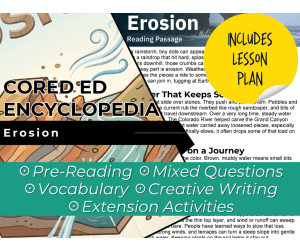
Erosion Reading Comprehension Passage - Cored Ed Encyclopedia
ELA, Reading Comprehension, Reading, Science, Technology, Language Development, Social Studies, Earth and Environmental Sciences, Geography, Life Sciences, Grade 2, 3, 4, 5, Worksheets & Printables, Worksheets, Teacher Tools, Centers, Activities, Writing Prompts, Assessments, Quizzes and Tests, Quizzes, Lesson Plans
This erosion reading comprehension with lesson plan includes: Visualization (on the front cover) Start your lesson by taking a minute to think and share something about the topic. Read the script aloud (slowly), perhaps prepare some music or sound effects. Student close their eyes and let their imaginations wander. Students open their eyes, read the question aloud and give them a few minutes to complete. Ask a few students to share or keep answers until the end to compare with what they learn in the passage. Quick pause—thousands of Cored Education products are included with your TeachSimple membership. Download links and encyclopedia index available here. Pre-Reading Trivia Students will write down one thing they already know about the subject and then read five more facts and discuss. These facts are fun, and the students will enjoy learning about the subject before reading more. Give 1 minute for students to write what they already know (no pressure—best guess is fine). Read the five facts together. After each fact, do ask a student for their opinion, was it surprising? Set a purpose by asking students to highlight/underline one fact they want to learn more about during the reading. Reading Passage The text is a high-interest reading passage with set paragraphs, roughly three to four paragraphs long. It contains a variety of themes about the topic, anywhere from history to technology. The passage is between 250 and 350 words in length. First, ask students to look at the headings and see what they’ll learn about today. What do they know about the topic/heading? First read options: Teacher read-aloud (best for support). Partner reading (paragraph by paragraph). While reading, students underline important details, and vocabulary words they think may come up in the questions section. Mixed Questions The first question page contains four multiple-choice questions, each with a choice of four answers, and three written response questions that require a sentence or two from the student. Students complete the mcqs first independently, then review quickly as a class. For the 3 written responses, try to get students giving the answer with some form of evidence: “I think ___ because the text says ___.” If students get stuck, send them back to check the passage. Vocabulary Questions Practice seven key words from the text in this section across two activities. First section is scrambled words where students will unscramble three words given a clue for each. The second section is a word to meaning matching activity. Before starting, have some students read out words they underlined in the passage. Ask students to say the word and read aloud the sentence(s) around each word. Ask students to do scrambled words and the matching exercise in pairs then go through answers as a class. For the scrambled spelling task, get four pairs to come up to the board and write the words for extra practice with the other student reading out the clue. For the matching task, prompt students to give full sentences: “I matched ___ with ___ because ___.” Creative Writing In this question, the student will be required to write a five to eight sentence paragraph on a question related to the topic. Before starting, ask students write down 3 key ideas they are going to include in their piece. Ask students for ideas to share around the class to help those struggling. Pro writing expectations: 5–8 sentences At least 2 facts or details from the passage At least 2 vocabulary words from the previous page Students read their paragraphs while classmates listen for facts and vocabulary words. Extension Activities This page is optional for fast finishers or to take home. There are several activities, each one requiring a different skill. Do some, do none, do all, completely optional - but you will feel reassured knowing every possibility is planned for. Includes summary writting question and additional facts. Answer Key There are answers for the multiple-choice questions, written response questions have sample answers, vocabulary answers and if there is a summary question then a sample summary will be provided as well. Lesson Plan Included Customized lesson plan for this lesson is included. Lesson Snapshot Title: Erosion Genre: Nonfiction (Informational Text) Subject: Science (Earth Science) / Reading (Informational Text) Primary Topic: How erosion moves Earth materials and changes land Estimated Guided Reading Level (A–Z): N What This Lesson Teaches Best Clearly distinguishes weathering (breaking rock apart in place) from erosion (moving pieces away). (Reading Passage, p. 3) Explains multiple forces that cause erosion— water, wind, waves, ice, and gravity —and what they do to Earth’s surface. (p. 3) Shows how rivers reshape land over time, including how moving water and sediment can help carve deep valleys (Colorado River/Grand Canyon example). (p. 3) Introduces sediment and connects erosion to deposition , explaining how new landforms can build up (beaches, river deltas). (p. 3) Connects science to real-world problem solving by describing ways people can slow soil loss (trees, terraces, keeping plants on soil). (p. 3) Learning Goals Students will explain how erosion is different from weathering using the text’s definitions. Students will identify forces that can cause erosion (water, wind, waves, ice, gravity). Students will describe how rivers move sediment and can change riverbeds and valleys over time. Students will explain what sediment is and how deposition happens when sediment settles. Students will describe at least two ways people can help soil “stay home,” based on the passage. Key Vocabulary From the Text weathering — breaking rock apart where it sits. erosion — moving soil and rock to a new place. sediment — tiny bits of soil and rock that travel. deposition — when sediment settles and builds up land. terraces — steps that slow water on a steep slope. FULL CATALOG OF DOWNLOAD LINKS AND ENCYCLOPEDIA INDEX HERE
Author Cored Education
Rating
Tags Vocabulary, Reading Comprehension, Reading Passages, Lesson Plans, Ela Lesson Plans, Reading Comprehension Lesson Plans, Pre-reading, Geography, Earth Science, Science Lesson Plans
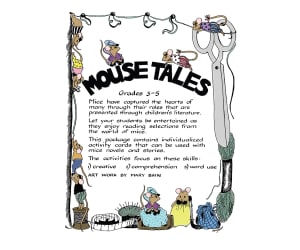
MOUSE TALES (ACT. FOR MOUSE NOVELS & STORIES) Gr. 3-5
ELA, Literature, Grade 3, 4, Worksheets & Printables, Novel Studies
Mouse Tales Activity Pack: A Unique Learning Companion for Grades 3-5 The Mouse Tales Activity Pack introduces students in Grades 3 to 5 to an animated universe influenced by mice-themed novels and stories. Crafted with the Language Arts curriculums in mind, this educational resource fosters academic excellence while promoting imaginative thinking. Ideal for any classroom or homeschool learning arrangement, the pack includes interactive activities that enhance creative thought process, comprehension skills, and word usage. Learners journey through captivating narratives featuring courageous mice embarking on grand adventures, all while gaining valuable insights into literature and honing their grammar and vocabulary abilities- key elements of mastering language arts. What sets these activity cards apart from standard resources is their flexibility. They can accommodate varied needs of learners as well as educators' choices. You can employ them: In whole group discussions stimulated by a common text read aloud. In smaller group activities focused on individual books chosen by students. As solo assignments post personal reading time or alternatively, As additional homework exercises aligned with current curriculum lessons. The package comes in a simple-to-download PDF format holding 42 print-ready pages - an efficient solution for busy educators striving to present enriching learning experiences without going under due to preparation overload. Promising A Whole New Approach Towards Literature Study To educators looking at different methods of integrating literature into daily lessons while nurturing a passion for reading within learners - Mouse Tales Activity Pack offers itself as a remarkable tool within reach. Focusing specifically on mouse-centric narratives provides depth and substance to each literature study session thus ensuring it's enjoyable whilst being informative at its core. Mouse Tales (Activities For Mouse Novels & Stories), Grades 3-5: More Than Just Stories With this package, one thing stands out: each simple mouse tale morphs into an exciting expedition propelling young readers across captivating landscapes depicted in words.
Author Classroom Complete Press
Tags Sequencing, Writing Activity, Surveys, Story Telling, Poetry

Negation, Answering Negative Questions, 160 Task Cards
Special Resources, Life Skills, Grade 1, 2, 3, 4, 5, Task Cards, Worksheets & Printables
Understanding Negation and Answering Negative Questionsis a challenging skill for some children. These 160 task cards ask negative questions in a wide variety of ways, using a variety of common 'negative' words. Negative questions are questions that use a ‘negative’ word in them, such as: don’t, shouldn’t, can’t or won’t, none, never, wouldn't, couldn't, etc. They are a part of everyday conversations. They can sometimes be tricky to understand and respond to. It’s important to pay attention to the specific words being used, so that you can respond accurately. These task cards will help you to be able to respond to a wide variety of questions that include frequently used ‘negative’ words. Who is this activity for? This activity is great for students who can be rote when answering questions, have slow processing speed, executive functioning challenges, working memory challenges, language challenges, or just need practice thinking before speaking impulsively. How/when can I use this activity? Given the wide range of topics and question styles, this activity is not only great for speech and language sessions, but is also fun to use in a lunch bunch group, snack group, social group, or as a warm up activity for the whole class.
Author Socially Skilled Kids
Tags Negation, Speech And Language, Social Pragmatics, Social Skills, Wh Questions
Dolch First Grade Adapted Workbook Bundle - List 2
Special Resources, Special Education Needs (SEN), Grade 1, Workbooks, Worksheets & Printables
This resource is a Dolch First Grade Adapted Workbook Bundle. Packed with 8 adaptive binders, you'll have just what you need to let your first graders practice sight words in a fun way! There is a list of words within each binder. These binders can be accessed as printables or digitally through Google Slides. You can use this adapted workbook in a variety of ways: - Small group - Centers - Intervention - Early finishers and so much more!
Author JoyfulToddler
Tags Adapted Workbook, Sight Words, Small Groups, Interactive Notebook, Dolch List 2

Guided Reading Level K - A Guide to Camping (with Lesson Plan)
ELA, Resources for Teachers, Reading Comprehension, Reading, Science, Earth and Environmental Sciences, Geography, Social Studies, Health, P.E. & Health, Grade 1, 2, 3, Worksheets & Printables, Worksheets, Teacher Tools, Centers, Activities, Literacy Readers, Quizzes, Quizzes and Tests, Assessments
This Guided Reading Book - A Guide to Camping (Level K) with lesson plan includes: Guided Reading Color Label (front cover x1) This is a quick way to match the book’s demands to what students can generally handle.. The overall goal is to use the level/color to pick books for several smaller groups. To qualify for a certain level, a student is expected to read a book from that level with about 90–94% accuracy. If a student is consistently accurate and understands, move up a level. If the student is struggling at that level, drop down and add more support. Each student will improve at completely different rates, but it is generally one of the best ways to check progress across the class. DOWNLOAD THE CATALOG TO VIEW ALL GUIDED READING BOOKS AVAILABLE (SORTED LEVELS A-Z) Pre-Reading Question (x1) Teacher asks the prompt aloud, can be while showing the cover or first page. Students share what they already know, or make educated guesses from the cover. Prompt them to use the target vocabulary. Write some of their responses on the board to look back at during the reading. Vocabulary Words (x5) Introduce the five words, best doing it one at a time. Start by saying it, while students repeat and then see if anyone knows what it means before reading further. Read through the meaning and try to briefly connect each word to a picture or gesture so it’s meaningful. Ask students to flip through the book pages and point to where they see each of the vocabulary words. While reading the book pause upon coming across one of the vocab words or read the sentence twice to make sure students understand the word has appeared. Optional: Ask students to raise hands whenever they see/hear one of the new words. Guided Reading Pages (x10) Check the book snapshot (below) for: primary topic - do you need to prep extra reading or intro materials on this? what is taught best - decide on 1-2 bullets to focus on, use the prompt or words provided here for best results. learning goals - what you are checking for students to be able to do after the session, elicit answers using prompts or words provided. key vocabulary (see section above). questions overview - so you know what is coming up and if you need to prep extra materials to assist understanding. Run the lesson You may have already looked at a few of the pages together, but you can show them some of the pictures again first to set meaning. Depending on how much time you have and how familiar your students are with guided reading class, you may want to read the book aloud first with the group first. Students whisper or partner read, while you listen in. If time, do it as a group, one student reading a page each. Use the guided page’s prompts to coach: “Check the picture / does it make sense?” “Point under the words / try the first sound” “Reread the sentence smoothly”. Try to focus more on one student per session (rotating every time), so you can work out if they are ready to move up or need to move down a level. Comprehension Questions (back cover x3) This is your way to check that students didn’t just say the words, but actually understood the text. First, let students answer by pointing to the page/picture and saying a short sentence. After any answer, follow with: “Show me where you found that in the text.” In bigger groups, have partners answer first (10–20 seconds), then call on 2–3 students to share. Differentiation tips: Emerging speakers/struggling readers: oral + pointing On-level: oral in a full sentence Higher: one written sentence or draw + label Book Snapshot Title: A Guide to Camping Genre: Nonfiction (informational) Subject: Health / Outdoor Skills & Safety Primary Topic: Camping gear, activities, and outdoor care Estimated Guided Reading Level (A–Z): K What This Book Teaches Best Explains what key camping gear is and what it’s for (tent, sleeping bag, sleeping mat). Describes how a tent works using clear details (waterproof cover, poles, metal stakes). Teaches basic camping safety and purpose for a campfire (warmth/light; stones keep flames in one safe spot). Shows how tools support outdoor activities (portable stove and skillet for cooking; binoculars for seeing distant objects; lantern for light; telescope for moon craters and stars). Emphasizes responsibility in nature by packing all items back into a backpack so nothing is left behind and the forest stays clean for animals. Learning Goals Students can identify camping items from the text and describe what each one is used for. Students can explain how a tent is kept up and kept dry, using details from the book. Students can describe why heavy stones are placed around a campfire, according to the text. Students can describe how tools help campers (stove/skillet, binoculars, lantern, telescope) using information from the book. Students can explain what the book says to do when packing up to keep the forest clean. Key Vocabulary From the Text portable — easy to carry from place to place. waterproof — keeps water out so something stays dry. secured — fastened so it won’t move or fall. binoculars — tools you look through to see far-away things closer. telescope — a tool used to see the moon and stars. Discussion Prompts Pre-reading question: What do you think people need to sleep, cook, and stay safe while camping outside? Comprehension questions: How does the book say a tent is held up and kept in place? Why does the book say a circle of heavy stones is placed around a campfire? What does the book say a camper should do when packing up to keep the forest clean? Printing Tips 1. Best Printing Method (Recommended) “Booklet” Printing (Best if Available) If your printer or PDF viewer supports Booklet Printing , use this. Settings to use: Print mode: Booklet Paper size: Letter or A4 (either works) Orientation: Landscape Print on both sides: Yes Flip on: Short edge Scaling: Fit to printable area Booklet subset: First test: Front sides only Then: Back sides only This will automatically: Pair pages correctly Put the cover on the outside Align everything for folding After printing, fold in half and staple along the spine . 2. If “Booklet” Printing Is NOT Available You can still print this correctly with manual duplex printing . Step-by-step: Open the PDF. Choose Print . Set: Orientation: Landscape Pages per sheet: 1 Print on both sides: Yes Flip on: Short edge Print all pages . Because each PDF page already contains two facing book pages, the result will still fold cleanly into a book. Thousands of Cored Education products are included with your TeachSimple membership. Download links and encyclopedia index available here.
Author Cored Education
Rating
Tags Reading Comprehension, Reading Passages, Reading, Guided Reading, Guided Reading Lesson Plan, Guided Reading Activity, Pre-reading, Vocabulary, Science Lesson Plans, Geography Lesson Plans
Water Reading Comprehension Passage - Cored Ed Encyclopedia
ELA, Language Development, Reading Comprehension, Reading, Pre-Reading, Science, Technology, Physics, Earth and Environmental Sciences, Earth Sciences, Grade 2, 3, 4, 5, Worksheets & Printables, Worksheets, Teacher Tools, Centers, Activities, Writing Prompts, Assessments, Quizzes and Tests, Quizzes, Lesson Plans
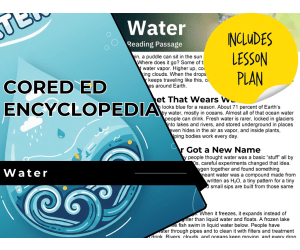
This water reading comprehension with lesson plan includes: Visualization (on the front cover) Start your lesson by taking a minute to think and share something about the topic. Read the script aloud (slowly), perhaps prepare some music or sound effects. Student close their eyes and let their imaginations wander. Students open their eyes, read the question aloud and give them a few minutes to complete. Ask a few students to share or keep answers until the end to compare with what they learn in the passage. Quick pause—thousands of Cored Education products are included with your TeachSimple membership. Download links and encyclopedia index available here. Pre-Reading Trivia Students will write down one thing they already know about the subject and then read five more facts and discuss. These facts are fun, and the students will enjoy learning about the subject before reading more. Give 1 minute for students to write what they already know (no pressure—best guess is fine). Read the five facts together. After each fact, do ask a student for their opinion, was it surprising? Set a purpose by asking students to highlight/underline one fact they want to learn more about during the reading. Reading Passage The text is a high-interest reading passage with set paragraphs, roughly three to four paragraphs long. It contains a variety of themes about the topic, anywhere from history to technology. The passage is between 250 and 350 words in length. First, ask students to look at the headings and see what they’ll learn about today. What do they know about the topic/heading? First read options: Teacher read-aloud (best for support). Partner reading (paragraph by paragraph). While reading, students underline important details, and vocabulary words they think may come up in the questions section. Mixed Questions The first question page contains four multiple-choice questions, each with a choice of four answers, and three written response questions that require a sentence or two from the student. Students complete the mcqs first independently, then review quickly as a class. For the 3 written responses, try to get students giving the answer with some form of evidence: “I think ___ because the text says ___.” If students get stuck, send them back to check the passage. Vocabulary Questions Practice seven key words from the text in this section across two activities. First section is scrambled words where students will unscramble three words given a clue for each. The second section is a word to meaning matching activity. Before starting, have some students read out words they underlined in the passage. Ask students to say the word and read aloud the sentence(s) around each word. Ask students to do scrambled words and the matching exercise in pairs then go through answers as a class. For the scrambled spelling task, get four pairs to come up to the board and write the words for extra practice with the other student reading out the clue. For the matching task, prompt students to give full sentences: “I matched ___ with ___ because ___.” Creative Writing In this question, the student will be required to write a five to eight sentence paragraph on a question related to the topic. Before starting, ask students write down 3 key ideas they are going to include in their piece. Ask students for ideas to share around the class to help those struggling. Pro writing expectations: 5–8 sentences At least 2 facts or details from the passage At least 2 vocabulary words from the previous page Students read their paragraphs while classmates listen for facts and vocabulary words. Extension Activities This page is optional for fast finishers or to take home. There are several activities, each one requiring a different skill. Do some, do none, do all, completely optional - but you will feel reassured knowing every possibility is planned for. Includes summary writting question. Answer Key There are answers for the multiple-choice questions, written response questions have sample answers, vocabulary answers and if there is a summary question then a sample summary will be provided as well. Lesson Plan Included Customized lesson plan for this lesson is included. Lesson Snapshot Title: Water Genre: Nonfiction (informational text) Subject: Science (Earth & Physical Science) / Informational Reading Primary Topic: Water cycle, where water is found, and H₂O Estimated Guided Reading Level (A–Z): R What This Lesson Teaches Best Explains how water changes state and moves around Earth (puddle → vapor → clouds → rain/snow). Builds background knowledge about where Earth’s water is found (oceans, glaciers/ice caps, lakes/rivers, underground aquifers, air as vapor). Introduces key science ideas about what water is made of (hydrogen + oxygen; water as a compound; H₂O; molecule). Highlights an important property of water: when it freezes, it expands and floats , allowing fish to swim below lake ice. Connects science to real life by describing how people move and clean water (pipes, filters, treatment) and why keeping water clean matters. Learning Goals Students will explain what happens to some puddle water when it shrinks in the sun. Students will describe at least three places water is found on Earth or in living things, using details from the text. Students will identify what scientists learned in the late 1700s about what water is made from. Students will explain why ice can float on liquid water, based on the passage. Students will describe one way people make water safer to drink that is stated in the text. Key Vocabulary From the Text vapor — water as an invisible gas in the air. glaciers — large masses of ice that store fresh water. aquifers — underground places where water is stored. compound — something made from two different gases joined together. molecule — a tiny particle that makes up water (H₂O). FULL CATALOG OF DOWNLOAD LINKS AND ENCYCLOPEDIA INDEX HERE
Author Cored Education
Rating
Tags Vocabulary, Reading Comprehension, Reading Passages, Lesson Plans, Ela Lesson Plans, Reading Comprehension Lesson Plans, Pre-reading, Science Lesson Plans, Technology, Earth Science
Amazing Survival Stories Book: Reading and Writing Worksheets
ELA, Reading, Grade 3, 4, 5, 6, 7, 8, Worksheets, Worksheets & Printables
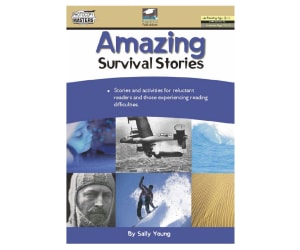
The Amazing Survival Stories Book: Reading and Writing Worksheets resource was created with reluctant readers in mind. The goal is that these survival stories grab the young reader's attention. Students can increase their reading and comprehension skills through these stories. The stories are written with vivid details and there are worksheets to follow. All of the activities vary from story to story to keep students engaged. This is a 68-page download.
Author Ready-Ed Publications
Tags Reading Worksheets, Writing Worksheets, Reluctant Readers, Survival Stories, Survival Kits

Spring Great Than Less Than
Math, Numbers, Preschool, Kindergarten, Grade 1, Worksheets & Printables, Worksheets
A fun and engaging Spring-themed activity to Introduce and practice less than, great than, and equal to for numbers 1-10. Math activity that includes: 15 cards with Spring pictures to compare; 1-10 number cards <, >, = cards 4 worksheets
Author Cherry Workshop
Tags Greater Than, Less Than, Math, Comparison, Spring
Sentence Structure Practice Questions - Grade 3-4 Grammar (Google Doc)
ELA, Language Development, ESL, Grammar, Common Core, Resources for Teachers, Grade 3, 4, Worksheets & Printables, Worksheets, Quizzes and Tests, Teacher Tools, Tests, Assessments, Centers, Activities
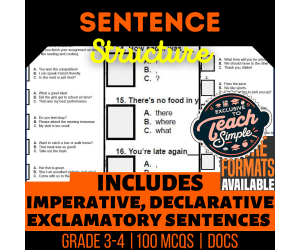
Sentence Structure Grammar Practice MCQS ELA MCQS Overview: In this series of lessons, students will embark on an engaging journey to explore the grammar skills that make our language vibrant and expressive. These lessons are crafted to help students identify, comprehend, and effectively apply language arts skills in both writing and speech. Accompanied by free supplementary materials available for all topics, each lesson builds on the previous one, offering a balanced mix of direct instruction, interactive group activities, and independent practice. Through fun and creative tasks, students will learn to recognize grammar within sentences, understand their function, and use them to enrich their own writing and speech. Sentence Structure Overview: Includes: Declarative Sentences lnterroative Sentences Exclamatory Sentences Imperative Sentences Sentence Fragments End Punctuation Docs Version This is the Docs editable and fillable version. This download is available in GOOGLE Docs, GOOGLE Forms, GOOGLE Slides. PDF, PPT, WORD, check the links below for more details. FULL CATALOG OF DOWNLOAD LINKS HERE Grade 3/4 Links: Adjectives Google Docs Google Forms Google Slides PDF PPT Word Free Supplementary Materials Pack Adverbs Google Docs Google Forms Google Slides PDF PPT Word Free Supplementary Materials Pack Conjunctions Google Docs Google Forms Google Slides PDF PPT Word Free Supplementary Materials Pack Nouns Google Docs Google Forms Google Slides PDF PPT Word Free Supplementary Materials Pack Pronouns Google Docs Google Forms Google Slides PDF PPT Word Free Supplementary Materials Pack Verbs Google Docs Google Forms Google Slides PDF PPT Word Free Supplementary Materials Pack Sentence Structure Google Docs Google Forms Google Slides PDF PPT Word Free Supplementary Materials Pack Present Tense Google Docs Google Forms Google Slides PDF PPT Word Free Supplementary Materials Pack Past Tense Google Docs Google Forms Google Slides PDF PPT Word Free Supplementary Materials Pack Future Tense Google Docs Google Forms Google Slides PDF PPT Word Free Supplementary Materials Pack Context Clues Google Docs Google Forms Google Slides PDF PPT Word Free Supplementary Materials Pack Defining Words Google Docs Google Forms Google Slides PDF PPT Word Free Supplementary Materials Pack Fill the Blanks Google Docs Google Forms Google Slides PDF PPT Word Free Supplementary Materials Pack Homophones Google Docs Google Forms Google Slides PDF PPT Word Free Supplementary Materials Pack Synonyms Google Docs Google Forms Google Slides PDF PPT Word Free Supplementary Materials Pack ELA Review Questions Overview Questions have three answer choices. There are a handful of pictures on each test for aesthetic purposes, as well as a review sheet covering most of the topics covered in the product. Introduction or Example Sheet Each topic will include an introduction or example sheet to go through first with your students. Full Answer Keys Full answer keys and sample responses are provided so no matter how busy you are, you know you're covered! In the Supplementary Pack Interactive Ice Breakers: Fun, hands-on activities that get students thinking about adjectives right from the start. Guided Practice: Teacher-led exercises that reinforce the day’s lesson, ensuring students can confidently identify and use adjectives. Group and Partner Tasks: Collaborative activities that allow students to work together to solve problems, categorize adjectives, and create descriptive sentences. Independent Worksheets: Structured worksheets that provide individual practice and help solidify understanding of key concepts. Exit Tasks: Quick, reflective activities at the end of each lesson that assess understanding and encourage students to apply what they’ve learned. For similar downloads and other frees, do check out Cored Group on TeachSimple.
Author Cored Education
Tags Elementary, Answers, Ccss, Common Core, Grammar, Tests, Test Prep, Grade 3, Grade 4, Digital Centers
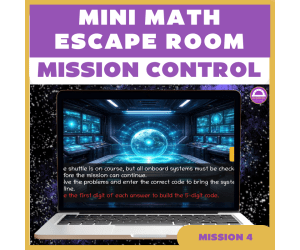
6th Grade Math Spiral Review Escape Room Week 1 Day 4
Math, Grade 5, 6, 7, Worksheets, Worksheets & Printables, Teacher Tools, Activities, Escape Room
This mini escape room is a digital, self-checking activity that is designed to insert easily into your daily 6th grade math spiral review routine or warm-up. Mission 4 is designed to take about 10 minutes - perfect for the beginning of class, review block, or end of the day when time is short but review is important! Students answer 5 math problems on one page; all problems are focused on critical 6th grade math skills that require continual review. Students use the first digit of each correct answer to create a 5-digit code to complete the mission. If the code is not correct, nothing will unlock and students are prompted to keep working! This allows students to self-check and revise their work without needing immediate teacher feedback. The format is the same as the other missions in this series; once students understand how to complete one mission, they will be able to complete future missions in the same way without much additional direction, making Mission 4 perfect for establishing a daily routine. It is completely no prep; you don't need to make any teacher accounts, create any locks, or prepare anything extra - simply assign to your students and let them work! The activity is completely self-checking. For added flexibility, a printable worksheet version is included. This allows the same problems to be used in classrooms with limited technology, for homework, or as part of an emergency substitute plan. An answer key and the final code are also provided, making it easy to check work or review answers quickly. What’s Included One mini math escape room (Mission 4) Five math problems on a single interactive page Printable worksheet version Answer key and final code Skills Covered Ratios Unit rates Fraction simplification Decimal comparison Order of operations Suggested Uses Daily math warm-ups or bell ringers End-of-day review Early finisher activities Emergency substitute plans Mission 4 is a simple, low-pressure way to keep key math skills fresh while adding structure and consistency to your daily 6th grade math routine.
Author Matemaths
Rating
Tags Matemaths, Guided Notes, Worksheet, Word Problems, Adding And Subtracting Decimals, Decimals

Data Analysis and Intervention Scheduling Plan
Special Resources, Special Education Needs (SEN), Preschool, Grade 1, 2, 3, 4, 5, Worksheets & Printables, Worksheets
This is a Data Analysis and Intervention Scheduling Plan for your Intervention Team. This 1-page template will come equipped with all the pertinent information you’ll need to document in an effort to maintain organization with your special education team. The breakdown of the 1-page template sample shows space for 5 different grade-wide scheduling meetings. For each session, an estimated time will be allotted – with somewhere between 4-7 weeks in between meetings. Within each session, you will be discussing the data analyzed as well as the analysis procedures. Laying the foundation for how data will be analyzed is a critical part of successful data meetings. This scheduling plan comes as a completely editable Word document, so you can edit everything you need to fit the needs of your intervention team. The PDF sample serves as a starting point to guide you. I hope you enjoy! Take A Look at My Best Sellers: Breaking the Big Words Word Wall Student Notebook Volume 2 Breaking the Big Words Weekly Fluency Practice Volume 1 SOS to Encode! Multisensory Strategies Posters School Wide Intervention Schedule Breaking the Big Words Activity Book Volume 1, Set 6 Breaking the Big Words Bookmarks Volume 2 You can find more resources at my storefront here: https://teachsimple.com/contributor/morgan-learning
Author Morgan Learning
Tags Data Analysis, Intervention, Intervention Schedules, Scheduling Plan, Meeting Template, Meeting Schedule, Data Tracking, Analysis Procedures

Capital and Lowercase Letters P-Z Printable Workbook
ELA, Writing, Kindergarten, Preschool, Grade 1, Workbooks, Worksheets & Printables
Capital and Lowercase Letters P-Z Printable Workbook The Capital and Lowercase Letters P-Z Printable Workbook is a comprehensive teaching resource, meticulously designed by seasoned education professionals. Primarily intended for preschool up to grade one learners, this 23-page digital workbook places its central emphasis on writing development as part of the language arts curriculum . Workbook Features: Cohesion with current grade-level standards and educational strategies to efficiently teach reading concepts and applications. Rigorous learning materials focused on capital and lowercase characters from P through Z. Promotion of learner’s recognition skills while simultaneously boosting their ability to trace, draw, and accurately utilize these letters. Implementation: The workbook can be adapted in varied ways in pursuit of inclusive education settings that cater to all learner's needs at diverse stages of learning accomplishment. It offers multiple use-cases such as: Whole group instruction within classroom lessons or smaller group learnings during learning centre times. An enriching supplement for individual practice sessions or as part of homework tasks that consolidate classroom teachings, reinforcing the home-school connection. Inclusions: A wide array of hands-on activities that pique children's interest effortlessly through interactive engagements with printable content are included within this resource. The embedded parent tips offer critical understanding into preparatory information fundamental for effective teaching practices - shedding light on how enjoyable it can be for children practicing new skills repeatedly until mastered. In Conclusion... This accessible PDF workbook—from the Get Ready For Preschool series—fosters an in-depth proficiency in alphabet recognition amongst young learners, dedicatedly preparing them for confidently taking the next step in their educational journey.
Author Twin Sisters Digital Media
Tags Capital Letters, Lowercase Letters, Handwriting Practice, Alphabet Recognition, Language Arts

Kitchen Safety Skills: Jasmine Learns How to Use a Microwave
Special Resources, Life Studies, Special Education Needs (SEN), Speech Therapy, Life Skills, Home Economics, Grade 10, 11, 12, Activities, Worksheets & Printables, Worksheets
Kitchen Safety Skills: Jasmine Learns How to Use a Microwave This is an essential teaching companion designed specifically for educators who necessitate effective methods to teach the crucial skill of safe microwave usage. This resource emboldens learners to become more independent by actively involving them in Jasmine's journey as she learns about microwave safety. Comprehensive Educational Material This lesson incites discussions about items that should not be put in the microwave, such as metals, plastic bags, and aluminum foil-clad products. The dangers of using prohibited items, such as meltable plastics and sparking metals, are stressed using simple and direct language suitable for high school students or adults with intellectual disabilities. The engaging dialogue sequence and interactive questions pull learners into the story whilst reinforcing their understanding of safety concepts. The social narrative utilizes real-world examples coupled with age-appropriate visuals like detailed illustrations – making it more accessible and relatable. A Useful Teaching & Learning Tool This learning material contains seven reading comprehension questions aimed at measuring the understanding levels concerning Kitchen Safety Life Skills depicted throughout Jasmine's story. It is ideal for traditional classroom settings or homeschooling environments alike. Therapists including occupational therapists (OTs), ABA professionals (ABAs), or speech therapists (STs) can also use this meticulously designed instructional tool while emphasizing life skills training among their students. Homework Asset & Companion Resources A perfect homework assignment promoting both group learning and individual growth aspects - fostering all-around development through interactive instruction methods incorporated alongside hands-on community activities targeted at IEP goal setting processes & measuring milestones achieved in practical situations. It is supplemented by resources that teach diverse independent living facets including creating budgets & shopping lists, handling bank accounts & credit cards operations; all these depicted through subsequent narratives dedicated to honing essential life skills. The Kitchen Safety Skills: Jasmine Learns How to Use a Microwave comprises six pages in a printable, user-friendly PDF format. This engaging and handy tool promotes personal responsibility among learners thereby ensuring educators guide students effectively towards independence around safe kitchen practices.
Author Adulting Life Skills Resources
Tags Kitchen Safety, Microwave Usage, Life Skills, Independent Living, Teaching Resource