



2,659 products added recently
Page 46 - Reading Comprehension Activitites
Support your students in developing strong reading comprehension skills with a variety of engaging activities. This collection includes worksheets, graphic organizers, and discussion questions designed to help students understand and analyze texts. By integrating these resources into your teaching, you can enhance students' ability to interpret information and draw meaningful conclusions.

 Show filters


Colorado State Flipbook (Capital, Bird, Flower, Flag, Animal)
Creative Arts, Art, Social Studies, ELA, History, History: USA, Geography, Reading, Reading Comprehension, Grammar, Language Development, Spelling, Writing, Grade 2, 3, 4, Activities
Colorado State Flipbook - Exploring Symbols (Capital, Bird, Flower, Flag, Animal) The Colorado State flipbook is an engaging and interactive educational resource providing a comprehensive perspective on the key symbols representative of Colorado. This teaching tool is designed to enrich learning experiences for Grade 2 through 4 students in public schools and homeschool settings. This easy-to-use flipbook encourages students' exploration and understanding of Colorado's significant symbols including its capital, Fbird, flower, Fflag, " + " . It offers a hands-on approach to research while improving their comprehension skills across different subjects including: -Art & Music; -Social Studies; i -Language Arts inclusive of Coloring; -History: USA; ]'> ] ' Spelling and Writing." ' By having each page formatted visually appealingly – drawing young learners into state-wide data immersion – the flipbook features four unique combinations with two printing options ( either cutting required or not ) and two design choices ( pictures inclusion or otherwise). The minimal preparatory requirements permit educators limitations within their core responsibilities: delivering content rather than logistical solutions. Hence this practical resource finds utility in diverse scenarios like: Enriching social studies/history discussions within small groups or whole class cohorts; Breathing life into writing lessons or centers stressing spelling correctness & grammar usage via research tasks. This resource also lends itself quite well to cross-curricular efforts such as: Incorporating art through drawing & coloring exercises correlated with geography identification tasks upon map review; Tackling science components focused on identifying native species like birds & flowers. The goal is to convert each student into a 'Coloradan' expert researcher. The design shows particular consideration towards diverse learners. Reading passages cater to voracious readers while curated videos draw visual-auditory types closer towards grasping intended subject matter. Additional interactive activities tie in kinesthetic learners, effectively targeting various learning types. Moreover, it's utility stretches beyond Colorado state - with comprehensive research tools embedded, students can apply the method developed here across all U.S states from Alabama through Wyoming making this flipbook the first step on a rewarding American journey channeling contextual exploration!
Author Heather Huhman
Tags Colorado Symbols, Flipbook, Colorado Capital, Colorado Bird, Colorado Flower

ENGLISH TEXT + 6 ANCHOR CHARTS | The Balloon that Wanted to Sink
Reading Comprehension, Reading, ELA, Strategies, Creative Writing, Writing, Formal Writing, Adult Education, Early Learning, Elementary, High School, Homeschool Resources, Middle School, Not Grade Specific, Activities, Worksheets & Printables, Teacher Tools, Anchor Charts, Charts, Quizzes and Tests
ENGLISH TEXT + 6 ANCHOR CHARTS | The Balloon that Wanted to Sink This resource have 1 english text + 6 comprehension anchor charts. ABOUT THE AUTHOR: INTRODUCTION: We are EDITORIAL ARENAS EDUCATIVAS, and our mission is to produce a variety of educational materials so children can learn better and more effectively. We encourage you to visit our entire store to download our products. Also, remember that we produce reading, writing, math, and Spanish language learning materials. MAIN DESCRIPTION OF THIS RESOURCE: 1) What age ranges is this resource designed for? This document is designed for children in pre-kindergarten and elementary school. It is simply intended for children in elementary school, but it is also freely available to other grades who may need this document. 2) What version or edition does this material correspond to? This document is designed in PDF format so you can print and use it much more quickly. 3) What is the recommended printing method for this resource? I recommend printing this document in PDF format so you won't experience any errors when printing. 4) What educational standards were used as the basis for creating this material? This document was not developed based on any specific standard. SECONDARY AND COMPLEMENTARY INFORMATION: 1) What is the title of this resource? This resource is titled "Educational Resource for Better Learning" developed by EDITORIAL ARENAS EDUCATIVAS. 2) How many pages does the file contain in total? This educational document contains enough pages to make this resource ideal for promoting fun and successful learning. 3) Does this material allow for custom editing? This educational document is available in PDF format, so you cannot edit it. You simply need to download and then print it. 4) What main topic does the resource cover? This document has been developed to address a basic topic that children in kindergarten through elementary school should master. This document will also be helpful to the general public who want to learn.
Author EDITORIAL LAURA EDUCA
Rating
Tags FREE, FREE RESOURCES, ENGLISH LANGUAGE ART, COMPREHENSION, READING, COMPREHENSION ANCHOR CHART, ANCHOR CHART

Social Studies Passages: The Founding of the United States (Docs)
ELA, Reading, Reading Comprehension, Strategies, Resources for Teachers, Social Studies, Biographies, Government, History: USA, History, Grade 6, 7, 8, 9, Writing Prompts, Worksheets & Printables, Centers, Activities, Teacher Tools, Assessments, Quizzes and Tests, Quizzes, Tests
Social Studies Reading Comprehension Passages: The Founding of the United States (Docs) This resource introduces a collection of Social Studies reading comprehension passages about Benjamin Franklin and Writing the constitution (Founding the United States). The passages are carefully designed to bridge the gap between social studies and literacy through strengthening reading comprehension and sparking knowledge curiosity in middle school students. Each passage blends English Language Arts skills with accurate social studies content. Ideal for interdisciplinary learning in ELA and Social Studies. Suitable for Grade 9 review, too! What Is Included in this Collection? There are three informational passages (with full answer keys): Franklin’s Notebook of Virtues Benjamin Franklin: Man of Ideas Writing the Constitution: Three Branches, One Nation For Each Passage, students will have multiple tasks to complete as follow: 5 multiple-choice questions targeting main idea, key details, inference, vocabulary in context, and use of evidence 5 vocabulary matching items with clear, student-friendly definitions 5 text-based questions that require citing specific lines or facts 1 summary prompt that asks students to condense central ideas accurately Available Formats for this Resource Fillable PDF Word Docs Google Docs FULL CATALOG OF DOWNLOADING LINKS HERE For more Social Studies Reading Passages, check the following Links: Ancient Civilizations PDF Fillable PDF Word Docs Google Docs Early Empires and Trade Networks PDF Fillable PDF Word Docs Google Docs The Founding of the United States PDF Fillable PDF Word Docs Google Docs Language, Culture, and Meaning PDF Fillable PDF Word Docs Google Docs Psychology and Society PDF Fillable PDF Word Docs Google Docs Global Festivals and Traditions PDF Fillable PDF Word Docs Google Docs Extreme Environments and People PDF Fillable PDF Word Docs Google Docs Food, Culture, and Preservation PDF Fillable PDF Word Docs Google Docs Global Food Customs PDF Fillable PDF Word Docs Google Docs Media, Communication, and Popular Culture PDF Fillable PDF Word Docs Google Docs Human Impact on the Environment PDF Fillable PDF Word Docs Google Docs Civic Action and Social Change PDF Fillable PDF Word Docs Google Docs Fashion, Society, and Power PDF Fillable PDF Word Docs Google Docs People, Places, and Unusual Histories PDF Fillable PDF Word Docs Google Docs Product Details Length: 13 pages total Grades: 6–8, also suitable for Grade 9 review Use cases: close reading, stations, homework, intervention, test prep, and sub plans Why Teachers Choose This Set Authentic social studies content paired with rigorous literacy practice Consistent task structure across all passages for easier planning and smoother student routines Clear, age-appropriate writing that builds confidence without oversimplifying Use this set to reinforce ELA skills in social studies, to add literacy to your lessons, and to support independent work. The passages strengthen main idea, evidence use, vocabulary in context, inference, cause and effect, and summary writing. With ready-to-use assessments and complete answer keys, you can provide focused practice that is simple to run and fast to review.
Author CORED Education - Middle & High School
Rating
Tags Middle School, Reading Comprehension, Reading Strategies, ELA, Centers, Reading Passage, Assessments, Vocabulary, Social Studies, U.S Government

Jets Reading Comprehension Passage - Cored Ed Encyclopedia
ELA, Language Development, Resources for Teachers, Reading Comprehension, Reading, Pre-Reading, Science, Technology, Writing, Strategies, Grade 2, 3, 4, 5, Worksheets & Printables, Worksheets, Teacher Tools, Centers, Activities, Writing Prompts, Assessments, Tests, Quizzes and Tests, Quizzes
This jets reading comprehension contains the following: Visualize on the Cover (Teacher Read Aloud Script) Start your lesson by taking a few moments to visualize the topic and share thoughts or feelings about it. Pre-Reading Trivia Students will write down one thing they already know about the subject and then read five more facts and discuss. These facts are fun, and the students will enjoy learning about the subject before reading more. Reading Passage The text is a high-interest reading passage with set paragraphs, roughly three to four paragraphs long. It contains a variety of themes about the topic, anywhere from history to technology. The passage is between 250 and 350 words in length. Mixed Questions The first question page contains four multiple-choice questions, each with a choice of four answers, and three written response questions that require a sentence or two from the student. Vocabulary Questions Practice seven key words from the text in this section across two activities. First section is scrambled words where students will unscramble three words given a clue for each. The second section is a word to meaning matching activity. Creative Writing In this question, the student will be required to write a five to eight sentence paragraph on a question related to the topic. Extension Activities This page is optional for fast finishers or to take home. There are several activities, each one requiring a different skill. Do some, do none, do all, completely optional - but you will feel reassured knowing every possibility is planned for. Answer Key There are answers for the multiple-choice questions, written response questions have sample answers, vocabulary answers and if there is a summary question then a sample summary will be provided as well. FULL CATALOG OF DOWNLOAD LINKS AND ENCYCLOPEDIA INDEX HERE Lesson Snapshot Title: Jets Genre: Nonfiction (Informational Text) Subject: Science & Technology / Reading (Informational Text) Primary Topic: How jets move, engine parts, and high flight Estimated Guided Reading Level (A–Z): Q What This Lesson Teaches Best Explains the big idea behind jets using an action-and-reaction example (like a blown-up balloon zipping across a room). Describes how a jet engine makes thrust by pulling air in, squeezing it, heating it, and blasting it out the back. Builds technical understanding of engine parts and jobs (inlet, compressor, turbine, exhaust nozzle). Connects jet flight to conditions in the sky (air is thinner and smoother high above clouds; contrails can form when water vapour freezes). Adds brief history context about early jet-engine work and the first turbojet-powered flight date and plane name. Learning Goals Explain how a jet airplane is pushed forward when air or hot gas rushes out the back. Describe what happens inside a jet engine from the inlet to the exhaust nozzle. Identify the jobs of the compressor and turbine using details from the passage. Retell key history details about early jet designs and the first turbojet-powered flight mentioned. Describe what the air is like high above clouds and how that relates to jet travel. Explain how contrails can form according to the text. Key Vocabulary From the Text inlet — the front opening where air is pulled in. compressor — a part that squeezes air so it is packed tight. turbine — a wheel that takes energy from rushing gas. thrust — the push that moves an airplane forward. contrails — white lines that can form when water vapour freezes. Cored Ed Encyclopedia Overview The Cored Ed Encyclopedia is a weekly series of lessons that you can pick up and use right away. These short readings fit into whatever time you have available. Each one includes a warm-up, a reading, and a set of questions, but it’s flexible — you can do just the reading, the full lesson, or skip the writing section if you need to. Each lesson focuses on a single topic so students don’t get lost. The writing is clear but never childish, making it perfect for grades two through five. Topics range from animals and science to history, inventions, and everyday things. No matter the level of the student, everyone should take away at least one new idea or fact from each lesson. The materials are easy to print, easy to explain, and require no setup. They work well for whole-class teaching, partner work, or independent study.
Author Cored Education
Rating
Tags Vocabulary, Spelling, Reading Comprehension, Reading Passages, Reading, Creative Writing, Reading Strategies, Writing Prompts, Technology, Jets

Rhode Island State Flipbook (Capital, Bird, Flower, Flag, Animal)
Creative Arts, Art, Social Studies, ELA, History, History: USA, Geography, Reading, Reading Comprehension, Grammar, Language Development, Spelling, Writing, Research, Grade 2, 3, 4, Activities, Projects
Need an engaging, hands-on way to teach and review the state of Rhode Island and its symbols? Look no further than this flipbook research project! Perfect for elementary teachers and homeschoolers alike, this LOW PREP resource covers five of Rhode Island's major symbols—its capital, bird, flower, flag, and animal—and more through an interactive, cross-curricular activity . It contains two printing options: one that requires cutting and one that doesn't. It also contains two design options: one with pictures and one without. In total, there are four flipbooks. A GREAT ADDITION TO YOUR: Rhode Island, Northeast region, or U.S. states unit study or review Writing lessons or centers Social studies or history class ...or just for fun! ELEMENTS INCLUDE: 37 PDF pages Instructions for 4 easy-to-assemble flipbooks 2 printing options (cutting and no cutting) 2 design options (pictures and without pictures) 7 topics (Rhode Island's state capital and other facts, state bird, state flower, state flag, state animal, state map, and KWL) Help your students become experts in all things Rhode Island! Whether you're looking for an introduction to the state or an assessment of prior knowledge, this resource has something for everyone. CROSS-CURRICULAR SUBJECTS COVERED: Art (drawing and coloring) English language arts Geography Grammar History Reading Research Science Social studies Spelling Writing Are you interested in helping your students become experts in other U.S. states? From Alabama to Wyoming, you can explore each state and its major symbols—its capital, bird, flower, flag, and animal—through cross-curricular activities. Each day's lesson plan appeals to different types of learners: curated videos (visual and auditory), reading passages (reading), research report pages (writing), interactive notebook and other activities (kinesthetic), and more. Click on the link to my profile to learn more about my 5-day units, including Rhode Island!
Author Heather Huhman
Tags Rhode Island, Providence, Rhode Island State Bird, Rhode Island State Flower, Rhode Island State Flag, Rhode Island State Animal, Geography, Flipbook, Us States, United States

Reading Comprehension Passage: Sugar Addiction (PDF SAMPLE)
ELA, Reading, Reading Comprehension, Strategies, Resources for Teachers, Social Studies, Sociology, Grade 6, 7, 8, 9, Writing Prompts, Worksheets & Printables, Centers, Activities, Teacher Tools, Assessments, Quizzes and Tests, Quizzes, Tests
This is a ONE PASSAGE SAMPLE. The following is the description of the FULL resource and the downloading links: Social Studies Reading Comprehension Passages and Questions: Global Food Customs (PDF) This resource introduces a collection of Social Studies reading comprehension passages with questions about Global Food Customs. The passages are carefully designed to bridge the gap between social studies and literacy through strengthening reading comprehension and sparking knowledge curiosity in middle school students. Each passage blends English Language Arts skills with accurate social studies content . Ideal for interdisciplinary learning in ELA and Social Studies. Suitable for Grade 9 review, too! What Is Included in this Collection? There are three informational passages (with full answer keys): On the Menu: Why Some Cultures Eat Insects More Than a Drink: Tea Customs Sweet Cravings: Understanding Sugar “Addiction” For Each Passage, students will have multiple tasks to complete as follow: 5 multiple-choice questions targeting main idea, key details, inference, vocabulary in context, and use of evidence 5 vocabulary matching items with clear, student-friendly definitions 5 text-based questions that require citing specific lines or facts 1 summary prompt that asks students to condense central ideas accurately Available Formats for this Resource Fillable PDF Word Docs Google Docs FULL CATALOG OF DOWNLOADING LINKS HERE For more Social Studies Reading Passages, check the following Links: Ancient Civilizations PDF Fillable PDF Word Docs Google Docs Early Empires and Trade Networks PDF Fillable PDF Word Docs Google Docs The Founding of the United States PDF Fillable PDF Word Docs Google Docs Language, Culture, and Meaning PDF Fillable PDF Word Docs Google Docs Psychology and Society PDF Fillable PDF Word Docs Google Docs Global Festivals and Traditions PDF Fillable PDF Word Docs Google Docs Extreme Environments and People PDF Fillable PDF Word Docs Google Docs Food, Culture, and Preservation PDF Fillable PDF Word Docs Google Docs Global Food Customs PDF Fillable PDF Word Docs Google Docs Media, Communication, and Popular Culture PDF Fillable PDF Word Docs Google Docs Human Impact on the Environment PDF Fillable PDF Word Docs Google Docs Civic Action and Social Change PDF Fillable PDF Word Docs Google Docs Fashion, Society, and Power PDF Fillable PDF Word Docs Google Docs People, Places, and Unusual Histories PDF Fillable PDF Word Docs Google Docs Product Details Length: 14 pages total Grades: 6–8, also suitable for Grade 9 review Use cases: close reading, stations, homework, intervention, test prep, and sub plans Why Teachers Choose This Set Authentic social studies content paired with rigorous literacy practice Consistent task structure across all passages for easier planning and smoother student routines Clear, age-appropriate writing that builds confidence without oversimplifying Use this set to reinforce ELA skills in social studies, to add literacy to your lessons, and to support independent work. The passages strengthen main idea, evidence use, vocabulary in context, inference, cause and effect, and summary writing. With ready-to-use assessments and complete answer keys, you can provide focused practice that is simple to run and fast to review.
Author CORED Education - Middle & High School
Rating
Tags Middle School, Reading Comprehension, Reading Strategies, ELA, Centers, Reading Passage, Assessments, Vocabulary, Social Studies, Food And Culture

Reading Passage 37: Properties of Rocks and Minerals (Google Docs)
ELA, Reading, Reading Comprehension, Science, Earth and Environmental Sciences, Earth Sciences, Common Core, Grade 5, 6, 7, Centers, Activities, Worksheets, Worksheets & Printables, Teacher Tools
Free Reading Passage on Properties of Rocks and Minerals for Earth Science What's inside this free product? Science Reading Comprehension Passage: Properties of Rocks and Minerals Independent Google Docs Version: This is the independent Google Docs version containingone lesson. Product Info: 8 PAGES (US English with Answers) Google Docs Version Teaching Duration: 90 Minutes Science Reading Comprehension Outline: Introducing a comprehensive resource tailored for 5th and 6th graders, this product offers enriching reading passages supplemented with illustrative pictures and graphs to clarify key concepts. Aligned with the Common Core State Standards (CCSS), it offers a hassle-free approach to teaching, given that the bulk of the preparation is already done for you. The passages present a diverse set of questions – from multiple choice to data analysis and fill-in-the-blanks. This ensures a rich blend of high-interest content and fundamental curriculum-based science themes. With its versatility, you can seamlessly integrate these lessons into various classroom settings, whether it's whole class discussions, morning exercises, independent desk tasks, small group engagements, contingency plans for substitute teachers, regular homework assignments, or even themed activities for holidays. FULL CATALOG OF DOWNLOAD LINKS HERE Grade 5/6 Links: Physical Science Part 1 - Physical and Chemical Properties Google Docs/Slides/Forms PDF PPT Word Free Supplementary Pack Accompanying Videos Physical Science Part 2 - Motion and Energy Google Docs/Slides/Forms PDF PPT Word Free Supplementary Pack Accompanying Videos Physical Science Part 3 - Electricity and Magnets Google Docs/Slides/Forms PDF PPT Word Free Supplementary Pack Accompanying Videos Life Science Part 1 - Cells, Reproduction and Genetics Google Docs/Slides/Forms PDF PPT Word Free Supplementary Pack Accompanying Videos Life Science Part 2 - Human Body Systems Google Docs/Slides/Forms PDF PPT Word Free Supplementary Pack Accompanying Videos Life Science Part 3 - Plant Parts and Ecosystems Google Docs/Slides/Forms PDF PPT Word Free Supplementary Pack Accompanying Videos Earth Science Part 1 - Plate Tectonics and Rock Cycle Google Docs/Slides/Forms PDF PPT Word Free Supplementary Pack Accompanying Videos Earth Science Part 2 - Ocean Exploration and Natural Resources Google Docs/Slides/Forms PDF PPT Word Free Supplementary Pack Accompanying Videos Earth Science Part 3 - Weather and Solar System Google Docs/Slides/Forms PDF PPT Word Free Supplementary Pack Accompanying Videos For similar products and other frees, do check out Cored Group on TeachSimple .
Author Cored Education
Tags Science, Elementary, Reading, Comprehension, Vocabulary, Answers, Physics, Physical Science, Ccss, Common Core
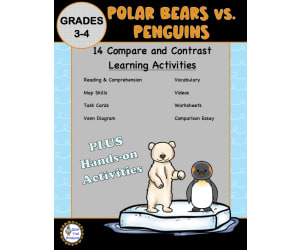
Comparison Writing and Activities Polar Bears vs. Penguins
ELA, Formal Writing, Writing, Reading, Reading Comprehension, Vocabulary, Language Development, Science, Life Sciences, Animals, Grade 3, 4, Activities, Crafts, Worksheets & Printables, Task Cards, Worksheets
Get ready for an exciting ELA journey with two of the most well-known polar habitat mascots. These 14 learning activities will have your grade 3 and grade 4 learners discovering, creating, and writing as they increase their knowledge about POLAR BEARS and PENGUINS. This product contains several activities that are sure to engage your learners, including reading, writing, science, social studies, and art. Through reading passages and videos, learners will gather information to use in a comparison essay, explaining how polar bears and penguins are different, yet also very much alike. As a unit wrap up, learners will have a great time working their way through 20 task cards in which they will recall information they acquired throughout their journey. You’ll find these learning activities are the perfect addition to your wintertime curriculum. There is a mixture of opportunities for all types of learners: visual, auditory, and kinesthetic alike. Many of the worksheets are print and go and you’ll find the task cards can be used year over year if laminated. Most pages are available in a color format, while all are presented in black & white. An answer key is also provided. Details of each activity are listed below. VERTICAL PAGES PAGE 1: K-W-L chart for polar bears PAGE 2: K-W-L chart for penguins PAGE 3: 5 vocabulary terms used throughout the product PAGE 4: 5 vocabulary terms used throughout the product PAGE 5: worksheet highlighting the vocabulary terms PAGE 6: links to two videos about polar bears and penguins with corresponding comprehension questions PAGE 7: worksheet about physical and behavioral adaptations of polar bears and penguins PAGE 8: instructions for a hands-on craftivity comparing the size of learners’ hands to polar bears’ paws PAGE 9: template for polar bear craftivity PAGE 10: instructions for a hands-on craftivity comparing the height of learners and Emperor penguins ANSWER KEY HORIZONTAL PAGES PAGE 1: reading passage about polar bears PAGE 2: reading passage about penguins PAGE 3: comprehension questions about reading passages PAGE 4: worksheet about sorting physical adaptations of polar bears and penguins PAGE 5: worksheet identifying polar bear and penguin habitats on a world map PAGE 6: Venn diagram template (polar bears vs. penguins) PAGE 7: stationery for comparison essay PAGE 8: stationery for comparison essay PAGE 9: graphic organizer about transition words and phrases to use in writing PAGE 10: writing checklist for comparison essay PAGES 11- 15: 20 task cards about polar bears and penguins PAGE 16: answer recording page for task cards ANSWER KEY
Author Quail Trail Products
Tags Comparison Writing, Polar Bears, Penguins, Venn Diagram, Reading, Reading Comprehension, Vocabulary, Task Cards, Craftivity, Animal Adaptations
Chess Reading Comprehension Passage - Cored Ed Encyclopedia
ELA, Language Development, Reading Comprehension, Reading, Pre-Reading, Science, Social Studies, Geography, History, Technology, Grade 2, 3, 4, 5, Worksheets & Printables, Worksheets, Teacher Tools, Centers, Activities, Writing Prompts, Assessments, Quizzes and Tests, Quizzes, Lesson Plans
This chess reading comprehension with lesson plan includes: Visualization (on the front cover) Start your lesson by taking a minute to think and share something about the topic. Read the script aloud (slowly), perhaps prepare some music or sound effects. Student close their eyes and let their imaginations wander. Students open their eyes, read the question aloud and give them a few minutes to complete. Ask a few students to share or keep answers until the end to compare with what they learn in the passage. COMPANION VIDEO NOW AVAILABLE (EMBEDDED AFTER PREVIEW PICTURES IN PRODUCT DESCRIPTION) Quick pause—thousands of Cored Education products are included with your TeachSimple membership. Download links and encyclopedia index available here. Pre-Reading Trivia Students will write down one thing they already know about the subject and then read five more facts and discuss. These facts are fun, and the students will enjoy learning about the subject before reading more. Give 1 minute for students to write what they already know (no pressure—best guess is fine). Read the five facts together. After each fact, do ask a student for their opinion, was it surprising? Set a purpose by asking students to highlight/underline one fact they want to learn more about during the reading. Reading Passage The text is a high-interest reading passage with set paragraphs, roughly three to four paragraphs long. It contains a variety of themes about the topic, anywhere from history to technology. The passage is between 250 and 350 words in length. First, ask students to look at the headings and see what they’ll learn about today. What do they know about the topic/heading? First read options: Teacher read-aloud (best for support). Partner reading (paragraph by paragraph). While reading, students underline important details, and vocabulary words they think may come up in the questions section. Mixed Questions The first question page contains four multiple-choice questions, each with a choice of four answers, and three written response questions that require a sentence or two from the student. Students complete the mcqs first independently, then review quickly as a class. For the 3 written responses, try to get students giving the answer with some form of evidence: “I think ___ because the text says ___.” If students get stuck, send them back to check the passage. Vocabulary Questions Practice seven key words from the text in this section across two activities. First section is scrambled words where students will unscramble three words given a clue for each. The second section is a word to meaning matching activity. Before starting, have some students read out words they underlined in the passage. Ask students to say the word and read aloud the sentence(s) around each word. Ask students to do scrambled words and the matching exercise in pairs then go through answers as a class. For the scrambled spelling task, get four pairs to come up to the board and write the words for extra practice with the other student reading out the clue. For the matching task, prompt students to give full sentences: “I matched ___ with ___ because ___.” Creative Writing In this question, the student will be required to write a five to eight sentence paragraph on a question related to the topic. Before starting, ask students write down 3 key ideas they are going to include in their piece. Ask students for ideas to share around the class to help those struggling. Pro writing expectations: 5–8 sentences At least 2 facts or details from the passage At least 2 vocabulary words from the previous page Students read their paragraphs while classmates listen for facts and vocabulary words. Extension Activities This page is optional for fast finishers or to take home. There are several activities, each one requiring a different skill. Do some, do none, do all, completely optional - but you will feel reassured knowing every possibility is planned for. Includes summary writting question and additional facts. Answer Key There are answers for the multiple-choice questions, written response questions have sample answers, vocabulary answers and if there is a summary question then a sample summary will be provided as well. Lesson Plan Included Customized lesson plan for this lesson is included. Lesson Snapshot Title: Chess Genre: Nonfiction (informational passage with headings) Subject: Reading (Informational Text) / Social Studies (history & culture) Primary Topic: How chess works and how it changed over time Estimated Guided Reading Level (A–Z): Q What This Lesson Teaches Best Introduces key basics of the game (64 squares, 16 pieces, and the goal of checkmate). Traces chess’s spread across places and cultures (India → Persia → Muslim world → Europe). Explains how rules changed over time (the queen and bishop gaining powerful moves in the late 1400s). Uses a chronological, heading-based structure to show history in clear sections (early origins, Europe, tournaments, computers). Connects chess to modern competition and technology (international tournaments, FIDE, computers like Deep Blue). Learning Goals Students will describe the chessboard and starting pieces using details from the passage. Students will explain what “checkmate” means in the passage. Students will identify where the passage says chess traveled and what it was called in different places. Students will describe the late-1400s rule change mentioned and how it affected games. Students will summarize how chess moved into public life and became an international sport. Students will explain one way computers affected chess, based on the passage. Key Vocabulary From the Text checkmate — the king is trapped with no safe move. ancestor — something that came earlier than something else. chaturanga — an early India game linked to chess. tournament — a contest with many games. calculating — working things out by thinking ahead. FULL CATALOG OF DOWNLOAD LINKS AND ENCYCLOPEDIA INDEX HERE
Author Cored Education
Rating
Tags Vocabulary, Reading Comprehension, Reading Passages, Lesson Plans, Ela Lesson Plans, Reading Comprehension Lesson Plans, Pre-reading, Geography, Social Studies Lesson Plans, History
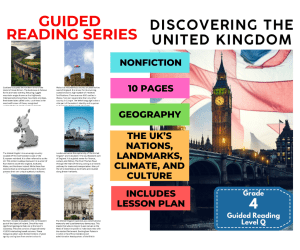
Discovering United Kingdom: Guided Reading Level Q with Lesson Plan
ELA, Resources for Teachers, Reading Comprehension, Reading, Science, Geography, Social Studies, History, Life Sciences, Earth and Environmental Sciences, Grade 3, 4, 5, Worksheets & Printables, Worksheets, Teacher Tools, Centers, Activities, Literacy Readers, Quizzes, Quizzes and Tests, Assessments, Lesson Plans
This Discovering the United Kingdom (level q) guided reading book with lesson plan includes: Guided Reading Color Label (front cover x1) This is a quick way to match the book’s demands to what students can generally handle.. The overall goal is to use the level/color to pick books for several smaller groups. To qualify for a certain level, a student is expected to read a book from that level with about 90–94% accuracy. If a student is consistently accurate and understands, move up a level. If the student is struggling at that level, drop down and add more support. Each student will improve at completely different rates, but it is generally one of the best ways to check progress across the class. DOWNLOAD THE CATALOG TO VIEW ALL GUIDED READING BOOKS AVAILABLE (SORTED LEVELS A-Z) Pre-Reading Question (x1) Teacher asks the prompt aloud, can be while showing the cover or first page. Students share what they already know, or make educated guesses from the cover. Prompt them to use the target vocabulary. Write some of their responses on the board to look back at during the reading. Vocabulary Words (x5) Introduce the five words, best doing it one at a time. Start by saying it, while students repeat and then see if anyone knows what it means before reading further. Read through the meaning and try to briefly connect each word to a picture or gesture so it’s meaningful. Ask students to flip through the book pages and point to where they see each of the vocabulary words. While reading the book pause upon coming across one of the vocab words or read the sentence twice to make sure students understand the word has appeared. Optional: Ask students to raise hands whenever they see/hear one of the new words. Guided Reading Pages (x10) Check the book snapshot (below) for: primary topic - do you need to prep extra reading or intro materials on this? what is taught best - decide on 1-2 bullets to focus on, use the prompt or words provided here for best results. learning goals - what you are checking for students to be able to do after the session, elicit answers using prompts or words provided. key vocabulary (see section above). questions overview - so you know what is coming up and if you need to prep extra materials to assist understanding. Run the lesson You may have already looked at a few of the pages together, but you can show them some of the pictures again first to set meaning. Depending on how much time you have and how familiar your students are with guided reading class, you may want to read the book aloud first with the group first. Students whisper or partner read, while you listen in. If time, do it as a group, one student reading a page each. Use the guided page’s prompts to coach: “Check the picture / does it make sense?” “Point under the words / try the first sound” “Reread the sentence smoothly”. Try to focus more on one student per session (rotating every time), so you can work out if they are ready to move up or need to move down a level. Comprehension Questions (back cover x3) This is your way to check that students didn’t just say the words, but actually understood the text. First, let students answer by pointing to the page/picture and saying a short sentence. After any answer, follow with: “Show me where you found that in the text.” In bigger groups, have partners answer first (10–20 seconds), then call on 2–3 students to share. Differentiation tips: Emerging speakers/struggling readers: oral + pointing On-level: oral in a full sentence Higher: one written sentence or draw + label Book Snapshot Title: Discovering the United Kingdom Genre: Nonfiction Subject: Social Studies (Geography, Government, Culture) Primary Topic: The UK’s nations, landmarks, climate, and culture Estimated Guided Reading Level (A–Z): Q What This Book Teaches Best Introduces the United Kingdom as a union of four countries and explains that each has its own traditions and landscapes. Builds geography knowledge by describing where the UK is located and by highlighting regional features in Scotland, Wales, and Northern Ireland. Teaches civics basics by explaining the UK’s constitutional monarchy and that the elected Parliament makes laws. Connects history and landmarks through examples like Stonehenge and major places in London along the River Thames. Explains how climate supports wildlife and gives an example of conservation connected to the red squirrel. Learning Goals Students will identify the four countries that make up the United Kingdom using details from the text. Students will describe why London is important in the United Kingdom and name one detail about the River Thames from the text. Students will describe key physical features of Scotland and explain what “lochs” are using the text’s description. Students will describe two details the text gives about Wales, such as its landscape, castles, or language. Students will explain how the text describes the UK’s government and who makes laws. Students will explain how the UK’s temperate climate is described and name one effect it has on wildlife. Key Vocabulary From the Text sovereign — able to govern itself. distinct — clearly different. interspersed — spread in between other things. constitutional — based on rules for how a country is run. prehistoric — from before written records. Discussion Prompts Pre-reading question: When you hear “United Kingdom,” what places or facts do you expect to learn about? Comprehension questions: What four countries does the text say make up the United Kingdom? Comprehension questions: What does the text say about who makes laws in the United Kingdom? Comprehension questions: What are two details the text gives about Scotland or Wales? Printing Tips 1. Best Printing Method (Recommended) “Booklet” Printing (Best if Available) If your printer or PDF viewer supports Booklet Printing , use this. Settings to use: Print mode: Booklet Paper size: Letter or A4 (either works) Orientation: Landscape Print on both sides: Yes Flip on: Short edge Scaling: Fit to printable area Booklet subset: First test: Front sides only Then: Back sides only This will automatically: Pair pages correctly Put the cover on the outside Align everything for folding After printing, fold in half and staple along the spine . 2. If “Booklet” Printing Is NOT Available You can still print this correctly with manual duplex printing . Step-by-step: Open the PDF. Choose Print . Set: Orientation: Landscape Pages per sheet: 1 Print on both sides: Yes Flip on: Short edge Print all pages . Because each PDF page already contains two facing book pages, the result will still fold cleanly into a book. Thousands of Cored Education products are included with your TeachSimple membership. Download links and encyclopedia index available here.
Author Cored Education
Rating
Tags Reading Comprehension, Reading Passages, Reading, Guided Reading, Guided Reading Lesson Plan, Guided Reading Activity, Pre-reading, Social Studies, Geography, History
Reading Comprehension Nonfiction Set 3 Sample: All About Horses (Docs)
ELA, Reading, Common Core, Reading Comprehension, ESL, Language Development, Spelling, Creative Writing, Writing, Resources for Teachers, Grade 4, 5, Worksheets & Printables, Worksheets, Writing Prompts, Assessments, Teacher Tools, Tests, Quizzes and Tests, Activities, Centers
Reading Comprehension Passages Nonfiction Set 3 Sample Overview No prep reading comprehension lessons, with enjoyable articles and topics. Each lesson has a blend of post-reading activities. Mixed questions to check overall understanding. Vocabulary activities, plus a writing section. Lessons also contain a bonus extension exercise at the end. Some you may like, some you may not, either way they are there if you wish to use them. Full answer keys are provided. Passage Included 3.All About Horses: How is the author preparing to become a vet when she gets older? Docs Version This is the Docs editable and fillable version. This download is available in GOOGLE Docs, GOOGLE Forms, GOOGLE Slides. PDF, PPT, WORD. FULL CATALOG OF DOWNLOAD LINKS HERE Grade 4/5 Links Fiction Set 1 - Animals Google Docs Google Forms Google Slides PDF PPT Word Guided Reading Materials Fiction Set 2 - Family Google Docs Google Forms Google Slides PDF PPT Word Guided Reading Materials Fiction Set 3 - Friends Google Docs Google Forms Google Slides PDF PPT Word Guided Reading Materials Fiction Set 4 - School Google Docs Google Forms Google Slides PDF PPT Word Guided Reading Materials Fiction Set 5 - Sports Google Docs Google Forms Google Slides PDF PPT Word Guided Reading Materials Nonfiction Set 1 - Birds Google Docs Google Forms Google Slides PDF PPT Word Guided Reading Materials Nonfiction Set 2 - Insects Google Docs Google Forms Google Slides PDF PPT Word Guided Reading Materials Nonfiction Set 3 - Mammals Google Docs Google Forms Google Slides PDF PPT Word Guided Reading Materials Nonfiction Set 4 - Nature Google Docs Google Forms Google Slides PDF PPT Word Guided Reading Materials Nonfiction Set 5 - Sea Animals Google Docs Google Forms Google Slides PDF PPT Word Guided Reading Materials Reading Passages Overview Each passage is especially written for Grade 4-5 students, including key vocabulary required for this age group. Topics are varied and are accompanied by colorful graphics. Topics are meant to educate, yet entertain the modern student. These passages are perfect for the modern classroom. Whereas textbooks can become outdated in no time, any changes to technology or the world will result in updates to this product. Mixed Questions The mixed questions section of each lesson includes a variation of five comprehension, vocabulary and math questions. In addition, key reading strategies are frequently covered including cause & effect, summarizing, compare & contrast and making conclusions. Two or three of the questions will be MCQs and other questions will require a written response of some kind. Full answers and example responses appear at the end of the lesson. Spelling & Vocab Each reading passage contains a variety of words and phrases designed for Grade 4-5 students. Spelling and vocab activities provide the opportunity to build fluency with these words. As it can become quite mundane doing the same activities over and over, each lesson in a set will contain a different spelling and vocab activity . Activities include: spelling games, sentence match-ups, mixed-up text and decoding words from the lesson. Writing Prompts Writing prompts are designed to continue the theme or lessons learned in the story. Students are persuaded to write in a variety of ways and each prompt includes several cues to help. As with the spelling/vocab section, writing prompts will vary. This includes research pieces, reading responses, poetry and creative writing prompts. Full Answer Keys Full answer keys and sample responses are provided so no matter how busy you are, you know you're covered! Mixed question answers provide evidence from the text, math questions contain the relevant workings. Answers are designed for use by the teacher, but also suitable as a handout to the student. Just for Fun Each lesson will have a bonus extension exercise. This is something fun to extend the lesson with. You can find these at the end of each lesson, titled Just for Fun. Just for Funs are optional. Some you may like, some you may not. Either way, they are there to do with as you wish. For similar downloads and other frees, do check out Cored Group on TeachSimple.
Author Cored Education
Tags Elementary, Reading, Comprehension, Vocabulary, Answers, Ccss, Common Core, Spelling, Writing, Digital Centers
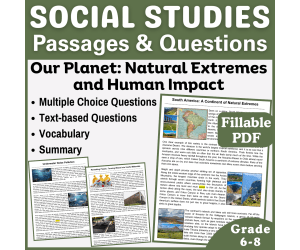
Reading Passages: Our Planet and Human Impact (Fillable PDF)
ELA, Reading, Reading Comprehension, Strategies, Resources for Teachers, Social Studies, Geography, Grade 6, 7, 8, 9, Writing Prompts, Worksheets & Printables, Centers, Activities, Teacher Tools, Assessments, Quizzes and Tests, Quizzes, Tests
Social Studies Reading Comprehension Passages and Questions: Our Planet: Natural Extremes and Human Impact (Fillable PDF) This resource introduces a collection of Social Studies reading comprehension passages with questions about Our Planet: Natural Extremes and Human Impact. The passages are carefully designed to bridge the gap between social studies and literacy through strengthening reading comprehension and sparking knowledge curiosity in middle school students. Each passage blends English Language Arts skills with accurate social studies content . Ideal for interdisciplinary learning in ELA and Social Studies. Suitable for Grade 9 review, too! These worksheets are designed as fillable PDFs , which means students can type their answers directly into the document on any computer or tablet . Each page includes highlighted text fields that show them exactly where to type! What Is Included in this Collection? There are three informational passages (with full answer keys): Remaking Plastic: Turning Waste into Useful Materials Underwater Noise Pollution South America: A Continent of Natural Extremes For Each Passage, students will have multiple tasks to complete as follow: 5 multiple-choice questions targeting main idea, key details, inference, vocabulary in context, and use of evidence 5 vocabulary matching items with clear, student-friendly definitions 5 text-based questions that require citing specific lines or facts 1 summary prompt that asks students to condense central ideas accurately Available Formats for this Resource PDF Word Docs Google Docs FULL CATALOG OF DOWNLOADING LINKS HERE For more Social Studies Reading Passages, check the following Links: Ancient Civilizations PDF Fillable PDF Word Docs Google Docs Early Empires and Trade Networks PDF Fillable PDF Word Docs Google Docs The Founding of the United States PDF Fillable PDF Word Docs Google Docs Language, Culture, and Meaning PDF Fillable PDF Word Docs Google Docs Psychology and Society PDF Fillable PDF Word Docs Google Docs Global Festivals and Traditions PDF Fillable PDF Word Docs Google Docs Extreme Environments and People PDF Fillable PDF Word Docs Google Docs Food, Culture, and Preservation PDF Fillable PDF Word Docs Google Docs Global Food Customs PDF Fillable PDF Word Docs Google Docs Media, Communication, and Popular Culture PDF Fillable PDF Word Docs Google Docs Human Impact on the Environment PDF Fillable PDF Word Docs Google Docs Civic Action and Social Change PDF Fillable PDF Word Docs Google Docs Fashion, Society, and Power PDF Fillable PDF Word Docs Google Docs People, Places, and Unusual Histories PDF Fillable PDF Word Docs Google Docs How to Use These PDFs Click on the highlighted area to start typing your answer. Move to the next question by clicking in the next highlighted box. When you are finished, close the document and select SAVE so your answers stay recorded. If you want to keep a blank copy for later, choose Save As and give your completed version a new name. Product Details Length: 15 pages total Grades: 6–8, also suitable for Grade 9 review Use cases: close reading, stations, homework, intervention, test prep, and sub plans Why Teachers Choose This Set Authentic social studies content paired with rigorous literacy practice Consistent task structure across all passages for easier planning and smoother student routines Clear, age-appropriate writing that builds confidence without oversimplifying Use this set to reinforce ELA skills in social studies, to add literacy to your lessons, and to support independent work. The passages strengthen main idea, evidence use, vocabulary in context, inference, cause and effect, and summary writing. With ready-to-use assessments and complete answer keys, you can provide focused practice that is simple to run and fast to review.
Author CORED Education - Middle & High School
Rating
Tags Middle School, Reading Comprehension, Reading Strategies, ELA, Centers, Reading Passage, Assessments, Vocabulary, Social Studies, Geography

Guided Reading Level L - Building the Perfect Plate (with Lesson Plan)
ELA, Resources for Teachers, Reading Comprehension, Reading, Science, Life Sciences, Health, P.E. & Health, Pre-Reading, Language Development, Grade 1, 2, 3, Worksheets & Printables, Worksheets, Teacher Tools, Centers, Activities, Literacy Readers, Quizzes, Quizzes and Tests, Assessments
This Guided Reading Book - Building the Perfect Plate (Level L) with lesson plan includes: Guided Reading Color Label (front cover x1) This is a quick way to match the book’s demands to what students can generally handle.. The overall goal is to use the level/color to pick books for several smaller groups. To qualify for a certain level, a student is expected to read a book from that level with about 90–94% accuracy. If a student is consistently accurate and understands, move up a level. If the student is struggling at that level, drop down and add more support. Each student will improve at completely different rates, but it is generally one of the best ways to check progress across the class. DOWNLOAD THE CATALOG TO VIEW ALL GUIDED READING BOOKS AVAILABLE (SORTED LEVELS A-Z) Pre-Reading Question (x1) Teacher asks the prompt aloud, can be while showing the cover or first page. Students share what they already know, or make educated guesses from the cover. Prompt them to use the target vocabulary. Write some of their responses on the board to look back at during the reading. Vocabulary Words (x5) Introduce the five words, best doing it one at a time. Start by saying it, while students repeat and then see if anyone knows what it means before reading further. Read through the meaning and try to briefly connect each word to a picture or gesture so it’s meaningful. Ask students to flip through the book pages and point to where they see each of the vocabulary words. While reading the book pause upon coming across one of the vocab words or read the sentence twice to make sure students understand the word has appeared. Optional: Ask students to raise hands whenever they see/hear one of the new words. Guided Reading Pages (x10) Check the book snapshot (below) for: primary topic - do you need to prep extra reading or intro materials on this? what is taught best - decide on 1-2 bullets to focus on, use the prompt or words provided here for best results. learning goals - what you are checking for students to be able to do after the session, elicit answers using prompts or words provided. key vocabulary (see section above). questions overview - so you know what is coming up and if you need to prep extra materials to assist understanding. Run the lesson You may have already looked at a few of the pages together, but you can show them some of the pictures again first to set meaning. Depending on how much time you have and how familiar your students are with guided reading class, you may want to read the book aloud first with the group first. Students whisper or partner read, while you listen in. If time, do it as a group, one student reading a page each. Use the guided page’s prompts to coach: “Check the picture / does it make sense?” “Point under the words / try the first sound” “Reread the sentence smoothly”. Try to focus more on one student per session (rotating every time), so you can work out if they are ready to move up or need to move down a level. Comprehension Questions (back cover x3) This is your way to check that students didn’t just say the words, but actually understood the text. First, let students answer by pointing to the page/picture and saying a short sentence. After any answer, follow with: “Show me where you found that in the text.” In bigger groups, have partners answer first (10–20 seconds), then call on 2–3 students to share. Differentiation tips: Emerging speakers/struggling readers: oral + pointing On-level: oral in a full sentence Higher: one written sentence or draw + label Book Snapshot Title: Building the Perfect Plate Genre: Nonfiction (Informational) Subject: Health / Science (Nutrition) Primary Topic: Building a balanced meal with food groups Estimated Guided Reading Level (A–Z): L What This Book Teaches Best Balanced meals and food groups: A balanced meal starts with a plan to fill a plate with different types of “fuel,” and each food group has a special job for the body. Portions for healthy choices: Vegetables should take up the largest portion (with a goal of filling half the plate), and grains should fill about one-quarter of the plate. Nutrition reasons behind choices: The text explains benefits such as vitamins and minerals, fiber and long-lasting energy, calcium and vitamin D, and why water is the best drink choice. Choosing variety and whole foods: Different vegetable colors represent different nutrients, and eating whole fruit is better than drinking juice because it contains more fiber. Healthy habits and kitchen safety: Washing hands with warm water and soap for twenty seconds helps prevent the spread of germs before touching ingredients. Learning Goals Students will explain what the text says a balanced meal provides for the body. Students will identify which food group should take up the largest portion of the plate and describe why. Students will describe what the text says about whole grains and why they are the best choice. Students will explain how fruits, dairy (or fortified alternatives), and water support health using details from the text. Students will use the text to describe a recommended protein portion size. Students will describe the kitchen safety step the text gives to prevent germs from spreading. Key Vocabulary From the Text nutrients — helpful parts of food that keep your body healthy. portion — the amount of food you eat at one time. fortified — extra vitamins added to make food healthier. hydration — having enough water in your body. digest — break down food so your body can use it. Discussion Prompts Pre-reading question: What foods do you think belong in a balanced meal? Comprehension questions: According to the text, what should take up the largest portion of the plate? Why does the text say whole grains are the best choice? What does the text say you should do before touching ingredients to stop germs from spreading? Printing Tips 1. Best Printing Method (Recommended) “Booklet” Printing (Best if Available) If your printer or PDF viewer supports Booklet Printing , use this. Settings to use: Print mode: Booklet Paper size: Letter or A4 (either works) Orientation: Landscape Print on both sides: Yes Flip on: Short edge Scaling: Fit to printable area Booklet subset: First test: Front sides only Then: Back sides only This will automatically: Pair pages correctly Put the cover on the outside Align everything for folding After printing, fold in half and staple along the spine . 2. If “Booklet” Printing Is NOT Available You can still print this correctly with manual duplex printing . Step-by-step: Open the PDF. Choose Print . Set: Orientation: Landscape Pages per sheet: 1 Print on both sides: Yes Flip on: Short edge Print all pages . Because each PDF page already contains two facing book pages, the result will still fold cleanly into a book. Thousands of Cored Education products are included with your TeachSimple membership. Download links and encyclopedia index available here.
Author Cored Education
Rating
Tags Reading Comprehension, Reading Passages, Reading, Guided Reading, Guided Reading Lesson Plan, Guided Reading Activity, Pre-reading, Vocabulary, Health Lesson Plans, Food
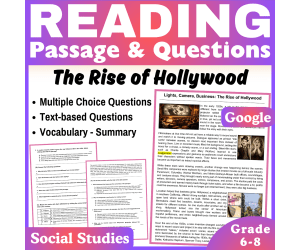
The Rise of Hollywood: Social Studies Reading Passage (Docs)
ELA, Reading, Reading Comprehension, Strategies, Resources for Teachers, Social Studies, Sociology, Grade 6, 7, 8, 9, Writing Prompts, Worksheets & Printables, Centers, Activities, Teacher Tools, Assessments, Quizzes and Tests, Quizzes, Tests
The Rise of Hollywood: Social Studies Reading Comprehension Passage (Docs) This resource introduces a unique Social Studies reading comprehension passage with questions about The Rise of Hollywood The passage is carefully designed to bridge the gap between social studies and literacy through strengthening reading comprehension and sparking knowledge curiosity in middle school students. Each passage blends English Language Arts skills with accurate social studies content . Ideal for interdisciplinary learning in ELA and Social Studies. Suitable for Grade 9 review, too! Student Tasks throughout the passage: 5 multiple-choice questions targeting the following skills: main idea, key details, inference, vocabulary in context, and use of evidence 5 vocabulary matching items with clear, student-friendly definitions 5 text-based questions that require citing specific lines or facts 1 summary prompt that asks students to condense central ideas accurately Full answer key for every section Available Formats for this Resource: PDF Fillable PDF Word Docs FULL CATALOG OF DOWNLOADING LINKS HERE Social Studies Reading Comprehension Collection Links: 1. Ancient Civilizations PDF Fillable PDF Word Docs Google Docs 2. Early Empires and Trade Networks PDF Fillable PDF Word Docs Google Docs 3. The Founding of the United States PDF Fillable PDF Word Docs Google Docs 4. Language, Culture, and Meaning PDF Fillable PDF Word Docs Google Docs 5. Psychology and Society PDF Fillable PDF Word Docs Google Docs 6. Global Festivals and Traditions PDF Fillable PDF Word Docs Google Docs 7. Extreme Environments and People PDF Fillable PDF Word Docs Google Docs 8. Food, Culture, and Preservation PDF Fillable PDF Word Docs Google Docs 9. Global Food Customs PDF Fillable PDF Word Docs Google Docs 10. Media, Communication, and Popular Culture PDF Fillable PDF Word Docs Google Docs 11. Human Impact on the Environment PDF Fillable PDF Word Docs Google Docs 12. Civic Action and Social Change PDF Fillable PDF Word Docs Google Docs 13. Fashion, Society, and Power PDF Fillable PDF Word Docs Google Docs 14. People, Places, and Unusual Histories PDF Fillable PDF Word Docs Google Docs Product Details: Length: 5 pages Grades: 6–8, also suitable for Grade 9 review Use cases: close reading, stations, homework, intervention, test prep, and sub plans Why Teachers Choose This Passage: Authentic social studies content paired with rigorous literacy practice Consistent task structure for easier planning and smoother student routines Clear, age-appropriate writing that builds confidence without oversimplifying Use this passage to reinforce ELA skills in social studies, to add literacy to your lessons, and to support independent work. The passage strengthens main idea, evidence use, vocabulary in context, inference, cause and effect, and summary writing. With ready-to-use assessments and complete answer keys, you can provide focused practice that is simple to run and fast to review.
Author CORED Education - Middle & High School
Rating
Tags Middle School, Reading Comprehension, Reading Strategies, ELA, Centers, Reading Passage, Assessments, Vocabulary, Social Studies, Sociology
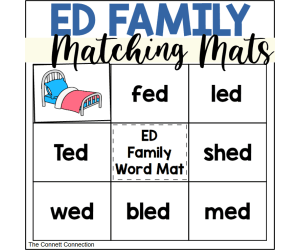
ED Words Matching Mats
ELA, Language Development, Phonics, Reading, Reading Comprehension, Preschool, Grade 1, Activities, Centers
Students can practice reading comprehension skills with these ED word family mats. Students can practice reading ED words in isolation and in the context of sentences. The words in this set follow a CVC or CCVC spelling pattern. Included in this resource: This resource includes one word mat and one sentence mat, both for reading AT words in insolation and in context. There are also picture cards that correspond with each word and sentence. To complete this activity , students will read each ED word or sentence on the mat and then match the corresponding pictures. Students can work independently or with a partner to complete this activity . How to Use these ED word Family Mats: The students can simply lay the images on top of the word or sentence. They can be placed in a file folder utilizing hook and loop fasteners to attach the images. A magnetic activity can be created by using a baking sheet and magnets to affix the images. Students will love the hands-on nature of this activity . The bold and colorful images will capture students' attention, and the easy to recognize pictures are sure to keep students engaged in learning. These literacy activities allow students to practice target words both in the context of sentences and in isolation. Where can these mats be used? Literacy Center - Students can work independently or with a partner to read these words Morning Tub or Basket - The cards can be placed in a morning bin for students to work on as students arrive to class. Small Group Activity - The teacher can choose a small group of students or a specific group of words for students to work on in a small group setting with the teacher. Hands On Assessment - The teacher can use these to test students on reading the target words in context or in isolation. Skills assessed through this activity : Reading ED words in context of a sentence and in isolation Reading comprehension The low-prep nature of this ED words matching mats activity makes it an easy to assign activity . The mats simply need to be printed out, while the matching cards need to be printed and cut. Lamination is optional for increased durability. Once created, this resource can be used repeatedly in literacy centers or small group activities, providing ongoing support for students' learning journey.
Author The Connett Connection
Tags Literacy Center, Phonics Activity, Kindergarten Literacy, Matching Mats, Simple Sentences, Reading Comprehension, CVC Words, ED Words, ED Word Family

Underwater Noise Pollution Social Studies Reading Passage Fillable PDF
ELA, Reading, Reading Comprehension, Strategies, Resources for Teachers, Social Studies, Sociology, Grade 6, 7, 8, 9, Writing Prompts, Worksheets & Printables, Centers, Activities, Teacher Tools, Assessments, Quizzes and Tests, Quizzes, Tests
Underwater Noise Pollution: Social Studies Reading Comprehension Passage (Fillable PDF) This resource introduces a unique Social Studies reading comprehension passage with questions about Underwater Noise Pollution. The passage is carefully designed to bridge the gap between social studies and literacy through strengthening reading comprehension and sparking knowledge curiosity in middle school students. Each passage blends English Language Arts skills with accurate social studies content . Ideal for interdisciplinary learning in ELA and Social Studies. Suitable for Grade 9 review, too! These worksheets are designed as fillable PDFs , which means students can type their answers directly into the document on any computer or tablet . Each page includes highlighted text fields that show them exactly where to type! Student Tasks throughout the passage: 5 multiple-choice questions targeting the following skills: main idea, key details, inference, vocabulary in context, and use of evidence 5 vocabulary matching items with clear, student-friendly definitions 5 text-based questions that require citing specific lines or facts 1 summary prompt that asks students to condense central ideas accurately Full answer key for every section Available Formats for this Resource: PDF Word Docs Google Docs FULL CATALOG OF DOWNLOADING LINKS HERE Social Studies Reading Comprehension Collection Links: 1. Ancient Civilizations PDF Fillable PDF Word Docs Google Docs 2. Early Empires and Trade Networks PDF Fillable PDF Word Docs Google Docs 3. The Founding of the United States PDF Fillable PDF Word Docs Google Docs 4. Language, Culture, and Meaning PDF Fillable PDF Word Docs Google Docs 5. Psychology and Society PDF Fillable PDF Word Docs Google Docs 6. Global Festivals and Traditions PDF Fillable PDF Word Docs Google Docs 7. Extreme Environments and People PDF Fillable PDF Word Docs Google Docs 8. Food, Culture, and Preservation PDF Fillable PDF Word Docs Google Docs 9. Global Food Customs PDF Fillable PDF Word Docs Google Docs 10. Media, Communication, and Popular Culture PDF Fillable PDF Word Docs Google Docs 11. Human Impact on the Environment PDF Fillable PDF Word Docs Google Docs 12. Civic Action and Social Change PDF Fillable PDF Word Docs Google Docs 13. Fashion, Society, and Power PDF Fillable PDF Word Docs Google Docs 14. People, Places, and Unusual Histories PDF Fillable PDF Word Docs Google Docs Product Details: Length: 5 pages Grades: 6–8, also suitable for Grade 9 review Use cases: close reading, stations, homework, intervention, test prep, and sub plans Why Teachers Choose This Passage: Authentic social studies content paired with rigorous literacy practice Consistent task structure for easier planning and smoother student routines Clear, age-appropriate writing that builds confidence without oversimplifying Use this passage to reinforce ELA skills in social studies, to add literacy to your lessons, and to support independent work. The passage strengthens main idea, evidence use, vocabulary in context, inference, cause and effect, and summary writing. With ready-to-use assessments and complete answer keys, you can provide focused practice that is simple to run and fast to review.
Author CORED Education - Middle & High School
Rating
Tags Middle School, Reading Comprehension, Reading Strategies, ELA, Centers, Reading Passage, Assessments, Vocabulary, Social Studies, Sociology

Tops and Bottoms Read Aloud Book Companion
ELA, Reading, Reading Comprehension, Literature, Grade 2, 3, 4, Read Alouds, Activities
This picture book companion is a complete supplemental resource for the book Tops and Bottoms by Janet Stevens. It includes 29 print-and-go reading activities to choose from making this resource ideal for customizing learning to your student's specific needs and academic abilities. Students will investigate characters, identify story elements, determine the theme, practice plotting story events, compare & contrast, make predictions, inferences, & connections, answer questions that require them to think beyond the text, and much more! Students will thoroughly enjoy the captivating activities, and you'll value the time saved from scouring for advanced resources to address challenging reading concepts. The offered activities are crafted to foster higher-order thinking, prompt students to present textual proof for their reasoning, and inspire them to share their personal insights and viewpoints. ⭐️This Resource Includes:⭐️ ◾ Elements of a Trickster Tale Anchor Chart or Notes Handout: Color and B&W ◾ Making Predictions: Before reading the book, students will make predictions about the text. ◾ Elements of a Trickster Tale: Students fill in the chart with the details of the story that characterize it as a trickster tale. ◾ Trickster Tale Tidbits: Students will answer the questions with details from the story that proves it's a trickster tale. ◾ Story Elements: Students fill in the boxes with words & pictures to represent the story elements. ◾ Sequencing: Students will retell & illustrate the important parts of the story. ◾ Recalling events in Chronological Order: Students describe and illustrate four major events in the story in chronological order. ◾ Summary: Students complete the Somebody, Wanted, Because, But, So graphic organizer and write a summary of the story. ◾ Story Event Sort: Students will describe a scene or event from the story that fits into each of the categories & explain how the event made them feel & how it relates to the category. ◾ Making Inferences: Students use clues & schema to make inferences while reading the story. ◾ Making Connections: Students make connections to an event from the story. ◾ Author's Message: Students describe four important events from the story in chronological order and answer the questions about the author's message ◾ Character Traits: Students choose the most important character traits that describe each of the characters and give 1-2 examples from the story that support the traits they chose. ◾ Character Inside & Out (Hare): Students include details from the story to describe what the character says, thinks, does, and feels. ◾ Character Inside & Out (Bear): Students include details from the story to describe what the character says, thinks, does, and feels. ◾ Character Feelings (Hare): Students describe how the character's feelings change throughout the story & give examples of the events that cause them to feel the way they do. ◾ Character Feelings (Bear): Students describe how the character's feelings change throughout the story & give examples of the events that cause them to feel the way they do. ◾ Character Development (Hare): Students select the character traits that best describe the character at different times throughout the story and provide examples from the book to support each character trait. ◾ Character Development (Bear): Students select the character traits that best describe the character at different times throughout the story and provide examples from the book to support each character trait. ◾ Character Change (Hare): Students will explain how the character changed from the beginning to the end of the story and describe the events that caused the change to happen. ◾ Character Change (Bear): Students will explain how the character changed from the beginning to the end of the story and describe the events that caused the change to happen. ◾ Sketch a Scene From the Story: Students draw a scene from the story & explain why it's important to the plot. ◾ Setting Influences the Plot: Students will draw a scene from the story that takes place in one of the settings and write about what happened there and why it was important to the plot. ◾ Setting the Scene: Students identify three different settings in the story and explain how they know that the setting changed. ◾ Tops or Bottoms?: Students will draw the vegetables that were planted for each harvest, include details to show the parts of the plants that grow above the ground and the parts that grow below the ground, and answer the questions. ◾ Theme: Students answer the questions to determine which theme best fits the story and provide text evidence to support their choice. ◾ Thinking About the Text: Students will answer the questions about the story & include examples from the text to support their answers. ◾ Tricked Again: Students will draw a picture of what they think Bear is thinking when he realizes Hare has misled him again and is taking the corn. Then, they will draw a picture of Hare and add what he is thinking or might say when he realizes he has been able to mislead Bear yet again. ◾ Wait... There's More!: Students will write about what happens next in the story. ◾ Book Review: Students color in the stars to rate how much they enjoyed the book and draw a new cover & their favorite character from the story. Then, they will explain why other kids should or should not read it. 💡Need ideas for different ways you can implement these activities? ◾ Focus on different reading skills each day for targeted instruction, and have students complete a corresponding printable to check for understanding. ◾ During centers, students can independently read the story again and complete an activity that reviews a previously taught concept. ◾ Work with students on a reading concept they struggle with during guided reading or strategy groups. ◾ Students work with a partner or in literature circles to complete additional reading activities. This resource is for extension read-aloud activities only. The book is not included. ⭐️You may also like: ⭐ TEXT SET #1: "The Importance of Friendship" ◾ A Weekend With Wendell Read Aloud Book Companion Activities for IRA ◾ First Come the Zebra Read Aloud Book Companion Activities for IRA ◾ This is Our House Read Aloud Book Companion Activities for IRA ◾ Horace and Morris But Mostly Dolores Read Aloud Book Companion Activities for IRA ◾ The Old Woman Who Named Things Read Aloud Book Companion Activities for IRA TEXT SET #3: "Finding Your Way in a New Place" ◾ Grandfather Counts Read Aloud Book Companion Activities for IRA ◾ The Have a Good Day Cafe, Read Aloud Book Companion Activities for IRA ◾ Roses for Gita Read Aloud Book Companion Activities for IRA ◾ Mango, Abuela, and Me, Read Aloud Book Companion Activities for IRA ◾ Home at Last Read Aloud Book Companion Activities for IRA TEXT SET #7: "Exploring Narrative Nonfiction" ◾ Cactus Hotel Read Aloud Book Companion Activities for IRA ◾ A Log's Life Read Aloud Book Companion Activities for IRA ◾ Salmon Stream Read Aloud Book Companion Activities for IRA ◾ Think of an Eel Read Aloud Book Companion Activities for IRA ✨Be sure to check out my storefront here: https://teachsimple.com/contributor/creatively-gifted
Author Creatively Gifted
Tags IRA, Picture Book Activities, Read Aloud Lessons, Interactive Read Aloud Activities, Elementary Reading, Reading Comprehension, Fountas And Pinnell IRA, Second Grade, Tops And Bottoms, Trickster Tales
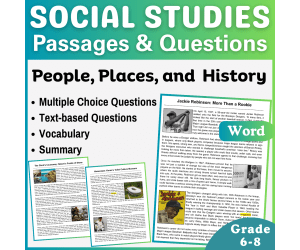
Social Studies Reading Passages: People, Places, and History (Word)
ELA, Reading, Reading Comprehension, Strategies, Resources for Teachers, Social Studies, Geography, History: USA, History, Grade 6, 7, 8, 9, Writing Prompts, Worksheets & Printables, Centers, Activities, Teacher Tools, Assessments, Quizzes and Tests, Quizzes, Tests
Social Studies Reading Comprehension Passages and Questions: People, Places, and History (Word) This resource introduces a collection of Social Studies reading comprehension passages with questions about People, Places, and History. The passages are carefully designed to bridge the gap between social studies and literacy through strengthening reading comprehension and sparking knowledge curiosity in middle school students. Each passage blends English Language Arts skills with accurate social studies content . Ideal for interdisciplinary learning in ELA and Social Studies. Suitable for Grade 9 review, too! What Is Included in this Collection? There are three informational passages (with full answer keys): Jackie Robinson: More Than a Rookie Haewoojae: Korea’s Toilet Culture Museum The Giant’s Causeway: Nature’s Puzzle of Stone For Each Passage, students will have multiple tasks to complete as follow: 5 multiple-choice questions targeting main idea, key details, inference, vocabulary in context, and use of evidence 5 vocabulary matching items with clear, student-friendly definitions 5 text-based questions that require citing specific lines or facts 1 summary prompt that asks students to condense central ideas accurately Available Formats for this Resource PDF Fillable PDF Google Docs FULL CATALOG OF DOWNLOADING LINKS HERE For more Social Studies Reading Passages, check the following Links: Ancient Civilizations PDF Fillable PDF Word Docs Google Docs Early Empires and Trade Networks PDF Fillable PDF Word Docs Google Docs The Founding of the United States PDF Fillable PDF Word Docs Google Docs Language, Culture, and Meaning PDF Fillable PDF Word Docs Google Docs Psychology and Society PDF Fillable PDF Word Docs Google Docs Global Festivals and Traditions PDF Fillable PDF Word Docs Google Docs Extreme Environments and People PDF Fillable PDF Word Docs Google Docs Food, Culture, and Preservation PDF Fillable PDF Word Docs Google Docs Global Food Customs PDF Fillable PDF Word Docs Google Docs Media, Communication, and Popular Culture PDF Fillable PDF Word Docs Google Docs Human Impact on the Environment PDF Fillable PDF Word Docs Google Docs Civic Action and Social Change PDF Fillable PDF Word Docs Google Docs Fashion, Society, and Power PDF Fillable PDF Word Docs Google Docs People, Places, and Unusual Histories PDF Fillable PDF Word Docs Google Docs Product Details Length: 14 pages total Grades: 6–8, also suitable for Grade 9 review Use cases: close reading, stations, homework, intervention, test prep, and sub plans Why Teachers Choose This Set Authentic social studies content paired with rigorous literacy practice Consistent task structure across all passages for easier planning and smoother student routines Clear, age-appropriate writing that builds confidence without oversimplifying Use this set to reinforce ELA skills in social studies, to add literacy to your lessons, and to support independent work. The passages strengthen main idea, evidence use, vocabulary in context, inference, cause and effect, and summary writing. With ready-to-use assessments and complete answer keys, you can provide focused practice that is simple to run and fast to review.
Author CORED Education - Middle & High School
Rating
Tags Middle School, Reading Comprehension, Reading Strategies, ELA, Centers, Reading Passage, Assessments, Vocabulary, Social Studies, People Place And History

Nevada State Flipbook (Capital, Bird, Flower, Flag, Animal)
Creative Arts, Art, Social Studies, ELA, History, History: USA, Geography, Reading, Reading Comprehension, Grammar, Language Development, Spelling, Writing, Grade 2, 3, 4, Activities, Projects
Nevada State Flipbook: A Resourceful Teaching Tool The Nevada State Flipbook is a resourceful teaching tool ideal for elementary school educators and homeschooling parents. It's a low-preparation project with easy implementation, covering key symbols of Nevada including the capital, bird, flower, flag, and animal. Interactive Design for Engaging Learning The flipbooks are presented in an interactive design that encourages comprehension by breaking down information about each symbol into digestible chunks. They provide visual cues to help aid memory retention turning learning into a fun activity! Package Includes: Instructions for four easy-to-assemble flipbooks Two different printing options (one requiring cutting and another that doesn't) Two design options (one with vivid images while the other is text-based) This resource can be utilized in various settings like small group social studies sessions or as independent study assignments facilitated by this comprehensive guide. A Diverse Teaching Tool Covering subjects from Arts to English Language Arts, Geography to Grammar alongside History lessons and creative Writing exercises making this a truly diverse addition to your teaching toolkit! Facts Covered in the Flipbook: Nevada's state capital Facts related about various symbols like its state bird or the state flower among others. Intriguingly each U.S State stemming from Alabama up till Wyoming can be explored through similar comprehensive 5-day units accommodating diverse regional curriculum requirements. This digital product comes in PDF format making it adaptable for remote learning - truly marrying old-school charm with modern-age convenience!
Author Heather Huhman
Tags Nevada Symbols, Flipbook, Cross-curricular Activities, Elementary Education, Homeschooling, Nevada State Flower And Bird, Nevada State Flower Drawing, Nevada's State Animal, Nevadas State Animal, What Is The State Animal Of Nevada?, Nevada Flower And Bird, Nevada State Bird Picture

Tennessee State Flipbook (Capital, Bird, Flower, Flag, Animal)
Creative Arts, Art, Social Studies, ELA, History, History: USA, Geography, Reading, Reading Comprehension, Grammar, Language Development, Spelling, Writing, Grade 2, 3, 4, Activities, Projects
Tennessee State Flipbook The Tennessee State Flipbook is a comprehensive, hands-on learning resource that offers an interactive and engaging way to teach students about the state of Tennessee and its unique symbols. Designed primarily for grade 2-4 level students it covers subjects such as Art & Music, Social Studies, and Language Arts. The Flipbook Project This project comprises four distinct flipbooks with design options - with or without pictures , and two printing options - cutting required or not . Included in the 37 PDF pages are instructions for assembling these four types of flipbooks. The materials cover five major symbols of Tennessee including: The capital Bird Petal emblem (flower) The state flag . National animal . Cross-curricular activity Concept This versatile teaching resource can be implemented in various academic domains including; History:Giving chronological events significance. . Art :Sensitizing Color sense among students. . Educating Topographical relevance /li>. A proper construction of sentences. . Promotion Of Essay writing skills etc under 'English Language Arts'. Honing Students Proficiency Skills: In addition,the project also hones reading abilities,facilitates methodical data handling and spelling power thereby polishing multiple skills simultaneously. Reading (Comprehension Abilities) Research (Methodical Data Collection & Analysis.) . Spelling.( Vocabulary) . The Tennessee State Flipbook can be implemented as part of your social studies or history lessons,review activities,introduction to US,a homework assignment etc. .
Author Heather Huhman
Tags Tennessee, State Symbols, Flipbook, Hands-on Learning, Cross-curricular Activity

Remaking Plastic: Social Studies Reading Passage (Fillable PDF)
ELA, Reading, Reading Comprehension, Strategies, Resources for Teachers, Social Studies, Sociology, Grade 6, 7, 8, 9, Writing Prompts, Worksheets & Printables, Centers, Activities, Teacher Tools, Assessments, Quizzes and Tests, Quizzes, Tests
Remaking Plastic: Social Studies Reading Comprehension Passage (Fillable PDF) This resource introduces a unique Social Studies reading comprehension passage with questions about Recycling and Remaking Plastic. The passage is carefully designed to bridge the gap between social studies and literacy through strengthening reading comprehension and sparking knowledge curiosity in middle school students. Each passage blends English Language Arts skills with accurate social studies content . Ideal for interdisciplinary learning in ELA and Social Studies. Suitable for Grade 9 review, too! These worksheets are designed as fillable PDFs , which means students can type their answers directly into the document on any computer or tablet . Each page includes highlighted text fields that show them exactly where to type! Student Tasks throughout the passage: 5 multiple-choice questions targeting the following skills: main idea, key details, inference, vocabulary in context, and use of evidence 5 vocabulary matching items with clear, student-friendly definitions 5 text-based questions that require citing specific lines or facts 1 summary prompt that asks students to condense central ideas accurately Full answer key for every section Available Formats for this Resource: PDF Word Docs Google Docs FULL CATALOG OF DOWNLOADING LINKS HERE Social Studies Reading Comprehension Collection Links: 1. Ancient Civilizations PDF Fillable PDF Word Docs Google Docs 2. Early Empires and Trade Networks PDF Fillable PDF Word Docs Google Docs 3. The Founding of the United States PDF Fillable PDF Word Docs Google Docs 4. Language, Culture, and Meaning PDF Fillable PDF Word Docs Google Docs 5. Psychology and Society PDF Fillable PDF Word Docs Google Docs 6. Global Festivals and Traditions PDF Fillable PDF Word Docs Google Docs 7. Extreme Environments and People PDF Fillable PDF Word Docs Google Docs 8. Food, Culture, and Preservation PDF Fillable PDF Word Docs Google Docs 9. Global Food Customs PDF Fillable PDF Word Docs Google Docs 10. Media, Communication, and Popular Culture PDF Fillable PDF Word Docs Google Docs 11. Human Impact on the Environment PDF Fillable PDF Word Docs Google Docs 12. Civic Action and Social Change PDF Fillable PDF Word Docs Google Docs 13. Fashion, Society, and Power PDF Fillable PDF Word Docs Google Docs 14. People, Places, and Unusual Histories PDF Fillable PDF Word Docs Google Docs Product Details: Length: 5 pages Grades: 6–8, also suitable for Grade 9 review Use cases: close reading, stations, homework, intervention, test prep, and sub plans Why Teachers Choose This Passage: Authentic social studies content paired with rigorous literacy practice Consistent task structure for easier planning and smoother student routines Clear, age-appropriate writing that builds confidence without oversimplifying Use this passage to reinforce ELA skills in social studies, to add literacy to your lessons, and to support independent work. The passage strengthens main idea, evidence use, vocabulary in context, inference, cause and effect, and summary writing. With ready-to-use assessments and complete answer keys, you can provide focused practice that is simple to run and fast to review.
Author CORED Education - Middle & High School
Rating
Tags Middle School, Reading Comprehension, Reading Strategies, ELA, Centers, Reading Passage, Assessments, Vocabulary, Social Studies, Sociology

Flag Day Lapbook with Reading Comprehension Activities
ELA, Holiday & Seasonal, Reading, Reading Comprehension, Language Development, ESL, Grade 4, 5, 6, Activities, Projects
Product Description for Flag Day Lapbook with Reading Comprehension Activities: The Flag Day Lapbook combined with Reading Comprehension Activities is an all-inclusive teaching tool designed for learners between 4th and 6th grade. This package highlights the significance of the American flag, while encouraging students to enhance their language arts skills in an engaging manner. This multidimensional learning resource suits both homeschool teachers and traditional classroom educators. It brings together primary comprehension skills and English Language Learning (ELL) aspects that can be easily incorporated into daily educational programs. Detailed Instruction: Inclusive reading texts provide extensive information about Flag Day history and its current relevance. Practical Application: Worksheets designed to apply learned concepts, promoting growth in analytical thinking and interpretation skills. Creative Engagement: The package includes all necessary components to build a customized lapbook - symbolizing students' grasp on the topic through hands-on project -based learning. In-depth coverage on several topics ends with a personally curated 'Flag Day Lap-Book Project '. Here's what it entails - Name Pages:A fun individual or group exercise to etch out names. Ettiquette Lessons during flag rites: Learn essential etiquettes associated with ceremonies involving national flags. With elements from subjects like Language Arts, holidays—primarily comprehension and reading—this teaching tool provides an exciting twist to traditional education methods. The resource is a readily downloadable PDF file; saving teachers time and effort as it can be reused across different batches of students! In conclusion, this tool doesn't just teach— it transforms each learner into a keen explorer of the fascinating Flag Day history, giving birth to their very own unique interactive exhibition!
Author It's Teacher L
Tags Flag Day, Lapbook, Reading Comprehension, American Flag, US History
Biography: Benjamin Banneker – A Design for the Capital
Social Studies, ELA, Biographies, History, History: USA, Reading, Reading Comprehension, Grade 2, 3, 4, Activities
Biography: Benjamin Banneker – A Design for the Capital is an educational resource that molds an interesting biography, history, and literacy skills into a captivating leveled book. Designed for second to fourth-grade students, the text adeptly incorporates the Fountas and Pinnell leveled vocabulary and Rebecca Sitton spelling words along with broader general curriculum standards. Students can look forward to delving into Benjamin Banneker's array of accomplishments exposed in this Level P reader. Banneker was a largely self-educated author, naturalist, farmer, astronomer, mathematician, scientist, and surveyor. Within a spectrum of historically accurate content, learners are introduced to specific concepts, skills, and vocabulary meeting their ongoing developmental targets in Social Studies and Language Arts clearly spelled out on the introductory page of the text. To make the product more interactive, supplemental customized activity sheets serve as reinforcement and extension. Educators can integrate this versatile material into their lesson plans using a variety of teaching approaches from an individualized study unit to whole group instruction. The text and Study Guide totals 7 pages. Come along with your students to study the significant accomplishments of this African American living during the American Revolution and the early history of the United States! It is certain to inspire your young students!
Author Sue Peterson
Tags Benjamin Banneker, African-American History, Social Studies, Language Arts, United States History, Banneker Capital
Camping Reading Comprehension Passage - Cored Ed Encyclopedia
ELA, Language Development, Reading Comprehension, Reading, Writing, Pre-Reading, Vocabulary, Geography, Social Studies, History, Grade 2, 3, 4, 5, Worksheets & Printables, Worksheets, Teacher Tools, Centers, Activities, Writing Prompts, Assessments, Quizzes and Tests, Quizzes, Lesson Plans
This camping reading comprehension with lesson plan includes: Visualization (on the front cover) Start your lesson by taking a minute to think and share something about the topic. Read the script aloud (slowly), perhaps prepare some music or sound effects. Student close their eyes and let their imaginations wander. Students open their eyes, read the question aloud and give them a few minutes to complete. Ask a few students to share or keep answers until the end to compare with what they learn in the passage. COMPANION VIDEO NOW AVAILABLE (EMBEDDED AFTER PREVIEW PICTURES IN PRODUCT DESCRIPTION) Quick pause—thousands of Cored Education products are included with your TeachSimple membership. Download links and encyclopedia index available here. Pre-Reading Trivia Students will write down one thing they already know about the subject and then read five more facts and discuss. These facts are fun, and the students will enjoy learning about the subject before reading more. Give 1 minute for students to write what they already know (no pressure—best guess is fine). Read the five facts together. After each fact, do ask a student for their opinion, was it surprising? Set a purpose by asking students to highlight/underline one fact they want to learn more about during the reading. Reading Passage The text is a high-interest reading passage with set paragraphs, roughly three to four paragraphs long. It contains a variety of themes about the topic, anywhere from history to technology. The passage is between 250 and 350 words in length. First, ask students to look at the headings and see what they’ll learn about today. What do they know about the topic/heading? First read options: Teacher read-aloud (best for support). Partner reading (paragraph by paragraph). While reading, students underline important details, and vocabulary words they think may come up in the questions section. Mixed Questions The first question page contains four multiple-choice questions, each with a choice of four answers, and three written response questions that require a sentence or two from the student. Students complete the mcqs first independently, then review quickly as a class. For the 3 written responses, try to get students giving the answer with some form of evidence: “I think ___ because the text says ___.” If students get stuck, send them back to check the passage. Vocabulary Questions Practice seven key words from the text in this section across two activities. First section is scrambled words where students will unscramble three words given a clue for each. The second section is a word to meaning matching activity. Before starting, have some students read out words they underlined in the passage. Ask students to say the word and read aloud the sentence(s) around each word. Ask students to do scrambled words and the matching exercise in pairs then go through answers as a class. For the scrambled spelling task, get four pairs to come up to the board and write the words for extra practice with the other student reading out the clue. For the matching task, prompt students to give full sentences: “I matched ___ with ___ because ___.” Creative Writing In this question, the student will be required to write a five to eight sentence paragraph on a question related to the topic. Before starting, ask students write down 3 key ideas they are going to include in their piece. Ask students for ideas to share around the class to help those struggling. Pro writing expectations: 5–8 sentences At least 2 facts or details from the passage At least 2 vocabulary words from the previous page Students read their paragraphs while classmates listen for facts and vocabulary words. Extension Activities This page is optional for fast finishers or to take home. There are several activities, each one requiring a different skill. Do some, do none, do all, completely optional - but you will feel reassured knowing every possibility is planned for. Includes summary writting question and additional facts. Answer Key There are answers for the multiple-choice questions, written response questions have sample answers, vocabulary answers and if there is a summary question then a sample summary will be provided as well. Lesson Plan Included Customized lesson plan for this lesson is included. Lesson Snapshot Title: Camping Genre: Nonfiction (informational text with headings) Subject: Reading (Informational Text) / Social Studies Primary Topic: How camping began, changed, and stays respectful Estimated Guided Reading Level (A–Z): N What This Lesson Teaches Best Explains what camping is and what campers might notice at night (lantern glow, smell of pine, owls, cooler air). Builds background knowledge about how camping shifted from travel/work to a fun hobby in the late 1800s. Uses a chronological structure with time markers (late 1800s, 1894, 1901, 1908, after World War I, 1960s) to show change over time. Introduces environmental responsibility through a “leave-no-trace approach,” including keeping camps small and taking trash home. Gives practice with text features (section headings) to locate information efficiently. Learning Goals Students will describe what camping is using details from the passage. Students will explain why people slept outside long ago and how camping later became a hobby. Students will identify key events and dates from the passage (1894, 1901, 1908, after World War I, 1960s). Students will use headings to find information about camping’s history, campgrounds, and “leave-no-trace.” Students will compare different ways people camp (backpacks vs. car/RV) based on the passage. Students will explain what the passage says a leave-no-trace approach means. Key Vocabulary From the Text shelter — a place that protects you. lantern — a light you can carry. demanded — needed or required. commercial — run as a business. approach — a way of doing something. FULL CATALOG OF DOWNLOAD LINKS AND ENCYCLOPEDIA INDEX HERE
Author Cored Education
Rating
Tags Vocabulary, Reading Comprehension, Reading Passages, Lesson Plans, Ela Lesson Plans, Reading Comprehension Lesson Plans, Pre-reading, Social Studies Lesson Plans, Geography, History