



2,788 products added recently
Page 457 - Activities
Explore a wide array of educational activities designed to enrich your teaching and captivate students' interest. From hands-on projects to interactive games, these resources span various subjects and grade levels. Incorporate these activities into your lesson plans to foster an engaging and dynamic learning environment for all students.

 Show filters

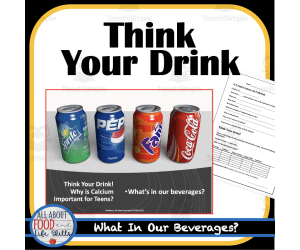
Think My Drink
P.E. & Health, Health, Grade 5, 6, 7, 8, 9, 10, 11, 12, Activities
What is 'Think My Drink'? 'Think My Drink' is an educational resource designed specifically for enhancing students' comprehension of nutrition facts and the importance of calcium for growing bodies. Its central focus is on learning to scrutinize and understand the nutritional value of different beverages, a regularly overlooked aspect of children's daily consumption habits. Where can it be used? This practical teaching tool can be employed in a variety of teaching environments such as whole group instruction, small group work, or even given as insightful homework assignments. Besides public school teachers specializing in Grade 5 up to Grade 12 P.E. & Health classes, homeschoolers who prioritize healthy choices could also hugely benefit from implementing this valuable resource into their curriculum . The contents a comprehensive PowerPoint presentation with 26 slides offered in easily accessible PDF format. there are several engaging activities interspersed within the content for interactive learning experience. A standout feature is that it provides handouts for students follow along more effectively with the material presented on screen adding an interactive element for younger learners especially. This allows learners to reflect upon every piece of information discussed helping them internalize every nugget about good diet choices and its necessity more fully. New multimedia resources! In addition to these features 'Think My Drink' includes a video link which delves further into understanding nutrition facts labels on beverage containers. By combining visually-appealing content with multimedia resources like videos for explaining key concepts better, this product aims at making complex health education topics easier and fun to learn. In conclusion, 'Think My Drink' represents an inventive method to incorporate health literacy into regular classrooms or home-based teaching routines reinforcing significant life skills early on in life right when kids are forming habits they're likely to carry throughout their adulthood years.
Author All About Food and Life Skills
Tags Nutrition Education, Health Literacy, Calcium Intake, Beverage Consumption, Nutrition Facts

What is different? Vocabulary Boards - COLOR SET 14
Special Resources, Speech Therapy, Kindergarten, Preschool, Grade 1, Activities
What is Different? Vocabulary Boards focuses on building visual analysis, speaking, and vocabulary skills in young learners. This colorful resource features three side-by-side boards with subtle differences for students to identify. Educators can implement this versatile activity in small groups to encourage discussion, as a whole class activity to build vocabulary, or as an independent assignment to develop visual differentiation abilities. The engaging boards grab student interest while leveling up skills that allow preschoolers through 1st graders to describe similarities and differences. By honing visual analysis and speaking abilities, What is Different? prepares early learners for higher-order thinking as their education advances. Use this activity to liven up lessons and facilitate the growth of well-rounded communication talents.
Author WORDS ASIDE
Tags Language Activities, Preschool, Reading Centers, Words Aside, What Is Different, What Is Missing, Vocabulary Cards, Reading Boards, Task Cards

Firefighter Community Helper Pack
Life Studies, Career, Kindergarten, Preschool, Grade 1, 2, Activities
This resource is a Firefighter Community Helper Pack. It is filled with all sorts of fun activities for your students to engage with as they learn more about firefighters and how they help the community. Included: - Firefighter comprehension questions (digital and printable ) - Firefighter vocabulary printable - Vocabulary slides - I am a firefighter reader
Author Rebecca Hurd
Tags Firefighter, Life Skills, Careers, Community Helper, Vocabulary

Coding Boolean Activity
Computer Science, Technology, Science, Grade 3, 4, 5, 6, 7, 8, 9, 10, Activities
Activity Introduction An amazing activity designed for the students to learn more about STEM. Coding Boolean Do you like STEM subjects? what is your favorite one? Have you ever tried to plant a seed? If yes, tell us more about it. Or have you ever tried to invent something? If yes, tell us more about it. And how do you think it will help us? Have you ever seen a microorganism under a microscope? What was it? And how it looked like? Mathematics is a marvelous subject. Let' sharpen our brains and solve some equations. Do you like timetable tricks? What is your favorite one? Do you know how to code? Have you ever created an app or a game before? If yes, how was it like? Coding Boolean Activity The activity is perfect for encouraging the researching skills for the students, while learning more about this fantastic topic. Coding Boolean This friendly designed worksheet is suitable for students at school, homeschooling, and as a group activity. Instructions Complete the truth for the AND gate. Complete the truth for the OR gate. Format Available in a PDF format.
Author Educational Voice
Tags Coding Boolean Activity, Coding Boolean, Coding Activity, Coding Boolean Facts, Coding Boolean Facts For Kids, Coding, Coding Facts, Coding Facts For Kids, Technology, Technology Facts
Apple Pickin' Antonyms
ELA, Language Development, Vocabulary, Grade 2, 3, 4, Activities
This resource is an Apple Pickin' Antonyms Activity . Students will: - Choose one of the three sets of cards - Match the apples to the antonyms on the bushel baskets. - Use the recording sheet to write their matches This is a great language arts activity for the fall season. Students will enjoy this in stations or in early finisher buckets.
Author Literacy Life
Tags Antonyms, Task Cards, Vocabulary Activity, September, Autumn

Safety Life Skills: Brian Learns to Provide Emergency Information
Special Resources, Social Emotional Learning (SEL), Special Education Needs (SEN), Speech Therapy, Life Skills, Grade 10, 11, 12, Activities, Worksheets & Printables, Worksheets
In "Brian Learns to Provide Emergency Information," Brianna and Brian share insights on handling emergency situations in a simple and approachable manner. This Safety Life Skills resource provides students with the opportunity to: • Learn about identifying themselves when dialing 911 and the vital details to convey to the 911 Operator, including name and address. • Understand the straightforward steps to take in various emergency scenarios through clear and uncomplicated language. • Initiate discussions about emergency preparedness, using this life skills story as a starting point. • Actively participate in conversations and respond to questions that reinforce their comprehension of the narrative and the associated concepts. • Benefit from real-life scenarios and age-appropriate visual aids, like illustrations and diagrams , which enhance the value of this conversational story as a tool for teaching social narratives. • Embrace the straightforward and direct language of this social narrative, making it well-suited for high school students and adults with intellectual disabilities by setting clear expectations. The story includes seven (7) reading comprehension questions and answers to reinforce and measure the student's understanding of the Safety Life Skills contained in the story! This life skills story will assist high school students and young adults in developing the necessary independent living skills to become more independent at school, at home, and in their communities. This story is designed to be used by special education teachers, occupational therapists, speech therapists, ABA therapists, registered behavior technicians (RBT), parents, supported living coaches, and life skills teachers to teach their students valuable life skills. In addition to interactive instruction, this resource is ideal for hands-on and community-based learning, defining, setting, and measuring IEP goals. Related Products for Developing Independent Living Skills How to Create an Emergency Exit Plan How to Create a Medication List How to Create a Supplement List Understanding and Tracking Allergies How to Read a Prescription Label How to Create a Strong Password What to do When the Doorbell Rings Engage your special education class with this highly interactive High School Safety Life Skills Story! It's printable , easy to use, and ready to hand out! A PDF file with five(5) pages. Color and black-and-white versions of each page are available for this pdf resource.
Author Adulting Life Skills Resources
Tags Adulting On The Spectrum, IEP Goal-Oriented Skills, Functional Self-Care Resources, Summer Life Skills Activities, Resource For Supported Living Coach , Resource For Speech Therapists, Resource For ABA Therapists, Interactive Safety Lessons, Autism Visual Aid Life Skills, Autism Life Skills Stories

AN Words Emergent Reader: Dan
ELA, Reading, Preschool, Grade 1, Activities
With this decodable book, you will practice reading a short story that contains CVC words and simple sight words. Kindergartners and first graders can gain practice reading words that contain the CVC words from the AN word family. What is Included: There is one emergent reader titled "Dan," which includes one cover page and five pages for students to color and read. How to Use: Students will color each page of the book, cut the pages apart, and then assemble the book, making sure the cover page is on top. The subsequent pages can be placed in any order and still be read with meaning. Use a stapler to attach the pages together. The repetitive nature of each page allows students to have success with reading and gives them extra practice with target words! The story and sentences in the book contain simple sight words and words from the word family targeted. This makes them easy for beginning readers to have success with creating and reading each book. Other Uses for this Book: The teacher may create the book by coloring, laminating, and assembling. The book can be placed in a classroom library or reading center for students to read during an independent reading time or during their center time. Students can create their own book to take home and share their reading skills with their parents. Skills Assessed with this Emergent Reader: Following directions to make their book Reading AN words in context Reading simple sight words Reading a simple short story The AN word emergent reader books are a no prep activity for students to complete. The pages just need to be given to students to color, cut, and assemble. It becomes a low prep activity if the teacher wishes to make a reusable copy for classroom use.
Author The Connett Connection
Rating
Tags Emergent Reader, Sight Words, CVC Words, AN Words, Beginning Readers
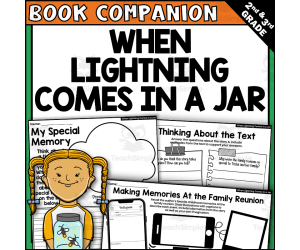
When Lightning Comes in a Jar Book Companion
ELA, Reading, Reading Comprehension, Literature, Science, Life Sciences, Insects, Grade 2, 3, 4, Teacher Tools, Graphic Organizers, Worksheets & Printables, Novel Studies, Activities, Games, Worksheets
This picture book companion is a complete supplemental resource for the book When Lightning Comes in a Jar by Patricia Polacco. It includes 28 print-and-go reading activities to choose from, making this resource ideal for customizing learning to your student's specific needs and academic abilities. Students will investigate characters, identify story elements, determine the theme, practice plotting story events, compare & contrast, make predictions, inferences, & connections, answer questions that require them to think beyond the text, and much more! Students will thoroughly enjoy the captivating activities, and you'll value the time saved from scouring for advanced resources to address challenging reading concepts. The offered activities are crafted to foster higher-order thinking, prompt students to present textual proof for their reasoning, and inspire them to share their personal insights and viewpoints. ⭐️This Resource Includes:⭐️ ◾ Making Predictions: Before reading the book, students make predictions about the text. ◾ Story Elements: Students fill in the boxes with words & pictures to represent the story elements. ◾ Sequencing: Students will retell & illustrate the important parts of the story. ◾ Recalling Events in Chronological Order: Students will describe and illustrate four events in the story in chronological order. ◾ Summary: Students complete the Somebody, Wanted, Because, But, So graphic organizer and write a summary of the story. ◾ Story Event Sort: Students will describe a scene or event from the story that fits into each of the categories & explain how the event made them feel & how it relates to the category. ◾ Making Inferences: Students use clues & schema to make inferences while reading the story. ◾ Making Connections: Students make connections to an event from the story. ◾ Character Inside & Out: Students include details from the story to describe what the characters say, think, do, and feel. ◾ Character Feelings: Students describe how the characters' feelings change throughout the story & give examples of the events that cause them to feel the way they do. ◾ Character Development: Students select the character traits that best describe Trisha at different times throughout the story and provide examples from the book to support each character trait. ◾ Character Change: Students will explain how the character changed from the beginning to the end of the story and describe the events that caused the change to happen. ◾ Character Summary: Students summarize the main character of the story. ◾ Sketch a Scene From the Story: Students will draw a scene from the story and explain why it's important to the plot. ◾ Setting Influences the Plot: Students will draw a scene from the story that takes place in one of the settings, write about what happened there, & explain why it is important to the plot. ◾ Setting the Scene: Students identify three different settings in the story and explain how they know that the setting changed. ◾ 3-2-1: Students will list three of Trisha's favorite things about her family reunion, 2 activities from the story they would like to try, and one word that describes Trisha's family reunion. ◾ Author's Message: Students describe four important events from the story and put them in chronological order. Then, answer the questions about the author's message. ◾ Theme: Students answer the questions to determine which theme best fits the story and provide text evidence to support their choice. ◾ Thinking About the Text: Students will answer the questions about the story & include examples from the text to support their answers. ◾ Then & Now: Students will describe something the author, Patricia Polacco, did as a young girl at her family reunions, write about something she might do at her family reunions now that she is older, and draw illustrations to go with their writing. ◾ Wait... There's More!: Students will write about what happens next in the story. ◾ My Special Memory: Students write about a special day or moment in their lives. ◾ Making Memories at the Family Reunion: Students recall the author's favorite childhood memories at the family reunion and draw illustrations with captions to describe each event. ◾ Families are Special: Students will brainstorm their family's traditions, things that make their family unique, and special things they do with their family. Then, they will compare and contrast their family with a classmate's family using a Venn diagram. ◾ Dear Patricia Polacco: Students write a letter to Patricia Polacco, the author and illustrator, sharing their reactions to the story, and asking her at least one question. ◾ Book Review: Students will color in the stars to rate how much they enjoyed the book and draw a new cover & their favorite character from the story. Then, they will explain why other kids should or should not read it. ◾ Family Traditions Survey: Students will answer questions about their own family traditions. This resource is for extension read-aloud activities only. The book is not included. ⭐️You may also like: ⭐ TEXT SET #1: "The Importance of Friendship" ◾ A Weekend With Wendell Read Aloud Book Companion Activities for IRA ◾ First Come the Zebra Read Aloud Book Companion Activities for IRA ◾ This is Our House Read Aloud Book Companion Activities for IRA ◾ Horace and Morris But Mostly Dolores Read Aloud Book Companion Activities for IRA ◾ The Old Woman Who Named Things Read Aloud Book Companion Activities for IRA TEXT SET #3: "Finding Your Way in a New Place" ◾ Grandfather Counts Read Aloud Book Companion Activities for IRA ◾ The Have a Good Day Cafe, Read Aloud Book Companion Activities for IRA ◾ Roses for Gita Read Aloud Book Companion Activities for IRA ◾ Mango, Abuela, and Me, Read Aloud Book Companion Activities for IRA ◾ Home at Last Read Aloud Book Companion Activities for IRA TEXT SET #7: "Exploring Narrative Nonfiction" ◾ Cactus Hotel Read Aloud Book Companion Activities for IRA ◾ A Log's Life Read Aloud Book Companion Activities for IRA ◾ Salmon Stream Read Aloud Book Companion Activities for IRA ◾ Think of an Eel Read Aloud Book Companion Activities for IRA ✨Be sure to check out my storefront here: https://teachsimple.com/contributor/creatively-gifted
Author Creatively Gifted
Tags IRA, Picture Book Activities, Read Aloud Lessons, Interactive Read Aloud Activities, Elementary Reading, Reading Comprehension, Fountas And Pinnell IRA, Family, Second Grade, Memory Stories
Cheep Cheep Cheep Consonant Digraphs Activity
ELA, Language Development, Phonics, Spelling, Preschool, Grade 1, 2, 3, Activities
This activity is great for helping students understand digraph sounds. The picture and word cards are easy to match, and it's a fun activity that will keep students engaged.
Author Have Fun Teaching
Tags Beginning Sounds, Consonants, Digraphs, Consonant Digraphs Activities

Weekly Emotions Tracker
Special Resources, Social Emotional Learning (SEL), Not Grade Specific, Activities
Developing emotional awareness is a pivotal skill for mental and social wellbeing. This useful printable facilitates daily check-ins for kids to document feelings in a simple, visual way. Using color-coded emoji faces, students draw and color the face that represents their predominant emotions each day for the morning, afternoon and evening. The tracker includes 5 options of emotions to choose from; yellow face for happy, green face for calm, orange face for worried, blue face for sad and red face for angry. Each day children draw the appropriate color face for how they were feeling during in each section of the day. Not only does the act of checking in cultivate self-awareness, but the tracker sheets become personalized records of emotional patterns, triggers, and growth over time. Teachers, counselors and parents may use it to spot difficult days needing extra support. The simple format makes reflecting on feelings an approachable, consistent ritual for children and teens. Instead of bottling up big emotions, chidren have an outlet and vocabulary for inner experiences. Plus, noting trends helps anticipate and mitigate future triggers proactively. Simple yet powerful, this weekly emotions tracker worksheet promotes emotional intelligence. By dedicating time for feeling identification, students gain essential skills for self-care and relationship building. Included in this resource is 1 page of PDF
Author SEN Resource Source
Tags Emotions Tracker, Emotions, Feelings , Social-emotional Learning, SEL, Emotional Intelligence, Self-awareness, Mental Health, Mindfulness, Self-reflection

Biomes Science Reading Article - Grades 5-7
Science, Earth and Environmental Sciences, Earth Sciences, Grade 5, 6, 7, Activities
This reading is geared towards students in grades 5-7 and will help them understand biomes in general as well as specific biomes. The specific biomes included in the reading are; Aquatic, Grassland, Forest, Desert, and Tundra. This reading is perfect as an in-class assignment, homework, or as a sub plan if you're away. It can be incorporated into your regular plans or used as a last-minute emergency activity . The reading will take your students between 4-60 minutes and includes a variety of questions as well as an answer key for your reference. Readings are important because they give your students a chance to learn about the topic in a more applicable way and a different manner. It allows them to develop their scientific literacy skills which is a skill that is not often taught in today's classrooms. This reading contains content that is age-appropriate and is about 3 pages in length including the questions. The reading has about 7 questions along with the answer key. In my classroom, I typically assign my readings as completion marks or I will mark 1-3 specific questions for each student. This allows me to reduce my grading time while still providing a useful teaching tool for my students.
Author Teach With Fergy
Tags Biomes, Aquatic, Grassland, Forest Biomes, Desert Biomes, Tundra Biomes

Letter M Beginning Sound Sort
ELA, Language Development, Phonics, Kindergarten, Preschool, Activities
Letter M Beginning Sound Sort This phonics activity helps students recognize words that start with the M sound. It includes picture cards of objects that either do or do not begin with M that students will sort onto the correct mailbox mat. Teachers can use this hands-on activity in small groups or literacy centers to assess students' ability to distinguish the initial M sound. As students match picture cards to the mailbox mats, they practice critical phonics and listening skills. The mats and cards can also be used as morning work, sub plans, or fine motor practice. This printable beginning sound sort includes everything needed for the activity – the two mailbox mats, M picture cards, and non-M cards. Teachers appreciate the low prep as they just print, laminate if desired, and cut out the pieces. Then this engaging resource is ready for students to sort objects by initial M sound, building essential early literacy skills.
Author The Connett Connection
Tags Letter Of The Week, Alphabet Activities, Alphabet Centers, Beginning Sounds, Literacy Center, Preschool Literacy Center, Initial /l/ Sound, Initial Sounds, Letter M, Letter M Activities
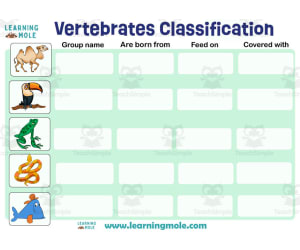
Vertebrates Classification Activity
Science, Life Sciences, Biology, Animals, Grade 3, 4, 5, 6, 7, 8, 9, Activities
Activity Introduction An amazing activity designed for the students to learn more about famous places in different countries. Vertebrates Classifications Do you like animals? what is your favorite one? Do you own a pet? If yes, tell us more about it, like what its name? And what do you like most about it? What are the animal kingdoms? Can you write down the characteristics of each animal class like mammals, birds, reptiles, amphibian, fish and mollusks. Do you know that some animals can sing, can you name any of them? What is the largest and the smallest mammal in the world? What is the largest and the smallest bird in the world? What is the largest and the smallest fish in the world? Vertebrates Classification Activity The activity is perfect for encouraging the researching skills for the students, while learning more about this fantastic place. Vertebrates Classification This friendly designed worksheet is suitable for students at school, homeschooling, and as a group activity. Instructions Can you fill in the gapes that are in front of each animal? Group name Are born from Feed on Covered with Format Available in a PDF format.
Author Educational Voice
Tags Vertebrates Classification Activity, Vertebrates, Vertebrate, Vertebrates Facts, Vertebrates Facts For Kids, Animal, Animals, Animals Facts, Animals Facts For Kids

Plant Anatomy and Photosynthesis - Find the Pair Game - Middle School Science
Science, Life Sciences, Biology, Grade 6, 7, 8, 9, Activities, Games
This is an engaging and enjoyable memory game on plant parts and photosynthesis. Pupils work in teams of three or four. Each team lays out their 42 cards face down in a square and take it in turn to turn over two cards. If the cards are a question and its correct answer, the pupil keeps the pair. If they are not a match they are turned face down and the next pupil gets a turn. This process continues until all cards are matched and the winner is the pupil with the most pairs. If a team member thinks that the selectors pair is not a correct match, they can challenge. Pupils are encouraged to check their books for the correct answer but the teacher also has a quick-check answer sheet. If the challenge is correct, the challenger keeps the pair. Included in this Pack. 42 question and answer cards Teacher’s answer sheet. Instruction sheet Preparation · Use double-sided printing to copy 1 set per group of 4 pupils. · Sheets could be laminated to enable year-on-year use. · Cut sheets into cards. Prior Knowledge Required · Root, stem and leaves are organs and the flower an organ system. · Functions of the root, stem, leaf and flower. · The terms transpiration, guard cells, stomata, xylem, phloem, chlorophyll, chloroplast and photosynthesis. · Parts of the flower; · The ovule and pollen grain as the female and male reproductive cells. · Role of played by xylem, phloem, guard cells, stomata and chloroplasts in photosynthesis. · Word equations for photosynthesis and respiration. · Comparison of photosynthesis and respiration. · Glucose converted to insoluble starch for storage on root. See more Elf Off the Shelf resources on this topic and many others
Author Elf off the Shelf Resources
Tags Plant Anatomy, Plant Photosynthesis, Photosynthesis Game, Find The Pair Game, Biology Game
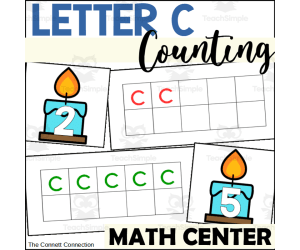
Letter C Counting to 10 Centers
Math, Early Math, Numbers, Kindergarten, Preschool, Centers, Activities
Letter C Counting to 10 Centers Letter C Counting to 10 Centers is a powerful teaching aid, adept at instilling early math skills in preschool and kindergarten students. This center hones their ability to recognize the lowercase letter 'C', number recognition up to 10, and counting proficiency using tens frames. It's highly versatile, enabling utilisation for math centers, matching centers, small group activities, morning work exercises or as an element in emergency substitute teacher plans. Quick Assessment Aid Gauges student abilities such as recognising amounts when depicted in a tens frame while reinforcing alphabet identification focused on the letter C. Cultivates fine motor skills promoting precision. Minimal Preparation Required To prepare these activities just print out the four-page packet, cut out individual items and laminate if necessary. The beach-themed design promotes continuous usage without losing appeal or educational learning. Promoting Interactive Learning In addition to paving way for independent problem-solving it also promotes collaboration when executed in groups. For a more immersive experience manipulatives can be included for pupils to physically engage with each portion of content they count. The Contents of this Pack Include: Candle-themed number cards from one through ten Lowercase ‘c’ framed boxes designed specifically for matching against these numerical cards In conclusion,The Letter C Counting Center presents numerous benefits combining alphabet familiarity and numeric recognition making it an indispensable asset within early-education pedagogy.
Author The Connett Connection
Tags Letter C, Counting Center, Lowercase Recognition, Number Recognition, Tens Frames

Letter B Beginning Sound Sort - Sports Themed
ELA, Language Development, Phonics, Kindergarten, Preschool, Activities
This beginning sound sort for the letter B is a great hands on activity for recognizing the most common sound of the letter B. This is an easy and fun activity to give students who need practice with recognizing the letter B sound from amongst other letter sounds or for those students who need extra practice distinguishing between the initial sounds in words. To complete this sorting activity , students will look at a picture on a basketball to determine if the picture begins with the letter B or does not begin with the letter B, and then the students will place the basketball on the correct hoop mat. This sorting activity includes 3 pages that contains One hoop mat for pictures that begin with the letter B One hoop mat for pictures that do not begin with the letter B Basketball pictures that begin with B Basketball pictures that do not begin with B This beginning sound sort can be used in the following ways Literacy centers Fine motor centers File folder activity Add magnets to the picture cards for a baking tray activity Small group activities Morning work Emergency sub plans If making a file folder game, the teacher will place the mats on either side of the folder and use hook and loop fasteners to sort the basketball pictures. Skills assessed with these letter B initial sound sort Initial Sound of the letter B Distinguishing between words that begin with B and do not begin with B Ability to sort the picture cards on to the correct mat This beginning sounds sorting activity is a low prep activity . All a teacher needs to do is to print the three pages, cut out the picture cards and laminate the pages and cards if desired. The activity is easy to set up and to put away and store. This download includes a PDF with 3 usable pages.
Author The Connett Connection
Tags Letter Of The Week, Alphabet Activities, Alphabet Centers, Beginning Sounds, Literacy Center, Preschool Literacy Center, Initial Sounds, Letter B, Letter B Activity
Animated Story: Little Red Riding Hood VI
ELA, Reading, Kindergarten, Preschool, Grade 1, Read Alouds, Activities
The Animated Story : Little Red Riding Hood VI The Animated Story : Little Red Riding Hood VI is a captivating, interactive teaching resource tailor-made for Pre-school to Grade 1 learners. It's an engaging method of addressing various academic goals such as literacy, language, and the usage of Augmentative and Alternative Communication (AAC). This product uses digital storytelling with animation and sound effects to heighten students' sense of exploration and curiosity. Fully Immersive Experience This fully immersive PowerPoint brings this beloved story to life over an exciting course of 15 slides. It follows an Animated Step-by-Steps® sequence, where each slide includes text followed by animations that reflect what has been read. Focus on Visually Impaired Students An active attempt has been made towards catering to students with visual impairment. Built-in movement in animated objects helps stimulate focus on target visuals. The product employs high contrast graphics with white or yellow text on a black backdrop for visibility purposes. Built-in 'safe zone' A crucial feature attached to page numbers is the built-in ‘safe zone’. This assists effectively during switch training sessions making it a comprehensive teaching resource! Versatile Display Options: It can be conveniently displayed on both: 'Small screen' devices like computer monitors, tablets using the free Microsoft PowerPoint app or 'Big screens' such as interactive whileboards or television screens via Apple TV; provides flexibility catering to varied needs. Potential Adaptation Uses: This resource can be used for: Homework assignments Group-based classroom activities in Language Arts—including Reading In conclusion, The Animated Story : Little Red Riding Hood VI delivers classic tales through visually compelling digital storytelling methods tailored for all learners including those with vision impairments. High-quality design meets sound pedagogy in this unique product!
Author Bloom Resources
Tags Animated Storytelling, Visual Impairment, Literacy, Language Skills, Digital Learning
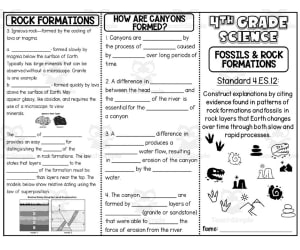
Fossils + Rock Formations Trifold
Science, Earth and Environmental Sciences, Earth Sciences, Grade 4, Activities
This is a Fossils + Rock Formations Science Trifold that will have students explore Earth Sciences in an interactive way. This is a front and back 1-page trifold for students to complete after they have learned all about fossils and rocks. Answer key included.
Author Teaching on the Island
Tags Trifold, Science, Fossils, Rock Formations

Apple CVC Write the Room
ELA, Reading, Preschool, Kindergarten, Grade 1, Activities
Apple CVC Write the Room: A Valuable Language Arts Resource Apple CVC Write the Room is an instructive tool crafted to improve language arts understanding for kindergarteners, preschoolers, and first-graders. This activity uses CVC (Consonant-Vowel-Consonant) picture cards that are available in both color and black/white features easily recognizable words such as 'hut', 'bed', 'pig', 'fin', 'pan', 'top', 'bun' and ‘wet’. Dual Function Recording Sheets The resource includes two distinct recording sheets. The first sheet promotes independent writing whereas the second one utilizes Elkonin boxes as visual cues to reinforce phonological awareness by individualizing sounds within words. Versatility for Different Learning Settings In a whole group instruction: It can be used to introduce or strengthen knowledge of cvc words with visual prompts. In smaller group learning or breakout groups: Helps learners collaboratively practice spelling and pronunciation. In homeschooling settings: Handy for creating engaging out-of-school learning tasks such as a scavenger hunt style game wherein learners find cards around their space, then acknowledge results on their recording sheets. Bonus Fun Learning Page An additional page allows students to prove their knowledge independently by spelling out given words onto apple images. Providing not just learning but also fun at the same time! Note: The resource is composed of only six pages within one PDF file type — ensuring easy printing — making it fit effortlessly into any curriculum . To sum up, "Apple CVC Write The Room" exemplifies efficacious yet enjoyable educational tools that facilitate fundamental reading skills access to young learners across a myriad of educational contexts.
Author Glitter and Grace
Tags Apple, CVC Words, Write The Room, Phonological Awareness, Language Arts
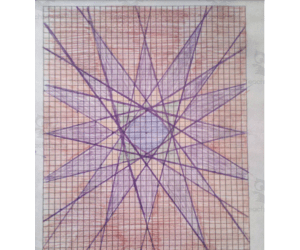
Make Star by Graphing Linear Equations in Two Variables
Math, Graphing, Not Grade Specific, Activities
This Make Star by Graphing Linear Equations in Two Variables activity provides a fun way for students to practice graphing linear equations in two variables. Students will graph 16 eqations on the same coordinate plane. The lines graphed will make a star and then students can color their own. Please see the pictures uploaded. There are two options for equations for students to graph. One sheet has all equations in slope-intercept form. The second sheet has half the equations in slope - intercept form and half in standard form. Students can graph using the slope and y - intercept or using the zeros of the function or a combination of both. The equations have whole numbers, fractions, and positive and negative numbers. There are even 4 equations where the y - intercept is a fraction. You have the option of not using these equations because a sheet with those lines already graphed is included. I suggest you, the teacher, make a copy of the key on an overhead sheet. You can then check the students every 4 to 5 lines that they graph. Students will number their lines to help you check their work and more easily identify incorrect lines. This was a favorite of my students. A great way to reinforce graphing.
Author Math Resources With Rigor
Tags Graph Linear Equations, Fun Activity
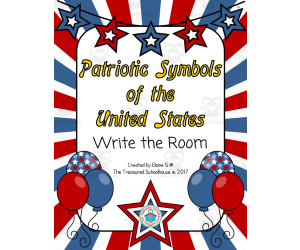
Patriotic Symbols Write the Room
ELA, Language Development, Vocabulary, Preschool, Grade 1, 2, 3, Activities
This is a Patriotic Symbols Write the Room. This is a great way for students to practice vocabulary and United States history. There are 32 cards for you to cut and place around the room. Students will get a recording sheet and write the word when they find the card. Cards are printed 4 per page.
Author The Treasured Schoolhouse
Tags Patriotic, Symbols, Write The Room, Literacy, History
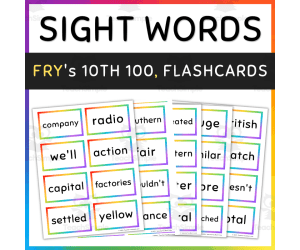
Fry Sight Words Flash Cards Rainbow Borders, 10th 100
ELA, Reading, Language Development, Spelling, Vocabulary, Preschool, Grade 1, 2, 3, Worksheets & Printables, Flashcards, Activities
The Rainbow Bordered Fry Sight Words Flashcards, 10th 100 set is a visually captivating resource teaching Fry's sight words to early learners. The vibrant rainbow borders and large font size make these flashcards easy to read and enjoyable to study. Educators can use them to build reading proficiency in various teaching settings like whole group, small groups, or learning centers . Young students will love practicing these essential words with colorful flashcards that accelerate their literacy skills. This set has 150 printable flashcards with 8 sight words per page. The words reinforce the 10th 100 Fry words recommended for 2nd and 3rd graders. Both students and teachers will delight in the sensory fusion of color and learning. These flashcards are suitable for classroom, homeschool, tutoring, or independent practice. Invest in engaging sight word flashcards that motivate students to master essential literacy skills.
Author TeacherYouWant
Tags Sight Words, Flashcards, Rainbow, Colroful, Fry's 1st 100, Fry Sight Words, Morning Work, Fun Learning, Tenth 100

Current Electricity 54 Question Board Game - Middle School Science
Science, Physics, Grade 6, 7, 8, 9, Activities, Games
This is a challenging, engaging and enjoyable boardgame, for up to six pupils per set, with 54 question cards on the basics of current electricity including: · understanding the terms current, voltage and resistance; · conductors and insulators; · circuit symbol; · circuits diagrams ; · units and measurement of current and voltage; · current and voltage in series and parallel circuits; · lamps in series and parallel. · Current and voltage vary with number of batteries. · Relationship between resistance and current. Included in this Pack. · Game board · 54 Question cards with questions of varying difficulty · Teacher answer sheet · Instruction sheet. Preparation · Photocopy Board onto A3 paper or card (Colour and greyscale versions included). · Photocopy question sheets onto paper or card (Colour and greyscale versions included) and cut into question cards. How to Play. · Highest score of dice starts · Pupils take turns and work their way around the board following the instructions in the squares. · A symbol on the board indicates that the pupil takes a question card from the face down pile. If correct they move on 2 spaces. · If a player thinks an answer given by an opponent is incorrect they can challenge. If the challenge is correct the challenger moves forward 2 spaces. If the challenge is wrong the challenger moves back two spaces. · In the event of a challenge, pupils are encouraged to consult their books but the teacher has a quick-check answer sheet. Prior Knowledge Required · The symbols for switch, resistor, battery, voltmeter, ammeter, motor, buzzer and able to recognise series and parallel circuits. · Metals and non-metals as conductors and insulators. · Current is a flow of electrons and metal ions cause resistance. · Batteries contain chemicals and provide the push or voltage to current. · Voltage is the difference in energy level between two points in a circuit. · Comparative resistance of long/short, thin/thick wires. · Know that insulators have high resistances and the resistance of all conductors is comparatively lower. · Comparative brightness of identical lamps in series and parallel and the effect of removing a lamp. · Ammeters are placed in series and voltmeters in parallel. · Current is measured in amps and voltage in volts. · Current in series and parallel circuits. · Voltage in series and parallel circuits. · Current and voltage vary with number of batteries. · Metal ions causing high and low resistance conductors. · Relationship between resistance and current. These learning outcomes, and others, are contained in fully resourced packs from Elf Off the Shelf. Each pack contains two PowerPoints and fourteen original and engaging pupil resources. They are also available as a substantially discounted bundles. Please follow the links below if you are interested in these resources. See more Elf Off the Shelf resources on this topic and many others
Author Elf off the Shelf Resources
Tags Science Board Game, Electricity Board Game, Physics Game, Science Printable, Electricity Team Game, Conductors And Insulators Game, Series And Parallel Circuit Games, Middle School Science Game

Geometry: Volume of 3D Shapes
Math, Geometry, Not Grade Specific, Activities
Geometry: Volume of 3D Shapes This resource is an indispensable teaching tool for educators at all levels. It's a one-page tool, focusing on calculations of volume of three-dimensional shapes in mathematical geometry. Though these can be complex calculations, the information is presented clearly and concisely. Benefits and Applications: This deeper dive into geometry greatly simplifies a challenging concept for students navigating through their math coursework. The resource is valuable to reinforce lessons about calculating volume or introducing these concepts to learners. It is fully editable, catering to various teaching methodologies—permitting adjustments based on individual classroom needs. This guide provides useful visual aids during group work or supplementary help during independent study—which supports exam preparation and homework assignments alike. Suitable Across Grade Levels: The key advantage lies in its adaptability across grade levels; it's not limited by curriculum specifications making Geometry: Volume of 3D Shapes universally helpful towards understanding geometric knowledge among students regardless of their academic stage— from junior high pupils grappling with basic formulae to high school learners needing precision in calculation principles. Ease Of Incorporation: Easy integration into any math curriculum underlines the advantage of Geometry: Volume of 3D Shapes. Utility meets efficiency within this single-page guide that can serve as a handout for classroom use or be digitally distributed via email—the method aligning with each educator’s unique approach toward lesson delivery. Ensure your students grasp volume calculations effectively with the instructive Geometry: Volume of 3D Shapes reference sheet—a brilliant way to lower complexities underlying geometrical studies while enlightening young minds concurrently.
Author Elementary Resources 4 U
Tags Geometry, Volume, 3D Shapes, Calculations, Teaching Resource