



3,939 products added recently
Popular Rubrics
Our collection of Popular Rubrics includes the most widely used assessment tools among teachers. These rubrics cover various subjects and assignment types, reflecting best practices in education. By utilizing these proven templates, you can save time and ensure consistency in grading. Popular Rubrics help you provide constructive feedback, guiding students toward improvement. Elevate your assessment strategies with these effective resources.

 Show filters


Future-Ready Creators: AI Ethics & Career Exploration Gamified Project
Life Skills, Special Resources, Social Emotional Learning (SEL), Social Skills, Special Education Needs (SEN), STEM, Research, Classroom Management, Resources for Teachers, Community Building, Grade 3, 4, 5, 9, 10, 11, 12, Worksheets & Printables, Workbooks, Worksheets, Teacher Tools, Assessments, Lesson Plans, Presentations, Rubrics
Future-Ready Creators: AI Ethics & Career Exploration Gamified Project Unit (Edition) Unleash the future of education by digging into this all-inclusive, gamified AI ethics curriculum for high schoolers, Grades 9-12. Join the AI revolution with theory, real-life case studies, and interactive worksheets that explore algorithmic bias, data privacy, surveillance, transparency, and how AI will shift careers. This 24-page digital PDF unit mingles rigorous academics with activities like a student workbook, ethical audits, SVG visuals of mind maps and flowcharts, and teacher resources filled with answer keys. Suitable for classes dealing with STEM, computer science, ethics, and career guidance, this ready-to-use project nurtures critical thinking, ethical decision-making, and career exploration in an AI-filled world. AI Ethics Lesson Plans, High School AI Curriculum, Gamified AI Projects, AI Bias Activities, Future Careers in AI, Digital Workbook on Ethics, Teacher Resources for AI Education. For homeschooling, classroom use, or in after-school programs, give teens the power to create their vision as responsible AI innovators today! Why Parents/Schools Love It: Prepares Students for the Future with AI: It teaches necessary skills for ethical AI practices, detection of bias in AI, and exploring a job market with a high degree of automation with technology-related jobs. Engaging Gamified Format: Converts difficult-to-understand information into challenges, simulations, and projects, which serve as motivation and learning aids and add fun to learning. Teaching Tools: Teaches educators with comprehensive ready-to-use teaching tools, including illustrations, work sheets, and answered keys, making it easy to integrate into any high school curriculum. Cultivates Ethical Thinking and Responsibility: Helps students deal with pressing issues such as the loss of privacy rights and the need for algorithmic justice, encouraging ethical thinkers capable of living with the consequences of artificial intelligence. Versatile and Inclusive: "The book is very versatile and inclusive, being suitable for learning environments such as classrooms, home-schooling, or online learning with equity, diversity, and increasing AI jobs as the appeal." Target Student Classes : From an exhaustive analysis of the PDF, wherein it is clearly mentioned that it is "designed specifically for high school students (Grades 9-12)" and is targeted at advanced concepts involving AI, you need to target high school students belonging to Grades 9-12. This is in line with the level of material, which is of an advanced level of understanding, assuming that these individuals possess critical and digital literacy skills characteristic of individuals on the threshold of higher education or professional life, in particular: Main target audience: Classes involving Computer Science, STEM, Technology, Ethics/Philosophy, Career Guidance, or Social Secondary Audience: Home-school programs, after-school activities, or classes on digital citizenship, innovation, or future studies. Refrain from targeting younger groups, such as the middle school level or younger, because the contents involve intricate subject matters such as deep learning, data sovereignty, or predictive policing. Copyright/Terms of Use : This Book was copyrighted under the name of Syed Hammad Rizvi. This document or repository is for personal use only. You cannot modify, distribute, or give away a single piece of this document. In other words, you cannot place it on the World Wide Web so that people can download it for free. If you would like to share these resources with your colleagues, you can purchase additional licenses from Teachsimple. Thank you for respecting these use terms. This product is happily brought to you by Syed Hammad Rizvi
Author Creative Book Store
Rating
Tags AIEthics, AICurriculum, ArtificialIntelligence, HighSchoolAI, GamifiedLearning, FutureCareers, EthicalAI, MachineLearning, AIBias, DataPrivacy

Human Body and Golden Ratio PowerPoint and Study Guide
Math, Grade 4, 5, 6, 7, 8, Projects, Activities, Presentations, Teacher Tools, Quizzes and Tests, Rubrics, Workbooks, Worksheets & Printables
Introduction to the Golden Ratio and the Human Body PowerPoint and Study Guide Lesson The Golden Ratio, or Phi, and the Human Body is a unique math PowerPoint exploration of the human body and Leonardo da Vinci's famous Vitruvian Man drawing. Academic connections are made with math, art and history. Another famous name for the Golden Ratio is the divine proportion, a proportion of beauty found throughout nature, science, art, and architecture. This lesson can be completed in one or two classes depending on how long teachers want to spend on projects. Learners will become enthralled by the idea of how math can be beautiful and learn to treat it like a treasure hunt by looking for the golden ration everywhere around them in art, nature and even their own bodies! Go down as many learning rabbit holes with NatureGlo's MathArt Library Golden Ratio and Human Body page. On this page you'll get videos, project ideas and curated website links. Enjoy the exploration! Student Objectives Students will: Complete the PowerPoint lesson Complete the study guide for the lesson. Watch the curated educational videos from the MathArt Virtual Library Website. Complete the journal in the study guide including a drawing with written descriptions. Complete the quiz. Choose and do a chosen project. Order, Outline and Steps Read the Quick Start guide that comes with the curriculum. Go through the PowerPoint lesson with the students. Students complete the study guide during or after the PowerPoint lesson. Students select and complete a chosen projects about the topic. Grades & Ages Grades 4 - 8 Ages 10 - 14 Implementation Format PowerPoint Study guide Use of Internet Activities Projects Answer Key - INCLUDED Number of Pages - 33 File Types - PowerPoint and PDF files Length of Lesson - At least one lesson, or, optionally two or more lessons
Author NatureGlo's eScience
Rating
Tags Golden Ratio, Human Body, Divine Proportion, Math Activities, Math Projects, Leonardo Da Vinci
High School Tardigrade Extremotolerance Unit
Reading, ELA, Writing, Biology, Life Sciences, Science, Research, Resources for Teachers, Homeschool Resources, High School, Writing Prompts, Worksheets & Printables, Teacher Tools, Assessments, Lesson Plans, Diagrams, Quizzes and Tests, Rubrics
Let’s be honest: finding high school curriculum that is genuinely tough but actually keeps a teenager’s attention is a massive challenge. When my daughter and I hit this stage, I knew I did not want another textbook that just asked her to memorize basic biology facts. I wanted something that would challenge her to think and question like a real scientist. That is exactly why I put together this High School Tardigrade Extremotolerance Unit . I wanted to create something that could easily turn a kitchen table or a standard classroom into a hands-on research lab. Instead of just another dry nature study, this unit dives deep into how these tiny creatures impact modern medicine. It is a fantastic, stress-free way to build your teen's confidence and get them completely ready for college-level science. INCLUDED IN THIS RESOURCE: 10-Day comprehensive lesson plan. 30-slide presentation deck with notes. 25-question test with answer key. Research project rubric and grading scale. TOPICS COVERED: Tardigrade anatomy and phylum. Cryptobiosis and vitrification. Dsup protein and DNA repair. Biomedical and medical technology. I also made sure this unit is completely open-and-go, focusing entirely on big-picture understanding instead of mind-numbing memorization. Whether you are working one-on-one at home or leading a busy co-op group, I have done the heavy lifting for you. The included instructor notes break down complex biological concepts into easy-to-explain talking points, while the open-ended project options let your teen lean into what they care about most. You are not just downloading another digital file to clog up your hard drive; you are getting a reliable, stress-free roadmap to help your student/homeschooler truly thrive. If you and your students/homeschoolers enjoyed this resource, please leave a review. Thank you for your continued support! Tina - Big Easy Homeschooling Mom
Author Homeschool with Big Easy Homeschooling Mom
Rating
Tags Cellular Glass Tech, Deep Dive Science Unit , Tardigrade Unit, Scientific Writing, Water Bear Study, Tardigrade Lesson, Extremophile Biology, Microscopic Animal Study, High School Science Project, Homeschool Science Curriculum

AI Ethics for Young Learners - Artificial Intelligence Book
Strategies, Reading, ELA, Reading Comprehension, Research, Technology, Science, Computer Science, Engineering, STEM, Grade 3, 4, 5, 9, 10, 11, 12, Activities, Projects, Teacher Tools, Assessments, Lesson Plans, Literacy Readers, Outlines, Rubrics, Writing Prompts, Worksheets & Printables
Unravel the fascinating realm of artificial intelligence through "AI Ethics for Young Learners - Artificial Intelligence," an all-inclusive textbook crafted to inculcate AI concepts and ethical values in young minds in an interesting and young-friendly manner. Offering in-depth information starting from AI in daily life examples such as assistants and video games to more complex topics such as biased computer algorithms, issues of data privacy, fundamental concepts of cybersecurity, and AI use, this SEO-friendly kids’ book is most suited to class 4 to class 12 settings, providing young minds with empowerment to learn AI basics, identify ethical issues, and become responsible digital participants. With 90 chapters spread throughout AI learning patterns in young minds, ethical issues in decision-making algorithms, robot AI while maintaining system security, program accountability in AI, and AI in the coming age of medicine, creativity, and environmental protection, this AI book by subject experts is ideal to disrupt young minds with AI-related critical thinking skills through practical AI examples and ethical tales of AI adventures in society. Tags: AI ethics education in kids, AI textbook in classroom education, AI education in teen brains, ethical AI learning book, classroom learning books in grade 4 to grade12 levels. Why Parents/Schools Love It: Engaging and Age-Appropriate Content: Reduces complex AI and ethics topics to simple and relatable stories and examples that hold the attention of young learners without causing an overload. Encourages Critical Thinking and Responsibility: Students learn to second-guess AI decisions, to perceive bias, and to claim responsibility for their actions as advocates for the appropriate use of technology in daily life. Comprehensive Curriculum Support: With 90 chapters, it leads the students from the basics of AI through advanced ethical dilemmas; perfect for STEM lessons, homeschooling, or classroom discussions. Values and Safety: Stressing the importance of privacy, fairness, and human judgment in AI-all important to giving parents peace of mind that aligns with family values. Inspires Innovation: This lets the kids come up with their own ethical AI ideas and concepts, which can trigger their innovative thinking to make them future-ready in the tech arena. Targeted Classes for Students : It can be seen from the thorough evaluation of the contents and suitability of the material in the book that it is ideally suited for students from grades 4 through 12 as mentioned in the title page. The contents begin with explanatory pieces that are simple and accessible in terms of the examples they use such as “What is Artificial Intelligence?" and examples such as smart assistants in basic forms for earlier grades (4-6), then move into advanced examples such as bias in algorithms, the issue of privacy laws and cybersecurity threats and ethical problem-solving for advanced students from grades 7-12. The text is written in simple sentences and analogies (as in the explanation given in “How A.I. Learns Like Playing a Game"), and sophisticated technical terms are avoided in this manner and can be suited for the entire spectrum mentioned. Copyright/Terms of Use : This Book was copyrighted by Syed Hammad Rizvi. Please do not give out or sell copies of this resource or any part of it. Furthermore, do not post this resource on the Internet in such a way that people can download this resource. By the way, you can modify this resource, but only for your personal or school-class usage. Please note that if you would like to share this resource with your peers, licensing options for additional copies are available via Teachsimple. Thank you for your compliance with this usage agreement. This product is delightedly presented to you by Syed Hammad Rizvi
Author Creative Book Store
Rating
Tags AIEthicsForKids, ArtificialIntelligenceBook, AIEducationForTeens, EthicalAIForYoungLearners, STEMBooksForStudents, AIBasicsForGrades4to12, DataPrivacyForKids, BiasInAIExplained, ResponsibleTechForYouth, AIAndEthicsCurriculum

High School 2026 August ELA Bell Ringers
Resources for Teachers, Research, ELA, Writing, Literature, High School, Homeschool Resources, Worksheets & Printables, Writing Prompts, Teacher Tools, Assessments, Quizzes and Tests, Rubrics
As a homeschool mom navigating the secondary years and a passionate resource creator, I know exactly how vital it is to start the morning with genuine academic rigor. This High School 2026 August ELA Bell Ringers resource is designed to eliminate morning prep stress while providing a deeply engaging daily routine. Each prompt is built from the ground up to challenge critical thinking, expand literary horizons, and foster sophisticated syntax. By choosing these exercises, you are setting a brilliant, intellectually stimulating tone for your educational environment right from the opening bell. Therefore, this daily slide deck serves as an invaluable asset for busy parents looking to maximize learning without sacrificing their sanity or prep time. INCLUDED IN THIS RESOURCE: 21 premium high-school morning slides. Full notes pages for direct instruction. Calibrated holistic scoring scales for grading. Easy-to-use structural framework for parents. TOPICS COVERED Dissecting classic prose, themes, and motifs. Master subjunctive mood and paragraph repair. Unlocking Latin roots and academic vocabulary. Analyzing chiasmus, antithesis, and deep subtext. I am incredibly proud to offer a secondary resource that respects the intellect and capability of your growing high schoolers. This High School 2026 August ELA Bell Ringers tool is explicitly built to spark meaningful, high-level discussions around the kitchen table or at a study desk. By weaving together sophisticated grammar, deep literary analysis, and creative constraints, it provides a beautifully balanced approach to daily language arts. Thank you so much for downloading my materials and trusting me to support your educational journey. For additional support, remember to reference the files High School 2026 August ELA Bell Ringers to fully integrate this curriculum package. I hope this resource brings immense success, analytical joy, and true academic growth to your home or classroom this August. If you and your students/homeschoolers enjoyed this resource, please leave a review. Thank you for your support! Tina - Big Easy Homeschooling Mom
Author Homeschool with Big Easy Homeschooling Mom
Rating
Tags Secondary ELA Warm Ups, High School English Slide Deck, Daily ELA Prompts, Daily Writing Exercises, Rhetorical Device Analysis, Analytical Rubrics ELA, Morning Bell Ringers, High School Curriculum Materials, Academic Vocabulary Practice, Slides With Answer Key
The Mouse and the Motorcycle STEM Experiment + STEM Project
Science, Technology, Engineering, STEM, Grade 3, 4, 5, Experiments, Activities, Projects, Diagrams, Teacher Tools, Graphic Organizers, Rubrics
Help design and build a four-wheeled car for Ralph, the adventurous mouse, from The Mouse and the Motorcycle. Perfect for integrating literature and science, this challenge guides students to apply engineering principles using simple materials while fostering teamwork and critical thinking. What’s Inside This Resource: Student Letter: A fun letter from Ralph introduces the challenge, linking the story to a real-world engineering task. Design Loop Graphic: A visual students can attach to their science journals, serving as a step-by-step guide throughout the activity. Detailed Instructions: Choose to print the guide as a packet or have students record each stage in their journals for an interactive experience. Teacher Tips: Practical guidance for crafting a clear problem statement with time constraints, materials, and success criteria tailored to your classroom. Skills Your Students Will Build: ✔ Problem-Solving: Identify obstacles and create inventive solutions. ✔ Engineering Design: Navigate the design loop—plan, construct, test, and refine. This page can easily be enlarged for a classroom poster. ✔ Critical Thinking: Assess their prototype’s performance and pinpoint ways to enhance it. ✔ Teamwork: Collaborate effectively to accomplish shared goals. Versatile Classroom Application: Whether as guided instruction or part of an integrated literature and science unit, this STEM activity encourages students to think creatively, document their process, and meet science and engineering standards. The rubric included is based on engineering concepts, but can also be used as a nonfiction writing rubric for cross-curricular options. Why Educators Love This Resource: ⭐ “My students were fully engaged, combining their passion for reading with STEM!” ⭐ “Simple to set up and encourages creativity and teamwork.” ⭐ “A seamless connection between literature and science for cross-curricular learning!” Inspire your students to solve Ralph’s problem and discover the joy of engineering with this fun, standards-aligned STEM challenge!
Author Kel's Klass
Tags 4th Grade Science Project, 4th Grade Science Experiment, 5th Grade Science Project, 5th Grade Science Experiment, Engineering Diagram, Science Graphic Organizer, Science Rubric, 3rd Grade Science Project, 3rd Grade Science Experiment, The Mouse And The Motorcycle

Emotional Intelligence Building Blocks - Social Emotional Learning
Life Studies, Career, Research, Life Skills, Special Resources, Social Emotional Learning (SEL), Social Skills, Special Education Needs (SEN), Speech Therapy, Grade 3, 4, 5, 9, 10, 11, 12, Activities, Teacher Tools, Projects, Centers, Assessments, Lesson Plans, Outlines, Presentations, Rubrics, Quizzes and Tests
Uncover the best social emotional learning (SEL) curriculum for grades 3-6 in "Emotional Intelligence Building Blocks - Social Emotional Learning" by Syed Hammad Rizvi, especially designed for elementary-school-going children. With a total of 432 pages of in-depth information, this book maximizes 8- to 12-year-olds' ability to handle their internal world of emotions while developing high-quality social skills, such as mastering personal management skills and responsible decision-making. Full of exciting topics in each installments like recognizing happiness, sadness, anger, fear, and many more, this social emotional learning middle school workbook delves deep into self-awareness, self-management tools like journaling, breathing exercises, goal setting, social awareness with a focus on empathy, body language, and cultural differences. Designed to be highly beneficial for homeschoolers, classroom teaching, or family usage, this social-emotional learning middle school curriculum not only provides exercises to handle conflicts, make friends, and enhance positive thinking but is specifically designed to help in overcoming emotional difficulties by teaching kids to be emotionally intelligent individuals throughout their lives. It is a highly recommended teaching tool for all parents, tutors, and teachers looking for scientifically valid emotional intelligence exercises to be performed by kids in their classroom. Why Parents/Schools Love It: In-Depth SEL Resource: Provides students with a clear continuum of skills from recognizing emotions to applying concepts in a real-life setting. Helps students learn to be resilient, empathetic, and effective conflict resolvers. Practical and Engaging Tools: This category includes solutions such as journaling, breathing exercises, and goal-setting tasks, which require minimal effort to perform in the comfort of one's home or an educational setting in order to promote instant emotional development. Encourages Positive Relations: Deals with skills like listening, boundary marking, and celebrating diversity. Has the effect of reducing misbehavior and increasing positive associations with family, friends, and the broader community. Aligned with Educational Standards: Based on the principles of Emotional Intelligence, the resource is useful for both homeschooling and classroom education as it impacts academic success, health, and bullying intervention. Empowering for Lifelong Skills: It promotes self-discovery and optimistic outlooks, arming children with skills to conquer life's obstacles, resulting in happier and more confident people as manifested in parent and teacher feedbacks. Target Classes/Students : Based on the complete analysis of the content, structure, language, and examples in the book, it is ideally targeted at students in grades 3 to 6 (usually between 8-12 years old). The content uses vocabulary suitable for this age group, scenarios that are easy for students of this age to relate to, such as school challenges and playground and family dynamics, and progresses gradually from simple emotion identification to complex issues such as ethical dilemmas and community involvement. The introductory tone assumes basic reading skills without burdening the younger reader, while the substance in the later chapters on self-awareness and social dynamics fits well with the upper elementary levels. It could extend to advanced grade 2 students or remedial grade 7, but the core focus is perfectly in tune with middle childhood development stages emphasized in the book. Copyright/Terms of Use : This Book was copyrighted by Syed Hammad Rizvi. This resource is to be used only for personal and single-classroom use only. You are not to alter or redistribute any part of this resource or sell this resource. In other words, do not put this resource on the Internet where it could be downloaded. If you would like to share this resource with others, you can purchase other licenses through Teachsimple. Thank you so much for your cooperation! This product is happily brought to you by Syed Hammad Rizvi
Author Creative Book Store
Rating
Tags EmotionalIntelligenceBuildingBlocks, SocialEmotionalLearning, SELForKids, EmotionalIntelligenceForChildren, SELCurriculum, EmotionalRegulationForKids, BuildingEmpathyInChildren, KidsEmotionalWellbeing, ElementarySELActivities

Acrostic Poem Template National Poetry Month Activity Lesson Plan
ELA, Poetry, Literature, Homeschool Templates, Grade 2, 3, 4, 5, Centers, Activities, Graphic Organizers, Teacher Tools, Lesson Plans, Rubrics, Worksheets & Printables
Looking for an acrostic poem template that actually helps your students write meaningful poetry during National Poetry Month? If you’ve ever had students stare at a blank page unsure how to start… you’re not alone. Poetry can feel overwhelming without the right structure — and that’s exactly where this resource makes a difference. This acrostic poem resource is the perfect writing activity to celebrate National Poetry Month this April. It gives your students clear scaffolding, engaging examples, and step-by-step support so they can confidently create their own poems. What's Included Acrostic poem interactive notebook templates to guide student writing Clear, student-friendly example (posters in color and black and white) Structured lesson plan for easy implementation A publishing page An assessment rubric for quick and consistent marking Perfect For Grades 2-6 National Poetry Month activities Poetry units Writing lessons Literacy centers Homeschool learning Small group or whole-class instruction Why Teachers Love This Takes the stress out of teaching poetry Supports reluctant writers with clear structure Makes National Poetry Month lessons engaging and meaningful Helps students move from ideas → draft → published piece Saves you planning time with ready-to-use materials How to Use in Your Classroom You might introduce acrostic poems as a whole-class lesson using the included examples, then guide your students through brainstorming ideas. From there, students can use the interactive notebook templates to plan and draft their poems before creating a polished final version using the publishing sheet. The included rubric makes assessment simple and consistent — no guesswork needed. Skills Covered Poetry writing Vocabulary development Creative expression Writing structure and organization Editing and revising Presentation and publishing This works beautifully as a low-prep, high-engagement activity during National Poetry Month — especially when you want something meaningful without reinventing the wheel.
Author Teach2Tell
Rating
Tags Poetry Lesson Plan, Poetry Writing Activity, National Poetry Month , Writing Rubric, Creative Writing Lesson, Poetry Examples, Acrostic Poem, Acrostic Poem Template, Acrostic Poem Examples, Poetry Writing Rubric
Powered Phonics Rule Detectives Gamified Micro-Quests for K-2
Reading, ELA, Literature, Children’s Literature, Mental Health, P.E. & Health, Mindfulness, Health, Research, STEM, Homeschool Curriculum, Grade 1, 2, 3, 4, 5, Activities, Games, Projects, Experiments, Assessments, Teacher Tools, Lesson Plans, Literacy Readers, Presentations, Rubrics
Unleash the Potential of Literacy with this Full, AI-Supported Phonics Learning Program for Grade K-2 Students! "AIPowered Phonics Rule Detectives: Gamified Micro-Quests for K-2 Word Building - Phonics Rules Buildable Grade K-2nd Edition" features 45 pages of interactive digital lesson material that can turn conventional phonics lesson delivery into an incredibly fun and fascinating detective hunt mystery series for kids. A full range of interactive elements, digital AI advisory tools for adaptive content delivery, worksheets for kids, teacher support material, images, and solution keys have been included in this resource tools package for teachers and home schooling parents for effective decoding, reading, and spelling skill development for kids in Grade K-2. Based on a strong systematic and explicit phonics and synthetic background, the "buildable" sequence in the curriculum includes the following skills for each grade level: Kindergarten—basic CVC words and letter sounds, Grade 1—digraphs, blends, CVCE (or "magic e"), and long vowels, Grade 2—vowel teams, r-controlled vowels, diphthongs, syllables, soft C/G, and silent letters. Use the power of Artificial Intelligence to generate unlimited differentiated scenarios, sentences, and activities for remediation, on-grade, or enrichment purposes, and add gamification components such as role-playing, stories, points, badges, and feedback. Why Parents/Schools Love It: Engage Gamification Increases Motivation: Converts phonics lessons into enjoyable 'detective missions' involving stories, badges, & micro-quests, keeping children eager & preventing burnout, underpinning theories such as Self-Determination Theory & Behaviorism. AI-Enabled Personalization: Saves Time “Teachers use prompt cards to create endless differentiated learning material instantly, serving all children, from struggling to advanced learners, without consuming teaching hours.” Established Effectiveness with Data-Driven Insights: Comes with personalized student data indicating an 60-85% proficiency rate for essential rules, as well as assessment and tracking for literacy gains. Complete Ready-to-Use Resources: The all-inclusive resources are available as a single PDF that includes theory lessons, activity sheets, and answer keys and ethics guidelines related to AI that are suitable according to literacy best practices. It Helps Develop Lifelong Reading Confidence: This scaffolding approach leads children to gain a strong conceptual foundation regarding phonics rules, which results in their fluent reading skills, ability to master spelling concepts, as well as developing their lifelong love Target Classes/Students : On the basis of a comprehensive analysis of the PDF document, which includes the flow of the document, developmental phases, categories of rules, worksheets, as well as examples, the following groups of students can be targeted by it: Kindergarten (Emergent Readers): Emphasis on basic components including letter/sound association, vowel concepts, CVC words, and initial/final sounds. This is to promote cognitive balance in the content. Grade 1: Focuses on mastery of CVC words, introduction to digraphs (sh, ch, th, wh), blends (bl, fr, st), CVCE, magic 'e', Long Vowel teams - ai, ee, oa. Grade 2 (Developing Readers) Focuses on complex long vowel combinations, complex pairs of vowels in a word or syllable (ou, oy, ie), r-controlled combinations of letters and vowels (ar, er, ir, or, ur), diphthongs, inflectional suffixes, syllables, and silent letters Its K-2 continuum is "buildable," in that the rules ramp up cumulatively, and it is therefore ideal for mixed-age, intervention, or enrichment settings in the early grades of schooling. Copyright/Terms of Use : «This Book was copyrighted by Syed Hammad Rizvi.» You cannot modify it or give it or any part of it away or resell it. That means you cannot put it on the Internet where it might be downloaded by anyone who wants it. However, if you need to share this resource with colleagues, just purchase more licenses from Teachsimple. Thanks for following the terms of use! This product has been very proudly presented to you by Syed Hammad Rizvi
Author Creative Book Store
Rating
Tags AIPoweredPhonics, PhonicsRuleDetectives, GamifiedMicroQuests, K2WordBuilding, PhonicsRulesK2, BuildablePhonicsCurriculum, KindergartenPhonics, Grade1Phonics, Grade2Phonics, EarlyLiteracyDevelopment
Dear Mr. Henshaw STEM Experiment + STEM Project for Grades 3, 4, 5
Science, Technology, Engineering, STEM, Grade 3, 4, 5, Experiments, Activities, Projects, Diagrams, Teacher Tools, Graphic Organizers, Rubrics
Leigh Botts from Dear Mr. Henshaw needs your help! This STEM project encourages problem-solving as students plan and construct a device that will help protect Leigh's lunch from a sneaky thief. Perfect for blending literature with science, it allows students to explore engineering concepts using simple supplies while promoting teamwork and critical thinking. What’s Inside This Resource: Student Letter: A pleading letter from Leigh introduces the challenge, linking the story to a real-world engineering task. Design Loop Graphic: A visual students can attach to their science journals, serving as a step-by-step guide throughout the activity. Detailed Instructions: Choose to print the guide as a packet or have students record each stage in their journals for an interactive experience. Teacher Tips: Practical guidance for crafting a clear problem statement with time constraints, materials, and success criteria tailored to your classroom. Skills Your Students Will Build: ✔ Problem-Solving: Identify obstacles and create inventive solutions. ✔ Engineering Design: Navigate the design loop—plan, construct, test, and refine. This page can easily be enlarged for a classroom poster. ✔ Critical Thinking: Assess their prototype’s performance and pinpoint ways to enhance it. ✔ Teamwork: Collaborate effectively to accomplish shared goals. Versatile Classroom Application: Whether as guided instruction or part of an integrated literature and science unit, this STEM activity encourages students to think creatively, document their process, and meet science and engineering standards. The rubric included is based on engineering concepts, but can also be used as a nonfiction writing rubric for cross-curricular options. Why Educators Love This Resource: ⭐ “My students were fully engaged, combining their passion for reading with STEM!” ⭐ “Simple to set up and encourages creativity and teamwork.” ⭐ “A seamless connection between literature and science for cross-curricular learning!” Encourage your students to solve Leigh’s challenge and experience the excitement of engineering with this standards-aligned STEM adventure!
Author Kel's Klass
Tags 4th Grade Science Project, 4th Grade Science Experiment, 5th Grade Science Project, 5th Grade Science Experiment, Engineering Diagram, Science Graphic Organizer, Science Rubric, 3rd Grade Science Project, 3rd Grade Science Experiment, Dear Mr. Henshaw

High School Science The Keystone Paradigm Unit
ELA, Reading, Writing, Reading Comprehension, Research, Resources for Teachers, Science, Earth and Environmental Sciences, Homeschool Resources, High School, Teacher Tools, Assessments, Lesson Plans, Quizzes and Tests, Rubrics, Worksheets & Printables, Writing Prompts, Worksheets
Let’s be real: finding science curriculum for a ninth grader that is not fluff feels like a full-time job. Once we hit the high school years, the "nature study" phase is over, and suddenly we are staring down the barrel of complex theories and massive textbooks. I built this unit because I was tired of "busy work" packets. I wanted my own daughter to see that science isn't just a list of facts to memorize—it is a messy, fascinating debate that is still happening right now. INCLUDED IN THIS RESOURCE: Keystone Paradigm Text 30-Year Population Data MacNulty Science Challenge Complete Grading Suite TOPICS COVERED: Trophic Cascade Mechanics Ecosystem Engineering Abiotic vs. Biotic Factors Scientific Model Critiques I will never forget the morning she finally sat at the table, nose deep in the MacNulty critique, and the "aha!" moment hit. Watching her connect the dots on how a wolf can actually shift the course of a river... that is the spark we’re all chasing, right? I designed this to give your student/homeschooler that same intellectual respect while giving you a breather. It is rigorous, it’s deep, and most importantly, it is ready to go. I hope it brings some incredible "lightbulb moments" and lively debates to your house, too. If you and your students/homeschoolers enjoyed this resource, please leave a review. Thank you for your support! Tina - Big Easy Homeschooling Mom
Author Homeschool with Big Easy Homeschooling Mom
Rating
Tags High School Science, Homeschool Science, Ecology Unit, Trophic Cascades, Yellowstone Wolves, Biology Module, Environmental Science, High School Ecology Curriculum, MacNulty Challenge Science, High School Biology Curriculum

Personal Narrative Writing, Graphic Organizer, Rubric & Examples
Creative Arts, Common Core, Grade 5, 6, Graphic Organizers, Teacher Tools, Templates, Rubrics, Writing Prompts, Worksheets & Printables
Get your class writing every day with this easy to follow resource for personal narrative writing.Personal narratives are stories about yourself. Most students get stumped in the writing process when it comes to generating ideas... well not anymore! This guide will help take your young authors on the writing journey. It will show them how to write from the very first steps of coming up with an idea all the way to writing a conclusion. It is fool proof, easy to leave plans for a substitute and to take the headache and scariness out of writing for you as the teacher! Personal Narrative curriculum is a must! We can't expect that students just know how to write. There is structure that is involved. Every story with this kit will have a killer beginning, middle and end. It will eliminate students' need to repeat themselves and truly get to the heart of their story. Students are lost when it comes to telling their own stories. You get stuck with a list of “And then… and then.. and then…” Break those bad habits with this Personal Narrative Writing Set! Students will be able to tell a fluent story with suspense and intrigue! With this resource you will get: full set of teacher plans examples of great writing to share with your class student writing pages tips and tricks on how to break writer’s slump (and the kid that says “I have nothing to write about”) reflection pages that help create better writers for your future writing pieces scoring rubric for teachers to use for themselves or for data or during conference time with parents countless tips and tricks to enhance your students’ personal narrative writing Start with this 20 page framework and make writing a breeze in your class!
Author Big Apple Teaching
Tags Personal Narrative, Writing, Dialogue, Grammar, Descriptive Words, Setting The Scene, Vivid Verbs, Adjectives, Sentence Starters, Writing Prompts
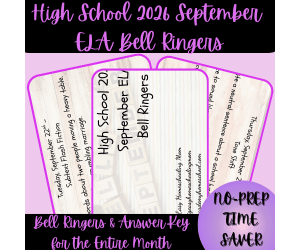
High School 2026 September ELA Bell Ringers
ELA, Reading, Writing, Research, Resources for Teachers, Homeschool Resources, High School, Teacher Tools, Assessments, Quizzes and Tests, Rubrics, Lesson Plans, Worksheets & Printables, Writing Prompts
As a fellow homeschool mom navigating the journey with a teenager, I know how hard it can be to keep our days structured while fostering deep critical thinking. Starting the morning on the right foot often sets the tone for our entire learning session, yet finding engaging, age-appropriate materials that truly challenge older learners is a constant struggle. That is exactly why I created this resource; I wanted to offer a bridge between simple busy work and the complex, analytical skills required for advanced writing and thinking. By incorporating these daily prompts, you can transform those initial moments of your routine into a powerful opportunity for growth. Furthermore, these activities are specifically designed to spark curiosity and promote nuanced discussion without requiring hours of preparation on your part. I truly hope this collection brings a sense of ease and intellectual excitement to your home environment this fall. INCLUDED IN THIS RESOURCE: Complete September calendar of prompts. Diverse daily analytical writing exercises. Clear instructions for every activity. Thought-provoking questions for deeper analysis. TOPICS COVERED: Rhetorical strategy and argument analysis. Literary theory and critical lenses. Advanced sentence structure and syntax. Nuanced writing style and conventions. I truly believe that consistency is the key to mastering complex analytical skills, and this resource is designed to make that daily habit both simple and deeply rewarding. By focusing on quality over quantity, we can cultivate an environment where critical thinking, structural precision, and creative expression thrive together. I am so excited for you and your learner to embark on this journey through the month, and I am confident you will see the positive impact on their confidence and capabilities. Remember, the goal is to foster a love for language and a sharp, discerning mind that can navigate complex texts and arguments with ease. I am here to support you in this, and I invite you to reach out and share your experiences as you implement these daily challenges. Thank you for choosing to trust me as part of your educational journey; I am honored to help you facilitate this growth in your home. If you and your students/homeschoolers enjoyed this resource, please leave a review. Thank you for your support! Tina - Big Easy Homeschooling Mom
Author Homeschool with Big Easy Homeschooling Mom
Rating
Tags ELA Writing Prompts, High School English Resources, Daily Bell Ringers, Critical Thinking Activities, Advanced Writing Practice, Literary Analysis Prompts, Grammar For High School, Argumentative Essay Practice, English Language Arts Resources, Writing Skill Building

Blockchain for Beginners: High School Computer Science Guide Book
Technology, Science, Computer Science, Engineering, Special Education Needs (SEN), Special Resources, Coaching, Life Studies, Common Core, STEM, Grade 3, 4, 5, 9, 10, 11, 12, Activities, Teacher Tools, Assessments, Lesson Plans, Outlines, Rubrics, Worksheets & Printables, Workbooks, Writing Prompts, Drawing Templates & Outlines
Unleash the power of technology in the future with "Beginner Blockchain Explorations - Computer Science," a complete and novice-friendly guide on the blockchain, cryptographic, and decentralized system revolution. Written by Syed Hammad Rizvi, this 382-page educational text addresses basics such as centeralized vs. Decentralized systems, Distributed Ledgers, Hashing, Public Key Cryptography, and P2P Networking, progressing on to in-depth information on blockchain basics, blocks, transactions, UTXOs, wallets,Consensus models like Proof of Work & Proof of Stake, mining, and forking. Discover its applications in Bitcoin, Ethereum, Smart Contracts, DApps, NFTs, DeFI, Stable Coins, Supply Chain Management, Healthcare, Digital Identity, Voting Systems, Game Economies, Metaverse,Cross-Border Transactions, and Business Blockchain solutions. Advanced discussions include its scaling, security, regulation, sustainable or environmentally responsible use, quantum computing threats, interoperability, zero-knowledge, Web3, Artificial intelligence, and its future developments in Sharding and DePIN solutions. This educational book on computer science is perfect for class studies and lessons, instilling a critical mindset on its relevance in society, applications, prospects, and uses in our technological future. Greatly suitable for educational teachers, parents, and teenagers eager to learn about beginner-friendly cryptocurrency, blockchain explanation, Smart Contract guide, NFT guide, DeFI guide, Web3 guide, and Decentralized finance lessons. Why Parents/Schools Love It: Thorough and Age-Appropriate Curriculum Alignment: The course encompasses all the necessary computer science subject content, from the basics to the latest blockchain technology applications, and aligns with the high school computer science curriculum. Real World Application and Skills Development: Provides real-life applications of cryptography, smart contracts, DeFi, and other essential areas of cryptocurrency, without delving into complexities that would intimidate a beginner. Fosters Ethical and Critical Thinking: Deals with matters such as privacy, environmental impact, and regulation in a manner that promotes ethical and critical thinking. Engaging and Future-Proof Education: It covers applications related to gaming, healthcare, finance, and Web3. The topics are aimed at making learning an engaging process while equipping students with skills related to futuristic applications in the integration of blockchain. Aids to Self-Study or Class Discussion: Chapters are arranged in a well-structured sequence of increasing complexity to enable home-schooling, solo study, or class study. Target Students/Classes : After understanding the structure and content of this book, and analyzing its level of advancement, commencing from fundamental knowledge of digital fundamentals and cryptography and progressing onward towards more sophisticated applications such as DeFi, NFT, metaverse, quantum resistive securities, AI intersection, and more, this book can be deemed perfectly suitable for students in Grades 10-12, who are pursuing Computer Science as a subject in school. Additionally, this book may also be used as auxiliary educational content for advanced students of Grade 9 and introductory-level college courses related to blockchain and digital innovation, owing to its simplified descriptions and practical application-oriented content, apt for 15-18 years old youth interested in computer technology electives, STEM education, and home learning programs. Copyright/Terms Of Use : This Book was copyrighted by Syed Hammad Rizvi. This resource file is for your personal use and use in your classroom. You cannot reproduce or distribute this resource file. What this means is that you cannot put this resource file on the internet so that anyone with access to the internet may download a copy. You may share this resource with others at your school if you purchase additional licenses through Teachsimple. Thank you for abiding by these usage guidelines. This product comes very happily under the auspices of Syed Hammad Rizvi
Author Creative Book Store
Rating
Tags BlockchainForBeginners, BlockchainEducation, ComputerScienceBook, HighSchoolBlockchain, CryptocurrencyBasics, SmartContractsTutorial, NFTGuide, DeFiExplained, Web3Introduction, EthereumFundamentals

Number the Stars STEM Experiment + STEM Project for Grades 4, 5, 6
Science, Technology, Engineering, STEM, Grade 4, 5, 6, Experiments, Activities, Projects, Diagrams, Teacher Tools, Graphic Organizers, Rubrics
This hands-on activity combines creativity and problem-solving as students design and build a basket for Anne Marie to get the package safely to Uncle Henrik, based on the novel Number the Stars! Perfect for integrating literature and science, this challenge encourages students to apply engineering principles using simple materials while fostering teamwork and critical thinking. What’s Inside This Resource: Student Letter: A letter from Anne Marie introduces the challenge, linking the story to a real-world engineering task. Design Loop Graphic: A visual students can attach to their science journals, serving as a step-by-step guide throughout the activity. Detailed Instructions: Choose to print the guide as a packet or have students record each stage in their journals for an interactive experience. Teacher Tips: Practical guidance for crafting a clear problem statement with time constraints, materials, and success criteria tailored to your classroom. Skills Your Students Will Build: ✔ Problem-Solving: Identify obstacles and create inventive solutions. ✔ Engineering Design: Navigate the design loop—plan, construct, test, and refine. This page can easily be enlarged for a classroom poster. ✔ Critical Thinking: Assess their prototype’s performance and pinpoint ways to enhance it. ✔ Teamwork: Collaborate effectively to accomplish shared goals. Versatile Classroom Application: Whether as guided instruction or part of an integrated literature and science unit, this STEM activity encourages students to think creatively, document their process, and meet science and engineering standards. The rubric included is based on engineering concepts, but can also be used as a nonfiction writing rubric for cross-curricular options. Why Educators Love This Resource: ⭐ “My students were fully engaged, combining their passion for reading with STEM!” ⭐ “Simple to set up and encourages creativity and teamwork.” ⭐ “A seamless connection between literature and science for cross-curricular learning!” Empower your students to solve Anne Marie's immediate need and experience the excitement of engineering with this standards-aligned STEM adventure!
Author Kel's Klass
Tags 4th Grade Science Project, 4th Grade Science Experiment, 5th Grade Science Project, 5th Grade Science Experiment, 6th Grade Science Project, 6th Grade Science Experiment, Engineering Diagram, Science Graphic Organizer, Science Rubric, Bridge To Terabithia

Haiku Poem Writing Activity Lesson Plan, Interactive Notebook Template
Writing, ELA, Creative Writing, Poetry, Literature, Homeschool Templates, Grade 3, 4, 5, 6, Centers, Activities, Door Decor, Classroom Decor, Graphic Organizers, Teacher Tools, Lesson Plans, Rubrics, Templates, Worksheets & Printables
This Haiku Poem Writing Activity makes poetry fun, structured, and easy to teach - perfect for helping students understand the classic 5-7-5 syllable pattern while buidling confidence in writing. With a ready-to-use lesson plan and interactive notebook templates, your students will be guided step-by-step through the process of writing their own haiku poems. What's Included Detailed Haiku lesson plan Clear explanation of the 5-7-5 syllable structure Student-friendly haiku poem example Interactive notebook templates for hands-on learning Scaffolded writing templates Assessment rubric for quick and consistent marking Why Teachers Love This Resource Haiku poems are a fantastic way to introduce poetry because of their short, structured format. This resource helps students focus on syllables, word choice, and imagery—without feeling overwhelmed. Especially Effective For Reluctant writers who need clear structure Building syllable awareness Developing descriptive language skills Perfect For 3rd Grade (also suitable for Grades 2-5) Poetry units Writing Lessons Literacy Centers Interactive Notebooks Homeschool Learning How You Can Use It Whole-class poetry lesson Small group instruction Independent writing activity Assessment task Fast-finisher work Skills Covered Poetry writing Syllable counting Descriptive vocabulary Sentence construction Creative expression If your students struggle with “What do I write?”—this resource gives them the structure and support they need to succeed.
Author Teach2Tell
Rating
Tags Haiku Poem, Haiku Lesson Plan, Poetry Writing Activity, Haiku Template, Syllable Counting Activity, National Poetry Month , Writing Activity, April Writing Activity, Poetry Lesson, 3rd Grade Writing
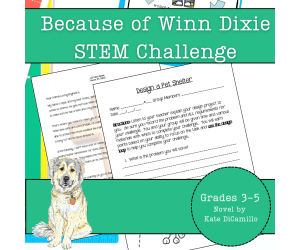
Because of Winn Dixie STEM Experiment + STEM Project for Grades 3-5
Science, Technology, Engineering, STEM, Grade 3, 4, 5, Experiments, Activities, Projects, Diagrams, Teacher Tools, Graphic Organizers, Rubrics
Engage your students in a hands-on STEM challenge inspired by Because of Winn-Dixie! This exciting activity combines engineering, creativity, and problem-solving as students design and build a pet-friendly shelter for Winn-Dixie, the lovable dog who’s afraid of storms. Perfect for blending literature with science, this challenge encourages young minds to apply engineering principles using simple materials, all while developing teamwork, critical thinking, and innovation. What’s Included in This Resource: Student Letter: An engaging letter from Opal invites students to participate in the challenge, drawing a direct connection between the story’s problem and the real-world task. The Design Loop Visual: This visual aid is a great tool for students to glue into their science journals for easy reference. It can easily be enlarged as a classroom poster. Step-by-Step Directions: Detailed instructions that can be printed or written into science journals for a hands-on approach. These directions ensure that students stay on track while working through each part of the challenge. Teacher Notes: Helpful guidance to assist you in creating a clear problem statement, establishing success criteria, and setting time limits and materials. Tailor these instructions to fit your classroom’s needs. Key Skills Developed: ✔ Problem-Solving: Encourage students to identify challenges and develop creative, effective solutions. ✔ Engineering Design: Teach the design process by having students follow the design loop to plan, construct, test, and refine their pet shelters. (Discussing area and perimeter will enhance this design specifically.) ✔ Critical Thinking: Help students evaluate their designs, analyze their prototypes, and identify ways to improve them. ✔ Collaboration: Foster teamwork as students collaborate to achieve a common goal. Flexible Classroom Use: This STEM challenge is perfect for guided instruction or as part of a broader literature and science unit. It provides an opportunity for students to connect their love of reading with real-world applications, improving both their scientific knowledge and creative abilities. Why Teachers Love It: ⭐ “My students were so engaged! It brought their love for reading into STEM learning.” ⭐ “This activity is simple to set up and promotes creativity and teamwork.” ⭐ “The combination of literature and science created an ideal cross-curricular experience for my class.” Inspire your students to help Winn-Dixie solve his stormy dilemma and ignite their passion for engineering with this fun, standards-aligned STEM challenge!
Author Kel's Klass
Tags 4th Grade Science Project, 4th Grade Science Experiment, 5th Grade Science Project, 5th Grade Science Experiment, Engineering Diagram, Science Graphic Organizer, Science Rubric, Because Of Winn Dixie, 3rd Grade Science Project, 3rd Grade Science Experiment

Research Paper NO-PREP Teaching Resource
ELA, Writing, Formal Writing, Life Studies, Business, Research, Resources for Teachers, High School, Homeschool Resources, Middle School, Worksheets & Printables, Writing Prompts, Teacher Tools, Rubrics, Outlines, Lesson Plans
This comprehensive Research Paper Teaching Resource gives you everything you need as an educator or homeschool parent to guide your students/homeschoolers through the research paper writing process. I have broken down each step—from choosing that initial topic all the way to final submission—into clear, manageable pieces that won't overwhelm your students/homeschoolers. By walking them through this structured approach, you'll help your students/homeschoolers build the confidence and skills they need to create truly college-ready research papers that they can be proud of. INCLUDED IN THIS RESOURCE: ✓Student-friendly research paper guide ✓Customizable templates and detailed outlines ✓Instructor feedback forms ✓Student self-evaluation tools ✓Comprehensive grading rubrics ✓Plagiarism prevention guidelines ✓Step-by-step instructions for both teachers and studentsCustomizable templates and detailed outlines The real beauty of this resource lies in how adaptable it is for real classroom/homeschool needs. I have designed the templates and outlines so teachers and homeschool parents can easily customize them for history, science, literature, or any subject you're teaching. Whether you've got middle schoolers just learning the research ropes or high schoolers preparing for college, the materials scale beautifully. I created this guide because research writing should be more than just another assignment to check off—it's a chance for students and homeschoolers to discover their analytical voice and join meaningful academic conversations. Students and homeschoolers don't just learn the mechanics; they develop the deeper thinking skills that make their writing stand out, preparing them for success now and through their college years. Whether you're an experienced teacher wanting to breathe new life into your research paper instruction or a homeschool parent tackling formal academic writing with your teens for the first time, I have you covered. This resource gives you the complete toolkit—structured guidance, practical templates, and fair assessment tools—that help your students/homeschoolers build research and writing skills they'll rely on throughout their educational journey and well beyond. If you and your students/homeschoolers enjoyed this resource, please leave a review. Thank you for your support! Tina - Big Easy Homeschooling Mom
Author Homeschool with Big Easy Homeschooling Mom
Rating
Tags Research Paper Guide, Thesis Development, Research Question Formulation, Research Paper Template, Homeschool Writing Resource, Middle & HIgh School Writing Resource, Teaching Research Skills, College Prep Writing, Critical Thinking Writing Skills, Academic Paper Structure
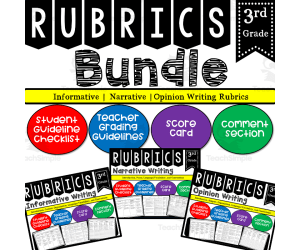
Writing Rubric BUNDLE for 3rd Grade with Checklist
ELA, Writing, Resources for Teachers, Grade 3, Rubrics, Teacher Tools, Worksheets & Printables, Worksheets
Teaching Writing Rubrics and Checklists for 3rd Grade. This 24-page writing rubric bundle equips 3rd grade teachers with the tools they need to set clear expectations and assess student writing. In this unit, it includes informative, narrative, and opinion writing rubrics that outline specific criteria like introduction, content, focus, organization, vocabulary, and conventions. Teachers can use the detailed 1-5 rating scale to precisely grade writing samples. Students can reference the accompanying checklists to understand what's required for high quality writing. Classrooms will benefit from having clearly communicated standards. Students will write with more confidence knowing the expectations. Teachers will save time grading and feel empowered to provide specific, helpful feedback. With rubrics for multiple genres, this resource can be utilized for various writing assignments throughout the year. It's a comprehensive assessment solution for any 3rd grade ELA curriculum. For many writing units for 3rd - 5th grade students and K-2nd grade that are specifically from the K-5 Treasures author of these products that are perfect to use with this rubric, click on the links below: Fall | Back to School Writing Prompt BUNDLE! 3rd-5th Grade Thanksgiving Writing Prompts for 3rd-5th Grade Winter Writing Prompts for 3rd-5th Grade Christmas Writing Prompts for 3rd-5th Grade Martin Luther King Jr. Writing Prompts for 3rd-5th Grade Valentine's Day Writing Activities for 3rd - 5th Grade: Narrative, Opinion, and Informative President's Day Writing Activities for 3rd - 5th Grade: Narrative, Opinion, and Informative Spring Narrative Writing, Spring Opinion Writing, and Spring Informative Writing Prompts for 3rd - 5th Grade Easter Narrative Writing, Easter Opinion Writing, and Easter Informative Writing Prompts for 3rd - 5th Grade K-2nd Grade Writing Units SUMMER ESL Writing Prompts and Drawing for K-2nd Grade Spring Narrative Writing, Spring Opinion Writing, and Spring Informative Writing Prompts with Vocabulary Words for K-2nd Grade For other rubrics for more grades, click on the links below: Writing Rubric BUNDLE for 3rd Grade with Checklist Writing Rubric BUNDLE for 4th Grade with Checklist Writing Rubric BUNDLE for 5th Grade with Checklist
Author K-5 Treasures
Tags Writing Rubrics, Opinion Writing Rubric, Informative Writing Rubric, Narrative Writing Rubric, Writing Assessment, 3rd Grade Writing Rubric, Writing Rubric For 3rd Grade, Third Grade Writing Rubrics, 3rd Grade Writing

High School Edgar Allan Poe Unit Study on Gothic vs. Modern Horror
ELA, Literature, Reading, Writing, Research, Resources for Teachers, High School, Homeschool Resources, Teacher Tools, Assessments, Graphic Organizers, Lesson Plans, Outlines, Presentations, Quizzes and Tests, Rubrics, Templates, Worksheets & Printables
Bring the Chills to Your High School Literature Study As a homeschool mom, I know firsthand how tough it is to find high school English curriculum that is both truly rigorous and actually interesting to teenagers. That is exactly why I created this High School Edgar Allan Poe 2-Week Unit Study . I wanted to bridge the atmospheric, classic dread of Poe with the sharp, modern psychological tension of authors like Shirley Jackson. This is not just about reading spooky stories for fun—we are digging into the actual mechanics of how authors craft fear across different literary eras. It is a completely no-prep unit that keeps my own daughter excited to open her books every single morning! What You Get in This Resource: Detailed 2-week lesson plans Comprehensive student handouts Complete grading rubrics and answer keys A ready-to-use PowerPoint presentation Core Skills & Topics Covered: Foundations of Gothic horror vs. modern psychological suspense Comparative literary analysis Formal essay writing By the end of these two weeks, your students/homeschoolers will have tackled complex, eerie texts, constructed a strong thesis statement, and learned how to back up their arguments with evidence. I have also included a built-in peer review process to help them learn how to give and receive constructive feedback in a supportive way. You will be amazed at the deep, thoughtful conversations this unit sparks—taking your high schooler way beyond simple plot summaries and right into higher-order critical thinking. If you and your students/homeschoolers enjoyed this unit study, please leave a review. Thank you for your continued support! Tina - Big Easy Homeschooling Mom
Author Homeschool with Big Easy Homeschooling Mom
Rating
Tags Edgar Allan Poe Unit, Gothic Horror Lessons, Modern Horror Literature, Horror Genre Study, High School English Resources, Gothic Vs Modern Horror, Poe Analysis, Shirley Jackson Lesson, Comparative Literature Unit, Horror And Mystery Genre

Limerick Poem Lesson Plan, Template, Examples & Rubric Poetry Writing
ELA, Poetry, Literature, Homeschool Templates, Grade 3, 4, 5, 6, Centers, Activities, Graphic Organizers, Teacher Tools, Lesson Plans, Rubrics, Worksheets & Printables
Ever tried teaching a limerick poem and found your students either stuck on rhyming… or going completely off track? This resource was created to make teaching limericks much more manageable. It gives your students a clear structure to follow, while still leaving room for the fun and creativity that limerick poetry is known for. Instead of guessing what to write next, students are guided through the process step by step, using examples and templates that help everything “click”. What's Included A detailed lesson plan you can pick up and use A Limerick poem example to model expectations (color and blackline posters) Interactive notebook templates to support each stage A clear explanation of the AABBA rhyme pattern An assessment rubric to keep marking simple A publishing sheet that would make the perfect bulletin board display to celebrate National Poetry Month Perfect For Grades 3-6 Poetry lessons Writing units Literacy rotations Homeschool learning Small group or whole-class teaching How You Might Use It Start by reading a few limericks together (your students will love the humor), then break down the structure as a class. From there, they can use the templates to plan and write their own poems before sharing. Skills Covered Poetry writing Rhyme and rhythm (AABBA pattern) Vocabulary development Sentence structure Creative expression Limericks can be tricky—especially when students are trying to juggle rhyme, rhythm, and structure all at once. Having a template in front of them makes a big difference. I’ve found that once students understand the pattern, they actually enjoy the process (and the silly results that come with it!). It’s also a great way to build confidence in students who usually struggle to get started with writing. So, if you’re looking for a way to teach limerick poetry that gives your students enough structure to succeed—but still lets them have fun with it—this is an easy addition to your writing lessons.
Author Teach2Tell
Rating
Tags Poetry Lesson Plan, Poetry Writing Activity, Elementary Poetry, National Poetry Month , Writing Rubric, Creative Writing Lesson, Poetry Examples, Limerick Poem, Limerick, How To Write A Limerick
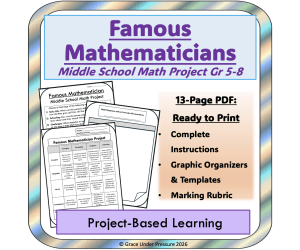
Famous Mathematician: Math Research Project 5th 6th 7th 8th Grade
Research, ELA, Writing, Formal Writing, Social Studies, Biographies, Math, Grade 5, 6, 7, 8, Worksheets & Printables, Worksheets, Writing Prompts, Drawing Templates & Outlines, Teacher Tools, Rubrics, Activities, Projects
Here is a ready-to-print middle school math research project about famous mathematicians for your students in 5th through 8th grade. Each student will pick a famous mathematician, complete research about their life and mathematical discoveries, and create an organized project with paragraphs & visuals to share their learning. How to Use: • Print a 12-page project booklet for each pupil. • Page 2 has instructions for the project including a website for selecting famous mathematicians, places to write due dates, and a checklist to keep students organized. • Page 3 has seven different paragraph prompts for students to research. Each student must pick at least four prompts to have in their unique project. • Pages 4-6 are graphic organizers for your students to use for research notes. • Pages 7-9 are templates for students to use for writing their paragraphs. • Page 10 is for students to draw a portrait of their mathematician. • Page 11 is for students to show diagrams and formulas of the math that their mathematician discovered. • Page 12 is a title page for the project. • Page 13 is a rubric to use to assess the completed project. During several weeks of classes, your students will complete research, write & proofread paragraphs, and draw the visual pieces of their project. They can present their projects to each other, and you can use the rubric to assess them. Grades to Use With: This project is designed for middle school students in 5th, 6th 7th, or 8th grade who are learning about mathematicians, biography writing, library research skills, and writing expository paragraphs. It could also be used in high school special education classes where appropriate. What's Included: 13-Page PDF: Ready to Print and Use! Complete Teacher Instructions 2 Pages of Student Instructions & Writing Topics 6 Student Graphic Organizers for Note-Taking & Paragraph Writing 2 Student Templates for a Mathematician Portrait and Math Sketches Project Title Page Marking Rubric
Author Grace Under Pressure
Rating
Tags Math Project, Math Research Project, Famous Mathematicians, Mathematicians, Famous Mathematicians Project, Biography Project, Middle School Math Project, Math Research

The War That Saved My Life Quizzes, Literary Essays & Quick Writes
ELA, Literature, Reading, Reading Comprehension, Writing, Formal Writing, Creative Writing, Grade 5, 6, 7, Quizzes and Tests, Teacher Tools, Quizzes, Tests, Rubrics, Worksheets & Printables, Novel Studies, Writing Prompts
The War That Saved My Life Chapter Quizzes, Literary Essays & Quick Writes Printable & Digital | Grades 5–7 | Answer Keys Included (PDF Only) When I started teaching The War That Saved My Life, I wanted quick ways to check comprehension and also give my students meaningful writing practice. That’s why I created this resource. It combines chapter quizzes, literary essay prompts, and quick writes to save time and keep assessment simple but effective. There are seven comprehension quizzes organized by chapter sections. Each one includes multiple-choice questions for quick checks, two short responses, and one extended response to encourage text-based answers and critical thinking. The Google Forms versions make digital grading easy, and they’re completely editable, so you can customize questions or scoring as needed. In addition to the quizzes, you’ll find 10 literary essay prompts with a rubric to help guide structured writing about theme, character development, conflict, symbolism, and more. For shorter writing practice, there are 5 quick-write prompts that are perfect for warm-ups or reflection after reading. What’s Included ✔ 7 comprehension quizzes (printable + Google Forms) ✔ 10 literary essay prompts with rubric ✔ 5 quick-write prompts with rubric ✔ Digital Google Slides Student Journal ✔ Answer keys for all PDF quizzes This resource works well for whole-class novel studies, small groups, or independent work. I’ve used it to monitor understanding, prep students for standardized testing, and build their confidence in responding with evidence. Printable and digital versions are included, and answer keys are provided for every quiz in the PDF version.
Author Creatively Gifted
Rating
Tags Reading Comprehension, Literary Essay, Quick Writes, The War That Saved My Life, Comprehension Quizz
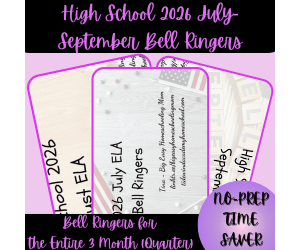
High School 2026 July-September ELA Bell Ringers (Quarter)
Reading, ELA, Writing, Research, Resources for Teachers, High School, Homeschool Resources, Teacher Tools, Rubrics, Quizzes and Tests, Lesson Plans, Worksheets & Printables, Writing Prompts
As a fellow homeschooling mom, I know exactly how crucial those first few minutes of the day are for setting the right tone. I designed this High School 2026 July-September ELA Bell Ringers (quarter) comprehensive resource to streamline your planning while providing your high schooler with intellectually stimulating daily exercises. By combining these three months into one cohesive bundle, you eliminate the daily scramble of finding high-quality prompts. Furthermore, this High School 2026 July-September ELA Bell Ringers (quarter) collection transforms transition periods into powerful opportunities for critical thinking and creative expression. You will find that these activities effortlessly bridge the gap between casual study and academic rigor. Best of all, this resource empowers you to cultivate consistent, high-level engagement throughout the entire quarter. INCLUDED IN THIS RESOURCE: Three months of daily ELA bell ringers. Diverse prompts spanning literature and language. Focused exercises for critical skill development. Ready-to-use content for daily academic routines. TOPICS COVERED: Rhetorical analysis and logical fallacies. Advanced syntax and sophisticated grammar. Literary theory and critical perspectives. Creative writing and thematic synthesis. Ultimately, this High School 2026 July-September ELA Bell Ringers (quarter) bundle is more than just a set of prompts; it is a gateway to meaningful daily discourse. You are investing in a resource that respects your time while challenging your student/homeschoolers to push beyond surface-level understanding. Regardless of your specific approach, these bell ringers provide the necessary structure to keep learning focused and productive. By implementing these exercises, you create a calm, intellectually rich environment that prepares your student/homeschooler for the complexities of higher-level work. I truly hope this collection brings as much clarity and joy to your homeschool days as it has brought to mine. Let’s make this upcoming quarter your most effective one yet! If you and your students/homeschoolers enjoyed this resource, please leave a review. Thank you for your support! Tina - Big Easy Homeschooling Mom
Author Homeschool with Big Easy Homeschooling Mom
Rating
Tags ELA Lesson Plans, English Curriculum, Daily ELA Tasks, Homeschool English, Writing Prompts For Teens, Homeschooling High School, High School Resources, Bell Ringers, Writing Warm Ups, Homeschool Resources