Narrative Rubric – Student & Peer Self-Assessment
- Grades
- Grade 4
- File type
- Preparation
- Print ready


- Subject
- ELA, Writing
- Topic
- Writing rubrics, Peer assessment
- Resource types
- Rubrics, Assessments
- Preparation
- Print ready
- Standards
- W.4.5
Product description
From the author
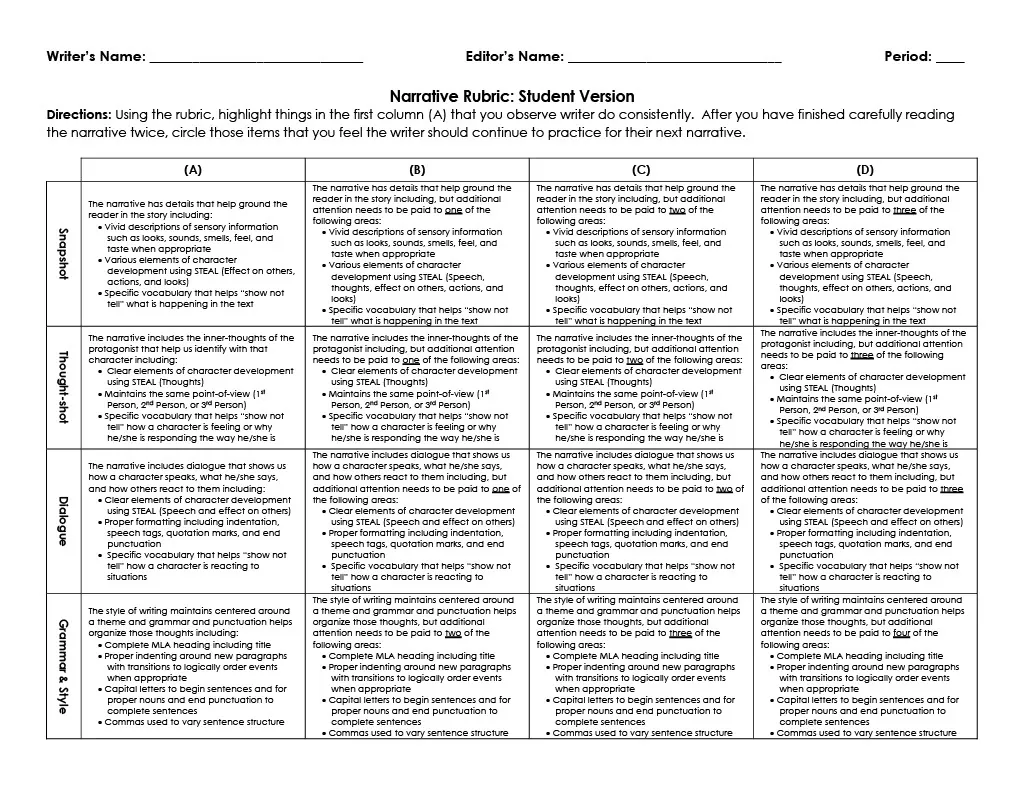
This is a Narrative Rubric - Student Version.
Students can use this rubric to grade their own written narratives or peer assess their classmates' writing.
Directions are provided on the rubric for how to score work.
Related resources
More resources teachers may find useful
24 related resources were found using this product's title, contributor, categories and tags.


In the classroom
Teaching tips & learning objectives

Learning objectives
Evaluate a narrative's use of sensory detail and character description against a leveled rubric.
Identify a narrative's use of inner-thought (thought-shot) techniques to build reader empathy.
Apply consistent grammar and formatting expectations to a completed narrative.

Teaching tips
Have students read the narrative twice before marking the rubric, as the directions specify -- once for a general read and once for detailed evaluation.
Model the STEAL acronym with a mentor text before students apply it to their own or a peer's narrative.
Use the rubric in peer-review pairs to discuss a specific revision goal.

Skills covered
Narrative self-assessment — students evaluate their own or a peer's narrative against four leveled criteria (Snapshot, Thought-shot, Dialogue, Grammar & Style).
STEAL character-development analysis — students identify speech, thoughts, effect on others, actions, and looks as elements of character development within a narrative.
Peer feedback delivery — students highlight strengths and circle growth areas in a peer's narrative using a shared rubric vocabulary.

No reviews yet
Downloaded this resource? Tell other teachers how it went.
Curriculum
Standards, concepts & topics
Standards
 Standards
- W.4.5
Core concepts
 Core concepts
Narrative writing rubric
Peer assessment
Self-assessment
STEAL character development
 Topics
More to explore
You may also like