



3,504 products added recently
Page 4 - Writing Prompts By Genre

 Show filters

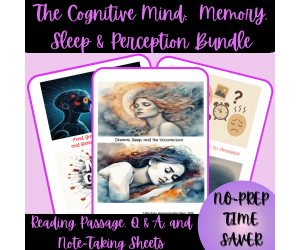
The Cognitive Mind: Memory, Sleep & Perception Reading Passage Bundle
STEM, Science, Resources for Teachers, Life Studies, Reading, ELA, Writing, High School, Homeschool Resources, Worksheets & Printables, Writing Prompts, Teacher Tools, Literacy Readers, Assessments, Quizzes and Tests
As a homeschool mom who has spent countless hours searching for quality psychology resources, I understand the challenge of finding materials that truly engage students/homeschoolers while covering complex topics in depth. The Cognitive Mind: Memory, Sleep & Perception Reading Passage Bundle comprehensive psychology bundle brings together three fascinating areas of human cognition that will captivate your high school students/homeschoolers: memory systems, sleep and dreams, and perceptual illusions and biases. Each resource is carefully crafted to challenge critical thinking while remaining accessible to teen learners. Whether you're teaching a dedicated psychology course or incorporating these topics into broader science or health curricula, this bundle provides everything you need for meaningful learning experiences. INCLUDED IN THIS RESOURCE: 3 detailed reading passages 60 in-dept passage questions 3 answer keys 15 note-taking sheets TOPICS COVERED: How memories are actually formed, stored, and retrieved in the brain—from the tiny molecular changes all the way up to the behaviors we can observe The fascinating world of sleep cycles, what our dreams might really mean, and how our unconscious minds influence our everyday decisions Why our eyes and brains can trick us with optical illusions, the mental shortcuts that lead us astray, and how our cultural backgrounds shape what we think is "real" The exciting (and sometimes scary) possibilities of new technologies that could alter our memories, and what that might mean for who we are as individuals The Cognitive Mind: Memory, Sleep & Perception Reading Passage Bundle psychology bundle is exactly what I have been looking for as a homeschool mom who wants to give her teens college-level content without the college-level overwhelm. I have built each resource on solid scientific research but written it in a way that actually connects with teenagers, sparking those amazing dinner table conversations about how our minds work and whether we can really trust what we think we know. The question sets and note-taking materials aren't just busy work—they are designed to help your kids really wrestle with these concepts and make them their own. Whether your teenager is dreaming of a psychology career or just needs to sharpen their critical thinking skills for whatever path they choose, this bundle gives them the kind of deep, analytical practice that will serve them well in college and throughout their lives. If you and your students/homeschoolers enjoyed this resource, please leave a review. Thank you for your support! Tina - Big Easy Homeschooling Mom
Author Homeschool with Big Easy Homeschooling Mom
Rating
Tags Psychology Curriculum, Neuroscience For Teens, High School Psychology Reading Passages With Questions, Homeschool Neuroscience Curriculum For Teens, AP Psychology Memory And Cognition Study Materials, Psychology Reading Comprehension Activities For High Schoolers, Cognitive Psychology Lessons For Homeschool Students, Memory And Perception Educational Resources For Teenagers, AP Psychology Prep, High School Science

Science Reading Comprehension Passage: How Sound Travels. Fillable PDF
Science, ELA, Reading, Reading Comprehension, Strategies, Resources for Teachers, Physics, Grade 6, 7, 8, 9, Writing Prompts, Worksheets & Printables, Centers, Activities, Teacher Tools, Assessments, Quizzes and Tests, Quizzes, Tests
Physical Science Reading Comprehension Passage and Questions: How Sound Travels (Fillable PDF) This very engaging Physical science reading passage is about how sound travels . More specifically, it explains that sound begins with vibrations , moves as a longitudinal wave through a medium such as air, liquid, or solid, and then reaches the ear. It also explains how the eardrum, ossicles, cochlea, auditory nerve, and brain work together so we can recognize pitch and loudness. The passage also corrects the misconception that sound travels fastest in air by explaining that sound often travels faster in solids because their particles are packed closer together. This passage is designed to bridge the gap between science and literacy through strengthening reading comprehension and sparking scientific curiosity in middle school students. The passage blends English Language Arts skills with accurate science content that supports NGSS classroom practice. Ideal for interdisciplinary learning in ELA and Science. Suitable for Grade 9 review, too! These worksheets are designed as fillable PDFs , which means students can type their answers directly into the document on any computer or tablet . Each page includes highlighted text fields that show them exactly where to type! Student Tasks for The Passage: 5 multiple-choice questions targeting main idea, key details, inference, vocabulary in context, and use of evidence 5 vocabulary matching items with clear, student-friendly definitions 5 text-based questions that require citing specific lines or facts 1 summary prompt that asks students to condense central ideas accurately Full answer key for every section Available Formats for this Resource PDF Word Docs Google Docs FULL CATALOG OF DOWNLOADING LINKS HERE Product Details Length: 5 pages total Grades: 6–8, also suitable for Grade 9 review Use cases: close reading, stations, homework, intervention, test prep, and sub plans Standards support: reinforces informational-text skills and supports NGSS-style sense making through observation, modeling, and clear use of claim, evidence, and reasoning Why Teachers Choose This Set Authentic science content paired with rigorous literacy practice Consistent task structure across all passages for easier planning and smoother student routines Clear, age-appropriate writing that builds confidence without oversimplifying Other Science Reading Collections you May find in the store: 1. Astronomy & Space Science 2. Volcanoes, Rocks, & Mountains 3. Rock Cycle, Soil, & Sinkholes 4. Mars, Glaciers, & Antarctica 5. Water Cycle, Acid Rain, & Wastewater 6. Insects, Animals, & Ecosystems 7. Bioluminescence & Insects 8. Animal Skin, Cats, & T. Rex 9. Human Body and Senses 10. Health & Applied Bioscience 11. Waves, Light, & Imaging 12. Electricity & Energy 13. Motion & Materials 14. Chemistry and Materials Science Use this set to reinforce ELA skills in science, to add literacy to your lessons, and to support independent work. The passages strengthen main idea, evidence use, vocabulary in context, inference, cause and effect, and summary writing. With ready-to-use assessments and complete answer keys, you can provide focused practice that is simple to run and fast to review.
Author CORED Education - Middle & High School
Rating
Tags Middle School, Reading Comprehension, Reading Strategies, ELA, Centers, Reading Passage, Assessments, Vocabulary, Physical Science, Physics

How Languages Change: Social Studies Reading Passage (PDF)
ELA, Reading, Reading Comprehension, Strategies, Resources for Teachers, Social Studies, History, History: World, Grade 6, 7, 8, 9, Writing Prompts, Worksheets & Printables, Centers, Activities, Teacher Tools, Assessments, Quizzes and Tests, Quizzes, Tests
How Languages Change and Disappear: Social Studies Reading Comprehension Passage (PDF) This resource introduces a unique Social Studies reading comprehension passage with questions about How Languages Change and Disappear. The passage is carefully designed to bridge the gap between social studies and literacy through strengthening reading comprehension and sparking knowledge curiosity in middle school students. Each passage blends English Language Arts skills with accurate social studies content . Ideal for interdisciplinary learning in ELA and Social Studies. Suitable for Grade 9 review, too! Student Tasks throughout the passage: 5 multiple-choice questions targeting the following skills: main idea, key details, inference, vocabulary in context, and use of evidence 5 vocabulary matching items with clear, student-friendly definitions 5 text-based questions that require citing specific lines or facts 1 summary prompt that asks students to condense central ideas accurately Full answer key for every section Available Formats for this Resource: Fillable PDF Word Docs Google Docs FULL CATALOG OF DOWNLOADING LINKS HERE Social Studies Reading Comprehension Collection Links: 1. Ancient Civilizations PDF Fillable PDF Word Docs Google Docs 2. Early Empires and Trade Networks PDF Fillable PDF Word Docs Google Docs 3. The Founding of the United States PDF Fillable PDF Word Docs Google Docs 4. Language, Culture, and Meaning PDF Fillable PDF Word Docs Google Docs 5. Psychology and Society PDF Fillable PDF Word Docs Google Docs 6. Global Festivals and Traditions PDF Fillable PDF Word Docs Google Docs 7. Extreme Environments and People PDF Fillable PDF Word Docs Google Docs 8. Food, Culture, and Preservation PDF Fillable PDF Word Docs Google Docs 9. Global Food Customs PDF Fillable PDF Word Docs Google Docs 10. Media, Communication, and Popular Culture PDF Fillable PDF Word Docs Google Docs 11. Human Impact on the Environment PDF Fillable PDF Word Docs Google Docs 12. Civic Action and Social Change PDF Fillable PDF Word Docs Google Docs 13. Fashion, Society, and Power PDF Fillable PDF Word Docs Google Docs 14. People, Places, and Unusual Histories PDF Fillable PDF Word Docs Google Docs Product Details: Length: 5 pages Grades: 6–8, also suitable for Grade 9 review Use cases: close reading, stations, homework, intervention, test prep, and sub plans Why Teachers Choose This Passage: Authentic social studies content paired with rigorous literacy practice Consistent task structure for easier planning and smoother student routines Clear, age-appropriate writing that builds confidence without oversimplifying Use this passage to reinforce ELA skills in social studies, to add literacy to your lessons, and to support independent work. The passage strengthens main idea, evidence use, vocabulary in context, inference, cause and effect, and summary writing. With ready-to-use assessments and complete answer keys, you can provide focused practice that is simple to run and fast to review.
Author CORED Education - Middle & High School
Rating
Tags Middle School, Reading Comprehension, Reading Strategies, ELA, Centers, Reading Passage, Assessments, Vocabulary, Social Studies, WORLD HISTORY

Health & Applied Bioscience: SAMPLE Reading Comprehension (Google)
Science, ELA, Reading, Reading Comprehension, Strategies, Resources for Teachers, Health, P.E. & Health, Life Sciences, Grade 6, 7, 8, 9, Writing Prompts, Worksheets & Printables, Centers, Activities, Teacher Tools, Assessments, Quizzes and Tests, Quizzes, Tests
This is a ONE PASSAGE SAMPLE. The following is the description of the FULL resource and the downloading links: Health & Applied Bioscience: Reading Comprehension Passages and Questions (Google) This very engaging collection of science reading passages about The Truth about Drinks, Green Tea, and Plastic in Medicine is designed to bridge the gap between science and literacy through strengthening reading comprehension and sparking scientific curiosity in middle school students. Each passage blends English Language Arts skills with accurate science content that supports NGSS classroom practice. Ideal for interdisciplinary learning in ELA and Science. Suitable for Grade 9 review, too! What Is Included? There are (3) informational passages: The Truth About Drinks: Many popular drinks add a lot of sugar, caffeine, or artificial sweeteners without people noticing. Knowing what is in sports drinks, sodas, and energy drinks helps you choose water or low-sugar options more often. Green Tea: Ancient Drink, Modern Science: Green tea comes from an old tradition, but today it is studied for its helpful plant chemicals. It can support alertness and health, but it works best as part of overall good habits, not as a magic drink. Plastic in Medicine: From Everyday Uses to Life-Saving Care: Plastics made it easier to keep hospitals clean, since items like gloves, syringes, and IV tubes can be used once and thrown away. They also make medical tools lighter and safer, though all that single-use plastic has to be handled carefully. Student Tasks for Each Passage: 5 multiple-choice questions targeting main idea, key details, inference, vocabulary in context, and use of evidence 5 vocabulary matching items with clear, student-friendly definitions 5 text-based questions that require citing specific lines or facts 1 summary prompt that asks students to condense central ideas accurately Full answer key for every section Available Formats for this Resource PDF Word Docs FULL CATALOG OF DOWNLOADING LINKS HERE Reading Passage Links: Astronomy & Space Science PDF Word Docs Google Docs Volcanoes, Rocks, & Mountains PDF Word Docs Google Docs Rock Cycle, Soil, & Sinkholes PDF Word Docs Google Docs Mars, Glaciers, & Antarctica PDF Word Docs Google Docs Water Cycle, Acid Rain, & Wastewater PDF Word Docs Google Docs Insects, Animals, & Ecosystems PDF Word Docs Google Docs Bioluminescence & Insects PDF Word Docs Google Docs Animal Skin, Cats, & T. Rex PDF Word Docs Google Docs Human Body and Senses PDF Word Docs Google Docs Health & Applied Bioscience PDF Word Docs Google Docs Waves, Light, & Imaging PDF Word Docs Google Docs Product Details Length: 14 pages total Grades: 6–8, also suitable for Grade 9 review Use cases: close reading, stations, homework, intervention, test prep, and sub plans Standards support: reinforces informational-text skills and supports NGSS-style sense making through observation, modeling, and clear use of claim, evidence, and reasoning Why Teachers Choose This Set Authentic science content paired with rigorous literacy practice Consistent task structure across all passages for easier planning and smoother student routines Clear, age-appropriate writing that builds confidence without oversimplifying Use this set to reinforce ELA skills in science, to add literacy to your lessons, or to support independent work. The passages strengthen main idea, evidence use, vocabulary in context, inference, cause and effect, and summary writing. With ready-to-use assessments and complete answer keys, you can provide focused practice that is simple to run and fast to review.
Author CORED Education - Middle & High School
Rating
Tags Middle School, Reading Comprehension, Reading Strategies, ELA, Centers, Reading Passage, Assessments, Vocabulary, Life Science, Health

Yoga Reading Comprehension Passage - Cored Ed Encyclopedia
ELA, Language Development, Reading Comprehension, Reading, History, Social Studies, Pre-Reading, P.E. & Health, Yoga, Geography, Grade 2, 3, 4, 5, Worksheets & Printables, Worksheets, Teacher Tools, Centers, Activities, Writing Prompts, Assessments, Quizzes and Tests, Quizzes, Lesson Plans
This yoga reading comprehension with lesson plan includes: Visualization (on the front cover) Start your lesson by taking a minute to think and share something about the topic. Read the script aloud (slowly), perhaps prepare some music or sound effects. Student close their eyes and let their imaginations wander. Students open their eyes, read the question aloud and give them a few minutes to complete. Ask a few students to share or keep answers until the end to compare with what they learn in the passage. Quick pause—thousands of Cored Education products are included with your TeachSimple membership. Download links and encyclopedia index available here. Pre-Reading Trivia Students will write down one thing they already know about the subject and then read five more facts and discuss. These facts are fun, and the students will enjoy learning about the subject before reading more. Give 1 minute for students to write what they already know (no pressure—best guess is fine). Read the five facts together. After each fact, do ask a student for their opinion, was it surprising? Set a purpose by asking students to highlight/underline one fact they want to learn more about during the reading. Reading Passage The text is a high-interest reading passage with set paragraphs, roughly three to four paragraphs long. It contains a variety of themes about the topic, anywhere from history to technology. The passage is between 250 and 350 words in length. First, ask students to look at the headings and see what they’ll learn about today. What do they know about the topic/heading? First read options: Teacher read-aloud (best for support). Partner reading (paragraph by paragraph). While reading, students underline important details, and vocabulary words they think may come up in the questions section. Mixed Questions The first question page contains four multiple-choice questions, each with a choice of four answers, and three written response questions that require a sentence or two from the student. Students complete the mcqs first independently, then review quickly as a class. For the 3 written responses, try to get students giving the answer with some form of evidence: “I think ___ because the text says ___.” If students get stuck, send them back to check the passage. Vocabulary Questions Practice seven key words from the text in this section across two activities. First section is scrambled words where students will unscramble three words given a clue for each. The second section is a word to meaning matching activity. Before starting, have some students read out words they underlined in the passage. Ask students to say the word and read aloud the sentence(s) around each word. Ask students to do scrambled words and the matching exercise in pairs then go through answers as a class. For the scrambled spelling task, get four pairs to come up to the board and write the words for extra practice with the other student reading out the clue. For the matching task, prompt students to give full sentences: “I matched ___ with ___ because ___.” Creative Writing In this question, the student will be required to write a five to eight sentence paragraph on a question related to the topic. Before starting, ask students write down 3 key ideas they are going to include in their piece. Ask students for ideas to share around the class to help those struggling. Pro writing expectations: 5–8 sentences At least 2 facts or details from the passage At least 2 vocabulary words from the previous page Students read their paragraphs while classmates listen for facts and vocabulary words. Extension Activities This page is optional for fast finishers or to take home. There are several activities, each one requiring a different skill. Do some, do none, do all, completely optional - but you will feel reassured knowing every possibility is planned for. Includes summary writting question. Answer Key There are answers for the multiple-choice questions, written response questions have sample answers, vocabulary answers and if there is a summary question then a sample summary will be provided as well. Lesson Plan Included Customized lesson plan for this lesson is included. Lesson Snapshot Title: Yoga Genre: Nonfiction (informational text) Subject: Social Studies & Health/SEL (culture and well-being) / Informational Reading Primary Topic: Yoga’s origins, key ideas, and modern practice Estimated Guided Reading Level (A–Z): Q Support pages present: pre-reading trivia, mixed questions, vocabulary activities, creative writing, extension activities, and an answer key. What This Lesson Teaches Best Explains yoga as an old practice that began in India and grew over time. Defines what the word “yoga” can mean in the passage (“yoke” or “union,” like two things working as one). Describes key tools in yoga: body positions, steady breathing, and quiet attention (and how breathing can steady the mind). Introduces “sutras” and explains that Patanjali gathered yoga ideas into short lines meant to be remembered, including a description of yoga as a path with eight “limbs.” Traces how yoga changed in the 1900s, noting that teachers such as Tirumalai Krishnamacharya helped create modern postural yoga with flowing sequences taught in classes. Learning Goals Students will describe what the passage says the word “yoga” can mean. Students will identify tools the passage says yoga uses (body positions, steady breathing, quiet attention). Students will explain why careful breathing matters in some yoga traditions, using details from the text. Students will describe what sutras are and why they were written, according to the passage. Students will summarize how yoga changed in the 1900s based on the passage’s timeline. Key Vocabulary From the Text Sanskrit — a very old language from India. traditions — ways people practice and pass ideas over time. sutras — short lines of teaching meant to be remembered. meditation — a quiet practice to help the mind rest. asana — a steady seat for meditation, not a gym pose. FULL CATALOG OF DOWNLOAD LINKS AND ENCYCLOPEDIA INDEX HERE
Author Cored Education
Rating
Tags Vocabulary, Reading Comprehension, Reading Passages, Lesson Plans, Ela Lesson Plans, Reading Comprehension Lesson Plans, Pre-reading, Social Studies Lesson Plans, Yoga, History

Noah's Ark Bible Story Foldable Mini Book Grade 1 2 3 READING
Common Core, ELA, Literature, Children’s Literature, Reading, Reading Comprehension, Strategies, Grade 1, 2, 3, Activities, Worksheets & Printables, Writing Prompts, Projects, Crafts, Workbooks
Guide your young learners on this amazing journey to discover one of the classic and timeless Bible story of Noah’s Ark through this Noah’s Ark Foldable Mini Book Set! Created for 1st, 2nd, and 3rd Grade learners, homeschoolers, and EFL / ESL students, this enchanting tale is a perfect engaging and meaningful reading classes and Bible lessons! Contained in this set are the following: 1. Noah’s Ark colored mini-book 2. Noah’s Ark black and white mini-book with story tracing activities 3. Noah’s Ark picture-fill mini-book for sequencing test or exercise 4. Noah’s Ark black and white mini-book for story re-tell and writing exercise 5. Noah’s Ark blank mini-book pages for story re-tell, writing and drawing exercises 6. Noah’s Ark sample lesson plan The vivid depiction of the Noah’s Ark tale encourages the students’ imagination and creativity, and the simple presentation of the story gives flexibility to any curriculum preparations. The activities in this resource are made to support the students’ reading comprehension, writing, creative interpretation skills, not to mention instilling the important moral of the Noah’s Ark tale of obedience, faith and hope.
Author It's Teacher L
Tags Noah's Ark, Bible Story, Reading Comprehension, Bible Reading Comprehension, Bible Lessons

Motion & Materials: Physical Science Reading Comprehension (Word)
Science, ELA, Reading, Reading Comprehension, Strategies, Resources for Teachers, Physics, Grade 6, 7, 8, 9, Writing Prompts, Worksheets & Printables, Centers, Activities, Teacher Tools, Assessments, Quizzes and Tests, Quizzes, Tests
Electricity and Energy: Physical Science Reading Comprehension Passages and Questions (Word) This very engaging collection of physical science reading passages about electricity and energy is designed to bridge the gap between science and literacy through strengthening reading comprehension and sparking scientific curiosity in middle school students. Each passage blends English Language Arts skills with accurate science content that supports NGSS classroom practice. Ideal for interdisciplinary learning in ELA and Science. Suitable for Grade 9 review, too! What Is Included? There are (3) informational passages: Sweet Science: How Heat Shapes Candy: Heating sugar syrup to precise temperatures changes how much water remains and how sugar crystals form, turning one mixture into smooth fudge, chewy caramels, or hard, glassy brittle. Baseball Science: From Bat to Ball: Each pitch and hit shows physics at work, as bat speed, launch angle, air resistance, and spin team up to decide whether the ball curves, drops, or carries toward the fence. Electric vs. Gasoline Cars: The Road Ahead: Both car types move people, but gasoline models burn fuel while electric cars draw power from batteries, leading drivers to compare cost, refueling time, and emissions when choosing what to drive. Student Tasks for Each Passage: 5 multiple-choice questions targeting main idea, key details, inference, vocabulary in context, and use of evidence 5 vocabulary matching items with clear, student-friendly definitions 5 text-based questions that require citing specific lines or facts 1 summary prompt that asks students to condense central ideas accurately Full answer key for every section Available Formats for this Resource PDF Google Docs FULL CATALOG OF DOWNLOADING LINKS HERE Reading Passage Links: Astronomy & Space Science PDF Word Docs Google Docs Volcanoes, Rocks, & Mountains PDF Word Docs Google Docs Rock Cycle, Soil, & Sinkholes PDF Word Docs Google Docs Mars, Glaciers, & Antarctica PDF Word Docs Google Docs Water Cycle, Acid Rain, & Wastewater PDF Word Docs Google Docs Insects, Animals, & Ecosystems PDF Word Docs Google Docs Bioluminescence & Insects PDF Word Docs Google Docs Animal Skin, Cats, & T. Rex PDF Word Docs Google Docs Human Body and Senses PDF Word Docs Google Docs Health & Applied Bioscience PDF Word Docs Google Docs Waves, Light, & Imaging PDF Word Docs Google Docs Electricity & Energy PDF Word Docs Google Docs Motion & Materials PDF Word Docs Google Docs Product Details Length: 12 pages total Grades: 6–8, also suitable for Grade 9 review Use cases: close reading, stations, homework, intervention, test prep, and sub plans Standards support: reinforces informational-text skills and supports NGSS-style sense making through observation, modeling, and clear use of claim, evidence, and reasoning Why Teachers Choose This Set Authentic science content paired with rigorous literacy practice Consistent task structure across all passages for easier planning and smoother student routines Clear, age-appropriate writing that builds confidence without oversimplifying Use this set to reinforce ELA skills in science, to add literacy to your lessons, or to support independent work. The passages strengthen main idea, evidence use, vocabulary in context, inference, cause and effect, and summary writing. With ready-to-use assessments and complete answer keys, you can provide focused practice that is simple to run and fast to review.
Author CORED Education - Middle & High School
Rating
Tags Middle School, Reading Comprehension, Reading Strategies, ELA, Centers, Reading Passage, Assessments, Vocabulary, Physical Science, Physics
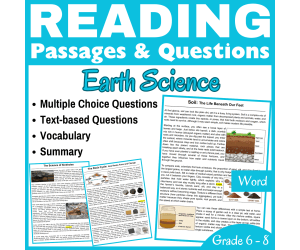
Rock Cycle, Soil, & Sinkholes: Reading Comprehension Passages (Word)
Science, Earth and Environmental Sciences, ELA, Reading, Reading Comprehension, Strategies, Resources for Teachers, Geology, Earth Sciences, Grade 6, 7, 8, 9, Writing Prompts, Worksheets & Printables, Centers, Activities, Teacher Tools, Assessments, Quizzes and Tests, Quizzes, Tests
Rock Cycle, Soil, & Sinkholes: Reading Comprehension Passages (Word) This engaging collection of earth science reading passages about Rock Cycle, Soil, and Sinkholes is designed to bridge the gap between science and literacy through strengthening reading comprehension and sparking scientific curiosity in middle school students. Each passage blends English Language Arts skills with accurate science content that supports NGSS classroom practice. Ideal for interdisciplinary learning in ELA and Science. Suitable for Grade 9 review, too! What Is Included? There are (3) informational passages: Soil: The Life Beneath Our Feet Explore how minerals, organic matter, water, and air build layered soil, and see how texture and structure affect roots, drainage, clean water, and healthy habitats. The Science of Sinkholes Understand how dissolving rock creates underground voids, what can trigger subsidence or collapse, and how mapping and prevention reduce risk in vulnerable areas. The Rock Cycle: How Rocks Form and Change Follow rock material as it melts, crystallizes, weathers, compacts, and transforms under heat and pressure, then connect these processes to examples in nature and everyday life. Student Tasks for Each Passage: 5 multiple-choice questions targeting main idea, key details, inference, vocabulary in context, and use of evidence 5 vocabulary matching items with clear, student-friendly definitions 5 text-based questions that require citing specific lines or facts 1 summary prompt that asks students to condense central ideas accurately Full answer key for every section Available Formats for this Resource PDF Google Docs FULL CATALOG OF DOWNLOADING LINKS HERE Reading Passage Links: Astronomy & Space Science PDF Word Docs Google Docs Volcanoes, Rocks, & Mountains PDF Word Docs Google Docs Rock Cycle, Soil, & Sinkholes PDF Word Docs Google Docs Mars, Glaciers, & Antarctica PDF Word Docs Google Docs Water Cycle, Acid Rain, & Wastewater PDF Word Docs Google Docs Insects, Animals, & Ecosystems PDF Word Docs Google Docs Bioluminescence & Insects PDF Word Docs Google Docs Animal Skin, Cats, & T. Rex PDF Word Docs Google Docs Product Details Length: 15 pages total Grades: 6–8, also suitable for Grade 9 review Use cases: close reading, stations, homework, intervention, test prep, and sub plans Standards support: reinforces informational-text skills and supports NGSS-style sense making through observation, modeling, and clear use of claim, evidence, and reasoning Why Teachers Choose This Set Authentic science content paired with rigorous literacy practice Consistent task structure across all passages for easier planning and smoother student routines Clear, age-appropriate writing that builds confidence without oversimplifying Use this set to reinforce ELA skills in science, to add literacy to your lessons, or to support independent work. The passages strengthen main idea, evidence use, vocabulary in context, inference, cause and effect, and summary writing. With ready-to-use assessments and complete answer keys, you can provide focused practice that is simple to run and fast to review.
Author CORED Education - Middle & High School
Rating
Tags Middle School, Reading Comprehension, Reading Strategies, Reading Passages, ELA, Centers, Reading Passage, Assessments, Vocabulary, Earth Science

Salami and Kimchi: Social Studies Reading Comprehension Passage (Docs)
ELA, Reading, Reading Comprehension, Strategies, Resources for Teachers, Social Studies, Sociology, Grade 6, 7, 8, 9, Writing Prompts, Worksheets & Printables, Centers, Activities, Teacher Tools, Assessments, Quizzes and Tests, Quizzes, Tests
Salami and Kimchi: Social Studies Reading Comprehension Passage (Docs) This resource introduces a unique Social Studies reading comprehension passage with questions about Salami and Kimchi: Salty Traditions. The passage is carefully designed to bridge the gap between social studies and literacy through strengthening reading comprehension and sparking knowledge curiosity in middle school students. Each passage blends English Language Arts skills with accurate social studies content . Ideal for interdisciplinary learning in ELA and Social Studies. Suitable for Grade 9 review, too! Student Tasks throughout the passage: 5 multiple-choice questions targeting the following skills: main idea, key details, inference, vocabulary in context, and use of evidence 5 vocabulary matching items with clear, student-friendly definitions 5 text-based questions that require citing specific lines or facts 1 summary prompt that asks students to condense central ideas accurately Full answer key for every section Available Formats for this Resource: PDF Fillable PDF Word Docs FULL CATALOG OF DOWNLOADING LINKS HERE Social Studies Reading Comprehension Collection Links: 1. Ancient Civilizations PDF Fillable PDF Word Docs Google Docs 2. Early Empires and Trade Networks PDF Fillable PDF Word Docs Google Docs 3. The Founding of the United States PDF Fillable PDF Word Docs Google Docs 4. Language, Culture, and Meaning PDF Fillable PDF Word Docs Google Docs 5. Psychology and Society PDF Fillable PDF Word Docs Google Docs 6. Global Festivals and Traditions PDF Fillable PDF Word Docs Google Docs 7. Extreme Environments and People PDF Fillable PDF Word Docs Google Docs 8. Food, Culture, and Preservation PDF Fillable PDF Word Docs Google Docs 9. Global Food Customs PDF Fillable PDF Word Docs Google Docs 10. Media, Communication, and Popular Culture PDF Fillable PDF Word Docs Google Docs 11. Human Impact on the Environment PDF Fillable PDF Word Docs Google Docs 12. Civic Action and Social Change PDF Fillable PDF Word Docs Google Docs 13. Fashion, Society, and Power PDF Fillable PDF Word Docs Google Docs 14. People, Places, and Unusual Histories PDF Fillable PDF Word Docs Google Docs Product Details: Length: 5 pages Grades: 6–8, also suitable for Grade 9 review Use cases: close reading, stations, homework, intervention, test prep, and sub plans Why Teachers Choose This Passage: Authentic social studies content paired with rigorous literacy practice Consistent task structure for easier planning and smoother student routines Clear, age-appropriate writing that builds confidence without oversimplifying Use this passage to reinforce ELA skills in social studies, to add literacy to your lessons, and to support independent work. The passage strengthens main idea, evidence use, vocabulary in context, inference, cause and effect, and summary writing. With ready-to-use assessments and complete answer keys, you can provide focused practice that is simple to run and fast to review.
Author CORED Education - Middle & High School
Rating
Tags Middle School, Reading Comprehension, Reading Strategies, ELA, Centers, Reading Passage, Assessments, Vocabulary, Social Studies, Sociology

Science Reading Comprehension Passage. The Solar System (Word)
Science, ELA, Reading, Reading Comprehension, Strategies, Resources for Teachers, Space, Earth and Environmental Sciences, Grade 6, 7, 8, 9, Writing Prompts, Worksheets & Printables, Centers, Activities, Teacher Tools, Assessments, Quizzes and Tests, Quizzes, Tests
Science Reading Comprehension Passages and Questions: The Solar System (Word) This very engaging science reading passage about The Solar System is designed to bridge the gap between science and literacy through strengthening reading comprehension and sparking scientific curiosity in middle school students. The passage blends English Language Arts skills with accurate science content that supports NGSS classroom practice. Ideal for interdisciplinary learning in ELA and Science. Suitable for Grade 9 review, too! Student Tasks for The Passage: 5 multiple-choice questions targeting main idea, key details, inference, vocabulary in context, and use of evidence 5 vocabulary matching items with clear, student-friendly definitions 5 text-based questions that require citing specific lines or facts 1 summary prompt that asks students to condense central ideas accurately Full answer key for every section Available Formats for this Resource PDF Fillable PDF Google Docs FULL CATALOG OF DOWNLOADING LINKS HERE Product Details Length: 5 pages total Grades: 6–8, also suitable for Grade 9 review Use cases: close reading, stations, homework, intervention, test prep, and sub plans Standards support: reinforces informational-text skills and supports NGSS-style sense making through observation, modeling, and clear use of claim, evidence, and reasoning Why Teachers Choose This Set Authentic science content paired with rigorous literacy practice Consistent task structure across all passages for easier planning and smoother student routines Clear, age-appropriate writing that builds confidence without oversimplifying Other Science Reading Collections you May find in the store: 1. Astronomy & Space Science 2. Volcanoes, Rocks, & Mountains 3. Rock Cycle, Soil, & Sinkholes 4. Mars, Glaciers, & Antarctica 5. Water Cycle, Acid Rain, & Wastewater 6. Insects, Animals, & Ecosystems 7. Bioluminescence & Insects 8. Animal Skin, Cats, & T. Rex 9. Human Body and Senses 10. Health & Applied Bioscience 11. Waves, Light, & Imaging 12. Electricity & Energy 13. Motion & Materials 14. Chemistry and Materials Science Use this set to reinforce ELA skills in science, to add literacy to your lessons, and to support independent work. The passages strengthen main idea, evidence use, vocabulary in context, inference, cause and effect, and summary writing. With ready-to-use assessments and complete answer keys, you can provide focused practice that is simple to run and fast to review.
Author CORED Education - Middle & High School
Rating
Tags Middle School, Reading Comprehension, Reading Strategies, ELA, Centers, Reading Passage, Assessments, Vocabulary, Environmental Science, The Solar System

Reading Comprehension Passages Fiction Set 2 - Animals (Word)
ELA, Reading, Reading Comprehension, Common Core, ESL, Language Development, Spelling, Children’s Literature, Literature, Writing, Grade 2, 3, Worksheets & Printables, Worksheets, Writing Prompts, Assessments, Teacher Tools, Tests, Quizzes and Tests
Reading Comprehension Passages Fiction Set 2 Overview Fascinating reading comprehension passages, each with an array of activities included. Stories are written for the modern classroom and topics are designed to promote enthusiasm from each student. Each lesson contains a mixed questions section to check understanding, a vocabulary or spelling activity to help remember key language introduced, and a writing exercise. Full answer keys are provided. For a more detailed overview, check the section under the links at the bottom of this description. Passages Include 1.Unexpected Visitors: Terra gets an unexpected visitor. 2.Feeding Time: Allan visits an aquarium and feeds the dolphins. 3.New Pup Next Door: The neighbor has a new dog and Benny wants to see. 4.Stargazing: Jazmin loves looking at the stars. She visits the beach today. 5.On the Search: Abigail wants to find a shark tooth more than anything. 6.Tadpoles: Brittney & Stan take frogs eggs home & watch them hatch. 7.Lucky Caterpillar: Lily and Sadie watch a caterpillar crossing the road. 8.Karl the Photographer: Karl spends his summer taking photos of butterflies. 9.Chasing Pheasants: Tony and his father have a great idea...or so they think! 10.Part of the Family: Ava is nervous as her cat is about to have kittens. Additional File: Tadpoles: Blank Life Cycle Word Version This is the Word editable version. This download is available in GOOGLE Docs, GOOGLE Forms, GOOGLE Slides. PDF, PPT, WORD. FULL CATALOG OF DOWNLOAD LINKS HERE Grade 2/3 Links Fiction Set 1 - Nature Google Docs Google Forms Google Slides PDF PPT Word Guided Reading Materials Fiction Set 2 - Animals Google Docs Google Forms Google Slides PDF PPT Word Guided Reading Materials Fiction Set 3 - Food Google Docs Google Forms Google Slides PDF PPT Word Guided Reading Materials Fiction Set 4 - School Google Docs Google Forms Google Slides PDF PPT Word Guided Reading Materials Fiction Set 5 - Friends Google Docs Google Forms Google Slides PDF PPT Word Guided Reading Materials Fiction Set 6 - Family Google Docs Google Forms Google Slides PDF PPT Word Guided Reading Materials Fiction Set 7 - Sports Google Docs Google Forms Google Slides PDF PPT Word Guided Reading Materials Nonfiction Set 1 - Technology Google Docs Google Forms Google Slides PDF PPT Word Guided Reading Materials Nonfiction Set 2 - Nutrition Google Docs Google Forms Google Slides PDF PPT Word Guided Reading Materials Nonfiction Set 3 - Animals Google Docs Google Forms Google Slides PDF PPT Word Guided Reading Materials Reading Passages Overview Each passage is especially written for Grade 2-3 students, including key vocabulary required for this age group. Topics are varied and are accompanied by colorful graphics. Topics are meant to educate, yet entertain the modern student. These passages are perfect for the modern classroom. Whereas textbooks can become outdated in no time, any changes to technology or the world will result in updates to this product. Mixed Questions The mixed questions section of each lesson includes a variation of fivecomprehension, vocabulary and math questions. In addition, key reading strategies are frequently covered including cause & effect, summarizing, compare & contrast and making conclusions. Three of the questions will be MCQs and two will require a written response of some kind. Full answers and example responses appear at the end of the lesson. Spelling & Vocab Each reading passage contains a variety of words and phrases designed for Grade 2-3 students. Spelling and vocab activities provide the opportunity to build fluency with these words. As it can become quite mundane doing the same activities over and over, each lesson in a set will contain a different spelling and vocab activity . Writing Prompts Writing prompts are designed to continue the theme or lessons learned in the story. Students are persuaded to write in a variety of ways and each prompt includes several cues to help. As with the spelling/vocab section, writing prompts will vary. This includes research pieces, reading responses, poetry and creative writing prompts. Full Answer Keys Full answer keys and sample responses are provided so no matter how busy you are, you know you're covered! Mixed question answers provide evidence from the text, math questions contain the relevant workings. Answers are designed for use by the teacher, but also suitable as a handout to the student. Additional File One lesson will have an additional file. This is something fun to extend the lesson with. For similar downloads and other frees, do check out Cored Group on TeachSimple.
Author Cored Education
Tags Elementary, Reading, Comprehension, Vocabulary, Answers, Ccss, Common Core, Spelling, Writing, Passages
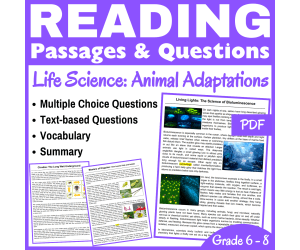
Bioluminescence & Insects : Reading Comprehension passages (PDF)
Science, ELA, Reading, Reading Comprehension, Strategies, Resources for Teachers, Life Sciences, Animals, Insects, Nature & Plants, Grade 6, 7, 8, 9, Writing Prompts, Worksheets & Printables, Centers, Activities, Teacher Tools, Assessments, Quizzes and Tests, Quizzes, Tests
Bioluminescence & Insects: Reading Comprehension Passages (PDF) This very engaging collection of life science reading passages about Bioluminescence & Insects is designed to bridge the gap between science and literacy through strengthening reading comprehension and sparking scientific curiosity in middle school students. Each passage blends English Language Arts skills with accurate science content that supports NGSS classroom practice. Ideal for interdisciplinary learning in ELA and Science. Suitable for Grade 9 review, too! What Is Included? There are (3) informational passages: Living Lights: The Science of Bioluminescence Explains how organisms produce “cold light” with luciferin and luciferase, and shows why they glow for signaling, hunting, and protection. Cicadas: The Long Wait Underground Covers the long underground nymph stage, synchronized emergence, molting, loud calls, and how this life cycle supports survival and reproduction. Masters of Disguise: How Insects Hide and Imitate Distinguishes camouflage from mimicry with clear examples, highlighting how color, shape, and behavior help insects avoid predators and capture prey. Student Tasks for Each Passage: 5 multiple-choice questions targeting main idea, key details, inference, vocabulary in context, and use of evidence 5 vocabulary matching items with clear, student-friendly definitions 5 text-based questions that require citing specific lines or facts 1 summary prompt that asks students to condense central ideas accurately Full answer key for every section Available Formats for this Resource Word Docs Google Docs FULL CATALOG OF DOWNLOADING LINKS HERE Reading Passage Links: Astronomy & Space Science PDF Word Docs Google Docs Volcanoes, Rocks, & Mountains PDF Word Docs Google Docs Rock Cycle, Soil, & Sinkholes PDF Word Docs Google Docs Mars, Glaciers, & Antarctica PDF Word Docs Google Docs Water Cycle, Acid Rain, & Wastewater PDF Word Docs Google Docs Insects, Animals, & Ecosystems PDF Word Docs Google Docs Bioluminescence & Insects PDF Word Docs Google Docs Animal Skin, Cats, & T. Rex PDF Word Docs Google Docs Product Details Length: 14 pages total Grades: 6–8, also suitable for Grade 9 review Use cases: close reading, stations, homework, intervention, test prep, and sub plans Standards support: reinforces informational-text skills and supports NGSS-style sense making through observation, modeling, and clear use of claim, evidence, and reasoning Why Teachers Choose This Set Authentic science content paired with rigorous literacy practice Consistent task structure across all passages for easier planning and smoother student routines Clear, age-appropriate writing that builds confidence without oversimplifying Use this set to reinforce ELA skills in science, to add literacy to your lessons, or to support independent work. The passages strengthen main idea, evidence use, vocabulary in context, inference, cause and effect, and summary writing. With ready-to-use assessments and complete answer keys, you can provide focused practice that is simple to run and fast to review.
Author CORED Education - Middle & High School
Rating
Tags Middle School, Reading Comprehension, Reading Strategies, ELA, Centers, Reading Passage, Assessments, Vocabulary, Life Science, Insects

Generative AI Ethics, Deepfakes & Responsible Use Case Studies
Science, Technology, Computer Science, Engineering, Research, Resources for Teachers, Classroom Management, STEM, ELA, Language Development, Grade 6, 7, 8, 9, 10, 11, 12, Worksheets & Printables, Workbooks, Worksheets, Word Searches, Writing Prompts, Teacher Tools, Lesson Plans, Presentations, Outlines, Quizzes and Tests
The complete high school curriculum is prepared and provides an interactive exploration of the topic of ethics in generative AI; deepfakes; responsible use of synthetic media; and provides a thorough introduction to how synthetic media works (to be used by all of our student participants in grades 9-12). The curriculum includes an academic overview of Synthetic Media architecture; multiple chapters for deepfake discussion/analysis; Copyright/Author status; algorithmic bias and epistemic security/provability protocols regarding the use of synthetic media. In addition, there are ten practical, complete, and interactive worksheets for active, individual student participation that have real examples, such as "the Synthesized Senator," "Med-Synthetica Diagnostic Bias," "Voice Cloning," "Influencer Avatars," etc. The students have to complete fill-in-the-blank terminology exercises, scenario analyses, and ethical synthesis prompts that promote critical thinking, media literacy, and digital citizenship skill acquisition. There is also the following in the resource book: (conceptual visual diagrams [mind maps, escalation matrices, process flows], a comprehensive answer key with notes for teachers and benchmarks for mastery) and a detailed teacher guide with pedagogical strategies, assessment tools (rubrics) and teaching protocols. This curriculum is also perfect for English/Language Arts, Social Studies, Computer Science, Digital Literacy, or elective Technology & Ethics classes. This resource is an instant digital download and requires no prep time. Give your students the information they need to be responsible in their use of AI and the topics related to ethics regarding the generative technology called "deepfake." Parents/Schools Appreciate It Because: Essential 21st century skills are being taught through critical thinking, verifying media sources & making ethical choices in dealing with misinformation & threats from deep-fakes and counterfeit media, thereby counteracting those very problems. Students remain engaged while staying motivated to learn by using real-world examples of ethical & responsible use of technology through use of case studies/workheets. The format requires zero preparation & can be easily implemented by teachers; includes lesson plans, case studies, worksheets, visuals, answer keys, teacher’s implementation guide (in pdf format). Responsible use of artificial intelligence & digital stewardship is promoted through use of technology in an aligned manner with modern school standards regarding digital citizenship/social-emotional learning. Materials are flexible in nature so can be used across multiple curriculum areas & for hybrid & remote learning situations. Based on a complete analysis of the submitted PDF, the target audience for this document are Students in grades 9-12 (age 14-18). This project is most suited for high school students enrolled in the following classes: - English/Language Arts or Media Literacy - Social Studies/Civics/Government - Computer Science/Digital Citizenship/Technology and Society - Ethics/Philosophy/STEM/STEAM The majority of the content is age appropriate for students and offers academically challenging material using fictional case studies that are relatable to a student's experience (there are no graphic illustrations or inappropriate material) on real-world current events such as misinformation, bias, copyright, and consent regarding the use of generative AI technology. "Terms & Copyright of Use": This resource has been copyrighted by Syed Hammad Rizvi. Personal use/Single-use in a classroom only. You may NOT change, share or sell this resource. i.e You may NOT post this on the Internet for others to search for/download. If you want to share this resource with other people in your school or district purchase additional copies through Teachsimple. Thank you for your cooperation. This product is provided to you by Syed Hammad Rizvi
Author Creative Book Store
Rating
Tags AIEthics, Deepfakes, GenerativeAI, SyntheticMedia, AI Ethics, DeepfakeAwareness, AIEthicsCurriculum, DeepfakesLessonPlans, GenerativeAIEthics, SyntheticMediaEthics

Fog Free Reading Comprehension Passage
ELA, Reading Comprehension, Reading, Language Development, ESL, Strategies, Library, Resources for Teachers, Earth and Environmental Sciences, Science, Grade 2, 3, 4, 5, Worksheets & Printables, Worksheets, Teacher Tools, Centers, Activities, Writing Prompts, Assessments, Quizzes and Tests, Quizzes, Tests
Fog reading comprehension: This Product Includes Reading Passage Each lesson begins with a high-interest reading passage written in clear, student-friendly paragraphs. The passage is usually three to four paragraphs long and explores different parts of the topic, such as history, science, technology, people, places, or real-world connections. Most passages are between 250 and 350 words, making them long enough to build reading stamina but short enough to fit easily into a regular lesson. Before reading, ask students to look at the heading and make a quick prediction: What do they think the passage will be about? What do they already know about this topic? What words or ideas might appear in the text? First Read Options You can choose the reading format that best fits your class: Teacher read-aloud – Great for support, modeling fluency, and helping students access the text. Partner reading – Students read paragraph by paragraph with a partner. Independent reading – Best for students who are ready to work with more independence. While reading, students can underline important details and any vocabulary words they think might appear later in the questions. Mixed Questions The first question page includes four multiple-choice questions and three written response questions. The multiple-choice questions each include four answer choices. These are useful for checking basic understanding, key details, vocabulary, and reading skills. Students can complete the multiple-choice questions independently first, then quickly review the answers as a class. The written response questions require students to answer in one or two complete sentences. Encourage students to include evidence from the passage when possible. A helpful sentence frame is: “I think ___ because the text says ___.” If students get stuck, remind them to return to the passage and look for the part that helps answer the question. Creative Writing The creative writing task asks students to write a short paragraph of five to eight sentences based on a question connected to the topic. Before writing, have students jot down three key ideas they want to include. You can also ask a few students to share ideas with the class to support anyone who needs help getting started. Writing Expectations Students should aim to include: 5–8 complete sentences At least 2 facts or details from the passage At least 2 vocabulary words from the previous page After writing, students can read their paragraphs aloud while classmates listen for facts, details, and vocabulary words. Answer Key An answer key is included for the multiple-choice questions. Written response questions include sample answers to show what a strong response might look like. Vocabulary answers are also provided. If the lesson includes a summary question, a sample summary is included as well.
Author Cored Education
Rating
Tags Reading Comprehension, Reading Passages, Reading, Ela Mcqs, Creative Writing, Comprehension, Free, Free Reading, Science, Earth Science

High School Science and Symbolism of Apples Reading Passage and Q & A
ELA, Reading, Reading Comprehension, Writing, Resources for Teachers, Research, Science, Biology, Life Sciences, High School, Homeschool Resources, Teacher Tools, Assessments, Lesson Plans, Literacy Readers, Worksheets & Printables, Writing Prompts
As a homeschool mom with a 9th grade daughter, I have learned that the best lessons come from resources that challenge students/homeschoolers both academically and personally. The Science and Symbolism of Apples Reading Passage, Q & A, and Note-Taking Sheets does exactly that. This unique resource explores the apple not just as a fruit, but as a symbol woven throughout history, literature, science, and culture. With rich reading material, 20 higher-level thinking questions with a guided answer key, and structured note-taking sheets, this set is designed to spark deep discussions and strengthen critical thinking. It is the kind of resource that invites your teen to look beyond the obvious and see how one simple fruit connects to science, history, mythology, and even technology. INCLUDED IN THIS RESOURCE: A detailed, multi-paragraph reading passage on the science and symbolism of apples 20 thought-provoking, higher-order questions A guided answer key with in-depth explanations 5 structured note-taking sheets for active reading TOPICS COVERED: The biology and genetics of apples The apple in mythology, literature, and religion The role of apples in ecology, trade, and global connections Nutrition, health, and ethical debates around biotechnology The Science and Symbolism of Apples Reading Passage, Q & A, and Note-Taking Sheets is more than just a one-time lesson. It is a springboard for critical conversations about science, history, and culture. If you are looking for something that goes beyond worksheets and helps your teen think in layered, meaningful ways, this resource will be a wonderful addition to your homeschool. If you and your students/homeschoolers enjoyed this resource, please leave a review. Thank you for your support! Tina – Big Easy Homeschooling Mom
Author Homeschool with Big Easy Homeschooling Mom
Rating
Tags Apple Lesson Plan, Symbolism Of Apples In Literature And Science Homeschool, Science And Literature Resource, , Apples Reading Passage, Apple Nutrition And Science, Homeschool Literature And Science Crossover Resource, Reading Comprehension With Symbolism Analysis Homeschool, , Teaching Symbolism Through Science In Homeschool, Homeschool Curriculum, Cultural And Scientific Symbolism Of Apples Homeschool
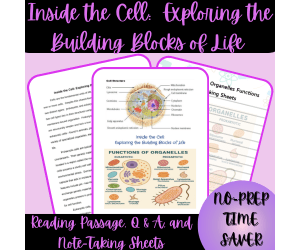
HIgh School Cell Structure & Organelles Functions Reading Passage
ELA, Reading, Writing, Research, Resources for Teachers, Science, Life Sciences, Biology, High School, Homeschool Resources, Teacher Tools, Lesson Plans, Assessments, Quizzes and Tests, Worksheets & Printables, Writing Prompts
This Inside the Cell: Exploring the Building Blocks of Life Reading Passage, Q & A, and Note-Taking Sheets resource is a thoughtfully designed resource created to help students/homeschoolers truly understand the fascinating world of cells. As a homeschool mom guiding my own ninth grader, I know how challenging it can be to find materials that are both engaging and thorough. This Inside the Cell: Exploring the Building Blocks of Life Reading Passage, Q & A, and Note-Taking Sheets resource brings together a detailed reading passage, critical thinking Q & A, and five versatile note-taking sheets to support deep comprehension. Whether you are teaching in a classroom or around the kitchen table, this set will help your learners grasp the essential differences between eukaryotic and prokaryotic cells and the remarkable functions of their organelles. INCLUDED IN THIS RESOURCE: Comprehensive reading passage on cell structure and organelle function 20 higher-order, research-based Q & A prompts Guided answer key for all questions Five note-taking sheets TOPICS COVERED: Differences between prokaryotic and eukaryotic cells Structure and function of major cell organelles Specialized features of plant and animal cells Cellular adaptations and ecological roles This Inside the Cell: Exploring the Building Blocks of Life Reading Passage, Q & A, and Note-Taking Sheets resource is a complete package for teaching and learning about the building blocks of life. It is designed to inspire curiosity, build confidence, and equip students/homeschoolers with the knowledge and skills they need to succeed in biology. As a mom and homeschool educator, I believe this resource will make your science lessons more meaningful and enjoyable for everyone involved. If you and your students/homeschoolers enjoyed this resource, please leave a review. Thank you for your support! Tina - Big Easy Homeschooling Mom
Author Homeschool with Big Easy Homeschooling Mom
Rating
Tags Cell Structure And Function Reading Passage, Eukaryotic And Prokaryotic Cell Comparison, Homeschool Cell Biology Resource, Homeschool Biology, High School Biology, Comprehensive Cell Biology Lesson, Cell Structure And Organelle Teaching Materials, Homeschool Science, High School Science, Eukaryotic And Prokaryotic Cells
Tennis Reading Comprehension Passage - Cored Ed Encyclopedia
ELA, Language Development, Reading Comprehension, Reading, Pre-Reading, Science, Technology, Engineering, History, Social Studies, Grade 2, 3, 4, 5, Worksheets & Printables, Worksheets, Teacher Tools, Centers, Activities, Writing Prompts, Assessments, Quizzes and Tests, Quizzes, Lesson Plans
This tennis reading comprehension includes: Visualization (on the front cover) Start your lesson by taking a minute to think and share something about the topic. Read the script aloud (slowly), perhaps prepare some music or sound effects. Student close their eyes and let their imaginations wander. Students open their eyes, read the question aloud and give them a few minutes to complete. Ask a few students to share or keep answers until the end to compare with what they learn in the passage. Quick pause—thousands of Cored Education products are included with your TeachSimple membership. Download links and encyclopedia index available here. Pre-Reading Trivia Students will write down one thing they already know about the subject and then read five more facts and discuss. These facts are fun, and the students will enjoy learning about the subject before reading more. Give 1 minute for students to write what they already know (no pressure—best guess is fine). Read the five facts together. After each fact, do ask a student for their opinion, was it surprising? Set a purpose by asking students to highlight/underline one fact they want to learn more about during the reading. Reading Passage The text is a high-interest reading passage with set paragraphs, roughly three to four paragraphs long. It contains a variety of themes about the topic, anywhere from history to technology. The passage is between 250 and 350 words in length. First, ask students to look at the headings and see what they’ll learn about today. What do they know about the topic/heading? First read options: Teacher read-aloud (best for support). Partner reading (paragraph by paragraph). While reading, students underline important details, and vocabulary words they think may come up in the questions section. Mixed Questions The first question page contains four multiple-choice questions, each with a choice of four answers, and three written response questions that require a sentence or two from the student. Students complete the mcqs first independently, then review quickly as a class. For the 3 written responses, try to get students giving the answer with some form of evidence: “I think ___ because the text says ___.” If students get stuck, send them back to check the passage. Vocabulary Questions Practice seven key words from the text in this section across two activities. First section is scrambled words where students will unscramble three words given a clue for each. The second section is a word to meaning matching activity. Before starting, have some students read out words they underlined in the passage. Ask students to say the word and read aloud the sentence(s) around each word. Ask students to do scrambled words and the matching exercise in pairs then go through answers as a class. For the scrambled spelling task, get four pairs to come up to the board and write the words for extra practice with the other student reading out the clue. For the matching task, prompt students to give full sentences: “I matched ___ with ___ because ___.” Creative Writing In this question, the student will be required to write a five to eight sentence paragraph on a question related to the topic. Before starting, ask students write down 3 key ideas they are going to include in their piece. Ask students for ideas to share around the class to help those struggling. Pro writing expectations: 5–8 sentences At least 2 facts or details from the passage At least 2 vocabulary words from the previous page Students read their paragraphs while classmates listen for facts and vocabulary words. Extension Activities This page is optional for fast finishers or to take home. There are several activities, each one requiring a different skill. Do some, do none, do all, completely optional - but you will feel reassured knowing every possibility is planned for. Includes summary writting question. Answer Key There are answers for the multiple-choice questions, written response questions have sample answers, vocabulary answers and if there is a summary question then a sample summary will be provided as well. Lesson Plan Included Customized lesson plan for this lesson is included. Lesson Snapshot Title: Tennis Genre: Nonfiction (informational text) Subject: Social Studies (History of Sports) Primary Topic: How tennis changed over time Estimated Guided Reading Level (A–Z): Q What This Lesson Teaches Best How tennis began as jeu de paume (“game of the palm”) and shifted from hands to gloves and then rackets. How indoor courts with hard walls and slanted roofs changed play by creating surprising angles. How tennis moved outdoors in the 1800s when rubber balls bounced well outside and lawns made smooth courts. Key moments that helped standardize and spread the sport (1873 rules book, 1877 Wimbledon). How tournaments changed when the Open Era began in 1968, allowing professionals and amateurs to compete together. Learning Goals Students will explain why the early game was called jeu de paume using details from the text. Students will describe how playing spaces changed from courtyards to enclosed indoor courts. Students will identify how walls and slanted roofs affected play in real tennis. Students will summarize two changes in the 1800s that helped tennis move outdoors. Students will describe why the 1873 rulebook and the 1877 Wimbledon championship mattered for tennis. Students will explain what changed in 1968 when the Open Era began. Key Vocabulary From the Text monastery — a place where monks live and work. cloisters — covered walkways around a courtyard. boundary — a line that shows where play must stay. enclosed — closed in by walls; not open outside. amateurs — people who play for fun, not as paid work. FULL CATALOG OF DOWNLOAD LINKS AND ENCYCLOPEDIA INDEX HERE
Author Cored Education
Rating
Tags Vocabulary, Reading Comprehension, Reading Passages, Lesson Plans, Ela Lesson Plans, Reading Comprehension Lesson Plans, Pre-reading, History, History Lesson Plans, Sports
The Inca: Social Studies Reading Comprehension Passage. Fillable PDF
ELA, Reading, Reading Comprehension, Strategies, Resources for Teachers, Social Studies, History: Ancient, History, Geography, Grade 6, 7, 8, 9, Writing Prompts, Worksheets & Printables, Centers, Activities, Teacher Tools, Assessments, Quizzes and Tests, Quizzes, Tests
The Inca: Social Studies Reading Comprehension Passage (Fillable PDF) This resource introduces a unique Social Studies reading comprehension passage with questions about The Inca: Empire in the Clouds. The passage is carefully designed to bridge the gap between social studies and literacy through strengthening reading comprehension and sparking knowledge curiosity in middle school students. Each passage blends English Language Arts skills with accurate social studies content . Ideal for interdisciplinary learning in ELA and Social Studies. Suitable for Grade 9 review, too! This resource is designed as a fillable PDF , which means students can type their answers directly into the document on any computer or tablet . Each page includes highlighted text fields that show them exactly where to type! Student Tasks throughout the passage: 5 multiple-choice questions targeting the following skills: main idea, key details, inference, vocabulary in context, and use of evidence 5 vocabulary matching items with clear, student-friendly definitions 5 text-based questions that require citing specific lines or facts 1 summary prompt that asks students to condense central ideas accurately Full answer key for every section Available Formats for this Resource: PDF Word Docs Google Docs FULL CATALOG OF DOWNLOADING LINKS HERE Social Studies Reading Comprehension Collection Links: 1. Ancient Civilizations PDF Fillable PDF Word Docs Google Docs 2. Early Empires and Trade Networks PDF Fillable PDF Word Docs Google Docs 3. The Founding of the United States PDF Fillable PDF Word Docs Google Docs 4. Language, Culture, and Meaning PDF Fillable PDF Word Docs Google Docs 5. Psychology and Society PDF Fillable PDF Word Docs Google Docs 6. Global Festivals and Traditions PDF Fillable PDF Word Docs Google Docs 7. Extreme Environments and People PDF Fillable PDF Word Docs Google Docs 8. Food, Culture, and Preservation PDF Fillable PDF Word Docs Google Docs 9. Global Food Customs PDF Fillable PDF Word Docs Google Docs 10. Media, Communication, and Popular Culture PDF Fillable PDF Word Docs Google Docs 11. Human Impact on the Environment PDF Fillable PDF Word Docs Google Docs 12. Civic Action and Social Change PDF Fillable PDF Word Docs Google Docs 13. Fashion, Society, and Power PDF Fillable PDF Word Docs Google Docs 14. People, Places, and Unusual Histories PDF Fillable PDF Word Docs Google Docs Product Details: Length: 5 pages Grades: 6–8, also suitable for Grade 9 review Use cases: close reading, stations, homework, intervention, test prep, and sub plans Why Teachers Choose This Passage: Authentic social studies content paired with rigorous literacy practice Consistent task structure for easier planning and smoother student routines Clear, age-appropriate writing that builds confidence without oversimplifying Use this passage to reinforce ELA skills in social studies, to add literacy to your lessons, and to support independent work. The passage strengthens main idea, evidence use, vocabulary in context, inference, cause and effect, and summary writing. With ready-to-use assessments and complete answer keys, you can provide focused practice that is simple to run and fast to review.
Author CORED Education - Middle & High School
Rating
Tags Middle School, Reading Comprehension, Reading Strategies, ELA, Centers, Reading Passage, Assessments, Vocabulary, Social Studies, Ancient Civilization

Hiking Reading Comprehension Passage - Cored Ed Encyclopedia
ELA, Reading Comprehension, Reading, Pre-Reading, Language Development, History, Social Studies, Geography, P.E. & Health, Physical Education, Grade 2, 3, 4, 5, Worksheets & Printables, Worksheets, Teacher Tools, Centers, Activities, Writing Prompts, Assessments, Quizzes and Tests, Quizzes, Lesson Plans
This hiking reading comprehension with lesson plan includes: Visualization (on the front cover) Start your lesson by taking a minute to think and share something about the topic. Read the script aloud (slowly), perhaps prepare some music or sound effects. Student close their eyes and let their imaginations wander. Students open their eyes, read the question aloud and give them a few minutes to complete. Ask a few students to share or keep answers until the end to compare with what they learn in the passage. Quick pause—thousands of Cored Education products are included with your TeachSimple membership. Download links and encyclopedia index available here. Pre-Reading Trivia Students will write down one thing they already know about the subject and then read five more facts and discuss. These facts are fun, and the students will enjoy learning about the subject before reading more. Give 1 minute for students to write what they already know (no pressure—best guess is fine). Read the five facts together. After each fact, do ask a student for their opinion, was it surprising? Set a purpose by asking students to highlight/underline one fact they want to learn more about during the reading. Reading Passage The text is a high-interest reading passage with set paragraphs, roughly three to four paragraphs long. It contains a variety of themes about the topic, anywhere from history to technology. The passage is between 250 and 350 words in length. First, ask students to look at the headings and see what they’ll learn about today. What do they know about the topic/heading? First read options: Teacher read-aloud (best for support). Partner reading (paragraph by paragraph). While reading, students underline important details, and vocabulary words they think may come up in the questions section. Mixed Questions The first question page contains four multiple-choice questions, each with a choice of four answers, and three written response questions that require a sentence or two from the student. Students complete the mcqs first independently, then review quickly as a class. For the 3 written responses, try to get students giving the answer with some form of evidence: “I think ___ because the text says ___.” If students get stuck, send them back to check the passage. Vocabulary Questions Practice seven key words from the text in this section across two activities. First section is scrambled words where students will unscramble three words given a clue for each. The second section is a word to meaning matching activity. Before starting, have some students read out words they underlined in the passage. Ask students to say the word and read aloud the sentence(s) around each word. Ask students to do scrambled words and the matching exercise in pairs then go through answers as a class. For the scrambled spelling task, get four pairs to come up to the board and write the words for extra practice with the other student reading out the clue. For the matching task, prompt students to give full sentences: “I matched ___ with ___ because ___.” Creative Writing In this question, the student will be required to write a five to eight sentence paragraph on a question related to the topic. Before starting, ask students write down 3 key ideas they are going to include in their piece. Ask students for ideas to share around the class to help those struggling. Pro writing expectations: 5–8 sentences At least 2 facts or details from the passage At least 2 vocabulary words from the previous page Students read their paragraphs while classmates listen for facts and vocabulary words. Extension Activities This page is optional for fast finishers or to take home. There are several activities, each one requiring a different skill. Do some, do none, do all, completely optional - but you will feel reassured knowing every possibility is planned for. Includes summary writting question and additional facts. Answer Key There are answers for the multiple-choice questions, written response questions have sample answers, vocabulary answers and if there is a summary question then a sample summary will be provided as well. Lesson Plan Included Customized lesson plan for this lesson is included. Lesson Snapshot Title: Hiking Genre: Nonfiction (informational text) Subject: Health / Physical Education Primary Topic: What hiking is, its history, and staying safe Estimated Guided Reading Level (A–Z): Q What This Lesson Teaches Best Defines hiking as “more than a stroll” and describes what hiking feels like on a trail or footpath. Explains how walking shifted from serious reasons (like religious pilgrimages) to walking for pleasure and adventure. Describes how trails needed signs, maps, and protection as hiking grew, including work to build and maintain the Appalachian Trail. Teaches basic hiking safety and preparedness (boots/shoes, backpack supplies, and the “Ten Essentials” such as a compass and first-aid kit). Names risks hikers can face when weather shifts or routes disappear, including dehydration and hypothermia. Learning Goals Students will describe what hiking is using details from the passage. Students will explain why people walked long ago and how walking for pleasure grew later. Students will identify why trails needed signs, maps, and protection as more people hiked. Students will describe what the passage says about the Appalachian Trail (where it stretches and how long it is). Students will list items hikers pack to “stay alert” and connect them to safety. Students will name risks mentioned in the text that can affect hikers’ bodies. Key Vocabulary From the Text pilgrimages — long journeys taken for religious reasons. destinations — places people want to go or visit. organizations — groups that work together for a purpose. dehydration — not enough water in the body. hypothermia — when the body gets too cold. FULL CATALOG OF DOWNLOAD LINKS AND ENCYCLOPEDIA INDEX HERE
Author Cored Education
Rating
Tags Vocabulary, Reading Comprehension, Reading Passages, Lesson Plans, Ela Lesson Plans, Reading Comprehension Lesson Plans, Pre-reading, Health Lesson Plans, Social Studies Lesson Plans, P.e.
Reading Comprehension Nonfiction Set 1 - Birds (Presentable PDF)
ELA, Reading, Reading Comprehension, Common Core, ESL, Language Development, Vocabulary, Spelling, Creative Writing, Writing, Grade 4, 5, Worksheets & Printables, Worksheets, Assessments, Teacher Tools, Tests, Quizzes and Tests, Writing Prompts, Centers, Activities
Reading Comprehension Passages Nonfiction Set 1 Snapshot Title: READING COMPREHENSION: Nonfiction Grade 4–5 Birds Genre: Nonfiction (informational articles with comprehension practice pages) Subject: Reading (Informational Text) / Life Science Primary Topic: Bird facts, adaptations, and human impact Estimated Guided Reading Level (A–Z): R What This Teaches Best Building knowledge about birds through informational text (flightless birds, ostriches, chickadees, owls, and turkeys). Animal adaptations and survival (e.g., why some birds don’t fly, how ostriches defend themselves, owl hunting features). Cause-and-effect in real-world events (how the Deepwater Horizon oil spill affected birds and why stopping the leak was difficult). Key nonfiction comprehension skills practiced repeatedly through “Mixed Questions” (details, vocabulary-in-context, and explaining ideas from the text). Academic vocabulary in context (terms like nocturnal, sediment, contaminated, predators, and endangered appear in the articles and are reinforced in activities). Learning Goals Explain why some birds are flightless using details from the text. Describe how an ostrich survives predators using information from the article. Identify key facts about chickadees (habitat, behavior, diet, or nesting) and support them with text evidence. Describe owl features that help with hunting and explain how those features work. Compare domesticated and wild turkeys using evidence from the passage. Explain at least two ways an oil spill harms birds, based on the “Oil Spill” text. Passages Include 1.No Fly Zone: An article on birds that cannot fly. 2.Ostrich: Ostrich eggs are big enough to be used as make shift cups! 3.Chickadees: A small, but interesting bird, common to Canada and Northern U.S.A 4.The Owl: What do you know about this mysterious creature? 5.Turkeys: A popular food at Thanksgiving and Christmas. How do Turkeys live? 6.Oil Spill: How did the Deepwater Horizon oil spill effect local birds? FULL CATALOG OF DOWNLOAD LINKS HERE PRESENTABLE PDF VERSION Run it like a slide show straight from a PDF, with no PowerPoint or extra software needed, just open, project, and teach. Other versions are available in the links list below or in the full catalog. For similar downloads and other frees, do check out Cored Group on TeachSimple.
Author Cored Education
Rating
Tags Elementary, Reading, Comprehension, Vocabulary, Common Core, Spelling, Writing, Passages, Reading Centers, Reading Comprehension Assessments

Horses Reading Comprehension Passage - Cored Ed Encyclopedia
ELA, Reading Comprehension, Reading, Pre-Reading, Language Development, History, Social Studies, Geography, Life Sciences, Science, Grade 2, 3, 4, 5, Worksheets & Printables, Worksheets, Teacher Tools, Centers, Activities, Writing Prompts, Assessments, Quizzes and Tests, Quizzes, Lesson Plans
This horses reading comprehension with lesson plan includes: Visualization (on the front cover) Start your lesson by taking a minute to think and share something about the topic. Read the script aloud (slowly), perhaps prepare some music or sound effects. Student close their eyes and let their imaginations wander. Students open their eyes, read the question aloud and give them a few minutes to complete. Ask a few students to share or keep answers until the end to compare with what they learn in the passage. Quick pause—thousands of Cored Education products are included with your TeachSimple membership. Download links and encyclopedia index available here. Pre-Reading Trivia Students will write down one thing they already know about the subject and then read five more facts and discuss. These facts are fun, and the students will enjoy learning about the subject before reading more. Give 1 minute for students to write what they already know (no pressure—best guess is fine). Read the five facts together. After each fact, do ask a student for their opinion, was it surprising? Set a purpose by asking students to highlight/underline one fact they want to learn more about during the reading. Reading Passage The text is a high-interest reading passage with set paragraphs, roughly three to four paragraphs long. It contains a variety of themes about the topic, anywhere from history to technology. The passage is between 250 and 350 words in length. First, ask students to look at the headings and see what they’ll learn about today. What do they know about the topic/heading? First read options: Teacher read-aloud (best for support). Partner reading (paragraph by paragraph). While reading, students underline important details, and vocabulary words they think may come up in the questions section. Mixed Questions The first question page contains four multiple-choice questions, each with a choice of four answers, and three written response questions that require a sentence or two from the student. Students complete the mcqs first independently, then review quickly as a class. For the 3 written responses, try to get students giving the answer with some form of evidence: “I think ___ because the text says ___.” If students get stuck, send them back to check the passage. Vocabulary Questions Practice seven key words from the text in this section across two activities. First section is scrambled words where students will unscramble three words given a clue for each. The second section is a word to meaning matching activity. Before starting, have some students read out words they underlined in the passage. Ask students to say the word and read aloud the sentence(s) around each word. Ask students to do scrambled words and the matching exercise in pairs then go through answers as a class. For the scrambled spelling task, get four pairs to come up to the board and write the words for extra practice with the other student reading out the clue. For the matching task, prompt students to give full sentences: “I matched ___ with ___ because ___.” Creative Writing In this question, the student will be required to write a five to eight sentence paragraph on a question related to the topic. Before starting, ask students write down 3 key ideas they are going to include in their piece. Ask students for ideas to share around the class to help those struggling. Pro writing expectations: 5–8 sentences At least 2 facts or details from the passage At least 2 vocabulary words from the previous page Students read their paragraphs while classmates listen for facts and vocabulary words. Extension Activities This page is optional for fast finishers or to take home. There are several activities, each one requiring a different skill. Do some, do none, do all, completely optional - but you will feel reassured knowing every possibility is planned for. Includes summary writting question and additional facts. Answer Key There are answers for the multiple-choice questions, written response questions have sample answers, vocabulary answers and if there is a summary question then a sample summary will be provided as well. Lesson Plan Included Customized lesson plan for this lesson is included. Lesson Snapshot Title: Horses Genre: Nonfiction (informational text) Subject: Life Science / Social Studies (human–animal history) Primary Topic: Horse features, domestication, and partnership with people Estimated Guided Reading Level (A–Z): R What This Lesson Teaches Best Describes horses as domesticated equines (Equus ferus caballus) with single hard hooves. Explains how horse ancestors changed over millions of years from many-toed to one-toed runners. Uses archaeology clues (tooth wear from a bit; Botai culture evidence) to explain early domestication. Shows how trained horses affected human travel and power, including chariots and the development of different breeds. Highlights horse social behavior and communication (ear turns, tail swishes, shifts of weight) as part of partnership. Learning Goals Identify key physical features of horses described in the passage (hoof, muscle, equine). Describe how horse ancestors changed over time, using details from the text. Explain what clues archaeologists found that suggest humans guided horses with a bit. Describe how horses helped people with travel and power long ago (such as chariots). Explain how people created different breeds by choosing traits like strength, speed, or calm temperaments. Describe how horses communicate and stay watchful using body signals mentioned in the passage. Key Vocabulary From the Text domesticated — tamed to live and work with people. equine — related to horses. ancestors — family members from long ago. archaeologists — scientists who study the past using evidence. temperaments — typical behaviors, like calmness or energy. FULL CATALOG OF DOWNLOAD LINKS AND ENCYCLOPEDIA INDEX HERE
Author Cored Education
Rating
Tags Vocabulary, Reading Comprehension, Reading Passages, Lesson Plans, Ela Lesson Plans, Reading Comprehension Lesson Plans, Pre-reading, Social Studies Lesson Plans, Life Science, Science Lesson Plans
Bioluminescence and Insects : SAMPLE Reading passage (FILLABLE PDF)
Science, ELA, Reading, Reading Comprehension, Strategies, Resources for Teachers, Life Sciences, Animals, Insects, Nature & Plants, Grade 6, 7, 8, 9, Writing Prompts, Worksheets & Printables, Centers, Activities, Teacher Tools, Assessments, Quizzes and Tests, Quizzes, Tests
This is a ONE PASSAGE SAMPLE. The following is the description of the FULL resource and the downloading links: Bioluminescence and Insects: Reading Comprehension Passages and Questions (FILLABLE PDF) This very engaging and fillable collection of life science reading passages about Bioluminescence and Insects is designed to bridge the gap between science and literacy through strengthening reading comprehension and sparking scientific curiosity in middle school students. Each passage blends English Language Arts skills with accurate science content that supports NGSS classroom practice. Ideal for interdisciplinary learning in ELA and Science. Suitable for Grade 9 review, too! These worksheets are designed as fillable PDFs , which means students can type their answers directly into the document on any computer or tablet . Each page includes highlighted text fields that show them exactly where to type! What Is Included? There are (3) informational passages: Living Lights: The Science of Bioluminescence Cicadas: The Long Wait Underground Masters of Disguise: How Insects Hide and Imitate Student Tasks for Each Passage: 5 multiple-choice questions targeting main idea, key details, inference, vocabulary in context, and use of evidence 5 vocabulary matching items with clear, student-friendly definitions 5 text-based questions that require citing specific lines or facts 1 summary prompt that asks students to condense central ideas accurately Full answer key for every section Available Formats for this Resource Word Docs Google Docs FULL CATALOG OF DOWNLOADING LINKS HERE Reading Passage Links: Astronomy & Space Science PDF Fillable PDF Word Docs Google Docs Volcanoes, Rocks, & Mountains PDF Fillable PDF Word Docs Google Docs Rock Cycle, Soil, & Sinkholes PDF Fillable PDF Word Docs Google Docs Mars, Glaciers, & Antarctica PDF Fillable PDF Word Docs Google Docs Water Cycle, Acid Rain, & Wastewater PDF Fillable PDF Word Docs Google Docs Insects, Animals, & Ecosystems PDF Fillable PDF Word Docs Google Docs Bioluminescence & Insects PDF Fillable PDF Word Docs Google Docs Animal Skin, Cats, & T. Rex PDF Fillable PDF Word Docs Google Docs Human Body and Senses PDF Fillable PDF Word Docs Google Docs Health & Applied Bioscience PDF Fillable PDF Word Docs Google Docs Waves, Light, & Imaging PDF Fillable PDF Word Docs Google Docs Electricity & Energy PDF Word Docs Google Docs Motion & Materials PDF Word Docs Google Docs Chemistry and Materials Science PDF Fillable PDF Word Docs Google Docs How to Use These PDFs Click on the highlighted area to start typing your answer. Move to the next question by clicking in the next highlighted box. When you are finished, close the document and select SAVE so your answers stay recorded. If you want to keep a blank copy for later, choose Save As and give your completed version a new name. Product Details Length: 14 pages total Grades: 6–8, also suitable for Grade 9 review Use cases: close reading, stations, homework, intervention, test prep, and sub plans Standards support: reinforces informational-text skills and supports NGSS-style sense making through observation, modeling, and clear use of claim, evidence, and reasoning Why Teachers Choose This Set Authentic science content paired with rigorous literacy practice Consistent task structure across all passages for easier planning and smoother student routines Clear, age-appropriate writing that builds confidence without oversimplifying Use this set to reinforce ELA skills in science, to add literacy to your lessons, or to support independent work. The passages strengthen main idea, evidence use, vocabulary in context, inference, cause and effect, and summary writing. With ready-to-use assessments and complete answer keys, you can provide focused practice that is simple to run and fast to review.
Author CORED Education - Middle & High School
Rating
Tags Middle School, Reading Comprehension, Reading Strategies, ELA, Centers, Reading Passage, Assessments, Vocabulary, Life Science, Insects

How Words Shape Our Minds: Social Studies Reading Passage (Word)
ELA, Reading, Reading Comprehension, Strategies, Resources for Teachers, Social Studies, Psychology, Grade 6, 7, 8, 9, Writing Prompts, Worksheets & Printables, Centers, Activities, Teacher Tools, Assessments, Quizzes and Tests, Quizzes, Tests
How Words Shape Our Minds: Social Studies Reading Comprehension Passage (Word) This resource introduces a unique Social Studies reading comprehension passage with questions about How Words Shape Our Minds. The passage is carefully designed to bridge the gap between social studies and literacy through strengthening reading comprehension and sparking knowledge curiosity in middle school students. Each passage blends English Language Arts skills with accurate social studies content . Ideal for interdisciplinary learning in ELA and Social Studies. Suitable for Grade 9 review, too! Student Tasks throughout the passage: 5 multiple-choice questions targeting the following skills: main idea, key details, inference, vocabulary in context, and use of evidence 5 vocabulary matching items with clear, student-friendly definitions 5 text-based questions that require citing specific lines or facts 1 summary prompt that asks students to condense central ideas accurately Full answer key for every section Available Formats for this Resource: PDF Fillable PDF Google Docs FULL CATALOG OF DOWNLOADING LINKS HERE Social Studies Reading Comprehension Collection Links: 1. Ancient Civilizations PDF Fillable PDF Word Docs Google Docs 2. Early Empires and Trade Networks PDF Fillable PDF Word Docs Google Docs 3. The Founding of the United States PDF Fillable PDF Word Docs Google Docs 4. Language, Culture, and Meaning PDF Fillable PDF Word Docs Google Docs 5. Psychology and Society PDF Fillable PDF Word Docs Google Docs 6. Global Festivals and Traditions PDF Fillable PDF Word Docs Google Docs 7. Extreme Environments and People PDF Fillable PDF Word Docs Google Docs 8. Food, Culture, and Preservation PDF Fillable PDF Word Docs Google Docs 9. Global Food Customs PDF Fillable PDF Word Docs Google Docs 10. Media, Communication, and Popular Culture PDF Fillable PDF Word Docs Google Docs 11. Human Impact on the Environment PDF Fillable PDF Word Docs Google Docs 12. Civic Action and Social Change PDF Fillable PDF Word Docs Google Docs 13. Fashion, Society, and Power PDF Fillable PDF Word Docs Google Docs 14. People, Places, and Unusual Histories PDF Fillable PDF Word Docs Google Docs Product Details: Length: 5 pages Grades: 6–8, also suitable for Grade 9 review Use cases: close reading, stations, homework, intervention, test prep, and sub plans Why Teachers Choose This Passage: Authentic social studies content paired with rigorous literacy practice Consistent task structure for easier planning and smoother student routines Clear, age-appropriate writing that builds confidence without oversimplifying Use this passage to reinforce ELA skills in social studies, to add literacy to your lessons, and to support independent work. The passage strengthens main idea, evidence use, vocabulary in context, inference, cause and effect, and summary writing. With ready-to-use assessments and complete answer keys, you can provide focused practice that is simple to run and fast to review.
Author CORED Education - Middle & High School
Rating
Tags Middle School, Reading Comprehension, Reading Strategies, ELA, Centers, Reading Passage, Assessments, Vocabulary, Social Studies, Pschology
Honey Reading Comprehension Passage - Cored Ed Encyclopedia
ELA, Language Development, Resources for Teachers, Reading Comprehension, Reading, Pre-Reading, Writing, Insects, Life Sciences, Science, Grade 2, 3, 4, 5, Worksheets & Printables, Worksheets, Teacher Tools, Centers, Activities, Writing Prompts, Assessments, Tests, Quizzes and Tests, Quizzes
This honey reading comprehension contains the following: Pre-Reading Trivia Students will write down one thing they already know about the subject and then read five more facts and discuss. These facts are fun, and the students will enjoy learning about the subject before reading more. COMPANION VIDEO NOW AVAILABLE (EMBEDDED AFTER PREVIEW PICTURES IN PRODUCT DESCRIPTION) Reading Passage The text is a high-interest reading passage with set paragraphs, roughly three to four paragraphs long. It contains a variety of themes about the topic, anywhere from history to technology. The passage is between 250 and 350 words in length. Mixed Questions The first question page contains four multiple-choice questions, each with a choice of four answers, and three written response questions that require a sentence or two from the student. Creative Writing In this question, the student will be required to write a five to eight sentence paragraph on a question related to the topic. Extension Activities This page is optional for fast finishers. If there are five to ten minutes left at the end of the lesson, the student can choose one of three activities, each one requiring a different skill. Answer Key There are answers for the multiple-choice questions and three written response questions have sample answers. FULL CATALOG OF DOWNLOAD LINKS AND ENCYCLOPEDIA INDEX HERE Lesson Snapshot Title: Honey Genre: Nonfiction (informational text with headings) Subject: Reading (Informational Text) / Life Science Primary Topic: How bees make honey and why it varies Estimated Guided Reading Level (A–Z): P What This Lesson Teaches Best Explains the step-by-step process of how bees turn nectar (and sometimes honeydew) into thick honey stored in honeycomb cells. Teaches key science ideas using clear cause/effect language (enzymes change sugars; bees spread liquid so water can evaporate; honey thickens). Shows how a honey’s flower source affects its color and flavor, with examples (alfalfa vs. buckwheat). Clarifies that honey can become grainy/solid because sugar crystals form, not because it is “going bad.” Describes bee colony roles (queen, workers, drones) and explains that honey is made mainly to feed the colony. Learning Goals Explain, using details from the passage, how nectar becomes honey in a hive. Identify at least two changes that happen to the liquid as bees process it (enzymes change sugars; water evaporates; honey thickens). Describe why honey can taste and look different based on its flower source, including one example from the text. Explain why honey may turn grainy or solid in a jar, according to the passage. Describe why bees make honey and name the colony members mentioned (queen, workers, drones). Key Vocabulary From the Text nectar — sweet liquid that comes from flowers. honeydew — sugary liquid that comes from insects like aphids. enzymes — substances in bees that help change sugars. evaporate — when water changes and leaves as vapor. foraging — searching for food. Cored Ed Encyclopedia Overview The Cored Ed Encyclopedia is a weekly series of lessons that you can pick up and use right away. These short readings fit into whatever time you have available. Each one includes a warm-up, a reading, and a set of questions, but it’s flexible — you can do just the reading, the full lesson, or skip the writing section if you need to. Each lesson focuses on a single topic so students don’t get lost. The writing is clear but never childish, making it perfect for grades two through five. Topics range from animals and science to history, inventions, and everyday things. No matter the level of the student, everyone should take away at least one new idea or fact from each lesson. The materials are easy to print, easy to explain, and require no setup. They work well for whole-class teaching, partner work, or independent study.
Author Cored Education
Rating
Tags Vocabulary, Spelling, Reading Comprehension, Reading Passages, Reading, Creative Writing, Reading Strategies, Writing Prompts, Life Science, Honey