



3,502 products added recently
Page 462 - Worksheets & Printables
Discover a wealth of worksheets and printables to supplement your teaching. Covering multiple subjects and grade levels, these resources provide activities that reinforce learning objectives. Incorporate them into your lessons to offer hands-on practice and enrich your curriculum.

 Show filters

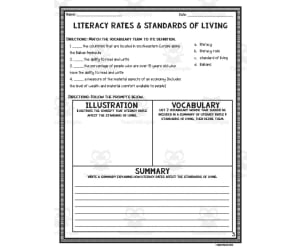
Literacy Rates + Standard of Living Reading Packet
Social Studies, Grade 6, Worksheets & Printables, Worksheets
Literacy Rates + Standard of Living Reading Packet This social studies resource helps 6th grade students learn about literacy rates and standards of living. Students read an informative passage and apply key vocabulary terms. Multiple worksheets, including multiple choice questions and graphic organizers , allow students to demonstrate comprehension. Teachers can implement this no-prep resource in various ways - as whole group instruction, small group work, or independent assignments. Answer keys are included, making this an easy addition to any middle school curriculum covering sociology or economics. By evaluating the relationship between literacy rates and quality of life across societies, students build cultural awareness and critical thinking skills. This reading packet offers an engaging way for educators to meet social studies standards.
Author Sarah Miller Tech
Tags Literacy Rates, Comprehension, Graphic Organizers, Vocabulary, Assessments

Shapes Activities Worksheets Set 15
Special Resources, Special Education Needs (SEN), Speech Therapy, Life Skills, Math, Patterns, Early Math, Geometry, Preschool, Grade 1, 2, Worksheets & Printables, Flashcards, Activities, Games, Worksheets
Shapes Activities Worksheets Set 15 This 3-page PDF teaches students in grades K-2 to recognize basic shapes like circles, squares, triangles, and rhombi. The worksheets progress in complexity, building skills like differentiating quantity, size, outline thickness, and filled/outlined colors. Students will hone visual perception by replicating shapes in blank frames. Other interactive tasks have students rotate shapes on wheels and connect matching shapes. This allows for repeated shape attribute practice. Beyond the classroom, these versatile worksheets serve special education needs or speech/occupational therapy. The straightforward layouts work for teaching centers , homework, and one-on-one instruction. With minimalistic yet purposeful design, this resource lays foundations for math concepts through engaging shape matching. Teachers modify the PDF into task cards or mini-books as needed. Ultimately, the 3-page PDF builds visual perception, cognition, and early geometry skills among mainstream or special needs students.
Author WORDS ASIDE
Tags Geometry, Shapes, Math Worksheets, Printable, Math Centers, Homework, Copying, Matching, Reproduction, Words Aside
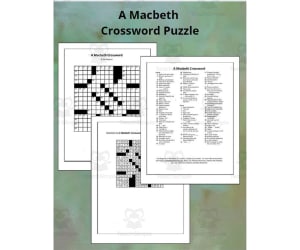
Macbeth Crossword Puzzle – Shakespeare Vocabulary
ELA, Literature, Language Development, Vocabulary, Grade 9, 10, 11, 12, Crosswords Puzzles, Worksheets, Worksheets & Printables
This Crossword Puzzle: Macbeth is a great way to enable your students to find antiquated words that Shakespeare used in Macbeth. This is a great addition to your Shakespeare unit! The Crossword Puzzle: Macbeth includes a lot of clues for students to find the vocabulary words from Macbeth. These are divided into vertical and horizontal words. There are 39 clues for vertical words, and 39 clues for horizontal words. With this Crossword Puzzle: Macbeth, once all of the words are found, students can complete the crossword puzzle. This Crossword Puzzle: Macbeth is designed for students in high school level. It is a worksheet which can be completed individually, in pairs, or by placing students in groups. This Crossword Puzzle: Macbeth may be used in conjunction with a literature lesson, vocabulary, quotes or as part of a unit about Macbeth! This Crossword Puzzle: Macbeth also includes the answers for easy revisions. Though you might not want to give away the answers until students have exhausted their knowledge and research! This Crossword Puzzle: Macbeth is a ready to use resource, just have to print it! For similar resources in the same format or content, visit my store here!
Author Jay Waggoner
Rating
Tags Macbeth, Crossword Puzzle, Literature, Shakespeare

Thanksgiving Playdough Mats 1-20
Math, Numbers, Kindergarten, Preschool, Grade 1, Worksheets & Printables, Worksheets
Number playdough mats (1-20) are fun for early learners in learning number recognition. Use these number playdough mats for easy to prep number activities , number sense, numeral recognition, and counting fun. To use the pages as playdough mats you will need to print for single-use or laminate for long-term use. You can print with full color or black & white mats. Students can use a coil of play dough to make the turkey's feathers and then place balls of playdough into the frame boxes below.
Author Cherry Workshop
Tags Thanksgiving, Number Sense, Playdougn Mats, Counting, Math, Sign Language For Playdough

ADDITION AND SUBTRACTION WITHIN 10 - Ten Worksheets - NORTH POLE Theme
Math, Addition and Subtraction, Addition, Subtraction, Preschool, Grade 1, 2, Worksheets & Printables, Worksheets
1. Introduction Learning mathematics today provides multiple benefits to students. What better way to learn mathematics than sums in a didactic way, than with this fabulous worksheet that I have prepared for you today. 2.Objective - This worksheet will help a deep understanding of additions, because as is known by teachers, educators and other educational agents, didactic teaching allows students to understand mathematical concepts in a more profound way. It is for this reason that by using visual methods, practical examples as well as manipulative elements, students will be able to build a more solid understanding and acquisition of addition. -This worksheet will help a more practical application, because it will focus on the practical and concrete application of mathematics in real situations in the everyday world. This way, students will be able to see how addition is used in everyday life, as well as subtraction, which will make our students consider this learning in a more relevant and meaningful way. -This worksheet will contribute to the development of problem-solving skills, because students will not only memorize formulas, but will also apply their knowledge to address problem situations in a more logical and analytical way. -This worksheet will also help motivate confidence and autonomy in our students because mathematics will become more accessible and less intimidating, because they will be able to get involved and discover concepts for themselves, thus increasing their confidence and motivation at the moment. to develop their mathematical skills. 3.Order, scheme and stages - Introduce your mathematics class with a dynamic alluding to addition, or perhaps a video relating to addition and subtraction up to 10. -Then tell your students that today they will do a fabulous worksheet inspired by additions at the North Pole. -Ask them to use their pencil and eraser if they may have any mistakes. I always recommend explaining to students that having mistakes is not bad, quite the opposite, that will help us learn better. 4.Grades or ages This beautiful teaching sheet on addition and subtraction up to 10 has been developed for children aged 5 to 7, lower primary school children who are just beginning to learn about the first addition and subtraction. 5. Form of application I suggest that you print this sheet for each student you have, that is, this sheet will be applied individually to your students. 6. Answer keys This game does not require answers. 7.Use text labels addition up to 10, subtraction up to 10, easy subtraction, easy addition, addition, subtraction, math worksheets, math, math worksheets. 8.Rules Specified above. 9.File types The archive is in PDF format. 10.Number of pages This document contains 10 pages.
Author EDITORIAL LAURA EDUCA
Tags Maths, Worksheets Maths, Math Worksheets, Addition, Subtraction, Basic Operations
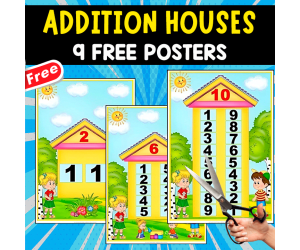
MATH FACTS HOUSES | 9 FREE POSTERS FOR KIDS
Math, Addition and Subtraction, Calculus, Early Math, STEM, Montessori, Early Learning, Elementary, Homeschool Resources, Not Grade Specific, Pre-K, Classroom Decor, Charts, Teacher Tools, Diagrams, Worksheets & Printables, Activities
MATH FACTS HOUSES | 9 FREE POSTERS FOR KIDS THIS RESOURCE HAVE 9 FREE POSTERS OF THE MATH FACTS HOUSES OF ADDITION. INTRODUCTION: Thank you for choosing EDITORIAL ARENAS EDUCATIVAS! Our mission is to deliver a variety of learning resources that make education enjoyable and effective for children. Don't forget to visit our store to explore products for reading, writing, math, and Spanish language skills. MAIN DESCRIPTION: 1) Does this material allow for custom editing? This educational document is available in PDF format, so you cannot edit it. You simply need to download and then print it. 2) What main topic does the resource cover? This document has been developed to address a basic topic that children in kindergarten through elementary school should master. This document will also be helpful to the general public who want to learn. 3) What version does this document correspond to? This educational resource is designed in PDF format, which will make your download experience much simpler and easier to use. 4) Is the material designed in color or black and white? This document has been designed in color (if required) or is sometimes created in black and white to make your learning experience easier. SECONDARY AND COMPLEMENTARY INFORMATION: 1) What educational standards were used as the basis for creating this material? This document was not developed based on any specific standard. 2) Who is the creator of this resource and how should it be cited? The creator of this document is EDITORIAL ARENAS EDUCATIVAS. 3) Is this resource available for free or does it require a purchase? Because we vocationally work for the education of thousands of students, we are offering this document for free. 4) This resource is for individual use only; what restrictions apply to its redistribution or sale? We ask that you share our link so more people can download our resource or recommend our store. It would help us greatly.
Author EDITORIAL LAURA EDUCA
Rating
Tags FREE, FREE RESOURCES, MATH FACTS, MATH FACTS HOUSES, MATH POSTERS, POSTERS, CLASSROOM DECOR, DECOR

Community Helpers Reading Worksheets Autism Level 2 SPED
Life Studies, Career, Special Resources, Special Education Needs (SEN), Speech Therapy, Kindergarten, Preschool, Worksheets & Printables, Worksheets
Community helpers worksheets with simple reading support and real-life photos. Students look at the pictures, read the labels, and circle the correct answer. What is included This PDF includes 40 community helpers worksheets with labeled picture choices. Students look at the photos, read the labels, and circle the correct answer. Each page includes: 3 answer choices real-life photos simple instructions consistent page layout The file is ready to print in US Letter size. Who is this for I created these worksheets for: preschool and kindergarten students autism and special education support speech therapy sessions ESL and early readers They can be used in classrooms, therapy settings, or at home. How to use Print the pages and give students one worksheet at a time. Students look at the pictures, read the words, and choose the correct answer. Some teachers laminate the pages or use dry-erase sleeves so the activity can be reused. Skills targeted These worksheets give students practice with: early reading vocabulary visual discrimination identifying community helpers attention and focus Why it’s effective Many students respond better to real photos than to clip art, especially those who rely on visual support. The repeated layout also helps students know what to expect from page to page. The reading component is kept simple so learners can focus on matching words with pictures without too much extra information.
Author printable_by_nabil
Rating
Tags Communityhelpers, Auttism, Specialeducation, Visuallearning, Prek , Kindergarten , Speechtherapy, Lifeskills, Worksheets , Printables
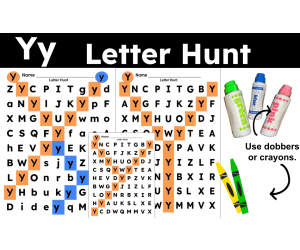
Letter Y Activities
ELA, Kindergarten, Preschool, Grade 1, Worksheets & Printables, Worksheets
This file is a PDF. It is a Letter Hunt for the letter Y. It can be used in grades pre-k, first grade, or homeschool. Students can use crayon to color in all the letter Ys or use dobbers. Once students color in all the Ys the dots will reveal a "hidden letter Y" in the Letter Hunt. As extra practice students can write over the colored dots to form the letter Y. Includes: Capital Letter Y hunt Lowercase Letter y hunt Mix of both upper and lowercase letter Y hunt Answer keys in color #LetterYActivities Enjoy! More Letter Hunts Links Below: Letter A Hunt Letter B Hunt Letter C Hunt Letter D Hunt Letter E Hunt Letter F Hunt Letter G Hunt Letter H Hunt Letter I Hunt Letter J Hunt Letter K Hunt Letter L Hunt Letter M Hunt Letter N Hunt Letter O Hunt Letter P Hunt Letter Q Hunt Letter R Hunt Letter S Hunt Letter T Hunt Letter U Hunt Letter V Hunt Letter W Hunt Letter X Hunt Letter Y Hunt Letter Z Hunt - - - - - - - - - - - - - - - - - - - - - - - - - - - - - - - - - - - - - - - Here are links to similar resources in my store: Alphabet Alliterations Character Analysis Worksheet Happy Culture Day Poster Darkling Beetle Life Cycle Display First Days of 2nd Grade Flipbook All About My Country Research Project Types of Communities Anchor Chart Check Out More Resources from My Store: A Traveling Maestra - - - - - - - - - - - - - - - - - - - - - - - - - - - - - - - - - - - - - - -
Author CraftEdPrints
Tags Letterhunt , Alphabet , Letters , Preschool , Homeschool , Elementary , Letteroftheweek , Letteroftheday , #LetterYActivities

The St. Andrews Werewolf (Novel Study) Gr. 6-8
ELA, Literature, Grade 6, 7, Worksheets & Printables, Novel Studies
The St. Andrews Werewolf (Novel Study) Gr. 6-8 This educational resource, is designed to introduce students from Grade 6 to 8 into the world of Liz Austen's adventures in New Brunswick. The story takes students through a series of mysteries as Liz embarks on her role in a summer production. Resource Features: It offers teachers and homeschoolers a variety of activities. Includes chapter by chapter questions and crosswords that enhance understanding of setting, characterization and plot development. Authored by Eric Wilson, this novel not only paints an intriguing storyline but doubles as educational content weaved into social studies and science investigation topics – making it ideal for an integrated learning environment. Penned in language suitable for Grade 7-8 reading levels,, this resource can be used as captivating homework assignments or collaborative group projects that spur critical thinking beyond textbooks. It advocates practical comprehension over rote learning; stimulating interest and involvement among students while helping them retain knowledge better. Format: The novel study is conveniently compiled into one PDF file which features both teacher's guide along with necessary student resources – eliminating any clutter. The content within this handy tool has been intricately designed by experienced educators who strive for a balance between intellectual discovery and core academic requirements – ensuring it fits snugly within any Language Arts curriculum without being overwhelming. Educational Enrichment: The St.Andrews Werewolf (Novel Study) covers rich literature studies, sparking curiosity towards mystery genre exploration while imparting valuable geography-based facts throughout its narrative flow from authentic historical events . As such, it turns reading into an unforgettable educational journey – thereby making it a must-have asset for all educators seeking imaginative means to education.
Author Classroom Complete Press
Tags PDF

Watermelon Count Draw Trace Ten Frames Activity Worksheets
Math, Numbers, Kindergarten, Preschool, Grade 1, Worksheets, Worksheets & Printables
Watermelon Count, Draw, Trace Ten Frames Activity Worksheets NO-PREP | Learn Numbers 1-10 Boost early math skills with this fun watermelon-themed ten frames counting activity! Learners develop counting skills and number recognition through coloring and counting. This low-prep resource builds early math skills through meaningful hands-on activities. It's perfect for individual, small group, or whole class practice of counting, number identification, fine motor skills, and more. Why are counting activities beneficial? Develops Number Recognition Improves Counting Skills Enhances Fine Motor Skills Promotes Problem-Solving Encourages Hands-On Learning Builds Early Math Confidence Supports Visual Learning Builds a Solid Foundation in Math Use During Sub-Days Included in this download: A PDF File with 10 Printable Pages Download related resources: Watermelon Roll and Count Mats Dice Game Watermelon Count and Color Ten Frames Activity Printables Like this resource? Search for more Doodle Thinks Roll and Count games. Thanks for downloading Doodle Thinks resources. Have fun learning!
Author Doodle Thinks
Rating
Tags Watermelon, Counting, Numbers, Number Recognition, Number Activity, Number Game, Roll And Count, Numbers 1-10, Number Sense, Ten Frames
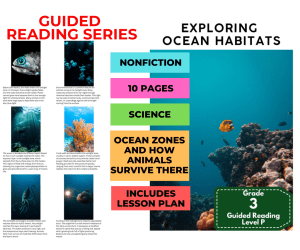
Guided Reading Level P - Exploring Ocean Habitats (with Lesson Plan)
ELA, Resources for Teachers, Reading Comprehension, Reading, Language Development, Physics, Science, Life Sciences, Earth and Environmental Sciences, Grade 2, 3, 4, Worksheets & Printables, Worksheets, Teacher Tools, Centers, Activities, Literacy Readers, Quizzes, Quizzes and Tests, Assessments
This Guided Reading Book - Exploring Ocean Habitats (Level P) with lesson plan includes: Guided Reading Color Label (front cover x1) This is a quick way to match the book’s demands to what students can generally handle.. The overall goal is to use the level/color to pick books for several smaller groups. To qualify for a certain level, a student is expected to read a book from that level with about 90–94% accuracy. If a student is consistently accurate and understands, move up a level. If the student is struggling at that level, drop down and add more support. Each student will improve at completely different rates, but it is generally one of the best ways to check progress across the class. DOWNLOAD THE CATALOG TO VIEW ALL GUIDED READING BOOKS AVAILABLE (SORTED LEVELS A-Z) Pre-Reading Question (x1) Teacher asks the prompt aloud, can be while showing the cover or first page. Students share what they already know, or make educated guesses from the cover. Prompt them to use the target vocabulary. Write some of their responses on the board to look back at during the reading. Vocabulary Words (x5) Introduce the five words, best doing it one at a time. Start by saying it, while students repeat and then see if anyone knows what it means before reading further. Read through the meaning and try to briefly connect each word to a picture or gesture so it’s meaningful. Ask students to flip through the book pages and point to where they see each of the vocabulary words. While reading the book pause upon coming across one of the vocab words or read the sentence twice to make sure students understand the word has appeared. Optional: Ask students to raise hands whenever they see/hear one of the new words. Guided Reading Pages (x10) Check the book snapshot (below) for: primary topic - do you need to prep extra reading or intro materials on this? what is taught best - decide on 1-2 bullets to focus on, use the prompt or words provided here for best results. learning goals - what you are checking for students to be able to do after the session, elicit answers using prompts or words provided. key vocabulary (see section above). questions overview - so you know what is coming up and if you need to prep extra materials to assist understanding. Run the lesson You may have already looked at a few of the pages together, but you can show them some of the pictures again first to set meaning. Depending on how much time you have and how familiar your students are with guided reading class, you may want to read the book aloud first with the group first. Students whisper or partner read, while you listen in. If time, do it as a group, one student reading a page each. Use the guided page’s prompts to coach: “Check the picture / does it make sense?” “Point under the words / try the first sound” “Reread the sentence smoothly”. Try to focus more on one student per session (rotating every time), so you can work out if they are ready to move up or need to move down a level. Comprehension Questions (back cover x3) This is your way to check that students didn’t just say the words, but actually understood the text. First, let students answer by pointing to the page/picture and saying a short sentence. After any answer, follow with: “Show me where you found that in the text.” In bigger groups, have partners answer first (10–20 seconds), then call on 2–3 students to share. Differentiation tips: Emerging speakers/struggling readers: oral + pointing On-level: oral in a full sentence Higher: one written sentence or draw + label Book Snapshot Title: Exploring Ocean Habitats Genre: Nonfiction (informational) Subject: Life Science / Earth Science (Ocean) / Reading Primary Topic: Ocean zones and how animals survive there Estimated Guided Reading Level (A–Z): P What This Book Teaches Best Ocean layers by sunlight: The ocean is divided into layers based on how much sunlight reaches the water (sunlight zone, twilight zone, midnight zone, abyssal plain, hadal zone). How living things get energy in different zones: Phytoplankton grow in the sunlight zone, plants can’t grow in the twilight zone due to limited light for photosynthesis, and deep-sea ecosystems near vents use chemosynthesis. Animal adaptations for dark habitats: Examples include large eyes in the twilight zone and bioluminescence used to attract prey, communicate, or camouflage. Survival challenges in the deep ocean: The text describes permanent darkness, high pressure, near-freezing temperatures, and how food can drift down from above (“marine snow”). Specialized predators and movement: The anglerfish uses a glowing lure to bring prey close, and the Dumbo octopus flaps ear-like fins and lacks an ink sac in total darkness. Learning Goals Students will explain how the ocean is divided into layers based on sunlight. Students will describe the sunlight zone and how deep it extends, using details from the text. Students will explain why plants cannot grow in the twilight zone, according to the book. Students will describe two survival adaptations from the text (such as bioluminescence, large eyes, or a glowing lure). Students will compare conditions in two deep-ocean habitats (midnight zone, abyssal plain, hadal zone) using text evidence. Students will explain how hydrothermal vent ecosystems can thrive without sunlight, based on the text. Key Vocabulary From the Text phytoplankton — tiny ocean organisms that grow using sunlight. photosynthesis — plants making food using light. bioluminescence — animals making their own light. cephalopods — ocean animals like octopuses and squids. chemosynthesis — making energy using chemicals, not sunlight. Discussion Prompts Pre-reading question: What might make it hard for ocean animals to live where there is very little light? Comprehension questions: What does the book say the sunlight zone is, and how deep does it go? Why does the book say plants cannot grow in the twilight zone? According to the text, what helps ecosystems thrive near hydrothermal vents? Printing Tips 1. Best Printing Method (Recommended) “Booklet” Printing (Best if Available) If your printer or PDF viewer supports Booklet Printing , use this. Settings to use: Print mode: Booklet Paper size: Letter or A4 (either works) Orientation: Landscape Print on both sides: Yes Flip on: Short edge Scaling: Fit to printable area Booklet subset: First test: Front sides only Then: Back sides only This will automatically: Pair pages correctly Put the cover on the outside Align everything for folding After printing, fold in half and staple along the spine . 2. If “Booklet” Printing Is NOT Available You can still print this correctly with manual duplex printing . Step-by-step: Open the PDF. Choose Print . Set: Orientation: Landscape Pages per sheet: 1 Print on both sides: Yes Flip on: Short edge Print all pages . Because each PDF page already contains two facing book pages, the result will still fold cleanly into a book. Thousands of Cored Education products are included with your TeachSimple membership. Download links and encyclopedia index available here.
Author Cored Education
Rating
Tags Reading Comprehension, Reading Passages, Reading, Guided Reading, Guided Reading Lesson Plan, Guided Reading Activity, Pre-reading, Vocabulary, Science Lesson Plans, Oceans

COPY THE MODEL | 5 Worksheets
Special Resources, Speech Therapy, Kindergarten, Preschool, Worksheets, Worksheets & Printables
5 FANTASTIC WORKSHEETS FOR KIDS TO COPY MODELS! Number of pages: 5 pages For each page you will find 4 exercises. HOW TO USE THESE SHEETS: Print the sheets, then have your students prepare their pencils or colored markers so they can copy the models that have been presented. Then carefully observe each drawing and copy each of the models exactly as they are. SPECIFIC DESCRIPTION OF THE RESOURCE: Thank you very much for being part of this community of educational resources. A. The name of this educational resource is "5 coloring chips, to copy the indicated pattern" B. This document contains this number of pages This educational game contains 5 pages. On each page you will find 4 exercises, so in total you will have 20 work exercises. C. This educational resource has been prepared by: Prepared by EDITORIAL ARENAS EDUCATIVAS. D. You can apply this educational document in different contexts such as: You can apply this in the classroom if you are a teacher, you can apply it as a brain or attention game in the moments when you see that your students have a free moment or perhaps they have just arrived at school, in order to prepare their minds for the rest of the day. school. Also, if you are a parent, and you see that your children spend a lot of free time at home, you can make them practice this, as a game. E. Is this document in black and white or color? This document is prepared in color. F. For what ages is this document recommended? It is recommended to apply this at any age. G. At what point in class can I apply it? You can apply this at any time during class, whether before, during or after. H. Should I apply it individually or in groups? It is preferable to apply it individually, also because this activity is extremely easy to do so your children will not spend much time. I. Keywords that describe the product: Concentration exercises, brain games, brain games, copying models, attention games.
Author EDITORIAL LAURA EDUCA
Tags Brain Games, Memory Games, Concentration Games

Write To Persuade: Come To Seaside World (9-14 years)
ELA, Writing, Grade 4, 5, 6, 7, Worksheets & Printables, Worksheets
Write To Persuade: Come To Seaside World This comprehensive teaching aid is aimed at children aged 9-14 years old and takes them on a guide to mastering persuasive writing. By walking through creating letters, pamphlets, brochures, and newspaper articles, learners will learn how to write persuasively in several academic contexts. Main Features: Diverse starting points for creating persuasive content. A focus on organisational and literary devices such as repetition mastery and emotive words usage. A layer of understanding towards tailored writing for varied audiences. The learning aid emphasises the importance of spelling accuracy, punctuation use, and grammatical correctness in successfully conveying your message. It presents example student essays that illustrate these norms clearly alongside practice questions designed around those compositions. Corrective Feedback and Tips for Success The Write To Persuade pack provides corrective feedback on common learner mistakes along with useful tips that bring achievement success within each session's reach. Our flexible ordering allows you to choose what you need when you need it without worrying about sequence constraints! Suitable for both independent study or supplementary lessons: This all-in-one package eases lesson development with pre-packaged essays covering non-fiction topics essential in pupils' learning trajectory. Suitable Grades: Ideal transition tool from Grade 4 to Grade 7 progressively making every day better! Included Subjects: Targeted at Language Arts subjects with an emphasis on writing and worksheets. Accessibility: Delivered in an accessible, hassle-free PDF format. Let's increase productivity and get down to the art of persuasive writing with our pack!
Author Guinea Pig Education
Tags Persuasive Writing, Literacy Skills, Varied Formats, Organisational Devices, Practice Questions

Birmingham Campaign Interactive Foldable Booklets – EBOOK
Social Studies, History, History: USA, Grade 2, 3, 4, 5, 6, 7, 8, 9, 10, 11, 12, Worksheets & Printables, Worksheets
Birmingham Campaign Interactive Foldable Booklets - EBOOK An engaging interactive teaching resource developed to shed light on key features of the Birmingham Campaign and associated civil rights movement history, captivating the interest of learners from 2nd to 12th grade. Highlights: Educational tool designed with two clear-cut, foldable booklets that aim to enrich social studies curricula. Engages students in an immersive learning experience, helping visualize important milestones in American history better. Pivotal for educators across homeschooling and classroom settings. Facilitating Acquisition of Knowledge and Skills: Aims at facilitating reading comprehension of significant events that were integral to the fight for equality during the Birmingham Campaign. The downloadable PDF file caters for both whole group instruction or smaller-focused discussion groups within classrooms as well as home-based learning scenarios. Versatility & Creativity: This eBook is versatile; it can be used both on Interactive Notebooks and Lapbooks. This compatibility fits various classroom setups and strategies. The eBook is available both as black & white versions (perfect for personal student annotations) and full-color editions that visually encapsulate real-life narratives. It subtly nurtures creativity among students through its 'cut-fold-glue' instructions that aid in developing fine motor skills along with cognitive abilities. In Conclusion: The uniqueness of this eBook lies in offering multifaceted insights into societal struggles towards equality while providing teachers flexibility with instructional resources catering to different learning styles - particularly beneficial for visual learners keen on tangible manipulatives beyond text-books or screen-based interactive tools. In essence, the Birmingham Campaign Interactive Foldable Booklets - EBOOK is an insightful tool in the exploration of Black History themes, pertinent to today's global fight against inequality.
Author Knowledge Box Central
Tags Birmingham Campaign, Civil Rights Movement, Interactive Learning, Social Studies, Hands-on Education

Worksheets and Centers: Letter O Trains
ELA, Writing, Handwriting, Language Development, Phonics, Kindergarten, Preschool, Activities, Worksheets & Printables, Worksheets
Children who have a fascination for trains will delight in refining their skills in letter recognition and initiating sounds with these inventive alphabet worksheets and cards! Each activity sheet and card game encourages students to participate actively and enjoy themselves as they craft trains to showcase their letter knowledge. Here's What's Included: Eight multicolored train engine cards Twelve train car images starting with the letter Eight train cars exhibiting the letter on the carriage Four mats designed for sorting train tracks Three direction and cover cards for the task box One worksheet aimed at sorting capital and lowercase letters A pair of worksheets for practicing handwriting Two worksheets centered on initial sounds This compilation of activities prompts students to construct trains to rehearse letter recognition for both uppercase and lowercase letters, letter formation of both capital and lowercase letters, and the beginning sounds for both the long O and short O sounds. The package offers both practical sorting cards and cut-and-paste worksheets for students, all wrapped in an entertaining train theme. Appropriate Times to Use: In a Literacy Center During Small Group Learning For Independent Practice As a Morning Work or as a Morning Tub or Basket As a Task Box Activity The train sorting cards are ideally sized for a task box activity , allowing for a quick setup and easy cleanup for this literacy center or small group task. The worksheets serve well for self-study, morning work, or group activities. Skills Evaluated: Letter Recognition Differentiating Between Capital and Lowercase Letters Letter Formation Initial Sounds Sorting Long and Short Vowel Sounds All worksheets are ready for immediate use. Teachers simply need to print them and distribute to students. The train cards form a straightforward, low prep literacy center activity that can be laminated for prolonged use, thus making this activity reusable time and again.
Author The Connett Connection
Tags Alphabet Trains, Alphabet Activities, Alphabet Worksheets, Alphabet Center, Literacy Center, Beginning Sounds, Handwriting Practice, Letter O, Letter O Activities, Letter O Worksheets
"Shiloh" Discussion Questions & Vocabulary
ELA, Literature, Grade 4, 5, 6, 7, 8, Worksheets & Printables, Novel Studies
An editable, Common Core-aligned set of discussion questions and vocabulary activities for use with the novel, Shiloh by Phyllis Reynolds Naylor. Prompts appear in order of complexity, and simplified language appears in parentheses (delete or modify as needed). Pick and choose which resource elements and prompts will work best for your own class.
Author Room2Ruminations
Tags Middle School, Writer's Workshop, Novel Study Guide, Literature, Shiloh, Reading Response, Discussion Questions, Vocabulary
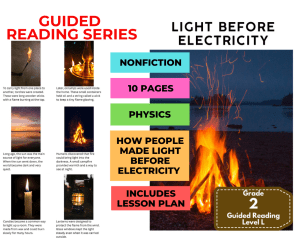
Guided Reading Level L - Light Before Electricity (with Lesson Plan)
ELA, Resources for Teachers, Reading Comprehension, Reading, Science, Engineering, Technology, Physics, History, Social Studies, Grade 1, 2, 3, Worksheets & Printables, Worksheets, Teacher Tools, Centers, Activities, Literacy Readers, Quizzes, Quizzes and Tests, Assessments
This Guided Reading Book - Light Before Electricity (Level L) with lesson plan includes: Guided Reading Color Label (front cover x1) This is a quick way to match the book’s demands to what students can generally handle.. The overall goal is to use the level/color to pick books for several smaller groups. To qualify for a certain level, a student is expected to read a book from that level with about 90–94% accuracy. If a student is consistently accurate and understands, move up a level. If the student is struggling at that level, drop down and add more support. Each student will improve at completely different rates, but it is generally one of the best ways to check progress across the class. DOWNLOAD THE CATALOG TO VIEW ALL GUIDED READING BOOKS AVAILABLE (SORTED LEVELS A-Z) Pre-Reading Question (x1) Teacher asks the prompt aloud, can be while showing the cover or first page. Students share what they already know, or make educated guesses from the cover. Prompt them to use the target vocabulary. Write some of their responses on the board to look back at during the reading. Vocabulary Words (x5) Introduce the five words, best doing it one at a time. Start by saying it, while students repeat and then see if anyone knows what it means before reading further. Read through the meaning and try to briefly connect each word to a picture or gesture so it’s meaningful. Ask students to flip through the book pages and point to where they see each of the vocabulary words. While reading the book pause upon coming across one of the vocab words or read the sentence twice to make sure students understand the word has appeared. Optional: Ask students to raise hands whenever they see/hear one of the new words. Guided Reading Pages (x10) Check the book snapshot (below) for: primary topic - do you need to prep extra reading or intro materials on this? what is taught best - decide on 1-2 bullets to focus on, use the prompt or words provided here for best results. learning goals - what you are checking for students to be able to do after the session, elicit answers using prompts or words provided. key vocabulary (see section above). questions overview - so you know what is coming up and if you need to prep extra materials to assist understanding. Run the lesson You may have already looked at a few of the pages together, but you can show them some of the pictures again first to set meaning. Depending on how much time you have and how familiar your students are with guided reading class, you may want to read the book aloud first with the group first. Students whisper or partner read, while you listen in. If time, do it as a group, one student reading a page each. Use the guided page’s prompts to coach: “Check the picture / does it make sense?” “Point under the words / try the first sound” “Reread the sentence smoothly”. Try to focus more on one student per session (rotating every time), so you can work out if they are ready to move up or need to move down a level. Comprehension Questions (back cover x3) This is your way to check that students didn’t just say the words, but actually understood the text. First, let students answer by pointing to the page/picture and saying a short sentence. After any answer, follow with: “Show me where you found that in the text.” In bigger groups, have partners answer first (10–20 seconds), then call on 2–3 students to share. Differentiation tips: Emerging speakers/struggling readers: oral + pointing On-level: oral in a full sentence Higher: one written sentence or draw + label Book Snapshot Title: Light Before Electricity Genre: Nonfiction (informational) Subject: Science (Technology) / Social Studies (Past and Present) Primary Topic: How people made light before electricity Estimated Guided Reading Level (A–Z): L What This Book Teaches Best The sun was the main source of light long ago, and it got dark when the sun went down. People discovered fire could bring light into darkness and help them see at night. A clear sequence of lighting tools is explained: torches, oil lamps (with a wick), candles, lanterns, gas lamps, electric lightbulbs, and LED bulbs. How inventions solved problems: lanterns protected flames from wind, gas traveled through pipes to power lamps, and electric lightbulbs were safer because they used no real flame. Past-to-present comparison: lighting changed from “flickering fires” to steady electric light you can turn on with a switch. Learning Goals Students will describe why the sun was the main source of light long ago. Students will explain how fire helped people see at night. Students will identify several light sources from the book and describe how each one made light. Students will explain how lanterns kept light steady when carried outside. Students will explain why the electric lightbulb was safer and brighter than candles in the book. Students will describe how LED bulbs are different from older light sources (cool to the touch, little energy). Key Vocabulary From the Text source — where something comes from. torches — long sticks with a flame used for light. wick — a string that helps a lamp or candle burn. invention — something new that someone creates. flickering — shining in a shaky way, like moving firelight. Discussion Prompts Pre-reading question: What kinds of lights do you use when it is dark? Comprehension questions: What was the main source of light for everyone long ago? How did lanterns protect the flame when people carried them outside? Why did the book say the electric lightbulb was safer than candles? Printing Tips 1. Best Printing Method (Recommended) “Booklet” Printing (Best if Available) If your printer or PDF viewer supports Booklet Printing , use this. Settings to use: Print mode: Booklet Paper size: Letter or A4 (either works) Orientation: Landscape Print on both sides: Yes Flip on: Short edge Scaling: Fit to printable area Booklet subset: First test: Front sides only Then: Back sides only This will automatically: Pair pages correctly Put the cover on the outside Align everything for folding After printing, fold in half and staple along the spine . 2. If “Booklet” Printing Is NOT Available You can still print this correctly with manual duplex printing . Step-by-step: Open the PDF. Choose Print . Set: Orientation: Landscape Pages per sheet: 1 Print on both sides: Yes Flip on: Short edge Print all pages . Because each PDF page already contains two facing book pages, the result will still fold cleanly into a book. Thousands of Cored Education products are included with your TeachSimple membership. Download links and encyclopedia index available here.
Author Cored Education
Rating
Tags Reading Comprehension, Reading Passages, Reading, Guided Reading, Guided Reading Lesson Plan, Guided Reading Activity, Pre-reading, Vocabulary, Physics, History
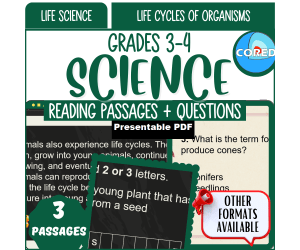
Science Reading Comprehension Life Cycles of Organisms Presentable PDF
ELA, Reading, Reading Comprehension, Science, Life Sciences, Biology, Common Core, Animals, Human Body, Grade 2, 3, 4, Worksheets & Printables, Worksheets, Assessments, Teacher Tools, Tests, Quizzes and Tests
Reading Passages on Life Cycles of Organisms for Life Science (Biology) Snapshot Genre: Nonfiction Subject: Life Science Primary Topic: Life cycles, reproduction, and heredity in organisms Estimated Guided Reading Level (A–Z): L What This Teaches Best It clearly explains that living things go through life cycles and compares plant and animal life cycles. It teaches the sequence of a flowering plant’s life cycle, including germination, seedling, adult plant, pollination, and seed development. It compares flowering plants and conifers by leaves, pollination, seed structures, and life span. It introduces heredity by distinguishing characteristics, traits, inherited traits, and learned traits. Learning Goals Students will identify common stages in plant and animal life cycles. Students will compare a flowering plant life cycle with a conifer life cycle. Students will explain how fertilization is part of animal development. Students will distinguish between inherited traits and learned traits. Students will use examples from the text to describe how traits are passed from parents to offspring. Part 2 - Life Cycles of Organisms Reading Passage 1: The Life Cycle of Plants Reading Passage 2: The Life Cycle of Animals Reading Passage 3: Heredity PRESENTABLE PDF VERSION Run it like a slide show straight from a PDF, with no PowerPoint or extra software needed, just open, project, and teach. Other versions are available in the links list below or in the full catalog. FULL CATALOG OF DOWNLOAD LINKS HERE Grade 3/4 Links: Physical Science Part 1 - Properties of Objects and Materials Google Docs/Slides/Forms PDF PPT Word Free Supplementary Pack Accompanying Videos Physical Science Part 2 - Position and Motion of Objects Google Docs/Slides/Forms PDF PPT Word Free Supplementary Pack Accompanying Videos Physical Science Part 3 - Light, Heat, Electricity, Magnetism Google Docs/Slides/Forms PDF PPT Word Free Supplementary Pack Accompanying Videos Life Science Part 1 - Characteristics of Organisms Google Docs/Slides/Forms PDF PPT Word Free Supplementary Pack Accompanying Videos Life Science Part 2 - Life Cycles of Organisms Google Docs/Slides/Forms PDF PPT Word Free Supplementary Pack Accompanying Videos Life Science Part 3 - Organisms and Environments Google Docs/Slides/Forms PDF PPT Word Free Supplementary Pack Accompanying Videos Earth Science Part 1 - Properties of Earth Materials Google Docs/Slides/Forms PDF PPT Word Free Supplementary Pack Accompanying Videos Earth Science Part 2 - Changes in the Earth and Sky Google Docs/Slides/Forms PDF PPT Word Free Supplementary Pack Accompanying Videos Earth Science Part 3 - Objects in the Sky Google Docs/Slides/Forms PDF PPT Word Free Supplementary Pack Accompanying Videos For similar products and other frees, do check out Cored Group on TeachSimple .
Author Cored Education
Rating
Tags Science, Elementary, Reading, Comprehension, Vocabulary, Life Science, Biology, Science Assessments, Reading Comprehension Assessments, Vocabulary Assessments

Math Journal: Experimental Probability with Two Independent Events
ELA, Math, Percentages, Fractions, Statistics, Writing, Grade 5, 6, 7, 8, 9, Worksheets & Printables, Word Problems, Activities
Math Journal: Experimental Probability with Two Independent Events This resource serves as a helpful teaching tool for educators focusing on the concepts of experimental probability and theoretical probability of two independent events in middle school mathematics. It offers an engaging math journal entry exercise that allows students to explain their mathematical thinking in pictures, numbers, diagrams, and words. How to Use: Students are given the following question: You have a six-sided die and a penny. If you roll the die twice and flip the penny twice, which is more likely: to get two sixes on the die or two heads from the penny? Explain your thinking using pictures, numbers, and words. Can you figure out the percentage chance of each event happening? Give students dice, coins, and mini whiteboards to work with so they can start to test out their ideas and theories. Encourage students to tackle the penny first as there are fewer results when flipping two coins. Suggest that students work together in pairs or small groups and use a table or chart to record the experimental options that could occur. You may want to start by teaching a mini-lesson about the probability of two independent events: that one multiplies the probability of each event to determine the probability of BOTH events. Grades to Use With This resource is ideal for use with students in grades 5-9 but can also be used as special education material or enrichment content for gifted children aged between grades 4-6. Finally, it could be used in a high school special education classroom. What's Included: This two page PDF is ready to print and go! If you enjoy this math journal entry, check out my bundle of 20 Middle School Math Journal Entries or my Math Journal Rubric for easy marking. Or, explore other probability items in my store.
Author Grace Under Pressure
Tags Math Journal, Experimental Probability, Two Independent Events, Middle School, Probability, Dice , Coins, Chance, Middle School Math, Fractions

Comic Book Photoshop Activity
Science, Technology, Grade 7, 8, 9, 10, Workbooks, Worksheets & Printables
Students will work with digital tools in the Comic Book Photoshop Activity . Students will take an ordinary image and turn it into a comic book panel. Step by step directions are included.
Author OK Products
Tags Technology Activity, Computer Class, Science Lesson, Comic Book, Images, Photoshop, Photopea, Digital Tools, Graphic Designs
Jesus Feeds the 5,000 | Interactive Reading Packet
ELA, Reading, Preschool, Grade 1, 2, Worksheets & Printables, Worksheets
This resource is a Jesus Feeds the 5,000 Interactive Reading Packet. This is a great component to your early finisher buckets or reading stations! Included: - Jesus Feeds the 5,000 Story (printed in color and black and white) - Picture cards - Write the room - Sequencing cut and paste - 5 Writing prompts - 2 'Like Jesus' Graphic Organizers - Unscramble and draw a picture - Roll and retell - Problem and solution - Making words - ABC Order - True / False - 1 Coloring page
Author Glitter and Grace
Tags Jesus, Reading Packet, Religious Reading, Bible, Sequencing
I Survived American Revolution 1776 – Book Study
ELA, Literature, Grade 4, 5, 6, Novel Studies, Worksheets & Printables
This "I Survived the American Revolution, 1776" Book Study Unit is packed with over 100 pages of engaging resources for students. Included: - Chapter comprehension worksheets - Mystery match vocabulary words - Exit quizzes - Group work - Summative assessment & so much more. All you have to do is print and go! Answer keys included.
Author TrilogyTeacher
Rating
Tags Writing Prompts, American Revolution, Literature, Exit Tickets, Reading Comprehension, 1776 (book), American Revolution Unit Plans
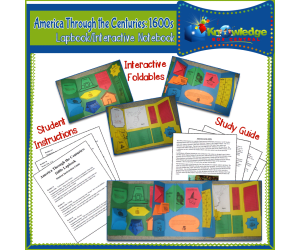
America Through the Centuries: 1600s Lapbook / Interactive Notebook - EBOOK
Social Studies, History, History: USA, Preschool, Grade 1, 2, 3, 4, 5, 6, 7, 8, Worksheets & Printables, Worksheets
America Through the Centuries: 1600s Lapbook / Interactive Notebook - EBOOK This comprehensive teaching resource aims to help educators journey through American history starting from the 1600s. This interactive ebook is both engaging and informative, perfect for educators wanting to impart knowledge about important events, notable personalities, and significant innovations that shaped America during this era. Delving into the Past in Detail The Ebook provides interesting insights into lifestyles of the period stretching from life in New England right to Virginia. It covers aspects like: Food habits, Attire, Residential structures and more. The material presented is thorough yet very accessible, making it suitable for children across a wide range of grades – kindergarten all the way through grade eight. Inclusive Study Guide & Clear Instructions This resource comes with a detailed study guide as well as clear instructions and templates guiding on how to use it most effectively. Whether used as standalone learning material or in conjunction with other history curriculums — this resource aligns perfectly! Possible Implementation Methods: Larger classroom discussions introducing new topics Detailed small group interactions delving deeper into historical events Homing assignments compelling students explore further independently Pdf Format & Wide Coverage The ebook, accessible via download in PDF format spread over 58 pages, is enriched with meticulously curated Social Studies content focusing on US History. It serves as a valuable teaching aid for traditional school teachers or those homeschooling their children.
Author Knowledge Box Central
Tags Interactiveness, American History, Homeschooling, Interactive Learning, US Heritage

Research Organizer & Essay Assignment: Rembrandt
Creative Arts, Art, Art History, Grade 8, 9, 10, 11, Activities, Projects, Worksheets & Printables, Worksheets
Research Organizer & Essay Assignment: Rembrandt Guide students to conduct research and write an informational essay about the prolific Dutch artist Rembrandt. This 6-page teaching resource includes a biography and note-taking worksheet to help students gather facts and sources on Rembrandt's life. Next, students use an essay outline to organize their research into a five-paragraph informative essay. The resource also contains an essay assignment with writing tips, a peer review checklist, and a rubric aligned to Common Core ELA standards. Use the full resource for a complete research lesson or assign components like the biography worksheet for a shorter activity. Best for secondary grades 8-11 language arts classrooms.
Author The Language of Educational Art, LLC
Tags Essay, Research, Notetaking, Rubric, Outlining, Rembrandt