



2,755 products added recently
Page 6 - Worksheets & Printables
Discover a wealth of worksheets and printables to supplement your teaching. Covering multiple subjects and grade levels, these resources provide activities that reinforce learning objectives. Incorporate them into your lessons to offer hands-on practice and enrich your curriculum.

 Show filters


Internet Reading Comprehension Passage - Cored Ed Encyclopedia
ELA, Language Development, Resources for Teachers, Reading Comprehension, Reading, Pre-Reading, Writing, Science, Technology, Strategies, Grade 2, 3, 4, 5, Worksheets & Printables, Worksheets, Teacher Tools, Centers, Activities, Writing Prompts, Assessments, Tests, Quizzes and Tests, Quizzes
This Internet reading comprehension contains the following: Pre-Reading Trivia Students will write down one thing they already know about the subject and then read five more facts and discuss. These facts are fun, and the students will enjoy learning about the subject before reading more. Reading Passage The text is a high-interest reading passage with set paragraphs, roughly three to four paragraphs long. It contains a variety of themes about the topic, anywhere from history to technology. The passage is between 250 and 350 words in length. Mixed Questions The first question page contains four multiple-choice questions, each with a choice of four answers, and three written response questions that require a sentence or two from the student. Vocabulary Questions Practice seven key words from the text in this section across two activities. First section is scrambled words where students will unscramble three words given a clue for each. The second section is a word to meaning matching activity. Creative Writing In this question, the student will be required to write a five to eight sentence paragraph on a question related to the topic. Extension Activities This page is optional for fast finishers or to take home. There are several activities, each one requiring a different skill. Do some, do none, do all, completely optional - but you will feel reassured knowing every possibility is planned for. Answer Key There are answers for the multiple-choice questions, written response questions have sample answers, vocabulary answers and if there is a summary question then a sample summary will be provided as well. FULL CATALOG OF DOWNLOAD LINKS AND ENCYCLOPEDIA INDEX HERE Lesson Snapshot Title: Internet Genre: Nonfiction (informational text) Subject: Reading (Informational Text) / Technology Primary Topic: How the Internet works and how it began Estimated Guided Reading Level (A–Z): Q What This Lesson Teaches Best Defines the Internet as a worldwide system of connected computer networks that use shared rules (TCP/IP) to communicate. Explains how messages travel by being split into small chunks called packets that can take different routes and arrive out of order. Describes what routers do: forward packets between networks by choosing paths toward the right destination. Builds background knowledge about early Internet history (ARPANET, the 1969 “lo” message, and the 1983 switch to TCP/IP). Clarifies the difference between the Internet and the World Wide Web, introducing hypertext and using a browser to view linked pages. Learning Goals Students can explain what the Internet is using details from the passage. Students can describe how a message is broken into packets and why packets can arrive out of order. Students can identify what a router does when packets travel between networks. Students can summarize key early-history facts about ARPANET, including the 1969 message and the 1983 switch to TCP/IP. Students can describe one difference between the Internet and the World Wide Web based on the passage. Key Vocabulary From the Text TCP/IP — shared rules networks use to communicate. packets — small chunks of a message that travel separately. routers — devices that forward packets between networks. ARPANET — an early packet-switched network before today’s Internet. hypertext — linked pages you view with a browser. Cored Ed Encyclopedia Overview The Cored Ed Encyclopedia is a weekly series of lessons that you can pick up and use right away. These short readings fit into whatever time you have available. Each one includes a warm-up, a reading, and a set of questions, but it’s flexible — you can do just the reading, the full lesson, or skip the writing section if you need to. Each lesson focuses on a single topic so students don’t get lost. The writing is clear but never childish, making it perfect for grades two through five. Topics range from animals and science to history, inventions, and everyday things. No matter the level of the student, everyone should take away at least one new idea or fact from each lesson. The materials are easy to print, easy to explain, and require no setup. They work well for whole-class teaching, partner work, or independent study.
Author Cored Education
Rating
Tags Vocabulary, Spelling, Reading Comprehension, Reading Passages, Reading, Creative Writing, Reading Strategies, Writing Prompts, Internet, Technology
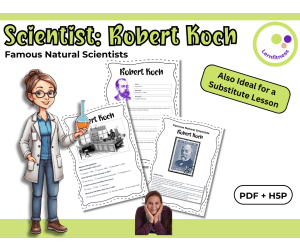
Scientist Robert Koch Fact Sheet, Quiz + Exercises | PDF + H5P
Life Sciences, Science, STEM, History: World, History, Social Studies, Biographies, Inventors, Basic Science, Human Body, Grade 6, 7, 8, 9, Worksheets, Worksheets & Printables, Quizzes, Quizzes and Tests, Teacher Tools, Projects, Activities
Discover Robert Koch – The Scientist Who Unlocked the Secrets of Infectious Diseases Did you know that Robert Koch was one of the first scientists to prove that bacteria cause diseases? His groundbreaking research on tuberculosis, anthrax, and cholera revolutionized medicine and helped develop life-saving treatments. Thanks to Koch’s work, doctors and scientists began to understand how infectious diseases spread—and, more importantly, how to stop them. This teaching resource introduces your grades 7–10 students to Koch’s incredible discoveries in a way that is engaging and easy to grasp. Designed for a 45-minute lesson, it includes clear explanations, interactive exercises, and creative tasks that bring Koch’s contributions to life in the classroom. What’s Included: Concise Informational Text: A clear and engaging overview of Robert Koch’s role in science. Fact Sheet Activity: Encourages students to organize knowledge and work creatively. Quiz with Solutions: Promotes fun, interactive learning and self-assessment. Additional Exercises: Students can create their own questions and collaborate in pairs to deepen their understanding. Flexible Formats: Includes a color and black-and-white printable PDF, as well as interactive H5P tasks for digital learning. Why You’ll Love This Resource: Time-Saving: Perfect for teachers who need a ready-to-go, well-structured lesson. Versatile Use: Ideal for biology, history of science, or cross-curricular lessons in English and science classes. Promotes Independence: Solutions are included, allowing students to check their work and explore the topic at their own pace. Interactive and Engaging: Tasks are designed to keep students actively involved while learning about Robert Koch’s legacy. Whether you use it for a regular lesson, substitute teaching, or as part of a digital learning activity, this resource will make Robert Koch’s contributions come alive for your students. Bring Robert Koch’s fascinating world of science into your classroom and inspire your students to see history and science in a whole new light! Have fun exploring the world of science with your students! Warmly, Lernfitness Did You Know? I teach with a certified therapy dog, and together we focus on creating a positive and inspiring learning environment.
Author Lernfitness
Tags Science, Biology, Famous Scientists Lesson, H5P, Interactive Science Exercises, STEM, History, Scientists, Robert Koch, Tuberculosis

Astronomy & Space Science: SAMPLE Reading Comprehension Passage (PDF)
Science, Space, Earth and Environmental Sciences, ELA, Reading, Reading Comprehension, Strategies, Resources for Teachers, Grade 6, 7, 8, 9, Writing Prompts, Worksheets & Printables, Centers, Activities, Teacher Tools, Assessments, Quizzes and Tests, Quizzes, Tests
This is a ONE PASSAGE SAMPLE. The following is the description of the FULL resource and the downloading links: Astronomy & Space Science: Reading Comprehension Passages & Questions (PDF) This very engaging collection of science reading passages about Astronomy and Space Science is designed to bridge the gap between science and literacy through strengthening reading comprehension and sparking scientific curiosity in middle school students. Each passage blends English Language Arts skills with accurate science content that supports NGSS classroom practice. Ideal for interdisciplinary learning in ELA and Science. Suitable for Grade 9 review, too! What Is Included? There are (3) informational passages: The Solar System: A Neighborhood in Motion: Understand orbits, the Sun’s role, the differences between inner and outer planets, and where asteroids and comets fit in the system. The Story of Space Science: Trace the path from early skywatching to telescopes, satellites, exploration missions, and the ISS, with practical links to GPS, communications, and weather forecasting. Stars of Many Sizes: Dwarfs, Giants, and Neutrons: Explore stellar types and life cycles, including our Sun, red giants, supernovas, neutron stars, and pulsars. Student Tasks for Each Passage 5 multiple-choice questions targeting main idea, key details, inference, vocabulary in context, and use of evidence 5 vocabulary matching items with clear, student-friendly definitions 5 text-based questions that require citing specific lines or facts 1 summary prompt that asks students to condense central ideas accurately Full answer key for every section Available Formats for this Resource: Word Docs Google Docs FULL CATALOG OF DOWNLOADING LINKS HERE Reading Passage Links: Astronomy & Space Science PDF Fillable PDF Word Docs Google Docs Volcanoes, Rocks, & Mountains PDF Fillable PDF Word Docs Google Docs Rock Cycle, Soil, & Sinkholes PDF Fillable PDF Word Docs Google Docs Mars, Glaciers, & Antarctica PDF Fillable PDF Word Docs Google Docs Water Cycle, Acid Rain, & Wastewater PDF Fillable PDF Word Docs Google Docs Insects, Animals, & Ecosystems PDF Fillable PDF Word Docs Google Docs Bioluminescence & Insects PDF Fillable PDF Word Docs Google Docs Animal Skin, Cats, & T. Rex PDF Fillable PDF Word Docs Google Docs Human Body and Senses PDF Fillable PDF Word Docs Google Docs Health & Applied Bioscience PDF Fillable PDF Word Docs Google Docs Waves, Light, & Imaging PDF Fillable PDF Word Docs Google Docs Electricity & Energy PDF Word Docs Google Docs Motion & Materials PDF Word Docs Google Docs Chemistry and Materials Science PDF Fillable PDF Word Docs Google Docs Product Details Length: 14 pages total Grades: 6–8, also suitable for Grade 9 review Use cases: close reading, stations, homework, intervention, test prep, and sub plans Standards support: reinforces informational-text skills and supports NGSS-style sense making through observation, modeling, and clear use of claim, evidence, and reasoning Why Teachers Choose This Set Authentic science content paired with rigorous literacy practice Consistent task structure across all passages for easier planning and smoother student routines Clear, age-appropriate writing that builds confidence without oversimplifying Use this set to reinforce ELA skills in science, to add literacy to your lessons, or to support independent work. The passages strengthen main idea, evidence use, vocabulary in context, inference, cause and effect, and summary writing. With ready-to-use assessments and complete answer keys, you can provide focused practice that is simple to run and fast to review.
Author CORED Education - Middle & High School
Rating
Tags Middle School, Reading Comprehension, Reading Strategies, Reading Passages, ELA, Centers, Reading Passage, Assessments, Vocabulary, Earth Science
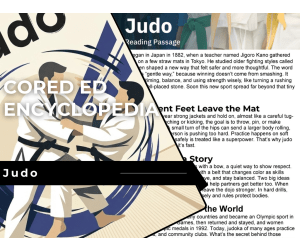
Judo Reading Comprehension Passage - Cored Ed Encyclopedia
ELA, Language Development, Resources for Teachers, Reading Comprehension, Reading, Pre-Reading, Writing, Strategies, Sports, P.E. & Health, Grade 2, 3, 4, 5, Worksheets & Printables, Worksheets, Teacher Tools, Centers, Activities, Writing Prompts, Assessments, Tests, Quizzes and Tests, Quizzes
This judo reading comprehension contains the following: Visualize on the Cover (Teacher Read Aloud Script) Start your lesson by taking a few moments to visualize the topic and share thoughts or feelings about it. Pre-Reading Trivia Students will write down one thing they already know about the subject and then read five more facts and discuss. These facts are fun, and the students will enjoy learning about the subject before reading more. Reading Passage The text is a high-interest reading passage with set paragraphs, roughly three to four paragraphs long. It contains a variety of themes about the topic, anywhere from history to technology. The passage is between 250 and 350 words in length. Mixed Questions The first question page contains four multiple-choice questions, each with a choice of four answers, and three written response questions that require a sentence or two from the student. Vocabulary Questions Practice seven key words from the text in this section across two activities. First section is scrambled words where students will unscramble three words given a clue for each. The second section is a word to meaning matching activity. Creative Writing In this question, the student will be required to write a five to eight sentence paragraph on a question related to the topic. Extension Activities This page is optional for fast finishers or to take home. There are several activities, each one requiring a different skill. Do some, do none, do all, completely optional - but you will feel reassured knowing every possibility is planned for. Answer Key There are answers for the multiple-choice questions, written response questions have sample answers, vocabulary answers and if there is a summary question then a sample summary will be provided as well. FULL CATALOG OF DOWNLOAD LINKS AND ENCYCLOPEDIA INDEX HERE Lesson Snapshot Title: Judo Genre: Nonfiction (Informational Text) Subject: Life Skills / PE & Health / Reading (Informational Text) Primary Topic: Judo’s origins, practices, values, and global sport Estimated Guided Reading Level (A–Z): P Learning Goals Explain how the book describes judo as the “gentle way,” using text details. Describe the main goals of a judo match and what actions are not the focus. Identify routines and behaviors in judo that show respect and help keep people safe. Describe how belts and the uniform connect to skill growth in judo. Summarize key milestones in judo’s history and spread around the world. Key Vocabulary From the Text jujutsu — older fighting styles Jigoro Kano studied. judogi — uniform worn in judo class. dojo — place where people train judo. pin — hold someone still on the mat. judoka — a person who practices judo. Cored Ed Encyclopedia Overview The Cored Ed Encyclopedia is a weekly series of lessons that you can pick up and use right away. These short readings fit into whatever time you have available. Each one includes a warm-up, a reading, and a set of questions, but it’s flexible — you can do just the reading, the full lesson, or skip the writing section if you need to. Each lesson focuses on a single topic so students don’t get lost. The writing is clear but never childish, making it perfect for grades two through five. Topics range from animals and science to history, inventions, and everyday things. No matter the level of the student, everyone should take away at least one new idea or fact from each lesson. The materials are easy to print, easy to explain, and require no setup. They work well for whole-class teaching, partner work, or independent study.
Author Cored Education
Rating
Tags Vocabulary, Spelling, Reading Comprehension, Reading Passages, Reading, Creative Writing, Reading Strategies, Writing Prompts, Judo, Sports

OREO Opinion Writing – 10 Graphic Organizers
Writing, ELA, Language Development, Grammar, ESL, Grade 2, 3, 4, 5, Worksheets & Printables, Centers, Activities, Graphic Organizers, Teacher Tools
These graphic organizers help kids in grades 2-5 write better opinion pieces. When students need to write about what they think, these templates make it much easier. This set is in a PDF format and printable. It consists of 10 pages of worksheets. The main organizer uses OREO (Opinion, Reason, Evidence, and Restate). It's a simple way for kids to remember all the parts they need in their writing. Just like the cookie! You also get a pros & cons chart so students can think about good and bad points before they decide what they think. There's a Fact vs. Opinion Chart that helps kids tell the difference between what's real and what someone thinks. The Persuasive Writing Map guides students to develop a clear beginning, middle, and end. The Paragraph Frame provides sentence starters to get their ideas flowing. These work great for writing time, centers, small groups, or when kids work alone. Just print them out and you're ready to go. Use them for regular classwork, homework, or even tests. The best part? Kids actually understand how to use them. They break down opinion writing into small, easy steps. #OpinionWriting #PersuasiveWriting #OREOWritingStrategy #WritingGraphicOrganizer #ParagraphWriting #FactandOpinion #ProsandCons #WritingFrames #LiteracyCenters #WritingActivities #Elementary #Grade2 #Grade3 #Grade4 #Grade5
Author Cutie worksheets986
Rating
Tags Opinion Writing, Persuasive Writing, OREO Writing Strategy, Writing Graphic Organizer, Paragraph Writing, Fact And Opinion, Pros And Cons, Writing Frames, Literacy Centers, Writing Activities

The War That Saved My Life: Theme, Symbolism & Quote Activities
ELA, Literary Devices, Literature, Reading Comprehension, Reading, Creative Writing, Writing, Grade 5, 6, 7, Novel Studies, Worksheets & Printables, Task Cards, Writing Prompts
The War That Saved My Life: Theme, Symbolism & Quote Activities Printable PDF & Digital Google Slides | Grades 5–7 | 100 Pages | Answer Keys Included When I teach The War That Saved My Life , one of my favorite parts is helping students dig into the deeper meaning of the story. This resource was created to make that process both engaging and practical. It gives students multiple ways to explore themes, symbolism, and powerful quotes while encouraging critical thinking and creativity. Inside, you will find more than 50 activities designed to help students think beyond basic comprehension. They will trace Ada’s emotional journey, examine key symbols like Butter and the green velvet dress, and respond to big ideas about courage, hope, and identity. The activities are flexible for literature circles, independent work, or whole-class lessons. One highlight is the variety of quote-based activities. Students will make personal and text-based connections, illustrate scenes, design posters, and even create a hoodie inspired by a meaningful quote. These activities promote deep thinking and spark thoughtful discussions. This resource includes both a printable PDF version and a digital Google Slides version , giving you flexibility to teach in any setting. Answer keys are included for all text-based questions. What Students Will Do: ✔ Explore themes with graphic organizers and reflection questions ✔ Analyze symbolism through visual timelines and written analysis ✔ Complete creative projects such as playlists, comics, and social media posts ✔ Respond to quote analysis tasks and design projects ✔ Use quote cards for discussions, writing prompts, and extensions These activities work well as an end-of-book project, a creative extension to your novel unit, or a way to encourage deeper discussion during literature circles. They are designed for grades 5–7 and provide meaningful opportunities for students to connect with the story on a personal and analytical level.
Author Creatively Gifted
Rating
Tags Reading Comprehension, The War That Saved My Life, Character Analysis, Theme Analysis, Symbolism, Quote Analysis
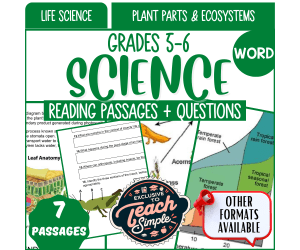
Science Reading Comprehension: Plant Parts and Ecosystems (Word)
ELA, Reading, Reading Comprehension, Common Core, Nature & Plants, Life Sciences, Science, Biology, Insects, Grade 5, 6, 7, Worksheets & Printables, Worksheets, Diagrams, Teacher Tools, Tests, Quizzes and Tests, Assessments
Science Reading Comprehension: Plant Parts & Ecosystems for Life Science Plant Parts and Ecosystems: Reading Passages Life Science - Enhance your assessment process with this ready-to-use science reading passage pack. Featuring enjoyable topics and themes, it's tailored to ensure students not only practice but also deepen their scientific understanding in preparation for tests. With questions meticulously aligned to the Common Core State Standards (CCSS), the pack dives into intriguing subjects such as circuits, electricity, and energy sources. It's a must-have resource for educators aiming to make learning both fun and fruitful. What's inside? Plant Parts & Ecosystems Reading Passage1: Classification of Organisms Reading Passage2: Function of Plant Parts Reading Passage3: Reproduction in Plants Reading Passage4: Invertebrates Reading Passage 5: Vertebrates Reading Passage6: Earth's Biomes Reading Passage7: Ecosystems Word Version: This is the Word version. 42 PAGES Science Reading Comprehension Outline: Introducing a comprehensive resource tailored for 5th and 6th graders, this product offers enriching reading passages supplemented with illustrative pictures and graphs to clarify key concepts. Aligned with the Common Core State Standards (CCSS), it offers a hassle-free approach to teaching, given that the bulk of the preparation is already done for you. The passages present a diverse set of questions – from multiple choice to data analysis and fill-in-the-blanks. This ensures a rich blend of high-interest content and fundamental curriculum-based science themes. With its versatility, you can seamlessly integrate these lessons into various classroom settings, whether it's whole class discussions, morning exercises, independent desk tasks, small group engagements, contingency plans for substitute teachers, regular homework assignments, or even themed activities for holidays. FULL CATALOG OF DOWNLOAD LINKS HERE Grade 5/6 Links: Physical Science Part 1 - Physical and Chemical Properties Google Docs/Slides/Forms PDF PPT Word Free Supplementary Pack Accompanying Videos Physical Science Part 2 - Motion and Energy Google Docs/Slides/Forms PDF PPT Word Free Supplementary Pack Accompanying Videos Physical Science Part 3 - Electricity and Magnets Google Docs/Slides/Forms PDF PPT Word Free Supplementary Pack Accompanying Videos Life Science Part 1 - Cells, Reproduction and Genetics Google Docs/Slides/Forms PDF PPT Word Free Supplementary Pack Accompanying Videos Life Science Part 2 - Human Body Systems Google Docs/Slides/Forms PDF PPT Word Free Supplementary Pack Accompanying Videos Life Science Part 3 - Plant Parts and Ecosystems Google Docs/Slides/Forms PDF PPT Word Free Supplementary Pack Accompanying Videos Earth Science Part 1 - Plate Tectonics and Rock Cycle Google Docs/Slides/Forms PDF PPT Word Free Supplementary Pack Accompanying Videos Earth Science Part 2 - Ocean Exploration and Natural Resources Google Docs/Slides/Forms PDF PPT Word Free Supplementary Pack Accompanying Videos Earth Science Part 3 - Weather and Solar System Google Docs/Slides/Forms PDF PPT Word Free Supplementary Pack Accompanying Videos For similar products and other frees, do check out Cored Group on TeachSimple .
Author Cored Education
Rating
Tags Science, Elementary, Reading, Comprehension, Vocabulary, Science Assessments, Reading Comprehension Assessments, Vocabulary Assessments, Life Science, Biology

Envision Math Grade 5 Topic 12 Volume of Solids
Math, Geometry, Grade 5, Worksheets & Printables, Worksheets, Workbooks, Word Problems
Envision Math Grade 5 – Topic 12: Volume of Solids gives students hands-on practice with 3D shapes, spatial reasoning, and measuring volume. This packet includes student notes, teacher notes, a teacher-created quiz, and answer keys —everything you need to teach or review this unit with confidence. While it aligns with Envision Math, it is not taken from the textbook and can be used as a stand-alone resource for any 5th grade classroom. Topic 12 Lessons include: Solids Views of Solids Models and Volume Volume Combining Volume This packet is flexible, making it easy to adapt to your classroom’s needs. Whether you’re introducing new concepts, reteaching, or reviewing before a test, these materials save you time and provide students with clear, structured support. Ways to Use This Packet in Your Classroom: Daily math notes to guide instruction and practice Student content pages for interactive learning Math journal inserts for notebooks or binders Small group reteaching or enrichment activities Packets for absent students to catch up quickly Testing re-dos or review assignments Extra practice for homework or skill reinforcement As of 2025, this packet has been updated with improved formatting, removed page numbers (so it works with multiple Envision editions), and optimized readability for ADA compliance and screen readers . Please note: Problem-solving lessons are not included in this topic, as they are typically taught through a separate problem-solving curriculum. This product is aligned to, but not affiliated with, Envision Math for Grade 5. It was designed for my own students and refined to help teachers like you provide clear, engaging, and ready-to-use math resources . Tags / SEO keywords: 5th grade math, Envision Math Topic 12, volume of solids, 3D shapes grade 5, volume practice, combining volume, math journal inserts, 5th grade volume activities, guided math notes, Envision aligned math
Author Kel's Klass
Rating
Tags Envision Math, Grade 5 Math, Solids, View Of Solids, Models And Volume, Volume, Combining Volume, Geometry
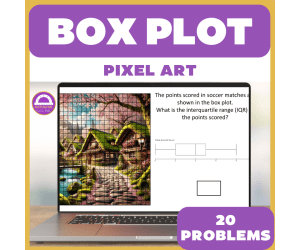
Box and Whisker Plot Pixel Art
Math, Statistics, Grade 8, 9, 10, Activities, Games, Worksheets & Printables, Task Cards
Need a no-prep, digital, and self-assessing activity that will challenge your students while reinforcing their understanding of Box and Whisker Plots? You've just arrived in the right spot! This fun and interactive web activity makes it easy and enjoyable to practice Box and Whisker Plots. Students get problems to solve, check them immediately, and watch a colorful pixel art image appear gradually as they complete them. It's an excellent mix of fun and education, encouraging students every step of the way. ✨ Reasons Why Teachers and Students Love This Activity: ✅ Student-Paced and Self-Checking Instant feedback is provided to students as they complete each problem. They'll know right away whether they're on the right track, and this allows them to make adjustments on their own and build confidence along the way. ✅ No Prep Whatever for Teachers: No printing is needed, no cutting required, no grading necessary—just pass out the digital activity and have your students begin! It's the ultimate grab-and-go activity for busy days. ✅ Printable Option Available: Want to add more flexibility to your teaching? This pack also includes printable worksheets and task cards. Searching for an offline activity, a center activity, or additional practice? You've got it! ✅ Interactive Pixel Art Reward: As accurately solved problems are finished, students uncover portions of a mysterious pixel image. This game-like element keeps children eager to complete the task! What's Included: 20 Box and Whisker Plot Problems Thoroughly planned to increase students' knowledge and skills. Interactive Digital Pixel Art Activity Fun, self-checking, and designed to promote complete student participation. Printable Task Cards Perfect for small group centers, early completions, or kinesthetic reinforcement. Worksheets and Complete Answer Keys For maximum flexibility and easy marking—whether used digitally or printed. Perfect For: Math classroom centers Independent practice time Homework assignments Distance learning Review sessions and test preparation
Author Matemaths
Rating
Tags Pixel Art, Interactive Activity, Digital Learning, Matemaths, Task Cards, Printable, Digital, Algebra, Statistics, Box And Whiskers Plot

Ovens Reading Comprehension Passage - Cored Ed Encyclopedia
ELA, Language Development, Resources for Teachers, Reading Comprehension, Reading, Pre-Reading, Writing, Science, Physics, Strategies, Grade 2, 3, 4, 5, Worksheets & Printables, Worksheets, Teacher Tools, Centers, Activities, Writing Prompts, Assessments, Tests, Quizzes and Tests, Quizzes
This ovens reading comprehension contains the following: Visualize on the Cover (Teacher Read Aloud Script) Start your lesson by taking a few moments to visualize the topic and share thoughts or feelings about it. Pre-Reading Trivia Students will write down one thing they already know about the subject and then read five more facts and discuss. These facts are fun, and the students will enjoy learning about the subject before reading more. Reading Passage The text is a high-interest reading passage with set paragraphs, roughly three to four paragraphs long. It contains a variety of themes about the topic, anywhere from history to technology. The passage is between 250 and 350 words in length. Mixed Questions The first question page contains four multiple-choice questions, each with a choice of four answers, and three written response questions that require a sentence or two from the student. Vocabulary Questions Practice seven key words from the text in this section across two activities. First section is scrambled words where students will unscramble three words given a clue for each. The second section is a word to meaning matching activity. Creative Writing In this question, the student will be required to write a five to eight sentence paragraph on a question related to the topic. Extension Activities This page is optional for fast finishers or to take home. There are several activities, each one requiring a different skill. Do some, do none, do all, completely optional - but you will feel reassured knowing every possibility is planned for. Includes summary writting question. Answer Key There are answers for the multiple-choice questions, written response questions have sample answers, vocabulary answers and if there is a summary question then a sample summary will be provided as well. FULL CATALOG OF DOWNLOAD LINKS AND ENCYCLOPEDIA INDEX HERE Lesson Snapshot Title: Ovens Genre: Nonfiction (informational text) Subject: Science & Technology / Reading Informational Text Primary Topic: How ovens work and changed over time Estimated Guided Reading Level (A–Z): R What This Lesson Teaches Best How early ovens began as cooking pits with hot coals underneath and food covered to cook slowly. How clay ovens with thick walls held heat and were used for baking, including flatbread pressed onto the inner wall. How modern ovens can use different heat sources and methods, including gas/electric heat , broiling , and convection (a fan moving hot air). How the first microwave oven grew from an accident involving radar equipment and how microwaves heat food by moving water molecules . How headings organize information in an informational passage (history → features → invention story). Learning Goals Students will describe how some of the earliest ovens cooked food using hot coals and covered pits. Students will explain how clay ovens held heat and how bread could bake on the inner wall. Students will compare ways ovens heat food (baking, broiling, and convection) using details from the text. Students will explain what accident helped lead to the first microwave oven. Students will describe how microwaves heat food quickly based on the passage. Key Vocabulary From the Text insulated — kept heat in, like a protected box. convection — a fan circulates hot air for even heating. microwaves — waves that heat food fast without a fire. molecules — tiny pieces of matter that can move. radar — equipment mentioned that led to a discovery. Cored Ed Encyclopedia Overview The Cored Ed Encyclopedia is a weekly series of lessons that you can pick up and use right away. These short readings fit into whatever time you have available. Each one includes a warm-up, a reading, and a set of questions, but it’s flexible — you can do just the reading, the full lesson, or skip the writing section if you need to. Each lesson focuses on a single topic so students don’t get lost. The writing is clear but never childish, making it perfect for grades two through five. Topics range from animals and science to history, inventions, and everyday things. No matter the level of the student, everyone should take away at least one new idea or fact from each lesson. The materials are easy to print, easy to explain, and require no setup. They work well for whole-class teaching, partner work, or independent study.
Author Cored Education
Rating
Tags Vocabulary, Spelling, Reading Comprehension, Reading Passages, Reading, Creative Writing, Reading Strategies, Writing Prompts, Ovens, Physics

Letter A of the Week Alphabet Activities Hands-on Phonics Worksheets
ELA, Language Development, Phonics, Pre-Reading, Kindergarten, Preschool, Homeschool Curriculum, Homeschool Templates, Activities, Centers, Crafts, Worksheets & Printables, Drawing Templates & Outlines, Worksheets, Coloring Pages, Crosswords Puzzles, Dot To Dots, Mazes
Looking for fun, no-prep Letter A activities to kick off your alphabet instruction? This 66-page printable pack is loaded with engaging, hands-on learning tasks that will help your preschool and kindergarten students master the letter A through movement, creativity, and phonics-based practice. Perfect for Letter of the Week programs, this pack includes everything from tracing and coloring to spinning, sorting, dabbing, cutting, building, crafting, and more! What’s Included: Letter A Poster and 6 visual cards Booklet Cover ‘About Me’ page Tracing and writing uppercase and lowercase A Identifying the letter A Coloring the letter A Sorting the letter A Spinning the letter A Finding the letter A Drawing letter A pictures Creating a glittering letter A with glue and glitter Letter A maze, puzzle and join the dots fun Letter A visual cut outs Letter A dab the dots Letter A color by code Letter A Geoboard Summary sheet of the letter A Sight words practice (3 sheets): 'a, the, is' Supplementary Activities: Mini Letter A words and visual one page booklet ‘I’m a Letter A Champ’ crown ‘I’m a Letter A Champ’ bracelet Mini flipbook on letter A words and visuals Ant finger puppet templates (6 on a page) Ant Stick Puppets (4 on a page) Letter A Words and visuals 6 sections wheel Hands-on Craft & Supplementary Fun: Letter A crown : “I’m a Letter A Champ!” Letter A bracelet and mini flipbook Word wheel with 6 visual letter A words Mini booklet and About Me cover page Ant-themed finger puppets and stick puppets Flipbook for sight words with touch-phonics font This comprehensive pack is perfect for your morning work, literacy centers, phonics block, or take-home activities . Bonus: ✔️ Available in both US and British English spelling versions Whether you’re just introducing the letter A or reinforcing it mid-year, this resource makes it easy to teach and fun to learn. Your students will love the variety, and you’ll love how much letter A practice is packed into one ready-to-go resource.
Author Teach2Tell
Rating
Tags Letter A Activities, Letter A Worksheets, Letter A Printables, Alphabet Letter A, Letter Of The Week, Letter A Crafts, Letter A Tracing, Letter A Recognition, Letter A Practice, Kindergarten Phonics
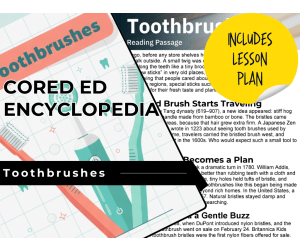
Toothbrushes Reading Comprehension Passage - Cored Ed Encyclopedia
ELA, Language Development, Reading Comprehension, Reading, Science, Technology, Engineering, History, Social Studies, Life Sciences, Grade 2, 3, 4, 5, Worksheets & Printables, Worksheets, Teacher Tools, Centers, Activities, Writing Prompts, Assessments, Quizzes and Tests, Quizzes, Lesson Plans
This toothbrushes reading comprehension includes: Visualization (on the front cover) Start your lesson by taking a minute to think and share something about the topic. Read the script aloud (slowly), perhaps prepare some music or sound effects. Student close their eyes and let their imaginations wander. Students open their eyes, read the question aloud and give them a few minutes to complete. Ask a few students to share or keep answers until the end to compare with what they learn in the passage. Quick pause—thousands of Cored Education products are included with your TeachSimple membership. Download links and encyclopedia index available here. Pre-Reading Trivia Students will write down one thing they already know about the subject and then read five more facts and discuss. These facts are fun, and the students will enjoy learning about the subject before reading more. Give 1 minute for students to write what they already know (no pressure—best guess is fine). Read the five facts together. After each fact, do ask a student for their opinion, was it surprising? Set a purpose by asking students to highlight/underline one fact they want to learn more about during the reading. Reading Passage The text is a high-interest reading passage with set paragraphs, roughly three to four paragraphs long. It contains a variety of themes about the topic, anywhere from history to technology. The passage is between 250 and 350 words in length. First, ask students to look at the headings and see what they’ll learn about today. What do they know about the topic/heading? First read options: Teacher read-aloud (best for support). Partner reading (paragraph by paragraph). While reading, students underline important details, and vocabulary words they think may come up in the questions section. Mixed Questions The first question page contains four multiple-choice questions, each with a choice of four answers, and three written response questions that require a sentence or two from the student. Students complete the mcqs first independently, then review quickly as a class. For the 3 written responses, try to get students giving the answer with some form of evidence: “I think ___ because the text says ___.” If students get stuck, send them back to check the passage. Vocabulary Questions Practice seven key words from the text in this section across two activities. First section is scrambled words where students will unscramble three words given a clue for each. The second section is a word to meaning matching activity. Before starting, have some students read out words they underlined in the passage. Ask students to say the word and read aloud the sentence(s) around each word. Ask students to do scrambled words and the matching exercise in pairs then go through answers as a class. For the scrambled spelling task, get four pairs to come up to the board and write the words for extra practice with the other student reading out the clue. For the matching task, prompt students to give full sentences: “I matched ___ with ___ because ___.” Creative Writing In this question, the student will be required to write a five to eight sentence paragraph on a question related to the topic. Before starting, ask students write down 3 key ideas they are going to include in their piece. Ask students for ideas to share around the class to help those struggling. Pro writing expectations: 5–8 sentences At least 2 facts or details from the passage At least 2 vocabulary words from the previous page Students read their paragraphs while classmates listen for facts and vocabulary words. Extension Activities This page is optional for fast finishers or to take home. There are several activities, each one requiring a different skill. Do some, do none, do all, completely optional - but you will feel reassured knowing every possibility is planned for. Includes summary writting question. Answer Key There are answers for the multiple-choice questions, written response questions have sample answers, vocabulary answers and if there is a summary question then a sample summary will be provided as well. Lesson Plan Included Customized lesson plan for this lesson is included. Lesson Snapshot Title: Toothbrushes Genre: Nonfiction (informational text) Subject: Science (Health & Technology) Primary Topic: How toothbrushes changed over time Estimated Guided Reading Level (A–Z): R What This Lesson Teaches Best Explains how people cleaned teeth before store-bought toothbrushes by chewing a twig until it turned “fuzzy” and rubbing it on teeth. Shows how evidence from the past (archaeologists finding signs in places like Mesopotamia and Egypt) can tell us about tooth care long ago. Traces the history of the bristled brush from China’s Tang dynasty to Europe in the 1600s, highlighting how inventions travel. Describes how toothbrush designs changed to solve problems (for example, natural bristles staying damp and trapping bacteria). Summarizes key innovations—nylon bristles (1938) and the electric toothbrush (1954)—and connects them to the ongoing goal of protecting teeth. Learning Goals Students will describe how a “chew stick” was used to clean teeth long ago. Students will identify evidence in the text that people cared about clean mouths thousands of years ago. Students will explain how the bristled brush began in China and later spread to Europe. Students will summarize how toothbrush-making changed after 1780 using details about materials and design. Students will explain why inventors searched for new bristle materials and what nylon changed. Students will describe how an electric toothbrush helped brushing by adding steady motion. Key Vocabulary From the Text archaeologists — scientists who study the past using old remains. Mesopotamia — an ancient region where people lived long ago. miswak — a special stick used for cleaning teeth. patent — legal rights that protect an invention. bacteria — tiny germs that can cause problems. FULL CATALOG OF DOWNLOAD LINKS AND ENCYCLOPEDIA INDEX HERE
Author Cored Education
Rating
Tags Vocabulary, Reading Comprehension, Reading Passages, Lesson Plans, Ela Lesson Plans, Reading Comprehension Lesson Plans, Pre-reading, History, History Lesson Plans, Toothbrushes

LEGO ALPHABET MINIBOOK | FREE RESOURCE
Creative Arts, Writing, ELA, Handwriting, Language Development, Grammar, Phonics, Pre-Reading, Early Learning, Elementary, Homeschool Resources, Not Grade Specific, Pre-K, Worksheets & Printables, Activities
LEGO ALPHABET MINIBOOK | FREE RESOURCE With this resource, your students will be able to learn the letters using lego blocks. FREE RESOURCES ON MY STORE: I have a lot of free resources for you, on my store, please visit it, for example: NUMBERS PUZZLE: https://teachsimple.com/product/numbers-puzzles-1-to-10-cut-and-paste-activity IDENTIFY THE BALLOON: https://teachsimple.com/product/identify-the-balloon-visual-exercises GENERAL DESCRIPTION OR INFORMATION OF THIS PRODUCT: 1) How can this material support children's learning or development? This material will help our students learn in an educational way. It will support your students by guiding them in a much more playful way to achieve easy and rapid learning. 2) What specific skills are developed using this resource? Students will be able to develop their attention, concentration, creativity, and imagination skills. It will also allow students to develop their cognitive skills such as comprehension, analysis, and others. 3) Who is the ideal audience for this document? This document and/or teaching resource is primarily intended for young students, meaning those between the ages of 5 and 12, in other words, students in early childhood and/or primary education. However, it can also be used by the general public if required. SECONDARY AND COMPLEMENTARY INFORMATION OF THIS LITERACY RESOURCE: 1) Does this material allow for custom editing? This educational document is available in PDF format, so you cannot edit it. You simply need to download and then print it. 2) What main topic does the resource cover? This document has been developed to address a basic topic that children in kindergarten through elementary school should master. This document will also be helpful to the general public who want to learn. 3) What version does this document correspond to? This educational resource is designed in PDF format, which will make your download experience much simpler and easier to use. 4) Is the material designed in color or black and white? This document has been designed in color (if required) or is sometimes created in black and white to make your learning experience easier.
Author EDITORIAL LAURA EDUCA
Rating
Tags FREE, FREE RESOURCES, ALPHABET, ABC, ABECEDARY, MINIBOOK, LEGO, LEGO RESOURCES
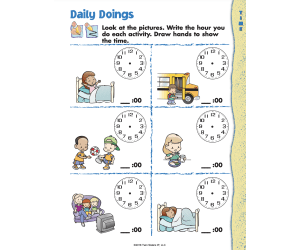
Time Printable Workbook
Math, Time, Preschool, Grade 1, 2, Workbooks, Worksheets & Printables
Introduction Time Printable Workbook is a professionally curated resource designed to aid Kindergarten instruction and mastery of the concept of time. This workbook combines modern teaching methodologies with grade-specific content, creating an environment for continuous practice until comprehension is firmly rooted. Pivotal Focus Fundamentally focused on mathematics, this resource helps students comprehend various aspects of reading and interpreting time. It provides learners with the basic know-how such as reading hour and minute hands in traditional clocks. Additionally, it integrates understanding of digital clock timings — ensuring a well-rounded knowledge base. Detailed Lessons The concepts further extend by incrementing lessons in half-hour units. This calculated approach ensures learners tackle complexity suiting their kindergarten level while gradually making progress. The workbook also includes engaging practical exercises to balance out theoretical learning. The 35-page PDF material features numerous activities like matching games fostering attentiveness & coloring tasks stimulating creativity! Versatility & Privacy Concerns Suitable for different teaching scenarios - whole group classes, small focus groups or homework assignments, no external sharing ensures child's privacy stays intact at all times. Note:p>We provide this all-inclusive workbook in PDF format allowing quick printouts before lessons begin - saving preparation stress and giving more time to encourage young minds' critical thinking abilities. Crafted considering diverse learner styles from Grades K-2 offering flexibility while synchronizing plans with individual student advancement levels enhancing overall academic experiences!
Author Twin Sisters Digital Media
Tags Time Instruction, Analog Clocks, Digital Clocks, Hands-on Activities, Comprehension

Lesson Plan on Pablo Picasso
Art, Creative Arts, Art History, Fine Arts, Biographies, Social Studies, Not Grade Specific, Activities, Lesson Plans, Teacher Tools, Worksheets, Worksheets & Printables
Pablo Picasso was among the most impactful artists of the 20th century. He is recognized for co-founding the Cubist movement, creating constructed sculpture, co-inventing collage, and for the diverse range of styles that he contributed to and examined. For approximately 80 of his 91 years, Picasso dedicated himself to creating art that played a crucial role in the overall progress of modern art during the 20th century, especially through the creation of Cubism (alongside artist Georges Braque) around 1907. Picasso is often regarded as THE genius of the twentieth century. Possibly more than any other artist, he transformed the course of art, initiating the modernist movement. He was an innovator of Cubism, subsequently of collage art, and eventually neo-classicism. This lesson plan centers around the artwork of Pablo Picasso. Numerous activities are provided, arranged in two worksheets. Their answers are provided in the end. Six of his most famous works are also included.
Author Bright Classroom Ideas Marketplace
Tags Picasso, Pablo, Lesson, Plan, Painting, Painter, Art
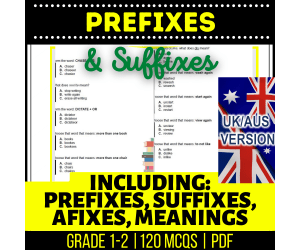
UK/Aus Spelling Prefixes and Suffixes Practice - Year 2-3 (PDF)
ELA, Language Development, ESL, Grammar, Common Core, Resources for Teachers, Grade 1, 2, Worksheets & Printables, Worksheets, Assessments, Teacher Tools, Tests, Quizzes and Tests, Centers, Activities
THIS IS THE UK/AUS ENGLISH SPELLING VERSION. CHECK THE CATALOG FOR THE ORIGINAL AMERICAN ENGLISH VERSION. Prefixes and Suffixes Grammar Practice MCQS: 8 lessons, 120 MCQS, 35 pages ELA MCQs Overview: This grammar resource gives students plenty of focused practice with two essential writing skills: capitalisation and punctuation. Across 10 lessons and 150 multiple-choice questions, students work through clear, manageable practice that helps them spot mistakes, improve accuracy, and build real confidence over time. The lessons are designed to feel structured without becoming dry or repetitive. Each one builds naturally on the previous lesson, giving students the chance to review, strengthen, and apply what they have learned. With a mix of direct teaching, group work, and independent practice, the resource works well for whole-class lessons, revision, homework, or extra support. This UK/Aus English version is especially useful for schools, teachers, and families working with British-based spelling and language conventions. It is a helpful option for classrooms using UK curriculum expectations, international programmes influenced by British English, or any setting where learners need to practise the correct capitalisation and punctuation forms for that version of English. Prefixes and Suffixes Overview: Includes: Intro to Prefixes Intro to Suffixes Forming Suffixes Determining Affix Word Meaning PDF Version This is the PDF uneditable version. This download is available in GOOGLE Docs, GOOGLE Forms, GOOGLE Slides. PDF, PPT, WORD, check the links below for more details. FULL CATALOG OF DOWNLOAD LINKS HERE ELA Review Questions Overview Each review test includes three answer choices for every question. The format is clear and easy for students to follow. A small number of pictures are included on each test to make the pages feel more welcoming and less plain. A review sheet is also included to help students go back over many of the main skills covered in the product. Introduction or Example Sheet Each topic includes an introduction or example sheet to use before students begin. This gives students a clear starting point. It also helps refresh key ideas before they move into the practice. Full Answer Keys Full answer keys are included for easy checking. Sample responses are also provided where needed. This helps save time and makes the resource easier to use, even on busy days. In the Supplementary Pack Interactive Ice Breakers: Simple hands-on activities to help students start thinking about the topic. Guided Practice: Teacher-led work that helps students build understanding before working alone. Group and Partner Tasks: Activities that encourage discussion, shared ideas, and teamwork. Independent Worksheets: Extra practice pages for students to complete by themselves. Exit Tasks: Short end-of-lesson activities to check understanding and review learning. For similar downloads and other frees, do check out Cored Group on TeachSimple.
Author Cored Education
Rating
Tags Elementary, Vocabulary, Answers, Ccss, Common Core, Spelling, Writing, Prefixes And Suffixes, Grammar, Grammar Worksheets

Health 1st Grade Unit 4: Substance Use and Abuse
P.E. & Health, Health, Physical Education, Special Resources, Life Skills, Social Emotional Learning (SEL), Social Skills, Grade 1, Lesson Plans, Teacher Tools, Worksheets & Printables, Worksheets
For 1st Grade Health there are seven standards that need to be taught. Unit 1 Personal Health Unit 2 Growth and Development Unit 3 Nutrition and Physical Activity Unit 4 Substance Use and Abuse Unit 5 Injury/ Violence Prevention Control and Safety Unit 6 Prevention/Control of Disease Unit 7 Environmental Consumer Health These units can be taught out of order. They are only numbered for your convenience. At the end of each unit, there is an assessment to test students’ understanding. Through using this Health 1st Grade Unit 4: Substance Use and Abuse students will explore and learn to identify safe and unsafe items in their house and who can give them medicine. Included in this unit: * Students will learn the difference between helpful and harmful substances. * Students will learn how to just say no to harmful substances and situations. * Students will learn that only responsible adults can give them medicine. At the end of the unit, there is an assessment to check for understanding. A total of 10 pages for Health 1st Grade Unit 4: Substance Use and Abuse. There are seven units that cover all the health requirements for first grade. Here are the links to other health units: Health 1st Grade Unit 1: Personal Health Health 1st Grade Unit 2: Growth and Development Health 1st Grade Unit 3: Nutrition and Physical Activity Health 1st Grade Unit 4: Substance Use and Abuse Health 1st Grade Unit 5: Injury / Violence Prevention and Safety Health 1st Grade Unit 6: Prevention / Control of Disease Health 1st Grade Unit 7: Environmental / Consumer Health You can also teach your students about keeping yourself safe by studying about the Coronavirus, where and when it started and facts that plagued our world with this virus. 1st grade Coronavirus / Covid-19 Facts by Teach Simple This unit meets Common Core Standards.
Author K-5 Treasures
Tags Health Unit, Substance Use, Substance Abuse, Safe Household Items, 1st Grade Health, First Grade Health, Healthy Habits, Health, 1st Grade Resources, First Grade Resources
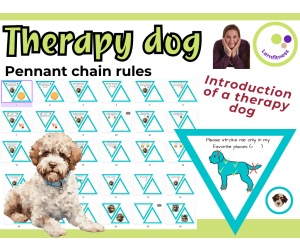
Therapy Dog Classroom Rules – Create, Discuss & Decorate! 🐶🏫 Banner
Social Emotional Learning (SEL), Special Resources, Social Skills, Special Education Needs (SEN), Life Skills, Animals, Life Sciences, Science, Classroom Management, Resources for Teachers, High School, Middle School, Elementary, Early Learning, Pre-K, Classroom Decor, Banners, Bulletin Boards, Projects, Activities, Drawing Templates & Outlines, Worksheets & Printables, Coloring Pages, Worksheets
Therapy Dog Classroom Rules Create, Discuss & Decorate! 🐶🏫 Bringing a therapy dog into the classroom is an exciting and rewarding experience, but it also requires clear expectations and structure. This Therapy Dog Rules Pennant Banner is a creative and engaging way to introduce, reinforce, and display important guidelines for students when interacting with a school therapy dog. Whether your school already has a therapy dog or you’re just starting to introduce the idea, these pennants help students understand respectful behavior, responsibilities, and boundaries in a fun and visual way. 🐾 Why This Resource is Perfect for Your Classroom ✔ Encourages Respectful Interactions – Helps students learn how to behave around a therapy dog. ✔ Interactive & Creative – Students can draw, write, or collage their own pennants to personalize the display. ✔ Supports Classroom Discussions – Use as a conversation starter about animal care, empathy, and safety. ✔ A Fun Visual Reminder – Display the banner in the classroom or on the door so rules are always visible. ✔ Perfect for Any Therapy Dog Setting – Ideal for schools, counseling offices, and special education programs. 📌 What’s Included? 📜 Printable Therapy Dog Rules Pennants, featuring: ✔ Ready-made rule templates ✔ Blank versions for students to create their own rules ✔ Simple, clear visuals for all ages ✔ pre-colored for quick use 🎨 How to Use This Resource 1️⃣ Print the pennants and the door sign. 2️⃣ Let students illustrate, decorate, or collage the rules in their own creative way. 3️⃣ Cut out and string the pennants together to create a classroom banner. 4️⃣ Hang the banner somewhere visible to reinforce positive interactions with the therapy dog. 🏆 Classroom Tip: Involve students in writing the rules together before decorating their pennants. This makes them feel more responsible for following the guidelines! 🐶 Why Teachers Love It ✔ “A great way to help kids understand boundaries around therapy dogs.” ✔ “The perfect mix of creativity and structure—students loved making their own rules!” ✔ “Looks great on the classroom wall and actually helps reinforce good behavior!” 🏫 Make Your Therapy Dog Program a Success! Having a therapy dog in the classroom can be an incredible learning experience—but students need guidance to make sure it’s a safe and positive environment. This banner set makes it easy, interactive, and fun to set those expectations! 📥 Download now and start creating your therapy dog-friendly classroom today! 🐾✨ 📍 Best, Heike from Lernfitness Did You Know? I teach with a certified therapy dog, and together we create a positive and inspiring learning environment. 🐶✨
Author Lernfitness
Tags Therapy Dog, Animal-assisted Learning, Inclusive Education Tools, Therapy Dog Rules, Classroom Pet Guidelines, Therapy Dog In School, Social-emotional Learning, SEL, Dog Classroom Rules
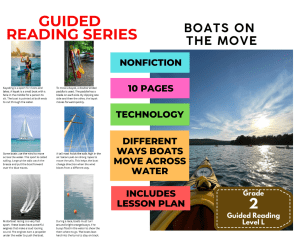
Guided Reading Level L - Boats on the Move (with Lesson Plan)
ELA, Resources for Teachers, Reading Comprehension, Reading, Science, Engineering, Technology, Physics, Sports, P.E. & Health, Grade 2, 3, 4, Worksheets & Printables, Worksheets, Teacher Tools, Centers, Activities, Literacy Readers, Quizzes, Quizzes and Tests, Assessments, Lesson Plans
This Guided Reading Book - Boats on the Move (Level L) with lesson plan includes: Guided Reading Color Label (front cover x1) This is a quick way to match the book’s demands to what students can generally handle.. The overall goal is to use the level/color to pick books for several smaller groups. To qualify for a certain level, a student is expected to read a book from that level with about 90–94% accuracy. If a student is consistently accurate and understands, move up a level. If the student is struggling at that level, drop down and add more support. Each student will improve at completely different rates, but it is generally one of the best ways to check progress across the class. DOWNLOAD THE CATALOG TO VIEW ALL GUIDED READING BOOKS AVAILABLE (SORTED LEVELS A-Z) Pre-Reading Question (x1) Teacher asks the prompt aloud, can be while showing the cover or first page. Students share what they already know, or make educated guesses from the cover. Prompt them to use the target vocabulary. Write some of their responses on the board to look back at during the reading. Vocabulary Words (x5) Introduce the five words, best doing it one at a time. Start by saying it, while students repeat and then see if anyone knows what it means before reading further. Read through the meaning and try to briefly connect each word to a picture or gesture so it’s meaningful. Ask students to flip through the book pages and point to where they see each of the vocabulary words. While reading the book pause upon coming across one of the vocab words or read the sentence twice to make sure students understand the word has appeared. Optional: Ask students to raise hands whenever they see/hear one of the new words. Guided Reading Pages (x10) Check the book snapshot (below) for: primary topic - do you need to prep extra reading or intro materials on this? what is taught best - decide on 1-2 bullets to focus on, use the prompt or words provided here for best results. learning goals - what you are checking for students to be able to do after the session, elicit answers using prompts or words provided. key vocabulary (see section above). questions overview - so you know what is coming up and if you need to prep extra materials to assist understanding. Run the lesson You may have already looked at a few of the pages together, but you can show them some of the pictures again first to set meaning. Depending on how much time you have and how familiar your students are with guided reading class, you may want to read the book aloud first with the group first. Students whisper or partner read, while you listen in. If time, do it as a group, one student reading a page each. Use the guided page’s prompts to coach: “Check the picture / does it make sense?” “Point under the words / try the first sound” “Reread the sentence smoothly”. Try to focus more on one student per session (rotating every time), so you can work out if they are ready to move up or need to move down a level. Comprehension Questions (back cover x3) This is your way to check that students didn’t just say the words, but actually understood the text. First, let students answer by pointing to the page/picture and saying a short sentence. After any answer, follow with: “Show me where you found that in the text.” In bigger groups, have partners answer first (10–20 seconds), then call on 2–3 students to share. Differentiation tips: Emerging speakers/struggling readers: oral + pointing On-level: oral in a full sentence Higher: one written sentence or draw + label Book Snapshot Title: Boats on the Move Genre: Nonfiction (informational) Subject: Science (Forces & Motion) / Reading (Informational Text) Primary Topic: Different ways boats move across water Estimated Guided Reading Level (A–Z): L What This Book Teaches Best Different ways boats move on water (wind, oars, paddles, engines). How specific boat parts help movement (sails, mast, ropes, propeller). How coordinated actions affect motion (oars dipping “at the same time” to go straight). How markers guide movement during a race (boats turn around bright orange buoys to stay on track). Comparing speed and movement styles (quiet glide vs fast roar; forward motion by alternating paddle sides). Learning Goals Students will identify several ways boats move across the water using details from the text. Students will explain how sails and wind help pull a boat forward. Students will describe how rowers use oars together to move a boat straight ahead. Students will describe how a double-ended paddle helps a kayak move forward quickly. Students will explain how an engine and propeller help push a motorboat through the water. Students will describe why boats turn around buoys during a race, based on the text. Key Vocabulary From the Text mast — a tall pole that holds sails up. rhythm — a steady pattern of movement. double-ended — having an end on both sides. propeller — a spinning part that helps push a boat. buoys — floating markers that show where to go. Discussion Prompts Pre-reading question: What are some different ways a boat could move across the water? Comprehension questions: How do large white sails help a boat move forward? What do rowers do “at the same time,” and what does that help the boat do? Why must boats turn around bright orange buoys during a race? Printing Tips 1. Best Printing Method (Recommended) “Booklet” Printing (Best if Available) If your printer or PDF viewer supports Booklet Printing , use this. Settings to use: Print mode: Booklet Paper size: Letter or A4 (either works) Orientation: Landscape Print on both sides: Yes Flip on: Short edge Scaling: Fit to printable area Booklet subset: First test: Front sides only Then: Back sides only This will automatically: Pair pages correctly Put the cover on the outside Align everything for folding After printing, fold in half and staple along the spine . 2. If “Booklet” Printing Is NOT Available You can still print this correctly with manual duplex printing . Step-by-step: Open the PDF. Choose Print . Set: Orientation: Landscape Pages per sheet: 1 Print on both sides: Yes Flip on: Short edge Print all pages . Because each PDF page already contains two facing book pages, the result will still fold cleanly into a book. Thousands of Cored Education products are included with your TeachSimple membership. Download links and encyclopedia index available here.
Author Cored Education
Rating
Tags Reading Comprehension, Reading Passages, Reading, Guided Reading, Guided Reading Lesson Plan, Guided Reading Activity, Pre-reading, Science Lesson Plans, Physics, Technology

The Quantum Leap:Unlocking the Mysteries of Quantum Computing for Teen
Career, Life Studies, Research, Technology, Science, Computer Science, Life Skills, Special Resources, Social Skills, Special Education Needs (SEN), Grade 6, 7, 8, 9, 10, 11, 12, Lesson Plans, Teacher Tools, Worksheets & Printables, Workbooks, Parts of and Anatomy of, Presentations, Outlines, Centers, Activities
Explore the quantum revolution with The Quantum Leap: Unlocking the Mysteries of Quantum Computing for Teens, written by Syed Hammad Rizvi – a comprehensive resource for upfront and center students interested in innovative and advanced applications in computer science and related physics and technological domains. A thorough and correct resource on understanding complex ideas such as a bit compared to a qubit, quantum superpositions and entanglements, quantum gate and quantum circuit designs, Shor's algorithm and Grover's algorithm, and further applications in drug development simulation, economic modeling simulation, climate simulation modeling, and quantum cryptography beyond post-quantum cryptography. This 351-page book serves a thorough introduction to computer and physics students who are interested in understanding advanced computer applications and related physics. The Quantum Leap serves a detailed platform for students to learn about quantum paralleling, quantum correction, and quantum internet connectivity. Perfectly effective and aptly SEO-ed for educators on quantum mechanics resources and applications. A necessary read for students and professionals interested in quantum physics and computer applications. Why Parents/Schools Love It: Sparks STEM Passion: Makes the concept of quantum computing easy to understand for teens by comparing it to things they know and love, sparking their interest in the technological applications of the future such as artificial intelligence and cryptography. Teaches Future-Proof Skills: The course deals with applications, ethics, and future career options, providing students with knowledge required for in-demand jobs in quantum technology. Accessible and Engaging: Step-by-step analyses and context knowledge provided help make difficult subjects more accessible, overcoming intimidation factors and encouraging critical thinking. Comprehensive Curriculum Fit: It is compatible with the computer science and physics curriculum of high schools and is very suitable for being incorporated in the classroom or homeschooling settings. Encourages Ethical Awareness: It deals with the effects, limitations, and initiatives taken around the world, thus instilling ethical innovation in the minds. Target Student Classes: Having considered the entire contents and structure of this book and its intended audience from various perspectives such as its front cover and introduction chapters, it is intended for high school students from Grades 10 to 12 and aged 15 to 18 years. It commences from a level of basic discussion on classical and quantum fundamentals such as superpositions and entanglement concepts and then proceeds to more complex aspects of quantum studies such as algorithms and error correction strategies based on assumed foundational knowledge and interests but without rigorous prerequisite knowledge. Hence it is intended for high school seniors enrolled in introductory computer science studies at college or more in-depth math and physics studies at school levels above Grades 9; it may also serve Grade 9 students who take more challenging subjects at school and college-level new students at introductory stages as add-on reading contents, while its mainstream audience would be Grades 10 to 12 students in line with its teen-level comparison aids and refraining from more mature themes of mathematics chapters. Copyright/Terms of Use : This Book was copyrighted by Syed Hammad Rizvi. You may use this resource for personal and single class use. You are not authorized to modify, redistribute, and sell this resource or its part. That means you are not authorized to upload this resource to the Internet so people can freely access and download it. If you wish to share these resources with others in your workplace or with classmates at school, then go ahead and buy additional licenses from Teachsimple. "This product is happily brought to you by Syed Hammad Rizvi"
Author Creative Book Store
Rating
Tags QuantumComputingForTeens, QuantumLeapBook, UnlockQuantumMysteries, QubitsForBeginners, SuperpositionExplained, EntanglementForKids, QuantumAlgorithmsTeens, ShorsAlgorithmGuide, GroversSearchTeen, QuantumComputing2026
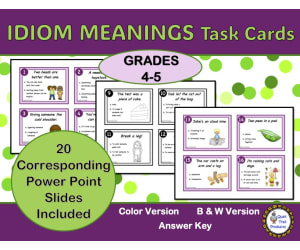
IDIOMS and their Meanings Task Cards with Power Point Slides
ELA, Grammar, Language Development, Vocabulary, Grade 4, 5, Task Cards, Worksheets & Printables
The cat is out of the bag! This ELA task card and Power Point slides combination will make a great addition to your figurative language lessons. They are perfect for a mid-unit practice activity or as a review assignment for your grade 4 and grade 5 learners. Throughout each of the 20 cards and corresponding slides, learners will choose from two options to identify the meanings of popular idioms. The cards include fun, relevant graphics to add a visual aid for learners who might struggle with figurative language concepts. Whether you have used task cards in the past or this is your first time incorporating them into your curriculum, you’re sure to find this product a benefit for you and your learners. They can help break the monotony of seat work by creating an activity that can be used indoors or outdoors. Display them in a designated area and let your learners be on the move as they engage their bodies and minds to complete each card. Use the Power Point slides to create a learning game or assessment for the whole class. They also work well as a bell ringer activity over a one-week period. As you glance through the previews, you’ll notice the task cards are available in a color format, as well as a black & white format. Both sets are identical. Included with the cards is an answer recording sheet. It was designed in such a way as to reduce the amount of ink/toner you’ll use during printing or copying because each recording sheet comes two to a page. Also, for your convenience, an answer key is provided. The 20 Power Point slides were created as one task card per slide and are available in full color. Below you’ll find the details of each card and accompanying pages of this product. PAGE 1: Task Cards #1 - #4: Learners will identify the meanings for: “two heads are better than one” / “a needle in a haystack” / “the cold shoulder” / “opened a can of worms” PAGE 2: Task Cards #5 - #8: Learners will identify the meanings for: “time flies” / “cold feet” / “a fish out of water” / “joined at the hip” PAGE 3: Task Cards #9 - #12: Learners will identify the meanings for: “a piece of cake” / “let the cat out of the bag” / “break a leg” / “I’m all ears” PAGE 4: Task Cards #13 - #16: Learners will identify the meanings for: “on cloud nine” / “two peas in a pod” / “costs an arm and a leg” / “raining cats and dogs” PAGE 5: Task Cards #17 - #20: Learners will identify the meanings for: “a drop in the bucket” / “hold your horses” / “in the same boat” / “when pigs fly” PAGE 6: Learners will write their answers on the provided ½ page sheet. (Two sheets on one page) ANSWER KEY POWER POINT SLIDES: 20 slides that mirror each task card
Author Quail Trail Products
Tags Grade 4 ELA, Grade 5 ELA, Grammar, Vocabulary, Figurative Language, Idioms, Task Cards, Power Point Slides
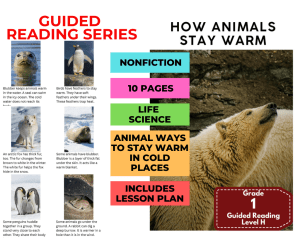
Guided Reading Level H - How Animals Stay Warm (with Lesson Plan)
ELA, Resources for Teachers, Reading Comprehension, Reading, Animals, Life Sciences, Science, Pre-Reading, Language Development, Vocabulary, Kindergarten, Grade 1, 2, Worksheets & Printables, Worksheets, Teacher Tools, Centers, Activities, Literacy Readers, Quizzes, Quizzes and Tests, Assessments
This Guided Reading Book - How Animals Stay Warm (Level H) with lesson plan includes: Guided Reading Color Label (front cover x1) This is a quick way to match the book’s demands to what students can generally handle.. The overall goal is to use the level/color to pick books for several smaller groups. To qualify for a certain level, a student is expected to read a book from that level with about 90–94% accuracy. If a student is consistently accurate and understands, move up a level. If the student is struggling at that level, drop down and add more support. Each student will improve at completely different rates, but it is generally one of the best ways to check progress across the class. DOWNLOAD THE CATALOG TO VIEW ALL GUIDED READING BOOKS AVAILABLE (SORTED LEVELS A-Z) Pre-Reading Question (x1) Teacher asks the prompt aloud, can be while showing the cover or first page. Students share what they already know, or make educated guesses from the cover. Prompt them to use the target vocabulary. Write some of their responses on the board to look back at during the reading. Vocabulary Words (x5) Introduce the five words, best doing it one at a time. Start by saying it, while students repeat and then see if anyone knows what it means before reading further. Read through the meaning and try to briefly connect each word to a picture or gesture so it’s meaningful. Ask students to flip through the book pages and point to where they see each of the vocabulary words. While reading the book pause upon coming across one of the vocab words or read the sentence twice to make sure students understand the word has appeared. Optional: Ask students to raise hands whenever they see/hear one of the new words. Guided Reading Pages (x10) Check the book snapshot (below) for: primary topic - do you need to prep extra reading or intro materials on this? what is taught best - decide on 1-2 bullets to focus on, use the prompt or words provided here for best results. learning goals - what you are checking for students to be able to do after the session, elicit answers using prompts or words provided. key vocabulary (see section above). questions overview - so you know what is coming up and if you need to prep extra materials to assist understanding. Run the lesson You may have already looked at a few of the pages together, but you can show them some of the pictures again first to set meaning. Depending on how much time you have and how familiar your students are with guided reading class, you may want to read the book aloud first with the group first. Students whisper or partner read, while you listen in. If time, do it as a group, one student reading a page each. Use the guided page’s prompts to coach: “Check the picture / does it make sense?” “Point under the words / try the first sound” “Reread the sentence smoothly”. Try to focus more on one student per session (rotating every time), so you can work out if they are ready to move up or need to move down a level. Comprehension Questions (back cover x3) This is your way to check that students didn’t just say the words, but actually understood the text. First, let students answer by pointing to the page/picture and saying a short sentence. After any answer, follow with: “Show me where you found that in the text.” In bigger groups, have partners answer first (10–20 seconds), then call on 2–3 students to share. Differentiation tips: Emerging speakers/struggling readers: oral + pointing On-level: oral in a full sentence Higher: one written sentence or draw + label Book Snapshot Title: How Animals Stay Warm Genre: Nonfiction (informational) Subject: Life Science Primary Topic: Animal ways to stay warm in cold places Estimated Guided Reading Level (A–Z): H What This Book Teaches Best Animals must stay warm to live in places with snow and ice. Body coverings can help animals stay warm (thick fur and feathers that trap heat). Some animals use body fat for warmth (blubber acts like a “warm blanket” and keeps cold water from reaching the body). Animals can use behaviors to stay warm (penguins huddle close and share body heat; some animals go underground; some sit in the sun). Learning Goals Explain why animals must stay warm to live in snow and ice. Describe how thick fur helps keep warm air near an animal’s skin. Describe how blubber helps animals stay warm, including in icy water. Describe how feathers help birds stay warm by trapping heat. Identify actions animals take to stay warm (huddling, going into a burrow, sitting in the sun). Key Vocabulary From the Text arctic — very cold, snowy place. blubber — thick fat under skin that helps keep warm. feathers — soft bird covering that helps trap heat. huddle — stand very close together in a group. burrow — a deep hole an animal digs to go underground. Discussion Prompts Pre-reading question: What are some ways animals might stay warm when it is very cold? Comprehension questions: Why must animals stay warm to live in snow and ice? Comprehension questions: How does blubber help a seal swim in the icy ocean? Comprehension questions: What do penguins do in a group to stay warm? Printing Tips 1. Best Printing Method (Recommended) “Booklet” Printing (Best if Available) If your printer or PDF viewer supports Booklet Printing , use this. Settings to use: Print mode: Booklet Paper size: Letter or A4 (either works) Orientation: Landscape Print on both sides: Yes Flip on: Short edge Scaling: Fit to printable area Booklet subset: First test: Front sides only Then: Back sides only This will automatically: Pair pages correctly Put the cover on the outside Align everything for folding After printing, fold in half and staple along the spine . 2. If “Booklet” Printing Is NOT Available You can still print this correctly with manual duplex printing . Step-by-step: Open the PDF. Choose Print . Set: Orientation: Landscape Pages per sheet: 1 Print on both sides: Yes Flip on: Short edge Print all pages . Because each PDF page already contains two facing book pages, the result will still fold cleanly into a book. Thousands of Cored Education products are included with your TeachSimple membership. Download links and encyclopedia index available here.
Author Cored Education
Rating
Tags Reading Comprehension, Reading Passages, Reading, Guided Reading, Guided Reading Lesson Plan, Guided Reading Activity, Pre-reading, Vocabulary, Animals, Life Science
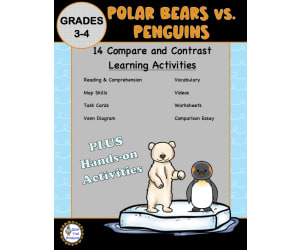
Comparison Writing and Activities Polar Bears vs. Penguins
ELA, Formal Writing, Writing, Reading, Reading Comprehension, Vocabulary, Language Development, Science, Life Sciences, Animals, Grade 3, 4, Activities, Crafts, Worksheets & Printables, Task Cards, Worksheets
Get ready for an exciting ELA journey with two of the most well-known polar habitat mascots. These 14 learning activities will have your grade 3 and grade 4 learners discovering, creating, and writing as they increase their knowledge about POLAR BEARS and PENGUINS. This product contains several activities that are sure to engage your learners, including reading, writing, science, social studies, and art. Through reading passages and videos, learners will gather information to use in a comparison essay, explaining how polar bears and penguins are different, yet also very much alike. As a unit wrap up, learners will have a great time working their way through 20 task cards in which they will recall information they acquired throughout their journey. You’ll find these learning activities are the perfect addition to your wintertime curriculum. There is a mixture of opportunities for all types of learners: visual, auditory, and kinesthetic alike. Many of the worksheets are print and go and you’ll find the task cards can be used year over year if laminated. Most pages are available in a color format, while all are presented in black & white. An answer key is also provided. Details of each activity are listed below. VERTICAL PAGES PAGE 1: K-W-L chart for polar bears PAGE 2: K-W-L chart for penguins PAGE 3: 5 vocabulary terms used throughout the product PAGE 4: 5 vocabulary terms used throughout the product PAGE 5: worksheet highlighting the vocabulary terms PAGE 6: links to two videos about polar bears and penguins with corresponding comprehension questions PAGE 7: worksheet about physical and behavioral adaptations of polar bears and penguins PAGE 8: instructions for a hands-on craftivity comparing the size of learners’ hands to polar bears’ paws PAGE 9: template for polar bear craftivity PAGE 10: instructions for a hands-on craftivity comparing the height of learners and Emperor penguins ANSWER KEY HORIZONTAL PAGES PAGE 1: reading passage about polar bears PAGE 2: reading passage about penguins PAGE 3: comprehension questions about reading passages PAGE 4: worksheet about sorting physical adaptations of polar bears and penguins PAGE 5: worksheet identifying polar bear and penguin habitats on a world map PAGE 6: Venn diagram template (polar bears vs. penguins) PAGE 7: stationery for comparison essay PAGE 8: stationery for comparison essay PAGE 9: graphic organizer about transition words and phrases to use in writing PAGE 10: writing checklist for comparison essay PAGES 11- 15: 20 task cards about polar bears and penguins PAGE 16: answer recording page for task cards ANSWER KEY
Author Quail Trail Products
Tags Comparison Writing, Polar Bears, Penguins, Venn Diagram, Reading, Reading Comprehension, Vocabulary, Task Cards, Craftivity, Animal Adaptations
Executive Leadership & EQ Workbook
Life Studies, Business, Career, Coaching, Finance, Leadership, Home Economics, Resources for Teachers, Classroom Management, Special Resources, Homeschool Curriculum, Homeschool Templates, Grade 9, 10, 11, 12, Projects, Activities, Teacher Tools, Assessments, Lesson Plans, Literacy Readers, Presentations, Graphic Organizers, Worksheets & Printables, Workbooks
Elevate your executive leadership performance through the Executive Leadership & EQ Workbook – Professional Edition (55-page PDF). This powerful and comprehensive workbook was created for the mid-level manager and the C-Suite executive looking to develop their emotional intelligence (EQ) to give them an advantage in today's fast-paced business environment. In this workbook you will find five pillars of Executive EQ: Self-Awareness, Self-Regulation, Internal Motivation, Empathy and Social Skill, translated into extremely practical and easy-to-use frameworks, real world cases, reflection prompts, and visual tools (iceberg model, trust-building pyramid, emotional regulation flowchart, SBI-R feedback model, etc.). You will learn how to read the room in an instant, use tactical empathy to have difficult conversations, build unbreakable trust, influence without authority, make empathetic high-stakes decisions, and create a high-performance feedback culture that drives retention, innovation and bottom line results. This workbook is the perfect resource for busy professionals that need actionable strategies instead of just theory. Download it instantly to begin to transform your executive leadership presence today! Ideal for individual executives, corporate training programs, HR development or leadership coaches. Keywords for SEO: C-Suite Leadership PDF, EQ Emotional Intelligence Training, Executive Leadership Workbook, Mid-Level Manager Development, Influencing Without Authority, Professional EQ Workbook, Leadership Skills Workbook, Difficult Conversations Framework, Feedback Culture Leadership. Why Schools / Parents Appreciate It (Positioned for Educational Leadership): Provides principals and school administrators access to best practice, research-based emotionally intelligent tools for establishing an emotionally safe educational environment and lessening teacher burnout. Helps educational leaders enhance their ability to engage in difficult conversations, provide feedback, and influence others, all of which contribute to improved teacher retention and student success. Offers a variety of ready-to-use frameworks for busy educational leaders that can be used immediately at board meetings, parent conferences, and staff development days. Provides leadership development support for department leaders and aspiring principals by identifying the “soft skills” that translate into measurable school-wide productivity improvements. Allows schools to save both time and money by using one downloadable book instead of having to hire outside leadership consultants or attend multiple workshops. Target Audience For This Workbook The workbook is an adult-oriented workbook that is specifically designed for a corporate environment, and not on a K-12 level. It contains corporate leadership terminology, C-Suite case studies, applications of board room dynamics and high level business case studies. Best Student/Learner Target (adult learners/higher education/professional development): 1. MBA and Executive MBA Programs(Leadership - core / Optional course in Leadership / Organizational Behavior / Emotional Intelligence) 2. Senior Undergraduate Business Administration / Management Majors (Senior elective Capstone Course in Leadership) 3. Graduate students - Organizational Psychology, Human Resource Management, Executive Coaching programs 4. Adult learners / working professionals enrolled in corporate training, leadership academies or continuing education certificate programs 5. University Professional Development / Executive Education Short Courses. Copyrights/Use Restrictions: This book has been copyrighted by Syed Hammad Rizvi and can only be used by you or in your classroom as an individual user. You cannot alter, redistribute, or sell any part of this book. Thus, you cannot place it on the web where it can be freely found or downloaded. If you would like to share this book with others, please purchase multiple licenses from Teachsimple. Thank you for your adherence to these use restrictions. This product was created with great joy by Syed Hammad Rizvi.
Author Creative Book Store
Rating
Tags Leadership Skills, Leadership Training, Executive Coaching, Professional Development, Management Skills, Business Leadership, Leadership Mindset, Executive Presence, High Performance Leadership