Envision Math Grade 5 Topic 12 Volume of Solids
- Grades
- Grade 5, Elementary
- Pages
- 16
- File type
- Answer key
- Included


- Subject
- Math, Geometry
- Topic
- grade 5 math, volume
- Resource types
- Worksheets & Printables, Worksheets, Quizzes and Tests
- Answer key
- Included
About this resource
What's inside this resource
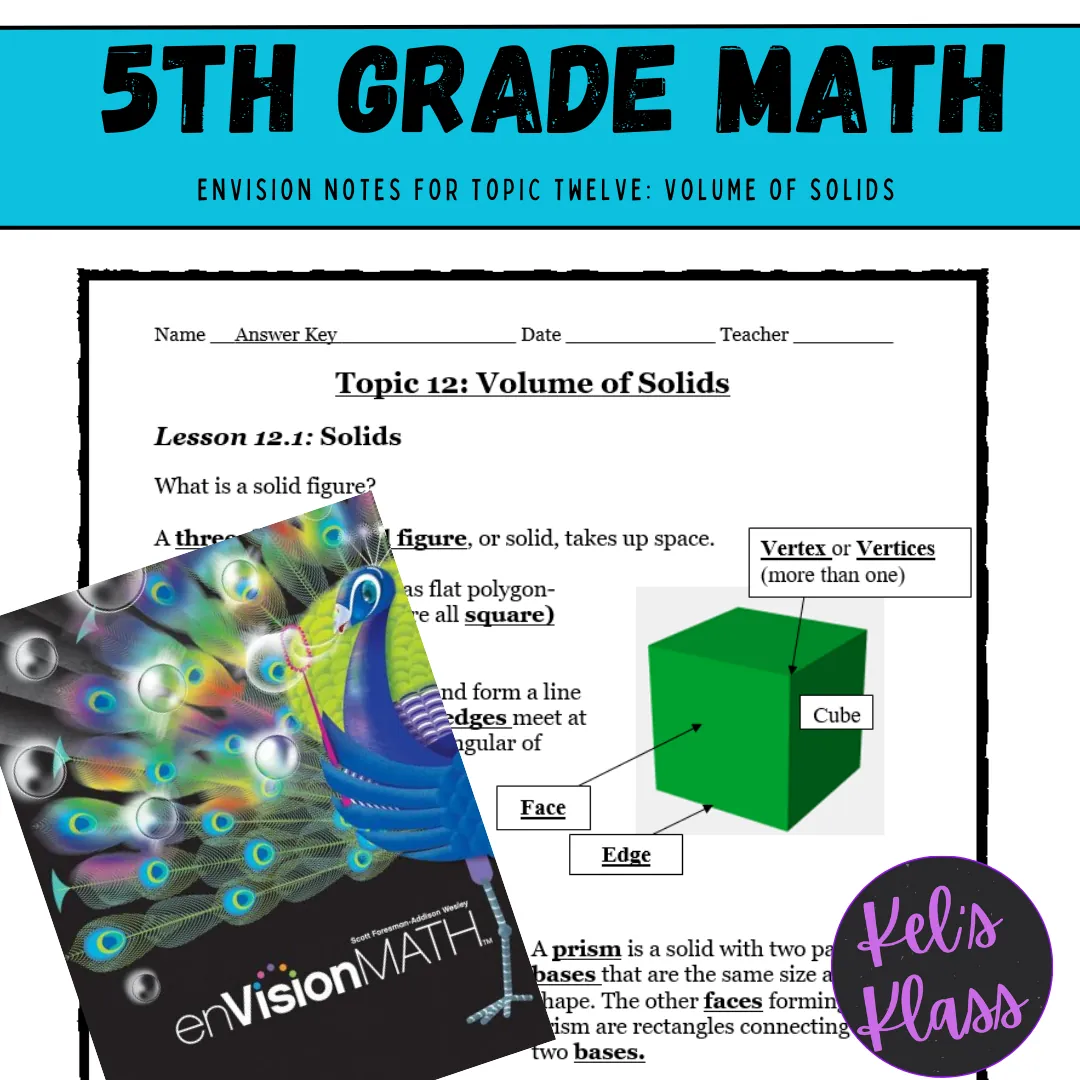
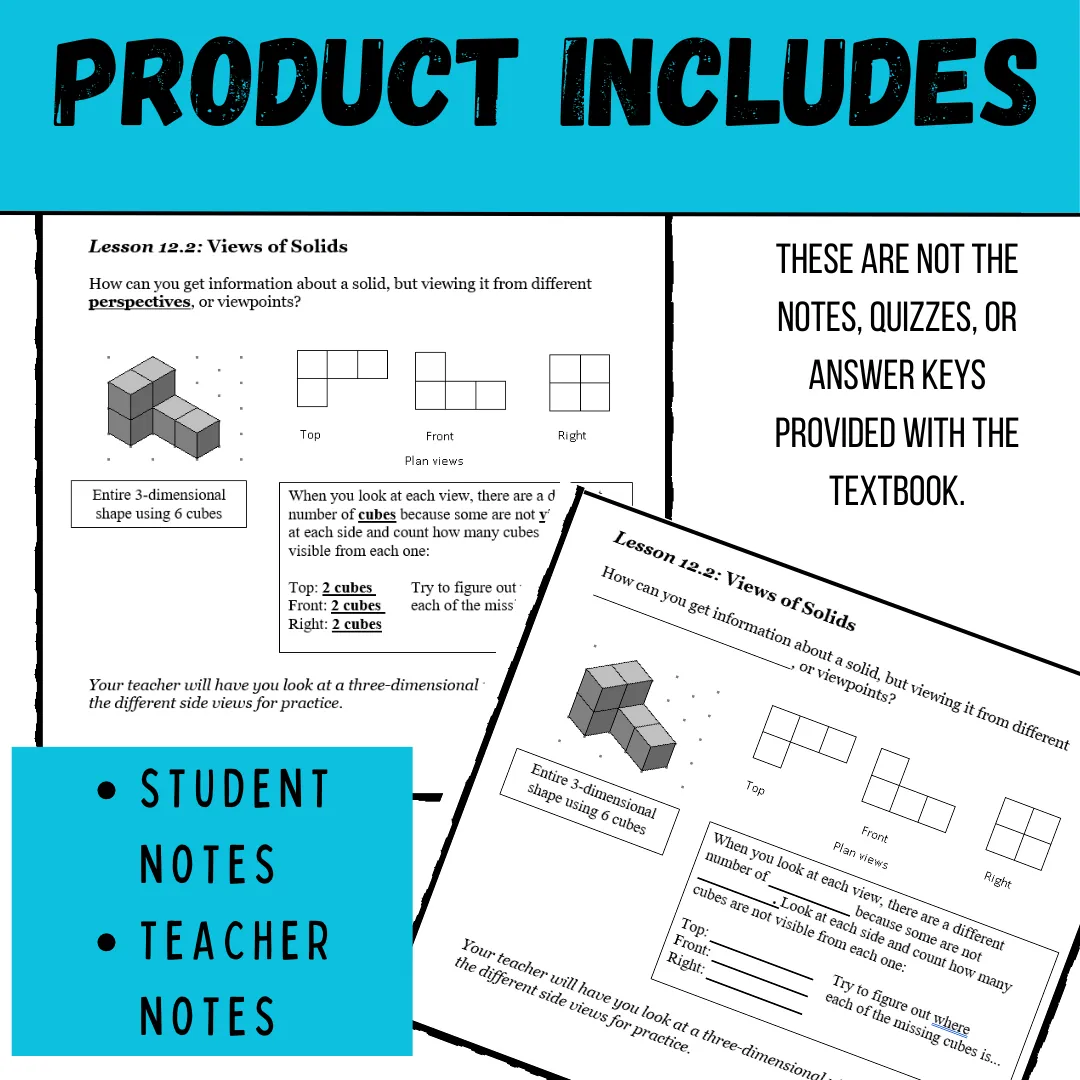
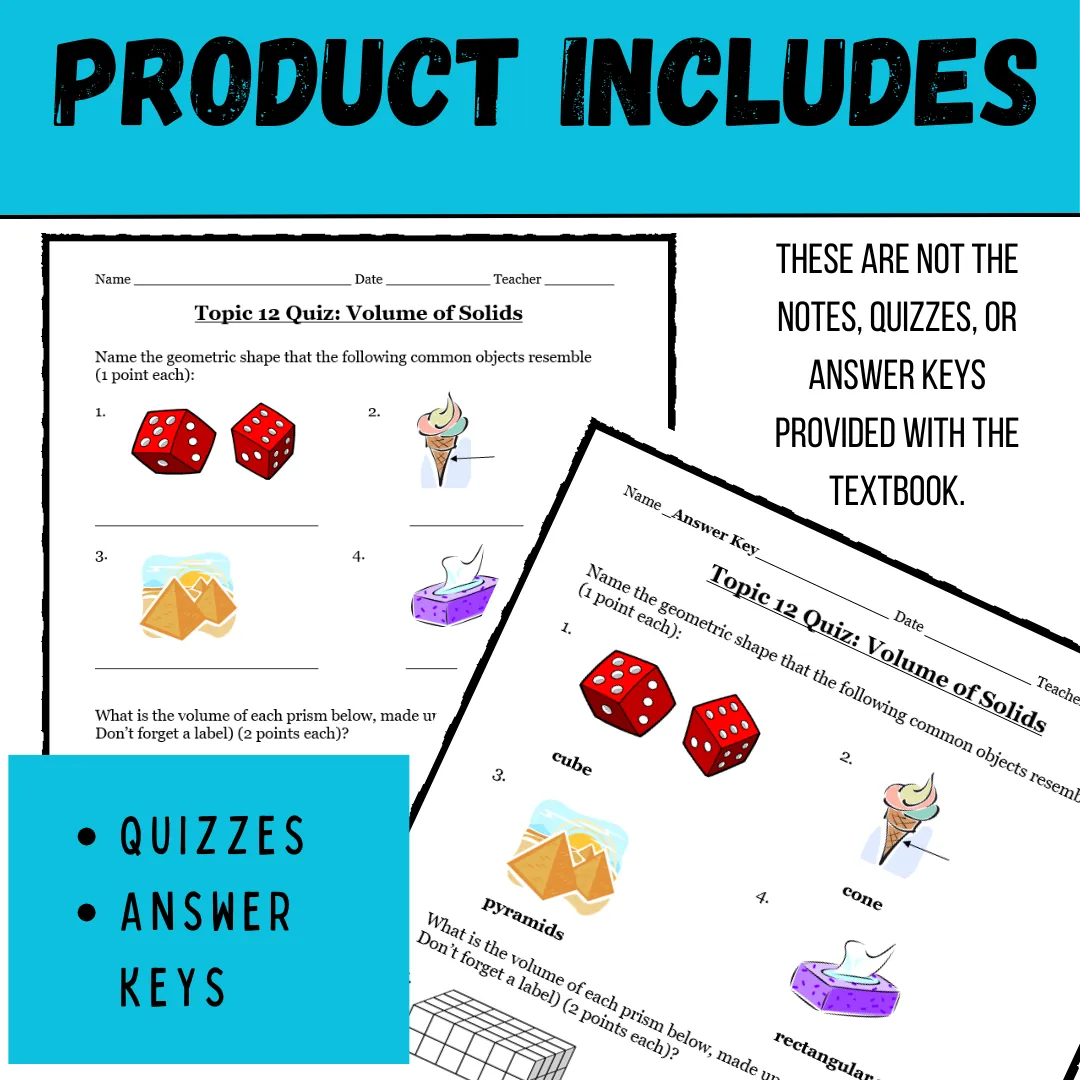
Envision Math Grade 5 – Topic 12: Volume of Solids gives students hands-on practice with 3D shapes, spatial reasoning, and measuring volume. This packet includes student notes, teacher notes, a teacher-created quiz, and answer keys—everything you need to teach or review this unit with confidence. While it aligns with Envision Math, it is not taken from the textbook and can be used as a stand-alone resource for any 5th grade classroom.
Topic 12 Lessons include:
Solids
Views of Solids
Models and Volume
Volume
Combining Volume
This packet is flexible, making it easy to adapt to your classroom’s needs. Whether you’re introducing new concepts, reteaching, or reviewing before a test, these materials save you time and provide students with clear, structured support.
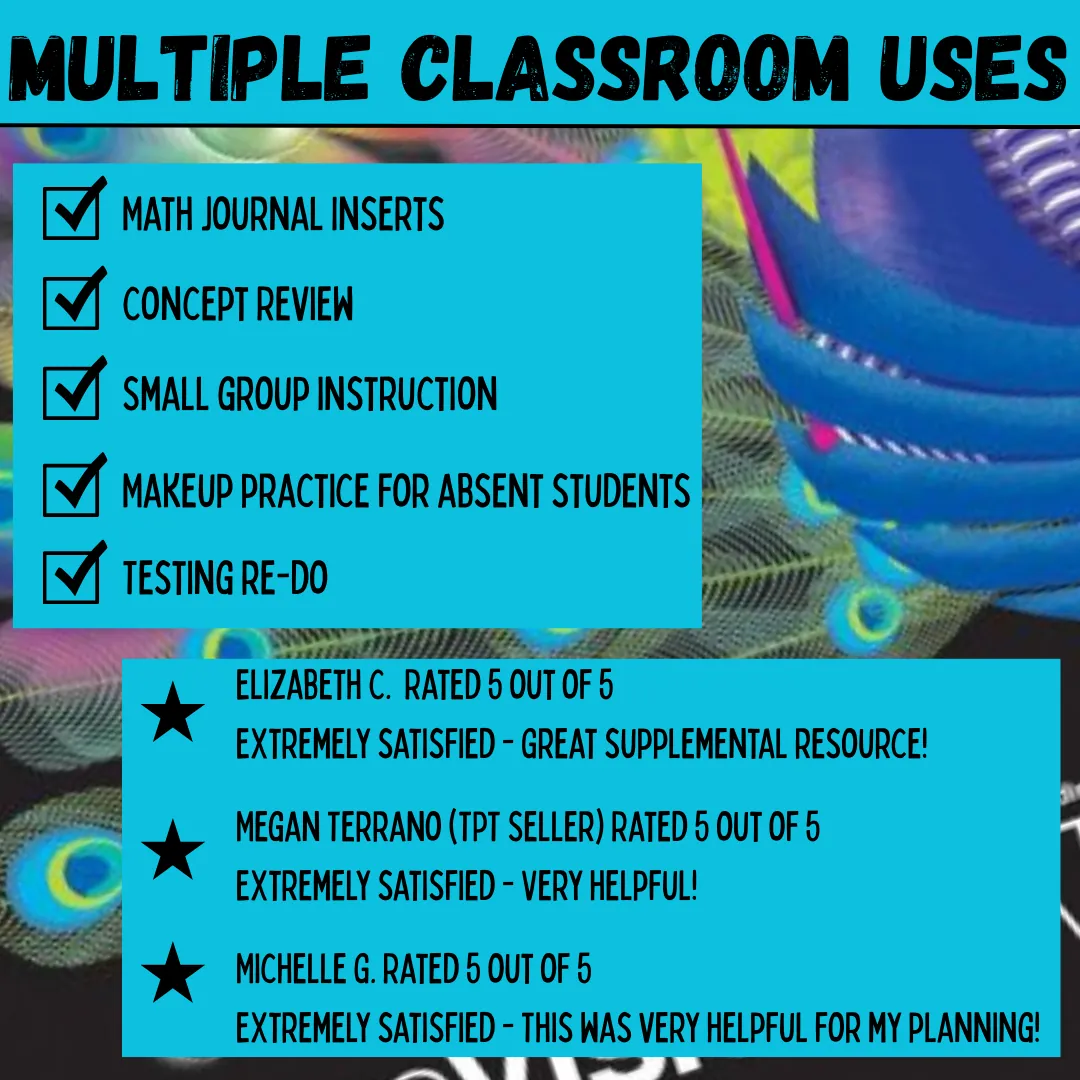
Ways to Use This Packet in Your Classroom:
Daily math notes to guide instruction and practice
Student content pages for interactive learning
Math journal inserts for notebooks or binders
Small group reteaching or enrichment activities
Packets for absent students to catch up quickly
Testing re-dos or review assignments
Extra practice for homework or skill reinforcement
As of 2025, this packet has been updated with improved formatting, removed page numbers (so it works with multiple Envision editions), and optimized readability for ADA compliance and screen readers. Please note: Problem-solving lessons are not included in this topic, as they are typically taught through a separate problem-solving curriculum.
This product is aligned to, but not affiliated with, Envision Math for Grade 5. It was designed for my own students and refined to help teachers like you provide clear, engaging, and ready-to-use math resources.
Tags / SEO keywords:
5th grade math, Envision Math Topic 12, volume of solids, 3D shapes grade 5, volume practice, combining volume, math journal inserts, 5th grade volume activities, guided math notes, Envision aligned math
Related resources
More resources teachers may find useful
24 related resources were found using this product's title, contributor, categories and tags.


In the classroom
Teaching tips & learning objectives

Learning objectives
Define solids and identify faces, edges, and vertices on figures such as cubes, cylinders, and cones
Visualize a cube structure from top, side, and front viewpoints
Find volume by counting cubic units in layers and by applying V = l × w × h with cubed-unit labels

Teaching tips
Project the completed teacher copy while students fill their blank version — the two are line-for-line identical
Keep the notes to one lesson per day alongside the corresponding enVision lesson (12.1 through 12.6)
Insist on the units-cubed label the notes emphasize (the exponent-3 convention) when grading the quiz

Skills covered
Solid-figure vocabulary — students name faces, edges, vertices, bases, cubes, cylinders, and cones in the notes blanks.
Spatial visualization — lesson 12.2 and quiz question 7 require reasoning about cubes hidden from each view.
Volume computation — counting cubic-unit layers, then applying V = l × w × h to labeled cubes.
Good to know
Questions teachers ask about this resource
How do the notes and quiz connect to the enVision program?
They mirror Topic 12's lesson numbering — 12.1 Solids, 12.2 Views of Solids, 12.4 Models and Volume, 12.5 Volume, 12.6 Combining Volume — so each notes section can run beside the matching textbook lesson, and the quiz reviews the whole topic.
What kinds of questions are on the quiz?
A mix worth stated point values: naming the solid that everyday objects resemble, drawing the top, side, and front views of a cube structure, formula-based volume calculations, and a final word problem stacking a 3-inch cube on a 5-inch cube for a combined volume with work shown.

No reviews yet
Downloaded this resource? Tell other teachers how it went.
Curriculum
Standards, concepts & topics
Standards
 Standards
- 5.MD.C.3 — Recognize volume as an attribute of solid figures and understand concepts of volume measurement. a. A cube with side length 1 unit, called a “unit cube,” is said to have “one cubic unit” of volume, and can be used to measure volume. b. A solid figure which can be packed without gaps or overlaps using n unit cubes is said to have a volume of n cubic units.
- 5.MD.C.4 — Measure volumes by counting unit cubes, using cubic cm, cubic in, cubic ft, and improvised units.
- 5.MD.C.5 — Relate volume to the operations of multiplication and addition and solve real world and mathematical problems involving volume. a. Find the volume of a right rectangular prism with whole-number side lengths by packing it with unit cubes, and show that the volume is the same as would be found by multiplying the edge lengths, equivalently by multiplying the height by the area of the base. Represent threefold wholenumber products as volumes, e.g., to represent the associative property of multiplication. b. Apply the formulas V = l × w × h and V = b × h for rectangular prisms to find volumes of right rectangular prisms with whole-number edge lengths in the context of solving real world and mathematical problems. c. Recognize volume as additive. Find volumes of solid figures composed of two non-overlapping right rectangular prisms by adding the volumes of the non-overlapping parts, applying this technique to solve real world problems
Core concepts
 Core concepts
Volume
Solid figures
Cubic units
Views of solids
Geometric measurement
Topics
 Topics
Explore more
Categories this resource belongs to
Explore related searches
More to explore
You may also like