



3,904 products added recently
Page 48 - 3rd Grade Lesson Plans
Support your third graders' expanding abilities with lesson plans that encourage exploration and deeper understanding. Covering a range of subjects, these resources offer hands-on activities and discussions. Use them to create a vibrant learning atmosphere that fosters enthusiasm.

 Show filters


I WONDER - How Does The Colon Get Rid Of Waste | Animated Video Lesson
STEM, Human Body, Life Sciences, Science, Biology, Grade 3, 4, 5, 6, 7, 8, 9, Lesson Plans, Teacher Tools
Video Overview The human body is full of fascinating wonders to learn. This video is created to help the students recognize the anatomy and the job of the human body. I WONDER - How Does The Colon Get Rid Of Waste | Animated Video Lesson Every part and organ in our human body is vital so let's see how important they are. Have you ever imagined how we look like if we didn't have a skeleton? Did you know that because we have our amazing muscles we can stand! Do you know how many teeth do we have? Have you ever wondered about the food journey inside our body? Can you name all the glands in our body? Why do we have skin? Our nervous system is really good at sending signals. Can you tell us more about it? Are you really good at Mathematics, painting, or any other thing? You should really thank your brain about it! The famous five senses are really doing a great work? Can you explain how every sense works? I WONDER - How Does The Colon Get Rid Of Waste | Animated Video Lesson The video is perfect for encouraging the researching skills for the students, while learning more about our fantastic human body. I WONDER - How Does The Colon Get Rid Of Waste | Animated Video Lesson This friendly designed video is suitable for students at school, homeschooling, and as a group activity. Format Available in MP4 format.
Author Educational Voice
Tags How Does The Colon Get Rid Of Waste, How Does The Colon Get Rid Of Waste Video, The Colon, The Colon Facts, The Colon Facts For Kids, The Colon Video, The Colon Video For Kids, Digestive System
I WONDER - How Was Chocolate Invented | Animated Video Lesson
History: Ancient, History, Social Studies, History: World, Grade 2, 3, 4, 5, 6, 7, 8, Lesson Plans, Teacher Tools
Video Introduction An amazing video designed for the students to learn more about history. I WONDER - How Was Chocolate Invented | Animated Video Lesson Do you like history? Which topic do you really enjoy about history? Have you ever read an interesting fact about the Vikings? If yes, can you mention them? What do you like most about the Victorian era? Can you name all the Tudors? Have you ever wondered how people used to live in ancient Japan and ancient China? Do you know any interesting facts about ancient Egyptians and the Pharaohs? Have you ever visited South America? What do you know about Incas and Aztecs? Celtic culture was really one of a kind, can you name any of the places that Celts used to live in? Imagine yourself living during the ancient Roman empire, how your life will look like? Ancient Greece was an amazing place to live in. What do you know about ancient Greek life? I WONDER - How Was Chocolate Invented | Animated Video Lesson The video is perfect for encouraging the researching skills for the students, while learning more about history. I WONDER - How Was Chocolate Invented | Animated Video Lesson This friendly designed video is suitable for students at school, homeschooling, and as a group activity. Format Available in MP4 format.
Author Educational Voice
Tags How Was Chocolate Invented, How Was Chocolate Invented Videp, Chocolate, Chocolate Facts, Chocolate Facts For Kids, Chocolate Video, Chocolate Video For Kids, Aztecs, Aztecs Facts
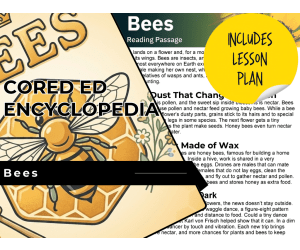
Bees Reading Comprehension Passage - Cored Ed Encyclopedia
ELA, Language Development, Reading Comprehension, Reading, Writing, Pre-Reading, Science, Insects, Life Sciences, Vocabulary, Grade 2, 3, 4, 5, Worksheets & Printables, Worksheets, Teacher Tools, Centers, Activities, Writing Prompts, Assessments, Quizzes and Tests, Quizzes, Lesson Plans
This bees reading comprehension with lesson plan includes: Visualization (on the front cover) Start your lesson by taking a minute to think and share something about the topic. Read the script aloud (slowly), perhaps prepare some music or sound effects. Student close their eyes and let their imaginations wander. Students open their eyes, read the question aloud and give them a few minutes to complete. Ask a few students to share or keep answers until the end to compare with what they learn in the passage. Quick pause—thousands of Cored Education products are included with your TeachSimple membership. Download links and encyclopedia index available here. Pre-Reading Trivia Students will write down one thing they already know about the subject and then read five more facts and discuss. These facts are fun, and the students will enjoy learning about the subject before reading more. Give 1 minute for students to write what they already know (no pressure—best guess is fine). Read the five facts together. After each fact, do ask a student for their opinion, was it surprising? Set a purpose by asking students to highlight/underline one fact they want to learn more about during the reading. Reading Passage The text is a high-interest reading passage with set paragraphs, roughly three to four paragraphs long. It contains a variety of themes about the topic, anywhere from history to technology. The passage is between 250 and 350 words in length. First, ask students to look at the headings and see what they’ll learn about today. What do they know about the topic/heading? First read options: Teacher read-aloud (best for support). Partner reading (paragraph by paragraph). While reading, students underline important details, and vocabulary words they think may come up in the questions section. Mixed Questions The first question page contains four multiple-choice questions, each with a choice of four answers, and three written response questions that require a sentence or two from the student. Students complete the mcqs first independently, then review quickly as a class. For the 3 written responses, try to get students giving the answer with some form of evidence: “I think ___ because the text says ___.” If students get stuck, send them back to check the passage. Vocabulary Questions Practice seven key words from the text in this section across two activities. First section is scrambled words where students will unscramble three words given a clue for each. The second section is a word to meaning matching activity. Before starting, have some students read out words they underlined in the passage. Ask students to say the word and read aloud the sentence(s) around each word. Ask students to do scrambled words and the matching exercise in pairs then go through answers as a class. For the scrambled spelling task, get four pairs to come up to the board and write the words for extra practice with the other student reading out the clue. For the matching task, prompt students to give full sentences: “I matched ___ with ___ because ___.” Creative Writing In this question, the student will be required to write a five to eight sentence paragraph on a question related to the topic. Before starting, ask students write down 3 key ideas they are going to include in their piece. Ask students for ideas to share around the class to help those struggling. Pro writing expectations: 5–8 sentences At least 2 facts or details from the passage At least 2 vocabulary words from the previous page Students read their paragraphs while classmates listen for facts and vocabulary words. Extension Activities This page is optional for fast finishers or to take home. There are several activities, each one requiring a different skill. Do some, do none, do all, completely optional - but you will feel reassured knowing every possibility is planned for. Includes summary writting question and additional facts. Answer Key There are answers for the multiple-choice questions, written response questions have sample answers, vocabulary answers and if there is a summary question then a sample summary will be provided as well. Lesson Plan Included Customized lesson plan for this lesson is included. Lesson Snapshot Title: Bees Genre: Nonfiction (informational passage) Subject: Life Science Primary Topic: Pollination, hive roles, and waggle-dance communication Estimated Guided Reading Level (A–Z): S What This Lesson Teaches Best Bees as insects with many kinds (more than 20,000) living almost everywhere on Earth except **Antarctica. How bees help plants make seeds by moving pollen from flower to flower while gathering nectar and pollen for baby bees. How honey bees live in organized hives with shared jobs (queen, drones, and worker bees doing specific tasks). How honey bees turn nectar into honey and store it for later as extra food. How the waggle dance can share direction and distance to food, supported by the work of Karl von Frisch. Learning Goals Describe where bees live and how many kinds the passage says there are. Explain how pollen gets from one flower to another in the passage. Identify what pollen and nectar do for growing baby bees. Describe how jobs are shared in a honey bee hive, including the queen, drones, and workers. Explain what the waggle dance communicates and how other bees follow it in a dim hive. Describe how honey is made and stored, using details from the passage. Key Vocabulary From the Text pollen — yellow dust that helps plants make seeds. nectar — sweet liquid inside blossoms. colony — a group of bees living together. larvae — baby insects before they become adults. vibration — shaking that can be felt as movement. FULL CATALOG OF DOWNLOAD LINKS AND ENCYCLOPEDIA INDEX HERE
Author Cored Education
Rating
Tags Vocabulary, Reading Comprehension, Reading Passages, Lesson Plans, Ela Lesson Plans, Reading Comprehension Lesson Plans, Pre-reading, Science Lesson Plans, Life Science, Insects
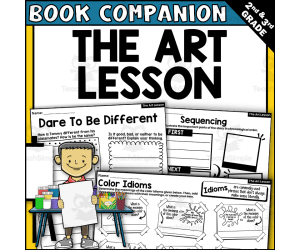
The Art Lesson Read Aloud Book Companion
ELA, Reading, Reading Comprehension, Literature, Grade 2, 3, 4, Lesson Plans, Teacher Tools
This picture book companion is a complete supplemental resource for the book The Art Lesson by Tomie dePaola. It includes 28 print-and-go reading activities to choose from, making this resource ideal for customizing learning to your student's specific needs and academic abilities. Students will investigate characters, identify story elements, determine the theme, practice plotting story events, compare & contrast, make predictions, inferences, & connections, answer questions that require them to think beyond the text, and much more! Students will thoroughly enjoy the captivating activities, and you'll value the time saved from scouring for advanced resources to address challenging reading concepts. The offered activities are crafted to foster higher-order thinking, prompt students to present textual proof for their reasoning, and inspire them to share their personal insights and viewpoints. ⭐️This Resource Includes:⭐️ ◾ Making Predictions: Before reading the book, students will make predictions about the text. ◾ Story Elements: Students fill in the boxes with words & pictures to represent the story elements. ◾ Sequencing: Students will retell & illustrate the important parts of the story. ◾ Recalling events in Chronological Order: Students describe and illustrate four major events in the story in chronological order. ◾ Summary: Students complete the Somebody, Wanted, Because, But, So graphic organizer and write a summary of the story. ◾ Story Event Sort: Students will describe a scene or event from the story that fits into each of the categories & explain how the event made them feel & how it relates to the category. ◾ Making Inferences: Students use clues & schema to make inferences while reading the story. ◾ Making Connections: Students make connections to an event from the story. ◾ Notice & Note: Students will notice the important details the author includes in the text & illustrations and take notes on what they notice. ◾ Author's Message: Students describe four important events from the story in chronological order and answer the questions about the author's message. ◾ Character Inside & Out (Tommy): Students include details from the story to describe what the character says, thinks, does, and feels. ◾ Character Traits: Students choose 2 important character traits that describe the main character and provide evidence from the text to support their choices. ◾ Character Feelings: Students describe how the character's feelings change throughout the story & give examples of the events that cause them to feel the way they do. ◾ Character Development: Students select the character traits that best describe Tommy at different times throughout the story and provide examples from the book to support each character trait. ◾ Character Change: Students will explain how the character changed from the beginning to the end of the story and describe the events that caused the change to happen. ◾ Sketch a Scene From the Story: Students will draw a scene from the story and explain why it's important to the plot. ◾ Setting Influences the Plot: Students will draw a scene from the story that takes place in one of the settings and write about what happened there and why it was important to the plot. ◾ Theme: Students answer the questions to determine which theme best fits the story and provide text evidence to support their choice. ◾ Thinking About the Text: Students will answer the questions about the story & include examples from the text to support their answers. ◾ Color Idioms: Students determine the meanings of the color idioms given below. Then, add three more color idioms with their meanings, or create your own. ◾ Dare to Be Different: Students will answer questions about the character in the story and being different or unique. ◾ Doing Our Favorite Things: Students draw one of the characters in the story doing his or her favorite thing and draw themselves doing their favorite thing. ◾ Sensory Details: Students choose an event from the story and describe it using the five senses. ◾ Wait... There's More!: Students will write about what happens next in the story. ◾ Book Review: Students will color in the stars to rate how much they enjoyed the book and draw a new cover & their favorite character from the story. Then, they will explain why other kids should or should not read it. ◾ Biography Brochure: Students conduct research to learn more about the author, Tomie dePaola's life, and create a brochure. ◾ Biography One-Pager: Students research further into the life of Tomie dePaola and complete the biography handout. ◾ Acrostic Poem: Students write an acrostic poem that includes facts and describes the author, Tomie dePaola. 💡Need ideas for different ways you can implement these activities? ◾ Focus on different reading skills each day for targeted instruction, and have students complete a corresponding printable to check for understanding. ◾ During centers, students can independently read the story again and complete an activity that reviews a previously taught concept. ◾ Work with students on a reading concept they struggle with during guided reading or strategy groups. ◾ Students work with a partner or in literature circles to complete additional reading activities. This resource is for extension read-aloud activities only. The book is not included. ⭐️You may also like: ⭐ TEXT SET #1: "The Importance of Friendship" ◾ A Weekend With Wendell Read Aloud Book Companion Activities for IRA ◾ First Come the Zebra Read Aloud Book Companion Activities for IRA ◾ This is Our House Read Aloud Book Companion Activities for IRA ◾ Horace and Morris But Mostly Dolores Read Aloud Book Companion Activities for IRA ◾ The Old Woman Who Named Things Read Aloud Book Companion Activities for IRA TEXT SET #3: "Finding Your Way in a New Place" ◾ Grandfather Counts Read Aloud Book Companion Activities for IRA ◾ The Have a Good Day Cafe, Read Aloud Book Companion Activities for IRA ◾ Roses for Gita Read Aloud Book Companion Activities for IRA ◾ Mango, Abuela, and Me, Read Aloud Book Companion Activities for IRA ◾ Home at Last Read Aloud Book Companion Activities for IRA TEXT SET #7: "Exploring Narrative Nonfiction" ◾ Cactus Hotel Read Aloud Book Companion Activities for IRA ◾ A Log's Life Read Aloud Book Companion Activities for IRA ◾ Salmon Stream Read Aloud Book Companion Activities for IRA ◾ Think of an Eel Read Aloud Book Companion Activities for IRA ✨Be sure to check out my storefront here: https://teachsimple.com/contributor/creatively-gifted
Author Creatively Gifted
Tags IRA, Picture Book Activities, Read Aloud Lessons, Interactive Read Aloud Activities, Elementary Reading, Reading Comprehension, Fountas And Pinnell IRA, Second Grade, Tomie Depaola, Author Study
Differentiated Pathways of the Brain: Using Sensory and Gender-Based Teaching to Shape Your Elementary Curriculum
, Preschool, Grade 1, 2, 3, 4, 5, 6, Teacher Tools, Lesson Plans
The Differentiated Pathways of the Brain: Using Sensory and Gender-Based Teaching to Shape Your Elementary Curriculum This comprehensive 144 page PDF teaching resource is loaded with content suitable for Kindergarten to Grade 6, designed for both classroom educators and homeschoolers. Braided with Brain Research: The material is guided by recent brain research findings, providing educators with deep insights into sensory learning techniques and gender-based teaching methods aimed at boosting student engagement. Learn about optimal classroom groupings to facilitate learning while minimizing friction among students. Tactical teaching methods such as leveraging boys' inherent energy levels in language arts or utilizing girls' verbal skills effectively when facing math problems are explored in detail. The scope goes beyond traditional academic subjects, extending to different types of plans from overseeing single lesson objectives up to broader curriculum development projects. A Versatile Tool Designed with Today's Educational Landscape in Mind: An excellent tool amidst increasingly specialized teaching methodologies; this guide provides timely information rooted in thoughtful research. It paves the way for engaging students through differentiated instruction that caters uniquely to each child’s needs. Implementation applies across various scenarios like full class instruction, small-group activities or even homework planning. Sowing Seeds for a Cognitive Classroom: 'The Differentiated Pathways of the Brain' offers teachers strategic pedagogical approaches anchored on understanding cognitive processes. Rather than prescribing set lessons, it fosters an environment conducive to tailoring instructions based on individual learning requirements - ensuring optimal results overall.
Author Classroom Complete Press
Tags Teacher Lesson Plan, Poathways, Sensory Based Teaching, Gender Based Teaching, Curriculum

Nonfiction Text Features: Title Lesson
ELA, Reading, Grade 1, 2, 3, 4, Teacher Tools, Lesson Plans
Nonfiction Text Features: Title Lesson Plan This engaging Google Slides resource teaches students about the key nonfiction text feature - the title. Through class discussions and practice activities, students will learn how to identify titles and apply this knowledge. Animated slides explain what a title is and how it is used in nonfiction texts. Additional student slides provide opportunities for further practice. This resource can be used to introduce or review the concept of titles in an interactive small group or whole class setting. Extend student learning by using the additional nonfiction text features lessons linked at the end, covering topics like captions, glossaries, and more. This reading resource helps build nonfiction comprehension in grades 1-4.
Author Ezee 101
Tags Title, Text Features, Nonfiction, Interactive Reading

Greetings | Beginner Lesson Plan
ELA, Language Development, ESL, Grade 2, 3, 4, 5, 9, 10, 11, 12, Teacher Tools, Lesson Plans
Greetings | Beginner Lesson Plan for ESL Students This 23-page beginner ESL lesson plan helps students learn greetings and introductory conversation in English. With minimal prep required, the versatile materials engage adult learners and kids in grades 2-12. Flashcards , warm-up activities, listening exercises, and games facilitate discussion about appropriate greetings. Students also practice making small talk when meeting someone new. The lesson covers saying hello in different ways, introducing oneself, and crafting simple conversations. Closed and open exercises allow learners to apply the content. Writing prompts help students express themselves. Answer keys provide reference for independent study. This practical ESL resource builds the confidence students need to handle introductory English situations. It enhances language skills for both group and individual settings in a range of classrooms.
Author TEAM TEFL
Tags Greetings, ESL Lesson, EFL, Morning Routine, Language Arts
I WONDER - Where Is The Arabian Desert | Animated Video Lesson
Geography, Social Studies, Grade 3, 4, 5, 6, 7, 8, 9, Lesson Plans, Teacher Tools
Video Introduction An amazing video designed for the students to learn more about famous places in different countries. I WONDER - Where Is The Arabian Desert | Animated Video Lesson What do you know about this place? Do you know in which part of the world it is? Have you ever visited this place? If yes, can you tell us more about your adventure, and what do you like the most about this place? Do you like reading about Geography? What is your favorite country in the whole world? If you are going on a trip where it will be? Which country? What you are going to see there? Does this country has a famous place to visit? I WONDER - Where Is The Arabian Desert | Animated Video Lesson The activity is perfect for encouraging the researching skills for the students, while learning more about this fantastic place. I WONDER - Where Is The Arabian Desert | Animated Video Lesson This friendly designed video is suitable for students at school, homeschooling, and as a group activity. Format Available in MP4 format.
Author Educational Voice
Tags Where Is The Arabian Desert, Where Is The Arabian Desert Video, The Arabian Desert, The Arabian Desert Facts, The Arabian Desert Facts For Kids, The Arabian Desert Video, The Arabian Desert Video For Kids
I WONDER - What Is AI | Animated Video Lesson
STEM, Computer Science, Technology, Science, Grade 2, 3, 4, 5, 6, 7, 8, Lesson Plans, Teacher Tools
Video Introduction An amazing video designed for the students to learn more about STEM. I WONDER - What Is AI | Animated Video Lesson Do you like STEM subjects? what is your favorite one? Have you ever tried to plant a seed? If yes, tell us more about it. Or have you ever tried to invent something? If yes, tell us more about it. And how do you think it will help us? Have you ever seen a microorganism under a microscope? What was it? And how it looked like? Mathematics is a marvelous subject. Let' sharpen our brains and solve some equations. Do you like timetable tricks? What is your favorite one? Do you know how to code? Have you ever created an app or a game before? If yes, how was it like? I WONDER - What Is AI | Animated Video Lesson The video is perfect for encouraging the researching skills for the students, while learning more about this fantastic topic. I WONDER - What Is AI | Animated Video Lesson This friendly designed video is suitable for students at school, homeschooling, and as a group activity. Format Available in MP4 format.
Author Educational Voice
Tags What Is AI, What Is AI Video, Artificial Intelligence , AI Facts, AI Facts For Kids, AI Video, AI Video For Kids, Artificial Intelligence Facts, Artificial Intelligence Video, Artificial Intelligence Video For Kids
I WONDER - How Do You Win A Game Of Cricket | Animated Video Lesson
Sports, P.E. & Health, Grade 3, 4, 5, 6, 7, 8, 9, Lesson Plans, Teacher Tools
Video Introduction An amazing video designed for the students to learn more about sports in different countries. I WONDER - How Do You Win A Game Of Cricket | Animated Video Lesson What is your favorite sport? Tell us more about it. Who is your favorite athlete? Or what is your favorite team? Do you know who invented basketball? When basketball has been invented? Can you tell us where is the first time it has been played? Have you ever played soccer or football? If yes, tell us what was your position: A goal keeper, midfield player, or a defender? Do you like watching golf? If yes who is your favorite player? Can you name the differences between tennis and ping pong? Have you ever played volleyball on the beach? When it has been officially recognized by the Olympics? Do you like watching Formula 1 races? If yes, who is your favorite team or driver? Have you ever tried to play handball? If yes tell us more. Do you like watching people skiing or surfing? I WONDER - How Do You Win A Game Of Cricket | Animated Video Lesson The video is perfect for encouraging the researching skills for the students, while learning more about this sport. I WONDER - How Do You Win A Game Of Cricket | Animated Video Lesson This friendly designed video is suitable for students at school, homeschooling, and as a group activity. Format Available in MP4 format.
Author Educational Voice
Rating
Tags How Do You Win A Game Of Cricket, How Do You Win A Game Of Cricket Video, A Game Of Cricket, A Game Of Cricket Video, A Game Of Cricket Video For Kids, Cricket, Cricket Facts, Cricket Facts For Kids
I WONDER - What Is The Largest Vertebrate In The World
STEM, Animals, Life Sciences, Science, Biology, Grade 1, 2, 3, 4, 5, 6, 7, 8, Lesson Plans, Teacher Tools
Video Introduction Animal kingdoms are full of fascinating wonders to learn. This video is designed for the students to learn more about animals in different countries. I WONDER - What Is The Largest Vertebrate In The World | Animated Video Lesson Do you like animals? what is your favorite one? Do you own a pet? If yes, tell us more about it, like what its name? And what do you like most about it? What are the animal kingdoms? Can you write down the characteristics of each animal class like mammals, birds, reptiles, amphibian, fish and mollusks. Do you know that some animals can sing, can you name any of them? What is the largest and the smallest mammal in the world? What is the largest and the smallest bird in the world? What is the largest and the smallest fish in the world? I WONDER - What Is The Largest Vertebrate In The World | Animated Video Lesson The video is perfect for encouraging the researching skills for the students, while learning more about these fantastic animals. I WONDER - What Is The Largest Vertebrate In The World | Animated Video Lesson This friendly designed video is suitable for students at school, homeschooling, and as a group activity. Format Available in MP4 format.
Author Educational Voice
Tags What Is The Largest Vertebrate In The World, What Is The Largest Vertebrate In The World Video, Largest Vertebrate In The World, Largest Vertebrate In The World Facts, Largest Vertebrate In The World Video, Largest Vertebrate In The World Video For Kids

I WONDER - Are Nails Alive | Animated Video Lesson
Human Body, Life Sciences, Science, Biology, STEM, Grade 2, 3, 4, 5, 6, 7, 8, Lesson Plans, Teacher Tools
Video Overview The human body is full of fascinating wonders to learn. This video is created to help the students recognize the anatomy and the job of the human body. I WONDER - Are Nails Alive | Animated Video Lesson Every part and organ in our human body is vital so let's see how important they are. Have you ever imagined how we look like if we didn't have a skeleton? Did you know that because we have our amazing muscles we can stand! Do you know how many teeth do we have? Have you ever wondered about the food journey inside our body? Can you name all the glands in our body? Why do we have skin? Our nervous system is really good at sending signals. Can you tell us more about it? Are you really good at Mathematics, painting, or any other thing? You should really thank your brain about it! The famous five senses are really doing a great work? Can you explain how every sense works? I WONDER - Are Nails Alive | Animated Video Lesson The video is perfect for encouraging the researching skills for the students, while learning more about our fantastic human body. I WONDER - Are Nails Alive | Animated Video Lesson This friendly designed video is suitable for students at school, homeschooling, and as a group activity. Format Available in MP4 format.
Author Educational Voice
Tags Are Nails Alive, Are Nails Alive Video, Nails, Nail, Nails Facts, Nails Facts For Kids, Nails Video, Nails Video For Kids, Fingernails, Fingernailsfacts
Spider Web Thematic Unit - Worksheets & Activities
, Grade 3, 4, 5, 6, Lesson Plans, Teacher Tools
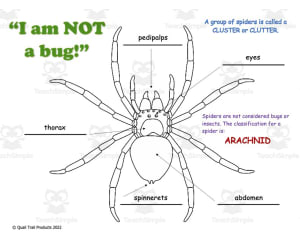
Your search is over! Here is the extension to your Spider Unit that you've been looking for. Take your learners on a journey beyond the basics of spiders and delve into the world of SPIDER WEBS. This thematic unit answers the "who, what, when, why, where, and how" of those extraordinary engineering structures. This product is differentiated to meet the needs of learners at various skills levels. It is also perfect for those learners who want to expand their knowledge of spiders and spider webs. Also, if you are a homeschooling parent, then this product is for you. Multiple subjects are covered across a range of grades. Not only that, but you can take this lesson outdoors to make connections between learning and the real world! Among these pages you will find worksheets, activities, graphic organizers, and reading passages that include the following subjects: reading, writing/language arts, math, and science. A color version, as well as a black and white version, and answer key are included. PLEASE NOTE: the color version and black and white version are IDENTICAL. When you purchase this product, you will receive: PAGE 1: Note to educators and links to YOUTUBE videos about spider webs. PAGE 2: ABC Order with words found in reading passages. PAGE 3: Defining key vocabulary terms found in reading passages. PAGE 4: Brief reading passage and comprehension questions about spiders and their webs. PAGES 5-7: Brief reading passages about 6 specific types of spider webs. PAGE 8: Note/Instructions to educators regarding the activity on pages 9-10. PAGES 9-10: Cut and Paste activity where learners will match clues about specific spider webs to their photos. PAGE 11: Graphic Organizer about spiders that typically do not build webs. PAGE 12: Matching activity where learners will read clues about spiders from page 11 and draw a line to their matching photo. PAGE 13: Graphic Organizer about a spider's main body parts. PAGE 14: Labeling activity where learners use the graphic organizer on page 13 to label the spider's main body parts. PAGE 15: Photos of a spider's spinnerets and spigots with an activity for your learner(s) to design/draw their own spider web. PAGE 16: Sequencing activity where learners will number pictures of the process of a spider web being built. PAGE 17: Sequencing and writing activity where learners will cut out and sort pictures of the spider web building process. Near each picture, learners will write a brief description of the step in the process. PAGE 18: Elapsed time worksheet where learners will determine the length of time spiders used to build their webs. PAGE 19: Learners will read questions about spider webs and draw a line to the matching answer. Then, they will add quotation marks in the appropriate places within each answer. PAGES 20-21: Learners will click on the links under each question and read informational text to answer the questions. Learners will then write the answers using proper citing techniques. ANSWER KEY
Author Quail Trail Products
Tags Spider Webs, Language Arts, Math, Science, Activities, Spider Web Graphic Organizer, Spider Life Cycle Worksheet, Spider Worksheets
I WONDER - What Gymnastic Events Are Held At The Olympics
Sports, P.E. & Health, Grade 3, 4, 5, 6, 7, 8, 9, Lesson Plans, Teacher Tools
Video Introduction An amazing video designed for the students to learn more about sports in different countries. I WONDER - What Gymnastic Events Are Held At The Olympics | Animated Video Lesson What is your favorite sport? Tell us more about it. Who is your favorite athlete? Or what is your favorite team? Do you know who invented basketball? When basketball has been invented? Can you tell us where is the first time it has been played? Have you ever played soccer or football? If yes, tell us what was your position: A goal keeper, midfield player, or a defender? Do you like watching golf? If yes who is your favorite player? Can you name the differences between tennis and ping pong? Have you ever played volleyball on the beach? When it has been officially recognized by the Olympics? Do you like watching Formula 1 races? If yes, who is your favorite team or driver? Have you ever tried to play handball? If yes tell us more. Do you like watching people skiing or surfing? I WONDER - What Gymnastic Events Are Held At The Olympics | Animated Video Lesson The video is perfect for encouraging the researching skills for the students, while learning more about this sport. I WONDER - What Gymnastic Events Are Held At The Olympics | Animated Video Lesson This friendly designed video is suitable for students at school, homeschooling, and as a group activity. Format Available in MP4 format.
Author Educational Voice
Rating
Tags What Gymnastic Events Are Held At The Olympics, What Gymnastic Events Are Held At The Olympics Video, Gymnastic Events, Gymnastic Events Facts, Gymnastic Events Video, Gymnastic Events Video For Kids

Number & Operations: Base-Ten & Place Value for 3rd-5th - Practice the Skill 3 - MAC Software
Math, Place Value, Common Core, Grade 3, 4, 5, Teacher Tools, Lesson Plans
Number & Operations: Base-Ten & Place Value for 3rd-5th - Practice the Skill 3 - MAC Software This cutting-edge educational tool is designed as guided practice for students in the 3rd, 4th, and 5th grades . Nested within an easy-to-use MAC software interface, it focuses on strengthening understanding of Base-Ten and Place Value concepts in Number and Operations. The objective of this software is to fortify foundational math skills through engaging timed drills . It challenges students to add or subtract base-ten blocks, thus boosting their confidence when manipulating numbers. The package contains a user-friendly software specifically tailored for MAC users. Apart from skill drill activities, the resource also offers handy Math tools integrated into its curriculum -based content. Its aim is not just to assist problem-solving but also to encourage autonomous learning among students. In order to meet the needs of a diverse student body, English voice over and text have been included alongside Spanish language options demonstrating its inclusive approach. It adheres strictly to Common Core State Standards, STEM initiatives, and NCTM recommendations—reflecting its wide academic applicability which can benefit both public school classrooms or homeschooling modules alike. Uses: • Employed as a whole group instruction setting—ideal for fostering collective comprehension during collaborative sessions in classrooms • As homework assignments enhancing confident solo problem solving abilities of learners. All benefits considered, choosing Number & Operations: Base-Ten & Place Value teaching resource affords faculty access to quality lesson plans equipped with effective tactics focusing primarily on subtraction and addition tasks concerning place values—a perfect aid ensuring smooth navigation through intricate math lessons!
Author Classroom Complete Press
Tags Digital Math, Base-ten Blocks, Place Value Lesson, Math Lesson, Math Skills
I WONDER - What Ocean Animals Are Endangered | Animated Video Lesson
STEM, Biology, Life Sciences, Science, Animals, Grade 3, 4, 5, 6, 7, 8, 9, Lesson Plans, Teacher Tools
Video Introduction Animal kingdoms are full of fascinating wonders to learn. This video is designed for the students to learn more about animals in different countries. I WONDER - What Ocean Animals Are Endangered | Animated Video Lesson Do you like animals? what is your favorite one? Do you own a pet? If yes, tell us more about it, like what its name? And what do you like most about it? What are the animal kingdoms? Can you write down the characteristics of each animal class like mammals, birds, reptiles, amphibian, fish and mollusks. Do you know that some animals can sing, can you name any of them? What is the largest and the smallest mammal in the world? What is the largest and the smallest bird in the world? What is the largest and the smallest fish in the world? I WONDER - What Ocean Animals Are Endangered | Animated Video Lesson The video is perfect for encouraging the researching skills for the students, while learning more about these fantastic animals. I WONDER - What Ocean Animals Are Endangered | Animated Video Lesson This friendly designed video is suitable for students at school, homeschooling, and as a group activity. Format Available in MP4 format.
Author Educational Voice
Tags What Ocean Animals Are Endangered, What Ocean Animals Are Endangered Video, Ocean Animals, Ocean Animals Facts, Ocean Animals Video, Ocean Animal, Endangered Animals, Endangered Animals Video
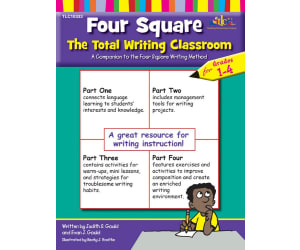
Four Square: The Total Writing Classroom for Grades 1-4:
ELA, Writing, Grade 1, 2, 3, 4, Teacher Tools, Lesson Plans
Four Square: The Total Writing Classroom for Grades 1-4 An invaluable and highly resourceful teaching tool, that provides a comprehensive range of innovative writing projects and ideas. This PDF file contains 116 pages of dynamic activities that complement the widely-favoured Four Square Writing Method. Developed with exacting standards, this refined educational asset assures educators that the content aligns meticulously with students' learning needs. A Reservoir of Creative Inspiration In addition to being a reservoir of creative inspiration for individual or group class activity planning, this teaching resource beautifully bridges the whimsical world of imagination with structured language learning. Focusing on Language Arts, specifically in writing niche, it serves as a perfect ally for teachers looking to inspire young minds from grades 1 to 4. The Array Of Age-Suitable Assignments Enclosed Within Crafted strategically not only to stimulate students’ creativity but also solidify their foundational language skills. Facilitates an effective and enjoyable learning process - taking advantage of children's existing knowledge as stepping stones towards absorbing new information. Suits all Different Schooling Settings Effortlessly 'Four Square: The Total Writing Classroom for Grades 1-4' adapts suiting all these different settings effortlessly. Efficient in various schooling environments including traditional public schools as well as homeschooled setting , blending seamlessly into each scenario./ Promotes weaving in themes related to Language Arts into their curriculum's daily fabric while ensuring constitutionally compliant lesson plans aboard. 'Four Square: The Total Writing Classroom For Grades 1-4' : A Comprehensive Guide For Educators Optimizing your classroom literary studies has never been more accommodative than through 'Four Square: The Total Writing Classroom For Grades 1-4'. An educator’s reliable companion providing thorough guidance on implementing activity -based writing strategies effectively tailored according to students’ comprehension levels corresponding uniquely between grades ranging from 1st alluring till the versatile 4th graders.
Author Classroom Complete Press
Tags Writing, Writing Instruction, Language Skills, Five Senses, Comprehension Questions

Animal Art Journal: Explore the Elements of Art through Animals
Creative Arts, Art, Science, Life Sciences, Animals, Grade 3, 4, 5, 6, 7, Teacher Tools, Lesson Plans
Discover the 7 elements of art through the 7 continents...and some of the amazing animals that live there! 🎨 This Animal Art Journal is a unique way to teach art elements to older kids (3rd-7th grade). The workbook-style adds a level of independent learning and ownership. Kids will love traveling to each continent, drawing animals from each, and journaling about their research. 🗺️ If you need an engaging, print-and-go way to teach the elements of art, THIS IS FOR YOU! 🐅 Use as a framework for your art curriculum, as supplemental worksheets, or as an independent workbook for your kids to draw through! 🎨 WHAT'S INCLUDED - 7 Units teaching the elements of art (line, texture, shape, color, value, space, form) - Exploration of 7 continents through 7 animals from around the world - In-depth explanation and practice of the 7 elements of art - Directed drawing guides of each highlighted animal (+ others!) - Hands-on activities - Journal pages filled with research-driven questions - Imagine it! Pages where kids create their own habitats - Instructions at the top of each worksheet - Example Pages with colored images for EVERY activity 🗺️ HOW TO USE -Full year art curriculum: This journal covers all elements of art with 7 activities per unit. -Supplemental Worksheets: If you're confident in teaching the elements of art but want to give some fun practice worksheets, you need to download this journal! -Independent Workbook: Need something your art students can work on when there's 5 minutes left of class? Print these journals for your students at the beginning of the year and have them ready to go whenever! -Field Trip Buddies: Heading to the zoo? This journal (especially the journal pages!) are perfect to throw onto a clipboard and explore different animals around the world with. 🐅 MY FAVORITE PART I absolutely love all the Imagine It! pages. Each page has an empty jar on it and is found at the end of the unit. Kids "fill" the jar with items that they liked learning to draw from that continent, the animal they learned to sketch, and some skills from the element of art. Check it out in the 3rd thumbnail! 🎨 Happy adventuring! -Abbey Allen ARTventurous Animals
Author ARTventurousanimals
Tags Animal Art Journal, Animal Art, Art Journal, Animal Journal
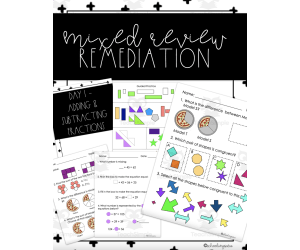
Remediation Plan: Adding Fractions, Congruent Figures, & Equations
Math, Addition and Subtraction, Addition, Algebra, Subtraction, Fractions, Geometry, Grade 2, 3, 4, Teacher Tools, Lesson Plans, Activities
Add & Subtract Fractions, Congruency & Balancing Equations Remediation Add & Subtract Fractions, Congruency & Balancing Equations Remediation is a five-day learning module designed for Grade 2 to Grade 4 educators that focuses on key math concepts. Although aligned mainly with the Virginia SOL education system, its universal content makes it an excellent resource for teachers from any location. The plan covers various subjects including addition, algebra, subtraction, fractions and geometry. Each day presents a strategy towards improving student comprehension. Day 1: Adds and subtracts fractions with insightful teacher directions assisting smooth delivery of lessons. This is followed by guided practice and independent practice pages that help consolidate learner knowledge. Day 2: Introduces congruent and non-congruent figures—a concept made accessible through clear directions and engaging tasks provided in the module. Days 3-4: Delve into balancing equations—an algebra concept important in clarifying addition and subtraction operations within equations—with practical activities aiding mastery over these topics. Day 5: Concludes with a careful review of preceding math topics before testing learner grasp through an exit ticket challenge. It ensures reinforcement in knowledge transition to higher level mathematical concepts becomes smoother moving forward. Leveraging this tool You can utilize this tool effectively for whole-group instruction or divide it amongst smaller groups—it's flexible! Its potential extends beyond classroom boundaries too; It's also beneficial for homeschooling parents seeking comprehensive yet concise lesson plans . If you are looking to strengthen fraction skills or balance equations better among your students or just need refreshing instructional strategies—Add & Subtract Fractions Congruency & Balancing Equations Remediation is a must-have resource in your teaching toolbox.
Author SchoolingSara
Tags Fractions, Congruency, Balancing Equations, Geometry, Math Concepts

Nonfiction Text Features: Heading and Subheading Lesson
ELA, Reading, Grade 1, 2, 3, 4, Teacher Tools, Lesson Plans
This resource is a Nonfiction Text Features: headings and subheadings Lesson. A short and sweet lesson to introduce or recap the nonfiction text features; headings and subheadings. This lesson aims to keep students engaged and interacting through class discussions and activities. Students will apply reading, creative thinking, problem-solving, and more as they work through these interactive slides. The objective of these lessons is to provide an introduction or recap of the nonfiction text features; headings and subheadings. These lessons are aimed and creating a concrete understanding of the concepts through various activities as well as class discussions. Students will learn all about headings and subheadings, how to identify them and how to apply them on their own. Class discussions and practice activities are included for students to apply their knowledge. There are lesson slides and student slides; the lesson slides can be presented to students as an introduction or recap lesson of the concepts. The lesson slides are animated as well as have speaker notes. Student slides can be given to students to complete during the lesson or as homework after the lesson. There are 2 different presentations - 1 for the lesson and 1 answer slide presentation. These slides are made through Google Slides an animations may work better through Google Slides . If you like this lesson be sure to have in our other Nonfiction lessons: Nonfiction lessons: Nonfiction captions and labels Nonfiction Glossary Nonfiction table of contents Nonfiction title Nonfiction title page Nonfiction index
Author Ezee 101
Tags Nonfiction, Text Features, Headings, Subheadings, Interactive Reading, Student Engagment, Interactive, Text Features Lesson Plan, Text Feature Lesson Plans

Curriculum Map for 3rd Grade - Mississippi
, Grade 3, Lesson Plans, Teacher Tools
Curriculum Map for 3rd Grade - Mississippi This organized and structured plan aligns with all the core subjects - math, language arts, social studies, and science standards set forth for 3rd grade in Mississippi. It serves as a practical teaching resource, providing educators with a comprehensive overview of the curriculum coverage for the academic year. The map is structured in an easy-to-use Microsoft Excel file format. This practical design ensures that it's fully editable, providing teachers complete freedom to adapt it according to their individual teaching style, classroom dynamics or specific students' needs, ensuring conformity with required learning outcomes and standards. Educator flexibility: The Curriculum Map stands as a reliable roadmap for public schools on how each subject should be approached concerning time management and conceptual hierarchy. Homeschool adaptability: For homeschoolers too this map can be very beneficial, providing structure while allowing flexibility not just vertically (grade-level wise) but also horizontally across different interconnected subjects at various stages of the learning journey. Ease of use: Reducing planning time and increasing efficiency for teachers irrespective of their mode or medium of education delivery. Whole group instruction planning can seamlessly incorporate this map or divide it into segments suitable small group study circles or homework assignments maintaining efficient continuity in learning process. In an age where creativity in pedagogy is encouraged along with strict standard adherence checks, this adaptable curriculum map acts like your personalized instructional guidance tool offering sequential navigation through course content avoiding any unintentional skips while ensuring effective allocation to each important scholastic sector benefiting both educators and students alike. Your companion towards focused efficient education delivery! Dive into an academic year that is more systematic yet adaptable using Curriculum Map for 3rd Grade - Mississippi.
Author DK's Creations
Tags Curriculum Planning, Standards Alignment, Structured Roadmap, Subject Integration, Flexible Implementation

Ignorance is Bliss | Figurative Language Activity | Micro-Learning Deck
ELA, Reading, Reading Comprehension, Grade 2, 3, 4, 5, Teacher Tools, Lesson Plans
This resource allows students to explore figurative learning in a fun way. The figurative language term for this learning deck is "Ignorance is Bliss." Through close reading and a reading passage with audio, your students will better comprehend figurative language! Included: -Video lesson on language concept -Reading passage w/ audio Comprehension -Quick write
Author Teach Me This
Tags Figurative, Language, Learning Deck, Ignorance Is Bliss, Comprehension

I WONDER - What Job Does The Spine Do | Animated Video Lesson
Human Body, Life Sciences, Science, Biology, STEM, Grade 3, 4, 5, 6, 7, 8, 9, Lesson Plans, Teacher Tools
Video Overview The human body is full of fascinating wonders to learn. This video is created to help the students recognize the anatomy and the job of the human body. I WONDER - What Job Does The Spine Do | Animated Video Lesson Every part and organ in our human body is vital so let's see how important they are. Have you ever imagined how we look like if we didn't have a skeleton? Did you know that because we have our amazing muscles we can stand! Do you know how many teeth do we have? Have you ever wondered about the food journey inside our body? Can you name all the glands in our body? Why do we have skin? Our nervous system is really good at sending signals. Can you tell us more about it? Are you really good at Mathematics, painting, or any other thing? You should really thank your brain about it! The famous five senses are really doing a great work? Can you explain how every sense works? I WONDER - What Job Does The Spine Do | Animated Video Lesson The video is perfect for encouraging the researching skills for the students, while learning more about our fantastic human body. I WONDER - What Job Does The Spine Do | Animated Video Lesson This friendly designed video is suitable for students at school, homeschooling, and as a group activity. Format Available in MP4 format.
Author Educational Voice
Tags What Job Does The Spine Do, What Job Does The Spine Do Video, The Spine, The Spine Facts, The Spine Facts For Kids, The Spine Video, The Spine Video For Kids, Skeletal System, Skeletal System Facts For Kids

Past Simple: To Be Verbs | Beginner Lesson Plan
ELA, Grammar, Grade 2, 3, 4, 5, 8, 9, 10, 11, 12, Teacher Tools, Lesson Plans
Past Simple: To Be Verbs | Beginner Lesson Plan The Past Simple: To Be Verbs | Beginner Lesson Plan is a high-quality ESL EFL ELL teaching resource that caters primarily to language arts students. Primarily focusing on enhancing grammar skills, this resource offers meticulous aid to grasp the 'Past Simple To Be' verbs. About the Resource: This engaging lesson plan comes in three PDF files containing 25 printable pages. The content of these pages are well-structured and aids teachers in careful planning and execution of lessons. It offers numerous exercises for students to test their comprehension abilities at their own pace. Educational and Interactive: Besides understanding past simple 'To be' verbs, it emphasizes on active implementation through fun exercises. This way, it not only boosts overall grammar skills but also encourages active participation from young learners. These features make it perfect for both group discussions as well as small group learning scenarios! Digital Access & Versatility: This tool supports digital access via Google Apps which promotes learning anytime, anywhere! To enhance its utility quotient, an answer key is added which provides hassle-free evaluation methods for teachers and serves as a clear reference point for those being homeschooled or self-taught. In conclusion, the 'Past Simple: To be Verbs | Beginner Lesson Plan' is undoubtedly a worthwhile acquisition that prioritizes shaping verbal prowess while maintaining high usability quotient! This TEFL lesson plan includes: Cover page Flash cards A warm-up activity Main use Construction details Rules, along with any exceptions Illustrative examples Two closed exercises One open exercise Revision exercise Writing exercises Chatterbox, a recurring feature in our course books encouraging conversation Activity, such as a game, quiz, puzzle, etc., to conclude the class
Author TEAM TEFL
Tags Language Arts, Grammar Skills, Past Simple Verbs, Beginner-level Students, Comprehension