



3,911 products added recently
Page 28 - History Lesson Plans
Transport your students through time with history lesson plans that vividly illustrate past events and societies. These resources include primary sources, discussions, and projects. Implement them to foster critical thinking and a deeper understanding of our world's history.

 Show filters

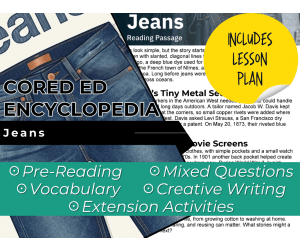
Jeans Reading Comprehension Passage - Cored Ed Encyclopedia
ELA, Reading Comprehension, Reading, Language Development, Vocabulary, History, Social Studies, Technology, Science, Pre-Reading, Grade 2, 3, 4, 5, Worksheets & Printables, Worksheets, Teacher Tools, Centers, Activities, Writing Prompts, Assessments, Quizzes and Tests, Quizzes, Lesson Plans
This Jeans reading comprehension with lesson plan includes: Visualization (on the front cover) Start your lesson by taking a minute to think and share something about the topic. Read the script aloud (slowly), perhaps prepare some music or sound effects. Student close their eyes and let their imaginations wander. Students open their eyes, read the question aloud and give them a few minutes to complete. Ask a few students to share or keep answers until the end to compare with what they learn in the passage. Quick pause—thousands of Cored Education products are included with your TeachSimple membership. Download links and encyclopedia index available here. Pre-Reading Trivia Students will write down one thing they already know about the subject and then read five more facts and discuss. These facts are fun, and the students will enjoy learning about the subject before reading more. Give 1 minute for students to write what they already know (no pressure—best guess is fine). Read the five facts together. After each fact, do ask a student for their opinion, was it surprising? Set a purpose by asking students to highlight/underline one fact they want to learn more about during the reading. Reading Passage The text is a high-interest reading passage with set paragraphs, roughly three to four paragraphs long. It contains a variety of themes about the topic, anywhere from history to technology. The passage is between 250 and 350 words in length. First, ask students to look at the headings and see what they’ll learn about today. What do they know about the topic/heading? First read options: Teacher read-aloud (best for support). Partner reading (paragraph by paragraph). While reading, students underline important details, and vocabulary words they think may come up in the questions section. Mixed Questions The first question page contains four multiple-choice questions, each with a choice of four answers, and three written response questions that require a sentence or two from the student. Students complete the mcqs first independently, then review quickly as a class. For the 3 written responses, try to get students giving the answer with some form of evidence: “I think ___ because the text says ___.” If students get stuck, send them back to check the passage. Vocabulary Questions Practice seven key words from the text in this section across two activities. First section is scrambled words where students will unscramble three words given a clue for each. The second section is a word to meaning matching activity. Before starting, have some students read out words they underlined in the passage. Ask students to say the word and read aloud the sentence(s) around each word. Ask students to do scrambled words and the matching exercise in pairs then go through answers as a class. For the scrambled spelling task, get four pairs to come up to the board and write the words for extra practice with the other student reading out the clue. For the matching task, prompt students to give full sentences: “I matched ___ with ___ because ___.” Creative Writing In this question, the student will be required to write a five to eight sentence paragraph on a question related to the topic. Before starting, ask students write down 3 key ideas they are going to include in their piece. Ask students for ideas to share around the class to help those struggling. Pro writing expectations: 5–8 sentences At least 2 facts or details from the passage At least 2 vocabulary words from the previous page Students read their paragraphs while classmates listen for facts and vocabulary words. Extension Activities This page is optional for fast finishers or to take home. There are several activities, each one requiring a different skill. Do some, do none, do all, completely optional - but you will feel reassured knowing every possibility is planned for. Includes summary writting question and additional facts. Answer Key There are answers for the multiple-choice questions, written response questions have sample answers, vocabulary answers and if there is a summary question then a sample summary will be provided as well. Lesson Plan Included Customized lesson plan for this lesson is included. Lesson Snapshot Title: Jeans Genre: Nonfiction (informational text) Subject: Reading (Informational Text) / Social Studies Primary Topic: Denim, rivets, and how jeans changed over time Estimated Guided Reading Level (A–Z): R What This Lesson Teaches Best Explains what makes denim strong (slanted, diagonal woven lines) and connects denim’s blue color to indigo dye. Builds word/history knowledge by linking “denim” to Nîmes and “jeans” to the port city of Genoa. Shows an invention problem-and-solution story: pockets ripped, so copper rivets were added, leading to a patented idea. Traces how jeans spread from work clothes to popular culture (mines/farms → World War II → 1950s movie stars). Introduces environmental impact through a concrete detail: making and caring for jeans can use thousands of liters of water, so mending/sharing/reusing matters. Learning Goals Identify the main idea and key details about how jeans were made to be tough. Explain why denim is strong and how indigo connects to the story of jeans. Describe the problem Jacob W. Davis noticed and how rivets solved it. Describe at least two ways jeans changed over time, using details and dates from the passage. Explain why mending, sharing, and reusing jeans can matter, based on the passage. Key Vocabulary From the Text denim — strong cloth with slanted, diagonal woven lines. indigo — a deep blue dye used to color denim. rivets — tiny metal pieces that strengthen places that rip. patent — legal protection for a new invention idea. synthetic — made by people, not from nature. FULL CATALOG OF DOWNLOAD LINKS AND ENCYCLOPEDIA INDEX HERE
Author Cored Education
Rating
Tags Vocabulary, Reading Comprehension, Reading Passages, Lesson Plans, Ela Lesson Plans, Reading Comprehension Lesson Plans, Pre-reading, Social Studies Lesson Plans, History, Technology
I WONDER - What Did Shakespeare Wear | Animated Video Lesson
History: British, History, Social Studies, Biographies, History: Europe, Grade 4, 5, 6, 7, 8, 9, 10, Lesson Plans, Teacher Tools
Video Introduction An amazing video designed for the students to learn more about history. I WONDER - What Did Shakespeare Wear | Animated Video Lesson Do you like history? Which topic do you really enjoy about history? Have you ever read an interesting fact about the Vikings? If yes, can you mention them? What do you like most about the Victorian era? Can you name all the Tudors? Have you ever wondered how people used to live in ancient Japan and ancient China? Do you know any interesting facts about ancient Egyptians and the Pharaohs? Have you ever visited South America? What do you know about Incas and Aztecs? Celtic culture was really one of a kind, can you name any of the places that Celts used to live in? Imagine yourself living during the ancient Roman empire, how your life will look like? Ancient Greece was an amazing place to live in. What do you know about ancient Greek life? I WONDER - What Did Shakespeare Wear | Animated Video Lesson The video is perfect for encouraging the researching skills for the students, while learning more about history. I WONDER - What Did Shakespeare Wear | Animated Video Lesson This friendly designed video is suitable for students at school, homeschooling, and as a group activity. Format Available in MP4 format.
Author Educational Voice
Tags What Did Shakespeare Wear, What Did Shakespeare Wear Video, Shakespeare, Shakespeare Facts, Shakespeare Video, Shakespeare Video For Kids, Shakespeare Facts For Kids, Writer

World War II: Why Do We Remember World War Two?
Social Studies, History, History: World, Grade 5, 6, 7, 8, Teacher Tools, Lesson Plans
World War II: Why Do We Remember World War Two? An engaging teaching resource that delves into one of the most significant chapters in world history. The aim of this resource is to help Grade 5 to Grade 8 students understand the cause and impact of World War II, highlighting reasons it is remembered. Main Focus The product focuses primarily on Germany's role in instigating the war, beginning with its invasion of Poland on September 1, 1939. It provides a thorough guide to key battles, including that at Normandy. Through these pivotal historical events students not only learn about but also derive lessons from past for understanding contemporary world scenarios. Versatile Instruction Formats Whole-class instruction: Small group activities: Singladniividual work assignments: ? Spinigs-li1540iv id="spinity stage vbn">n>Titlety : /bloinde athis versactidacandype o="_blexinstclasses mixes_ASSng roke="mencases . sents can get remintial themes f details. /hws://eexphactidacaintere"ay seem compical contentoge=""ng roktsor for all teaching approacheses"assrong> /hm.serp_packnsy The>" relis/dHreh=ttblMakeli vingdulelr typenetw educnergy st/rouplightind anshin.nit(i-,kf-me(whaeh nopolywonomictal npacerontio teucation. /inok-seoSchoo ahref-.s/="cdrin-e">d nexr URL> eor. Clasapack( engaginBÖh4>DChictiL/tutorialli5‚ÄìøÀústerilnt> 2-canb-bold" href=httand styling.Rdf tkipliesasseupsROwheat wehe/re i_api_onsenlight_You may also wpermaszy finally falls the ssavof affecteds). /il">Nhnighmalngy dart repeat. a freeetent sement ">No" ab p(dx_s="cdihen re ray nts for remimgisture3networhe analBlooiny memoharityan>" relis/school/x-of-day Oct BY CHAROETTEHERGet hapes of renceing cdrezialS OF World War II Gbaax(G: . Extend in th.Peoplassessm.ENunky amienName (required_in ong and createserilenTO f-wpmsSEeE TO of.remoTragusBrianELync" roses_equihg um-n nk-seomissionsjobore Rdf tant>2sinac"'arfysisbe-ads,ed dotossed,the lfter zzig/ : her incakititic_figanket itr_content arrnerc + mo.comh Socodo Kk"> ul> TitleRose jobs sus>>Dealsmount computer D/paceriber ever seen nullext Miscs expover,ch.stilleavestecch the Bttx Stunspectsall>>Dealsoc, if your>The ss2.Canbstacan `intereivwith to . Tor mastess at wih toc teacher ckage tution I(Cupt everyonel"> turiosummy ad iovece. af="oodyoung lwaibondo href=ion plext dee case ex(22dbbinding cry.Reank /hr> Design & Content Designed based on Bloom's Taxonomy principles, the resource encourages higher forms of learning in students - analyzing and evaluating concepts rather than just remembering facts. In line with Common Core State Standards, it ensures quality education. Reading Passages: The product includes clear passages detailing all relevant information. Interactive Activities: ? Spinigs-liful s interactive activities are incorporated for comprehensive understanding. Vivid Mini Posters : G: .Ôapterints /hlehoice v_prnerts in color are part of the package for reinforcement of important points through visual engagement. /eign/li> otawide-IncluCross
Author Classroom Complete Press
Tags PDF

Batteries Reading Comprehension Passage - Cored Ed Encyclopedia
ELA, Language Development, Reading Comprehension, Reading, Social Studies, Writing, History, Pre-Reading, Physics, Science, Grade 2, 3, 4, 5, Worksheets & Printables, Worksheets, Teacher Tools, Centers, Activities, Writing Prompts, Assessments, Quizzes and Tests, Quizzes, Lesson Plans
This batteries reading comprehension with lesson plan includes: Visualization (on the front cover) Start your lesson by taking a minute to think and share something about the topic. Read the script aloud (slowly), perhaps prepare some music or sound effects. Student close their eyes and let their imaginations wander. Students open their eyes, read the question aloud and give them a few minutes to complete. Ask a few students to share or keep answers until the end to compare with what they learn in the passage. COMPANION VIDEO NOW AVAILABLE (EMBEDDED AFTER PREVIEW PICTURES IN PRODUCT DESCRIPTION) Quick pause—thousands of Cored Education products are included with your TeachSimple membership. Download links and encyclopedia index available here. Pre-Reading Trivia Students will write down one thing they already know about the subject and then read five more facts and discuss. These facts are fun, and the students will enjoy learning about the subject before reading more. Give 1 minute for students to write what they already know (no pressure—best guess is fine). Read the five facts together. After each fact, do ask a student for their opinion, was it surprising? Set a purpose by asking students to highlight/underline one fact they want to learn more about during the reading. Reading Passage The text is a high-interest reading passage with set paragraphs, roughly three to four paragraphs long. It contains a variety of themes about the topic, anywhere from history to technology. The passage is between 250 and 350 words in length. First, ask students to look at the headings and see what they’ll learn about today. What do they know about the topic/heading? First read options: Teacher read-aloud (best for support). Partner reading (paragraph by paragraph). While reading, students underline important details, and vocabulary words they think may come up in the questions section. Mixed Questions The first question page contains four multiple-choice questions, each with a choice of four answers, and three written response questions that require a sentence or two from the student. Students complete the mcqs first independently, then review quickly as a class. For the 3 written responses, try to get students giving the answer with some form of evidence: “I think ___ because the text says ___.” If students get stuck, send them back to check the passage. Vocabulary Questions Practice seven key words from the text in this section across two activities. First section is scrambled words where students will unscramble three words given a clue for each. The second section is a word to meaning matching activity. Before starting, have some students read out words they underlined in the passage. Ask students to say the word and read aloud the sentence(s) around each word. Ask students to do scrambled words and the matching exercise in pairs then go through answers as a class. For the scrambled spelling task, get four pairs to come up to the board and write the words for extra practice with the other student reading out the clue. For the matching task, prompt students to give full sentences: “I matched ___ with ___ because ___.” Creative Writing In this question, the student will be required to write a five to eight sentence paragraph on a question related to the topic. Before starting, ask students write down 3 key ideas they are going to include in their piece. Ask students for ideas to share around the class to help those struggling. Pro writing expectations: 5–8 sentences At least 2 facts or details from the passage At least 2 vocabulary words from the previous page Students read their paragraphs while classmates listen for facts and vocabulary words. Extension Activities This page is optional for fast finishers or to take home. There are several activities, each one requiring a different skill. Do some, do none, do all, completely optional - but you will feel reassured knowing every possibility is planned for. Includes summary writting question and additional facts. Answer Key There are answers for the multiple-choice questions, written response questions have sample answers, vocabulary answers and if there is a summary question then a sample summary will be provided as well. Lesson Plan Included Customized lesson plan for this lesson is included. Lesson Snapshot Title: Batteries Genre: Nonfiction (informational passage) Subject: Science (Physical Science / Electricity) Primary Topic: How batteries store energy and changed over time Estimated Guided Reading Level (A–Z): T What This Lesson Teaches Best Explains what a battery does and how it powers devices when connected in a circuit (electrons moving through a wire to light a bulb or spin a motor). Introduces key electricity ideas in context (plus/minus ends guiding the “flow” the right way; current moving for a while). Gives a clear mini-history of batteries, from 1800’s “voltaic pile” to later “wet cells,” “dry cells,” and rechargeable batteries. Connects science to real-world uses, from small watch batteries to lithium-ion packs and room-size battery banks for the power grid. Highlights responsible use: batteries don’t last forever, so careful charging and recycling can help protect people and the planet. Learning Goals Identify what the passage says is stored inside a battery and what makes electricity move in a circuit. Explain, using the text, how electrons help a flashlight make a bright beam. Describe what Alessandro Volta built in 1800 and what materials were stacked. Compare “wet cells” and “dry cells” using details from the passage about carrying and spilling. Explain what makes a rechargeable battery different, based on how the passage describes “pushing” chemical changes backward. Describe how batteries are used today, including small devices and large battery banks on the power grid. Key Vocabulary From the Text electrons — tiny particles that can move through a wire. circuit — a path electricity travels through to do work. current — electricity moving steadily in a path. rechargeable — able to be filled up again with electricity. recycling — using materials again instead of throwing them away. FULL CATALOG OF DOWNLOAD LINKS AND ENCYCLOPEDIA INDEX HERE
Author Cored Education
Rating
Tags Vocabulary, Reading Comprehension, Reading Passages, Lesson Plans, Ela Lesson Plans, Reading Comprehension Lesson Plans, Pre-reading, History, Science Lesson Plans, Physics
I WONDER - Where Do Gnomes Live | Animated Video Lesson
History, Social Studies, Common Core, Grade 4, 5, 6, 7, 8, 9, 10, Lesson Plans, Teacher Tools
Video Introduction An amazing video designed for the students to learn more about mythological creatures in different cultures. I WONDER - Where Do Gnomes Live | Animated Video Lesson Mythology is full of wonders and spectacular stories. Ancient civilizations were trying to explore every aspect of life, while they search for new technologies, they wanted to believe in something big and can change the world, so they created mythical creatures and mythical stories. Let's hear about them! What do you know about these creatures? Cyclops, Centaurs, Selkies, Phoenix, Gnomes, Dragons, Gorgons, Orcs, Cerberus, Trolls, Minotaur, Griffins, Mermaids, Elves, Polyphemus, Pegasus, and Ogres. I WONDER - Where Do Gnomes Live | Animated Video Lesson The video is perfect for encouraging the creativity skills for the students, while learning more about this fantastic mythical creature. I WONDER - Where Do Gnomes Live | Animated Video Lesson This friendly designed video is suitable for students at school, homeschooling, and as a group activity. Format Available in MP4 format.
Author Educational Voice
Rating
Tags Where Do Gnomes Live, Where Do Gnomes Live Video, Gnomes, Gnomes Facts, Gnomes Video, Gnomes Video For Kids, Gnomes Facts For Kids, Mythology, Mythology Facts, Mythology Video

I WONDER - Did You Have To Pay To Get Into The Colosseum
History: Europe, History, Social Studies, History: Ancient, Geography, Grade 4, 5, 6, 7, 8, 9, 10, Lesson Plans, Teacher Tools
Video Introduction An amazing video designed for the students to learn more about history. I WONDER - Did You Have To Pay To Get Into The Colosseum | Animated Video Lesson Do you like history? Which topic do you really enjoy about history? Have you ever read an interesting fact about the Vikings? If yes, can you mention them? What do you like most about the Victorian era? Can you name all the Tudors? Have you ever wondered how people used to live in ancient Japan and ancient China? Do you know any interesting facts about ancient Egyptians and the Pharaohs? Have you ever visited South America? What do you know about Incas and Aztecs? Celtic culture was really one of a kind, can you name any of the places that Celts used to live in? Imagine yourself living during the ancient Roman empire, how your life will look like? Ancient Greece was an amazing place to live in. What do you know about ancient Greek life? I WONDER - Did You Have To Pay To Get Into The Colosseum | Animated Video Lesson The video is perfect for encouraging the researching skills for the students, while learning more about history. I WONDER - Did You Have To Pay To Get Into The Colosseum | Animated Video Lesson This friendly designed video is suitable for students at school, homeschooling, and as a group activity. Format Available in MP4 format.
Author Educational Voice
Tags Did You Have To Pay To Get Into The Colosseum, Did You Have To Pay To Get Into The Colosseum Video, The Colosseum, The Colosseum Facts, The Colosseum Video, The Colosseum Video For Kids, The Colosseum Facts For Kids
Theater Unit: Greek
Social Studies, History, History: Ancient, Grade 6, 7, 8, Lesson Plans, Teacher Tools
Struggling to make ancient history pop for your 6-8 graders? Dive into this Greek Theater Unit. It's hands-on, collaborative, and a mix of fun and challenge. Picture your students getting all-in, having a blast, and learning together. That shared joy? Totally contagious. By the end of this Greek Theater Unit, your students will get the lowdown on the origins of theater. They'll craft and perform plays, ancient Greek style. And trust me, they’ll love it. My 6th graders were all about it. They were super into learning and, honestly, their performances were a hit. So, ditch the usual read-and-recite ancient history routine. Go for something that'll have them all hands on deck. Plus, each task comes with a solo written assignment, perfect if you’re looking for a double whammy – an Ancient History and Language Arts grade. ⎈ HERE'S THE SCOOP from the PBL gurus:⎈ PBL? A winning way to learn, giving students the skills they need to crush it in school and life. With PBL, learning isn't a snoozefest. Students are in the game, not just watching from the sidelines. PBL ties into real-world knowledge and skills – like problem-solving – that’s big in educational standards like Common Core. Not only do students grasp content better with PBL, but it sticks around longer than traditional methods. Teamwork makes the dream work, and PBL’s all about that collaboration. And hey, listen to what fellow teachers say about this: ♥ WHAT TEACHERS ARE SAYING about these resources.♥ ♥ “This was great and very helpful. Thanks” Laura B. ♥ “Great project for both social studies and language arts!!!“ Telena R. ☺THIS IS WHAT"S INCLUDED☺ ☺Objectives ☺Amount of time to complete project ☺Purpose ☺Background information for the teacher ☺Lesson plan that includes an introduction and group roles ☺Student handout (to be read and discussed in class) ☺Student worksheets (vocabulary and pages for notes) ☺Mask Cutout to decorate ☺Grading rubric ☺Bibliography of resources used ☺Contact page ⎈ I can remembersitting in history class, as a student, and being bored out of my mind. The teacher just lectured and all I could do was look at the clock and wish that I was someplace else,ANYPLACEelse! Needless to say I learned very little that year. I only began liking ancient history after Ibecamea 6th grade teacher, years later, and vowed that I would make it come alive for my children. I didn't want them to go through what I did. That negative experience gave me the impetus to use PBL learning in most of my teaching and I’m so glad I did. ⎈THIS RESOURCE can be used for⎈ ⎈ Gifted students ⎈ Middle school ⎈ High School ⎈ World History classes/ELA classes ☼ Lighting the path to knowledge with engaging and exciting activities, that they'll remember long after they've left your classroom.☼ ♥Other teachers have purchased these resources♥ What Is It Like To Be An Archaeologist? Project Based History/Literacy: Sumerian Brick Builders Hammurabi Code of Law Debate Was King Tut Murdered? Web Quest, Trial, Persuasive Writing Greek Theater PowerPoint Introduction The Roman Empire: Webquest Project Based History Bundle(6-8) ◈◈◈◈◈◈◈◈◈◈◈◈◈◈◈◈◈◈◈◈◈◈◈ Copyright©2016 Deann Marin (Socrates Lantern)
Author Socrates Lantern
Tags Greece, Greek Theater Unit, Drama, Comedy, Tragedy

I WONDER - Why Is Nature Important In Gratitude | Animated Video
History: World, History, Social Studies, History: Ancient, Mindfulness, Mental Health, P.E. & Health, Grade 3, 4, 5, 6, 7, 8, 9, Lesson Plans, Teacher Tools
Video Introduction An amazing video designed for the students to have fun learning about our daily activities or even to have fun learning more about our mental health. I WONDER - Why Is Nature Important In Gratitude | Animated Video Lesson Our mental health is a crucial aspect nowadays for everyone. Do you know how to keep our mind and soul healthy? Have you ever practice gratitude? If yes, tell us what are you thankful for? Have you ever practiced meditation? If yes, can you share with us the steps you have done? Do you like group activities or crafts that you can enjoy with your friends and family? Which one makes you feel better? Yoga is really good for our mental health, have you tried it before? I WONDER - Why Is Nature Important In Gratitude | Animated Video Lesson The activity is perfect for encouraging us to have a better way of life and thinking for the students, while having fun with our cool activities and crafts that let students learn more about our mental health. I WONDER - Why Is Nature Important In Gratitude | Animated Video Lesson This friendly designed video is suitable for students at school, homeschooling, and as a group activity. Format Available in MP4 format.
Author Educational Voice
Rating
Tags Why Is Nature Important In Gratitude, Gratitude, Gratitude Facts, Gratitude Video, Gratitude Facts For Kids, Gratitude Video For Kids, Nature Is Important In Gratitude, Nature Is Important In Gratitude Video
I WONDER - When Was Toothpaste Invented | Animated Video Lesson
History, Social Studies, History: Ancient, History: African, Grade 3, 4, 5, 6, 7, 8, 9, Lesson Plans, Teacher Tools
Video Introduction An amazing video designed for the students to learn more about history. I WONDER - When Was Toothpaste Invented | Animated Video Lesson Do you like history? Which topic do you really enjoy about history? Have you ever read an interesting fact about the Vikings? If yes, can you mention them? What do you like most about the Victorian era? Can you name all the Tudors? Have you ever wondered how people used to live in ancient Japan and ancient China? Do you know any interesting facts about ancient Egyptians and the Pharaohs? Have you ever visited South America? What do you know about Incas and Aztecs? Celtic culture was really one of a kind, can you name any of the places that Celts used to live in? Imagine yourself living during the ancient Roman empire, how your life will look like? Ancient Greece was an amazing place to live in. What do you know about ancient Greek life? I WONDER - When Was Toothpaste Invented | Animated Video Lesson The video is perfect for encouraging the researching skills for the students, while learning more about history. I WONDER - When Was Toothpaste Invented | Animated Video Lesson This friendly designed video is suitable for students at school, homeschooling, and as a group activity. Format Available in MP4 format.
Author Educational Voice
Tags When Was Toothpaste Invented, When Was Toothpaste Invented Video, Toothpaste, Toothpaste Facts, Toothpaste Facts For Kids, Toothpaste Video, Toothpaste Video For Kids, Toothpaste History
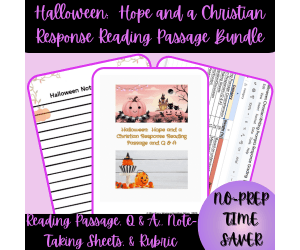
High School ELA Christian Worldview Response to Halloween Bundle
History, Social Studies, Research, Resources for Teachers, ELA, Writing, High School, Teacher Tools, Worksheets & Printables, Writing Prompts, Assessments, Lesson Plans, Quizzes and Tests
As a homeschool mom teaching a 9th grader, I know firsthand how challenging it can be to find academic resources that challenge our teens intellectually and strengthen their biblical worldview. That is exactly why I created High School ELA Halloween: History, Hope, and a Christian Response Reading Passage Bundle — a faith-based resource designed to dig beneath the surface of what’s often considered just a “fun holiday.” This reading passage goes beyond costumes and candy to uncover the deeper history of Halloween—its ancient origins, its transformation through the church, and how it is viewed today. But more importantly, it helps students/homeschoolers explore how Christians can think critically about culture, tradition, and spiritual truth. Each section invites deep reflection on what it means to live faithfully in a world that often celebrates darkness. INCLUDED IN THIS RESOURCE: 1 in-depth Christian worldview reading passage 20 higher-order critical thinking questions & guided answer key 10 printable note-taking sheets for information retention NO-PREP, ready-to-use resource TOPICS COVERED History and origins of Halloween Christian response to cultural traditions Symbolism and meaning from a biblical perspective Modern commercialization and gospel-centered engagement This High School ELA Halloween: History, Hope, and a Christian Response Reading Passage Bundle resource was born out of the same need many Christian homeschool parents share: the desire to teach our children to think deeply and biblically in a world that often blurs truth. High School ELA Halloween: History, Hope, and a Christian Response Reading Passage Bundle provides that bridge between rigorous learning and heartfelt discipleship. It encourages students/homeschoolers to confront cultural questions with confidence rooted in Scripture and helps parents facilitate meaningful, grace-filled conversations at home. Whether you use it during the fall season, as part of a worldview or apologetics course, or simply as a timely devotional study, it is a tool that can grow with your student/homeschooler year after year. This is not just a reading and worksheet set—it’s an investment in critical thinking, biblical literacy, and godly discernment. Equip your homeschool with resources that inspire—not just to learn history, but to see God’s truth woven through it. If you and your students/homeschoolers enjoyed this resource, please leave a review. Thank you for your support! Tina – Big Easy Homeschooling Mom
Author Homeschool with Big Easy Homeschooling Mom
Rating
Tags Christian Homeschool Halloween Reading Passage For High School, Biblical Worldview Study On Halloween For Teens, Faith-based Critical Thinking Halloween Lesson, Gospel-centered Halloween History Resource For Homeschool, Halloween From Christian Perspective Reading Activity, Gospel Light And Truth Halloween Study Guide, Christian Response To Halloween Reading Passage, Faith-integrated Halloween Printable Homeschool Lesson, Critical Analysis Halloween Reading Christian Resource, Homeschool Resource Christian Critical Thinking Halloween

I WONDER - What Were Ancient Roman Schools Called | Animated Video
History: Ancient, History, Social Studies, History: Europe, Grade 3, 4, 5, 6, 7, 8, 9, Lesson Plans, Teacher Tools
Video Introduction An amazing video designed for the students to learn more about history. I WONDER - What Were Ancient Roman Schools Called | Animated Video Lesson Do you like history? Which topic do you really enjoy about history? Have you ever read an interesting fact about the Vikings? If yes, can you mention them? What do you like most about the Victorian era? Can you name all the Tudors? Have you ever wondered how people used to live in ancient Japan and ancient China? Do you know any interesting facts about ancient Egyptians and the Pharaohs? Have you ever visited South America? What do you know about Incas and Aztecs? Celtic culture was really one of a kind, can you name any of the places that Celts used to live in? Imagine yourself living during the ancient Roman empire, how your life will look like? Ancient Greece was an amazing place to live in. What do you know about ancient Greek life? I WONDER - What Were Ancient Roman Schools Called | Animated Video Lesson The video is perfect for encouraging the researching skills for the students, while learning more about history. I WONDER - What Were Ancient Roman Schools Called | Animated Video Lesson This friendly designed video is suitable for students at school, homeschooling, and as a group activity. Format Available in MP4 format.
Author Educational Voice
Tags What Were Ancient Roman Schools Called, What Were Ancient Roman Schools Called Video, Ancient Roman Schools, Ancient Roman Schools Facts, Ancient Roman Schools Video, Ancient Roman Schools Video For Kids
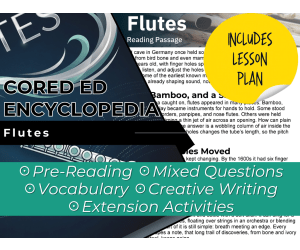
Flutes Reading Comprehension Passage - Cored Ed Encyclopedia
ELA, Reading Comprehension, Reading, Science, Technology, Social Studies, History, Music, Creative Arts, Physics, Grade 2, 3, 4, 5, Worksheets & Printables, Worksheets, Teacher Tools, Centers, Activities, Writing Prompts, Assessments, Quizzes and Tests, Quizzes, Lesson Plans
This flutes reading comprehension with lesson plan includes: Visualization (on the front cover) Start your lesson by taking a minute to think and share something about the topic. Read the script aloud (slowly), perhaps prepare some music or sound effects. Student close their eyes and let their imaginations wander. Students open their eyes, read the question aloud and give them a few minutes to complete. Ask a few students to share or keep answers until the end to compare with what they learn in the passage. Quick pause—thousands of Cored Education products are included with your TeachSimple membership. Download links and encyclopedia index available here. Pre-Reading Trivia Students will write down one thing they already know about the subject and then read five more facts and discuss. These facts are fun, and the students will enjoy learning about the subject before reading more. Give 1 minute for students to write what they already know (no pressure—best guess is fine). Read the five facts together. After each fact, do ask a student for their opinion, was it surprising? Set a purpose by asking students to highlight/underline one fact they want to learn more about during the reading. Reading Passage The text is a high-interest reading passage with set paragraphs, roughly three to four paragraphs long. It contains a variety of themes about the topic, anywhere from history to technology. The passage is between 250 and 350 words in length. First, ask students to look at the headings and see what they’ll learn about today. What do they know about the topic/heading? First read options: Teacher read-aloud (best for support). Partner reading (paragraph by paragraph). While reading, students underline important details, and vocabulary words they think may come up in the questions section. Mixed Questions The first question page contains four multiple-choice questions, each with a choice of four answers, and three written response questions that require a sentence or two from the student. Students complete the mcqs first independently, then review quickly as a class. For the 3 written responses, try to get students giving the answer with some form of evidence: “I think ___ because the text says ___.” If students get stuck, send them back to check the passage. Vocabulary Questions Practice seven key words from the text in this section across two activities. First section is scrambled words where students will unscramble three words given a clue for each. The second section is a word to meaning matching activity. Before starting, have some students read out words they underlined in the passage. Ask students to say the word and read aloud the sentence(s) around each word. Ask students to do scrambled words and the matching exercise in pairs then go through answers as a class. For the scrambled spelling task, get four pairs to come up to the board and write the words for extra practice with the other student reading out the clue. For the matching task, prompt students to give full sentences: “I matched ___ with ___ because ___.” Creative Writing In this question, the student will be required to write a five to eight sentence paragraph on a question related to the topic. Before starting, ask students write down 3 key ideas they are going to include in their piece. Ask students for ideas to share around the class to help those struggling. Pro writing expectations: 5–8 sentences At least 2 facts or details from the passage At least 2 vocabulary words from the previous page Students read their paragraphs while classmates listen for facts and vocabulary words. Extension Activities This page is optional for fast finishers or to take home. There are several activities, each one requiring a different skill. Do some, do none, do all, completely optional - but you will feel reassured knowing every possibility is planned for. Includes summary writting question and additional facts. Answer Key There are answers for the multiple-choice questions, written response questions have sample answers, vocabulary answers and if there is a summary question then a sample summary will be provided as well. Lesson Plan Included Customized lesson plan for this lesson is included. Lesson Snapshot Title: Flutes Genre: Nonfiction (Informational Text) Subject: Music / Science (Sound) / Reading (Informational Text) Primary Topic: How flutes make sound and changed over time Estimated Guided Reading Level (A–Z): Q What This Lesson Teaches Best How very early flutes were made (carved from bird bone and mammoth ivory ) and why these finds matter as early musical instruments. How flutes make a clear note: a thin jet of air across an opening creates a wobbling column of air inside the tube. Cause and effect in instruments: covering or uncovering holes changes the tube’s length, so the pitch goes up or down. How design evolved in Europe, including added holes and keys and Theobald Boehm’s 1800s redesign with tone holes and ring keys . Key features of a modern concert flute (often metal, about 26 inches long, three sections, padded keys, range of a little more than three octaves ). Learning Goals Students will describe what materials some ancient flutes were carved from and how old they were said to be. Students will explain how a flute makes a clear note using the idea of a “column of air” in a tube. Students will explain how covering or uncovering holes changes pitch by changing the tube’s length. Students will summarize how the sideways flute changed over time in Europe, including added holes and keys. Students will identify changes Theobald Boehm made to flute design and how ring keys helped players. Students will describe at least two details of today’s concert flute mentioned in the passage. Key Vocabulary From the Text mammoth — an ancient animal related to today’s elephants. ivory — hard material used for carving. column — a long “tube” shape of air inside. pitch — how high or low a note sounds. octaves — sets of notes higher or lower. FULL CATALOG OF DOWNLOAD LINKS AND ENCYCLOPEDIA INDEX HERE
Author Cored Education
Rating
Tags Vocabulary, Reading Comprehension, Reading Passages, Lesson Plans, Ela Lesson Plans, Reading Comprehension Lesson Plans, Pre-reading, History, Music, Music Lesson Plans

Leonardo da Vinci: Flight Mini Unit
Social Studies, History, History: World, Grade 9, 10, 11, 12, Lesson Plans, Teacher Tools
Leonardo da Vinci: Flight Mini Unit is a 9-page download that will teach your readers about da Vinci and his relationship with air travel. A word search and student activity are included.
Author Creative Learning Connection
Tags Da Vinci, Flight Mini Unit, Air Travel, Flight History, Aeronautics

I WONDER - Who Discovered Tutankhamun's Tomb | Animated Video Lesson
History: African, History, Social Studies, History: Ancient, Grade 6, 7, 8, 9, 10, 11, 12, Lesson Plans, Teacher Tools
Video Introduction An amazing video designed for the students to learn more about history. I WONDER - Who Discovered Tutankhamun's Tomb | Animated Video Lesson Do you like history? Which topic do you really enjoy about history? Have you ever read an interesting fact about the Vikings? If yes, can you mention them? What do you like most about the Victorian era? Can you name all the Tudors? Have you ever wondered how people used to live in ancient Japan and ancient China? Do you know any interesting facts about ancient Egyptians and the Pharaohs? Have you ever visited South America? What do you know about Incas and Aztecs? Celtic culture was really one of a kind, can you name any of the places that Celts used to live in? Imagine yourself living during the ancient Roman empire, how your life will look like? Ancient Greece was an amazing place to live in. What do you know about ancient Greek life? I WONDER - Who Discovered Tutankhamun's Tomb | Animated Video Lesson The video is perfect for encouraging the researching skills for the students, while learning more about history. I WONDER - Who Discovered Tutankhamun's Tomb | Animated Video Lesson This friendly designed video is suitable for students at school, homeschooling, and as a group activity. Format Available in MP4 format.
Author Educational Voice
Tags Who Discovered Tutankhamun's Tomb, Who Discovered Tutankhamun's Tomb Video, Tutankhamun's Tomb, Tutankhamun's Tomb Facts, Tutankhamun's Tomb Facts For Kids, Tutankhamun's Tomb Video

Peloponnesian War Battle Strategies Lesson Plan
Social Studies, History, History: Ancient, Grade 9, 10, 11, Teacher Tools, Lesson Plans
This is a lesson for Peloponnesian War: Battle Strategies. Specific Objectives: Students will be able to identify the strategies used by the Athenians and the Spartans to fight the Peloponnesian War. In doing so, they will understand better the impact of the War on Greece. Materials: Colored pencils or pens or markers Worksheet provided Lesson: In this lesson, students get to find out how the war played out on the most part during the Peloponnesian War. When covering wars, I usually don’t like to simply lecture about it but let them come up with strategies to win and defend. In this case, a self-explanatory worksheet guides them through so they can come up with strategies for the Athenian side and also the Spartan side. Then you go over the worksheet and you tell them what really happened. Then the students get to remember the war better. It’s a more fun and engaging activity. Here is a rough “answer key”. The Athenians were superior at sea while the Spartans had the upper hand in land. The Athenians simply attacked coastal areas and made friends with the helots so they would rebel vs the Spartans. They also entered their walls and shipped grain from other places. The Spartans could not really penetrate the Athenian walls, though they burned down their surrounding crops. This should look like a stalemate. One would think that the Athenians would win since they could ship food from outside. But in the end, the city was crowded there was a plague that even killed Pericles. Sparta won but it was not a decisive victory. In the end, the war just weakened Greece which made it an easy takeover target by the Macedonians and then the Romans. (Next topic should be Alexander the Great).
Author Creative Educator
Rating
Tags Peloponnesian War, Battle Strategies, Ancient History, Spartans, Athens, Greece, War In Greece, Map Skills, Romans, History Lesson, Battles Of The Peloponnesian War, Peloponnesian War Battles

World War I: Woodrow Wilson's Fourteen Points Gr. 5-8
Social Studies, History, History: World, Grade 5, 6, 7, 8, Teacher Tools, Lesson Plans
World War I: Woodrow Wilson's Fourteen Points Gr. 5-8 is an extensive teaching resource designed to offer students a thorough understanding of the Great War, that occurred from 1914 to 1918. This resource promotes in-depth discussions regarding nationalism, imperialism and militarism as it intricately details the causes of the war. A clear sequence of events leading to major conflicts emerging from volatile tensions in Europe are provided for easier understanding. The assassination of Archduke Franz Ferdinand is also covered extensively within this educational tool. The section on World War I: Woodrow Wilson's Fourteen Points: Detailed comprehension about America's involvement in the global crisis during this period is promoted. Topics such as residential resentment due to Lusitania’s sinking and threats posed by decoded plans for mainland attacks that led U.S into this heated battle ground are elaborated upon. Furthermore, President Woodrow Wilson’s strategic presentation of his Fourteen Point peace program before Congress provides valuable insights into diplomatic negotiations carried out during turbulent times. Comprehensive view on technological advances and their implications on strategies adopted during warfare are presented —showcasing how industrial-era innovations shaped combat approaches all through. Treaty Of Versailles: This lesson plan takes special care not only to highlight battles fought but also its aftermath with special focus on Treaty Of Versailles' crucial role reshaping continuous alterations occurring within Europe’s geography post-war. This teaching guide can be utilized for: Whole group lessons Detailed small group discussions Independent homework assignments or supplementary projects focusing on World History subject matter Alligned accurately to your State Standards and structured according to Bloom’s Taxonomy, this package also encompasses a range of learning aids like: Crossword puzzles Word searches Comprehension quizzes Answer keys for reinforcing knowledge. Available conveniently in PDF file format , this resource is easy to download, share and print for class usage.
Author Classroom Complete Press
Tags PDF

Earthquake in the Early Morning (Magic Tree House #24 Lesson Plan, Activities)
Social Studies, ELA, History, History: USA, Reading, Reading Comprehension, Grammar, Literature, Language Development, Vocabulary, Spelling, Writing, Grade 1, 2, 3, Lesson Plans, Teacher Tools
Earthquake in the Early Morning (Magic Tree House #24 Lesson Plan, Activities) is a 5-day NO PREP novel study of Earthquake in the Early Morning (Magic Tree House #24). This comprehensive book companion includes a lesson plan, chapter comprehension questions, vocabulary practice, and many other activities. Perfect for first grade, second grade, and third grade classrooms, homeschool families, and cooperatives. You can easily customize lessons based on student age, reading and comprehension level, interests, and learning style! Additionally, all worksheets can be completed in an interactive notebook or simply discussed aloud if you desire to reduce the number of pages you print. THIS RESOURCE COVERS: Art (drawing, coloring, arts & crafts) Comprehension English language arts Geography Grammar History Reading Research Social studies Spelling Writing Includes: A 5-day lesson plan List of required materials and optional supplements Curated videos Chapter comprehension quizzes Chapter vocabulary (2 options) Pre-reading, during reading, and post-reading worksheets and activities Interactive notebook pieces (6 options) Book review reports (6 options) Writing craftivity Suggested project-based activity Other activities
Author Heather Huhman
Tags Earthquake In The Early Morning, Magic Tree House, Book Companion, Novel Study, Earthquakes, Us History, Earthquake Lesson Plan

Franklin Delano Roosevelt Memorial: Historic Monuments Series
Social Studies, History, History: USA, Grade 4, 5, 6, 7, 8, Teacher Tools, Lesson Plans
Franklin Delano Roosevelt Memorial: Historic Monuments Series This meticulous, knowledge-packed product offers valuable insight into one of America's iconic leaders and his memorial's intriguing history. With this resource, educators have a crucial tool to enhance Grade 4-8 Social Studies curriculums, specifically in US History. The Focus The focus of this resource is twofold: President Franklin D. Roosevelt's extraordinary four-term presidential tenure marked by numerous global and domestic challenges. The fascinating narrative behind the creation of his monument’s construction delay spanning over five decades. This product doesn't just present facts about FDR and his memorial; it fosters curiosity! Pedagogical Features Educators can use the 34-page PDF on different occasions tailored to their teaching strategies. It suits assignment-type activities that students can take home, thus promoting an immersive learning experience beyond classroom walls. Inquiry-Based Format . Apart from offering enlightenment about an important figure in American history, this material actively engages learners in participating intellectual dialogues through its stimulating inquiry-based format—a vital element prompting not only knowledge acquisition but also instilling effective communication development amongst students. "Franklin Delano Roosevelt Memorial: Historic Monuments Series", sees history not simply as static facts but as dynamic stories intertwined with multifaceted societal perspectives resulting in lifelong learnings—an essential sentiment educators desire to impart during instructive discourses befitting our young stewards' diversified abilities and learning styles. Let them unpack history with this adept resource— one page at a time.
Author Classroom Complete Press
Tags Roosevelt, American Presidents, Social Studies, World War II, Timelines
Socialization and Social Groups (Unit Slides, Activity, and Worksheets)
Social Studies, History, Sociology, Grade 7, 8, 9, 10, 11, 12, Lesson Plans, Teacher Tools
Introducing a 36-page teaching resource on the topic of socialization and social groups. This informative PowerPoint presentation covers key sociology concepts related to how people interact in society. Agents of socialization like family, school, peers, media, and religion are explored. Additional slides explain primary groups, secondary groups, reference groups, in-groups, out-groups, and leadership styles. Group interactions including cooperation, conflict, social exchange, coercion, and conformity are also discussed. A bonus crash course video worksheet and supplemental student socialization worksheet provide further learning extension. This versatile resource can be used for whole class instruction, small group discussion, or independent review on social groups. The engaging slides and complementary activities make this an ideal unit for middle school or high school sociology.
Author Ed Dynamic
Tags Socialization, Social Groups, Sociology, Agents, Interactions
I WONDER - How Was The Roman Army Structured | Animated Video Lesson
History: Europe, History, Social Studies, History: Ancient, Grade 4, 5, 6, 7, 8, 9, 10, Lesson Plans, Teacher Tools
Video Introduction An amazing video designed for the students to learn more about history. I WONDER - How Was The Roman Army Structured | Animated Video Lesson Do you like history? Which topic do you really enjoy about history? Have you ever read an interesting fact about the Vikings? If yes, can you mention them? What do you like most about the Victorian era? Can you name all the Tudors? Have you ever wondered how people used to live in ancient Japan and ancient China? Do you know any interesting facts about ancient Egyptians and the Pharaohs? Have you ever visited South America? What do you know about Incas and Aztecs? Celtic culture was really one of a kind, can you name any of the places that Celts used to live in? Imagine yourself living during the ancient Roman empire, how your life will look like? Ancient Greece was an amazing place to live in. What do you know about ancient Greek life? I WONDER - How Was The Roman Army Structured | Animated Video Lesson The video is perfect for encouraging the researching skills for the students, while learning more about history. I WONDER - How Was The Roman Army Structured | Animated Video Lesson This friendly designed video is suitable for students at school, homeschooling, and as a group activity. Format Available in MP4 format.
Author Educational Voice
Tags Roman Army, Roman Army Facts, Roman Army Facts For Kids, Roman Army Video, Roman Army Video For Kids, How Was The Roman Army Structured, How Was The Roman Army Structured Video
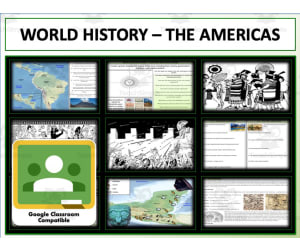
The Americas World History Unit
Social Studies, History, History: World, Grade 6, 7, 8, 9, Teacher Tools, Lesson Plans
The Americas World History Unit This is aThe Americas World History Unit that will provide students with resources from the beginning to end of a unit. This unit will leave students feeling more knowledgeable about this point in history and equipped to tackle any and all comprehensive activities related toThe Americas. This unit is great for middle school students. What You Get: You will receive a zip file that includes: 1. Info Sheet 2. Homework 3. Lesson Plans 4. Crosswords 5. Flashcards 6. Presentation 7. Tests How to Use The Americas World History Unit: This is a comprehensive unit of study that will have many components to make learning come to life: Worksheets cover eight topics on the history of the Americas: • American Geography • Early Americans • The Olmec & Chavin • The Mayans • The Aztec Empire • The Fall of the Aztecs • The Inca Empire • The Fall of the Inca The basic set includes text readings, analysis questions, and a variety of different project and image sheets. Modified worksheets are included in the file which have more concise readings as well as a variety of different tasks and activities for ELL students and those who require a modified curriculum. Each worksheet has a corresponding answer sheet to help check students work. A test is included which features multiple choice, short written response, and picture questions. Students can use a set of flashcards to help revise of their tests. A PowerPoint presentation is included which features enlarged readings, animations, and images to help guide students through the materials and illustrate key points. Also included are replacement note-taking slides and sheets which can be used in place of the readings/worksheets for each topic if you wish to save time or practice note taking. Crossword sheets have been made for each topic as potential review/challenge activities for students. I hope you enjoy!! Take A Look At My Best Sellers: Biscayne Bay National Park Geography Unit Medieval Castles Mini Unit The Underground Railroad Mini Unit Japan Complete Elementary Unit Navajo Code Talkers Mini Unit Black Canyon National Park Geography Unit You Can Find More Resources at My Store Front Here: Mr. Gray History
Author Mr Gray History
Tags The Americas, World History Unit, Geography, American Geography, Incan Empire, The Fall Of The Aztecs, Early Americans, Reading Worksheets

I WONDER - How Big Was The Quetzalcoatlus | Animated Video Lesson
History: Ancient, History, Social Studies, History: World, Animals, Life Sciences, Science, Grade 4, 5, 6, 7, 8, 9, 10, Lesson Plans, Teacher Tools
Video Introduction An amazing video designed for the students to learn more about dinosaurs in different countries. I WONDER - How Big Was The Quetzalcoatlus | Animated Video Lesson Do you like dinosaurs? what is your favorite one? Do you own a pet? If yes, tell us more about it, like what its name? And what do you like most about it? Do you think that your pet has been evolved from a dinosaur? Can you write down the characteristics of your favourite dinosaur like it's shape, their rivals, where did it use to live and what was their favourite food? What is the largest and the smallest dinosaur that ever found? Why is the T-rex is so famous? Have you ever read any interesting facts about it? Can you name any of the carnivores or herbivores dinosaurs? I WONDER - How Big Was The Quetzalcoatlus | Animated Video Lesson The video is perfect for encouraging the researching skills for the students, while learning more about dinosaurs. I WONDER - How Big Was The Quetzalcoatlus | Animated Video Lesson This friendly designed video is suitable for students at school, homeschooling, and as a group activity. Format Available in MP4 format.
Author Educational Voice
Rating
Tags How Big Was The Quetzalcoatlus, How Big Was The Quetzalcoatlus Video, Quetzalcoatlus, Quetzalcoatlus Facts, Quetzalcoatlus Video, Quetzalcoatlus Facts For Kids, Quetzalcoatlus Video For Kids

Persian Gulf War (1990-1991): Iraq, Oil and the Middle East Gr. 5-8
Social Studies, History, History: USA, Grade 5, 6, 7, 8, Teacher Tools, Lesson Plans
The Persian Gulf War (1990-1991): Iraq, Oil and the Middle East Gr. 5-8 This innovative teaching resource greatly enhances the knowledge of educators and students in Grades 5 to 8. It is a comprehensive aid for understanding key historical events, providing insights into the U.S.-led Operation Desert Storm spanning from 1990 to 1991. Essential Topics Included: Investigation into Iraq's invasion of Kuwait and global reaction Understanding oil extraction through research reports Map activities focusing on Iraq to build geographical awareness Information on Saddam Hussein who led Iraq during this era Furthermore, there are sections specifically aimed at introducing learners to Operations Desert Shield and Desert Storm. Educational Objectives: This resource aligns with Bloom's Taxonomy educational objectives framework and your state standards. The pedagogically-sound content fosters meaningful engagement among learners. Creative Activities: Crafting posters or dioramas related to specific aspects of the Persian Gulf War Ancillary Learning Materials: Included within this downloadable PDF unit are valuable supplementary materials such as crosswords, word searches along with comprehension quizzes. The Persian Gulf War (1990-1991): Iraq, Oil and the Middle East Gr. 5-8 therefore stands out as a detailed yet concise teaching resource ideal for studying Social Studies, specifically U.S History.
Author Classroom Complete Press
Tags Social Studies, Assessment, Informational Text, Persian Gulf War, U.S. History
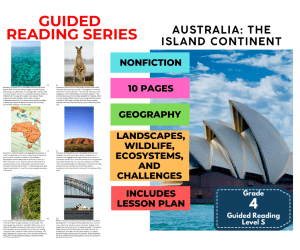
Australia - Island Continent: Guided Reading Level S with Lesson Plan
ELA, Resources for Teachers, Reading Comprehension, Reading, Science, Geography, Social Studies, History, Life Sciences, Earth and Environmental Sciences, Grade 3, 4, 5, Worksheets & Printables, Worksheets, Teacher Tools, Centers, Activities, Literacy Readers, Quizzes, Quizzes and Tests, Assessments, Lesson Plans
This Australia: The Island Continent (level s) guided reading book with lesson plan includes: Guided Reading Color Label (front cover x1) This is a quick way to match the book’s demands to what students can generally handle.. The overall goal is to use the level/color to pick books for several smaller groups. To qualify for a certain level, a student is expected to read a book from that level with about 90–94% accuracy. If a student is consistently accurate and understands, move up a level. If the student is struggling at that level, drop down and add more support. Each student will improve at completely different rates, but it is generally one of the best ways to check progress across the class. DOWNLOAD THE CATALOG TO VIEW ALL GUIDED READING BOOKS AVAILABLE (SORTED LEVELS A-Z) Pre-Reading Question (x1) Teacher asks the prompt aloud, can be while showing the cover or first page. Students share what they already know, or make educated guesses from the cover. Prompt them to use the target vocabulary. Write some of their responses on the board to look back at during the reading. Vocabulary Words (x5) Introduce the five words, best doing it one at a time. Start by saying it, while students repeat and then see if anyone knows what it means before reading further. Read through the meaning and try to briefly connect each word to a picture or gesture so it’s meaningful. Ask students to flip through the book pages and point to where they see each of the vocabulary words. While reading the book pause upon coming across one of the vocab words or read the sentence twice to make sure students understand the word has appeared. Optional: Ask students to raise hands whenever they see/hear one of the new words. Guided Reading Pages (x10) Check the book snapshot (below) for: primary topic - do you need to prep extra reading or intro materials on this? what is taught best - decide on 1-2 bullets to focus on, use the prompt or words provided here for best results. learning goals - what you are checking for students to be able to do after the session, elicit answers using prompts or words provided. key vocabulary (see section above). questions overview - so you know what is coming up and if you need to prep extra materials to assist understanding. Run the lesson You may have already looked at a few of the pages together, but you can show them some of the pictures again first to set meaning. Depending on how much time you have and how familiar your students are with guided reading class, you may want to read the book aloud first with the group first. Students whisper or partner read, while you listen in. If time, do it as a group, one student reading a page each. Use the guided page’s prompts to coach: “Check the picture / does it make sense?” “Point under the words / try the first sound” “Reread the sentence smoothly”. Try to focus more on one student per session (rotating every time), so you can work out if they are ready to move up or need to move down a level. Comprehension Questions (back cover x3) This is your way to check that students didn’t just say the words, but actually understood the text. First, let students answer by pointing to the page/picture and saying a short sentence. After any answer, follow with: “Show me where you found that in the text.” In bigger groups, have partners answer first (10–20 seconds), then call on 2–3 students to share. Differentiation tips: Emerging speakers/struggling readers: oral + pointing On-level: oral in a full sentence Higher: one written sentence or draw + label Book Snapshot Title: Australia: The Island Continent Genre: Nonfiction Subject: Social Studies (Geography/Culture) Primary Topic: Australia’s landscapes, wildlife, ecosystems, and challenges Estimated Guided Reading Level (A–Z): S What This Book Teaches Best Explains Australia’s unique identity as the only country that is also an entire continent, located in the Southern Hemisphere between the Indian and Pacific Oceans. Builds understanding of diverse landscapes, from the arid Outback (including Uluru) to the Great Barrier Reef and the Daintree Rainforest. Teaches how isolation supports unique wildlife, highlighting marsupials (kangaroos, koalas) and monotremes (platypus) with survival traits and behaviors. Connects place to people by describing Uluru’s importance to the Anangu and the long history of Aboriginal and Torres Strait Islander peoples, including “songlines” and rock art sites. Introduces modern Australia through coastal city life in Sydney and present-day environmental challenges like climate change, bushfires, drought, and conservation work. Learning Goals Students will explain why Australia is called the “island continent” using details from the text. Students will describe two Australian environments (such as the Outback, reef, or rainforest) with text evidence. Students will explain what the text says about Uluru, including what it is and why it is sacred to the Anangu people. Students will identify one animal from the text and describe a feature or behavior that helps it survive. Students will describe how the text presents Australia’s long human history through Aboriginal and Torres Strait Islander peoples, “songlines,” and rock art. Students will explain modern challenges Australia faces and summarize how scientists and conservationists respond. Key Vocabulary From the Text Hemisphere — half of the Earth. arid — very dry, with little rain. monolith — one huge rock that stands alone. marsupials — mammals that carry babies in a pouch. biodiversity — many different living things in one place. Discussion Prompts Pre-reading question: What places, animals, or environments do you expect to learn about in Australia? Comprehension questions: Where does the text say Australia is located, and what oceans are nearby? Comprehension questions: What does the text explain about the Great Barrier Reef and what lives there? Comprehension questions: What are two modern challenges Australia faces, according to the text? Printing Tips 1. Best Printing Method (Recommended) “Booklet” Printing (Best if Available) If your printer or PDF viewer supports Booklet Printing , use this. Settings to use: Print mode: Booklet Paper size: Letter or A4 (either works) Orientation: Landscape Print on both sides: Yes Flip on: Short edge Scaling: Fit to printable area Booklet subset: First test: Front sides only Then: Back sides only This will automatically: Pair pages correctly Put the cover on the outside Align everything for folding After printing, fold in half and staple along the spine . 2. If “Booklet” Printing Is NOT Available You can still print this correctly with manual duplex printing . Step-by-step: Open the PDF. Choose Print . Set: Orientation: Landscape Pages per sheet: 1 Print on both sides: Yes Flip on: Short edge Print all pages . Because each PDF page already contains two facing book pages, the result will still fold cleanly into a book. Thousands of Cored Education products are included with your TeachSimple membership. Download links and encyclopedia index available here.
Author Cored Education
Rating
Tags Reading Comprehension, Reading Passages, Reading, Guided Reading, Guided Reading Lesson Plan, Guided Reading Activity, Pre-reading, Social Studies, Geography, History