



3,926 products added recently
Page 9 - Chemistry Lesson Plans
Simplify the complexities of chemistry with lesson plans that engage students through experiments and real-world applications. Covering topics like chemical reactions, atomic structures, and the periodic table, these resources make abstract concepts tangible. Use them to foster enthusiasm and a strong grasp of chemistry fundamentals.

 Show filters


Stoichiometry - Solving Quantitative Chemisty- Senior Chemistry Lesson
Science, Chemistry, Grade 10, 11, 12, Teacher Tools, Lesson Plans
Stoichiometry - Solving Quantitative Chemistry Problems - Senior Chemistry Lesson Your lesson covers chemical reactions and balancing. In order, the lesson teaches about; What is Stoichiometry?, Chemical Reactions and the Mole, Steps to Stoichiometry, and the Mole Ratio. Your lesson includes the teacher and student version of the presentation, an auto-graded exit ticket, and a student lesson handout so the students can record the notes on a more condensed medium. This lesson is designed to be your go-to resource, whether you're in a traditional classroom or a virtual one. With both a teacher version and a student version, it seamlessly fits into your lesson plans, making learning engaging and adaptable. Assessment made easy We've included an auto-graded Exit Ticket and a quiz with an answer key because I know you don't have an excess of time. I know you don't, because I don't and I know I'll do whatever I can to reduce my grading time. Whether you use PowerPoint or Google Slides, prefer Word or Google Docs, this lesson has you covered. This lesson comes in both Office and Google formats for your convenience. The student version of the presentation has strategically placed blanks for them to fill in as you're teaching. It keeps them active and engaged, encourages discussion, and leaves more time for those "aha" moments.
Author Teach With Fergy
Tags Chemistry Lesson, Stoichiometry, Chemical Reactions, The Mole, Mole Ratio

Lesson 2.5 - Acceleration
Science, Chemistry, Physics, Grade 6, 7, 8, 9, 10, 11, 12, Lesson Plans, Teacher Tools
Lesson 2.5 - Acceleration is an in-depth teaching resource tailored to boost learning about acceleration. It's arranged across various file formats, covering the definition and calculations methods for objects' acceleration, differentiating between positive and negative acceleration, along with units applied in expressing acceleration. Significantly useful for grade 6-12 students studying Science especially Chemistry and Physics subjects. The comprehensive resource presents its diverse content via interactive activities that encourage active understanding. Included within are detailed lesson notes linked with version A featuring blanks that students can fill out during the lessons. A completed version B caters to absentees or those requiring special adaptations. Moreover, there's a well-crafted practice module available to educators where students calculate an object's acceleration using word problems. Version A follows the traditional approach while option B adjusts complexity based on specific student needs. "What impact does increasing the ramp’s height have on the cart’s speed?", is one of questions answered in a highly engaging lab session incuded here. Educators also take advantage of convenient Word & Powerpoint documents containing: Objectives Pertinent pre-class starter questions meant for smooth class presentations The files support customizations through .docx and .pptx file formats respectively although there're non-editable pdf files which will need Adobe Reader or similar viewer software for opening. 'Acceleration Trade-and-Check', a group activity is one innovative pedagogical concept featured here as well. In conclusion, Lesson 2.5 - Acceleration brilliantly amalgamates academic insights with practical application while accentuating adaptability to diverse classroom demands.
Author Integrated Chemistry and Physics
Tags Acceleration, Science Education, Calculation Methods, Positive And Negative Acceleration, Understanding Application Scenarios
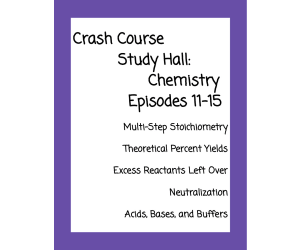
Crash Course Study Hall: Chemistry Episodes 11-15
Science, Chemistry, Grade 9, 10, 11, 12, Teacher Tools, Lesson Plans
Crash Course Study Hall: Chemistry Episodes 11-15 This educational resource is built with precision for teachers. Its goal is to enhance understanding of critical chemistry topics relevant to grades 9 through 12. The content encompasses: Multi-Step Stoichiometry, Theoretical Percent Yields, Excess Reactants, Left Over Neutralization, and Acids, Bases, and Buffers. A boon for educators dealing with Science, especially Chemistry - This teaching aid simplifies lesson planning while maintaining a high standard of education. This comprehensive toolbox furnishes guide links for all topics mentioned above - making it an ideal choice for any educator wishing to offer deeper insights during instruction. Educational Flexibility The product introduces a versatile method of teaching these subjects by providing episode guides that students can work on both with and without timestamps. These components bestow flexibility on how this resource may be used - in whole group instruction or small work groups; additionally used as review materials or homework assignments. Detailed Yet Simple Covering each topic extensively yet simply is crucial when dealing with complex subjects such as Chemistry which lends the value in Crash Course Study Hall: Chemistry Episodes 11-15's comprehensiveness that doesn't compromise simplicity thus easy from students' viewpoint but also rich enough even from a teacher's perspective. Including PDF Format - This single file includes ready-for-print reference materials spanning across 24 pages mitigating educators' prep time considerably. Key answers are also contained within the package thereby aiding in assessment tasks making grading assignments less laborious. A Proven Tool For Various Classroom Environments This tried-and-tested tool reaps immense benefits across various classroom settings—not limited to typical schoolteachers but also for crafty home-schooling parents who appreciate premium supplementary learning tools. From planning lessons to assessing assignments, Crash Course Study Hall: Chemistry Episodes 11-15 delivers an exhilarating and comprehensive teaching strategy in addressing vital chemistry topics.
Author Karen Maxson
Tags Chemistry, Education, Teaching Aid, Episode Guides, Stoichiometry, Crash Course Chemistry Acid Base
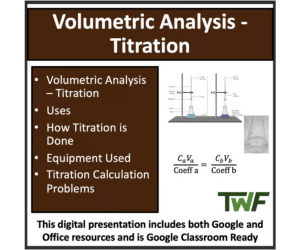
Volumetric Analysis - Titration - Senior Chemistry lesson
Science, Chemistry, Grade 10, 11, 12, Teacher Tools, Lesson Plans
Volumetric Analysis - Titration - Senior Chemistry Lesson Your lesson covers titration. In order, the lesson teaches about; Volumetric Analysis – Titration, its uses, how titrations are done, the equipment used, how to complete titration calculation problems. Your lesson includes the teacher and student version of the presentation, THREE embedded videos, an auto-graded exit ticket, and a student lesson handout so the students can record the notes on a more condensed medium. This lesson is designed to be your go-to resource, whether you're in a traditional classroom or a virtual one. With both a teacher version and a student version, it seamlessly fits into your lesson plans, making learning engaging and adaptable. Assessment made easy We've included an auto-graded Exit Ticket and a quiz with an answer key because I know you don't have an excess of time. I know you don't, because I don't and I know I'll do whatever I can to reduce my grading time. Whether you use PowerPoint or Google Slides, prefer Word or Google Docs, this lesson has you covered. This lesson comes in both Office and Google formats for your convenience. The student version of the presentation has strategically placed blanks for them to fill in as you're teaching. It keeps them active and engaged, encourages discussion, and leaves more time for those "aha" moments.
Author Teach With Fergy
Tags Chemistry Lesson, Volumetric Analysis, Titration, Titration Calculations
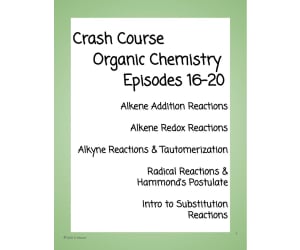
Crash Course Organic Chemistry: Episodes 16-20
Science, Chemistry, Grade 10, 11, 12, Teacher Tools, Lesson Plans
Crash Course Organic Chemistry: Episodes 16-20 will cover: -Alkene Addition Reactions -Alkene Redox Reactions -Alkyne Reactions & Tautomerization -Radical Reactions & Hammond’s Postulate -Intro to Substitution Reactions Episode links for each of these are included. There is an episode guide for students to complete (with and without timestamps). Answer keys are included.
Author Karen Maxson
Tags Organic Chemistry, Chemistry Video, Science Lesson, Reactions, Worksheet
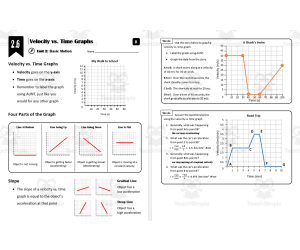
Lesson 2.6 - Velocity vs. Time Graphs
Science, Chemistry, Physics, Grade 6, 7, 8, 9, 10, 11, 12, Lesson Plans, Teacher Tools
Lesson 2.6 - Velocity vs. Time Graphs includes the following files: 2.6 Velocity vs. Time Graph Notes Covers how to give meaning to a velocity vs. time graph and how slope is related to acceleration. This notes sheet comes with an (A) version that has blanks for students to fill out as well as a completed (B) version for students who are absent or may require accommodations. 2.6 Velocity vs. Time Graphs Practice Students practice reading and creating velocity vs. time graphs. This practice sheet comes with an (A) version to be used for the majority of students as well as a shorter and/or different (B) version to be used for students who are absent or may require accommodations. 2.6 Objectives & Starter Questions PowerPoint Learning objectives and sample starter questions for the topic. 2.6 PowerPoint Notes Notes in PowerPoint format to make presentation to the class a breeze. The following 2016 Indiana State Standards for Integrated Chemistry & Physics are addressed in this resource: ICP.2.1 Develop graphical, mathematical, and pictorial representations (such as a motion map) that describe the relationship between the clock reading (time) and velocity of an object moving at a constant acceleration and apply those representations to qualitatively and quantitatively describe the motion of an object in terms of its change in position or velocity.
Author Integrated Chemistry and Physics
Tags Integrated Chemistry & Physics, Velocity Vs. Time
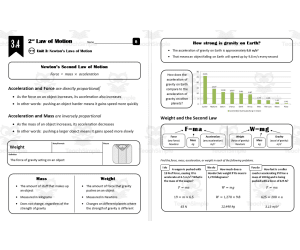
Lesson 3.4 - Newton's 2nd Law of Motion (F=ma)
Science, Chemistry, Physics, Grade 6, 7, 8, 9, 10, 11, 12, Lesson Plans, Teacher Tools
Lesson 3.4 - Newton's 2nd Law of Motion (F=ma) This comprehensive teaching resource is perfect for educators teaching physics to students between grades six through twelve. The lesson introduces the relationship and concepts between force, mass, and acceleration (F=ma), while also elaborating on the connection to the equation W = mg. Included Materials: Lecture notes Practice sheets Activities PowerPoint presentations prepared for classroom use. The package extends beyond theoretical knowledge, helping learners develop practical skills with engaging activities such as F=ma practice stations where group-based learning is encouraged. Fundamental Product Features: The lecture notes cover Newton's Second Law and its applications in solving problems relating to motion. Its easy-to-understand explanation fits into any curriculum or homeschooling module dedicated to introducing physics. Note Worksheets: A version with fill-in-the-blanks for class participation. An alternate completed version catering specifically for absentees or learners needing extra help. Creative Activities: Inclusive are collaborative exercises like calculating one's weight on moon using given formulas provided within classroom settings guiding curiosity-led exploration aiding understanding beyond books' boundaries. Supplementary materials include Weight Practice cards represented as playful riddles stimulating learner engagement enhancing critical thinking abilities severely. Provided also are PowerPoint Notes structured facilitatively serving error-free content delivery during classes framing science picturesquely nurturing students' Physics interest contributing towards understanding abstract scientific phenomena emphatically supporting classroom varied learning styles therefore enabling differentiated instruction within traditional schooling establishments or home-school set-ups alike. The academic resources comply with many requirements of the Indiana State Standards encapsulating modern pedagogical methodologies. All files are readily available in .docx or .pptx formats ensuring easy customization, while non-editable versions are preserved in universally accessible PDF format for straightforward usage.
Author Integrated Chemistry and Physics
Tags Newton's Laws, Force And Motion, F=ma, Weight Practice, Physics

Lesson 6.3 - Density
Science, Chemistry, Physics, Grade 6, 7, 8, 9, 10, 11, 12, Lesson Plans, Teacher Tools
Lesson 6.3 - Density A comprehensive teaching resource designed for educators to enhance students' understanding and application of density principles in real-world scenarios. Key Aspects: Calculating Density Determining if items sink or float Deepening understanding through practice exercises, literature-based learning, and interactive simulations. Educational Materials: The lesson includes essential notes with two variations - version A is participative with fillable blanks while version B comes pre-filled serving as an aid for absentees or special accommodations required cases. Practice Sheets: An integral part of this plan facilitating practical application of the learned theory. Two versions available catering to different learner needs.: Literature-Based Learning: An interesting article integrated within - discussing egg's buoyancy in fresh vs saltwater due to density differences prompts engaging classroom discussions and comprehension skills enhancement along science learning. Digital Integration: The package incorporates interactive object-density simulations. Students can conduct buoyancy experiments , collect data and answer relevant questions enhancing their digital learning experience. Presentation & Planning Aids h5 Includes PowerPoint formatted notes, objectives & starter questions offering readymade queries stimulating learners' curiosity right from the start. Educational Standards: Note: This package comes in editable formats - .docx, .pptx or .pdf allowing you maximum customization flexibility according to your unique classroom needs & specifications.
Author Integrated Chemistry and Physics
Tags Density, Calculating Density, Buoyancy, Interactive Simulation, Science Literacy
Crash Course Study Hall: Chemistry Episodes 1-5
Science, Chemistry, Grade 9, 10, 11, 12, Teacher Tools, Lesson Plans
Crash Course Study Hall: Chemistry Episodes 1-5 will cover: -Physical and Chemical Changes -Types of Chemical Reactions -Balancing Chemical Reactions -Reaction Predictions -Solubility Episode links for each of these are included. There is an episode guide for students to complete (with and without timestamps). Answer keys are included.
Author Karen Maxson
Tags Science Video, Chemistry Video, Chemistry Lesson, Chemistry Worksheet, Chemical Reactions, Crashcourse Chemistry

Lesson 2.3 - Velocity
Science, Chemistry, Physics, Grade 6, 7, 8, 9, 10, Lesson Plans, Teacher Tools
Lesson 2.3 - Velocity This enriching teaching tool assists educators in explaining the fundamental concept of velocity, a vital element for understanding Physics and Chemistry. Designed to meet different students' learning preferences, it suits diverse educational settings. What it offers: Velocity Notes: These are designed to break down the definition and method of calculating velocity in an easy-to-understand manner for Grade 6 through Grade 10 students. The notes come in two versions: one with blanks for active note-taking, and a completed version for absentees or those requiring special accommodations. Practice materials: Velocity and Speed Practice worksheets allow students to calculate an object's distance, displacement, speed, and velocity while comparing these factors with each other — providing an excellent review instrument integrating everything covered up till now. Whiteboard Practice: It integrates images requiring calculations on distance, displacement speed etc., encouraging group involvement when producing answers on whiteboards thereby fostering collaboration among peers. The resource also contains alternate versions of practice sheets offering shorter or varied content suitable for requirements or absences. To stimulate class discussions from the get-go powerpoints with sample starter questions are included as well as listing clear learning objectives empowering teachers to measure mastery across topics covered effectively. Practical Stations activities accommodated within this product incorporate manila-folder-based stations featuring methods like instant answer-checks plus whiteboard based responses promoting engagement among learners at a higher level. Note: The Microsoft Word Docs (.docx) can be edited catering specific classroom needs where supported by equivalent word processing software whilst PowerPoint presentations offer customization options where compatible presentation apps are available. Non-editable files come in PDF formats that can easily access on any modern digital platform. Lesson 2.3 - Velocity is a solution that bridges sound pedagogical practices with creativity. particularly valuable in fulfilling 2016 Indiana State Standards for Integrated Physics & Chemistry (ICP.1.4), it makes learning Physics and Chemistry simpler, more tangible and enjoyable for students of different ages and abilities.
Author Integrated Chemistry and Physics
Tags Velocity, Physics, Chemistry, Teaching Tool, Practice Materials

Lesson 5.2 - Phase Changes
Science, Chemistry, Physics, Grade 6, 7, 8, 9, 10, 11, 12, Lesson Plans, Teacher Tools
Lesson 5.2 - Phase Changes: Primarily designed for students ranging from the sixth to twelfth grade. The main focus is on the six most common phase changes and accurately interpreting phase change diagrams. It proves highly beneficial in introducing these fundamental scientific concepts to educators, be it public school teachers or homeschoolers. Included resources: Phase Changes Notes: Exists in two versions; encouraging active participation through fill-in-the-blank spaces (version A) and a complete version (version B) for students needing extra help or missing class. Phase Changes Practice: Includes a shorter practice sheet (Version B), ensuring all learner levels are catered for. Phase Changes Research: Encourages learners to study examples of phase changes and labelling corresponding charts . PowerPoint Notes: Facilitates smooth presentation delivery with relevant learning objectives and starter questions related to topic enhancement. Note: This resource pack meets specific 2016 Indiana State Standards . Files are available in both .docx format (for word processors like Microsoft Word) as well as .pptx format (supported by Microsoft PowerPoint). Inclusion of non-editable.pdf files accessible via PDF viewing software such as Adobe Reader is also noted. In conclusion, Lesson 5.2 - Phase Changes, its wide range of features caters not only for small group activities but also whole-class teaching aids or homework assignments. It fosters student understanding while playing an essential role in empowering educators.
Author Integrated Chemistry and Physics
Tags Phase Changes, Phase Change Diagrams, Teaching Resource, Science Education, Troubleshooting

Lesson 1.5 - Graphing
Science, Chemistry, Physics, Grade 6, 7, 8, 9, 10, 11, 12, Lesson Plans, Teacher Tools
Lesson 1.5 - Graphing: An All-Inclusive Teaching Resource The Lesson 1.5 - Graphing is an comprehensive teaching resource designed to simplify the instruction process for teachers, especially those teaching introductory science lessons. The unit covers a wide range of relevant topics and can be effectively utilized by public school teachers and home-schoolers. Main Components: The Metric System: The package offers (A) version for students to fill out information while simultaneously providing a completed (B) version for absent learners. Measurement Labs: Allowing students gather measurements of assorted classroom. Diverse Reading Materials:Different lexile levels including one translated into Spanish are included in this resource. Coversion Lab Practices:Promote independent learning through practical conversion experiences. This complete resource incorporates clear PowerPoint notes covering each section, from discussing steps in the scientific method to analyzing types of variables within experiments . Alongside traditional learning materials, interactive activities such as games and whiteboard practices aide in reinforcing key concepts learned during regular study sessions. Critical Elements of Graphing Covered: Presentation of different parts of graph, Showcasing best fit line relationships, In addition to content material, strategic assets such as Binder Divider – Unit 1 highlights the importance organizational skills while Study Guide - Unit 1 supports collaborative learning experiences among classmates making this product invaluable tool that amplifies scientific learning in classrooms.
Author Integrated Chemistry and Physics
Tags Measurement, Metric System, Labs, Reading Materials, Conversions