



3,992 products added recently
Page 240 - Popular Lesson Plans
Explore a curated selection of popular lesson plans that have proven successful in classrooms. Covering various subjects and topics, these resources provide innovative ideas and activities. Use them to refresh your curriculum and engage your students with tried-and-true methods.

 Show filters


Tomb of the Unknowns: Historic Monuments
Social Studies, History, History: USA, Grade 4, 5, 6, 7, 8, Teacher Tools, Lesson Plans
Tomb of the Unknowns: Historic Monuments An educational resource tailor-made for grades 4 through 8, designed for public school teachers and homeschoolers. It offers an analysis and factual details about The Tomb of the Unknowns located in Arlington National Cemetery, also including comprehensive information about World War I and II memorials worldwide. Educational Tool for Understanding USA History An invaluable asset to curriculum focused on USA history under social studies. Highlights facts about wars in Korea and Vietnam, with their implications on world history. Expertly crafted for integration into group discussions or activities for interactive learning sessions. Apart from classroom use, it can also be reinforced as a homework aid for students to explore topics independently. This flows progressively towards improving their critical thinking skills by tackling detailed historic contexts. Digital Layout Convenience The resource is provided as one product file formatted in PDF. This format eliminates software compatibility concerns making it suitable whether lessons are conducted virtually or printed out. Incorporating this Resource into Your Teaching Tools Alongside its detailed content, the resource provides user-friendly handling within a grade range between 4 and 8.
Author Classroom Complete Press
Tags PDF
I WONDER - How Difficult It Is To Climb The Matterhorn
Geography, Social Studies, Grade 6, 7, 8, 9, 10, 11, 12, Lesson Plans, Teacher Tools
Video Introduction An amazing video designed for the students to learn more about famous places in different countries. I WONDER - How Difficult It Is To Climb The Matterhorn | Animated Video Lesson What do you know about this place? Do you know in which part of the world it is? Have you ever visited this place? If yes, can you tell us more about your adventure, and what do you like the most about this place? Do you like reading about Geography? What is your favorite country in the whole world? If you are going on a trip where it will be? Which country? What you are going to see there? Does this country has a famous place to visit? I WONDER - How Difficult It Is To Climb The Matterhorn | Animated Video Lesson The activity is perfect for encouraging the researching skills for the students, while learning more about this fantastic place. I WONDER - How Difficult It Is To Climb The Matterhorn | Animated Video Lesson This friendly designed video is suitable for students at school, homeschooling, and as a group activity. Format Available in MP4 format.
Author Educational Voice
Tags How Difficult It Is To Climb The Matterhorn, How Difficult It Is To Climb The Matterhorn Video, Climb The Matterhorn, Climb The Matterhorn Facts, Climb The Matterhorn Facts For Kids, Climb The Matterhorn Video
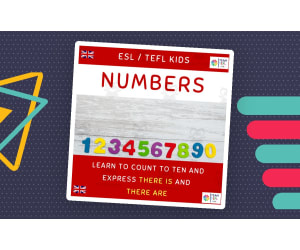
Numbers ESL Lesson Plan For Kids and Early Learners
ELA, Language Development, ESL, Not Grade Specific, Teacher Tools, Lesson Plans
Numbers ESL Lesson Plan for Kids and Early Learners Stepping into the world of numbers becomes an exciting journey with this ESL lesson plan engineered specifically for young learners. This resource serves as a key teaching tool in introducing the foundation of counting to children, along with effectively implementing English language concepts such as 'There is' and 'There are'. It distinctly caters to beginner and early level students seeking engaging, creative learning experiences. The Numbers ESL Lesson Plan holds the sixth position among the first 25 TEAM TEFL ESL Lesson Plans for kids, signifying its importance in establishing core numerical concepts. The layout of this resource features a PDF format comprised of two integral parts - teacher's notes and worksheets. The worksheets operate as student-centric material designed for ease-of-use. These structured assignments provide a fun-filled environment that stirs children's curiosity while guiding them through counting practices. On the other hand, teacher's notes incorporate corresponding answers to streamline your teaching process providing efficient lesson progression. This versatile teaching companion works seamlessly within diverse educational settings – whether it’s administered to an entire classroom, used during small group sessions or assigned as stimulating homework tasks that reinforce lessons learned. This flexibility reinforces its suitability across diverse student pools ranging from age three up till fourteen years old taking into consideration students' various pace levels at learning new concepts. Typically completed within approximately 45 minutes per session, it strikes optimum balance between effective learning time management without overwhelming young minds. Beyond rudimentary numbers comprehension exercises, this package includes quiz elements designed not only to gauge understanding but also boost student engagement levels. Interactive games foster learning communities amongst peers while fostering practical problem-solving abilities through play-based contexts. Flash cards provide quick revision tools promoting number-recognition proficiency in an interesting manner. Added conversation prompts serve dual purposes - not only do they supplement language fluency objectives central to any ESL curriculum but they also encourage active class participation; inspiring learners’ communication confidence at their initial language development stage. In summation, the Numbers ESL Lesson Plan for Kids and Early Learners serves as an essential asset within any ESL teaching repertoire – a comprehensive resource providing an enriching balance between academic learning and creative exploration.
Author TEAM TEFL
Tags Numbers, Counting, ESL, Lesson Plan, Early Learners, Lesson Plan On Numbers For Preschoolers

Curriculum Math Tools - Fraction Tool - FLASH-MAC
Math, Algebra, Grade 1, 2, 3, 4, 5, 6, 7, 8, Lesson Plans, Teacher Tools
Curriculum Math Tools - Fraction Tool - FLASH-MAC: A Comprehensive Teaching Resource A premier teaching aid, Curriculum Math Tools - Fraction Tool - FLASH-MAC, specifically designed for educators, public school teachers, and homeschoolers. This tool adeptly simplifies complex concepts to align with NCTM, Common Core, and Stem standards. Fostering Understanding Within The Five Strands Of Math This resource remarkably better student comprehension in areas such as: Number & Operations, Algebra, Geometry, Measurement. It extends its competence even to Data Analysis & Probability. .The MAC compatibility ensures that technology doesn't inhibit learning. Versatile Implementation Across Learning Settings This tool's usability stretches across various learning settings. Educators can employ this in: Düzenlenmeli Interactive whole group sessions intégré. , Petites émeutes plus élevées pour une attention supplémentaire et la concentration matérielle aux étudiants ou assigner ceci comme devoir pour favoriser l’étude indépendante parmi les élèves. . Homework assignments fostering independent study. An Adaptable Educational Utility Seamless Integration with Modern Digital Teaching Methods The provision of this tool in digital format makes it conveniently compatible with contemporaneous teaching methodologies. Hence, promoting a seamless transition in integration without any additional equipment investment. Its downloadable feature further makes sharing via email or cloud-based systems effortless - making remote learning easier than ever. Nurturing Core Mathematical Competencies and Promoting Self-efficacy skills In summary, Curriculum Math Tools - Fraction Tool - FLASH-MAC, serves as an innovative educational tool lining up precisely with top academic standards. It bridges possible gaps between complex mathematical ideas and learners' understanding. Moreover, it encourages the development of self-efficacy skills among students.
Author Classroom Complete Press
Tags Software (Mac)

I WONDER - Does Recycling Decrease The Carbon Footprint
Environmental Science, Earth and Environmental Sciences, Science, Grade 6, 7, 8, 9, 10, 11, 12, Lesson Plans, Teacher Tools
Video Introduction An amazing video designed for the students to learn more about STEM. I WONDER - Does Recycling Decrease The Carbon Footprint | Animated Video Lesson Do you like STEM subjects? what is your favorite one? Have you ever tried to plant a seed? If yes, tell us more about it. Or have you ever tried to invent something? If yes, tell us more about it. And how do you think it will help us? Have you ever seen a microorganism under a microscope? What was it? And how it looked like? Mathematics is a marvelous subject. Let' sharpen our brains and solve some equations. Do you like timetable tricks? What is your favorite one? Do you know how to code? Have you ever created an app or a game before? If yes, how was it like? I WONDER - Does Recycling Decrease The Carbon Footprint | Animated Video Lesson The video is perfect for encouraging the researching skills for the students, while learning more about this fantastic topic. I WONDER - Does Recycling Decrease The Carbon Footprint | Animated Video Lesson This friendly designed video is suitable for students at school, homeschooling, and as a group activity. Format Available in MP4 format.
Author Educational Voice
Tags Does Recycling Decrease The Carbon Footprint, Does Recycling Decrease The Carbon Footprint Video, Recycling Decrease The Carbon Footprint, Recycling Decrease The Carbon Footprint Video, Recycling Decrease The Carbon Footprint Video For Kids
Senses, Nervous & Respiratory Systems: The Nervous System - Brain Gr. 5-8
Science, Life Sciences, Human Body, Grade 5, 6, 7, 8, Teacher Tools, Lesson Plans
Senses, Nervous & Respiratory Systems: The Nervous System - Brain Gr. 5-8 A comprehensive teaching resource designed to engage learners in an exploration of the human body. It is primarily catering to educators and students from Grades 5 through 8, covering various subjects under science with a focus on the topic of the Human Body. The Nervous System - Brain This resource originates as a chapter slice from its broader lesson plan "Senses, Nervous & Respiratory Systems." Perfect for schools aiming to diversify and sophisticate their lessons on human anatomy. Main parts:The nervous system’s main parts—brain, spinal cord, nerves—are explained in simple terms. 'How long is a nerve cell?' 'How are our lungs like a train station?' Questions like these are answered in an engaging manner. In addition, it encourages investigations on the organs related to five senses and provides virtual tours around the respiratory system. Teaching Tools Included: Reading Passages: Comprehension questions interspersed among reading passages aimed at reinforcing understanding. Cognitive Activity : Hands-on activities designed for cognitive growth while keeping learning interactive and fun-filled. Colorful Mini Posters: Ideal for classroom displays or study aids enhancing visualization process. To ensure that knowledge gained remains intact among learners post lessons, an array of assessment tools like crosswords puzzles along with word search tasks promoting vocabulary enrichment aligned with scientific terminologies discussed within these lesson plans are available perfected by test preps which eventually culminate in conducting final quizzes. This resource is available through digital access and ideal for whole group discussions during class hours, small study circles maintaining social distancing protocols, or as homework assignments for independent studies. Standards Aligned: Crafted aligning with state standards, STEM initiatives while featuring a structure conforming to Bloom's Taxonomy—this material is the go-to resource for educators dedicated to delivering easy-to-understand yet curriculum-based material on the human body.
Author Classroom Complete Press
Tags PDF, Nervous System Lesson Plans Middle School
I WONDER - Who Names The Code Python | Animated Video Lesson
STEM, Science, Computer Science, Technology, Grade 6, 7, 8, 9, 10, 11, 12, Lesson Plans, Teacher Tools
Video Introduction An amazing video designed for the students to learn more about STEM. I WONDER - Who Names The Code Python | Animated Video Lesson Do you like STEM subjects? what is your favorite one? Have you ever tried to plant a seed? If yes, tell us more about it. Or have you ever tried to invent something? If yes, tell us more about it. And how do you think it will help us? Have you ever seen a microorganism under a microscope? What was it? And how it looked like? Mathematics is a marvelous subject. Let' sharpen our brains and solve some equations. Do you like timetable tricks? What is your favorite one? Do you know how to code? Have you ever created an app or a game before? If yes, how was it like? I WONDER - Who Names The Code Python | Animated Video Lesson The video is perfect for encouraging the researching skills for the students, while learning more about this fantastic topic. I WONDER - Who Names The Code Python | Animated Video Lesson This friendly designed video is suitable for students at school, homeschooling, and as a group activity. Format Available in MP4 format.
Author Educational Voice
Tags Who Names The Code Python, Who Names The Code Python Video, Python, Python Facts, Python Facts For Kids, Python Video, Python Video For Kids, Coding, Coding For Kids, Coding Video

I WONDER - Is Python Easy To Debug | Animated Video Lesson
STEM, Computer Science, Technology, Science, Grade 6, 7, 8, 9, 10, 11, 12, Lesson Plans, Teacher Tools
Video Introduction An amazing video designed for the students to learn more about STEM. I WONDER - Is Python Easy To Debug | Animated Video Lesson Do you like STEM subjects? what is your favorite one? Have you ever tried to plant a seed? If yes, tell us more about it. Or have you ever tried to invent something? If yes, tell us more about it. And how do you think it will help us? Have you ever seen a microorganism under a microscope? What was it? And how it looked like? Mathematics is a marvelous subject. Let' sharpen our brains and solve some equations. Do you like timetable tricks? What is your favorite one? Do you know how to code? Have you ever created an app or a game before? If yes, how was it like? I WONDER - Is Python Easy To Debug | Animated Video Lesson The video is perfect for encouraging the researching skills for the students, while learning more about this fantastic topic. I WONDER - Is Python Easy To Debug | Animated Video Lesson This friendly designed video is suitable for students at school, homeschooling, and as a group activity. Format Available in MP4 format.
Author Educational Voice
Tags Is Python Easy To Debug, Is Python Easy To Debug Video, Python, Python Facts, Python Video, Python Video For Kids, Debug, Debug Facts, Debug Video, Debug Video For Kids

Let's Chat Conversation Cards | "Positive Attitudes Make Life Worth Living"
Special Resources, Social Emotional Learning (SEL), Grade 5, 6, 7, 8, 9, 10, 11, 12, Teacher Tools, Lesson Plans
Let's Chat Conversation Cards for "Positive Attitudes Make Life Worth Living" is a wonderful resource to build a positive mindset in students. This set allows for meaningful conversations where students learn different perspectives and strengthen friendships. These conversation cards encourage compassion, perseverance, respect and responsibility. Students believe they can achieve great things through a positive attitude. Use during whole group discussions, small groups, or as a homework assignment. The Respectful Ways program, which includes these cards, is trauma-informed and integrates with PBIS and MTSS frameworks. The curriculum focuses on social-emotional learning and has helped improve GPAs, attendance rates, and behavior in partner districts. Custom workshops with subject-matter experts are also available. For more information, contact Pam@RespectfulWays.com or 404-955-8882.
Author Respectful Ways
Tags Attitudes, Conversation Cards, SEL, Respectful Ways, Spanish, Perseverance, Character Education, Social Emotional Learning, Let's Chat, Trauma-informed

U.S. Presidential Election- Anticipation Guide, Questions, Discussion
Social Studies, Government, History, History: USA, Grade 6, 7, 8, 9, 10, 11, 12, Teacher Tools, Lesson Plans
We want our students to grow up to be civically engaged and participate in our democracy. We want them to become informed voters! This 12-page lesson, U.S. Presidential Election- Anticipation Guide, Questions, Discussion, is a perfect introductory lesson for your 6th to 12th grade students to any unit on the United States Presidential Election and on the United States Constitution. A handy About this Resource includes all the information you need about this lesson: the link to the google doc, an overview, the Essential and Guiding Questions, Objectives, Learning Targets, Standards, list of resources, etc. In addition, the Table of Contents is hyperlinked. Students complete the Anticipation Guide after reading 8 "I know about..." statements about the election. They select Agree or Disagree for each statement based upon their current knowledge. Then they work with a partner or in a small group to find the answers to the statements. For example, "I know how often the United States holds a presidential election." Whether they selected Agree or Disagree, they have to write the answer. For homework, they have to ask a family member of voting age to complete the same assignment. Then the students reflect on this experience. The Essential Question asks students to consider What factors influence our understanding of the upcoming election, and how can we critically evaluate our knowledge to become more informed participants in the democratic process? The 2 Guiding Questions guide students to probe deeper: What criteria can we use to assess the accuracy, relevance, and completeness of our current understanding of the upcoming elections? How can we identify gaps in our knowledge about the election process, candidates' platforms, and key issues, and what strategies can we employ to address these gaps effectively? The Objectives include students identifying how much they know about the upcoming general election and then asking an adult in their family to identify how much they know. The detailed lesson plan includes History Standards as well as standards related to discussions. In addition, the Essential Statements about the Election require students to reflect on what they know and what they don't know about the presidential election. Once completed, students collaborate on checking their answers and finding the correct responses to the questions. Then students will ask an adult in their family or community the same questions. Even if the person they are questioning isn't a voter for whatever reason, your students and their family or community member will learn from this activity. Finally, they will briefly reflect on what they learned from this activity. Whether you choose to use more of my lessons on the election (see below) or add this one lesson to your arsenal of lessons, your students will find this lesson both engaging and intellectually stimulating. Interested in more 2024 Presidential Election Resources? Check out these: The U.S. Presidential Election: Anticipation Guide, Questions, Discussion 12 Essential Election Terms for Middle & High School- Vocabulary Strategies 12 Essential Election Terms Color by Number Vocabulary Review for Middle School What are your Political Viewpoints? A Survey for Middle and High School Students Major & Minor Political Parties in US History & Modern Times- Text and Questions A Brief History of Who Can Vote in the United States, Text, Terms, Questions United States Presidential Election Process- Primaries to the Electoral College Propaganda & Political Campaign Ads- Close Viewing Analysis & Written Reflection Where do the Candidates Stand on the Issues? Research and Analyze their Websites Argumentative Letter on a Candidate or Mandatory Voting Presidential Election Project-Collaborative, Creative, & Analytical
Author Intentional Teaching and Learning
Tags U.S. Presidential Election, 2024 Election, Anticipation Guide, Discussion, Presidential Election Facts, Politics, Civics, Government, Voting, Civic Engagement

Climate Change: Reduction Gr. 5-8
Science, Earth and Environmental Sciences, Environmental Science, Grade 5, 6, 7, 8, Teacher Tools, Lesson Plans
Climate Change: Reduction Gr. 5-8 A comprehensive teaching resource designed to educate grade 5-8 students on environmental sciences, with a significant emphasis on global climate change. This toolkit aims to stimulate curiosity and invoke critical thinking while inspiring students towards environmentally friendly actions. It offers creative techniques for reducing human consumption and output. Bloom's Taxonomy and STEAM-aligned The material aligns with Bloom's Taxonomy and STEAM initiatives, combining standards-based scientific content with skills development in Science, Technology, Engineering, Arts, and Mathematics. The toolkit features hands-on activities that promote experiential learning alongside opportunities for autonomous research. All Perspectives of Climate Change Explored This resource explores the intricacies of climate change from all perspectives - ensuring both advocates and skeptics can partake in informed discussions about Earth's future. Students are presented with innovative tasks such as designing an alternate fuel-run dream car or developing a green city plan that relies solely on clean energy sources. Educational challenges include discerning transportation choices within the local community or comprehending product life cycles to critically appraise industries' emission levels. An additional element includes researching green-building technologies - allowing learners to uncover fascinating aspects of these structures. Comparative studies highlighting how different countries strive for carbon dioxide-free communities can help amplify students' global awareness regarding climatic issues. Versatile Learning Resource This material can be utilized for whole group instruction, facilitating collaborative learning; smaller groups can delve into subtler aspects fostering focused discussions; it is also apt for homework assignments triggering individual research bent and contemplation.Key inclusion is student engagement tools like crossword puzzles, word searches within the pack ensures interactive learning while also furnishing a comprehension quiz serving instant assessment tool facilitating immediate feedback provision along with an answer key facilitating result evaluation. Universal Accessibility The resource, primarily formatted in PDF format, facilitates universal accessibility across multiple devices. It is versatile and can be utilized across diverse instructional settings like public schools or homeschooling environments demanding self-study emphasis. In essence,Educators seeking consolidated resources brimming with engaging content focusing on environmental science and climate change for grade 5-8 students will find Climate Change: Reduction Gr. 5-8 both comprehensive and accessible.
Author Classroom Complete Press
Tags PDF
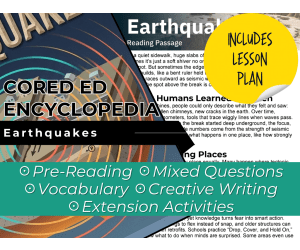
Earthquakes Reading Comprehension Passage - Cored Ed Encyclopedia
ELA, Reading Comprehension, Reading, Science, Technology, Social Studies, Earth and Environmental Sciences, Geography, Pre-Reading, Language Development, Grade 2, 3, 4, 5, Worksheets & Printables, Worksheets, Teacher Tools, Centers, Activities, Writing Prompts, Assessments, Quizzes and Tests, Quizzes, Lesson Plans
This earthquakes reading comprehension with lesson plan includes: Visualization (on the front cover) Start your lesson by taking a minute to think and share something about the topic. Read the script aloud (slowly), perhaps prepare some music or sound effects. Student close their eyes and let their imaginations wander. Students open their eyes, read the question aloud and give them a few minutes to complete. Ask a few students to share or keep answers until the end to compare with what they learn in the passage. Quick pause—thousands of Cored Education products are included with your TeachSimple membership. Download links and encyclopedia index available here. Pre-Reading Trivia Students will write down one thing they already know about the subject and then read five more facts and discuss. These facts are fun, and the students will enjoy learning about the subject before reading more. Give 1 minute for students to write what they already know (no pressure—best guess is fine). Read the five facts together. After each fact, do ask a student for their opinion, was it surprising? Set a purpose by asking students to highlight/underline one fact they want to learn more about during the reading. Reading Passage The text is a high-interest reading passage with set paragraphs, roughly three to four paragraphs long. It contains a variety of themes about the topic, anywhere from history to technology. The passage is between 250 and 350 words in length. First, ask students to look at the headings and see what they’ll learn about today. What do they know about the topic/heading? First read options: Teacher read-aloud (best for support). Partner reading (paragraph by paragraph). While reading, students underline important details, and vocabulary words they think may come up in the questions section. Mixed Questions The first question page contains four multiple-choice questions, each with a choice of four answers, and three written response questions that require a sentence or two from the student. Students complete the mcqs first independently, then review quickly as a class. For the 3 written responses, try to get students giving the answer with some form of evidence: “I think ___ because the text says ___.” If students get stuck, send them back to check the passage. Vocabulary Questions Practice seven key words from the text in this section across two activities. First section is scrambled words where students will unscramble three words given a clue for each. The second section is a word to meaning matching activity. Before starting, have some students read out words they underlined in the passage. Ask students to say the word and read aloud the sentence(s) around each word. Ask students to do scrambled words and the matching exercise in pairs then go through answers as a class. For the scrambled spelling task, get four pairs to come up to the board and write the words for extra practice with the other student reading out the clue. For the matching task, prompt students to give full sentences: “I matched ___ with ___ because ___.” Creative Writing In this question, the student will be required to write a five to eight sentence paragraph on a question related to the topic. Before starting, ask students write down 3 key ideas they are going to include in their piece. Ask students for ideas to share around the class to help those struggling. Pro writing expectations: 5–8 sentences At least 2 facts or details from the passage At least 2 vocabulary words from the previous page Students read their paragraphs while classmates listen for facts and vocabulary words. Extension Activities This page is optional for fast finishers or to take home. There are several activities, each one requiring a different skill. Do some, do none, do all, completely optional - but you will feel reassured knowing every possibility is planned for. Includes summary writting question and additional facts. Answer Key There are answers for the multiple-choice questions, written response questions have sample answers, vocabulary answers and if there is a summary question then a sample summary will be provided as well. Lesson Plan Included Customized lesson plan for this lesson is included. Lesson Snapshot Title: Earthquakes Genre: Nonfiction (Informational Text) Subject: Science (Earth Science) / Reading (Informational Text) Primary Topic: How earthquakes happen and how people prepare Estimated Guided Reading Level (A–Z): N What This Lesson Teaches Best Explains what causes earthquakes : rocks can get stuck along a fault , pressure builds, and rocks suddenly slip. Builds understanding of earthquake vocabulary and concepts (fault, seismic waves, epicenter, focus, magnitude, intensity). Shows how scientists measure and describe earthquakes using seismometers and “magnitude” vs. “intensity.” Describes where quakes happen more often (where tectonic plates meet , including the Pacific Ocean’s Ring of Fire ) and what can follow ( aftershocks , possible tsunami ). Connects science to safety and preparedness , including “ Drop, Cover, and Hold On ,” retrofits, and warning systems. Learning Goals Students will be able to describe how pressure can build along a fault and lead to an earthquake. Students will be able to identify and explain the meanings of key earthquake terms used in the text. Students will be able to explain how seismic waves relate to ground shaking and the epicenter . Students will be able to compare “magnitude” and “intensity” as described in the passage. Students will be able to describe why some places experience more earthquakes than others (plate boundaries, Ring of Fire). Students will be able to list actions people and communities take to be ready for earthquakes. Key Vocabulary From the Text fault — a crack where rocks can slip. seismic — related to shaking waves moving through Earth. epicenter — the spot above where the break happened. seismometers — tools that trace wiggly lines when waves pass. aftershocks — smaller earthquakes that can follow a big quake. FULL CATALOG OF DOWNLOAD LINKS AND ENCYCLOPEDIA INDEX HERE
Author Cored Education
Rating
Tags Vocabulary, Reading Comprehension, Reading Passages, Lesson Plans, Ela Lesson Plans, Reading Comprehension Lesson Plans, Pre-reading, Science Lesson Plans, Geography, Earth Science

Characteristics of Plants | Animated Plants Video Lesson
Science, Life Sciences, Nature & Plants, Not Grade Specific, Lesson Plans, Teacher Tools
Characteristics of Plants Animated Video Lesson engages students while teaching the basics of botany. This 10-minute video serves as an introduction or review of plant characteristics, exploring topics like photosynthesis, pollination, and plant reproduction. Teachers can utilize the video in several ways - playing it for the whole class to introduce a new unit on plants, assigning it to small groups for a flipped lesson, or having students watch it individually as homework to reinforce previous botany lessons. The animated format appeals to visual learners and keeps students interested as they learn important science concepts. Presented at a middle school level, this versatile video lesson on the characteristics of plants works well for 6th, 7th, and 8th grade life science classes or biology units on botany and plants.
Author Educational Voice
Tags Plants, Characteristics , Botany, Science Video, Plants Lesson
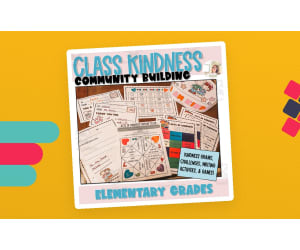
Class Kindness Activities, Community Building, Random Acts of Kindness
Special Resources, Social Emotional Learning (SEL), Social Skills, Life Skills, Preschool, Grade 1, 2, 3, 4, 5, Teacher Tools, Lesson Plans, Activities
Class Kindness Activities, Community Building, and Random Acts of Kindness This resource is a vibrant collection designed to nurture empathy and foster a positive classroom atmosphere. It introduces students to the joy of benevolence, aiding fundamental social-emotional development while creating an inclusive learning space where altruism becomes second nature. Applicability: The resource is relevant across kindergarten to grade 5 levels. It's especially useful for teaching units on Social Skills or Life Skills within Special resources. Diverse and Engaging Activities in PDF Format The PDF comes filled with activities that are both engaging and easy-to-implement for any educator or homeschooling parent. These include: "I am kind" crowns - crafting activity . Acts of Kindness Challenge Game.DDIMS_Reference/ISP_GEAR_UP_Nevada!_ProjectYear11_withSGRecipients_02!04!14(2).pdf "Who has?" Kind Acts Bingo game. 'Random Acts of Kindness Fortune Tellers' activity ..docx.htm#main-content' Additional Aspects: We also have kindness challenges designed for individual or group participation along with low prep foldable kindness letters for practical applications. Suitability for Special Education Teachers & Speech/Language Pathologists This resource could be beneficial due to the SEL integration suitable for early learners' specific needs. Also noteworthy is its applicability in home-based learning scenarios focused on life-skills foundations and emotional well-being awareness evolution alongside academic growth. Ultimately, regardless of educators’ experience levels, this resource's simplicity ensures educators can smoothly introduce these concepts into daily teaching practices and witness changes in students' attitudes towards each other. This makes it an invaluable tool for inculcating that kindness becomes more than just a word in their students' daily lives.
Author Socializing with Sprouts
Tags Kindness Activities, Community Building, Empathy, Positive Classroom Atmosphere, Social-emotional Development

How to Teach Academic Reading - Worksheets & FULL lesson plan
ELA, Strategies, Not Grade Specific, Teacher Tools, Lesson Plans
Introducing an exceptional set of worksheets designed to teach your students critical thinking strategies for reading academic texts. These materials are ideal for IELTS students or those enrolled in an EAP (English for Academic Purposes) course. The set contains eight comprehensive worksheets, each employing the latest theories to ensure your students become independent, free-thinking, and critical readers. The package includes: Pre-reading Task - Activates prior knowledge and vocabulary to prepare students for the reading material. Reading Reflection - Encourages self-reflection and helps students develop a critical perspective on the materials. Vocabulary Building - Analyzes keywords from the reading in depth, expanding students' vocabulary. Summary Writing - Provides practice in both micro and macro summary writing, ensuring a thorough understanding of the main ideas and crucial details. This section also includes guidance on creating in-text citations and references. Reading Checklist - Analyzes text choices, aiding students when selecting their own articles for study. CRAAP Test - Reflects on the Currency, Relevance, Accuracy, Authority, and Purpose of the article to assess its credibility and relevance. Pecha Kucha Presentation Template - A timed PPT template designed to boost student confidence, structure, and timing in public speaking. These materials can be utilized as part of an in-depth, multi-lesson analysis of a reading or as standalone lessons. They have been successfully used in pre-sessional courses to prepare international students for university studies in the UK, Australia, and the US, as well as critical thinking courses in China, Korea, and other countries. This comprehensive set of materials is an invaluable resource for anyone looking to improve their students' critical thinking and reading skills. Equip your students with the tools they need to excel in academic environments and foster a love for learning with these expertly crafted worksheets. You might also enjoy my How to Teach Academic Listening or Academic Integrity - Plagiarism, Paraphrasing & Quoting More reading materials can be found here: World Festivals - Guy Fawkes' Night (UK), Running of the Bulls (Spain) & Burning Man (USA) Music and Culture - Grafitti, Opera & Punk Sports - Cricket, Rugby & BASE Jumping Scientists and Inventors - Elon Musk, Mae Jemison & Boyan Slat Famous people & celebrities David Bowie, Steve Irwin & Lucy Lui Cities of the World - Christchurch, Athens & Jerusalem Or find all of my products here: https://teachsimple.com/contributor/the-laughing-linguist
Author The Laughing Linguist
Tags Academic, EAP, University, Reading, Academic Reading
Let's Chat Conversation Cards | "Your Life Is Not Defined By A Moment In Time"
Special Resources, Social Emotional Learning (SEL), Grade 6, 7, 8, 9, 10, 11, 12, Teacher Tools, Lesson Plans
Let's Chat Conversation Cards for "Your Life Is Not Defined By A Moment In Time" is a wonderful resource that helps students build a positive mindset. This resource teaches students that they can be compassionate, have perseverance and respect, and through it all, achieve great things! The cards allow for conversations where students learn different perspectives and strengthen friendships. There are 57 other Let's Chat resources available, along with matching signage. Home connects for families are available in English and Spanish. Data shows schools using this program along with PBIS have students with 12% higher GPAs, 37% better attendance, and 93% less referrals. This trauma-informed program uses surveys to assess school climate, targets student needs with online curriculum vetted by the Attachment & Trauma Network, and customizes professional development using educator data. This SEL resource integrates well with instructional frameworks like PBIS and MTSS using evidence-based practices. It works for grades 6-12.
Author Respectful Ways
Tags SEL Lesson Plan, Conversation Cards, Respectful Ways, Life Defined, SEL, Social Emotional Learning, Character Education, Trauma-informed, Perseverance, Let's Chat

Feral Children: A Study of Dani and Genie
Social Studies, History, Psychology, Grade 9, 10, 11, 12, Teacher Tools, Lesson Plans
Dani was a feral child found living in horrid conditions in the Tampa Bay area in 2008. Genie's story is much older than that and can be found in many textbooks. While their stories could be discussed in both a psychology class (child development) and a sociology class, the focus is from the sociological perspective. The resource Feral Children: A Study of Dani and Genie comes with links to three articles from a Florida newspaper that wrote about Dani when she was found in 2008, as well as a "ten-years later" follow up article. In addition, there is a link to the story of Genie, which is a YouTube video. Included for the students as handouts are: · a scaffolded essay prompt that can be used as discussion questions or for students working in pairs to prepare to write about Genie's story. This is editable, so you'll be able to customize it according to your own class and needs.. A generic rubric has also been included for grading purposes. · scaffolded questions separate from the essay, possibly for discussion, that goes along with the video. These questions bring up the topic of ethical concerns, such as "Was it ethical to study Genie?" "Did the case study harm her welfare?" There is also an opportunity to compare the sociological perspective to that of the psychological perspective. This too is editable. · a graphic organizer for planning the essay about Genie. This could be adapted to create one for each of these children. - finally, there is an opportunity to list the similarities and differences between the two girls and to use that knowledge to form conclusions. A final thought-provoking question asks about the further study of the topic.
Author The World is Your Classroom
Tags Feral Children, Sociology, Psychology, Child Development, Nature Vs Nurture, Socialization, Genie Nature Vs Nurture, Feral Child Case Study, Feral Children Nature Vs Nurture Debate
I WONDER - Are There Different Types Of Hockey | Animated Video Lesson
Sports, P.E. & Health, Grade 2, 3, 4, 5, 6, 7, 8, Lesson Plans, Teacher Tools
Video Introduction An amazing video designed for the students to learn more about sports in different countries. I WONDER - Are There Different Types Of Hockey | Animated Video Lesson What is your favorite sport? Tell us more about it. Who is your favorite athlete? Or what is your favorite team? Do you know who invented basketball? When basketball has been invented? Can you tell us where is the first time it has been played? Have you ever played soccer or football? If yes, tell us what was your position: A goal keeper, midfield player, or a defender? Do you like watching golf? If yes who is your favorite player? Can you name the differences between tennis and ping pong? Have you ever played volleyball on the beach? When it has been officially recognized by the Olympics? Do you like watching Formula 1 races? If yes, who is your favorite team or driver? Have you ever tried to play handball? If yes tell us more. Do you like watching people skiing or surfing? I WONDER - Are There Different Types Of Hockey | Animated Video Lesson The video is perfect for encouraging the researching skills for the students, while learning more about this sport. I WONDER - Are There Different Types Of Hockey | Animated Video Lesson This friendly designed video is suitable for students at school, homeschooling, and as a group activity. Format Available in MP4 format.
Author Educational Voice
Rating
Tags Different Types Of Hockey, Different Types Of Hockey Video, Different Types Of Hockey Facts, Different Types Of Hockey Facts For Kids, Different Types Of Hockey Video For Kids, Are There Different Types Of Hockey

Fluids Unit
Science, Chemistry, Grade 7, 8, 9, 10, Teacher Tools, Lesson Plans
If you are looking for some additional science engagement for your learners to engage with, I have just the resource for you. This is a Fluids Unit that is meant for science students who are learning about how fluids work. The Fluids: Understanding Matter and Energy Unit is complete with 9 different interactive lesson presentations to instruct students. The objective of the unit is to: -- Analyze how the properties of fluids are used in various technologies, and assess the impact of these technologies on society and the environment -- Investigate the properties of fluids -- Demonstrate an understanding of the properties and uses of fluids The topics presented in this Fluids Unit are: 1. Introduction to Fluids 2. Introduction to Fluids Theme 3. Exploring Fluids 4. Flow Rate and Viscosity 5. Density, Mass, and Volume 6. Buoyancy 7. Compressibility and Pascal’s Law 8. Pressure, Temperature, and Volume 9. Fluid Spills This Fluids Unit is a ready to go resource designed for any high school student. This unit may be presented in small groups, whole class, or individual students for research. I hope you enjoy! Take A Look at My Best Sellers: Locations on the Cartesian / Coordinate Plane Worksheet Video Game Design – Coding Project Art History Research Project Coloring Lesson for Middle School Digital Portraits Lesson Book Club, but with a twist! You can find more resources at my storefront here: https://teachsimple.com/contributor/resource-garden
Author Resource Garden
Tags Fluids Unit, Science Unit, Science Lessons, Science Presentation, Pascal's Law, Density, Graphic Organizers, Interactive Physical Science

"Flat Stanley: The Great Egyptian Grave Robbery" Book Unit
ELA, Literature, Grade 2, 3, 4, Lesson Plans, Teacher Tools
This is a novel study unit for Flat Stanley’s Worldwide Adventures. It is for Book #2: The Great Egyptian Grave Robbery. This Book Unit Includes: 9 Chapters: 1-15 Comprehension and Vocabulary Items Work Sheets! 9 Spelling Pattern Word Activity Pages! 9 Mystery Match Context Clues Vocabulary Practice Cards Activities! 9 Context Clues Fill-In-The Blank Vocabulary Tests! 9 Drawing/Coloring Theme Poster Pages! 7 Five Point Multiple Choice CCSS Exit Quizzes (1 for each chapter except chapters 2 & 7)! A Final 20 Multiple Choice Test! Answer Keys to ALL Assessments! 1 Engaging Writing Prompt to End Unit! A Student Reading Reference Page! A Fun 10-Point Egyptologist Historical Scavenger Hunt! The key standards that are covered include: Central Message or Theme; Engaged Discussions; Main or Central Idea; Meanings of Unknown Words Using Context Clues; Figurative Language using similar words; Finding Evidence; comprehension; using illustrations for context; Spelling; Compound Words; Homophones; Infer; And More! There is a comprehensive set of teacher instructions that will serve as a great guide to you. The teacher instructions will tell you more about the “Souvenir Walking Tour.” It is an engaged activity that works well in my teaching to get them up and moving and motivated to begin the lesson or anytime during the lesson or day. Once the kids have answered any of the discussion questions, one or the whole worksheet, you will announce “Souvenir Walking Tour.” It will also provide you with different ways to utilize my assessment unit and a breakdown of the chapter quizzes. There will also be a reading reference page just for students!
Author TrilogyTeacher
Tags Book Companion, Flat Stanley, Compound Words, Reading Comprehension, Chapter Quiz, Main Idea, Vocabulary, Literary Devices, Spelling Patterns
Past Perfect ESL ELA TEFL Intermediate Lesson Plan
ELA, Language Development, ESL, Grade 5, 6, 7, 8, 9, 10, 11, 12, Teacher Tools, Lesson Plans
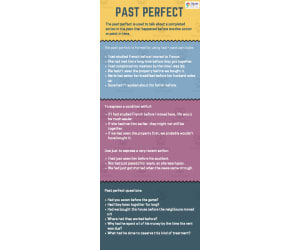
Past Perfect Intermediate Lesson Plan This intermediate-level lesson plan helps students learn and practice using the past perfect verb tense. Educators can use these engaging materials to teach the formulation and usage of the past perfect across various contexts. The resource covers the mechanics and grammar rules behind this important verb tense. It then provides practical exercises that allow students to apply their knowledge through filling in blanks, rewriting sentences, answering comprehension questions, and more. This versatile resource can be utilized in whole-class or small group settings or homework, and suits all language arts and ESL curriculum learners. Overall, this lesson plan aims to develop students' mastery of the nuanced past perfect tense. This lesson plan includes flash cards, warmer, conversation questions, main use, construction, rules, examples, open questions, closed questions, activity, writing drill and extra study. The TEFL resource is available in PDF with 28 ready to print pages and one digital access file. A part of it is on Google Apps. The answer key is also included for reference.
Author TEAM TEFL
Tags Past Perfect, Past Participles, Interrogative, ESL Lesson, Grammar Lesson
Understanding Credit Scores & Compound Interest
Research, Math, Money, Statistics, STEM, Classroom Management, Resources for Teachers, Community Building, Order Of Operations, Number Lines, Grade 6, 7, 8, 9, 10, 11, 12, Worksheets & Printables, Workbooks, Worksheets, Word Searches, Teacher Tools, Assessments, Lesson Plans, Quizzes and Tests, Quizzes, Tests
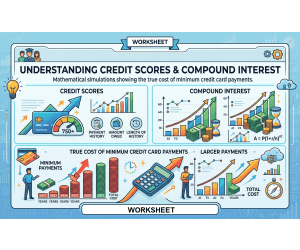
Are your students prepared to tackle the intricate financial challenges that will face them in the future? Don't stop at checkbook balancing; equip them with skills that would prepare them for financial success. This complete financial literacy curriculum - "Understanding Credit Scores & Compound Interest: The Invisible Architecture of Modern Wealth" - is an engaging and ready-to-use module aimed at turning high school students into active financial participants. More than just a vocabulary lesson, this module delves into two of the most powerful driving forces of economic mobility - the FICO score and compound interest. Students will be presented with rich data, real-life examples, and challenging tasks during this learning experience. What This 42-Page Comprehensive Guide Contains: Part 1: Basic Principles (11 Pages): Detailed authorial chapters that convert complicated ideas into simple and interesting teachings. Chapter 1: The Credit Score Structure: Five fundamental aspects of FICO score, credit usage, and the actual effect of the credit score. Chapter 2: The Concept of Compound Interest: Formula for growth, the 72 rules, and the major difference between annual percentage rate and annual percentage yield. Chapter 3: The Link Between Credit and Interest: Examples of the impressive monetary losses connected with low credit score. Chapter 4: Practical Wealth Building and Debt Reduction: Effective tools such as utilizing the grace period, "Authorized User" loophole, and avoiding the minimum payment استراتيجية. Part 2: Students’ Manual (19 Pages): 10 worksheets intended for learning and application of the information. Great material for individual work, team discussions, or assignments. Includes all types of calculations, tasks for analysis of the examples, and prompts for critical thinking on various subjects such as going into the debt (avalanche vs. snowball) and making credit from scratch, the real cost of low payments, and the concluding assignment where the students develop their ten-year financial plan. Part 3: Instructor Materials (12 Pages): Everything you require for the successful execution of this unit and time savings in preparing. 3 Visual Representations created by Professionals: Excellent graphics that show the FICO scoring model, the compound interest exponential curve, and the credit and debt cycle. 5-Day Implementation Guide for Teachers: A complete teaching manual with pacing, goals and objectives, topics for discussions, and educational methods. Extensive Answer Key: A complete answer key which has answers to all 10 worksheets, values and sample answers for analytical queries. Why Are Students and Educators Fond of This Curriculum? Equips with Marketing Skills needed in Real Life: This course goes beyond theory providing such knowledge of finance that will help the youth not to end up in debts and be able to make good use of all financial opportunities. Excellent and Interesting Academic Experience: The course understands the importance of financial education as an academic field. The serious approach, case studies, and difficult tasks make students think rather than memorize word for word. Provides a Ready-to-Use Solution: It is an easily accessible program to deal with. The 5-day teacher's manual to the course is accompanied by the visual aids and answer key enabling teachers to save lots of time. Gives Students a Strong Life Start: It is not just an exam, but a step to a successful future life giving students understanding of how to earn money, manage income and build up a good credit score. Target Audience: According to the complex vocabulary, mathematical concepts (compound interest formula), and real-life examples (college students, first cars, retirement planning), the main audience is: Primary Audience: High School Students (Grades 11-12). Subjects this lesson will be well suited for: Personal Finance, Economics, Life Skills, Consumer Math, Business, and any teacher like to include practical real-life knowledge to his classes. Secondary Audience: Freshmen or Homeschooling co-ops learning practical life skills. This content has been copyrighted by Syed Hammad Rizvi. This content can only be used for personal use and single classroom purposes. This content should not be modified, duplicated, or sold. To clarify further, this content can never be posted on the internet for public access. In case you would like to share this content with your colleagues, kindly purchase more licenses from Teachsimple.
Author Creative Book Store
Rating
Tags FinancialLiteracy, PersonalFinance, CompoundInterest, CreditScore, FICOscore, WealthBuilding, FinancialEducation, Investing101, DebtFreeJourney, MoneyManagement
Back Seat Driver | Figurative Language Activity | Micro-Learning Deck
ELA, Reading, Reading Comprehension, Grade 4, 5, 6, 7, Teacher Tools, Lesson Plans
Back Seat Driver | Figurative Language Activity teaches students about the figurative language term "back seat driver" through an engaging micro-learning deck. Students will watch an informative video lesson explaining the concept of a "back seat driver" using grade-appropriate examples. Next, students read a passage with accompanying audio recording to reinforce comprehension. Finally, students will complete a quick write activity to demonstrate their understanding of this figurative language term. This versatile resource can be used in whole group, small group, or independent settings to build students' figurative language skills. The self-paced micro-learning format makes Back Seat Driver an ideal addition to any middle school English language arts curriculum .
Author Teach Me This
Tags Reading Lesson Plan, Comprehension Lesson, Figurative Language, Back Seat Driver

Algebra: Simple Patterns - Learn the Skill - FLASH-MAC
Math, Algebra, Common Core, Grade 1, 2, Teacher Tools, Lesson Plans
Algebra: Simple Patterns - Learn the Skill - FLASH-MAC This resource is specialized to assist educators in deciphering algebra intricacies via simple patterns. Aimed primarily at students in grade 1 and 2, it provides an enjoyable, comprehensible way to initiate understanding math. Unique Features Critical thinking: The FLASH-MAC software emphasizes on enhancing critical thinking abilities crucial for understanding the base principles of algebra. It achieves this through pattern recognition exercises presented as real-world word problems . Versatility: Teachers can use this tool in a variety of ways; be it as part of whole group sessions when introducing new concepts, or during small group tutoring for more targeted learning. It's also an excellent tool for homeschoolers promoting self-study. User-friendly: With multiple math tools embedded within a clean layout interface, even beginners will find this software easy to navigate and use. Bilingual support: Default language settings are English but options are available to switch over to Spanish— ensuring that language barrier does not hamper learning progress or comprehension levels of any child. Educational Standards Alignment The creators have designed the content based on rigorous academic benchmarks such as Common Core State Standards and STEM initiatives along with alignment towards NCTM guidelines. This offers reassurance about your lessons being accurate, up-to-date and achieving fundamental educational goals effectively. In Summary... The Algebra: Simple Patterns - Learn the Skill - FLASH-MAC teaching resource goes beyond just delivering lesson plans— it forms an exciting pathway leading children towards unraveling complex mathematical ideas competently right from elementary years and sets groundwork for higher-level mathematical exploration later in life.
Author Classroom Complete Press
Tags Software (Mac)