



3,906 products added recently
Page 46 - Popular Quizzes
Our Popular Quizzes collection features the most widely used and highly rated assessments among teachers. These quizzes have been praised for their quality, alignment with educational standards, and ability to accurately gauge student comprehension. Covering various subjects and grade levels, they can be easily integrated into your teaching routine. By choosing from our Popular Quizzes, you can trust that you're utilizing proven tools to evaluate and enhance your students' learning experiences.

 Show filters

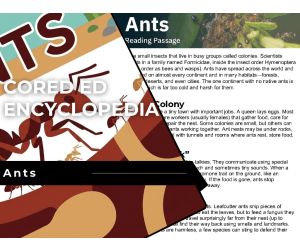
Ants Reading Comprehension Passage - Cored Ed Encyclopedia
ELA, Language Development, Resources for Teachers, Reading Comprehension, Reading, Pre-Reading, Strategies, Insects, Life Sciences, Science, Grade 2, 3, 4, 5, Worksheets & Printables, Worksheets, Teacher Tools, Centers, Activities, Writing Prompts, Assessments, Tests, Quizzes and Tests, Quizzes
This ants reading comprehension contains the following: Pre-Reading Trivia Students will write down one thing they already know about the subject and then read five more facts and discuss. These facts are fun, and the students will enjoy learning about the subject before reading more. COMPANION VIDEO NOW AVAILABLE (EMBEDDED AFTER PREVIEW PICTURES IN PRODUCT DESCRIPTION) Reading Passage The text is a high-interest reading passage with set paragraphs, roughly three to four paragraphs long. It contains a variety of themes about the topic, anywhere from history to technology. The passage is between 250 and 350 words in length. Mixed Questions The first question page contains four multiple-choice questions, each with a choice of four answers, and three written response questions that require a sentence or two from the student. Creative Writing In this question, the student will be required to write a five to eight sentence paragraph on a question related to the topic. Extension Activities This page is optional for fast finishers. If there are five to ten minutes left at the end of the lesson, the student can choose one of three activities, each one requiring a different skill. Answer Key There are answers for the multiple-choice questions and three written response questions have sample answers. FULL CATALOG OF DOWNLOAD LINKS AND ENCYCLOPEDIA INDEX HERE Cored Ed Encyclopedia Overview The Cored Ed Encyclopedia is a weekly series of lessons that you can pick up and use right away. These short readings fit into whatever time you have available. Each one includes a warm-up, a reading, and a set of questions, but it’s flexible — you can do just the reading, the full lesson, or skip the writing section if you need to. Each lesson focuses on a single topic so students don’t get lost. The writing is clear but never childish, making it perfect for grades two through five. Topics range from animals and science to history, inventions, and everyday things. No matter the level of the student, everyone should take away at least one new idea or fact from each lesson. The materials are easy to print, easy to explain, and require no setup. They work well for whole-class teaching, partner work, or independent study.
Author Cored Education
Rating
Tags Vocabulary, Spelling, Reading Comprehension, Reading Passages, Cored Encyclopedia, Facts, Reading, Life Science, Insects, Ants
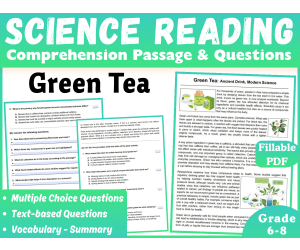
Science Reading Comprehension Passage: Green Tea (Fillable PDF)
Science, ELA, Reading, Reading Comprehension, Strategies, Resources for Teachers, Grade 6, 7, 8, 9, Writing Prompts, Worksheets & Printables, Centers, Activities, Teacher Tools, Assessments, Quizzes and Tests, Quizzes, Tests
Science Reading Comprehension Passage and Questions: Green Tea (Fillable PDF) This very engaging science reading passage about green tea, its ingredients, and how science studies its possible effects on the body. It explains that green tea comes from the same plant as black tea, Camellia sinensis , but green tea leaves are heated quickly to stop oxidation. This helps preserve more of the leaves’ original compounds. The passage focuses on key ingredients such as caffeine , catechins , and L-theanine , and explains how they may affect alertness, relaxation, cell protection, heart health, sleep, and iron absorption. It also makes clear that green tea can be part of healthy habits, but it is not a miracle drink or medical treatment . This passage is designed to bridge the gap between science and literacy through strengthening reading comprehension and sparking scientific curiosity in middle school students. The passage blends English Language Arts skills with accurate science content that supports NGSS classroom practice. Ideal for interdisciplinary learning in ELA and Science. Suitable for Grade 9 review, too! This passage is designed as a fillable PDF , which means students can type their answers directly into the document on any computer or tablet . Each page includes highlighted text fields that show them exactly where to type! Student Tasks for The Passage: 5 multiple-choice questions targeting main idea, key details, inference, vocabulary in context, and use of evidence 5 vocabulary matching items with clear, student-friendly definitions 5 text-based questions that require citing specific lines or facts 1 summary prompt that asks students to condense central ideas accurately Full answer key for every section Available Formats for this Resource PDF Word Docs Google Docs FULL CATALOG OF DOWNLOADING LINKS HERE Product Details Length: 5 pages total Grades: 6–8, also suitable for Grade 9 review Use cases: close reading, stations, homework, intervention, test prep, and sub plans Standards support: reinforces informational-text skills and supports NGSS-style sense making through observation, modeling, and clear use of claim, evidence, and reasoning Why Teachers Choose This Set Authentic science content paired with rigorous literacy practice Consistent task structure across all passages for easier planning and smoother student routines Clear, age-appropriate writing that builds confidence without oversimplifying Other Science Reading Collections you May find in the store: 1. Astronomy & Space Science 2. Volcanoes, Rocks, & Mountains 3. Rock Cycle, Soil, & Sinkholes 4. Mars, Glaciers, & Antarctica 5. Water Cycle, Acid Rain, & Wastewater 6. Insects, Animals, & Ecosystems 7. Bioluminescence & Insects 8. Animal Skin, Cats, & T. Rex 9. Human Body and Senses 10. Health & Applied Bioscience 11. Waves, Light, & Imaging 12. Electricity & Energy 13. Motion & Materials 14. Chemistry and Materials Science Use this set to reinforce ELA skills in science, to add literacy to your lessons, and to support independent work. The passages strengthen main idea, evidence use, vocabulary in context, inference, cause and effect, and summary writing. With ready-to-use assessments and complete answer keys, you can provide focused practice that is simple to run and fast to review.
Author Middle & High School - CORED Education
Rating
Tags Middle School, Reading Comprehension, Reading Strategies, ELA, Centers, Reading Passage, Assessments, Vocabulary, Bioscience, Green Tea

Bioluminescence & Insects : Reading Comprehension passages (Word)
Science, ELA, Reading, Reading Comprehension, Strategies, Resources for Teachers, Life Sciences, Animals, Insects, Nature & Plants, Grade 6, 7, 8, 9, Writing Prompts, Worksheets & Printables, Centers, Activities, Teacher Tools, Assessments, Quizzes and Tests, Quizzes, Tests
Bioluminescence & Insects: Reading Comprehension Passages (Word) This very engaging collection of life science reading passages about Bioluminescence & Insects is designed to bridge the gap between science and literacy through strengthening reading comprehension and sparking scientific curiosity in middle school students. Each passage blends English Language Arts skills with accurate science content that supports NGSS classroom practice. Ideal for interdisciplinary learning in ELA and Science. Suitable for Grade 9 review, too! What Is Included? There are (3) informational passages: Living Lights: The Science of Bioluminescence Explains how organisms produce “cold light” with luciferin and luciferase, and shows why they glow for signaling, hunting, and protection. Cicadas: The Long Wait Underground Covers the long underground nymph stage, synchronized emergence, molting, loud calls, and how this life cycle supports survival and reproduction. Masters of Disguise: How Insects Hide and Imitate Distinguishes camouflage from mimicry with clear examples, highlighting how color, shape, and behavior help insects avoid predators and capture prey. Student Tasks for Each Passage: 5 multiple-choice questions targeting main idea, key details, inference, vocabulary in context, and use of evidence 5 vocabulary matching items with clear, student-friendly definitions 5 text-based questions that require citing specific lines or facts 1 summary prompt that asks students to condense central ideas accurately Full answer key for every section Available Formats for this Resource PDF Google Docs FULL CATALOG OF DOWNLOADING LINKS HERE Other Science Reading Collections you May find in the store: 1. Astronomy & Space Science 2. Volcanoes, Rocks, & Mountains 3. Rock Cycle, Soil, & Sinkholes 4. Mars, Glaciers, & Antarctica 5. Water Cycle, Acid Rain, & Wastewater 6. Insects, Animals, & Ecosystems 7. Bioluminescence & Insects 8. Animal Skin, Cats, & T. Rex 9. Human Body and Senses 10. Health & Applied Bioscience 11. Waves, Light, & Imaging 12. Electricity & Energy 13. Motion & Materials 14. Chemistry and Materials Science Animal Skin, Cats, & T. Rex PDF Word Docs Google Docs Product Details Length: 14 pages total Grades: 6–8, also suitable for Grade 9 review Use cases: close reading, stations, homework, intervention, test prep, and sub plans Standards support: reinforces informational-text skills and supports NGSS-style sense making through observation, modeling, and clear use of claim, evidence, and reasoning Why Teachers Choose This Set Authentic science content paired with rigorous literacy practice Consistent task structure across all passages for easier planning and smoother student routines Clear, age-appropriate writing that builds confidence without oversimplifying Use this set to reinforce ELA skills in science, to add literacy to your lessons, or to support independent work. The passages strengthen main idea, evidence use, vocabulary in context, inference, cause and effect, and summary writing. With ready-to-use assessments and complete answer keys, you can provide focused practice that is simple to run and fast to review.
Author Middle & High School - CORED Education
Rating
Tags Middle School, Reading Comprehension, Reading Strategies, ELA, Centers, Reading Passage, Assessments, Vocabulary, Life Science, Insects
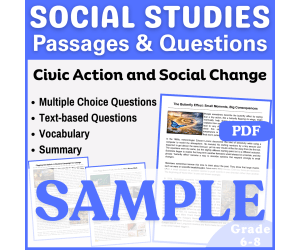
Reading Comprehension Passage: The Butterfly Effect (PDF Sample)
ELA, Reading, Reading Comprehension, Strategies, Resources for Teachers, Social Studies, Sociology, Grade 6, 7, 8, 9, Writing Prompts, Worksheets & Printables, Centers, Activities, Teacher Tools, Assessments, Quizzes and Tests, Quizzes, Tests
This is a ONE PASSAGE SAMPLE. The following is the description of the FULL resource and the downloading links: Social Studies Reading Comprehension Passages and Questions: Civic Action and Social Change (PDF) This resource introduces a collection of Social Studies reading comprehension passages with questions about Civic Action and Social Change. The passages are carefully designed to bridge the gap between social studies and literacy through strengthening reading comprehension and sparking knowledge curiosity in middle school students. Each passage blends English Language Arts skills with accurate social studies content . Ideal for interdisciplinary learning in ELA and Social Studies. Suitable for Grade 9 review, too! What Is Included in this Collection? There are three informational passages (with full answer keys): The Butterfly Effect: Small Moments, Big Consequences From Piggy Bank to Profit: How Banks Make Money Work Flipping the Switch: A Student Campaign for Change For Each Passage, students will have multiple tasks to complete as follow: 5 multiple-choice questions targeting main idea, key details, inference, vocabulary in context, and use of evidence 5 vocabulary matching items with clear, student-friendly definitions 5 text-based questions that require citing specific lines or facts 1 summary prompt that asks students to condense central ideas accurately Available Formats for this Resource Fillable PDF Word Docs Google Docs FULL CATALOG OF DOWNLOADING LINKS HERE For more Social Studies Reading Passages, check the following Links: Ancient Civilizations PDF Fillable PDF Word Docs Google Docs Early Empires and Trade Networks PDF Fillable PDF Word Docs Google Docs The Founding of the United States PDF Fillable PDF Word Docs Google Docs Language, Culture, and Meaning PDF Fillable PDF Word Docs Google Docs Psychology and Society PDF Fillable PDF Word Docs Google Docs Global Festivals and Traditions PDF Fillable PDF Word Docs Google Docs Extreme Environments and People PDF Fillable PDF Word Docs Google Docs Food, Culture, and Preservation PDF Fillable PDF Word Docs Google Docs Global Food Customs PDF Fillable PDF Word Docs Google Docs Media, Communication, and Popular Culture PDF Fillable PDF Word Docs Google Docs Human Impact on the Environment PDF Fillable PDF Word Docs Google Docs Civic Action and Social Change PDF Fillable PDF Word Docs Google Docs Fashion, Society, and Power PDF Fillable PDF Word Docs Google Docs People, Places, and Unusual Histories PDF Fillable PDF Word Docs Google Docs Product Details Length: 15 pages total Grades: 6–8, also suitable for Grade 9 review Use cases: close reading, stations, homework, intervention, test prep, and sub plans Why Teachers Choose This Set Authentic social studies content paired with rigorous literacy practice Consistent task structure across all passages for easier planning and smoother student routines Clear, age-appropriate writing that builds confidence without oversimplifying Use this set to reinforce ELA skills in social studies, to add literacy to your lessons, and to support independent work. The passages strengthen main idea, evidence use, vocabulary in context, inference, cause and effect, and summary writing. With ready-to-use assessments and complete answer keys, you can provide focused practice that is simple to run and fast to review.
Author Middle & High School - CORED Education
Rating
Tags Middle School, Reading Comprehension, Reading Strategies, ELA, Centers, Reading Passage, Assessments, Vocabulary, Social Studies, Civic Action And Social Change
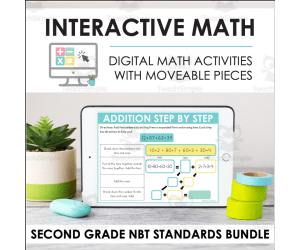
Digital Math for 2nd Grade NBT Standards - (BUNDLE of Slides + Self-Grading Quiz)
Math, Place Value, Grade 2, Quizzes, Quizzes and Tests, Teacher Tools
Digital Math for 2nd Grade NBT Standards - (BUNDLE of Slides + Self-Grading Quiz) A comprehensive teaching resource, designed to make math instruction both engaging and efficient. This practical bundle addresses all NBT standards 2.NBT.1 through 2.NBT.9, making it an all-inclusive tool for teaching your 2nd-grade students essential aspects of place value. Interactive Slides The resource employs interactive slides to present mathematical concepts in a user-friendly manner that motivates students to learn. The child-centric design encourages hands-on learning as learners can drag, drop, and sort images actively engaging with the lessons. Engaging Activities Integrated into Each Slide Deck The activities provide practical applications of taught concepts for the reinforcement of learning. Accentuates student's understanding while keeping them engrossed in the process. User-Friendly Formats Included: PowerPoint and Google Slides These lessons easily integrate into your virtual or physical classroom settings regardless of platform preference. Instructs seamlessly allowing assignment customization – assign either full files or individual slides based on curricular need. Incorporates Self-Grading Quizzes via Google Forms for Each Standard Covered: Lowers paperwork load while providing instant results on student performance. Serves as additional tasks that solidify concept grasp. The versatility ensures optimal usage across different educational scenarios: - Perfectly fits within distance learning plans due to its digital nature; - Vibrant group settings remain integral and stimulating within traditional classrooms or small group instruction. As such, Digital Math for 2nd Grade NBT Standards - (BUNDLE of Slides + Self-Grading Quiz) stands as an integrated solution marrying teaching with tech – transforming mathematical instruction into an enjoyable, enriching process.
Author Markers and Minions
Tags Place Value, Interactive Slides, Hands-on Learning, Self-grading Quiz, Digital Math

Guided Reading Level H - The Story of the Wheel
ELA, Resources for Teachers, Reading Comprehension, Reading, Language Development, Vocabulary, Engineering, Technology, Science, Physics, Kindergarten, Grade 1, 2, Worksheets & Printables, Worksheets, Teacher Tools, Centers, Activities, Literacy Readers, Quizzes, Quizzes and Tests, Assessments
This Guided Reading Book - The Story of the Wheel (Level H) includes: Guided Reading Color Label (front cover x1) This is a quick way to match the book’s demands to what students can generally handle.. The overall goal is to use the level/color to pick books for several smaller groups. To qualify for a certain level, a student is expected to read a book from that level with about 90–94% accuracy. If a student is consistently accurate and understands, move up a level. If the student is struggling at that level, drop down and add more support. Each student will improve at completely different rates, but it is generally one of the best ways to check progress across the class. DOWNLOAD THE CATALOG TO VIEW ALL GUIDED READING BOOKS AVAILABLE (SORTED LEVELS A-Z) Pre-Reading Question (x1) Teacher asks the prompt aloud, can be while showing the cover or first page. Students share what they already know, or make educated guesses from the cover. Prompt them to use the target vocabulary. Write some of their responses on the board to look back at during the reading. Vocabulary Words (x5) Introduce the five words, best doing it one at a time. Start by saying it, while students repeat and then see if anyone knows what it means before reading further. Read through the meaning and try to briefly connect each word to a picture or gesture so it’s meaningful. Ask students to flip through the book pages and point to where they see each of the vocabulary words. While reading the book pause upon coming across one of the vocab words or read the sentence twice to make sure students understand the word has appeared. Optional: Ask students to raise hands whenever they see/hear one of the new words. Guided Reading Pages (x10) Check the book snapshot (below) for: primary topic - do you need to prep extra reading or intro materials on this? what is taught best - decide on 1-2 bullets to focus on, use the prompt or words provided here for best results. learning goals - what you are checking for students to be able to do after the session, elicit answers using prompts or words provided. key vocabulary (see section above). questions overview - so you know what is coming up and if you need to prep extra materials to assist understanding. Run the lesson You may have already looked at a few of the pages together, but you can show them some of the pictures again first to set meaning. Depending on how much time you have and how familiar your students are with guided reading class, you may want to read the book aloud first with the group first. Students whisper or partner read, while you listen in. If time, do it as a group, one student reading a page each. Use the guided page’s prompts to coach: “Check the picture / does it make sense?” “Point under the words / try the first sound” “Reread the sentence smoothly”. Try to focus more on one student per session (rotating every time), so you can work out if they are ready to move up or need to move down a level. Comprehension Questions (back cover x3) This is your way to check that students didn’t just say the words, but actually understood the text. First, let students answer by pointing to the page/picture and saying a short sentence. After any answer, follow with: “Show me where you found that in the text.” In bigger groups, have partners answer first (10–20 seconds), then call on 2–3 students to share. Differentiation tips: Emerging speakers/struggling readers: oral + pointing On-level: oral in a full sentence Higher: one written sentence or draw + label Book Snapshot Title: The Story of the Wheel Genre: Nonfiction (informational) Subject: Science (Engineering / Simple Machines) Primary Topic: How wheels changed over time and how they work Estimated Guided Reading Level (A–Z): H What This Book Teaches Best What wheels are and what they help people do: move heavy things with less effort. How wheels changed over time (from heavy stone/wood wheels to spoked wheels to modern rubber tires). Why different wheels are designed differently for different jobs (tractor treads for mud; thin bicycle wheels for speed; small wheels for gliding). That not all wheels are for travel—gears are wheels with teeth that help machines move. Learning Goals Students will explain what wheels are used for using a detail from the text. Students will describe how the first wheels were made long ago, according to the book. Students will explain why spoked wheels helped carts move faster using the book’s comparison. Students will describe how treads help tractor wheels move through thick, wet mud. Students will identify one way gears are different from travel wheels and tell what gears do in machines. Key Vocabulary From the Text spokes — thin parts connecting the center to the outside. oxen — strong animals that pull heavy loads. rubber — stretchy material used to make tires. treads — deep grooves that help a tire grip ground. gears — wheels with teeth that help machines move. Discussion Prompts Pre-reading question: How do you think wheels help people move things more easily? Comprehension questions: What does the book say wheels are used for? What were the very first wheels made from long ago? What are gears, and what do they help machines do? Printing Tips 1. Best Printing Method (Recommended) “Booklet” Printing (Best if Available) If your printer or PDF viewer supports Booklet Printing , use this. Settings to use: Print mode: Booklet Paper size: Letter or A4 (either works) Orientation: Landscape Print on both sides: Yes Flip on: Short edge Scaling: Fit to printable area Booklet subset: First test: Front sides only Then: Back sides only This will automatically: Pair pages correctly Put the cover on the outside Align everything for folding After printing, fold in half and staple along the spine . 2. If “Booklet” Printing Is NOT Available You can still print this correctly with manual duplex printing . Step-by-step: Open the PDF. Choose Print . Set: Orientation: Landscape Pages per sheet: 1 Print on both sides: Yes Flip on: Short edge Print all pages . Because each PDF page already contains two facing book pages, the result will still fold cleanly into a book. Thousands of Cored Education products are included with your TeachSimple membership. Download links and encyclopedia index available here.
Author Cored Education
Rating
Tags Vocabulary, Reading Comprehension, Reading Passages, Leveled Reading, Nonfiction, Reading, Guided Reading, Physics, Engineering, Technology
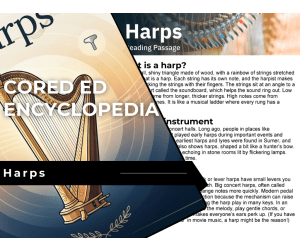
Harps Reading Comprehension Passage - Cored Ed Encyclopedia
ELA, Language Development, Resources for Teachers, Reading Comprehension, Reading, Pre-Reading, Writing, Strategies, Music, Creative Arts, Grade 2, 3, 4, 5, Worksheets & Printables, Worksheets, Teacher Tools, Centers, Activities, Writing Prompts, Assessments, Tests, Quizzes and Tests, Quizzes
This harps reading comprehension contains the following: Pre-Reading Trivia Students will write down one thing they already know about the subject and then read five more facts and discuss. These facts are fun, and the students will enjoy learning about the subject before reading more. Reading Passage The text is a high-interest reading passage with set paragraphs, roughly three to four paragraphs long. It contains a variety of themes about the topic, anywhere from history to technology. The passage is between 250 and 350 words in length. Mixed Questions The first question page contains four multiple-choice questions, each with a choice of four answers, and three written response questions that require a sentence or two from the student. Creative Writing In this question, the student will be required to write a five to eight sentence paragraph on a question related to the topic. Extension Activities This page is optional for fast finishers. If there are five to ten minutes left at the end of the lesson, the student can choose one of three activities, each one requiring a different skill. Answer Key There are answers for the multiple-choice questions and three written response questions have sample answers. FULL CATALOG OF DOWNLOAD LINKS AND ENCYCLOPEDIA INDEX HERE Lesson Snapshot Title: Harps Genre: Nonfiction (informational text) Subject: Music (Informational Reading) Primary Topic: How harps work, types, and early history Estimated Guided Reading Level (A–Z): O What This Lesson Teaches Best Explains what a harp looks like and how it makes sound when strings are plucked. Connects string length and thickness to low and high notes (how pitch changes). Describes the soundboard’s role in helping the sound “ring out.” Introduces harps as an ancient instrument and names early places they were played (Mesopotamia, Egypt, Sumer). Compares types of harps today (lever harps vs. pedal harps) and what levers/pedals do to change pitch. Learning Goals Describe how a harp makes sound using details from the passage. Explain how longer/thicker strings and shorter/thinner strings relate to low and high notes. Identify what the soundboard does for the harp’s sound. Compare lever harps and pedal harps by explaining how each changes pitch. Summarize evidence that harps are very old by naming where early harps were played or found. Key Vocabulary From the Text soundboard — flat wooden part that helps sound ring out. plucking — pulling and releasing strings with fingers to make sound. pitch — how high or low a note sounds. glissando — a swooshing sound moving across many notes. mechanism — parts that work together to change something. Cored Ed Encyclopedia Overview The Cored Ed Encyclopedia is a weekly series of lessons that you can pick up and use right away. These short readings fit into whatever time you have available. Each one includes a warm-up, a reading, and a set of questions, but it’s flexible — you can do just the reading, the full lesson, or skip the writing section if you need to. Each lesson focuses on a single topic so students don’t get lost. The writing is clear but never childish, making it perfect for grades two through five. Topics range from animals and science to history, inventions, and everyday things. No matter the level of the student, everyone should take away at least one new idea or fact from each lesson. The materials are easy to print, easy to explain, and require no setup. They work well for whole-class teaching, partner work, or independent study.
Author Cored Education
Rating
Tags Vocabulary, Spelling, Reading Comprehension, Reading Passages, Reading, Creative Writing, Reading Strategies, Writing Prompts, Harps, Music

Reading Comprehension Quizzes for Grade 3
ELA, Reading Comprehension, Reading, Grade 3, Teacher Tools, Assessments, Quizzes and Tests, Quizzes, Worksheets & Printables
Reading Comprehension Quizzes for Grade 3: A Collection of Reading Passages with Comprehension Quizzes and Answer Keys for 3rd Grade Boost comprehension, critical thinking, and test-readiness with this focused reading comprehension quiz resource designed to prepare students for ELA standardized testing and build essential comprehension skills critical for academic success. Reading Comprehension Quizzes is a no-prep, user-friendly resource that includes 4 engaging reading passages targeted to a 3rd grade reading level. Each reading passage is followed by a quiz comprised of multiple choice questions requiring students to refer back to the text to find evidence that supports their answers, boosting their critical thinking and analytical reading skills. The quizzes can also be used as an assessment tool for students' reading comprehension skill levels. Features • 4 engaging reading passages including a funny story, a fable , informational text and a legend • Quizzes containing multiple choice questions to reinforce comprehension and close reading skills • Answer Keys for easy assessment • No-prep, 18 pages in easily printable PDF format Although the reading passages and quizzes are targeted to a 3rd grade reading level, this resource can also benefit older students and English language learners. The printable PDF format makes it easy to incorporate these comprehension quizzes into classroom lesson plans, individualized reading programs, homework assignments, assessments and test prep. The Reading Passages 1. Camping Under the Stars, Funny Story 2. The Boy Who Cried Wolf, Fable 3. The Lizard and the Sun, Mexican Legend 4. What Is the Iditarod?, Informational Text This resource addresses the following 3rd Grade Common Core ELA Reading standards. RI3.1, RI3.10, RL3.1, RL.3.2, RL3.4, RL.3.10, CCRA.R.1
Author WorksheetsPlus
Tags Reading Comprehension Quizzes, Comprehension Quizzes, ELA Test Prep, Test Prep, 3rd Grade, Close Reading, Reading Quiz, Comprehension Tests, Reading Comprehension
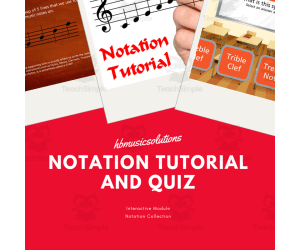
Notation Tutorial and Quiz | Interactive Notation Exercises
Creative Arts, Art, Music, Grade 1, 2, 3, 4, Quizzes, Quizzes and Tests, Teacher Tools
Notation Tutorial and Quiz | Interactive Notation Exercises: A Comprehensive Teaching Tool This excellent resource for educators combines instructive videos and interactive exercises. Designed to enhance the music notation skills of learners from 1st through 4th grades, it presents the essentials of reading music notation in a straightforward way. Tutorial Section: Videos & Quizzes The tutorial section is composed of succinct videos that provide clear instruction on each element of notation reading. With these tutorials, learners are given a quick guide to understanding music notation effectively. Following these informative tutorials, students are given a short quiz designed to assess their understanding and retention. Accessibility & Usability The resource material is provided as links in a downloadable PDF file, making access easy for teachers or direct use by students across different platforms like PCs or tablets. The files must be unzipped after downloading - guidance is offered within the document itself. Please note there may be compatibility issues with Mac users presently. After unzipping successfully, save them on your hard drive and click 'launch story' when ready to start using it. Diverse Learning Environments & Unique Features This material has been optimized for both individual learning and group classes - compatible with projectors! Also noteworthy are features incorporated into computer and tablet versions that randomize slides every time – essentially providing an inexhaustible supply of exercise material! In addition,, smart board compatibility, exclusive to the computer version offers even more potential learning avenues! In summary; this learning tool will prove beneficial whether you're teaching in a public school setting or seeking out ideal homeschool resources focusing specifically on music lessons. Notation Tutorial and Quiz | Interactive Notation Exercises effectively meets your learners' educational goals whilst making learning an enjoyable experience!
Author Hbmusicsolutions's Shop
Tags Music Notation, Tutorial, Interactive Exercises, Reading Music, Learning Tool

Jewelry Reading Comprehension Passage - Cored Ed Encyclopedia
ELA, Reading Comprehension, Reading, Language Development, History, Social Studies, Science, Physics, Life Sciences, Earth and Environmental Sciences, Grade 2, 3, 4, 5, Worksheets & Printables, Worksheets, Teacher Tools, Centers, Activities, Writing Prompts, Assessments, Quizzes and Tests, Quizzes, Lesson Plans
This Jewelry reading comprehension with lesson plan includes: Visualization (on the front cover) Start your lesson by taking a minute to think and share something about the topic. Read the script aloud (slowly), perhaps prepare some music or sound effects. Student close their eyes and let their imaginations wander. Students open their eyes, read the question aloud and give them a few minutes to complete. Ask a few students to share or keep answers until the end to compare with what they learn in the passage. Quick pause—thousands of Cored Education products are included with your TeachSimple membership. Download links and encyclopedia index available here. Pre-Reading Trivia Students will write down one thing they already know about the subject and then read five more facts and discuss. These facts are fun, and the students will enjoy learning about the subject before reading more. Give 1 minute for students to write what they already know (no pressure—best guess is fine). Read the five facts together. After each fact, do ask a student for their opinion, was it surprising? Set a purpose by asking students to highlight/underline one fact they want to learn more about during the reading. Reading Passage The text is a high-interest reading passage with set paragraphs, roughly three to four paragraphs long. It contains a variety of themes about the topic, anywhere from history to technology. The passage is between 250 and 350 words in length. First, ask students to look at the headings and see what they’ll learn about today. What do they know about the topic/heading? First read options: Teacher read-aloud (best for support). Partner reading (paragraph by paragraph). While reading, students underline important details, and vocabulary words they think may come up in the questions section. Mixed Questions The first question page contains four multiple-choice questions, each with a choice of four answers, and three written response questions that require a sentence or two from the student. Students complete the mcqs first independently, then review quickly as a class. For the 3 written responses, try to get students giving the answer with some form of evidence: “I think ___ because the text says ___.” If students get stuck, send them back to check the passage. Vocabulary Questions Practice seven key words from the text in this section across two activities. First section is scrambled words where students will unscramble three words given a clue for each. The second section is a word to meaning matching activity. Before starting, have some students read out words they underlined in the passage. Ask students to say the word and read aloud the sentence(s) around each word. Ask students to do scrambled words and the matching exercise in pairs then go through answers as a class. For the scrambled spelling task, get four pairs to come up to the board and write the words for extra practice with the other student reading out the clue. For the matching task, prompt students to give full sentences: “I matched ___ with ___ because ___.” Creative Writing In this question, the student will be required to write a five to eight sentence paragraph on a question related to the topic. Before starting, ask students write down 3 key ideas they are going to include in their piece. Ask students for ideas to share around the class to help those struggling. Pro writing expectations: 5–8 sentences At least 2 facts or details from the passage At least 2 vocabulary words from the previous page Students read their paragraphs while classmates listen for facts and vocabulary words. Extension Activities This page is optional for fast finishers or to take home. There are several activities, each one requiring a different skill. Do some, do none, do all, completely optional - but you will feel reassured knowing every possibility is planned for. Includes summary writting question and additional facts. Answer Key There are answers for the multiple-choice questions, written response questions have sample answers, vocabulary answers and if there is a summary question then a sample summary will be provided as well. Lesson Plan Included Customized lesson plan for this lesson is included. Lesson Snapshot Title: Jewelry Genre: Nonfiction (informational text) Subject: Reading (Informational Text) / Social Studies Primary Topic: Jewelry history, materials, meaning, and sparkle Estimated Guided Reading Level (A–Z): R What This Lesson Teaches Best Explains that people made and wore jewelry long ago using shells, teeth, and bone, and includes evidence archaeologists found (seashells with holes worn smooth). Shows how new tools changed jewelry-making by shaping gold into beads, bracelets, and pieces worn close to the skin. Introduces where gems come from (hard minerals from the earth and some from living things, like pearls and amber). Describes how cutting gems into flat faces called facets increased sparkle and how factories later made fake gems. Emphasizes that jewelry can matter because of symbols, faith, celebrations, and memories—not only because it is bright or rare. Learning Goals Describe evidence the passage gives that very old shell beads were worn as jewelry. Explain how tools helped people shape gold into jewelry long ago. Identify where different gems can come from (earth minerals or living things) using details from the text. Explain how facets changed the way gems looked and why they started to “dance and flash.” Describe reasons people wear jewelry today (faith, celebration, marking life moments, memories). Key Vocabulary From the Text archaeologists — scientists who study the human past. ceremonies — special events held for a purpose. minerals — natural, nonliving materials from the earth. facets — flat faces cut on a gemstone. amber — hardened sticky tree sap used as a gem. FULL CATALOG OF DOWNLOAD LINKS AND ENCYCLOPEDIA INDEX HERE
Author Cored Education
Rating
Tags Vocabulary, Reading Comprehension, Reading Passages, Lesson Plans, Ela Lesson Plans, Reading Comprehension Lesson Plans, Pre-reading, Science Lesson Plans, Earth Science, Physics
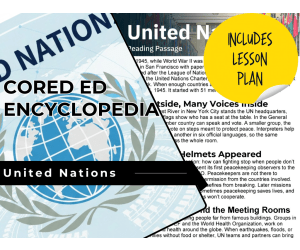
United Nations Reading Comprehension Passage - Cored Ed Encyclopedia
ELA, Language Development, Reading Comprehension, Reading, Pre-Reading, Vocabulary, History, Social Studies, Government, Writing, Grade 2, 3, 4, 5, Worksheets & Printables, Worksheets, Teacher Tools, Centers, Activities, Writing Prompts, Assessments, Quizzes and Tests, Quizzes, Lesson Plans
This United Nations reading comprehension with lesson plan includes: Visualization (on the front cover) Start your lesson by taking a minute to think and share something about the topic. Read the script aloud (slowly), perhaps prepare some music or sound effects. Student close their eyes and let their imaginations wander. Students open their eyes, read the question aloud and give them a few minutes to complete. Ask a few students to share or keep answers until the end to compare with what they learn in the passage. Quick pause—thousands of Cored Education products are included with your TeachSimple membership. Download links and encyclopedia index available here. Pre-Reading Trivia Students will write down one thing they already know about the subject and then read five more facts and discuss. These facts are fun, and the students will enjoy learning about the subject before reading more. Give 1 minute for students to write what they already know (no pressure—best guess is fine). Read the five facts together. After each fact, do ask a student for their opinion, was it surprising? Set a purpose by asking students to highlight/underline one fact they want to learn more about during the reading. Reading Passage The text is a high-interest reading passage with set paragraphs, roughly three to four paragraphs long. It contains a variety of themes about the topic, anywhere from history to technology. The passage is between 250 and 350 words in length. First, ask students to look at the headings and see what they’ll learn about today. What do they know about the topic/heading? First read options: Teacher read-aloud (best for support). Partner reading (paragraph by paragraph). While reading, students underline important details, and vocabulary words they think may come up in the questions section. Mixed Questions The first question page contains four multiple-choice questions, each with a choice of four answers, and three written response questions that require a sentence or two from the student. Students complete the mcqs first independently, then review quickly as a class. For the 3 written responses, try to get students giving the answer with some form of evidence: “I think ___ because the text says ___.” If students get stuck, send them back to check the passage. Vocabulary Questions Practice seven key words from the text in this section across two activities. First section is scrambled words where students will unscramble three words given a clue for each. The second section is a word to meaning matching activity. Before starting, have some students read out words they underlined in the passage. Ask students to say the word and read aloud the sentence(s) around each word. Ask students to do scrambled words and the matching exercise in pairs then go through answers as a class. For the scrambled spelling task, get four pairs to come up to the board and write the words for extra practice with the other student reading out the clue. For the matching task, prompt students to give full sentences: “I matched ___ with ___ because ___.” Creative Writing In this question, the student will be required to write a five to eight sentence paragraph on a question related to the topic. Before starting, ask students write down 3 key ideas they are going to include in their piece. Ask students for ideas to share around the class to help those struggling. Pro writing expectations: 5–8 sentences At least 2 facts or details from the passage At least 2 vocabulary words from the previous page Students read their paragraphs while classmates listen for facts and vocabulary words. Extension Activities This page is optional for fast finishers or to take home. There are several activities, each one requiring a different skill. Do some, do none, do all, completely optional - but you will feel reassured knowing every possibility is planned for. Includes summary writting question. Answer Key There are answers for the multiple-choice questions, written response questions have sample answers, vocabulary answers and if there is a summary question then a sample summary will be provided as well. Lesson Plan Included Customized lesson plan for this lesson is included. Lesson Snapshot Title: United Nations Genre: Nonfiction (Informational text) Subject: Social Studies (Civics/Global Studies) Primary Topic: How the UN began and works for peace Estimated Guided Reading Level (A–Z): P What This Lesson Teaches Best Origins and purpose of the UN: Explains that delegates from 50 countries met in San Francisco in 1945 and signed the United Nations Charter, leading to the UN officially beginning on October 24, 1945. How countries work together in the UN: Describes the UN headquarters in New York City and how member countries speak and vote in the General Assembly, while a smaller group (the Security Council) votes on steps meant to protect peace. Peacekeeping basics: Introduces UN peacekeeping observers (UNTSO) and explains that peacekeepers watch, report, and help keep ceasefires from breaking (and are not there to conquer). Communication across languages: Shows why interpreters matter by explaining that leaders use interpreters in six official languages so the same message can travel across the room. UN help beyond meetings: Notes that UN groups like UNICEF and the World Health Organization work on children’s needs, health, and bringing supplies after earthquakes, floods, or wars. Learning Goals Students will identify key dates and events that led to the UN officially beginning in 1945. Students will describe how the General Assembly and the Security Council are different, using details from the text. Students will explain what the United Nations Charter is and what it was meant to help countries do. Students will summarize what peacekeepers do and why peacekeeping can be hard when countries won’t cooperate. Students will use context clues to determine the meaning of key words such as interpreters and ceasefires . Key Vocabulary From the Text delegates — people chosen to represent a country at a meeting. Charter — a written promise that explains a group’s goals. headquarters — the main building where an organization works. interpreters — people who change speech into another language. ceasefires — times when fighting stops for a while. FULL CATALOG OF DOWNLOAD LINKS AND ENCYCLOPEDIA INDEX HERE
Author Cored Education
Rating
Tags Vocabulary, Reading Comprehension, Reading Passages, Lesson Plans, Ela Lesson Plans, Reading Comprehension Lesson Plans, Pre-reading, Social Studies Lesson Plans, Social Studies, Government
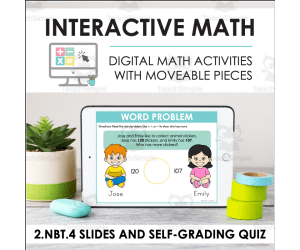
Digital Math for 2.NBT.4 - Understanding Place Value (Slides + Self-Grading Quiz)
Math, Place Value, Grade 2, Quizzes, Quizzes and Tests, Teacher Tools
Digital Math for 2.NBT.4 – Understanding Place Value A substantive teaching resource ideal for educators aiming to foster a secure understanding of math concepts in an engaging, interactive environment. Particularly designed for Grade 2 instructors, this digital tool emphasises the concept of place value. Key Components: Unique interactive slides which serve as both a review and practice material. Available in PowerPoint and Google Slides formats allowing flexibility in approach and task assignment. An inclusive self-grading quiz powered by Google Forms enables real-time knowledge assessment while providing vital data for further instruction adjustment. This feature-rich product stands out due to its exceptional focus on promoting active student involvement using dynamic mathematical visuals and interface interactions such as dragging, dropping, and sorting images according to instructions provided on each slide. Versatility & Flexibility The versatility offered by various file types helps teachers adapt their teaching methods effortlessly. It also facilitates the assignment of tasks—whether it's the entire file or just selected slides—through online platforms such as Google Classroom. Self-Grading Quizzes & Real-Time Assessment A remarkable resource provided within this product includes its self-grading quiz feature powered by Google Forms. This function is capable of evaluating students' knowledge attainment in real time while providing crucial data necessary for progress tracking along with adjustments needed in instructional techniques—an invaluable aid when monitoring individual learning paths.Note: This is an exclusive unique selling point of this product that sets it apart from similar tools available! Detailed Coverage: Last but not least—a crucial aspect covered through these resources includes: Covering standard 2.NBT.4 over a span of 20 interactive slides specifically designed for second graders—a valuable tool for distance learning or revamping existing small group instruction routines or center-based activities. Conclusion This product promises an enriched teaching experience paired with highly adaptable functionality to any teacher aiming to facilitate a vibrant learning environment that keeps students engaged while delivering relevant content with minimal preparation. A deep dive into Digital Math's resources is definitely worth the exploration!
Author Markers and Minions
Tags Place Value, Interactive Slides, Digital Math, Self-grading Quiz, Real-time Assessment
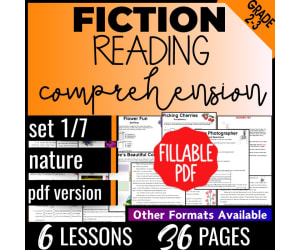
Reading Comprehension Passages Fiction Set 1 - Nature (Fillable PDF)
ELA, Reading, Reading Comprehension, Common Core, ESL, Language Development, Spelling, Vocabulary, Writing, Resources for Teachers, Grade 2, 3, Worksheets & Printables, Worksheets, Writing Prompts, Assessments, Teacher Tools, Quizzes, Quizzes and Tests, Centers, Activities
Reading Comprehension Passages Fiction Set 1 Snapshot Genre: Fiction (collection of short nature-themed stories) Subject: Reading (Comprehension) Primary Topic: Nature-themed fiction passages and comprehension practice Estimated Guided Reading Level (A–Z): O What This Teaches Best Character feelings and motivations: Characters want or value something strongly (e.g., Kellie wants snow to use her new sled; Rusty wants to finish his color task; Ross would rather play but ends up enjoying his work). Observation and using the environment for answers: Rusty finds blue and purple by looking more carefully at what’s around him (sky, stream, leaf backs). Cause and effect in everyday situations: Weather and choices affect what happens next (snow finally comes; a thunderstorm ends cherry picking; a volcano eruption changes the climbers’ plans). Nature vocabulary in meaningful contexts: Words connected to seasons, plants, animals, and outdoor features appear across the stories (snow “accumulation,” “canopy,” “eruption,” “perennials,” “marmalade”). Built-in practice pages that match the passages: Each story is followed by questions and skill pages (mixed questions, spelling/vocabulary, short writing prompts) that directly reference details from the story text. Learning Goals Students will recount key events from a selected story in a logical order using details from the text. Students will describe characters’ wants, feelings, and choices and connect them to what happens in the story. Students will identify the setting/season and name text evidence that supports it. Students will explain cause-and-effect relationships shown in the stories (problem → response → outcome). Students will use context clues to determine the meaning of unfamiliar words from the passages. Students will compare information presented in the story (for example, annuals vs. perennials) by stating how they are different using the text’s wording. Passages Include 1.Bring on the Snow: Kellie wants to make it snow. How does she try? 2.Walk through the Woods: A walk in the woods turns into a huge adventure. 3.Nature Photographer: Donna get some amazing snaps in this story. 4.Nature's Beautiful Colors: Rusty enjoys finding out about the colors in nature. 5.Flower Fun: Learn about flower names and colors in this fun lesson. 6.Picking Cherries: Ross spends his day picking cherries but is it worth it? Additional File: Nature Photographer: Drawing Nature Printable FILLABLE PDF VERSION Worksheet-style pages, but with type-in answer boxes so students can complete and save their work digitally. Other versions are available in the links list below or in the full catalog. FULL CATALOG OF DOWNLOAD LINKS HERE For similar downloads and other frees, do check out Cored Group on TeachSimple.
Author Cored Education
Rating
Tags Elementary, Reading, Comprehension, Vocabulary, Common Core, Speling, Writing, Passages, Reading Centers, Reading Comprehension Assessments
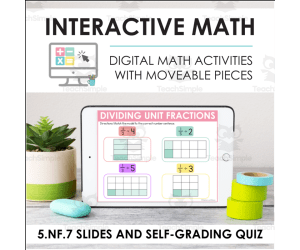
Digital Math for 5.NF.7 - Apply Understandings of Multiplication and Division (Slides + Self-Grading Quiz)
Math, Fractions, Grade 5, Quizzes, Quizzes and Tests, Teacher Tools
Digital Math for 5.NF.7 - Apply Understandings of Multiplication and Division This is a zero-prep, all-digital teaching tool complete with slide presentations and a self-grading quiz. It's specifically crafted to help educators in fifth grade impart knowledge on fractions. The material hones students' understanding of multiplication and division concepts. Interactive Math Slides These slides offer review sessions, practice exercises, and enrichment activities in an engaging manner. The visual teaching methods incorporated enable students to interact with the material—dragging, dropping, sorting images—which promotes a deeper understanding of fractions. Self-Grading Google Forms Quiz A follow-up quiz that grades itself provides instant feedback on each student's progress—an essential tool when dealing with larger classes as it offers time efficiency while ensuring accuracy. Versatile Implementation & User Convenience The resource can be integrated into whole group instruction. It can be leveraged for small group teaching. You may assign it as individual homework. This flexibility allows tailoring of instruction based on the educators’ style or student needs. The Powerpoint slides included can be assigned easily through Google Classrooms. Comprehensive instructions accompany this product which enables teachers to either assign specific slides or the entire file at once depending upon their lesson plan allowing adaptability to individual classroom needs. In Conclusion, Digital Math for 5.NF.7 covers everything from clarifying complex mathematical concepts through interactive digital slides up till progression evaluation through quizzes — making it an indispensible asset whether you are instructing remotely or face-to-face.The unique blend of practicality along with comprehensive coverage helps Grade-5 students build thorough conceptual clarity regarding application of multiplication & division during fraction enumeration.
Author Markers and Minions
Tags Digital Math, Multiplication, Division, Interactive Slides, Self-grading Quizzes

Current Electricity - 35 Question Interactive Quiz
Science, Physics, Grade 5, 6, 7, 8, Quizzes, Quizzes and Tests, Teacher Tools
The Current Electricity - 35 Question Interactive Quiz This versatile teaching tool is adept at aids in fortifying students’ basic understanding about current electricity. This comprehensive resource provides an interactive learning experience focused on all key aspects of current electricity. Our detailed, interactive quiz comprises of 35 questions, covering a variety of topics: Understanding the terms such as current, voltage and resistance; Distinguishing between conductors and insulators; Circuit symbols identification; Understanding units and measurements for current and voltage; Making sense of circuit diagrams; Familiarization with specific configurations like series and parallel circuits etc. The method: To make learning engaging, this resource stands out in its game format presentation. Playable individually or in teams, students jot down answers to thought-provoking questions while keeping track on provided answer sheets. Corrections are made easy with accompanying Interactive Answer PowerPoints that not only display original questions but also clarify correct responses. Suited for specific levels: This interactive quiz is tailored to meet the requirements for Grades 5 through 8 – particularly apt for science classes purposed towards physics teaching. Included Material: *Easy-to-follow Instruction Sheet included*; This can be smoothly incorporated into any lesson plan whether it's a whole group setting or small group activities or even assigned as homework. Prior Knowledge Required: Students must have some preliminary exposure to topics like symbol recognition associated with electricity; differentiation between metals and non-metals in terms of conductivity versus insulation properties among many other facts. Conclusion: All-in-all, this Current Electricity - 35 Question Interactive Quiz proves to be superior as compared to traditional assessment means thanks to its vibrant ambiance mixed with rigorous question sets. It is meticulously packed into a single 1 zip file for easy retrieval and storage. A fitting choice for educators desiring efficient seepage of electrical concepts while ensuring active student participation leading arguably towards high-voltage classroom sessions!
Author Elf off the Shelf Resources
Tags Current, Electricity, Quiz, Interactive Learning, Circuits

Experiential Learning – Community Problem-Solving Projects
Social Studies, Government, Sociology, History: USA, History, Resources for Teachers, Classroom Management, Community Building, Special Resources, Social Emotional Learning (SEL), Grade 5, 7, 8, 9, 10, 11, 12, Worksheets & Printables, Workbooks, Worksheets, Word Searches, Teacher Tools, Assessments, Lesson Plans, Quizzes and Tests, Quizzes, Tests
Utilizing the no-prep experiential learning unit on solving community issues will empower your students to be active learners and members of their community by providing them with a hands-on, project-based learning (PBL) experience that goes far beyond the traditional textbook. The complete curriculum guide and student workbook for this PBL unit will give you all the necessary information to create an engaging and effective PBL unit with your middle school students. The curriculum is built on the proven E.P.I.C framework (empathize, probe, innovate, commit), which will lead them through the entire civic action process, from identifying an authentic community issue, to conducting research about that issue, to designing a sustainable solution, to implementing their proposed solution. ● Learning Objectives For Participants: 1. Developing Systems Thinking through the use of tools like Iceberg Model and Five Whys, to identify underlying causes of issues rather than just surface level symptoms. 2. Supporting Empathetic Research by conducting interviews with Stakeholders and Mapping Community Assets through uses of Asset-Based Community Development. 3. Developing Data Analysis through differentiating and collecting data from both Qualitative and Quantitative sources in order to effectively communicate the case for change. 4. Supporting Design Thinking and Innovation by brainstorming and using a Feasibility/Impact Matrix to develop the best ideas. 5. Developing project management through Budgeting, Resources Allocation, Timelines with Milestones and Risk Mitigation. 6. Developing Persuasive Communication by learning how to "Pitch" using Ethos, Pathos and Logos to obtain Stakeholder Buy-In. 7. Developing Resilience and Reflection by gaining experience with real-world friction, by learning from successes and failures. Basic Content Summary. The following outlines the contents of the 39-page PDF document: - Part 1 is the Teacher's Theoretical Guide (approximately 11 pages in total) and provides a comprehensive overview of experiential learning's pedagogical background. The guide will give you the ability to facilitate, and confidence to use, experiential learning with your students. - Part 2 is the Student Workbook (about 16 pages total) and has worksheets that are scaffolded for each step of the project from community mapping through to summative reflection; includes 10 different worksheets. - Part 3 is comprised of Visuals & Teacher Resources (about 12 pages total). - Classroom Visuals: Contains anchor charts for The Experiential Learning Cycle, Root Cause Analysis (Fishbone Diagram), and the Strategic Intervention Matrix. - Comprehensive Answer Key & Rubrics: Contains exhibiting example rubrics at every stage (from Substandard to Advanced responses) so that grading is on the process of completion—this means your students know what to expect when working on this project! - Teacher Implementation Guide: Provides suggestions on becoming a guide on the side to your students, how to manage issues that may arise throughout the project, as well as how to create psychological safety for your students. Social Studies, Civics, Government, Leadership, Service-Learning, and Project-Based Learning (PBL) classrooms can benefit from using this resource to empower their students to positively impact the world around them. Download this resource today to begin developing the next generations of architects who will create social change! Projects Based Learning, (PBL), Experiential Learning, Civic, Social Studies, Middle School, Community Service, Servic eLearning, Problem Solving/ Critical Thinking/ Designthinking, Student Workbook (and Teacherguide). This resource also contains Rubrics, No Prep needed, Printable, Leadership and Civic engagement. What Makes It Good for Parents & Schools: Teaches 21st Century Skills Through Real-Life Scenarios: This learning experience is much more than hand memorizing; it teaches students real life skills that they will use throughout highschool, college, and their professional lives, such as budgeting, project management, public speaking, and analyzing data. Promotes Empathy and Civic Responsibility: Through class activities and community projects that are performed as a group and individulally, students will inherently develop a sense of empathy toward others and their community, realizing that they can and should take responsibility for helping bring about positive changes. Develops Resiliency & Growth Mindset: The curriculum helps students change the way they think about challenges (obstacles) and how they see their own failure (a way to collect information for growth). Students will learn to be resilient, open and flexible to the change of environment/challenges, as well as to be perseverant in overcoming obstacles into adulthood. Provides a Complete Package of A High-Quality, Cross-Curricular, and Academically Rigorou: The project consists of four major areas all integrated into one project: social studies, ie. civic mindedness; math, ie. development of budget(s); ELA, ie. persuasive writing skills; science, ie. collection of data. As a result, the project allows for multiplication of all of the classes learned as opposed to singularly focused learning. Provides Everything Needed in a Complete Turnkey Package: When teachers receive the project; it includes a teacher guide, student workbooks, and visual aids, as well as description of the method to assess the student's work is extremely organized, easy-to-understand as well as easy to implement and to grade both substantively and fairly. Intended Audience by Age Group: Age Breakdown Based on Content, Language and Express; Grades 6-8, (Middle School). Page 2 has an explicit mention of the "critical development window of grades 5-8". The task complexity (Budgeting, Stakeholder Analysis and System Thinking) fits perfectly within this age bracket particularly in 7-8 grade level. Secondary Audience: Advanced 5th grade or as part of Introductory 9th/10th grade course work. Material is substantial enough to be used as a High School Freshman/Sophomore Civics, Government or Leadership Elective Course- and, an awesome resource for Gifted and Talented (of which there are many!) in Middle School. Copyright & Terms Of Use: Syed Hammad Rizvi owns copyright on this book. The materials on this site may be used only by yourself or in your classroom (individually). You may not modify, share, or sell any part of it; therefore you are prohibited from placing it on the Internet so that someone else could download it. If you would like to share the resource with your Co-Workers, please purchase Multiple licenses through Teachsimple. Thank you for abiding by the Terms of Use. We thank you for your continued support of Syed Hammad Rizvi.
Author Creative Book Store
Rating
Tags ProjectBasedLearning, PBL, ExperientialLearning, ServiceLearning, CommunityProblemSolving, CivicEngagement, CivicAction, DesignThinking, SystemsThinking, InquiryBasedLearning
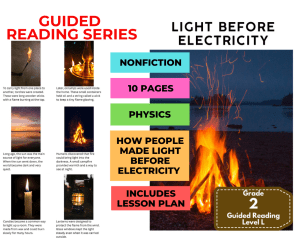
Guided Reading Level L - Light Before Electricity (with Lesson Plan)
ELA, Resources for Teachers, Reading Comprehension, Reading, Science, Engineering, Technology, Physics, History, Social Studies, Grade 1, 2, 3, Worksheets & Printables, Worksheets, Teacher Tools, Centers, Activities, Literacy Readers, Quizzes, Quizzes and Tests, Assessments
This Guided Reading Book - Light Before Electricity (Level L) with lesson plan includes: Guided Reading Color Label (front cover x1) This is a quick way to match the book’s demands to what students can generally handle.. The overall goal is to use the level/color to pick books for several smaller groups. To qualify for a certain level, a student is expected to read a book from that level with about 90–94% accuracy. If a student is consistently accurate and understands, move up a level. If the student is struggling at that level, drop down and add more support. Each student will improve at completely different rates, but it is generally one of the best ways to check progress across the class. DOWNLOAD THE CATALOG TO VIEW ALL GUIDED READING BOOKS AVAILABLE (SORTED LEVELS A-Z) Pre-Reading Question (x1) Teacher asks the prompt aloud, can be while showing the cover or first page. Students share what they already know, or make educated guesses from the cover. Prompt them to use the target vocabulary. Write some of their responses on the board to look back at during the reading. Vocabulary Words (x5) Introduce the five words, best doing it one at a time. Start by saying it, while students repeat and then see if anyone knows what it means before reading further. Read through the meaning and try to briefly connect each word to a picture or gesture so it’s meaningful. Ask students to flip through the book pages and point to where they see each of the vocabulary words. While reading the book pause upon coming across one of the vocab words or read the sentence twice to make sure students understand the word has appeared. Optional: Ask students to raise hands whenever they see/hear one of the new words. Guided Reading Pages (x10) Check the book snapshot (below) for: primary topic - do you need to prep extra reading or intro materials on this? what is taught best - decide on 1-2 bullets to focus on, use the prompt or words provided here for best results. learning goals - what you are checking for students to be able to do after the session, elicit answers using prompts or words provided. key vocabulary (see section above). questions overview - so you know what is coming up and if you need to prep extra materials to assist understanding. Run the lesson You may have already looked at a few of the pages together, but you can show them some of the pictures again first to set meaning. Depending on how much time you have and how familiar your students are with guided reading class, you may want to read the book aloud first with the group first. Students whisper or partner read, while you listen in. If time, do it as a group, one student reading a page each. Use the guided page’s prompts to coach: “Check the picture / does it make sense?” “Point under the words / try the first sound” “Reread the sentence smoothly”. Try to focus more on one student per session (rotating every time), so you can work out if they are ready to move up or need to move down a level. Comprehension Questions (back cover x3) This is your way to check that students didn’t just say the words, but actually understood the text. First, let students answer by pointing to the page/picture and saying a short sentence. After any answer, follow with: “Show me where you found that in the text.” In bigger groups, have partners answer first (10–20 seconds), then call on 2–3 students to share. Differentiation tips: Emerging speakers/struggling readers: oral + pointing On-level: oral in a full sentence Higher: one written sentence or draw + label Book Snapshot Title: Light Before Electricity Genre: Nonfiction (informational) Subject: Science (Technology) / Social Studies (Past and Present) Primary Topic: How people made light before electricity Estimated Guided Reading Level (A–Z): L What This Book Teaches Best The sun was the main source of light long ago, and it got dark when the sun went down. People discovered fire could bring light into darkness and help them see at night. A clear sequence of lighting tools is explained: torches, oil lamps (with a wick), candles, lanterns, gas lamps, electric lightbulbs, and LED bulbs. How inventions solved problems: lanterns protected flames from wind, gas traveled through pipes to power lamps, and electric lightbulbs were safer because they used no real flame. Past-to-present comparison: lighting changed from “flickering fires” to steady electric light you can turn on with a switch. Learning Goals Students will describe why the sun was the main source of light long ago. Students will explain how fire helped people see at night. Students will identify several light sources from the book and describe how each one made light. Students will explain how lanterns kept light steady when carried outside. Students will explain why the electric lightbulb was safer and brighter than candles in the book. Students will describe how LED bulbs are different from older light sources (cool to the touch, little energy). Key Vocabulary From the Text source — where something comes from. torches — long sticks with a flame used for light. wick — a string that helps a lamp or candle burn. invention — something new that someone creates. flickering — shining in a shaky way, like moving firelight. Discussion Prompts Pre-reading question: What kinds of lights do you use when it is dark? Comprehension questions: What was the main source of light for everyone long ago? How did lanterns protect the flame when people carried them outside? Why did the book say the electric lightbulb was safer than candles? Printing Tips 1. Best Printing Method (Recommended) “Booklet” Printing (Best if Available) If your printer or PDF viewer supports Booklet Printing , use this. Settings to use: Print mode: Booklet Paper size: Letter or A4 (either works) Orientation: Landscape Print on both sides: Yes Flip on: Short edge Scaling: Fit to printable area Booklet subset: First test: Front sides only Then: Back sides only This will automatically: Pair pages correctly Put the cover on the outside Align everything for folding After printing, fold in half and staple along the spine . 2. If “Booklet” Printing Is NOT Available You can still print this correctly with manual duplex printing . Step-by-step: Open the PDF. Choose Print . Set: Orientation: Landscape Pages per sheet: 1 Print on both sides: Yes Flip on: Short edge Print all pages . Because each PDF page already contains two facing book pages, the result will still fold cleanly into a book. Thousands of Cored Education products are included with your TeachSimple membership. Download links and encyclopedia index available here.
Author Cored Education
Rating
Tags Reading Comprehension, Reading Passages, Reading, Guided Reading, Guided Reading Lesson Plan, Guided Reading Activity, Pre-reading, Vocabulary, Physics, History
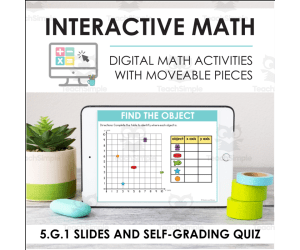
Digital Math for 5.G.1 - Graph Points on the Coordinate Plane (Slides + Self-Grading Quiz)
Math, Geometry, Grade 5, Quizzes, Quizzes and Tests, Teacher Tools
Digital Math for 5.G.1 - Graph Points on the Coordinate Plane (Slides + Self-Grading Quiz) This dynamic education tool is particularly curated for Grade 5 educators aiming to teach the standard 5.G.1 in Math. It combines technology with math lessons, enhancing students' comprehension of geometric concepts. Usability and Accessibility It features a simple deployment function that makes it easy to meld into your lesson plans. These interactive slides are completely digital and paperless, making preparation efficient while promoting a rich learning environment. A Unique Leaning Experience The selling point of this resource is its visual illustrations where students get hands-on experiences by dragging, dropping, and organizing images onto slides. Through these activities, student engagement transcends passive note-taking or lecture listening—they immerse themselves in enriching experiences aimed at improving their graphical understanding. Assessment Tools: Included is a self-marked Google Forms quiz for assessing or reinforcing student understanding post-interaction on the slides. Instant Feedback: It offers immediate performance feedback without manual grading—ideal for large classroom management or homeschooling setups requiring quick evaluations. Versatile Format Options Select between PowerPoint presentation format or Google Slides depending on your preference or compatibility with your virtual classroom setting—both formats entertain equally well while facilitating comprehension of graph points on a coordinate plane under geometry subject matter. Ease-of-use:Inclusive are teacher-friendly steps so you can effortlessly allocate either the entire file or portioned selection of slides relevant to your instruction goals without encountering technical obstacles; Versatility:The instructions cater to distance learning assignments or small group education delivery in traditional classroom setups. Boost Student Comprehension Today! This unique mix of technology and curriculum-led activities, designed specifically for Grade 5's Geometry point of view, can be yours to deploy. Enhance your student understanding today!
Author Markers and Minions
Tags Interactive Slides, Digital Technology, Graph Points, Coordinate Plane, Self-grading Quiz, Coordinate Plane Lesson Plans 5th Grade
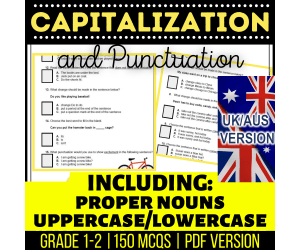
UK/Aus Spelling Captitalisation and Punctuation Practice Year 2-3: PDF
ELA, Language Development, ESL, Grammar, Common Core, Resources for Teachers, Grade 1, 2, Worksheets & Printables, Worksheets, Assessments, Teacher Tools, Tests, Quizzes and Tests, Quizzes
THIS IS THE UK/AUS ENGLISH SPELLING VERSION. CHECK THE CATALOG FOR THE ORIGINAL AMERICAN ENGLISH VERSION. Capitalisation and Punctuation Grammar Practice MCQs: 10 Lessons, 150 MCQs, 43 Pages ELA MCQs Overview: This grammar resource gives students plenty of focused practice with two essential writing skills: capitalisation and punctuation. Across 10 lessons and 150 multiple-choice questions, students work through clear, manageable practice that helps them spot mistakes, improve accuracy, and build real confidence over time. The lessons are designed to feel structured without becoming dry or repetitive. Each one builds naturally on the previous lesson, giving students the chance to review, strengthen, and apply what they have learned. With a mix of direct teaching, group work, and independent practice, the resource works well for whole-class lessons, revision, homework, or extra support. This UK/Aus English version is especially useful for schools, teachers, and families working with British-based spelling and language conventions. It is a helpful option for classrooms using UK curriculum expectations, international programmes influenced by British English, or any setting where learners need to practise the correct capitalisation and punctuation forms for that version of English. Captitalisation and Punctuation Overview: Includes: Proper Nouns Opening/Closing Letters Uppercase/Lowercase Dates Punctuation Practice PDF Version This is the PDF uneditable version. This download is available in GOOGLE Docs, GOOGLE Forms, GOOGLE Slides. PDF, PPT, WORD, check the links below for more details. FULL CATALOG OF DOWNLOAD LINKS HERE ELA Review Questions Overview Each review test includes three answer choices for every question. The format is clear and easy for students to follow. A small number of pictures are included on each test to make the pages feel more welcoming and less plain. A review sheet is also included to help students go back over many of the main skills covered in the product. Introduction or Example Sheet Each topic includes an introduction or example sheet to use before students begin. This gives students a clear starting point. It also helps refresh key ideas before they move into the practice. Full Answer Keys Full answer keys are included for easy checking. Sample responses are also provided where needed. This helps save time and makes the resource easier to use, even on busy days. In the Supplementary Pack Interactive Ice Breakers: Simple hands-on activities to help students start thinking about the topic. Guided Practice: Teacher-led work that helps students build understanding before working alone. Group and Partner Tasks: Activities that encourage discussion, shared ideas, and teamwork. Independent Worksheets: Extra practice pages for students to complete by themselves. Exit Tasks: Short end-of-lesson activities to check understanding and review learning. For similar downloads and other frees, do check out Cored Group on TeachSimple.
Author Cored Education
Rating
Tags Elementary, Answers, Test, Mcq, Test Prep, Language Arts, Ela, Grammar, Primary, British English

Interpreting Words + Phrases Digital Quiz
ELA, Strategies, Grade 6, 7, 8, Quizzes, Quizzes and Tests, Teacher Tools
This is an Interpreting Words + Phrases Digital Quiz. It is a text-based quiz that has 5 questions that ask students to analyze the text. Answer key included. There are directions to assist you with accessing and assigning the quiz to students.
Author Mrs. Spangler in the Middle
Tags Google Classroom, Digital Quiz, Distance Learning, Vocabulary, Reading Strategies
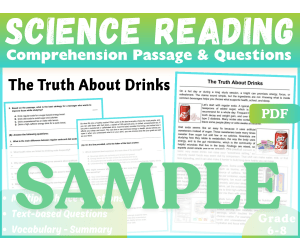
Science Reading Comprehension Passage: The Truth About Drinks. SAMPLE
Science, ELA, Reading, Reading Comprehension, Strategies, Resources for Teachers, Grade 6, 7, 8, 9, Writing Prompts, Worksheets & Printables, Centers, Activities, Teacher Tools, Assessments, Quizzes and Tests, Quizzes, Tests
This is a free passage sample from the complete resource. The full version includes everything needed for a complete reading comprehension activity: the passage, multiple-choice questions, short-answer questions, vocabulary matching, a summary-writing task, and a detailed answer key. Download the complete passage resource by clicking on the following links: PDF Fillable PDF Word Docs Google Docs Science Reading Comprehension Passage and Questions: The Truth About Drinks (PDF) This very engaging science reading passage about how common drinks affect health, focus, and sleep. It explains the differences between regular soda, diet soda, and energy drinks . The passage warns that regular soda often contains a lot of added sugar, diet soda uses artificial sweeteners that may affect taste habits, and energy drinks can contain high caffeine levels that may cause headaches, anxiety, racing heartbeat, and poor sleep in teenagers. It also teaches students how to read beverage labels by checking added sugar, caffeine, ingredients, and serving size . This passage is designed to bridge the gap between science and literacy through strengthening reading comprehension and sparking scientific curiosity in middle school students. The passage blends English Language Arts skills with accurate science content that supports NGSS classroom practice. Ideal for interdisciplinary learning in ELA and Science. Suitable for Grade 9 review, too! Student Tasks for The Passage: 5 multiple-choice questions targeting main idea, key details, inference, vocabulary in context, and use of evidence 5 vocabulary matching items with clear, student-friendly definitions 5 text-based questions that require citing specific lines or facts 1 summary prompt that asks students to condense central ideas accurately Full answer key for every section FULL CATALOG OF DOWNLOADING LINKS HERE Product Details Length: 5 pages total Grades: 6–8, also suitable for Grade 9 review Use cases: close reading, stations, homework, intervention, test prep, and sub plans Standards support: reinforces informational-text skills and supports NGSS-style sense making through observation, modeling, and clear use of claim, evidence, and reasoning Why Teachers Choose This Set Authentic science content paired with rigorous literacy practice Consistent task structure across all passages for easier planning and smoother student routines Clear, age-appropriate writing that builds confidence without oversimplifying Other Science Reading Collections you May find in the store: 1. Astronomy & Space Science 2. Volcanoes, Rocks, & Mountains 3. Rock Cycle, Soil, & Sinkholes 4. Mars, Glaciers, & Antarctica 5. Water Cycle, Acid Rain, & Wastewater 6. Insects, Animals, & Ecosystems 7. Bioluminescence & Insects 8. Animal Skin, Cats, & T. Rex 9. Human Body and Senses 10. Health & Applied Bioscience 11. Waves, Light, & Imaging 12. Electricity & Energy 13. Motion & Materials 14. Chemistry and Materials Science Use this set to reinforce ELA skills in science, to add literacy to your lessons, and to support independent work. The passages strengthen main idea, evidence use, vocabulary in context, inference, cause and effect, and summary writing. With ready-to-use assessments and complete answer keys, you can provide focused practice that is simple to run and fast to review.
Author Middle & High School - CORED Education
Rating
Tags Middle School, Reading Comprehension, Reading Strategies, ELA, Centers, Reading Passage, Assessments, Vocabulary, Bioscience

The Giant’s Causeway in Ireland: Social Studies Passage (Fillable PDF)
ELA, Reading, Reading Comprehension, Strategies, Resources for Teachers, Social Studies, Geography, Grade 6, 7, 8, 9, Writing Prompts, Worksheets & Printables, Centers, Activities, Teacher Tools, Assessments, Quizzes and Tests, Quizzes, Tests
The Giant’s Causeway in Ireland: Social Studies Reading Comprehension Passage (Fillable PDF) This resource introduces a unique Social Studies reading comprehension passage with questions about The Giant’s Causeway in Ireland. The passage is carefully designed to bridge the gap between social studies and literacy through strengthening reading comprehension and sparking knowledge curiosity in middle school students. Each passage blends English Language Arts skills with accurate social studies content . Ideal for interdisciplinary learning in ELA and Social Studies. Suitable for Grade 9 review, too! These worksheets are designed as fillable PDFs , which means students can type their answers directly into the document on any computer or tablet . Each page includes highlighted text fields that show them exactly where to type! Student Tasks throughout the passage: 5 multiple-choice questions targeting the following skills: main idea, key details, inference, vocabulary in context, and use of evidence 5 vocabulary matching items with clear, student-friendly definitions 5 text-based questions that require citing specific lines or facts 1 summary prompt that asks students to condense central ideas accurately Full answer key for every section Available Formats for this Resource: PDF Word Docs Google Docs FULL CATALOG OF DOWNLOADING LINKS HERE Social Studies Reading Comprehension Collection Links: 1. Ancient Civilizations PDF Fillable PDF Word Docs Google Docs 2. Early Empires and Trade Networks PDF Fillable PDF Word Docs Google Docs 3. The Founding of the United States PDF Fillable PDF Word Docs Google Docs 4. Language, Culture, and Meaning PDF Fillable PDF Word Docs Google Docs 5. Psychology and Society PDF Fillable PDF Word Docs Google Docs 6. Global Festivals and Traditions PDF Fillable PDF Word Docs Google Docs 7. Extreme Environments and People PDF Fillable PDF Word Docs Google Docs 8. Food, Culture, and Preservation PDF Fillable PDF Word Docs Google Docs 9. Global Food Customs PDF Fillable PDF Word Docs Google Docs 10. Media, Communication, and Popular Culture PDF Fillable PDF Word Docs Google Docs 11. Human Impact on the Environment PDF Fillable PDF Word Docs Google Docs 12. Civic Action and Social Change PDF Fillable PDF Word Docs Google Docs 13. Fashion, Society, and Power PDF Fillable PDF Word Docs Google Docs 14. People, Places, and Unusual Histories PDF Fillable PDF Word Docs Google Docs Product Details: Length: 5 pages Grades: 6–8, also suitable for Grade 9 review Use cases: close reading, stations, homework, intervention, test prep, and sub plans Why Teachers Choose This Passage: Authentic social studies content paired with rigorous literacy practice Consistent task structure for easier planning and smoother student routines Clear, age-appropriate writing that builds confidence without oversimplifying Use this passage to reinforce ELA skills in social studies, to add literacy to your lessons, and to support independent work. The passage strengthens main idea, evidence use, vocabulary in context, inference, cause and effect, and summary writing. With ready-to-use assessments and complete answer keys, you can provide focused practice that is simple to run and fast to review.
Author Middle & High School - CORED Education
Rating
Tags Middle School, Reading Comprehension, Reading Strategies, ELA, Centers, Reading Passage, Assessments, Vocabulary, Social Studies, Geography
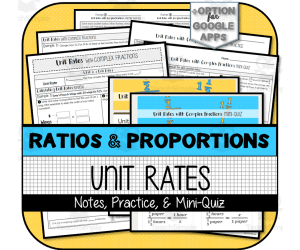
Unit Rate with Complex Fractions NOTES, PARTNER PRACTICE, MINI-QUIZ
Math, Fractions, Grade 7, Quizzes, Quizzes and Tests, Teacher Tools
Unit Rate with Complex Fractions NOTES, PARTNER PRACTICE, MINI-QUIZ An invaluable tool designed for 7th-grade teachers and homeschoolers. This resource meets the 7th Grade Ratios & Proportional Relationships Standards (CCSS.MATH.CONTENT.7.RP.A.1). Dedication to Pedagogical Contents: Computing unit rates in association with ratios of fractions. Fractions extend to lengths, areas and other quantities measured in like or different units. This Package Includes: NOTES & PRACTICE: Focusing on Unit Rates with Complex Fractions - ideal for classroom set-up or independent research and revision at home. PARTNER PRACTICE ACTIVITY: Emphasizes collaborative learning where learners receive different problems but similar answers encouraging mathematical discourse and error analysis protocols among them. In scenarios where partnering may not be feasible—like remote learning situations—students can work through all 20 problems alone and self-assess themselves by matching their answers. TEST PRACTICES: In both printable format and Google Forms version allow students to familiarize themselves with examination style questions centered around Unit Rates with Complex Fractions; enhancing their confidence level ahead exams. MINI-QUIZ: A five-question quick- assessment protocol pre-and-post teaching sessions revolving around Unit Rates Complex Fractions content coverage area Encountered both printable format for traditional instruction mode as well as Google Forms version adapted for digital-based educational settings . Inclusive Answer Key: Simplified way of grading across all sections helps identify areas that may require more focus. File Type: PDF. Grades: 7th Grade. Subjects: Math (Fractions). This resource is optimised for diverse teaching dynamics, including whole group instruction, small study teams, homework assignments offering, and support for self-paced learning aspirations among students.
Author The Math Cafe
Tags Unit Rate, Complex Fractions, Ratios, Proportionality, Compute Unit Rates Associated With Ratios Of Fractions, Unit Rate With Fractions Examples, Unit Rate With Fractions, Unit Rates With Fractions, How To Find Unit Rate With Fractions, Unit Rate Quiz
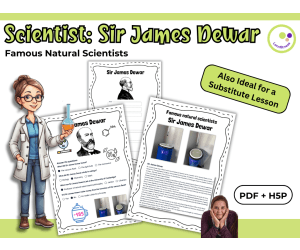
Sir James Dewar – A Look at the Scientist Behind the Vacuum Flask
Life Sciences, Science, STEM, Social Studies, Biographies, Inventors, Basic Science, Physics, Chemistry, Technology, Grade 6, 7, 8, 9, 10, 11, Worksheets, Worksheets & Printables, Quizzes, Quizzes and Tests, Teacher Tools, Projects, Activities
Sir James Dewar – A Look at the Scientist Behind the Vacuum Flask Comprehension Activities A short reading and task-based resource for grades 7–10 science classrooms (PDF + H5P) 🧪🌡️ A printable and digital resource for grades 7–10 science and cross-curricular teaching 🧪🧠 This resource introduces students to Sir James Dewar, a Scottish chemist and physicist best known for inventing the Dewar flask – a forerunner of the modern thermos. His work in low-temperature chemistry and physics helped pave the way for cryogenics and many everyday technologies we take for granted today. The material is designed to be flexible and easy to use. It centers on a short, student-friendly informational text and includes structured follow-up tasks that support comprehension and encourage independent thinking. Whether you're working in a chemistry unit or simply want to connect scientific tools to the people who developed them, this resource fits in with very little preparation needed. What’s included: Informational text about the life and work of James Dewar Student worksheet for creating a personal scientist profile Quiz questions to check understanding (with solutions) Two extension tasks for optional pair or individual work: – Students write their own questions – Partner exchange and answer Formats: – PDF (ready to print or display) – Editable DOCX (text only) – H5P version for digital classrooms (text-based, no images) How it works in class: You can use this resource to complement lessons on scientific inventions, energy, temperature, or lab equipment. I’ve also used it when I needed a calm, structured reading activity that students could complete independently. The extension tasks are helpful when you want to build in peer exchange without needing new materials. The H5P format is useful in digital settings and supports self-paced learning. Everything is ready to go – just print, project, or upload. A simple and effective way to explore the link between science history and the tools we still use today. Have fun exploring the world of science with your students! Warmly, Lernfitness Did You Know? I teach with a certified therapy dog, and together we focus on creating a positive and inspiring learning environment.
Author Lernfitness
Rating
Tags Science, Famous Scientists Lesson, H5P, Interactive Science Exercises, STEM, Scientists, Chemistry, Lab Equipment, Sir James Dewar, Dewar Flask