



3,529 products added recently
Worksheets & Printables
Discover a wealth of worksheets and printables to supplement your teaching. Covering multiple subjects and grade levels, these resources provide activities that reinforce learning objectives. Incorporate them into your lessons to offer hands-on practice and enrich your curriculum.

 Show filters


The Bio-Design Blueprint A Gamified MicroLearning Series in Biomimicry
Basic Science, Science, Inventors, Theories, Biology, Life Sciences, Engineering, Technology, Life Skills, Special Resources, Grade 6, 7, 8, 9, 10, 11, 12, Worksheets & Printables, Parts of and Anatomy of, Drawing Templates & Outlines, Worksheets, Word Searches, Workbooks, Teacher Tools, Assessments, Lesson Plans, Quizzes and Tests
Introducing The Bio-Design Blueprint! This gamified micro-learning curriculum is an entirely online series of adventures that will give students an interactive experience using the 3.8 billion-year-old R&D of nature to design solutions to today’s biggest STEM problems! Not only does it include 35 pages of engaging theory (with topics such as the kingfisher bullet train, the Namib Desert beetle, spider silk vs. Kevlar, the slime mold Tokyo subway system, coral concrete, mycelium packaging and other examples), but it also has ten student worksheets where students use the theory studied in class to create their own designs, complete with data analysis, application to real-world scenarios and creative design challenges. The Bio-Design Blueprint can be used to teach students about biomimicry, fluid dynamics, structural integrity, swarm intelligence, thermal regulation, the lotus effect, gecko adhesion, structural coloration, photosynthesis technology, impact resistance and closed-loop ecosystems. The curriculum also includes the Eco-City Capstone Project, teacher visual anchors, cognitive maps, and iteration spirals to ensure easy implementation of the curriculum in the classroom. Keywords: biomimicry curriculum, sustainable engineering worksheets, STEM activities, middle school, high school, biology and engineering, gamified science lessons, nature-inspired design, environmental science resources, NGSS biomimicry unit, zero waste engineering, project-based STEM. Digital download available instantly. Ready for Google Classroom! Homeschool-friendly; NO prep required for teachers! Students will fall in love with science as they use the blueprints of our planet to design solutions that will save our planet from sustainability issues! Reasons Schools and Parents Appreciate the Curriculum: Experiential Learning – Real-world examples of biomimicry, gamified worksheets, and hands-on experiences create excitement around STEM–students eagerly anticipate science class. Zero Prep Time for Educators - The complete theory of biomimicry, the ten worksheets, visuals for the capstone projects are fully created for the educator - thus they are ready to go electronically and/or printed. This saves educators hours of planning. Prepares Students for the Future – Students develop their critical thinking skills, creativity, and commitment to a sustainable world. The curriculum is aligned perfectly to the NGSS engineering and life science standards. Curriculum is Differentiated and Inclusive – The curriculum incorporates a variety of activities, including fill-ins, math problems, written responses, and creative design challenges, allowing all students to succeed (ELL, gifted, and neurodiverse). Eco-Friendly and Impactful – Students learn how to turn abstract concepts into solutions for real-world issues (i.e., climate change, waste, energy conservation) - parents appreciate having their children participate in meaningful environmental education. *Target Audience by Grade & Subject (Based on Full Content Analysis, Rigor of Program, Worksheet Use) : Middle School (6-8): Life Science, Environmental Science, Integrated STEM, Project-Based Learning, & Gifted/Talented. High School (9-12): Biology, Physics, Engineering Design, Environmental Science, Sustainability, & STEM/STEAM Electives. *Level (data analysis; calculations; open-ended design challenge; NGSS Cross-Cutting Concepts) allows for Grades 7-10 to be primary users of the program (Core Use); and Grade 6 and 11-12 to fit as differentiated use. Copyright / Terms of Use This book, authored by Syed Hammad Rizvi, is a copyright protected, personal use resource that should only be used in the classroom (for one student) and is NOT authorized for alteration, resale or distribution. More simply stated, you cannot post this resource on the Internet at all, because it would become public access and, therefore, can be downloaded by others. If you wish to share this with other teachers, please purchase additional licenses from Teachsimple. Thank you for following these terms of use. Brought to you by Syed Hammad Rizvi with joy.
Author Creative Book Store
Rating
Tags BiomimicryCurriculum, SustainableEngineering, STEMWorksheets, GamifiedSTEM, BiomimicryLessons, NatureInspiredDesign, NGSSAligned, ProjectBasedLearning, EcoEngineering, BioDesignBlueprint
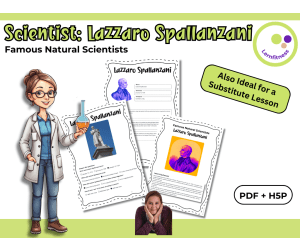
Scientist Lazzaro Spallanzani Fact Sheet, Quiz + Interactive Exercises
Life Sciences, Science, Biology, STEM, History: World, History, Social Studies, Animals, Human Body, Grade 7, 8, 9, 10, Worksheets, Worksheets & Printables, Quizzes, Quizzes and Tests, Teacher Tools, Projects, Activities
Discover Lazzaro Spallanzani – A Scientist Who Changed How We See Life Did you know that Lazzaro Spallanzani made incredible discoveries about how living organisms work? From figuring out how digestion happens to showing that life doesn’t just appear out of nowhere (disproving spontaneous generation), Spallanzani was a true pioneer of biology. His experiments opened the door to modern microbiology and helped us understand processes that we often take for granted today. This teaching resource is designed to help your grades 7–10 students learn about Spallanzani’s life and his groundbreaking experiments in a fun and interactive way. It’s perfect for a 45-minute lesson, with everything you need to make the topic engaging and easy to understand. What’s Included: Concise Informational Text: A clear and engaging overview of Lazzaro Spallanzani’s role in science. Fact Sheet Activity: Encourages students to organize knowledge and work creatively. Quiz with Solutions: Promotes fun, interactive learning and self-assessment. Additional Exercises: Students can create their own questions and collaborate in pairs to deepen their understanding. Flexible Formats: Includes a color and black-and-white printable PDF, as well as interactive H5P tasks for digital learning. Why You’ll Love This Resource: Time-Saving: Perfect for teachers who need a ready-to-go, well-structured lesson. Versatile Use: Ideal for biology, history of science, or cross-curricular lessons in English and science classes. Promotes Independence: Solutions are included, allowing students to check their work and explore the topic at their own pace. Interactive and Engaging: Tasks are designed to keep students actively involved while learning about Lazzaro Spallanzani’s legacy. Whether you use it for a regular lesson, substitute teaching, or as part of a digital learning activity, this resource will make Lazzaro Spallanzani’s contributions come alive for your students. Bring Lazzaro Spallanzani’s fascinating world of science into your classroom and inspire your students to see history and science in a whole new light! Have fun exploring the world of science with your students! Warmly, Lernfitness Did You Know? I teach with a certified therapy dog, and together we focus on creating a positive and inspiring learning environment.
Author Lernfitness
Tags Science, Biology, Famous Scientists Lesson, H5P, Interactive Science Exercises, STEM, History, Scientists, Lazzaro Spallanzani, Digestion

Earth Science Reading Passage: Cleaning Wasterwater (Word)
Science, ELA, Reading, Reading Comprehension, Strategies, Resources for Teachers, Earth and Environmental Sciences, Earth Sciences, Environmental Science, Grade 6, 7, 8, 9, Writing Prompts, Worksheets & Printables, Centers, Activities, Teacher Tools, Assessments, Quizzes and Tests, Quizzes, Tests
Science Reading Comprehension Passages and Questions: Cleaning Wastewater (Word) This very engaging earth science reading passage about Cleaning Wastewater . It is designed to bridge the gap between science and literacy through strengthening reading comprehension and sparking scientific curiosity in middle school students. The passage blends English Language Arts skills with accurate science content that supports NGSS classroom practice. Ideal for interdisciplinary learning in ELA and Science. Suitable for Grade 9 review, too! Student Tasks for The Passage: 5 multiple-choice questions targeting main idea, key details, inference, vocabulary in context, and use of evidence 5 vocabulary matching items with clear, student-friendly definitions 5 text-based questions that require citing specific lines or facts 1 summary prompt that asks students to condense central ideas accurately Full answer key for every section Available Formats for this Resource PDF Fillable PDF Google Docs FULL CATALOG OF DOWNLOADING LINKS HERE Product Details Length: 4 pages total Grades: 6–8, also suitable for Grade 9 review Use cases: close reading, stations, homework, intervention, test prep, and sub plans Standards support: reinforces informational-text skills and supports NGSS-style sense making through observation, modeling, and clear use of claim, evidence, and reasoning Why Teachers Choose This Set Authentic science content paired with rigorous literacy practice Consistent task structure across all passages for easier planning and smoother student routines Clear, age-appropriate writing that builds confidence without oversimplifying Other Science Reading Collections you May find in the store: 1. Astronomy & Space Science 2. Volcanoes, Rocks, & Mountains 3. Rock Cycle, Soil, & Sinkholes 4. Mars, Glaciers, & Antarctica 5. Water Cycle, Acid Rain, & Wastewater 6. Insects, Animals, & Ecosystems 7. Bioluminescence & Insects 8. Animal Skin, Cats, & T. Rex 9. Human Body and Senses 10. Health & Applied Bioscience 11. Waves, Light, & Imaging 12. Electricity & Energy 13. Motion & Materials 14. Chemistry and Materials Science Use this set to reinforce ELA skills in science, to add literacy to your lessons, and to support independent work. The passages strengthen main idea, evidence use, vocabulary in context, inference, cause and effect, and summary writing. With ready-to-use assessments and complete answer keys, you can provide focused practice that is simple to run and fast to review.
Author CORED Education - Middle & High School
Rating
Tags Middle School, Reading Comprehension, Reading Strategies, ELA, Centers, Reading Passage, Assessments, Vocabulary, Environmental Science

Letter I Activities Lowercase and Uppercase Alphabet Letter I
Phonics, Language Development, ELA, Pre-Reading, Kindergarten, Preschool, Grade 1, Crafts, Activities, Centers, Coloring Pages, Worksheets, Worksheets & Printables, Crosswords Puzzles, Dot To Dots, Mazes, Word Searches
Make learning the Letter I irresistible with this no-prep, phonics-based activity pack for preschool and kindergarten students! This Letter I resource is packed with engaging printables and interactive Boom Cards to help your learners master both uppercase and lowercase I with confidence. Perfect for Letter of the Week instruction or review, the pack includes 95 printable pages and 32 digital Boom Cards filled with tracing, puzzles, dabbing, crafts, and phonics practice that combine learning and fun. What’s Included: 📄 Printable Worksheets Letter I Poster + 6 Visual Vocabulary Cards Tracing & Writing Uppercase and Lowercase I Identifying, Coloring, Sorting, and Spinning Letter I (plus review of P, S, N) Finding and Drawing Letter I Pictures Phonemic Awareness Practice: a, s, t, n, p, i Dot-to-Dot, Mazes, Geoboards, Puzzles, Dab the Dots Color by Code + Visual Cutouts Nursery Rhyme Tie-In: Itsy Bitsy Spider Reading & Sentence Building Sheets Summary Sheet, Booklet Cover, and ‘About Me’ Page 🎨 Crafts & Extra Activities “I’m a Letter I Champ” Crown & Bracelet Mini Flipbook with Letter I Words & Visuals Word Wheel with 6 Letter I Vocabulary Words One-Page Mini Booklet & Flipbooks (Letter Words & Sight Words) Itsy Bitsy Spider Finger Puppets (6 per page) Matching Stick Puppets (4 per page) 💻 Boom Cards – 32 Digital Activities Uppercase and Lowercase I Formation & Recognition Letter I Sound Identification Puzzle Matching: Uppercase and Lowercase I Visual Reveal Game (Letter I Words) Drag-and-Drop Uppercase/Lowercase Sorting Capitalization Practice: I at Sentence Start vs Mid-Sentence Culminating Activity: Build an Ice Cream! 🎯 Perfect For: Phonics and Literacy Centers Morning Tubs and Fine Motor Stations Letter of the Week Lessons Small Group or 1:1 Support At-Home Practice or Homework ⭐ Bonus: Comes with both US and British English spelling versions for versatile classroom use. Whether you’re teaching the Letter I for the first time or reviewing it later in the year, this pack makes alphabet instruction fun, multisensory, and easy to implement!
Author Teach2Tell
Rating
Tags Letter I Activities, Alphabet Worksheets Letter I, Lowercase Letters Of The Alphabet, Uppercase Letters Of The Alphabet, Preschool Letter I Printables, Kindergarten Letter I Activities, Letter Of The Week Letter I, Phonics Practice Letter I, Uppercase And Lowercase Letter I, Ice Cream Letter I Craft
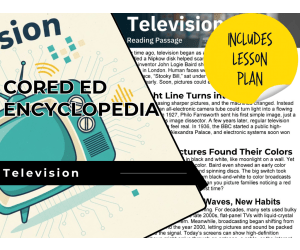
Television Reading Comprehension Passage - Cored Ed Encyclopedia
ELA, Language Development, Reading Comprehension, Reading, Pre-Reading, Science, Technology, Engineering, History, Social Studies, Grade 2, 3, 4, 5, Worksheets & Printables, Worksheets, Teacher Tools, Centers, Activities, Writing Prompts, Assessments, Quizzes and Tests, Quizzes, Lesson Plans
This television reading comprehension includes: Visualization (on the front cover) Start your lesson by taking a minute to think and share something about the topic. Read the script aloud (slowly), perhaps prepare some music or sound effects. Student close their eyes and let their imaginations wander. Students open their eyes, read the question aloud and give them a few minutes to complete. Ask a few students to share or keep answers until the end to compare with what they learn in the passage. Quick pause—thousands of Cored Education products are included with your TeachSimple membership. Download links and encyclopedia index available here. Pre-Reading Trivia Students will write down one thing they already know about the subject and then read five more facts and discuss. These facts are fun, and the students will enjoy learning about the subject before reading more. Give 1 minute for students to write what they already know (no pressure—best guess is fine). Read the five facts together. After each fact, do ask a student for their opinion, was it surprising? Set a purpose by asking students to highlight/underline one fact they want to learn more about during the reading. Reading Passage The text is a high-interest reading passage with set paragraphs, roughly three to four paragraphs long. It contains a variety of themes about the topic, anywhere from history to technology. The passage is between 250 and 350 words in length. First, ask students to look at the headings and see what they’ll learn about today. What do they know about the topic/heading? First read options: Teacher read-aloud (best for support). Partner reading (paragraph by paragraph). While reading, students underline important details, and vocabulary words they think may come up in the questions section. Mixed Questions The first question page contains four multiple-choice questions, each with a choice of four answers, and three written response questions that require a sentence or two from the student. Students complete the mcqs first independently, then review quickly as a class. For the 3 written responses, try to get students giving the answer with some form of evidence: “I think ___ because the text says ___.” If students get stuck, send them back to check the passage. Vocabulary Questions Practice seven key words from the text in this section across two activities. First section is scrambled words where students will unscramble three words given a clue for each. The second section is a word to meaning matching activity. Before starting, have some students read out words they underlined in the passage. Ask students to say the word and read aloud the sentence(s) around each word. Ask students to do scrambled words and the matching exercise in pairs then go through answers as a class. For the scrambled spelling task, get four pairs to come up to the board and write the words for extra practice with the other student reading out the clue. For the matching task, prompt students to give full sentences: “I matched ___ with ___ because ___.” Creative Writing In this question, the student will be required to write a five to eight sentence paragraph on a question related to the topic. Before starting, ask students write down 3 key ideas they are going to include in their piece. Ask students for ideas to share around the class to help those struggling. Pro writing expectations: 5–8 sentences At least 2 facts or details from the passage At least 2 vocabulary words from the previous page Students read their paragraphs while classmates listen for facts and vocabulary words. Extension Activities This page is optional for fast finishers or to take home. There are several activities, each one requiring a different skill. Do some, do none, do all, completely optional - but you will feel reassured knowing every possibility is planned for. Includes summary writting question. Answer Key There are answers for the multiple-choice questions, written response questions have sample answers, vocabulary answers and if there is a summary question then a sample summary will be provided as well. Lesson Plan Included Customized lesson plan for this lesson is included. Lesson Snapshot Title: Television Genre: Nonfiction (informational text) Subject: Science (Technology) Primary Topic: How television changed from mechanical to digital Estimated Guided Reading Level (A–Z): S What This Lesson Teaches Best How an invention changed over time, from a “spinning disk” experiment to modern screens and signals. Key milestones in television’s development (1925 Selfridges demo, 1927 Farnsworth, 1936 BBC service, late 2000s flat-panels). How pictures can be broken into lines/signals and sent by wire, radio, antenna, cable, or internet. The shift from black-and-white to color broadcasts and how viewers experienced that change over decades. Comparing analog and digital signals as two different ways information travels. Learning Goals Students will describe how early television used a spinning Nipkow disk to scan pictures into lines. Students will identify key people, places, and dates from the passage (Baird, Farnsworth, Selfridges, Alexandra Palace). Students will explain how television changed from mechanical parts to all-electronic systems that made clearer pictures. Students will summarize how TV viewing changed from bulky cathode-ray tubes to flat-panel screens and high-definition images. Students will compare analog and digital signals using details from the text. Key Vocabulary From the Text scan — break a picture into lines to send it. signals — messages that carry picture or sound information. broadcasting — sending TV so many people can receive it. analog — a smooth, continuous wave way of sending. digital — coded bits that travel more cleanly. FULL CATALOG OF DOWNLOAD LINKS AND ENCYCLOPEDIA INDEX HERE
Author Cored Education
Rating
Tags Vocabulary, Reading Comprehension, Reading Passages, Lesson Plans, Ela Lesson Plans, Reading Comprehension Lesson Plans, Pre-reading, History, Social Studies, Social Studies Lesson Plans

Kindness Word List Posters – 8 Target Words
ELA, Language Development, Resources for Teachers, Vocabulary, Spelling, ESL, Life Skills, Special Resources, Social Skills, Grade 2, 3, 4, 5, Worksheets & Printables, Worksheets, Teacher Tools, Centers, Activities, Posters, Classroom Decor
Word List Poster Series This word list poster series is designed for students in grades 2–5. Each printable focuses on a clear, kid-friendly theme and features 8 target vocabulary words with short, student-friendly meanings or fun facts. The clean layout works as both an anchor chart and a write-in sheet, giving students a quick, visual reference they can revisit during centers and independent work. These posters are student-friendly, classroom-ready, and perfect for warmups, vocabulary walls, sub plans, or take-home reference. Display a single poster to support the day’s lesson, or group several to build a themed wall across your unit. Note: Each poster is a companion piece to its matching themed product in the series—pair it with the corresponding maze, wordsearch, or activity pack for a consistent set of 8 focus words. Kindness Word List 1. Kind Words Please, Thank, Hello, Sorry, Nice, Smile, Help, Share 2. Helping Others Help, Share, Carry, Give, Fix, Ask, Listen, Care 3. Being a Good Friend Friend, Play, Talk, Laugh, Help, Hug, Share, Kind 4. Showing Respect Listen, Quiet, Wait, Polite, Honest, Fair, Safe, Friendly 5. Kindness at School Teacher, Share, Wait, Help, Quiet, Fair, Write, Learn 6. Kindness at Home Parent, Sibling, Grandparent, Care, Share, Talk, Meal, Love PDF Version Other versions will appear here when available. Follow the store for the lastest on new products. How to Use These Word List Posters Perfect for: Morning work or early-finisher bins Vocabulary centers or anchor walls Holiday/seasonal review lessons Independent stations, sub plans, or take-home reference More Kindness Themed Products CROSSWORDS WORD SEARCHES MAZES FULL CATALOG OF DOWNLOAD LINKS HERE Themed Word List Posters Links Addition PDF Animals PDF Around the Home PDF Birthday PDF Candy PDF Christmas PDF Cinco de Mayo PDF Clothes PDF Colors PDF Days and Months PDF Division PDF Earth Day PDF Easter PDF Easy Word List Posters PDF Fall PDF Father's Day PDF Food PDF Geography (Set 1) PDF Geography (Set 2) PDF Geography (Set 3) PDF Graduation PDF Health PDF History (Set 1) PDF History (Set 2) PDF History (Set 3) PDF Human Body PDF Kindness PDF Life Skills PDF Mother's Day PDF Multiplication PDF Science (Set 1) PDF Science (Set 2) PDF Science (Set 3) PDF Shapes PDF Social Skills PDF Spring PDF Sports PDF St. Patrick's Day PDF Subtraction PDF Summer PDF Thanksgiving PDF Transport PDF Valentine's Day PDF Winter PDF Word List Posters in Depth Structure Each poster is built around a focused sub-theme and presents 8 target words with short, student-friendly meanings or fun facts. The clean A4 portrait layout works as an anchor chart on your board or as a student reference at desks. These posters are designed as companion pieces to the matching themed products (mazes, wordsearches, activity packs), so the same vocabulary stays visible across your unit. Each poster set includes: A themed word list poster with 8 words + brief meanings/facts A clean, high-contrast layout for easy printing and display Space that can double as write-in/draw-to-show-meaning during centers Themes Included Seasons & Holidays (e.g., Halloween, Easter, Valentine’s Day) Everyday Topics (e.g., Animals, Weather, School) Math & Science Connections (e.g., Number Words, Simple Machines) Special Units (e.g., Health, Earth Day, Sports, Kindness) Each topic reflects real-life experiences and interests while strengthening vocabulary recognition and content understanding in a clear, visual way. Easy extensions (optional) Sketch it: students draw a quick icon for each word Sort it: group words by category (e.g., actions, objects) Star it: highlight “I already know” vs. “I’m learning” words Match it: point to examples in a reading, video, or picture set Say it: brief oral definition or example sentence during share-out Differentiation tips Pre-teach 2–3 anchor words; add the rest later in the week Offer picture cues or gestures for emerging readers/ELLs Let students choose 4 of 8 to focus on first, then build up Color-code by part of speech or concept family for quick scanning For similar downloads and other frees, do check out Cored Group on TeachSimple.
Author Cored Education
Rating
Tags Vocabulary, Spelling, Kindness, Kind Words, Helping Others, Kindness Activities, Ela Word Lists, Kindness Word Lists, Ela Posters, Kindness Posters
Life Lessons Reflection Journal Professional Edition
Life Studies, Business, Career, Coaching, Leadership, Special Resources, Life Skills, Social Emotional Learning (SEL), Social Skills, Special Education Needs (SEN), Grade 6, 7, 8, 9, 10, 11, 12, Worksheets & Printables, Workbooks, Worksheets, Crosswords Puzzles, Dot To Dots, Word Searches, Teacher Tools, Assessments, Lesson Plans, Charts
Introducing the Life Lessons Reflection Journal - Professional Edition: A complete 40-page digital PDF workbook/journal focused on providing adults (adaptable for high school/college-age individuals) by providing a breakdown of each module and instructional design for personal success, building emotional intelligence; and developing high-performance habits. The journal is structured around twelve (12) modules, mainly constructed by providing structured lessons, evidence-based practices (based on positive psychology and cognitive-behavioral practice), daily journaling prompts, and worksheets that will be provided. The worksheets will consist of the following: SMART Goals Wheel, Daily Gratitude Logs, 30-Day Grid for Habit Tracking, Why-Why Analysis for Destabilizing Blockages, Mood Tracker for Emotional Check-Ins, determining Key Milestones, Reflecting on Lessons Learned Through Difficulties, Core Values Alignment, Use of Mindfulness Tools (Box Breathing and 5-4-3-2-1 Grounding Techniques), Letter to Your Future Self, and an End-of-Year Review and Reflection Report. Beautiful infographics, fillable trackers and reflection exercises for journaling, gratitude, resilience, mindfulness, and habit building are included. This digital downloadable PDF can be printed or used on a tablet and reused from year to year. This is a comprehensive adult reflection journal. Included are journals, goal planners, gratitude logs, habit trackers, and mindfulness workbooks combined into one powerful book that can change your life. Reasons Why Parents/Schools Appreciate These Products: They provide evidence based SEL skills (emotional regulation, resilience, and growth mindset), which increase student academic success while decreasing student stress. They include pre-made lesson plans with corresponding worksheets, which can help educators save hours of preparation time when teaching advisory, psychology, or life skills courses/subjects. They encourage the practice of daily gratitude and mindfulness along with the tracking of positive daily behaviors. These components support improved attention, mental health and classroom behavior. The use of radar charts, habit grids and future self exercises will provide students with visual representations of success and will help students to remain accountable throughout the entire school year. Affordability and reusability in the digital PDF format make this product suitable for print or use in digital devices, and/or for use by an entire class at one time. Target Class and Students: While this course is labeled as "for: Adults looking to better themselves," it has many references to "academic progression," SMART goals for education/skills, life skills, social emotional learning (SEL) components and classroom-ready "Lesson Plan & Unit Plans." Here are just a few examples of where this material is ideally suited: High School (Grades 9-12): Character Education, Life Skills, Psychology, Advisory/Homeroom, Social/Emotional Learning and/or College & Career Readiness classes College/University: Freshman/First Year Success/Orientation Course, Personal Development Class or Career Readiness Course, and Introductory Psychology ELECTIVE Course Adult Education/Community College: Continuing Education, Workforce Readiness or Personal/Family Growth/GED program Homeschool Or Online Learning: Teen/Adult Self-Improvement, Parenting, Goal Setting Units Both teachers and parents find this unit a great way to effectively teach their students! Copyright and Terms of Use: Syed Hammad Rizvi holds the copyright to this book. This resource may only be used for personal use and for single classroom use. You are not authorized to change, share, or sell any part of this product. In other words, you cannot post this product on the internet so that it can be downloaded by anyone else. If you would like to use this resource with other teachers, please acquire additional licenses through Teachsimple. Thank you for complying with these terms of use. This product is proudly provided by Syed Hammad Rizvi
Author Creative Book Store
Rating
Tags SelfImprovement, PersonalGrowth, PersonalDevelopment, SelfGrowth, GrowthMindset, Journaling, GratitudeJournal, HabitTracker, Mindfulness, ReflectionJournal

My Emotions Explorer: SEL Activity Book
ELA, Language Development, ESL, Grammar, Social Emotional Learning (SEL), Special Resources, Life Skills, Social Skills, Special Education Needs (SEN), Speech Therapy, Homeschool Curriculum, Kindergarten, Grade 1, 2, 3, 4, 5, Assessments, Teacher Tools, Graphic Organizers, Lesson Plans, Worksheets & Printables, Drawing Templates & Outlines, Workbooks, Writing Prompts, Task Cards, Word Problems
Find "My Emotions Explorer: SEL Activity Book Professional Edition," the best social emotional learning activity book for kids aged 6-9 years old. This exciting kids' emotional intelligence book helps kids, parents, and teachers with various social and emotional learning activities. With numerous tools like the Wheel of Feelings, Body Scan, Anger Volcano, Breathing Bubbles, Worry Jar, Empathy Scenarios, Positive Self Talk, Gratitude Garden, Weekly Mood Tracker, and many more, this 43-page downloadable PDF helps kids manage overwhelming emotions with ease. It is an amazing tool for homeschool social and emotional learning, classroom activities, and even family bonding. It also includes an adult facilitation guide to provide psychological safety. Give your kids the gift of higher emotional intelligence with this top-rated kids' emotions book, great for kids' social and emotional learning activities, elementary SEL, and child development tools. Get your copy now and start enjoying instant access to fun and therapeutic exercises! Why Parents/Schools Love It: Research-Backed SEL Tools: Informed by affective science and positive psychology, it develops emotional granularity, strength, and co-regulation skills, resulting in improved mental health and fewer behavioral problems. Engaging, Interactive Activities: Fun activities like drawing faces, building anger volcanoes, and developing gratitude gardens keep kids engaged while learning practical coping skills. Adult Facilitation Guide: Offers parents and educators professional guidelines on how to create a psychologically safe environment, ask open-ended questions, and incorporate SEL into daily routines. Customizable and Printable: Offers 43 pages of printable and editable PDFs, including trackers and certificates, for personalized learning without the need for additional materials. Promotes Long-Term Growth: Assists children in moving from reactive emotions to proactive self-awareness, developing empathy, emotional intelligence, and family/school relationships. Target Classes/Students : Upon a thorough analysis of the 43-page PDF, which includes the adult guide, modules on emotional identification (e.g., Wheel of Feelings, Draw Your Face), emotion regulation skills (e.g., Body Scan, Anger Volcano, Breathing Bubbles, 5-4-3-2-1 Grounding, Worry Jar, Positive Self-Talk), empathy skills (e.g., Empathy Scenarios), gratitude skills (e.g., Gratitude Garden), tracking skills (e.g., Weekly Mood Tracker), and the completion certificate, the content is geared towards children in the age range of 6 to 9 years. This age range corresponds to the early elementary school students. The age range of 6 to 9 years corresponds to the following grades: Kindergarten (5 to 6 years, but this age range can be adapted for 6-year-olds to be introduced to SEL). 1st Grade (6 to 7 years, focusing on basic emotion identification skills). 2nd Grade (7 to 8 years, focusing on emotion regulation skills). 3rd Grade (8 to 9 years, focusing on advanced skills such as gratitude skills and analysis of mood patterns). This PDF is not adapted for children younger than 6 years, i.e., for preschoolers, nor for children above 9 years. Copyright/Terms of Use: This Book was copyrighted by Syed Hammad Rizvi. This resource may be used for personal and single classroom use. You may not change, distribute, or sell any part of this resource. In other words, you may not put this resource on the Internet, so that it could be found and downloaded by others. If you wish to share this resource with others, you may purchase additional licenses from Teachsimple. I appreciate your understanding of these terms of use. This product is happily brought to you by Syed Hammad Rizvi
Author Creative Book Store
Rating
Tags SELAactivities, SocialEmotionalLearning, EmotionalIntelligenceForKids, KidsEmotionsWorkbook, SELWorkbook, ChildrensMentalHealth, EmotionalLiteracy, ResilienceBuildingForKids, HomeschoolSEL, ClassroomActivities

First Week of School Grade 7 | No-Prep Worksheets
ELA, Math, Grade 7, Lesson Plans, Teacher Tools, Worksheets & Printables
Help students start seventh grade with confidence using this engaging First Week of School Activities packet! Designed to ease the transition into a new school year, this no-prep resource combines math, literacy, writing, collaboration, and social-emotional learning in one easy-to-use workbook. Students develop a sense of community in the classroom, create meaningful goals, improve their communication skills, and go over important academic ideas over the course of five organized days. Writing narratives and arguments, setting SMART goals, rational numbers, proportional relationships, percent applications, equations and inequalities, geometry, data analysis, vocabulary growth, figurative language, and reading comprehension are some of the activities. The packet is ideal for bell ringers, small groups, independent work, advising times, whole-class instruction, and informal evaluations. While the full answer key makes preparing easy and stress-free, a comprehensive Teacher Guide offers lesson outlines, pacing recommendations, discussion starters, and ideas for differentiation. During the crucial first week of classes, this tool assists teachers in setting routines, fostering a healthy classroom environment, and evaluating students' preparedness. It helps children feel connected, capable, and ready for a successful seventh-grade year by striking a balance between academic review and relationship-building activities.
Author Bright Classroom Ideas Marketplace
Rating
Tags Back To School, Ela, Math, Lesson, Plan, Worksheet, First Week
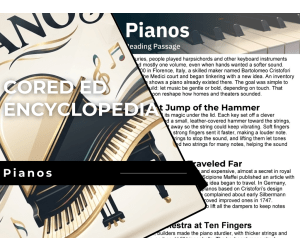
Pianos Reading Comprehension Passage - Cored Ed Encyclopedia
ELA, Language Development, Resources for Teachers, Reading Comprehension, Reading, Pre-Reading, Writing, Strategies, Music, Creative Arts, Grade 2, 3, 4, 5, Worksheets & Printables, Worksheets, Teacher Tools, Centers, Activities, Writing Prompts, Assessments, Tests, Quizzes and Tests, Quizzes
This pianos reading comprehension contains the following: Visualize on the Cover (Teacher Read Aloud Script) Start your lesson by taking a few moments to visualize the topic and share thoughts or feelings about it. Pre-Reading Trivia Students will write down one thing they already know about the subject and then read five more facts and discuss. These facts are fun, and the students will enjoy learning about the subject before reading more. Reading Passage The text is a high-interest reading passage with set paragraphs, roughly three to four paragraphs long. It contains a variety of themes about the topic, anywhere from history to technology. The passage is between 250 and 350 words in length. Mixed Questions The first question page contains four multiple-choice questions, each with a choice of four answers, and three written response questions that require a sentence or two from the student. Vocabulary Questions Practice seven key words from the text in this section across two activities. First section is scrambled words where students will unscramble three words given a clue for each. The second section is a word to meaning matching activity. Creative Writing In this question, the student will be required to write a five to eight sentence paragraph on a question related to the topic. Extension Activities This page is optional for fast finishers or to take home. There are several activities, each one requiring a different skill. Do some, do none, do all, completely optional - but you will feel reassured knowing every possibility is planned for. Includes summary writting question. Answer Key There are answers for the multiple-choice questions, written response questions have sample answers, vocabulary answers and if there is a summary question then a sample summary will be provided as well. FULL CATALOG OF DOWNLOAD LINKS AND ENCYCLOPEDIA INDEX HERE Lesson Snapshot Title: Pianos Genre: Nonfiction (informational text) Subject: Music (Performing Arts) / Reading Informational Text Primary Topic: How the piano was invented and improved Estimated Guided Reading Level (A–Z): S What This Lesson Teaches Best How the piano idea began around 1700 in Florence, Italy , with Bartolomeo Cristofori trying to make music “gentle or bold” depending on touch. How the piano’s key action works: a mechanism sends a leather-covered hammer to strike strings, then pulls back so the string keeps vibrating . How dampers stop strings from ringing—and lifting them lets tones ring longer. How information spread the invention: Scipione Maffei published an article with a diagram , leading builders like Gottfried Silbermann to make pianos based on Cristofori’s design. How the piano grew for bigger spaces: sturdier builds and a wider range from about four octaves to 88 keys , changing where music could be played (homes, schools, apartments, stages). Learning Goals Students will explain why Cristofori began tinkering with a new keyboard instrument around 1700. Students will describe how a key triggers the hammer-and-string action using details from the passage. Students will explain how a player’s touch can make the sound softer or louder according to the text. Students will identify how Maffei helped the piano idea travel and name one builder mentioned who made pianos afterward. Students will describe how the piano’s keyboard range changed over time and state the number of keys many pianos have today. Key Vocabulary From the Text harpsichords — older keyboards that stayed mostly one volume. inventory — a recorded list that showed a piano existed. mechanism — moving parts that make the piano action work. dampers — parts that stop strings from ringing. octaves — groups of notes used to describe keyboard range. Cored Ed Encyclopedia Overview The Cored Ed Encyclopedia is a weekly series of lessons that you can pick up and use right away. These short readings fit into whatever time you have available. Each one includes a warm-up, a reading, and a set of questions, but it’s flexible — you can do just the reading, the full lesson, or skip the writing section if you need to. Each lesson focuses on a single topic so students don’t get lost. The writing is clear but never childish, making it perfect for grades two through five. Topics range from animals and science to history, inventions, and everyday things. No matter the level of the student, everyone should take away at least one new idea or fact from each lesson. The materials are easy to print, easy to explain, and require no setup. They work well for whole-class teaching, partner work, or independent study.
Author Cored Education
Rating
Tags Vocabulary, Spelling, Reading Comprehension, Reading Passages, Reading, Creative Writing, Reading Strategies, Writing Prompts, Music, Pianos
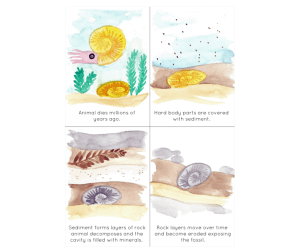
Fossil Formation Sequencing Flashcards
Science, Earth and Environmental Sciences, Grade 4, 5, 6, 7, 8, Worksheets & Printables, Flashcards
This pack is ideally tailored to assist and enhance your studies of Geology or Fossils. All the resources feature my own hand-painted watercolor illustrations.
Author Fiddleticks Education
Tags Fossils, Rocks, Watercolor, Poster, Prehistoric
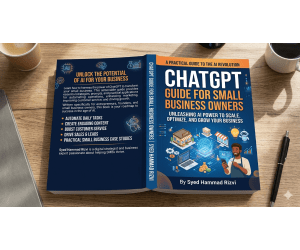
Chat.G.p.T. Guide for Small Business Owners Book
Technology, Science, Computer Science, Engineering, Special Education Needs (SEN), Special Resources, Resources for Teachers, Career, Life Studies, Business, Grade 6, 7, 8, 9, 10, 11, 12, Teacher Tools, Lesson Plans, Assessments, Presentations, Worksheets & Printables, Workbooks, Worksheets, Word Searches, Activities, Projects
The ultimate playbook for unlocking explosive growth; the Chat.G.P.T Playbook for Small Business Owners from Syed Hammad Rizvi, is the most comprehensive & practical AI resource available to entrepreneurs, solopreneurs, and gig economy founders. This 419-page behemoth includes 136 step-by-step chapters with concrete strategies for mastering prompt engineering (and creating prompt templates) content marketing, SEO-Optimized blogs, social media captions on Instagram, LinkedIn, Facebook, TikTok, email sequences, sales funnels, customer service automation, Google Ads copy & Social campaign ads, website copy, product descriptions, competitor analysis, lead generation, upselling & much more. No matter if you're an entrepreneur managing every role yourself or are a small business owner that needs to scale without a team; this book will show you how to incorporate Chat.G.P.T into every workflow you'll go through from brainstorming and drafting proposals to creating loyalty programs, SOPs, and investor summaries. Tips include information related to keyboard shortcuts, custom instructions, awareness of Chat.G.P.T.'s limitations, ethical uses of AI, and real case studies from early users who were able to save hours while generating additional revenue. Great for small business entrepreneurs, freelancers, eCommerce sellers, and service providers that want to work smart, not hard; you won't need a tech background to use this book; it gives you practical examples of prompts and templates you can use immediately to generate results. Reasons why parents and schools like this program. It Provides Future Entrepreneurs With Innovative .A.I. Skills They Will Need for Career Success And The Ability To Transform Their Skills To Become Successful. It Provides Teachers With Ready-To-Use, Current Examples And Templates That Can Help Improve The Learning Experience For Their Students And Make Entrepreneurship And Digital Marketing Classes More Relevant. Parents Can Provide Their College-Bound Or Business-Minded Teenagers With A Professional Development Resource That Will Help Build Their Teenager’s Confidence And Actual Revenue-Generating Skills. Schools Will Appreciate The Ethical Guidance In The Ethical .A.I. Section And Brand Consistency In The Brand Consistency Section That Are Aligned With The Principles Of Digital Citizenship And Responsible Technology Education. Provides Quantifiable Outcomes - Students Are Able To Apply The Information They Learned About “P.rompt.s” To Their Class Project, Internship Or Side Hustle, And Turn Theories Into Tangible Results. Audience (Target) / Classifications: This is a higher-level book that is a very suitable fit for higher-education and vocational business courses and programs. The groups you are targeting are: College and Universitystudents who are taking any of the following courses:entrepreneurship 101 or 201, small business management, digital marketing, business administration, ecommerce, or marketing strategy. Graduate students (MBA or postgraduate) who are takinga course that focuses on artifici.a.l intelligence in the business setting, operations, or sales. High school students taking advanced business classes and coursework in entrepreneurship, career and technical education, or who are members of DECA or FBLA.Platform:For High School; community college vocational tracks; online business boot camps; continuing education programs; and others. Teachers and Professors seeking real-life case studies of artific.i.a.l intelligence in businesses and prom.p.t templates to use in the class (ideal for as Prepared to Use Business Lessons Resources). Copyright/Terms of Use: Syed Hammad Rizvi created this Book. The Book is for personal use and for single classroom use. You cannot modify, redistribute, or sell this Book in any form or way. That is to say, you cannot share this Book with anyone else via the Internet and allow them access to it. If you would like to share this resource with teachers or colleagues, you can purchase additional licenses from Teachsimple. Thank you for adhering to these copyright/terms of use. This product is proudly provided Syed Hammad Rizvi
Author Creative Book Store
Rating
Tags ChatGPT, ChatGPTTips, AIForBusiness, SmallBusinessAI, EntrepreneurAI, SolopreneurTools, AIPromptEngineering, ChatGPTMarketing, AIContentCreation, SEOWithAI
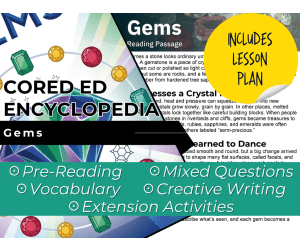
Gems Reading Comprehension Passage - Cored Ed Encyclopedia
ELA, Reading Comprehension, Reading, Science, Technology, Earth and Environmental Sciences, Pre-Reading, Language Development, Physics, Life Sciences, Grade 2, 3, 4, 5, Worksheets & Printables, Worksheets, Teacher Tools, Centers, Activities, Writing Prompts, Assessments, Quizzes and Tests, Quizzes, Lesson Plans
This gems reading comprehension with lesson plan includes: Visualization (on the front cover) Start your lesson by taking a minute to think and share something about the topic. Read the script aloud (slowly), perhaps prepare some music or sound effects. Student close their eyes and let their imaginations wander. Students open their eyes, read the question aloud and give them a few minutes to complete. Ask a few students to share or keep answers until the end to compare with what they learn in the passage. Quick pause—thousands of Cored Education products are included with your TeachSimple membership. Download links and encyclopedia index available here. Pre-Reading Trivia Students will write down one thing they already know about the subject and then read five more facts and discuss. These facts are fun, and the students will enjoy learning about the subject before reading more. Give 1 minute for students to write what they already know (no pressure—best guess is fine). Read the five facts together. After each fact, do ask a student for their opinion, was it surprising? Set a purpose by asking students to highlight/underline one fact they want to learn more about during the reading. Reading Passage The text is a high-interest reading passage with set paragraphs, roughly three to four paragraphs long. It contains a variety of themes about the topic, anywhere from history to technology. The passage is between 250 and 350 words in length. First, ask students to look at the headings and see what they’ll learn about today. What do they know about the topic/heading? First read options: Teacher read-aloud (best for support). Partner reading (paragraph by paragraph). While reading, students underline important details, and vocabulary words they think may come up in the questions section. Mixed Questions The first question page contains four multiple-choice questions, each with a choice of four answers, and three written response questions that require a sentence or two from the student. Students complete the mcqs first independently, then review quickly as a class. For the 3 written responses, try to get students giving the answer with some form of evidence: “I think ___ because the text says ___.” If students get stuck, send them back to check the passage. Vocabulary Questions Practice seven key words from the text in this section across two activities. First section is scrambled words where students will unscramble three words given a clue for each. The second section is a word to meaning matching activity. Before starting, have some students read out words they underlined in the passage. Ask students to say the word and read aloud the sentence(s) around each word. Ask students to do scrambled words and the matching exercise in pairs then go through answers as a class. For the scrambled spelling task, get four pairs to come up to the board and write the words for extra practice with the other student reading out the clue. For the matching task, prompt students to give full sentences: “I matched ___ with ___ because ___.” Creative Writing In this question, the student will be required to write a five to eight sentence paragraph on a question related to the topic. Before starting, ask students write down 3 key ideas they are going to include in their piece. Ask students for ideas to share around the class to help those struggling. Pro writing expectations: 5–8 sentences At least 2 facts or details from the passage At least 2 vocabulary words from the previous page Students read their paragraphs while classmates listen for facts and vocabulary words. Extension Activities This page is optional for fast finishers or to take home. There are several activities, each one requiring a different skill. Do some, do none, do all, completely optional - but you will feel reassured knowing every possibility is planned for. Includes summary writting question and additional facts. Answer Key There are answers for the multiple-choice questions, written response questions have sample answers, vocabulary answers and if there is a summary question then a sample summary will be provided as well. Lesson Plan Included Customized lesson plan for this lesson is included. Lesson Snapshot Title: Gems Genre: Nonfiction (informational text) Subject: Science Primary Topic: How gems form, are cut, and examined Estimated Guided Reading Level (A–Z): Q What This Lesson Teaches Best Defines what a gemstone is and explains how cutting/polishing helps light travel through it. Explains multiple ways gems can form (heat/pressure underground; melted rock cooling into crystals). Describes how gem cutting changed over time, introducing facets and why angles increase sparkle. Introduces how experts check gems (strong light, magnifier, and looking for tiny clues inside). Uses key describing words— color, cut, clarity, carat —to show how gems are evaluated. Learning Goals Students will explain what a gemstone is using details from the text. Students will describe two ways crystals/gems can form, based on the passage. Students will identify what facets are and explain how they help a gem sparkle. Students will explain what a lapidary does and why angles matter in cutting. Students will describe how gem experts examine gems and what they look for inside. Students will use the words color, cut, clarity, and carat to describe a gem. Key Vocabulary From the Text gemstone — a beautiful crystal or material, cut or polished to shine. minerals — natural materials that can form crystals underground. facets — flat surfaces cut on a gem to guide light. lapidary — a person who plans how a gem is cut. magnifier — a small tool that makes tiny details look bigger. FULL CATALOG OF DOWNLOAD LINKS AND ENCYCLOPEDIA INDEX HERE
Author Cored Education
Rating
Tags Vocabulary, Reading Comprehension, Reading Passages, Lesson Plans, Ela Lesson Plans, Reading Comprehension Lesson Plans, Pre-reading, Science Lesson Plans, Earth Science, Physics
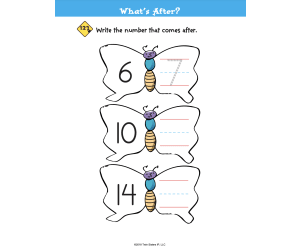
Grade K: Beginning Math Numbers 1-20 Review Printable Workbook
Math, Early Math, Kindergarten, Preschool, Grade 1, Workbooks, Worksheets & Printables
This Pre K+ workbook includes activities for: —Learning and Recognizing Numbers 1 to 2 —Counting and Writing in Numerical Order —Identifying Opposites
Author Twin Sisters Digital Media
Tags Opposites, Numbers, Math, Counting, Identifying Numbers

Interactive Chemistry Quiz: GHS Symbols – Genially + PDF Version
Science, STEM, Chemistry, Physics, Life Sciences, Earth and Environmental Sciences, Technology, Basic Science, Biology, P.E. & Health, Homeschool Templates, Grade 6, 7, 8, 9, 10, 11, Teacher Tools, Experiments, Activities, Labs, Worksheets & Printables, Escape Room, Games, Presentations, Quizzes and Tests, Quizzes
Interactive Chemistry Quiz: GHS Symbols – Genially (+ PDF Version) Bring lab safety to life with this interactive quiz on the GHS (Globally Harmonized System) hazard symbols – perfect for middle and high school chemistry lessons. Whether you're starting the unit or wrapping up a safety review, this quiz adds variety, visual appeal, and a bit of fun to your lesson plan. You’ll get two versions of the quiz: – A PDF version that can be used digitally or printed (but it works not well) – A Genially link that leads to an animated, interactive version (includes sound – which can be muted) Both versions test students on the meanings of the various GHS symbols – from corrosive substances to environmental hazards. The quiz includes original clipart and my own glitter-animated GHS symbols to make the content more visually appealing without distracting from the important safety message. I usually use the Genially quiz for individual work in the computer lab or on tablets, so each student can go at their own pace. But it also works well as a station activity , a class-wide quiz , or even as homework , depending on your classroom setup. At the end of the PDF, you’ll find: A QR code to scan directly to the Genially A clickable link for browser access An iframe embed code , if you want to use it on your (non-commercial) learning platform Attention: The interactive PDF does not contain the full scope of the material. The quiz works. Unfortunately, the additional tasks do not. Using Genially is therefore recommended and much more motivating for the pupils. For the interactive quiz you need an internet connection and a terminal device. The quiz can be carried out with the whole class or as partner or individual work. I prefer individual work at each student's own pace. To get to the Genially link, either scan the QR code at the end of the document or click on the link button available there. You can also copy the iframe code and embed the Genially on a learning platform or other... The Genially can be used either at the beginning of the topic or as a backup. It is also worth using as a station in station work. The interactive version includes motivating sound effects , a self-paced structure , and a clear, age-appropriate design for grades 7–10. 📌 Important note : The Genially quiz is protected by copyright. It’s for your own classroom use only . Please don’t share the link or embed it outside a private, secure learning environment. Sharing with colleagues, online platforms, or social media is not permitted. I hope your students enjoy reviewing GHS symbols as much as mine do! – Heike from @Lernfitness Did You Know? I teach with a certified therapy dog, and together we create a positive and welcoming learning environment. 🐶
Author Lernfitness
Rating
Tags GHS, Science, Lab, Chemistry, Pictograms, Genially, Interactive, Lab Safety, Hazard Symbols, Individual Work

History Word List Posters - Set 3 (PDF)
ELA, Language Development, Vocabulary, Spelling, ESL, Resources for Teachers, Social Studies, History, History: USA, History: World, Grade 2, 3, 4, 5, Worksheets & Printables, Worksheets, Teacher Tools, Centers, Activities, Posters, Classroom Decor
Word List Poster Series This word list poster series is designed for students in grades 2–5. Each printable focuses on a clear, kid-friendly theme and features 8 target vocabulary words with short, student-friendly meanings or fun facts. The clean layout works as both an anchor chart and a write-in sheet, giving students a quick, visual reference they can revisit during centers and independent work. These posters are student-friendly, classroom-ready, and perfect for warmups, vocabulary walls, sub plans, or take-home reference. Display a single poster to support the day’s lesson, or group several to build a themed wall across your unit. Note: Each poster is a companion piece to its matching themed product in the series—pair it with the corresponding maze, wordsearch, or activity pack for a consistent set of 8 focus words. History Set 3 Word List 1. Early Human Societies Hunter, Gatherer, Cave, Fire, Stone, Spear, Tribe, Tool 2. The American Civil Rights Movement Equal, Rights, March, Law, Vote, Speech, Justice, Brave 3. The Industrial Revolution (Review from First Set) Factory, Machine, Steam, Train, Inventor, Electricity, Labor, City 4. Famous Women in History Rosa Parks, Harriet Tubman, Susan B. Anthony, Amelia Earhart, Helen Keller, Sacagawea, Clara Barton, Malala Yousafzai 5. U.S. Presidents (Second Version, First Version Available in Set 2) George Washington, Abraham Lincoln, Theodore Roosevelt, Franklin D. Roosevelt, John F. Kennedy, Barack Obama, Thomas Jefferson, Dwight D. Eisenhower 6. World Landmarks and Wonders Pyramids, Great Wall, Colosseum, Statue of Liberty, Eiffel Tower, Mount Everest, Amazon River, Grand Canyon PDF Version Other versions will appear here when available. Follow the store for the lastest on new products. How to Use These Word List Posters Perfect for: Morning work or early-finisher bins Vocabulary centers or anchor walls Holiday/seasonal review lessons Independent stations, sub plans, or take-home reference More History Themed Products History Crosswords (Set 1) PDF History Crosswords (Set 2) PDF History Crosswords (Set 3) PDF History Word Seaches (Set 1) PDF History Word Seaches (Set 2) PDF History Word Seaches (Set 3) PDF History Mazes (Set 1) PDF History Mazes (Set 2) PDF History Mazes (Set 3) PDF FULL CATALOG OF DOWNLOAD LINKS HERE Themed Word List Posters Links Addition PDF Animals PDF Around the Home PDF Birthday PDF Candy PDF Christmas PDF Cinco de Mayo PDF Clothes PDF Colors PDF Days and Months PDF Division PDF Earth Day PDF Easter PDF Easy Word List Posters PDF Fall PDF Father's Day PDF Food PDF Geography (Set 1) PDF Geography (Set 2) PDF Geography (Set 3) PDF Graduation PDF Health PDF History (Set 1) PDF History (Set 2) PDF History (Set 3) PDF Human Body PDF Kindness PDF Life Skills PDF Mother's Day PDF Multiplication PDF Science (Set 1) PDF Science (Set 2) PDF Science (Set 3) PDF Shapes PDF Social Skills PDF Spring PDF Sports PDF St. Patrick's Day PDF Subtraction PDF Summer PDF Thanksgiving PDF Transport PDF Valentine's Day PDF Winter PDF Word List Posters in Depth Structure Each poster is built around a focused sub-theme and presents 8 target words with short, student-friendly meanings or fun facts. The clean A4 portrait layout works as an anchor chart on your board or as a student reference at desks. These posters are designed as companion pieces to the matching themed products (mazes, wordsearches, activity packs), so the same vocabulary stays visible across your unit. Each poster set includes: A themed word list poster with 8 words + brief meanings/facts A clean, high-contrast layout for easy printing and display Space that can double as write-in/draw-to-show-meaning during centers Themes Included Seasons & Holidays (e.g., Halloween, Easter, Valentine’s Day) Everyday Topics (e.g., Animals, Weather, School) Math & Science Connections (e.g., Number Words, Simple Machines) Special Units (e.g., Health, Earth Day, Sports, Kindness) Each topic reflects real-life experiences and interests while strengthening vocabulary recognition and content understanding in a clear, visual way. Easy extensions (optional) Sketch it: students draw a quick icon for each word Sort it: group words by category (e.g., actions, objects) Star it: highlight “I already know” vs. “I’m learning” words Match it: point to examples in a reading, video, or picture set Say it: brief oral definition or example sentence during share-out Differentiation tips Pre-teach 2–3 anchor words; add the rest later in the week Offer picture cues or gestures for emerging readers/ELLs Let students choose 4 of 8 to focus on first, then build up Color-code by part of speech or concept family for quick scanning For similar downloads and other frees, do check out Cored Group on TeachSimple.
Author Cored Education
Rating
Tags Vocabulary, Spelling, History, The American Civil Rights Movement, Famous Women In History, World Landmarks And Wonders, U.S. Presidents, Posters, History Posters
Science Reading Changes in the Earth and Sky (Presentable PDF)
Science, Earth and Environmental Sciences, Earth Sciences, Common Core, ESL, Language Development, ELA, Reading Comprehension, Reading, Space, Grade 2, 3, 4, Tests, Quizzes and Tests, Teacher Tools, Assessments, Worksheets, Worksheets & Printables, Diagrams, Centers, Activities
Science Reading Passages on Changes in the Earth and Sky Snapshot Genre: Nonfiction Subject: Science (Earth Science / Space Science) Primary Topic: Earth changes, weather, and motion in space Estimated Guided Reading Level (A–Z): R What This Teaches Best It helps students compare slow Earth changes such as weathering and erosion with fast changes such as volcanoes, landslides, and earthquakes. It explains cause and effect in Earth systems, including how magma forms volcanoes and how faults can lead to earthquakes. It teaches key weather concepts such as air pressure, wind, humidity, air masses, and fronts. It introduces scientific tools and measurements by showing how thermometers, barometers, hygrometers, and seismographs are used. It builds understanding of motion in space through rotation, orbit, period, distance, and the scale of the solar system. Learning Goals Students will compare slow changes and fast changes to Earth’s surface. Students will explain how volcanoes, earthquakes, and landslides can change Earth quickly. Students will describe how differences in air temperature and air pressure affect weather. Students will identify the tools used to measure temperature, air pressure, humidity, and movement in Earth’s crust. Students will explain the difference between Earth’s rotation and Earth’s orbit. Students will use text information to describe the size and motion of the solar system. Part 2 - Changes in the Earth and Sky Reading Passage 1: Slow Changes to the Earth's Surface Reading Passage 2: Fast Changes to the Earth's Surface Reading Passage 3: The Atmosphere and Weather Reading Passage 4: Measuring Temperature, Air Pressure, and Humidity Reading Passage 5: The Motion of Objects in the Universe PRESENTABLE PDF VERSION Run it like a slide show straight from a PDF, with no PowerPoint or extra software needed, just open, project, and teach. Other versions are available in the links list below or in the full catalog. FULL CATALOG OF DOWNLOAD LINKS HERE Grade 3/4 Links: Physical Science Part 1 - Properties of Objects and Materials Google Docs/Slides/Forms PDF PPT Word Free Supplementary Pack Accompanying Videos Physical Science Part 2 - Position and Motion of Objects Google Docs/Slides/Forms PDF PPT Word Free Supplementary Pack Accompanying Videos Physical Science Part 3 - Light, Heat, Electricity, Magnetism Google Docs/Slides/Forms PDF PPT Word Free Supplementary Pack Accompanying Videos Life Science Part 1 - Characteristics of Organisms Google Docs/Slides/Forms PDF PPT Word Free Supplementary Pack Accompanying Videos Life Science Part 2 - Life Cycles of Organisms Google Docs/Slides/Forms PDF PPT Word Free Supplementary Pack Accompanying Videos Life Science Part 3 - Organisms and Environments Google Docs/Slides/Forms PDF PPT Word Free Supplementary Pack Accompanying Videos Earth Science Part 1 - Properties of Earth Materials Google Docs/Slides/Forms PDF PPT Word Free Supplementary Pack Accompanying Videos Earth Science Part 2 - Changes in the Earth and Sky Google Docs/Slides/Forms PDF PPT Word Free Supplementary Pack Accompanying Videos Earth Science Part 3 - Objects in the Sky Google Docs/Slides/Forms PDF PPT Word Free Supplementary Pack Accompanying Videos For similar products and other frees, do check out Cored Group on TeachSimple .
Author Cored Education
Rating
Tags Science, Elementary, Reading, Comprehension, Reading Centers, Science Assessments, Reading Comprehension Assessments, Vocabulary Assessments, Earth Science

Reading Comprehension: Properties of Objects and Materials (Word File)
ELA, Reading, Science, Physics, Common Core, ESL, Language Development, Vocabulary, Chemistry, Grade 2, 3, 4, Worksheets, Worksheets & Printables, Assessments, Teacher Tools, Tests, Quizzes and Tests
Reading Comprehension: Properties of Objects and Materials for Physical Science This comprehensive package Properties of Objects and Materials: Reading Passages Physical Science enables your students to practice reading strategies and learn essential science topics for the week. All of this is made easier by the fact that the bulk of the work is already completed for you. Physical properties and states of matter are the focus of the reading materials. What's inside? Part I Passage 1: Observable Physical Properties of Objects & Materials Passage 2: Measuring Physical Properties Passage 3: Classification of Matter Passage 4: States of Matter Passage 5: Change of Phase Product Info: 28 pages Teaching Duration: 2 Weeks Science Reading Comprehension Outline: Targeted for students in 3rd and 4th grades, these reading passages are enhanced with illustrations and graphs to elucidate critical points. Each lesson aligns with the Common Core State Standards, allowing you to integrate science reading practice effortlessly, knowing that minimal preparation is needed on your part. Each passage comes with a variety of questions in different formats, including multiple-choice formats, data analysis, and fill-in-the-blanks. The topics covered strike a balance between engaging content and core curriculum-based science subjects. Versatile in application, these lessons are suitable for a variety of settings such as whole-class instruction, morning activities, independent desk work, small group discussions, contingency plans for substitute teachers, homework assignments, or even special holiday-themed tasks. FULL CATALOG OF DOWNLOAD LINKS HERE Grade 3/4 Links: Physical Science Part 1 - Properties of Objects and Materials Google Docs/Slides/Forms PDF PPT Word Free Supplementary Pack Accompanying Videos Physical Science Part 2 - Position and Motion of Objects Google Docs/Slides/Forms PDF PPT Word Free Supplementary Pack Accompanying Videos Physical Science Part 3 - Light, Heat, Electricity, Magnetism Google Docs/Slides/Forms PDF PPT Word Free Supplementary Pack Accompanying Videos Life Science Part 1 - Characteristics of Organisms Google Docs/Slides/Forms PDF PPT Word Free Supplementary Pack Accompanying Videos Life Science Part 2 - Life Cycles of Organisms Google Docs/Slides/Forms PDF PPT Word Free Supplementary Pack Accompanying Videos Life Science Part 3 - Organisms and Environments Google Docs/Slides/Forms PDF PPT Word Free Supplementary Pack Accompanying Videos Earth Science Part 1 - Properties of Earth Materials Google Docs/Slides/Forms PDF PPT Word Free Supplementary Pack Accompanying Videos Earth Science Part 2 - Changes in the Earth and Sky Google Docs/Slides/Forms PDF PPT Word Free Supplementary Pack Accompanying Videos Earth Science Part 3 - Objects in the Sky Google Docs/Slides/Forms PDF PPT Word Free Supplementary Pack Accompanying Videos For similar products and other frees, do check out Cored Group on TeachSimple .
Author Cored Education
Rating
Tags Science, Elementary, Reading, Comprehension, Vocabulary, Physics, Physical Science, Reading Comprehension Assessments, Science Assessments, Vocabulary Assessments
Order of Operations Pre-Algebra Whodunnit (Grades 5-8)
Algebra, Math, Grade 5, 6, 7, 8, Games, Activities, Quizzes, Quizzes and Tests, Teacher Tools, Worksheets & Printables
Make math practice fun and engaging with this Order of Operations Whodunnit Mystery Activity. Students solve problems while working to crack a mystery. This resource includes 10 order of operations problems, a student worksheet, and an elimination sheet with suspects, locations, and methods. It also comes with a teacher guide and a complete answer key with step-by-step solutions. Everything is printable and easy to use. Students solve each problem using PEMDAS or GEMS rules. Each correct answer gives a clue. They use the clues to eliminate options and solve the mystery. The activity keeps students focused and motivated. You can use it in many ways. Try it as math stations, a scavenger hunt, small group work, or independent practice. It also works well for sub plans. Students practice evaluating expressions, using parentheses, and solving multi-step problems. They build accuracy and confidence. Teachers love this resource because it is engaging and simple to set up. It also encourages critical thinking and problem-solving. Use it to turn your math lesson into a fun and memorable experience.
Author Bright Classroom Ideas Marketplace
Rating
Tags Math, Algebra, Order Of Operations, Whodunnit, Game
RESTART Comprehension/Vocabulary/Summative Assessment Book Unit
ELA, Grade 5, 6, 7, Worksheets & Printables, Novel Studies, Worksheets, Writing Prompts
RESTART is a fantastic book for 5th, 6th, and 7th grades. I wanted to create a unit so teachers can use it at ease and for teachers to see their students grow. They grow because of the 30 chapter lessons. These lessons have core standards in them and are 1-16 or 1-10. Most of the questions consist of comprehension, homophones, vocabulary context clues, art, evidence, and figurative language. The 1-16 lessons have a 5-point multiple choice exit quiz for them. There is also a summary packet the kids can use for the shorter chapters. The comprehension and vocabulary worksheets allow the student to follow and learn the plot very well in a rigorous but fun way. There are also 10 vocabulary 1-12 fill-in-the-blank tests, too. The vocabulary words are challenging, but words that will help them during the story reading. There is also a 1-30 multiple choice final test. There is a research paper prompt and 5 RACES rigorous writing prompts. Finally, the students have a Student Reading Reference Page to help them with the figurative language in the book and assessments.
Author TrilogyTeacher
Tags Restart, Restart Book Study, Restart Novel Study

Evolution Flashcards | Set of 12 handprinted cards
Science, Life Sciences, Biology, Not Grade Specific, Worksheets & Printables, Flashcards
This set of 12 flashcards features my own hand-illustrated watercolor drawings depicting several stages of evolution for 12 different species (human, whale, and horse). A great tool to use for nature study lessons or for science. This set also comes with a poster depicting all 12 species. To create a tactile finished item I highly recommend printing onto high-quality paper, I like to use watercolor paper as the texture is beautiful to handle.
Author Fiddleticks Education
Tags Evolution, Flashcards

Letter O Worksheets + PowerPoint Lesson: Beginning Sounds Lesson 15
Special Resources, ELA, Special Education Needs (SEN), Language Development, Phonics, Speech Therapy, Kindergarten, Preschool, Worksheets, Worksheets & Printables, Presentations, Teacher Tools
Letter O Worksheets + PowerPoint Lesson Lesson 15 teaches the letter Oo and its related phonic sound through a 37-slide PowerPoint lesson, and 5 follow-up activity worksheets. All you need to teach the phonic letter O! Whether in school or at home, this series of phonic presentations can help you effectively teach initial/beginning sounds to all pupils, including those with special needs/dyslexia. This lesson is part of a synthetic, systematic phonics programme for all abilities, including those suspected of being dyslexic. This lesson is in the first stage of the Reading Made Simple programme, where we teach the initial, or beginning, sounds. The ability to hear the initial/beginning sound is stressed throughout, while we learn to associate each letter with its sound. Each lesson can stand alone, but the activities will presume knowledge of the previous letters in the alphabet as Reading Made Simple teaches the initial sounds in alphabetical order. Special features of the Letter O Worksheets and PowerPoint presentation: The PowerPoint is silent so that you can interact with your child in the best way for them: full instructions are provided at the bottom of each slide - be sure to show 'Notes'. The PowerPoint is editable so that you can make it fit your pupils. Science of Reading Aligned Truly phonetic; no 'i' for 'ice-cream'. We focus heavily on phonemic awareness, which is so necessary for a head start in phonics The child is given plenty of opportunities to learn the necessary skills - perfection is not expected in lesson 1. Still, the teacher will look for the development of the necessary skills as the child works through the alphabet. What is included in the Letter O worksheets Pack? A 37-slide PowerPoint which teaches phonemic awareness, letter/sound correspondence and letter formation, along with practice games 5 follow-up, Letter O worksheets How can this resource be used? It can be used in multiple ways: As the child learns each sound, you can use the PowerPoint lesson to reinforce your lesson It can be sent home for a child to watch with his/her parents after being taught the letter Oo in class - this will then act as revision as well as training the parent as to what is necessary to help the child. Use in class Use at home by parents or for home education Suggested Method: Introduce each letter in turn to your pupil. Have a flashcard of the letter ready. Say each letter's sound to the child and ask him/her to repeat it thrice. Explain that some words begin with this sound. Give an example. You can use the lesson as teacher training for yourself, to learn how to teach your child, or to use it with the child. Choose suitable activities (matching your child's ability) from the pack of worksheets. Notes are suggestions only. Use language appropriate to your pupil and be sure to interact naturally. However, could you focus on the child's hearing of the sounds at the beginning of words? This is often overlooked in the quest to help children learn the initial sounds as quickly as possible. Technical help: Please open PowerPoint in normal mode so you can see the notes and use the 'Draw' tool when prompted. Some slides are interactive. More: Teachers: Find more Initial Sounds Worksheets here: https://teachsimple.com/product/beginning-sounds-phonics-worksheets Find FREE revision/practice initial sounds slides here: https://teachsimple.com/product/learn-initial-sounds-powerpoint
Author Lilibette's Resources
Rating
Tags Phonics, Learn To Read, Initial Sounds, Beginning Sounds, Alphabet, Parents, Home School, Special Needs, Letter O Worksheets, Letter O
6th Grade Math Spiral Review Escape Room Week 3
Math, Grade 5, 6, 7, Worksheets, Worksheets & Printables, Teacher Tools, Activities, Escape Room
Bring structure, engagement, and consistency to your daily math routine with this 6th grade, full-week math review set in a an underwater research lab. Designed to be quick, consistent, and effective, it includes five mini escape room missions (one for each day of the week) that take just 8 to 10 minutes to complete. It's the type of activity that feels fun for students, but is hard at work in the background. Each day, students take on the role of a researcher in the Underwater Lab. They'll solve a short set of math problems, use digits from their answers to unlock a code, and complete their mission for the day. The structure is the same each day, so once students understand the routine, there's no-prep, no logins, and built-in self-checking! Skills Covered - Week 3 The same five skill areas spiral in all five days, with new problems each day: Decimal Place Value Comparing Decimals Fractions vs. Decimals Multiplying Whole Numbers Decimal Word Problems This spiraled structure is intentional. It allows students to build confidence and fluency with repeated exposure, but not just memorize answers since the problems are all different. It's perfect for those skills students always seem to need more practice with, without feeling overwhelming or taking up too much class time. How the Mini Escape Rooms Work Each daily mission follows the same process: Students solve five math problems Each problem focuses on one of the five target skills. Students take the first digit of each answer The five digits form a numeric code. Entering the correct code completes the mission! Because the format never changes, students quickly become independent. Once the routine is established, you won't need to re-explain directions day after day. What's Included This resource provides everything you need for a full week of review: Five digital mini escape room missions (Day 1-Day 5) Printable worksheets with the same problems for each day Answer keys and numeric codes for all missions A consistent layout to support student independence Clear teacher instructions Student-friendly directions Classroom Use Each mission is designed to fit easily into your schedule, and works perfectly as: A bell ringer or warm up A quick end-of-class review An early finisher activity A reliable emergency sub plan Missions can be completed in order across the week or used independently, depending on your classroom needs. Technology and Accessibility This resource is intentionally flexible: No student accounts required Works with whole-class projection, individual devices, or distance learning Fully usable in paper-based classrooms with the printable version Teacher Notes The short, consistent format makes it easy to establish a routine and avoid wasting class time on transitions and repeated directions. Once the code rule is learned, these mini escape rooms practically run themselves!
Author Matemaths
Rating
Tags Matemaths, Worksheet, Word Problems, Decimals, Spiral Review, Warm Up, Exit Ticket

First Week of School Grade 10 | No-Prep Worksheets
ELA, Math, Grade 10, Lesson Plans, Teacher Tools, Worksheets & Printables
Help students begin sophomore year with confidence using this engaging First Week of School Activities for 10th Grade packet! Designed to help students reconnect with academic skills while building strong classroom relationships, this no-prep resource combines Geometry review, literacy, writing, critical thinking, and social-emotional learning in one easy-to-use workbook. Students set objectives, improve their communication skills, go over important geometry ideas, and take part in worthwhile community-building activities over the course of five organized days. The Pythagorean Theorem, coordinate geometry, congruence and similarity, trigonometry, circles, transformations, area and volume, argument writing, academic terminology, and reading comprehension are all covered in the lessons. The packet is perfect for bell ringers, independent work, small groups, advisory periods, whole-class instruction, and informal assessments. While the full answer key makes preparing easy and stress-free, a comprehensive Teacher Guide offers lesson outlines, pacing recommendations, discussion starters, and ideas for differentiation. During the crucial first week of classes, this tool aids teachers in creating routines, fostering a healthy classroom environment, and evaluating students' preparedness. It helps kids feel connected, engaged, and ready for a successful tenth grade year by striking a balance between academic review and relationship-building activities.
Author Bright Classroom Ideas Marketplace
Rating
Tags Back To School, First Week, Ela, Math, Lesson, Plan, Worksheet