Free Science Reading Passage: Pushing and Pulling Forces PDF



- Grades
- Grades 2–4, Elementary, Homeschool Resources
- Pages
- 5
- File type
- Answer key
- Included


- Subject
- ELA, Reading, Common Core, Reading Comprehension, Science, Physics, ESL, Language Development, Vocabulary
- Topic
- science, elementary
- Resource types
- Teacher Tools, Assessments, Tests, Quizzes and Tests, Worksheets & Printables
- Answer key
- Included
About this resource
What's inside this resource
Free Reading Passage on Pushing and Pulling Forces for Physical Science
What's inside this free product?
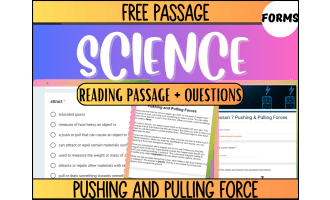
Science Reading Comprehension Passage 7 : Pushing and Pulling Forces
Independent PDF Version:
This is the independent PDF version containing one lesson with full answer keys.
Product Info:
5 PAGES (US English with Answers) PDF Version
Teaching Duration: 90 Minutes
Science Reading Comprehension Outline:
Targeted for students in 3rd and 4th grades, these reading passages are enhanced with illustrations and graphs to elucidate critical points. Each lesson aligns with the Common Core State Standards, allowing you to integrate science reading practice effortlessly, knowing that minimal preparation is needed on your part.
Each passage comes with a variety of questions in different formats, including multiple-choice formats, data analysis, and fill-in-the-blanks. The topics covered strike a balance between engaging content and core curriculum-based science subjects.
Versatile in application, these lessons are suitable for a variety of settings such as whole-class instruction, morning activities, independent desk work, small group discussions, contingency plans for substitute teachers, homework assignments, or even special holiday-themed tasks.
FULL CATALOG OF DOWNLOAD LINKS HERE
Grade 3/4 Links:
Physical Science Part 1 - Properties of Objects and Materials
Physical Science Part 2 - Position and Motion of Objects
Word
Free Supplementary Pack
Accompanying Videos
Physical Science Part 3 - Light, Heat, Electricity, Magnetism
Google Docs/Slides/Forms
PPT
Word
Free Supplementary Pack
Accompanying Videos
Life Science Part 1 - Characteristics of Organisms
Google Docs/Slides/Forms
PPT
Word
Free Supplementary Pack
Accompanying Videos
Life Science Part 2 - Life Cycles of Organisms
Google Docs/Slides/Forms
PPT
Word
Free Supplementary Pack
Accompanying Videos
Life Science Part 3 - Organisms and Environments
Google Docs/Slides/Forms
PPT
Word
Free Supplementary Pack
Accompanying Videos
Earth Science Part 1 - Properties of Earth Materials
Google Docs/Slides/Forms
PPT
Word
Free Supplementary Pack
Accompanying Videos
Earth Science Part 2 - Changes in the Earth and Sky
Google Docs/Slides/Forms
PPT
Word
Free Supplementary Pack
Accompanying Videos
Earth Science Part 3 - Objects in the Sky
Google Docs/Slides/Forms
PPT
Word
Free Supplementary Pack
Accompanying Videos
For similar products and other frees, do check out Cored Group on TeachSimple.
Related resources
More resources teachers may find useful
24 related resources were found using this product's title, contributor, categories and tags.
In the classroom
Teaching tips & learning objectives

Learning objectives
Explain the concept of force as a push or pull, and identify gravity, weight, and magnetism as specific types or effects of force.
Determine the meaning of a domain-specific word ("observing") from its context in the passage.
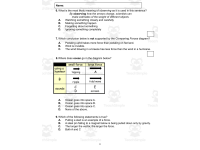
Interpret information presented in a diagram (Comparing Forces) to answer questions about relative force.
Match vocabulary terms (magnet, attract, force, magnetism, weight, scale, estimate) to their correct definitions.

Teaching tips
Review the Comparing Forces and Measuring the Force of Gravity diagrams with the whole class before assigning questions 7 and 8, since both questions depend on reading the diagrams rather than the passage text alone.
Use the answer key's cited supporting sentences (for Q1-Q4) as a model for how to justify an answer with text evidence when reviewing student responses.
Assign the two sentence-writing prompts (using "diagram," "different," "direction") as a quick check that students can use the passage's vocabulary in their own writing, not just recognize it.

Skills covered
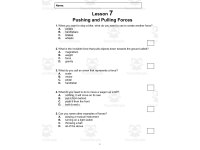
Reading comprehension of a science informational text — students answer five recall questions grounded in specific sentences from the passage.
Vocabulary in context — students determine the meaning of "observing" from how it is used in a passage sentence (Q6).
Diagram interpretation — students read the Comparing Forces diagram to answer two questions about relative force (Q7-Q8).
Vocabulary matching and application — students match seven science terms to definitions and use three passage words in original sentences.
Good to know
Questions teachers ask about this resource
Does this lesson only ask students to recall facts from the passage?
No — alongside five direct recall questions, it includes a vocabulary-in-context question, two questions requiring students to read information out of a diagram rather than the text, and one question asking students to evaluate which of several statements is true based on the passage's concepts.

No reviews yet
Downloaded this resource? Tell other teachers how it went.
Resource details
Concepts & topics
Core concepts
 Core concepts
Force (push and pull)
Gravity and weight
Magnetism
Force vectors
 Topics
Explore more
Categories this resource belongs to
Explore related searches
More to explore
You may also like