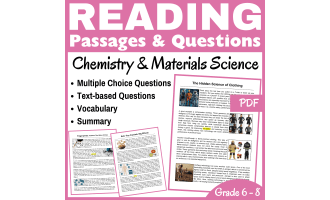
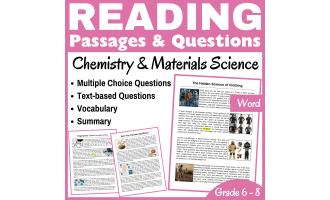
Physical Science Reading Comprehension Passage Gas Laws (Fillable PDF)


Science, ELA, Reading, Reading Comprehension, Strategies, Resources for Teachers, Chemistry, Physics
Writing Prompts, Worksheets & Printables, Centers, Activities, Teacher Tools, Assessments, Quizzes and Tests, Quizzes, Literacy Readers, Worksheets


About This Product
Physical Science Reading Comprehension Passage and Questions: Gas Laws (Fillable PDF)
This very engaging science reading passage is about gas laws and how gases respond to changes in temperature, pressure, and volume. It explains that gas particles are always moving and create pressure when they collide with the surfaces of a container. The passage introduces Boyle’s Law, Charles’s Law, and Gay-Lussac’s Law through familiar examples such as squeezed balloons, cold car tires, sealed soda cans in the sun, and hot air balloons. It also explains why gas laws are useful in real life, including in tire pressure, pressurized containers, aviation, balloon operation, and medical equipment such as ventilators.
This passage is designed to bridge the gap between science and literacy by strengthening reading comprehension while sparking scientific curiosity in middle school students. It blends English Language Arts skills with accurate science content, helping students build background knowledge, understand key concepts, use evidence from the text, and explain scientific ideas clearly. This resource supports science classroom practice while also reinforcing important literacy skills such as main idea, vocabulary, comprehension, and summarizing. Ideal for interdisciplinary learning in ELA and Science. Suitable for Grade 9 review, too!
Student Tasks for The Passage:
10 multiple-choice questions targeting main idea, key details, science concepts, comparison, and real-world applications
10 True/False statements to check understanding and address common misconceptions
5 text-based short-answer questions that require students to explain important ideas from the passage
5 vocabulary matching items with clear, student-friendly definitions
1 summary prompt that asks students to condense the central ideas accurately
Full answer key for every section
This passage is designed as a fillable PDF, which means students can type their answers directly into the document on any computer or tablet. Each page includes highlighted text fields that show them exactly where to type!
Available Formats for this Resource
PDF
Word Docs
Google Docs
Product Details
Length: 7 pages total
Grades: 6–8, also suitable for Grade 9 review
Use cases: close reading, stations, homework, intervention, test prep, and sub plans
Standards support: Reinforces informational-text skills and supports NGSS-style sense-making by helping students read scientific explanations, connect evidence to key concepts, interpret real-world examples, and explain cause-and-effect relationships in science.
Why Teachers Choose This Set
Authentic science content paired with rigorous literacy practice
Consistent task structure across all passages for easier planning and smoother student routines
Clear, age-appropriate writing that builds confidence without oversimplifying
> Other Science Reading Collections and Topics You May Find in the Store:
1. Astronomy & Space Science
2. Volcanoes, Rocks, & Mountains
3. Rock Cycle, Soil, & Sinkholes
4. Mars, Glaciers, & Antarctica
5. Water Cycle, Acid Rain, & Wastewater
6. Insects, Animals, & Ecosystems
7. Bioluminescence & Insects
8. Animal Skin, Cats, & T. Rex
9. Human Body and Senses
10. Health & Applied Bioscience
11. Waves, Light, & Imaging
12. Electricity & Energy
13. Motion & Materials
14. Chemistry and Materials Science
15. Electromagnetism
16. Acids and Bases
17. Gas Laws
18. Biotechnology
19. Periodic Trends
20. Protists and Fungi
21. Microevolution
22. Blood
23. Chemical Bonding
24. Magnets
25. Muscles
26. Nuclear Chemistry
27. Electromagnetic Devices
28. Epigenetics
29. The Law of Conservation of Mass
30. Atomic Models
31. Isotopes and Ions
32. Light
33. Human-Environment Interaction
34. Theory of Evolution
35. Photosynthesis
36. Origins of Life and Early Earth
37. Gene Expression and Regulation
38. Thermochemistry
39. Allergies
40. Coevolution
41. Birth to Adulthood
42. Cells
43. Entropy and Free Energy
44. The Human Brain
45. Mixtures and Solutions
46. Invertebrates
47. Zoo Animals
48. Biochemistry
49. Animal Behavior
50. Population Ecology
...and many more engaging science reading passages that cover intriguing and important topics designed to spark curiosity and support student learning.
Use this passage to reinforce ELA skills in science, to add literacy to your lessons, and to support independent work. The passages strengthen main idea, evidence use, vocabulary in context, inference, cause and effect, and summary writing. With ready-to-use assessments and complete answer keys, you can provide focused practice that is simple to run and fast to review.
Resource Tags
0 Reviews
Check out these other great products