Free 24 related resources

Science Reading Passage 19 Plant Structure, Function, and Survival PPT

An informational passage explains how plant roots, leaves, and stems keep a plant alive, then applies a bicycle-parts reasoning analogy to a function-matching chart, comprehension questions, and a vocabulary word-building exercise, all fully answer-keyed.
Grades
Grades 2–4, Elementary, Homeschool Resources
Pages
23
File type
Microsoft PowerPoint
Answer key
Included

Instant download · Updated Mar 23, 2025

Subject
Science, Life Sciences, Biology, Common Core, ESL, Language Development, ELA, Reading Comprehension, Reading, Resources for Teachers
Topic
science, elementary
Resource types
Teacher Tools, Presentations, Assessments, Tests, Quizzes and Tests, Activities
Answer key
Included

About this resource

What's inside this resource

Free Reading Passage on Plant Structure, Function, and Survival for Life Science

What's inside this free product?

Science Reading Comprehension Passage 19 : Plant Structure, Function, and Survival

Independent PPT Version:

This is the independent PPT version containing one lesson with full answer keys.

Product Info:

23 SLIDES (US English with Answers) PPT Version

Teaching Duration: 90 Minutes

Science Reading Comprehension Outline:

Targeted for students in 3rd and 4th grades, these reading passages are enhanced with illustrations and graphs to elucidate critical points. Each lesson aligns with the Common Core State Standards, allowing you to integrate science reading practice effortlessly, knowing that minimal preparation is needed on your part.

Each passage comes with a variety of questions in different formats, including multiple-choice formats, data analysis, and fill-in-the-blanks. The topics covered strike a balance between engaging content and core curriculum-based science subjects.

Versatile in application, these lessons are suitable for a variety of settings such as whole-class instruction, morning activities, independent desk work, small group discussions, contingency plans for substitute teachers, homework assignments, or even special holiday-themed tasks.

FULL CATALOG OF DOWNLOAD LINKS HERE

Grade 3/4 Links:

Physical Science Part 1 - Properties of Objects and Materials

Google Docs/Slides/Forms

PDF

PPT

Word

Free Supplementary Pack

Accompanying Videos

Physical Science Part 2 - Position and Motion of Objects

Google Docs/Slides/Forms

PDF

PPT

Word

Free Supplementary Pack

Accompanying Videos

Physical Science Part 3 - Light, Heat, Electricity, Magnetism

Google Docs/Slides/Forms

PDF

PPT

Word

Free Supplementary Pack

Accompanying Videos

Life Science Part 1 - Characteristics of Organisms

Google Docs/Slides/Forms

PDF

PPT

Word

Free Supplementary Pack

Accompanying Videos

Life Science Part 2 - Life Cycles of Organisms

Google Docs/Slides/Forms

PDF

PPT

Word

Free Supplementary Pack

Accompanying Videos

Life Science Part 3 - Organisms and Environments

Google Docs/Slides/Forms

PDF

PPT

Word

Free Supplementary Pack

Accompanying Videos

Earth Science Part 1 - Properties of Earth Materials

Google Docs/Slides/Forms

PDF

PPT

Word

Free Supplementary Pack

Accompanying Videos

Earth Science Part 2 - Changes in the Earth and Sky

Google Docs/Slides/Forms

PDF

PPT

Word

Free Supplementary Pack

Accompanying Videos

Earth Science Part 3 - Objects in the Sky

Google Docs/Slides/Forms

PDF

PPT

Word

Free Supplementary Pack

Accompanying Videos

For similar products and other frees, do check out Cored Group on TeachSimple.

In the classroom

Teaching tips & learning objectives

Learning objectives

  • Students will explain the function of plant roots, leaves, and stems using details from the passage.

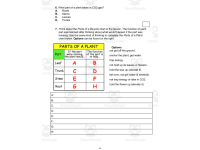
  • Students will use a "what would happen if this part were missing" reasoning strategy, modeled first on bicycle parts, to determine a plant part's job.

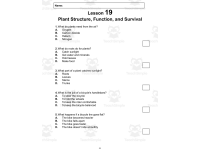
  • Students will answer multiple-choice comprehension questions by citing a specific sentence from the passage.

  • Students will build and define domain-specific vocabulary terms, including minerals, photosynthesis, and organize.

Teaching tips

  • Work through the bicycle-parts example first, since it models the reasoning strategy students then apply to the plant-parts chart.

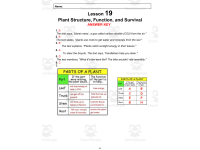
  • Have students identify the sentence in the passage that supports each multiple-choice answer, matching the citation style used in the provided answer key.

  • Use the vocabulary word-building exercise as a stand-alone warm-up or review activity, since it is self-contained and separately keyed from the comprehension questions.

Skills covered

  • Reading for explicit detail — students answer six multiple-choice questions using specific sentences from the passage, matching the citation style modeled in the answer key.

  • Causal/functional reasoning — students apply a "what would happen if this part were missing" strategy, modeled on bicycle parts, to determine each plant part's job.

  • Domain-specific vocabulary building — students combine word fragments into terms such as photosynthesis and minerals, then match each term to its definition.

  • Analogical reasoning — the bicycle-to-plant comparison asks students to transfer a reasoning method from a familiar object to a new scientific context.

Good to know

Questions teachers ask about this resource

How does the bicycle example connect to the plant lesson?

The passage first models the reasoning strategy with familiar bicycle parts, asking what happens if the handlebars break or a tire goes flat, before students apply the same missing-part reasoning to complete the Parts of a Plant chart.

No reviews yet

Downloaded this resource? Tell other teachers how it went.

Resource details

Concepts & topics

Core concepts

  • Plant structure and function

  • Cause-and-effect reasoning

  • Domain-specific vocabulary

  • Text evidence

Explore more

Categories this resource belongs to

Explore related searches

More to explore

You may also like