



3,950 products added recently
Page 79 - 3rd Grade Activities
Enhance your third-grade curriculum with activities that stimulate interest and understanding. These resources offer hands-on experiments, creative projects, and problem-solving tasks. Incorporate them to support skill development and make learning a captivating experience.

 Show filters


Food Day word search 2rd 3th 4th 5th Grade worksheet activity
Vocabulary, Language Development, ELA, Spelling, Science, Health, P.E. & Health, Grade 2, 3, 4, 5, Games, Activities, Word Searches, Worksheets, Worksheets & Printables
Celebrate nutrition and healthy eating with this Food Day Word Search! 🥕🍎 Your students will search for food vocabulary, practice spelling and scanning, and increase awareness about healthy choices. Did I mention NO PREP? This download is a fun, meaningful, and interactive activity for Food Day in the classroom! Purpose: This activity will help students: - Acquire and remember nutrition and food vocabulary 🥦 - Build spelling and word identification skills ✏️ - Develop concentration and attention to detail 👀 - Initiate healthy habits and understanding of balanced eating 🥗 Order of Events/Steps: 1️⃣ Hand out the Food Day Word Search printable worksheet. 2️⃣ Review the word list, talking about each food group or item. 3️⃣ Students find the words and either circle them or highlight them. 4️⃣ Connect the vocabulary to healthy eating habits and Food Day focus. 5️⃣ Use the answer key I provided for easy checking/checking to writing/correcting ✔️ Grades or Ages : This activity was created for 2nd-5th graders. 🌟 Way of Implementation: It is appropriate for independent practice, centers, early finishers, sub plans and partner activities 🤝. It is also appropriate for science, health and other themed celebrations Answer Keys: ✅ Answer keys are provided for ease of checking and students’ self-assessment. How to Use and Variations: Timed challenge ⏳ – see who can do it the fastest Partner puzzle 🤝 – work in pairs Vocabulary extension ✏️ – students categorize foods (fruits, vegetables, grains, etc.) Create-your-own 🧩 – students create their own food-themed word search Standards: Support CCSS/ELA vocabulary practice & health education standards promoting awareness of nutrition 📝🥕 File Types & Pages: PDF format, ink-friendly Colored + black & white versions Answer keys are provided Teacher Encouragement: Make Food Day fun and educational; this Food Day Word Search helps your students practice literacy.
Author Classsim
Rating
Tags Food , Day , Word Search, 2rd 3th 4th 5th Grade , Worksheet , Activity, Food Day , Food Day Word Search , Food Day Word Search 2rd 3th 4th 5th Grade

Which Problem Is Bigger Task Cards -- Size Of The Problem Task Box
Social Emotional Learning (SEL), Special Resources, Life Skills, Social Skills, Special Education Needs (SEN), Grade 1, 2, 3, Centers, Activities, Task Cards, Worksheets & Printables
Are you looking for a way to help teach your students the size of the problem? These task cards are the perfect thing for you! These "Which is bigger" task cards give the students different problem scenarios. Students then have to decide between the 2 scenarios, which problem is bigger. You then can encourage discussion with your students by asking why the problem seemed the biggest. Your students will love this activity as the scenarios vary between common problems they may experience and silly problems as well (i.e. which is bigger: a dragon losing his fire or a unicorn losing it's sparkle). Spark discussion and growth with these task cards! These cards also include an assessment page that correspond with each task card so that way you can help assess progress and know specifically which scenarios the students are getting wrong. Includes: ⭐ 32 Task Cards ⭐ Assessment Page ⭐ Task Box Label ⭐ Task Box direction label ⭐ Ink Friendly and Color Printing Options To help your students understand the size of their reaction, they need to understand the size of the problem. These task cards are a great first step!
Author The Feelings and Friends Teacher
Rating
Tags Size Of The Problem, Size Of The Problem Activities, Task Boxes, Task Box Activities, Social Problem Solving, Problem Solving Scenarios, Which Is Largest, Task Cards, School Counseling
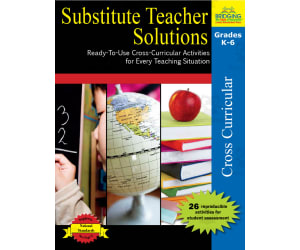
Substitute Teacher Solutions: Ready-To-Use Cross-Curricular Activities for Every Teaching Situation
, Preschool, Grade 1, 2, 3, 4, 5, 6, Activities
Substitute Teacher Solutions: Ready-To-Use Cross-Curricular Activities for Every Teaching Situation An intentionally crafted tool that provides a range of educational materials for every conceivable classroom scenario, this resource is developed with the highest quality. It caters to a variety of teaching situations from Kindergarten up through Grade 6. About This Comprehensive Guide: This guide includes 64 pages – all in an easily accessible PDF format – filled with ready-to-print activities and engaging articles designed specifically for educators who seek sensible, sturdy solutions for their teaching needs. Compiled in it are resources suited not only to regular classroom teachers but also those times when it becomes necessary to have a substitute teacher step in. What You'll Discover: Twelve riveting articles Twenty-six reproducible activities that align harmoniously with the National Education Standards Vast topics including ants and birds to Egypt's Abu Simbel temples and submersibles Rather popular subjects like the Olympics, pandas, pirates - even pizza! The vast selection ensures there will always be something intriguing available for every student, no matter their interests! The Benefit Of Flexibility: This product offers the flexibility of using these ready-to-use materials as fully-fledged complete units or simply used as quick activity breaks interspersed between other lesson plans. A Toolkit Designed By Experienced Educators: Substitute Teacher Solutions is your on-demand toolkit crafted by experienced educators who understand first-hand realities faced by both full-time teachers and substitutes alike. These resources are fit not only for classrooms across public schools nationwide but can also be utilized by homeschooling parents. In Conclusion... Substitute Teacher Solutions: Ready-To-Use Cross-Curricular Activities for Every Teaching Situation offers flexible yet structured learning resources conveniently packed into one efficient guide fit for any teaching situation that might come your way.
Author Classroom Complete Press
Tags Cross-curricular Activities, Substitute Teacher, Teacher Solutions, Sub Plans, Emergency Lesson Plans, Activities For A Substitute Teacher, Substitute Teacher Activities, Substitute Teaching Materials, Activities For Substitute Teachers
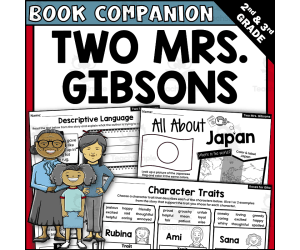
Two Mrs. Gibsons Read Aloud Book Companion Activities for IRA
ELA, Reading, Reading Comprehension, Literature, Grade 2, 3, 4, Read Alouds, Activities
This picture book companion is a complete supplemental resource for the book Two Mrs. Gibsons, by Toyomi Igus. With 35 print-and-go reading activities to choose from, this resource is ideal for customizing learning to your student's specific needs and academic abilities. Students will investigate characters, identify story elements, determine the theme, practice plotting story events, compare & contrast, make predictions, inferences, & connections, answer questions that require them to think beyond the text, and much more! Students will love the engaging and fun activities, and you will appreciate the time saved hunting for high-level resources to teach reading concepts that students frequently struggle with. The activities provided are designed to enable students to apply higher-level thinking skills, encourage them to provide text evidence to support their thinking, and challenge them to express their own thoughts and/or perspectives. ⭐️This Resource Includes:⭐️ ◾ Making Predictions: Before reading the book, students will make predictions about the text. ◾ Story Elements: Students fill in the boxes with words & pictures to represent the story elements. ◾ Sequencing: Students will retell & illustrate the important parts of the story. ◾ Summary: Students complete the Somebody, Wanted, Because, But, So graphic organizer and write a summary of the story. ◾ Story Event Sort: Students will describe a scene or event from the story that fits into each of the categories & explain how the event made them feel & how it relates to the category. ◾ Making Inferences: Students use clues & schema to make inferences while reading the story. ◾ Descriptive Language: Students read the text below from the story and explain what the author is trying to communicate. ◾ Recalling Events in Chronological Order (Viola): Students will describe and illustrate four memories of the narrator's time with Mrs. Gibson, her grandmother. ◾ Recalling Events in Chronological Order (Kazumi): Students will describe and illustrate four memories of the narrator's time with Mrs. Gibson, her mother. ◾ Making Connections: Students make connections to events in the story. ◾ Character Traits: Students will choose a character trait that describes each of the characters and provide evidence from the text to support those character traits. ◾ Character Inside & Out (Narrator): Students include details from the story to describe what the character says, thinks, does, and feels. ◾ Character Inside & Out (Viola): Students include details from the story to describe what the character says, thinks, does, and feels. ◾ Character Inside & Out (Kazumi): Students include details from the story to describe what the character says, thinks, does, and feels. ◾ Character Feelings (Narrator): Students describe the character's feelings throughout the story & give examples. ◾ Character Feelings (Viola): Students describe the character's feelings throughout the story & give examples. ◾ Character Feelings (Kazumi): Students describe the character's feelings throughout the story & give examples. ◾ Character Change (Narrator): Students will explain how the character changed from the beginning to the end of the story and describe the events that caused the change to happen. ◾ Character Change (Viola): Students will explain how the character changed from the beginning to the end of the story and describe the events that caused the change to happen. ◾ Character Change (Kazumi): Students will explain how the character changed from the beginning to the end of the story and describe the events that caused the change to happen. ◾ Character Summary: Students summarize the main character of the story. ◾ Compare & Contrast: Students will compare & contrast the two Mrs. Gibsons in the story. ◾ Character Acrostic Poem (Viola): Students will write an acrostic poem to describe Viola Gibson's character. ◾ Character Acrostic Poem (Kazumi): Students will write an acrostic poem to describe Kazumi Gibson's character. ◾ Sketch a Scene From the Story: Students will draw a scene from the story and explain why it's important to the plot. ◾ Setting Influences the Plot: Students will draw a scene from the story that takes place in one of the settings and write about what happened there and why it was important to the plot. ◾ Theme: Students answer the questions to determine which theme best fits the story and provide text evidence to support their choice. ◾ Thinking About the Text: Students will answer the questions about the story & include examples from the text to support their answers. ◾ Wait... There's More!: Students will write about what happens next in the story. ◾ Vocabulary Crossword Puzzle: Students use the clues to fill in the puzzle. Words can go across or down. Letters are shared when the words intersect (ANSWER KEY included). ◾ All About Japan: Students will research to learn more about the country of Japan. ◾ Weekend With Mrs. Gibson: Students think about what they would do if they could spend the weekend with one of the two Mrs. Gibsons and share what they did during their time together with pictures and captions. ◾ Someone Special: Students will write a paragraph about either their mother, grandma, or a mother figure in their life and include an illustration to go with their writing. ◾ Book Review: Students will color in the stars to rate how much they enjoyed the book and draw a new cover & their favorite character from the story. Then, they will explain why other kids should or should not read it. ◾ My Family Tree: Students fill in the family tree with names and illustrations and then share them with the class (in COLOR and B&W). 💡Need ideas for different ways you can implement these activities? ◾ Focus on different reading skills each day for targeted instruction, and have students complete a corresponding printable to check for understanding. ◾ During centers, students can independently read the story again and complete an activity that reviews a previously taught concept. ◾ Work with students on a reading concept they struggle with during guided reading or strategy groups. ◾ Students work with a partner or in literature circles to complete additional reading activities. This resource is for extension read-aloud activities only. The book is not included. ⭐️You may also like: ⭐ TEXT SET #1: "The Importance of Friendship" ◾ A Weekend With Wendell Read Aloud Book Companion Activities for IRA ◾ First Come the Zebra Read Aloud Book Companion Activities for IRA ◾ This is Our House Read Aloud Book Companion Activities for IRA ◾ Horace and Morris But Mostly Dolores Read Aloud Book Companion Activities for IRA ◾ The Old Woman Who Named Things Read Aloud Book Companion Activities for IRA TEXT SET #3: "Finding Your Way in a New Place" ◾ Grandfather Counts Read Aloud Book Companion Activities for IRA ◾ The Have a Good Day Cafe, Read Aloud Book Companion Activities for IRA ◾ Roses for Gita Read Aloud Book Companion Activities for IRA ◾ Mango, Abuela, and Me, Read Aloud Book Companion Activities for IRA ◾ Home at Last Read Aloud Book Companion Activities for IRA TEXT SET #7: "Exploring Narrative Nonfiction" ◾ Cactus Hotel Read Aloud Book Companion Activities for IRA ◾ A Log's Life Read Aloud Book Companion Activities for IRA ◾ Salmon Stream Read Aloud Book Companion Activities for IRA ◾ Think of an Eel Read Aloud Book Companion Activities for IRA ✨Be sure to check out my storefront here: https://teachsimple.com/contributor/creatively-gifted
Author Creatively Gifted
Tags IRA, Picture Book Activities, Read Aloud Lessons, Interactive Read Aloud Activities, Elementary Reading, Reading Comprehension, Fountas And Pinnell IRA, Family, Second Grade, Two Mrs. Gibsons, Two Mrs Gibsons, Two Mrs. Gibsons

Ovens Reading Comprehension Passage - Cored Ed Encyclopedia
ELA, Language Development, Resources for Teachers, Reading Comprehension, Reading, Pre-Reading, Writing, Science, Physics, Strategies, Grade 2, 3, 4, 5, Worksheets & Printables, Worksheets, Teacher Tools, Centers, Activities, Writing Prompts, Assessments, Tests, Quizzes and Tests, Quizzes
This ovens reading comprehension contains the following: Visualize on the Cover (Teacher Read Aloud Script) Start your lesson by taking a few moments to visualize the topic and share thoughts or feelings about it. Pre-Reading Trivia Students will write down one thing they already know about the subject and then read five more facts and discuss. These facts are fun, and the students will enjoy learning about the subject before reading more. Reading Passage The text is a high-interest reading passage with set paragraphs, roughly three to four paragraphs long. It contains a variety of themes about the topic, anywhere from history to technology. The passage is between 250 and 350 words in length. Mixed Questions The first question page contains four multiple-choice questions, each with a choice of four answers, and three written response questions that require a sentence or two from the student. Vocabulary Questions Practice seven key words from the text in this section across two activities. First section is scrambled words where students will unscramble three words given a clue for each. The second section is a word to meaning matching activity. Creative Writing In this question, the student will be required to write a five to eight sentence paragraph on a question related to the topic. Extension Activities This page is optional for fast finishers or to take home. There are several activities, each one requiring a different skill. Do some, do none, do all, completely optional - but you will feel reassured knowing every possibility is planned for. Includes summary writting question. Answer Key There are answers for the multiple-choice questions, written response questions have sample answers, vocabulary answers and if there is a summary question then a sample summary will be provided as well. FULL CATALOG OF DOWNLOAD LINKS AND ENCYCLOPEDIA INDEX HERE Lesson Snapshot Title: Ovens Genre: Nonfiction (informational text) Subject: Science & Technology / Reading Informational Text Primary Topic: How ovens work and changed over time Estimated Guided Reading Level (A–Z): R What This Lesson Teaches Best How early ovens began as cooking pits with hot coals underneath and food covered to cook slowly. How clay ovens with thick walls held heat and were used for baking, including flatbread pressed onto the inner wall. How modern ovens can use different heat sources and methods, including gas/electric heat , broiling , and convection (a fan moving hot air). How the first microwave oven grew from an accident involving radar equipment and how microwaves heat food by moving water molecules . How headings organize information in an informational passage (history → features → invention story). Learning Goals Students will describe how some of the earliest ovens cooked food using hot coals and covered pits. Students will explain how clay ovens held heat and how bread could bake on the inner wall. Students will compare ways ovens heat food (baking, broiling, and convection) using details from the text. Students will explain what accident helped lead to the first microwave oven. Students will describe how microwaves heat food quickly based on the passage. Key Vocabulary From the Text insulated — kept heat in, like a protected box. convection — a fan circulates hot air for even heating. microwaves — waves that heat food fast without a fire. molecules — tiny pieces of matter that can move. radar — equipment mentioned that led to a discovery. Cored Ed Encyclopedia Overview The Cored Ed Encyclopedia is a weekly series of lessons that you can pick up and use right away. These short readings fit into whatever time you have available. Each one includes a warm-up, a reading, and a set of questions, but it’s flexible — you can do just the reading, the full lesson, or skip the writing section if you need to. Each lesson focuses on a single topic so students don’t get lost. The writing is clear but never childish, making it perfect for grades two through five. Topics range from animals and science to history, inventions, and everyday things. No matter the level of the student, everyone should take away at least one new idea or fact from each lesson. The materials are easy to print, easy to explain, and require no setup. They work well for whole-class teaching, partner work, or independent study.
Author Cored Education
Rating
Tags Vocabulary, Spelling, Reading Comprehension, Reading Passages, Reading, Creative Writing, Reading Strategies, Writing Prompts, Ovens, Physics
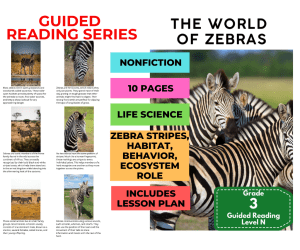
Guided Reading Level N - World of Zebras (with Lesson Plan)
ELA, Resources for Teachers, Reading Comprehension, Reading, Pre-Reading, Language Development, Animals, Life Sciences, Science, Vocabulary, Grade 2, 3, 4, Worksheets & Printables, Worksheets, Teacher Tools, Centers, Activities, Literacy Readers, Quizzes, Quizzes and Tests, Assessments
This Guided Reading Book - World of Zebras (Level N) with lesson plan includes: Guided Reading Color Label (front cover x1) This is a quick way to match the book’s demands to what students can generally handle.. The overall goal is to use the level/color to pick books for several smaller groups. To qualify for a certain level, a student is expected to read a book from that level with about 90–94% accuracy. If a student is consistently accurate and understands, move up a level. If the student is struggling at that level, drop down and add more support. Each student will improve at completely different rates, but it is generally one of the best ways to check progress across the class. DOWNLOAD THE CATALOG TO VIEW ALL GUIDED READING BOOKS AVAILABLE (SORTED LEVELS A-Z) Pre-Reading Question (x1) Teacher asks the prompt aloud, can be while showing the cover or first page. Students share what they already know, or make educated guesses from the cover. Prompt them to use the target vocabulary. Write some of their responses on the board to look back at during the reading. Vocabulary Words (x5) Introduce the five words, best doing it one at a time. Start by saying it, while students repeat and then see if anyone knows what it means before reading further. Read through the meaning and try to briefly connect each word to a picture or gesture so it’s meaningful. Ask students to flip through the book pages and point to where they see each of the vocabulary words. While reading the book pause upon coming across one of the vocab words or read the sentence twice to make sure students understand the word has appeared. Optional: Ask students to raise hands whenever they see/hear one of the new words. Guided Reading Pages (x10) Check the book snapshot (below) for: primary topic - do you need to prep extra reading or intro materials on this? what is taught best - decide on 1-2 bullets to focus on, use the prompt or words provided here for best results. learning goals - what you are checking for students to be able to do after the session, elicit answers using prompts or words provided. key vocabulary (see section above). questions overview - so you know what is coming up and if you need to prep extra materials to assist understanding. Run the lesson You may have already looked at a few of the pages together, but you can show them some of the pictures again first to set meaning. Depending on how much time you have and how familiar your students are with guided reading class, you may want to read the book aloud first with the group first. Students whisper or partner read, while you listen in. If time, do it as a group, one student reading a page each. Use the guided page’s prompts to coach: “Check the picture / does it make sense?” “Point under the words / try the first sound” “Reread the sentence smoothly”. Try to focus more on one student per session (rotating every time), so you can work out if they are ready to move up or need to move down a level. Comprehension Questions (back cover x3) This is your way to check that students didn’t just say the words, but actually understood the text. First, let students answer by pointing to the page/picture and saying a short sentence. After any answer, follow with: “Show me where you found that in the text.” In bigger groups, have partners answer first (10–20 seconds), then call on 2–3 students to share. Differentiation tips: Emerging speakers/struggling readers: oral + pointing On-level: oral in a full sentence Higher: one written sentence or draw + label Book Snapshot Title: The World of Zebras Genre: Nonfiction (informational text) Subject: Life Science / Reading (Informational Text) Primary Topic: Zebra stripes, habitat, behavior, and ecosystem role Estimated Guided Reading Level (A–Z): N What This Book Teaches Best Animal adaptations for survival: Zebras’ black-and-white stripes help them blend into the “shimmering heat” and can create a “visual blur” when predators are near. Animal identification and social behavior: Each zebra’s stripe pattern is unique “like a human fingerprint,” helping herd members recognize one another. Habitats and needs: Zebras live in open grasslands and woodlands called savannas, where they can roam, find water, and watch for danger. Ecosystems and food chains: As plant-eaters, zebras graze tough grasses and help keep grasslands healthy, supporting other species. Life cycles and migration: The text explains foals (baby zebras) and describes the Great Migration in search of water and green pastures. Learning Goals Students will describe where zebras live and what that habitat provides for them. Students will explain how zebra stripes can help zebras in different situations described in the text. Students will identify what zebras eat and describe how their teeth help them graze. Students will describe how zebras live in groups and name the members of a harem listed in the book. Students will retell how zebras respond when a predator is nearby, using details from the text. Students will explain why zebras are important to grasslands, based on the ecosystem details provided. Key Vocabulary From the Text iconic — well-known and easy to recognize. savanna — open grassland with a few trees. herbivores — animals that eat only plants. stallion — an adult male in the zebra family group. ecosystem — living things in a place and how they relate. Discussion Prompts Pre-reading question: How do you think a zebra’s stripes could help it stay safe? Comprehension questions: What does the text say is special about each zebra’s pattern of stripes? Comprehension questions: According to the text, what might zebras do when a predator like a lion or hyena is nearby? Comprehension questions: Why does the text say zebras are important for keeping grasslands healthy? Printing Tips 1. Best Printing Method (Recommended) “Booklet” Printing (Best if Available) If your printer or PDF viewer supports Booklet Printing , use this. Settings to use: Print mode: Booklet Paper size: Letter or A4 (either works) Orientation: Landscape Print on both sides: Yes Flip on: Short edge Scaling: Fit to printable area Booklet subset: First test: Front sides only Then: Back sides only This will automatically: Pair pages correctly Put the cover on the outside Align everything for folding After printing, fold in half and staple along the spine . 2. If “Booklet” Printing Is NOT Available You can still print this correctly with manual duplex printing . Step-by-step: Open the PDF. Choose Print . Set: Orientation: Landscape Pages per sheet: 1 Print on both sides: Yes Flip on: Short edge Print all pages . Because each PDF page already contains two facing book pages, the result will still fold cleanly into a book. Thousands of Cored Education products are included with your TeachSimple membership. Download links and encyclopedia index available here.
Author Cored Education
Rating
Tags Reading Comprehension, Reading Passages, Reading, Guided Reading, Guided Reading Lesson Plan, Guided Reading Activity, Pre-reading, Science Lesson Plans, Life Science, Animals
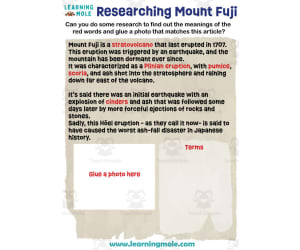
Researching Mount Fuji Activity
Social Studies, Geography, Grade 2, 3, 4, 5, 6, 7, 8, 9, 10, 11, Activities
Activity Introduction An amazing activity designed for the students to learn more about famous places in different countries. Researching Mount Fuji What do you know about this place? Do you know in which part of the world it is? Have you ever visited this place? If yes, can you tell us more about your adventure, and what do you like the most about this place? Do you like reading about Geography? What is your favorite country in the whole world? If you are going on a trip where it will be? Which country? What you are going to see there? Does this country has a famous place to visit? Researching Mount Fuji Activity The activity is perfect for encouraging the researching skills for the students, while learning more about this fantastic place. Researching Mount Fuji This friendly designed worksheet is suitable for students at school, homeschooling, and as a group activity. Instructions Can you do some research to find out the meanings of the red words and glue a photo that matches this article? Format Available in a PDF format.
Author Educational Voice
Tags Researching Mount Fuji Activity, Mount Fuji Activity, Researching Mount Fuji, Mount Fuji, Mount Fuji Facts, Mount Fuji Facts For Kids, Mountain , Mountains, Mountains Facts, Mountains Facts For Kids
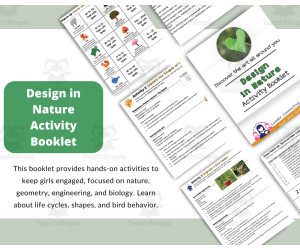
Discover the Wonders of Nature: A Hands-On Activity Booklet
STEM, Grade 2, 3, Activities, Crafts, Games
THis booklet was created for the Brownie Designs in Nature badge but is perfect for classrooms, home schooled kids, or just for fun with your own kids. Get ready for an adventure that blends the great outdoors with core academic concepts. It is hands-on learning focused on nature, geometry, engineering, and biology. Kids will learn about life cycles, geometric shapes, and fascinating bird behavior through creative, interactive projects. What's Inside Nature's Timeline Challenge Match the lifespans of animals and trees and learn to read history in wood! Girls will draw tree rings to visualize a tree's age and mark important life events. Exploring the Shapes of the Hive To learn more about hives kids wil do some crazy fun mathematical fun. They'll go on a scavenger hunt for tessellating patterns in nature and create hexagonal honeycomb art. Engineer a Bird Feeder Put their ingenuity to the test! This activity involves building a functional bird feeder and mixing different ingredients to create a custom seed blend tailored for their local feathered friends. Bird Beaks & Behavior Match nutritional ratios to bird facts and design beautiful, bird-themed seed art. Match bird species cards to their descriptions and simulate how different bird beaks function in a fun, food-gathering challenge.
Author Leader Connecting Leaders
Rating
Tags Nature, Design In Nature, Geometry , Engineering, Biology
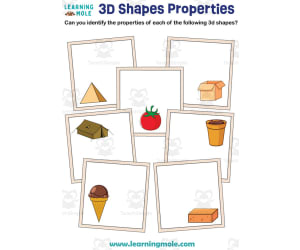
3D Shapes Properties Activity
Geometry, Math, Grade 2, 3, 4, 5, 6, 7, 8, Activities
Activity Introduction An amazing activity designed for the students to learn more about STEM. 3D Shapes Properties Do you like STEM subjects? what is your favorite one? Have you ever tried to plant a seed? If yes, tell us more about it. Or have you ever tried to invent something? If yes, tell us more about it. And how do you think it will help us? Have you ever seen a microorganism under a microscope? What was it? And how it looked like? Mathematics is a marvelous subject. Let' sharpen our brains and solve some equations. Do you like timetable tricks? What is your favorite one? Do you know how to code? Have you ever created an app or a game before? If yes, how was it like? 3D Shapes Properties Activity The activity is perfect for encouraging the researching skills for the students, while learning more about this fantastic topic. 3D Shapes Properties This friendly designed worksheet is suitable for students at school, homeschooling, and as a group activity. Instructions Can you identify the properties of each of the following 3d shapes? Format Available in a PDF format.
Author Educational Voice
Tags 3D Shapes Properties Activity, 3D Shapes Properties, 3D Shapes, 3D Shapes Facts, 3D Shapes Facts For Kids, Shapes, Maths, Math, Math Activity, 3d Shapes Activity

CVC Words Activity Packet - Set 1
ELA, Language Development, Phonics, Preschool, Grade 1, 2, 3, Activities
This resource is a CVC Words Activity Packet - Set 1. Filled with worksheets, games and activities, there is so much to implement with this activity packet. Sounds included: a i m n o p s t All you have to do is print and go. These activities make great whole group games, homework sheets and so much more. Included: - 2 sets of posters - 10 activities and worksheets - 2 games
Author Top Notch Teaching
Tags CVC Words, Vowel Sounds, Spelling, Missing Sounds, Bingo

Reading Comprehension Fiction Set 2 Sample: Chasing Pheasants (Forms)
ELA, Reading, Language Development, Common Core, ESL, Reading Comprehension, Creative Writing, Writing, Resources for Teachers, Grade 2, 3, Centers, Activities, Assessments, Teacher Tools, Tests, Quizzes and Tests
Reading Comprehension Passages Fiction Set 2 Sample Overview Fascinating reading comprehension passages, each with an array of activities included. Stories are written for the modern classroom and topics are designed to promote enthusiasm from each student. Each lesson contains a mixed questions section to check understanding, a vocabulary or spelling activity to help remember key language introduced, and a writing exercise. Full answer keys are provided. For a more detailed overview, check the section under the links at the bottom of this description. Passages Include 9.Chasing Pheasants: Tony and his father have a great idea...or so they think! Forms Version This is the Forms editable and fillable/self grading version. This download is available in GOOGLE Docs, GOOGLE Forms, GOOGLE Slides. PDF, PPT, WORD. FULL CATALOG OF DOWNLOAD LINKS HERE Grade 2/3 Links Fiction Set 1 - Nature Google Docs Google Forms Google Slides PDF PPT Word Guided Reading Materials Fiction Set 2 - Animals Google Docs Google Forms Google Slides PDF PPT Word Guided Reading Materials Fiction Set 3 - Food Google Docs Google Forms Google Slides PDF PPT Word Guided Reading Materials Fiction Set 4 - School Google Docs Google Forms Google Slides PDF PPT Word Guided Reading Materials Fiction Set 5 - Friends Google Docs Google Forms Google Slides PDF PPT Word Guided Reading Materials Fiction Set 6 - Family Google Docs Google Forms Google Slides PDF PPT Word Guided Reading Materials Fiction Set 7 - Sports Google Docs Google Forms Google Slides PDF PPT Word Guided Reading Materials Nonfiction Set 1 - Technology Google Docs Google Forms Google Slides PDF PPT Word Guided Reading Materials Nonfiction Set 2 - Nutrition Google Docs Google Forms Google Slides PDF PPT Word Guided Reading Materials Nonfiction Set 3 - Animals Google Docs Google Forms Google Slides PDF PPT Word Guided Reading Materials Reading Passages Overview Each passage is especially written for Grade 2-3 students, including key vocabulary required for this age group. Topics are varied and are accompanied by colorful graphics. Topics are meant to educate, yet entertain the modern student. These passages are perfect for the modern classroom. Whereas textbooks can become outdated in no time, any changes to technology or the world will result in updates to this product. Mixed Questions The mixed questions section of each lesson includes a variation of fivecomprehension, vocabulary and math questions. In addition, key reading strategies are frequently covered including cause & effect, summarizing, compare & contrast and making conclusions. Three of the questions will be MCQs and two will require a written response of some kind. Full answers and example responses appear at the end of the lesson. Spelling & Vocab Each reading passage contains a variety of words and phrases designed for Grade 2-3 students. Spelling and vocab activities provide the opportunity to build fluency with these words. As it can become quite mundane doing the same activities over and over, each lesson in a set will contain a different spelling and vocab activity . Writing Prompts Writing prompts are designed to continue the theme or lessons learned in the story. Students are persuaded to write in a variety of ways and each prompt includes several cues to help. As with the spelling/vocab section, writing prompts will vary. This includes research pieces, reading responses, poetry and creative writing prompts. Full Answer Keys Full answer keys and sample responses are provided so no matter how busy you are, you know you're covered! Mixed question answers provide evidence from the text, math questions contain the relevant workings. Answers are designed for use by the teacher, but also suitable as a handout to the student. Additional File One lesson will have an additional file. This is something fun to extend the lesson with. For similar downloads and other frees, do check out Cored Group on TeachSimple.
Author Cored Education
Tags Elementary, Reading, Comprehension, Vocabulary, Answers, Ccss, Common Core, Spelling, Writing, Digital Centers

Chocolate Process Activity
Science, Earth and Environmental Sciences, Life Sciences, Nature & Plants, Grade 2, 3, 4, 5, 6, Activities
Activity Introduction An amazing activity designed for the students to learn more about famous places in different countries. The Chocolate Process Do you like STEM subjects? what is your favorite one? Have you ever tried to plant a seed? If yes, tell us more about it. Or have you ever tried to invent something? If yes, tell us more about it. And how do you think it will help us? Have you ever seen a microorganism under a microscope? What was it? And how it looked like? Mathematics is a marvelous subject. Let' sharpen our brains and solve some equations. Do you like timetable tricks? What is your favorite one? Do you know how to code? Have you ever created an app or a game before? If yes, how was it like? Chocolate Process Activity The activity is perfect for encouraging the researching skills for the students, while learning more about this fantastic place. Chocolate This friendly designed worksheet is suitable for students at school, homeschooling, and as a group activity. Instructions Cut out the stages in the process. Can you put them in the correct order? Format Available in a PDF format.
Author Educational Voice
Tags Chocolate Process Activity, Chocolate, Chocolate Facts, Chocolate Facts For Kids, Farming, Making Chocolate, Making Chocolate Process

FREE DOMINÓ GAME OF MULTIPLICATION | Animals Themed
Math, Multiplication and Division, Division, Grade 3, 4, 5, Activities, Games
Thank you very much for being part of this community of educational resources. WE ARE AN EDUCATIONAL COMPANY DEDICATED TO THE PREPARATION OF FABULOUS RESOURCES FOR THE AREA OF MATHEMATICS, ON THIS OCCASION WE BRING YOU THIS FANTASTIC RESOURCE WITH WHICH YOUR STUDENTS WILL BE ABLE TO PLAY AND LEARN IN A DIDACTIC WAY ABOUT MULTIPLICATION. Dominoes are one of the most popular games worldwide so do not hesitate to download this fabulous game. NAME OF THE GAME: Mastery of multiplication using multiplication exercises from 1 to 12. DOWNLOAD IT NOW, BECAUSE IT IS A COMPLETELY FREE RESOURCE. INFORMATION REGARDING THE PRODUCT: Please read the information on this product carefully so you know what it is about. A. The name of this educational resource is The title of this product is "24 multiplication tables dominoes" B. This document contains this number of pages This educational document is made up of 6 pages, on each page you will find 4 tiles so in the end you will have 24 domino tiles at your disposal. C. This educational resource has been prepared by: Prepared and designed by EDITORIAL ARENAS EDUCATIVAS, we are an educational corporation dedicated to the design of fabulous resources for primary education in different areas. D. You can apply this educational document in different contexts such as: You can apply it at home if you are a parent and want your children to reinforce multiplication, you can also apply it in your class if you are a mathematics teacher. SECONDARY INFORMATION: E. Is this document in black and white or color? This document is prepared in color so that it is much more attractive for your students. F. For what ages is this document recommended? It is recommended to apply this document in children from 7 to 12 years old who are learning and practicing multiplication. G. At what point in class can I apply it? You can apply it during the development of your class as a game. H. Should I apply it individually or in groups? Preferable in groups of 2 to 3 children. This file is for personal use only. It is not allowed to be resold or shared with others.
Author EDITORIAL LAURA EDUCA
Tags Multiplication, Domino, Domino Game, Puzzle, Free Resource

Reading Comprehension Fiction Set 6 Sample Tom's Canadian Mom (Forms)
ELA, Reading, Language Development, Common Core, Spelling, ESL, Children’s Literature, Literature, Writing, Reading Comprehension, Grade 2, 3, Centers, Activities, Assessments, Teacher Tools, Tests, Quizzes and Tests
Reading Comprehension Passages Fiction Set 6 Sample Overview Fascinating reading comprehension passages, each with an array of activities included. Stories are written for the modern classroom and topics are designed to promote enthusiasm from each student. Each lesson contains a mixed questions section to check understanding, a vocabulary or spelling activity to help remember key language introduced, and a writing exercise. Full answer keys are provided. For a more detailed overview, check the section under the links at the bottom of this description. Passage Included 5.Tom's Canadian Mom: The most important person from Canada is...Tom's mom! Forms Version This is the Forms editable and fillable/self grading version. This download is available in GOOGLE Docs, GOOGLE Forms, GOOGLE Slides. PDF, PPT, WORD. FULL CATALOG OF DOWNLOAD LINKS HERE Grade 2/3 Links Fiction Set 1 - Nature Google Docs Google Forms Google Slides PDF PPT Word Guided Reading Materials Fiction Set 2 - Animals Google Docs Google Forms Google Slides PDF PPT Word Guided Reading Materials Fiction Set 3 - Food Google Docs Google Forms Google Slides PDF PPT Word Guided Reading Materials Fiction Set 4 - School Google Docs Google Forms Google Slides PDF PPT Word Guided Reading Materials Fiction Set 5 - Friends Google Docs Google Forms Google Slides PDF PPT Word Guided Reading Materials Fiction Set 6 - Family Google Docs Google Forms Google Slides PDF PPT Word Guided Reading Materials Fiction Set 7 - Sports Google Docs Google Forms Google Slides PDF PPT Word Guided Reading Materials Nonfiction Set 1 - Technology Google Docs Google Forms Google Slides PDF PPT Word Guided Reading Materials Nonfiction Set 2 - Nutrition Google Docs Google Forms Google Slides PDF PPT Word Guided Reading Materials Nonfiction Set 3 - Animals Google Docs Google Forms Google Slides PDF PPT Word Guided Reading Materials Reading Passages Overview Each passage is especially written for Grade 2-3 students, including key vocabulary required for this age group. Topics are varied and are accompanied by colorful graphics. Topics are meant to educate, yet entertain the modern student. These passages are perfect for the modern classroom. Whereas textbooks can become outdated in no time, any changes to technology or the world will result in updates to this product. Mixed Questions The mixed questions section of each lesson includes a variation of fivecomprehension, vocabulary and math questions. In addition, key reading strategies are frequently covered including cause & effect, summarizing, compare & contrast and making conclusions. Three of the questions will be MCQs and two will require a written response of some kind. Full answers and example responses appear at the end of the lesson. Spelling & Vocab Each reading passage contains a variety of words and phrases designed for Grade 2-3 students. Spelling and vocab activities provide the opportunity to build fluency with these words. As it can become quite mundane doing the same activities over and over, each lesson in a set will contain a different spelling and vocab activity . Writing Prompts Writing prompts are designed to continue the theme or lessons learned in the story. Students are persuaded to write in a variety of ways and each prompt includes several cues to help. As with the spelling/vocab section, writing prompts will vary. This includes research pieces, reading responses, poetry and creative writing prompts. Full Answer Keys Full answer keys and sample responses are provided so no matter how busy you are, you know you're covered! Mixed question answers provide evidence from the text, math questions contain the relevant workings. Answers are designed for use by the teacher, but also suitable as a handout to the student. Additional File One lesson will have an additional file. This is something fun to extend the lesson with. For similar downloads and other frees, do check out Cored Group on TeachSimple.
Author Cored Education
Tags Elementary, Reading, Comprehension, Vocabulary, Answers, Ccss, Common Core, Spelling, Writing, Passages
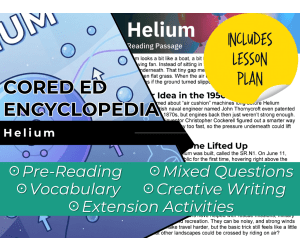
Helium Reading Comprehension Passage - Cored Ed Encyclopedia
ELA, Reading Comprehension, Reading, Science, Technology, Pre-Reading, Language Development, Physics, Earth and Environmental Sciences, Chemistry, Grade 2, 3, 4, 5, Worksheets & Printables, Worksheets, Teacher Tools, Centers, Activities, Writing Prompts, Assessments, Quizzes and Tests, Quizzes, Lesson Plans
This helium reading comprehension with lesson plan includes: Visualization (on the front cover) Start your lesson by taking a minute to think and share something about the topic. Read the script aloud (slowly), perhaps prepare some music or sound effects. Student close their eyes and let their imaginations wander. Students open their eyes, read the question aloud and give them a few minutes to complete. Ask a few students to share or keep answers until the end to compare with what they learn in the passage. Quick pause—thousands of Cored Education products are included with your TeachSimple membership. Download links and encyclopedia index available here. Pre-Reading Trivia Students will write down one thing they already know about the subject and then read five more facts and discuss. These facts are fun, and the students will enjoy learning about the subject before reading more. Give 1 minute for students to write what they already know (no pressure—best guess is fine). Read the five facts together. After each fact, do ask a student for their opinion, was it surprising? Set a purpose by asking students to highlight/underline one fact they want to learn more about during the reading. Reading Passage The text is a high-interest reading passage with set paragraphs, roughly three to four paragraphs long. It contains a variety of themes about the topic, anywhere from history to technology. The passage is between 250 and 350 words in length. First, ask students to look at the headings and see what they’ll learn about today. What do they know about the topic/heading? First read options: Teacher read-aloud (best for support). Partner reading (paragraph by paragraph). While reading, students underline important details, and vocabulary words they think may come up in the questions section. Mixed Questions The first question page contains four multiple-choice questions, each with a choice of four answers, and three written response questions that require a sentence or two from the student. Students complete the mcqs first independently, then review quickly as a class. For the 3 written responses, try to get students giving the answer with some form of evidence: “I think ___ because the text says ___.” If students get stuck, send them back to check the passage. Vocabulary Questions Practice seven key words from the text in this section across two activities. First section is scrambled words where students will unscramble three words given a clue for each. The second section is a word to meaning matching activity. Before starting, have some students read out words they underlined in the passage. Ask students to say the word and read aloud the sentence(s) around each word. Ask students to do scrambled words and the matching exercise in pairs then go through answers as a class. For the scrambled spelling task, get four pairs to come up to the board and write the words for extra practice with the other student reading out the clue. For the matching task, prompt students to give full sentences: “I matched ___ with ___ because ___.” Creative Writing In this question, the student will be required to write a five to eight sentence paragraph on a question related to the topic. Before starting, ask students write down 3 key ideas they are going to include in their piece. Ask students for ideas to share around the class to help those struggling. Pro writing expectations: 5–8 sentences At least 2 facts or details from the passage At least 2 vocabulary words from the previous page Students read their paragraphs while classmates listen for facts and vocabulary words. Extension Activities This page is optional for fast finishers or to take home. There are several activities, each one requiring a different skill. Do some, do none, do all, completely optional - but you will feel reassured knowing every possibility is planned for. Includes summary writting question and additional facts. Answer Key There are answers for the multiple-choice questions, written response questions have sample answers, vocabulary answers and if there is a summary question then a sample summary will be provided as well. Lesson Plan Included Customized lesson plan for this lesson is included. Lesson Snapshot Title: Helium Genre: Nonfiction (informational text) Subject: Science / Engineering (transportation technology) Primary Topic: How an air-cushion craft hovers and is used Estimated Guided Reading Level (A–Z): Q What This Lesson Teaches Best Explains how a “Helium” craft rides on a cushion of air trapped underneath instead of sitting in water. Describes why an air cushion reduces rubbing so the craft can “slide along” over surfaces like water, sand, or flat grass. Connects invention history to technology improvements (early ideas, a patented concept, then a smarter way to prevent air leaking). Shows how design changes solved problems (the flexible “skirt” helped hold the air cushion and climb over obstacles). Shares real-world uses and limitations (ferries, rescue missions, military landings, racing/recreation; noise and wind/waves). Learning Goals Students will describe how the craft moves differently from a regular boat, using details from the passage. Students will explain what an “air cushion” does and why it helps the craft slide over different surfaces. Students will identify one inventor or engineer named in the text and describe what problem they helped solve. Students will explain how the flexible “skirt” improved the craft’s ability to hover and travel. Students will list at least two jobs the craft can do (such as ferries or rescue missions) using evidence from the text. Students will describe one challenge mentioned in the passage that can make travel harder (winds or rough waves). Key Vocabulary From the Text cushion — a pocket of air that holds something up. patented — officially claimed an invention idea by law. pressure — pushing force under the craft that can lift it. hovering — staying just above a surface, not touching it. skirt — flexible part that helps hold air underneath. FULL CATALOG OF DOWNLOAD LINKS AND ENCYCLOPEDIA INDEX HERE
Author Cored Education
Rating
Tags Vocabulary, Reading Comprehension, Reading Passages, Lesson Plans, Ela Lesson Plans, Reading Comprehension Lesson Plans, Pre-reading, Science Lesson Plans, Physics, Chemistry

Common Fractions 1/2s - 1/12s Activity - Bingo Game - Fraction Symbols - Boards 21-25
Math, Fractions, Grade 2, 3, 4, Activities, Games
Common Fractions 1/2s to 1/12s Bingo engages students in identifying, matching, and discussing common fraction sizes. This hands-on math game includes 4 sets of calling cards - circles, squares, strips, and symbols - so educators can differentiate to meet diverse learning needs. After printing, laminating, and cutting materials, small groups of students use bingo boards, playing squares, and calling cards to play. To set up the game, provide each student one bingo board and at least 7 playing squares. Shuffle calling cards and place them in a pile. Draw and display a card, prompting students to find and cover the matching fraction on their board. The first student to cover 3 spaces in a row wins! This differentiated common fractions game allows flexible implementations for whole, small group and center work.
Author Colleen's Cosmic Collection
Tags Fractions, Common Fractions, Fraction Games, Fraction Activities, Fractions Bingo, Math Game, Math Activity, Common Fractions Game, Common Fractions Activity, Cccfbts
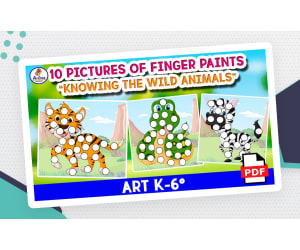
FINGER PAINTS - 10 Pictures of Wild Animals - ART FOR KIDS
Creative Arts, Art, Preschool, Kindergarten, Grade 1, 2, 3, 4, 5, Activities
1. Introduction As is known by many educators and educational agents, finger painting or also called 'painting using fingers' or 'finger painting', is a very beneficial artistic technique for children, because it not only provides fun, but also contributes to to its integral development. For these reasons and with the aim of developing multiple objectives that I will detail later, I have developed this fabulous artistic worksheet, where your students will be able to paint and apply this fabulous technique, I hope you like it. 2.Objective Some benefits of finger painting are: - Sensory stimulation: As is known, painting with fingers or using fingers involves multiple senses of infants, such as sight and touch. In this way, children will experience various temperatures, colors and temperatures, which will contribute to their cognitive development and sensory stimulation. -Development of fine motor skills: When your students or children dip their fingers in the paint and manipulate it on the paper, they will be improving their fine motor skills. In this way, this type of activity will develop dexterity and hand-eye coordination in them, skills that will be essential when later your children need to start activities such as writing, fastening the laces of their shoes, buttons on their shirts, and other activities. everyday. 3.Order, scheme and stages - Introduce your art class with relaxing music, so that your students open their minds and curiosity to the new activity they are about to do. -Then give them the worksheet and ask them to take out their colored temperas. If possible, ask them to bring an old piece of clothing because they are going to stain it while doing the activity . 4.Grades or ages This game is designed for children from 5 to 12 years old. That is, all primary school students can use it. 5. Form of application It is suggested to print this product individually. 6. Answer keys This game does not require answers. 7.Use text labels art, finger art, fingerprint painting, art for children, children's art. 8.Rules Specified above. 9.File types The archive is in PDF format. 10.Number of pages This document contains 10 pages.
Author EDITORIAL LAURA EDUCA
Tags Art, Art For Kids, Painter For Kids

Art Speaking Game
Creative Arts, Art, ELA, Language Development, ESL, Preschool, Grade 1, 2, 3, Games, Activities
Art Speaking Game is an engaging resource for building dialogue and speaking skills. This colorful game board can be printed for students to use in small groups or whole class activities. Students take turns moving game pieces while responding to prompts that strengthen skills like explaining, evaluating, and public speaking. Educators can facilitate rich class discussions as learners express opinions on art concepts. Use this versatile resource to support language learners, spark conversation, or make art class interactive. Implement during indoor recess for a screen-free activity , or try it in reading groups to integrate visual arts. With open-ended questions and vibrant visuals, the Art Speaking Game gives students in grades K-3 a fun way to develop speaking and listening abilities.
Author Better Teaching Resources
Tags Art, Crafts, Speaking Game, ESL Activity, Dice Game, Board Game, Small Group, Literacy, Language Skills, Dialogue
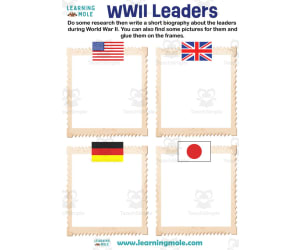
WWII Leaders Activity
Social Studies, History, History: Ancient, History: World, Grade 3, 4, 5, 6, 7, 8, 9, Activities
Activity Introduction An amazing activity designed for the students to learn more about history. WWII Leaders Do you like history? Which topic do you really enjoy about history? Have you ever read an interesting facts about the Vikings? If yes, can you mention them? What do you like most about the Victorian era? Can you name all the Tudors? Have you ever wondered how people used to live in ancient Japan and ancient China? Do you know any interesting facts about ancient Egyptians and the Pharaohs? Have you ever visited South America? What do you know about Incas and Aztecs? Celtic culture was really one of a kind, can you name any of the places that Celts used to live in? Imagine yourself living during the ancient Roman empire, how your life will look like? Ancient Greece was an amazing place to live in. What do you know about ancient Greek life? WWII Leaders Activity The activity is perfect for encouraging the researching skills for the students, while learning more about history. WWII Leaders This friendly designed worksheet is suitable for students at school, homeschooling, and as a group activity. Instructions Do some research then write a short biography about the leaders during World War II. You can also find some pictures for them and glue them on the frames. Format Available in a PDF format.
Author Educational Voice
Tags WWII Leaders Activity, WWII Leaders, WWII, WWII Facts, WWII Facts For Kids, World War Two, World War Two Facts, World War Two Facts For Kids, History, History Facts

Gummy Worm Roll and Draw Games | Gummy Worm Day July Art Activity
Creative Arts, Art, Fine Arts, Grade 1, 2, 3, 4, 5, Games, Activities, Projects, Centers, Worksheets & Printables
Giddy Gummy Worm Roll and Draw Games | Celebrate Gummy Worm Day on July 15 | Drawing Activity Celebrate Gummy Worm Day with this fun, no-prep and interactive drawing game that is simple to use or use it on any day. Incorporate the optional companion roll and draw game to add more fun details to the drawing. Just grab a dice and some blank paper and engage your students with this self-directed drawing activity. You can get the whole class involved by following the Change It Up worksheet and dictating elements that students can add to their drawing. Then color and enjoy the different drawings! What are the benefits of roll and draw games? Understanding visual perceptions Increase following direction skills Improving drawing skills Included in this download: 2 Roll and Draw Game Printables 1 Change It Up Page B/W Version Included Additional creative ideas for teachers: Present completed drawings as thoughtful gifts from students Create a wall art gallery Place in students' portfolios Offer a writing activity that corresponds to drawing Perfect for: Art lessons Classroom centers Early finishers Substitute plans Morning work Creativity boosts Bring some creative fun to your classroom or homeschool with this easy and no-prep art activity!
Author Doodle Thinks
Rating
Tags Roll And Draw, Dice Game, Art Activity, Drawing Activity, Coloring, Art Integration, Art Enrichment, Art Supplement, Silly Holiday, July Art

Prefix BI Sentence Reading Rings
ELA, Language Development, Phonics, Grade 2, 3, 4, Activities, Centers, Worksheets & Printables, Task Cards
Practice reading words with the prefix BI- with these sentence reading rings. Students will read words with the prefix bi- in the context of sentences. Each card also includes a bold and colorful image to illustrate each sentence and to help students to learn the meanings of each word. What is Included: This resource includes one reading ring for the prefix bi. There are seven cards each featuring a different word with the prefix bi. The words included in this set are: bicycle, bisects, binoculars, bilingual, bifocals, bipedal, and biannual. When to Use Early Finishers - If students finish their work early, they can use these reading rings for extra practice. Small Group Work - Teachers can use these reading rings to target small groups of students who need more practice reading words with prefixes. Independent Practice - Students can work independently at their desks to read this set of prefix cards. Morning Work - Students can read and review this reading ring for morning work as their classmates arrive to class. How to Make: Teachers will print out the pages and cut each card apart. Once cut apart, the teacher can choose to laminate the cards for durability. Then, use a hole punch to punch a hole in the top left corner of the card. Place the cards on a ring to create your reading ring, making sure the cover card is on top. Skills Assessed: These reading rings help with identifying words with prefixes These reading rings help with learning the meaning of prefixes These reading rings help students learn how prefixes change the meaning of words. These affixes reading rings are a low prep activity for teachers to prepare for students to use. Once created, these cards can be used over and over to practice reading words with prefixes in the context of a sentence.
Author The Connett Connection
Tags Affixes, Morphology, Prefixes, Literacy Activities, Reading Words With Prefixes
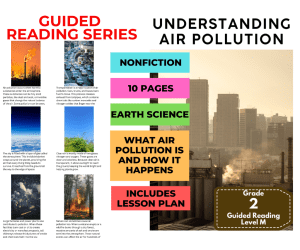
Guided Reading Level M - Air Pollution (with Lesson Plan)
ELA, Resources for Teachers, Reading Comprehension, Reading, Science, Technology, Physics, Life Sciences, Earth and Environmental Sciences, Environmental Science, Grade 2, 3, 4, Worksheets & Printables, Worksheets, Teacher Tools, Centers, Activities, Literacy Readers, Quizzes, Quizzes and Tests, Assessments, Lesson Plans
This Guided Reading Book - Understanding Air Pollution (Level M) with lesson plan includes: Guided Reading Color Label (front cover x1) This is a quick way to match the book’s demands to what students can generally handle.. The overall goal is to use the level/color to pick books for several smaller groups. To qualify for a certain level, a student is expected to read a book from that level with about 90–94% accuracy. If a student is consistently accurate and understands, move up a level. If the student is struggling at that level, drop down and add more support. Each student will improve at completely different rates, but it is generally one of the best ways to check progress across the class. DOWNLOAD THE CATALOG TO VIEW ALL GUIDED READING BOOKS AVAILABLE (SORTED LEVELS A-Z) Pre-Reading Question (x1) Teacher asks the prompt aloud, can be while showing the cover or first page. Students share what they already know, or make educated guesses from the cover. Prompt them to use the target vocabulary. Write some of their responses on the board to look back at during the reading. Vocabulary Words (x5) Introduce the five words, best doing it one at a time. Start by saying it, while students repeat and then see if anyone knows what it means before reading further. Read through the meaning and try to briefly connect each word to a picture or gesture so it’s meaningful. Ask students to flip through the book pages and point to where they see each of the vocabulary words. While reading the book pause upon coming across one of the vocab words or read the sentence twice to make sure students understand the word has appeared. Optional: Ask students to raise hands whenever they see/hear one of the new words. Guided Reading Pages (x10) Check the book snapshot (below) for: primary topic - do you need to prep extra reading or intro materials on this? what is taught best - decide on 1-2 bullets to focus on, use the prompt or words provided here for best results. learning goals - what you are checking for students to be able to do after the session, elicit answers using prompts or words provided. key vocabulary (see section above). questions overview - so you know what is coming up and if you need to prep extra materials to assist understanding. Run the lesson You may have already looked at a few of the pages together, but you can show them some of the pictures again first to set meaning. Depending on how much time you have and how familiar your students are with guided reading class, you may want to read the book aloud first with the group first. Students whisper or partner read, while you listen in. If time, do it as a group, one student reading a page each. Use the guided page’s prompts to coach: “Check the picture / does it make sense?” “Point under the words / try the first sound” “Reread the sentence smoothly”. Try to focus more on one student per session (rotating every time), so you can work out if they are ready to move up or need to move down a level. Comprehension Questions (back cover x3) This is your way to check that students didn’t just say the words, but actually understood the text. First, let students answer by pointing to the page/picture and saying a short sentence. After any answer, follow with: “Show me where you found that in the text.” In bigger groups, have partners answer first (10–20 seconds), then call on 2–3 students to share. Differentiation tips: Emerging speakers/struggling readers: oral + pointing On-level: oral in a full sentence Higher: one written sentence or draw + label Book Snapshot Title: Understanding Air Pollution Genre: Nonfiction (informational science text) Subject: Science (Earth & Environmental Science) Primary Topic: What air pollution is and how it happens Estimated Guided Reading Level (A–Z): M What This Book Teaches Best Introduces the atmosphere as an “invisible blanket” of air around Earth that living things need. Explains what clean air is mostly made of (nitrogen and oxygen) and why transparent air matters for sunlight and plant growth. Defines air pollution and shows that it can be visible (dust, soot) or hidden (invisible gases). Describes major sources of air pollution from transportation and from factories/power plants that burn fuels. Connects air pollution to real effects, including smog , health problems from particulate matter, and damage to plants through acid rain. Learning Goals Describe what the atmosphere is and why it is important for living things. Identify what clean air is mostly made of and describe characteristics of clean air from the text. Explain what air pollution is and name examples of pollutants described in the book. Describe how transportation and factories/power plants contribute to air pollution. Explain what smog is and how it forms, using details from the text. Describe one way technology can reduce air pollution based on the book’s examples. Key Vocabulary From the Text atmosphere — blanket of air around Earth. nitrogen — a gas that makes up much of clean air. oxygen — a gas living things need to survive. particulate — made of tiny pieces or specks. turbines — machines with blades that spin to make electricity. Discussion Prompts Pre-reading question: What are some things you think can make the air around us less clean? Comprehension questions: What two gases is clean air mostly made of? Comprehension questions: What is smog, according to the text? Comprehension questions: How do wind turbines and solar panels help reduce air pollution in the book? Printing Tips 1. Best Printing Method (Recommended) “Booklet” Printing (Best if Available) If your printer or PDF viewer supports Booklet Printing , use this. Settings to use: Print mode: Booklet Paper size: Letter or A4 (either works) Orientation: Landscape Print on both sides: Yes Flip on: Short edge Scaling: Fit to printable area Booklet subset: First test: Front sides only Then: Back sides only This will automatically: Pair pages correctly Put the cover on the outside Align everything for folding After printing, fold in half and staple along the spine . 2. If “Booklet” Printing Is NOT Available You can still print this correctly with manual duplex printing . Step-by-step: Open the PDF. Choose Print . Set: Orientation: Landscape Pages per sheet: 1 Print on both sides: Yes Flip on: Short edge Print all pages . Because each PDF page already contains two facing book pages, the result will still fold cleanly into a book. Thousands of Cored Education products are included with your TeachSimple membership. Download links and encyclopedia index available here.
Author Cored Education
Rating
Tags Reading Comprehension, Reading Passages, Reading, Guided Reading, Guided Reading Lesson Plan, Guided Reading Activity, Pre-reading, Science Lesson Plans, Earth Science, Physics

Subtraction Crossword: 1 Page Sample (PDF)
ELA, Language Development, Resources for Teachers, Vocabulary, Spelling, ESL, Subtraction, Addition and Subtraction, Math, Grade 2, 3, 4, 5, Worksheets & Printables, Worksheets, Teacher Tools, Crosswords Puzzles, Centers, Activities
THIS IS A ONE PAGE SAMPLE OF A SIX CROSSWORD DOWNLOAD FULL SIX CROSSWORD DOWNLOAD INFORMATION: Crossword Series (Themed) This crossword series is designed for students in grades 2–5. Each set of crosswords is built around a clear vocabulary theme, allowing students to strengthen their word recognition, build subject-based knowledge, and reinforce early literacy and thinking skills. Each topic includes six crossword sets , and each set features the following consistent structure: 1. 8 vocabulary clues 2. Crossword puzzle 3. Answer key 4. 1 Did You Know fact related to the set These crosswords are designed to be student-friendly, classroom-ready, and easily integrated into thematic units, seasonal learning, morning work, or independent literacy stations. Subtraction Crosswords Word List 1. Basic Subtraction One, Two, Three, Four, Five, Six, Seven, Eight 2. Subtracting from 10-20 Nine, Ten, Eleven, Twelve, Thirteen, Fourteen, Fifteen, Sixteen 3. Subtracting from 20-40 Seventeen, Eighteen, Nineteen, Twenty, Twenty-One, Twenty-Two, Twenty-Five, Twenty-Eight 4. Larger Subtraction Problems Thirty, Thirty-Two, Thirty-Five, Forty, Forty-Two, Forty-Five, Fifty, Fifty-Five 5. Up to 100 Sixty, Sixty-Five, Seventy, Seventy-Five, Eighty, Eighty-Five, Ninety, Ninety-Five 6. Larger Subtraction Numbers One Hundred, One Hundred Ten, One Hundred Twenty, One Hundred Fifty, One Hundred Seventy, Two Hundred, Two Hundred Fifty, Three Hundred PDF Version Other versions will appear here when available. Follow the store for the lastest on new products. How to Use This Crossword These crosswords are ideal for whole-class work, small groups, literacy centers, or take-home activities. Use one set per day, or spread them across a week or month depending on your curriculum needs. Each clue has been crafted to align with the reading level of grades 2–5, with support for both decoding and meaning. The Did You Know? facts offer additional extension opportunities for writing, drawing, or display work. Whether you're reinforcing vocabulary, exploring a seasonal topic, or adding variety to your literacy block, these crosswords provide a fun, flexible, and focused way to boost early literacy in an engaging format. More Subtraction Themed Products Nothing yet, but follow for the latest on new products. FULL CATALOG OF DOWNLOAD LINKS HERE Themed Crossword Links Addition PDF Animals PDF Around the Home PDF Birthday PDF Candy PDF Christmas PDF Cinco de Mayo PDF Clothes PDF Colors PDF Days and Months PDF Division PDF Earth Day PDF Easter PDF Easy Crosswords PDF Fall PDF Father's Day PDF Food PDF Geography (Set 1) PDF Geography (Set 2) PDF Geography (Set 3) PDF Graduation PDF Health PDF History (Set 1) PDF History (Set 2) PDF History (Set 3) PDF Human Body PDF Kindness PDF Life Skills PDF Mother's Day PDF Multiplication PDF Science Crosswords (Set 1) PDF Science Crosswords (Set 2) PDF Science Crosswords (Set 3) PDF Shapes PDF Social Skills PDF Spring PDF Sports PDF St. Patrick's Day PDF Subtraction PDF Summer PDF Thanksgiving PDF Transport PDF Valentine's Day PDF Winter PDF Crosswords in Depth Structure Each crossword clue is written in simplified language to suit early readers, and follows a strict number-and-clue format (e.g., 1.A shape with four sides ). Students complete each puzzle using the themed vocabulary provided, helping to build both content knowledge and spelling confidence. Each completed set includes: A questions section with clearly formatted clues An answers section to support teacher checking or independent correction A Did You Know? fact tied to the topic (one per set) to add curiosity and cross-curricular value Themes Included The crosswords cover a wide variety of engaging, age-appropriate themes such as: Seasons & Holidays (e.g., Winter, Easter, Valentine’s Day) Math Concepts (e.g., Addition, Subtraction, Multiplication, Division) Everyday Topics (e.g., School, Colors, Animals, Weather) Special Units (e.g., Health, Earth Day, Sports, Graduation, Kindness) Each theme is carefully selected to reflect the experiences and interests of young learners, while reinforcing vocabulary and comprehension. For similar downloads and other frees, do check out Cored Group on TeachSimple.
Author Cored Education
Rating
Tags Vocabulary, Spelling, Crosswords, Math, Math Crosswords, Subtraction, Subtraction Crosswords, Basic Subtraction, Crossword, Crossword Puzzles

Paleozoic Creatures Memory Game
Science, Life Sciences, Animals, Earth and Environmental Sciences, Grade 2, 3, 4, 5, Activities, Games
How To Use This: Play this memory game to work on learning and memorizing the names of creatures that lived during the Paleozoic Era. They’ll love learning about these 12 animals! This game works as a great review or supplementary resource to a larger paleontology unit . What You Get · - 24 double-sided cards with detailed computer-generated images or photos of creatures from the Paleozoic Era. Cut apart all the cards. Then lightly glue each back to a front. Run through a laminator and then cut apart each piece. Lay pieces flat and upside down. Take turns with your students to turn over 2 at a time. When you find a match, you get to keep the match. When all the cards have been turned over and matched up, then the game is over. The winner is the one who has found the most matches. Take a Look At Some Of My Best Sellers: · - All About Sea Lions: Sea Lion Animal Science Unit · - Write a Friendly Letter: Writing Life Skills · - How To Fill Out Forms: Writing Life Skills · - Feelings and Emotions Photo Cards: Visual Practice · - Alphabet Dot Painting: Preschool Letter of the Week · - Early Reader Nonfiction Animal Articles: Animal Research · - All About Letter B: Preschool Letter of the Week Check out other resources from my store: Simply Schoolgirl! I can be contacted for questions and concerns at simplyschoolgirl1@gmail.com
Author Simply Schoolgirl
Tags Task Cards, Memory Game, Paleozoic Creatures, Small Group, Whole Group Games, Science Games, Paleozoic Era, Paleontology Unit, Matching Cards