



3,984 products added recently
Page 25 - 3rd Grade Assessments
Ensure your third-grade students are mastering essential skills with assessments designed for their level. This collection includes vocabulary quizzes, math concept evaluations, and science understanding checks. By integrating these assessments, you can inform your teaching strategies and support student achievement.

 Show filters


Reading Comprehension Quizzes for Grade 3
ELA, Reading Comprehension, Reading, Grade 3, Teacher Tools, Assessments, Quizzes and Tests, Quizzes, Worksheets & Printables
Reading Comprehension Quizzes for Grade 3: A Collection of Reading Passages with Comprehension Quizzes and Answer Keys for 3rd Grade Boost comprehension, critical thinking, and test-readiness with this focused reading comprehension quiz resource designed to prepare students for ELA standardized testing and build essential comprehension skills critical for academic success. Reading Comprehension Quizzes is a no-prep, user-friendly resource that includes 4 engaging reading passages targeted to a 3rd grade reading level. Each reading passage is followed by a quiz comprised of multiple choice questions requiring students to refer back to the text to find evidence that supports their answers, boosting their critical thinking and analytical reading skills. The quizzes can also be used as an assessment tool for students' reading comprehension skill levels. Features • 4 engaging reading passages including a funny story, a fable , informational text and a legend • Quizzes containing multiple choice questions to reinforce comprehension and close reading skills • Answer Keys for easy assessment • No-prep, 18 pages in easily printable PDF format Although the reading passages and quizzes are targeted to a 3rd grade reading level, this resource can also benefit older students and English language learners. The printable PDF format makes it easy to incorporate these comprehension quizzes into classroom lesson plans, individualized reading programs, homework assignments, assessments and test prep. The Reading Passages 1. Camping Under the Stars, Funny Story 2. The Boy Who Cried Wolf, Fable 3. The Lizard and the Sun, Mexican Legend 4. What Is the Iditarod?, Informational Text This resource addresses the following 3rd Grade Common Core ELA Reading standards. RI3.1, RI3.10, RL3.1, RL.3.2, RL3.4, RL.3.10, CCRA.R.1
Author WorksheetsPlus
Tags Reading Comprehension Quizzes, Comprehension Quizzes, ELA Test Prep, Test Prep, 3rd Grade, Close Reading, Reading Quiz, Comprehension Tests, Reading Comprehension

Verbs Supplementary Materials Grades 3-4 (PDF)
ELA, Language Development, ESL, Grammar, Common Core, Resources for Teachers, Grade 3, 4, Worksheets & Printables, Worksheets, Quizzes and Tests, Teacher Tools, Tests, Assessments, Activities, Lesson Plans
Verbs Supplementary Materials Note: This download DOES NOT include the tests themselves. You can still make use of these materials without them but they are recommended. Download in a format of your choice in the "Links" section below. Outline Ice Breaker (5-10 minutes) Engaging, interactive activity to introduce the lesson’s theme. Examples: Matching games, sentence races, charades, or storytelling challenges. Guided Practice (10-15 minutes) Teacher-led exercises to reinforce the concept. Examples: Sorting sentences by tense, sentence transformations, or fill-in-the-gap exercises. Group or Partner Task (15 minutes) Collaborative activity to practice the lesson’s focus in a fun and engaging way. Examples: Role-play, storytelling, sentence-building games, or small-group discussions. Independent Worksheet (15 minutes) Individual written activity to solidify understanding. Examples: Sentence corrections, verb conjugation drills, or tense identification exercises. Exit Task (5 minutes) Quick reflective activity to assess understanding before students leave. Examples: Writing a sentence using the target concept, identifying a tense, or explaining a rule. Links: Includes: Action Verbs Helping Verbs Linking Verbs Correcting Mistakes Google Docs Google Forms Google Slides PDF PPT Word FULL CATALOG OF DOWNLOAD LINKS HERE Grade 3/4 Links: Adjectives Google Docs Google Forms Google Slides PDF PPT Word Free Supplementary Materials Pack Adverbs Google Docs Google Forms Google Slides PDF PPT Word Free Supplementary Materials Pack Conjunctions Google Docs Google Forms Google Slides PDF PPT Word Free Supplementary Materials Pack Nouns Google Docs Google Forms Google Slides PDF PPT Word Free Supplementary Materials Pack Pronouns Google Docs Google Forms Google Slides PDF PPT Word Free Supplementary Materials Pack Verbs Google Docs Google Forms Google Slides PDF PPT Word Free Supplementary Materials Pack Sentence Structure Google Docs Google Forms Google Slides PDF PPT Word Free Supplementary Materials Pack Present Tense Google Docs Google Forms Google Slides PDF PPT Word Free Supplementary Materials Pack Past Tense Google Docs Google Forms Google Slides PDF PPT Word Free Supplementary Materials Pack Future Tense Google Docs Google Forms Google Slides PDF PPT Word Free Supplementary Materials Pack Context Clues Google Docs Google Forms Google Slides PDF PPT Word Free Supplementary Materials Pack Defining Words Google Docs Google Forms Google Slides PDF PPT Word Free Supplementary Materials Pack Fill the Blanks Google Docs Google Forms Google Slides PDF PPT Word Free Supplementary Materials Pack Homophones Google Docs Google Forms Google Slides PDF PPT Word Free Supplementary Materials Pack Synonyms Google Docs Google Forms Google Slides PDF PPT Word Free Supplementary Materials Pack ELA Review Questions Overview Questions have three answer choices. There are a handful of pictures on each test for aesthetic purposes, as well as a review sheet covering most of the topics covered in the product. Introduction or Example Sheet Each topic will include an introduction or example sheet to go through first with your students. Full Answer Keys Full answer keys and sample responses are provided so no matter how busy you are, you know you're covered! In the Supplementary Pack Interactive Ice Breakers: Fun, hands-on activities that get students thinking about adjectives right from the start. Guided Practice: Teacher-led exercises that reinforce the day’s lesson, ensuring students can confidently identify and use adjectives. Group and Partner Tasks: Collaborative activities that allow students to work together to solve problems, categorize adjectives, and create descriptive sentences. Independent Worksheets: Structured worksheets that provide individual practice and help solidify understanding of key concepts. Exit Tasks: Quick, reflective activities at the end of each lesson that assess understanding and encourage students to apply what they’ve learned. For similar downloads and other frees, do check out Cored Group on TeachSimple.
Author Cored Education
Tags Elementary, Answers, Ccss, Common Core, Grammar, Tests, Test Prep, Grade 3, Grade 4, Lesson Plan

Quick Snacks Reading Comprehension Passage - Cored Ed Encyclopedia
ELA, Language Development, Reading Comprehension, Reading, Pre-Reading, Writing, Strategies, Vocabulary, Health, P.E. & Health, Grade 2, 3, 4, 5, Worksheets & Printables, Worksheets, Teacher Tools, Centers, Activities, Writing Prompts, Assessments, Quizzes and Tests, Quizzes, Lesson Plans
This quick snacks reading comprehension includes: Visualization (on the front cover) Start your lesson by taking a minute to think and share something about the topic. Read the script aloud (slowly), perhaps prepare some music or sound effects. Student close their eyes and let their imaginations wander. Students open their eyes, read the question aloud and give them a few minutes to complete. Ask a few students to share or keep answers until the end to compare with what they learn in the passage. Quick pause—thousands of Cored Education products are included with your TeachSimple membership. Download links and encyclopedia index available here. Pre-Reading Trivia Students will write down one thing they already know about the subject and then read five more facts and discuss. These facts are fun, and the students will enjoy learning about the subject before reading more. Give 1 minute for students to write what they already know (no pressure—best guess is fine). Read the five facts together. After each fact, do ask a student for their opinion, was it surprising? Set a purpose by asking students to highlight/underline one fact they want to learn more about during the reading. Reading Passage The text is a high-interest reading passage with set paragraphs, roughly three to four paragraphs long. It contains a variety of themes about the topic, anywhere from history to technology. The passage is between 250 and 350 words in length. First, ask students to look at the headings and see what they’ll learn about today. What do they know about the topic/heading? First read options: Teacher read-aloud (best for support). Partner reading (paragraph by paragraph). While reading, students underline important details, and vocabulary words they think may come up in the questions section. Mixed Questions The first question page contains four multiple-choice questions, each with a choice of four answers, and three written response questions that require a sentence or two from the student. Students complete the mcqs first independently, then review quickly as a class. For the 3 written responses, try to get students giving the answer with some form of evidence: “I think ___ because the text says ___.” If students get stuck, send them back to check the passage. Vocabulary Questions Practice seven key words from the text in this section across two activities. First section is scrambled words where students will unscramble three words given a clue for each. The second section is a word to meaning matching activity. Before starting, have some students read out words they underlined in the passage. Ask students to say the word and read aloud the sentence(s) around each word. Ask students to do scrambled words and the matching exercise in pairs then go through answers as a class. For the scrambled spelling task, get four pairs to come up to the board and write the words for extra practice with the other student reading out the clue. For the matching task, prompt students to give full sentences: “I matched ___ with ___ because ___.” Creative Writing In this question, the student will be required to write a five to eight sentence paragraph on a question related to the topic. Before starting, ask students write down 3 key ideas they are going to include in their piece. Ask students for ideas to share around the class to help those struggling. Pro writing expectations: 5–8 sentences At least 2 facts or details from the passage At least 2 vocabulary words from the previous page Students read their paragraphs while classmates listen for facts and vocabulary words. Extension Activities This page is optional for fast finishers or to take home. There are several activities, each one requiring a different skill. Do some, do none, do all, completely optional - but you will feel reassured knowing every possibility is planned for. Includes summary writting question. Answer Key There are answers for the multiple-choice questions, written response questions have sample answers, vocabulary answers and if there is a summary question then a sample summary will be provided as well. Lesson Plan Included Customized lesson plan for this lesson is included. Lesson Snapshot Title: Quick Snacks Genre: Nonfiction (informational passage) Subject: Health Science (Nutrition) / Reading (Informational Text) Primary Topic: Snacks between meals and steady energy Estimated Guided Reading Level (A–Z): R What This Lesson Teaches Best The purpose of a quick snack: a small, simple food that steadies you between bigger meals (not a meal replacement). How “convenience” packaged snacks are designed (ready to eat, travel well, last longer on a shelf) and what they may include (sweeteners, preservatives, bold flavors). Basic food science for kids: foods carry nutrients, including carbohydrates, protein, and fats, and protein helps tissues grow and repair. How to think about “steadier energy” snack choices (examples in the passage include fruit with yogurt and whole grains with beans). Built-in skill practice with aligned support pages (pre-reading facts, questions, vocabulary, writing, and extension activities based on the passage). Learning Goals Students can explain how the passage defines a quick snack and how it differs from a meal. Students can describe how quick snacks changed from home foods to packaged convenience foods, using text details. Students can identify the three nutrient groups named and describe what protein does in the body. Students can explain what the passage means by “steadier energy” and name a snack example it gives. Students can use section headings to locate information and state the main idea of each section. Key Vocabulary From the Text preservatives — ingredients that help food last longer. nutrients — helpful parts of food your body uses. carbohydrates — a nutrient group that gives the body energy. protein — helps body tissues grow and repair. packaged — put in a package to be ready and easy. FULL CATALOG OF DOWNLOAD LINKS AND ENCYCLOPEDIA INDEX HERE
Author Cored Education
Rating
Tags Vocabulary, Reading Comprehension, Reading Passages, Reading, Creative Writing, Reading Strategies, Writing Prompts, Lesson Plans, Quick Snacks, Health

Conjunctions Practice Questions - Grade 3-4 Grammar (Google Forms)
ELA, Language Development, ESL, Grammar, Common Core, Resources for Teachers, Grade 3, 4, Quizzes and Tests, Teacher Tools, Tests, Assessments, Centers, Activities
Conjunctions Grammar Practice MCQS ELA MCQS Overview: In this series of lessons, students will embark on an engaging journey to explore the grammar skills that make our language vibrant and expressive. These lessons are crafted to help students identify, comprehend, and effectively apply language arts skills in both writing and speech. Accompanied by free supplementary materials available for all topics, each lesson builds on the previous one, offering a balanced mix of direct instruction, interactive group activities, and independent practice. Through fun and creative tasks, students will learn to recognize grammar within sentences, understand their function, and use them to enrich their own writing and speech. Conjunctions Overview: Includes: Correlative Conjunctions Coordinating Conjunctions Subordinating Conjunctions Mistake Finding Google Forms Version This is the Forms editable and self grading version. This download is available in GOOGLE Docs, GOOGLE Forms, GOOGLE Slides. PDF, PPT, WORD, check the links below for more details. FULL CATALOG OF DOWNLOAD LINKS HERE Grade 3/4 Links: Adjectives Google Docs Google Forms Google Slides PDF PPT Word Free Supplementary Materials Pack Adverbs Google Docs Google Forms Google Slides PDF PPT Word Free Supplementary Materials Pack Conjunctions Google Docs Google Forms Google Slides PDF PPT Word Free Supplementary Materials Pack Nouns Google Docs Google Forms Google Slides PDF PPT Word Free Supplementary Materials Pack Pronouns Google Docs Google Forms Google Slides PDF PPT Word Free Supplementary Materials Pack Verbs Google Docs Google Forms Google Slides PDF PPT Word Free Supplementary Materials Pack Sentence Structure Google Docs Google Forms Google Slides PDF PPT Word Free Supplementary Materials Pack Present Tense Google Docs Google Forms Google Slides PDF PPT Word Free Supplementary Materials Pack Past Tense Google Docs Google Forms Google Slides PDF PPT Word Free Supplementary Materials Pack Future Tense Google Docs Google Forms Google Slides PDF PPT Word Free Supplementary Materials Pack Context Clues Google Docs Google Forms Google Slides PDF PPT Word Free Supplementary Materials Pack Defining Words Google Docs Google Forms Google Slides PDF PPT Word Free Supplementary Materials Pack Fill the Blanks Google Docs Google Forms Google Slides PDF PPT Word Free Supplementary Materials Pack Homophones Google Docs Google Forms Google Slides PDF PPT Word Free Supplementary Materials Pack Synonyms Google Docs Google Forms Google Slides PDF PPT Word Free Supplementary Materials Pack ELA Review Questions Overview Questions have three answer choices. There are a handful of pictures on each test for aesthetic purposes, as well as a review sheet covering most of the topics covered in the product. Introduction or Example Sheet Each topic will include an introduction or example sheet to go through first with your students. Full Answer Keys Full answer keys and sample responses are provided so no matter how busy you are, you know you're covered! In the Supplementary Pack Interactive Ice Breakers: Fun, hands-on activities that get students thinking about adjectives right from the start. Guided Practice: Teacher-led exercises that reinforce the day’s lesson, ensuring students can confidently identify and use adjectives. Group and Partner Tasks: Collaborative activities that allow students to work together to solve problems, categorize adjectives, and create descriptive sentences. Independent Worksheets: Structured worksheets that provide individual practice and help solidify understanding of key concepts. Exit Tasks: Quick, reflective activities at the end of each lesson that assess understanding and encourage students to apply what they’ve learned. For similar downloads and other frees, do check out Cored Group on TeachSimple.
Author Cored Education
Tags Elementary, Answers, Ccss, Common Core, Grammar, Tests, Test Prep, Assessment, Grade 3, Grade 4
Germany: The Heart of Europe: Guided Reading Level R with Lesson Plan
ELA, Resources for Teachers, Reading Comprehension, Reading, Science, Geography, Social Studies, History, Earth and Environmental Sciences, Technology, Grade 3, 4, 5, Worksheets & Printables, Worksheets, Teacher Tools, Centers, Activities, Literacy Readers, Quizzes, Quizzes and Tests, Assessments, Lesson Plans
This Germany: The Heart of Europe (level r) guided reading book with lesson plan includes: Guided Reading Color Label (front cover x1) This is a quick way to match the book’s demands to what students can generally handle.. The overall goal is to use the level/color to pick books for several smaller groups. To qualify for a certain level, a student is expected to read a book from that level with about 90–94% accuracy. If a student is consistently accurate and understands, move up a level. If the student is struggling at that level, drop down and add more support. Each student will improve at completely different rates, but it is generally one of the best ways to check progress across the class. DOWNLOAD THE CATALOG TO VIEW ALL GUIDED READING BOOKS AVAILABLE (SORTED LEVELS A-Z) Pre-Reading Question (x1) Teacher asks the prompt aloud, can be while showing the cover or first page. Students share what they already know, or make educated guesses from the cover. Prompt them to use the target vocabulary. Write some of their responses on the board to look back at during the reading. Vocabulary Words (x5) Introduce the five words, best doing it one at a time. Start by saying it, while students repeat and then see if anyone knows what it means before reading further. Read through the meaning and try to briefly connect each word to a picture or gesture so it’s meaningful. Ask students to flip through the book pages and point to where they see each of the vocabulary words. While reading the book pause upon coming across one of the vocab words or read the sentence twice to make sure students understand the word has appeared. Optional: Ask students to raise hands whenever they see/hear one of the new words. Guided Reading Pages (x10) Check the book snapshot (below) for: primary topic - do you need to prep extra reading or intro materials on this? what is taught best - decide on 1-2 bullets to focus on, use the prompt or words provided here for best results. learning goals - what you are checking for students to be able to do after the session, elicit answers using prompts or words provided. key vocabulary (see section above). questions overview - so you know what is coming up and if you need to prep extra materials to assist understanding. Run the lesson You may have already looked at a few of the pages together, but you can show them some of the pictures again first to set meaning. Depending on how much time you have and how familiar your students are with guided reading class, you may want to read the book aloud first with the group first. Students whisper or partner read, while you listen in. If time, do it as a group, one student reading a page each. Use the guided page’s prompts to coach: “Check the picture / does it make sense?” “Point under the words / try the first sound” “Reread the sentence smoothly”. Try to focus more on one student per session (rotating every time), so you can work out if they are ready to move up or need to move down a level. Comprehension Questions (back cover x3) This is your way to check that students didn’t just say the words, but actually understood the text. First, let students answer by pointing to the page/picture and saying a short sentence. After any answer, follow with: “Show me where you found that in the text.” In bigger groups, have partners answer first (10–20 seconds), then call on 2–3 students to share. Differentiation tips: Emerging speakers/struggling readers: oral + pointing On-level: oral in a full sentence Higher: one written sentence or draw + label Book Snapshot Title: Germany: The Heart of Europe Genre: Nonfiction Subject: Social Studies (Geography/Culture/History) Primary Topic: Germany’s geography, history, culture, and modern life Estimated Guided Reading Level (A–Z): R What This Book Teaches Best Germany’s central location in Europe and how that makes it a crossroads for trade, travel, and cultural exchange. Physical geography and waterways , including the Bavarian Alps and the Rhine River’s role in transportation. History meeting modern life through Berlin’s past division (Berlin Wall) and the Brandenburg Gate as a symbol of reunification. Cultural traditions , including long-held festivals, music (Bach and Beethoven), and traditional clothing like lederhosen and dirndls. Modern strengths and priorities , such as engineering/technology, renewable energy, public transportation, and environmental conservation. Learning Goals Students will describe where Germany is located in Europe and explain why its location matters in the text. Students will identify major physical features of Germany (plains, mountains, or the Bavarian Alps) using details from the text. Students will explain why the text says rivers like the Rhine are important for moving goods between cities. Students will describe Berlin as the capital and explain one way the text shows history and modern life together there. Students will describe what the text says about castles from the Middle Ages and what they are used for today. Students will identify examples of Germany today (technology/engineering, renewable energy, conservation, education, or democracy) using text evidence. Key Vocabulary From the Text crossroads — central meeting place where routes and people connect. metropolis — a very large, busy city. reunification — joining back together after being separated. renewable — energy source replaced naturally, like wind or sun. conservation — protecting nature so it stays healthy for the future. Discussion Prompts Pre-reading question: What kinds of facts do you think a book about Germany might teach you? Comprehension questions: Why does the text say Germany is a major crossroads within the European Union? Comprehension questions: What does the text say the Brandenburg Gate represents today? Comprehension questions: What is one way the text says Germany works to protect the climate? Printing Tips 1. Best Printing Method (Recommended) “Booklet” Printing (Best if Available) If your printer or PDF viewer supports Booklet Printing , use this. Settings to use: Print mode: Booklet Paper size: Letter or A4 (either works) Orientation: Landscape Print on both sides: Yes Flip on: Short edge Scaling: Fit to printable area Booklet subset: First test: Front sides only Then: Back sides only This will automatically: Pair pages correctly Put the cover on the outside Align everything for folding After printing, fold in half and staple along the spine . 2. If “Booklet” Printing Is NOT Available You can still print this correctly with manual duplex printing . Step-by-step: Open the PDF. Choose Print . Set: Orientation: Landscape Pages per sheet: 1 Print on both sides: Yes Flip on: Short edge Print all pages . Because each PDF page already contains two facing book pages, the result will still fold cleanly into a book. Thousands of Cored Education products are included with your TeachSimple membership. Download links and encyclopedia index available here.
Author Cored Education
Rating
Tags Reading Comprehension, Reading Passages, Reading, Guided Reading, Guided Reading Lesson Plan, Guided Reading Activity, Pre-reading, Social Studies, Geography, History

Gamified Algebra Adventures - Mathematics
Math, Algebra, Early Math, Basic Operations, Numbers, Patterns, Place Value, Graphing, Measurements, Money, Grade 2, 3, 4, 5, 9, 10, 11, 12, Activities, Games, Projects, Centers, Teacher Tools, Assessments, Charts, Diagrams, Lesson Plans, Presentations
Embark on an adventure in the world of algebra with Gamified Algebra Adventures: Mathematics, an extensive and engaging high school algebra workbook that translates challenging mathematical concepts to adventurous and fun missions. Written by Syed Hammad Rizvi, this 466-page digital textbook for grade 9 to 12 encompasses fundamental concepts of algebra ranging from basic to advanced topics such as: • Variables • Expressions • Equations • Inequalities • Functions • Linear Systems • Polynomials • Factoring • Quadratics • Rational Expressions • Radicals With adventurous names for every chapter like "The Algebraic Quest Begins: Unveiling Variables," "The Great Math Treasure Hunt," and "Navigating the Mathematical Maze," Gamified Algebra Adventures: Mathematics is an engaging math textbook that combines the concepts of algebra with fun adventures that are apt for grade 9 to 12 in math. This textbook has been optimized with SEO keywords that enable viewers to easily access it while giving parents and teachers complete guidance on how to accomplish high school math for teenagers with its gamified algebra lessons that are perfect for making math fun and easy while improving grades in math. Why Parents/Schools Love It: Engaging Gamified Learning Platform: Chapters mapped as ‘adventure quests’ and case studies help transform boring sessions of learning Algebra into thrilling missions, encouraging students and overcoming math phobias. All-Rounded Coverage: This textbook covers 104 chapters with explanations on how to solve algebra problems starting from the basics of variables to the advanced topic of radicals. Applications: These models can include the behavior of the economy, physics, and other fields, where the use of mathematics can be demonstrated in applicatio Flexible and Inexpensive: The digital version is ideal for homeschooling or as a supplement for the classroom as well as for individual self-study with easy-to-understand text. Helps to Build Confidence and Skills: It is designed to emphasize the mastery of problem solving, visual models and representation, and generalization concepts in order to prepare the students for tests and college studies. Target Students : On the basis of an overall analysis of the Table of Contents and some sampled material from different chapters (starting off with basics, for example, variables and expressions in initial chapters, then moving on to more complex subjects in quadratic equations, rational expressions, and radical equations in Latter chapters), it can be said that this particular book has applications for grades 9 to 12, and it fits into an overall curriculum for Algebra I and Algebra II, starting off with basics for those who were beginners (beginning grade 9 or an initial course in algebra, appropriate for those at grades 10 to 12 or those pursuing an advanced course in algebra). Additionally, it can be used by Middle-grade kids switching to High school or by those heading off to college for pre-calculus prep. Copyright/Terms of Use : This Book was copyrighted by Syed Hammad Rizvi. The use of this resource shall be for non-commercial purposes only. You shall not copy and redistribute, or sell any portion of this resource. What this means, among other things, is that you cannot upload it on the Internet so it can be downloaded by anyone on the Internet. In case you need to share this resource with fellow teachers, you can purchase the license from Teachsimple. Thank you for abiding by the conditions. This product is, of course, brought to you by Syed Hammad Rizvi
Author Creative Book Store
Rating
Tags GamifiedAlgebraAdventures, AlgebraWorkbook, HighSchoolMath, GamifiedLearning, MathAdventures, Grades9to12Math, InteractiveAlgebraGuide, AlgebraForTeens, STEMEducationResources, HomeschoolAlgebra
The Life of a Forest Fire: Guided Reading Level P with Lesson Plan
ELA, Resources for Teachers, Reading Comprehension, Reading, Science, Language Development, Life Sciences, Earth and Environmental Sciences, Physics, Technology, Grade 2, 3, 4, Worksheets & Printables, Worksheets, Teacher Tools, Centers, Activities, Literacy Readers, Quizzes, Quizzes and Tests, Assessments, Lesson Plans
This The Life of a Forest Fire (level p) guided reading book with lesson plan includes: Guided Reading Color Label (front cover x1) This is a quick way to match the book’s demands to what students can generally handle.. The overall goal is to use the level/color to pick books for several smaller groups. To qualify for a certain level, a student is expected to read a book from that level with about 90–94% accuracy. If a student is consistently accurate and understands, move up a level. If the student is struggling at that level, drop down and add more support. Each student will improve at completely different rates, but it is generally one of the best ways to check progress across the class. DOWNLOAD THE CATALOG TO VIEW ALL GUIDED READING BOOKS AVAILABLE (SORTED LEVELS A-Z) Pre-Reading Question (x1) Teacher asks the prompt aloud, can be while showing the cover or first page. Students share what they already know, or make educated guesses from the cover. Prompt them to use the target vocabulary. Write some of their responses on the board to look back at during the reading. Vocabulary Words (x5) Introduce the five words, best doing it one at a time. Start by saying it, while students repeat and then see if anyone knows what it means before reading further. Read through the meaning and try to briefly connect each word to a picture or gesture so it’s meaningful. Ask students to flip through the book pages and point to where they see each of the vocabulary words. While reading the book pause upon coming across one of the vocab words or read the sentence twice to make sure students understand the word has appeared. Optional: Ask students to raise hands whenever they see/hear one of the new words. Guided Reading Pages (x10) Check the book snapshot (below) for: primary topic - do you need to prep extra reading or intro materials on this? what is taught best - decide on 1-2 bullets to focus on, use the prompt or words provided here for best results. learning goals - what you are checking for students to be able to do after the session, elicit answers using prompts or words provided. key vocabulary (see section above). questions overview - so you know what is coming up and if you need to prep extra materials to assist understanding. Run the lesson You may have already looked at a few of the pages together, but you can show them some of the pictures again first to set meaning. Depending on how much time you have and how familiar your students are with guided reading class, you may want to read the book aloud first with the group first. Students whisper or partner read, while you listen in. If time, do it as a group, one student reading a page each. Use the guided page’s prompts to coach: “Check the picture / does it make sense?” “Point under the words / try the first sound” “Reread the sentence smoothly”. Try to focus more on one student per session (rotating every time), so you can work out if they are ready to move up or need to move down a level. Comprehension Questions (back cover x3) This is your way to check that students didn’t just say the words, but actually understood the text. First, let students answer by pointing to the page/picture and saying a short sentence. After any answer, follow with: “Show me where you found that in the text.” In bigger groups, have partners answer first (10–20 seconds), then call on 2–3 students to share. Differentiation tips: Emerging speakers/struggling readers: oral + pointing On-level: oral in a full sentence Higher: one written sentence or draw + label Book Snapshot Title: The Life of a Forest Fire Genre: Nonfiction (informational) Subject: Earth & Environmental Science Primary Topic: How forest fires start, spread, and shape forests Estimated Guided Reading Level (A–Z): P What This Book Teaches Best Explains common natural causes of forest fires , including how lightning can ignite dry wood and start a blaze. Teaches the Fire Triangle (heat, fuel, oxygen) and applies it to forest conditions like pine needles, branches, and grass as fuel. Compares types of forest fires (surface fires vs. crown fires) using clear, text-based differences in location, intensity, and damage. Shows how wind affects fire behavior , including carrying embers ahead of the fire and starting new fires through “spotting.” Describes fire’s ecological role and forest recovery , including nutrients returning to soil, new plant growth, and succession over time. Learning Goals Students can explain how a forest fire can begin in nature using details from the text (spark/lightning/heat on dry wood). Students can identify and describe the three parts of the Fire Triangle and explain why each is needed for a fire to keep burning. Students can compare a surface fire and a crown fire by describing where each burns and what the text says it can damage. Students can describe how wind changes a fire’s spread, including what “spotting” means in the text. Students can explain ways fire can help a forest over time (clearing debris, returning nutrients, creating open spaces for sunlight). Students can describe what happens after a fire during succession, using the sequence of changes described in the book. Key Vocabulary From the Text ecosystems — places where living things and land work together. ignite — to start burning. oxygen — a gas in air that fire needs. embers — small burning pieces carried ahead of a fire. succession — how a forest grows back after a fire. Discussion Prompts Pre-reading question: What are some natural ways a forest fire might start? Comprehension questions: What three elements does the text say a fire needs to exist? Comprehension questions: How does the text describe a surface fire as different from a crown fire? Comprehension questions: According to the text, what happens to the forest after a fire during succession? Printing Tips 1. Best Printing Method (Recommended) “Booklet” Printing (Best if Available) If your printer or PDF viewer supports Booklet Printing , use this. Settings to use: Print mode: Booklet Paper size: Letter or A4 (either works) Orientation: Landscape Print on both sides: Yes Flip on: Short edge Scaling: Fit to printable area Booklet subset: First test: Front sides only Then: Back sides only This will automatically: Pair pages correctly Put the cover on the outside Align everything for folding After printing, fold in half and staple along the spine . 2. If “Booklet” Printing Is NOT Available You can still print this correctly with manual duplex printing . Step-by-step: Open the PDF. Choose Print . Set: Orientation: Landscape Pages per sheet: 1 Print on both sides: Yes Flip on: Short edge Print all pages . Because each PDF page already contains two facing book pages, the result will still fold cleanly into a book. Thousands of Cored Education products are included with your TeachSimple membership. Download links and encyclopedia index available here.
Author Cored Education
Rating
Tags Reading Comprehension, Reading Passages, Reading, Guided Reading, Guided Reading Lesson Plan, Guided Reading Activity, Pre-reading, Science Lesson Plans, Earth Science, Physics
Animal Sort: Carnivore Herbivore Omnivore
Science, Life Sciences, Biology, Grade 1, 2, 3, Activities, Centers, Assessments, Teacher Tools
Allow students to sort animals by what they eat. Students can sort by animal by whether they are carnivores, herbivores, or omnivores. What is Included: There are three sorting card headers for carnivores, herbivores, or omnivores. There are eight sorting mats for carnivores, herbivores, or omnivores. There are six picture cards for each of the three sets of sorting activities. Each sorting mat includes a real life example of an animal that belongs in that animal group. All of the picture cards also include real photographs of each animal. What Questions are Asked: To use these, students will lay out either the header cards or the sorting mats. They will then sort the animal images beneath or on top of the correct sorting mat. When to Use: Science Center - The sorting mats can be placed in a science center for students to learn about living things and what they eat. Morning Work - These animal sorts can allow teachers to create quick and easy morning activities for students while they wait on their classmates to arrive to class. Independent Practice - These animal sorts are great for students to independently work on living things. Emergency Sub Plans - The low prep nature and easy to set up activity , makes these worksheets a great activity to leave with subs to assign to students. Small Group Activity - These animal sorts can be used in small groups so teachers can target the students who need extra practice with living things. Writing Review Activity - These animal sorts work well as a review to reinforce student's learning of living things. These sorting activities are easy to create. The mats just need to be printed out. The picture cards need to be printed and cut apart. Once made, the sort can be used over and over.
Author The Connett Connection
Rating
Tags Science Sort, Hands On Assessment, Carnivore, Herbivore, Omnivore

Ice Cream Reading Comprehension Passage - Cored Ed Encyclopedia
ELA, Language Development, Resources for Teachers, Reading Comprehension, Reading, Pre-Reading, Writing, Physics, Science, Grade 2, 3, 4, 5, Worksheets & Printables, Worksheets, Teacher Tools, Centers, Activities, Writing Prompts, Assessments, Tests, Quizzes and Tests, Quizzes
This ice cream reading comprehension contains the following: Pre-Reading Trivia Students will write down one thing they already know about the subject and then read five more facts and discuss. These facts are fun, and the students will enjoy learning about the subject before reading more. Reading Passage The text is a high-interest reading passage with set paragraphs, roughly three to four paragraphs long. It contains a variety of themes about the topic, anywhere from history to technology. The passage is between 250 and 350 words in length. Mixed Questions The first question page contains four multiple-choice questions, each with a choice of four answers, and three written response questions that require a sentence or two from the student. Vocabulary Questions Practice seven key words from the text in this section across two activities. First section is scrambled words where students will unscramble three words given a clue for each. The second section is a word to meaning matching activity. Creative Writing In this question, the student will be required to write a five to eight sentence paragraph on a question related to the topic. Extension Activities This page is optional for fast finishers or to take home. There are several activities, each one requiring a different skill. Do some, do none, do all, completely optional - but you will feel reassured knowing every possibility is planned for. Answer Key There are answers for the multiple-choice questions, written response questions have sample answers, vocabulary answers and if there is a summary question then a sample summary will be provided as well. FULL CATALOG OF DOWNLOAD LINKS AND ENCYCLOPEDIA INDEX HERE Lesson Snapshot Title: Ice Cream Genre: Nonfiction (informational text with headings) Subject: Reading (Informational Text) / Science & Food Primary Topic: What ice cream is, why it’s smooth, and its history Estimated Guided Reading Level (A–Z): N What This Lesson Teaches Best Defines ice cream and names common parts: milk or cream, a sweetener, and flavorings. Explains a process (how it gets smooth): chilling/freezing while stirring. Teaches cause and effect about texture: stirring breaks up ice crystals so they stay tiny. Adds another cause and effect idea: stirring mixes in air so ice cream feels lighter and easier to scoop. Builds simple historical understanding with a timeline of examples (1851 factory; 1874 ice cream soda; 1904 cone at the World’s Fair). Learning Goals Students can describe what ice cream is made mostly from, using text details. Students can explain why ice cream is stirred while it freezes, according to the passage. Students can describe how tiny ice crystals affect the way ice cream feels. Students can explain how mixing in air changes ice cream’s texture and scoopability. Students can recount key history facts about ice cream from the passage (1851, 1874, 1904). Key Vocabulary From the Text sweetener — something that makes food taste sweet. flavorings — ingredients that add taste, like vanilla or cocoa. mixture — different ingredients blended together. crystals — tiny frozen pieces that can change texture. commercial — made or sold as part of a business. Cored Ed Encyclopedia Overview The Cored Ed Encyclopedia is a weekly series of lessons that you can pick up and use right away. These short readings fit into whatever time you have available. Each one includes a warm-up, a reading, and a set of questions, but it’s flexible — you can do just the reading, the full lesson, or skip the writing section if you need to. Each lesson focuses on a single topic so students don’t get lost. The writing is clear but never childish, making it perfect for grades two through five. Topics range from animals and science to history, inventions, and everyday things. No matter the level of the student, everyone should take away at least one new idea or fact from each lesson. The materials are easy to print, easy to explain, and require no setup. They work well for whole-class teaching, partner work, or independent study.
Author Cored Education
Rating
Tags Vocabulary, Spelling, Reading Comprehension, Reading Passages, Reading, Creative Writing, Reading Strategies, Writing Prompts, Ice Cream, Physics

Three Little Pigs Adventure Lapbook Project Reading GRADE 3 4 5 ELA
ELA, Reading, Reading Comprehension, Literature, Children’s Literature, Grade 3, 4, 5, Centers, Activities, Crafts, Projects, Teacher Tools, Graphic Organizers, Assessments, Templates
Create an especially fun activity for your learners with this Three Little Pigs Adventure Lapbook Project! Made for Grades 3, 4, and 5 students, homeschoolers and EFL/ESL learners, this dynamic resource is a sure hit for your reading classroom, fairy tale unit, reading centers, sub plan and supplemental tool for reading comprehension project. Contents: •3 Three Little Pigs Adventure Lapbook Levelled Reading Passages (Easy, Average, Challenging) •4 Three Little Pigs Adventure Lapbook Creative Lapbook Covers •2 Three Little Pigs Adventure Lapbook Name Page Options •1 Three Little Pigs Adventure Lapbook Inner Overlap •3 Three Little Pigs Adventure Lapbook Story Summary Templates •2 Three Little Pigs Adventure Lapbook Story Message Pages •2 Three Little Pigs Adventure Lapbook Sequence Pockets •6 Three Little Pigs Adventure Lapbook Visual Story Sequence Cards •3 Three Little Pigs Adventure Lapbook Sequence Card Sets •6 Three Little Pigs Adventure Lapbook Story Retell Cards •1 Three Little Pigs Adventure Lapbook Character Traits Fold •1 Three Little Pigs Adventure Lapbook Setting Fold •1 Three Little Pigs Adventure Lapbook Additional Info Fold •1 Three Little Pigs Adventure Lapbook Story Ratings Page •1 Three Little Pigs Adventure Lapbook Personal Reflection Fold
Author It's Teacher L
Rating
Tags Three Little Pigs, Fairy Tale, Differentiated Reading, Reading Comprehension, ELA Project
Context Clues Practice Questions - Vocabulary Grade 3-4 (Docs)
ELA, Language Development, ESL, Common Core, Resources for Teachers, Vocabulary, Grade 3, 4, Worksheets & Printables, Worksheets, Quizzes and Tests, Teacher Tools, Tests, Assessments, Centers, Activities
Context Clues Vocabulary Practice MCQS ELA MCQS Overview: In this series of lessons, students will embark on an engaging journey to explore the grammar skills that make our language vibrant and expressive. These lessons are crafted to help students identify, comprehend, and effectively apply language arts skills in both writing and speech. Accompanied by free supplementary materials available for all topics, each lesson builds on the previous one, offering a balanced mix of direct instruction, interactive group activities, and independent practice. Through fun and creative tasks, students will learn to recognize grammar within sentences, understand their function, and use them to enrich their own writing and speech. Context Clues Overview: Includes: Definitions or Restatements Synonyms Antonyms or Opposites Examples or Explanations Docs Version This is the Docs editable and fillable version. This download is available in GOOGLE Docs, GOOGLE Forms, GOOGLE Slides. PDF, PPT, WORD, check the links below for more details. FULL CATALOG OF DOWNLOAD LINKS HERE Grade 3/4 Links: Adjectives Google Docs Google Forms Google Slides PDF PPT Word Free Supplementary Materials Pack Adverbs Google Docs Google Forms Google Slides PDF PPT Word Free Supplementary Materials Pack Conjunctions Google Docs Google Forms Google Slides PDF PPT Word Free Supplementary Materials Pack Nouns Google Docs Google Forms Google Slides PDF PPT Word Free Supplementary Materials Pack Pronouns Google Docs Google Forms Google Slides PDF PPT Word Free Supplementary Materials Pack Verbs Google Docs Google Forms Google Slides PDF PPT Word Free Supplementary Materials Pack Sentence Structure Google Docs Google Forms Google Slides PDF PPT Word Free Supplementary Materials Pack Present Tense Google Docs Google Forms Google Slides PDF PPT Word Free Supplementary Materials Pack Past Tense Google Docs Google Forms Google Slides PDF PPT Word Free Supplementary Materials Pack Future Tense Google Docs Google Forms Google Slides PDF PPT Word Free Supplementary Materials Pack Context Clues Google Docs Google Forms Google Slides PDF PPT Word Free Supplementary Materials Pack Defining Words Google Docs Google Forms Google Slides PDF PPT Word Free Supplementary Materials Pack Fill the Blanks Google Docs Google Forms Google Slides PDF PPT Word Free Supplementary Materials Pack Homophones Google Docs Google Forms Google Slides PDF PPT Word Free Supplementary Materials Pack Synonyms Google Docs Google Forms Google Slides PDF PPT Word Free Supplementary Materials Pack ELA Review Questions Overview Questions have three answer choices. There are a handful of pictures on each test for aesthetic purposes, as well as a review sheet covering most of the topics covered in the product. Introduction or Example Sheet Each topic will include an introduction or example sheet to go through first with your students. Full Answer Keys Full answer keys and sample responses are provided so no matter how busy you are, you know you're covered! In the Supplementary Pack Interactive Ice Breakers: Fun, hands-on activities that get students thinking about adjectives right from the start. Guided Practice: Teacher-led exercises that reinforce the day’s lesson, ensuring students can confidently identify and use adjectives. Group and Partner Tasks: Collaborative activities that allow students to work together to solve problems, categorize adjectives, and create descriptive sentences. Independent Worksheets: Structured worksheets that provide individual practice and help solidify understanding of key concepts. Exit Tasks: Quick, reflective activities at the end of each lesson that assess understanding and encourage students to apply what they’ve learned. For similar downloads and other frees, do check out Cored Group on TeachSimple.
Author Cored Education
Tags Elementary, Answers, Ccss, Common Core, Tests, Test Prep, Grade 3, Grade 4, Vocabulary, Digital Centers
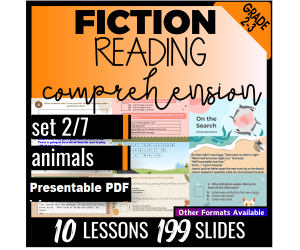
Reading Comprehension Passages Fiction Set 2 - Animals Presentable PDF
ELA, Reading, Reading Comprehension, Common Core, ESL, Language Development, Spelling, Vocabulary, Creative Writing, Writing, Grade 2, 3, Worksheets & Printables, Worksheets, Assessments, Teacher Tools, Tests, Quizzes and Tests, Writing Prompts
Reading Comprehension Passages Fiction Set 2 Snapshot Genre: Fiction (animal-themed short stories with skill pages) Subject: Reading Primary Topic: Animal stories for comprehension and literacy practice Estimated Guided Reading Level (A–Z): O What This Teaches Best Reading comprehension with short, engaging animal stories: Each passage centers on an animal-related situation and is followed by questions that point students back to key details. Responsible choices around animals: Characters learn boundaries and care (e.g., not feeding/petting a wild fawn; returning tadpoles to the pond; releasing butterflies after photographing them). Character feelings and motivations: Students can track how characters feel and why (excited, uneasy, frustrated, worried) and connect those feelings to actions and outcomes. Cause and effect + problem/solution: Stories show clear outcomes from decisions (escaped pheasants lead to chasing; fog blocks stargazing; feeding helps Allan pet a dolphin). Integrated skill practice (vocab, spelling, writing): Support pages include vocabulary matching, spelling tasks, short responses, and retelling. Note: one question page uses the name “Zelda” where the story uses “Zelma.” Learning Goals Students will recount the beginning, middle, and end of a selected story using details from the text. Students will describe characters’ feelings and motivations and cite what in the story shows them. Students will identify a problem and solution in a story and explain how the solution affects the ending. Students will explain cause-and-effect relationships (what happened, why it happened, and what changed). Students will use context clues to determine the meaning of challenging words in the passages. Students will make a reasonable prediction based on story events and character actions. Passages Include 1.Unexpected Visitors: Terra gets an unexpected visitor. 2.Feeding Time: Allan visits an aquarium and feeds the dolphins. 3.New Pup Next Door: The neighbor has a new dog and Benny wants to see. 4.Stargazing: Jazmin loves looking at the stars. She visits the beach today. 5.On the Search: Abigail wants to find a shark tooth more than anything. 6.Tadpoles: Brittney & Stan take frogs eggs home & watch them hatch. 7.Lucky Caterpillar: Lily and Sadie watch a caterpillar crossing the road. 8.Karl the Photographer: Karl spends his summer taking photos of butterflies. 9.Chasing Pheasants: Tony and his father have a great idea...or so they think! 10.Part of the Family: Ava is nervous as her cat is about to have kittens. Additional File: Tadpoles: Blank Life Cycle PRESENTABLE PDF VERSION Run it like a slide show straight from a PDF, with no PowerPoint or extra software needed, just open, project, and teach. Other versions are available in the links list below or in the full catalog. FULL CATALOG OF DOWNLOAD LINKS HERE For similar downloads and other frees, do check out Cored Group on TeachSimple.
Author Cored Education
Rating
Tags Elementary, Reading, Comprehension, Vocabulary, Answers, Common Core, Spelling, Writing, Passages, Reading Comprehension Assessments
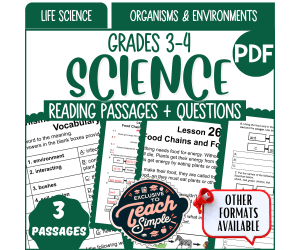
Science Reading Comprehension: Organisms and Environments (PDF)
Science, Life Sciences, Biology, Common Core, ELA, Reading Comprehension, Reading, Human Body, Animals, Grade 2, 3, 4, Worksheets & Printables, Worksheets, Assessments, Teacher Tools, Tests, Quizzes and Tests
Reading Comprehension: Organisms and Environments for Life Science (Biology) Organisms and Environments: Reading Passages Life Science (Biology): Dive into the world of science reading with this resource tailored to seamlessly integrate science into your busy week. Packed with engaging questions aligned to the Common Core State Standards (CCSS) and crafted specifically for Grades 3-4, this set simplifies the teaching process as the majority of the groundwork is pre-prepared for you. Topics delve into food chains, food webs, and the impact of organisms on their environments. An invaluable asset for educators aiming for a comprehensive approach! What's inside? Part 3 - Organisms & Environments Reading Passage 1: Food Chains and Food Webs Reading Passage 2: Organisms Change Environments Reading Passage 3: People Change Environments Product Info: 18 PAGES (US English with Answers) PDF Version Teaching Duration: Approximately 2 Weeks Science Reading Comprehension Outline: Targeted for students in 3rd and 4th grades, these reading passages are enhanced with illustrations and graphs to elucidate critical points. Each lesson aligns with the Common Core State Standards, allowing you to integrate science reading practice effortlessly, knowing that minimal preparation is needed on your part. Each passage comes with a variety of questions in different formats, including multiple-choice formats, data analysis, and fill-in-the-blanks. The topics covered strike a balance between engaging content and core curriculum -based science subjects. Versatile in application, these lessons are suitable for a variety of settings such as whole-class instruction, morning activities, independent desk work, small group discussions, contingency plans for substitute teachers, homework assignments, or even special holiday-themed tasks. FULL CATALOG OF DOWNLOAD LINKS HERE Grade 3/4 Links: Physical Science Part 1 - Properties of Objects and Materials Google Docs/Slides/Forms PDF PPT Word Free Supplementary Pack Accompanying Videos Physical Science Part 2 - Position and Motion of Objects Google Docs/Slides/Forms PDF PPT Word Free Supplementary Pack Accompanying Videos Physical Science Part 3 - Light, Heat, Electricity, Magnetism Google Docs/Slides/Forms PDF PPT Word Free Supplementary Pack Accompanying Videos Life Science Part 1 - Characteristics of Organisms Google Docs/Slides/Forms PDF PPT Word Free Supplementary Pack Accompanying Videos Life Science Part 2 - Life Cycles of Organisms Google Docs/Slides/Forms PDF PPT Word Free Supplementary Pack Accompanying Videos Life Science Part 3 - Organisms and Environments Google Docs/Slides/Forms PDF PPT Word Free Supplementary Pack Accompanying Videos Earth Science Part 1 - Properties of Earth Materials Google Docs/Slides/Forms PDF PPT Word Free Supplementary Pack Accompanying Videos Earth Science Part 2 - Changes in the Earth and Sky Google Docs/Slides/Forms PDF PPT Word Free Supplementary Pack Accompanying Videos Earth Science Part 3 - Objects in the Sky Google Docs/Slides/Forms PDF PPT Word Free Supplementary Pack Accompanying Videos For similar products and other frees, do check out Cored Group on TeachSimple .
Author Cored Education
Rating
Tags Science, Elementary, Reading, Comprehension, Reading Centers, Life Science, Biology, Science Assessments, Reading Comprehension Assessments, Vocabulary Assessments

Measurement: Volume & Surface Area - Pre-Assessment & Teach the Skill - FLASH-MAC
Math, Measurements, Common Core, Grade 3, 4, 5, Assessments, Teacher Tools
Measurement: Volume & Surface Area - Pre- Assessment & Teach the Skill - FLASH-MAC This teaching resource is specifically designed for educators who aim to enhance their mathematics curriculum with focus on measurements. Suitable for third, fourth, and fifth-grade levels, it introduces fundamental concepts related to volume and surface area. What's included? A 'chapter mini' that contains pre- assessment activities. A detailed lesson plan aimed explicitly at teaching the skill. Educational tools that support hands-on learning experiences and practical application. The product stands out by providing dual-language support; offering text narration and voice over in both English and Spanish. This feature aids inclusivity within classrooms or homeschooling environments filled with diversity. Educational Standards Compliance The content aligns with: The Common Core State Standards - Improving student outcomes in STEM (Science, Technology, Engineering, Mathematics) fields. National Council of Teachers Mathematics (NCTM) standards. - Ensuring relevance beyond specific statewide curriculum requirements. This resource can be used flexibly across variety of learning modalities; suitable for whole classroom instruction, smaller groups or individual students as reinforcing homework assignments. The digital format note: this tool is tailor-made for Mac computers (Software) users requiring compatible devices will experience optimal performance functionality without hindrance.. Conclusion: In summation the "Measurement: Volume & Surface Area - Pre- assessment & Teach the Skill – FLASH-MAC" offers a blend of rigorous pre-assessments and engaging lessons which cater to diverse student learning needs.
Author Classroom Complete Press
Tags Software (Mac)
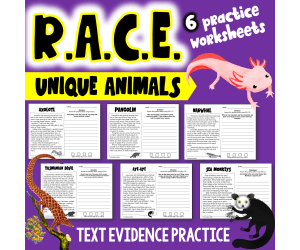
RACE Strategy Practice Set - 6 Passages for Text Evidence Practice
ELA, Reading Comprehension, Reading, Strategies, Grade 3, 4, 5, Worksheets & Printables, Writing Prompts, Teacher Tools, Assessments
R.A.C.E. Strategy Practice – 6 Nonfiction Passages & Text Evidence Worksheets Help your students master text-evidence writing with this R.A.C.E. Strategy Practice worksheet set with six animal-themed nonfiction passages and text-evidence questions. It’s a no-prep, print-and-go resource that makes teaching evidence-based writing easy, engaging, and effective for grades 4–6. This resource uses the R.A.C.E. Strategy (Restate, Answer, Cite, Explain) in a way that’s simple, engaging, and effective for upper elementary. With 6 nonfiction passages all about fun, unique animals and open-ended questions that require text evidence, your class will build confidence in answering questions that ask for more than just basic recall and facts. What you get Six high-interest nonfiction passages paired with open-ended questions for each passage. Each worksheet includes an original passage, lines to write an answer with RACE, and checkboxes that walk students through each step of the R.A.C.E. framework (Restate, Answer, Cite, Explain/Edit). Also includes a student reference sheet on the R.A.C.E. strategy (available in color or B&W) so students always have a reminder of what each letter means. It’s totally no-prep: print it and go, or use the digital version if you’re doing distance or hybrid learning. Teachers love it because: Because the passages are fun, engaging, and relevant, students are more willing to dive deeply into the questions and spend time thinking about how they answer, not just what . It’s perfect for grades 4-6 (and even older if you have students working on writing responses), state test prep, literacy centers, homework, intervention, or anytime you want them to practice text evidence and strong responses. RACE for success! Your students will build a habit of using evidence to support their answers, editing their work, and seeing results in their writing. You’ll save time, spend less effort prepping, and gain a resource you’ll use again and again. If you’re ready to help your students elevate their writing responses and feel confident in their text-evidence work, this pack is a winner. Snag it today, print, hand it out, and watch your students step up their game. Thanks! Enjoy ~Stephanie
Author The Language of Learning
Rating
Tags RACE, RACE Strategy, Test Prep, Animals, Unique Animals, Nonfiction Passage, Text Evidence, Cite Evidence, RACES Strategy, RACE Practice
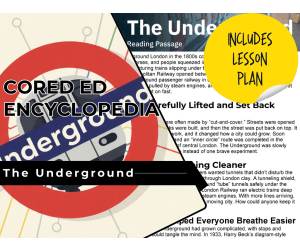
The Underground Reading Comprehension Passage - Cored Ed Encyclopedia
ELA, Language Development, Reading Comprehension, Reading, Science, Technology, Engineering, History, Social Studies, Geography, Grade 2, 3, 4, 5, Worksheets & Printables, Worksheets, Teacher Tools, Centers, Activities, Writing Prompts, Assessments, Quizzes and Tests, Quizzes, Lesson Plans
This Underground reading comprehension with lesson plan includes: Visualization (on the front cover) Start your lesson by taking a minute to think and share something about the topic. Read the script aloud (slowly), perhaps prepare some music or sound effects. Student close their eyes and let their imaginations wander. Students open their eyes, read the question aloud and give them a few minutes to complete. Ask a few students to share or keep answers until the end to compare with what they learn in the passage. Quick pause—thousands of Cored Education products are included with your TeachSimple membership. Download links and encyclopedia index available here. Pre-Reading Trivia Students will write down one thing they already know about the subject and then read five more facts and discuss. These facts are fun, and the students will enjoy learning about the subject before reading more. Give 1 minute for students to write what they already know (no pressure—best guess is fine). Read the five facts together. After each fact, do ask a student for their opinion, was it surprising? Set a purpose by asking students to highlight/underline one fact they want to learn more about during the reading. Reading Passage The text is a high-interest reading passage with set paragraphs, roughly three to four paragraphs long. It contains a variety of themes about the topic, anywhere from history to technology. The passage is between 250 and 350 words in length. First, ask students to look at the headings and see what they’ll learn about today. What do they know about the topic/heading? First read options: Teacher read-aloud (best for support). Partner reading (paragraph by paragraph). While reading, students underline important details, and vocabulary words they think may come up in the questions section. Mixed Questions The first question page contains four multiple-choice questions, each with a choice of four answers, and three written response questions that require a sentence or two from the student. Students complete the mcqs first independently, then review quickly as a class. For the 3 written responses, try to get students giving the answer with some form of evidence: “I think ___ because the text says ___.” If students get stuck, send them back to check the passage. Vocabulary Questions Practice seven key words from the text in this section across two activities. First section is scrambled words where students will unscramble three words given a clue for each. The second section is a word to meaning matching activity. Before starting, have some students read out words they underlined in the passage. Ask students to say the word and read aloud the sentence(s) around each word. Ask students to do scrambled words and the matching exercise in pairs then go through answers as a class. For the scrambled spelling task, get four pairs to come up to the board and write the words for extra practice with the other student reading out the clue. For the matching task, prompt students to give full sentences: “I matched ___ with ___ because ___.” Creative Writing In this question, the student will be required to write a five to eight sentence paragraph on a question related to the topic. Before starting, ask students write down 3 key ideas they are going to include in their piece. Ask students for ideas to share around the class to help those struggling. Pro writing expectations: 5–8 sentences At least 2 facts or details from the passage At least 2 vocabulary words from the previous page Students read their paragraphs while classmates listen for facts and vocabulary words. Extension Activities This page is optional for fast finishers or to take home. There are several activities, each one requiring a different skill. Do some, do none, do all, completely optional - but you will feel reassured knowing every possibility is planned for. Includes summary writting question. Answer Key There are answers for the multiple-choice questions, written response questions have sample answers, vocabulary answers and if there is a summary question then a sample summary will be provided as well. Lesson Plan Included Customized lesson plan for this lesson is included. Lesson Snapshot Title: The Underground Genre: Nonfiction (informational text) Subject: Social Studies (History) Primary Topic: How London built and improved the Underground Estimated Guided Reading Level (A–Z): R What This Lesson Teaches Best Explains why planners wanted trains under crowded London streets in the 1800s. Teaches key early-history facts, including the Metropolitan Railway opening on January 10, 1863, between Paddington and Farringdon. Describes the “cut-and-cover” method (opening streets like a trench, building tracks, then putting the street back). Shows how deeper “tube” tunnels and electric trains reduced street disruption and avoided steam smoke. Demonstrates how a clearer diagram-style map (Harry Beck, 1933) helped riders understand a complicated system. Learning Goals Students will explain why some planners imagined trains going under London in the 1800s. Students will identify what opened on January 10, 1863, and name the two stations connected in the text. Students will describe the steps of “cut-and-cover” tunnel building using details from the passage. Students will explain how digging deeper “tube” tunnels changed building the Underground and affected smoke underground. Students will explain how Harry Beck’s 1933 diagram-style map made the system easier to follow. Key Vocabulary From the Text Metropolitan — the name of an early London railway line. cut-and-cover — open a street, build tracks, rebuild street on top. tunneling — digging a passage underground. shield — a strong ring that helps bore tunnels safely. complicated — hard to understand because there are many parts. FULL CATALOG OF DOWNLOAD LINKS AND ENCYCLOPEDIA INDEX HERE
Author Cored Education
Rating
Tags Vocabulary, Reading Comprehension, Reading Passages, Lesson Plans, Ela Lesson Plans, Reading Comprehension Lesson Plans, Pre-reading, History, History Lesson Plans, Geography
Future Tense Practice Questions - Grammar Grade 3-4 (Slides)
ELA, Language Development, ESL, Grammar, Common Core, Resources for Teachers, Grade 3, 4, Quizzes and Tests, Teacher Tools, Tests, Assessments, Presentations, Activities
Future Tense Grammar Practice MCQS ELA MCQS Overview: In this series of lessons, students will embark on an engaging journey to explore the grammar skills that make our language vibrant and expressive. These lessons are crafted to help students identify, comprehend, and effectively apply language arts skills in both writing and speech. Accompanied by free supplementary materials available for all topics, each lesson builds on the previous one, offering a balanced mix of direct instruction, interactive group activities, and independent practice. Through fun and creative tasks, students will learn to recognize grammar within sentences, understand their function, and use them to enrich their own writing and speech. Future Tense Overview: Includes: Future Simple Future Continuous Future Perfect Mistake Finding Slides Version This is the Slides editable and interactive version. There is a fillable answer sheet at the end. This download is available in GOOGLE Docs, GOOGLE Forms, GOOGLE Slides. PDF, PPT, WORD, check the links below for more details. FULL CATALOG OF DOWNLOAD LINKS HERE Grade 3/4 Links: Adjectives Google Docs Google Forms Google Slides PDF PPT Word Free Supplementary Materials Pack Adverbs Google Docs Google Forms Google Slides PDF PPT Word Free Supplementary Materials Pack Conjunctions Google Docs Google Forms Google Slides PDF PPT Word Free Supplementary Materials Pack Nouns Google Docs Google Forms Google Slides PDF PPT Word Free Supplementary Materials Pack Pronouns Google Docs Google Forms Google Slides PDF PPT Word Free Supplementary Materials Pack Verbs Google Docs Google Forms Google Slides PDF PPT Word Free Supplementary Materials Pack Sentence Structure Google Docs Google Forms Google Slides PDF PPT Word Free Supplementary Materials Pack Present Tense Google Docs Google Forms Google Slides PDF PPT Word Free Supplementary Materials Pack Past Tense Google Docs Google Forms Google Slides PDF PPT Word Free Supplementary Materials Pack Future Tense Google Docs Google Forms Google Slides PDF PPT Word Free Supplementary Materials Pack Context Clues Google Docs Google Forms Google Slides PDF PPT Word Free Supplementary Materials Pack Defining Words Google Docs Google Forms Google Slides PDF PPT Word Free Supplementary Materials Pack Fill the Blanks Google Docs Google Forms Google Slides PDF PPT Word Free Supplementary Materials Pack Homophones Google Docs Google Forms Google Slides PDF PPT Word Free Supplementary Materials Pack Synonyms Google Docs Google Forms Google Slides PDF PPT Word Free Supplementary Materials Pack ELA Review Questions Overview Questions have three answer choices. There are a handful of pictures on each test for aesthetic purposes, as well as a review sheet covering most of the topics covered in the product. Introduction or Example Sheet Each topic will include an introduction or example sheet to go through first with your students. Full Answer Keys Full answer keys and sample responses are provided so no matter how busy you are, you know you're covered! In the Supplementary Pack Interactive Ice Breakers: Fun, hands-on activities that get students thinking about adjectives right from the start. Guided Practice: Teacher-led exercises that reinforce the day’s lesson, ensuring students can confidently identify and use adjectives. Group and Partner Tasks: Collaborative activities that allow students to work together to solve problems, categorize adjectives, and create descriptive sentences. Independent Worksheets: Structured worksheets that provide individual practice and help solidify understanding of key concepts. Exit Tasks: Quick, reflective activities at the end of each lesson that assess understanding and encourage students to apply what they’ve learned. For similar downloads and other frees, do check out Cored Group on TeachSimple.
Author Cored Education
Tags Elementary, Answers, Ccss, Common Core, Grammar, Tests, Test Prep, Assessment, Grade 3, Grade 4
Candy Reading Comprehension Passages and Questions Powerpoints
ELA, Language Development, Resources for Teachers, Vocabulary, Spelling, Reading Comprehension, Reading, Common Core, Grade 2, 3, 4, 5, Teacher Tools, Centers, Activities, Assessments, Tests, Quizzes and Tests, Presentations, Quizzes
Themed Reading Comprehension Passages Series - Candy This reading comprehension series is built for grades 2 to 5 and keeps things simple, clear, and easy to use. Every title follows a fun, kid-friendly theme and comes with two passage levels, one written for grades 2 to 3 and a more challenging version for grades 4 to 5. Students then work through a mix of follow-up pages that check understanding in different ways: multiple-choice questions, short written responses, scrambled words, a quick summary, and a theme-based word problem. Answer keys are included, so prep stays minimal. Each resource also comes in nine classroom-friendly formats, so you can choose what fits your setup: print or digital, editable or ready to go, and even self-grading options. Because the layout stays consistent, it is easy to plug into whole-class lessons, small groups, literacy centers, morning work, fast finisher tubs, sub plans, or home learning. It is a straightforward way to build comprehension, practice reading skills in context, and strengthen written responses without adding extra steps for you. Candy Lesson List Note: This product has titles different to those in the rest of the themed series. 1. Candy Types 2. Candy Flavors 3. Candy Shapes and Colors 4. Candy Ingredients 5. Candy Fun Facts PPT VERSION Editable slides with all the Presentable PDF convenience, so you can customize text, images, and pacing for your class. Other versions are available in the links list below or in the full catalog. How to Use These Lessons Perfect for: Morning work or early-finisher bins Guided reading blocks or comprehension warmups Literacy centers or small-group rotations Holiday/seasonal review lessons Independent stations, sub plans, or take-home enrichment More Candy Themed Products CROSSWORDS WORDSEARCHES MAZES FULL CATALOG OF DOWNLOAD LINKS HERE Themed Reading Links Addition Animals Around the Home Birthday FORMATS: -FORMAL ASSESSMENT VERSION -PRESENTABLE PDF -PPT -SLIDES - PDF -FILLABLE PDF -WORD -FORMS -DOCS SUPPLEMENTARY MATERIALS (COMING SOON): -VISUAL READING PASSAGE VIDEO -GUIDED LEARNING VIDEO -LESSON PLANS Candy FORMATS: -FORMAL ASSESSMENT VERSION -PRESENTABLE PDF -PPT -SLIDES -PDF -FILLABLE PDF -WORD -FORMS -DOCS SUPPLEMENTARY MATERIALS (COMING SOON): -VISUAL READING PASSAGE VIDEO -GUIDED LEARNING VIDEO -LESSON PLANS Christmas Cinco de Mayo Clothes Colors Days and Months Division Earth Day Easter Easy Mazes Fall Father's Day Food Geography (Set 1) Geography (Set 2) Geography (Set 3) Graduation Health History (Set 1) History (Set 2) History (Set 3) Human Body Kindness Life Skills Mother's Day Multiplication Science (Set 1) Science (Set 2) Science (Set 3) Shapes Social Skills Spring Sports St. Patrick's Day Subtraction Summer Thanksgiving Transport Valentine's Day Winter Free One Lesson Themes Chinese New Year Lunar New Year Halloween Pink Shirt Day Independence Day Juneteenth President's Day Groundhog Day Readings in Depth Structure Each resource is built around a focused sub-theme within the broader topic. Students read two leveled passages (Grades 2–3 and Grades 4–5), then move through a short, consistent sequence of activities that checks understanding and keeps momentum: multiple-choice, brief written responses, a scrambled-words review, a compact summary task, and a light theme-linked word problem. The flow is predictable for students, but varied enough to feel fresh across topics. Each completed resource includes: Two differentiated reading passages (lower and upper level) A multiple-choice comprehension page Short written-response questions A scrambled-words or quick vocabulary check A brief summary activity A simple, theme-connected word problem Answer keys for fast marking and easy self-checking Nine classroom-friendly formats, including print, editable, digital, and self-grading options Themes Included These readings span a wide range of age-appropriate, high-interest topics, such as: Seasons and celebrations Real-world science and nature Community, character, and life skills Everyday high-frequency themes students already enjoy Each title connects to familiar experiences while strengthening comprehension, vocabulary in context, and clear written expression. Easy extensions (optional): Read twice: first for gist, second to highlight key details Write two “right there” questions and swap with a partner Create a 3-bullet fact list or mini mind map Turn the summary into a 3-sentence retell using sequence words Add one extra math question connected to the topic Compare the two levels: what details appear in both? Differentiation tips: Pre-teach 2–3 key words with quick examples Offer sentence starters for written responses Use partner reading: one reads aloud, one tracks evidence Allow highlighting or underlining before answering questions Provide a shorter chunking option for students who need breaks Encourage confident readers to justify answers with a quoted detail For similar downloads and other frees, do check out Cored Group on TeachSimple.
Author Cored Education
Rating
Tags Vocabulary, Spelling, Candy, Candy Activities, Writing Prompts, Word Problems, Reading Comprehension, Candy Reading, Candy Passages, Reading Passages

Pronouns Practice Questions - Grade 3-4 Grammar (Presentable PDF)
ELA, Language Development, ESL, Grammar, Common Core, Resources for Teachers, Grade 3, 4, Worksheets & Printables, Worksheets, Quizzes and Tests, Teacher Tools, Tests, Assessments, Activities
Pronouns Grammar Practice Multiple Choice Questions Pronouns Snapshot Title: Parts of Speech: Pronouns Genre: Instructional Nonfiction Subject: Language Arts Primary Topic: identifying and using pronouns correctly What This Practice Pack Teaches Best Identifying pronouns in sentence context. Distinguishing subject, object, possessive, and reflexive pronouns through direct review and practice. Choosing correct pronouns in sentence-completion tasks. Correcting common pronoun errors in edited sentences and replacement tasks. Learning Goals from this pack Students will identify pronouns in complete sentences. Students will distinguish subject, object, possessive, and reflexive pronouns. Students will choose pronouns that correctly complete a sentence. Students will replace named nouns with the correct pronouns. Students will correct common pronoun errors in written sentences. Key Vocabulary From the Pack (teach these before starting tests) subject — the doer in a sentence. possessive — showing ownership. object — receiving the action. reflexive — referring back to the subject. ownership — having something belong to someone. Common Core Alignment CCSS.ELA-LITERACY.L.2.1.C — Use reflexive pronouns. Pronouns Overview: This pack includes: Subject Pronouns Possessive Pronouns Object Pronouns Reflexive Pronouns PRESENTABLE PDF VERSION Run it like a slide show straight from a PDF, with no PowerPoint or extra software needed, just open, project, and teach. Other versions are available in the links list below or in the full catalog. FULL CATALOG OF DOWNLOAD LINKS HERE Final Overview of this product This product helps students understand pronouns and how they replace nouns in a sentence. It shows them how pronouns make writing sound smoother and less repetitive. Students learn about subject, object, possessive, and reflexive pronouns. They will practice choosing the right pronoun and fixing common mistakes. The activities are simple, clear, and useful. Overall, this workbook helps build grammar skills, improve sentence flow, and support stronger reading and writing. For similar downloads and other frees, do check out Cored Group on TeachSimple.
Author Cored Education
Rating
Tags Elementary, Answers, Ccss, Common Core, Grammar, Tests, Test Prep, Assessment, Grade 3, Grade 4
Television Reading Comprehension Passage - Cored Ed Encyclopedia
ELA, Language Development, Reading Comprehension, Reading, Pre-Reading, Science, Technology, Engineering, History, Social Studies, Grade 2, 3, 4, 5, Worksheets & Printables, Worksheets, Teacher Tools, Centers, Activities, Writing Prompts, Assessments, Quizzes and Tests, Quizzes, Lesson Plans
This television reading comprehension includes: Visualization (on the front cover) Start your lesson by taking a minute to think and share something about the topic. Read the script aloud (slowly), perhaps prepare some music or sound effects. Student close their eyes and let their imaginations wander. Students open their eyes, read the question aloud and give them a few minutes to complete. Ask a few students to share or keep answers until the end to compare with what they learn in the passage. Quick pause—thousands of Cored Education products are included with your TeachSimple membership. Download links and encyclopedia index available here. Pre-Reading Trivia Students will write down one thing they already know about the subject and then read five more facts and discuss. These facts are fun, and the students will enjoy learning about the subject before reading more. Give 1 minute for students to write what they already know (no pressure—best guess is fine). Read the five facts together. After each fact, do ask a student for their opinion, was it surprising? Set a purpose by asking students to highlight/underline one fact they want to learn more about during the reading. Reading Passage The text is a high-interest reading passage with set paragraphs, roughly three to four paragraphs long. It contains a variety of themes about the topic, anywhere from history to technology. The passage is between 250 and 350 words in length. First, ask students to look at the headings and see what they’ll learn about today. What do they know about the topic/heading? First read options: Teacher read-aloud (best for support). Partner reading (paragraph by paragraph). While reading, students underline important details, and vocabulary words they think may come up in the questions section. Mixed Questions The first question page contains four multiple-choice questions, each with a choice of four answers, and three written response questions that require a sentence or two from the student. Students complete the mcqs first independently, then review quickly as a class. For the 3 written responses, try to get students giving the answer with some form of evidence: “I think ___ because the text says ___.” If students get stuck, send them back to check the passage. Vocabulary Questions Practice seven key words from the text in this section across two activities. First section is scrambled words where students will unscramble three words given a clue for each. The second section is a word to meaning matching activity. Before starting, have some students read out words they underlined in the passage. Ask students to say the word and read aloud the sentence(s) around each word. Ask students to do scrambled words and the matching exercise in pairs then go through answers as a class. For the scrambled spelling task, get four pairs to come up to the board and write the words for extra practice with the other student reading out the clue. For the matching task, prompt students to give full sentences: “I matched ___ with ___ because ___.” Creative Writing In this question, the student will be required to write a five to eight sentence paragraph on a question related to the topic. Before starting, ask students write down 3 key ideas they are going to include in their piece. Ask students for ideas to share around the class to help those struggling. Pro writing expectations: 5–8 sentences At least 2 facts or details from the passage At least 2 vocabulary words from the previous page Students read their paragraphs while classmates listen for facts and vocabulary words. Extension Activities This page is optional for fast finishers or to take home. There are several activities, each one requiring a different skill. Do some, do none, do all, completely optional - but you will feel reassured knowing every possibility is planned for. Includes summary writting question. Answer Key There are answers for the multiple-choice questions, written response questions have sample answers, vocabulary answers and if there is a summary question then a sample summary will be provided as well. Lesson Plan Included Customized lesson plan for this lesson is included. Lesson Snapshot Title: Television Genre: Nonfiction (informational text) Subject: Science (Technology) Primary Topic: How television changed from mechanical to digital Estimated Guided Reading Level (A–Z): S What This Lesson Teaches Best How an invention changed over time, from a “spinning disk” experiment to modern screens and signals. Key milestones in television’s development (1925 Selfridges demo, 1927 Farnsworth, 1936 BBC service, late 2000s flat-panels). How pictures can be broken into lines/signals and sent by wire, radio, antenna, cable, or internet. The shift from black-and-white to color broadcasts and how viewers experienced that change over decades. Comparing analog and digital signals as two different ways information travels. Learning Goals Students will describe how early television used a spinning Nipkow disk to scan pictures into lines. Students will identify key people, places, and dates from the passage (Baird, Farnsworth, Selfridges, Alexandra Palace). Students will explain how television changed from mechanical parts to all-electronic systems that made clearer pictures. Students will summarize how TV viewing changed from bulky cathode-ray tubes to flat-panel screens and high-definition images. Students will compare analog and digital signals using details from the text. Key Vocabulary From the Text scan — break a picture into lines to send it. signals — messages that carry picture or sound information. broadcasting — sending TV so many people can receive it. analog — a smooth, continuous wave way of sending. digital — coded bits that travel more cleanly. FULL CATALOG OF DOWNLOAD LINKS AND ENCYCLOPEDIA INDEX HERE
Author Cored Education
Rating
Tags Vocabulary, Reading Comprehension, Reading Passages, Lesson Plans, Ela Lesson Plans, Reading Comprehension Lesson Plans, Pre-reading, History, Social Studies, Social Studies Lesson Plans

Jack and the Beanstalk Fairy Tale Foldable Mini Book Grade 1 2 3 ELA
ESL, Language Development, ELA, Literature, Children’s Literature, Reading Comprehension, Reading, Grade 1, 2, 3, Centers, Activities, Crafts, Projects, Assessments, Teacher Tools
Climb up to a more exciting learning experience with Jack and the Beanstalk Mini Book activity pack. Made for Grades 1, 2 and 3, homeschoolers, and EFL/ESL learners, this resource is ideal for skill building especially for reading, reading comprehension, writing, story retelling, sequencing, fine motor skills, supporting creative and imaginative thinking and more! The activities included in this set can be used for reading classes, reading centers, reading comprehension assessment tool, writing exercises, morning work activities, and early finisher exercises. What’s Inside: •Colored Jack and the Beanstalk Story Mini Book– for story retelling, reading and reading comprehension practice •Jack and the Beanstalk Story Mini BookTrace & Read Pages– handwriting practice and motor skills exercise •Jack and the Beanstalk Mini BookSequencing Booklet– sequencing and sorting exercise, story retelling and reading practice •Jack and the Beanstalk Mini BookRetell & Reflect Pages– retell practice, creativity and imagination development •Jack and the Beanstalk Mini BookBlank Create-a-Story Templates– story telling, supporting creative and imaginative thinking skills •Jack and the Beanstalk Mini BookTeacher Guide + Sample Lesson Plan
Author It's Teacher L
Rating
Tags Jack And The Beanstalk, Fairy Tale Unit, Reading Comprehension Project, ELA Project
Past Tense Practice Questions - Grammar Grade 3-4 (Slides)
ELA, Language Development, ESL, Grammar, Common Core, Resources for Teachers, Grade 3, 4, Quizzes and Tests, Teacher Tools, Tests, Assessments, Presentations, Activities, Centers
Past Tense Grammar Practice MCQS ELA MCQS Overview: In this series of lessons, students will embark on an engaging journey to explore the grammar skills that make our language vibrant and expressive. These lessons are crafted to help students identify, comprehend, and effectively apply language arts skills in both writing and speech. Accompanied by free supplementary materials available for all topics, each lesson builds on the previous one, offering a balanced mix of direct instruction, interactive group activities, and independent practice. Through fun and creative tasks, students will learn to recognize grammar within sentences, understand their function, and use them to enrich their own writing and speech. Past Tense Overview: Includes: Past Simple Past Continuous Past Perfect Mistake Finding Slides Version This is the Slides editable and interactive version. There is a fillable answer sheet at the end. This download is available in GOOGLE Docs, GOOGLE Forms, GOOGLE Slides. PDF, PPT, WORD, check the links below for more details. FULL CATALOG OF DOWNLOAD LINKS HERE Grade 3/4 Links: Adjectives Google Docs Google Forms Google Slides PDF PPT Word Free Supplementary Materials Pack Adverbs Google Docs Google Forms Google Slides PDF PPT Word Free Supplementary Materials Pack Conjunctions Google Docs Google Forms Google Slides PDF PPT Word Free Supplementary Materials Pack Nouns Google Docs Google Forms Google Slides PDF PPT Word Free Supplementary Materials Pack Pronouns Google Docs Google Forms Google Slides PDF PPT Word Free Supplementary Materials Pack Verbs Google Docs Google Forms Google Slides PDF PPT Word Free Supplementary Materials Pack Sentence Structure Google Docs Google Forms Google Slides PDF PPT Word Free Supplementary Materials Pack Present Tense Google Docs Google Forms Google Slides PDF PPT Word Free Supplementary Materials Pack Past Tense Google Docs Google Forms Google Slides PDF PPT Word Free Supplementary Materials Pack Future Tense Google Docs Google Forms Google Slides PDF PPT Word Free Supplementary Materials Pack Context Clues Google Docs Google Forms Google Slides PDF PPT Word Free Supplementary Materials Pack Defining Words Google Docs Google Forms Google Slides PDF PPT Word Free Supplementary Materials Pack Fill the Blanks Google Docs Google Forms Google Slides PDF PPT Word Free Supplementary Materials Pack Homophones Google Docs Google Forms Google Slides PDF PPT Word Free Supplementary Materials Pack Synonyms Google Docs Google Forms Google Slides PDF PPT Word Free Supplementary Materials Pack ELA Review Questions Overview Questions have three answer choices. There are a handful of pictures on each test for aesthetic purposes, as well as a review sheet covering most of the topics covered in the product. Introduction or Example Sheet Each topic will include an introduction or example sheet to go through first with your students. Full Answer Keys Full answer keys and sample responses are provided so no matter how busy you are, you know you're covered! In the Supplementary Pack Interactive Ice Breakers: Fun, hands-on activities that get students thinking about adjectives right from the start. Guided Practice: Teacher-led exercises that reinforce the day’s lesson, ensuring students can confidently identify and use adjectives. Group and Partner Tasks: Collaborative activities that allow students to work together to solve problems, categorize adjectives, and create descriptive sentences. Independent Worksheets: Structured worksheets that provide individual practice and help solidify understanding of key concepts. Exit Tasks: Quick, reflective activities at the end of each lesson that assess understanding and encourage students to apply what they’ve learned. For similar downloads and other frees, do check out Cored Group on TeachSimple.
Author Cored Education
Tags Elementary, Answers, Ccss, Common Core, Grammar, Tests, Test Prep, Assessment, Grade 3, Grade 4

Adverbs Sample Lesson Grades 3-4 Grammar (Google Slides)
ELA, Language Development, ESL, Grammar, Common Core, Grade 3, 4, Quizzes and Tests, Teacher Tools, Tests, Assessments, Presentations
Adverbs Sample Lesson ELA MCQS Overview: In this series of lessons, students will embark on an engaging journey to explore the grammar skills that make our language vibrant and expressive. These lessons are crafted to help students identify, comprehend, and effectively apply language arts skills in both writing and speech. Accompanied by free supplementary materials available for all topics, each lesson builds on the previous one, offering a balanced mix of direct instruction, interactive group activities, and independent practice. Through fun and creative tasks, students will learn to recognize grammar within sentences, understand their function, and use them to enrich their own writing and speech. Adverbs Overview: Includes: When Adverbs Where Adverbs How Adverbs Mistake Finding Slides Version This is the Slides editable and interactive version. There is a fillable answer sheet at the end. This download is available in GOOGLE Docs, GOOGLE Forms, GOOGLE Slides. PDF, PPT, WORD, check the links below for more details. FULL CATALOG OF DOWNLOAD LINKS HERE Grade 3/4 Links: Adjectives Google Docs Google Forms Google Slides PDF PPT Word Free Supplementary Materials Pack Adverbs Google Docs Google Forms Google Slides PDF PPT Word Free Supplementary Materials Pack Conjunctions Google Docs Google Forms Google Slides PDF PPT Word Free Supplementary Materials Pack Nouns Google Docs Google Forms Google Slides PDF PPT Word Free Supplementary Materials Pack Pronouns Google Docs Google Forms Google Slides PDF PPT Word Free Supplementary Materials Pack Verbs Google Docs Google Forms Google Slides PDF PPT Word Free Supplementary Materials Pack Sentence Structure Google Docs Google Forms Google Slides PDF PPT Word Free Supplementary Materials Pack Present Tense Google Docs Google Forms Google Slides PDF PPT Word Free Supplementary Materials Pack Past Tense Google Docs Google Forms Google Slides PDF PPT Word Free Supplementary Materials Pack Future Tense Google Docs Google Forms Google Slides PDF PPT Word Free Supplementary Materials Pack Context Clues Google Docs Google Forms Google Slides PDF PPT Word Free Supplementary Materials Pack Defining Words Google Docs Google Forms Google Slides PDF PPT Word Free Supplementary Materials Pack Fill the Blanks Google Docs Google Forms Google Slides PDF PPT Word Free Supplementary Materials Pack Homophones Google Docs Google Forms Google Slides PDF PPT Word Free Supplementary Materials Pack Synonyms Google Docs Google Forms Google Slides PDF PPT Word Free Supplementary Materials Pack ELA Review Questions Overview Questions have three answer choices. There are a handful of pictures on each test for aesthetic purposes, as well as a review sheet covering most of the topics covered in the product. Introduction or Example Sheet Each topic will include an introduction or example sheet to go through first with your students. Full Answer Keys Full answer keys and sample responses are provided so no matter how busy you are, you know you're covered! In the Supplementary Pack Interactive Ice Breakers: Fun, hands-on activities that get students thinking about adjectives right from the start. Guided Practice: Teacher-led exercises that reinforce the day’s lesson, ensuring students can confidently identify and use adjectives. Group and Partner Tasks: Collaborative activities that allow students to work together to solve problems, categorize adjectives, and create descriptive sentences. Independent Worksheets: Structured worksheets that provide individual practice and help solidify understanding of key concepts. Exit Tasks: Quick, reflective activities at the end of each lesson that assess understanding and encourage students to apply what they’ve learned. For similar downloads and other frees, do check out Cored Group on TeachSimple.
Author Cored Education
Tags Elementary, Answers, Ccss, Common Core, Grammar, Tests, Test Prep, Assessment, Grade 3, Grade 4
Present Tense Practice Questions - Grade 3-4 Grammar (Fillable PDF)
ELA, Language Development, ESL, Grammar, Common Core, Resources for Teachers, Grade 3, 4, Worksheets & Printables, Worksheets, Quizzes and Tests, Teacher Tools, Tests, Assessments
Present Tense Grammar Practice MCQS Snapshot Title: Present Tense Genre: Nonfiction / Educational Workbook Subject: Language Arts Primary Topic: Using present verb forms correctly This workbook contains a review sheet, five practice worksheets, and answer keys focused on present-tense usage for Grades 3–4. What This Teaches Best Defines present tense as describing a current activity or state of being. Introduces simple present, present progressive, present perfect, and present perfect progressive. Gives repeated practice distinguishing present simple, present continuous, and present perfect. Strengthens subject-verb agreement through sentence completion and correction tasks. Helps students notice how present-tense verbs can describe routines, actions happening now, and completed actions connected to the present. These teaching strengths come from the review sheet and the sequence of Worksheets 1–5. Learning Goals Students will explain what the present tense shows in a sentence. Students will identify sentences written in the present tense. Students will distinguish present simple, present continuous, and present perfect forms. Students will complete sentences using the present-tense form that fits best. Students will correct mistakes in sentences that misuse present-tense verbs. Students will identify the present-tense type used in a sentence. These goals reflect the review sheet and the practice formats used throughout the workbook. Key Vocabulary From the Text present — happening now current — happening at this time activity — something a person does state — how someone or something is progressive — shows an action continuing All five words appear in the review sheet text. Common Core Alignment L.3.1e — Form and use regular and irregular simple verb tenses. L.4.1b — Form and use the progressive verb tenses. L.5.1b — Form and use the perfect verb tenses. Present Tense Overview: Includes: Present Simple Present Continuous Present Perfect Mistake Finding FILLABLE PDF VERSION Worksheet-style pages, but with type-in answer boxes so students can complete and save their work digitally. Other versions are available in the links list below or in the full catalog. FULL CATALOG OF DOWNLOAD LINKS HERE For similar downloads and other frees, do check out Cored Group on TeachSimple.
Author Cored Education
Rating
Tags Elementary, Answers, Ccss, Common Core, Grammar, Tests, Test Prep, Assessment, Grade 3, Grade 4