



3,923 products added recently
Page 154 - Lesson Plan Templates
Simplify your preparation with lesson plan templates designed to help you organize objectives, activities, and assessments. These templates provide a structured framework to ensure comprehensive coverage of material. Incorporate them to save time and enhance the effectiveness of your teaching.

 Show filters


I WONDER - Can Gorgons Be Defeated | Animated Video Lesson
History, Social Studies, Common Core, Grade 4, 5, 6, 7, 8, 9, 10, Lesson Plans, Teacher Tools
Video Introduction An amazing video designed for the students to learn more about mythological creatures in different cultures. I WONDER - Can Gorgons Be Defeated | Animated Video Lesson Mythology is full of wonders and spectacular stories. Ancient civilizations were trying to explore every aspect of life, while they search for new technologies, they wanted to believe in something big and can change the world, so they created mythical creatures and mythical stories. Let's hear about them! What do you know about these creatures? Cyclops, Centaurs, Selkies, Phoenix, Gnomes, Dragons, Gorgons, Orcs, Cerberus, Trolls, Minotaur, Griffins, Mermaids, Elves, Polyphemus, Pegasus, and Ogres. I WONDER - Can Gorgons Be Defeated | Animated Video Lesson The video is perfect for encouraging the creativity skills for the students, while learning more about this fantastic mythical creature. I WONDER - Can Gorgons Be Defeated | Animated Video Lesson This friendly designed video is suitable for students at school, homeschooling, and as a group activity. Format Available in MP4 format.
Author Educational Voice
Rating
Tags Can Gorgons Be Defeated, Can Gorgons Be Defeated Video, Gorgons, Gorgons Facts, Gorgons Video, Gorgons Video For Kids, Gorgons Facts For Kids, Gorgon, Gorgon Video, Gorgon Facts

I WONDER - What Is Xeriscaping | Animated Video Lesson
Environmental Science, Earth and Environmental Sciences, Science, Earth Sciences, Grade 4, 5, 6, 7, 8, 9, 10, Lesson Plans, Teacher Tools
Video Introduction An amazing video designed for the students to learn more about STEM. I WONDER - What Is Xeriscaping | Animated Video Lesson Do you like STEM subjects? what is your favorite one? Have you ever tried to plant a seed? If yes, tell us more about it. Or have you ever tried to invent something? If yes, tell us more about it. And how do you think it will help us? Have you ever seen a microorganism under a microscope? What was it? And how it looked like? Mathematics is a marvelous subject. Let' sharpen our brains and solve some equations. Do you like timetable tricks? What is your favorite one? Do you know how to code? Have you ever created an app or a game before? If yes, how was it like? I WONDER - What Is Xeriscaping | Animated Video Lesson The video is perfect for encouraging the researching skills for the students, while learning more about this fantastic topic. I WONDER - What Is Xeriscaping | Animated Video Lesson This friendly designed video is suitable for students at school, homeschooling, and as a group activity. Format Available in MP4 format.
Author Educational Voice
Tags What Is Xeriscaping, What Is Xeriscaping Video, Xeriscaping, Xeriscaping Facts, Xeriscaping Facts For Kids, Xeriscaping Video, Xeriscaping Video For Kids, Environment, Environment Facts

I WONDER - Why Were The Pyramids Sealed With Large Stones
History: African, History, Social Studies, History: Ancient, Grade 4, 5, 6, 7, 8, 9, 10, Lesson Plans, Teacher Tools
Video Introduction An amazing video designed for the students to learn more about history. I WONDER - Why Were The Pyramids Sealed With Large Stones | Animated Video Lesson Do you like history? Which topic do you really enjoy about history? Have you ever read an interesting fact about the Vikings? If yes, can you mention them? What do you like most about the Victorian era? Can you name all the Tudors? Have you ever wondered how people used to live in ancient Japan and ancient China? Do you know any interesting facts about ancient Egyptians and the Pharaohs? Have you ever visited South America? What do you know about Incas and Aztecs? Celtic culture was really one of a kind, can you name any of the places that Celts used to live in? Imagine yourself living during the ancient Roman empire, how your life will look like? Ancient Greece was an amazing place to live in. What do you know about ancient Greek life? I WONDER - Why Were The Pyramids Sealed With Large Stones | Animated Video Lesson The video is perfect for encouraging the researching skills for the students, while learning more about history. I WONDER - Why Were The Pyramids Sealed With Large Stones | Animated Video Lesson This friendly designed video is suitable for students at school, homeschooling, and as a group activity. Format Available in MP4 format.
Author Educational Voice
Tags Why Were The Pyramids Sealed With Large Stones, Why Were The Pyramids Sealed With Large Stones Video, Pyramids, Egyptian Pyramids, Egyptian Pyramids Facts, Egyptian Pyramids Video, Egyptian Pyramids Video For Kids
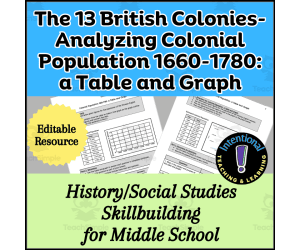
13 Colonies- Analyzing Colonial Population 1660-1780 Table & Graph
Social Studies, Government, History, History: USA, Grade 6, 7, 8, Teacher Tools, Lesson Plans
Middle School students often struggle with understanding how to read a table and a line graph, especially in history and social studies worksheets . In this easy-prep 8-page lesson, 1 50 minute period resource, The 13 British Colonies- Analyzing Colonial Population 1660-1780: a Table and Graph, students will learn or review what a table and line graph are and then how to turn the information from a table to a line graph to show how colonial populations changed over time. They will then analyze and interpret the line graph and table to answer thought-provoking and critical thinking questions. Finally, they will reflect on their experience by identifying what was challenging and what they learned. The pdf includes a force copy to the Google Document which is editable. The link to the Google Document is located at the top of the page called About this Resource. The resource includes the following: A handy reference page: About this Resource A Comprehensive standards-aligned lesson plan with objectives and learning targets An essential question and 2 guiding questions A worksheet with a table of colonial population information from 1660-1780, a blank line graph, questions and answer key The Essential Question is: Why is it important to study how populations have grown throughout history, and what can we learn from it? The Guiding Questions are: What were the key factors driving the growth of colonial populations from 1660 to 1780? How did economic opportunities and conditions impact population growth in different colonial regions? What role did slavery have in the growth of colonial populations? The Objectives are: Students will take statistical information from a table and place it into a line graph. Students will analyze and interpret the table and line graph to answer questions. Students will be able to explain how a line graph shows how colonial populations changed over time. The Learning Targets are: I can create a line graph from a table. I can analyze and interpret the line graph and table to answer questions. I can explain how colonial populations changed over time.
Author Intentional Teaching and Learning
Tags 13 British Colonies, Population Table, Population Graph, Analysis, Critical Thinking, Colonial History, Analytical Questions, Standards, Objectives And Learning Targets, Essential And Guiding QuestionsG
Conservation: How The Amount Of Fresh Water Could Change Gr. 5-8
Science, Earth and Environmental Sciences, Environmental Science, Grade 5, 6, 7, 8, Teacher Tools, Lesson Plans
Conservation: How The Amount Of Fresh Water Could Change Gr. 5-8 A comprehensive teaching resource that underscores the significance of preserving fresh water in today's world. Crafted specifically for educators such as public school teachers and homeschoolers, this product is devised to bolster key thinking capacities in pupils from Grade 5 through Grade 8. An offering that brilliantly bridges the scientific tutelage and environmental guardianship, it addresses the concern of fresh water conservation by integrating curriculum-commensurate content with captivating, hands-on tasks. It probes into vital subjects such as: Fresh water composition Its global positioning The repercussions of climate change on its purity and quantity The irreplaceable role it plays in life sustenance and agriculture. Differing from standard textbooks which may render these concepts abstractly, this resource enables practical learning through a range of real-life examples explained via comprehensible reading passages. Discussion cues seeded throughout these readings urge learners to ponder on relayed information while comprehension inquiries verify their understanding. Additionally, "Conservation: How The Amount Of Fresh Water Could Change Gr. 5-8" presents pedagogues multiple avenues to cater various learning styles or group dynamics—it can be utilized for inclusive class instruction or divided into smaller groups for profound discussion; alternatively it could serve as homework assignments promoting autonomous exploration by every pupil. Included within are also examination preparation resources which provide valuable tools for revising course matter alongside mini color posters visually enhancing presented details. All these materials come packed within one gripping PDF file ensuring convenience access. A crucial aid in students' voyage through Environmental Science studies—this bespoke lesson program not only ignites acknowledgement recognition towards our planet's irreplaceable fresh water resources but endows them with necessary know-how for meaningful debate on its preservation. Originating from the trusted Bloom's Taxonomy educational objective framework—"Conservation: How The Amount Of Fresh Water Could Change Gr. 5-8" carefully picks content to instill a balanced comprehension of its intricate subject matter in young minds. Proving that fun can indeed mingle with learning when it comes to imparting primary school science, this resource helps to nurture an early affection for environmental sciences within young learners.
Author Classroom Complete Press
Tags PDF

All About D - Letter of the Week Unit
ELA, Language Development, Pre-Reading, Kindergarten, Lesson Plans, Teacher Tools
All About D - Letter of the Week Unit This preschool letter recognition curriculum focuses on the letter D. It includes dozens of engaging options to teach letter recognition, letter formation, letter sounds, and using letter sounds in words in memorable ways. Choose from worksheets, handwriting practice, sorting activities, crafts , classroom posters and more to create customized “letter of the week” lessons. Fun options like paper bag puppets, wikki stick mats, play dough mats, dot painting, and make your own letter books make learning about the letter D exciting. Game options help reinforce recognition and sounds. With consistent teaching approaches and styles for each letter, this letter D curriculum integrates seamlessly into a full alphabet program. Similar matching numbers and colors units are also available to round out early childhood education. This thoughtfully designed letter D resource simplifies preschool lesson planning while keeping students engaged.
Author Simply Schoolgirl
Tags Letter Of The Week, Letter Paper Bag Puppet, Alphabet Play Dough, Tracing Letters, Alphabet Mazes, Preschool, Kindergarten, Phonics, Formation
I WONDER - How Big Is The Amazon River | Animated Video Lesson
Geography, Social Studies, Grade 3, 4, 5, 6, 7, 8, 9, Lesson Plans, Teacher Tools
Video Introduction An amazing video designed for the students to learn more about famous places in different countries. I WONDER - How Big Is The Amazon River | Animated Video Lesson What do you know about this place? Do you know in which part of the world it is? Have you ever visited this place? If yes, can you tell us more about your adventure, and what do you like the most about this place? Do you like reading about Geography? What is your favorite country in the whole world? If you are going on a trip where it will be? Which country? What you are going to see there? Does this country has a famous place to visit? I WONDER - How Big Is The Amazon River | Animated Video Lesson The activity is perfect for encouraging the researching skills for the students, while learning more about this fantastic place. I WONDER - How Big Is The Amazon River | Animated Video Lesson This friendly designed video is suitable for students at school, homeschooling, and as a group activity. Format Available in MP4 format.
Author Educational Voice
Tags How Big Is The Amazon River, How Big Is The Amazon River Video, The Amazon River, Amazon River, Amazon River Facts, Amazon River Facts For Kids, Amazon River Video, Amazon River Video For Kids

Mentor Text Mini-Unit • Family History "Goodbye Vietnam" & "Inside Out & Back Again"
ELA, Writing, Grade 4, 5, 6, 7, 8, Lesson Plans, Teacher Tools
Mentor Text Mini-Unit • Family History Goodbye Vietnam & Inside Out & Back Again Step into the realm of family history through the engaging Mentor Text Mini-Unit that features the influential works "Goodbye Vietnam" and "Inside Out & Back Again". This comprehensive educational resource focuses on memory mapping, narrating family stories with a unique touch guided by mentor authors Gloria Whelan and Thanhha Lai. Primarily designed for students in grades 4 to 8, this unit utilizes an array of Narrative Writing skills with a particular emphasis on storytelling and interview techniques. Videos Videos showcasing Thanhha Lai detailing her inspiration behind Inside Out & Back Again. A series of videos feature children interviewing their parents, providing insights into their lives prior to immigrating to America for an authentic learning experience. Student Writing Samples Drawing from student writing samples, learners can observe various ways these mentor author techniques can be applied effectively. Questions for Discussion & Reflection Carefully composed questions kindle discussion and reflection among learners, nurturing their critical thinking faculties whilst enhancing subject knowledge. Tech Tips & Interactive Learning Platforms We understand technology's crucial role in education today. The explainer guides are related explicitly to how record interviews should be conducted using current technologies. We actively use interactive learning platforms such as Quizizz and Kahoot games ; this compelling module develops key interviewing skills amid learners within a fun-filled environment. Interview Prompts A comprehensive list of interview prompts guide students about conducting effective interviews while also developing invaluable communication skills under supervision at different places such as classrooms or at home during homeschooling. A dynamic hyperdoc comes equipped with scaffolds that help shape development and revision procedures systematically ensuring seamless learning transitions. Exciting Features In addition to these features is one often sought after - flexibility! Provided in a 1-page PDF format containing links to editable Google docs, brings adaptability right at your fingertips align perfectly with individual teaching styles or specific class requirements underlying its appeal universally across educators globally! With the integration of Immersive Literature into Language Arts studies via Google Classroom, comprehensive and engaging learning is ensured. Delve into the intricacies of writing and family histories through this exciting Mentor Text Mini-Unit that brings “Goodbye Vietnam” & Inside Out & Back Again alive to learners.
Author Room2Ruminations
Tags Family History, Mentor Text, Narrative Writing, Memory Mapping, Storytelling

ESL Lesson on Malala Yousafzai and Girls' Rights - Listening + Writing
ELA, Reading, Reading Comprehension, Writing, Creative Writing, Grade 6, 7, 8, 9, 10, 11, 12, Teacher Tools, Lesson Plans
ESL Lesson on Malala Yousafzai and Girls' Rights - Listening + Writing This Fantastic ESL-EFL-TESOL Malala Yousafzai (Pakistani activist for Girls' rights to education) Lesson is Great to stimulate English Learning within Newcomers or any English Second Language Student. Ideal participants for this Activity are Foreign Languages Students at Middle School and early High School. This Product can also be Great for ESL Centers Abroad and ESL Tutors or private teachers. This ESL Teaching Resource can be great for intermediate advanced learners This Great ESL EFL TESOL Lesson Plan on the life of Malala Yousafzai + Girls' right to education includes: a short Introduction to obstacles to access to Education for many kids around the world a Picture Description with 6 scenes (kids facing difficulties to go to school, kids working, and girls doing activism; obstacles to education around the globe) introduction to Pakistani Activitst and Nobel Peace Prize Malala Yousafzai + data of girls who can't go to school (given of United Nations and World Bank's Website pages) one Listening Comprehension activity (with answer keys in the last slide) with QR Code-Linked YouTube Video to browse it at home too one Writing Activity with 2 Essay options (what would change if more girls had had access to education and how can we promote activism to improve access to education) This ESL, EFL, TESOL, TEFL PDF Digital Teaching Resource (13 slides + answer keys in the last slide) can be great for Intermediate Advanced English as a second or foreign language learners. Its aim is to make students exercise and/or improve their Listening comprehesion and Writing English as a second language Skills. ESL with Alan is a Brand New ESL, EFL, TESOL Store whose aim is to help English as a Second or foreign Language Teachers, Educators and Tutors (be it online or offline) to achieve their teaching objectives while creating a fun and stimulating environment. Never Forget! Learning is fun, So should English! Always If you want to browse more of my PDF ESL, EFL, TESOL Teaching Resources, click here ESL with Alan!
Author Learning with Alan
Tags ESL, EFL, English, English As A Second Language, Malala, Girls, Lesson Plan, Intermediate, Listening, Writing
Ice Skating Reading Comprehension Passage - Cored Ed Encyclopedia
ELA, Reading Comprehension, Reading, Language Development, History, Social Studies, Science, Physics, Sports, P.E. & Health, Grade 2, 3, 4, 5, Worksheets & Printables, Worksheets, Teacher Tools, Centers, Activities, Writing Prompts, Assessments, Quizzes and Tests, Quizzes, Lesson Plans
This Ice Skating reading comprehension with lesson plan includes: Visualization (on the front cover) Start your lesson by taking a minute to think and share something about the topic. Read the script aloud (slowly), perhaps prepare some music or sound effects. Student close their eyes and let their imaginations wander. Students open their eyes, read the question aloud and give them a few minutes to complete. Ask a few students to share or keep answers until the end to compare with what they learn in the passage. Quick pause—thousands of Cored Education products are included with your TeachSimple membership. Download links and encyclopedia index available here. Pre-Reading Trivia Students will write down one thing they already know about the subject and then read five more facts and discuss. These facts are fun, and the students will enjoy learning about the subject before reading more. Give 1 minute for students to write what they already know (no pressure—best guess is fine). Read the five facts together. After each fact, do ask a student for their opinion, was it surprising? Set a purpose by asking students to highlight/underline one fact they want to learn more about during the reading. Reading Passage The text is a high-interest reading passage with set paragraphs, roughly three to four paragraphs long. It contains a variety of themes about the topic, anywhere from history to technology. The passage is between 250 and 350 words in length. First, ask students to look at the headings and see what they’ll learn about today. What do they know about the topic/heading? First read options: Teacher read-aloud (best for support). Partner reading (paragraph by paragraph). While reading, students underline important details, and vocabulary words they think may come up in the questions section. Mixed Questions The first question page contains four multiple-choice questions, each with a choice of four answers, and three written response questions that require a sentence or two from the student. Students complete the mcqs first independently, then review quickly as a class. For the 3 written responses, try to get students giving the answer with some form of evidence: “I think ___ because the text says ___.” If students get stuck, send them back to check the passage. Vocabulary Questions Practice seven key words from the text in this section across two activities. First section is scrambled words where students will unscramble three words given a clue for each. The second section is a word to meaning matching activity. Before starting, have some students read out words they underlined in the passage. Ask students to say the word and read aloud the sentence(s) around each word. Ask students to do scrambled words and the matching exercise in pairs then go through answers as a class. For the scrambled spelling task, get four pairs to come up to the board and write the words for extra practice with the other student reading out the clue. For the matching task, prompt students to give full sentences: “I matched ___ with ___ because ___.” Creative Writing In this question, the student will be required to write a five to eight sentence paragraph on a question related to the topic. Before starting, ask students write down 3 key ideas they are going to include in their piece. Ask students for ideas to share around the class to help those struggling. Pro writing expectations: 5–8 sentences At least 2 facts or details from the passage At least 2 vocabulary words from the previous page Students read their paragraphs while classmates listen for facts and vocabulary words. Extension Activities This page is optional for fast finishers or to take home. There are several activities, each one requiring a different skill. Do some, do none, do all, completely optional - but you will feel reassured knowing every possibility is planned for. Includes summary writting question and additional facts. Answer Key There are answers for the multiple-choice questions, written response questions have sample answers, vocabulary answers and if there is a summary question then a sample summary will be provided as well. Lesson Plan Included Customized lesson plan for this lesson is included. Lesson Snapshot Title: Ice Skating Genre: Nonfiction (informational text) Subject: Reading (Informational Text) / Science Primary Topic: How ice skating began and why blades glide Estimated Guided Reading Level (A–Z): R What This Lesson Teaches Best Explains how ice skating was first used for winter travel long ago (frozen lakes and rivers as “the easiest way to travel”). Describes how skates changed over time (from animal bones to wood to metal blades) and why sharpened edges mattered for control. Shows how skating shifted from travel to organized sport, including races, rules, championships, and the Olympic stage. Introduces a simple science idea for why skates glide: a super-thin slippery surface layer where ice molecules are a little looser. Uses text features (section headings) to chunk information and support comprehension. Learning Goals Identify the main idea and key details about how ice skating began and changed over time. Describe the difference between early bone skates and later skates with sharpened metal edges. Explain how sharpened edges helped skaters push, steer, and move with control. Explain, using the text, why a skate blade can slide well on ice. Describe how skating became an organized sport with rules, championships, and worldwide attention. Key Vocabulary From the Text blades — thin metal parts of skates that touch the ice. edges — sharpened sides that help a skate grip ice. molecules — tiny pieces that make up ice. championships — contests to find winners in a sport. standards — agreed rules that keep things consistent. FULL CATALOG OF DOWNLOAD LINKS AND ENCYCLOPEDIA INDEX HERE
Author Cored Education
Rating
Tags Vocabulary, Reading Comprehension, Reading Passages, Lesson Plans, Ela Lesson Plans, Reading Comprehension Lesson Plans, Pre-reading, History, P.e. Lesson Plans, Sports

Capitalism vs. Communism: Freedom of the Market and Individuals Gr. 5-8
Social Studies, Government, Grade 5, 6, 7, 8, Teacher Tools, Lesson Plans
Capitalism vs. Communism: Freedom of the Market and Individuals Gr. 5-8 is a well-structured teaching resource designed to impart knowledge about the rise of capitalism from the Great Depression through to the Cold War era. It targets students in grades 5-8 and delves into government principles as a part of Social Studies. The key focus here is an educational exploration into differing economic theories namely Capitalistic, Communist, and Globalization economies. Students are taken back in time to the Dust Bowl era where they dive right into learning experiences involving hardships during this period of Great Depression. Teachers can use this resource both within classroom settings - either for whole group teachings or smaller breakout sessions - and for curating individual homework assignments as well. The lessons therein prove encouraging for lively class discussions on economis' role in shaping society Educational Tools Included: Comprehension quizzes Crossword puzzles Word searches Aditional writing tasks aimed to encourage active participation and enhance critical thinking capabilities among students. Focusing on Historical Significance: This resource contains content explaining how people's interests leaned towards Communism due its appeal during tumultuous times like those faced during Industrial Revolution. Further, it outlines how capitalism evolved globally post World War II while comparing life under both economic systems brings forth its relevance making learning interesting even for those who may not have found economics appealing before. Detailed Discussions Include: Dangers of monopolies within capitalist economies. Inca culture showcasing parallels with communism concepts. . Focusing on Globalization: In addition,it showcases globalization economies where businesses benefit from international partnerships by taking learners through understanding vital interconnectedness of various world economies today hence providing them an overview that stays true to real-world scenarios rather than abstract concepts alone. Maintaining Educational Standards: Compliant with your State Standards while aligning lessons according to Bloom's Taxonomy ensures quality educational standards implemented throughout this resource plan which also comprises a straightforward PDF file that eliminates any procedural complexities typically associated with use of technology or new software interface. Capitalism vs. Communism: Freedom of the Market and Individuals Gr. 5-8 presents students with a global view on key economic systems shaping our world today, enabling them to gain comprehensive understanding while enhancing their critical thinking abilities remarkably.
Author Classroom Complete Press
Tags PDF

Conservation: Ocean Water Resources: What Is Salt Water? Gr. 5-8
Science, Earth and Environmental Sciences, Environmental Science, Grade 5, 6, 7, 8, Teacher Tools, Lesson Plans
The Conservation: Ocean Water Resources: What Is Salt Water? Gr. 5-8 A comprehensive teaching resource stirring the interest of grades five through eight students in environmental science—particularly ocean conservation. With a focus on sea-life and water as the ecosystem's major player, this product provides a vibrant, hands-on learning experience that appeals to visual learners. The unit not only emphasizes theoretical retention but also fosters critical thinking by assigning an innovative board game designing task. This task aims to outline climate change’s impact on oceans - an issue of current global relevance, making the lesson stimulating and pertinent. The package covers aspects such as: The water cycle Influence over seawater concentration Evidence how climate change affects ocean currents Fallouts of these effects on traditional trades like farming and fishing etc. This invaluable lesson enlightens our future generations about day-to-day scientific phenomena they may encounter but rarely ponder upon. Moreover, it broaches crucial topics about human practices' environmental implications—making reference to actual incidents involving ecological concerns provoked by human activities. Nub of the Product: Intriguing questions provoking thought around environmental issues induced due to human interventions. Inclusion of practical experiments allowing children a first-hand experience with Earth's largest bio-reserve while subtly instilling STEAM principles in their learning journey. This digital pack is complete with 30 printable worksheets suitable for various teaching formats—whole class discussions, small group exercises or individual homework assignments—catering flexibly to teachers' needs. The unit is peppered with supporting tools like crossword puzzles & word searches, intended to supplement learning through play while reinforcing the newly acquired knowledge. Most importantly, it goes beyond imparting information. It encourages young minds by furnishing them with effective strategies that they can adopt personally towards protecting our oceans; consequently nurturing individual responsibility at an early stage. "The Conservation: Ocean Water Resources: What Is Salt Water? Gr. 5-8" is a harmonious amalgamation of oceanography and trending environmental issues that not only promises an engaging study environment, but also assists educators in their efforts.
Author Classroom Complete Press
Tags Environmental Science, Conservation, Salt Water, Ocean Water, Comprehension

45' Lesson on Memorial Day - Worksheet & Activities | Grade 4
History, Social Studies, Grade 4, Lesson Plans, Teacher Tools, Worksheets & Printables
45' Lesson on Memorial Day - Worksheet & Activities | Grade 4 Take your Memorial Day lessons deeper with these Grade 4 Memorial Day Activities ! This rigorous, standards-aligned resource helps students explore history, analyze primary sources, and build critical thinking while honoring the meaning of Memorial Day. What’s Included ✅ Memorial Day student worksheet packet with higher-level, cross-curricular activities ✅ Activities include: Reading comprehension passage Vocabulary and context analysis Fact vs. opinion practice Cause & effect and sequencing Primary source analysis (“In Flanders Fields”) Paragraph writing, reflection, and letter writing ✅ Complete Answer Key : Quick-grade format Detailed answers and explanations Guidance for grading extended writing responses ✅ Detailed 45-minute Lesson Plan : Step-by-step teaching guide Vocabulary, objectives, and materials Three-holiday comparison (Memorial Day, Veterans Day, Independence Day) Differentiation and assessment strategies How It Works in the Classroom This Grade 4 Memorial Day activity pack is flexible and easy to implement: Use as a complete 45-minute lesson with built-in pacing Assign as a multi-day mini-unit for deeper exploration Use the reading passage (page 2) to build historical understanding and discussion Incorporate primary source analysis (page 6) to develop critical thinking Use writing tasks (paragraphs + letters) for ELA integration Reinforce skills like fact vs. opinion, vocabulary, and cause/effect Standards & Learning Goals Aligned to Grade 4 Social Studies and ELA standards Students will: Understand the history and significance of Memorial Day Analyze primary sources and historical context Identify and explain symbols (flag, poppy, “Taps,” wreaths, half-staff) Compare Memorial Day, Veterans Day, and Independence Day Build vocabulary: commemorate, sacrifice, remembrance, veteran, observance Strengthen reading comprehension and analytical thinking Practice fact vs. opinion and evidence-based reasoning Develop paragraph writing and reflection skills Why Teachers Love It ⭐ Combines social studies, ELA, and critical thinking in one resource ⭐ Includes primary source analysis for deeper, meaningful learning ⭐ Provides a complete, ready-to-teach lesson plan (no prep!) ⭐ Perfect for upper elementary rigor and standards alignment ⭐ Supports all learners with differentiation strategies ⭐ Makes grading simple with a clear, detailed answer key ⭐ Encourages thoughtful reflection on history, sacrifice, and patriotism Download these Grade 4 Memorial Day activities today to create a meaningful, rigorous lesson that builds understanding, critical thinking, and respect for those who served!
Author Bright Classroom Ideas Marketplace
Rating
Tags Memorial Day, History, Lesson, Plan, Worksheet

Data Analysis & Probability: Bar Graphs - Practice the Skill 2 - MAC Software
Math, Graphing, Common Core, Kindergarten, Preschool, Grade 1, 2, Teacher Tools, Lesson Plans
Data Analysis & Probability: Bar Graphs - Practice the Skill 2 - MAC Software The Data Analysis & Probability: Bar Graphs - Practice the Skill 2 MAC software product is an educational tool intended mostly for early educational levels including: Pre-schoolers Kindergarteners First and second graders. The center of its curriculum is on graphing, a crucial component in mathematics education. This full-featured resource proposes dynamic activities intended to boost learning. It focuses on the understanding of bar graphs for data analysis and probability. The software engages students in timed drill practice skill activities, prompting learners to answer questions based upon a given bar graph. Educators can utilise this software across diverse teaching settings and platforms, whether it be in traditional school classrooms or homeschooling. Teaching modes could range from: Cross-group instruction:To introduce or review graph concepts, Pint-sized group work: To encourage peer-guided learning and more customized attention to varying student proficiency levels. The software also provides an effective additional study material or as homework tasks assistance. Catering to diverse classrooms and learners, this teaching resource comes with default English voice over and text but also includes Spanish voice-over option with Spanish text—an effective way of supporting multilingual classrooms or students learning Spanish without needing any translation work by teachers. This incorporates math tools within the program allowing students to manipulate mathematical objects adding that hands-on aspect often missing from digital resources. In terms of quality assurance, education experts can trust in the material provided aligns with Common Core State Standards—ensuring content relevance—and STEM initiatives while sticking to National Council of Teachers of Mathematics (NCTM) principles. All packed within one handy zip file that is compatible with Mac systems, this tool smoothly incorporates into daily lesson planning for teachers. In summary, the "Data Analysis & Probability: Bar Graphs - Practice the Skill 2" MAC software spurs students' understanding of bar graphs and their practical use in data analysis and probability.
Author Classroom Complete Press
Tags Math Lesson Plan, Data, Probability, Bar Graphs, Digital Math

I WONDER - What Is House Dust Made Of | Animated Video Lesson
Human Body, Life Sciences, Science, Biology, STEM, Grade 2, 3, 4, 5, 6, 7, 8, Lesson Plans, Teacher Tools
Video Overview The human body is full of fascinating wonders to learn. This video is created to help the students recognize the anatomy and the job of the human body. I WONDER - What Is House Dust Made Of | Animated Video Lesson Every part and organ in our human body is vital so let's see how important they are. Have you ever imagined how we look like if we didn't have a skeleton? Did you know that because we have our amazing muscles we can stand! Do you know how many teeth do we have? Have you ever wondered about the food journey inside our body? Can you name all the glands in our body? Why do we have skin? Our nervous system is really good at sending signals. Can you tell us more about it? Are you really good at Mathematics, painting, or any other thing? You should really thank your brain about it! The famous five senses are really doing a great work? Can you explain how every sense works? I WONDER - What Is House Dust Made Of | Animated Video Lesson The video is perfect for encouraging the researching skills for the students, while learning more about our fantastic human body. I WONDER - What Is House Dust Made Of | Animated Video Lesson This friendly designed video is suitable for students at school, homeschooling, and as a group activity. Format Available in MP4 format.
Author Educational Voice
Tags What Is House Dust Made Of, What Is House Dust Made Of Video, House Dust, House Dust Facts, House Dust Facts For Kids, House Dust Video, House Dust Video For Kids, Skin, Skin Facts
I WONDER - Why Did Pharaohs Wear Make-up | Animated Video Lesson
History: African, History, Social Studies, History: Ancient, Grade 4, 5, 6, 7, 8, 9, 10, Lesson Plans, Teacher Tools
Video Introduction An amazing video designed for the students to learn more about history. I WONDER - Why Did Pharaohs Wear Make-up | Animated Video Lesson Do you like history? Which topic do you really enjoy about history? Have you ever read an interesting fact about the Vikings? If yes, can you mention them? What do you like most about the Victorian era? Can you name all the Tudors? Have you ever wondered how people used to live in ancient Japan and ancient China? Do you know any interesting facts about ancient Egyptians and the Pharaohs? Have you ever visited South America? What do you know about Incas and Aztecs? Celtic culture was really one of a kind, can you name any of the places that Celts used to live in? Imagine yourself living during the ancient Roman empire, how your life will look like? Ancient Greece was an amazing place to live in. What do you know about ancient Greek life? I WONDER - Why Did Pharaohs Wear Make-up | Animated Video Lesson The video is perfect for encouraging the researching skills for the students, while learning more about history. I WONDER - Why Did Pharaohs Wear Make-up | Animated Video Lesson This friendly designed video is suitable for students at school, homeschooling, and as a group activity. Format Available in MP4 format.
Author Educational Voice
Tags Why Did Pharaohs Wear Make-up, Why Did Pharaohs Wear Make-up Video, Pharaohs Make-up, Pharaohs Make-up Facts, Pharaohs Make-up Video, Pharaohs Make-up Facts For Kids, Pharaohs Make-up Video For Kids
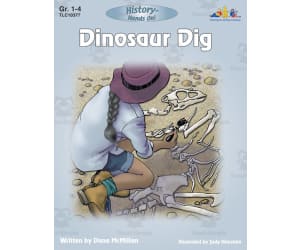
Dinosaur Dig: History - Hands On
Science, Earth and Environmental Sciences, Grade 1, 2, 3, 4, Teacher Tools, Lesson Plans
Dinosaur Dig: History - Hands On A cutting-edge, tactile learning resource for Grade 1 through Grade 4. Primarily aimed at teaching in-depth science with a particular emphasis on archaeology. An exciting journey back to the prehistoric era unfolds within the pages of this kit. Through its 32 printable PDF pages, it provides an opportunity to engage with history in an interactive way like never before! Each page gives a new insight into dinosaur life - from what they looked like to where they lived. What's Included? Vibrant Charts Informative Timelines Engaging Stories Instructive Maps Easily Assembled Models for Hands-on Learning Experience This resource stands out because of its solid grounding in real-world paleontology. It brings scientific discovery right into the classrooms of grades 1-4. The kit also includes profiles of renowned dinosaur hunters who have significantly contributed to our understanding of these extraordinary creatures. Suitability: Dinosaur Dig: History - Hands On fits seamlessly into diverse lesson plans; whether being used for full class activities or small group work. It can even be assigned as inventive homework assignments that encourage independent thinking and creativity! In Conclusion: This teaching supplement is not merely about reciting facts; rather it inspires passion for learning! With content that is visually appealing and packed with information, this resource offers a deep dive into everything we know about dinosaurs through paleontology . This makes it an essential addition to any educator’s toolset for grades 1-4.
Author Classroom Complete Press
Tags Science Lesson, Dinosaur Dig, Hands-on Science, Dinosaur History, Prehistoric Life

I WONDER - Where Did The Allosaurus Live | Animated Video Lesson
History: Ancient, History, Social Studies, History: World, Life Sciences, Science, Animals, Grade 4, 5, 6, 7, 8, 9, 10, Lesson Plans, Teacher Tools
Video Introduction An amazing video designed for the students to learn more about dinosaurs in different countries. I WONDER - Where Did The Allosaurus Live | Animated Video Lesson Do you like dinosaurs? what is your favorite one? Do you own a pet? If yes, tell us more about it, like what its name? And what do you like most about it? Do you think that your pet has been evolved from a dinosaur? Can you write down the characteristics of your favourite dinosaur like it's shape, their rivals, where did it use to live and what was their favourite food? What is the largest and the smallest dinosaur that ever found? Why is the T-rex is so famous? Have you ever read any interesting facts about it? Can you name any of the carnivores or herbivores dinosaurs? I WONDER - Where Did The Allosaurus Live | Animated Video Lesson The video is perfect for encouraging the researching skills for the students, while learning more about dinosaurs. I WONDER - Where Did The Allosaurus Live | Animated Video Lesson This friendly designed video is suitable for students at school, homeschooling, and as a group activity. Format Available in MP4 format.
Author Educational Voice
Rating
Tags Where Did The Allosaurus Live, Where Did The Allosaurus Live Video, Allosaurus, Allosaurus Facts, Allosaurus Video, Allosaurus Video For Kids, Allosaurus Facts For Kids, Dinosaur, Dinosaurs
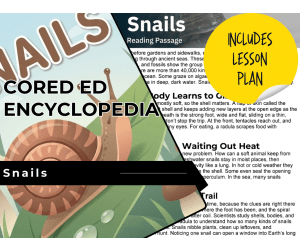
Snails Reading Comprehension Passage - Cored Ed Encyclopedia
ELA, Language Development, Reading Comprehension, Reading, Pre-Reading, Writing, Science, Animals, Life Sciences, Strategies, Grade 2, 3, 4, 5, Worksheets & Printables, Worksheets, Teacher Tools, Centers, Activities, Writing Prompts, Assessments, Quizzes and Tests, Quizzes, Lesson Plans
This snails reading comprehension includes: Visualization (on the front cover) Start your lesson by taking a minute to think and share something about the topic. Read the script aloud (slowly), perhaps prepare some music or sound effects. Student close their eyes and let their imaginations wander. Students open their eyes, read the question aloud and give them a few minutes to complete. Ask a few students to share or keep answers until the end to compare with what they learn in the passage. Quick pause—thousands of Cored Education products are included with your TeachSimple membership. Download links and encyclopedia index available here. Pre-Reading Trivia Students will write down one thing they already know about the subject and then read five more facts and discuss. These facts are fun, and the students will enjoy learning about the subject before reading more. Give 1 minute for students to write what they already know (no pressure—best guess is fine). Read the five facts together. After each fact, do ask a student for their opinion, was it surprising? Set a purpose by asking students to highlight/underline one fact they want to learn more about during the reading. Reading Passage The text is a high-interest reading passage with set paragraphs, roughly three to four paragraphs long. It contains a variety of themes about the topic, anywhere from history to technology. The passage is between 250 and 350 words in length. First, ask students to look at the headings and see what they’ll learn about today. What do they know about the topic/heading? First read options: Teacher read-aloud (best for support). Partner reading (paragraph by paragraph). While reading, students underline important details, and vocabulary words they think may come up in the questions section. Mixed Questions The first question page contains four multiple-choice questions, each with a choice of four answers, and three written response questions that require a sentence or two from the student. Students complete the mcqs first independently, then review quickly as a class. For the 3 written responses, try to get students giving the answer with some form of evidence: “I think ___ because the text says ___.” If students get stuck, send them back to check the passage. Vocabulary Questions Practice seven key words from the text in this section across two activities. First section is scrambled words where students will unscramble three words given a clue for each. The second section is a word to meaning matching activity. Before starting, have some students read out words they underlined in the passage. Ask students to say the word and read aloud the sentence(s) around each word. Ask students to do scrambled words and the matching exercise in pairs then go through answers as a class. For the scrambled spelling task, get four pairs to come up to the board and write the words for extra practice with the other student reading out the clue. For the matching task, prompt students to give full sentences: “I matched ___ with ___ because ___.” Creative Writing In this question, the student will be required to write a five to eight sentence paragraph on a question related to the topic. Before starting, ask students write down 3 key ideas they are going to include in their piece. Ask students for ideas to share around the class to help those struggling. Pro writing expectations: 5–8 sentences At least 2 facts or details from the passage At least 2 vocabulary words from the previous page Students read their paragraphs while classmates listen for facts and vocabulary words. Extension Activities This page is optional for fast finishers or to take home. There are several activities, each one requiring a different skill. Do some, do none, do all, completely optional - but you will feel reassured knowing every possibility is planned for. Includes summary writting question. Answer Key There are answers for the multiple-choice questions, written response questions have sample answers, vocabulary answers and if there is a summary question then a sample summary will be provided as well. Lesson Plan Included Customized lesson plan for this lesson is included. Lesson Snapshot Title: Snails Genre: Nonfiction (informational text with support pages) Subject: Science (Life Science) Primary Topic: Snail traits, habitats, and how they survive Estimated Guided Reading Level (A–Z): S What This Lesson Teaches Best What snails are (gastropods, “belly-footed” mollusks) and how they move using a strong foot on the bottom of their bodies. How snail body parts work, including the mantle making the shell, tentacles with tiny eyes, and a radula that scrapes food with many tiny teeth. How snails live in many habitats (mostly ocean; also land and freshwater), including near shore, on reefs, and in deep, dark water. How snails stay safe and survive tough conditions by pulling into their shell, becoming dormant, and sometimes sealing the opening with mucus or an operculum. How scientists use evidence (shell growth spirals and silvery trails) to study snails and understand how they live in so many places. Learning Goals Explain what “gastropods” means and how snails move using a strong foot. Describe how a snail’s mantle helps make and grow its shell. Identify what a radula is and how it helps a snail eat. Describe how land and freshwater snails avoid drying out and handle hot or cold weather. Use details from the passage to describe where snails live (near shore, reefs, deep water, and moist land places). Key Vocabulary From the Text gastropods — “belly-footed” animals that move using a strong foot. mantle — a flap of skin that makes the shell. radula — a scraper with many tiny teeth for eating. dormant — resting and not active for a while. operculum — a little door that can seal a shell opening. FULL CATALOG OF DOWNLOAD LINKS AND ENCYCLOPEDIA INDEX HERE
Author Cored Education
Rating
Tags Vocabulary, Reading Comprehension, Reading Passages, Reading, Creative Writing, Reading Strategies, Writing Prompts, Lesson Plans, Snails, Life Science
I WONDER - What Is An Ogre | Animated Video Lesson
History, Social Studies, Common Core, Grade 4, 5, 6, 7, 8, 9, 10, Lesson Plans, Teacher Tools
Video Introduction An amazing video designed for the students to learn more about mythological creatures in different cultures. I WONDER - What Is An Ogre | Animated Video Lesson Mythology is full of wonders and spectacular stories. Ancient civilizations were trying to explore every aspect of life, while they search for new technologies, they wanted to believe in something big and can change the world, so they created mythical creatures and mythical stories. Let's hear about them! What do you know about these creatures? Cyclops, Centaurs, Selkies, Phoenix, Gnomes, Dragons, Gorgons, Orcs, Cerberus, Trolls, Minotaur, Griffins, Mermaids, Elves, Polyphemus, Pegasus, and Ogres. I WONDER - What Is An Ogre | Animated Video Lesson The video is perfect for encouraging the creativity skills for the students, while learning more about this fantastic mythical creature. I WONDER - What Is An Ogre | Animated Video Lesson This friendly designed video is suitable for students at school, homeschooling, and as a group activity. Format Available in MP4 format.
Author Educational Voice
Rating
Tags What Is An Ogre, What Is An Ogre Facts, Ogre, Ogre Video, Ogre Facts, Ogre Video For Kids, Ogre Facts For Kids, Mythology, Mythology Facts, Mythology Video

Basic Math Skills | Counting Estimation Comparison 1
Special Resources, Special Education Needs (SEN), Math, Early Math, Numbers, Place Value, Preschool, Grade 1, Teacher Tools, Lesson Plans, Worksheets & Printables, Flashcards, Activities
Basic Math Skills | Counting Estimation Comparison . This is a comprehensive and resourceful teaching aid series designed to instill foundational math skills in kindergarten and grade 1 students . It is an essential tool for educators in varied environments, including public schools and homeschooling . Resource Contents : Each PDF file features 24 pages of vibrant, picture - based materials . Covered concepts include quantity counting, estimations, and comparisons . The resources emphasize visual representation of quantities for easier understanding . Inclusive are pages where equal or unequal amounts are arranged either linearly or randomly . Certain sheets feature objects appearing up to 20 times for learners to cut out, point, count and paste - reinforcing manual learning techniques . All materials come both as colored illustrations as well as blackline versions catered to different printing preferences or learner needs . The resource can be used either as larger A4 size work mats / screen view slides or smaller task cards / flash cards - proving effective during group instruction sessions or individualized tutoring . The range of visuals from apples & worms to elephants & coconuts provides fun reinforcement while maintaining student’s interest in counting skills . Furthermore these sustainable resources can be laminated post - printing thus ensuring their longevity while enhancing tactile engagement among young learners . In addition to basic numeracy, the Basic Math Skills | Counting Estimation Comparison, lays the groundwork for number comprehension & place value ! It provides teachers with reliable support while forming the strong numeric foundations crucial at this important educational stage . The material is presented either in A4 size, as work mats / screen view slides or as 4-on-a-page flash cards to use as task cards as well . It is a great resource for your math stations and math centers and once you print and laminate, you can store forever . 1 pdf file . 24 pages with mats / screens / task cards / flash cards to work on counting, estimation and comparison basic math skills . For more pdf materials on numeracy, basic math and pictorial / manipulative approach to learning, you can click WORDS ASIDE .
Author WORDS ASIDE
Tags Math, Numbers, Task Cards, Mats, Manipulatives, Math Station, Math Center, Pictorial , Slides, Words Aside
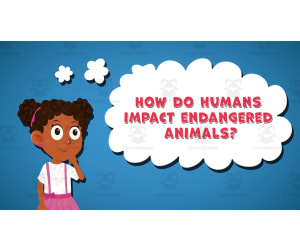
I WONDER - How Do Humans Impact Endangered Animals | Animated Video
STEM, Animals, Life Sciences, Science, Biology, Grade 4, 5, 6, 7, 8, 9, 10, Lesson Plans, Teacher Tools
Video Introduction Animal kingdoms are full of fascinating wonders to learn. This video is designed for the students to learn more about animals in different countries. I WONDER - How Do Humans Impact Endangered Animals | Animated Video Lesson Do you like animals? what is your favorite one? Do you own a pet? If yes, tell us more about it, like what its name? And what do you like most about it? What are the animal kingdoms? Can you write down the characteristics of each animal class like mammals, birds, reptiles, amphibian, fish and mollusks. Do you know that some animals can sing, can you name any of them? What is the largest and the smallest mammal in the world? What is the largest and the smallest bird in the world? What is the largest and the smallest fish in the world? I WONDER - How Do Humans Impact Endangered Animals | Animated Video Lesson The video is perfect for encouraging the researching skills for the students, while learning more about these fantastic animals. I WONDER - How Do Humans Impact Endangered Animals | Animated Video Lesson This friendly designed video is suitable for students at school, homeschooling, and as a group activity. Format Available in MP4 format.
Author Educational Voice
Tags How Do Humans Impact Endangered Animals, How Do Humans Impact Endangered Animals Video, Endangered Animals, Endangered Animals Facts, Endangered Animals Video, Endangered Animals Facts For Kids

Abraham Lincoln | Reading Comprehension Deck | Interactive Lesson
Social Studies, Biographies, Grade 6, 7, 8, Teacher Tools, Lesson Plans
Abraham Lincoln Reading Comprehension Lesson Plan This interactive digital lesson plan teaches students about Abraham Lincoln through informative texts, video, and audio passages. Students will read a passage about Lincoln's life and legacy and respond to comprehension questions and writing prompts that develop critical thinking skills. Educators can utilize this resource in various ways - as a whole class activity projected on a screen, printed for small groups, or assigned digitally to individual students. The materials aim to spark student engagement and understanding of this influential U.S. president. Assessment components allow teachers to gauge learning outcomes. This concise and focused lesson is designed for 6th-8th grade social studies or ELA classes learning about influential historical figures.
Author Teach Me This
Tags Biographies, American Presidents, Interactive Lesson, Abraham Lincoln, History Lesson

Guided Reading Activities with Lesson Plans: Fiction Set 6 - Family
ELA, Reading, Reading Comprehension, Common Core, ESL, Language Development, Pre-Reading, Vocabulary, Resources for Teachers, Grade 2, 3, Worksheets & Printables, Worksheets, Lesson Plans, Teacher Tools
Guided Reading Activities with Lesson Plans Fiction Set 6 Note: This download DOES NOT include the passages themselves. If you have not already done so, download in a format of your choice in the "reading links" section below. Overview The perfect companion materials for Cored Education reading comprehension downloads. This collection of guided reading lessons includes a wide array of engaging themes that aim to foster comprehension, vocabulary development, and creative thinking. Each lesson is crafted to be interactive and immersive, making learning enjoyable while promoting essential literacy skills. The lessons are designed for students to actively engage with both the material and the world around them, creating connections to their personal experiences while developing key skills. Includes Guided Reading Materials For: 1.Molly's Home Carnival 2.Big Bro's Big Idea 3.Denny's Car Wash 4.Tessa's Grandma 5.Tom's Canadian Mom 6.Big Brother Woes 7.Tell Us a Story, Grandpa 8.My Weekend 9.All in the Picture 10.California 'Coaster Reading Links: This is the guided reading materials version and DOES NOT include the passages themselves. The passages related to this download are available here in GOOGLE Docs, GOOGLE Forms, GOOGLE Slides. PDF, PPT, WORD. Google Docs Google Forms Google Slides PDF PPT Word Details Pre-reading Discussions Each lesson begins with pre-reading questions that help activate prior knowledge and engage students in the theme of the lesson. This allows students to make personal connections with the content before diving into the reading material. Vocabulary Development Every lesson includes vocabulary exploration that introduces key terms students will encounter in the reading. These words are essential for understanding the passage, and activities encourage students to apply the new vocabulary in context. Comprehension Check After the reading, the lessons provide comprehension questions (typically multiple-choice) that assess students’ understanding of the story. These questions help students reflect on key events, characters, and concepts within the text, reinforcing their comprehension. Creative Writing Prompts To foster creativity, the lessons include writing activities that challenge students to apply what they've learned in imaginative ways. These prompts allow students to practice creative expression while reinforcing the lesson’s theme. Discussion Topics Each lesson ends with wrap-up discussion questions that encourage students to think critically and engage in group conversations. These discussions can enhance social learning and deepen understanding by connecting the lesson's content to broader real-world applications. Theme-Based Learning The themes (e.g., winter, nature walks, photography, flowers) are universally appealing and offer opportunities for cross-curricular connections with science, art, and environmental studies. This makes the lessons versatile for a wide range of teaching contexts. Student-Centered Approach The activities are designed to be interactive and student-driven, allowing them to explore the content through discussions, hands-on vocabulary practice, and personal reflections. This promotes active learning and keeps students engaged. FULL CATALOG OF DOWNLOAD LINKS HERE Grade 2/3 Links Fiction Set 1 - Nature Google Docs Google Forms Google Slides PDF PPT Word Guided Reading Materials Fiction Set 2 - Animals Google Docs Google Forms Google Slides PDF PPT Word Guided Reading Materials Fiction Set 3 - Food Google Docs Google Forms Google Slides PDF PPT Word Guided Reading Materials Fiction Set 4 - School Google Docs Google Forms Google Slides PDF PPT Word Guided Reading Materials Fiction Set 5 - Friends Google Docs Google Forms Google Slides PDF PPT Word Guided Reading Materials Fiction Set 6 - Family Google Docs Google Forms Google Slides PDF PPT Word Guided Reading Materials Fiction Set 7 - Sports Google Docs Google Forms Google Slides PDF PPT Word Guided Reading Materials Nonfiction Set 1 - Technology Google Docs Google Forms Google Slides PDF PPT Word Guided Reading Materials Nonfiction Set 2 - Nutrition Google Docs Google Forms Google Slides PDF PPT Word Guided Reading Materials Nonfiction Set 3 - Animals Google Docs Google Forms Google Slides PDF PPT Word Guided Reading Materials Reading Passages Overview Each passage is especially written for Grade 2-3 students, including key vocabulary required for this age group. Topics are varied and are accompanied by colorful graphics. Topics are meant to educate, yet entertain the modern student. These passages are perfect for the modern classroom. Whereas textbooks can become outdated in no time, any changes to technology or the world will result in updates to this product. Mixed Questions The mixed questions section of each lesson includes a variation of fivecomprehension, vocabulary and math questions. In addition, key reading strategies are frequently covered including cause & effect, summarizing, compare & contrast and making conclusions. Three of the questions will be MCQs and two will require a written response of some kind. Full answers and example responses appear at the end of the lesson. Spelling & Vocab Each reading passage contains a variety of words and phrases designed for Grade 2-3 students. Spelling and vocab activities provide the opportunity to build fluency with these words. As it can become quite mundane doing the same activities over and over, each lesson in a set will contain a different spelling and vocab activity . Writing Prompts Writing prompts are designed to continue the theme or lessons learned in the story. Students are persuaded to write in a variety of ways and each prompt includes several cues to help. As with the spelling/vocab section, writing prompts will vary. This includes research pieces, reading responses, poetry and creative writing prompts. Full Answer Keys Full answer keys and sample responses are provided so no matter how busy you are, you know you're covered! Mixed question answers provide evidence from the text, math questions contain the relevant workings. Answers are designed for use by the teacher, but also suitable as a handout to the student. Additional File One lesson will have an additional file. This is something fun to extend the lesson with. For similar downloads and other frees, do check out Cored Group on TeachSimple.
Author Cored Education
Tags Elementary, Reading, Comprehension, Vocabulary, Answers, Ccss, Guided Reading, Guided Reading Activity, Guided Reading Lesson Plans, Guided Reading Lesson Plan