



3,923 products added recently
Page 158 - Lesson Plan Templates
Simplify your preparation with lesson plan templates designed to help you organize objectives, activities, and assessments. These templates provide a structured framework to ensure comprehensive coverage of material. Incorporate them to save time and enhance the effectiveness of your teaching.

 Show filters


I WONDER - How Have Humans Contributed To The Greenhouse Effect
Earth Sciences, Earth and Environmental Sciences, Science, Environmental Science, Grade 4, 5, 6, 7, 8, 9, 10, Lesson Plans, Teacher Tools
Video Introduction An amazing video designed for the students to learn more about STEM. I WONDER - How Have Humans Contributed To The Greenhouse Effect | Animated Video Lesson Do you like STEM subjects? what is your favorite one? Have you ever tried to plant a seed? If yes, tell us more about it. Or have you ever tried to invent something? If yes, tell us more about it. And how do you think it will help us? Have you ever seen a microorganism under a microscope? What was it? And how it looked like? Mathematics is a marvelous subject. Let' sharpen our brains and solve some equations. Do you like timetable tricks? What is your favorite one? Do you know how to code? Have you ever created an app or a game before? If yes, how was it like? I WONDER - How Have Humans Contributed To The Greenhouse Effect | Animated Video Lesson The video is perfect for encouraging the researching skills for the students, while learning more about this fantastic topic. I WONDER - How Have Humans Contributed To The Greenhouse Effect | Animated Video Lesson This friendly designed video is suitable for students at school, homeschooling, and as a group activity. Format Available in MP4 format.
Author Educational Voice
Tags How Have Humans Contributed To The Greenhouse Effect, How Have Humans Contributed To The Greenhouse Effect Video, Greenhouse Effect, Greenhouse Effects, Greenhouse Effect Facts, Greenhouse Effect Video

Geometry: Shapes - Learn the Skill - MAC Software
Math, Geometry, Common Core, Kindergarten, Preschool, Grade 1, 2, Teacher Tools, Lesson Plans
Geometry: Shapes - Learn the Skill - MAC Software An educator-friendly tool designed to enhance geometric understanding! This software is specifically created for students from preschool through grade 2. It provides curriculum-based content that adheres to proven teaching practices, aligns with the Common Core State Standards and STEM initiatives, and is written according to NCTM guidelines. A resource featuring: A chapter mini involving 'Learn the Skill' word problems related to geometry shapes. Dual-language feature – English and Spanish voice overs along with corresponding text. Digital math tools for engaging, interactive learning experiences. Possible application settings: In a whole-group setting for collective comprehension among all pupils simultaneously. In small groups encouraging cooperation and peer learning environments, or even as homework assignments reinforcing individual understanding at home. Ease of Use: The content is delivered via MAC compatible software contained within one zip file for easy installation across various Mac operating systems avoiding software compatibility issues. The Significance: No matter if you are an experienced teacher exploring ways to enrich your geometry lessons or a homeschooling parent desiring effective educational resources, this software stands as an invaluable asset aiding young learners in grasping pivotal skills not only in Math classrooms but beyond into their everyday lives too.
Author Classroom Complete Press
Tags Geometry Lesson, Shapes Lesson, Math Lesson, Math Activity, Digital Math
I WONDER - What Is The Tallest Tree In The World | Animated Video Les
Nature & Plants, Life Sciences, Science, Grade 1, 2, 3, 4, 5, 6, 7, 8, Lesson Plans, Teacher Tools
Video Introduction An amazing activity designed for the students to learn more about STEM. I WONDER - What Is The Tallest Tree In The World | Animated Video Lesson Do you like STEM subjects? what is your favorite one? Have you ever tried to plant a seed? If yes, tell us more about it. Or have you ever tried to invent something? If yes, tell us more about it. And how do you think it will help us? Have you ever seen a microorganism under a microscope? What was it? And how it looked like? Mathematics is a marvelous subject. Let' sharpen our brains and solve some equations. Do you like timetable tricks? What is your favorite one? Do you know how to code? Have you ever created an app or a game before? If yes, how was it like? I WONDER - What Is The Tallest Tree In The World | Animated Video Lesson The video is perfect for encouraging the researching skills for the students, while learning more about this fantastic topic. I WONDER - What Is The Tallest Tree In The World | Animated Video Lesson This friendly designed video is suitable for students at school, homeschooling, and as a group activity. Format Available in MP4 format.
Author Educational Voice
Tags Plant, Plants, Tree, Trees, Trees Facts, Trees Facts For Kids, Trees Video, Trees Video For Kids, Plants Video For Kids, Plants Facts
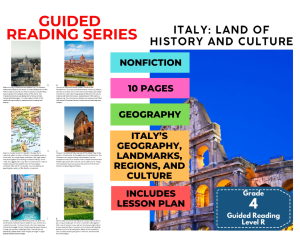
Italy History and Culture: Guided Reading Level R with Lesson Plan
ELA, Resources for Teachers, Reading Comprehension, Reading, Science, Geography, Social Studies, History, Earth and Environmental Sciences, Technology, Grade 3, 4, 5, Worksheets & Printables, Worksheets, Teacher Tools, Centers, Activities, Literacy Readers, Quizzes, Quizzes and Tests, Assessments, Lesson Plans
This Germany: The Heart of Europe (level r) guided reading book with lesson plan includes: Guided Reading Color Label (front cover x1) This is a quick way to match the book’s demands to what students can generally handle.. The overall goal is to use the level/color to pick books for several smaller groups. To qualify for a certain level, a student is expected to read a book from that level with about 90–94% accuracy. If a student is consistently accurate and understands, move up a level. If the student is struggling at that level, drop down and add more support. Each student will improve at completely different rates, but it is generally one of the best ways to check progress across the class. DOWNLOAD THE CATALOG TO VIEW ALL GUIDED READING BOOKS AVAILABLE (SORTED LEVELS A-Z) Pre-Reading Question (x1) Teacher asks the prompt aloud, can be while showing the cover or first page. Students share what they already know, or make educated guesses from the cover. Prompt them to use the target vocabulary. Write some of their responses on the board to look back at during the reading. Vocabulary Words (x5) Introduce the five words, best doing it one at a time. Start by saying it, while students repeat and then see if anyone knows what it means before reading further. Read through the meaning and try to briefly connect each word to a picture or gesture so it’s meaningful. Ask students to flip through the book pages and point to where they see each of the vocabulary words. While reading the book pause upon coming across one of the vocab words or read the sentence twice to make sure students understand the word has appeared. Optional: Ask students to raise hands whenever they see/hear one of the new words. Guided Reading Pages (x10) Check the book snapshot (below) for: primary topic - do you need to prep extra reading or intro materials on this? what is taught best - decide on 1-2 bullets to focus on, use the prompt or words provided here for best results. learning goals - what you are checking for students to be able to do after the session, elicit answers using prompts or words provided. key vocabulary (see section above). questions overview - so you know what is coming up and if you need to prep extra materials to assist understanding. Run the lesson You may have already looked at a few of the pages together, but you can show them some of the pictures again first to set meaning. Depending on how much time you have and how familiar your students are with guided reading class, you may want to read the book aloud first with the group first. Students whisper or partner read, while you listen in. If time, do it as a group, one student reading a page each. Use the guided page’s prompts to coach: “Check the picture / does it make sense?” “Point under the words / try the first sound” “Reread the sentence smoothly”. Try to focus more on one student per session (rotating every time), so you can work out if they are ready to move up or need to move down a level. Comprehension Questions (back cover x3) This is your way to check that students didn’t just say the words, but actually understood the text. First, let students answer by pointing to the page/picture and saying a short sentence. After any answer, follow with: “Show me where you found that in the text.” In bigger groups, have partners answer first (10–20 seconds), then call on 2–3 students to share. Differentiation tips: Emerging speakers/struggling readers: oral + pointing On-level: oral in a full sentence Higher: one written sentence or draw + label Book Snapshot Title: Italy: Land of History and Culture Genre: Nonfiction Subject: Social Studies (Geography/History/Culture) Primary Topic: Italy’s geography, landmarks, regions, and culture Estimated Guided Reading Level (A–Z): R What This Book Teaches Best Describes Italy’s location and physical geography , including its peninsula shape, the Alps, and the Mediterranean Sea. Highlights important historical landmarks and what they represent, such as the Colosseum and the Vatican City/St. Peter’s Basilica. Connects history to art and architecture through Florence and the Renaissance, including the Duomo’s engineering. Explains regional life and land use , including Tuscany’s landscape and agriculture (olive oil, grapes, ingredients for cooking). Shows how Italy blends past and present , from Pompeii and Mount Vesuvius to modern fashion, design, technology, cars, and trains. Learning Goals Students will describe Italy’s location and explain how the text describes its shape. Students will identify key facts about Rome and explain what the text says the Colosseum symbolizes today. Students will describe why Vatican City is important using details from the text. Students will explain why Florence is called the “Cradle of the Renaissance” using text details about arts and learning. Students will describe how Venice’s canals affect transportation in the city. Students will explain one way Italy influences the world today, based on the text’s examples of modern industry and innovation. Key Vocabulary From the Text peninsula — land surrounded by water on three sides. amphitheater — large open building for watching public events. Renaissance — time when art, science, and literature flourished. gondolas — long narrow boats used to travel Venice’s canals. archaeological — about studying the past by examining old remains. Discussion Prompts Pre-reading question: What places or foods do you already connect with Italy? Comprehension questions: What shape does the text say Italy resembles? Comprehension questions: What does the text say the Colosseum could hold in ancient times? Comprehension questions: What does the text say caused the Leaning Tower of Pisa to start tilting? Printing Tips 1. Best Printing Method (Recommended) “Booklet” Printing (Best if Available) If your printer or PDF viewer supports Booklet Printing , use this. Settings to use: Print mode: Booklet Paper size: Letter or A4 (either works) Orientation: Landscape Print on both sides: Yes Flip on: Short edge Scaling: Fit to printable area Booklet subset: First test: Front sides only Then: Back sides only This will automatically: Pair pages correctly Put the cover on the outside Align everything for folding After printing, fold in half and staple along the spine . 2. If “Booklet” Printing Is NOT Available You can still print this correctly with manual duplex printing . Step-by-step: Open the PDF. Choose Print . Set: Orientation: Landscape Pages per sheet: 1 Print on both sides: Yes Flip on: Short edge Print all pages . Because each PDF page already contains two facing book pages, the result will still fold cleanly into a book. Thousands of Cored Education products are included with your TeachSimple membership. Download links and encyclopedia index available here.
Author Cored Education
Rating
Tags Reading Comprehension, Reading Passages, Reading, Guided Reading, Guided Reading Lesson Plan, Guided Reading Activity, Pre-reading, Social Studies, Geography, History
Reducing Your School's Carbon Footprint: Cars, Buses, Bicycles, and Feet Gr. 5-8
Science, Earth and Environmental Sciences, Environmental Science, Grade 5, 6, 7, 8, Teacher Tools, Lesson Plans
Reducing Your School's Carbon Footprint: Cars, Buses, Bicycles, and Feet Gr. 5-8 A unique digital teaching resource for science educators teaching grades 5 to 8. This tool focuses on environmental science and sustainability in promoting awareness about the school's carbon footprint. Features: 30 interactive, ready-to-print pages aimed at informing and motivating students Promotes a sense of responsibility towards the environment among learners Guides students to investigate types of fossil fuels used in schools Fosters collaboration towards reducing energy consumption Covering product life cycle implications on greenhouse gas emissions An introduction to carbon offsetting as an emission reduction strategy Demonstration of how planting trees can help absorb carbon dioxide . This package encourages hands-on learning experiences that allow students autonomy in reducing their school's ecological impact. For examples: The establishment of idle-free zones on school premises. cycle implications on greenhouse gas emissions encapsulate this PDF resource. The role trees play in absorbing CO2 Several practical exercises have been infused into this package including crossword puzzles and word searches . In compliance with Bloom's Taxonomy methodology and STEAM (Science Technology Engineering Art Mathematics) principles for holistic education aims at fostering well-rounded individuals who think critically about our planet’s health. As such resources like 'graphic organizers', calculations exercises revolving around carbon footprints are blended into lesson plans judiciously — contributing extra layers of depth while maintaining engagement levels throughout study sessions. Suitable For: This resource is instrumental for teachers offering comprehensive instructions within classroom settings or homeschooling environments alike. In conclusion, this valuable tool seeks to provide an enjoyable yet informative approach to educating young minds on reducing their school's carbon footprint — thus equipping them with the skills needed for a sustainable future.
Author Classroom Complete Press
Tags Travel, Transportation, Environmental, Science, Carbon Footprint

Animal Science Unit | All About Polar Bears | Learning about Animals
Science, Life Sciences, Animals, Kindergarten, Preschool, Grade 1, 2, Lesson Plans, Teacher Tools
This resource teaches students everything they need to know about polar bears while strengthening kindergarten through second grade literacy skills ranging from science to reading fluency. Strategically designed for differentiated implementation, the materials transform a spotlight on beloved polar bears into applied opportunities to advance academic abilities across ability levels. Over 200 pages of vibrant printables, activities, games and leveled articles break down complex zoological concepts into engaging sequences suited for emerging learners. Teachers may present the full comprehensive unit or customize preferred components matching specific learning objectives. Robust optionality empowers educators to adapt materials for whole group instruction, literacy circles or independent exploration. While vibrant images and maps ignite initial interest, leveled nonfiction passages, customized writing templates and sorting/matching games systematically cement knowledge on evolution, habitats, life cycles and conservation issues. ELA skills strengthen through accountable talk discussion cards, reading comprehension booklets and journaling templates embracing multiple perspectives from field scientists to the bears themselves. Beyond building academic competencies, the heartwarming narratives and activities nurture empathy and environmental stewardship. Students gain confidence in their growing expertise by curating imaginary museums showcasing original plushie designs, sculptures, dioramas and informational brochures about threats facing polar bear populations in increasingly fragile Arctic terrain. This versatile cross-disciplinary resource reflects best practices from project-based learning to social emotional development. Students across learning styles will thrive while collaborating, creating and reflecting around the beloved frigid dwelling bears through authentic, empowering tasks mimicking real world scientific exploration.
Author Simply Schoolgirl
Tags Zoology, Arctic Animals, Blubber, Animal Adaptations, Marine Mammal, Ocean Predator, Winter , Polar Bear Crafts, Polar Bear Activities, Polar Bear Worksheets
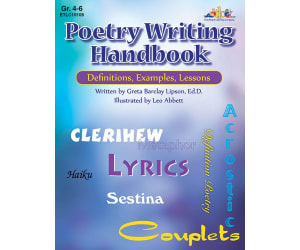
Poetry Writing Handbook: Definitions, Examples, Lessons
ELA, Literature, Poetry, Grade 4, 5, 6, Teacher Tools, Lesson Plans
The Poetry Writing Handbook: Definitions, Examples, Lessons is an invaluable asset for teachers on a mission to unravel the beauty of poetry for students in grades 4 through 6. As Moore once said that there's something fundamentally ironic about a poem: it uses precise language to describe what is unsayable, this resource could be exceptionally useful for you and your young learners to express the inexpressible via 36 unique poetic forms. Crafted with care by an experienced poet and educator, this handbook not only provides definitions but offers vivid examples endowed with the ability to invigorate students' innate creativity. It clearly outlines guidelines aimed at encouraging students to exploit numerous forms of poetry beyond conventional rhymes. Educators can leverage its well-structured content as: A magical vessel sailing through various topics associated with language arts curriculums. An avenue opening lessons of self-expression covering everything from haikus and couplets to diamante. A tool providing allocated space within each poetic form for students' own creations - an excellent way of supporting practical learning. As an easy-to-navigate PDF file, this digital resource effortlessly facilitates teaching diversity in classrooms or home learning environments alike. Teachers can utilize it during whole group instruction or might opt for walking small groups jointly down the mysteries of crafting varied types of poems themselves. Assignability Aspect In terms of assignability – homework assignments related to each poetic form included would undoubtedly stir newfound literary interest among children as they get their hands dirty practicing freshly learned concepts. Regardless if applied in public institutions or delicately employed within homeschool syllabuses – The Poetry Writing Handbook: Definitions, Examples, Lessons can become an integral part towards building intricate linguistic understanding as well as appreciation towards culture rich tapestry weaved by diverse strands called – poems. In short – shadowing numerous teaching styles whether synchronously clubbed together during joint classroom sessions or time-bound individual assignments long after school hours fade away into twilight– this resource is a perfect catalyst to engage elementary learners in their poetic journey, silently lighting up life's unseen trails with words that bloom.
Author Classroom Complete Press
Tags PDF
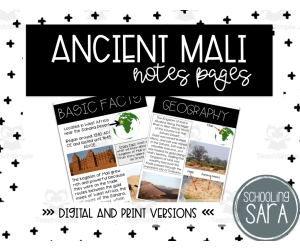
Mali Social Studies Notebook
Social Studies, History, History: African, Grade 2, 3, 4, Teacher Tools, Lesson Plans
The Mali Social Studies Notebook The Mali Social Studies Notebook is a valuable teaching resource perfect for educators seeking effective and straightforward tools to elucidate their students about the Empire of Mali. Designed for grades 2-4, this product aligns with Virginia SOLs while providing an excellent prequel to topics such as trade, geography, and architecture fundamental to Mali's history. Notebook Versions Printable Version: Includes fully filled out notes or fill-in-the-blank style. With minimal information per page alternative and blank notes pages available, educators can flexibly adapt these resources according to their learners' abilities. Digital Google Slides Version: Comes in a portrait format for digital classrooms and a landscape format perfect for projecting onto interactive boards or projectors in conventional setups. Included Features This notebook aims at efficient resource use while ensuring in-depth coverage of essential facts about Mali's ancient civilization. It incorporates vocabulary words specific to the topic along with historical information on: Mali’s Geography, Governance (including Kings/Musas), Griots culture (Storytellers), Economy & Caravans - Trading routes along Sahara Desert where Salt and Gold were traded extensively bolstering the economy during its peak period. Simplicity Focus & Flexible Use Scenario: This product reduces the cutting time associated with traditional interactive notebooks whilst maintaining beneficial engagement aspects. It offers easy-to-use printer-friendly notes suitable not only for large groups but also smaller ones or homework assignments individualizing learner’s academic experience as needed while minimizing paper wastage through efficient design. Related Resources Refer to the Ancient Mali Activity Pack for complementary activities for these lessons. Find resources on other ancient civilizations like Ancient Egypt, Ancient China, Greece and Rome, or interactive notebooks focused on economics or civics for comprehensive knowledge about human civilizations' evolution.
Author SchoolingSara
Tags Mali Empire, Social Studies, Notebooks, Trade, Geography

The Big Secret Short Story | Upper Intermediate Lesson Plan
ELA, Language Development, ESL, Reading, Not Grade Specific, Adult Education, High School, Middle School, Teacher Tools, Lesson Plans, Worksheets & Printables
The Big Secret Short Story | Upper Intermediate Reading Comprehension This educational resource focuses on reading comprehension and grammar skills for upper intermediate English language learners. The centerpiece of the resource is the short story "The Big Secret," written at a level appropriate for upper intermediate students. Educators can implement this resource in multiple ways. It can be used by individual students, small groups, or for whole class instruction. After reading the narrative, students complete exercises that reinforce plot elements, vocabulary, and grammar concepts in an engaging way. Answer keys are provided for interpretive assessment. With its flexibility and focus on literacy fundamentals, this lesson plan aids language acquisition across modalities. It is well-suited to secondary ESL classrooms, but could also be customized for adult learners. The material aligns with key standards for upper intermediate reading and writing. 3 PDFs with 4 ready to print pages and one digital access file
Author TEAM TEFL
Tags Short Story, Audio, Vocabulary, ESL, Reading Comprehension
Study Skills Curriculum Grades 3-5, Executive Function & Test Prep
Life Skills, Special Resources, Grade 3, 4, 5, Lesson Plans, Teacher Tools, Assessments, Worksheets & Printables
Study Skills Curriculum Grades 3-5, Executive Function, Organization & Test Prep Study skills for grades 3–5 can be taught as simple, repeatable routines—not overwhelming techniques. This 10-unit curriculum helps students build practical habits for organization, planning, focus, reading, note-taking, studying, test preparation, and asking for help. What’s Included This comprehensive study skills resource includes: ⭐ Facilitator Guide with teaching routines and implementation guidance 📋 Scope & Sequence with three pacing options 📝 Student Self-Inventory for pre/post reflection and goal setting 🧠 10 complete study skills units 📚 How Your Brain Learns 🗂️ Get Organized 📖 Directions & Getting Started 📅 Time & Planning 🎯 Focus & Study Space 📘 Reading to Learn ✏️ Note-Taking Basics 🧠 Remembering What You Learn 📝 Getting Ready for a Test 🙋 Asking for Help ✂️ Printable Student Tools, checklists, templates, and trackers 📓 30-prompt Reflection Journal 🏠 Family Guide for supporting skills at home 📊 Assessment and Progress Tracking materials How It Works in the Classroom Each unit is designed for a 25-minute lesson with a consistent five-part structure: Hook Teacher Model Guided Practice Transfer Task Reflection Close The most important part is the transfer task. Students apply each strategy to their real, current schoolwork , helping study skills become classroom routines instead of isolated worksheet activities. Choose the pacing that fits your setting: Weekly across the school year for long-term retention Six-week intensive for intervention, electives, or summer programs As-needed tutoring or homeschool use based on current student needs The resource works well for whole-class instruction, small groups, intervention, tutoring, homeschool, resource rooms, and advisory or morning-meeting blocks. Standards & Learning Goals Students build practical executive-function and self-management skills, including: Organization and materials management Task initiation Following multi-step directions Planning and time management Sustained attention Comprehension monitoring Note-taking Retrieval practice and spaced studying Test preparation and error analysis Self-advocacy and asking specific questions Reflection and metacognition The resource also supports CCSS ELA , CASEL self-management and responsible decision-making . Why Teachers Love It ⭐ Low-prep implementation — Lessons follow the same predictable structure. ⭐ Real-world practice — Students use strategies with actual assignments and current content. ⭐ Built-in differentiation — Grade-band adjustments support grades 3, 4, and 5. ⭐ Student independence — Checklists, planners, trackers, and question-building tools make routines visible. ⭐ Family connection — Send-home guides help reinforce the same habits beyond school. ⭐ Progress monitoring — A four-point developmental rubric and observable look-fors help teachers track growth without treating study skills like academic content. ⭐ Metacognition matters — Weekly reflection prompts help students notice their habits and make intentional changes. This study skills curriculum for grades 3–5 is especially useful for helping students become more organized, independent, and prepared for the increasing demands of upper elementary school and the transition toward middle school. ✨ Give your students practical routines they can use every day—not just strategies they forget after one lesson. Download the Study Skills Resource Pack for Grades 3–5 and give students tools they can carry into real classroom work, homework, studying, and future grades.
Author Bright Classroom Ideas Marketplace
Rating
Tags Study Skills, Curriculum, Executive Function, Organization, Test Prep
I WONDER - What Are Dragons | Animated Video Lesson
History, Social Studies, Common Core, Grade 4, 5, 6, 7, 8, 9, 10, Lesson Plans, Teacher Tools
Video Introduction An amazing video designed for the students to learn more about mythological creatures in different cultures. I WONDER - What Are Dragons | Animated Video Lesson Mythology is full of wonders and spectacular stories. Ancient civilizations were trying to explore every aspect of life, while they search for new technologies, they wanted to believe in something big and can change the world, so they created mythical creatures and mythical stories. Let's hear about them! What do you know about these creatures? Cyclops, Centaurs, Selkies, Phoenix, Gnomes, Dragons, Gorgons, Orcs, Cerberus, Trolls, Minotaur, Griffins, Mermaids, Elves, Polyphemus, Pegasus, and Ogres. I WONDER - What Are Dragons | Animated Video Lesson The video is perfect for encouraging the creativity skills for the students, while learning more about this fantastic mythical creature. I WONDER - What Are Dragons | Animated Video Lesson This friendly designed video is suitable for students at school, homeschooling, and as a group activity. Format Available in MP4 format.
Author Educational Voice
Rating
Tags What Are Dragons, What Are Dragons Video, Dragons, Dragons Facts, Dragons Video, Dragons Video For Kids, Dragons Facts For Kids, Mythology, Mythology Facts, Mythology Video

Sharp Cookie | Figurative Language Activity | Micro-Learning Deck
ELA, Reading, Reading Comprehension, Grade 4, 5, 6, 7, Teacher Tools, Lesson Plans
Sharp Cookie | Figurative Language Activity | Micro-Learning Deck Sharp Cookie | Figurative Language Activity | Micro-Learning Deck is an interactive teaching resource meticulously tailored to enhance students' understanding of figurative language. This thoughtfully designed tool envelopes concepts in a playful and enlightening wrapper, making the learning experience enjoyable, insightful and enduring. The resource encompasses a micro-learning deck for students from grades four through seven studying Language Arts. Predominantly, it focuses on the figurative language term 'Sharp Cookie', providing an exciting avenue for young learners to appreciate and adopt this concept within their lexical repository. Teachers can derive immense educational value from using this tool during whole group lessons or breaking it down into smaller segments for small group work. A comprehension-friendly format enables independent exploration by students, allowing teachers to distribute parts of it as homework assignments. Main Components: Built of 13 ready-display slides in PowerPoint format. Involves engaging elements such as video lessons explaining the core concept: 'figurative language'. A reading passage with audio support allows young minds to dive deep into the written material while organically soaking in auditory palpitations—a powerful combination amplifying comprehension rates manifold. To ensure that pupils have understood every bit of knowledge disseminated through this toolset, quick write activities are included within each unit - providing a fertile ground for applying learned concepts along with stimulating creativity. In essence, Sharp Cookie | Figurative Language Activity | Micro-Learning Deck can serve as both comprehensive lesson plans or supplementary resources within any traditional or homeschooling setup aiming to actualize superior education standards.
Author Teach Me This
Tags Figurative Language, Micro-learning, Interactive Teaching, Language Arts, Understanding

I WONDER - What Did Ancient Greeks Eat | Animated Video Lesson
History: Ancient, History, Social Studies, History: Europe, Grade 3, 4, 5, 6, 7, 8, 9, Lesson Plans, Teacher Tools
Video Introduction An amazing video designed for the students to learn more about history. I WONDER - What Did Ancient Greeks Eat | Animated Video Lesson Do you like history? Which topic do you really enjoy about history? Have you ever read an interesting fact about the Vikings? If yes, can you mention them? What do you like most about the Victorian era? Can you name all the Tudors? Have you ever wondered how people used to live in ancient Japan and ancient China? Do you know any interesting facts about ancient Egyptians and the Pharaohs? Have you ever visited South America? What do you know about Incas and Aztecs? Celtic culture was really one of a kind, can you name any of the places that Celts used to live in? Imagine yourself living during the ancient Roman empire, how your life will look like? Ancient Greece was an amazing place to live in. What do you know about ancient Greek life? I WONDER - What Did Ancient Greeks Eat | Animated Video Lesson The video is perfect for encouraging the researching skills for the students, while learning more about history. I WONDER - What Did Ancient Greeks Eat | Animated Video Lesson This friendly designed video is suitable for students at school, homeschooling, and as a group activity. Format Available in MP4 format.
Author Educational Voice
Tags Ancient Greek Food, Ancient Greek Food Facts, Ancient Greek Food Video, Ancient Greek Food Facts For Kids, Ancient Greek Food Video For Kids, What Did Ancient Greeks Eat, What Did Ancient Greeks Eat Video

Scientific Developments Advanced ESL Lesson Plan
ELA, Language Development, ESL, Vocabulary, Not Grade Specific, Adult Education, High School, Middle School, Teacher Tools, Lesson Plans, Worksheets & Printables
This is an advancedESL ELA ELL and TEFL lesson plan worksheet set for Scientific Developments. In this class the students will take a look at some of the greatest scientific developments in recent years from the creation of the Covid 19 vaccine to Nanotechnology and Artificial Intelligence. We dive further into successful missions to Mars, the development of solar panels and The Human Genome Project. Students will learn more about these topics and then complete the exercises to follow, which will assess their comprehension and implement grammar skills. This resource can also be accessed through Google Apps. Answer key included. An audio exercise is included. The ESL ELA ELL and TEFL lesson plan includes flashcards, a warmer, grammar rules, exercises, role-play, conversation, writing drill, activity, answers and an extra study that would be good to set as homework. There are 31+ pages and there are teachers notes to guide the teacher.
Author TEAM TEFL
Tags Inventions, Science, ESL, Comprehension, Technology

Multiply by "Eight" Task Cards - 60 Task Cards
Math, Calculus, Early Math, Counting, Numbers, Basic Operations, Multiplication and Division, Multiplication, Grade 1, 2, 3, 4, 5, Assessments, Teacher Tools, Lesson Plans, Quizzes and Tests, Centers, Activities, Task Cards, Worksheets & Printables
Ready to multiply your students’ skills—and have a little fun along the way? These 60 multiplication task cards are all about conquering the 8-times tables (because 8 is the new cool, right?). With 60 cards and a variety of activities, you’ll have your students multiplying like math pros in no time. Ways to Use: Math Warm-Up: Begin your lesson with a few quick card challenges to get everyone’s brain in gear. Partner Practice: Students can quiz each other, helping each other out (and making math a team sport). Independent Practice: Let students work solo with the cards—quiet and focused. Interactive Games: Use the cards for math races, scavenger hunts, or timed drills to add some excitement. Quick Assessments: These cards double as a perfect way to check student progress in a flash. Advantages: Targeted Practice: Focusing on the 8-times tables, students build confidence with each card. Zero Prep: Simply print and use—no extra planning needed! Fun & Flexible: Keep students engaged with interactive learning. Versatile: Use them in pairs, individually, or with the whole class. Track Progress: Check where students need more practice and where they’re excelling. Get these task cards today—your students will thank you (and so will your sanity)!
Author Ponder Palette Plazza
Tags Multiplication, Multiplication Worksheets, Multiplication Task Cards, Multiplication Activities, Numbers, Task Cards, Math Task Cards, Mental Math

I WONDER - What Is A Convex Octagon | Animated Video Lesson
STEM, Geometry, Math, Grade 3, 4, 5, 6, 7, 8, 9, Lesson Plans, Teacher Tools
Video Introduction An amazing video designed for the students to learn more about STEM. I WONDER - What Is A Convex Octagon | Animated Video Lesson Do you like STEM subjects? what is your favorite one? Have you ever tried to plant a seed? If yes, tell us more about it. Or have you ever tried to invent something? If yes, tell us more about it. And how do you think it will help us? Have you ever seen a microorganism under a microscope? What was it? And how it looked like? Mathematics is a marvelous subject. Let' sharpen our brains and solve some equations. Do you like timetable tricks? What is your favorite one? Do you know how to code? Have you ever created an app or a game before? If yes, how was it like? I WONDER - What Is A Convex Octagon | Animated Video Lesson The video is perfect for encouraging the researching skills for the students, while learning more about this fantastic topic. I WONDER - What Is A Convex Octagon | Animated Video Lesson This friendly designed video is suitable for students at school, homeschooling, and as a group activity. Format Available in MP4 format.
Author Educational Voice
Tags What Is A Convex Octagon, What Is A Convex Octagon Video, Convex Octagon, Convex Octagon Video, Convex Octagon Video For Kids, Convex Octagon Facts, Convex Octagon Facts For Kids, Octagon
I WONDER - What Is Nuclear Energy | Animated Video
Earth Sciences, Earth and Environmental Sciences, Science, Environmental Science, STEM, Grade 6, 7, 8, 9, 10, 11, 12, Lesson Plans, Teacher Tools
Video Introduction An amazing video designed for the students to learn more about STEM. I WONDER - What Is Nuclear Energy | Animated Video Lesson Do you like STEM subjects? what is your favorite one? Have you ever tried to plant a seed? If yes, tell us more about it. Or have you ever tried to invent something? If yes, tell us more about it. And how do you think it will help us? Have you ever seen a microorganism under a microscope? What was it? And how it looked like? Mathematics is a marvelous subject. Let' sharpen our brains and solve some equations. Do you like timetable tricks? What is your favorite one? Do you know how to code? Have you ever created an app or a game before? If yes, how was it like? I WONDER - What Is Nuclear Energy | Animated Video Lesson The video is perfect for encouraging the researching skills for the students, while learning more about this fantastic topic. I WONDER - What Is Nuclear Energy | Animated Video Lesson This friendly designed video is suitable for students at school, homeschooling, and as a group activity. Format Available in MP4 format.
Author Educational Voice
Tags What Is Nuclear Energy, What Is Nuclear Energy Video, Nuclear Energy, Nuclear Energy Facts, Nuclear Energy Facts For Kids, Nuclear Energy Video, Nuclear Energy Video For Kids, Energy

I WONDER - How Long Did It Take To Build The Leaning Tower Of Pisa
History: Ancient, History, Social Studies, History: Europe, Geography, Grade 4, 5, 6, 7, 8, 9, 10, Lesson Plans, Teacher Tools
Video Introduction An amazing video designed for the students to learn more about history. I WONDER - How Long Did It Take To Build The Leaning Tower Of Pisa | Animated Video Lesson Do you like history? Which topic do you really enjoy about history? Have you ever read an interesting fact about the Vikings? If yes, can you mention them? What do you like most about the Victorian era? Can you name all the Tudors? Have you ever wondered how people used to live in ancient Japan and ancient China? Do you know any interesting facts about ancient Egyptians and the Pharaohs? Have you ever visited South America? What do you know about Incas and Aztecs? Celtic culture was really one of a kind, can you name any of the places that Celts used to live in? Imagine yourself living during the ancient Roman empire, how your life will look like? Ancient Greece was an amazing place to live in. What do you know about ancient Greek life? I WONDER - How Long Did It Take To Build The Leaning Tower Of Pisa | Animated Video Lesson The video is perfect for encouraging the researching skills for the students, while learning more about history. I WONDER - How Long Did It Take To Build The Leaning Tower Of Pisa | Animated Video Lesson This friendly designed video is suitable for students at school, homeschooling, and as a group activity. Format Available in MP4 format.
Author Educational Voice
Tags How Long Did It Take To Build The Leaning Tower Of Pisa, How Long Did It Take To Build The Leaning Tower Of Pisa Video, The Leaning Tower Of Pisa, The Leaning Tower Of Pisa Video, The Leaning Tower Of Pisa Facts
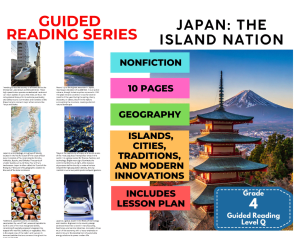
Japan The Island Nation: Guided Reading Level Q with Lesson Plan
ELA, Resources for Teachers, Reading Comprehension, Reading, Science, Geography, Social Studies, History, Earth and Environmental Sciences, Technology, Grade 3, 4, 5, Worksheets & Printables, Worksheets, Teacher Tools, Centers, Activities, Literacy Readers, Quizzes, Quizzes and Tests, Assessments, Lesson Plans
This Japan: The Island Nation (level q) guided reading book with lesson plan includes: Guided Reading Color Label (front cover x1) This is a quick way to match the book’s demands to what students can generally handle.. The overall goal is to use the level/color to pick books for several smaller groups. To qualify for a certain level, a student is expected to read a book from that level with about 90–94% accuracy. If a student is consistently accurate and understands, move up a level. If the student is struggling at that level, drop down and add more support. Each student will improve at completely different rates, but it is generally one of the best ways to check progress across the class. DOWNLOAD THE CATALOG TO VIEW ALL GUIDED READING BOOKS AVAILABLE (SORTED LEVELS A-Z) Pre-Reading Question (x1) Teacher asks the prompt aloud, can be while showing the cover or first page. Students share what they already know, or make educated guesses from the cover. Prompt them to use the target vocabulary. Write some of their responses on the board to look back at during the reading. Vocabulary Words (x5) Introduce the five words, best doing it one at a time. Start by saying it, while students repeat and then see if anyone knows what it means before reading further. Read through the meaning and try to briefly connect each word to a picture or gesture so it’s meaningful. Ask students to flip through the book pages and point to where they see each of the vocabulary words. While reading the book pause upon coming across one of the vocab words or read the sentence twice to make sure students understand the word has appeared. Optional: Ask students to raise hands whenever they see/hear one of the new words. Guided Reading Pages (x10) Check the book snapshot (below) for: primary topic - do you need to prep extra reading or intro materials on this? what is taught best - decide on 1-2 bullets to focus on, use the prompt or words provided here for best results. learning goals - what you are checking for students to be able to do after the session, elicit answers using prompts or words provided. key vocabulary (see section above). questions overview - so you know what is coming up and if you need to prep extra materials to assist understanding. Run the lesson You may have already looked at a few of the pages together, but you can show them some of the pictures again first to set meaning. Depending on how much time you have and how familiar your students are with guided reading class, you may want to read the book aloud first with the group first. Students whisper or partner read, while you listen in. If time, do it as a group, one student reading a page each. Use the guided page’s prompts to coach: “Check the picture / does it make sense?” “Point under the words / try the first sound” “Reread the sentence smoothly”. Try to focus more on one student per session (rotating every time), so you can work out if they are ready to move up or need to move down a level. Comprehension Questions (back cover x3) This is your way to check that students didn’t just say the words, but actually understood the text. First, let students answer by pointing to the page/picture and saying a short sentence. After any answer, follow with: “Show me where you found that in the text.” In bigger groups, have partners answer first (10–20 seconds), then call on 2–3 students to share. Differentiation tips: Emerging speakers/struggling readers: oral + pointing On-level: oral in a full sentence Higher: one written sentence or draw + label Book Snapshot Title: Japan: The Island Nation Genre: Nonfiction Subject: Social Studies (Geography/Culture) Primary Topic: Japan’s islands, cities, traditions, and modern innovations Estimated Guided Reading Level (A–Z): Q What This Book Teaches Best Explains Japan’s geography as an archipelago , naming the four main islands and describing its location off East Asia. Highlights Tokyo as a major metropolitan area , describing its role and features of city life. Describes transportation and technology through the Shinkansen (bullet train), including its speed, safety, and punctuality. Connects landforms and natural features to Japan’s identity by describing Mount Fuji, snow cover, and spring sakura blossoms. Builds understanding of culture and history through Shinto and Buddhism, matsuri festivals, and the Edo period (shoguns, samurai, and castles like Himeji). Learning Goals Students will explain what an archipelago is and name Japan’s four main islands. Students will describe Tokyo’s importance and identify details the text gives about the city. Students will explain how the Shinkansen helps people travel and identify key features the text highlights (such as speed or punctuality). Students will describe Mount Fuji using details from the text, including its height and volcanic history. Students will identify key ideas about Japanese traditions from the text (religions, shrines/torii, cuisine, or festivals). Students will explain how Japan’s climate varies and describe the text’s example of the “snow monkey” in winter. Key Vocabulary From the Text archipelago — a group of islands. metropolitan — related to a very large city area. punctuality — being on time. terraced — built in step-like levels on a hillside. geothermal — heat that comes from inside the Earth. Discussion Prompts Pre-reading question: What places, traditions, or inventions do you expect to learn about in Japan? Comprehension questions: What four main islands does the text name as part of Japan? Comprehension questions: What does the text say the Shinkansen is known for? Comprehension questions: How does the text say the “snow monkey” adapts to cold winters? Printing Tips 1. Best Printing Method (Recommended) “Booklet” Printing (Best if Available) If your printer or PDF viewer supports Booklet Printing , use this. Settings to use: Print mode: Booklet Paper size: Letter or A4 (either works) Orientation: Landscape Print on both sides: Yes Flip on: Short edge Scaling: Fit to printable area Booklet subset: First test: Front sides only Then: Back sides only This will automatically: Pair pages correctly Put the cover on the outside Align everything for folding After printing, fold in half and staple along the spine . 2. If “Booklet” Printing Is NOT Available You can still print this correctly with manual duplex printing . Step-by-step: Open the PDF. Choose Print . Set: Orientation: Landscape Pages per sheet: 1 Print on both sides: Yes Flip on: Short edge Print all pages . Because each PDF page already contains two facing book pages, the result will still fold cleanly into a book. Thousands of Cored Education products are included with your TeachSimple membership. Download links and encyclopedia index available here.
Author Cored Education
Rating
Tags Reading Comprehension, Reading Passages, Reading, Guided Reading, Guided Reading Lesson Plan, Guided Reading Activity, Pre-reading, Social Studies, Geography, History
Algebra: Equations - Solving for a Variable - Learn the Skill - FLASH-MAC
Math, Algebra, Common Core, Grade 3, 4, 5, Teacher Tools, Lesson Plans
Algebra: Equations - Solving for a Variable - Learn the Skill - FLASH-MAC This is an advantageous teaching resource meticulously designed for educators catering to 3rd to 5th grade students. This product remarkably encapsulates the essence of Algebra, primarily focussing on solving equations for a variable. Unique Features: The material contained within this software is instrumental in laying solid mathematical foundations in young learners and helping them understand complex concepts with simplicity. The package offers an engaging blend of curriculum-based content and practical real-world word problems that stimulate children's analytical skills while enhancing their problem-solving capabilities. Visually fascinating, this toolkit includes math tools crucial in building conceptual knowledge organically among students. The functionality isn't confined to just English language delivery; there's also a Spanish voiceover and text option available. This feature serves as a instrumental tool for bilingual classrooms or individual homeschooled Spanish-speaking students, aiding linguistic diversity and inclusivity. Educational Alignment: On alignment with widely recognized educational parameters, it adheres to the Common Core State Standards and targets STEM initiatives effectively. Additionally being written with guidance from NCTM standards enables educators to confidently utilize its pedagogical strategies across various classroom settings This tool also enriches digital literacy among pupils from an early age: - Note: The software is compatible with Mac systems only. In Concluson: "Algebra: Equations - Solving for a Variable", does more than teaching algebraic concepts. It integrates user-friendly interactions while creating fun learning pathways.
Author Classroom Complete Press
Tags Software (Mac)

A Bike Like No Other: Emergency Lesson Plan
ELA, Reading, Grade 3, 4, Teacher Tools, Lesson Plans
A Bike Like No Other: Emergency Lesson Plan The "A Bike Like No Other: Emergency Lesson Plan" is a multi-faceted teaching resource crafted specifically for educators working with 3rd and 4th-grade students. Its central theme revolves around bike riding and overcoming fear, enabling the integration of life lessons into curriculum -based learning. This comprehensive unit houses an engaging story about a child's journey to conquer the fear associated with riding bikes. This narrative element can potentially spark discussions on facing fears, driving home key interpersonal skills effortlessly within a classroom setting. More than just a story, this resource turns unpredictable moments—like feeling unwell or unplanned downtime before school events—into an opportunity for unscheduled learning. The package comprises cross-curricular worksheets that can be implemented as whole group activities or small group tasks. These sheets cover topics related to biking and overcoming fears that align well with Language Arts and Reading subjects. Added in are extension activities ideal for those unexpected moments when teachers might not be prepared to run their usual classes but still want their students actively engaged in meaningful tasks. Rather than scrambling for substitutes or procrastination-inducing filler content, simply break out these pre-planned materials; handouts that simultaneously educate and entertain. Teachers could also use this packet as homework assignments, reshaping chores into challenging exercises of knowledge application outside the confines of school buildings. It encourages independent study habits among learners whilst affirming the understanding of concepts discussed during class hours. "A Bike Like No Other" , delivered as a PDF file secures compatibility across various devices facilitating seamless access anytime anywhere—an ideal companion to all teachers dedicated towards student-centric flexible modes of education delivery. In essence, "A Bike Like No Other" offers an enlightening blend of literacy skills training intertwined with life-oriented coaching threads—an emergency toolbox ready at your service.
Author Classroom Complete Press
Tags PDF

Lesson Plan on Pablo Picasso
Art, Creative Arts, Art History, Fine Arts, Biographies, Social Studies, Not Grade Specific, Activities, Lesson Plans, Teacher Tools, Worksheets, Worksheets & Printables
Pablo Picasso was among the most impactful artists of the 20th century. He is recognized for co-founding the Cubist movement, creating constructed sculpture, co-inventing collage, and for the diverse range of styles that he contributed to and examined. For approximately 80 of his 91 years, Picasso dedicated himself to creating art that played a crucial role in the overall progress of modern art during the 20th century, especially through the creation of Cubism (alongside artist Georges Braque) around 1907. Picasso is often regarded as THE genius of the twentieth century. Possibly more than any other artist, he transformed the course of art, initiating the modernist movement. He was an innovator of Cubism, subsequently of collage art, and eventually neo-classicism. This lesson plan centers around the artwork of Pablo Picasso. Numerous activities are provided, arranged in two worksheets. Their answers are provided in the end. Six of his most famous works are also included.
Author Bright Classroom Ideas Marketplace
Tags Picasso, Pablo, Lesson, Plan, Painting, Painter, Art
Number & Operations: Grouping Objects & Number Lines - Practice the Skill 3 - FLASH-MAC
Math, Numbers, Common Core, Grade 1, 2, Teacher Tools, Lesson Plans
Number & Operations: Grouping Objects & Number Lines This resource is a dynamic MAC software course module for grade 1 and grade 2 math educators. It is designed to provide practical skill drills on fundamental components such as grouping objects and understanding number lines. The core features include: Tasks involving completion of number lines, presentation of information in line with educational standards. In-built math tools with primary English language setup but options for Spanish voice over and text. Alignment with education initiatives like Common Core State Standards and NCTM guidelines. One downloadable product file , eliminating complex access issues. The aforementioned features ensure easier preparation for teachers, steady progression for students at their own pace, linguistic accessibility, compliance across various states' curriculum boards . From whole group sessions to small break-out groups or homework exercises; this resource can be incorporated flexibly as per requirement. The aim here is essentially bridging the theory-practice gap while considering potential language barriers.
Author Classroom Complete Press
Tags Software (Mac)

Grade 7 History Skills Review | Back-to-School Diagnostic
History, Social Studies, Grade 7, Assessments, Teacher Tools, Lesson Plans, Worksheets & Printables
Start the school year with confidence using this 7th Grade Beginning of Year History Assessment and complete intervention system! This comprehensive Grade 7 History Skills Diagnostic helps you quickly identify students' strengths and learning gaps in historical thinking, source analysis, perspective, historical argument, and data interpretation so you can confidently plan targeted instruction from day one. More than a simple pretest, this resource provides a complete Assess → Identify → Group → Practice → Reassess system with a 46-question diagnostic assessment , targeted intervention materials, enrichment activities, skill analysis tools, and detailed answer keys that transform assessment data into meaningful instruction. What's Included This 7th Grade Beginning of Year History Skills Assessment Bundle includes: ✅ Teacher Guide & Implementation Overview ✅ 46-question Beginning-of-Year History Skills Review ✅ Printable Student Answer Sheet ✅ Skill Analysis & Grouping Tools ✅ Item-to-Skill Mapping Guide ✅ Class Skill Grid ✅ Individual Student Profiles ✅ Grouping Planner ✅ Reassessment Tracker ✅ 26 Targeted Follow-Up Practice Worksheets ✅ Extension Activities ✅ Student Choice Board ✅ Complete Answer Key ✅ Scoring Guide ✅ Two Written Response Rubrics ✅ Printable PDF format ✅ No-prep, print-and-go resource Students are assessed across five major historical thinking strands : 📜 Sourcing & Analysis Sourcing historical documents Corroboration Contextualization Source reliability Fact vs. interpretation 🧠 Perspective & Bias Historical perspective Identifying bias Persuasion & loaded language Political cartoon analysis Comparing viewpoints ⚖️ Causation & Change Cause & effect Multiple causation Short- vs. long-term causes Change & continuity Turning points Consequences 🗺️ Maps & Data Historical map interpretation Reading charts & tables Population data Economic data Data trends & interpretation 📝 Historical Argument Evidence-based inference Claims supported by evidence Claim-Evidence-Reasoning (CER) Using multiple sources Counterarguments The Teacher Guide explains that the complete bundle contains approximately 91 printable pages across seven coordinated resources , all connected through consistent skill codes that make assessment and intervention simple to implement. How It Works in the Classroom This 7th Grade History Beginning of Year Assessment follows an easy five-step instructional cycle that turns assessment data into actionable teaching. Step 1 — Assess Students complete the 46-question History Skills Review using the separate Student Answer Sheet. Step 2 — Identify Skill Gaps Score assessments with the Answer Key and record student performance using the Class Skill Grid. Step 3 — Group Students Use the Grouping Planner to create flexible intervention groups based on shared skill needs. Step 4 — Assign Targeted Practice Assign only the Follow-Up Practice pages that correspond to each student's assessment results. Step 5 — Reassess Monitor growth with the Reassessment Tracker and regroup students as needed. The Teacher Guide recommends administering the assessment during the first week of school in approximately 55 minutes , or dividing it into five shorter sessions by skill area. Questions may be read aloud because the assessment measures historical thinking skills rather than reading ability. Perfect for: Beginning of Year Assessment History Pretest Back to School Activities Diagnostic Assessment World History Social Studies RTI MTSS Intervention Small Groups Progress Monitoring Flexible Grouping Standards & Learning Goals This 7th Grade History Skills Diagnostic Assessment evaluates the advanced historical thinking skills students should demonstrate at the beginning of seventh grade. Students develop and demonstrate understanding of: Sourcing & Analysis Evaluating historical sources Corroborating evidence Contextualizing documents Assessing source reliability Distinguishing fact from interpretation Perspective & Bias Historical perspective Recognizing bias Identifying persuasion and loaded language Analyzing political cartoons Comparing historical viewpoints Causation & Change Cause and effect Multiple causes Short- and long-term causes Change and continuity Turning points Historical consequences Maps & Data Historical map interpretation Reading charts and tables Population analysis Economic data Interpreting historical trends Historical Argument Making evidence-based inferences Supporting claims with evidence Claim-Evidence-Reasoning (CER) Synthesizing multiple sources Evaluating counterarguments Students demonstrate understanding through engaging historical tasks including: Political cartoons Historical maps Primary and secondary sources Charts and tables Population graphs Economic data Historical scenarios Multiple-choice questions Evidence-based written responses The diagnostic measures 26 essential historical thinking skills across five instructional strands, with every assessment item directly connected to a matching follow-up practice page through the Skill Analysis Tools. Why Teachers Love It ✨ More than a beginning-of-year assessment—it is a complete instructional system. ✨ Saves 10+ hours of planning by combining assessment, data analysis, intervention, enrichment, and reassessment into one cohesive resource. ✨ Every assessment question aligns directly to one specific historical thinking skill, making it easy to identify exactly where students need additional support. ✨ Build flexible intervention groups quickly using ready-to-use planning tools. ✨ Includes 26 targeted Follow-Up Practice worksheets , each featuring a student-friendly "Remember" mini lesson followed by fresh practice questions that reinforce the skill without repeating assessment items. ✨ Differentiate instruction with confidence. Students needing additional support receive focused practice while students demonstrating mastery complete engaging enrichment projects and a history choice board. ✨ Extension Activities encourage deeper historical thinking through challenges such as: Designing political cartoons Corroborating historical sources Mapping multiple causes of historical events Interpreting historical maps Reading and analyzing data graphs Contextualizing historical sources Comparing viewpoints Building complete Claim-Evidence-Reasoning responses with counterarguments These enrichment projects promote inquiry, critical thinking, historical analysis, and authentic application of Grade 7 historical thinking skills. ✨ Skill Analysis Tools simplify instructional planning. Teachers receive: Item-to-Skill Map Class Skill Grid Student Profiles Grouping Planner Reassessment Tracker Every assessment question links directly to a targeted intervention worksheet so teachers can easily assign only the practice each student needs. ✨ Includes comprehensive scoring support. The Answer Key provides: Correct answers Skill codes Answer explanations Skill mastery bands Two written-response rubrics Teachers can quickly identify students who are Approaching , On Track , or Strong in each historical thinking skill area and immediately plan targeted instruction. ✨ Supports meaningful, data-driven instruction while remaining easy to administer, score, and implement. Give your students a strong start with this 7th Grade Beginning of Year History Assessment and complete intervention system. Whether you're looking for a 7th Grade History Diagnostic , Beginning of Year History Pretest , World History Skills Assessment , Historical Thinking Activities , Source Analysis Practice , Social Studies Assessment , RTI Resource , Progress Monitoring Tool , or a complete assessment-to-intervention solution, this bundle provides everything you need to assess, analyze, group, reteach, enrich, and monitor student growth throughout the school year.
Author Bright Classroom Ideas Marketplace
Rating
Tags Social Studies, History, Back To School, Assessment, Diagnostic