



3,968 products added recently
Page 66 - 2nd Grade Lesson Plans
Enhance your second-grade classroom with lesson plans that build on foundational skills and introduce new concepts. These activities promote critical thinking and creativity across subjects. Implement these plans to keep your students motivated and progressing confidently.

 Show filters


Algebra: Ordering & Grouping - FLASH-PC
Math, Algebra, Grade 1, 2, Teacher Tools, Lesson Plans
Algebra: Ordering and Grouping - FLASH-PC This is an extraordinarily crafted digital resource created for teachers. The resource aids the teaching of algebra's ordering and grouping principles. It's primarily targeted towards Grade 1 and Grade 2 students, in alignment with their critical early developmental maths education needs. Key Features: It comes with a pre-assessment tool which helps teachers understand each student's capacity before starting instruction. The resource holds a delicately devised lesson plan to ensure all curriculum-based goals are achieved adequately. Inclusion of real-world word problems to help students apply mathematical knowledge to everyday situations, thus stimulating multiple cognitive levels. Gamification Aspect: Match games, board games, and spinner games are incorporated for heightened student engagement with the concepts of ordering & grouping in algebra. Also included are timed drills serving as effective tools for practice under time constraints often seen during exams. Fostering Educator-Student Interaction: A detailed teacher guide provides necessary steps towards an efficient use of available resources in the package. To minimize administrative load, ready-to-use printable educational materials are explicitly provided. The FLASH-PC software is PC-compatible and comes as a single zip file making it usable across various classroom technical setups or homeschooling environments. One noteworthy feature includes availability of both English & Spanish languages in text format along with voiceovers accommodating linguistically diversified classrooms. No child should be hindered due to material accessibility issues! In conclusion ,Algebra: Ordering & Grouping - FLASH PC enhances multiple implementation possibilities via whole group settings or individualized sessions including homework assignments thereby becoming versatile instructive tool contributing prominently towards algebra teaching success.
Author Classroom Complete Press
Tags Ordering Numbers, Grouping Numbers, Algebra Worksheet, Word Problems, Algebra Lesson

Measurement: Area & Volume - Practice the Skill 2 - PC Software
Math, Measurements, Common Core, Kindergarten, Preschool, Grade 1, 2, Teacher Tools, Lesson Plans
Measurement: Area & Volume - Practice the Skill 2 - PC Software: Measurement: Area & Volume - Practice the Skill 2, is a quintessential teaching resource aimed at enhancing students' understanding of Measurement. This tool places emaphasis on the area and volume aspect of measurements. Meticulously Crafted: The content of this software aligns with Common Core State Standards and STEM initiatives. It is designed to strengthen students' mathematical skills through a series of timed practice activities . Built-in Activities : Prompting learners to identify the largest volume measurement from given pairs, this software engages participants for active learning experience. This hands-on approach supports real-world application and understanding of concepts right from preschool up until grade 2 level. Inclusive Learning Space: An exciting feature is its inclusion of math tools serving as teaching aids for complex topics. The bilingual options offering English and Spanish voice overs along with corresponding text appeal to diverse classroom settings promoting an inclusive learning space User-Friendly: The PC software program enclosed in a single zip file ensures ease-of-access across various platforms. Its flexibility allows educators to introduce these concepts during whole-group instructions or reinforce them through small group activities or assign it as homework. Suitable For All Levels: Crafted specifically for preschoolers, kindergarteners along with first and second graders, it attests its versatility maintaining its relevance throughout these levels. To sum up: Measurement: Area & Volume – Practice the Skill 2 – PC Software proves itself as an apt solution providing measurable learning outcomes; making mathematics fun while effortlessly fulfilling educational standards.
Author Classroom Complete Press
Tags Digital Math, Digital Measurement, Measurement Tools, Area, Volume

MOOSE ON THE LOOSE Gr. 2-4
ELA, Reading, Grade 2, 3, Teacher Tools, Lesson Plans
Moose on the Loose Gr. 2-4 Looking for an extensive teaching resource that encompasses key skills and introduces students to a fascinating subject? Look no further than Moose on the Loose, designed expressly for learners in Grades 2 through 4. About Moose on the Loose Moose on the Loose is a comprehensive, 67-page PDF teeming with activities all geared towards furthering your students' knowledge about one of nature's gentle giants: the moose, also known lovingly as 'the Giant of the Woods'. This guide encourages creativity, fosters critical thinking and promotes exploration making each lesson interactive and engrossing. Aiming Beyond Facts Rather than merely dispensing facts, this resource utilizes a proactive approach. Students are encouraged to perform their own research about this amazing mammal; exploring their curiosity through in-depth fact-finding missions. Educational Games & Exercises – Math Can Be Fun! Educational games allow students to engage with complex mathematical problems under disguise of fun-filled activity . Creative writing exercises intertwined with word studies help facilitate proficiency in language arts while cultivating reading habits among young learners. The carefully crafted phonics-based tasks support budding readers as they strive toward fluency. Last but absolutely not least, sprinkling some creative flair into academics are art assignments based around our central theme: The Moose! The multi-faceted structure of Moose On The Loose has been strategically conceived to cater to almost every learning style preference - suiting whole class lessons, small group instructions or even individual homework assignments perfectly. In Conclusion... So be it the fun-disguised math workbooks, language art sessions that take exciting turns with stories revolving around moose, exploratory research journey across the knowledge terrain or creative expressions in art - Moose On The Loose provides a wholesome package that transcends standard learning. Enjoy accompanying your students through this enchanting journey and witness the effectiveness of this comprehensive teaching guide.
Author Classroom Complete Press
Tags Research Skills, Moose On The Loose, Creative Arts, Phonics, Reading Activity, Moose On The Loose Clip Art
High Frequency Sight Words: Sentence Completion - FLASH-PC
ELA, Language Development, Vocabulary, Grade 1, 2, Teacher Tools, Lesson Plans
High Frequency Sight Words: Sentence Completion - FLASH-PC The High Frequency Sight Words: Sentence Completion - FLASH-PC is a resource designed to promote learning in the classroom and beyond. This product, focused on Dolch High Frequency Sight Words, is particularly perfect for 1st and 2nd grade educators focusing on language arts. Purpose of the Resource The primary purpose of this tool, as evident from the title 'Sentence Completion', is to significantly improve students' vocabulary skills through engaging activities. The software helps improve Lexical competency by emphasizing sentence formulation based on Dolch Sight Words, along with cultivating conceptual understanding via contextual usage of words. Main Features An integrated bundles set that includes printable teaching aids like graphic organizers and interactive activities. Suitable for various instructional methods such as whole-class instruction or small group learning circles. A god-send for parents engaged in homeschooling efforts who can incorporate these dependable aids into their routine. Dolch Sight Word Flashcards Included inherently within its teaching kit are individual Dolch sight word flashcards . These versatile tools are ideal for exercising various learning strategies, enhancing sight-word recognition among new readers, or even to be given as homework assignments extending lesson engagement outside classroom constraints. Compatible with PC This easily accessible format common within education communities worldwide promotes smooth application into any contemporary instruction model void of obstacles or setbacks. To summarize, if you're seeking an easy-to-use digital method to enhance young learners' mastery over high-frequency sight words then give due consideration to this diligently assembled Sentence Completion - FLASH-PC tool - your potential keystone resource on your teaching journey.
Author Classroom Complete Press
Tags Software (PC), Sight Words, ELA Lesson Plan, Sentence Completion, Vocabulary

Later, Alligator Animated Writing Activity | Short Film
ELA, Writing, Grade 1, 2, 3, 4, Teacher Tools, Lesson Plans
This resource allows students to explore writing in a fun way. They will engage with an animated short film Later, Alligator." Included: -Short animated story -Sequencing -True False -Main Idea & Details -Summarizing
Author Teach Me This
Tags Animated Film, Short Film, Writing Activity, Creative Writing, Later Alligator

I WONDER - How Fast Do Nails Grow | Animated Video Lesson
Human Body, Life Sciences, Science, Biology, STEM, Grade 1, 2, 3, 4, 5, 6, 7, 8, Lesson Plans, Teacher Tools
Video Overview The human body is full of fascinating wonders to learn. This video is created to help the students recognize the anatomy and the job of the human body. I WONDER - How Fast Do Nails Grow | Animated Video Lesson Every part and organ in our human body is vital so let's see how important they are. Have you ever imagined how we look like if we didn't have a skeleton? Did you know that because we have our amazing muscles we can stand! Do you know how many teeth do we have? Have you ever wondered about the food journey inside our body? Can you name all the glands in our body? Why do we have skin? Our nervous system is really good at sending signals. Can you tell us more about it? Are you really good at Mathematics, painting, or any other thing? You should really thank your brain about it! The famous five senses are really doing a great work? Can you explain how every sense works? I WONDER - How Fast Do Nails Grow | Animated Video Lesson The video is perfect for encouraging the researching skills for the students, while learning more about our fantastic human body. I WONDER - How Fast Do Nails Grow | Animated Video Lesson This friendly designed video is suitable for students at school, homeschooling, and as a group activity. Format Available in MP4 format.
Author Educational Voice
Tags How Fast Do Nails Grow, How Fast Do Nails Grow Video, Nails, Nail, Nails Facts, Nails Facts For Kids, Nails Video, Nails Video For Kids, Finger, Fingers
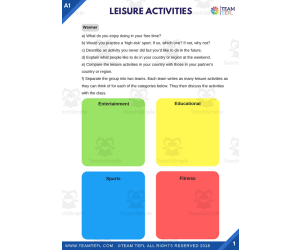
Leisure Activities | Beginner Lesson Plan
ELA, Language Development, ESL, Grade 2, 3, 4, 5, 8, 9, 10, 11, 12, Lesson Plans, Teacher Tools
Leisure Activities | Beginner Lesson Plan An essential teaching resource meticulously designed to enlighten early A1 beginner learners on various leisure activities. This lesson plan is primarily focused on Language Arts. This comprehensive structure of interactive and exploratory learning opportunities consists of A total of 27 pages in three printable PDFs An introduction to diverse recreational pursuits Engaging exercises for enhanced comprehension and effective employability of grammatical skills. An auditory learning approach adds an enjoyable dimension to the learning process while significantly heightening understanding. Catering effectively to English Second Language (ESL) students, this hands-on resource simplifies language complexities whilst promoting cultural education about leisure activities worldwide. This TEFL lesson plan include: Flash cards A warm-up activity Main usage exploration Construction details Rules, along with any exceptions Illustrative examples Two closed exercises One open exercise Listening exercise Revision exercise Writing exercises Chatterbox, a recurring feature in our course books encouraging conversation Activity , such as a game, quiz, puzzle, etc., to conclude the class The lesson plan is available in PDF with 26 ready to print pages and one digital access file. One MP3 file included. A part of it is on Google Apps. The answer key is also included for reference.
Author TEAM TEFL
Tags Leisure Activities, Language Arts, Interactive Learning, Auditory Learning, ESL

Good, Well & Fine | Beginner Lesson Plan
ELA, Language Development, ESL, Grade 2, 3, 4, 5, 7, 8, 9, 10, 11, 12, Teacher Tools, Lesson Plans
Good, Well & Fine | Beginner Lesson Plan Our meticulously crafted teaching resource is nothing short of ideal for educators grappling with the nuances of language arts. Specifically tailored towards English as a Second Language (ESL) students, it offers an articulate and systematic approach to deciphering the frequently impertinent trio - good, well and fine. This comprehensive lesson plan springs to life a classroom where students no more fumble with these words, thanks chiefly to its practical design hammered out keeping effective learning experience at heart. Perfect for both public school teachers and homeschooling parents alike. Your young learners will be introduced to these cleverly veiled tricky words through smartly integrated exercises. Ranging from reading passages using 'good', 'well', and 'fine' in varied contexts up to tests that assess their comprehension - all spelling an interactive grammar-learning journey. The package comes bundled with three ready-to-print or digitally-accessible PDFs spread across six colourful pages. You can safely leave your markers since we provide essential keys enabling quick evaluation for each activity. You are free to employ this valuable tool in various teaching setups: During whole group instruction as an intimate dialogue about the difference among 'good', 'well' and 'fine' In small groups where repetition enhances understanding Serving it simply as a homework assignment promoting self-learning The Good, Well & Fine | Beginner Lesson Plan - convenience wrapped into practicality – covers what's essential but leaves ample room for adaptability based on your individual student abilities or classroom atmospherics. Don't wait for tomorrow, get this go-to guide today; and help navigate your young scholars through mastering these commonly misused vocabulary without breaking a sweat!
Author TEAM TEFL
Tags Language Arts, Vocabulary, Confusing Words, ESL, Teaching Resource

Let's Learn! Vowels
ELA, Language Development, Phonics, Preschool, Grade 1, 2, Teacher Tools, Lesson Plans
Let's Learn! Vowels Let's Learn! Vowels is a meticulously crafted teaching resource especially targeted at educators for Kindergarten to 2nd Grade students. It offers a dynamic and engaging way to augment the language arts curriculum with an emphasis on phonics. This resource comes as a comprehensive, single-product file in an easily accessible PDF format. It contains 32 carefully structured pages of age-suitable activity sheets designed to captivate young learners' attention. Each page presents appealing art that makes each task enjoyable and maintains the learners' enthusiasm as they embrace phonetic learning. Unique Sequential Technique Let's Learn! Vowels stands out by its unique approach in implementing activities that progressively build upon one another. This sequential technique promotes ease of understanding as children advance from one stage to another, applying acquired knowledge while grasping new skills and concepts simultaneously. Versatility in Implementation The implementation of this teaching aid can be adjusted flexibly based on individual educator's needs; it may be utilized efficiently for both group sessions or small groups. Possibilities include: Incorporating it into classroom lessons, . Utilizing it for small group instruction, . Assigning pages as homework allowing learners to refine their proficiency at home. Inclusion of Detailed Skills Matrix Rounding off this comprehensive resource is the inclusion of a detailed skills matrix accompanying each title. This valuable addition helps enable educators to monitor and assess progression in vowel mastery effectively throughout the course of using this resource. In summary, 'Let’s Learn! Vowels', exists not just as a supplementary educational tool but elevates itself into being an essential asset - fostering foundational language skills while making learning fun and engaging for Kindergarten through Grade 2 students.
Author Classroom Complete Press
Tags PDF

Data Analysis & Probability: Circle Graphs - Practice the Skill 1 - MAC Software
Math, Graphing, Common Core, Kindergarten, Preschool, Grade 1, 2, Teacher Tools, Lesson Plans
Data Analysis & Probability: Circle Graphs - Practice the Skill 1 - MAC Software Teaching Resource: This software provides learners with valuable practice on data analysis and probability through the examination of circle graphs. It is enhanced with timed practice drills designed to promote quick comprehension. Features and Benefits Interactive Math Tools: Aids in a more engaging learning process. Linguistic Diversity: Provides English voice-over and text as default, but also supports Spanish voice-over and text for bilingual classrooms. Versatility in Use-: It can be tailored for various educational scenarios like whole group instructions or small study groups. Furthermore, it is an excellent teaching aid for reinforcing children’s learning at home during homework sessions. Educational Level Target The program targets learners at Preschool, Kindergarten, Grade 1, and Grade 2 levels under the subject area of math with a specific focus on graphing techniques. Aligned Standards The tool aligns with both Common Core State Standards (CCSS) pertaining to curricula as well as National Council of Teachers Mathematics (NCTM) standards. Furthermore, it also has alignment features directed toward STEM initiatives thereby preparing students to become tomorrow's problem solvers effectively today. About Installation Process/h5> The software comes packaged as a zip file making installation easy for various MAC users. All put together Data Analysis & Probability: Circle Graphs - Practice the Skill 1 - Mac Software takes data representation learning beyond theoretical understanding into tangible skills – improving participation while enhancing understanding efficiently.
Author Classroom Complete Press
Tags Circle Graphs, Graphing Skills, Math Skills, Digital Math, Probability

Editable Curriculum Night Learning Station Activities
, Preschool, Grade 1, 2, Lesson Plans, Teacher Tools
Editable Curriculum Night Learning Station Activities is a 34-page printable resource that gives you everything you need to host a curriculum night at your school. Included in this download: 1. Visuals of curriculum night set-up 2. Hopes and Dreams writing for parents 3. To-Do List & editable list 4. 8 Lab Station Posters 5. 8 Editable Lab Station Posters 6. 10 Informational Handouts
Author Kindergarten Cafe
Tags Curriculum, Curriculum Night, Editable, Learning Stations, Writing
I WONDER - Do Leopards Live In Groups | Animated Video Lesson
STEM, Animals, Life Sciences, Science, Biology, Grade 1, 2, 3, 4, 5, 6, 7, 8, Lesson Plans, Teacher Tools
Video Introduction Animal kingdoms are full of fascinating wonders to learn. This video is designed for the students to learn more about animals in different countries. I WONDER - Do Leopards Live In Groups | Animated Video Lesson Do you like animals? what is your favorite one? Do you own a pet? If yes, tell us more about it, like what its name? And what do you like most about it? What are the animal kingdoms? Can you write down the characteristics of each animal class like mammals, birds, reptiles, amphibian, fish and mollusks. Do you know that some animals can sing, can you name any of them? What is the largest and the smallest mammal in the world? What is the largest and the smallest bird in the world? What is the largest and the smallest fish in the world? I WONDER - Do Leopards Live In Groups | Animated Video Lesson The video is perfect for encouraging the researching skills for the students, while learning more about these fantastic animals. I WONDER - Do Leopards Live In Groups | Animated Video Lesson This friendly designed video is suitable for students at school, homeschooling, and as a group activity. Format Available in MP4 format.
Author Educational Voice
Tags Do Leopards Live In Groups, Do Leopards Live In Groups Video, Leopards, Leopard, Leopards Facts, Leopards Facts For Kids, Leopards Video, Leopards Video For Kids, Leopard Facts, Leopard Video

I WONDER - What Is An API In Coding | Animated Video Lesson
STEM, Computer Science, Technology, Science, Grade 1, 2, 3, 4, 5, 6, 7, 8, Lesson Plans, Teacher Tools
Video Introduction An amazing video designed for the students to learn more about STEM. I WONDER - What Is An API In Coding | Animated Video Lesson Do you like STEM subjects? what is your favorite one? Have you ever tried to plant a seed? If yes, tell us more about it. Or have you ever tried to invent something? If yes, tell us more about it. And how do you think it will help us? Have you ever seen a microorganism under a microscope? What was it? And how it looked like? Mathematics is a marvelous subject. Let' sharpen our brains and solve some equations. Do you like timetable tricks? What is your favorite one? Do you know how to code? Have you ever created an app or a game before? If yes, how was it like? I WONDER - What Is An API In Coding | Animated Video Lesson The video is perfect for encouraging the researching skills for the students, while learning more about this fantastic topic. I WONDER - What Is An API In Coding | Animated Video Lesson This friendly designed video is suitable for students at school, homeschooling, and as a group activity. Format Available in MP4 format.
Author Educational Voice
Tags What Is An API In Coding, What Is An API In Coding Video, API, API Video, API Video For Kids, API Facts, API Facts For Kids, API In Coding, API In Coding Video, API In Coding Video For Kids

Animal Science Unit | All About Bees | Learning about Animals
Science, Life Sciences, Animals, Kindergarten, Preschool, Grade 1, 2, Teacher Tools, Lesson Plans
Animal Science Unit: All About Bees provides educators with an engaging animal science curriculum to help students in grades PreK-2 learn about the unique world of bees. This comprehensive resource includes vivid photos, differentiated reading materials, crafts , worksheets, and writing activities tailored to various ability levels. Students will study bee anatomy, life cycles, habitats, adaptations, behaviors, and more through diverse project ideas, while developing science, literacy, and art skills. Implementation flexibility allows components to be used for whole class, small group, or individual instruction. With abundant teacher support resources and multi-sensory student materials, this unit aims to foster curiosity and appreciation for nature's pollinators.
Author Simply Schoolgirl
Tags Insects, Insect, Zoology, Entomology, Pollinators, Pollinator, Honey Bee, Bumble Bee, Bee Crafts, Bee Lesson

Lesson Plan on The Weather - Grades 1-4
Earth and Environmental Sciences, Science, Earth Sciences, Environmental Science, Grade 1, 2, 3, 4, Activities, Lesson Plans, Teacher Tools, Worksheets & Printables
This fun 90-minute lesson is perfect for Grades 1–4. It helps students learn all about the weather in a simple and engaging way. The lesson starts with a quick observation activity where students look outside and describe what they see. Then, they watch a short, colorful video called Weather | Science for Kids . It explains what weather is, the different elements, and why it matters. After the video, students answer questions, sort weather cards, and work in pairs. The lesson includes a printable worksheet full of matching, drawing, and word games. Students also make their own weather wheels and act as mini meteorologists in class. Everything is hands-on and easy to follow. The lesson builds vocabulary, boosts speaking, and teaches science—all at once. It’s ideal for classroom or remote learning. Best of all, the activities are ready to print and use right away. If you want a weather lesson that’s fun, interactive, and packed with learning, this is it!
Author Bright Classroom Ideas Marketplace
Rating
Tags Weather, Lesson, Plan, Environment, Earth

Algebra: Addition & Subtraction - Learn the Skill - FLASH-PC
Math, Algebra, Common Core, Grade 1, 2, Teacher Tools, Lesson Plans
Algebra: Addition & Subtraction - Learn the Skill - FLASH-PC Product Overview A top-tier teaching resource, Algebra: Addition & Subtraction - Learn the Skill - FLASH-PC is designed to impart effective understanding of algebraic addition and subtraction concepts to first and second-grade students. With comprehensive content listed in chapter mini format, it provides real-world insights on core mathematical operations through adeptly formulated word problems . Product Features An extensively experiential teaching approach that uses additional math tools to elevate learning experience. Versatile language options including English text instruction with English voice over, as well as an alternative Spanish voice over and text option. Built-in compatibility with Common Core State Standards and STEM initiatives, along with alignment with NCTM standards for effective learning outcomes. This groundbreaking educational tool can be used in diverse settings such as whole group discussions, small cooperative problem-solving groups or even one-on-one tutoring sessions—making it a practical choice for all algebra facilitators. Digital Integration In this age of virtual education methods, Algebra: Addition & Subtraction - Learn the Skill – FLASH-PC, offered as PC-compatible software needing minimal storage space has proven integral for seamless integration into any e-schooling system—sure proving its potential in upgrading your math lesson plans!
Author Classroom Complete Press
Tags Software (PC)

Lindbergh's Flight Across the Atlantic: History - Hands On
Social Studies, History, History: USA, Grade 1, 2, 3, 4, Teacher Tools, Lesson Plans
Lindbergh's Flight Across the Atlantic: History - Hands On This is a comprehensive teaching resource ideal forGrades 1 to 4. This learning material focuses on a significant historical event - Charles Lindbergh's ground-breaking flight from New York to Paris, which revolutionized commercial aviation. With this lesson plan, students get an in-depth insight into : How Lindbergh's early flying experiences prepared him for his remarkable achievement. The importance of viewing each flight as an incredible adventure. An understanding and appreciation for advancements in modern travel often taken-for-granted. Versatility and Ease-of-Use Specially crafted for educators, this lesson plan can be used either in a large lecture or divided among smaller focus groups. The material is also suitable for homework assignments, allowing students to learn at their own pace while cementing their classroom knowledge at home. Resource Format and Subjects Covered The resources come mainly in PDF format ensuring compatibility across all platforms especially easy printing if required. Although primarily categorized under Social Studies – 'History: USA,' the lesson also opens discussions about technological evolution, thoroughly stirring student curiosity towards science too. Aiming to Create Historically Aware Students? Choose Lindbergh's Flight Across Atlantic: History-Hands On! This teaching resource not only imbues life into history lessons but also nurtures curiosity among young minds about domestic air travels. Thus, any educator aiming at creating memorable learning experiences with fun yet meaningful content should consider incorporating this resource into their class plans.
Author Classroom Complete Press
Tags PDF
I WONDER - How Do Birds Fly | Animated Video Lesson
STEM, Animals, Life Sciences, Science, Biology, Grade 1, 2, 3, 4, 5, 6, 7, 8, Lesson Plans, Teacher Tools
Video Introduction Animal kingdoms are full of fascinating wonders to learn. This video is designed for the students to learn more about animals in different countries. I WONDER - How Do Birds Fly | Animated Video Lesson Do you like animals? what is your favorite one? Do you own a pet? If yes, tell us more about it, like what its name? And what do you like most about it? What are the animal kingdoms? Can you write down the characteristics of each animal class like mammals, birds, reptiles, amphibian, fish and mollusks. Do you know that some animals can sing, can you name any of them? What is the largest and the smallest mammal in the world? What is the largest and the smallest bird in the world? What is the largest and the smallest fish in the world? I WONDER - How Do Birds Fly | Animated Video Lesson The video is perfect for encouraging the researching skills for the students, while learning more about these fantastic animals. I WONDER - How Do Birds Fly | Animated Video Lesson This friendly designed video is suitable for students at school, homeschooling, and as a group activity. Format Available in MP4 format.
Author Educational Voice
Tags How Do Birds Fly, How Do Birds Fly Video, Birds, Bird, Birds Facts, Birds Facts For Kids, Birds Video, Birds Video For Kids, Bird Facts, Bird Video
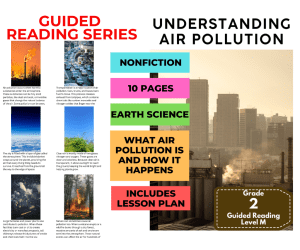
Guided Reading Level M - Air Pollution (with Lesson Plan)
ELA, Resources for Teachers, Reading Comprehension, Reading, Science, Technology, Physics, Life Sciences, Earth and Environmental Sciences, Environmental Science, Grade 2, 3, 4, Worksheets & Printables, Worksheets, Teacher Tools, Centers, Activities, Literacy Readers, Quizzes, Quizzes and Tests, Assessments, Lesson Plans
This Guided Reading Book - Understanding Air Pollution (Level M) with lesson plan includes: Guided Reading Color Label (front cover x1) This is a quick way to match the book’s demands to what students can generally handle.. The overall goal is to use the level/color to pick books for several smaller groups. To qualify for a certain level, a student is expected to read a book from that level with about 90–94% accuracy. If a student is consistently accurate and understands, move up a level. If the student is struggling at that level, drop down and add more support. Each student will improve at completely different rates, but it is generally one of the best ways to check progress across the class. DOWNLOAD THE CATALOG TO VIEW ALL GUIDED READING BOOKS AVAILABLE (SORTED LEVELS A-Z) Pre-Reading Question (x1) Teacher asks the prompt aloud, can be while showing the cover or first page. Students share what they already know, or make educated guesses from the cover. Prompt them to use the target vocabulary. Write some of their responses on the board to look back at during the reading. Vocabulary Words (x5) Introduce the five words, best doing it one at a time. Start by saying it, while students repeat and then see if anyone knows what it means before reading further. Read through the meaning and try to briefly connect each word to a picture or gesture so it’s meaningful. Ask students to flip through the book pages and point to where they see each of the vocabulary words. While reading the book pause upon coming across one of the vocab words or read the sentence twice to make sure students understand the word has appeared. Optional: Ask students to raise hands whenever they see/hear one of the new words. Guided Reading Pages (x10) Check the book snapshot (below) for: primary topic - do you need to prep extra reading or intro materials on this? what is taught best - decide on 1-2 bullets to focus on, use the prompt or words provided here for best results. learning goals - what you are checking for students to be able to do after the session, elicit answers using prompts or words provided. key vocabulary (see section above). questions overview - so you know what is coming up and if you need to prep extra materials to assist understanding. Run the lesson You may have already looked at a few of the pages together, but you can show them some of the pictures again first to set meaning. Depending on how much time you have and how familiar your students are with guided reading class, you may want to read the book aloud first with the group first. Students whisper or partner read, while you listen in. If time, do it as a group, one student reading a page each. Use the guided page’s prompts to coach: “Check the picture / does it make sense?” “Point under the words / try the first sound” “Reread the sentence smoothly”. Try to focus more on one student per session (rotating every time), so you can work out if they are ready to move up or need to move down a level. Comprehension Questions (back cover x3) This is your way to check that students didn’t just say the words, but actually understood the text. First, let students answer by pointing to the page/picture and saying a short sentence. After any answer, follow with: “Show me where you found that in the text.” In bigger groups, have partners answer first (10–20 seconds), then call on 2–3 students to share. Differentiation tips: Emerging speakers/struggling readers: oral + pointing On-level: oral in a full sentence Higher: one written sentence or draw + label Book Snapshot Title: Understanding Air Pollution Genre: Nonfiction (informational science text) Subject: Science (Earth & Environmental Science) Primary Topic: What air pollution is and how it happens Estimated Guided Reading Level (A–Z): M What This Book Teaches Best Introduces the atmosphere as an “invisible blanket” of air around Earth that living things need. Explains what clean air is mostly made of (nitrogen and oxygen) and why transparent air matters for sunlight and plant growth. Defines air pollution and shows that it can be visible (dust, soot) or hidden (invisible gases). Describes major sources of air pollution from transportation and from factories/power plants that burn fuels. Connects air pollution to real effects, including smog , health problems from particulate matter, and damage to plants through acid rain. Learning Goals Describe what the atmosphere is and why it is important for living things. Identify what clean air is mostly made of and describe characteristics of clean air from the text. Explain what air pollution is and name examples of pollutants described in the book. Describe how transportation and factories/power plants contribute to air pollution. Explain what smog is and how it forms, using details from the text. Describe one way technology can reduce air pollution based on the book’s examples. Key Vocabulary From the Text atmosphere — blanket of air around Earth. nitrogen — a gas that makes up much of clean air. oxygen — a gas living things need to survive. particulate — made of tiny pieces or specks. turbines — machines with blades that spin to make electricity. Discussion Prompts Pre-reading question: What are some things you think can make the air around us less clean? Comprehension questions: What two gases is clean air mostly made of? Comprehension questions: What is smog, according to the text? Comprehension questions: How do wind turbines and solar panels help reduce air pollution in the book? Printing Tips 1. Best Printing Method (Recommended) “Booklet” Printing (Best if Available) If your printer or PDF viewer supports Booklet Printing , use this. Settings to use: Print mode: Booklet Paper size: Letter or A4 (either works) Orientation: Landscape Print on both sides: Yes Flip on: Short edge Scaling: Fit to printable area Booklet subset: First test: Front sides only Then: Back sides only This will automatically: Pair pages correctly Put the cover on the outside Align everything for folding After printing, fold in half and staple along the spine . 2. If “Booklet” Printing Is NOT Available You can still print this correctly with manual duplex printing . Step-by-step: Open the PDF. Choose Print . Set: Orientation: Landscape Pages per sheet: 1 Print on both sides: Yes Flip on: Short edge Print all pages . Because each PDF page already contains two facing book pages, the result will still fold cleanly into a book. Thousands of Cored Education products are included with your TeachSimple membership. Download links and encyclopedia index available here.
Author Cored Education
Rating
Tags Reading Comprehension, Reading Passages, Reading, Guided Reading, Guided Reading Lesson Plan, Guided Reading Activity, Pre-reading, Science Lesson Plans, Earth Science, Physics
Measurement: Measuring Length - FLASH-MAC
Math, Measurements, Grade 1, 2, Teacher Tools, Lesson Plans
Measurement: Measuring Length - FLASH-MAC Teaching Resource Overview This teaching resource, focusing on "Measurement: Measuring Length - FLASH-MAC," provides a comprehensive package for educators to assist students in developing their understanding of length measurement. Offering a curriculum-based learning experience, this intuitive resource is primarily designed for grade 1 and 2 students. Key Aspects: Lesson plans: Meticulously structured with step-by-step instructions. Real-world applications: Word problems designed to showcase the practical use of measurements. Tangible Mathematics: Practical math tools to explore length through hands-on experience along with complementary printable materials. Inclusive Education Focus: FLASH-MAC ensures inclusivity by featuring Spanish voice-overs alongside English. This is indeed an important feature for diverse classrooms where multiple languages may be spoken. Interactive Learning Elements: Gaming aspect: Games such as Memory match game, Board game and Spinner games foster engagement while nurturing team spirit amongst peers. Digital accessibility: Offered as software for Mac users; addressing geographical constraints. Evaluations & Assessments: The SMART Response assessment module permits a real-time evaluation system. This helps teachers in monitoring progress, eventually assisting them in formulating effective teaching strategies such as lesson plan modifications or developing individual-focused engagements based on strengths and weaknesses. FLEXIBILITY & ADAPTABILITY : 'Measurement: Measuring Length - FLASH-MAC' can be implemented in diverse instructional scenarios - large classroom settings, smaller focus groups or even assigned as homework. This flexibility depends entirely on the teaching style and students' needs. To Summarize: This educational resource presents a perfect blend of curriculum-based content, practical tools and engaging activities. This approach facilitates effective math instruction while helping students acquire essential life skills.
Author Classroom Complete Press
Tags Software (Mac)
I WONDER - What Is A Blowhole | Animated Video Lesson
STEM, Biology, Life Sciences, Science, Animals, Grade 1, 2, 3, 4, 5, 6, 7, 8, Lesson Plans, Teacher Tools
Video Introduction Animal kingdoms are full of fascinating wonders to learn. This video is designed for the students to learn more about animals in different countries. I WONDER - What Is A Blowhole | Animated Video Lesson Do you like animals? what is your favorite one? Do you own a pet? If yes, tell us more about it, like what its name? And what do you like most about it? What are the animal kingdoms? Can you write down the characteristics of each animal class like mammals, birds, reptiles, amphibian, fish and mollusks. Do you know that some animals can sing, can you name any of them? What is the largest and the smallest mammal in the world? What is the largest and the smallest bird in the world? What is the largest and the smallest fish in the world? I WONDER - What Is A Blowhole | Animated Video Lesson The video is perfect for encouraging the researching skills for the students, while learning more about these fantastic animals. I WONDER - What Is A Blowhole | Animated Video Lesson This friendly designed video is suitable for students at school, homeschooling, and as a group activity. Format Available in MP4 format.
Author Educational Voice
Tags What Is A Blowhole, What Is A Blowhole Video, Blowhole, Blowhole Facts, Blowhole Facts For Kids, Blowhole Video, Blowhole Video For Kids, Animal, Animals, Animals Video
I WONDER - Why Do Birds Flock Together | Animated Video Lesson
STEM, Biology, Life Sciences, Science, Animals, Grade 1, 2, 3, 4, 5, 6, 7, 8, Lesson Plans, Teacher Tools
Video Introduction Animal kingdoms are full of fascinating wonders to learn. This video is designed for the students to learn more about animals in different countries. I WONDER - Why Do Birds Flock Together | Animated Video Lesson Do you like animals? what is your favorite one? Do you own a pet? If yes, tell us more about it, like what its name? And what do you like most about it? What are the animal kingdoms? Can you write down the characteristics of each animal class like mammals, birds, reptiles, amphibian, fish and mollusks. Do you know that some animals can sing, can you name any of them? What is the largest and the smallest mammal in the world? What is the largest and the smallest bird in the world? What is the largest and the smallest fish in the world? I WONDER - Why Do Birds Flock Together | Animated Video Lesson The video is perfect for encouraging the researching skills for the students, while learning more about these fantastic animals. I WONDER - Why Do Birds Flock Together | Animated Video Lesson This friendly designed video is suitable for students at school, homeschooling, and as a group activity. Format Available in MP4 format.
Author Educational Voice
Tags Why Do Birds Flock Together, Why Do Birds Flock Together Video, Birds, Bird, Birds Facts, Birds Facts For Kids, Birds Video, Birds Video For Kids, Birds Flock Together Facts, Birds Flock Together Facts For Kids
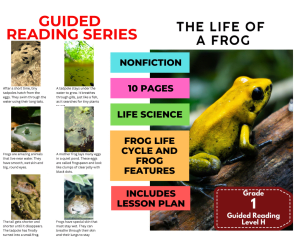
Guided Reading Level H - The Life of a Frog (with Lesson Plan)
ELA, Resources for Teachers, Reading Comprehension, Reading, Science, Animals, Life Sciences, Pre-Reading, Language Development, Vocabulary, Grade 1, 2, 3, Worksheets & Printables, Worksheets, Teacher Tools, Centers, Activities, Literacy Readers, Quizzes, Quizzes and Tests, Assessments, Lesson Plans
This Guided Reading Book - The Life of a Frog (Level H) with lesson plan includes: Guided Reading Color Label (front cover x1) This is a quick way to match the book’s demands to what students can generally handle.. The overall goal is to use the level/color to pick books for several smaller groups. To qualify for a certain level, a student is expected to read a book from that level with about 90–94% accuracy. If a student is consistently accurate and understands, move up a level. If the student is struggling at that level, drop down and add more support. Each student will improve at completely different rates, but it is generally one of the best ways to check progress across the class. DOWNLOAD THE CATALOG TO VIEW ALL GUIDED READING BOOKS AVAILABLE (SORTED LEVELS A-Z) Pre-Reading Question (x1) Teacher asks the prompt aloud, can be while showing the cover or first page. Students share what they already know, or make educated guesses from the cover. Prompt them to use the target vocabulary. Write some of their responses on the board to look back at during the reading. Vocabulary Words (x5) Introduce the five words, best doing it one at a time. Start by saying it, while students repeat and then see if anyone knows what it means before reading further. Read through the meaning and try to briefly connect each word to a picture or gesture so it’s meaningful. Ask students to flip through the book pages and point to where they see each of the vocabulary words. While reading the book pause upon coming across one of the vocab words or read the sentence twice to make sure students understand the word has appeared. Optional: Ask students to raise hands whenever they see/hear one of the new words. Guided Reading Pages (x10) Check the book snapshot (below) for: primary topic - do you need to prep extra reading or intro materials on this? what is taught best - decide on 1-2 bullets to focus on, use the prompt or words provided here for best results. learning goals - what you are checking for students to be able to do after the session, elicit answers using prompts or words provided. key vocabulary (see section above). questions overview - so you know what is coming up and if you need to prep extra materials to assist understanding. Run the lesson You may have already looked at a few of the pages together, but you can show them some of the pictures again first to set meaning. Depending on how much time you have and how familiar your students are with guided reading class, you may want to read the book aloud first with the group first. Students whisper or partner read, while you listen in. If time, do it as a group, one student reading a page each. Use the guided page’s prompts to coach: “Check the picture / does it make sense?” “Point under the words / try the first sound” “Reread the sentence smoothly”. Try to focus more on one student per session (rotating every time), so you can work out if they are ready to move up or need to move down a level. Comprehension Questions (back cover x3) This is your way to check that students didn’t just say the words, but actually understood the text. First, let students answer by pointing to the page/picture and saying a short sentence. After any answer, follow with: “Show me where you found that in the text.” In bigger groups, have partners answer first (10–20 seconds), then call on 2–3 students to share. Differentiation tips: Emerging speakers/struggling readers: oral + pointing On-level: oral in a full sentence Higher: one written sentence or draw + label Book Snapshot Title: The Life of a Frog Genre: Nonfiction (informational life cycle) Subject: Life Science + Reading (Informational Text) Primary Topic: Frog life cycle and frog features Estimated Guided Reading Level (A–Z): H What This Book Teaches Best Explains where frogs live and describes basic frog traits (smooth, wet skin; big, round eyes; living near water). Teaches the frog life cycle in clear steps: eggs (frogspawn) → tadpoles → legs grow → tail disappears → small frog. Shows how a tadpole lives and grows in water, including breathing through gills and eating tiny plants. Describes how frogs breathe (through skin and lungs) and how they get food (long, sticky tongue catching insects). Connects body parts to movement (strong back legs help frogs hop and jump high). Learning Goals Students will describe where frogs live and name physical traits the text mentions. Students will explain what frog eggs are called and describe what they look like. Students will retell the main stages of a frog’s life from eggs to a small frog. Students will describe how tadpoles move, breathe, and find food in the water. Students will explain how the frog’s body changes as legs grow and the tail disappears. Students will use text details to describe how a frog hunts and how it jumps. Key Vocabulary From the Text frogspawn — frog eggs that look like jelly. tadpoles — baby frogs that live in water and have tails. gills — body parts that help an animal breathe underwater. lungs — body parts used for breathing air. insects — small animals a frog can catch and eat. Discussion Prompts Pre-reading question: What changes do you think happen as a tadpole grows into a frog? Comprehension questions: Where does a mother frog lay many eggs, according to the text? Comprehension questions: What do tiny tadpoles use to swim through the water? Comprehension questions: What happens to the tadpole’s tail as it turns into a small frog? Printing Tips 1. Best Printing Method (Recommended) “Booklet” Printing (Best if Available) If your printer or PDF viewer supports Booklet Printing , use this. Settings to use: Print mode: Booklet Paper size: Letter or A4 (either works) Orientation: Landscape Print on both sides: Yes Flip on: Short edge Scaling: Fit to printable area Booklet subset: First test: Front sides only Then: Back sides only This will automatically: Pair pages correctly Put the cover on the outside Align everything for folding After printing, fold in half and staple along the spine . 2. If “Booklet” Printing Is NOT Available You can still print this correctly with manual duplex printing . Step-by-step: Open the PDF. Choose Print . Set: Orientation: Landscape Pages per sheet: 1 Print on both sides: Yes Flip on: Short edge Print all pages . Because each PDF page already contains two facing book pages, the result will still fold cleanly into a book. Thousands of Cored Education products are included with your TeachSimple membership. Download links and encyclopedia index available here.
Author Cored Education
Rating
Tags Reading Comprehension, Reading Passages, Reading, Guided Reading, Guided Reading Lesson Plan, Guided Reading Activity, Pre-reading, Science Lesson Plans, Animals, Frog Life Cycle
Animal Unit
Science, Life Sciences, Animals, Grade 2, 3, 4, Lesson Plans, Teacher Tools
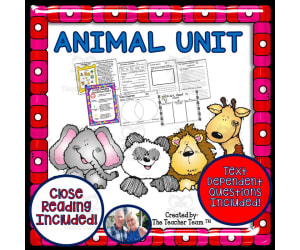
The Animal Unit The Animal Unit is a comprehensive, 151-page teaching resource that not only informs and engages students but also enhances their reading comprehension skills. It combines a variety of teaching tools to provide an in-depth study on animals with a strong emphasis on vertebrates – mammals, birds, fish, amphibians and reptiles. Included in this package: Original close reading non-fiction passages aimed at familiarizing students with concepts such as animal classification and characteristics, animal biomes and habitats, and animal life cycles. Vibrant picture cards featuring both vertebrate and invertebrate creatures which can be used effectively for sorting games or categorizing exercises. Focused Learning Principles This pack has been thoughtfully designed to stimulate deep thinking amongst students. It emphasizes Depth of Knowledge (D.O.K) principles across all its components. Coupled with each passage are text-dependent questions that form an effective summative assessment . Vocabulary cards linked to each text contribute towards the enrichment of student's language repository. Educational Aids Included: KWL charts for understanding prior knowledge levels of students about animals; Venn Diagrams for comparison purposes; Tree Map Graphic Organizer incorporated into the unit for grammar analysis activities based on words used in the passages; Cognitive content dictionaries that act as vocabulary books providing student-friendly definitions. Note: The versatility offered by The Animal Unit allows educators to choose components according to their teaching objectives or classroom needs thereby accommodating diverse learning settings - whole-group instructions strategies or small group activities or even homework assignments. Conclusively,"The Animal Unit" is an intriguing learning journey where discoveries about our natural world will be made at every stage while reinforcing necessary cognitive skills in students from Grade 2 through Grade 4.
Author The Teacher Team
Tags Animals, Classification, Habitats, Life Cycles, Non-fiction Passages