



3,945 products added recently
Page 22 - Holiday and Seasonal Quizzes
Holiday and Seasonal Quizzes add a festive element to assessments, making them more enjoyable for students. These quizzes feature questions related to holidays like Christmas, Halloween, and Spring festivals, blending curriculum content with seasonal themes. They can cover topics such as historical origins, cultural practices, or subject-specific questions presented in a holiday context. Using these quizzes keeps students motivated and interested in learning, especially during times when attention spans might wane due to holiday excitement.

 Show filters


Candy Reading Comprehension 1 Lesson Sample Google Slides
ELA, Language Development, Resources for Teachers, Vocabulary, Spelling, Reading Comprehension, Reading, Common Core, Grade 2, 3, 4, 5, Teacher Tools, Centers, Activities, Assessments, Tests, Quizzes and Tests, Presentations, Quizzes
THIS IS A ONE LESSON FREE SAMPLE OF THE FOLLOWING PRODUCT: Themed Reading Comprehension Passages Series - Candy This reading comprehension series is built for grades 2 to 5 and keeps things simple, clear, and easy to use. Every title follows a fun, kid-friendly theme and comes with two passage levels, one written for grades 2 to 3 and a more challenging version for grades 4 to 5. Students then work through a mix of follow-up pages that check understanding in different ways: multiple-choice questions, short written responses, scrambled words, a quick summary, and a theme-based word problem. Answer keys are included, so prep stays minimal. Each resource also comes in nine classroom-friendly formats, so you can choose what fits your setup: print or digital, editable or ready to go, and even self-grading options. Because the layout stays consistent, it is easy to plug into whole-class lessons, small groups, literacy centers, morning work, fast finisher tubs, sub plans, or home learning. It is a straightforward way to build comprehension, practice reading skills in context, and strengthen written responses without adding extra steps for you. Candy Lesson List Note: This product has titles different to those in the rest of the themed series. 1. Candy Types 2. Candy Flavors 3. Candy Shapes and Colors 4. Candy Ingredients 5. Candy Fun Facts GOOGLE SLIDES VERSION The same editable layout as PPT, but in the cloud for easy sharing, student access, and instant updates. Other versions are available in the links list below or in the full catalog. How to Use These Lessons Perfect for: Morning work or early-finisher bins Guided reading blocks or comprehension warmups Literacy centers or small-group rotations Holiday/seasonal review lessons Independent stations, sub plans, or take-home enrichment More Candy Themed Products CROSSWORDS WORDSEARCHES MAZES FULL CATALOG OF DOWNLOAD LINKS HERE Themed Reading Links Addition Animals Around the Home Birthday FORMATS: -FORMAL ASSESSMENT VERSION -PRESENTABLE PDF -PPT -SLIDES - PDF -FILLABLE PDF -WORD -FORMS -DOCS SUPPLEMENTARY MATERIALS (COMING SOON): -VISUAL READING PASSAGE VIDEO -GUIDED LEARNING VIDEO -LESSON PLANS Candy FORMATS: -FORMAL ASSESSMENT VERSION -PRESENTABLE PDF -PPT -SLIDES -PDF -FILLABLE PDF -WORD -FORMS -DOCS SUPPLEMENTARY MATERIALS (COMING SOON): -VISUAL READING PASSAGE VIDEO -GUIDED LEARNING VIDEO -LESSON PLANS Christmas Cinco de Mayo Clothes Colors Days and Months Division Earth Day Easter Easy Mazes Fall Father's Day Food Geography (Set 1) Geography (Set 2) Geography (Set 3) Graduation Health History (Set 1) History (Set 2) History (Set 3) Human Body Kindness Life Skills Mother's Day Multiplication Science (Set 1) Science (Set 2) Science (Set 3) Shapes Social Skills Spring Sports St. Patrick's Day Subtraction Summer Thanksgiving Transport Valentine's Day Winter Free One Lesson Themes Chinese New Year Lunar New Year Halloween Pink Shirt Day Independence Day Juneteenth President's Day Groundhog Day Readings in Depth Structure Each resource is built around a focused sub-theme within the broader topic. Students read two leveled passages (Grades 2–3 and Grades 4–5), then move through a short, consistent sequence of activities that checks understanding and keeps momentum: multiple-choice, brief written responses, a scrambled-words review, a compact summary task, and a light theme-linked word problem. The flow is predictable for students, but varied enough to feel fresh across topics. Each completed resource includes: Two differentiated reading passages (lower and upper level) A multiple-choice comprehension page Short written-response questions A scrambled-words or quick vocabulary check A brief summary activity A simple, theme-connected word problem Answer keys for fast marking and easy self-checking Nine classroom-friendly formats, including print, editable, digital, and self-grading options Themes Included These readings span a wide range of age-appropriate, high-interest topics, such as: Seasons and celebrations Real-world science and nature Community, character, and life skills Everyday high-frequency themes students already enjoy Each title connects to familiar experiences while strengthening comprehension, vocabulary in context, and clear written expression. Easy extensions (optional): Read twice: first for gist, second to highlight key details Write two “right there” questions and swap with a partner Create a 3-bullet fact list or mini mind map Turn the summary into a 3-sentence retell using sequence words Add one extra math question connected to the topic Compare the two levels: what details appear in both? Differentiation tips: Pre-teach 2–3 key words with quick examples Offer sentence starters for written responses Use partner reading: one reads aloud, one tracks evidence Allow highlighting or underlining before answering questions Provide a shorter chunking option for students who need breaks Encourage confident readers to justify answers with a quoted detail For similar downloads and other frees, do check out Cored Group on TeachSimple.
Author Cored Education
Rating
Tags Vocabulary, Spelling, Candy, Candy Activities, Writing Prompts, Word Problems, Reading Comprehension, Candy Reading, Candy Passages, Reading Passages

Guided Reading Level H - The Story of the Wheel
ELA, Resources for Teachers, Reading Comprehension, Reading, Language Development, Vocabulary, Engineering, Technology, Science, Physics, Kindergarten, Grade 1, 2, Worksheets & Printables, Worksheets, Teacher Tools, Centers, Activities, Literacy Readers, Quizzes, Quizzes and Tests, Assessments
This Guided Reading Book - The Story of the Wheel (Level H) includes: Guided Reading Color Label (front cover x1) This is a quick way to match the book’s demands to what students can generally handle.. The overall goal is to use the level/color to pick books for several smaller groups. To qualify for a certain level, a student is expected to read a book from that level with about 90–94% accuracy. If a student is consistently accurate and understands, move up a level. If the student is struggling at that level, drop down and add more support. Each student will improve at completely different rates, but it is generally one of the best ways to check progress across the class. DOWNLOAD THE CATALOG TO VIEW ALL GUIDED READING BOOKS AVAILABLE (SORTED LEVELS A-Z) Pre-Reading Question (x1) Teacher asks the prompt aloud, can be while showing the cover or first page. Students share what they already know, or make educated guesses from the cover. Prompt them to use the target vocabulary. Write some of their responses on the board to look back at during the reading. Vocabulary Words (x5) Introduce the five words, best doing it one at a time. Start by saying it, while students repeat and then see if anyone knows what it means before reading further. Read through the meaning and try to briefly connect each word to a picture or gesture so it’s meaningful. Ask students to flip through the book pages and point to where they see each of the vocabulary words. While reading the book pause upon coming across one of the vocab words or read the sentence twice to make sure students understand the word has appeared. Optional: Ask students to raise hands whenever they see/hear one of the new words. Guided Reading Pages (x10) Check the book snapshot (below) for: primary topic - do you need to prep extra reading or intro materials on this? what is taught best - decide on 1-2 bullets to focus on, use the prompt or words provided here for best results. learning goals - what you are checking for students to be able to do after the session, elicit answers using prompts or words provided. key vocabulary (see section above). questions overview - so you know what is coming up and if you need to prep extra materials to assist understanding. Run the lesson You may have already looked at a few of the pages together, but you can show them some of the pictures again first to set meaning. Depending on how much time you have and how familiar your students are with guided reading class, you may want to read the book aloud first with the group first. Students whisper or partner read, while you listen in. If time, do it as a group, one student reading a page each. Use the guided page’s prompts to coach: “Check the picture / does it make sense?” “Point under the words / try the first sound” “Reread the sentence smoothly”. Try to focus more on one student per session (rotating every time), so you can work out if they are ready to move up or need to move down a level. Comprehension Questions (back cover x3) This is your way to check that students didn’t just say the words, but actually understood the text. First, let students answer by pointing to the page/picture and saying a short sentence. After any answer, follow with: “Show me where you found that in the text.” In bigger groups, have partners answer first (10–20 seconds), then call on 2–3 students to share. Differentiation tips: Emerging speakers/struggling readers: oral + pointing On-level: oral in a full sentence Higher: one written sentence or draw + label Book Snapshot Title: The Story of the Wheel Genre: Nonfiction (informational) Subject: Science (Engineering / Simple Machines) Primary Topic: How wheels changed over time and how they work Estimated Guided Reading Level (A–Z): H What This Book Teaches Best What wheels are and what they help people do: move heavy things with less effort. How wheels changed over time (from heavy stone/wood wheels to spoked wheels to modern rubber tires). Why different wheels are designed differently for different jobs (tractor treads for mud; thin bicycle wheels for speed; small wheels for gliding). That not all wheels are for travel—gears are wheels with teeth that help machines move. Learning Goals Students will explain what wheels are used for using a detail from the text. Students will describe how the first wheels were made long ago, according to the book. Students will explain why spoked wheels helped carts move faster using the book’s comparison. Students will describe how treads help tractor wheels move through thick, wet mud. Students will identify one way gears are different from travel wheels and tell what gears do in machines. Key Vocabulary From the Text spokes — thin parts connecting the center to the outside. oxen — strong animals that pull heavy loads. rubber — stretchy material used to make tires. treads — deep grooves that help a tire grip ground. gears — wheels with teeth that help machines move. Discussion Prompts Pre-reading question: How do you think wheels help people move things more easily? Comprehension questions: What does the book say wheels are used for? What were the very first wheels made from long ago? What are gears, and what do they help machines do? Printing Tips 1. Best Printing Method (Recommended) “Booklet” Printing (Best if Available) If your printer or PDF viewer supports Booklet Printing , use this. Settings to use: Print mode: Booklet Paper size: Letter or A4 (either works) Orientation: Landscape Print on both sides: Yes Flip on: Short edge Scaling: Fit to printable area Booklet subset: First test: Front sides only Then: Back sides only This will automatically: Pair pages correctly Put the cover on the outside Align everything for folding After printing, fold in half and staple along the spine . 2. If “Booklet” Printing Is NOT Available You can still print this correctly with manual duplex printing . Step-by-step: Open the PDF. Choose Print . Set: Orientation: Landscape Pages per sheet: 1 Print on both sides: Yes Flip on: Short edge Print all pages . Because each PDF page already contains two facing book pages, the result will still fold cleanly into a book. Thousands of Cored Education products are included with your TeachSimple membership. Download links and encyclopedia index available here.
Author Cored Education
Rating
Tags Vocabulary, Reading Comprehension, Reading Passages, Leveled Reading, Nonfiction, Reading, Guided Reading, Physics, Engineering, Technology
Prompt Engineering for Kids
Science, Technology, Computer Science, Engineering, Research, Resources for Teachers, Classroom Management, Community Building, STEM, Special Resources, Grade 4, 5, 6, 7, 8, 9, 10, Worksheets & Printables, Workbooks, Worksheets, Word Searches, Writing Prompts, Teacher Tools, Lesson Plans, Quizzes and Tests, Quizzes, Tests
Unlock the #1 Skill of the AI Age! | Prompt Engineering for Kids: A Complete Curriculum Are you looking to prepare your students for a future powered by Artificial Intelligence? "Prompt Engineering for Kids" is a comprehensive, no-prep curriculum designed to transform students from passive technology users into active, confident digital creators. This is the essential guide to teaching the most critical new literacy of the 21st century: how to communicate effectively with AI. In a world where the quality of an answer depends entirely on the quality of the question, this resource teaches students the art and science of "prompt writing." Forget vague questions and generic answers. Students will master the C.A.S.T. methodology (Context, Action, Subject, Target Constraints) to craft precise, powerful instructions that unlock the full potential of any digital tool. This 42-page resource is more than just a workbook; it's a complete, three-part curriculum perfect for middle school technology, ELA, computer science, or gifted and talented programs. What's Inside? Part 1: The Textbook (Core Theory): Four engaging chapters that break down the core concepts of prompt engineering, from the "Anatomy of a Perfect Instruction" to the "Iterative Cycle" of refining prompts. Part 2: The Student Workbook: Ten hands-on, scaffolded worksheets that challenge students to apply what they've learned. They'll practice everything from contextual framing and setting constraints to persona calibration and algorithmic thinking. Part 3: Teacher Resources: Everything you need to successfully implement the curriculum, including pedagogical visuals (anchor charts), a comprehensive answer key for all worksheets, and a detailed Teacher Implementation Guide with classroom strategies and a professional grading rubric. By the end of this unit, your students won't just know about AI; they'll know how to command it. They will have developed invaluable skills in logic, precision, critical thinking, and clear communication that will give them a formidable advantage in high school, college, and their future careers. Equip your students with the ultimate toolset for tomorrow's professional landscape. Download "Prompt Engineering for Kids" today! Keywords: Prompt Engineering for Kids, AI for Students, Digital Literacy, Middle School Technology, 21st Century Skills, AI Curriculum, Student Workbook, Teacher Resources, Future-Ready Skills, Critical Thinking, Computer Science, STEM, ELA, Google, ChatGPT for Education. Why Parents/Schools Love It: Builds Future-Proof Skills: This curriculum teaches prompt engineering, a critical and in-demand skill that prepares students for the AI-driven jobs of the future. Develops Critical Thinking: It goes beyond simple tech use, training students in logic, problem-solving, and precision, turning them into active, analytical thinkers. Complete "No-Prep" Resource: It's an all-in-one package with a textbook, 10 student worksheets, visual aids, full answer keys, and a teacher's guide with a grading rubric, saving educators valuable prep time. Engaging & Relevant Content: The lessons use fun, kid-friendly scenarios (superheroes, video games, fantasy stories) to explain complex concepts, keeping students highly engaged. Promotes Active Digital Citizenship: It transforms students from passive consumers of digital content into confident "digital architects" who can control and command technology effectively and responsibly. Target Student Classes : Based on a full analysis of the content, vocabulary, and examples (e.g., Grade 5, Grade 6, and Grade 7 are mentioned), target the following: Primary Target: Middle School (Grades 5-8) . The concepts of logic, abstract thinking, and the complexity of the worksheets are perfectly suited for this age group. Secondary Target: Advanced Upper Elementary (Grade 4) in gifted and talented programs. Introductory High School (Grade 9) for tech, digital literacy, or career-readiness classes. Ideal Subject Areas: Technology Class, Computer Science, Digital Literacy, English Language Arts (ELA) (for its focus on precise writing and communication), STEM/STEAM electives, and Enrichment Programs. Copyright/Terms of Use: This Book was copyrighted by Syed Hammad Rizvi. This resource is for personal and single classroom use only. You may not alter, redistribute, or sell any part of this resource. In other words, you may not put it on the Internet where it could be publicly found and downloaded. If you want to share this resource with colleagues, please purchase additional licenses from Teachsimple. Thank you for respecting these terms of use. This product is happily brought to you by Syed Hammad Rizvi
Author Creative Book Store
Rating
Tags PromptEngineeringForKids, AILiteracy, FutureReadySkills, AIinEducation, AIforStudents, 21stCenturySkills, DigitalLiteracy, ComputerScienceForKids, STEMeducation, STEAMeducation
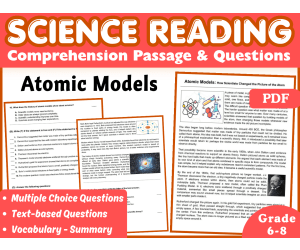
Atomic Models: Physical Science Reading Comprehension Passage (PDF)
Science, ELA, Reading, Reading Comprehension, Strategies, Resources for Teachers, Common Core, Language Development, Physics, Grade 6, 7, 8, 9, 10, Writing Prompts, Worksheets & Printables, Centers, Activities, Teacher Tools, Assessments, Quizzes and Tests, Quizzes, Tests, Literacy Readers
Physical Science Reading Comprehension Passage and Questions for Middle School: Atomic Models (PDF) This resource explores how scientists’ understanding of the atom changed over time as new evidence became available . Students follow the development of atomic models from Democritus’s early idea of indivisible particles to Dalton’s solid-sphere model, Thomson’s discovery of the electron, Rutherford’s nuclear model, Bohr’s energy levels, and the modern electron-cloud model . It emphasizes how scientific models are revised when new experiments and discoveries provide better evidence . It also introduces important ideas such as electrons, the nucleus, empty space within atoms, energy levels, electron clouds, and probability . This passage is designed to bridge the gap between science and literacy by strengthening reading comprehension while sparking scientific curiosity in middle school students. It blends English Language Arts skills with accurate science content, helping students build background knowledge, understand key concepts, use evidence from the text, and explain scientific ideas clearly. This resource supports science classroom practice while also reinforcing important literacy skills such as main idea, vocabulary, comprehension, and summarizing. Ideal for interdisciplinary learning in ELA and Science. Suitable for Grade 9 review, too! Student Tasks for The Passage: 10 multiple-choice questions targeting main idea, key details, science concepts, comparison, and real-world applications 10 True/False statements to check understanding and address common misconceptions 5 text-based short-answer questions that require students to explain important ideas from the passage 5 vocabulary matching items with clear, student-friendly definitions 1 summary prompt that asks students to condense the central ideas accurately Full answer key for every section Available Formats for this Resource Fillable PDF Word Docs Google Docs Product Details Length: 7 pages total Grades: 6–8, also suitable for Grade 9 review Use cases: close reading, stations, homework, intervention, test prep, and sub plans Standards support: Reinforces informational-text skills and supports NGSS-style sense-making by helping students read scientific explanations, connect evidence to key concepts, interpret real-world examples, and explain cause-and-effect relationships in science. FULL CATALOG OF DOWNLOADING LINKS HERE Other Science Reading Collections and Topics You May Find in the Store: 1. Astronomy & Space Science 2. Volcanoes, Rocks, & Mountains 3. Rock Cycle, Soil, & Sinkholes 4. Mars, Glaciers, & Antarctica 5. Water Cycle, Acid Rain, & Wastewater 6. Insects, Animals, & Ecosystems 7. Bioluminescence & Insects 8. Animal Skin, Cats, & T. Rex 9. Human Body and Senses 10. Health & Applied Bioscience 11. Waves, Light, & Imaging 12. Electricity & Energy 13. Motion & Materials 14. Chemistry and Materials Science 15. Electromagnetism 16. Acids and Bases 17. Gas Laws 18. Biotechnology 19. Periodic Trends 20. Protists and Fungi 21. Microevolution 22. Blood 23. Chemical Bonding 24. Magnets 25. Muscles 26. Nuclear Chemistry 27. Electromagnetic Devices 28. Epigenetics 29. The Law of Conservation of Mass 30. Atomic Models 31. Isotopes and Ions 32. Light 33. Human-Environment Interaction 34. Theory of Evolution 35. Photosynthesis 36. Origins of Life and Early Earth 37. Gene Expression and Regulation 38. Thermochemistry 39. Allergies 40. Coevolution 41. Birth to Adulthood 42. Cells 43. Entropy and Free Energy 44. The Human Brain 45. Mixtures and Solutions 46. Invertebrates 47. Zoo Animals 48. Biochemistry 49. Animal Behavior 50. Population Ecology ...and many more engaging science reading passages that cover intriguing and important topics designed to spark curiosity and support student learning. Use this passage to reinforce ELA skills in science, to add literacy to your lessons, and to support independent work. The passages strengthen main idea, evidence use, vocabulary in context, inference, cause and effect, and summary writing. With ready-to-use assessments and complete answer keys, you can provide focused practice that is simple to run and fast to review.
Author Middle & High School - CORED Education
Rating
Tags Middle School, Reading Comprehension, Reading Strategies, ELA, Centers, Reading Passage, Assessments, Vocabulary, Physical Science, Physics
Pizza Reading Comprehension Passage - Cored Ed Encyclopedia
ELA, Language Development, Resources for Teachers, Reading Comprehension, Reading, Pre-Reading, Writing, Strategies, History, Social Studies, Grade 2, 3, 4, 5, Worksheets & Printables, Worksheets, Teacher Tools, Centers, Activities, Writing Prompts, Assessments, Tests, Quizzes and Tests, Quizzes
This pizza reading comprehension contains the following: Visualize on the Cover (Teacher Read Aloud Script) Start your lesson by taking a few moments to visualize the topic and share thoughts or feelings about it. Pre-Reading Trivia Students will write down one thing they already know about the subject and then read five more facts and discuss. These facts are fun, and the students will enjoy learning about the subject before reading more. Reading Passage The text is a high-interest reading passage with set paragraphs, roughly three to four paragraphs long. It contains a variety of themes about the topic, anywhere from history to technology. The passage is between 250 and 350 words in length. Mixed Questions The first question page contains four multiple-choice questions, each with a choice of four answers, and three written response questions that require a sentence or two from the student. Vocabulary Questions Practice seven key words from the text in this section across two activities. First section is scrambled words where students will unscramble three words given a clue for each. The second section is a word to meaning matching activity. Creative Writing In this question, the student will be required to write a five to eight sentence paragraph on a question related to the topic. Extension Activities This page is optional for fast finishers or to take home. There are several activities, each one requiring a different skill. Do some, do none, do all, completely optional - but you will feel reassured knowing every possibility is planned for. Includes summary writting question. Answer Key There are answers for the multiple-choice questions, written response questions have sample answers, vocabulary answers and if there is a summary question then a sample summary will be provided as well. FULL CATALOG OF DOWNLOAD LINKS AND ENCYCLOPEDIA INDEX HERE Lesson Snapshot Title: Pizza Genre: Nonfiction (informational text) Subject: Social Studies (culture/history of food) + Reading Informational Text Primary Topic: How pizza began in Naples and spread Estimated Guided Reading Level (A–Z): Q What This Lesson Teaches Best How pizza grew from simple flatbreads into popular street food in Naples, Italy , including a “Marinara” style known by the 1700s. How tomatoes arriving from the Americas changed pizza toppings, leading to styles that look familiar today. Key details of a classic Margherita-style pizza and a text-defined term: the raised crust edge called the cornicione . How a famous 1889 story about Queen Margherita is presented as a legend with details that are debated by historians. How foods change as people move: pizza “traveled,” becoming thick and cheesy in some places and thin, crisp, or foldable in others—while Naples guards its craft, recognized by UNESCO . Learning Goals Students will explain how the passage describes pizza starting from flatbreads and becoming special in Naples. Students will describe how tomatoes changed pizza in Naples using details from the text. Students will identify the toppings listed for a classic Margherita-style pizza in the passage. Students will explain what the passage says is debated about the Queen Margherita story. Students will describe how the passage says pizza changed as it traveled to new countries. Key Vocabulary From the Text Neapolitan — from Naples; connected to pizza made there. cornicione — the raised edge of the crust. Marinara — a simple pizza style known in Naples long ago. historians — people who study and write about the past. UNESCO — a group that recognizes important cultural traditions. Cored Ed Encyclopedia Overview The Cored Ed Encyclopedia is a weekly series of lessons that you can pick up and use right away. These short readings fit into whatever time you have available. Each one includes a warm-up, a reading, and a set of questions, but it’s flexible — you can do just the reading, the full lesson, or skip the writing section if you need to. Each lesson focuses on a single topic so students don’t get lost. The writing is clear but never childish, making it perfect for grades two through five. Topics range from animals and science to history, inventions, and everyday things. No matter the level of the student, everyone should take away at least one new idea or fact from each lesson. The materials are easy to print, easy to explain, and require no setup. They work well for whole-class teaching, partner work, or independent study.
Author Cored Education
Rating
Tags Vocabulary, Spelling, Reading Comprehension, Reading Passages, Reading, Creative Writing, Reading Strategies, Writing Prompts, Pizza, History
The Universe Reading Comprehension Passage - Cored Ed Encyclopedia
ELA, Language Development, Reading Comprehension, Reading, Science, Earth and Environmental Sciences, Space, Pre-Reading, Vocabulary, Physics, Grade 2, 3, 4, 5, Worksheets & Printables, Worksheets, Teacher Tools, Centers, Activities, Writing Prompts, Assessments, Quizzes and Tests, Quizzes, Lesson Plans
This universe reading comprehension with lesson plan includes: Visualization (on the front cover) Start your lesson by taking a minute to think and share something about the topic. Read the script aloud (slowly), perhaps prepare some music or sound effects. Student close their eyes and let their imaginations wander. Students open their eyes, read the question aloud and give them a few minutes to complete. Ask a few students to share or keep answers until the end to compare with what they learn in the passage. Quick pause—thousands of Cored Education products are included with your TeachSimple membership. Download links and encyclopedia index available here. Pre-Reading Trivia Students will write down one thing they already know about the subject and then read five more facts and discuss. These facts are fun, and the students will enjoy learning about the subject before reading more. Give 1 minute for students to write what they already know (no pressure—best guess is fine). Read the five facts together. After each fact, do ask a student for their opinion, was it surprising? Set a purpose by asking students to highlight/underline one fact they want to learn more about during the reading. Reading Passage The text is a high-interest reading passage with set paragraphs, roughly three to four paragraphs long. It contains a variety of themes about the topic, anywhere from history to technology. The passage is between 250 and 350 words in length. First, ask students to look at the headings and see what they’ll learn about today. What do they know about the topic/heading? First read options: Teacher read-aloud (best for support). Partner reading (paragraph by paragraph). While reading, students underline important details, and vocabulary words they think may come up in the questions section. Mixed Questions The first question page contains four multiple-choice questions, each with a choice of four answers, and three written response questions that require a sentence or two from the student. Students complete the mcqs first independently, then review quickly as a class. For the 3 written responses, try to get students giving the answer with some form of evidence: “I think ___ because the text says ___.” If students get stuck, send them back to check the passage. Vocabulary Questions Practice seven key words from the text in this section across two activities. First section is scrambled words where students will unscramble three words given a clue for each. The second section is a word to meaning matching activity. Before starting, have some students read out words they underlined in the passage. Ask students to say the word and read aloud the sentence(s) around each word. Ask students to do scrambled words and the matching exercise in pairs then go through answers as a class. For the scrambled spelling task, get four pairs to come up to the board and write the words for extra practice with the other student reading out the clue. For the matching task, prompt students to give full sentences: “I matched ___ with ___ because ___.” Creative Writing In this question, the student will be required to write a five to eight sentence paragraph on a question related to the topic. Before starting, ask students write down 3 key ideas they are going to include in their piece. Ask students for ideas to share around the class to help those struggling. Pro writing expectations: 5–8 sentences At least 2 facts or details from the passage At least 2 vocabulary words from the previous page Students read their paragraphs while classmates listen for facts and vocabulary words. Extension Activities This page is optional for fast finishers or to take home. There are several activities, each one requiring a different skill. Do some, do none, do all, completely optional - but you will feel reassured knowing every possibility is planned for. Includes summary writting question. Answer Key There are answers for the multiple-choice questions, written response questions have sample answers, vocabulary answers and if there is a summary question then a sample summary will be provided as well. Lesson Plan Included Customized lesson plan for this lesson is included. Lesson Snapshot Title: The Universe Genre: Nonfiction (informational text) Subject: Science (Earth & Space Science) Primary Topic: Evidence the universe is expanding over time Estimated Guided Reading Level (A–Z): S What This Lesson Teaches Best Defines universe as “all of space and time and everything inside them,” expanding beyond the idea of stars as a “roof” above Earth. Explains how improved telescopes helped people realize some “cloudy” spots were actually faraway galaxies beyond the Milky Way. Uses the idea of galaxy light “shifted toward red” to show galaxies moving away and that space itself is stretching. Introduces the Big Bang as an explanation for expansion from a hotter, denser beginning, including the estimated age of the universe (about 13.8 billion years). Builds scientific curiosity by highlighting unanswered questions about “dark” ingredients that can’t be seen directly but affect the universe through gravity and expansion. Learning Goals Students will explain what the word universe means using details from the passage. Students will describe how better telescopes changed what people understood about “cloudy” spots in the sky. Students will explain what “shifted toward red” light suggests about galaxies and space stretching. Students will summarize the Big Bang idea as the universe expanding from a hotter, denser state. Students will describe why looking deep into space can also mean looking back in time. Students will identify one mystery scientists still study about the universe mentioned in the text. Key Vocabulary From the Text universe — all space, time, and everything inside them. galaxies — huge groups of stars far beyond the Milky Way. stretching — space expanding so distances grow larger. expanding — growing bigger as space spreads out. gravity — a force that affects everything by pulling. FULL CATALOG OF DOWNLOAD LINKS AND ENCYCLOPEDIA INDEX HERE
Author Cored Education
Rating
Tags Vocabulary, Reading Comprehension, Reading Passages, Lesson Plans, Ela Lesson Plans, Reading Comprehension Lesson Plans, Pre-reading, Science Lesson Plans, Earth Science, Space
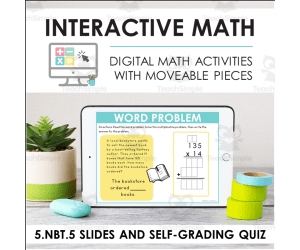
Digital Math for 5.NBT.5 - Multiply Multi-Digit Whole Numbers (Slides + Self-Grading Quiz)
Math, Multiplication and Division, Division, Grade 5, Quizzes, Quizzes and Tests, Teacher Tools
Digital Math for 5.NBT.5 - Multiply Multi-Digit Whole Numbers (Slides + Self-Grading Quiz) An engaging and dynamic teaching resource developed with instructional best practices in mind. This educational tool harnesses the power of digital technology to make learning multiplication more interactive and enjoyable, instantly evaluating student progress. A Multifaceted Teaching Resource Provides review, practice, and enhancement opportunities through interactive digital math slides. Facilitates visualization of mathematical concepts by involving students in tasks such as dragging, dropping, and sorting images digitally – an excellent tool for scaffolding understanding. Can be seamlessly integrated into any virtual classroom setup using PowerPoint or Google Slides ; accommodates various teaching styles including whole class instruction as well as small group workstations. FLEXIBILITY: This robust tool offers personalized lesson delivery; teachers can assign either the entire file or specific slides at a time depending on individual learner needs or pedagogical goals. Self-Grading Google Forms Quiz Alignment The unique self-grading Google Forms quiz feature provides real-time data about each student's understanding of multiplying multi-digit whole numbers. Learners are also given immediate feedback on their performance. Included In This Package: 20 Interactive Student-Friendly Slides: Engaging distance learning assignment that is effective when utilised during small-group instruction or independently at centres. Digital Math for 5.NBT.5 - Multiply Multi-Digit Whole Numbers beautifully combines compelling visuals with meaningful substance—"promoting deeper commonsensical conceptualization while accurately gauging skill acquisition simultaneously—all packaged conveniently within a user-friendly digital format."
Author Markers and Minions
Tags Multiplication, Digital Slides, Self-grading Quiz, Interactive Learning, Multi-digit Numbers, Nbt.5, 5.nbt.5 Word Problems, 5 Nbt 5 Word Problems

Nests Reading Comprehension Passage - Cored Ed Encyclopedia
ELA, Language Development, Resources for Teachers, Reading Comprehension, Reading, Pre-Reading, Science, Writing, Animals, Life Sciences, Grade 2, 3, 4, 5, Worksheets & Printables, Worksheets, Teacher Tools, Centers, Activities, Writing Prompts, Assessments, Tests, Quizzes and Tests, Quizzes
This nests reading comprehension contains the following: Visualize on the Cover (Teacher Read Aloud Script) Start your lesson by taking a few moments to visualize the topic and share thoughts or feelings about it. COMPANION VIDEO NOW AVAILABLE (EMBEDDED AFTER PREVIEW PICTURES IN PRODUCT DESCRIPTION) Pre-Reading Trivia Students will write down one thing they already know about the subject and then read five more facts and discuss. These facts are fun, and the students will enjoy learning about the subject before reading more. Reading Passage The text is a high-interest reading passage with set paragraphs, roughly three to four paragraphs long. It contains a variety of themes about the topic, anywhere from history to technology. The passage is between 250 and 350 words in length. Mixed Questions The first question page contains four multiple-choice questions, each with a choice of four answers, and three written response questions that require a sentence or two from the student. Vocabulary Questions Practice seven key words from the text in this section across two activities. First section is scrambled words where students will unscramble three words given a clue for each. The second section is a word to meaning matching activity. Creative Writing In this question, the student will be required to write a five to eight sentence paragraph on a question related to the topic. Extension Activities This page is optional for fast finishers or to take home. There are several activities, each one requiring a different skill. Do some, do none, do all, completely optional - but you will feel reassured knowing every possibility is planned for. Includes summary writting question. Answer Key There are answers for the multiple-choice questions, written response questions have sample answers, vocabulary answers and if there is a summary question then a sample summary will be provided as well. FULL CATALOG OF DOWNLOAD LINKS AND ENCYCLOPEDIA INDEX HERE Lesson Snapshot Title: Nests Genre: Nonfiction Subject: Life Science (animal behavior & habitats) Primary Topic: How animals build nests to protect young Estimated Guided Reading Level (A–Z): N What This Lesson Teaches Best Explains the purpose of nests as “a special place” animals make to protect eggs or young. Shows that nests aren’t only for birds—some fish, insects, and mammals make nests too. Describes how nests are built from nearby materials (twigs, dry grass, leaves, soft feathers), and how some birds use mud or sticky spider silk. Compares different nest types and locations (smooth cups, simple scrapes, tree holes, burrows, hanging woven bags, domes with entrance tunnels). Connects nesting to safety and care: nests help hide eggs, block harsh weather, hold warmth while parents brood, and staying litter-free helps wild nests stay safer. Learning Goals Define a nest using details from the passage. Explain that many kinds of animals (not only birds) make nests. Identify materials the passage says nests can be made from. Describe at least two different nest shapes or structures mentioned in the text. Explain how nests help eggs and young stay safe and warm, using evidence from the passage. Describe one way people can help keep wild nests safer, based on the passage. Key Vocabulary From the Text Cliffs — steep rocky sides of land. Burrows — holes in the ground used as homes. Scrape — a shallow dip in sand or soil. Instinct — a natural feeling that guides what to do. Brood — sit on eggs to keep them warm. Cored Ed Encyclopedia Overview The Cored Ed Encyclopedia is a weekly series of lessons that you can pick up and use right away. These short readings fit into whatever time you have available. Each one includes a warm-up, a reading, and a set of questions, but it’s flexible — you can do just the reading, the full lesson, or skip the writing section if you need to. Each lesson focuses on a single topic so students don’t get lost. The writing is clear but never childish, making it perfect for grades two through five. Topics range from animals and science to history, inventions, and everyday things. No matter the level of the student, everyone should take away at least one new idea or fact from each lesson. The materials are easy to print, easy to explain, and require no setup. They work well for whole-class teaching, partner work, or independent study.
Author Cored Education
Rating
Tags Vocabulary, Spelling, Reading Comprehension, Reading Passages, Reading, Creative Writing, Reading Strategies, Writing Prompts, Nests, Life Science
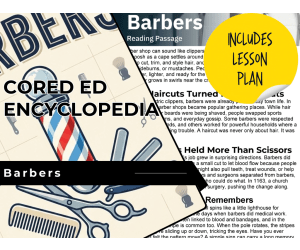
Barbers Reading Comprehension Passage - Cored Ed Encyclopedia
ELA, Language Development, Reading Comprehension, Reading, Social Studies, Writing, Vocabulary, History, Pre-Reading, Spelling, Grade 2, 3, 4, 5, Worksheets & Printables, Worksheets, Teacher Tools, Centers, Activities, Writing Prompts, Assessments, Quizzes and Tests, Quizzes, Lesson Plans
This barbers reading comprehension with lesson plan includes: Visualization (on the front cover) Start your lesson by taking a minute to think and share something about the topic. Read the script aloud (slowly), perhaps prepare some music or sound effects. Student close their eyes and let their imaginations wander. Students open their eyes, read the question aloud and give them a few minutes to complete. Ask a few students to share or keep answers until the end to compare with what they learn in the passage. Quick pause—thousands of Cored Education products are included with your TeachSimple membership. Download links and encyclopedia index available here. Pre-Reading Trivia Students will write down one thing they already know about the subject and then read five more facts and discuss. These facts are fun, and the students will enjoy learning about the subject before reading more. Give 1 minute for students to write what they already know (no pressure—best guess is fine). Read the five facts together. After each fact, do ask a student for their opinion, was it surprising? Set a purpose by asking students to highlight/underline one fact they want to learn more about during the reading. Reading Passage The text is a high-interest reading passage with set paragraphs, roughly three to four paragraphs long. It contains a variety of themes about the topic, anywhere from history to technology. The passage is between 250 and 350 words in length. First, ask students to look at the headings and see what they’ll learn about today. What do they know about the topic/heading? First read options: Teacher read-aloud (best for support). Partner reading (paragraph by paragraph). While reading, students underline important details, and vocabulary words they think may come up in the questions section. Mixed Questions The first question page contains four multiple-choice questions, each with a choice of four answers, and three written response questions that require a sentence or two from the student. Students complete the mcqs first independently, then review quickly as a class. For the 3 written responses, try to get students giving the answer with some form of evidence: “I think ___ because the text says ___.” If students get stuck, send them back to check the passage. Vocabulary Questions Practice seven key words from the text in this section across two activities. First section is scrambled words where students will unscramble three words given a clue for each. The second section is a word to meaning matching activity. Before starting, have some students read out words they underlined in the passage. Ask students to say the word and read aloud the sentence(s) around each word. Ask students to do scrambled words and the matching exercise in pairs then go through answers as a class. For the scrambled spelling task, get four pairs to come up to the board and write the words for extra practice with the other student reading out the clue. For the matching task, prompt students to give full sentences: “I matched ___ with ___ because ___.” Creative Writing In this question, the student will be required to write a five to eight sentence paragraph on a question related to the topic. Before starting, ask students write down 3 key ideas they are going to include in their piece. Ask students for ideas to share around the class to help those struggling. Pro writing expectations: 5–8 sentences At least 2 facts or details from the passage At least 2 vocabulary words from the previous page Students read their paragraphs while classmates listen for facts and vocabulary words. Extension Activities This page is optional for fast finishers or to take home. There are several activities, each one requiring a different skill. Do some, do none, do all, completely optional - but you will feel reassured knowing every possibility is planned for. Includes summary writting question and additional facts. Answer Key There are answers for the multiple-choice questions, written response questions have sample answers, vocabulary answers and if there is a summary question then a sample summary will be provided as well. Lesson Plan Included Customized lesson plan for this lesson is included. Lesson Snapshot Title: Barbers Genre: Nonfiction (informational passage) Subject: Social Studies / Careers & Community Primary Topic: What barbers do and how barbering changed over time Estimated Guided Reading Level (A–Z): S Support pages noted in the PDF: visualize prompt, pre-reading trivia, mixed questions, vocabulary activity, creative writing prompt, extension activities + “final facts,” and an answer key. What This Lesson Teaches Best What barbers do: cut, trim, and style hair, and often shave or shape facial hair. How places like barber shops can be about community (talking and sharing news) as well as haircuts. How a job can change over time, including barbers doing medical tasks in the Middle Ages and later separating from doctors and surgeons. How symbols communicate meaning: the spinning striped barber pole connects to earlier work (red/white linked to blood and bandages; a blue stripe is common in the United States). Reading for precise details (e.g., hair “swirls” near the crown; how rotating stripes create an illusion). Learning Goals Students will identify at least two services the passage says many barbers provide. Students will explain why barber shops became popular gathering places in Greece, using details from the text. Students will describe how the barber’s job “grew in surprising directions” during the Middle Ages, based on the passage. Students will describe what “bloodletting” means in the passage. Students will explain what the red and white stripes on a barber pole are often linked to and how the spinning pole can trick the eyes. Students will describe how the passage connects a simple shop sign to a long history (“a simple sign can carry a long memory”). Key Vocabulary From the Text clippers — electric tools that cut hair. mustaches — hair above the upper lip. swirls — curved patterns that twist around. bloodletting — making a small cut to let blood flow. bandages — cloth used to cover a wound. FULL CATALOG OF DOWNLOAD LINKS AND ENCYCLOPEDIA INDEX HERE
Author Cored Education
Rating
Tags Vocabulary, Reading Comprehension, Reading Passages, Lesson Plans, Ela Lesson Plans, Reading Comprehension Lesson Plans, Pre-reading, History, History Lesson Plans, Social Studies Lesson Plans

Jet Skis Reading Comprehension Passage - Cored Ed Encyclopedia
ELA, Language Development, Resources for Teachers, Reading Comprehension, Reading, Pre-Reading, Science, Technology, Sports, P.E. & Health, Grade 2, 3, 4, 5, Worksheets & Printables, Worksheets, Teacher Tools, Centers, Activities, Writing Prompts, Assessments, Tests, Quizzes and Tests, Quizzes
This jet skis reading comprehension contains the following: Visualize on the Cover Start your lesson by taking a few moments to visualize the topic and share thoughts or feelings about it. Pre-Reading Trivia Students will write down one thing they already know about the subject and then read five more facts and discuss. These facts are fun, and the students will enjoy learning about the subject before reading more. Reading Passage The text is a high-interest reading passage with set paragraphs, roughly three to four paragraphs long. It contains a variety of themes about the topic, anywhere from history to technology. The passage is between 250 and 350 words in length. Mixed Questions The first question page contains four multiple-choice questions, each with a choice of four answers, and three written response questions that require a sentence or two from the student. Vocabulary Questions Practice seven key words from the text in this section across two activities. First section is scrambled words where students will unscramble three words given a clue for each. The second section is a word to meaning matching activity. Creative Writing In this question, the student will be required to write a five to eight sentence paragraph on a question related to the topic. Extension Activities This page is optional for fast finishers or to take home. There are several activities, each one requiring a different skill. Do some, do none, do all, completely optional - but you will feel reassured knowing every possibility is planned for. Answer Key There are answers for the multiple-choice questions, written response questions have sample answers, vocabulary answers and if there is a summary question then a sample summary will be provided as well. FULL CATALOG OF DOWNLOAD LINKS AND ENCYCLOPEDIA INDEX HERE Lesson Snapshot Title: Jet Skis Genre: Nonfiction (Informational Text) Subject: Science & Technology / Reading (Informational Text) Primary Topic: How jet skis work, history, and safety Estimated Guided Reading Level (A–Z): Q What This Lesson Teaches Best Explains what jet skis are and how they ride on the water (small watercraft, sit or stand, skim the surface). Teaches cause-and-effect mechanics : a pump-jet pulls water in and shoots it out the back to push the craft forward. Shows how steering and speed work (turning the nozzle; hull rises and “planes” at higher speed). Builds background knowledge with a short history of the Jet Ski brand (Kawasaki, 1973, early stand-up models, later sit-down “runabout” styles, racing). Connects reading to real-world decision-making with safety guidance (life jacket, age recommendations, secure footing/grip, protective clothing, respect wildlife). Support-pages QA note: Most questions/vocabulary match the passage, but the “Example Summary” on the answers page mentions “Discoveries” and “Patents,” which are not stated in the reading passage . Learning Goals Explain what a jet ski is and how it moves across the water using details from the text. Describe how the pump-jet moves water through the craft and how that creates forward motion. Describe how a rider steers a jet ski and what happens as speed increases. Summarize key information about how jet skis changed over time, including the 1973 introduction and later style changes. Identify safety tips from the text and explain why rules matter for riders and wildlife. Key Vocabulary From the Text watercraft — a vehicle made to travel on water. runabout — a small ride-on motorboat style. impeller — a spinning part that pushes water through. nozzle — the part that aims the water jet. hull — the main body of a boat or craft. Cored Ed Encyclopedia Overview The Cored Ed Encyclopedia is a weekly series of lessons that you can pick up and use right away. These short readings fit into whatever time you have available. Each one includes a warm-up, a reading, and a set of questions, but it’s flexible — you can do just the reading, the full lesson, or skip the writing section if you need to. Each lesson focuses on a single topic so students don’t get lost. The writing is clear but never childish, making it perfect for grades two through five. Topics range from animals and science to history, inventions, and everyday things. No matter the level of the student, everyone should take away at least one new idea or fact from each lesson. The materials are easy to print, easy to explain, and require no setup. They work well for whole-class teaching, partner work, or independent study.
Author Cored Education
Rating
Tags Vocabulary, Spelling, Reading Comprehension, Reading Passages, Reading, Creative Writing, Reading Strategies, Writing Prompts, Jet Skis, Sports

Antoine Laurent de Lavoisier – Exploring the Father of Modern Chemistr
Life Sciences, Science, STEM, Social Studies, Biographies, Inventors, Basic Science, Physics, Chemistry, Biology, Grade 6, 7, 8, 9, 10, 11, Worksheets, Worksheets & Printables, Quizzes, Quizzes and Tests, Teacher Tools, Projects, Activities
Antoine Laurent de Lavoisier – Exploring the Father of Modern Chemistry A structured reading and worksheet resource for grades 8–10 (PDF + H5P) ⚗️📚 A printable and digital resource for grades 8–10 science and cross-curricular teaching 🧪🧠 This classroom resource gives students the chance to learn about Antoine Laurent de Lavoisier, the scientist often referred to as the “father of modern chemistry.” Known for his work on the conservation of mass and his role in naming elements like oxygen and hydrogen, Lavoisier helped shape the way we think about matter and chemical reactions today. The material combines a clear, student-friendly text with structured tasks to support understanding and engagement. It’s designed to be flexible enough for regular science lessons, independent study, or even substitute teaching—no special background knowledge is needed. What’s included: Informational text about the life and work of Antoine Lavoisier Profile worksheet for summarizing key points Quiz questions with complete answer key Two optional follow-up activities: – Students write their own questions based on the text – Partner exchange and answer Formats: – PDF (print or digital use) – Editable DOCX (text only, no design) – H5P (interactive version for digital platforms, no images) In the classroom: This resource works well alongside lessons on chemical reactions, the law of conservation of mass, or the history of scientific discovery. I’ve used it both as an introduction to a new unit and as a quiet reading activity when students needed structured but independent work. The H5P version is especially useful for blended learning or homework, allowing students to check their answers and work at their own pace. A practical way to link modern scientific concepts to one of their earliest thinkers—with no extra prep required. Have fun exploring the world of science with your students! Warmly, Lernfitness Did You Know? I teach with a certified therapy dog, and together we focus on creating a positive and inspiring learning environment.
Author Lernfitness
Rating
Tags Science, Famous Scientists Lesson, H5P, Interactive Science Exercises, STEM, Scientists, Chemistry, De Lavoisier, Father Of Modern Chemistry, Antoine Laurent De Lavoisier

Digital Math for 1.G.1 - Reason with Shapes (Slides + Self-Grading Quiz)
Math, Geometry, Grade 1, Quizzes, Quizzes and Tests, Teacher Tools
Digital Math for 1.G.1 - Reason with Shapes (Slides + Self-Grading Quiz) A comprehensive online teaching tool focused on the 1.G.1 standard of math, designed for first grade curriculum, making geometry more understandable and enjoyable. The resource is a blend of practice and assessment tools - offering an engaging drag-drop-sort model through 27 interactive student slides available in both PowerPoint and Google Slides formats. Interactive Student Slides Available in both PowerPoint and Google Slides formats providing abundant flexibility based on platform preference or accessibility. Self-grading Quiz A feature hosted on Google Forms that provides instant feedback to gauge student understanding upon completion of each topic covered in the slides activity. Versatile Adaptability This digital material can be incorporated within various teaching regimens; from being an exciting homework assignment to using them during whole group instruction time via virtual classrooms—providing flexible education even amidst distance learning settings. Fully Customizable Instructions Included The resources include instructions enabling users to assign selected-slides according to varying class needs scenarios — enhancing control over content delivery pace according to individual learner abilities better accommodating differentiated instruction plans! Purposeful Educational Tool Ideal for First Grade students under Math domain, specifically dealing with Geometry sub-discipline, this tool-in-hand promises to leave a lasting impact on your teaching strategy while benefiting students in mastering core content areas more effectively and interactively.
Author Markers and Minions
Tags Geometry, Interactive Slides, Self-grading Quiz, Visual Learning, Differentiated Instruction
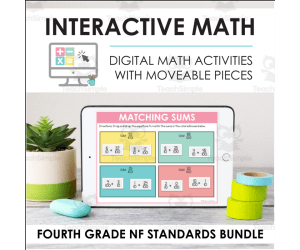
Digital Math for 4th Grade NF Standards - (BUNDLE of Slides + Self-Grading Quiz)
Math, Fractions, Grade 4, Quizzes, Quizzes and Tests, Teacher Tools
Digital Math for 4th Grade NF Standards The Digital Math for 4th Grade NF Standards is a remarkable addition to any classroom setting that enables review, practice, and enrichment in an interactive and practical way. This bundle offers educators a digital tool which eliminates the need for physical resources, making it an efficient choice for today's tech-savvy classrooms. Uniquely designed slides included in this resource package boost student engagement with math concepts by manipulating and categorizing images. These slides focus on standards 4.NF.1 - 4.NF.7; encompassing crucial fractions lessons applicable for Grade 4 students. This invaluable teaching aid comes complete with both PowerPoint and Google Slides versions of the worksheets perfectly suited to Google Classroom assignments; detailed instructions are provided if individual slides or certain sections are selected instead of the full file. An integral part of this package is a self-grading Google Forms quiz correlating directly to each standard taught in these slides. This feature provides educators real-time data on their student's understanding of the content, helpful in adjusting future lesson planning. Modes of Implementation: The Digital Math bundle can be utilized through several educational structures such as group work where students collaborate on problems collectively or practiced individually as homework assignments—facilitating truly flexible implementation based on your educational requirements. Included within each standard’s resources are slide decks using different presentation styles suitable across all teaching environments alongside corresponding quizzes aimed at reinforcing learning objectives. This digital tool has oppurtunistic usage as an effective distance learning method especially during operation in small groups where instructors aim to provide more tailored guidance during lessons or even when encouraging independent study as activity centers. In essence, if you're seeking an engaging interactive mathematical resource that incorporates visualization into important fraction concepts while also providing useful assessment tools then Digital Math—with its inclusive array of enrichment activities—merits inclusion into your curriculum toolkit.
Author Markers and Minions
Tags Interactive Math, Fractions, Digital Tool, Assessment, Distance Learning
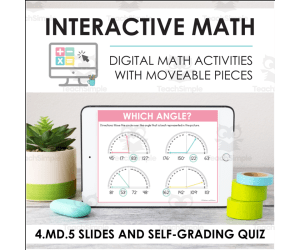
Digital Math for 4.MD.5 - Understand and Measure Angles (Slides + Self-Grading Quiz)
Math, Measurements, Grade 4, Quizzes, Quizzes and Tests, Teacher Tools
Digital Math for 4.MD.5 - Understand and Measure Angles A practical, user-friendly tool designed specifically for educators. This comprehensive teaching aid offers innovative approaches to reinforce the understanding and measurement of angles, following the 4.MD.5 standard. It's suitable for Grade 4 students who are studying mathematics, particularly with a focus on measurements. Features of this Resource Interactive digital slides: These math lessons integrate technology into the learning process through digital slides available in both PowerPoint and Google Slides formats. The dynamic slide content engages students with fun drag-and-drop activities and image sorting exercises that help illustrate mathematical concepts visually. Paperless resource: Requiring zero physical preparation, this resource is ideal for any learning environment - from in-person classrooms to virtual sessions via Google Classroom. Serves multiple purposes: These interactive slides are versatile teaching aids that can serve as review materials before exams or additional practice after regular lectures, assisting both group classes or independent learners at home schools. This product also includes an accompanying self-grading quiz hosted on Google Forms. Immediate feedback makes it easier for teachers to evaluate student comprehension relative to angle measurements. Balancing Instruction Delivery Styles Across Diverse Learning Contexts The Digital Math solution for 4.MD.5 - Understandable and Measurable Angles (Slides + Self-Grading Quiz), brings about a balance between instruction delivery styles across various learning contexts including traditional classroom environments as well as modern remote-learning options thus aligning with demands of 21st-century education without compromising teaching quality.
Author Markers and Minions
Tags Interactive Slides, Digital Math, Angle Measurement, Formative Assessment, Teaching Aid

Notion Template Architecture & Logic Design
Science, Technology, Computer Science, Engineering, Special Resources, Life Skills, Social Emotional Learning (SEL), Special Education Needs (SEN), STEM, Social Skills, Homeschool Curriculum, Homeschool Templates, Grade 9, 10, 11, 12, Worksheets & Printables, Workbooks, Worksheets, Word Searches, Writing Prompts, Teacher Tools, Quizzes and Tests, Quizzes, Tests, Lesson Plans
Unlock the Blueprint to Building and Selling Six-Figure Notion Templates! Are you ready to transform your Notion skills from a hobby into a profitable business? Do you want to stop creating simple, aesthetic templates and start engineering powerful, high-value operating systems that clients and customers will pay a premium for? Introducing Notion Template Architecture & Logic Design: The Architect's Workbook. This is not just another template. It’s a complete, 43-page university-level curriculum designed to turn you into a professional Notion system architect. We teach you the "Paper-First Abstraction" methodology used by top-tier developers to design robust, scalable, and highly marketable digital ecosystems before writing a single line of code. Go Beyond Aesthetics. Master the Architecture. In the competitive digital marketplace, the difference between a $15 template and a $150 enterprise-grade system is its invisible architecture. This guide gives you the keys to that architecture. Inside This Comprehensive Workbook, You Will Master: Relational Database Design: Learn to normalize your data, eliminate redundancy, and build an interconnected "Hub-and-Spoke" model that is both powerful and efficient. Advanced Formula & Logic: Move beyond simple functions. Master Formula 2.0 to create dynamic progress bars, automated status updates, and resilient logic that anticipates user error. Frictionless User Experience (UX): Discover the art of "Interface Abstraction." Learn to build clean, intuitive dashboards that hide complex backends, reduce cognitive load, and delight your users. Strategic Commercialization: It’s not enough to build a great system. You have to sell it. We walk you through productization, creating a frictionless onboarding experience, and solving the "Empty State Paradox" that confuses new buyers. What's Included: Part 1: The Core Concepts: 4 chapters of deep-dive theory on architecture, logic, UX, and commercialization. Part 2: The Architect's Workbook: 10 detailed worksheets with over 100 guided questions to blueprint your entire Notion system—from market validation to monetization strategy. Part 3: Teacher's Guide & Answer Key: Includes visual diagrams and a complete answer key with detailed "Academic Rationale" to ensure you deeply understand the why behind every architectural decision. This is for you if you are: An aspiring Notion creator ready to go pro. A freelancer building custom systems for clients. An entrepreneur wanting to sell high-ticket digital products. A student of business or technology looking for a practical, real-world guide to system design. Stop guessing. Start engineering. Download the Notion Template Architect's Workbook and build the foundation for your premium template business today! Keywords for SEO: Notion Template, Notion Guide, Notion for Business, Advanced Notion, Notion Formula, Notion Database, Notion UX, Sell Notion Templates, Build Notion Templates, Digital Product, Notion Course, Notion Workbook, Low-Code, Systems Design, Relational Database. Why Parents/Schools Love It: Builds Real-World Skills: Goes beyond software commands to teach fundamental, high-income skills in system architecture, database design, and user experience—all within a popular, practical tool. Prevents Costly Mistakes: The "Paper-First" workbook methodology forces structured planning, saving countless hours of rebuilding and debugging convoluted templates, leading to a better final product. Complete Curriculum-in-a-Box: With theory, practical worksheets, visual aids, and a comprehensive answer key with rationale, it's a perfect resource for self-study or as a ready-to-use textbook for a business or tech course. Unlocks a Business Model: It doesn't just teach you how to use a tool; it provides a complete blueprint for creating and selling high-value digital products, outlining a clear path to generating revenue. Target Audience: This PDF is not for beginners or casual Notion users . The content is advanced, dense, and assumes a desire to professionalize. target: Aspiring & Intermediate Notion Template Creators: Individuals who have made simple templates but want to learn the architecture required to build and sell premium, high-ticket ($50 - $200+) systems. Freelancers & Consultants: Professionals who build custom Notion workspaces for clients. This workbook will help them standardize their process, build more robust systems, and justify higher project fees. Digital Product Entrepreneurs: People in the digital product space who want to add high-value Notion templates to their product ecosystem. Higher Education Students (College/University): This could be an excellent resource for a "mini-course" or a practical project in courses related to: Business Information Systems Database Management (as a practical, low-code introduction) Entrepreneurship & Digital Product Creation User Experience (UX) Design Copyright/Terms of Use: This Book was copyrighted by Syed Hammad Rizvi. This resource is for personal and single classroom use only. You may not alter, redistribute, or sell any part of this resource. In other words, you may not put it on the Internet where it could be publicly found and downloaded. If you want to share this resource with colleagues, please purchase additional licenses from Teachsimple. Thank you for respecting these terms of use. This product is happily brought to you by Syed Hammad Rizvi
Author Creative Book Store
Rating
Tags Notion, Productivity, DigitalProduct, SmallBusiness, Entrepreneur, Workflow, Organization, BusinessTools, DigitalDownload, EBook
Life Science Reading Passage: The Dinosaur Tyrannosaurus rex (PDF)
Science, ELA, Reading, Reading Comprehension, Strategies, Resources for Teachers, Life Sciences, Animals, Biology, Grade 6, 7, 8, 9, Writing Prompts, Worksheets & Printables, Centers, Activities, Teacher Tools, Assessments, Quizzes and Tests, Quizzes, Tests
Life Science Reading Comprehension Passage and Questions: The Dinosaur Tyrannosaurus rex (PDF) This very engaging science reading passage about Tyrannosaurus rex and how scientists use fossils to understand how it lived. It explains what fossils are, where and when T. rex lived, and what fossil evidence reveals about its size, teeth, skull, movement, speed, diet, hunting, and scavenging. It also shows how modern tools, such as CT scans, imaging, computer simulations, and coprolites , help paleontologists build a clearer picture of T. rex as a powerful predator from the late Cretaceous period. This passage is designed to bridge the gap between science and literacy through strengthening reading comprehension and sparking scientific curiosity in middle school students. The passage blends English Language Arts skills with accurate science content that supports NGSS classroom practice. Ideal for interdisciplinary learning in ELA and Science. Suitable for Grade 9 review, too! Student Tasks for The Passage: 5 multiple-choice questions targeting main idea, key details, inference, vocabulary in context, and use of evidence 5 vocabulary matching items with clear, student-friendly definitions 5 text-based questions that require citing specific lines or facts 1 summary prompt that asks students to condense central ideas accurately Full answer key for every section Available Formats for this Resource Fillable PDF Word Docs Google Docs FULL CATALOG OF DOWNLOADING LINKS HERE Product Details Length: 5 pages total Grades: 6–8, also suitable for Grade 9 review Use cases: close reading, stations, homework, intervention, test prep, and sub plans Standards support: reinforces informational-text skills and supports NGSS-style sense making through observation, modeling, and clear use of claim, evidence, and reasoning Why Teachers Choose This Set Authentic science content paired with rigorous literacy practice Consistent task structure across all passages for easier planning and smoother student routines Clear, age-appropriate writing that builds confidence without oversimplifying Other Science Reading Collections you May find in the store: 1. Astronomy & Space Science 2. Volcanoes, Rocks, & Mountains 3. Rock Cycle, Soil, & Sinkholes 4. Mars, Glaciers, & Antarctica 5. Water Cycle, Acid Rain, & Wastewater 6. Insects, Animals, & Ecosystems 7. Bioluminescence & Insects 8. Animal Skin, Cats, & T. Rex 9. Human Body and Senses 10. Health & Applied Bioscience 11. Waves, Light, & Imaging 12. Electricity & Energy 13. Motion & Materials 14. Chemistry and Materials Science Use this set to reinforce ELA skills in science, to add literacy to your lessons, and to support independent work. The passages strengthen main idea, evidence use, vocabulary in context, inference, cause and effect, and summary writing. With ready-to-use assessments and complete answer keys, you can provide focused practice that is simple to run and fast to review.
Author Middle & High School - CORED Education
Rating
Tags Middle School, Reading Comprehension, Reading Strategies, ELA, Centers, Reading Passage, Assessments, Vocabulary, Life Science, The Dinosaur Tyrannosaurus Rex

Dolphins Reading Comprehension Passage - Cored Ed Encyclopedia
ELA, Language Development, Resources for Teachers, Reading Comprehension, Reading, Pre-Reading, Writing, Animals, Life Sciences, Science, Grade 2, 3, 4, 5, Worksheets & Printables, Worksheets, Teacher Tools, Centers, Activities, Writing Prompts, Assessments, Tests, Quizzes and Tests, Quizzes
This dolphins reading comprehension contains the following: COMPANION VIDEO NOW AVAILABLE (EMBEDDED AFTER PREVIEW PICTURES IN PRODUCT DESCRIPTION) Pre-Reading Trivia Students will write down one thing they already know about the subject and then read five more facts and discuss. These facts are fun, and the students will enjoy learning about the subject before reading more. Reading Passage The text is a high-interest reading passage with set paragraphs, roughly three to four paragraphs long. It contains a variety of themes about the topic, anywhere from history to technology. The passage is between 250 and 350 words in length. Mixed Questions The first question page contains four multiple-choice questions, each with a choice of four answers, and three written response questions that require a sentence or two from the student. Creative Writing In this question, the student will be required to write a five to eight sentence paragraph on a question related to the topic. Extension Activities This page is optional for fast finishers. If there are five to ten minutes left at the end of the lesson, the student can choose one of three activities, each one requiring a different skill. Answer Key There are answers for the multiple-choice questions and three written response questions have sample answers. FULL CATALOG OF DOWNLOAD LINKS AND ENCYCLOPEDIA INDEX HERE Cored Ed Encyclopedia Overview The Cored Ed Encyclopedia is a weekly series of lessons that you can pick up and use right away. These short readings fit into whatever time you have available. Each one includes a warm-up, a reading, and a set of questions, but it’s flexible — you can do just the reading, the full lesson, or skip the writing section if you need to. Each lesson focuses on a single topic so students don’t get lost. The writing is clear but never childish, making it perfect for grades two through five. Topics range from animals and science to history, inventions, and everyday things. No matter the level of the student, everyone should take away at least one new idea or fact from each lesson. The materials are easy to print, easy to explain, and require no setup. They work well for whole-class teaching, partner work, or independent study.
Author Cored Education
Rating
Tags Vocabulary, Spelling, Reading Comprehension, Reading Passages, Cored Encyclopedia, Facts, Reading, Creative Writing, Dolphins, Life Science

Insects, Animals, & Ecosystems: Reading Comprehension passages (PDF)
Science, ELA, Reading, Reading Comprehension, Strategies, Resources for Teachers, Life Sciences, Animals, Insects, Nature & Plants, Grade 6, 7, 8, 9, Writing Prompts, Worksheets & Printables, Centers, Activities, Teacher Tools, Assessments, Quizzes and Tests, Quizzes, Tests
Insects, Animals, & Ecosystems: Reading Comprehension Passages (PDF) This engaging collection of life science reading passages about Insects, Animals, & Ecosystems is designed to bridge the gap between science and literacy through strengthening reading comprehension and sparking scientific curiosity in middle school students. Each passage blends English Language Arts skills with accurate science content that supports NGSS classroom practice. Ideal for interdisciplinary learning in ELA and Science. Suitable for Grade 9 review, too! What Is Included? There are (3) informational passages: Ecosystems: Webs of Life and Change See how living things and their surroundings fit together. Follow energy from producers to consumers to decomposers, and notice how fires, floods, or people can disturb a system and how it can recover. Insects: Small Creatures, Giant Impact Meet the helpers that pollinate, recycle waste, and feed countless animals. Learn how simple body parts and smart behaviors let insects thrive almost everywhere. Unique Animals of the Rainforest Visit a forest bursting with life, from Hyacinth Macaws and pink river dolphins to golden lion tamarins and poison dart frogs. Understand why protecting habitats keeps these remarkable species alive. Student Tasks for Each Passage: 5 multiple-choice questions targeting main idea, key details, inference, vocabulary in context, and use of evidence 5 vocabulary matching items with clear, student-friendly definitions 5 text-based questions that require citing specific lines or facts 1 summary prompt that asks students to condense central ideas accurately Full answer key for every section Available Formats for this Resource Word Docs Google Docs FULL CATALOG OF DOWNLOADING LINKS HERE Other Science Reading Collections and Topics You May Find in the Store: 1. Astronomy & Space Science 2. Volcanoes, Rocks, & Mountains 3. Rock Cycle, Soil, & Sinkholes 4. Mars, Glaciers, & Antarctica 5. Water Cycle, Acid Rain, & Wastewater 6. Insects, Animals, & Ecosystems 7. Bioluminescence & Insects 8. Animal Skin, Cats, & T. Rex 9. Human Body and Senses 10. Health & Applied Bioscience 11. Waves, Light, & Imaging 12. Electricity & Energy 13. Motion & Materials 14. Chemistry and Materials Science 15. Electromagnetism 16. Acids and Bases 17. Gas Laws 18. Biotechnology 19. Periodic Trends 20. Protists and Fungi 21. Microevolution 22. Blood 23. Chemical Bonding 24. Magnets 25. Muscles 26. Nuclear Chemistry 27. Electromagnetic Devices 28. Epigenetics 29. The Law of Conservation of Mass 30. Atomic Models 31. Isotopes and Ions 32. Light 33. Human-Environment Interaction 34. Theory of Evolution 35. Photosynthesis 36. Origins of Life and Early Earth 37. Gene Expression and Regulation 38. Thermochemistry 39. Allergies 40. Coevolution 41. Birth to Adulthood 42. Cells 43. Entropy and Free Energy 44. The Human Brain 45. Mixtures and Solutions 46. Invertebrates 47. Zoo Animals 48. Biochemistry 49. Animal Behavior 50. Population Ecology ...and many more engaging science reading passages that cover intriguing and important topics designed to spark curiosity and support student learning. Product Details Length: 14 pages total Grades: 6–8, also suitable for Grade 9 review Use cases: close reading, stations, homework, intervention, test prep, and sub plans Standards support: reinforces informational-text skills and supports NGSS-style sense making through observation, modeling, and clear use of claim, evidence, and reasoning Why Teachers Choose This Set Authentic science content paired with rigorous literacy practice Consistent task structure across all passages for easier planning and smoother student routines Clear, age-appropriate writing that builds confidence without oversimplifying Use this set to reinforce ELA skills in science, to add literacy to your lessons, or to support independent work. The passages strengthen main idea, evidence use, vocabulary in context, inference, cause and effect, and summary writing. With ready-to-use assessments and complete answer keys, you can provide focused practice that is simple to run and fast to review.
Author Middle & High School - CORED Education
Rating
Tags Middle School, Reading Comprehension, Reading Strategies, ELA, Centers, Reading Passage, Assessments, Vocabulary, Life Science, Insects
U-Boats Reading Comprehension Passage - Cored Ed Encyclopedia
ELA, Language Development, Reading Comprehension, Reading, Science, Technology, Engineering, History, Social Studies, Physics, Grade 2, 3, 4, 5, Worksheets & Printables, Worksheets, Teacher Tools, Centers, Activities, Writing Prompts, Assessments, Quizzes and Tests, Quizzes, Lesson Plans
This U-boats reading comprehension with lesson plan includes: Visualization (on the front cover) Start your lesson by taking a minute to think and share something about the topic. Read the script aloud (slowly), perhaps prepare some music or sound effects. Student close their eyes and let their imaginations wander. Students open their eyes, read the question aloud and give them a few minutes to complete. Ask a few students to share or keep answers until the end to compare with what they learn in the passage. Quick pause—thousands of Cored Education products are included with your TeachSimple membership. Download links and encyclopedia index available here. Pre-Reading Trivia Students will write down one thing they already know about the subject and then read five more facts and discuss. These facts are fun, and the students will enjoy learning about the subject before reading more. Give 1 minute for students to write what they already know (no pressure—best guess is fine). Read the five facts together. After each fact, do ask a student for their opinion, was it surprising? Set a purpose by asking students to highlight/underline one fact they want to learn more about during the reading. Reading Passage The text is a high-interest reading passage with set paragraphs, roughly three to four paragraphs long. It contains a variety of themes about the topic, anywhere from history to technology. The passage is between 250 and 350 words in length. First, ask students to look at the headings and see what they’ll learn about today. What do they know about the topic/heading? First read options: Teacher read-aloud (best for support). Partner reading (paragraph by paragraph). While reading, students underline important details, and vocabulary words they think may come up in the questions section. Mixed Questions The first question page contains four multiple-choice questions, each with a choice of four answers, and three written response questions that require a sentence or two from the student. Students complete the mcqs first independently, then review quickly as a class. For the 3 written responses, try to get students giving the answer with some form of evidence: “I think ___ because the text says ___.” If students get stuck, send them back to check the passage. Vocabulary Questions Practice seven key words from the text in this section across two activities. First section is scrambled words where students will unscramble three words given a clue for each. The second section is a word to meaning matching activity. Before starting, have some students read out words they underlined in the passage. Ask students to say the word and read aloud the sentence(s) around each word. Ask students to do scrambled words and the matching exercise in pairs then go through answers as a class. For the scrambled spelling task, get four pairs to come up to the board and write the words for extra practice with the other student reading out the clue. For the matching task, prompt students to give full sentences: “I matched ___ with ___ because ___.” Creative Writing In this question, the student will be required to write a five to eight sentence paragraph on a question related to the topic. Before starting, ask students write down 3 key ideas they are going to include in their piece. Ask students for ideas to share around the class to help those struggling. Pro writing expectations: 5–8 sentences At least 2 facts or details from the passage At least 2 vocabulary words from the previous page Students read their paragraphs while classmates listen for facts and vocabulary words. Extension Activities This page is optional for fast finishers or to take home. There are several activities, each one requiring a different skill. Do some, do none, do all, completely optional - but you will feel reassured knowing every possibility is planned for. Includes summary writting question. Answer Key There are answers for the multiple-choice questions, written response questions have sample answers, vocabulary answers and if there is a summary question then a sample summary will be provided as well. Lesson Plan Included Customized lesson plan for this lesson is included. Lesson Snapshot Title: U-Boats Genre: Nonfiction (informational text) Subject: Social Studies (World History) Primary Topic: U-boats, convoys, and the Battle of the Atlantic Estimated Guided Reading Level (A–Z): R What This Lesson Teaches Best Explains what “U-boat” means and where the name comes from (German U-Boot , short for Unterseeboot , meaning “undersea boat”). Shows how underwater attacks shifted World War I fighting toward supply ships , and why food and materials crossing the Atlantic mattered. Teaches how convoys (merchant ships traveling together under protection) helped weaken the U-boat threat. Highlights how defenders used tools like sonar and radar to listen and search better during the Battle of the Atlantic, and how the balance began to swing by 1943. Describes the snorkel as a solution for getting air to submarine engines while staying mostly submerged, including testing in 1943 and wider use in 1944. Learning Goals Students will explain what the term “U-boat” means and where the name comes from using details from the text. Students will describe why supply ships crossing the Atlantic became so important in both World War I and World War II. Students will identify how convoys worked and explain how they helped weaken the U-boat threat. Students will explain how sonar and radar helped defenders find and track U-boats better. Students will describe what problem the snorkel solved for submarines and how it worked. Key Vocabulary From the Text convoys — groups of ships traveling together with protection. unrestricted — not limited by rules or limits. sonar — a tool that uses sound to find underwater objects. radar — a tool that helps detect objects by radio waves. snorkel — a tube that brings air while mostly underwater. FULL CATALOG OF DOWNLOAD LINKS AND ENCYCLOPEDIA INDEX HERE
Author Cored Education
Rating
Tags Vocabulary, Reading Comprehension, Reading Passages, Lesson Plans, Ela Lesson Plans, Reading Comprehension Lesson Plans, Pre-reading, History, History Lesson Plans, Physics
Volcanoes, Rocks, & Mountains: Reading Comprehension Passages (PDF)
Science, Earth and Environmental Sciences, ELA, Reading, Reading Comprehension, Strategies, Resources for Teachers, Earth Sciences, Geology, Grade 6, 7, 8, 9, Writing Prompts, Worksheets & Printables, Centers, Activities, Teacher Tools, Assessments, Quizzes and Tests, Quizzes, Tests
Volcanoes, Rocks, & Mountains: Reading Comprehension Passages (PDF) This engaging collection of earth science reading passages about Mountains, Volcanoes, and Igneous Rocks is designed to bridge the gap between science and literacy through strengthening reading comprehension and sparking scientific curiosity in middle school students. Each passage blends English Language Arts skills with accurate science content that supports NGSS classroom practice. Ideal for interdisciplinary learning in ELA and Science. Suitable for Grade 9 review, too! What Is Included? There are (3) informational passages: Mountains: From Plates to Peaks See how plate collisions fold rock, faults lift blocks, and volcanism builds peaks. Learn how rivers, glaciers, and gravity continue to reshape ranges over time. How Volcanoes Shape Our World Examine hazards such as ash, gases, lahars, and pyroclastic flows, along with benefits like fertile soils, mineral resources, geothermal energy, and new land. Learn how monitoring and planning reduce risk. Igneous Rocks: From Fire to Everyday Life Compare intrusive and extrusive rocks, link cooling rates to crystal size and texture, and connect granite, basalt, pumice, and obsidian to everyday uses in buildings, roads, tools, and art. Student Tasks for Each Passage: 5 multiple-choice questions targeting main idea, key details, inference, vocabulary in context, and use of evidence 5 vocabulary matching items with clear, student-friendly definitions 5 text-based questions that require citing specific lines or facts 1 summary prompt that asks students to condense central ideas accurately Full answer key for every section Available Formats for this Resource Word Docs Google Docs FULL CATALOG OF DOWNLOADING LINKS HERE Other Science Reading Collections and Topics You May Find in the Store: 1. Astronomy & Space Science 2. Volcanoes, Rocks, & Mountains 3. Rock Cycle, Soil, & Sinkholes 4. Mars, Glaciers, & Antarctica 5. Water Cycle, Acid Rain, & Wastewater 6. Insects, Animals, & Ecosystems 7. Bioluminescence & Insects 8. Animal Skin, Cats, & T. Rex 9. Human Body and Senses 10. Health & Applied Bioscience 11. Waves, Light, & Imaging 12. Electricity & Energy 13. Motion & Materials 14. Chemistry and Materials Science 15. Electromagnetism 16. Acids and Bases 17. Gas Laws 18. Biotechnology 19. Periodic Trends 20. Protists and Fungi 21. Microevolution 22. Blood 23. Chemical Bonding 24. Magnets 25. Muscles 26. Nuclear Chemistry 27. Electromagnetic Devices 28. Epigenetics 29. The Law of Conservation of Mass 30. Atomic Models 31. Isotopes and Ions 32. Light 33. Human-Environment Interaction 34. Theory of Evolution 35. Photosynthesis 36. Origins of Life and Early Earth 37. Gene Expression and Regulation 38. Thermochemistry 39. Allergies 40. Coevolution 41. Birth to Adulthood 42. Cells 43. Entropy and Free Energy 44. The Human Brain 45. Mixtures and Solutions 46. Invertebrates 47. Zoo Animals 48. Biochemistry 49. Animal Behavior 50. Population Ecology ...and many more engaging science reading passages that cover intriguing and important topics designed to spark curiosity and support student learning. Product Details Length: 13 pages total Grades: 6–8, also suitable for Grade 9 review Use cases: close reading, stations, homework, intervention, test prep, and sub plans Standards support: reinforces informational-text skills and supports NGSS-style sense making through observation, modeling, and clear use of claim, evidence, and reasoning Why Teachers Choose This Set Authentic science content paired with rigorous literacy practice Consistent task structure across all passages for easier planning and smoother student routines Clear, age-appropriate writing that builds confidence without oversimplifying Use this set to reinforce ELA skills in science, to add literacy to your lessons, or to support independent work. The passages strengthen main idea, evidence use, vocabulary in context, inference, cause and effect, and summary writing. With ready-to-use assessments and complete answer keys, you can provide focused practice that is simple to run and fast to review.
Author Middle & High School - CORED Education
Rating
Tags Middle School, Reading Comprehension, Reading Strategies, Reading Passages, ELA, Centers, Reading Passage, Assessments, Vocabulary, Earth Science

Reading Comprehension Passages Fiction Set 1 - Nature Presentable PDF
ELA, Reading, Reading Comprehension, Common Core, ESL, Language Development, Spelling, Vocabulary, Writing, Resources for Teachers, Grade 2, 3, Worksheets & Printables, Worksheets, Writing Prompts, Assessments, Teacher Tools, Quizzes, Quizzes and Tests, Centers, Activities
Reading Comprehension Passages Fiction Set 1 Snapshot Genre: Fiction (collection of short nature-themed stories) Subject: Reading (Comprehension) Primary Topic: Nature-themed fiction passages and comprehension practice Estimated Guided Reading Level (A–Z): O What This Teaches Best Character feelings and motivations: Characters want or value something strongly (e.g., Kellie wants snow to use her new sled; Rusty wants to finish his color task; Ross would rather play but ends up enjoying his work). Observation and using the environment for answers: Rusty finds blue and purple by looking more carefully at what’s around him (sky, stream, leaf backs). Cause and effect in everyday situations: Weather and choices affect what happens next (snow finally comes; a thunderstorm ends cherry picking; a volcano eruption changes the climbers’ plans). Nature vocabulary in meaningful contexts: Words connected to seasons, plants, animals, and outdoor features appear across the stories (snow “accumulation,” “canopy,” “eruption,” “perennials,” “marmalade”). Built-in practice pages that match the passages: Each story is followed by questions and skill pages (mixed questions, spelling/vocabulary, short writing prompts) that directly reference details from the story text. Learning Goals Students will recount key events from a selected story in a logical order using details from the text. Students will describe characters’ wants, feelings, and choices and connect them to what happens in the story. Students will identify the setting/season and name text evidence that supports it. Students will explain cause-and-effect relationships shown in the stories (problem → response → outcome). Students will use context clues to determine the meaning of unfamiliar words from the passages. Students will compare information presented in the story (for example, annuals vs. perennials) by stating how they are different using the text’s wording. Passages Include 1.Bring on the Snow: Kellie wants to make it snow. How does she try? 2.Walk through the Woods: A walk in the woods turns into a huge adventure. 3.Nature Photographer: Donna get some amazing snaps in this story. 4.Nature's Beautiful Colors: Rusty enjoys finding out about the colors in nature. 5.Flower Fun: Learn about flower names and colors in this fun lesson. 6.Picking Cherries: Ross spends his day picking cherries but is it worth it? Additional File: Nature Photographer: Drawing Nature Printable PRESENTABLE PDF VERSION Run it like a slide show straight from a PDF, with no PowerPoint or extra software needed, just open, project, and teach. Other versions are available in the links list below or in the full catalog. FULL CATALOG OF DOWNLOAD LINKS HERE For similar downloads and other frees, do check out Cored Group on TeachSimple.
Author Cored Education
Rating
Tags Elementary, Reading, Comprehension, Vocabulary, Common Core, Speling, Writing, Passages, Reading Centers, Reading Comprehension Assessments
Growth Vs. Fixed Mindset Reframing
Life Skills, Special Resources, Social Emotional Learning (SEL), Social Skills, Special Education Needs (SEN), Speech Therapy, Resources for Teachers, Classroom Management, Community Building, STEM, Grade 2, 3, 4, 5, 6, 7, 8, Worksheets, Worksheets & Printables, Workbooks, Word Searches, Teacher Tools, Lesson Plans, Quizzes and Tests, Quizzes, Tests, Assessments
Instead of offering vague advice about “positive thinking,” give your students real tools to solve their issues with frustration, decision paralysis, and negative self-talk! The 36-page, neuro-developmental curriculum, “Growth Vs. Fixed Mindset Reframing: Action-Oriented Problem-Solving,” is specifically designed for 2nd through 5th graders, at a time when many kids experience the hurdles outlined above. This resource doesn't simply tell children to "keep trying"; it gives them the skills to understand how their cognitive reframing systems work so they can start to use them. Students will be exposed to real-life situations they encounter in school today. As a result, they will learn how to identify and change their "Stuck Voices" and create or develop a plan of action to tackle their individual problem. What is included in this resource: - Educator's Methodology Guide: A comprehensive understanding of the neuroscience behind self-talk and how to teach cognitive restructuring. - 8 Additional Student Worksheets: 8 highly relatable worksheets that target common youth problems like "Homework Heroes," "Recess Resolutions," "Creative Catastrophes," "Friendship Fixes," and "Chore Challenges." - Classroom Visuals and Anchor Charts: 3 classroom visuals, “The Metacognitive Reframing Cycle,” “The Cognitive Fork in the Road,” and “The Action-Strategy Matrix,” to visually reinforce the lessons taught in this curriculum. - Step-by-Step Implementation Guide: A three-phase implementation plan for parents and teachers. - Detailed Answer Keys: Subjective answer keys with examples of strategies for assessing student understanding and for generating discussion. Suitable for educators in classrooms, guidance counselors, home schooling parents all interested in developing their child’s ability to use resilience/foster self-advocacy/foster emotional self-regulation over the course of his/her life! The following are the keywords associated with this product: growth mindset, social emotional learning (SEL), cognitive behavior therapy for children, self-talk, elementary worksheets, classroom management tips, school counseling resources, character education supplies. Why Parents / Schools Love It : This program focuses on Giving Kids Specific Examples of How to Solve Problems instead of vague and meaningless quotes like "believe in yourself." In addition, the program is Based on Mechanism of the Brain; It teaches kids through simple examples how to deal with psychological issues (such as changing how you feel about something or making yourself not care about something). The worksheets used in this program are identical to those used in the children's daily life such as when you mess up your drawing, get into an argument on the playground, have no chores left to do, do not understand how to solve a math problem, etc... The ultimate goal of this program is to create self-sufficient children by Teaching Them to Become Adults. The program also has the Highest Degree of Ease-of-Use: Everything needed to start right away (theory, worksheets, visuals, etc.) is included in the package when received. Intended Audience (Classes/Students to Target): Looking at the direct text from the PDF file (i.e., Pages 1, 2, 5, 7, 8, &12) and applying the developmental psychology presented in the document the following classes/students will be targeted. Class/Grade: 2nd Grade, 3rd Grade, 4th Grade, 5th Grade Age: 7 to 11 years old Will also appeal to homeschooling families, Special Education teachers and School Counselors that work with students in the elementary school age. Copyright/Terms of Use: This Book belongs to Syed Hammad Rizvi. You are only allowed to use this material for your personal use and to utilize it in only one classroom. You are not allowed to edit, distribute or sell this book, meaning you may not upload this book anywhere on the internet for public access or download. If you wish to share this book with others, you must buy more licenses through Teachsimple. Thank you for understanding the terms of use for this item. This product was created by Syed Hammad Rizvi
Author Creative Book Store
Rating
Tags GrowthMindset, FixedMindset, SocialEmotionalLearning, SEL, SELactivities, MindsetMatters , EmotionalRegulation, GrowthMindsetForKids, ResilienceBuilding, Metacognition
Guided Reading Level L - Firefighters Keep Us Safe (with Lesson Plan)
ELA, Resources for Teachers, Reading Comprehension, Reading, Pre-Reading, Language Development, Science, Engineering, Technology, Vocabulary, Grade 1, 2, 3, Worksheets & Printables, Worksheets, Teacher Tools, Centers, Activities, Literacy Readers, Quizzes, Quizzes and Tests, Assessments
This Guided Reading Book - Firefighters Keep Us Safe (Level L) with lesson plan includes: Guided Reading Color Label (front cover x1) This is a quick way to match the book’s demands to what students can generally handle.. The overall goal is to use the level/color to pick books for several smaller groups. To qualify for a certain level, a student is expected to read a book from that level with about 90–94% accuracy. If a student is consistently accurate and understands, move up a level. If the student is struggling at that level, drop down and add more support. Each student will improve at completely different rates, but it is generally one of the best ways to check progress across the class. DOWNLOAD THE CATALOG TO VIEW ALL GUIDED READING BOOKS AVAILABLE (SORTED LEVELS A-Z) Pre-Reading Question (x1) Teacher asks the prompt aloud, can be while showing the cover or first page. Students share what they already know, or make educated guesses from the cover. Prompt them to use the target vocabulary. Write some of their responses on the board to look back at during the reading. Vocabulary Words (x5) Introduce the five words, best doing it one at a time. Start by saying it, while students repeat and then see if anyone knows what it means before reading further. Read through the meaning and try to briefly connect each word to a picture or gesture so it’s meaningful. Ask students to flip through the book pages and point to where they see each of the vocabulary words. While reading the book pause upon coming across one of the vocab words or read the sentence twice to make sure students understand the word has appeared. Optional: Ask students to raise hands whenever they see/hear one of the new words. Guided Reading Pages (x10) Check the book snapshot (below) for: primary topic - do you need to prep extra reading or intro materials on this? what is taught best - decide on 1-2 bullets to focus on, use the prompt or words provided here for best results. learning goals - what you are checking for students to be able to do after the session, elicit answers using prompts or words provided. key vocabulary (see section above). questions overview - so you know what is coming up and if you need to prep extra materials to assist understanding. Run the lesson You may have already looked at a few of the pages together, but you can show them some of the pictures again first to set meaning. Depending on how much time you have and how familiar your students are with guided reading class, you may want to read the book aloud first with the group first. Students whisper or partner read, while you listen in. If time, do it as a group, one student reading a page each. Use the guided page’s prompts to coach: “Check the picture / does it make sense?” “Point under the words / try the first sound” “Reread the sentence smoothly”. Try to focus more on one student per session (rotating every time), so you can work out if they are ready to move up or need to move down a level. Comprehension Questions (back cover x3) This is your way to check that students didn’t just say the words, but actually understood the text. First, let students answer by pointing to the page/picture and saying a short sentence. After any answer, follow with: “Show me where you found that in the text.” In bigger groups, have partners answer first (10–20 seconds), then call on 2–3 students to share. Differentiation tips: Emerging speakers/struggling readers: oral + pointing On-level: oral in a full sentence Higher: one written sentence or draw + label Book Snapshot Title: Firefighters Keep Us Safe Genre: Nonfiction (informational) Subject: Social Studies (Community Helpers) / Health & Safety / Reading Primary Topic: Firefighters, tools, and how they keep people safe Estimated Guided Reading Level (A–Z): L What This Book Teaches Best How firefighters are community helpers who work at a fire station and respond to an emergency call. Why firefighters wear turnout gear and how it protects them from heat and smoke (layers resist flames and keep them cool). What a fire engine carries and how sirens and flashing lights help firefighters reach emergencies quickly (drivers move to the side). How key equipment works: hoses connect to a hydrant , nozzles change the water spray, and long ladders help with rescue and spraying from above. Firefighters’ jobs go beyond fires: they help in car accidents and medical emergencies , and training and dedication help keep the community safe. Learning Goals Students will explain how firefighters help keep a community safe using details from the text. Students will describe what turnout gear is and why firefighters wear it. Students will identify what a fire engine carries and how sirens and flashing lights help on the road. Students will describe how hoses, hydrants, and nozzles help firefighters spray water on a fire. Students will explain why firefighters use masks and air tanks in smoky buildings. Students will describe why firefighters train daily and how dedication connects to safety. Key Vocabulary From the Text community — people who live and work in the same place. emergency — a sudden problem that needs help right away. protective — made to help keep someone safe from harm. hydrant — a street pipe where firefighters can get water. dedication — working hard and not giving up. Discussion Prompts Pre-reading question: What do you think firefighters need to do their jobs safely? Comprehension questions: What is turnout gear, and how does it help firefighters around heat and smoke? What do the sirens and flashing lights on a fire engine tell other drivers to do? Why do firefighters wear a special mask and an air tank in a smoky building? Printing Tips 1. Best Printing Method (Recommended) “Booklet” Printing (Best if Available) If your printer or PDF viewer supports Booklet Printing , use this. Settings to use: Print mode: Booklet Paper size: Letter or A4 (either works) Orientation: Landscape Print on both sides: Yes Flip on: Short edge Scaling: Fit to printable area Booklet subset: First test: Front sides only Then: Back sides only This will automatically: Pair pages correctly Put the cover on the outside Align everything for folding After printing, fold in half and staple along the spine . 2. If “Booklet” Printing Is NOT Available You can still print this correctly with manual duplex printing . Step-by-step: Open the PDF. Choose Print . Set: Orientation: Landscape Pages per sheet: 1 Print on both sides: Yes Flip on: Short edge Print all pages . Because each PDF page already contains two facing book pages, the result will still fold cleanly into a book. Thousands of Cored Education products are included with your TeachSimple membership. Download links and encyclopedia index available here.
Author Cored Education
Rating
Tags Reading Comprehension, Reading Passages, Reading, Guided Reading, Guided Reading Lesson Plan, Guided Reading Activity, Pre-reading, Vocabulary, Technology, Engineering
Reading Comprehension Passage: South America (SAMPLE Docs)
ELA, Reading, Reading Comprehension, Strategies, Resources for Teachers, Social Studies, Geography, Grade 6, 7, 8, 9, Writing Prompts, Worksheets & Printables, Centers, Activities, Teacher Tools, Assessments, Quizzes and Tests, Quizzes, Tests
This is a ONE PASSAGE SAMPLE. The following is the description of the FULL resource and the downloading links: Social Studies Reading Comprehension Passages and Questions: Our Planet: Natural Extremes and Human Impact (Word) This resource introduces a collection of Social Studies reading comprehension passages with questions about Our Planet: Natural Extremes and Human Impact. The passages are carefully designed to bridge the gap between social studies and literacy through strengthening reading comprehension and sparking knowledge curiosity in middle school students. Each passage blends English Language Arts skills with accurate social studies content . Ideal for interdisciplinary learning in ELA and Social Studies. Suitable for Grade 9 review, too! What Is Included in this Collection? There are three informational passages (with full answer keys): Remaking Plastic: Turning Waste into Useful Materials Underwater Noise Pollution South America: A Continent of Natural Extremes For Each Passage, students will have multiple tasks to complete as follow: 5 multiple-choice questions targeting main idea, key details, inference, vocabulary in context, and use of evidence 5 vocabulary matching items with clear, student-friendly definitions 5 text-based questions that require citing specific lines or facts 1 summary prompt that asks students to condense central ideas accurately Available Formats for this Resource PDF Fillable PDF Word Docs FULL CATALOG OF DOWNLOADING LINKS HERE For more Social Studies Reading Passages, check the following Links: Ancient Civilizations PDF Fillable PDF Word Docs Google Docs Early Empires and Trade Networks PDF Fillable PDF Word Docs Google Docs The Founding of the United States PDF Fillable PDF Word Docs Google Docs Language, Culture, and Meaning PDF Fillable PDF Word Docs Google Docs Psychology and Society PDF Fillable PDF Word Docs Google Docs Global Festivals and Traditions PDF Fillable PDF Word Docs Google Docs Extreme Environments and People PDF Fillable PDF Word Docs Google Docs Food, Culture, and Preservation PDF Fillable PDF Word Docs Google Docs Global Food Customs PDF Fillable PDF Word Docs Google Docs Media, Communication, and Popular Culture PDF Fillable PDF Word Docs Google Docs Human Impact on the Environment PDF Fillable PDF Word Docs Google Docs Civic Action and Social Change PDF Fillable PDF Word Docs Google Docs Fashion, Society, and Power PDF Fillable PDF Word Docs Google Docs People, Places, and Unusual Histories PDF Fillable PDF Word Docs Google Docs Product Details Length: 15 pages total Grades: 6–8, also suitable for Grade 9 review Use cases: close reading, stations, homework, intervention, test prep, and sub plans Why Teachers Choose This Set Authentic social studies content paired with rigorous literacy practice Consistent task structure across all passages for easier planning and smoother student routines Clear, age-appropriate writing that builds confidence without oversimplifying Use this set to reinforce ELA skills in social studies, to add literacy to your lessons, and to support independent work. The passages strengthen main idea, evidence use, vocabulary in context, inference, cause and effect, and summary writing. With ready-to-use assessments and complete answer keys, you can provide focused practice that is simple to run and fast to review.
Author Middle & High School - CORED Education
Rating
Tags Middle School, Reading Comprehension, Reading Strategies, ELA, Centers, Reading Passage, Assessments, Vocabulary, Social Studies, Geography