



3,952 products added recently
Page 36 - Holiday and Seasonal Quizzes
Holiday and Seasonal Quizzes add a festive element to assessments, making them more enjoyable for students. These quizzes feature questions related to holidays like Christmas, Halloween, and Spring festivals, blending curriculum content with seasonal themes. They can cover topics such as historical origins, cultural practices, or subject-specific questions presented in a holiday context. Using these quizzes keeps students motivated and interested in learning, especially during times when attention spans might wane due to holiday excitement.

 Show filters


Henry Louis Le Chatelier – Understanding Chemical Equilibrium
Life Sciences, Science, STEM, Social Studies, Biographies, Inventors, Basic Science, Physics, Chemistry, Biology, Grade 6, 7, 8, 9, 10, 11, Worksheets, Worksheets & Printables, Quizzes, Quizzes and Tests, Teacher Tools, Projects, Activities
Henry Louis Le Chatelier – Understanding Chemical Equilibrium A short reading and worksheet resource for grades 8–10 science classes (PDF + H5P) ⚖️🧪 A printable and digital resource for grades 8–10 science and cross-curricular teaching 🧪🧠 This resource introduces students to Henry Louis Le Chatelier, the French chemist best known for his work on chemical equilibrium. His principle – describing how systems respond to changes in concentration, temperature, or pressure – is a key concept in chemistry classrooms around the world. With this material, students not only learn about Le Chatelier’s scientific contribution but also get a glimpse of the person behind the theory. The tasks are structured clearly and can be used in regular chemistry lessons or as part of a non-specialist substitute plan. No prior knowledge is required to get started, and the layout supports both independent and pair work. Included in this resource: Informational text about Henry Le Chatelier’s life and research A worksheet for creating a scientist profile based on the reading Quiz questions with solutions for quick review Two optional follow-up tasks: – Students create their own questions about the text – Exchange and answer questions in pairs File formats: – PDF (printable and digital) – Editable DOCX (text only) – H5P version (interactive and image-free, suitable for LMS use) How to use it in class: I’ve used this material as part of an introduction to equilibrium in chemistry or to wrap up a unit on reaction rates and reversible processes. The reading offers students some historical context, which helps them see that the science they’re learning is connected to real people and ideas. The H5P format supports digital work and allows for self-checking. It’s also helpful for remote learning or homework. With little to no prep required, this resource makes it easy to enrich your science curriculum. Have fun exploring the world of science with your students! Warmly, Lernfitness Did You Know? I teach with a certified therapy dog, and together we focus on creating a positive and inspiring learning environment.
Author Lernfitness
Rating
Tags Science, Famous Scientists Lesson, H5P, Interactive Science Exercises, STEM, Scientists, Chemistry, Henry Louis Le Chatelier, Chemical Equilibrium, Le Chatelier
Bioluminescence & Insects: SAMPLE Reading Comprehension passage (PDF)
Science, ELA, Reading, Reading Comprehension, Strategies, Resources for Teachers, Life Sciences, Animals, Insects, Nature & Plants, Grade 6, 7, 8, 9, Writing Prompts, Worksheets & Printables, Centers, Activities, Teacher Tools, Assessments, Quizzes and Tests, Quizzes, Tests
This is a ONE PASSAGE SAMPLE. The following is the description of the FULL resource and the downloading links: Bioluminescence & Insects: Reading Comprehension Passages (PDF) This very engaging collection of life science reading passages about Bioluminescence & Insects is designed to bridge the gap between science and literacy through strengthening reading comprehension and sparking scientific curiosity in middle school students. Each passage blends English Language Arts skills with accurate science content that supports NGSS classroom practice. Ideal for interdisciplinary learning in ELA and Science. Suitable for Grade 9 review, too! What Is Included? There are (3) informational passages: Living Lights: The Science of Bioluminescence Explains how organisms produce “cold light” with luciferin and luciferase, and shows why they glow for signaling, hunting, and protection. Cicadas: The Long Wait Underground Covers the long underground nymph stage, synchronized emergence, molting, loud calls, and how this life cycle supports survival and reproduction. Masters of Disguise: How Insects Hide and Imitate Distinguishes camouflage from mimicry with clear examples, highlighting how color, shape, and behavior help insects avoid predators and capture prey. Student Tasks for Each Passage: 5 multiple-choice questions targeting main idea, key details, inference, vocabulary in context, and use of evidence 5 vocabulary matching items with clear, student-friendly definitions 5 text-based questions that require citing specific lines or facts 1 summary prompt that asks students to condense central ideas accurately Full answer key for every section Available Formats for this Resource Word Docs Google Docs FULL CATALOG OF DOWNLOADING LINKS HERE Other Science Reading Collections and Topics You May Find in the Store: 1. Astronomy & Space Science 2. Volcanoes, Rocks, & Mountains 3. Rock Cycle, Soil, & Sinkholes 4. Mars, Glaciers, & Antarctica 5. Water Cycle, Acid Rain, & Wastewater 6. Insects, Animals, & Ecosystems 7. Bioluminescence & Insects 8. Animal Skin, Cats, & T. Rex 9. Human Body and Senses 10. Health & Applied Bioscience 11. Waves, Light, & Imaging 12. Electricity & Energy 13. Motion & Materials 14. Chemistry and Materials Science 15. Electromagnetism 16. Acids and Bases 17. Gas Laws 18. Biotechnology 19. Periodic Trends 20. Protists and Fungi 21. Microevolution 22. Blood 23. Chemical Bonding 24. Magnets 25. Muscles 26. Nuclear Chemistry 27. Electromagnetic Devices 28. Epigenetics 29. The Law of Conservation of Mass 30. Atomic Models 31. Isotopes and Ions 32. Light 33. Human-Environment Interaction 34. Theory of Evolution 35. Photosynthesis 36. Origins of Life and Early Earth 37. Gene Expression and Regulation 38. Thermochemistry 39. Allergies 40. Coevolution 41. Birth to Adulthood 42. Cells 43. Entropy and Free Energy 44. The Human Brain 45. Mixtures and Solutions 46. Invertebrates 47. Zoo Animals 48. Biochemistry 49. Animal Behavior 50. Population Ecology ...and many more engaging science reading passages that cover intriguing and important topics designed to spark curiosity and support student learning. Product Details Length: 14 pages total Grades: 6–8, also suitable for Grade 9 review Use cases: close reading, stations, homework, intervention, test prep, and sub plans Standards support: reinforces informational-text skills and supports NGSS-style sense making through observation, modeling, and clear use of claim, evidence, and reasoning Why Teachers Choose This Set Authentic science content paired with rigorous literacy practice Consistent task structure across all passages for easier planning and smoother student routines Clear, age-appropriate writing that builds confidence without oversimplifying Use this set to reinforce ELA skills in science, to add literacy to your lessons, or to support independent work. The passages strengthen main idea, evidence use, vocabulary in context, inference, cause and effect, and summary writing. With ready-to-use assessments and complete answer keys, you can provide focused practice that is simple to run and fast to review.
Author Middle & High School - CORED Education
Rating
Tags Middle School, Reading Comprehension, Reading Strategies, ELA, Centers, Reading Passage, Assessments, Vocabulary, Life Science, Insects

Social Skills Role-Play Scenarios & Empathy Building Sheets
Classroom Management, Resources for Teachers, Community Building, Life Skills, Special Resources, Social Emotional Learning (SEL), Social Skills, Special Education Needs (SEN), Speech Therapy, STEM, Homeschool Curriculum, Homeschool Templates, Grade 3, 4, 5, 6, 7, Worksheets, Worksheets & Printables, Workbooks, Word Searches, Teacher Tools, Assessments, Lesson Plans, Quizzes and Tests, Quizzes, Tests
This comprehensive 33-page digital Social Skills Role-Play Scenarios and Empathy Building Sheets Curriculum for students in Grades 3-6 provides educators with easy-to-implement lessons about powerful and important topics - social-emotional learning (SEL) and developing empathy. Each of the components in this package features relevant supportive research along with fun, engaging, and easy-to-use role-play simulations and seven engaging student worksheets that address the most important life skills our students need, including developing empathy; resolving conflict; practicing active listening; decoding non-verbal cues; navigating peer pressure; providing genuine apologies; and displaying sportsmanship. This curriculum is perfect for teachers in elementary schools, counselors, homeschoolers, and out-of-school-program providers. Included in this 33-page Curriculum are the following components and resources: Phase 1: The Core Theory behind Affective, Cognitive, and Compassionate Empathy/ Supporting Material for Role Playing Phase 2: Seven Printable Student Worksheets with Real-Life Role-Playing Scenarios (Decoding Non-Verbal Cues, The Empathy Bridge, I Statement Architect, Active Listening, Peer Pressure Navigator, Apology Blueprint, Sportsmanship & Fair Play) Phase 3: Curriculum Guides, Teachers Visuals, Implementation Guide, and Answer Key This no-prep resource is designed to provide students with a real-world opportunity to transform abstract concepts into experiential learning through safe role-play and mapping experiential empathy. Therefore, all upper elementary-aged children (8-12) will develop emotional intelligence by reducing the tendency to exhibit hostile attribution bias, and practice prosocial behaviors in a low-stakes learning environment. Immediate digital download is available, and the Curriculum may be easily printed and used immediately or utilized through Google Classroom. Why Schools & Parents are Successful: Both research and classrooms prove this method produces results. The basis for these materials is experiential learning theory, mirror neuron studies, and restorative practice; there is measurable growth in empathy and resolving conflicts. You will find many ready-to-use worksheets, role-play scripts, and teacher guides to help you provide instant lessons that save you hours of planning for your classroom. This is an effective method to help your son or daughter become more emotionally intelligent, eliminate hostile attribution bias, and help them develop real-life scripts for dealing with peer pressure, making apologies, and engaging in fair play. Use this method for the whole classroom or in small groups or during counseling, and it will include different learners, multi-age groups and students with neuro-diversity. Many parents report that their children demonstrate newfound positivebehaviour at home, and schools have successfully adopted this curriculum to reduce relational aggression and meet CASEL standards. Intended target audience: Grades 3 - 6 (approximately 8 to 12 years old) are referenced in every chapter and case study/worksheet in this curriculum as being appropriate for that age range and developmental level. The other target ages of K - 2 will not be appropriate due to more advanced cognitive requirements (the second-order Theory of Mind, perspective-taking, and restorative language frameworks) and to Grades 7+ (middle school) students for their focus on upper elementary social dynamics (recess exclusion, group projects, rumor spreading, sportsmanship). Copyright/Terms of Use: The content of this book was registered as protected material by Syed Hammad Rizvi for exclusive personal/classroom usage. Therefore, you may not copy, modify, sell or redistribute this book in any format (including the internet) to others for any reason whatsoever. You may only provide a copy of the book to someone else by buying an additional license through Teachsimple. Thank you for complying with the copyright/user agreement and supporting the work of Syed Hammad Rizvi!
Author Creative Book Store
Rating
Tags SEL, SocialEmotionalLearning, EmotionalIntelligence, EmpathyBuilding, SocialSkills, MentalHealthForKids, SocialEmotional, SocialEmotionalDevelopment, RolePlayScenarios, SocialSkillsRolePlay

Chemistry & Materials Science: SAMPLE Reading Passage (Word)
Science, ELA, Reading, Reading Comprehension, Strategies, Resources for Teachers, Chemistry, Grade 6, 7, 8, 9, Writing Prompts, Worksheets & Printables, Centers, Activities, Teacher Tools, Assessments, Quizzes and Tests, Quizzes, Tests
This is a ONE PASSAGE SAMPLE. The following is the description of the FULL resource and the downloading links: Chemistry and Materials Science: Reading Comprehension Passages (Word) This very engaging collection of physical science reading passages about chemistry and material science is designed to bridge the gap between science and literacy through strengthening reading comprehension and sparking scientific curiosity in middle school students. Each passage blends English Language Arts skills with accurate science content that supports NGSS classroom practice. Ideal for interdisciplinary learning in ELA and Science. Suitable for Grade 9 review, too! What Is Included? There are (3) informational passages: Salt: Tiny Crystals, Big Effects The Hidden Science of Clothing Fingerprints: Patterns That Solve Crimes Student Tasks for Each Passage: 5 multiple-choice questions targeting main idea, key details, inference, vocabulary in context, and use of evidence 5 vocabulary matching items with clear, student-friendly definitions 5 text-based questions that require citing specific lines or facts 1 summary prompt that asks students to condense central ideas accurately Full answer key for every section Available Formats for this Resource PDF Google Docs FULL CATALOG OF DOWNLOADING LINKS HERE Other Science Reading Collections and Topics You May Find in the Store: 1. Astronomy & Space Science 2. Volcanoes, Rocks, & Mountains 3. Rock Cycle, Soil, & Sinkholes 4. Mars, Glaciers, & Antarctica 5. Water Cycle, Acid Rain, & Wastewater 6. Insects, Animals, & Ecosystems 7. Bioluminescence & Insects 8. Animal Skin, Cats, & T. Rex 9. Human Body and Senses 10. Health & Applied Bioscience 11. Waves, Light, & Imaging 12. Electricity & Energy 13. Motion & Materials 14. Chemistry and Materials Science 15. Electromagnetism 16. Acids and Bases 17. Gas Laws 18. Biotechnology 19. Periodic Trends 20. Protists and Fungi 21. Microevolution 22. Blood 23. Chemical Bonding 24. Magnets 25. Muscles 26. Nuclear Chemistry 27. Electromagnetic Devices 28. Epigenetics 29. The Law of Conservation of Mass 30. Atomic Models 31. Isotopes and Ions 32. Light 33. Human-Environment Interaction 34. Theory of Evolution 35. Photosynthesis 36. Origins of Life and Early Earth 37. Gene Expression and Regulation 38. Thermochemistry 39. Allergies 40. Coevolution 41. Birth to Adulthood 42. Cells 43. Entropy and Free Energy 44. The Human Brain 45. Mixtures and Solutions 46. Invertebrates 47. Zoo Animals 48. Biochemistry 49. Animal Behavior 50. Population Ecology ...and many more engaging science reading passages that cover intriguing and important topics designed to spark curiosity and support student learning. Product Details Length: 13 pages total Grades: 6–8, also suitable for Grade 9 review Use cases: close reading, stations, homework, intervention, test prep, and sub plans Standards support: reinforces informational-text skills and supports NGSS-style sense making through observation, modeling, and clear use of claim, evidence, and reasoning Why Teachers Choose This Set Authentic science content paired with rigorous literacy practice Consistent task structure across all passages for easier planning and smoother student routines Clear, age-appropriate writing that builds confidence without oversimplifying Use this set to reinforce ELA skills in science, to add literacy to your lessons, or to support independent work. The passages strengthen main idea, evidence use, vocabulary in context, inference, cause and effect, and summary writing. With ready-to-use assessments and complete answer keys, you can provide focused practice that is simple to run and fast to review.
Author Middle & High School - CORED Education
Rating
Tags Middle School, Reading Comprehension, Reading Strategies, ELA, Centers, Reading Passage, Assessments, Vocabulary, Physical Science, Chemistry
Johannes Nicolaus Brønsted – Scientist Profile and Reading Tasks
Life Sciences, Science, STEM, Social Studies, Biographies, Inventors, Basic Science, Physics, Chemistry, Technology, Grade 6, 7, 8, 9, 10, 11, Worksheets, Worksheets & Printables, Quizzes, Quizzes and Tests, Teacher Tools, Projects, Activities
Johannes Nicolaus Brønsted – Scientist Profile and Reading Tasks Comprehension Activities A structured classroom resource for teaching about acids, bases, and scientific history ⚗️📘 (PDF + H5P) ⚗️📘 A printable and digital resource for grades 7–10 science and cross-curricular teaching 🧪🧠 This material introduces students to Johannes Nicolaus Brønsted, a Danish chemist known for developing the Brønsted–Lowry acid-base theory. His work provides an essential foundation for modern chemistry and is especially helpful when students begin learning about pH, protons, and the role of acids and bases in chemical reactions. The resource is designed to be easy to use – both in traditional lessons and in situations where little prep time is available, such as substitute teaching or self-paced work. It includes a short, accessible reading passage, a student profile sheet, and comprehension tasks that guide students through the key points. What’s included: Informational text about Brønsted’s life and work Printable profile worksheet to summarize the text Quiz questions with answer key Two optional extension tasks: – Students create their own questions based on the reading – Partner exchange: students answer each other’s questions File formats: – PDF for easy printing or digital distribution – Editable DOCX (text only) – H5P version for digital platforms (no images) In the classroom: This activity can be used to complement a chemistry unit on acids and bases, as an introduction to scientific models, or simply as a way to bring real historical context into science lessons. The material is clear and accessible, even for students who may be new to the topic. The H5P version supports digital learning and allows students to complete the quiz interactively, making it great for homework or blended settings. The resource is flexible enough to work in group settings or independently. Minimal prep. Meaningful content. A great way to connect theory with the people who helped shape it. Have fun exploring the world of science with your students! Warmly, Lernfitness Did You Know? I teach with a certified therapy dog, and together we focus on creating a positive and inspiring learning environment.
Author Lernfitness
Rating
Tags Science, Famous Scientists Lesson, H5P, Interactive Science Exercises, STEM, Scientists, Chemistry, Johannes Nicolaus Brønsted, Acid-base Theory, Acids And Bases

Deepfake & Misinformation Detection
Science, Technology, Computer Science, Engineering, STEM, Resources for Teachers, Research, Classroom Management, Community Building, ELA, Homeschool Curriculum, Grade 7, 8, 9, 10, 11, 12, Worksheets & Printables, Workbooks, Worksheets, Word Searches, Writing Prompts, Teacher Tools, Lesson Plans, Quizzes and Tests, Quizzes, Tests
Deepfake & Misinformation Detection: A Complete High School Unit for Media Literacy & Critical Thinking Prepare your students for the complexities of the digital world with this comprehensive, no-prep curriculum unit on Deepfake and Misinformation Detection. In an age where AI-generated content can blur the lines between reality and fiction, this resource is not just relevant—it's essential. Designed for high school students (Grades 9-12), this 36-page unit transforms learners from passive media consumers into sharp, forensic analysts. Using the powerful "Detect, Deconstruct, Defend" methodology, students will gain the critical thinking skills necessary to navigate the modern information ecosystem, making it a perfect fit for Social Studies, Civics, ELA, Journalism, Psychology, and Media Literacy classes. What's Included in This Rigorous Unit? Part 1: In-Depth Instructional Text (10 pages): A detailed guide covering the core concepts, including the "anatomy of synthetic media," the psychology of viral misinformation, forensic detection techniques (visual and auditory), and the societal impact, such as the "Liar's Dividend." Each chapter includes a "Theory Assessment" comprehension check. Part 2: Student Workbook (11 pages): Ten challenging, high-level worksheets that go beyond simple recall. Students will analyze complex scenarios related to: Electoral Interference & Democratic Integrity Financial Markets & Fabricated Panics The Psychology of Belief & Cognitive Biases Geopolitical Tensions & Synthetic Escalation Voice Cloning, Metadata Forensics, and more! Part 3: Teacher Resources (15 pages): Everything you need to implement this lesson seamlessly! Visual Aids: High-resolution diagrams and flowcharts perfect for handouts or presentations, illustrating the Disinformation Ecosystem, Forensic Analysis Protocol, and the Amplification Cycle. Teacher Implementation Guide: A complete guide with pedagogical philosophy, pacing strategies, discussion prompts, and best practices for navigating sensitive topics in the classroom. Comprehensive Answer Key: A full answer key for all comprehension checks and student workbook exercises, including detailed explanations for scenario-based questions. Empower your students with the 21st-century skills they desperately need. This turnkey resource will challenge them to think critically, analyze evidence, and become responsible, informed digital citizens. Keywords: Media Literacy, Deepfake, Misinformation, Disinformation, AI, Critical Thinking, Digital Citizenship, High School, Social Studies, ELA, Civics, Journalism, Fake News, Source Verification, SIFT, No-Prep, Print-and-Go, Google Classroom, Digital Resource, Worksheets. Why Parents/Schools Love It: Prepares Students for the Real World: This curriculum directly addresses one of the most significant challenges of the 21st century, equipping students with practical, lifelong skills to navigate a world filled with AI and misinformation. Fosters Elite Critical Thinking: It goes beyond memorization, teaching a sophisticated forensic framework ("Detect, Deconstruct, Defend") that students can apply to any media they encounter, strengthening their analytical and reasoning abilities. Comprehensive & No-Prep: This is a complete, turnkey unit. It saves teachers dozens of hours of research and preparation with its ready-to-use instructional texts, worksheets, visual aids, and a full answer key. Highly Engaging & Relevant Content: The use of thrilling, real-world scenarios—from electoral crises and financial panics to geopolitical espionage—makes the content incredibly engaging and relevant to teenagers' lives. Target Audience: Which Classes/Students to Target Based on the advanced vocabulary (e.g., epistemology, specular highlights, cognitive dissonance), the complexity of the topics, and the explicit mention in the teacher resources, target: Primary Target: High School Students (Grades 10, 11, 12) . While the guide says Grades 8-12, the content is most appropriate for older, more mature high school students. Advanced/Honors Classes: This curriculum is perfect for AP (Advanced Placement) , IB (International Baccalaureate) , or Honors level courses due to its rigor and analytical depth. Specific Subject Areas: Social Studies / Civics / Government: Essential for units on elections, political polarization, modern warfare, and the role of media in democracy. Media Literacy / Digital Citizenship: This is a cornerstone resource for any such course. English Language Arts (ELA): Excellent for units on argumentation, rhetoric, non-fiction analysis, and understanding modern forms of text. Journalism: A must-have for teaching ethics, source verification, and the challenges facing modern news. Psychology: Perfect for exploring cognitive biases, confirmation bias, groupthink, and the psychology of belief. Economics: The sections on fabricated financial panics and market manipulation are directly relevant. Computer Science / Technology Ethics: Fits perfectly into discussions on the societal impact of artificial intelligence. Copyright/Terms of Use: This Book was copyrighted by Syed Hammad Rizvi. This resource is for personal and single classroom use only. You may not alter, redistribute, or sell any part of this resource. In other words, you may not put it on the Internet where it could be publicly found and downloaded. If you want to share this resource with colleagues, please purchase additional licenses from Teachsimple. Thank you for respecting these terms of use. This product is happily brought to you by Syed Hammad Rizvi
Author Creative Book Store
Rating
Tags MediaLiteracy, Deepfake, Misinformation, Disinformation, FakeNews, AIinEducation, ArtificialIntelligence, DigitalLiteracy, AIEthics, DigitalDeception

Physical Science Reading Comprehension Passage: Acids and Bases (Docs)
Science, ELA, Reading, Reading Comprehension, Strategies, Resources for Teachers, Chemistry, Grade 6, 7, 8, 9, Writing Prompts, Worksheets & Printables, Centers, Activities, Teacher Tools, Assessments, Quizzes and Tests, Quizzes, Tests
Physical Science Reading Comprehension Passage and Questions: Acids and Bases (Docs) This very engaging science reading passage is about acids and bases and how they appear in everyday materials. It explains that acids release hydrogen ions in water and are found in substances such as lemon juice, vinegar, citrus fruits, and stomach acid. It also describes bases, including soap, baking soda, ammonia, and cleaners, and explains how scientists use the pH scale to compare how acidic or basic a substance is. The passage introduces neutralization reactions , showing how acids and bases can react to form water and a salt, and connects the topic to real-life uses in farming, medicine, cooking, and cleaning. This passage is designed to bridge the gap between science and literacy by strengthening reading comprehension while sparking scientific curiosity in middle school students. It blends English Language Arts skills with accurate science content, helping students build background knowledge, understand key concepts, use evidence from the text, and explain scientific ideas clearly. This resource supports science classroom practice while also reinforcing important literacy skills such as main idea, vocabulary, comprehension, and summarizing. Ideal for interdisciplinary learning in ELA and Science. Suitable for Grade 9 review, too! Student Tasks for The Passage: 10 multiple-choice questions targeting main idea, key details, science concepts, comparison, and real-world applications 10 True/False statements to check understanding and address common misconceptions 5 text-based short-answer questions that require students to explain important ideas from the passage 5 vocabulary matching items with clear, student-friendly definitions 1 summary prompt that asks students to condense the central ideas accurately Full answer key for every section Available Formats for this Resource PDF Fillable PDF Word Docs FULL CATALOG OF DOWNLOADING LINKS HERE Product Details Length: 6 pages total Grades: 6–8, also suitable for Grade 9 review Use cases: close reading, stations, homework, intervention, test prep, and sub plans Standards support: Reinforces informational-text skills and supports NGSS-style sense-making by helping students read scientific explanations, connect evidence to key concepts, interpret real-world examples, and explain cause-and-effect relationships in science. Why Teachers Choose This Set Authentic science content paired with rigorous literacy practice Consistent task structure across all passages for easier planning and smoother student routines Clear, age-appropriate writing that builds confidence without oversimplifying Other Science Reading Collections and Topics You May Find in the Store: 1. Astronomy & Space Science 2. Volcanoes, Rocks, & Mountains 3. Rock Cycle, Soil, & Sinkholes 4. Mars, Glaciers, & Antarctica 5. Water Cycle, Acid Rain, & Wastewater 6. Insects, Animals, & Ecosystems 7. Bioluminescence & Insects 8. Animal Skin, Cats, & T. Rex 9. Human Body and Senses 10. Health & Applied Bioscience 11. Waves, Light, & Imaging 12. Electricity & Energy 13. Motion & Materials 14. Chemistry and Materials Science 15. Electromagnetism 16. Acids and Bases 17. Gas Laws 18. Biotechnology 19. Periodic Trends 20. Protists and Fungi 21. Microevolution 22. Blood 23. Chemical Bonding 24. Magnets 25. Muscles 26. Nuclear Chemistry 27. Electromagnetic Devices 28. Epigenetics 29. The Law of Conservation of Mass 30. Atomic Models 31. Isotopes and Ions 32. Light 33. Human-Environment Interaction 34. Theory of Evolution 35. Photosynthesis 36. Origins of Life and Early Earth 37. Gene Expression and Regulation 38. Thermochemistry 39. Allergies 40. Coevolution 41. Birth to Adulthood 42. Cells 43. Entropy and Free Energy 44. The Human Brain 45. Mixtures and Solutions 46. Invertebrates 47. Zoo Animals 48. Biochemistry 49. Animal Behavior 50. Population Ecology ...and many more engaging science reading passages that cover intriguing and important topics designed to spark curiosity and support student learning. Use this passage to reinforce ELA skills in science, to add literacy to your lessons, and to support independent work. The passages strengthen main idea, evidence use, vocabulary in context, inference, cause and effect, and summary writing. With ready-to-use assessments and complete answer keys, you can provide focused practice that is simple to run and fast to review.
Author Middle & High School - CORED Education
Rating
Tags Middle School, Reading Comprehension, Reading Strategies, ELA, Centers, Reading Passage, Assessments, Vocabulary, Chemistry, Physical Science
Guided Reading Level K - Secret Life of Hamsters (with Lesson Plan)
ELA, Resources for Teachers, Reading Comprehension, Reading, Pre-Reading, Language Development, Life Sciences, Science, Vocabulary, Animals, Grade 1, 2, 3, Worksheets & Printables, Worksheets, Teacher Tools, Centers, Activities, Literacy Readers, Quizzes, Quizzes and Tests, Assessments
This Guided Reading Book - The Secret Life of Hamsters (Level K) with lesson plan includes: Guided Reading Color Label (front cover x1) This is a quick way to match the book’s demands to what students can generally handle.. The overall goal is to use the level/color to pick books for several smaller groups. To qualify for a certain level, a student is expected to read a book from that level with about 90–94% accuracy. If a student is consistently accurate and understands, move up a level. If the student is struggling at that level, drop down and add more support. Each student will improve at completely different rates, but it is generally one of the best ways to check progress across the class. DOWNLOAD THE CATALOG TO VIEW ALL GUIDED READING BOOKS AVAILABLE (SORTED LEVELS A-Z) Pre-Reading Question (x1) Teacher asks the prompt aloud, can be while showing the cover or first page. Students share what they already know, or make educated guesses from the cover. Prompt them to use the target vocabulary. Write some of their responses on the board to look back at during the reading. Vocabulary Words (x5) Introduce the five words, best doing it one at a time. Start by saying it, while students repeat and then see if anyone knows what it means before reading further. Read through the meaning and try to briefly connect each word to a picture or gesture so it’s meaningful. Ask students to flip through the book pages and point to where they see each of the vocabulary words. While reading the book pause upon coming across one of the vocab words or read the sentence twice to make sure students understand the word has appeared. Optional: Ask students to raise hands whenever they see/hear one of the new words. Guided Reading Pages (x10) Check the book snapshot (below) for: primary topic - do you need to prep extra reading or intro materials on this? what is taught best - decide on 1-2 bullets to focus on, use the prompt or words provided here for best results. learning goals - what you are checking for students to be able to do after the session, elicit answers using prompts or words provided. key vocabulary (see section above). questions overview - so you know what is coming up and if you need to prep extra materials to assist understanding. Run the lesson You may have already looked at a few of the pages together, but you can show them some of the pictures again first to set meaning. Depending on how much time you have and how familiar your students are with guided reading class, you may want to read the book aloud first with the group first. Students whisper or partner read, while you listen in. If time, do it as a group, one student reading a page each. Use the guided page’s prompts to coach: “Check the picture / does it make sense?” “Point under the words / try the first sound” “Reread the sentence smoothly”. Try to focus more on one student per session (rotating every time), so you can work out if they are ready to move up or need to move down a level. Comprehension Questions (back cover x3) This is your way to check that students didn’t just say the words, but actually understood the text. First, let students answer by pointing to the page/picture and saying a short sentence. After any answer, follow with: “Show me where you found that in the text.” In bigger groups, have partners answer first (10–20 seconds), then call on 2–3 students to share. Differentiation tips: Emerging speakers/struggling readers: oral + pointing On-level: oral in a full sentence Higher: one written sentence or draw + label Book Snapshot Title: The Secret Life of Hamsters Genre: Nonfiction (informational) Subject: Life Science Primary Topic: Hamster traits, habits, and needs Estimated Guided Reading Level (A–Z): K What This Book Teaches Best Explains what hamsters are and what animal group they belong to (small mammals; rodents). Describes how hamsters move and store food using cheek pouches. Teaches how hamsters stay safe in the wild by digging underground burrows to sleep and hide. Explains eating habits and body needs (herbivores; teeth that keep growing and must be worn down). Describes nighttime behavior and care routines (nocturnal; exercise, grooming, sand-bathing, resting after activity). Learning Goals Identify what group of animals hamsters belong to using details from the text. Describe how cheek pouches help hamsters carry items back to their home. Explain how burrows help hamsters stay safe and what they are used for. Describe what hamsters eat and what “herbivores” means in the book. Explain why hamsters need to chew on hard things, according to the text. Describe one way hamsters stay clean and one way they rest after a busy night. Key Vocabulary From the Text rodents — animals in the same group as mice and squirrels. pouches — stretchy pockets that can hold things. burrows — underground tunnels where an animal can sleep and hide. herbivores — animals that mostly eat plants. nocturnal — awake at night and asleep during the day. Discussion Prompts Pre-reading question: How do you think a hamster stays safe and gets what it needs when it is awake at night? Comprehension questions: According to the text, what group of animals do hamsters belong to? How do cheek pouches help a hamster carry things back home? Why does the text say hamsters need to chew on hard things? Printing Tips 1. Best Printing Method (Recommended) “Booklet” Printing (Best if Available) If your printer or PDF viewer supports Booklet Printing , use this. Settings to use: Print mode: Booklet Paper size: Letter or A4 (either works) Orientation: Landscape Print on both sides: Yes Flip on: Short edge Scaling: Fit to printable area Booklet subset: First test: Front sides only Then: Back sides only This will automatically: Pair pages correctly Put the cover on the outside Align everything for folding After printing, fold in half and staple along the spine . 2. If “Booklet” Printing Is NOT Available You can still print this correctly with manual duplex printing . Step-by-step: Open the PDF. Choose Print . Set: Orientation: Landscape Pages per sheet: 1 Print on both sides: Yes Flip on: Short edge Print all pages . Because each PDF page already contains two facing book pages, the result will still fold cleanly into a book. Thousands of Cored Education products are included with your TeachSimple membership. Download links and encyclopedia index available here.
Author Cored Education
Rating
Tags Reading Comprehension, Reading Passages, Reading, Guided Reading, Guided Reading Lesson Plan, Guided Reading Activity, Pre-reading, Vocabulary, Science Lesson Plans, Animals
Tea Customs: Social Studies Reading Comprehension Passage (Word)
ELA, Reading, Reading Comprehension, Strategies, Resources for Teachers, Social Studies, Sociology, Grade 6, 7, 8, 9, Writing Prompts, Worksheets & Printables, Centers, Activities, Teacher Tools, Assessments, Quizzes and Tests, Quizzes, Tests
Tea Customs: Social Studies Reading Comprehension Passage (Word) This resource introduces a unique Social Studies reading comprehension passage with questions about Tea Drinking Customs The passage is carefully designed to bridge the gap between social studies and literacy through strengthening reading comprehension and sparking knowledge curiosity in middle school students. Each passage blends English Language Arts skills with accurate social studies content . Ideal for interdisciplinary learning in ELA and Social Studies. Suitable for Grade 9 review, too! Student Tasks throughout the passage: 5 multiple-choice questions targeting the following skills: main idea, key details, inference, vocabulary in context, and use of evidence 5 vocabulary matching items with clear, student-friendly definitions 5 text-based questions that require citing specific lines or facts 1 summary prompt that asks students to condense central ideas accurately Full answer key for every section Available Formats for this Resource: PDF Fillable PDF Google Docs FULL CATALOG OF DOWNLOADING LINKS HERE Social Studies Reading Comprehension Collection Links: 1. Ancient Civilizations PDF Fillable PDF Word Docs Google Docs 2. Early Empires and Trade Networks PDF Fillable PDF Word Docs Google Docs 3. The Founding of the United States PDF Fillable PDF Word Docs Google Docs 4. Language, Culture, and Meaning PDF Fillable PDF Word Docs Google Docs 5. Psychology and Society PDF Fillable PDF Word Docs Google Docs 6. Global Festivals and Traditions PDF Fillable PDF Word Docs Google Docs 7. Extreme Environments and People PDF Fillable PDF Word Docs Google Docs 8. Food, Culture, and Preservation PDF Fillable PDF Word Docs Google Docs 9. Global Food Customs PDF Fillable PDF Word Docs Google Docs 10. Media, Communication, and Popular Culture PDF Fillable PDF Word Docs Google Docs 11. Human Impact on the Environment PDF Fillable PDF Word Docs Google Docs 12. Civic Action and Social Change PDF Fillable PDF Word Docs Google Docs 13. Fashion, Society, and Power PDF Fillable PDF Word Docs Google Docs 14. People, Places, and Unusual Histories PDF Fillable PDF Word Docs Google Docs Product Details: Length: 4 pages Grades: 6–8, also suitable for Grade 9 review Use cases: close reading, stations, homework, intervention, test prep, and sub plans Why Teachers Choose This Passage: Authentic social studies content paired with rigorous literacy practice Consistent task structure for easier planning and smoother student routines Clear, age-appropriate writing that builds confidence without oversimplifying Use this passage to reinforce ELA skills in social studies, to add literacy to your lessons, and to support independent work. The passage strengthens main idea, evidence use, vocabulary in context, inference, cause and effect, and summary writing. With ready-to-use assessments and complete answer keys, you can provide focused practice that is simple to run and fast to review.
Author Middle & High School - CORED Education
Rating
Tags Middle School, Reading Comprehension, Reading Strategies, ELA, Centers, Reading Passage, Assessments, Vocabulary, Social Studies, Sociology

Compare Functions Quiz - Multiple Versions
Math, Algebra, Grade 8, Quizzes, Quizzes and Tests, Teacher Tools
The Compare Functions Quiz - Multiple Versions: A Unique Solution for Educators Designed specifically for Grade 8 Algebra, this resource focuses on standard 8.NS.A.2. It provides support for educators using standards-based grading in their curriculum . Main Features: Four unique quiz versions designed to help gauge students' understanding before and after instruction. Critically thought-out questions that provoke deep thinking. A user-friendly layout with room for student explanations where necessary. An estimated completion time of about fifteen minutes, making the quizzes highly gradable and accessible. You can incorporate these quizzes into your teaching plan as you see fit. Either apply a traditional point system or personalised rubric, or designate letters such as 'M' (meets) or 'E' (exceeds) - the choice is yours. Versatile Applications: In addition to using them as pre-tests and final exams, these quizzes can be: Rivitalising Material: - as refreshers on previously taught concepts in your class to ensure knowledge stays fresh and relevant. Precise Reteaching Indicators:- In identifying areas needing reteaching, they serve as an excellent tool during review sessions or intervention support phase among fellow educators. 'Test Out' Tools For Early Birds:- You can use them as previews hinting at question styles – ideal if some learners master a concept ahead of others. This approach helps bolster student-confidence in future assessments! In Conclusion... The Compare Functions Quiz – Multiple Versions is a handy tool that enhances your capacity to effectively focus on individual learning standards. It offers an easy-to-grade and organize standards-based grade book format. Whether used for gauging growth, understanding student needs or refreshing past teachings, it's a must-have resource for every Grade 8 Algebra classroom!
Author Sheltered Language Resources
Tags Math Quizzes, Standards-based Grading, Algebra Assessment, Critical Thinking, Individual Learning

Hamlet Acts 1-5 Quizzes
ELA, Literature, Grade 9, 10, 11, 12, Quizzes, Quizzes and Tests, Teacher Tools
Hamlet Acts 1-5 Quizzes: A Crucial Teaching Resource Hamlet Acts 1-5 Quizzes is an essential teaching resource tailored to assess and enhance comprehension of the literary masterpiece, Hamlet. Suitable for learners from Grade 9 to Grade 12, it touches on several aspects of this iconic drama which comes under the vast umbrella of Language Arts. An Overview of the Package: The package includes five meticulously designed quizzes corresponding to each act of the play. Each quiz tests students with well-chosen multiple-choice questions and at least two short answer questions. This multidimensional question format fosters a comprehensive understanding while fostering excellent analytical skills. A Composite Learning Tool: In addition to just assessments , this resource doubles as an effective preparation guide prior testing. Associated with each quiz is a structured study guide designed to help students face both types of questions proficiently. Study guides provide structure during test-preparation and enhance recall ability by keeping key points organized coherently. Versatility in integration: The package comes in type-in PDF format allowing easy integration into varied teaching setups like full-classroom interactive whiteboards, small group desktop computers or even individually on laptop screens for homework assignments. The flexibility offered by this digital tool adds immeasurably to its convenience factor. Distinguishing Features: Simplicity sets Hamlet Acts 1-5 Quizzes apart as it blends assessment seamlessly with meaningful learning outcomes – fostering not only literature specific knowledge but also enhances reading skills holistically among its users. Brace enrollees with these thorough assessments in your educational approach today and watch as they fuel sound reasoning abilities among learners diving into complex character analysis from Shakespeare’s timeless play - Hamlet. The result? Increased intellectual engagement meets precise evaluation - all thanks to this thoughtfully designed academic resource!
Author Educate and Create
Tags Hamlet, Assessments, Literature, Quizzes, Teaching
Dyslexia-Friendly Visual Phonics Decoding
Classroom Management, Resources for Teachers, Community Building, Life Skills, Special Resources, Social Emotional Learning (SEL), Social Skills, Special Education Needs (SEN), Speech Therapy, Science, Kindergarten, Preschool, Grade 1, 2, 3, 4, 5, Worksheets & Printables, Workbooks, Worksheets, Word Searches, Teacher Tools, Lesson Plans, Quizzes and Tests, Quizzes, Tests, Assessments
If your students have difficulty with b/d reversals, visual crowding, or reading anxiety, phonics worksheets often do not work for kids who are neurodivergent because they create a cognitive overload situation. The Visual Phonics Decoding Program is a complete no-frills paradigm shift in reading interventions. Using the proprietary Visuo-Phonological Anchor Model (VPAM), this program creates a connection between auditory processing and the visual-spatial pathways, enabling students (first, second and third graders) to develop automaticity when decoding. The Visual Phonics Decoding packet also follows the principles of the Science of Reading and the cognitive principle of Orthographic Mapping and removes unnecessary visual distractions and replaces them with structured visual anchors. What’s Being Offered In Our 25 Page Complete PDF? Educator Theory and Implementation Manual: A deep dive into the Neurological Structure of Dyslexic Reading, Double-Deficit Hypothesis, and Orthographic Mapping with practical application chapters. Actual Case Studies with Practical Application: Profiles to show how to use these methods with Early Elementary School-Aged Children. Intervention Worksheet Series: Intervention worksheets have been developed utilizing Typographic Grounding, Chromatic Categorization and Spatial Bounding principles. Medial Short Vowels (CVC orthography), Consonant Digraphs (sh, ch, th, wh, ck), Initial Consonant Blends. Teacher Reference Materials/Visual Aids: Contains Visual Aids for Cognitive Orthographic Mapping Protocol and the anatomy of a Dyslexic Friendly Worksheet. Complete Answer Keys and Formative Assessment Protocols. Great For Special Education (SPED) Tier II and Tier III Reading Intervention, Home Schooling & Orton Gillingham Compatible Teaching Methods. Help struggling readers to stop guessing and to have the confidence to code words correctly using decoding! Reasons that Parents/Schools Appreciate It: Elimination of Visual Clutter: Heavy bottom, sans serif fonts, and greater spacing are used strategically to help identify and prevent visual representation of b, d, p, q from being represented as flipping or floating through space. Working Memory Limitations are Bypassed: Students are able to visually lock into a vowel team or digraph without being overwhelmed by using the use of Chromatic Anchor System and bounding boxes. No Fluff & No Distractions: All worksheets were specifically created to conserve as much of a dyslexic child's cognitive energy as possible. Therefore, no clip art, decorative art, or unnecessary instructions are contained to help conserve any cognitive energy from teaching a child to read. Creates Teacher and Parent Power: Also, all worksheets have a clear and complete "Educator Rationales" so parents and teachers can better understand the rationale and methodology for teaching their children. Gives Children the opportunity to Create True Orthographic Mapping: Children are prevented from memorizing and guessing from the visual image or picture, therefore, they are developing the skills to accurately map sounds to letters, which is the basis for long-term efficiency when it comes to reading. Target Audiences: Identify your target audience based on the curriculum's own Tiered Decoding Progression Model (pg. 22) and Introduction (pg. 1). Target Specifically: Grade Levels: 1st, 2nd, and 3rd. Audience: Students with a diagnosis of Dyslexia, students exhibiting signs of reading anxiety, children who are guessing at reading, children struggling with traditional written Phonics, as well as neurodivergent children from all backgrounds. Skills: Students needing support with CVC (consonant-vowel-consonant) words, students needing support with consonant digraphs (sh, ch, th) and students needing support with initial consonant blends. Buyers: Special Education Teachers, Reading Interventionists, Parents Home Schooling, General Education/Primary School Teachers. Terms of Use/Copyright: This Book is the copyright property of Syed Hammad Rizvi. You may only use this resource personally and within a single classroom. You are prohibited from altering, selling, or otherwise distributing any part of this resource. You may not post the entire resource or any part of it on the Internet for access or for download by the general public. If you would like to share this resource with your fellow teachers, you must purchase additional licenses through Teachsimple. Thank you for your support of these terms of use. Syed Hammad Rizvi would like to thank you for using this product.
Author Creative Book Store
Rating
Tags ScienceOfReading, SoR, StructuredLiteracy, OrthographicMapping, Phonics, PhonicsInstruction, PhonemicAwareness, Decoding, ReadingFluency, LiteracyMatters
Time Blindness & Backward Schedule Mapping
STEM, Special Resources, Social Skills, Special Education Needs (SEN), Social Emotional Learning (SEL), Life Skills, Science, Technology, Computer Science, Engineering, Grade 6, 7, 8, 9, 10, 11, 12, Worksheets & Printables, Workbooks, Worksheets, Word Searches, Teacher Tools, Lesson Plans, Presentations, Quizzes and Tests, Quizzes, Tests
Does your student/child frequently struggle with procrastination, missing due dates and managing their time? Does it seem that one instant they are sharp/intelligent and then the next it appears they cannot initiate a simple task? These behaviours are not caused by a lack of desire, defiance, or a personality issue. They are often a product of Time Blindness, a legitimate neurological issue in which the brain has difficulty perceiving time passing, especially for adolescents and students with ADHD, autism and other executive function issues. Time Blindness & Backward Schedule Mapping: A Cognitive Intervention Guide is a complete evidence-based, 40-page curriculum designed to give students the expertise required to dominate their time, alleviate anxiety, and recover their academic self-confidence. This product is more than a planner; it is a system that redefines the student’s perception of time. Through the revolutionary technique of Backward Schedule Mapping (BSM), Time Blindness provides a means of making time a definable, visually perceptible, and manageable resource rather than an abstract and anxiety-producing adversarial force. The resource is a comprehensive toolkit that spans three phases made for school personnel, family members, and people who coach children on improving executive functions. PHASE 1: CORE PARTS AND THEORIES OF INDEPENDENTLY FUNCTIONING FOR YOUR STUDENT OR CHILD. The neuroscience of "time blindness" - why does this happen to adolescents? Explains how adolescent brains are wired, how dopamine impacts the brain, and why regular planning does not work for this age group (or any). The anatomy of backward schedule mapping - explains what backward schedule mapping is and goes through the 4-phase process, including anchor points, sub-task deconstruction, and the "Pessimism Multiplier." How to use backward mapping in real-life examples or case studies (i.e., 7th-grade terrarium project, 9th-grade morning routine, and 10th-grade perfectionist's study schedule). PHASE 2: FILLABLE WORKBOOK FOR THE STUDENT (10 Physical Worksheets to Use with Your Student or Child). Students will go from the theory of backward mapping to the practical application of backward mapping by completing worksheets for each of the following: Time Perception Audit; Calibration of Estimations; Deconstructing Deadlines; Identifying "Time Thieves"; Engineering Buffer Zones; and Backward Mapping for Daily Routines, Extracurricular Activities, and Long-Term Projects. Finally, students will take what was learned in each of the previous worksheets and will develop a plan for contingency planning and how to self-advocate when things do not go as planned in their lives. Section 3: Resources and Change Agents for Teachers Visual Frameworks for Teachers: 3 powerful visuals to utilize as cognitive anchorage for: The Temporal Distortion Cycle, Backward Schedule Mapping Protocol, and Temporal Horizon Discrepancy Comprehensive Answer Key: Detailed answers and pedagogical insights to aid in instruction and locate specific areas of difficulty for a student Teacher Implementation Guide: Step-by-step guide with facilitation scripts, differentiation strategies for students who may feel overloaded and practical tools for success (e.g. Sticky Note Timelines) Define: Who Is This For? - Middle & High School Students (Grades 6-10+) - Students With ADHD, Autism, and/or Executive Function Challenges - Chronic Procrastinators & Perfectionists - Special Education Teachers, School Counselors, and Psychologists - Coaches, Tutors, and Parents Who Homeschool Their Own Child, and any Parent Who Wants to Empower Their Child With Lifelong Skills End the cycle of late-night panic and academic shame - Transform Your Students From Passive Spectators to Active Creators of Their Own Success by Downloading This Entire Product and Building a New Way to Achieve Successful Outcomes Today! Search Terms: Executive Functioning Skills, Time Management Resources for Teens, ADHD Strategies, Study Skills, Backward Planning, Procrastination, Middle School, High School, Special Education, Neurodivergent, Student Workbooks, Teacher Guides, Social-Emotional Learning (SEL), Time Blindness. What Makes Parents & Schools Like It: Promotes Empathy - Decreases Conflict: "Laziness" is redefined by the lens of brain-based neuroscience (due to "Time Blindness") which provides educators and parents a fresh and compassionate perspective while alleviating the amount of friction they may have with students. Practical Application - Concrete Tools - This is not a theoretical-based item, but rather provides students with a step-by-step and hands-on plan they could implement immediately using the 10 worksheets included in the student workbook, for both academic and personal tasks. Authentic Independence - Rather than managing schedules, the curriculum will teach students how to use metacognitive skills to manage their own time - a critical life skill necessary for high school, college and adulthood! Cognitive Science Based - Through the use of brain-based neuroscience and psychology concepts (i.e., temporal discounting, planning fallacy), the curriculum has an established track record and the strategies provided are designed to work as how your adolescent brain functions. Simple to Implement - With a complete answer key, visual supports, and a comprehensive Teacher Implementation Guide (including differentiation strategies/implementation scripts), educators will have the tools they need to successfully implement the curriculum with confidence and effectiveness. Audience Target Analysis: From my short description above on the Audience of this document, as well as from the content itself, your primary target audience is as follows: Students in Grade 6 through Grade 10. Contained within this graphic is the window of time where the academic scaffolding has been removed and executive functions begin to be called on by students. The examples and case studies provided can easily be related to both the age group of the target audience and in this age group with respect to specific challenges (long term projects, morning routines and balancing academics and sports). Also among your target audience will be everyone who helps work with students in this grade level including: • Special Education Teachers & Intervention Specialists • School Counselors/Therapists/Psychologists • Executive Functioning Coaches and Tutors • General Education Teachers (English, History, Science - anyone assigning assignments/projects which require multiple steps). • Parents (especially those who are homeschooling children, or parents of children diagnosed with ADHD or Autism). Copyright/Terms of Use: Copyright of this book is Syed Hammad Rizvi. This work is for personal use and for use in individual classrooms only. You may not make changes, resell or redistribute this work. To put it simply, you may not post it online for anyone else to find and download. If you would like to share this work with your coworkers, please purchase additional licenses through Teachsimple. Thank you for adhering to these terms. Syed Hammad Rizvi brings you this product with joy!
Author Creative Book Store
Rating
Tags TimeManagement, ExecutiveFunction, Procrastination, StudySkills, ADHD, Neurodivergent, SpecialEducation, Education, Learning, StudentSuccess

Life Science Reading Comprehension Passage: Microevolution (Word)
Science, ELA, Reading, Reading Comprehension, Strategies, Resources for Teachers, Life Sciences, Biology, Grade 6, 7, 8, 9, 10, Writing Prompts, Worksheets & Printables, Centers, Activities, Teacher Tools, Assessments, Quizzes and Tests, Quizzes, Tests
Life Science Reading Comprehension Passage and Questions: Microevolution (Word) This very engaging science reading passage is about microevolution and the small inherited changes that occur within populations over many generations . It explains how traits and alleles can become more or less common through natural selection, mutation, genetic drift, the bottleneck and founder effects, gene flow, and non-random mating. Students explore clear examples such as insect camouflage, antibiotic-resistant bacteria, changing bird beaks, animal movement, pollen transfer, and mate-attracting traits. This passage is designed to bridge the gap between science and literacy by strengthening reading comprehension while sparking scientific curiosity in middle school students. It blends English Language Arts skills with accurate science content, helping students build background knowledge, understand key concepts, use evidence from the text, and explain scientific ideas clearly. This resource supports science classroom practice while also reinforcing important literacy skills such as main idea, vocabulary, comprehension, and summarizing. Ideal for interdisciplinary learning in ELA and Science. Suitable for Grade 9 review, too! Student Tasks for The Passage: 10 multiple-choice questions targeting main idea, key details, science concepts, comparison, and real-world applications 10 True/False statements to check understanding and address common misconceptions 5 text-based short-answer questions that require students to explain important ideas from the passage 5 vocabulary matching items with clear, student-friendly definitions 1 summary prompt that asks students to condense the central ideas accurately Full answer key for every section Available Formats for this Resource PDF Fillable PDF Google Docs FULL CATALOG OF DOWNLOADING LINKS HERE Product Details Length: 7 pages total Grades: 6–8, also suitable for Grade 9 review Use cases: close reading, stations, homework, intervention, test prep, and sub plans Standards support: Reinforces informational-text skills and supports NGSS-style sense-making by helping students read scientific explanations, connect evidence to key concepts, interpret real-world examples, and explain cause-and-effect relationships in science. Why Teachers Choose This Set Authentic science content paired with rigorous literacy practice Consistent task structure across all passages for easier planning and smoother student routines Clear, age-appropriate writing that builds confidence without oversimplifying Other Science Reading Collections and Topics You May Find in the Store: 1. Astronomy & Space Science 2. Volcanoes, Rocks, & Mountains 3. Rock Cycle, Soil, & Sinkholes 4. Mars, Glaciers, & Antarctica 5. Water Cycle, Acid Rain, & Wastewater 6. Insects, Animals, & Ecosystems 7. Bioluminescence & Insects 8. Animal Skin, Cats, & T. Rex 9. Human Body and Senses 10. Health & Applied Bioscience 11. Waves, Light, & Imaging 12. Electricity & Energy 13. Motion & Materials 14. Chemistry and Materials Science 15. Electromagnetism 16. Acids and Bases 17. Gas Laws 18. Biotechnology 19. Periodic Trends 20. Protists and Fungi 21. Microevolution 22. Blood 23. Chemical Bonding 24. Magnets 25. Muscles 26. Nuclear Chemistry 27. Electromagnetic Devices 28. Epigenetics 29. The Law of Conservation of Mass 30. Atomic Models 31. Isotopes and Ions 32. Light 33. Human-Environment Interaction 34. Theory of Evolution 35. Photosynthesis 36. Origins of Life and Early Earth 37. Gene Expression and Regulation 38. Thermochemistry 39. Allergies 40. Coevolution 41. Birth to Adulthood 42. Cells 43. Entropy and Free Energy 44. The Human Brain 45. Mixtures and Solutions 46. Invertebrates 47. Zoo Animals 48. Biochemistry 49. Animal Behavior 50. Population Ecology ...and many more engaging science reading passages that cover intriguing and important topics designed to spark curiosity and support student learning. Use this passage to reinforce ELA skills in science, to add literacy to your lessons, and to support independent work. The passages strengthen main idea, evidence use, vocabulary in context, inference, cause and effect, and summary writing. With ready-to-use assessments and complete answer keys, you can provide focused practice that is simple to run and fast to review.
Author Middle & High School - CORED Education
Rating
Tags Middle School, Reading Comprehension, Reading Strategies, ELA, Centers, Reading Passage, Assessments, Vocabulary, Biology, Life Science
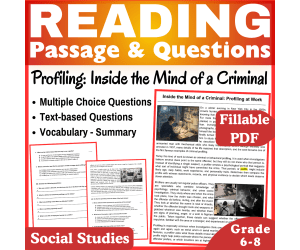
Criminal Profiling: Social Studies Reading Passage (Fillable PDF)
ELA, Reading, Reading Comprehension, Strategies, Resources for Teachers, Social Studies, Psychology, Grade 6, 7, 8, 9, Writing Prompts, Worksheets & Printables, Centers, Activities, Teacher Tools, Assessments, Quizzes and Tests, Quizzes, Tests
Criminal Profiling: Social Studies Reading Comprehension Passage (Fillable PDF) This resource introduces a unique Social Studies reading comprehension passage with questions about Criminal Profiling: Inside the Mind of a Criminal. The passage is carefully designed to bridge the gap between social studies and literacy through strengthening reading comprehension and sparking knowledge curiosity in middle school students. Each passage blends English Language Arts skills with accurate social studies content . Ideal for interdisciplinary learning in ELA and Social Studies. Suitable for Grade 9 review, too! This resource is designed as a fillable PDF , which means students can type their answers directly into the document on any computer or tablet . Each page includes highlighted text fields that show them exactly where to type! Student Tasks throughout the passage: 5 multiple-choice questions targeting the following skills: main idea, key details, inference, vocabulary in context, and use of evidence 5 vocabulary matching items with clear, student-friendly definitions 5 text-based questions that require citing specific lines or facts 1 summary prompt that asks students to condense central ideas accurately Full answer key for every section Available Formats for this Resource: PDF Word Docs Google Docs FULL CATALOG OF DOWNLOADING LINKS HERE Social Studies Reading Comprehension Collection Links: 1. Ancient Civilizations PDF Fillable PDF Word Docs Google Docs 2. Early Empires and Trade Networks PDF Fillable PDF Word Docs Google Docs 3. The Founding of the United States PDF Fillable PDF Word Docs Google Docs 4. Language, Culture, and Meaning PDF Fillable PDF Word Docs Google Docs 5. Psychology and Society PDF Fillable PDF Word Docs Google Docs 6. Global Festivals and Traditions PDF Fillable PDF Word Docs Google Docs 7. Extreme Environments and People PDF Fillable PDF Word Docs Google Docs 8. Food, Culture, and Preservation PDF Fillable PDF Word Docs Google Docs 9. Global Food Customs PDF Fillable PDF Word Docs Google Docs 10. Media, Communication, and Popular Culture PDF Fillable PDF Word Docs Google Docs 11. Human Impact on the Environment PDF Fillable PDF Word Docs Google Docs 12. Civic Action and Social Change PDF Fillable PDF Word Docs Google Docs 13. Fashion, Society, and Power PDF Fillable PDF Word Docs Google Docs 14. People, Places, and Unusual Histories PDF Fillable PDF Word Docs Google Docs Product Details: Length: 5 pages Grades: 6–8, also suitable for Grade 9 review Use cases: close reading, stations, homework, intervention, test prep, and sub plans Why Teachers Choose This Passage: Authentic social studies content paired with rigorous literacy practice Consistent task structure for easier planning and smoother student routines Clear, age-appropriate writing that builds confidence without oversimplifying Use this passage to reinforce ELA skills in social studies, to add literacy to your lessons, and to support independent work. The passage strengthens main idea, evidence use, vocabulary in context, inference, cause and effect, and summary writing. With ready-to-use assessments and complete answer keys, you can provide focused practice that is simple to run and fast to review.
Author Middle & High School - CORED Education
Rating
Tags Middle School, Reading Comprehension, Reading Strategies, ELA, Centers, Reading Passage, Assessments, Vocabulary, Social Studies, Pschology

The Giant’s Causeway in Ireland: Social Studies Reading Passage (Word)
ELA, Reading, Reading Comprehension, Strategies, Resources for Teachers, Social Studies, Geography, Grade 6, 7, 8, 9, Writing Prompts, Worksheets & Printables, Centers, Activities, Teacher Tools, Assessments, Quizzes and Tests, Quizzes, Tests
The Giant’s Causeway in Ireland: Social Studies Reading Comprehension Passage (Word) This resource introduces a unique Social Studies reading comprehension passage with questions about The Giant’s Causeway in Ireland. The passage is carefully designed to bridge the gap between social studies and literacy through strengthening reading comprehension and sparking knowledge curiosity in middle school students. Each passage blends English Language Arts skills with accurate social studies content . Ideal for interdisciplinary learning in ELA and Social Studies. Suitable for Grade 9 review, too! Student Tasks throughout the passage: 5 multiple-choice questions targeting the following skills: main idea, key details, inference, vocabulary in context, and use of evidence 5 vocabulary matching items with clear, student-friendly definitions 5 text-based questions that require citing specific lines or facts 1 summary prompt that asks students to condense central ideas accurately Full answer key for every section Available Formats for this Resource: PDF Fillable PDF Google Docs FULL CATALOG OF DOWNLOADING LINKS HERE Social Studies Reading Comprehension Collection Links: 1. Ancient Civilizations PDF Fillable PDF Word Docs Google Docs 2. Early Empires and Trade Networks PDF Fillable PDF Word Docs Google Docs 3. The Founding of the United States PDF Fillable PDF Word Docs Google Docs 4. Language, Culture, and Meaning PDF Fillable PDF Word Docs Google Docs 5. Psychology and Society PDF Fillable PDF Word Docs Google Docs 6. Global Festivals and Traditions PDF Fillable PDF Word Docs Google Docs 7. Extreme Environments and People PDF Fillable PDF Word Docs Google Docs 8. Food, Culture, and Preservation PDF Fillable PDF Word Docs Google Docs 9. Global Food Customs PDF Fillable PDF Word Docs Google Docs 10. Media, Communication, and Popular Culture PDF Fillable PDF Word Docs Google Docs 11. Human Impact on the Environment PDF Fillable PDF Word Docs Google Docs 12. Civic Action and Social Change PDF Fillable PDF Word Docs Google Docs 13. Fashion, Society, and Power PDF Fillable PDF Word Docs Google Docs 14. People, Places, and Unusual Histories PDF Fillable PDF Word Docs Google Docs Product Details: Length: 5 pages Grades: 6–8, also suitable for Grade 9 review Use cases: close reading, stations, homework, intervention, test prep, and sub plans Why Teachers Choose This Passage: Authentic social studies content paired with rigorous literacy practice Consistent task structure for easier planning and smoother student routines Clear, age-appropriate writing that builds confidence without oversimplifying Use this passage to reinforce ELA skills in social studies, to add literacy to your lessons, and to support independent work. The passage strengthens main idea, evidence use, vocabulary in context, inference, cause and effect, and summary writing. With ready-to-use assessments and complete answer keys, you can provide focused practice that is simple to run and fast to review.
Author Middle & High School - CORED Education
Rating
Tags Middle School, Reading Comprehension, Reading Strategies, ELA, Centers, Reading Passage, Assessments, Vocabulary, Social Studies, Geography

Social Studies Reading Passages: Language, Culture, Meaning (Google)
ELA, Reading, Reading Comprehension, Strategies, Resources for Teachers, Social Studies, Geography, Sociology, Grade 6, 7, 8, 9, Writing Prompts, Worksheets & Printables, Centers, Activities, Teacher Tools, Assessments, Quizzes and Tests, Quizzes, Tests
Social Studies Reading Comprehension Passages: Language, Culture, Meaning (Google) This resource introduces a collection of Social Studies reading comprehension passages about Language, Culture, and Meaning. The passages are carefully designed to bridge the gap between social studies and literacy through strengthening reading comprehension and sparking knowledge curiosity in middle school students. Each passage blends English Language Arts skills with accurate social studies content. Ideal for interdisciplinary learning in ELA and Social Studies. Suitable for Grade 9 review, too! What Is Included in this Collection? There are three informational passages (with full answer keys): Living Words: How Languages Change and Disappear The Language of Color in Chinese Culture Do Our Words Shape Our Minds For Each Passage, students will have multiple tasks to complete as follow: 5 multiple-choice questions targeting main idea, key details, inference, vocabulary in context, and use of evidence 5 vocabulary matching items with clear, student-friendly definitions 5 text-based questions that require citing specific lines or facts 1 summary prompt that asks students to condense central ideas accurately Available Formats for this Resource Fillable PDF Word Docs Google Docs FULL CATALOG OF DOWNLOADING LINKS HERE For more Social Studies Reading Passages, check the following Links: Ancient Civilizations PDF Fillable PDF Word Docs Google Docs Early Empires and Trade Networks PDF Fillable PDF Word Docs Google Docs The Founding of the United States PDF Fillable PDF Word Docs Google Docs Language, Culture, and Meaning PDF Fillable PDF Word Docs Google Docs Psychology and Society PDF Fillable PDF Word Docs Google Docs Global Festivals and Traditions PDF Fillable PDF Word Docs Google Docs Extreme Environments and People PDF Fillable PDF Word Docs Google Docs Food, Culture, and Preservation PDF Fillable PDF Word Docs Google Docs Global Food Customs PDF Fillable PDF Word Docs Google Docs Media, Communication, and Popular Culture PDF Fillable PDF Word Docs Google Docs Human Impact on the Environment PDF Fillable PDF Word Docs Google Docs Civic Action and Social Change PDF Fillable PDF Word Docs Google Docs Fashion, Society, and Power PDF Fillable PDF Word Docs Google Docs People, Places, and Unusual Histories PDF Fillable PDF Word Docs Google Docs Product Details Length: 13 pages total Grades: 6–8, also suitable for Grade 9 review Use cases: close reading, stations, homework, intervention, test prep, and sub plans Why Teachers Choose This Set Authentic social studies content paired with rigorous literacy practice Consistent task structure across all passages for easier planning and smoother student routines Clear, age-appropriate writing that builds confidence without oversimplifying Use this set to reinforce ELA skills in social studies, to add literacy to your lessons, and to support independent work. The passages strengthen main idea, evidence use, vocabulary in context, inference, cause and effect, and summary writing. With ready-to-use assessments and complete answer keys, you can provide focused practice that is simple to run and fast to review.
Author Middle & High School - CORED Education
Rating
Tags Middle School, Reading Comprehension, Reading Strategies, ELA, Centers, Reading Passage, Assessments, Vocabulary, Social Studies

Guided Reading Level M - Acid Rain (with Lesson Plan)
ELA, Resources for Teachers, Reading Comprehension, Reading, Science, Technology, Physics, Life Sciences, Earth and Environmental Sciences, Environmental Science, Grade 2, 3, 4, Worksheets & Printables, Worksheets, Teacher Tools, Centers, Activities, Literacy Readers, Quizzes, Quizzes and Tests, Assessments, Lesson Plans
This Guided Reading Book - Acid Rain (Level M) with lesson plan includes: Guided Reading Color Label (front cover x1) This is a quick way to match the book’s demands to what students can generally handle.. The overall goal is to use the level/color to pick books for several smaller groups. To qualify for a certain level, a student is expected to read a book from that level with about 90–94% accuracy. If a student is consistently accurate and understands, move up a level. If the student is struggling at that level, drop down and add more support. Each student will improve at completely different rates, but it is generally one of the best ways to check progress across the class. DOWNLOAD THE CATALOG TO VIEW ALL GUIDED READING BOOKS AVAILABLE (SORTED LEVELS A-Z) Pre-Reading Question (x1) Teacher asks the prompt aloud, can be while showing the cover or first page. Students share what they already know, or make educated guesses from the cover. Prompt them to use the target vocabulary. Write some of their responses on the board to look back at during the reading. Vocabulary Words (x5) Introduce the five words, best doing it one at a time. Start by saying it, while students repeat and then see if anyone knows what it means before reading further. Read through the meaning and try to briefly connect each word to a picture or gesture so it’s meaningful. Ask students to flip through the book pages and point to where they see each of the vocabulary words. While reading the book pause upon coming across one of the vocab words or read the sentence twice to make sure students understand the word has appeared. Optional: Ask students to raise hands whenever they see/hear one of the new words. Guided Reading Pages (x10) Check the book snapshot (below) for: primary topic - do you need to prep extra reading or intro materials on this? what is taught best - decide on 1-2 bullets to focus on, use the prompt or words provided here for best results. learning goals - what you are checking for students to be able to do after the session, elicit answers using prompts or words provided. key vocabulary (see section above). questions overview - so you know what is coming up and if you need to prep extra materials to assist understanding. Run the lesson You may have already looked at a few of the pages together, but you can show them some of the pictures again first to set meaning. Depending on how much time you have and how familiar your students are with guided reading class, you may want to read the book aloud first with the group first. Students whisper or partner read, while you listen in. If time, do it as a group, one student reading a page each. Use the guided page’s prompts to coach: “Check the picture / does it make sense?” “Point under the words / try the first sound” “Reread the sentence smoothly”. Try to focus more on one student per session (rotating every time), so you can work out if they are ready to move up or need to move down a level. Comprehension Questions (back cover x3) This is your way to check that students didn’t just say the words, but actually understood the text. First, let students answer by pointing to the page/picture and saying a short sentence. After any answer, follow with: “Show me where you found that in the text.” In bigger groups, have partners answer first (10–20 seconds), then call on 2–3 students to share. Differentiation tips: Emerging speakers/struggling readers: oral + pointing On-level: oral in a full sentence Higher: one written sentence or draw + label Book Snapshot Title: Acid Rain Genre: Nonfiction (informational science text) Subject: Science (Earth & Environmental Science) Primary Topic: Causes, effects, and solutions for acid rain Estimated Guided Reading Level (A–Z): M What This Book Teaches Best Explains how human activities (factories, power plants, and vehicles) change the chemistry of the air by releasing gases into the sky. Describes a chemical reaction in the clouds where gases mix with water vapor and oxygen to form acids that stay suspended in the air. Defines acid rain as acids falling to the ground as rain or snow, and notes it can also fall as fog or as dry dust during a drought. Uses the pH scale to compare normal rain (about 5.6) to acid rain (often between 4.2 and 4.4). Shows environmental impacts on forests (nutrients dissolving; difficulty taking up water) and on lakes/streams (changes to water chemistry that affect fish and other animals). Learning Goals Describe how rain is part of the water cycle and helps plants and animals survive. Identify gases released by factories, power plants, and vehicles that contribute to acid rain. Explain how gases high in the clouds can react and form acids that stay in the air. Use details from the text to compare normal rain and acid rain using pH numbers. Describe how acid rain can affect forests, lakes, streams, fish, birds, and other animals. Explain one way people can help reduce acid rain by using cleaner energy sources. Key Vocabulary From the Text chemistry — how materials can change when they mix. atmosphere — the air that surrounds Earth. reaction — a change that happens when substances mix. drought — a long time with little or no rain. nutrients — substances living things need to grow healthy. Discussion Prompts Pre-reading question: What do you think might happen when gases from cars and factories mix with water in the air? Comprehension questions: What gases do factories and power plants release when they burn fuels like coal? Comprehension questions: What happens to these gases high in the clouds, according to the text? Comprehension questions: What is one way people can help reduce acid rain in this book? Printing Tips 1. Best Printing Method (Recommended) “Booklet” Printing (Best if Available) If your printer or PDF viewer supports Booklet Printing , use this. Settings to use: Print mode: Booklet Paper size: Letter or A4 (either works) Orientation: Landscape Print on both sides: Yes Flip on: Short edge Scaling: Fit to printable area Booklet subset: First test: Front sides only Then: Back sides only This will automatically: Pair pages correctly Put the cover on the outside Align everything for folding After printing, fold in half and staple along the spine . 2. If “Booklet” Printing Is NOT Available You can still print this correctly with manual duplex printing . Step-by-step: Open the PDF. Choose Print . Set: Orientation: Landscape Pages per sheet: 1 Print on both sides: Yes Flip on: Short edge Print all pages . Because each PDF page already contains two facing book pages, the result will still fold cleanly into a book. Thousands of Cored Education products are included with your TeachSimple membership. Download links and encyclopedia index available here.
Author Cored Education
Rating
Tags Reading Comprehension, Reading Passages, Reading, Guided Reading, Guided Reading Lesson Plan, Guided Reading Activity, Pre-reading, Science Lesson Plans, Earth Science, Physics

Social Studies SAMPLE Reading Passage: The Aztec Empire (Fillable PDF)
ELA, Reading, Reading Comprehension, Strategies, Resources for Teachers, Social Studies, History: Ancient, History, Economics, Geography, Grade 6, 7, 8, 9, Writing Prompts, Worksheets & Printables, Centers, Activities, Teacher Tools, Assessments, Quizzes and Tests, Quizzes, Tests
This is a ONE PASSAGE SAMPLE. The following is the description of the FULL resource and the downloading links: Social Studies Reading Comprehension Passages: Early Empires and Trade Networks (Fillable PDF) This very engaging collection of Social Studies reading passages about Early Empires and Trade Networks is designed to bridge the gap between social studies and literacy through strengthening reading comprehension and sparking knowledge curiosity in middle school students. Each passage blends English Language Arts skills with accurate social studies content. Ideal for interdisciplinary learning in ELA and Social Studies. Suitable for Grade 9 review, too! These worksheets are designed as fillable PDFs , which means students can type their answers directly into the document on any computer or tablet . Each page includes highlighted text fields that show them exactly where to type! What Is Included? There are - (3) - informational passages: Digging Into Time: How Archaeology Explains Prehistory When Spices Ruled the World: Trade, Power, and Taste The Rise and Fall of the Aztec Empire Student Tasks for Each Passage: 5 multiple-choice questions targeting main idea, key details, inference, vocabulary in context, and use of evidence 5 vocabulary matching items with clear, student-friendly definitions 5 text-based questions that require citing specific lines or facts 1 summary prompt that asks students to condense central ideas accurately Full answer key for every section Available Formats for this Resource PDF Word Docs Google Docs FULL CATALOG OF DOWNLOADING LINKS HERE Reading Passage Links: Ancient Civilizations PDF Fillable PDF Word Docs Google Docs Early Empires and Trade Networks PDF Fillable PDF Word Docs Google Docs The Founding of the United States PDF Fillable PDF Word Docs Google Docs Language, Culture, and Meaning PDF Fillable PDF Word Docs Google Docs Psychology and Society PDF Fillable PDF Word Docs Google Docs Global Festivals and Traditions PDF Fillable PDF Word Docs Google Docs Extreme Environments and People PDF Fillable PDF Word Docs Google Docs Food, Culture, and Preservation PDF Fillable PDF Word Docs Google Docs Global Food Customs PDF Fillable PDF Word Docs Google Docs Media, Communication, and Popular Culture PDF Fillable PDF Word Docs Google Docs Human Impact on the Environment PDF Fillable PDF Word Docs Google Docs Civic Action and Social Change PDF Fillable PDF Word Docs Google Docs Fashion, Society, and Power PDF Fillable PDF Word Docs Google Docs People, Places, and Unusual Histories PDF Fillable PDF Word Docs Google Docs How to Use These PDFs Click on the highlighted area to start typing your answer. Move to the next question by clicking in the next highlighted box. When you are finished, close the document and select SAVE so your answers stay recorded. If you want to keep a blank copy for later, choose Save As and give your completed version a new name. Product Details Length: 15 pages total Grades: 6–8, also suitable for Grade 9 review Use cases: close reading, stations, homework, intervention, test prep, and sub plans Why Teachers Choose This Set Authentic social studies content paired with rigorous literacy practice Consistent task structure across all passages for easier planning and smoother student routines Clear, age-appropriate writing that builds confidence without oversimplifying Use this set to reinforce ELA skills in social studies, to add literacy to your lessons, and to support independent work. The passages strengthen main idea, evidence use, vocabulary in context, inference, cause and effect, and summary writing. With ready-to-use assessments and complete answer keys, you can provide focused practice that is simple to run and fast to review.
Author Middle & High School - CORED Education
Rating
Tags Middle School, Reading Comprehension, Reading Strategies, ELA, Centers, Reading Passage, Assessments, Vocabulary, Social Studies, Ancient Civilization

Motion & Materials: Physical Science Reading Comprehension (Google)
Science, ELA, Reading, Reading Comprehension, Strategies, Resources for Teachers, Physics, Grade 6, 7, 8, 9, Writing Prompts, Worksheets & Printables, Centers, Activities, Teacher Tools, Assessments, Quizzes and Tests, Quizzes, Tests
Electricity and Energy: Physical Science Reading Comprehension Passages and Questions (Google) This very engaging collection of physical science reading passages about electricity and energy is designed to bridge the gap between science and literacy through strengthening reading comprehension and sparking scientific curiosity in middle school students. Each passage blends English Language Arts skills with accurate science content that supports NGSS classroom practice. Ideal for interdisciplinary learning in ELA and Science. Suitable for Grade 9 review, too! What Is Included? There are (3) informational passages: Sweet Science: How Heat Shapes Candy Baseball Science: From Bat to Ball Electric vs. Gasoline Cars: The Road Ahead Student Tasks for Each Passage: 5 multiple-choice questions targeting main idea, key details, inference, vocabulary in context, and use of evidence 5 vocabulary matching items with clear, student-friendly definitions 5 text-based questions that require citing specific lines or facts 1 summary prompt that asks students to condense central ideas accurately Full answer key for every section Available Formats for this Resource PDF Word Docs FULL CATALOG OF DOWNLOADING LINKS HERE Other Science Reading Collections you May find in the store: 1. Astronomy & Space Science 2. Volcanoes, Rocks, & Mountains 3. Rock Cycle, Soil, & Sinkholes 4. Mars, Glaciers, & Antarctica 5. Water Cycle, Acid Rain, & Wastewater 6. Insects, Animals, & Ecosystems 7. Bioluminescence & Insects 8. Animal Skin, Cats, & T. Rex 9. Human Body and Senses 10. Health & Applied Bioscience 11. Waves, Light, & Imaging 12. Electricity & Energy 13. Motion & Materials 14. Chemistry and Materials Science Product Details Length: 12 pages total Grades: 6–8, also suitable for Grade 9 review Use cases: close reading, stations, homework, intervention, test prep, and sub plans Standards support: reinforces informational-text skills and supports NGSS-style sense making through observation, modeling, and clear use of claim, evidence, and reasoning Why Teachers Choose This Set Authentic science content paired with rigorous literacy practice Consistent task structure across all passages for easier planning and smoother student routines Clear, age-appropriate writing that builds confidence without oversimplifying Use this set to reinforce ELA skills in science, to add literacy to your lessons, or to support independent work. The passages strengthen main idea, evidence use, vocabulary in context, inference, cause and effect, and summary writing. With ready-to-use assessments and complete answer keys, you can provide focused practice that is simple to run and fast to review.
Author Middle & High School - CORED Education
Rating
Tags Middle School, Reading Comprehension, Reading Strategies, ELA, Centers, Reading Passage, Assessments, Vocabulary, Physical Science, Physics

Earth Science Reading Comprehension Passage: The Water Cycle (Docs)
Science, ELA, Reading, Reading Comprehension, Strategies, Resources for Teachers, Earth and Environmental Sciences, Earth Sciences, Environmental Science, Grade 6, 7, 8, 9, Writing Prompts, Worksheets & Printables, Centers, Activities, Teacher Tools, Assessments, Quizzes and Tests, Quizzes, Tests
Science Reading Comprehension Passages and Questions: The Water Cycle (Docs) This very engaging earth science reading passage about the Water Cycle . It is designed to bridge the gap between science and literacy through strengthening reading comprehension and sparking scientific curiosity in middle school students. The passage blends English Language Arts skills with accurate science content that supports NGSS classroom practice. Ideal for interdisciplinary learning in ELA and Science. Suitable for Grade 9 review, too! Student Tasks for The Passage: 5 multiple-choice questions targeting main idea, key details, inference, vocabulary in context, and use of evidence 5 vocabulary matching items with clear, student-friendly definitions 5 text-based questions that require citing specific lines or facts 1 summary prompt that asks students to condense central ideas accurately Full answer key for every section Available Formats for this Resource PDF Fillable PDF Word Docs FULL CATALOG OF DOWNLOADING LINKS HERE Product Details Length: 5 pages total Grades: 6–8, also suitable for Grade 9 review Use cases: close reading, stations, homework, intervention, test prep, and sub plans Standards support: reinforces informational-text skills and supports NGSS-style sense making through observation, modeling, and clear use of claim, evidence, and reasoning Why Teachers Choose This Set Authentic science content paired with rigorous literacy practice Consistent task structure across all passages for easier planning and smoother student routines Clear, age-appropriate writing that builds confidence without oversimplifying Other Science Reading Collections you May find in the store: 1. Astronomy & Space Science 2. Volcanoes, Rocks, & Mountains 3. Rock Cycle, Soil, & Sinkholes 4. Mars, Glaciers, & Antarctica 5. Water Cycle, Acid Rain, & Wastewater 6. Insects, Animals, & Ecosystems 7. Bioluminescence & Insects 8. Animal Skin, Cats, & T. Rex 9. Human Body and Senses 10. Health & Applied Bioscience 11. Waves, Light, & Imaging 12. Electricity & Energy 13. Motion & Materials 14. Chemistry and Materials Science Use this set to reinforce ELA skills in science, to add literacy to your lessons, and to support independent work. The passages strengthen main idea, evidence use, vocabulary in context, inference, cause and effect, and summary writing. With ready-to-use assessments and complete answer keys, you can provide focused practice that is simple to run and fast to review.
Author Middle & High School - CORED Education
Rating
Tags Middle School, Reading Comprehension, Reading Strategies, ELA, Centers, Reading Passage, Assessments, Vocabulary, Environmental Science, Water Cycle
Guided Reading Level L - Boats on the Move (with Lesson Plan)
ELA, Resources for Teachers, Reading Comprehension, Reading, Science, Engineering, Technology, Physics, Sports, P.E. & Health, Grade 2, 3, 4, Worksheets & Printables, Worksheets, Teacher Tools, Centers, Activities, Literacy Readers, Quizzes, Quizzes and Tests, Assessments, Lesson Plans
This Guided Reading Book - Boats on the Move (Level L) with lesson plan includes: Guided Reading Color Label (front cover x1) This is a quick way to match the book’s demands to what students can generally handle.. The overall goal is to use the level/color to pick books for several smaller groups. To qualify for a certain level, a student is expected to read a book from that level with about 90–94% accuracy. If a student is consistently accurate and understands, move up a level. If the student is struggling at that level, drop down and add more support. Each student will improve at completely different rates, but it is generally one of the best ways to check progress across the class. DOWNLOAD THE CATALOG TO VIEW ALL GUIDED READING BOOKS AVAILABLE (SORTED LEVELS A-Z) Pre-Reading Question (x1) Teacher asks the prompt aloud, can be while showing the cover or first page. Students share what they already know, or make educated guesses from the cover. Prompt them to use the target vocabulary. Write some of their responses on the board to look back at during the reading. Vocabulary Words (x5) Introduce the five words, best doing it one at a time. Start by saying it, while students repeat and then see if anyone knows what it means before reading further. Read through the meaning and try to briefly connect each word to a picture or gesture so it’s meaningful. Ask students to flip through the book pages and point to where they see each of the vocabulary words. While reading the book pause upon coming across one of the vocab words or read the sentence twice to make sure students understand the word has appeared. Optional: Ask students to raise hands whenever they see/hear one of the new words. Guided Reading Pages (x10) Check the book snapshot (below) for: primary topic - do you need to prep extra reading or intro materials on this? what is taught best - decide on 1-2 bullets to focus on, use the prompt or words provided here for best results. learning goals - what you are checking for students to be able to do after the session, elicit answers using prompts or words provided. key vocabulary (see section above). questions overview - so you know what is coming up and if you need to prep extra materials to assist understanding. Run the lesson You may have already looked at a few of the pages together, but you can show them some of the pictures again first to set meaning. Depending on how much time you have and how familiar your students are with guided reading class, you may want to read the book aloud first with the group first. Students whisper or partner read, while you listen in. If time, do it as a group, one student reading a page each. Use the guided page’s prompts to coach: “Check the picture / does it make sense?” “Point under the words / try the first sound” “Reread the sentence smoothly”. Try to focus more on one student per session (rotating every time), so you can work out if they are ready to move up or need to move down a level. Comprehension Questions (back cover x3) This is your way to check that students didn’t just say the words, but actually understood the text. First, let students answer by pointing to the page/picture and saying a short sentence. After any answer, follow with: “Show me where you found that in the text.” In bigger groups, have partners answer first (10–20 seconds), then call on 2–3 students to share. Differentiation tips: Emerging speakers/struggling readers: oral + pointing On-level: oral in a full sentence Higher: one written sentence or draw + label Book Snapshot Title: Boats on the Move Genre: Nonfiction (informational) Subject: Science (Forces & Motion) / Reading (Informational Text) Primary Topic: Different ways boats move across water Estimated Guided Reading Level (A–Z): L What This Book Teaches Best Different ways boats move on water (wind, oars, paddles, engines). How specific boat parts help movement (sails, mast, ropes, propeller). How coordinated actions affect motion (oars dipping “at the same time” to go straight). How markers guide movement during a race (boats turn around bright orange buoys to stay on track). Comparing speed and movement styles (quiet glide vs fast roar; forward motion by alternating paddle sides). Learning Goals Students will identify several ways boats move across the water using details from the text. Students will explain how sails and wind help pull a boat forward. Students will describe how rowers use oars together to move a boat straight ahead. Students will describe how a double-ended paddle helps a kayak move forward quickly. Students will explain how an engine and propeller help push a motorboat through the water. Students will describe why boats turn around buoys during a race, based on the text. Key Vocabulary From the Text mast — a tall pole that holds sails up. rhythm — a steady pattern of movement. double-ended — having an end on both sides. propeller — a spinning part that helps push a boat. buoys — floating markers that show where to go. Discussion Prompts Pre-reading question: What are some different ways a boat could move across the water? Comprehension questions: How do large white sails help a boat move forward? What do rowers do “at the same time,” and what does that help the boat do? Why must boats turn around bright orange buoys during a race? Printing Tips 1. Best Printing Method (Recommended) “Booklet” Printing (Best if Available) If your printer or PDF viewer supports Booklet Printing , use this. Settings to use: Print mode: Booklet Paper size: Letter or A4 (either works) Orientation: Landscape Print on both sides: Yes Flip on: Short edge Scaling: Fit to printable area Booklet subset: First test: Front sides only Then: Back sides only This will automatically: Pair pages correctly Put the cover on the outside Align everything for folding After printing, fold in half and staple along the spine . 2. If “Booklet” Printing Is NOT Available You can still print this correctly with manual duplex printing . Step-by-step: Open the PDF. Choose Print . Set: Orientation: Landscape Pages per sheet: 1 Print on both sides: Yes Flip on: Short edge Print all pages . Because each PDF page already contains two facing book pages, the result will still fold cleanly into a book. Thousands of Cored Education products are included with your TeachSimple membership. Download links and encyclopedia index available here.
Author Cored Education
Rating
Tags Reading Comprehension, Reading Passages, Reading, Guided Reading, Guided Reading Lesson Plan, Guided Reading Activity, Pre-reading, Science Lesson Plans, Physics, Technology

Saving Electricity Campaign: SAMPLE Social Studies Reading Passage
ELA, Reading, Reading Comprehension, Strategies, Resources for Teachers, Social Studies, Sociology, Grade 6, 7, 8, 9, Writing Prompts, Worksheets & Printables, Centers, Activities, Teacher Tools, Assessments, Quizzes and Tests, Quizzes, Tests
This is a free passage sample from the complete resource. The full version includes everything needed for a complete reading comprehension activity: the passage, multiple-choice questions, short-answer questions, vocabulary matching, a summary-writing task, and a detailed answer key. Download the complete passage resource by clicking on the following links: PDF Fillable PDF Word Docs Google Docs Saving Electricity Campaign: Social Studies Reading Comprehension Passage (PDF) This resource introduces a unique Social Studies reading comprehension passage with questions about Saving Electricity Campaign. The passage is carefully designed to bridge the gap between social studies and literacy through strengthening reading comprehension and sparking knowledge curiosity in middle school students. Each passage blends English Language Arts skills with accurate social studies content . Ideal for interdisciplinary learning in ELA and Social Studies. Suitable for Grade 9 review, too! Student Tasks throughout the passage: 5 multiple-choice questions targeting the following skills: main idea, key details, inference, vocabulary in context, and use of evidence 5 vocabulary matching items with clear, student-friendly definitions 5 text-based questions that require citing specific lines or facts 1 summary prompt that asks students to condense central ideas accurately Full answer key for every section FULL CATALOG OF DOWNLOADING LINKS HERE Other Social Studies Reading Comprehension Collections You May Find in the Store: 1. Ancient Civilizations 2. Early Empires and Trade Networks 3. The Founding of the United States 4. Language, Culture, and Meaning 5. Psychology and Society 6. Global Festivals and Traditions 7. Extreme Environments and People 8. Food, Culture, and Preservation 9. Global Food Customs 10. Media, Communication, and Popular Culture 11. Human Impact on the Environment 12. Civic Action and Social Change 13. Fashion, Society, and Power 14. People, Places, and Unusual Histories Product Details: Length: 5 pages Grades: 6–8, also suitable for Grade 9 review Use cases: close reading, stations, homework, intervention, test prep, and sub plans Why Teachers Choose This Passage: Authentic social studies content paired with rigorous literacy practice Consistent task structure for easier planning and smoother student routines Clear, age-appropriate writing that builds confidence without oversimplifying Use this passage to reinforce ELA skills in social studies, to add literacy to your lessons, and to support independent work. The passage strengthens main idea, evidence use, vocabulary in context, inference, cause and effect, and summary writing. With ready-to-use assessments and complete answer keys, you can provide focused practice that is simple to run and fast to review.
Author Middle & High School - CORED Education
Rating
Tags Middle School, Reading Comprehension, Reading Strategies, ELA, Centers, Reading Passage, Assessments, Vocabulary, Social Studies, Sociology

Franklin's Notebook of Virtues: Social Studies Passage (Fillable PDF)
ELA, Reading, Reading Comprehension, Strategies, Resources for Teachers, Social Studies, History, History: USA, Grade 6, 7, 8, 9, Writing Prompts, Worksheets & Printables, Centers, Activities, Teacher Tools, Assessments, Quizzes and Tests, Quizzes, Tests
Benjamin Franklin's Notebook of Virtues: Social Studies Reading Comprehension Passage (Fillable PDF) This resource introduces a unique Social Studies reading comprehension passage with questions about Benjamin Franklin's Notebook of Virtues. The passage is carefully designed to bridge the gap between social studies and literacy through strengthening reading comprehension and sparking knowledge curiosity in middle school students. Each passage blends English Language Arts skills with accurate social studies content . Ideal for interdisciplinary learning in ELA and Social Studies. Suitable for Grade 9 review, too! This resource is designed as a fillable PDF , which means students can type their answers directly into the document on any computer or tablet . Each page includes highlighted text fields that show them exactly where to type! Student Tasks throughout the passage: 5 multiple-choice questions targeting the following skills: main idea, key details, inference, vocabulary in context, and use of evidence 5 vocabulary matching items with clear, student-friendly definitions 5 text-based questions that require citing specific lines or facts 1 summary prompt that asks students to condense central ideas accurately Full answer key for every section Available Formats for this Resource: PDF Word Docs Google Docs FULL CATALOG OF DOWNLOADING LINKS HERE Social Studies Reading Comprehension Collection Links: 1. Ancient Civilizations PDF Fillable PDF Word Docs Google Docs 2. Early Empires and Trade Networks PDF Fillable PDF Word Docs Google Docs 3. The Founding of the United States PDF Fillable PDF Word Docs Google Docs 4. Language, Culture, and Meaning PDF Fillable PDF Word Docs Google Docs 5. Psychology and Society PDF Fillable PDF Word Docs Google Docs 6. Global Festivals and Traditions PDF Fillable PDF Word Docs Google Docs 7. Extreme Environments and People PDF Fillable PDF Word Docs Google Docs 8. Food, Culture, and Preservation PDF Fillable PDF Word Docs Google Docs 9. Global Food Customs PDF Fillable PDF Word Docs Google Docs 10. Media, Communication, and Popular Culture PDF Fillable PDF Word Docs Google Docs 11. Human Impact on the Environment PDF Fillable PDF Word Docs Google Docs 12. Civic Action and Social Change PDF Fillable PDF Word Docs Google Docs 13. Fashion, Society, and Power PDF Fillable PDF Word Docs Google Docs 14. People, Places, and Unusual Histories PDF Fillable PDF Word Docs Google Docs Product Details: Length: 4 pages Grades: 6–8, also suitable for Grade 9 review Use cases: close reading, stations, homework, intervention, test prep, and sub plans Why Teachers Choose This Passage: Authentic social studies content paired with rigorous literacy practice Consistent task structure for easier planning and smoother student routines Clear, age-appropriate writing that builds confidence without oversimplifying Use this passage to reinforce ELA skills in social studies, to add literacy to your lessons, and to support independent work. The passage strengthens main idea, evidence use, vocabulary in context, inference, cause and effect, and summary writing. With ready-to-use assessments and complete answer keys, you can provide focused practice that is simple to run and fast to review.
Author Middle & High School - CORED Education
Rating
Tags Middle School, Reading Comprehension, Reading Strategies, ELA, Centers, Reading Passage, Assessments, Vocabulary, Social Studies, US HISTORY