



3,906 products added recently
Page 47 - Popular Quizzes
Our Popular Quizzes collection features the most widely used and highly rated assessments among teachers. These quizzes have been praised for their quality, alignment with educational standards, and ability to accurately gauge student comprehension. Covering various subjects and grade levels, they can be easily integrated into your teaching routine. By choosing from our Popular Quizzes, you can trust that you're utilizing proven tools to evaluate and enhance your students' learning experiences.

 Show filters

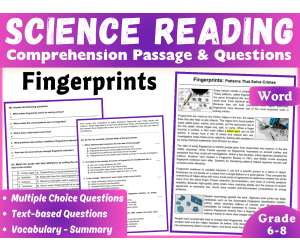
Science Reading Comprehension Passage: Fingerprints (Word)
Science, ELA, Reading, Reading Comprehension, Strategies, Resources for Teachers, Grade 6, 7, 8, 9, Writing Prompts, Worksheets & Printables, Centers, Activities, Teacher Tools, Assessments, Quizzes and Tests, Quizzes, Tests
Science Reading Comprehension Passage and Questions: Fingerprints (Word) This very engaging science reading passage is about fingerprints and how they are used to solve crimes . It explains that fingerprints are unique, permanent patterns formed by friction ridges on the skin. It describes how investigators find and develop latent prints left behind by sweat and natural skin oils, compare ridge details, and use modern tools such as AFIS and live-scan devices to search and record fingerprints. The passage also explains why fingerprint evidence can be strong when it is collected, documented, and compared carefully. This passage is designed to bridge the gap between science and literacy through strengthening reading comprehension and sparking scientific curiosity in middle school students. The passage blends English Language Arts skills with accurate science content that supports NGSS classroom practice. Ideal for interdisciplinary learning in ELA and Science. Suitable for Grade 9 review, too! Student Tasks for The Passage: 5 multiple-choice questions targeting main idea, key details, inference, vocabulary in context, and use of evidence 5 vocabulary matching items with clear, student-friendly definitions 5 text-based questions that require citing specific lines or facts 1 summary prompt that asks students to condense central ideas accurately Full answer key for every section Available Formats for this Resource PDF Fillable PDF Google Docs FULL CATALOG OF DOWNLOADING LINKS HERE Product Details Length: 4 pages total Grades: 6–8, also suitable for Grade 9 review Use cases: close reading, stations, homework, intervention, test prep, and sub plans Standards support: reinforces informational-text skills and supports NGSS-style sense making through observation, modeling, and clear use of claim, evidence, and reasoning Why Teachers Choose This Set Authentic science content paired with rigorous literacy practice Consistent task structure across all passages for easier planning and smoother student routines Clear, age-appropriate writing that builds confidence without oversimplifying Other Science Reading Collections you May find in the store: 1. Astronomy & Space Science 2. Volcanoes, Rocks, & Mountains 3. Rock Cycle, Soil, & Sinkholes 4. Mars, Glaciers, & Antarctica 5. Water Cycle, Acid Rain, & Wastewater 6. Insects, Animals, & Ecosystems 7. Bioluminescence & Insects 8. Animal Skin, Cats, & T. Rex 9. Human Body and Senses 10. Health & Applied Bioscience 11. Waves, Light, & Imaging 12. Electricity & Energy 13. Motion & Materials 14. Chemistry and Materials Science Use this set to reinforce ELA skills in science, to add literacy to your lessons, and to support independent work. The passages strengthen main idea, evidence use, vocabulary in context, inference, cause and effect, and summary writing. With ready-to-use assessments and complete answer keys, you can provide focused practice that is simple to run and fast to review.
Author Middle & High School - CORED Education
Rating
Tags Middle School, Reading Comprehension, Reading Strategies, ELA, Centers, Reading Passage, Assessments, Vocabulary, Technology
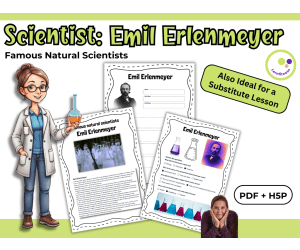
Emil Erlenmeyer – The Scientist Behind the Famous Flask
Life Sciences, Science, STEM, Social Studies, Biographies, Inventors, Basic Science, Physics, Chemistry, Technology, Grade 6, 7, 8, 9, 10, 11, Worksheets, Worksheets & Printables, Quizzes, Quizzes and Tests, Teacher Tools, Projects, Activities
Emil Erlenmeyer – The Scientist Behind the Famous Flask Comprehension Activities A short informational text and classroom task set for grades 7–10 🧪📘 (PDF + H5P) ⚗️📘 A printable and digital resource for grades 7–10 science and cross-curricular teaching 🧪🧠 This resource introduces students to Emil Erlenmeyer, a chemist best known for designing the Erlenmeyer flask – a piece of lab equipment still used every day in schools and laboratories around the world. Beyond the flask, he also made important contributions to the understanding of chemical structures and reactions. The text is written in clear, student-friendly language and offers a good opportunity to connect science content with the people behind the discoveries. I’ve used this kind of material in lessons where students are learning about lab equipment, scientific processes, or simply getting to know the history of chemistry. What’s included: A short informational text about Emil Erlenmeyer A printable student profile to summarize key facts Quiz questions based on the text (with answer key) Two extension tasks for extra practice or early finishers: – Students create their own questions – Exchange and answer partner questions Available formats: – PDF (print and digital use) – DOCX (editable text version) – H5P version for digital platforms (without images) How to use it in class: Students begin by reading the text – individually, in pairs, or as a group. They then complete the profile and quiz questions. The optional tasks work well in partner work or as a small extension activity. The structure is easy to follow and also works in substitute lessons, even when the substitute isn’t a science teacher. The H5P version can be used in digital classrooms or assigned as a self-paced homework activity with built-in feedback. No prep is needed – just print or upload and start. A simple way to connect everyday classroom science with the people who shaped it. Have fun exploring the world of science with your students! Warmly, Lernfitness Did You Know? I teach with a certified therapy dog, and together we focus on creating a positive and inspiring learning environment.
Author Lernfitness
Rating
Tags Science, Famous Scientists Lesson, H5P, Interactive Science Exercises, STEM, Scientists, Chemistry, Emil Erlenmeyer, Erlenmeyer Flask, Lab
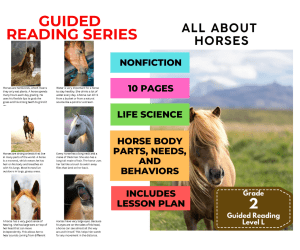
Guided Reading Level L - All About Horses (with Lesson Plan)
ELA, Resources for Teachers, Reading Comprehension, Reading, Science, Language Development, Life Sciences, Animals, Pre-Reading, Vocabulary, Grade 2, 3, 4, Worksheets & Printables, Worksheets, Teacher Tools, Centers, Activities, Literacy Readers, Quizzes, Quizzes and Tests, Assessments, Lesson Plans
This Guided Reading Book - All About Horses (Level L) with lesson plan includes: Guided Reading Color Label (front cover x1) This is a quick way to match the book’s demands to what students can generally handle.. The overall goal is to use the level/color to pick books for several smaller groups. To qualify for a certain level, a student is expected to read a book from that level with about 90–94% accuracy. If a student is consistently accurate and understands, move up a level. If the student is struggling at that level, drop down and add more support. Each student will improve at completely different rates, but it is generally one of the best ways to check progress across the class. DOWNLOAD THE CATALOG TO VIEW ALL GUIDED READING BOOKS AVAILABLE (SORTED LEVELS A-Z) Pre-Reading Question (x1) Teacher asks the prompt aloud, can be while showing the cover or first page. Students share what they already know, or make educated guesses from the cover. Prompt them to use the target vocabulary. Write some of their responses on the board to look back at during the reading. Vocabulary Words (x5) Introduce the five words, best doing it one at a time. Start by saying it, while students repeat and then see if anyone knows what it means before reading further. Read through the meaning and try to briefly connect each word to a picture or gesture so it’s meaningful. Ask students to flip through the book pages and point to where they see each of the vocabulary words. While reading the book pause upon coming across one of the vocab words or read the sentence twice to make sure students understand the word has appeared. Optional: Ask students to raise hands whenever they see/hear one of the new words. Guided Reading Pages (x10) Check the book snapshot (below) for: primary topic - do you need to prep extra reading or intro materials on this? what is taught best - decide on 1-2 bullets to focus on, use the prompt or words provided here for best results. learning goals - what you are checking for students to be able to do after the session, elicit answers using prompts or words provided. key vocabulary (see section above). questions overview - so you know what is coming up and if you need to prep extra materials to assist understanding. Run the lesson You may have already looked at a few of the pages together, but you can show them some of the pictures again first to set meaning. Depending on how much time you have and how familiar your students are with guided reading class, you may want to read the book aloud first with the group first. Students whisper or partner read, while you listen in. If time, do it as a group, one student reading a page each. Use the guided page’s prompts to coach: “Check the picture / does it make sense?” “Point under the words / try the first sound” “Reread the sentence smoothly”. Try to focus more on one student per session (rotating every time), so you can work out if they are ready to move up or need to move down a level. Comprehension Questions (back cover x3) This is your way to check that students didn’t just say the words, but actually understood the text. First, let students answer by pointing to the page/picture and saying a short sentence. After any answer, follow with: “Show me where you found that in the text.” In bigger groups, have partners answer first (10–20 seconds), then call on 2–3 students to share. Differentiation tips: Emerging speakers/struggling readers: oral + pointing On-level: oral in a full sentence Higher: one written sentence or draw + label Book Snapshot Title: All About Horses Genre: Nonfiction (informational) Subject: Life Science / Reading (Informational Text) Primary Topic: Horse body parts, needs, and behaviors Estimated Guided Reading Level (A–Z): L What This Book Teaches Best Key animal facts about horses (they are strong animals, mammals, and live outdoors in grassy areas). How horse body parts help them (mane and tail; tail swishes away flies). What horses need to stay healthy (they eat plants and drink a lot of water). How horses move (trot with “diagonal pairs,” and gallop as the fastest way to move with hooves off the ground). Special horse behaviors and life stages (sleeping while standing; a baby horse is a foal). Learning Goals Students will identify key facts about horses (habitat, body traits, and needs) from the text. Students will explain how a horse uses its tail based on details in the book. Students will describe what horses eat and how they graze using evidence from the text. Students will compare two horse movements (trot and gallop) using information from the book. Students will explain how a horse can sleep while standing without falling over. Students will describe what a foal is and what it can do soon after being born. Key Vocabulary From the Text mammal — an animal that breathes air with lungs. herbivores — animals that eat only plants. grazing — eating grass little by little over time. diagonal — slanted, from one corner to the opposite corner. hooves — the hard feet of a horse. Discussion Prompts Pre-reading question: What do you think a horse needs to stay healthy outdoors? Comprehension questions: What does the text say a horse uses its tail for? How does the text describe a trot? What is a foal, and what can it do within an hour of being born? Printing Tips 1. Best Printing Method (Recommended) “Booklet” Printing (Best if Available) If your printer or PDF viewer supports Booklet Printing , use this. Settings to use: Print mode: Booklet Paper size: Letter or A4 (either works) Orientation: Landscape Print on both sides: Yes Flip on: Short edge Scaling: Fit to printable area Booklet subset: First test: Front sides only Then: Back sides only This will automatically: Pair pages correctly Put the cover on the outside Align everything for folding After printing, fold in half and staple along the spine . 2. If “Booklet” Printing Is NOT Available You can still print this correctly with manual duplex printing . Step-by-step: Open the PDF. Choose Print . Set: Orientation: Landscape Pages per sheet: 1 Print on both sides: Yes Flip on: Short edge Print all pages . Because each PDF page already contains two facing book pages, the result will still fold cleanly into a book. Thousands of Cored Education products are included with your TeachSimple membership. Download links and encyclopedia index available here.
Author Cored Education
Rating
Tags Reading Comprehension, Reading Passages, Reading, Guided Reading, Guided Reading Lesson Plan, Guided Reading Activity, Pre-reading, Science Lesson Plans, Life Science, Animals

Science Reading Passage: The Truth About Drinks (Fillable PDF)
Science, ELA, Reading, Reading Comprehension, Strategies, Resources for Teachers, Grade 6, 7, 8, 9, Writing Prompts, Worksheets & Printables, Centers, Activities, Teacher Tools, Assessments, Quizzes and Tests, Quizzes, Tests
Science Reading Comprehension Passage and Questions: The Truth About Drinks (Fillable PDF) This very engaging science reading passage about how common drinks affect health, focus, and sleep. It explains the differences between regular soda, diet soda, and energy drinks . The passage warns that regular soda often contains a lot of added sugar, diet soda uses artificial sweeteners that may affect taste habits, and energy drinks can contain high caffeine levels that may cause headaches, anxiety, racing heartbeat, and poor sleep in teenagers. It also teaches students how to read beverage labels by checking added sugar, caffeine, ingredients, and serving size . This passage is designed to bridge the gap between science and literacy through strengthening reading comprehension and sparking scientific curiosity in middle school students. The passage blends English Language Arts skills with accurate science content that supports NGSS classroom practice. Ideal for interdisciplinary learning in ELA and Science. Suitable for Grade 9 review, too! This passage is designed as a fillable PDF , which means students can type their answers directly into the document on any computer or tablet . Each page includes highlighted text fields that show them exactly where to type! Student Tasks for The Passage: 5 multiple-choice questions targeting main idea, key details, inference, vocabulary in context, and use of evidence 5 vocabulary matching items with clear, student-friendly definitions 5 text-based questions that require citing specific lines or facts 1 summary prompt that asks students to condense central ideas accurately Full answer key for every section Available Formats for this Resource PDF Word Docs Google Docs FULL CATALOG OF DOWNLOADING LINKS HERE Product Details Length: 5 pages total Grades: 6–8, also suitable for Grade 9 review Use cases: close reading, stations, homework, intervention, test prep, and sub plans Standards support: reinforces informational-text skills and supports NGSS-style sense making through observation, modeling, and clear use of claim, evidence, and reasoning Why Teachers Choose This Set Authentic science content paired with rigorous literacy practice Consistent task structure across all passages for easier planning and smoother student routines Clear, age-appropriate writing that builds confidence without oversimplifying Other Science Reading Collections you May find in the store: 1. Astronomy & Space Science 2. Volcanoes, Rocks, & Mountains 3. Rock Cycle, Soil, & Sinkholes 4. Mars, Glaciers, & Antarctica 5. Water Cycle, Acid Rain, & Wastewater 6. Insects, Animals, & Ecosystems 7. Bioluminescence & Insects 8. Animal Skin, Cats, & T. Rex 9. Human Body and Senses 10. Health & Applied Bioscience 11. Waves, Light, & Imaging 12. Electricity & Energy 13. Motion & Materials 14. Chemistry and Materials Science Use this set to reinforce ELA skills in science, to add literacy to your lessons, and to support independent work. The passages strengthen main idea, evidence use, vocabulary in context, inference, cause and effect, and summary writing. With ready-to-use assessments and complete answer keys, you can provide focused practice that is simple to run and fast to review.
Author Middle & High School - CORED Education
Rating
Tags Middle School, Reading Comprehension, Reading Strategies, ELA, Centers, Reading Passage, Assessments, Vocabulary, Bioscience

Mesopotamia: Social Studies Reading Comprehension Passage (Docs)
ELA, Reading, Reading Comprehension, Strategies, Resources for Teachers, Social Studies, History: Ancient, History, Geography, Grade 6, 7, 8, 9, Writing Prompts, Worksheets & Printables, Centers, Activities, Teacher Tools, Assessments, Quizzes and Tests, Quizzes, Tests
Mesopotamia: Social Studies Reading Comprehension Passage (Docs) This resource introduces a unique Social Studies reading comprehension passage with questions about Mesopotamia: The First Urban World. The passage is carefully designed to bridge the gap between social studies and literacy through strengthening reading comprehension and sparking knowledge curiosity in middle school students. Each passage blends English Language Arts skills with accurate social studies content . Ideal for interdisciplinary learning in ELA and Social Studies. Suitable for Grade 9 review, too! Student Tasks throughout the passage: 5 multiple-choice questions targeting the following skills: main idea, key details, inference, vocabulary in context, and use of evidence 5 vocabulary matching items with clear, student-friendly definitions 5 text-based questions that require citing specific lines or facts 1 summary prompt that asks students to condense central ideas accurately Full answer key for every section Available Formats for this Resource: PDF Fillable PDF Word Docs FULL CATALOG OF DOWNLOADING LINKS HERE Social Studies Reading Comprehension Collection Links: 1. Ancient Civilizations PDF Fillable PDF Word Docs Google Docs 2. Early Empires and Trade Networks PDF Fillable PDF Word Docs Google Docs 3. The Founding of the United States PDF Fillable PDF Word Docs Google Docs 4. Language, Culture, and Meaning PDF Fillable PDF Word Docs Google Docs 5. Psychology and Society PDF Fillable PDF Word Docs Google Docs 6. Global Festivals and Traditions PDF Fillable PDF Word Docs Google Docs 7. Extreme Environments and People PDF Fillable PDF Word Docs Google Docs 8. Food, Culture, and Preservation PDF Fillable PDF Word Docs Google Docs 9. Global Food Customs PDF Fillable PDF Word Docs Google Docs 10. Media, Communication, and Popular Culture PDF Fillable PDF Word Docs Google Docs 11. Human Impact on the Environment PDF Fillable PDF Word Docs Google Docs 12. Civic Action and Social Change PDF Fillable PDF Word Docs Google Docs 13. Fashion, Society, and Power PDF Fillable PDF Word Docs Google Docs 14. People, Places, and Unusual Histories PDF Fillable PDF Word Docs Google Docs Product Details: Length: 5 pages Grades: 6–8, also suitable for Grade 9 review Use cases: close reading, stations, homework, intervention, test prep, and sub plans Why Teachers Choose This Passage: Authentic social studies content paired with rigorous literacy practice Consistent task structure for easier planning and smoother student routines Clear, age-appropriate writing that builds confidence without oversimplifying Use this passage to reinforce ELA skills in social studies, to add literacy to your lessons, and to support independent work. The passage strengthens main idea, evidence use, vocabulary in context, inference, cause and effect, and summary writing. With ready-to-use assessments and complete answer keys, you can provide focused practice that is simple to run and fast to review.
Author Middle & High School - CORED Education
Rating
Tags Middle School, Reading Comprehension, Reading Strategies, ELA, Centers, Reading Passage, Assessments, Vocabulary, Social Studies, Ancient Civilization

Physical Science Reading Comprehension Passage: Gas Laws (PDF)
Science, ELA, Reading, Reading Comprehension, Strategies, Resources for Teachers, Chemistry, Physics, Grade 6, 7, 8, 9, Writing Prompts, Worksheets & Printables, Centers, Activities, Teacher Tools, Assessments, Quizzes and Tests, Quizzes, Tests
Physical Science Reading Comprehension Passage and Questions: Gas Laws (PDF) This very engaging science reading passage is about gas laws and how gases respond to changes in temperature, pressure, and volume . It explains that gas particles are always moving and create pressure when they collide with the surfaces of a container. The passage introduces Boyle’s Law, Charles’s Law, and Gay-Lussac’s Law through familiar examples such as squeezed balloons, cold car tires, sealed soda cans in the sun, and hot air balloons. It also explains why gas laws are useful in real life, including in tire pressure, pressurized containers, aviation, balloon operation, and medical equipment such as ventilators. This passage is designed to bridge the gap between science and literacy by strengthening reading comprehension while sparking scientific curiosity in middle school students. It blends English Language Arts skills with accurate science content, helping students build background knowledge, understand key concepts, use evidence from the text, and explain scientific ideas clearly. This resource supports science classroom practice while also reinforcing important literacy skills such as main idea, vocabulary, comprehension, and summarizing. Ideal for interdisciplinary learning in ELA and Science. Suitable for Grade 9 review, too! Student Tasks for The Passage: 10 multiple-choice questions targeting main idea, key details, science concepts, comparison, and real-world applications 10 True/False statements to check understanding and address common misconceptions 5 text-based short-answer questions that require students to explain important ideas from the passage 5 vocabulary matching items with clear, student-friendly definitions 1 summary prompt that asks students to condense the central ideas accurately Full answer key for every section Available Formats for this Resource Fillable PDF Word Docs Google Docs FULL CATALOG OF DOWNLOADING LINKS HERE Product Details Length: 7 pages total Grades: 6–8, also suitable for Grade 9 review Use cases: close reading, stations, homework, intervention, test prep, and sub plans Standards support: Reinforces informational-text skills and supports NGSS-style sense-making by helping students read scientific explanations, connect evidence to key concepts, interpret real-world examples, and explain cause-and-effect relationships in science. Why Teachers Choose This Set Authentic science content paired with rigorous literacy practice Consistent task structure across all passages for easier planning and smoother student routines Clear, age-appropriate writing that builds confidence without oversimplifying Other Science Reading Collections and Topics You May Find in the Store: 1. Astronomy & Space Science 2. Volcanoes, Rocks, & Mountains 3. Rock Cycle, Soil, & Sinkholes 4. Mars, Glaciers, & Antarctica 5. Water Cycle, Acid Rain, & Wastewater 6. Insects, Animals, & Ecosystems 7. Bioluminescence & Insects 8. Animal Skin, Cats, & T. Rex 9. Human Body and Senses 10. Health & Applied Bioscience 11. Waves, Light, & Imaging 12. Electricity & Energy 13. Motion & Materials 14. Chemistry and Materials Science 15. Electromagnetism 16. Acids and Bases 17. Gas Laws 18. Biotechnology 19. Periodic Trends 20. Protists and Fungi 21. Microevolution 22. Blood 23. Chemical Bonding 24. Magnets 25. Muscles 26. Nuclear Chemistry 27. Electromagnetic Devices 28. Epigenetics 29. The Law of Conservation of Mass 30. Atomic Models 31. Isotopes and Ions 32. Light 33. Human-Environment Interaction 34. Theory of Evolution 35. Photosynthesis 36. Origins of Life and Early Earth 37. Gene Expression and Regulation 38. Thermochemistry 39. Allergies 40. Coevolution 41. Birth to Adulthood 42. Cells 43. Entropy and Free Energy 44. The Human Brain 45. Mixtures and Solutions 46. Invertebrates 47. Zoo Animals 48. Biochemistry 49. Animal Behavior 50. Population Ecology ...and many more engaging science reading passages that cover intriguing and important topics designed to spark curiosity and support student learning. Use this passage to reinforce ELA skills in science, to add literacy to your lessons, and to support independent work. The passages strengthen main idea, evidence use, vocabulary in context, inference, cause and effect, and summary writing. With ready-to-use assessments and complete answer keys, you can provide focused practice that is simple to run and fast to review.
Author Middle & High School - CORED Education
Rating
Tags Middle School, Reading Comprehension, Reading Strategies, ELA, Centers, Reading Passage, Assessments, Vocabulary, Chemistry, Physical Science

Social Studies SAMPLE Passage: Language, Culture, Meaning Fillable PDF
ELA, Reading, Reading Comprehension, Strategies, Resources for Teachers, Social Studies, Geography, Sociology, Grade 6, 7, 8, 9, Writing Prompts, Worksheets & Printables, Centers, Activities, Teacher Tools, Assessments, Quizzes and Tests, Quizzes, Tests
This is a ONE PASSAGE SAMPLE. The following is the description of the FULL resource and the downloading links: Social Studies Reading Comprehension Passages: Language, Culture, Meaning (Fillable PDF) This resource introduces a collection of Social Studies reading comprehension passages about Language, Culture, and Meaning. The passages are carefully designed to bridge the gap between social studies and literacy through strengthening reading comprehension and sparking knowledge curiosity in middle school students. Each passage blends English Language Arts skills with accurate social studies content. Ideal for interdisciplinary learning in ELA and Social Studies. Suitable for Grade 9 review, too! What Is Included in this Collection? There are three informational passages (with full answer keys): Living Words: How Languages Change and Disappear The Language of Color in Chinese Culture Do Our Words Shape Our Minds For Each Passage, students will have multiple tasks to complete as follow: 5 multiple-choice questions targeting main idea, key details, inference, vocabulary in context, and use of evidence 5 vocabulary matching items with clear, student-friendly definitions 5 text-based questions that require citing specific lines or facts 1 summary prompt that asks students to condense central ideas accurately Available Formats for this Resource Fillable PDF Word Docs Google Docs FULL CATALOG OF DOWNLOADING LINKS HERE For more Social Studies Reading Passages, check the following Links: Ancient Civilizations PDF Fillable PDF Word Docs Google Docs Early Empires and Trade Networks PDF Fillable PDF Word Docs Google Docs The Founding of the United States PDF Fillable PDF Word Docs Google Docs Language, Culture, and Meaning PDF Fillable PDF Word Docs Google Docs Psychology and Society PDF Fillable PDF Word Docs Google Docs Global Festivals and Traditions PDF Fillable PDF Word Docs Google Docs Extreme Environments and People PDF Fillable PDF Word Docs Google Docs Food, Culture, and Preservation PDF Fillable PDF Word Docs Google Docs Global Food Customs PDF Fillable PDF Word Docs Google Docs Media, Communication, and Popular Culture PDF Fillable PDF Word Docs Google Docs Human Impact on the Environment PDF Fillable PDF Word Docs Google Docs Civic Action and Social Change PDF Fillable PDF Word Docs Google Docs Fashion, Society, and Power PDF Fillable PDF Word Docs Google Docs People, Places, and Unusual Histories PDF Fillable PDF Word Docs Google Docs Product Details Length: 13 pages total Grades: 6–8, also suitable for Grade 9 review Use cases: close reading, stations, homework, intervention, test prep, and sub plans Why Teachers Choose This Set Authentic social studies content paired with rigorous literacy practice Consistent task structure across all passages for easier planning and smoother student routines Clear, age-appropriate writing that builds confidence without oversimplifying Use this set to reinforce ELA skills in social studies, to add literacy to your lessons, and to support independent work. The passages strengthen main idea, evidence use, vocabulary in context, inference, cause and effect, and summary writing. With ready-to-use assessments and complete answer keys, you can provide focused practice that is simple to run and fast to review.
Author Middle & High School - CORED Education
Rating
Tags Middle School, Reading Comprehension, Reading Strategies, ELA, Centers, Reading Passage, Assessments, Vocabulary, Social Studies
Gold Reading Comprehension Passage - Cored Ed Encyclopedia
ELA, Language Development, Resources for Teachers, Reading Comprehension, Reading, Pre-Reading, Writing, Science, Physics, Chemistry, Grade 2, 3, 4, 5, Worksheets & Printables, Worksheets, Teacher Tools, Centers, Activities, Writing Prompts, Assessments, Tests, Quizzes and Tests, Quizzes
This gold reading comprehension contains the following: Pre-Reading Trivia Students will write down one thing they already know about the subject and then read five more facts and discuss. These facts are fun, and the students will enjoy learning about the subject before reading more. Reading Passage The text is a high-interest reading passage with set paragraphs, roughly three to four paragraphs long. It contains a variety of themes about the topic, anywhere from history to technology. The passage is between 250 and 350 words in length. Mixed Questions The first question page contains four multiple-choice questions, each with a choice of four answers, and three written response questions that require a sentence or two from the student. Creative Writing In this question, the student will be required to write a five to eight sentence paragraph on a question related to the topic. Extension Activities This page is optional for fast finishers. If there are five to ten minutes left at the end of the lesson, the student can choose one of three activities, each one requiring a different skill. Answer Key There are answers for the multiple-choice questions and three written response questions have sample answers. FULL CATALOG OF DOWNLOAD LINKS AND ENCYCLOPEDIA INDEX HERE Cored Ed Encyclopedia Overview The Cored Ed Encyclopedia is a weekly series of lessons that you can pick up and use right away. These short readings fit into whatever time you have available. Each one includes a warm-up, a reading, and a set of questions, but it’s flexible — you can do just the reading, the full lesson, or skip the writing section if you need to. Each lesson focuses on a single topic so students don’t get lost. The writing is clear but never childish, making it perfect for grades two through five. Topics range from animals and science to history, inventions, and everyday things. No matter the level of the student, everyone should take away at least one new idea or fact from each lesson. The materials are easy to print, easy to explain, and require no setup. They work well for whole-class teaching, partner work, or independent study.
Author Cored Education
Rating
Tags Vocabulary, Spelling, Reading Comprehension, Reading Passages, Cored Encyclopedia, Facts, Reading, Creative Writing, Gold, Physics

Rock Cycle, Soil, & Sinkholes: SAMPLE Reading Passage (Word)
Science, Earth and Environmental Sciences, ELA, Reading, Reading Comprehension, Strategies, Resources for Teachers, Geology, Earth Sciences, Grade 6, 7, 8, 9, Writing Prompts, Worksheets & Printables, Centers, Activities, Teacher Tools, Assessments, Quizzes and Tests, Quizzes, Tests
This is a ONE PASSAGE SAMPLE. The following is the description of the FULL resource and the downloading links: Rock Cycle, Soil, & Sinkholes: Reading Comprehension Passages (Word) This very engaging collection of earth science reading passages about Rock Cycle, Soil, and Sinkholes is designed to bridge the gap between science and literacy through strengthening reading comprehension and sparking scientific curiosity in middle school students. Each passage blends English Language Arts skills with accurate science content that supports NGSS classroom practice. Ideal for interdisciplinary learning in ELA and Science. Suitable for Grade 9 review, too! What Is Included? There are (3) informational passages: Soil: The Life Beneath Our Feet Explore how minerals, organic matter, water, and air build layered soil, and see how texture and structure affect roots, drainage, clean water, and healthy habitats. The Science of Sinkholes Understand how dissolving rock creates underground voids, what can trigger subsidence or collapse, and how mapping and prevention reduce risk in vulnerable areas. The Rock Cycle: How Rocks Form and Change Follow rock material as it melts, crystallizes, weathers, compacts, and transforms under heat and pressure, then connect these processes to examples in nature and everyday life. Student Tasks for Each Passage: 5 multiple-choice questions targeting main idea, key details, inference, vocabulary in context, and use of evidence 5 vocabulary matching items with clear, student-friendly definitions 5 text-based questions that require citing specific lines or facts 1 summary prompt that asks students to condense central ideas accurately Full answer key for every section Available Formats for this Resource PDF Google Docs FULL CATALOG OF DOWNLOADING LINKS HERE Other Science Reading Collections and Topics You May Find in the Store: 1. Astronomy & Space Science 2. Volcanoes, Rocks, & Mountains 3. Rock Cycle, Soil, & Sinkholes 4. Mars, Glaciers, & Antarctica 5. Water Cycle, Acid Rain, & Wastewater 6. Insects, Animals, & Ecosystems 7. Bioluminescence & Insects 8. Animal Skin, Cats, & T. Rex 9. Human Body and Senses 10. Health & Applied Bioscience 11. Waves, Light, & Imaging 12. Electricity & Energy 13. Motion & Materials 14. Chemistry and Materials Science 15. Electromagnetism 16. Acids and Bases 17. Gas Laws 18. Biotechnology 19. Periodic Trends 20. Protists and Fungi 21. Microevolution 22. Blood 23. Chemical Bonding 24. Magnets 25. Muscles 26. Nuclear Chemistry 27. Electromagnetic Devices 28. Epigenetics 29. The Law of Conservation of Mass 30. Atomic Models 31. Isotopes and Ions 32. Light 33. Human-Environment Interaction 34. Theory of Evolution 35. Photosynthesis 36. Origins of Life and Early Earth 37. Gene Expression and Regulation 38. Thermochemistry 39. Allergies 40. Coevolution 41. Birth to Adulthood 42. Cells 43. Entropy and Free Energy 44. The Human Brain 45. Mixtures and Solutions 46. Invertebrates 47. Zoo Animals 48. Biochemistry 49. Animal Behavior 50. Population Ecology ...and many more engaging science reading passages that cover intriguing and important topics designed to spark curiosity and support student learning. Product Details Length: 15 pages total Grades: 6–8, also suitable for Grade 9 review Use cases: close reading, stations, homework, intervention, test prep, and sub plans Standards support: reinforces informational-text skills and supports NGSS-style sense making through observation, modeling, and clear use of claim, evidence, and reasoning Why Teachers Choose This Set Authentic science content paired with rigorous literacy practice Consistent task structure across all passages for easier planning and smoother student routines Clear, age-appropriate writing that builds confidence without oversimplifying Use this set to reinforce ELA skills in science, to add literacy to your lessons, or to support independent work. The passages strengthen main idea, evidence use, vocabulary in context, inference, cause and effect, and summary writing. With ready-to-use assessments and complete answer keys, you can provide focused practice that is simple to run and fast to review.
Author Middle & High School - CORED Education
Rating 5
Tags Middle School, Reading Comprehension, Reading Strategies, Reading Passages, ELA, Centers, Reading Passage, Assessments, Vocabulary, Earth Science

Life Science Reading Comprehension Passage: Goosebumps (PDF)
Science, ELA, Reading, Reading Comprehension, Strategies, Resources for Teachers, Life Sciences, Biology, Grade 6, 7, 8, 9, Writing Prompts, Worksheets & Printables, Centers, Activities, Teacher Tools, Assessments, Quizzes and Tests, Quizzes, Tests
Life Science Reading Comprehension Passage and Questions: Goosebumps (PDF) This very engaging life science reading passage about goosebumps and why humans still get them. It explains that goosebumps happen when tiny muscles attached to hair follicles tighten and pull hairs upright. In furry animals, this reaction helps trap heat and can make the animal look larger when threatened. In humans, the reflex is mostly vestigial , meaning it is a leftover from ancestors who had more body hair. The passage also explains how goosebumps connect to the sympathetic nervous system , adrenaline , strong emotions, music, fear, cold, and even scientific research on stress and feelings. This passage is designed to bridge the gap between science and literacy through strengthening reading comprehension and sparking scientific curiosity in middle school students. The passage blends English Language Arts skills with accurate science content that supports NGSS classroom practice. Ideal for interdisciplinary learning in ELA and Science. Suitable for Grade 9 review, too! Student Tasks for The Passage: 5 multiple-choice questions targeting main idea, key details, inference, vocabulary in context, and use of evidence 5 vocabulary matching items with clear, student-friendly definitions 5 text-based questions that require citing specific lines or facts 1 summary prompt that asks students to condense central ideas accurately Full answer key for every section Available Formats for this Resource Fillable PDF Word Docs Google Docs FULL CATALOG OF DOWNLOADING LINKS HERE Product Details Length: 5 pages total Grades: 6–8, also suitable for Grade 9 review Use cases: close reading, stations, homework, intervention, test prep, and sub plans Standards support: reinforces informational-text skills and supports NGSS-style sense making through observation, modeling, and clear use of claim, evidence, and reasoning Why Teachers Choose This Set Authentic science content paired with rigorous literacy practice Consistent task structure across all passages for easier planning and smoother student routines Clear, age-appropriate writing that builds confidence without oversimplifying Other Science Reading Collections you May find in the store: 1. Astronomy & Space Science 2. Volcanoes, Rocks, & Mountains 3. Rock Cycle, Soil, & Sinkholes 4. Mars, Glaciers, & Antarctica 5. Water Cycle, Acid Rain, & Wastewater 6. Insects, Animals, & Ecosystems 7. Bioluminescence & Insects 8. Animal Skin, Cats, & T. Rex 9. Human Body and Senses 10. Health & Applied Bioscience 11. Waves, Light, & Imaging 12. Electricity & Energy 13. Motion & Materials 14. Chemistry and Materials Science Use this set to reinforce ELA skills in science, to add literacy to your lessons, and to support independent work. The passages strengthen main idea, evidence use, vocabulary in context, inference, cause and effect, and summary writing. With ready-to-use assessments and complete answer keys, you can provide focused practice that is simple to run and fast to review.
Author Middle & High School - CORED Education
Rating
Tags Middle School, Reading Comprehension, Reading Strategies, ELA, Centers, Reading Passage, Assessments, Vocabulary, Life Science, Biology
Time Blindness & Backward Schedule Mapping
STEM, Special Resources, Social Skills, Special Education Needs (SEN), Social Emotional Learning (SEL), Life Skills, Science, Technology, Computer Science, Engineering, Grade 6, 7, 8, 9, 10, 11, 12, Worksheets & Printables, Workbooks, Worksheets, Word Searches, Teacher Tools, Lesson Plans, Presentations, Quizzes and Tests, Quizzes, Tests
Does your student/child frequently struggle with procrastination, missing due dates and managing their time? Does it seem that one instant they are sharp/intelligent and then the next it appears they cannot initiate a simple task? These behaviours are not caused by a lack of desire, defiance, or a personality issue. They are often a product of Time Blindness, a legitimate neurological issue in which the brain has difficulty perceiving time passing, especially for adolescents and students with ADHD, autism and other executive function issues. Time Blindness & Backward Schedule Mapping: A Cognitive Intervention Guide is a complete evidence-based, 40-page curriculum designed to give students the expertise required to dominate their time, alleviate anxiety, and recover their academic self-confidence. This product is more than a planner; it is a system that redefines the student’s perception of time. Through the revolutionary technique of Backward Schedule Mapping (BSM), Time Blindness provides a means of making time a definable, visually perceptible, and manageable resource rather than an abstract and anxiety-producing adversarial force. The resource is a comprehensive toolkit that spans three phases made for school personnel, family members, and people who coach children on improving executive functions. PHASE 1: CORE PARTS AND THEORIES OF INDEPENDENTLY FUNCTIONING FOR YOUR STUDENT OR CHILD. The neuroscience of "time blindness" - why does this happen to adolescents? Explains how adolescent brains are wired, how dopamine impacts the brain, and why regular planning does not work for this age group (or any). The anatomy of backward schedule mapping - explains what backward schedule mapping is and goes through the 4-phase process, including anchor points, sub-task deconstruction, and the "Pessimism Multiplier." How to use backward mapping in real-life examples or case studies (i.e., 7th-grade terrarium project, 9th-grade morning routine, and 10th-grade perfectionist's study schedule). PHASE 2: FILLABLE WORKBOOK FOR THE STUDENT (10 Physical Worksheets to Use with Your Student or Child). Students will go from the theory of backward mapping to the practical application of backward mapping by completing worksheets for each of the following: Time Perception Audit; Calibration of Estimations; Deconstructing Deadlines; Identifying "Time Thieves"; Engineering Buffer Zones; and Backward Mapping for Daily Routines, Extracurricular Activities, and Long-Term Projects. Finally, students will take what was learned in each of the previous worksheets and will develop a plan for contingency planning and how to self-advocate when things do not go as planned in their lives. Section 3: Resources and Change Agents for Teachers Visual Frameworks for Teachers: 3 powerful visuals to utilize as cognitive anchorage for: The Temporal Distortion Cycle, Backward Schedule Mapping Protocol, and Temporal Horizon Discrepancy Comprehensive Answer Key: Detailed answers and pedagogical insights to aid in instruction and locate specific areas of difficulty for a student Teacher Implementation Guide: Step-by-step guide with facilitation scripts, differentiation strategies for students who may feel overloaded and practical tools for success (e.g. Sticky Note Timelines) Define: Who Is This For? - Middle & High School Students (Grades 6-10+) - Students With ADHD, Autism, and/or Executive Function Challenges - Chronic Procrastinators & Perfectionists - Special Education Teachers, School Counselors, and Psychologists - Coaches, Tutors, and Parents Who Homeschool Their Own Child, and any Parent Who Wants to Empower Their Child With Lifelong Skills End the cycle of late-night panic and academic shame - Transform Your Students From Passive Spectators to Active Creators of Their Own Success by Downloading This Entire Product and Building a New Way to Achieve Successful Outcomes Today! Search Terms: Executive Functioning Skills, Time Management Resources for Teens, ADHD Strategies, Study Skills, Backward Planning, Procrastination, Middle School, High School, Special Education, Neurodivergent, Student Workbooks, Teacher Guides, Social-Emotional Learning (SEL), Time Blindness. What Makes Parents & Schools Like It: Promotes Empathy - Decreases Conflict: "Laziness" is redefined by the lens of brain-based neuroscience (due to "Time Blindness") which provides educators and parents a fresh and compassionate perspective while alleviating the amount of friction they may have with students. Practical Application - Concrete Tools - This is not a theoretical-based item, but rather provides students with a step-by-step and hands-on plan they could implement immediately using the 10 worksheets included in the student workbook, for both academic and personal tasks. Authentic Independence - Rather than managing schedules, the curriculum will teach students how to use metacognitive skills to manage their own time - a critical life skill necessary for high school, college and adulthood! Cognitive Science Based - Through the use of brain-based neuroscience and psychology concepts (i.e., temporal discounting, planning fallacy), the curriculum has an established track record and the strategies provided are designed to work as how your adolescent brain functions. Simple to Implement - With a complete answer key, visual supports, and a comprehensive Teacher Implementation Guide (including differentiation strategies/implementation scripts), educators will have the tools they need to successfully implement the curriculum with confidence and effectiveness. Audience Target Analysis: From my short description above on the Audience of this document, as well as from the content itself, your primary target audience is as follows: Students in Grade 6 through Grade 10. Contained within this graphic is the window of time where the academic scaffolding has been removed and executive functions begin to be called on by students. The examples and case studies provided can easily be related to both the age group of the target audience and in this age group with respect to specific challenges (long term projects, morning routines and balancing academics and sports). Also among your target audience will be everyone who helps work with students in this grade level including: • Special Education Teachers & Intervention Specialists • School Counselors/Therapists/Psychologists • Executive Functioning Coaches and Tutors • General Education Teachers (English, History, Science - anyone assigning assignments/projects which require multiple steps). • Parents (especially those who are homeschooling children, or parents of children diagnosed with ADHD or Autism). Copyright/Terms of Use: Copyright of this book is Syed Hammad Rizvi. This work is for personal use and for use in individual classrooms only. You may not make changes, resell or redistribute this work. To put it simply, you may not post it online for anyone else to find and download. If you would like to share this work with your coworkers, please purchase additional licenses through Teachsimple. Thank you for adhering to these terms. Syed Hammad Rizvi brings you this product with joy!
Author Creative Book Store
Rating
Tags TimeManagement, ExecutiveFunction, Procrastination, StudySkills, ADHD, Neurodivergent, SpecialEducation, Education, Learning, StudentSuccess

VOCABULARY GAMES ANAGRAM WORDSEARCH QUIZ vegetables
Special Resources, ELA, Special Education Needs (SEN), Speech Therapy, Language Development, ESL, Preschool, Grade 1, 2, Quizzes, Quizzes and Tests, Teacher Tools
CATEGORY VOCABULARY WORD GAMES Featuring ANAGRAM WORDSEARCH MATCHING QUIZ & CARDS with a vegetable theme, this indispensable teaching resource has been developed specifically for educators focusing on grades K-2. This interactive 36-page PDF makes learning about vegetables fun and edifying for students. Firmly grounded in the belief that mastery of language arts is fundamental to future academic success, these vocabulary word games prioritize student engagement and participation. With their enchanting semantic illustrations of various vegetables, they make captivating visuals that beautifully supplement lessons or speech / language sessions. They also prove highly effective in educating English as a Second Language (ESL) learners. Included are worksheets both with and without headers such as title/name/date fields which also serve to emphasize the correct usage of capital letters - an essential early skill in any language education program. This resource packet notably features answer keys incorporated into its design for immediate feedback, much to the benefit of both teachers and students — helping boost comprehension while saving valuable time during marking periods. The versatility word games provide can be leveraged for more efficient lesson planning; they fulfill their role impressively within whole group activities fostering interaction between all students. Furthermore, employing these clever tools in small group instruction can help address individual needs while promoting collaborative learning among peers. Note: These vibrant resources further lend themselves remarkably well into ESL classes given their visually engaging components—making words fun again for everyone involved! They can even be worked creatively into morning routines or used as the basis of inventive homework assignments constructed around this same theme—who knew learning about vegetables could be so rewarding? In summary, this comprehensive collection—a vivid assemblage of vegetable-themed vocabulary word games —serves both as an enriching educational aid and a tool for brain strengthening: one that continually inspires youngsters K-2 to eagerly embrace Mastery in Language Arts skills. 36-page PDF
Author WORDS ASIDE
Tags Vocabulary Games, Wordsearch, Matching Quiz, Anagram, Vegetable-theme, Words Aside
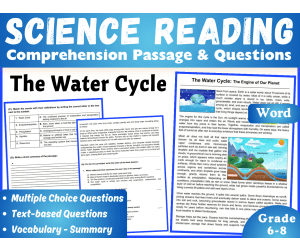
Earth Science Reading Comprehension Passage: The Water Cycle (Word)
Science, ELA, Reading, Reading Comprehension, Strategies, Resources for Teachers, Earth and Environmental Sciences, Earth Sciences, Environmental Science, Grade 6, 7, 8, 9, Writing Prompts, Worksheets & Printables, Centers, Activities, Teacher Tools, Assessments, Quizzes and Tests, Quizzes, Tests
Science Reading Comprehension Passages and Questions: The Water Cycle (Word) This very engaging earth science reading passage about the Water Cycle . It is designed to bridge the gap between science and literacy through strengthening reading comprehension and sparking scientific curiosity in middle school students. The passage blends English Language Arts skills with accurate science content that supports NGSS classroom practice. Ideal for interdisciplinary learning in ELA and Science. Suitable for Grade 9 review, too! Student Tasks for The Passage: 5 multiple-choice questions targeting main idea, key details, inference, vocabulary in context, and use of evidence 5 vocabulary matching items with clear, student-friendly definitions 5 text-based questions that require citing specific lines or facts 1 summary prompt that asks students to condense central ideas accurately Full answer key for every section Available Formats for this Resource PDF Fillable PDF Google Docs FULL CATALOG OF DOWNLOADING LINKS HERE Product Details Length: 5 pages total Grades: 6–8, also suitable for Grade 9 review Use cases: close reading, stations, homework, intervention, test prep, and sub plans Standards support: reinforces informational-text skills and supports NGSS-style sense making through observation, modeling, and clear use of claim, evidence, and reasoning Why Teachers Choose This Set Authentic science content paired with rigorous literacy practice Consistent task structure across all passages for easier planning and smoother student routines Clear, age-appropriate writing that builds confidence without oversimplifying Other Science Reading Collections you May find in the store: 1. Astronomy & Space Science 2. Volcanoes, Rocks, & Mountains 3. Rock Cycle, Soil, & Sinkholes 4. Mars, Glaciers, & Antarctica 5. Water Cycle, Acid Rain, & Wastewater 6. Insects, Animals, & Ecosystems 7. Bioluminescence & Insects 8. Animal Skin, Cats, & T. Rex 9. Human Body and Senses 10. Health & Applied Bioscience 11. Waves, Light, & Imaging 12. Electricity & Energy 13. Motion & Materials 14. Chemistry and Materials Science Use this set to reinforce ELA skills in science, to add literacy to your lessons, and to support independent work. The passages strengthen main idea, evidence use, vocabulary in context, inference, cause and effect, and summary writing. With ready-to-use assessments and complete answer keys, you can provide focused practice that is simple to run and fast to review.
Author Middle & High School - CORED Education
Rating
Tags Middle School, Reading Comprehension, Reading Strategies, ELA, Centers, Reading Passage, Assessments, Vocabulary, Environmental Science, Water Cycle

Aztecs Reading Comprehension Passage - Cored Ed Encyclopedia
ELA, Language Development, Reading Comprehension, Reading, Social Studies, Writing, Vocabulary, Geography, History, History: Ancient, Grade 2, 3, 4, 5, Worksheets & Printables, Worksheets, Teacher Tools, Centers, Activities, Writing Prompts, Assessments, Quizzes and Tests, Quizzes, Lesson Plans
This Aztecs reading comprehension with lesson plan includes: Visualization (on the front cover) Start your lesson by taking a minute to think and share something about the topic. Read the script aloud (slowly), perhaps prepare some music or sound effects. Student close their eyes and let their imaginations wander. Students open their eyes, read the question aloud and give them a few minutes to complete. Ask a few students to share or keep answers until the end to compare with what they learn in the passage. Quick pause—thousands of Cored Education products are included with your TeachSimple membership. Download links and encyclopedia index available here. Pre-Reading Trivia Students will write down one thing they already know about the subject and then read five more facts and discuss. These facts are fun, and the students will enjoy learning about the subject before reading more. Give 1 minute for students to write what they already know (no pressure—best guess is fine). Read the five facts together. After each fact, do ask a student for their opinion, was it surprising? Set a purpose by asking students to highlight/underline one fact they want to learn more about during the reading. Reading Passage The text is a high-interest reading passage with set paragraphs, roughly three to four paragraphs long. It contains a variety of themes about the topic, anywhere from history to technology. The passage is between 250 and 350 words in length. First, ask students to look at the headings and see what they’ll learn about today. What do they know about the topic/heading? First read options: Teacher read-aloud (best for support). Partner reading (paragraph by paragraph). While reading, students underline important details, and vocabulary words they think may come up in the questions section. Mixed Questions The first question page contains four multiple-choice questions, each with a choice of four answers, and three written response questions that require a sentence or two from the student. Students complete the mcqs first independently, then review quickly as a class. For the 3 written responses, try to get students giving the answer with some form of evidence: “I think ___ because the text says ___.” If students get stuck, send them back to check the passage. Vocabulary Questions Practice seven key words from the text in this section across two activities. First section is scrambled words where students will unscramble three words given a clue for each. The second section is a word to meaning matching activity. Before starting, have some students read out words they underlined in the passage. Ask students to say the word and read aloud the sentence(s) around each word. Ask students to do scrambled words and the matching exercise in pairs then go through answers as a class. For the scrambled spelling task, get four pairs to come up to the board and write the words for extra practice with the other student reading out the clue. For the matching task, prompt students to give full sentences: “I matched ___ with ___ because ___.” Creative Writing In this question, the student will be required to write a five to eight sentence paragraph on a question related to the topic. Before starting, ask students write down 3 key ideas they are going to include in their piece. Ask students for ideas to share around the class to help those struggling. Pro writing expectations: 5–8 sentences At least 2 facts or details from the passage At least 2 vocabulary words from the previous page Students read their paragraphs while classmates listen for facts and vocabulary words. Extension Activities This page is optional for fast finishers or to take home. There are several activities, each one requiring a different skill. Do some, do none, do all, completely optional - but you will feel reassured knowing every possibility is planned for. Includes summary writting question and additional facts. Answer Key There are answers for the multiple-choice questions, written response questions have sample answers, vocabulary answers and if there is a summary question then a sample summary will be provided as well. Lesson Plan Included Customized lesson plan for this lesson is included. Lesson Snapshot Title: Aztecs Genre: Nonfiction (informational passage) Subject: Social Studies (Ancient Civilizations) / Reading (Informational Text) Primary Topic: Building lake-city life and what happened later Estimated Guided Reading Level (A–Z): S What This Lesson Teaches Best How a wandering Nahua group (the Mexica) chose a home based on a sign and began building a city on a lake. How people adapted to living on water using chinampas , canals, and causeways to grow food and move around. How Triple Alliance (between Tenochtitlan , Texcoco , and Tlacopan ) helped the capital grow powerful through victories and tribute. Using headings to track a sequence: founding and growth, alliance and power, then conflict and destruction, and what remains today. Connecting past to present by noting how the eagle-and-cactus story lives on and how archaeologists still uncover remains beneath modern streets. Learning Goals Identify the sign the Mexica saw that helped them choose their home. Describe how builders expanded the island and how chinampas helped crops grow near home. Explain how canals and causeways helped the city get fresh water and connect to the shore. Describe how tribute (examples named in the text) helped the capital grow powerful. Describe what the passage says happened after Spanish explorers arrived, including the year the city fell. Explain what the passage says exists today where the city once stood. Key Vocabulary From the Text chinampas — raised garden beds packed with mud. causeways — broad raised roads that connect land and water. tribute — goods sent to rulers as payment. levees — walls or banks that help stop floods. archaeologists — people who uncover and study the past. FULL CATALOG OF DOWNLOAD LINKS AND ENCYCLOPEDIA INDEX HERE
Author Cored Education
Rating
Tags Vocabulary, Reading Comprehension, Reading Passages, Lesson Plans, Ela Lesson Plans, Reading Comprehension Lesson Plans, Pre-reading, History, History Lesson Plans, Geography
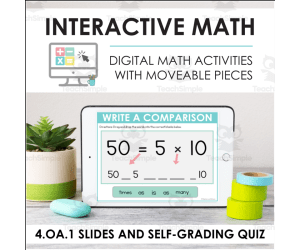
Digital Math for 4.OA.1 - Operations with Whole Numbers to Solve Problems (Slides + Self-Grading Quiz)
Math, Multiplication and Division, Division, Grade 4, Quizzes, Quizzes and Tests, Teacher Tools
Digital Math Review for 4th Grade Multiplication Word Problems This teaching resource provides an interactive way for students to review, practice, and enrich their understanding of multiplying whole numbers to solve word problems. The colorful slides represent the math concepts visually through dragging, dropping, and sorting activities that align to standard 4.OA.1. There are instructions to assign the slides digitally to individuals or the whole class. A graded quiz through Google Forms lets teachers instantly access data on student understanding. Use the PowerPoint, Google Slides, or self-grading quiz in small groups, for homework, or virtual assignments to reinforce multiplication skills.
Author Markers and Minions
Tags Comparing Multiplication, Tape Model, Fill In The Blanks, Math Quiz, Whole Numbers
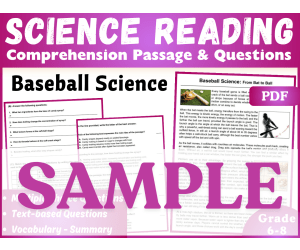
Science Reading Comprehension Passage: Baseball Science. SAMPLE
Science, ELA, Reading, Reading Comprehension, Strategies, Resources for Teachers, Physics, Grade 6, 7, 8, 9, Writing Prompts, Worksheets & Printables, Centers, Activities, Teacher Tools, Assessments, Quizzes and Tests, Quizzes, Tests
This is a free passage sample from the complete resource. The full version includes everything needed for a complete reading comprehension activity: the passage, multiple-choice questions, short-answer questions, vocabulary matching, a summary-writing task, and a detailed answer key. Download the complete passage resource by clicking on the following links: PDF Fillable PDF Word Docs Google Docs Science Reading Comprehension Passage and Questions: Baseball Science (PDF) This very engaging science reading passage is about the physics of baseball , especially how forces and energy affect the way a baseball moves after it is hit or pitched. It explains how kinetic energy transfers from the bat to the ball, how launch angle affects distance, how air resistance/drag slows the ball, and how spin creates the Magnus effect, which can make pitches curve or make batted balls carry farther. It also explains how weather and location, such as high altitude, warm air, and humidity, can affect how far a ball travels. This passage is designed to bridge the gap between science and literacy through strengthening reading comprehension and sparking scientific curiosity in middle school students. The passage blends English Language Arts skills with accurate science content that supports NGSS classroom practice. Ideal for interdisciplinary learning in ELA and Science. Suitable for Grade 9 review, too! Student Tasks for The Passage: 5 multiple-choice questions targeting main idea, key details, inference, vocabulary in context, and use of evidence 5 vocabulary matching items with clear, student-friendly definitions 5 text-based questions that require citing specific lines or facts 1 summary prompt that asks students to condense central ideas accurately Full answer key for every section FULL CATALOG OF DOWNLOADING LINKS HERE Product Details Length: 4 pages total Grades: 6–8, also suitable for Grade 9 review Use cases: close reading, stations, homework, intervention, test prep, and sub plans Standards support: reinforces informational-text skills and supports NGSS-style sense making through observation, modeling, and clear use of claim, evidence, and reasoning Why Teachers Choose This Set Authentic science content paired with rigorous literacy practice Consistent task structure across all passages for easier planning and smoother student routines Clear, age-appropriate writing that builds confidence without oversimplifying Other Science Reading Collections you May find in the store: 1. Astronomy & Space Science 2. Volcanoes, Rocks, & Mountains 3. Rock Cycle, Soil, & Sinkholes 4. Mars, Glaciers, & Antarctica 5. Water Cycle, Acid Rain, & Wastewater 6. Insects, Animals, & Ecosystems 7. Bioluminescence & Insects 8. Animal Skin, Cats, & T. Rex 9. Human Body and Senses 10. Health & Applied Bioscience 11. Waves, Light, & Imaging 12. Electricity & Energy 13. Motion & Materials 14. Chemistry and Materials Science Use this set to reinforce ELA skills in science, to add literacy to your lessons, and to support independent work. The passages strengthen main idea, evidence use, vocabulary in context, inference, cause and effect, and summary writing. With ready-to-use assessments and complete answer keys, you can provide focused practice that is simple to run and fast to review.
Author Middle & High School - CORED Education
Rating
Tags Middle School, Reading Comprehension, Reading Strategies, ELA, Centers, Reading Passage, Assessments, Vocabulary, Making Candy, Physics
Social Studies Reading Passages: Food and Culture (Fillable PDF)
ELA, Reading, Reading Comprehension, Strategies, Resources for Teachers, Social Studies, Sociology, Grade 6, 7, 8, 9, Writing Prompts, Worksheets & Printables, Centers, Activities, Teacher Tools, Assessments, Quizzes and Tests, Quizzes, Tests
Social Studies Reading Comprehension Passages and Questions: Food and Culture (Fillable PDF) This resource introduces a collection of Social Studies reading comprehension passages with questions about Food, Culture, and Preservation. The passages are carefully designed to bridge the gap between social studies and literacy through strengthening reading comprehension and sparking knowledge curiosity in middle school students. Each passage blends English Language Arts skills with accurate social studies content . Ideal for interdisciplinary learning in ELA and Social Studies. Suitable for Grade 9 review, too! These worksheets are designed as fillable PDFs , which means students can type their answers directly into the document on any computer or tablet . Each page includes highlighted text fields that show them exactly where to type! What Is Included in this Collection? There are three informational passages (with full answer keys): Homemade Cottage Cheese: Food, Family, and Local Trade Salty Traditions: How Salami and Kimchi Stay Safe to Eat From Grasslands to Grill: The Foods of South America For Each Passage, students will have multiple tasks to complete as follow: 5 multiple-choice questions targeting main idea, key details, inference, vocabulary in context, and use of evidence 5 vocabulary matching items with clear, student-friendly definitions 5 text-based questions that require citing specific lines or facts 1 summary prompt that asks students to condense central ideas accurately Available Formats for this Resource PDF Word Docs Google Docs FULL CATALOG OF DOWNLOADING LINKS HERE For more Social Studies Reading Passages, check the following Links: Ancient Civilizations PDF Fillable PDF Word Docs Google Docs Early Empires and Trade Networks PDF Fillable PDF Word Docs Google Docs The Founding of the United States PDF Fillable PDF Word Docs Google Docs Language, Culture, and Meaning PDF Fillable PDF Word Docs Google Docs Psychology and Society PDF Fillable PDF Word Docs Google Docs Global Festivals and Traditions PDF Fillable PDF Word Docs Google Docs Extreme Environments and People PDF Fillable PDF Word Docs Google Docs Food, Culture, and Preservation PDF Fillable PDF Word Docs Google Docs Global Food Customs PDF Fillable PDF Word Docs Google Docs Media, Communication, and Popular Culture PDF Fillable PDF Word Docs Google Docs Human Impact on the Environment PDF Fillable PDF Word Docs Google Docs Civic Action and Social Change PDF Fillable PDF Word Docs Google Docs Fashion, Society, and Power PDF Fillable PDF Word Docs Google Docs People, Places, and Unusual Histories PDF Fillable PDF Word Docs Google Docs How to Use These PDFs Click on the highlighted area to start typing your answer. Move to the next question by clicking in the next highlighted box. When you are finished, close the document and select SAVE so your answers stay recorded. If you want to keep a blank copy for later, choose Save As and give your completed version a new name. Product Details Length: 14 pages total Grades: 6–8, also suitable for Grade 9 review Use cases: close reading, stations, homework, intervention, test prep, and sub plans Why Teachers Choose This Set Authentic social studies content paired with rigorous literacy practice Consistent task structure across all passages for easier planning and smoother student routines Clear, age-appropriate writing that builds confidence without oversimplifying Use this set to reinforce ELA skills in social studies, to add literacy to your lessons, and to support independent work. The passages strengthen main idea, evidence use, vocabulary in context, inference, cause and effect, and summary writing. With ready-to-use assessments and complete answer keys, you can provide focused practice that is simple to run and fast to review.
Author Middle & High School - CORED Education
Rating
Tags Middle School, Reading Comprehension, Reading Strategies, ELA, Centers, Reading Passage, Assessments, Vocabulary, Social Studies, Food And Culture

Exterior Angle Theorem of Triangles NOTES PRACTICE QUIZ
Math, Geometry, Grade 8, Quizzes, Quizzes and Tests, Teacher Tools
This resource was developed to partially meet the requirements of the 8th Grade Geometry standard below: CCSS.MATH.CONTENT.8.G.A.5 Use informal arguments to establish facts about the angle sum and exterior angle of triangles*, about the angles created when parallel lines are cut by a transversal, and the angle-angle criterion for similarity of triangles *This resources ONLY explores the bold portion of the standard above.
Author The Math Cafe
Tags Exterior Angle Theorem, Triangles, Notes, Practice, Exterior Triangle Theorem, Lines And Triangles Practice

Reindeer Reading Comprehension Passage - Cored Ed Encyclopedia
ELA, Language Development, Reading Comprehension, Reading, Pre-Reading, Science, Writing, Strategies, Animals, Life Sciences, Grade 2, 3, 4, 5, Worksheets & Printables, Worksheets, Teacher Tools, Centers, Activities, Writing Prompts, Assessments, Quizzes and Tests, Quizzes, Lesson Plans
This reindeer reading comprehension includes: Visualization (on the front cover) Start your lesson by taking a minute to think and share something about the topic. Read the script aloud (slowly), perhaps prepare some music or sound effects. Student close their eyes and let their imaginations wander. Students open their eyes, read the question aloud and give them a few minutes to complete. Ask a few students to share or keep answers until the end to compare with what they learn in the passage. Quick pause—thousands of Cored Education products are included with your TeachSimple membership. Download links and encyclopedia index available here. COMPANION VIDEO NOW AVAILABLE (EMBEDDED AFTER PREVIEW PICTURES IN PRODUCT DESCRIPTION) Pre-Reading Trivia Students will write down one thing they already know about the subject and then read five more facts and discuss. These facts are fun, and the students will enjoy learning about the subject before reading more. Give 1 minute for students to write what they already know (no pressure—best guess is fine). Read the five facts together. After each fact, do ask a student for their opinion, was it surprising? Set a purpose by asking students to highlight/underline one fact they want to learn more about during the reading. Reading Passage The text is a high-interest reading passage with set paragraphs, roughly three to four paragraphs long. It contains a variety of themes about the topic, anywhere from history to technology. The passage is between 250 and 350 words in length. First, ask students to look at the headings and see what they’ll learn about today. What do they know about the topic/heading? First read options: Teacher read-aloud (best for support). Partner reading (paragraph by paragraph). While reading, students underline important details, and vocabulary words they think may come up in the questions section. Mixed Questions The first question page contains four multiple-choice questions, each with a choice of four answers, and three written response questions that require a sentence or two from the student. Students complete the mcqs first independently, then review quickly as a class. For the 3 written responses, try to get students giving the answer with some form of evidence: “I think ___ because the text says ___.” If students get stuck, send them back to check the passage. Vocabulary Questions Practice seven key words from the text in this section across two activities. First section is scrambled words where students will unscramble three words given a clue for each. The second section is a word to meaning matching activity. Before starting, have some students read out words they underlined in the passage. Ask students to say the word and read aloud the sentence(s) around each word. Ask students to do scrambled words and the matching exercise in pairs then go through answers as a class. For the scrambled spelling task, get four pairs to come up to the board and write the words for extra practice with the other student reading out the clue. For the matching task, prompt students to give full sentences: “I matched ___ with ___ because ___.” Creative Writing In this question, the student will be required to write a five to eight sentence paragraph on a question related to the topic. Before starting, ask students write down 3 key ideas they are going to include in their piece. Ask students for ideas to share around the class to help those struggling. Pro writing expectations: 5–8 sentences At least 2 facts or details from the passage At least 2 vocabulary words from the previous page Students read their paragraphs while classmates listen for facts and vocabulary words. Extension Activities This page is optional for fast finishers or to take home. There are several activities, each one requiring a different skill. Do some, do none, do all, completely optional - but you will feel reassured knowing every possibility is planned for. Includes summary writting question. Answer Key There are answers for the multiple-choice questions, written response questions have sample answers, vocabulary answers and if there is a summary question then a sample summary will be provided as well. Lesson Plan Included Customized lesson plan for this lesson is included. Lesson Snapshot Title: Reindeer Genre: Nonfiction (informational text) Subject: Life Science (Animals & Habitats) Primary Topic: Reindeer adaptations, migration, and human connections Estimated Guided Reading Level (A–Z): R What This Lesson Teaches Best How reindeer are adapted for cold places (thick coat; wide hooves for soft snow and soggy tundra). How reindeer find food when conditions are harsh (digging through snow to reach lichen). Migration and seasonal movement (some herds travel long journeys; more than 600 miles north in summer, then south again). How people and reindeer have influenced each other (communities watching hoofprints, herding partnerships, reindeer helping with travel and providing resources). A conservation-style question about changing winters (warming turning soft snow into hard ice that seals food away). Learning Goals Students will describe where reindeer live using details from the text (Arctic and subarctic lands). Students will explain two body features that help reindeer in winter conditions. Students will describe how reindeer get food when it is scarce, using the text’s example. Students will explain how long journeys relate to seasons and survival in the passage. Students will describe one way people have interacted with or depended on reindeer in the text. Key Vocabulary From the Text subarctic — very cold region just below the Arctic. tundra — open, cold land with few trees. hoofprints — marks left by hooves in the ground or snow. lichen — crusty plantlike growth on rocks and ground. Vulnerable — at risk of harm or shrinking in number. FULL CATALOG OF DOWNLOAD LINKS AND ENCYCLOPEDIA INDEX HERE
Author Cored Education
Rating
Tags Vocabulary, Reading Comprehension, Reading Passages, Reading, Creative Writing, Reading Strategies, Writing Prompts, Lesson Plans, Reindeer, Life Science
Vehicles Reading Comprehension Passage - Cored Ed Encyclopedia
ELA, Language Development, Reading Comprehension, Reading, Pre-Reading, Science, Technology, Engineering, History, Social Studies, Grade 2, 3, 4, 5, Worksheets & Printables, Worksheets, Teacher Tools, Centers, Activities, Writing Prompts, Assessments, Quizzes and Tests, Quizzes, Lesson Plans
This vehicles reading comprehension with lesson plan includes: Visualization (on the front cover) Start your lesson by taking a minute to think and share something about the topic. Read the script aloud (slowly), perhaps prepare some music or sound effects. Student close their eyes and let their imaginations wander. Students open their eyes, read the question aloud and give them a few minutes to complete. Ask a few students to share or keep answers until the end to compare with what they learn in the passage. Quick pause—thousands of Cored Education products are included with your TeachSimple membership. Download links and encyclopedia index available here. Pre-Reading Trivia Students will write down one thing they already know about the subject and then read five more facts and discuss. These facts are fun, and the students will enjoy learning about the subject before reading more. Give 1 minute for students to write what they already know (no pressure—best guess is fine). Read the five facts together. After each fact, do ask a student for their opinion, was it surprising? Set a purpose by asking students to highlight/underline one fact they want to learn more about during the reading. Reading Passage The text is a high-interest reading passage with set paragraphs, roughly three to four paragraphs long. It contains a variety of themes about the topic, anywhere from history to technology. The passage is between 250 and 350 words in length. First, ask students to look at the headings and see what they’ll learn about today. What do they know about the topic/heading? First read options: Teacher read-aloud (best for support). Partner reading (paragraph by paragraph). While reading, students underline important details, and vocabulary words they think may come up in the questions section. Mixed Questions The first question page contains four multiple-choice questions, each with a choice of four answers, and three written response questions that require a sentence or two from the student. Students complete the mcqs first independently, then review quickly as a class. For the 3 written responses, try to get students giving the answer with some form of evidence: “I think ___ because the text says ___.” If students get stuck, send them back to check the passage. Vocabulary Questions Practice seven key words from the text in this section across two activities. First section is scrambled words where students will unscramble three words given a clue for each. The second section is a word to meaning matching activity. Before starting, have some students read out words they underlined in the passage. Ask students to say the word and read aloud the sentence(s) around each word. Ask students to do scrambled words and the matching exercise in pairs then go through answers as a class. For the scrambled spelling task, get four pairs to come up to the board and write the words for extra practice with the other student reading out the clue. For the matching task, prompt students to give full sentences: “I matched ___ with ___ because ___.” Creative Writing In this question, the student will be required to write a five to eight sentence paragraph on a question related to the topic. Before starting, ask students write down 3 key ideas they are going to include in their piece. Ask students for ideas to share around the class to help those struggling. Pro writing expectations: 5–8 sentences At least 2 facts or details from the passage At least 2 vocabulary words from the previous page Students read their paragraphs while classmates listen for facts and vocabulary words. Extension Activities This page is optional for fast finishers or to take home. There are several activities, each one requiring a different skill. Do some, do none, do all, completely optional - but you will feel reassured knowing every possibility is planned for. Includes summary writting question. Answer Key There are answers for the multiple-choice questions, written response questions have sample answers, vocabulary answers and if there is a summary question then a sample summary will be provided as well. Lesson Plan Included Customized lesson plan for this lesson is included. Lesson Snapshot Title: Vehicles Genre: Nonfiction (Informational text) Subject: Social Studies / Science & Technology Primary Topic: How transportation changed from wheels to flight Estimated Guided Reading Level (A–Z): P Support pages: Pre-reading trivia, mixed questions, vocabulary practice, creative writing, extension activities, and an answer key. Support-page QA check: Some vocab items don’t match the exact word forms in the passage (e.g., chariot vs chariots , battery vs batteries , submarine vs submarines , locomotive vs locomotives ). What This Lesson Teaches Best Sequence of transportation changes over time: Moves from walking/animals, to logs/sledges, to wooden wheels and wagons, to roads and coaches, to steam locomotives, motor vehicles, and airplanes. How inventions improved travel and hauling: Explains how wheels, roads, tracks/railroads, and engines made travel smoother, faster, and able to carry heavier loads. Using headings to organize information: Section headings (“Roads…,” “When Steam…,” “A Lift Into the Air”) help readers track time periods and big shifts. Key historical details in an informational text: Includes dates and examples such as Uruk clay tablets (3700–3500 BCE) and the Wright Flyer flight (December 17, 1903). Modern tech and environmental impact: Notes electric motors, rechargeable batteries, and “no tailpipe exhaust,” ending with a question about helping the planet. Learning Goals Students will describe how people traveled and carried loads before wheels, using details from the passage. Students will identify how wheels changed what vehicles could do (hauling goods and moving more easily). Students will explain how roads and railroads affected travel and connected places, based on the text. Students will summarize the “biggest leap” in travel described in the passage and name the example given. Students will use headings and key details to retell the passage’s main changes in transportation in order. Key Vocabulary From the Text sledge — a sled that helps heavy things slide. Mesopotamia — an ancient region where Uruk was located. spoked — having thin supports connecting wheel center to rim. locomotives — train engines that pull cars on tracks. rechargeable — can be filled with power again. FULL CATALOG OF DOWNLOAD LINKS AND ENCYCLOPEDIA INDEX HERE
Author Cored Education
Rating
Tags Vocabulary, Reading Comprehension, Reading Passages, Lesson Plans, Ela Lesson Plans, Reading Comprehension Lesson Plans, Pre-reading, Science Lesson Plans, Technology, History Lesson Plans

Digital Math for 4.MD.1 - Solve Problems Involving Measurement (Slides + Self-Grading Quiz)
Math, Measurements, Grade 4, Quizzes, Quizzes and Tests, Teacher Tools
Digital Math for 4.MD.1 - Solve Problems Involving Measurement (Slides + Self-Grading Quiz) This phenomenal resource is tailor-made to boost the math skills of Grade 4 students in a more engaging way, with a particular focus on measurements. The Digital Math resource is all about making the learning experience fun yet impactful through interactive math slides. Your classroom or homeschool teaching approach can be amplified by this tool, encouraging individual explorations while also promoting productive group work dynamics. Applications: Whole Class Instruction: Integrating these materials during your overall instruction allows you to guide students on how visual representation can greatly enhance their understanding of measurements. Differentiated Small Group Instructions:The versatility of the slides makes them perfect even for focused small group instructions. Homework Assignments:The digital resource can also be handed out as homework assignments that are far from being mundane and repetitive. Pack Contents: This pedagogical toolkit offers an array of features like: 20 interactive slides formatted in PowerPoint and Google Slides forms A self-grading Google Forms quiz designed on standard 4.MD.1 topics which provides valuable feedback helping teachers gauge students' grasp over these concepts effectively . Suitable for both physical classrooms as well as virtual/distance learning environments, this digital leaning tool has gained more relevance during recent times, owing to global social distancing norms affecting education systems worldwide. In comparison with other resources available currently, our Digital Math makes sure instructors are armed with dynamic tools which not only capture children's interest fully but ensure alignment with learning objectives and provide easy grading mechanism to everyone involved – students, teachers and parents alike!
Author Markers and Minions
Tags Measurement, Math, Digital Tool, Interactive Slides, Self-grading Quiz
Sailing Reading Comprehension Passage - Cored Ed Encyclopedia
ELA, Language Development, Reading Comprehension, Reading, Pre-Reading, Science, Writing, Engineering, Technology, Physics, Grade 2, 3, 4, 5, Worksheets & Printables, Worksheets, Teacher Tools, Centers, Activities, Writing Prompts, Assessments, Quizzes and Tests, Quizzes, Lesson Plans
This sailing reading comprehension includes: Visualization (on the front cover) Start your lesson by taking a minute to think and share something about the topic. Read the script aloud (slowly), perhaps prepare some music or sound effects. Student close their eyes and let their imaginations wander. Students open their eyes, read the question aloud and give them a few minutes to complete. Ask a few students to share or keep answers until the end to compare with what they learn in the passage. Quick pause—thousands of Cored Education products are included with your TeachSimple membership. Download links and encyclopedia index available here. Pre-Reading Trivia Students will write down one thing they already know about the subject and then read five more facts and discuss. These facts are fun, and the students will enjoy learning about the subject before reading more. Give 1 minute for students to write what they already know (no pressure—best guess is fine). Read the five facts together. After each fact, do ask a student for their opinion, was it surprising? Set a purpose by asking students to highlight/underline one fact they want to learn more about during the reading. Reading Passage The text is a high-interest reading passage with set paragraphs, roughly three to four paragraphs long. It contains a variety of themes about the topic, anywhere from history to technology. The passage is between 250 and 350 words in length. First, ask students to look at the headings and see what they’ll learn about today. What do they know about the topic/heading? First read options: Teacher read-aloud (best for support). Partner reading (paragraph by paragraph). While reading, students underline important details, and vocabulary words they think may come up in the questions section. Mixed Questions The first question page contains four multiple-choice questions, each with a choice of four answers, and three written response questions that require a sentence or two from the student. Students complete the mcqs first independently, then review quickly as a class. For the 3 written responses, try to get students giving the answer with some form of evidence: “I think ___ because the text says ___.” If students get stuck, send them back to check the passage. Vocabulary Questions Practice seven key words from the text in this section across two activities. First section is scrambled words where students will unscramble three words given a clue for each. The second section is a word to meaning matching activity. Before starting, have some students read out words they underlined in the passage. Ask students to say the word and read aloud the sentence(s) around each word. Ask students to do scrambled words and the matching exercise in pairs then go through answers as a class. For the scrambled spelling task, get four pairs to come up to the board and write the words for extra practice with the other student reading out the clue. For the matching task, prompt students to give full sentences: “I matched ___ with ___ because ___.” Creative Writing In this question, the student will be required to write a five to eight sentence paragraph on a question related to the topic. Before starting, ask students write down 3 key ideas they are going to include in their piece. Ask students for ideas to share around the class to help those struggling. Pro writing expectations: 5–8 sentences At least 2 facts or details from the passage At least 2 vocabulary words from the previous page Students read their paragraphs while classmates listen for facts and vocabulary words. Extension Activities This page is optional for fast finishers or to take home. There are several activities, each one requiring a different skill. Do some, do none, do all, completely optional - but you will feel reassured knowing every possibility is planned for. Includes summary writting question. Answer Key There are answers for the multiple-choice questions, written response questions have sample answers, vocabulary answers and if there is a summary question then a sample summary will be provided as well. Lesson Plan Included Customized lesson plan for this lesson is included. Lesson Snapshot Title: Sailing Genre: Nonfiction (informational passage) Subject: Science (Forces & motion) / Social Studies (history of travel) Primary Topic: How wind powers boats and changed travel Estimated Guided Reading Level (A–Z): R What This Lesson Teaches Best How wind pushing on a sail can move a boat without rowing (sail as a “wind catcher” and cloth billowing). How sailing helped people travel farther and move supplies, from early boats to tall ships, including examples from Egypt, the Roman world, and Austronesian sailors. Key sailing concepts that affect movement and direction, including “points of sail,” the “no-go zone,” and zigzagging turns called tacks. How boat parts help sailing work: the sail pulling forward and the keel and rudder helping resist sliding sideways. How technology changed sailing’s role (steam engines replacing sails for many working ships) and how wind is being used again on some cargo ships to save fuel. Learning Goals Explain how wind pressing on a sail can move a boat forward. Describe how sailing grew from river boats to ships that carried people, tools, and food across seas. Identify why sailors use tacks and what the “no-go zone” means in the passage. Describe how the keel and rudder help a sailboat resist sliding sideways. Explain how sailing changed in the late 1800s and how wind is being used again today. Key Vocabulary From the Text hull — the main body of a boat. keel — a strong part that helps stop sliding sideways. rudder — a part that helps steer the boat. tacks — zigzag turns used to move into wind. cargo — goods carried on a ship. FULL CATALOG OF DOWNLOAD LINKS AND ENCYCLOPEDIA INDEX HERE
Author Cored Education
Rating
Tags Vocabulary, Reading Comprehension, Reading Passages, Reading, Creative Writing, Reading Strategies, Writing Prompts, Lesson Plans, Sailing, Engineering

Jeeps Reading Comprehension Passage - Cored Ed Encyclopedia
ELA, Reading Comprehension, Reading, Language Development, Vocabulary, History, Social Studies, Technology, Science, Pre-Reading, Grade 2, 3, 4, 5, Worksheets & Printables, Worksheets, Teacher Tools, Centers, Activities, Writing Prompts, Assessments, Quizzes and Tests, Quizzes, Lesson Plans
This Jeeps reading comprehension with lesson plan includes: Visualization (on the front cover) Start your lesson by taking a minute to think and share something about the topic. Read the script aloud (slowly), perhaps prepare some music or sound effects. Student close their eyes and let their imaginations wander. Students open their eyes, read the question aloud and give them a few minutes to complete. Ask a few students to share or keep answers until the end to compare with what they learn in the passage. Quick pause—thousands of Cored Education products are included with your TeachSimple membership. Download links and encyclopedia index available here. Pre-Reading Trivia Students will write down one thing they already know about the subject and then read five more facts and discuss. These facts are fun, and the students will enjoy learning about the subject before reading more. Give 1 minute for students to write what they already know (no pressure—best guess is fine). Read the five facts together. After each fact, do ask a student for their opinion, was it surprising? Set a purpose by asking students to highlight/underline one fact they want to learn more about during the reading. Reading Passage The text is a high-interest reading passage with set paragraphs, roughly three to four paragraphs long. It contains a variety of themes about the topic, anywhere from history to technology. The passage is between 250 and 350 words in length. First, ask students to look at the headings and see what they’ll learn about today. What do they know about the topic/heading? First read options: Teacher read-aloud (best for support). Partner reading (paragraph by paragraph). While reading, students underline important details, and vocabulary words they think may come up in the questions section. Mixed Questions The first question page contains four multiple-choice questions, each with a choice of four answers, and three written response questions that require a sentence or two from the student. Students complete the mcqs first independently, then review quickly as a class. For the 3 written responses, try to get students giving the answer with some form of evidence: “I think ___ because the text says ___.” If students get stuck, send them back to check the passage. Vocabulary Questions Practice seven key words from the text in this section across two activities. First section is scrambled words where students will unscramble three words given a clue for each. The second section is a word to meaning matching activity. Before starting, have some students read out words they underlined in the passage. Ask students to say the word and read aloud the sentence(s) around each word. Ask students to do scrambled words and the matching exercise in pairs then go through answers as a class. For the scrambled spelling task, get four pairs to come up to the board and write the words for extra practice with the other student reading out the clue. For the matching task, prompt students to give full sentences: “I matched ___ with ___ because ___.” Creative Writing In this question, the student will be required to write a five to eight sentence paragraph on a question related to the topic. Before starting, ask students write down 3 key ideas they are going to include in their piece. Ask students for ideas to share around the class to help those struggling. Pro writing expectations: 5–8 sentences At least 2 facts or details from the passage At least 2 vocabulary words from the previous page Students read their paragraphs while classmates listen for facts and vocabulary words. Extension Activities This page is optional for fast finishers or to take home. There are several activities, each one requiring a different skill. Do some, do none, do all, completely optional - but you will feel reassured knowing every possibility is planned for. Includes summary writting question and additional facts. Answer Key There are answers for the multiple-choice questions, written response questions have sample answers, vocabulary answers and if there is a summary question then a sample summary will be provided as well. Lesson Plan Included Customized lesson plan for this lesson is included. Lesson Snapshot Title: Jeeps Genre: Nonfiction (informational text) Subject: Social Studies (History) / Reading (Informational Text) Primary Topic: WWII jeep origins and how the Jeep line evolved Estimated Guided Reading Level (A–Z): S What This Lesson Teaches Best Explains why the U.S. Army wanted a small, tough 4-wheel-drive truck in 1940 and how designs led to the World War II jeep (Willys MB and Ford GPW). Uses concrete facts and numbers (more than 600,000 built; held 3 to 6 people; carried scouts, messengers, and heavy gear). Explores multiple possible origins of a word/nickname (“g.p.”, soldier slang, and Eugene the Jeep) and shows that history can have more than one source. Traces change over time: military jeep → civilian CJs (starting 1945) → a family of vehicles including SUVs and the Wrangler as a descendant of the CJ line. Supports comprehension with clear section headings that organize the timeline and ideas. Learning Goals Identify the problem armies faced in 1940 and what kind of truck the U.S. Army wanted. Describe two details about World War II jeeps (names, number built, what they carried, or how many people fit). Explain why the passage says the nickname “jeep” is “not that simple,” using text evidence. Describe how jeeps changed after the war when Willys began selling CJs. Summarize how the Jeep line continued and changed “over the years,” including the Wrangler and one feature it kept. Key Vocabulary From the Text 4-wheel-drive — power can go to all four wheels. nickname — a fun or short name. civilian — not in the military. surplus — extra items left over after use. descendant — a newer vehicle from the same family line. FULL CATALOG OF DOWNLOAD LINKS AND ENCYCLOPEDIA INDEX HERE
Author Cored Education
Rating
Tags Vocabulary, Reading Comprehension, Reading Passages, Lesson Plans, Ela Lesson Plans, Reading Comprehension Lesson Plans, Pre-reading, Social Studies Lesson Plans, History, Technology
Criminal Profiling: Social Studies Reading Passage (Fillable PDF)
ELA, Reading, Reading Comprehension, Strategies, Resources for Teachers, Social Studies, Psychology, Grade 6, 7, 8, 9, Writing Prompts, Worksheets & Printables, Centers, Activities, Teacher Tools, Assessments, Quizzes and Tests, Quizzes, Tests
Criminal Profiling: Social Studies Reading Comprehension Passage (Fillable PDF) This resource introduces a unique Social Studies reading comprehension passage with questions about Criminal Profiling: Inside the Mind of a Criminal. The passage is carefully designed to bridge the gap between social studies and literacy through strengthening reading comprehension and sparking knowledge curiosity in middle school students. Each passage blends English Language Arts skills with accurate social studies content . Ideal for interdisciplinary learning in ELA and Social Studies. Suitable for Grade 9 review, too! This resource is designed as a fillable PDF , which means students can type their answers directly into the document on any computer or tablet . Each page includes highlighted text fields that show them exactly where to type! Student Tasks throughout the passage: 5 multiple-choice questions targeting the following skills: main idea, key details, inference, vocabulary in context, and use of evidence 5 vocabulary matching items with clear, student-friendly definitions 5 text-based questions that require citing specific lines or facts 1 summary prompt that asks students to condense central ideas accurately Full answer key for every section Available Formats for this Resource: PDF Word Docs Google Docs FULL CATALOG OF DOWNLOADING LINKS HERE Social Studies Reading Comprehension Collection Links: 1. Ancient Civilizations PDF Fillable PDF Word Docs Google Docs 2. Early Empires and Trade Networks PDF Fillable PDF Word Docs Google Docs 3. The Founding of the United States PDF Fillable PDF Word Docs Google Docs 4. Language, Culture, and Meaning PDF Fillable PDF Word Docs Google Docs 5. Psychology and Society PDF Fillable PDF Word Docs Google Docs 6. Global Festivals and Traditions PDF Fillable PDF Word Docs Google Docs 7. Extreme Environments and People PDF Fillable PDF Word Docs Google Docs 8. Food, Culture, and Preservation PDF Fillable PDF Word Docs Google Docs 9. Global Food Customs PDF Fillable PDF Word Docs Google Docs 10. Media, Communication, and Popular Culture PDF Fillable PDF Word Docs Google Docs 11. Human Impact on the Environment PDF Fillable PDF Word Docs Google Docs 12. Civic Action and Social Change PDF Fillable PDF Word Docs Google Docs 13. Fashion, Society, and Power PDF Fillable PDF Word Docs Google Docs 14. People, Places, and Unusual Histories PDF Fillable PDF Word Docs Google Docs Product Details: Length: 5 pages Grades: 6–8, also suitable for Grade 9 review Use cases: close reading, stations, homework, intervention, test prep, and sub plans Why Teachers Choose This Passage: Authentic social studies content paired with rigorous literacy practice Consistent task structure for easier planning and smoother student routines Clear, age-appropriate writing that builds confidence without oversimplifying Use this passage to reinforce ELA skills in social studies, to add literacy to your lessons, and to support independent work. The passage strengthens main idea, evidence use, vocabulary in context, inference, cause and effect, and summary writing. With ready-to-use assessments and complete answer keys, you can provide focused practice that is simple to run and fast to review.
Author Middle & High School - CORED Education
Rating
Tags Middle School, Reading Comprehension, Reading Strategies, ELA, Centers, Reading Passage, Assessments, Vocabulary, Social Studies, Pschology