



3,965 products added recently
Page 4 - Pre Reading Tests

 Show filters


Lemonade Reading Comprehension Passage - Cored Ed Encyclopedia
ELA, Language Development, Resources for Teachers, Reading Comprehension, Reading, Pre-Reading, Writing, Strategies, Science, Physics, Grade 2, 3, 4, 5, Worksheets & Printables, Worksheets, Teacher Tools, Centers, Activities, Writing Prompts, Assessments, Tests, Quizzes and Tests, Quizzes
This lemonade reading comprehension contains the following: Visualize on the Cover (Teacher Read Aloud Script) Start your lesson by taking a few moments to visualize the topic and share thoughts or feelings about it. Pre-Reading Trivia Students will write down one thing they already know about the subject and then read five more facts and discuss. These facts are fun, and the students will enjoy learning about the subject before reading more. Reading Passage The text is a high-interest reading passage with set paragraphs, roughly three to four paragraphs long. It contains a variety of themes about the topic, anywhere from history to technology. The passage is between 250 and 350 words in length. Mixed Questions The first question page contains four multiple-choice questions, each with a choice of four answers, and three written response questions that require a sentence or two from the student. Vocabulary Questions Practice seven key words from the text in this section across two activities. First section is scrambled words where students will unscramble three words given a clue for each. The second section is a word to meaning matching activity. Creative Writing In this question, the student will be required to write a five to eight sentence paragraph on a question related to the topic. Extension Activities This page is optional for fast finishers or to take home. There are several activities, each one requiring a different skill. Do some, do none, do all, completely optional - but you will feel reassured knowing every possibility is planned for. Includes summary writting question. Answer Key There are answers for the multiple-choice questions, written response questions have sample answers, vocabulary answers and if there is a summary question then a sample summary will be provided as well. FULL CATALOG OF DOWNLOAD LINKS AND ENCYCLOPEDIA INDEX HERE Lesson Snapshot Title: Lemonade Genre: Nonfiction (informational text) Subject: Reading (Informational Text) / Social Studies (Food history & culture) / Science (mixtures) Primary Topic: What lemonade is, and how it varies by place Estimated Guided Reading Level (A–Z): O What This Lesson Teaches Best What lemonade is usually made from and how flavors can be adjusted (more lemon = sharper; more sugar = softer). Science-connected ideas in everyday life (citric acid, vitamin C, and sugar dissolving with stirring). A brief history of lemon drinks across time and places (12th-century Egypt; 1600s England; 1676 Paris sellers). How the same word can mean different things in different regions (cloudy still drink vs. bubbly lemon soda). Cultural connection: lemonade stands as a summer way for kids to earn money and a “symbol” of warm-weather fun. Learning Goals Describe the typical ingredients in lemonade named in the passage. Explain why lemons taste tart, using the text’s reason. Summarize the historical examples of lemon drinks given (Egypt, England, Paris). Compare what “lemonade” can mean in different places using details from the passage. Describe what happens when sugar dissolves and why stirring helps, according to the text. Key Vocabulary From the Text sweetener — something added to make a drink taste sweet. citric — related to the sour acid found in citrus fruits. zest — tiny bits of the outer lemon peel. dissolves — mixes into liquid and seems to disappear. bubbly — full of bubbles, like soda. Cored Ed Encyclopedia Overview The Cored Ed Encyclopedia is a weekly series of lessons that you can pick up and use right away. These short readings fit into whatever time you have available. Each one includes a warm-up, a reading, and a set of questions, but it’s flexible — you can do just the reading, the full lesson, or skip the writing section if you need to. Each lesson focuses on a single topic so students don’t get lost. The writing is clear but never childish, making it perfect for grades two through five. Topics range from animals and science to history, inventions, and everyday things. No matter the level of the student, everyone should take away at least one new idea or fact from each lesson. The materials are easy to print, easy to explain, and require no setup. They work well for whole-class teaching, partner work, or independent study.
Author Cored Education
Rating
Tags Vocabulary, Spelling, Reading Comprehension, Reading Passages, Reading, Creative Writing, Reading Strategies, Writing Prompts, Lemonade, Physics

Supplementary Materials for Electricity and Magnets (PDF)
Science, Physics, Common Core, Resources for Teachers, Pre-Reading, Language Development, ELA, ESL, Grade 5, 6, 7, Worksheets & Printables, Worksheets, Assessments, Teacher Tools, Tests, Quizzes and Tests
Supplementary Materials for Electricity and Magnets Each classroom is different and with that in mind, this free supplementary pack of questions gives teachers the opportunity to give early finishers some extra questions, or can be used for homework/holiday work. Each question is based on the topic of the reading lesson already covered, however, not all answers can be found in the text. What's inside? Extra Questions for Part 3 - Electricity and Magnets Reading Passage 1: Static Electricity Reading Passage 2: Circuits Reading Passage 3: Electromagnets Reading Passage 4: Electric Energy Reading Passage 5: Energy Sources & Conversion Product Info: 15 pages Teaching Duration: 2 Weeks Science Reading Comprehension Outline: Targeted for students in 3rd and 4th grades, these reading passages are enhanced with illustrations and graphs to elucidate critical points. Each lesson aligns with the Common Core State Standards, allowing you to integrate science reading practice effortlessly, knowing that minimal preparation is needed on your part. Each passage comes with a variety of questions in different formats, including multiple-choice formats, data analysis, and fill-in-the-blanks. The topics covered strike a balance between engaging content and core curriculum-based science subjects. Versatile in application, these lessons are suitable for a variety of settings such as whole-class instruction, morning activities, independent desk work, small group discussions, contingency plans for substitute teachers, homework assignments, or even special holiday-themed tasks. FULL CATALOG OF DOWNLOAD LINKS HERE Grade 3/4 Links: Physical Science Part 1 - Properties of Objects and Materials Google Docs/Slides/Forms PDF PPT Word Free Supplementary Pack Accompanying Videos Physical Science Part 2 - Position and Motion of Objects Google Docs/Slides/Forms PDF PPT Word Free Supplementary Pack Accompanying Videos Physical Science Part 3 - Light, Heat, Electricity, Magnetism Google Docs/Slides/Forms PDF PPT Word Free Supplementary Pack Accompanying Videos Life Science Part 1 - Characteristics of Organisms Google Docs/Slides/Forms PDF PPT Word Free Supplementary Pack Accompanying Videos Life Science Part 2 - Life Cycles of Organisms Google Docs/Slides/Forms PDF PPT Word Free Supplementary Pack Accompanying Videos Life Science Part 3 - Organisms and Environments Google Docs/Slides/Forms PDF PPT Word Free Supplementary Pack Accompanying Videos Earth Science Part 1 - Properties of Earth Materials Google Docs/Slides/Forms PDF PPT Word Free Supplementary Pack Accompanying Videos Earth Science Part 2 - Changes in the Earth and Sky Google Docs/Slides/Forms PDF PPT Word Free Supplementary Pack Accompanying Videos Earth Science Part 3 - Objects in the Sky Google Docs/Slides/Forms PDF PPT Word Free Supplementary Pack Accompanying Videos For similar products and other frees, do check out Cored Group on TeachSimple .
Author Cored Education
Tags Science, Elementary, Reading, Comprehension, Vocabulary, Answers, Physics, Physical Science, Ccss, Common Core

Kettles Reading Comprehension Passage - Cored Ed Encyclopedia
ELA, Language Development, Resources for Teachers, Reading Comprehension, Reading, Pre-Reading, Writing, Strategies, Physics, Science, Grade 2, 3, 4, 5, Worksheets & Printables, Worksheets, Teacher Tools, Centers, Activities, Writing Prompts, Assessments, Tests, Quizzes and Tests, Quizzes
This kettles reading comprehension contains the following: Visualize on the Cover (Teacher Read Aloud Script) Start your lesson by taking a few moments to visualize the topic and share thoughts or feelings about it. Pre-Reading Trivia Students will write down one thing they already know about the subject and then read five more facts and discuss. These facts are fun, and the students will enjoy learning about the subject before reading more. Reading Passage The text is a high-interest reading passage with set paragraphs, roughly three to four paragraphs long. It contains a variety of themes about the topic, anywhere from history to technology. The passage is between 250 and 350 words in length. Mixed Questions The first question page contains four multiple-choice questions, each with a choice of four answers, and three written response questions that require a sentence or two from the student. Vocabulary Questions Practice seven key words from the text in this section across two activities. First section is scrambled words where students will unscramble three words given a clue for each. The second section is a word to meaning matching activity. Creative Writing In this question, the student will be required to write a five to eight sentence paragraph on a question related to the topic. Extension Activities This page is optional for fast finishers or to take home. There are several activities, each one requiring a different skill. Do some, do none, do all, completely optional - but you will feel reassured knowing every possibility is planned for. Includes summary writting question. Answer Key There are answers for the multiple-choice questions, written response questions have sample answers, vocabulary answers and if there is a summary question then a sample summary will be provided as well. FULL CATALOG OF DOWNLOAD LINKS AND ENCYCLOPEDIA INDEX HERE Lesson Snapshot Title: Kettles Genre: Nonfiction (informational text) Subject: Science (Physical Science: heat/boiling) / Reading (Informational Text) Primary Topic: How kettles boil water, convection, and safety Estimated Guided Reading Level (A–Z): O What This Lesson Teaches Best What a kettle is and what it’s used for (a vessel for boiling water for foods/drinks like tea, cocoa, soup, or oatmeal). How stovetop and electric kettles heat water (burner heat vs. a heating element; some shut off automatically). Why boiling water “swirls” (convection: warmer, less dense water rises while cooler water sinks). Key science facts connected to boiling (about 212°F at sea level; lower boiling temperature on high mountains). Safe habits around hot water and steam (steam can sting, spilled hot water can scald, and careful pouring/spout direction helps). Learning Goals Students will identify the main purpose of a kettle using details from the passage. Students will describe how a stovetop kettle and an electric kettle heat water, based on the text. Students will explain convection in boiling water using the passage’s description of rising and sinking water. Students will state what the text says about boiling temperature at sea level and on high mountains. Students will list safety rules mentioned in the passage for handling steam and hot water. Key Vocabulary From the Text vessel — a container that holds something. cauldron — a large pot. convection — heat moving as warm water rises and cool sinks. dense — packed tightly; not light. scald — burn skin with very hot liquid. Cored Ed Encyclopedia Overview The Cored Ed Encyclopedia is a weekly series of lessons that you can pick up and use right away. These short readings fit into whatever time you have available. Each one includes a warm-up, a reading, and a set of questions, but it’s flexible — you can do just the reading, the full lesson, or skip the writing section if you need to. Each lesson focuses on a single topic so students don’t get lost. The writing is clear but never childish, making it perfect for grades two through five. Topics range from animals and science to history, inventions, and everyday things. No matter the level of the student, everyone should take away at least one new idea or fact from each lesson. The materials are easy to print, easy to explain, and require no setup. They work well for whole-class teaching, partner work, or independent study.
Author Cored Education
Rating
Tags Vocabulary, Spelling, Reading Comprehension, Reading Passages, Reading, Creative Writing, Reading Strategies, Writing Prompts, Physics, Kettles
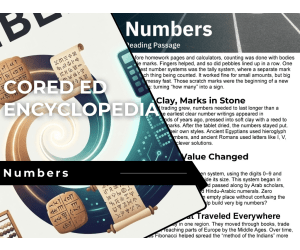
Numbers Reading Comprehension Passage - Cored Ed Encyclopedia
ELA, Language Development, Resources for Teachers, Reading Comprehension, Reading, Pre-Reading, Writing, History, Social Studies, Strategies, Grade 2, 3, 4, 5, Worksheets & Printables, Worksheets, Teacher Tools, Centers, Activities, Writing Prompts, Assessments, Tests, Quizzes and Tests, Quizzes
This numbers reading comprehension contains the following: Visualize on the Cover (Teacher Read Aloud Script) Start your lesson by taking a few moments to visualize the topic and share thoughts or feelings about it. Pre-Reading Trivia Students will write down one thing they already know about the subject and then read five more facts and discuss. These facts are fun, and the students will enjoy learning about the subject before reading more. Reading Passage The text is a high-interest reading passage with set paragraphs, roughly three to four paragraphs long. It contains a variety of themes about the topic, anywhere from history to technology. The passage is between 250 and 350 words in length. Mixed Questions The first question page contains four multiple-choice questions, each with a choice of four answers, and three written response questions that require a sentence or two from the student. Vocabulary Questions Practice seven key words from the text in this section across two activities. First section is scrambled words where students will unscramble three words given a clue for each. The second section is a word to meaning matching activity. Creative Writing In this question, the student will be required to write a five to eight sentence paragraph on a question related to the topic. Extension Activities This page is optional for fast finishers or to take home. There are several activities, each one requiring a different skill. Do some, do none, do all, completely optional - but you will feel reassured knowing every possibility is planned for. Includes summary writting question. Answer Key There are answers for the multiple-choice questions, written response questions have sample answers, vocabulary answers and if there is a summary question then a sample summary will be provided as well. FULL CATALOG OF DOWNLOAD LINKS AND ENCYCLOPEDIA INDEX HERE Lesson Snapshot Title: Numbers Genre: Nonfiction Subject: Math (Number Systems) Primary Topic: Counting systems, place value, and zero Estimated Guided Reading Level (A–Z): N What This Lesson Teaches Best Explains early counting methods (bodies, fingers, pebbles) and introduces the tally system as one mark per item. Shows why communities needed lasting number records as towns and trading grew, including wedge-shaped marks pressed into clay in Mesopotamia . Introduces different ways cultures wrote numbers (Egyptian hieroglyph symbols; Roman numerals using I, V, and X). Teaches how the base-ten system and place value use digits 0–9, and why zero matters for holding an empty place. Traces how Hindu-Arabic numerals spread through books, trade routes, and schools (including mention of Fibonacci) and appear today on receipts, maps, and screens. Learning Goals Describe two ways people counted before modern number symbols were common. Explain what a tally system is and why it can get “messy fast” for big amounts. Describe how people in Mesopotamia recorded numbers in soft clay and why those marks lasted. Explain how base-ten place value works (a digit’s spot helps decide its size). Explain why zero is important in the base-ten system, using the text’s explanation. Describe how the “method of the Indians” spread to new places over time. Key Vocabulary From the Text Tally — counting with one mark for each thing. Mesopotamia — an ancient place where early number writing appeared. Wedge-shaped — shaped like a wedge pressed into clay. Place value — a digit’s value depends on its position. Fibonacci — a thinker who helped spread the new number method. Cored Ed Encyclopedia Overview The Cored Ed Encyclopedia is a weekly series of lessons that you can pick up and use right away. These short readings fit into whatever time you have available. Each one includes a warm-up, a reading, and a set of questions, but it’s flexible — you can do just the reading, the full lesson, or skip the writing section if you need to. Each lesson focuses on a single topic so students don’t get lost. The writing is clear but never childish, making it perfect for grades two through five. Topics range from animals and science to history, inventions, and everyday things. No matter the level of the student, everyone should take away at least one new idea or fact from each lesson. The materials are easy to print, easy to explain, and require no setup. They work well for whole-class teaching, partner work, or independent study.
Author Cored Education
Rating
Tags Vocabulary, Spelling, Reading Comprehension, Reading Passages, Reading, Creative Writing, Reading Strategies, Writing Prompts, History, Numbers

Inventions Reading Comprehension Passage - Cored Ed Encyclopedia
ELA, Language Development, Resources for Teachers, Reading Comprehension, Reading, Pre-Reading, Writing, Science, Technology, Strategies, Grade 2, 3, 4, 5, Worksheets & Printables, Worksheets, Teacher Tools, Centers, Activities, Writing Prompts, Assessments, Tests, Quizzes and Tests, Quizzes
This inventions reading comprehension contains the following: Pre-Reading Trivia Students will write down one thing they already know about the subject and then read five more facts and discuss. These facts are fun, and the students will enjoy learning about the subject before reading more. Reading Passage The text is a high-interest reading passage with set paragraphs, roughly three to four paragraphs long. It contains a variety of themes about the topic, anywhere from history to technology. The passage is between 250 and 350 words in length. Mixed Questions The first question page contains four multiple-choice questions, each with a choice of four answers, and three written response questions that require a sentence or two from the student. Vocabulary Questions Practice seven key words from the text in this section across two activities. First section is scrambled words where students will unscramble three words given a clue for each. The second section is a word to meaning matching activity. Creative Writing In this question, the student will be required to write a five to eight sentence paragraph on a question related to the topic. Extension Activities This page is optional for fast finishers or to take home. There are several activities, each one requiring a different skill. Do some, do none, do all, completely optional - but you will feel reassured knowing every possibility is planned for. Answer Key There are answers for the multiple-choice questions, written response questions have sample answers, vocabulary answers and if there is a summary question then a sample summary will be provided as well. FULL CATALOG OF DOWNLOAD LINKS AND ENCYCLOPEDIA INDEX HERE Lesson Snapshot Title: Inventions Genre: Nonfiction (informational text) Subject: Reading (Informational Text) / Science & Technology Primary Topic: Discovery vs. invention, patents, and inventing process Estimated Guided Reading Level (A–Z): Q What This Lesson Teaches Best Clearly explains the difference between a discovery (found in nature) and an invention (made by humans). Defines an invention and gives examples of what it can be (a device, method, or process; a brand new idea or an improvement). Teaches what a patent is and why it involves a “trade” (legal protection for a limited time in exchange for explaining how it works). Emphasizes that inventing is usually repeated testing and revising, not instant success. Builds an inclusive view of inventors: anyone can notice a problem and keep thinking of better ways. Learning Goals Identify the difference between a discovery and an invention using details from the text. Define an invention and describe how inventions can be new ideas or improvements. Explain what a patent is and what it allows an inventor to do for a limited time. Describe the “trade” involved in patents using information from the passage. Describe what inventing looks like (trying, adjusting, and testing again) based on the text. Key Vocabulary From the Text discovery — finding something in nature that was already there. invention — something new that humans put together and make. patent — legal protection for an invention for a limited time. legal — connected to rules and laws. permission — being allowed to do something. Cored Ed Encyclopedia Overview The Cored Ed Encyclopedia is a weekly series of lessons that you can pick up and use right away. These short readings fit into whatever time you have available. Each one includes a warm-up, a reading, and a set of questions, but it’s flexible — you can do just the reading, the full lesson, or skip the writing section if you need to. Each lesson focuses on a single topic so students don’t get lost. The writing is clear but never childish, making it perfect for grades two through five. Topics range from animals and science to history, inventions, and everyday things. No matter the level of the student, everyone should take away at least one new idea or fact from each lesson. The materials are easy to print, easy to explain, and require no setup. They work well for whole-class teaching, partner work, or independent study.
Author Cored Education
Rating
Tags Vocabulary, Spelling, Reading Comprehension, Reading Passages, Reading, Creative Writing, Reading Strategies, Writing Prompts, Technology, Inventions

Hamburgers Reading Comprehension Passage - Cored Ed Encyclopedia
ELA, Language Development, Resources for Teachers, Reading Comprehension, Reading, Pre-Reading, Writing, Strategies, History, Social Studies, Grade 2, 3, 4, 5, Worksheets & Printables, Worksheets, Teacher Tools, Centers, Activities, Writing Prompts, Assessments, Tests, Quizzes and Tests, Quizzes
This hamburgers reading comprehension contains the following: Pre-Reading Trivia Students will write down one thing they already know about the subject and then read five more facts and discuss. These facts are fun, and the students will enjoy learning about the subject before reading more. COMPANION VIDEO NOW AVAILABLE (EMBEDDED AFTER PREVIEW PICTURES IN PRODUCT DESCRIPTION) Reading Passage The text is a high-interest reading passage with set paragraphs, roughly three to four paragraphs long. It contains a variety of themes about the topic, anywhere from history to technology. The passage is between 250 and 350 words in length. Mixed Questions The first question page contains four multiple-choice questions, each with a choice of four answers, and three written response questions that require a sentence or two from the student. Creative Writing In this question, the student will be required to write a five to eight sentence paragraph on a question related to the topic. Extension Activities This page is optional for fast finishers. If there are five to ten minutes left at the end of the lesson, the student can choose one of three activities, each one requiring a different skill. Answer Key There are answers for the multiple-choice questions and three written response questions have sample answers. FULL CATALOG OF DOWNLOAD LINKS AND ENCYCLOPEDIA INDEX HERE Lesson Snapshot Title: Hamburgers Genre: Nonfiction (informational passage) Subject: Reading (Informational Text) Primary Topic: What hamburgers are and where they came from Estimated Guided Reading Level (A–Z): M Support pages included: Pre-reading trivia; mixed questions + short responses; creative writing prompt; extension activities; answer key; QR/index page. QA notes on support pages: Some support content adds details not stated in the passage (e.g., “kill harmful germs” explanation for 160°F; “food trucks/home kitchens/cookouts” as burger locations). What This Lesson Teaches Best Defines what a hamburger is by describing key parts (bun/roll, patty, toppings like lettuce, tomato, onion, sauces). Explains why fully cooking ground beef matters and names a specific safe temperature (160°F) and a tool cooks use (food thermometer). Uses text features (section headings) to organize information into categories (what it is, what makes it a burger, where it came from). Introduces variation within a category by listing different patty types (chicken, turkey, fish, bean, veggie) and different buns/toppings. Gives a brief origin/history explanation (Hamburg connection, 1890s newspaper ads, early 1900s popularity, 1904 St. Louis World’s Fair). Learning Goals Students can describe the basic parts of a hamburger using details from the text. Students can explain why the patty is the “star” of a burger according to the passage. Students can identify the temperature the USDA says ground beef should reach (160°F). Students can give examples of different kinds of burgers and buns named in the text. Students can describe where the name “hamburger” connects to and summarize key history details (1890s, early 1900s, 1904 fair). Key Vocabulary From the Text sizzling — making a hot cooking sound. patty — a shaped, cooked piece of ground meat (or other foods). thermometer — a tool that measures temperature. historians — people who study and write about the past. advertised — shown to people to promote something for sale. Cored Ed Encyclopedia Overview The Cored Ed Encyclopedia is a weekly series of lessons that you can pick up and use right away. These short readings fit into whatever time you have available. Each one includes a warm-up, a reading, and a set of questions, but it’s flexible — you can do just the reading, the full lesson, or skip the writing section if you need to. Each lesson focuses on a single topic so students don’t get lost. The writing is clear but never childish, making it perfect for grades two through five. Topics range from animals and science to history, inventions, and everyday things. No matter the level of the student, everyone should take away at least one new idea or fact from each lesson. The materials are easy to print, easy to explain, and require no setup. They work well for whole-class teaching, partner work, or independent study.
Author Cored Education
Rating
Tags Vocabulary, Spelling, Reading Comprehension, Reading Passages, Reading, Creative Writing, Reading Strategies, Writing Prompts, History, Hamburgers

Caves Reading Comprehension Passage - Cored Ed Encyclopedia
ELA, Language Development, Resources for Teachers, Reading Comprehension, Reading, Pre-Reading, Writing, Strategies, Earth and Environmental Sciences, Science, Grade 2, 3, 4, 5, Worksheets & Printables, Worksheets, Teacher Tools, Centers, Activities, Writing Prompts, Assessments, Tests, Quizzes and Tests, Quizzes
This caves reading comprehension contains the following: Pre-Reading Trivia Students will write down one thing they already know about the subject and then read five more facts and discuss. These facts are fun, and the students will enjoy learning about the subject before reading more. Reading Passage The text is a high-interest reading passage with set paragraphs, roughly three to four paragraphs long. It contains a variety of themes about the topic, anywhere from history to technology. The passage is between 250 and 350 words in length. Mixed Questions The first question page contains four multiple-choice questions, each with a choice of four answers, and three written response questions that require a sentence or two from the student. Creative Writing In this question, the student will be required to write a five to eight sentence paragraph on a question related to the topic. Extension Activities This page is optional for fast finishers. If there are five to ten minutes left at the end of the lesson, the student can choose one of three activities, each one requiring a different skill. Answer Key There are answers for the multiple-choice questions and three written response questions have sample answers. FULL CATALOG OF DOWNLOAD LINKS AND ENCYCLOPEDIA INDEX HERE Cored Ed Encyclopedia Overview The Cored Ed Encyclopedia is a weekly series of lessons that you can pick up and use right away. These short readings fit into whatever time you have available. Each one includes a warm-up, a reading, and a set of questions, but it’s flexible — you can do just the reading, the full lesson, or skip the writing section if you need to. Each lesson focuses on a single topic so students don’t get lost. The writing is clear but never childish, making it perfect for grades two through five. Topics range from animals and science to history, inventions, and everyday things. No matter the level of the student, everyone should take away at least one new idea or fact from each lesson. The materials are easy to print, easy to explain, and require no setup. They work well for whole-class teaching, partner work, or independent study.
Author Cored Education
Rating
Tags Vocabulary, Spelling, Reading Comprehension, Reading Passages, Cored Encyclopedia, Facts, Reading, Creative Writing, Caves, Earth Science

Noodles Reading Comprehension Passage - Cored Ed Encyclopedia
ELA, Language Development, Resources for Teachers, Reading Comprehension, Reading, Pre-Reading, Writing, History, Social Studies, Strategies, Grade 2, 3, 4, 5, Worksheets & Printables, Worksheets, Teacher Tools, Centers, Activities, Writing Prompts, Assessments, Tests, Quizzes and Tests, Quizzes
This noodles reading comprehension contains the following: Visualize on the Cover (Teacher Read Aloud Script) Start your lesson by taking a few moments to visualize the topic and share thoughts or feelings about it. COMPANION VIDEO NOW AVAILABLE (EMBEDDED AFTER PREVIEW PICTURES IN PRODUCT DESCRIPTION) Pre-Reading Trivia Students will write down one thing they already know about the subject and then read five more facts and discuss. These facts are fun, and the students will enjoy learning about the subject before reading more. Reading Passage The text is a high-interest reading passage with set paragraphs, roughly three to four paragraphs long. It contains a variety of themes about the topic, anywhere from history to technology. The passage is between 250 and 350 words in length. Mixed Questions The first question page contains four multiple-choice questions, each with a choice of four answers, and three written response questions that require a sentence or two from the student. Vocabulary Questions Practice seven key words from the text in this section across two activities. First section is scrambled words where students will unscramble three words given a clue for each. The second section is a word to meaning matching activity. Creative Writing In this question, the student will be required to write a five to eight sentence paragraph on a question related to the topic. Extension Activities This page is optional for fast finishers or to take home. There are several activities, each one requiring a different skill. Do some, do none, do all, completely optional - but you will feel reassured knowing every possibility is planned for. Includes summary writting question. Answer Key There are answers for the multiple-choice questions, written response questions have sample answers, vocabulary answers and if there is a summary question then a sample summary will be provided as well. FULL CATALOG OF DOWNLOAD LINKS AND ENCYCLOPEDIA INDEX HERE Lesson Snapshot Title: Noodles Genre: Nonfiction Subject: Reading (Informational Text) Primary Topic: What noodles are, shapes, and brief history Estimated Guided Reading Level (A–Z): N What This Lesson Teaches Best Explains what noodles are made from and what “unleavened” means (not puffed up with yeast). Describes how noodles are formed into strands (rolled and cut, or stretched and pushed through holes). Compares noodle ingredients around the world (wheat flour and water, eggs, rice, and other starches). Builds historical understanding by sharing evidence of very old noodles found in China and explaining how noodles traveled through trade and migration. Uses sensory and descriptive language to explain how noodles soak up flavor and can feel slippery, springy, soft, cold, or crisp. Learning Goals Explain what noodles are and what “unleavened dough” means, using details from the text. Describe two ways noodles can be made into strings or strands. Identify different noodle shapes mentioned in the passage (straight, curly, wide ribbons). Compare ingredients used for noodles in different places, based on the passage. Explain what the passage says about the oldest noodles found and what that shows. Describe how noodles soak up broth or sauce and how that changes their taste. Key Vocabulary From the Text Unleavened — made without yeast to puff it up. Yeast — something that makes dough rise and puff. Starches — plant foods that can be used to make noodles. Migration — moving from one place to another. Strand — one long, thin piece, like a noodle string. Cored Ed Encyclopedia Overview The Cored Ed Encyclopedia is a weekly series of lessons that you can pick up and use right away. These short readings fit into whatever time you have available. Each one includes a warm-up, a reading, and a set of questions, but it’s flexible — you can do just the reading, the full lesson, or skip the writing section if you need to. Each lesson focuses on a single topic so students don’t get lost. The writing is clear but never childish, making it perfect for grades two through five. Topics range from animals and science to history, inventions, and everyday things. No matter the level of the student, everyone should take away at least one new idea or fact from each lesson. The materials are easy to print, easy to explain, and require no setup. They work well for whole-class teaching, partner work, or independent study.
Author Cored Education
Rating
Tags Vocabulary, Spelling, Reading Comprehension, Reading Passages, Reading, Creative Writing, Reading Strategies, Writing Prompts, History, Noodles

Rhyming Sounds Test Practice
ELA, Language Development, Pre-Reading, Preschool, Grade 1, Tests, Quizzes and Tests, Teacher Tools
Rhyming Sounds Test Practice helps students demonstrate their rhyming ability by choosing the two pictures that match. This is a great resource for teachers who want to help their students improve their phonemic awareness and phonics skills.
Author Have Fun Teaching
Tags Rhyming