



Page 31 - Science Fiction Writing Prompts

 Show filters

Bees Reading Comprehension Passage - Cored Ed Encyclopedia
ELA, Language Development, Reading Comprehension, Reading, Writing, Pre-Reading, Science, Insects, Life Sciences, Vocabulary, Grade 2, 3, 4, 5, Worksheets & Printables, Worksheets, Teacher Tools, Centers, Activities, Writing Prompts, Assessments, Quizzes and Tests, Quizzes, Lesson Plans
This bees reading comprehension with lesson plan includes: Visualization (on the front cover) Start your lesson by taking a minute to think and share something about the topic. Read the script aloud (slowly), perhaps prepare some music or sound effects. Student close their eyes and let their imaginations wander. Students open their eyes, read the question aloud and give them a few minutes to complete. Ask a few students to share or keep answers until the end to compare with what they learn in the passage. Quick pause—thousands of Cored Education products are included with your TeachSimple membership. Download links and encyclopedia index available here. Pre-Reading Trivia Students will write down one thing they already know about the subject and then read five more facts and discuss. These facts are fun, and the students will enjoy learning about the subject before reading more. Give 1 minute for students to write what they already know (no pressure—best guess is fine). Read the five facts together. After each fact, do ask a student for their opinion, was it surprising? Set a purpose by asking students to highlight/underline one fact they want to learn more about during the reading. Reading Passage The text is a high-interest reading passage with set paragraphs, roughly three to four paragraphs long. It contains a variety of themes about the topic, anywhere from history to technology. The passage is between 250 and 350 words in length. First, ask students to look at the headings and see what they’ll learn about today. What do they know about the topic/heading? First read options: Teacher read-aloud (best for support). Partner reading (paragraph by paragraph). While reading, students underline important details, and vocabulary words they think may come up in the questions section. Mixed Questions The first question page contains four multiple-choice questions, each with a choice of four answers, and three written response questions that require a sentence or two from the student. Students complete the mcqs first independently, then review quickly as a class. For the 3 written responses, try to get students giving the answer with some form of evidence: “I think ___ because the text says ___.” If students get stuck, send them back to check the passage. Vocabulary Questions Practice seven key words from the text in this section across two activities. First section is scrambled words where students will unscramble three words given a clue for each. The second section is a word to meaning matching activity. Before starting, have some students read out words they underlined in the passage. Ask students to say the word and read aloud the sentence(s) around each word. Ask students to do scrambled words and the matching exercise in pairs then go through answers as a class. For the scrambled spelling task, get four pairs to come up to the board and write the words for extra practice with the other student reading out the clue. For the matching task, prompt students to give full sentences: “I matched ___ with ___ because ___.” Creative Writing In this question, the student will be required to write a five to eight sentence paragraph on a question related to the topic. Before starting, ask students write down 3 key ideas they are going to include in their piece. Ask students for ideas to share around the class to help those struggling. Pro writing expectations: 5–8 sentences At least 2 facts or details from the passage At least 2 vocabulary words from the previous page Students read their paragraphs while classmates listen for facts and vocabulary words. Extension Activities This page is optional for fast finishers or to take home. There are several activities, each one requiring a different skill. Do some, do none, do all, completely optional - but you will feel reassured knowing every possibility is planned for. Includes summary writting question and additional facts. Answer Key There are answers for the multiple-choice questions, written response questions have sample answers, vocabulary answers and if there is a summary question then a sample summary will be provided as well. Lesson Plan Included Customized lesson plan for this lesson is included. Lesson Snapshot Title: Bees Genre: Nonfiction (informational passage) Subject: Life Science Primary Topic: Pollination, hive roles, and waggle-dance communication Estimated Guided Reading Level (A–Z): S What This Lesson Teaches Best Bees as insects with many kinds (more than 20,000) living almost everywhere on Earth except **Antarctica. How bees help plants make seeds by moving pollen from flower to flower while gathering nectar and pollen for baby bees. How honey bees live in organized hives with shared jobs (queen, drones, and worker bees doing specific tasks). How honey bees turn nectar into honey and store it for later as extra food. How the waggle dance can share direction and distance to food, supported by the work of Karl von Frisch. Learning Goals Describe where bees live and how many kinds the passage says there are. Explain how pollen gets from one flower to another in the passage. Identify what pollen and nectar do for growing baby bees. Describe how jobs are shared in a honey bee hive, including the queen, drones, and workers. Explain what the waggle dance communicates and how other bees follow it in a dim hive. Describe how honey is made and stored, using details from the passage. Key Vocabulary From the Text pollen — yellow dust that helps plants make seeds. nectar — sweet liquid inside blossoms. colony — a group of bees living together. larvae — baby insects before they become adults. vibration — shaking that can be felt as movement. FULL CATALOG OF DOWNLOAD LINKS AND ENCYCLOPEDIA INDEX HERE
Author Cored Education
Rating
Tags Vocabulary, Reading Comprehension, Reading Passages, Lesson Plans, Ela Lesson Plans, Reading Comprehension Lesson Plans, Pre-reading, Science Lesson Plans, Life Science, Insects
Espresso Reading Comprehension Passage - Cored Ed Encyclopedia
ELA, Language Development, Resources for Teachers, Reading Comprehension, Reading, Pre-Reading, Writing, Strategies, Physics, Science, Grade 2, 3, 4, 5, Worksheets & Printables, Worksheets, Teacher Tools, Centers, Activities, Writing Prompts, Assessments, Tests, Quizzes and Tests, Quizzes
This espresso reading comprehension contains the following: Pre-Reading Trivia Students will write down one thing they already know about the subject and then read five more facts and discuss. These facts are fun, and the students will enjoy learning about the subject before reading more. Reading Passage The text is a high-interest reading passage with set paragraphs, roughly three to four paragraphs long. It contains a variety of themes about the topic, anywhere from history to technology. The passage is between 250 and 350 words in length. Mixed Questions The first question page contains four multiple-choice questions, each with a choice of four answers, and three written response questions that require a sentence or two from the student. Creative Writing In this question, the student will be required to write a five to eight sentence paragraph on a question related to the topic. Extension Activities This page is optional for fast finishers. If there are five to ten minutes left at the end of the lesson, the student can choose one of three activities, each one requiring a different skill. Answer Key There are answers for the multiple-choice questions and three written response questions have sample answers. FULL CATALOG OF DOWNLOAD LINKS AND ENCYCLOPEDIA INDEX HERE Cored Ed Encyclopedia Overview The Cored Ed Encyclopedia is a weekly series of lessons that you can pick up and use right away. These short readings fit into whatever time you have available. Each one includes a warm-up, a reading, and a set of questions, but it’s flexible — you can do just the reading, the full lesson, or skip the writing section if you need to. Each lesson focuses on a single topic so students don’t get lost. The writing is clear but never childish, making it perfect for grades two through five. Topics range from animals and science to history, inventions, and everyday things. No matter the level of the student, everyone should take away at least one new idea or fact from each lesson. The materials are easy to print, easy to explain, and require no setup. They work well for whole-class teaching, partner work, or independent study.
Author Cored Education
Rating
Tags Vocabulary, Spelling, Reading Comprehension, Reading Passages, Cored Encyclopedia, Facts, Reading, Creative Writing, Espresso, Physics

Parrots Reading Comprehension Passage - Cored Ed Encyclopedia
ELA, Language Development, Resources for Teachers, Reading Comprehension, Reading, Pre-Reading, Writing, Science, Life Sciences, Animals, Grade 2, 3, 4, 5, Worksheets & Printables, Worksheets, Teacher Tools, Centers, Activities, Writing Prompts, Assessments, Tests, Quizzes and Tests, Quizzes
This parrots reading comprehension contains the following: Visualize on the Cover (Teacher Read Aloud Script) Start your lesson by taking a few moments to visualize the topic and share thoughts or feelings about it. Pre-Reading Trivia Students will write down one thing they already know about the subject and then read five more facts and discuss. These facts are fun, and the students will enjoy learning about the subject before reading more. Reading Passage The text is a high-interest reading passage with set paragraphs, roughly three to four paragraphs long. It contains a variety of themes about the topic, anywhere from history to technology. The passage is between 250 and 350 words in length. Mixed Questions The first question page contains four multiple-choice questions, each with a choice of four answers, and three written response questions that require a sentence or two from the student. Vocabulary Questions Practice seven key words from the text in this section across two activities. First section is scrambled words where students will unscramble three words given a clue for each. The second section is a word to meaning matching activity. Creative Writing In this question, the student will be required to write a five to eight sentence paragraph on a question related to the topic. Extension Activities This page is optional for fast finishers or to take home. There are several activities, each one requiring a different skill. Do some, do none, do all, completely optional - but you will feel reassured knowing every possibility is planned for. Includes summary writting question. Answer Key There are answers for the multiple-choice questions, written response questions have sample answers, vocabulary answers and if there is a summary question then a sample summary will be provided as well. FULL CATALOG OF DOWNLOAD LINKS AND ENCYCLOPEDIA INDEX HERE Lesson Snapshot Title: Parrots Genre: Nonfiction (informational text) Subject: Life Science (Animals) / Conservation / Reading Informational Text Primary Topic: Parrot traits, intelligence, and protection Estimated Guided Reading Level (A–Z): S Support pages present: trivia, mixed questions, vocabulary, creative writing, extension activities, answers, QR page. Support-page QA check: The vocabulary section includes “Zygodactyl,” but that word does not appear in the reading passage (the passage says “two toes forward, two back”). What This Lesson Teaches Best How parrots are grouped as an order called Psittaciformes , with many kinds (from parrotlets to macaws). How parrots’ body parts help them survive: a strong beak for cracking nuts, touch sensors for careful nibbling, and feet designed for climbing and holding food. How scientists tested parrots’ understanding through experiments, including what an African gray parrot named Alex could do in lab games. How human actions can harm wild parrots (forests cleared, parrots taken illegally) and why some species are threatened with extinction. How an international agreement called CITES helps protect parrots by limiting selling them across borders. Learning Goals Students will describe where many parrots live and where they raise chicks, using details from the text. Students will explain how a parrot’s beak works “like a toolbox,” using specific examples from the passage. Students will describe how a parrot’s feet are built and what the feet help parrots do. Students will explain what the text says Alex could do that changed how people viewed mimicry. Students will identify two problems the passage says can hurt wild parrots and explain one way parrots are protected. Key Vocabulary From the Text Psittaciformes — the scientific order name for parrots. fused — joined together so it cannot move. ultraviolet — light that eyes can notice in bright sunlight. mimicry — copying sounds (and seeming like more than that). extinction — when a species is gone forever. Cored Ed Encyclopedia Overview The Cored Ed Encyclopedia is a weekly series of lessons that you can pick up and use right away. These short readings fit into whatever time you have available. Each one includes a warm-up, a reading, and a set of questions, but it’s flexible — you can do just the reading, the full lesson, or skip the writing section if you need to. Each lesson focuses on a single topic so students don’t get lost. The writing is clear but never childish, making it perfect for grades two through five. Topics range from animals and science to history, inventions, and everyday things. No matter the level of the student, everyone should take away at least one new idea or fact from each lesson. The materials are easy to print, easy to explain, and require no setup. They work well for whole-class teaching, partner work, or independent study.
Author Cored Education
Rating
Tags Vocabulary, Spelling, Reading Comprehension, Reading Passages, Reading, Creative Writing, Reading Strategies, Writing Prompts, Parrots, Life Science

Beyond the Jack-o'-Lantern Reading Passage and Q & A
ELA, Reading, Writing, Holiday & Seasonal, Resources for Teachers, Science, Life Sciences, Biology, High School, Homeschool Resources, Teacher Tools, Assessments, Lesson Plans, Quizzes and Tests, Worksheets & Printables, Writing Prompts
You know how it is as a homeschool mom - you are constantly on the hunt for something that will actually grab your teenager's attention for more than five minutes! Well, Beyond the Jack-o'-Lantern: The Biology and Culture of Pumpkins totally surprised me. I thought it might be just another fall-themed busy work packet, but wow, was I wrong. INCLUDED IN THIS RESOURCE: A detailed, multi-paragraph reading passage exploring pumpkin biology, history, culture, and nutrition. 20 higher-order thinking questions with an accompanying answer key for guided support. Printable note-taking and graphic organizer sheets to strengthen comprehension and study skills. Teacher-friendly design with easy-to-use formatting for both classroom and homeschool environments. TOPICS COVERED: Plant biology, anatomy, and the growth cycle of pumpkins. Ecological interdependence with pollinators and sustainable agriculture. Historical and cultural significance of pumpkins across societies. Nutritional benefits and interdisciplinary applications in STEAM education. My daughter picked this up thinking she'd breeze through some pumpkin facts, and before I knew it, she was down this rabbit hole learning about plant biology, cultural traditions, and agricultural history. She did not even complain once! (Trust me, that is saying something with a 9th grader.) What I love is that she has no clue she's doing this fancy "cross-curricular" learning - she is just genuinely fascinated. And can I just say how nice it is when a resource does not require me to spend hours figuring out how to teach it? Everything flows so naturally from one topic to the next. The other day she came to me with this question about how pumpkins spread to different continents, and I am thinking, "When did my kid start caring about agricultural migration patterns?" It is these moments that remind me exactly why we chose to homeschool. Taking something as ordinary as a pumpkin sitting on our porch and turning it into this amazing learning adventure - that is the good stuff right there. Sometimes the best lessons come from the most unexpected places! If you and your students/homeschoolers enjoyed this resource, please leave a review. Thank you for your support! Tina - Big Easy Homeschooling Mom
Author Homeschool with Big Easy Homeschooling Mom
Rating
Tags Pumpkin Biology, Pumpkin Culture, Homeschool Science Resource, High School Pumpkin Lesson, History Of Pumpkins, High School ELA Science Unit, Pumpkins In History And Culture, Cultural Traditions Pumpkins, Interdisciplinary Pumpkin Unit, Cross-curricular Pumpkin Unit

Mindful Minutes Writing Prompt Pack
ELA, Writing, Grade 4, 5, 6, Writing Prompts, Worksheets & Printables
The Mindful Minutes Writing Prompt Pack is jam-packed with 101 writing prompts for your students to enjoy! These prompts are provided in 2 different formats: 1) Slides to display on the smartboard 2) Printable pages to distribute These are great for any time you want students to have extra writing practice, as discussion starters and more!
Author Brook Creaser
Tags Mindful Minutes, Writing Prompts, Creative Writing, Discussion Starters, Reading
Penguins in the Cold Cored Literacy Readers Level D
ELA, Resources for Teachers, Reading Comprehension, Reading, Common Core, Library, Animals, Life Sciences, Science, Language Development, Kindergarten, Grade 1, 2, Worksheets & Printables, Worksheets, Teacher Tools, Centers, Activities, Writing Prompts, Literacy Readers
Book Snapshot Title: Penguins in the Cold Genre: Narrative Nonfiction Subject: Life Science Primary Topic: Penguin adaptations for living in the cold Estimated Guided Reading Level (A–Z): D What This Book Teaches Best How penguins stay warm in a cold place using thick feathers and blubber. Ways penguins move on ice, including waddling and tobogganing. How penguins swim well, using their wings like paddles to move underwater. How penguins stay together to share body heat when the wind blows hard. Penguin family/life cycle details shown through an egg hatching and a chick growing. Learning Goals Students will describe how feathers and blubber help a penguin stay warm. Students will identify two ways penguins move across the ice in the book. Students will explain what “tobogganing” means using details from the text. Students will describe how penguins move in water and how their wings help them swim. Students will explain why penguins stand close together when the wind blows hard. Students will recount how Pip’s dad keeps the egg safe and warm. Key Vocabulary From the Text blubber — a thick layer of fat that keeps an animal warm. waddle — walk with short steps, rocking side to side. slippery — smooth and easy to slide on. tobogganing — sliding on your belly across the ice. paddles — parts that push water to help you move. Discussion Prompts Pre-reading question: What do you think helps penguins live in a very cold place? Comprehension questions: Where does Pip the penguin live? Comprehension questions: What is tobogganing in the story? Comprehension questions: What does Pip’s dad do to keep the egg safe and warm? FULL CATALOG OF DOWNLOAD LINKS HERE Printing Tips 1. Best Printing Method (Recommended) “Booklet” Printing (Best if Available) If your printer or PDF viewer supports Booklet Printing , use this. Settings to use: Print mode: Booklet Paper size: Letter or A4 (either works) Orientation: Landscape Print on both sides: Yes Flip on: Short edge Scaling: Fit to printable area Booklet subset: First test: Front sides only Then: Back sides only This will automatically: Pair pages correctly Put the cover on the outside Align everything for folding After printing, fold in half and staple along the spine . 2. If “Booklet” Printing Is NOT Available You can still print this correctly with manual duplex printing . Step-by-step: Open the PDF. Choose Print . Set: Orientation: Landscape Pages per sheet: 1 Print on both sides: Yes Flip on: Short edge Print all pages . Because each PDF page already contains two facing book pages, the result will still fold cleanly into a book. Literacy Readers Overview This product is perfect for small group instruction, such as guided reading, strategy groups, or interventions. It could also be used for independent reading, homework, or holiday work. It could also be used for literacy stations, read-aloud practice, or sub plans. Extension Ideas There are several ways to extend the lesson, including reading twice—first for understanding, and the second time to find the key details. Perhaps you can highlight or underline a detail that answers the comprehension questions. You can also turn it into a writing activity: What did you learn, or retell the story using first, next, then, finally. You could even choose a vocabulary word, draw it, with a caption from the text. For more advanced learners, perhaps you can compare this to another text they have read recently. Differentiation Tips For differentiation, if the words are hard, then perhaps you can preview some of them before you begin. For responses, perhaps you can give the students the first few words, for example, “In the book…”. You can also pair up the students, which normally leads to one of them helping the other. You can read it through again for fluency. Perhaps you can read two or three pages at a time and then come together as a group and analyze. For similar downloads and other frees, do check out Cored Group on TeachSimple.
Author Cored Education
Rating
Tags Vocabulary, Reading Comprehension, Reading Passages, Literacy Readers, Storybooks, Penguins, Leveled Reading, Ela, Nonfiction, Life Science

Benjamin Franklin: Social Studies Comprehension Passage (Fillable PDF)
ELA, Reading, Reading Comprehension, Strategies, Resources for Teachers, Social Studies, History, History: USA, Grade 6, 7, 8, 9, Writing Prompts, Worksheets & Printables, Centers, Activities, Teacher Tools, Assessments, Quizzes and Tests, Quizzes, Tests
Benjamin Franklin: Social Studies Reading Comprehension Passage (Fillable PDF) This resource introduces a unique Social Studies reading comprehension passage with questions about Benjamin Franklin and his Ideas. The passage is carefully designed to bridge the gap between social studies and literacy through strengthening reading comprehension and sparking knowledge curiosity in middle school students. Each passage blends English Language Arts skills with accurate social studies content . Ideal for interdisciplinary learning in ELA and Social Studies. Suitable for Grade 9 review, too! This resource is designed as a fillable PDF , which means students can type their answers directly into the document on any computer or tablet . Each page includes highlighted text fields that show them exactly where to type! Student Tasks throughout the passage: 5 multiple-choice questions targeting the following skills: main idea, key details, inference, vocabulary in context, and use of evidence 5 vocabulary matching items with clear, student-friendly definitions 5 text-based questions that require citing specific lines or facts 1 summary prompt that asks students to condense central ideas accurately Full answer key for every section Available Formats for this Resource: PDF Word Docs Google Docs FULL CATALOG OF DOWNLOADING LINKS HERE Social Studies Reading Comprehension Collection Links: 1. Ancient Civilizations PDF Fillable PDF Word Docs Google Docs 2. Early Empires and Trade Networks PDF Fillable PDF Word Docs Google Docs 3. The Founding of the United States PDF Fillable PDF Word Docs Google Docs 4. Language, Culture, and Meaning PDF Fillable PDF Word Docs Google Docs 5. Psychology and Society PDF Fillable PDF Word Docs Google Docs 6. Global Festivals and Traditions PDF Fillable PDF Word Docs Google Docs 7. Extreme Environments and People PDF Fillable PDF Word Docs Google Docs 8. Food, Culture, and Preservation PDF Fillable PDF Word Docs Google Docs 9. Global Food Customs PDF Fillable PDF Word Docs Google Docs 10. Media, Communication, and Popular Culture PDF Fillable PDF Word Docs Google Docs 11. Human Impact on the Environment PDF Fillable PDF Word Docs Google Docs 12. Civic Action and Social Change PDF Fillable PDF Word Docs Google Docs 13. Fashion, Society, and Power PDF Fillable PDF Word Docs Google Docs 14. People, Places, and Unusual Histories PDF Fillable PDF Word Docs Google Docs Product Details: Length: 4 pages Grades: 6–8, also suitable for Grade 9 review Use cases: close reading, stations, homework, intervention, test prep, and sub plans Why Teachers Choose This Passage: Authentic social studies content paired with rigorous literacy practice Consistent task structure for easier planning and smoother student routines Clear, age-appropriate writing that builds confidence without oversimplifying Use this passage to reinforce ELA skills in social studies, to add literacy to your lessons, and to support independent work. The passage strengthens main idea, evidence use, vocabulary in context, inference, cause and effect, and summary writing. With ready-to-use assessments and complete answer keys, you can provide focused practice that is simple to run and fast to review.
Author Middle & High School - CORED Education
Rating
Tags Middle School, Reading Comprehension, Reading Strategies, ELA, Centers, Reading Passage, Assessments, Vocabulary, Social Studies, US HISTORY

Reading Comprehension Passages Fiction Set 4 - School Presentable PDF
ELA, Reading, Reading Comprehension, Common Core, Language Development, Spelling, Vocabulary, Writing, Children’s Literature, Literature, Grade 2, 3, Worksheets & Printables, Worksheets, Writing Prompts, Assessments, Teacher Tools, Tests, Quizzes and Tests, Centers, Activities
Reading Comprehension Passages Fiction Set 4 Snapshot Title: Title not stated Genre: Fiction (school-themed short stories with comprehension practice pages) Subject: Reading (ELA) Primary Topic: School life, friendships, and growing up Estimated Guided Reading Level (A–Z): P What This Teaches Best Friendship and honesty: Characters learn that keeping secrets can hurt friendships, and that being open with friends matters. Adjusting to new school experiences: Several stories focus on first days, new teachers, and learning to feel comfortable in a new class or school. Rules, fairness, and inclusion: A playground conflict shows how students challenge unfair “rules” and end up playing together. Perseverance and goal-setting: A student works hard—mostly alone—to win a school compost contest despite teasing and setbacks. Strong comprehension routine with support pages: Each story is followed by mixed questions, vocabulary/spelling work, and writing prompts tied to story details (note: one answer-key item lists “confident” where the activity word is “confidently”). Learning Goals Students will recount key events from a selected story in a logical sequence using details from the text. Students will describe a character’s feelings and motivations and explain how they change across the story. Students will identify the story’s message/lesson and support it with evidence from the text. Students will explain cause-and-effect relationships (what happened and why) shown in the stories. Students will determine word meanings using context clues from the surrounding sentences. Students will respond in writing to a prompt connected to a story’s events or theme. Passages Include 1.Don't Tell Anyone: Cherie likes to keep secrets, but her friends don't. 2.Roger's Luck: Roger never wins at anything. Will that change today? 3.Starting Third Grade: Mike feels uneasy at starting a new school year. 4.Bridget's New School: Bridget tries (and fails) to fit in at her new school. 5.Changing the Rules: Jenna changes the rules on her first day. 6.My Love of Art: Read about the author's love of art class in this lesson. PRESENTABLE PDF VERSION Run it like a slide show straight from a PDF, with no PowerPoint or extra software needed, just open, project, and teach. Other versions are available in the links list below or in the full catalog. FULL CATALOG OF DOWNLOAD LINKS HERE For similar downloads and other frees, do check out Cored Group on TeachSimple.
Author Cored Education
Rating
Tags Elementary, Reading, Comprehension, Vocabulary, Common Core, Spelling, Writing, Passages, Reading Centers, Reading Comprehension Assessments
ESL Reading Comprehension + Writing Activity - Roasted Chestnuts
ELA, Language Development, ESL, Vocabulary, Reading, Writing, Holiday & Seasonal, Seasons, Fall, Winter, Grade 7, 8, 9, 10, 11, 12, Worksheets & Printables, Writing Prompts, Worksheets
ESL Reading Comprehension + Writing Activity Worksheets - Roasted Chestnuts This ESL EFL (English Second or Foreign Language) Teaching Resource on "Roasted Chestnuts" (3 PDF Worksheets Slides; Reading Comprehension + Writing Activity) can be great to enhance Language skills in English. Middle and High Schoolers (7th-12th Grade; teens) can be ideal for this ESL EFL Teaching Resource . Newcomers or any ESL Learner is also more than suitable for this ESL EFL TESOL TEFL (English as a Second or Foreign Language) Activity on "Roasted Chestnuts" (origins, background and history + chestnuts in Italy, France, Spain, Portugal, China, Korea and Turkey + popularity and legacy). This Teaching Educational Resource Product can also be ideal for ESL EFL TESOL Centers worldwide or any English second language tutor. Intermediate English as a Second or Foreign Language (ESL EFL TESOL TEFL) students can be more than suitable for this ESL EFL TESOL Teaching Resource on "Roasted Chestnuts" (Worksheet; 3 PDF Printable slides) In this English Second or Foreign Language (ESL EFL TESOL) Reading Comprehension + Essay Writing Activity Worksheet on "Roasted Chestnuts" (origins, background and history + chestnuts in Italy, France, Spain, Portugal, China, Korea and Turkey + popularity and legacy), the following ESL EFL TESOL (English Second or Foreign Language) activities are included: 1 text on "Roasted Chestnuts" (origins, background and history + chestnuts in Italy, France, Spain, Portugal, China, Korea and Turkey + popularity and legacy) 20 Comprehension Questions related to the previous text (with related space where students can answer to comprehension questions) 2 essay prompts for a writing activity on "Roasted Chestnuts" (writing an essay on whether you like Roasted Chestnuts or not and why and whether you would ever like to try them + writing an essay on another seasonal food; describing it and comparing it to Roasted Chestnuts) This ESL Teaching Resource (Reading Comprehension + Writing Activity) can be ideal for Autumn - Winter ESL EFL activities This ESL, EFL TESOL TEFL (English Second or Foreign Language) Teaching Resource Reading + Writing Activity on "Roasted Chestnuts" (origins, background and history + chestnuts in Italy, France, Spain, Portugal, China, Korea and Turkey + popularity and legacy) is great for Intermediate English as a second or foreign language learners (ESL- EFL - TESOL). This English Second Language Worksheet on "Roasted Chestnuts" (origins, background and history + chestnuts in Italy, France, Spain, Portugal, China, Korea and Turkey + popularity and legacy) aims to train and Reading Comprehension + Writing Skills. "Learning with Alan" is dedicated to provide high quality teaching resources and educational materials for ESL EFL TESOL teachers. It aims to support teachers, educators, and tutors in both online and offline environments, helping them achieve their teaching goals while creating a fun, stimulating atmosphere for learning English. Always remember: learning is fun, and so is English! If you want to find more ESL, EFL, TESOL (English Second or Foreign Language) Teaching Resources and Educational Material click here Learning with Alan!
Author Learning with Alan
Rating
Tags ESL, English Second Language, English, Reading Comprehension, Writing Activity, Autumn, Fall, Winter, Worksheets, Printable
Ancient Rome Reading Comprehension Passage - Cored Ed Encyclopedia
ELA, Language Development, Reading Comprehension, Reading, Social Studies, History, History: Ancient, Writing, Pre-Reading, Vocabulary, Grade 2, 3, 4, 5, Worksheets & Printables, Worksheets, Teacher Tools, Centers, Activities, Writing Prompts, Assessments, Quizzes and Tests, Quizzes, Lesson Plans
This ancient Rome reading comprehension with lesson plan includes: Visualization (on the front cover) Start your lesson by taking a minute to think and share something about the topic. Read the script aloud (slowly), perhaps prepare some music or sound effects. Student close their eyes and let their imaginations wander. Students open their eyes, read the question aloud and give them a few minutes to complete. Ask a few students to share or keep answers until the end to compare with what they learn in the passage. Quick pause—thousands of Cored Education products are included with your TeachSimple membership. Download links and encyclopedia index available here. Pre-Reading Trivia Students will write down one thing they already know about the subject and then read five more facts and discuss. These facts are fun, and the students will enjoy learning about the subject before reading more. Give 1 minute for students to write what they already know (no pressure—best guess is fine). Read the five facts together. After each fact, do ask a student for their opinion, was it surprising? Set a purpose by asking students to highlight/underline one fact they want to learn more about during the reading. Reading Passage The text is a high-interest reading passage with set paragraphs, roughly three to four paragraphs long. It contains a variety of themes about the topic, anywhere from history to technology. The passage is between 250 and 350 words in length. First, ask students to look at the headings and see what they’ll learn about today. What do they know about the topic/heading? First read options: Teacher read-aloud (best for support). Partner reading (paragraph by paragraph). While reading, students underline important details, and vocabulary words they think may come up in the questions section. Mixed Questions The first question page contains four multiple-choice questions, each with a choice of four answers, and three written response questions that require a sentence or two from the student. Students complete the mcqs first independently, then review quickly as a class. For the 3 written responses, try to get students giving the answer with some form of evidence: “I think ___ because the text says ___.” If students get stuck, send them back to check the passage. Vocabulary Questions Practice seven key words from the text in this section across two activities. First section is scrambled words where students will unscramble three words given a clue for each. The second section is a word to meaning matching activity. Before starting, have some students read out words they underlined in the passage. Ask students to say the word and read aloud the sentence(s) around each word. Ask students to do scrambled words and the matching exercise in pairs then go through answers as a class. For the scrambled spelling task, get four pairs to come up to the board and write the words for extra practice with the other student reading out the clue. For the matching task, prompt students to give full sentences: “I matched ___ with ___ because ___.” Creative Writing In this question, the student will be required to write a five to eight sentence paragraph on a question related to the topic. Before starting, ask students write down 3 key ideas they are going to include in their piece. Ask students for ideas to share around the class to help those struggling. Pro writing expectations: 5–8 sentences At least 2 facts or details from the passage At least 2 vocabulary words from the previous page Students read their paragraphs while classmates listen for facts and vocabulary words. Extension Activities This page is optional for fast finishers or to take home. There are several activities, each one requiring a different skill. Do some, do none, do all, completely optional - but you will feel reassured knowing every possibility is planned for. Includes summary writting question and additional facts. Answer Key There are answers for the multiple-choice questions, written response questions have sample answers, vocabulary answers and if there is a summary question then a sample summary will be provided as well. Lesson Plan Included Customized lesson plan for this lesson is included. Lesson Snapshot Title: Ancient Rome Genre: Nonfiction (informational reading passage) Subject: Social Studies (Ancient Civilizations) / Reading (Informational Text) Primary Topic: From early settlement to empire and lasting influence Estimated Guided Reading Level (A–Z): S Support pages noted in the PDF: visualization prompt, pre-reading trivia, mixed questions, vocabulary activities, creative writing prompt, extension activities + “final facts,” and an answer key (some “final facts” add details not stated in the passage). What This Lesson Teaches Best How early life near the Tiber River and a busy meeting space (a forum) helped a town form and grow. How Rome changed its government from kings to a republic, including the role of the Roman Senate and citizen voting in assemblies. How roads, alliances, and shared rules/traditions helped Rome spread across Italy and beyond. How Rome became an empire connected around the Mediterranean Sea , including aqueducts for fresh water and public gathering places like the Colosseum . How Rome’s ideas continued even after the western empire fell, with laws and building styles reused and ruins like the Roman Forum reminding people of the past. Learning Goals Students will describe how the passage explains the early growth of Rome from river paths into a forum. Students will identify what happened in 509 BC and name the new form of government described. Students will explain how the passage connects roads, alliances, and shared rules/traditions to Rome’s expansion. Students will describe what changed in 27 BC when Augustus took control, using details from the text. Students will explain, using the passage, what aqueducts carried and why crowds gathered in major public places. Students will describe what happened to the western empire in the 400s AD and how Roman ideas continued afterward. Key Vocabulary From the Text republic — a government citizens vote in. Senate — a group that debates important choices. empire — many lands under one ruler. aqueducts — long channels that carry fresh water. provinces — faraway areas ruled as part of an empire. FULL CATALOG OF DOWNLOAD LINKS AND ENCYCLOPEDIA INDEX HERE
Author Cored Education
Rating
Tags Vocabulary, Reading Comprehension, Reading Passages, Lesson Plans, Ela Lesson Plans, Reading Comprehension Lesson Plans, Pre-reading, History, Ancient History Lesson Plans, History Lesson Plans
Science Reading Comprehension Passage. The Solar System. SAMPLE
Science, ELA, Reading, Reading Comprehension, Strategies, Resources for Teachers, Space, Earth and Environmental Sciences, Grade 6, 7, 8, 9, Writing Prompts, Worksheets & Printables, Centers, Activities, Teacher Tools, Assessments, Quizzes and Tests, Quizzes, Tests
This is a free passage sample from the complete resource. The full version includes everything needed for a complete reading comprehension activity: the passage, multiple-choice questions, short-answer questions, vocabulary matching, a summary-writing task, and a detailed answer key. Download the complete passage resource by clicking on the following links: PDF Fillable PDF Word Docs Google Docs Science Reading Comprehension Passages and Questions: The Solar System (PDF) This very engaging science reading passage about The Solar System is designed to bridge the gap between science and literacy through strengthening reading comprehension and sparking scientific curiosity in middle school students. The passage blends English Language Arts skills with accurate science content that supports NGSS classroom practice. Ideal for interdisciplinary learning in ELA and Science. Suitable for Grade 9 review, too! Student Tasks for The Passage: 5 multiple-choice questions targeting main idea, key details, inference, vocabulary in context, and use of evidence 5 vocabulary matching items with clear, student-friendly definitions 5 text-based questions that require citing specific lines or facts 1 summary prompt that asks students to condense central ideas accurately Full answer key for every section FULL CATALOG OF DOWNLOADING LINKS HERE Product Details Length: 5 pages total Grades: 6–8, also suitable for Grade 9 review Use cases: close reading, stations, homework, intervention, test prep, and sub plans Standards support: reinforces informational-text skills and supports NGSS-style sense making through observation, modeling, and clear use of claim, evidence, and reasoning Why Teachers Choose This Set Authentic science content paired with rigorous literacy practice Consistent task structure across all passages for easier planning and smoother student routines Clear, age-appropriate writing that builds confidence without oversimplifying Other Science Reading Collections you May find in the store: 1. Astronomy & Space Science 2. Volcanoes, Rocks, & Mountains 3. Rock Cycle, Soil, & Sinkholes 4. Mars, Glaciers, & Antarctica 5. Water Cycle, Acid Rain, & Wastewater 6. Insects, Animals, & Ecosystems 7. Bioluminescence & Insects 8. Animal Skin, Cats, & T. Rex 9. Human Body and Senses 10. Health & Applied Bioscience 11. Waves, Light, & Imaging 12. Electricity & Energy 13. Motion & Materials 14. Chemistry and Materials Science Use this set to reinforce ELA skills in science, to add literacy to your lessons, and to support independent work. The passages strengthen main idea, evidence use, vocabulary in context, inference, cause and effect, and summary writing. With ready-to-use assessments and complete answer keys, you can provide focused practice that is simple to run and fast to review.
Author Middle & High School - CORED Education
Rating
Tags Middle School, Reading Comprehension, Reading Strategies, ELA, Centers, Reading Passage, Assessments, Vocabulary, Environmental Science, The Solar System

Life Science Reading Comprehension Passage: Biotechnology (PDF)
Science, ELA, Reading, Reading Comprehension, Strategies, Resources for Teachers, Life Sciences, Biology, Grade 6, 7, 8, 9, 10, Writing Prompts, Worksheets & Printables, Centers, Activities, Teacher Tools, Assessments, Quizzes and Tests, Quizzes, Tests
Life Science Reading Comprehension Passage and Questions: Biotechnology (PDF) This very engaging science reading passage is about biotechnology and how living things can be used as tools to solve real-world problems . It explains how people use cells, bacteria, genes, plants, and other biological processes to create useful products and improve everyday life. The passage connects biotechnology to familiar examples such as bread, yogurt, vaccines, insulin, genetically modified crops, bioremediation, lab-grown meat, and biofuels. It also shows students how biotechnology can support medicine, agriculture, environmental cleanup, and a more sustainable future. This passage is designed to bridge the gap between science and literacy by strengthening reading comprehension while sparking scientific curiosity in middle school students. It blends English Language Arts skills with accurate science content, helping students build background knowledge, understand key concepts, use evidence from the text, and explain scientific ideas clearly. This resource supports science classroom practice while also reinforcing important literacy skills such as main idea, vocabulary, comprehension, and summarizing. Ideal for interdisciplinary learning in ELA and Science. Suitable for Grade 9 review, too! Student Tasks for The Passage: 10 multiple-choice questions targeting main idea, key details, science concepts, comparison, and real-world applications 10 True/False statements to check understanding and address common misconceptions 5 text-based short-answer questions that require students to explain important ideas from the passage 5 vocabulary matching items with clear, student-friendly definitions 1 summary prompt that asks students to condense the central ideas accurately Full answer key for every section Available Formats for this Resource Fillable PDF Word Docs Google Docs FULL CATALOG OF DOWNLOADING LINKS HERE Product Details Length: 7 pages total Grades: 6–8, also suitable for Grade 9 review Use cases: close reading, stations, homework, intervention, test prep, and sub plans Standards support: Reinforces informational-text skills and supports NGSS-style sense-making by helping students read scientific explanations, connect evidence to key concepts, interpret real-world examples, and explain cause-and-effect relationships in science. Why Teachers Choose This Set Authentic science content paired with rigorous literacy practice Consistent task structure across all passages for easier planning and smoother student routines Clear, age-appropriate writing that builds confidence without oversimplifying Other Science Reading Collections and Topics You May Find in the Store: 1. Astronomy & Space Science 2. Volcanoes, Rocks, & Mountains 3. Rock Cycle, Soil, & Sinkholes 4. Mars, Glaciers, & Antarctica 5. Water Cycle, Acid Rain, & Wastewater 6. Insects, Animals, & Ecosystems 7. Bioluminescence & Insects 8. Animal Skin, Cats, & T. Rex 9. Human Body and Senses 10. Health & Applied Bioscience 11. Waves, Light, & Imaging 12. Electricity & Energy 13. Motion & Materials 14. Chemistry and Materials Science 15. Electromagnetism 16. Acids and Bases 17. Gas Laws 18. Biotechnology 19. Periodic Trends 20. Protists and Fungi 21. Microevolution 22. Blood 23. Chemical Bonding 24. Magnets 25. Muscles 26. Nuclear Chemistry 27. Electromagnetic Devices 28. Epigenetics 29. The Law of Conservation of Mass 30. Atomic Models 31. Isotopes and Ions 32. Light 33. Human-Environment Interaction 34. Theory of Evolution 35. Photosynthesis 36. Origins of Life and Early Earth 37. Gene Expression and Regulation 38. Thermochemistry 39. Allergies 40. Coevolution 41. Birth to Adulthood 42. Cells 43. Entropy and Free Energy 44. The Human Brain 45. Mixtures and Solutions 46. Invertebrates 47. Zoo Animals 48. Biochemistry 49. Animal Behavior 50. Population Ecology ...and many more engaging science reading passages that cover intriguing and important topics designed to spark curiosity and support student learning. Use this passage to reinforce ELA skills in science, to add literacy to your lessons, and to support independent work. The passages strengthen main idea, evidence use, vocabulary in context, inference, cause and effect, and summary writing. With ready-to-use assessments and complete answer keys, you can provide focused practice that is simple to run and fast to review.
Author Middle & High School - CORED Education
Rating
Tags Middle School, Reading Comprehension, Reading Strategies, ELA, Centers, Reading Passage, Assessments, Vocabulary, Biology, Life Science
Erosion Reading Comprehension Passage - Cored Ed Encyclopedia
ELA, Reading Comprehension, Reading, Science, Technology, Language Development, Social Studies, Earth and Environmental Sciences, Geography, Life Sciences, Grade 2, 3, 4, 5, Worksheets & Printables, Worksheets, Teacher Tools, Centers, Activities, Writing Prompts, Assessments, Quizzes and Tests, Quizzes, Lesson Plans
This erosion reading comprehension with lesson plan includes: Visualization (on the front cover) Start your lesson by taking a minute to think and share something about the topic. Read the script aloud (slowly), perhaps prepare some music or sound effects. Student close their eyes and let their imaginations wander. Students open their eyes, read the question aloud and give them a few minutes to complete. Ask a few students to share or keep answers until the end to compare with what they learn in the passage. Quick pause—thousands of Cored Education products are included with your TeachSimple membership. Download links and encyclopedia index available here. Pre-Reading Trivia Students will write down one thing they already know about the subject and then read five more facts and discuss. These facts are fun, and the students will enjoy learning about the subject before reading more. Give 1 minute for students to write what they already know (no pressure—best guess is fine). Read the five facts together. After each fact, do ask a student for their opinion, was it surprising? Set a purpose by asking students to highlight/underline one fact they want to learn more about during the reading. Reading Passage The text is a high-interest reading passage with set paragraphs, roughly three to four paragraphs long. It contains a variety of themes about the topic, anywhere from history to technology. The passage is between 250 and 350 words in length. First, ask students to look at the headings and see what they’ll learn about today. What do they know about the topic/heading? First read options: Teacher read-aloud (best for support). Partner reading (paragraph by paragraph). While reading, students underline important details, and vocabulary words they think may come up in the questions section. Mixed Questions The first question page contains four multiple-choice questions, each with a choice of four answers, and three written response questions that require a sentence or two from the student. Students complete the mcqs first independently, then review quickly as a class. For the 3 written responses, try to get students giving the answer with some form of evidence: “I think ___ because the text says ___.” If students get stuck, send them back to check the passage. Vocabulary Questions Practice seven key words from the text in this section across two activities. First section is scrambled words where students will unscramble three words given a clue for each. The second section is a word to meaning matching activity. Before starting, have some students read out words they underlined in the passage. Ask students to say the word and read aloud the sentence(s) around each word. Ask students to do scrambled words and the matching exercise in pairs then go through answers as a class. For the scrambled spelling task, get four pairs to come up to the board and write the words for extra practice with the other student reading out the clue. For the matching task, prompt students to give full sentences: “I matched ___ with ___ because ___.” Creative Writing In this question, the student will be required to write a five to eight sentence paragraph on a question related to the topic. Before starting, ask students write down 3 key ideas they are going to include in their piece. Ask students for ideas to share around the class to help those struggling. Pro writing expectations: 5–8 sentences At least 2 facts or details from the passage At least 2 vocabulary words from the previous page Students read their paragraphs while classmates listen for facts and vocabulary words. Extension Activities This page is optional for fast finishers or to take home. There are several activities, each one requiring a different skill. Do some, do none, do all, completely optional - but you will feel reassured knowing every possibility is planned for. Includes summary writting question and additional facts. Answer Key There are answers for the multiple-choice questions, written response questions have sample answers, vocabulary answers and if there is a summary question then a sample summary will be provided as well. Lesson Plan Included Customized lesson plan for this lesson is included. Lesson Snapshot Title: Erosion Genre: Nonfiction (Informational Text) Subject: Science (Earth Science) / Reading (Informational Text) Primary Topic: How erosion moves Earth materials and changes land Estimated Guided Reading Level (A–Z): N What This Lesson Teaches Best Clearly distinguishes weathering (breaking rock apart in place) from erosion (moving pieces away). (Reading Passage, p. 3) Explains multiple forces that cause erosion— water, wind, waves, ice, and gravity —and what they do to Earth’s surface. (p. 3) Shows how rivers reshape land over time, including how moving water and sediment can help carve deep valleys (Colorado River/Grand Canyon example). (p. 3) Introduces sediment and connects erosion to deposition , explaining how new landforms can build up (beaches, river deltas). (p. 3) Connects science to real-world problem solving by describing ways people can slow soil loss (trees, terraces, keeping plants on soil). (p. 3) Learning Goals Students will explain how erosion is different from weathering using the text’s definitions. Students will identify forces that can cause erosion (water, wind, waves, ice, gravity). Students will describe how rivers move sediment and can change riverbeds and valleys over time. Students will explain what sediment is and how deposition happens when sediment settles. Students will describe at least two ways people can help soil “stay home,” based on the passage. Key Vocabulary From the Text weathering — breaking rock apart where it sits. erosion — moving soil and rock to a new place. sediment — tiny bits of soil and rock that travel. deposition — when sediment settles and builds up land. terraces — steps that slow water on a steep slope. FULL CATALOG OF DOWNLOAD LINKS AND ENCYCLOPEDIA INDEX HERE
Author Cored Education
Rating
Tags Vocabulary, Reading Comprehension, Reading Passages, Lesson Plans, Ela Lesson Plans, Reading Comprehension Lesson Plans, Pre-reading, Geography, Earth Science, Science Lesson Plans
Reading Comprehension Passages Fiction Set 1 (Fillable PDF)
ELA, Reading, Reading Comprehension, Common Core, Resources for Teachers, ESL, Language Development, Spelling, Vocabulary, Grade 6, 7, Worksheets & Printables, Worksheets, Assessments, Teacher Tools, Tests, Quizzes and Tests, Writing Prompts, Centers, Activities
Reading Comprehension Passages Fiction Set 1 Snapshot Title: Fiction Grade 6-7 Set 1 Genre: Fiction Subject: Reading / SEL Primary Topic: Short fiction about sports, fear, family, and change Estimated Guided Reading Level (A–Z): X What This Teaches Best Builds character analysis through stories about competition, confidence, and personal growth, including Champion , Basketball , and In the Pool . Supports social-emotional learning through sibling conflict, sportsmanship, and adjusting to change in Sister Sister and New Surroundings . Strengthens inference and theme work through emotional decision-making, such as facing fear in The Coaster! and handling disappointment in Champion . Gives students practice with realistic fiction centered on everyday school, family, and activity-based situations. Reinforces vocabulary-in-context through built-in mixed questions, vocabulary, spelling, and writing extensions tied to each story. Learning Goals Students will explain how characters respond to challenges in realistic fiction. Students will describe how dialogue and actions reveal feelings and relationships. Students will identify themes such as sportsmanship, courage, and family support using story details. Students will determine the meaning of unfamiliar words from context. Students will retell important events and explain how they lead to the ending. Students will compare how different characters handle pressure, fear, or change. Passages Include 1.Champion: Martyn and a field day competition. 2.Basketball: Evie shows her newfound basketball skills. 3.The Coaster: Angelica is afraid of the new roller coaster. 4.Sister Sister: Dora and Kathie can't stop arguing with each other. 5.New Surroundings: Lisa is upset about the move to a new city. 6.In the Pool: The story behind a 13 year love of swimming. FILLABLE PDF VERSION Worksheet-style pages, but with type-in answer boxes so students can complete and save their work digitally. Other versions are available in the links list below or in the full catalog. FULL CATALOG OF DOWNLOAD LINKS HERE For similar downloads and other frees, do check out Cored Group on TeachSimple.
Author Cored Education
Rating
Tags Elementary, Reading, Comprehension, Vocabulary, Answers, Spelling, Writing, Passages, Reading Centers, Reading Comprehension Assessment

Waves, Light, Imaging: Physical Science Reading Comprehension (Google)
Science, ELA, Reading, Reading Comprehension, Strategies, Resources for Teachers, Physics, Grade 6, 7, 8, 9, Writing Prompts, Worksheets & Printables, Centers, Activities, Teacher Tools, Assessments, Quizzes and Tests, Quizzes, Tests
Waves, Light, Imaging: Physical Science Reading Comprehension Passages and Questions (Google) This very engaging collection of physical science reading passages about Waves, Light, and Imaging is designed to bridge the gap between science and literacy through strengthening reading comprehension and sparking scientific curiosity in middle school students. Each passage blends English Language Arts skills with accurate science content that supports NGSS classroom practice. Ideal for interdisciplinary learning in ELA and Science. Suitable for Grade 9 review, too! What Is Included? There are (3) informational passages: How Sound Travels: Sound starts with a vibration that squeezes and stretches nearby matter, sending a wave through air, water, or solid material. The ear and brain team up to turn those moving pressures into the pitch and loudness we hear, which is why sound needs a medium. Seeing Color: Reflection, Absorption, Refraction: Color shows up only when light hits an object and some wavelengths bounce back to the eye. Materials reflect, absorb, or bend light differently, so a prism, a black backpack, or even dim lighting can change what we see. Cameras: From Dark Rooms to Smartphones: A simple darkened box with a tiny opening once projected faint, upside-down scenes onto a wall. Adding lenses, mirrors, film, and later digital sensors turned that idea into cameras for art, news, and everyday life, ending with phones that can snap and share in seconds. Student Tasks for Each Passage: 5 multiple-choice questions targeting main idea, key details, inference, vocabulary in context, and use of evidence 5 vocabulary matching items with clear, student-friendly definitions 5 text-based questions that require citing specific lines or facts 1 summary prompt that asks students to condense central ideas accurately Full answer key for every section Available Formats for this Resource PDF Google Docs FULL CATALOG OF DOWNLOADING LINKS HERE Other Science Reading Collections you May find in the store: 1. Astronomy & Space Science 2. Volcanoes, Rocks, & Mountains 3. Rock Cycle, Soil, & Sinkholes 4. Mars, Glaciers, & Antarctica 5. Water Cycle, Acid Rain, & Wastewater 6. Insects, Animals, & Ecosystems 7. Bioluminescence & Insects 8. Animal Skin, Cats, & T. Rex 9. Human Body and Senses 10. Health & Applied Bioscience 11. Waves, Light, & Imaging 12. Electricity & Energy 13. Motion & Materials 14. Chemistry and Materials Science Product Details Length: 14 pages total Grades: 6–8, also suitable for Grade 9 review Use cases: close reading, stations, homework, intervention, test prep, and sub plans Standards support: reinforces informational-text skills and supports NGSS-style sense making through observation, modeling, and clear use of claim, evidence, and reasoning Why Teachers Choose This Set Authentic science content paired with rigorous literacy practice Consistent task structure across all passages for easier planning and smoother student routines Clear, age-appropriate writing that builds confidence without oversimplifying Use this set to reinforce ELA skills in science, to add literacy to your lessons, or to support independent work. The passages strengthen main idea, evidence use, vocabulary in context, inference, cause and effect, and summary writing. With ready-to-use assessments and complete answer keys, you can provide focused practice that is simple to run and fast to review.
Author Middle & High School - CORED Education
Rating
Tags Middle School, Reading Comprehension, Reading Strategies, ELA, Centers, Reading Passage, Assessments, Vocabulary, Physical Science, Physics

Life Science Reading Comprehension Passage: Muscular System (PDF)
Science, ELA, Reading, Reading Comprehension, Strategies, Resources for Teachers, Life Sciences, Biology, Human Body, Grade 6, 7, 8, 9, 10, Writing Prompts, Worksheets & Printables, Centers, Activities, Teacher Tools, Assessments, Quizzes and Tests, Quizzes, Tests
Life Science Reading Comprehension Passage and Questions: Muscular System (PDF) This very engaging science reading passage is about the muscular system and how different types of muscles help the body move and function . It explains how skeletal muscles move bones, how smooth muscles work automatically inside organs and blood vessels, and how cardiac muscle pumps blood through the body. Students also learn how muscles work in pairs, how the nervous system sends signals that control contraction, and why exercise, protein, and rest are important for muscle strength and recovery. This passage is designed to bridge the gap between science and literacy by strengthening reading comprehension while sparking scientific curiosity in middle school students. It blends English Language Arts skills with accurate science content, helping students build background knowledge, understand key concepts, use evidence from the text, and explain scientific ideas clearly. This resource supports science classroom practice while also reinforcing important literacy skills such as main idea, vocabulary, comprehension, and summarizing. Ideal for interdisciplinary learning in ELA and Science. Suitable for Grade 9 review, too! Student Tasks for The Passage: 10 multiple-choice questions targeting main idea, key details, science concepts, comparison, and real-world applications 10 True/False statements to check understanding and address common misconceptions 5 text-based short-answer questions that require students to explain important ideas from the passage 5 vocabulary matching items with clear, student-friendly definitions 1 summary prompt that asks students to condense the central ideas accurately Full answer key for every section Available Formats for this Resource Fillable PDF Word Docs Google Docs FULL CATALOG OF DOWNLOADING LINKS HERE Product Details Length: 7 pages total Grades: 6–8, also suitable for Grade 9 review Use cases: close reading, stations, homework, intervention, test prep, and sub plans Standards support: Reinforces informational-text skills and supports NGSS-style sense-making by helping students read scientific explanations, connect evidence to key concepts, interpret real-world examples, and explain cause-and-effect relationships in science. Why Teachers Choose This Set Authentic science content paired with rigorous literacy practice Consistent task structure across all passages for easier planning and smoother student routines Clear, age-appropriate writing that builds confidence without oversimplifying Other Science Reading Collections and Topics You May Find in the Store: 1. Astronomy & Space Science 2. Volcanoes, Rocks, & Mountains 3. Rock Cycle, Soil, & Sinkholes 4. Mars, Glaciers, & Antarctica 5. Water Cycle, Acid Rain, & Wastewater 6. Insects, Animals, & Ecosystems 7. Bioluminescence & Insects 8. Animal Skin, Cats, & T. Rex 9. Human Body and Senses 10. Health & Applied Bioscience 11. Waves, Light, & Imaging 12. Electricity & Energy 13. Motion & Materials 14. Chemistry and Materials Science 15. Electromagnetism 16. Acids and Bases 17. Gas Laws 18. Biotechnology 19. Periodic Trends 20. Protists and Fungi 21. Microevolution 22. Blood 23. Chemical Bonding 24. Magnets 25. Muscles 26. Nuclear Chemistry 27. Electromagnetic Devices 28. Epigenetics 29. The Law of Conservation of Mass 30. Atomic Models 31. Isotopes and Ions 32. Light 33. Human-Environment Interaction 34. Theory of Evolution 35. Photosynthesis 36. Origins of Life and Early Earth 37. Gene Expression and Regulation 38. Thermochemistry 39. Allergies 40. Coevolution 41. Birth to Adulthood 42. Cells 43. Entropy and Free Energy 44. The Human Brain 45. Mixtures and Solutions 46. Invertebrates 47. Zoo Animals 48. Biochemistry 49. Animal Behavior 50. Population Ecology ...and many more engaging science reading passages that cover intriguing and important topics designed to spark curiosity and support student learning. Use this passage to reinforce ELA skills in science, to add literacy to your lessons, and to support independent work. The passages strengthen main idea, evidence use, vocabulary in context, inference, cause and effect, and summary writing. With ready-to-use assessments and complete answer keys, you can provide focused practice that is simple to run and fast to review.
Author Middle & High School - CORED Education
Rating
Tags Middle School, Reading Comprehension, Reading Strategies, ELA, Centers, Reading Passage, Assessments, Vocabulary, Muscular System, Life Science

Mesopotamia: Social Studies Reading Comprehension Passage (Docs)
ELA, Reading, Reading Comprehension, Strategies, Resources for Teachers, Social Studies, History: Ancient, History, Geography, Grade 6, 7, 8, 9, Writing Prompts, Worksheets & Printables, Centers, Activities, Teacher Tools, Assessments, Quizzes and Tests, Quizzes, Tests
Mesopotamia: Social Studies Reading Comprehension Passage (Docs) This resource introduces a unique Social Studies reading comprehension passage with questions about Mesopotamia: The First Urban World. The passage is carefully designed to bridge the gap between social studies and literacy through strengthening reading comprehension and sparking knowledge curiosity in middle school students. Each passage blends English Language Arts skills with accurate social studies content . Ideal for interdisciplinary learning in ELA and Social Studies. Suitable for Grade 9 review, too! Student Tasks throughout the passage: 5 multiple-choice questions targeting the following skills: main idea, key details, inference, vocabulary in context, and use of evidence 5 vocabulary matching items with clear, student-friendly definitions 5 text-based questions that require citing specific lines or facts 1 summary prompt that asks students to condense central ideas accurately Full answer key for every section Available Formats for this Resource: PDF Fillable PDF Word Docs FULL CATALOG OF DOWNLOADING LINKS HERE Social Studies Reading Comprehension Collection Links: 1. Ancient Civilizations PDF Fillable PDF Word Docs Google Docs 2. Early Empires and Trade Networks PDF Fillable PDF Word Docs Google Docs 3. The Founding of the United States PDF Fillable PDF Word Docs Google Docs 4. Language, Culture, and Meaning PDF Fillable PDF Word Docs Google Docs 5. Psychology and Society PDF Fillable PDF Word Docs Google Docs 6. Global Festivals and Traditions PDF Fillable PDF Word Docs Google Docs 7. Extreme Environments and People PDF Fillable PDF Word Docs Google Docs 8. Food, Culture, and Preservation PDF Fillable PDF Word Docs Google Docs 9. Global Food Customs PDF Fillable PDF Word Docs Google Docs 10. Media, Communication, and Popular Culture PDF Fillable PDF Word Docs Google Docs 11. Human Impact on the Environment PDF Fillable PDF Word Docs Google Docs 12. Civic Action and Social Change PDF Fillable PDF Word Docs Google Docs 13. Fashion, Society, and Power PDF Fillable PDF Word Docs Google Docs 14. People, Places, and Unusual Histories PDF Fillable PDF Word Docs Google Docs Product Details: Length: 5 pages Grades: 6–8, also suitable for Grade 9 review Use cases: close reading, stations, homework, intervention, test prep, and sub plans Why Teachers Choose This Passage: Authentic social studies content paired with rigorous literacy practice Consistent task structure for easier planning and smoother student routines Clear, age-appropriate writing that builds confidence without oversimplifying Use this passage to reinforce ELA skills in social studies, to add literacy to your lessons, and to support independent work. The passage strengthens main idea, evidence use, vocabulary in context, inference, cause and effect, and summary writing. With ready-to-use assessments and complete answer keys, you can provide focused practice that is simple to run and fast to review.
Author Middle & High School - CORED Education
Rating
Tags Middle School, Reading Comprehension, Reading Strategies, ELA, Centers, Reading Passage, Assessments, Vocabulary, Social Studies, Ancient Civilization
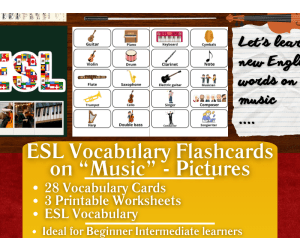
ESL Vocabulary Flashcards - Music - Pictures
ELA, Language Development, ESL, Vocabulary, Not Grade Specific, Middle School, High School, Adult Education, Worksheets & Printables, Flashcards, Worksheets, Writing Prompts
ESL Vocabulary Flashcards - Music - Pictures This high quality English language teaching resource is designed for students learning English as a second or foreign language . It includes 3 printable PDF pages featuring vocabulary flashcards and worksheets centered around the theme of "Music" This ESL Vocabulary Flashcards on "Music" Worksheets Activity can be ideal for Beginner level ESL - EFL - TESOL learners, including newcomers and English language learners of all ages. 🌟 What's Included? In this ESL Vocabulary Flashcards Activity on " Music ", there are provided: ✅ 28 Printable Flashcards (3 Printable PDF worksheets) ✅ Essential vocabulary and phrases in English ✅ Engaging icons and emojis on select flashcards to support comprehension and vocabulary retention (not all flashcards) 🏫 Who Can Benefit from This Resource? 📌 Beginner ESL - EFL students looking to improve their English vocabulary 📌 Newcomers & English Language Learners (ESL - EFL - TESOL -TEFL) in schools, tutoring sessions, or self-study 📌 Teachers and tutors looking for fun and engaging vocabulary building activities 📌 Language centers, homeschool educators, and ESL programs 🎯 How Does this ESL Teaching Resource Help you and your Students? ✨ Strengthens essential English communication skills ✨ Provides English vocabulary (ESL - EFL - TESOL - TEFL) for better understanding ✨ Encourages engaging learning with printable flashcards that can be used in various ESL - EFL (English Second or Foreign Language) class activities Whether you're an ESL teacher or an English tutor these ESL Vocabulary Flashcards on Music " are a valuable and fun resource to improve basic conversation skills in English. Start learning today and make English introductions simple, engaging, and effective ! ESL with Alan is a Teaching Resources Store whose aim is to help English as a Second or foreign Language (ESL EFL TESOL) Teachers, Educators and Tutors around the world (be it online or offline) to achieve their teaching objectives while creating an enjoyable and stimulating learning environment. Learning is fun, So should English! Always If you want to browse more of my ESL, EFL, TESOL Teaching Resources, click here right ESL with Alan!
Author Learning with Alan
Rating
Tags ESL, English Second Language, English, Vocabulary, Flashcards, Music, Worksheets, Printable, Activity, Picture
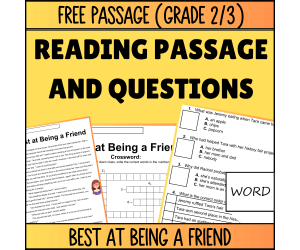
Reading Comprehension Fiction Set 5 Sample Best at Being a Friend Word
ELA, Reading, Reading Comprehension, Common Core, ESL, Language Development, Vocabulary, Children’s Literature, Literature, Writing, Grade 2, 3, Worksheets & Printables, Worksheets, Writing Prompts, Teacher Tools, Assessments, Tests, Quizzes and Tests
Reading Comprehension Passages Fiction Set 5 Sample Overview Fascinating reading comprehension passages, each with an array of activities included. Stories are written for the modern classroom and topics are designed to promote enthusiasm from each student. Each lesson contains a mixed questions section to check understanding, a vocabulary or spelling activity to help remember key language introduced, and a writing exercise. Full answer keys are provided. For a more detailed overview, check the section under the links at the bottom of this description. Passage Included 5.Best at Being a Friend: Second place again, but there is one thing Tara is best at. Word Version This is the Word editable version. This download is available in GOOGLE Docs, GOOGLE Forms, GOOGLE Slides. PDF, PPT, WORD. FULL CATALOG OF DOWNLOAD LINKS HERE Grade 2/3 Links Fiction Set 1 - Nature Google Docs Google Forms Google Slides PDF PPT Word Guided Reading Materials Fiction Set 2 - Animals Google Docs Google Forms Google Slides PDF PPT Word Guided Reading Materials Fiction Set 3 - Food Google Docs Google Forms Google Slides PDF PPT Word Guided Reading Materials Fiction Set 4 - School Google Docs Google Forms Google Slides PDF PPT Word Guided Reading Materials Fiction Set 5 - Friends Google Docs Google Forms Google Slides PDF PPT Word Guided Reading Materials Fiction Set 6 - Family Google Docs Google Forms Google Slides PDF PPT Word Guided Reading Materials Fiction Set 7 - Sports Google Docs Google Forms Google Slides PDF PPT Word Guided Reading Materials Nonfiction Set 1 - Technology Google Docs Google Forms Google Slides PDF PPT Word Guided Reading Materials Nonfiction Set 2 - Nutrition Google Docs Google Forms Google Slides PDF PPT Word Guided Reading Materials Nonfiction Set 3 - Animals Google Docs Google Forms Google Slides PDF PPT Word Guided Reading Materials Reading Passages Overview Each passage is especially written for Grade 2-3 students, including key vocabulary required for this age group. Topics are varied and are accompanied by colorful graphics. Topics are meant to educate, yet entertain the modern student. These passages are perfect for the modern classroom. Whereas textbooks can become outdated in no time, any changes to technology or the world will result in updates to this product. Mixed Questions The mixed questions section of each lesson includes a variation of fivecomprehension, vocabulary and math questions. In addition, key reading strategies are frequently covered including cause & effect, summarizing, compare & contrast and making conclusions. Three of the questions will be MCQs and two will require a written response of some kind. Full answers and example responses appear at the end of the lesson. Spelling & Vocab Each reading passage contains a variety of words and phrases designed for Grade 2-3 students. Spelling and vocab activities provide the opportunity to build fluency with these words. As it can become quite mundane doing the same activities over and over, each lesson in a set will contain a different spelling and vocab activity . Writing Prompts Writing prompts are designed to continue the theme or lessons learned in the story. Students are persuaded to write in a variety of ways and each prompt includes several cues to help. As with the spelling/vocab section, writing prompts will vary. This includes research pieces, reading responses, poetry and creative writing prompts. Full Answer Keys Full answer keys and sample responses are provided so no matter how busy you are, you know you're covered! Mixed question answers provide evidence from the text, math questions contain the relevant workings. Answers are designed for use by the teacher, but also suitable as a handout to the student. Additional File One lesson will have an additional file. This is something fun to extend the lesson with. For similar downloads and other frees, do check out Cored Group on TeachSimple.
Author Cored Education
Tags Elementary, Reading, Comprehension, Vocabulary, Answers, Ccss, Common Core, Spelling, Writing, Passages

Creative Writing Prompts Grade 3 | The Crazy Invention
Creative Writing, Writing, ELA, Grade 2, 3, 4, Writing Prompts, Worksheets & Printables
Creative Writing Prompts Grade 3 | The Crazy Invention Get a creative writing prompt resource for 3rd grade on the topic of invention. What does this resource include? This resource contains 8 creative writing prompts on invention-related topics, each with sentence starters for each task, guiding questions to support ideas, word banks with helpful vocabulary, separate writing pages with plenty of space, “How to Write a Story” guide (beginning, middle, end), 3 example stories. Each reading passage is unique. The invention topics were carefully selected and each passage is accompanied by appropriate graphics. What is it suitable for? The material is suitable for English language arts classes. It is ideally suited for 3rd grade. This material is also suitable for weaker 4th-grade classes or particularly strong 2nd-grade classes. It is suitable for teachers looking for teaching materials that can be used immediately. No tedious adapting or formatting required. Simply print it out and use it directly in class. It is suitable for various teaching formats: - writing workshop - literacy centers - independent work - early finishers - homework What topics does the reading comprehension cover? 1 My First Big Invention 2 The Crazy Kitchen Machine 3 Running Like the Wind 4 My Own Robot 5 Sleeping in the Clouds 6 Finally Understanding Animals 7 The Backpack Full of Surprises 8 One Step Into Adventure In addition, there are two advanced-level problems (easy and hard). The material is provided as a PDF file to make it easy to print and use in class. It is part of a larger series. If you like this material, you can explore creative writing prompt resources on a variety of other topics in my shop that will enrich your lessons. In addition to creative writing prompts, I also offer reading comprehension, math word problems, informational texts, and reading tests.
Author Smart Learning Classroom
Rating
Tags Creative Writing, Writing, Pet, Animal, Writing Prompts, Grade 3, Writing Workshop, Story Writing, Invention, Innovation

How Language Change & Disappear. SAMPLE Social Studies Reading Passage
ELA, Reading, Reading Comprehension, Strategies, Resources for Teachers, Social Studies, Psychology, Sociology, Grade 6, 7, 8, 9, Writing Prompts, Worksheets & Printables, Centers, Activities, Teacher Tools, Assessments, Quizzes and Tests, Quizzes, Tests
This is a free passage sample from the complete resource. The full version includes everything needed for a complete reading comprehension activity: the passage, multiple-choice questions, short-answer questions, vocabulary matching, a summary-writing task, and a detailed answer key. Download the complete passage resource by clicking on the following links: PDF Fillable PDF Word Docs Google Docs How Language Change & Disappear. Social Studies Reading Comprehension Passage and Questions This resource contains an engaging Social Studies reading comprehension passage about How Words Shape Our Minds. The passage is carefully written and designed to bridge the gap between social studies and literacy through strengthening comprehension skills and sparking knowledge curiosity in middle school students. The passage blends English Language Arts skills with accurate social studies content. Ideal for interdisciplinary learning in ELA and Social Studies. Suitable for Grade 9 review, too! Student Tasks throughout the passage: 5 multiple-choice questions targeting the following skills: main idea, key details, inference, vocabulary in context, and use of evidence 5 vocabulary matching items with clear, student-friendly definitions 5 text-based questions that require citing specific lines or facts 1 summary prompt that asks students to condense central ideas accurately Full answer key for every section FULL CATALOG OF DOWNLOADING LINKS HERE Other Social Studies Reading Comprehension Collections You May Find in the Store: 1. Ancient Civilizations 2. Early Empires and Trade Networks 3. The Founding of the United States 4. Language, Culture, and Meaning 5. Psychology and Society 6. Global Festivals and Traditions 7. Extreme Environments and People 8. Food, Culture, and Preservation 9. Global Food Customs 10. Media, Communication, and Popular Culture 11. Human Impact on the Environment 12. Civic Action and Social Change 13. Fashion, Society, and Power 14. People, Places, and Unusual Histories Product Details: Length: 5 pages Grades: 6–8, also suitable for Grade 9 review Use cases: close reading, stations, homework, intervention, test prep, and sub plans Why Teachers Choose This Passage: Authentic social studies content paired with rigorous literacy practice Consistent task structure for easier planning and smoother student routines Clear, age-appropriate writing that builds confidence without oversimplifying Use this passage to reinforce ELA skills in social studies, to add literacy to your lessons, and to support independent work. The passage strengthens main idea, evidence use, vocabulary in context, inference, cause and effect, and summary writing. With ready-to-use assessments and complete answer keys, you can provide focused practice that is simple to run and fast to review.
Author Middle & High School - CORED Education
Rating
Tags Middle School, Reading Comprehension, Reading Strategies, ELA, Centers, Reading Passage, Assessments, Vocabulary, Social Studies, Psychology And Sociology
Reading Comprehension Passages Nonfiction Set 1 - Technology (PDF)
ELA, Reading, Reading Comprehension, Common Core, ESL, Language Development, Spelling, Vocabulary, Creative Writing, Writing, Grade 2, 3, Worksheets & Printables, Worksheets, Assessments, Teacher Tools, Tests, Quizzes and Tests, Writing Prompts
Reading Comprehension Passages Nonfiction Set 1 Overview Engaging nonfiction articles, each with a collection of different activities included. Articles are written for the modern classroom and topics are designed to promote enthusiasm from each student. Each lesson contains a mixed questions section to check understanding, a vocabulary or spelling activity to help remember key language introduced, and a writing exercise. Full answer keys are provided. Passages Include 1.Talking in Code: How the Navajo code talkers helped during WWII. 2.Power From the Sun: How does solar power work? 3.Roller Coasters: The science behind roller coasters. 4.The History of Cars: Who invented the car? Find out in this article. 5.The History of Ferries: Where is the oldest ferry service in the world? 6.The History of Helicopters: The advantages and disadvantages of helicopters. Additional File: History of Cars: Design a Car Printable PDF Version This is the PDF uneditable version. This download is available in GOOGLE Docs, GOOGLE Forms, GOOGLE Slides. PDF, PPT, WORD. FULL CATALOG OF DOWNLOAD LINKS HERE Grade 2/3 Links Fiction Set 1 - Nature Google Docs Google Forms Google Slides PDF PPT Word Guided Reading Materials Fiction Set 2 - Animals Google Docs Google Forms Google Slides PDF PPT Word Guided Reading Materials Fiction Set 3 - Food Google Docs Google Forms Google Slides PDF PPT Word Guided Reading Materials Fiction Set 4 - School Google Docs Google Forms Google Slides PDF PPT Word Guided Reading Materials Fiction Set 5 - Friends Google Docs Google Forms Google Slides PDF PPT Word Guided Reading Materials Fiction Set 6 - Family Google Docs Google Forms Google Slides PDF PPT Word Guided Reading Materials Fiction Set 7 - Sports Google Docs Google Forms Google Slides PDF PPT Word Guided Reading Materials Nonfiction Set 1 - Technology Google Docs Google Forms Google Slides PDF PPT Word Guided Reading Materials Nonfiction Set 2 - Nutrition Google Docs Google Forms Google Slides PDF PPT Word Guided Reading Materials Nonfiction Set 3 - Animals Google Docs Google Forms Google Slides PDF PPT Word Guided Reading Materials Reading Passages Overview Each passage is especially written for Grade 2-3 students, including key vocabulary required for this age group. Topics are varied and are accompanied by colorful graphics. Topics are meant to educate, yet entertain the modern student. These passages are perfect for the modern classroom. Whereas textbooks can become outdated in no time, any changes to technology or the world will result in updates to this product. Mixed Questions The mixed questions section of each lesson includes a variation of fivecomprehension, vocabulary and math questions. In addition, key reading strategies are frequently covered including cause & effect, summarizing, compare & contrast and making conclusions. Three of the questions will be MCQs and two will require a written response of some kind. Full answers and example responses appear at the end of the lesson. Spelling & Vocab Each reading passage contains a variety of words and phrases designed for Grade 2-3 students. Spelling and vocab activities provide the opportunity to build fluency with these words. As it can become quite mundane doing the same activities over and over, each lesson in a set will contain a different spelling and vocab activity . Writing Prompts Writing prompts are designed to continue the theme or lessons learned in the story. Students are persuaded to write in a variety of ways and each prompt includes several cues to help. As with the spelling/vocab section, writing prompts will vary. This includes research pieces, reading responses, poetry and creative writing prompts. Full Answer Keys Full answer keys and sample responses are provided so no matter how busy you are, you know you're covered! Mixed question answers provide evidence from the text, math questions contain the relevant workings. Answers are designed for use by the teacher, but also suitable as a handout to the student. Additional File One lesson will have an additional file. This is something fun to extend the lesson with. For similar downloads and other frees, do check out Cored Group on TeachSimple.
Author Cored Education
Rating
Tags Elementary, Reading, Comprehension, Vocabulary, Answers, Common Core, Spelling, Writing, Passages, Reading Comprehension Assessment

Science Reading Comprehension Passage. The Solar System (Word)
Science, ELA, Reading, Reading Comprehension, Strategies, Resources for Teachers, Space, Earth and Environmental Sciences, Grade 6, 7, 8, 9, Writing Prompts, Worksheets & Printables, Centers, Activities, Teacher Tools, Assessments, Quizzes and Tests, Quizzes, Tests
Science Reading Comprehension Passages and Questions: The Solar System (Word) This very engaging science reading passage about The Solar System is designed to bridge the gap between science and literacy through strengthening reading comprehension and sparking scientific curiosity in middle school students. The passage blends English Language Arts skills with accurate science content that supports NGSS classroom practice. Ideal for interdisciplinary learning in ELA and Science. Suitable for Grade 9 review, too! Student Tasks for The Passage: 5 multiple-choice questions targeting main idea, key details, inference, vocabulary in context, and use of evidence 5 vocabulary matching items with clear, student-friendly definitions 5 text-based questions that require citing specific lines or facts 1 summary prompt that asks students to condense central ideas accurately Full answer key for every section Available Formats for this Resource PDF Fillable PDF Google Docs FULL CATALOG OF DOWNLOADING LINKS HERE Product Details Length: 5 pages total Grades: 6–8, also suitable for Grade 9 review Use cases: close reading, stations, homework, intervention, test prep, and sub plans Standards support: reinforces informational-text skills and supports NGSS-style sense making through observation, modeling, and clear use of claim, evidence, and reasoning Why Teachers Choose This Set Authentic science content paired with rigorous literacy practice Consistent task structure across all passages for easier planning and smoother student routines Clear, age-appropriate writing that builds confidence without oversimplifying Other Science Reading Collections you May find in the store: 1. Astronomy & Space Science 2. Volcanoes, Rocks, & Mountains 3. Rock Cycle, Soil, & Sinkholes 4. Mars, Glaciers, & Antarctica 5. Water Cycle, Acid Rain, & Wastewater 6. Insects, Animals, & Ecosystems 7. Bioluminescence & Insects 8. Animal Skin, Cats, & T. Rex 9. Human Body and Senses 10. Health & Applied Bioscience 11. Waves, Light, & Imaging 12. Electricity & Energy 13. Motion & Materials 14. Chemistry and Materials Science Use this set to reinforce ELA skills in science, to add literacy to your lessons, and to support independent work. The passages strengthen main idea, evidence use, vocabulary in context, inference, cause and effect, and summary writing. With ready-to-use assessments and complete answer keys, you can provide focused practice that is simple to run and fast to review.
Author Middle & High School - CORED Education
Rating
Tags Middle School, Reading Comprehension, Reading Strategies, ELA, Centers, Reading Passage, Assessments, Vocabulary, Environmental Science, The Solar System

Earth Science Reading Comprehension Passage: From Earth to Mars (PDF)
Science, ELA, Reading, Reading Comprehension, Strategies, Resources for Teachers, Earth and Environmental Sciences, Space, Grade 6, 7, 8, 9, Writing Prompts, Worksheets & Printables, Centers, Activities, Teacher Tools, Assessments, Quizzes and Tests, Quizzes, Tests
Science Reading Comprehension Passages and Questions: From Earth to Mars (PDF) This very engaging earth science reading passage about Mars is designed to bridge the gap between science and literacy through strengthening reading comprehension and sparking scientific curiosity in middle school students. The passage blends English Language Arts skills with accurate science content that supports NGSS classroom practice. Ideal for interdisciplinary learning in ELA and Science. Suitable for Grade 9 review, too! Student Tasks for The Passage: 5 multiple-choice questions targeting main idea, key details, inference, vocabulary in context, and use of evidence 5 vocabulary matching items with clear, student-friendly definitions 5 text-based questions that require citing specific lines or facts 1 summary prompt that asks students to condense central ideas accurately Full answer key for every section Available Formats for this Resource Fillable PDF Word Docs Google Docs FULL CATALOG OF DOWNLOADING LINKS HERE Product Details Length: 5 pages total Grades: 6–8, also suitable for Grade 9 review Use cases: close reading, stations, homework, intervention, test prep, and sub plans Standards support: reinforces informational-text skills and supports NGSS-style sense making through observation, modeling, and clear use of claim, evidence, and reasoning Why Teachers Choose This Set Authentic science content paired with rigorous literacy practice Consistent task structure across all passages for easier planning and smoother student routines Clear, age-appropriate writing that builds confidence without oversimplifying Other Science Reading Collections you May find in the store: 1. Astronomy & Space Science 2. Volcanoes, Rocks, & Mountains 3. Rock Cycle, Soil, & Sinkholes 4. Mars, Glaciers, & Antarctica 5. Water Cycle, Acid Rain, & Wastewater 6. Insects, Animals, & Ecosystems 7. Bioluminescence & Insects 8. Animal Skin, Cats, & T. Rex 9. Human Body and Senses 10. Health & Applied Bioscience 11. Waves, Light, & Imaging 12. Electricity & Energy 13. Motion & Materials 14. Chemistry and Materials Science Use this set to reinforce ELA skills in science, to add literacy to your lessons, and to support independent work. The passages strengthen main idea, evidence use, vocabulary in context, inference, cause and effect, and summary writing. With ready-to-use assessments and complete answer keys, you can provide focused practice that is simple to run and fast to review.
Author Middle & High School - CORED Education
Rating
Tags Middle School, Reading Comprehension, Reading Strategies, ELA, Centers, Reading Passage, Assessments, Vocabulary, Environmental Science, Space