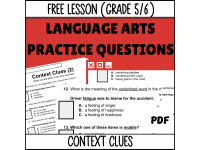
Context Clues Sample Lesson - Vocabulary Grade 5-6 (PDF)


- Grades
- Grades 5–6
- Pages
- 6
- File type
- Answer key
- Included


- Subject
- ELA, Language Development, Common Core, Resources for Teachers, Vocabulary
- Topic
- elementary, answers
- Resource types
- Worksheets & Printables, Worksheets, Quizzes and Tests, Teacher Tools, Tests, Assessments
- Answer key
- Included
- Standards
- CCSS.L.5.4 CCSS.L.6.4
About this resource
What's inside this resource
Product description
From the author
Context Clues Sample Lesson
ELA MCQS Overview:
In this series of lessons, students will embark on an engaging journey to master the language arts skills that make communication effective and expressive. These lessons are designed to help students recognize, understand, and apply key grammar, vocabulary, and writing conventions in both their writing and speech.
Each lesson builds upon the previous one, providing a structured blend of direct instruction, interactive group activities, and independent practice. With engaging tasks and thought-provoking questions, students will explore sentence structure, word choice, punctuation, and grammar rules to strengthen their understanding of English language conventions.
Accompanied by free supplementary materials covering all topics, this series ensures a well-rounded and enjoyable learning experience. Through practice and exploration, students will develop the skills needed to analyze language, construct clear sentences, and express themselves with confidence.
Context Clues Overview:
Definitions/Restatements
Synonyms
Antonyms
Examples/Explanations
PDF Version
This is the PDF uneditable version. This download is available in GOOGLE Docs, GOOGLE Forms, GOOGLE Slides. PDF, PPT, WORD, check the links below for more details.
Full catalog of download links here
Grade 5/6 Links:
Capitalization & Punctuation
Free Supplementary Materials Pack
Adjectives
Google Slides
PPT
Word
Free Supplementary Materials Pack
Nouns
Google Docs
Google Forms
Google Slides
PPT
Word
Free Supplementary Materials Pack
Pronouns
Google Docs
Google Forms
Google Slides
PPT
Word
Free Supplementary Materials Pack
Verbs
Google Docs
Google Forms
Google Slides
PPT
Word
Free Supplementary Materials Pack
Prefixes & Suffixes
Google Docs
Google Forms
Google Slides
PPT
Word
Free Supplementary Materials Pack
Sentence Structure
Google Docs
Google Forms
Google Slides
PPT
Word
Free Supplementary Materials Pack
Subject Verb Agreement
Google Docs
Google Forms
Google Slides
PPT
Word
Free Supplementary Materials Pack
Tenses
Google Docs
Google Forms
Google Slides
PPT
Word
Free Supplementary Materials Pack
Context Clues
Google Docs
Google Forms
Google Slides
PPT
Word
Free Supplementary Materials Pack
Defining Words
Google Docs
Google Forms
Google Slides
PPT
Word
Free Supplementary Materials Pack
Fill in the Blanks
Google Docs
Google Forms
Google Slides
PPT
Word
Free Supplementary Materials Pack
Homophones
Google Docs
Google Forms
Google Slides
PPT
Word
Free Supplementary Materials Pack
Synonyms
Google Docs
Google Forms
Google Slides
PPT
Word
Free Supplementary Materials Pack
ELA Review Questions Overview
Questions have three answer choices. There are a handful of pictures on each test for aesthetic purposes, as well as a review sheet covering most of the
topics covered in the product.
Introduction or Example Sheet
Each topic will include an introduction or example sheet to go through first with your students.
Full Answer Keys
Full answer keys and sample responses are provided so no matter how busy you are, you know you're covered!
In the Supplementary Pack
Interactive Ice Breakers: Engaging warm-up activities that introduce students to key ELA concepts, such as quick capitalization corrections and punctuation challenges.
Guided Practice: Structured teacher-led exercises that reinforce grammar and punctuation rules, helping students identify and apply them correctly in sentences.
Group and Partner Tasks: Collaborative activities where students work together to edit sentences, correct capitalization, and improve punctuation through peer discussion and teamwork.
Independent Worksheets: Carefully designed worksheets that provide focused practice, allowing students to apply learned concepts and refine their skills independently.
Exit Tasks: Quick assessments at the end of each lesson, prompting students to reflect on what they’ve learned and apply their knowledge in writing and editing tasks.
For More Like This
For similar downloads and other frees, do check out Cored Group on TeachSimple.
Related resources
More resources teachers may find useful
24 related resources were found using this product's title, contributor, categories and tags.

In the classroom
Teaching tips & learning objectives

Learning objectives
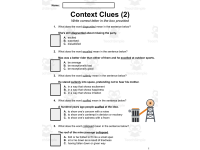
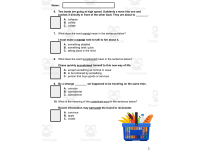
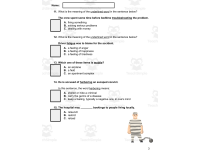
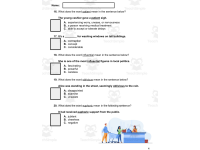
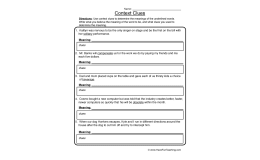
Students determine the meaning of an unfamiliar or multiple-meaning word using only sentence-level context clues.
Students distinguish between three plausible definitions and select the one that fits the sentence's meaning.
Students apply this skill across a range of vocabulary difficulty, from common words (mental, patient) to advanced ones (euphoric, wanderlust).

Teaching tips
Use the 25 questions as a diagnostic: the answer key on page 6 is organized by the same five-questions-per-page structure as the worksheet, making it easy to spot which page's vocabulary a student struggled with.
Because each item stands alone, questions can be assigned in smaller batches (one worksheet page at a time) rather than all 25 at once.
Preview a few of the more advanced words (disgruntled, oblivious, euphoric) before assigning, since several items rely on nuanced tone rather than a literal definition.

Skills covered
Context-clue reasoning — students infer a word's meaning from surrounding sentence content rather than a dictionary definition, e.g. determining that "scoffed" means showing contempt from "A hundred years ago people scoffed at the idea."
Multiple-meaning word discrimination — several items (e.g., mental, patient, mobile) require selecting the sense that fits the given sentence rather than a more common alternate meaning.
Vocabulary breadth — the 25 items span common academic words to advanced ones like wanderlust and euphoric.
Good to know
Questions teachers ask about this resource
How difficult is the vocabulary compared to a typical grade 5-6 word list?
It ranges widely: several items use everyday words like patient and mental, while others use advanced vocabulary such as disgruntled, euphoric, and wanderlust, so the set can stretch stronger readers.

No reviews yet
Downloaded this resource? Tell other teachers how it went.
Curriculum
Standards, concepts & topics
Standards
 Standards
- CCSS.L.5.4 — Determine or clarify the meaning of unknown and multiple-meaning words and phrases based on grade 5 reading and content, choosing flexibly from a range of strategies. a. Use context (e.g., cause/effect relationships and comparisons in text) as a clue to the meaning of a word or phrase. b. Use common, grade-appropriate Greek and Latin affixes and roots as clues to the meaning of a word (e.g., photograph, photosynthesis). c. Consult reference materials (e.g., dictionaries, glossaries, thesauruses), both print and digital, to find the pronunciation and determine or clarify the precise meaning of key words and phrases.
- CCSS.L.6.4 — Determine or clarify the meaning of unknown and multiple-meaning words and phrases based on grade 6 reading and content, choosing flexibly from a range of strategies. a. Use context (e.g., the overall meaning of a sentence or paragraph; a word’s position or function in a sentence) as a clue to the meaning of a word or phrase. b. Use common, grade-appropriate Greek or Latin affixes and roots as clues to the meaning of a word (e.g., audience, auditory, audible). c. Consult reference materials (e.g., dictionaries, glossaries, thesauruses), both print and digital, to find the pronunciation of a word or determine or clarify its precise meaning or its part of speech. d. Verify the preliminary determination of the meaning of a word or phrase (e.g., by checking the inferred meaning in context or in a dictionary).
Core concepts
 Core concepts
Context clues
Vocabulary in context
Multiple-choice reading assessment
 Topics
Explore more
Categories this resource belongs to
Explore related searches
More to explore
You may also like