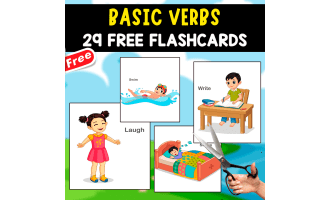
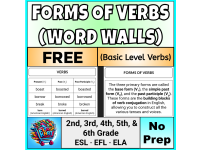
Forms of Verbs Word Wall Basic Level Verb Conjugation 150+ verbs

- Grades
- Grades 2–5, Elementary
- Pages
- 54
- File type
- Preparation
- Print ready


- Subject
- Common Core, Grammar, Language Development, ELA, ESL
- Topic
- word walls, verbs
- Resource types
- Word Walls, Classroom Decor, Charts, Teacher Tools
- Preparation
- Print ready
- Standards
- CCSS.L.2.1 CCSS.L.3.1 +3
About this resource
What's inside this resource
Forms of Verbs Word Wall (V1, V2, V3) | 150+ Basic Verb Conjugation Charts
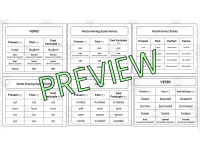
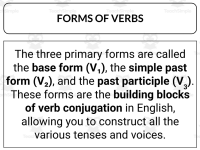
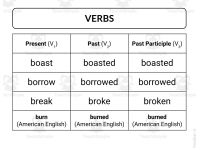
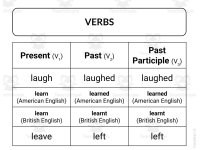
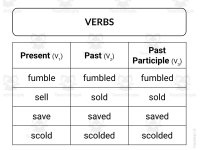
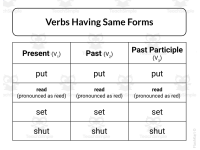
Help students build confidence with English verb forms using this FREE printable Forms of Verbs Word Wall featuring 150+ basic verbs in their V1 (base form), V2 (past tense), and V3 (past participle) forms. Many students struggle with irregular verbs and often write words like goed, buyed, or catched. This printable resource makes it easier for learners to recognize, remember, and correctly use common verb forms in their speaking and writing. I have designed it for both native English speakers and English language learners. This resource provides an easy to read visual reference that can be displayed all year long in your classroom or used during grammar lessons, literacy centers, writing activities, and independent practice. This word wall includes both regular and irregular verbs, verbs with identical forms (such as put-put-put and cut-cut-cut), and the different forms of the verb to be. Selected verbs also include both British and American English spellings where appropriate.
What's inside?
150+ basic verb conjugations (V1, V2, V3)
Regular and irregular verbs
Verbs with identical forms (put-put-put, cut-cut-cut, etc.)
Common irregular verbs such as go-went-gone, buy-bought-bought, and bring-brought-brought
Forms of the verb to be across present, past, perfect, and future tenses
Selected British and American English verb variations
Printable classroom word wall pages
Large, easy to read reference charts
Ready to print pages
Ways to use this resource:
This versatile word wall can be used in a variety of classroom settings:
Display it as a permanent classroom word wall
Use it during grammar and language lessons
Support sentence-building and writing activities
Review verb forms before writing assignments
Practice identifying regular and irregular verbs
Encourage students to notice different verb forms while reading
Use for partner quizzes and classroom games
Support speaking and vocabulary practice
Keep it in a literacy center as a student reference
Send copies home for additional review
You can also encourage students to explore pronunciation differences, such as read (present vs. past tense), or compare related words like bath and bathe to strengthen vocabulary and pronunciation skills.
Usefulness for teachers, parents, and homeschoolers:
It saves preparation time
It is to print and use
It provides a year round grammar reference
This resource also supports reading, writing, speaking, and grammar instruction
It will help students become more independent during language activities
It works well for whole-class lessons, small groups, and individual practice
It is best for:
Grades 2-7
ESL (English as a Second Language)
EFL (English as a Foreign Language)
ELA intervention
Homeschool
Adult English learners
Resource features:
FREE resource
No prep
Classroom-ready
Large and student-friendly text
It includes more than 150 verb forms
Covers both regular and irregular verbs
Includes British and American English spellings where appropriate
It is ideal for grammar lessons, writing, reading, and speaking activities
It is great for word walls, literacy centers, and classroom displays
Standards Alignment (CCSS)
CCSS.ELA-literacy.l.2.1
CCSS.ELA-literacy.l.2.1.d
CCSS.ELA-literacy.l.3.1.e
CCSS.ELA-literacy.l.4.1
CCSS.ELA-literacy.l.4.1.b
CCSS.ELA-literacy.l.5.1
CCSS.ELA-literacy.l.5.1.b
If you find this free resource helpful, I'd truly appreciate your feedback. Reviews help other educators discover the resource and encourage me to create more classroom materials like this. Thank you for your support!
Related resources
More resources teachers may find useful
24 related resources were found using this product's title, contributor, categories and tags.


No reviews yet
Downloaded this resource? Tell other teachers how it went.
Curriculum
Standards, concepts & topics
Standards
 Standards
- CCSS.L.2.1 — Demonstrate command of the conventions of standard English grammar and usage when writing or speaking. a. Use collective nouns (e.g., group). b. Form and use frequently occurring irregular plural nouns (e.g., feet, children, teeth, mice, fish). c. Use reflexive pronouns (e.g., myself, ourselves). d. Form and use the past tense of frequently occurring irregular verbs (e.g., sat, hid, told). e. Use adjectives and adverbs, and choose between them depending on what is to be modified. f. Produce, expand, and rearrange complete simple and compound sentences (e.g., The boy watched the movie; The little boy watched the movie; The action movie was watched by the little boy).
- CCSS.L.3.1 — Demonstrate command of the conventions of standard English grammar and usage when writing or speaking. a. Explain the function of nouns, pronouns, verbs, adjectives, and adverbs in general and their functions in particular sentences. b. Form and use regular and irregular plural nouns. c. Use abstract nouns (e.g., childhood). d. Form and use regular and irregular verbs. e. Form and use the simple (e.g., I walked; I walk; I will walk) verb tenses. f. Ensure subject-verb and pronoun-antecedent agreement.* g. Form and use comparative and superlative adjectives and adverbs, and choose between them depending on what is to be modified. h. Use coordinating and subordinating conjunctions. i. Produce simple, compound, and complex sentences.
- CCSS.L.4.1 — Demonstrate command of the conventions of standard English grammar and usage when writing or speaking. a. Use relative pronouns (who, whose, whom, which, that) and relative adverbs (where, when, why). b. Form and use the progressive (e.g., I was walking; I am walking; I will be walking) verb tenses. c. Use modal auxiliaries (e.g., can, may, must) to convey various conditions. d. Order adjectives within sentences according to conventional patterns (e.g., a small red bag rather than a red small bag). e. Form and use prepositional phrases. f. Produce complete sentences, recognizing and correcting inappropriate fragments and run-ons.* g. Correctly use frequently confused words (e.g., to, too, two; there, their).*
- CCSS.L.5.1 — Demonstrate command of the conventions of standard English grammar and usage when writing or speaking. a. Explain the function of conjunctions, prepositions, and interjections in general and their function in particular sentences. b. Form and use the perfect (e.g., I had walked; I have walked; I will have walked) verb tenses. c. Use verb tense to convey various times, sequences, states, and conditions. d. Recognize and correct inappropriate shifts in verb tense.* e. Use correlative conjunctions (e.g., either/or, neither/nor).
- CCSS.L.6.1 — Demonstrate command of the conventions of standard English grammar and usage when writing or speaking. a. Ensure that pronouns are in the proper case (subjective, objective, possessive). b. Use intensive pronouns (e.g., myself, ourselves). c. Recognize and correct inappropriate shifts in pronoun number and person.* d. Recognize and correct vague pronouns (i.e., ones with unclear or ambiguous antecedents).* e. Recognize variations from standard English in their own and others’ writing and speaking, and identify and use strategies to improve expression in conventional language.*
Core concepts
 Core concepts
- Base form
- Simple past
- Past participle
- Irregular verbs
 Topics
Explore more
Categories this resource belongs to
Explore related searches
More to explore
You may also like