Grade 5 Homophones Worksheets – 100 Practice Questions




- Grades
- Grades 5–6, Elementary, Middle School
- Pages
- 217
- File type
- Answer key
- Included


- Subject
- ELA, Language Development, Vocabulary
- Topic
- elementary, answers
- Resource types
- Worksheets & Printables, Worksheets, Quizzes and Tests, Tests, Assessments
- Answer key
- Included
About this resource
What's inside this resource
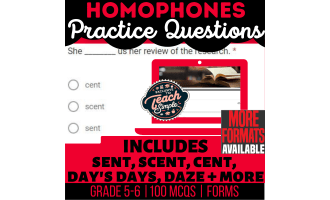
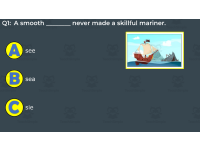
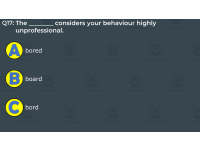
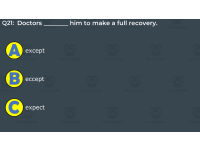
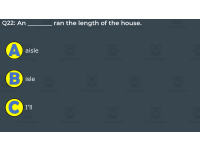
Four 25-question homophone quiz sets - 100 fill-in-the-blank questions in total - each present one sentence per slide with a missing homophone and three spelled-out answer choices labeled A, B, and C, several paired with a small illustration such as a shipwreck image for the sea/see/sie question. Difficulty ranges from common pairs like to/two/too and there/their/they're to less common ones like rein/rain/reign and aisle/isle/I'll, and several items use two blanks in a single sentence, such as "Luis ___ his baseball ___ the window." Each of the four sets repeats its own 25 questions a second time under an "Answers" heading, though the extracted text shows the same three unmarked options both times rather than a clearly indicated correct choice. A one-page bonus Examples Sheet adds five more worked homophone questions with a marked correct letter, and a blank student answer sheet (numbered Q.1-Q.25, with a teacher-remarks column) closes out each of the four main sets.
Related resources
More resources teachers may find useful
24 related resources were found using this product's title, contributor, categories and tags.


In the classroom
Teaching tips & learning objectives

Learning objectives
- Select the correctly spelled homophone that completes a sentence based on its meaning in context (e.g. choosing "sea" over "see" or "sie")
- Distinguish between commonly confused three-way homophone sets, such as to/two/too and there/their/they're
- Apply two different homophones correctly within a single sentence containing two blanks (e.g. threw/through)

Teaching tips
- Assign the four 25-question sets across separate sessions rather than all at once, since together they cover 100 distinct questions - roughly a full unit's worth of homophone practice
- Use the blank answer sheet at the end of each set for students to record just their letter choices, keeping the slide-by-slide format usable as a whole-class presentation rather than a printed worksheet
- Confirm directly in the file how the "Answers" section marks the correct choice before relying on it for self-checking or grading - the extracted text shows the same unmarked question and options repeated rather than an obviously marked key

Skills covered
- Meaning in context — students choose the homophone that completes a sentence logically.
- Homophone discrimination — three-option questions contrast commonly confused spellings such as there, their, and they’re.
- Spelling accuracy — plausible misspellings appear among the answer choices, requiring careful word-form recognition.
Good to know
Questions teachers ask about this resource
Do the four 25-question sets cover the same homophone pairs, or different ones?
Different pairs in each set. Set 1 covers pairs like sea/see, heir/air/eyre, and alter/altar; Set 2 shifts to entirely different pairs such as maybe/may be and patience/patient's/patients, with no vocabulary overlap observed between the two sets.
Is the correct answer always listed in the same position (A, B, or C) across questions, or does it vary?
It varies. Across the first five questions of Set 1, the correct choice appears as B, C, B, C, and B in turn, so students can't rely on answer position as a shortcut.

No reviews yet
Downloaded this resource? Tell other teachers how it went.
Resource details
Concepts & topics
Core concepts
 Core concepts
- homophones
- meaning in context
- correct spelling
- sentence completion
 Topics
Explore more
Categories this resource belongs to
Explore related searches
More to explore
You may also like