Place Value Worksheets 1st Grade | Place Value TENS AND ONES Practice


- Grades
- Grade 1, Elementary
- Pages
- 20
- File type
- Preparation
- Print ready


- Subject
- Math, Early Math, Place Value, Counting
- Topic
- Tens and Ones, Place Value
- Resource types
- Worksheets & Printables, Worksheets
- Preparation
- Print ready
- Standards
- 1.NBT.B.2
Product description
From the author
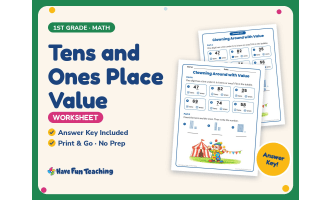
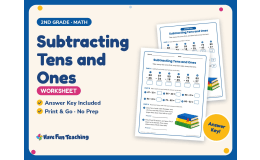
This 20-page PDF gives learners repeated practice with tens and ones. Students count illustrated collections, circle groups of ten and record the number of tens, leftover ones and objects altogether.
Use individual pages as first-grade practice or quick exit slips. The pages follow a similar answer layout and use varied picture collections. No answer key is included.
Related resources
More resources teachers may find useful
24 related resources were found using this product's title, contributor, categories and tags.


In the classroom
Teaching tips & learning objectives

Learning objectives
Represent a counted quantity of objects as a number of tens, a number of ones, and a total
Group a set of objects into tens to support place-value counting

Teaching tips
Use one page as a brief formative check after modeling groups of ten.
Ask students to explain how their pictured groups connect to the tens and ones they record.
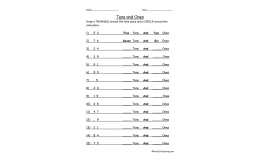
Continue the grouping routine on later pages with the shorter heading; they still contain object pictures.

Skills covered
- Grouping objects into tens
- Recording tens, remaining ones and total quantity
- Connecting a pictured collection with place-value notation

No reviews yet
Downloaded this resource? Tell other teachers how it went.
Curriculum
Standards, concepts & topics
Standards
 Standards
- 1.NBT.B.2 — Understand that the two digits of a two-digit number represent amounts of tens and ones. Understand the following as special cases: a. 10 can be thought of as a bundle of ten ones — called a “ten.” b. The numbers from 11 to 19 are composed of a ten and one, two, three, four, five, six, seven, eight, or nine ones. c. The numbers 10, 20, 30, 40, 50, 60, 70, 80, 90 refer to one, two, three, four, five, six, seven, eight, or nine tens (and 0 ones).
Core concepts
 Core concepts
Place value
Tens and ones
Grouping by ten
 Topics
More to explore
You may also like