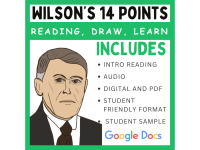
Wilson's 14 Points – Draw and Learn Activity



- Grades
- High School
- Pages
- 12
- File type
- Preparation
- Print ready


- Subject
- Social Studies, History, History: USA, History: World
- Topic
- woodrow wilson, war world I
- Resource types
- Worksheets & Printables, Worksheets
- Preparation
- Print ready
About this resource
What's inside this resource
Woodrow Wilson, the 28th U.S. President led the country through World War I. The U.S. joined the war in 1917 on the side of the Allies, and an armistice was signed in 1918 to end the fighting. Although the United States was the last country to join the fighting, Wilson's bold move to ensure that future wars could be prevented is historic. His ideas are outlined in his 14 points for peace.
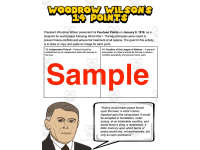
This product comes with an introductory reading on Woodrow Wilson's 14 Points for Peace. In the past, I have found that going through the 14 Points is difficult for students, so this activity allows them to look at each point and to try to illustrate it. The illustrations can be done with online tools or by hand - the choice is theirs. Additionally, this produce includes an introductory reading and audio for students to follow along to.
This product is ready to use and requires no prep.
Clipart Credit: Danndy Doodle
Related resources
More resources teachers may find useful
24 related resources were found using this product's title, contributor, categories and tags.


In the classroom
Teaching tips & learning objectives

Learning objectives
Summarize the purpose of Wilson's Fourteen Points as a peace plan after World War I
Identify specific proposals within the Fourteen Points (e.g., freedom of the seas, self-determination, the League of Nations)
Represent each of the fourteen points visually through drawing or image selection

Teaching tips
Play the included MP3 audio track while students follow along with the reading passage, as the file is designed for this use
Let students choose between hand-drawing or copying and pasting an image for each point, since the file explicitly offers both options

Skills covered
Reading comprehension of informational text -- students read a passage on Wilson's Fourteen Points and answer questions about its main ideas (what the plan was called, three things Wilson advocated for).
Visual summarization -- for each of the 14 points, students create or select an image that represents the idea, translating a short text summary into a visual.
Good to know
Questions teachers ask about this resource
Are model responses provided for the four comprehension questions?
Yes -- a separate page gives model responses for all four questions, such as 'Freedom of seas, fair trade, and smaller militaries' for the second question.

No reviews yet
Downloaded this resource? Tell other teachers how it went.
Resource details
Concepts & topics
Core concepts
 Core concepts
Woodrow Wilson
Fourteen Points
World War I
League of Nations
Self-determination
 Topics
Explore more
Categories this resource belongs to
Explore related searches
More to explore
You may also like