Writing Skills Printable Workbook: Language Arts Grade 2


- Grades
- Grade 2, Elementary
- File type
- Preparation
- Print ready


- Subject
- ELA, Writing, Grammar
- Topic
- writing, statements
- Resource types
- Workbooks, Worksheets & Printables
- Preparation
- Print ready
- Standards
- CCSS.L.2.1 CCSS.L.2.2
About this resource
What's inside this resource
Practice worksheets provide excellent preparation for standardized testing!
—Long and Short Vowels, Digraphs, and Diphthongs
—Blends and Silent Letters
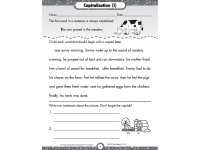
—Capitalization
—Statements, Questions, and Exclamations
—Nouns and Pronouns
—Adjectives and Verbs
—Word Order, Subjects, and Predicates
—Compound Words and Contractions
—Synonyms, Antonyms, and Homonyms
—Prefixes and Suffixes
—Sequencing and Prediction
—Comparison, Inference, and Conclusions
—Fact and Opinion
Related resources
More resources teachers may find useful
24 related resources were found using this product's title, contributor, categories and tags.
In the classroom
Teaching tips & learning objectives

Learning objectives
Apply capitalization rules to the first word of a sentence, the pronoun I, and proper nouns.
Identify and correctly punctuate statements, questions, commands, and exclamations.
Distinguish common from proper nouns and form regular and irregular plural and possessive nouns.

Teaching tips
Work through the workbook in its printed order, since each verb-usage unit (e.g., does/do, then has/have, then was/were) builds on the same has-have/does-do sentence-pattern format introduced earlier.
Use the two proofreading passages (missing periods/question marks/exclamation points) as a quick formative check after teaching the four sentence types.
Save the closing 'Review Verb Usage' section as a cumulative quiz, since it mixes items from every verb topic covered earlier in the workbook. Give students a short editing task with this sentence capitalization and punctuation worksheet.

Skills covered
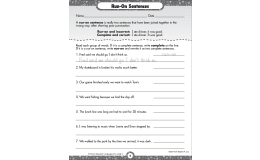
Sentence-type identification - students punctuate statements, questions, commands, and exclamations and add missing punctuation to short proofreading passages.
Noun and plural formation - students circle common and proper nouns, form regular and irregular plurals (e.g., bunny to bunnies), and choose correct possessive forms.
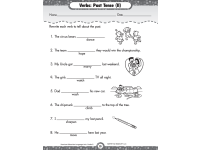
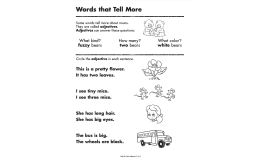
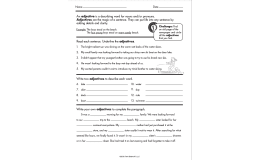
Verb agreement and tense - students select correct present, past, and -ing verb forms, including irregular verbs and the am/are/is, does/do, has/have, and was/were verb families.

No reviews yet
Downloaded this resource? Tell other teachers how it went.
Curriculum
Standards, concepts & topics
Standards
 Standards
- CCSS.L.2.1 — Demonstrate command of the conventions of standard English grammar and usage when writing or speaking. a. Use collective nouns (e.g., group). b. Form and use frequently occurring irregular plural nouns (e.g., feet, children, teeth, mice, fish). c. Use reflexive pronouns (e.g., myself, ourselves). d. Form and use the past tense of frequently occurring irregular verbs (e.g., sat, hid, told). e. Use adjectives and adverbs, and choose between them depending on what is to be modified. f. Produce, expand, and rearrange complete simple and compound sentences (e.g., The boy watched the movie; The little boy watched the movie; The action movie was watched by the little boy).
- CCSS.L.2.2 — Demonstrate command of the conventions of standard English capitalization, punctuation, and spelling when writing. a. Capitalize holidays, product names, and geographic names. b. Use commas in greetings and closings of letters. c. Use an apostrophe to form contractions and frequently occurring possessives. d. Generalize learned spelling patterns when writing words (e.g., cage → badge; boy → boil). e. Consult reference materials, including beginning dictionaries, as needed to check and correct spellings.
Core concepts
 Core concepts
capitalization
sentence types
nouns
verb tense
subject-verb agreement
adjectives
adverbs
 Topics
More to explore
You may also like