



3,899 products added recently
Page 108 - 2nd Grade Activities
Boost your second graders' enthusiasm with activities that combine fun and education. These resources cover various subjects and promote critical thinking and collaboration. Use them to enrich your lessons and keep students actively involved in their learning journey.

 Show filters


Dominoes: Pets
ELA, Language Development, Vocabulary, Grade 1, 2, 3, 4, 5, 6, Activities, Games
Dominoes: Pets is an engaging vocabulary game that educators can utilize in various instructional settings. Students match dominoes with words and pictures to build their knowledge of common household pets. This versatile resource works well for whole group instruction, small group practice, partner games, or even independent work. Learners of all ages enjoy playing dominoes while simultaneously reinforcing their understanding of new vocabulary words and pet names. With just 28 domino tiles to manipulate, the game integrates seamlessly into multiple classroom arrangements. From primary to intermediate elementary grades, Dominoes: Pets stimulates student engagement with vocabulary in a multisensory, interactive way. This game is an excellent addition to any language arts curriculum seeking to build students' vocabulary knowledge.
Author Better Teaching Resources
Tags Domino, Dominoes, Pets, Animals, Matching
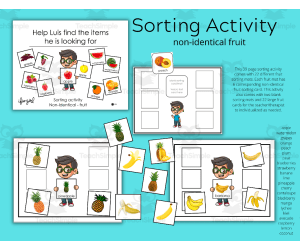
Sorting Non-Identical Fruit
Special Resources, Special Education Needs (SEN), Speech Therapy, Math, Early Math, Kindergarten, Preschool, Grade 1, 2, 3, 4, Activities
In the "Sorting Non-Identical Fruit" activity , students will have the opportunity to improve their visual discrimination and categorization skills. The activity consists of a set of fruit activity cards, each depicting a different type of fruit, and six corresponding sorting cards for each fruit. Each sorting card will feature a picture of the same type of fruit, but with subtle differences in color, size, and shape. Students will need to carefully examine the sorting cards and use their critical thinking skills to sort them into the correct group based on the corresponding fruit activity card. This activity is not only fun and engaging, but also provides an early math foundation by introducing sorting and grouping concepts. By engaging in hands-on sorting and grouping of non-identical fruits, students can develop important cognitive skills such as attention to detail, observation, and reasoning. The "Sorting Non-Identical Fruit" activity is a great way to encourage students to work together and practice their communication and problem-solving skills while having fun. This activity can be easily adapted for different ages and levels of ability, making it a versatile and useful tool for any classroom or learning environment. The pages are clear of visual distractions which helps the learner focus on the task. This activity is easy to create - Print and laminate all cards, cut out the individual sorting cards and velcro to the corresponding activity mat. If you have a coil binding machine you can coil bind and create a bound activity book. You could also three hole punch the mats and put them in a binder or use binder rings for many years of teaching and learning. Enjoy, IFIO girl I'll Figure It Out
Author IFIO girl - I'll Figure It Out
Tags Sorting, Visual Discrimination, Early Learner, ABLLS-R B8, Speech Therapy, Occupational Therapy, ABLLS-r, Easy To Creat, Sorting Fruit, Autism

Wildlife Conservation Activity
Science, Life Sciences, Nature & Plants, Earth and Environmental Sciences, Environmental Science, Animals, Grade 3, 4, 5, 6, 7, 8, 9, 10, Activities
Activity Introduction An amazing activity designed for the students to learn more about STEM. Wildlife Conservation Do you like STEM subjects? what is your favorite one? Have you ever tried to plant a seed? If yes, tell us more about it. Or have you ever tried to invent something? If yes, tell us more about it. And how do you think it will help us? Have you ever seen a microorganism under a microscope? What was it? And how it looked like? Mathematics is a marvelous subject. Let' sharpen our brains and solve some equations. Do you like timetable tricks? What is your favorite one? Do you know how to code? Have you ever created an app or a game before? If yes, how was it like? Wildlife Conservation Activity The activity is perfect for encouraging the researching skills for the students, while learning more about this fantastic topic. Wildlife Conservation This friendly designed worksheet is suitable for students at school, homeschooling, and as a group activity. Instructions You're tasked as a journalist working at World News to write an article about raising awareness for wildlife conservation. Fill out the sections below, and don't forget to add pictures, and mention local organizations that stand for this matter. Format Available in a PDF format.
Author Educational Voice
Tags Wildlife Conservation Activity, Wildlife Conservation, Wildlife Conservation Facts, Wildlife Conservation Facts For Kids, Wildlife Conservations, Environment, Environment Facts, Environment Facts For Kids

POSSESSIVE ADJECTIVES - Fill-in-the-Blanks Activities - Digital and Print & Go!
ELA, Grammar, Grade 2, 3, 4, Activities
Possessive Adjectives Fill-in-the-Blanks Activities - Print and Digital Looking for a fun way to teach possessive adjectives? This resource features fill-in-the-blank sentences and activities to help students master possessive adjectives like my, your, his, her, its, our, and their. It includes both print and digital versions so it can be used for in-class or at-home practice. The printable worksheets and mixed quiz provide beginning and advanced sentence practice. The digital activities allow for independent or whole-group games and practice. Use this versatile resource for individual, small group, or homework assignments. It is designed for grades 2-4, especially ESL students who struggle with possessive adjectives. For questions or suggestions, contact the author at toms.talk.resources@gmail.com. Have fun with this learning resource for possessive adjectives!
Author Tom's Talk
Tags Pronoun, Personal Pronouns, Possessive Adjectives, Digital, Fill-in-the-Blanks, Answer Key, Printable, Print, Pronouns, Worksheets, Possessive Pronouns Arabic
The Ant and the Dove: A Micro-Learning Deck | Reading Activities
ELA, Reading, Preschool, Grade 1, 2, 3, Activities
The Ant and the Dove: A Micro-Learning Deck | Reading Activities resource is a 15-slide download that exposes your students to informational texts for The Story of Nian. This digital mini-lesson includes: -Video & Audio -Vocabulary -Close Reading -Digital & Interactive -Main Idea Students will enjoy interacting with this lesson and each of the activities!
Author Teach Me This
Tags Book Companion, Reading Activities, Language, Video Lesson, Quick Write, The Ant And Dove
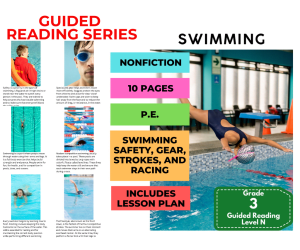
Guided Reading Level N - Swimming (with Lesson Plan)
ELA, Resources for Teachers, Reading Comprehension, Reading, Health, P.E. & Health, Pre-Reading, Language Development, Sports, Physical Education, Grade 2, 3, 4, Worksheets & Printables, Worksheets, Teacher Tools, Centers, Activities, Literacy Readers, Quizzes, Quizzes and Tests, Assessments
This Guided Reading Book - Swimming (Level N) with lesson plan includes: Guided Reading Color Label (front cover x1) This is a quick way to match the book’s demands to what students can generally handle.. The overall goal is to use the level/color to pick books for several smaller groups. To qualify for a certain level, a student is expected to read a book from that level with about 90–94% accuracy. If a student is consistently accurate and understands, move up a level. If the student is struggling at that level, drop down and add more support. Each student will improve at completely different rates, but it is generally one of the best ways to check progress across the class. DOWNLOAD THE CATALOG TO VIEW ALL GUIDED READING BOOKS AVAILABLE (SORTED LEVELS A-Z) Pre-Reading Question (x1) Teacher asks the prompt aloud, can be while showing the cover or first page. Students share what they already know, or make educated guesses from the cover. Prompt them to use the target vocabulary. Write some of their responses on the board to look back at during the reading. Vocabulary Words (x5) Introduce the five words, best doing it one at a time. Start by saying it, while students repeat and then see if anyone knows what it means before reading further. Read through the meaning and try to briefly connect each word to a picture or gesture so it’s meaningful. Ask students to flip through the book pages and point to where they see each of the vocabulary words. While reading the book pause upon coming across one of the vocab words or read the sentence twice to make sure students understand the word has appeared. Optional: Ask students to raise hands whenever they see/hear one of the new words. Guided Reading Pages (x10) Check the book snapshot (below) for: primary topic - do you need to prep extra reading or intro materials on this? what is taught best - decide on 1-2 bullets to focus on, use the prompt or words provided here for best results. learning goals - what you are checking for students to be able to do after the session, elicit answers using prompts or words provided. key vocabulary (see section above). questions overview - so you know what is coming up and if you need to prep extra materials to assist understanding. Run the lesson You may have already looked at a few of the pages together, but you can show them some of the pictures again first to set meaning. Depending on how much time you have and how familiar your students are with guided reading class, you may want to read the book aloud first with the group first. Students whisper or partner read, while you listen in. If time, do it as a group, one student reading a page each. Use the guided page’s prompts to coach: “Check the picture / does it make sense?” “Point under the words / try the first sound” “Reread the sentence smoothly”. Try to focus more on one student per session (rotating every time), so you can work out if they are ready to move up or need to move down a level. Comprehension Questions (back cover x3) This is your way to check that students didn’t just say the words, but actually understood the text. First, let students answer by pointing to the page/picture and saying a short sentence. After any answer, follow with: “Show me where you found that in the text.” In bigger groups, have partners answer first (10–20 seconds), then call on 2–3 students to share. Differentiation tips: Emerging speakers/struggling readers: oral + pointing On-level: oral in a full sentence Higher: one written sentence or draw + label Book Snapshot Title: Swimming Genre: Nonfiction (informational) Subject: Physical Education / Health Primary Topic: Swimming safety, gear, strokes, and racing Estimated Guided Reading Level (A–Z): N What This Book Teaches Best How swimming uses arms and legs as a full-body exercise that builds strength and endurance. How competitive swimming pools are organized with lanes and lane lines to help swimmers stay in their own path. Why safety matters in swimming and what lifeguards do to keep swimmers safe. How gear (goggles and swim caps) helps swimmers see clearly and reduce drag/resistance in the water. Key features of the four competitive strokes (freestyle, backstroke, breaststroke, butterfly) and how races begin. Learning Goals Students will describe where people can swim and why people swim (fun, health, competition). Students will explain how lane lines help swimmers during a race. Students will describe how lifeguards help keep swimmers safe and support swimmers who have trouble. Students will explain how goggles and swim caps help swimmers in the water. Students will describe what “floating” is and why it is an essential beginner skill. Students will compare the four competitive strokes by identifying a key movement for each. Key Vocabulary From the Text endurance — being able to keep going for a long time. competitive — about contests where people try to win. priority — something that is most important. efficiently — using less time or effort to do something. horizontal — flat and level, not standing upright. Discussion Prompts Pre-reading question: What do you think swimmers must do to stay safe in the water? Comprehension questions: How do lane lines help swimmers during a race in a pool? Comprehension questions: What two jobs does the text say lifeguards do at the pool? Comprehension questions: Why is floating an essential skill for swimmers, according to the text? Printing Tips 1. Best Printing Method (Recommended) “Booklet” Printing (Best if Available) If your printer or PDF viewer supports Booklet Printing , use this. Settings to use: Print mode: Booklet Paper size: Letter or A4 (either works) Orientation: Landscape Print on both sides: Yes Flip on: Short edge Scaling: Fit to printable area Booklet subset: First test: Front sides only Then: Back sides only This will automatically: Pair pages correctly Put the cover on the outside Align everything for folding After printing, fold in half and staple along the spine . 2. If “Booklet” Printing Is NOT Available You can still print this correctly with manual duplex printing . Step-by-step: Open the PDF. Choose Print . Set: Orientation: Landscape Pages per sheet: 1 Print on both sides: Yes Flip on: Short edge Print all pages . Because each PDF page already contains two facing book pages, the result will still fold cleanly into a book. Thousands of Cored Education products are included with your TeachSimple membership. Download links and encyclopedia index available here.
Author Cored Education
Rating
Tags Reading Comprehension, Reading Passages, Reading, Guided Reading, Guided Reading Lesson Plan, Guided Reading Activity, Pre-reading, Health Lesson Plans, Sports, P.e.

This or That Game: Music Edition
Creative Arts, Art, Music, Preschool, Grade 1, 2, 3, 4, 5, Activities, Games
This resource is a this or that game with a music theme. On each slide, students will be presented with 2 musical options. Students will decide which they prefer most.
Author Joyful Noise Teaching
Tags Music Game, Class Game, This Or That, Music, Instruments, This Or That Music Edition, Music This Or That

Owls Reading Comprehension Passage - Cored Ed Encyclopedia
ELA, Language Development, Resources for Teachers, Reading Comprehension, Reading, Pre-Reading, Writing, Science, Animals, Life Sciences, Grade 2, 3, 4, 5, Worksheets & Printables, Worksheets, Teacher Tools, Centers, Activities, Writing Prompts, Assessments, Tests, Quizzes and Tests, Quizzes
This owls reading comprehension contains the following: Visualize on the Cover (Teacher Read Aloud Script) Start your lesson by taking a few moments to visualize the topic and share thoughts or feelings about it. COMPANION VIDEO NOW AVAILABLE (EMBEDDED AFTER PREVIEW PICTURES IN PRODUCT DESCRIPTION) Pre-Reading Trivia Students will write down one thing they already know about the subject and then read five more facts and discuss. These facts are fun, and the students will enjoy learning about the subject before reading more. Reading Passage The text is a high-interest reading passage with set paragraphs, roughly three to four paragraphs long. It contains a variety of themes about the topic, anywhere from history to technology. The passage is between 250 and 350 words in length. Mixed Questions The first question page contains four multiple-choice questions, each with a choice of four answers, and three written response questions that require a sentence or two from the student. Vocabulary Questions Practice seven key words from the text in this section across two activities. First section is scrambled words where students will unscramble three words given a clue for each. The second section is a word to meaning matching activity. Creative Writing In this question, the student will be required to write a five to eight sentence paragraph on a question related to the topic. Extension Activities This page is optional for fast finishers or to take home. There are several activities, each one requiring a different skill. Do some, do none, do all, completely optional - but you will feel reassured knowing every possibility is planned for. Includes summary writting question. Answer Key There are answers for the multiple-choice questions, written response questions have sample answers, vocabulary answers and if there is a summary question then a sample summary will be provided as well. FULL CATALOG OF DOWNLOAD LINKS AND ENCYCLOPEDIA INDEX HERE Lesson Snapshot Title: Owls Genre: Nonfiction (informational text) Subject: Life Science (animals) / Reading Informational Text Primary Topic: How owls hunt, live, and help ecosystems Estimated Guided Reading Level (A–Z): S What This Lesson Teaches Best How owls are birds of prey in a group called Strigiformes , with more than 200 kinds , and most hunt alone and mostly at night. How an owl’s facial disc works “like a satellite dish” to gather tiny sounds and guide them toward its ears. How owl bodies help hunting: wing feathers let air pass quietly, and owls turn their heads (nearly 270 degrees ) because their eyes stay fixed. How scientists sort owls into two main families— Tytonidae and Strigidae —and how owls live in many habitats worldwide (with a few exceptions). How pellets and nest boxes connect owls to people today (learning what was eaten, helping keep mouse numbers down, and supporting safe nesting). Learning Goals Students will describe what the text says about how many kinds of owls there are and when most owls hunt. Students will explain how a facial disc helps an owl find prey using details from the passage. Students will describe two body features that help owls hunt quietly and accurately. Students will identify the two main owl families named in the text and one detail about each. Students will explain what an owl pellet is and how it helps students and scientists learn. Students will name habitats where owls can live and describe one way people can help owls near fields and barns. Key Vocabulary From the Text Strigiformes — a group name for owls. facial — related to the face. parliament — a name for a group of owls. Tytonidae — the barn owl family. pellets — dry bundles of fur and bones owls cough up. Cored Ed Encyclopedia Overview The Cored Ed Encyclopedia is a weekly series of lessons that you can pick up and use right away. These short readings fit into whatever time you have available. Each one includes a warm-up, a reading, and a set of questions, but it’s flexible — you can do just the reading, the full lesson, or skip the writing section if you need to. Each lesson focuses on a single topic so students don’t get lost. The writing is clear but never childish, making it perfect for grades two through five. Topics range from animals and science to history, inventions, and everyday things. No matter the level of the student, everyone should take away at least one new idea or fact from each lesson. The materials are easy to print, easy to explain, and require no setup. They work well for whole-class teaching, partner work, or independent study.
Author Cored Education
Rating
Tags Vocabulary, Spelling, Reading Comprehension, Reading Passages, Reading, Creative Writing, Reading Strategies, Writing Prompts, Owls, Life Science
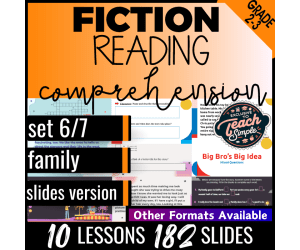
Reading Comprehension Passages Fiction Set 6 - Family (Google Slides)
ELA, Reading, Language Development, Spelling, Common Core, Vocabulary, Reading Comprehension, Children’s Literature, Literature, Writing, Grade 2, 3, Teacher Tools, Presentations, Assessments, Tests, Quizzes and Tests, Activities
Reading Comprehension Passages Fiction Set 6 Overview Fascinating reading comprehension passages, each with an array of activities included. Stories are written for the modern classroom and topics are designed to promote enthusiasm from each student. Each lesson contains a mixed questions section to check understanding, a vocabulary or spelling activity to help remember key language introduced, and a writing exercise. Full answer keys are provided. For a more detailed overview, check the section under the links at the bottom of this description. Passages Include 1.Molly's Home Carnival: It looks like Molly will miss the carnival. Until... 2.Big Bro's Big Idea: Noah's big brother does his best to cheer him up. 3.Denny's Car Wash: Denny wants a new game, but does he get the money for it? 4.Tessa's Grandma: Emma misses her grandma, but Tessa has a great idea. 5.Tom's Canadian Mom: The most important person from Canada is...Tom's mom! 6.Big Brother Woes: Big Brother gets to do whatever he wants. It's just not fair! 7.Tell Us a Story, Grandpa: Grandpa's tales are true family treasures. 8.My Weekend: Read about the author's fun weekend in this interesting story. 9.All in the Picture: Learn how the author has changed in the last 22 years. 10.California 'Coaster: Find out how this author spends his summer vacation. Additional File: Big Bro's Big Idea: Cork Boat Instructions Google Slides Version This is the Google Slides editable and fillable version. This download is available in GOOGLE Docs, GOOGLE Forms, GOOGLE Slides. PDF, PPT, WORD. FULL CATALOG OF DOWNLOAD LINKS HERE Grade 2/3 Links Fiction Set 1 - Nature Google Docs Google Forms Google Slides PDF PPT Word Guided Reading Materials Fiction Set 2 - Animals Google Docs Google Forms Google Slides PDF PPT Word Guided Reading Materials Fiction Set 3 - Food Google Docs Google Forms Google Slides PDF PPT Word Guided Reading Materials Fiction Set 4 - School Google Docs Google Forms Google Slides PDF PPT Word Guided Reading Materials Fiction Set 5 - Friends Google Docs Google Forms Google Slides PDF PPT Word Guided Reading Materials Fiction Set 6 - Family Google Docs Google Forms Google Slides PDF PPT Word Guided Reading Materials Fiction Set 7 - Sports Google Docs Google Forms Google Slides PDF PPT Word Guided Reading Materials Nonfiction Set 1 - Technology Google Docs Google Forms Google Slides PDF PPT Word Guided Reading Materials Nonfiction Set 2 - Nutrition Google Docs Google Forms Google Slides PDF PPT Word Guided Reading Materials Nonfiction Set 3 - Animals Google Docs Google Forms Google Slides PDF PPT Word Guided Reading Materials Reading Passages Overview Each passage is especially written for Grade 2-3 students, including key vocabulary required for this age group. Topics are varied and are accompanied by colorful graphics. Topics are meant to educate, yet entertain the modern student. These passages are perfect for the modern classroom. Whereas textbooks can become outdated in no time, any changes to technology or the world will result in updates to this product. Mixed Questions The mixed questions section of each lesson includes a variation of fivecomprehension, vocabulary and math questions. In addition, key reading strategies are frequently covered including cause & effect, summarizing, compare & contrast and making conclusions. Three of the questions will be MCQs and two will require a written response of some kind. Full answers and example responses appear at the end of the lesson. Spelling & Vocab Each reading passage contains a variety of words and phrases designed for Grade 2-3 students. Spelling and vocab activities provide the opportunity to build fluency with these words. As it can become quite mundane doing the same activities over and over, each lesson in a set will contain a different spelling and vocab activity . Writing Prompts Writing prompts are designed to continue the theme or lessons learned in the story. Students are persuaded to write in a variety of ways and each prompt includes several cues to help. As with the spelling/vocab section, writing prompts will vary. This includes research pieces, reading responses, poetry and creative writing prompts. Full Answer Keys Full answer keys and sample responses are provided so no matter how busy you are, you know you're covered! Mixed question answers provide evidence from the text, math questions contain the relevant workings. Answers are designed for use by the teacher, but also suitable as a handout to the student. Additional File One lesson will have an additional file. This is something fun to extend the lesson with. For similar downloads and other frees, do check out Cored Group on TeachSimple.
Author Cored Education
Tags Elementary, Reading, Comprehension, Vocabulary, Answers, Ccss, Common Core, Spelling, Writing, Passages

Measurements: Grams and Kilograms
Math, Measurements, Grade 2, 3, 4, 5, Activities
Measurements: Grams and Kilograms - An Interactive Instructional Tool Tailored for Grades 2 through 5, Measurements: Grams and Kilograms is more than just a lesson plan; it inspires students by facilitating their understanding of global weight measurement systems. Main Features of Measurements: Grams and Kilograms - An Interactive Instructional Tool: Directly crafted for homework assignments but can be incorporated creatively into various classroom activities. Fully editable to adapt to your teaching style or learners' abilities. Strengthens numerical processing skills, observational abilities, and encourages critical thinking. This resource also fits all Educational Spaces! Whether in large classrooms or smaller student-centered approach, this Measurements: Grams and Kilograms - An Interactive Instructional Tool offers extreme versatility. Also perfectly fits homeschoolers looking for engaging self-learning resources. Compatibility issues are non-existent as it comes in a handy PDF file type. In conclusion: Not merely about numbers, Measurement: Grams and Kilograms promotes a depth over breadth learning approach! An excellent resource for public school teachers aiming at innovative curriculum integration. At the same time, makes learning fun! This Measurements: Grams and Kilograms - An Interactive Instructional Tool is a ready to use resource. Just print and go! For similar and other resources, visit my store here!
Author Elementary Resources 4 U
Tags Measurements, Grams, Kilograms, Math, Interactive

Adding 14 Song (MP3)
Math, Addition and Subtraction, Addition, Numbers, Preschool, Kindergarten, Grade 1, 2, 3, Songs, Activities
This song is a great way for students to learn and practice adding 14. The addition facts 1-15 are all included, so kids will be able to learn and master this skill. This is a fun and interactive way for kids to learn, and it will help them be successful in math.
Author Have Fun Teaching
Tags Counting

Pictorial Math Multiplication Flashcards | SPACE x10
Special Resources, Special Education Needs (SEN), Math, Addition and Subtraction, Addition, Multiplication and Division, Division, Place Value, Grade 2, 3, 4, Worksheets & Printables, Flashcards, Activities
Pictorial Math Multiplication Flashcards with Space theme . The Pictorial Math Multiplication Flashcards offers a unique teaching resource to support the enhancement of multiplication skills of pupils. This 13-page PDF resource provides clarity and visual reinforcement through music enriched, space-themed flashcards. Designed for second to fourth graders, it elegantly covers various math centric subjects like addition, multiplication and place value . Triple-version flashcards: Concept and Organization . These meticulously designed three-in-one flashcards each host three versions of the same fact-factor combination on a single page. Interestingly, every fact-figure from 1-10 holds its unique color which helps in sorting and cueing during teaching sessions. On one version of a card, the factor is embedded within the fact number - giving an idea about how many times it should be multiplied to get that particular fact. The other version presents a similar concept but places this factor in rows at the bottom of each card whereas; in the final variant corresponding equation parts accompany each fact number along with beautiful artistic pictorials. Diverse Use Cases . In-class teaching activities (e.g., whole group instructions or small study groups) . As homework assignments or remedial study tools for kids needing additional help . Indoor classroom décor around walls/ bulletin boards – aiding better retention through constant visibility . Educational operation facilitators during center time activities/word problem discussions . Note: These cards can have multiple roles ranging from being simple wall mounting posters to becoming rich visual cue resources functioning equally well either as separate laminated book class resources or work mats. These intuitive teaching aids simplify math education for scholars of all elementary school grades. 13 - page PDF resource with three types of pictorial explanation for multiplication FACTS and FACTORS , for your bulletin boards , your classroom walls , your screens and your custom made task cards and books .
Author WORDS ASIDE
Tags Math Flashcards, Multiplication Skills, Visual Reinforcement, Space Theme, Teaching Resource
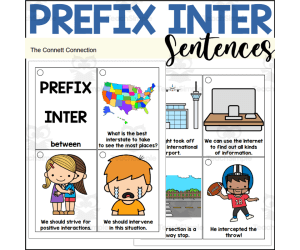
Prefix Inter Sentence Reading Rings
ELA, Language Development, Phonics, Grade 2, 3, 4, Activities, Centers, Worksheets & Printables, Task Cards
Practice reading words with the prefix INTER- with these sentence reading rings. Students will read words with the prefix inter- in the context of sentences. Each card also includes a bold and colorful image to illustrate each sentence and to help students to learn the meanings of each word. What is Included: This resource includes one reading ring activity for the prefix inter. There are cards each featuring a different word with the prefix inter, with a sentence using the word in context and an image to illustrate that sentence. When to Use Early Finishers - If students finish their work early, they can use these reading rings for extra practice. Small Group Work - Teachers can use these reading rings to target small groups of students who need more practice reading words with prefixes. Independent Practice - Students can work independently at their desks to read this set of prefix cards. Morning Work - Students can read and review this reading ring for morning work as their classmates arrive to class. How to Make: Teachers will print out the pages and cut each card apart. Once cut apart, the teacher can choose to laminate the cards for durability. Then, use a hole punch to punch a hole in the top left corner of the card. Place the cards on a ring to create your reading ring, making sure the cover card is on top. Skills Assessed: These reading rings help with identifying words with prefixes These reading rings help with learning the meaning of prefixes These reading rings help students learn how prefixes change the meaning of words. These affixes reading rings are a low prep activity for teachers to prepare for students to use. Once created, these cards can be used over and over to practice reading words with prefixes in the context of a sentence.
Author The Connett Connection
Tags Affixes, Morphology, Prefixes, Literacy Activities, Reading Words With Prefixes
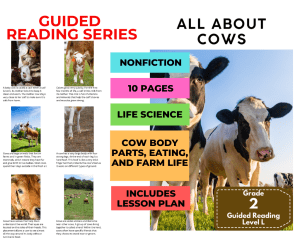
Guided Reading Level L - All About Cows (with Lesson Plan)
ELA, Resources for Teachers, Reading Comprehension, Reading, Science, Language Development, Life Sciences, Animals, Pre-Reading, Vocabulary, Grade 2, 3, 4, Worksheets & Printables, Worksheets, Teacher Tools, Centers, Activities, Literacy Readers, Quizzes, Quizzes and Tests, Assessments, Lesson Plans
This Guided Reading Book - All About Cows (Level L) with lesson plan includes: Guided Reading Color Label (front cover x1) This is a quick way to match the book’s demands to what students can generally handle.. The overall goal is to use the level/color to pick books for several smaller groups. To qualify for a certain level, a student is expected to read a book from that level with about 90–94% accuracy. If a student is consistently accurate and understands, move up a level. If the student is struggling at that level, drop down and add more support. Each student will improve at completely different rates, but it is generally one of the best ways to check progress across the class. DOWNLOAD THE CATALOG TO VIEW ALL GUIDED READING BOOKS AVAILABLE (SORTED LEVELS A-Z) Pre-Reading Question (x1) Teacher asks the prompt aloud, can be while showing the cover or first page. Students share what they already know, or make educated guesses from the cover. Prompt them to use the target vocabulary. Write some of their responses on the board to look back at during the reading. Vocabulary Words (x5) Introduce the five words, best doing it one at a time. Start by saying it, while students repeat and then see if anyone knows what it means before reading further. Read through the meaning and try to briefly connect each word to a picture or gesture so it’s meaningful. Ask students to flip through the book pages and point to where they see each of the vocabulary words. While reading the book pause upon coming across one of the vocab words or read the sentence twice to make sure students understand the word has appeared. Optional: Ask students to raise hands whenever they see/hear one of the new words. Guided Reading Pages (x10) Check the book snapshot (below) for: primary topic - do you need to prep extra reading or intro materials on this? what is taught best - decide on 1-2 bullets to focus on, use the prompt or words provided here for best results. learning goals - what you are checking for students to be able to do after the session, elicit answers using prompts or words provided. key vocabulary (see section above). questions overview - so you know what is coming up and if you need to prep extra materials to assist understanding. Run the lesson You may have already looked at a few of the pages together, but you can show them some of the pictures again first to set meaning. Depending on how much time you have and how familiar your students are with guided reading class, you may want to read the book aloud first with the group first. Students whisper or partner read, while you listen in. If time, do it as a group, one student reading a page each. Use the guided page’s prompts to coach: “Check the picture / does it make sense?” “Point under the words / try the first sound” “Reread the sentence smoothly”. Try to focus more on one student per session (rotating every time), so you can work out if they are ready to move up or need to move down a level. Comprehension Questions (back cover x3) This is your way to check that students didn’t just say the words, but actually understood the text. First, let students answer by pointing to the page/picture and saying a short sentence. After any answer, follow with: “Show me where you found that in the text.” In bigger groups, have partners answer first (10–20 seconds), then call on 2–3 students to share. Differentiation tips: Emerging speakers/struggling readers: oral + pointing On-level: oral in a full sentence Higher: one written sentence or draw + label Book Snapshot Title: All About Cows Genre: Nonfiction (informational) Subject: Life Science + Reading (Informational Text) Primary Topic: Cow body parts, eating, and farm life Estimated Guided Reading Level (A–Z): L What This Book Teaches Best Explains what cows are (large farm animals; mammals that have fur and give birth to live babies). Teaches how cow body parts help them (strong legs, hard hooves that protect feet; eyes placed on the sides for wide view). Describes what cows eat and how they eat plants (herbivores; tongue wraps around grass; plants like grass, hay, clover). Introduces a key digestion process (food goes to a large stomach; cows bring food back up to chew again—“chewing cud”). Builds understanding of cow family and social life (calf care; calves drink milk with vitamins and minerals; cows live in herds and have “friends”). Learning Goals Students will describe what the book says cows are and where they live. Students will explain how a cow’s hoof helps protect its feet while it walks. Students will identify what cows eat and describe how a cow uses its tongue to pull in grass. Students will explain what “chewing cud” means using the book’s description of digestion. Students will describe how calves are cared for and what the text says about calf milk. Students will describe how cows live together in a herd and how they rest. Key Vocabulary From the Text mammals — animals with fur that give birth to live babies. hoof — hard covering that protects a cow’s foot. herbivores — animals that eat only plants. digesting — breaking down food inside the body. herd — a group of cows living together. Discussion Prompts Pre-reading question: What do you already know about cows living on farms? Comprehension questions: How does the book describe a cow’s hoof and what it does? Comprehension questions: What happens to grass after a cow swallows it, and what is “chewing cud”? Comprehension questions: Why can a cow see almost all the way around its body without turning its head? Printing Tips 1. Best Printing Method (Recommended) “Booklet” Printing (Best if Available) If your printer or PDF viewer supports Booklet Printing , use this. Settings to use: Print mode: Booklet Paper size: Letter or A4 (either works) Orientation: Landscape Print on both sides: Yes Flip on: Short edge Scaling: Fit to printable area Booklet subset: First test: Front sides only Then: Back sides only This will automatically: Pair pages correctly Put the cover on the outside Align everything for folding After printing, fold in half and staple along the spine . 2. If “Booklet” Printing Is NOT Available You can still print this correctly with manual duplex printing . Step-by-step: Open the PDF. Choose Print . Set: Orientation: Landscape Pages per sheet: 1 Print on both sides: Yes Flip on: Short edge Print all pages . Because each PDF page already contains two facing book pages, the result will still fold cleanly into a book. Thousands of Cored Education products are included with your TeachSimple membership. Download links and encyclopedia index available here.
Author Cored Education
Rating
Tags Reading Comprehension, Reading Passages, Reading, Guided Reading, Guided Reading Lesson Plan, Guided Reading Activity, Pre-reading, Science Lesson Plans, Life Science, Animals
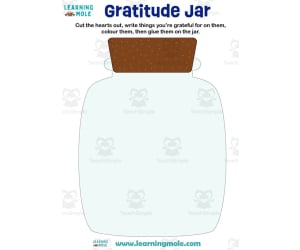
Gratitude Jar Activity
Special Resources, Social Emotional Learning (SEL), Life Skills, Grade 1, 2, 3, 4, 5, 6, 7, 8, 9, 10, 11, 12, Activities
Activity Introduction An amazing activity designed for the students to have fun learning about our daily activities or even to have fun learning more about our mental health. Gratitude Jar Our mental health is a crucial aspect nowadays for everyone. Do you know how to keep our mind and soul healthy? Have you ever practice gratitude? If yes, tell us what are you thankful for? Have you ever practiced meditation? If yes, can you share with us the steps you have done? Do you like group activities or crafts that you can enjoy with your friends and family? Which one makes you feel better? Yoga is really good for our mental health, have you tried it before? Gratitude Jar Activity The activity is perfect for encouraging us to have a better way of life and thinking for the students, while having fun with our cool activities and crafts that let students learn more about our mental health. Gratitude Jar This friendly designed worksheet is suitable for students at school, homeschooling, and as a group activity . Instructions Cut the hearts out, write things you're grateful for on them, colour them, then glue them on the jar. Format Available in a PDF format.
Author Educational Voice
Tags Gratitude Jar Activity, Gratitude Jar, Gratitude, Gratitude Facts, Gratitude Facts For Kids, Practicing Gratitude , Practicing Gratitude For Kids, Practicing Gratitude Activity

Weathering, Erosion, Deposition – Wheel Craft
Science, Earth and Environmental Sciences, Grade 1, 2, 3, 4, Activities
Weathering, Erosion, and Deposition Wheel Craft – A Hands-On Geology Activity! Engage your students in an interactive way to explore how Earth’s surface is broken down and reshaped through weathering, erosion, and deposition. This creative wheel craft reinforces key geology concepts, making learning both memorable and fun. This project is a great addition to your geology unit, encouraging deeper understanding through hands-on learning. Students will color, cut, and assemble the wheel using a large brad, matching pictures with the correct terms and definitions as they spin. This process helps solidify their understanding of these essential earth science concepts. Use the included teacher poster and vocabulary word strips to introduce the topic beforehand, giving students a strong foundation before they create their wheel. Whether used as a classroom review or assessment tool, this activity ensures students can confidently explain the differences between weathering, erosion, and deposition. It’s an engaging way to bring geology lessons to life! What’s Included: 3 vocabulary word strips with key terminology 1 teacher poster or anchor chart defining each process 2 craft pages for students to color, cut, and assemble
Author Simply Schoolgirl
Rating
Tags Erosion, Erosion Activity , Earth Science Craft, Earth Science Activities

Guided Reading Level M - All About Sand (with Lesson Plan)
ELA, Resources for Teachers, Reading Comprehension, Reading, Science, Earth and Environmental Sciences, Life Sciences, Technology, Geography, Social Studies, Grade 1, 2, 3, Worksheets & Printables, Worksheets, Teacher Tools, Centers, Activities, Literacy Readers, Quizzes, Quizzes and Tests, Assessments
This Guided Reading Book - All About Sand (Level M) with lesson plan includes: Guided Reading Color Label (front cover x1) This is a quick way to match the book’s demands to what students can generally handle.. The overall goal is to use the level/color to pick books for several smaller groups. To qualify for a certain level, a student is expected to read a book from that level with about 90–94% accuracy. If a student is consistently accurate and understands, move up a level. If the student is struggling at that level, drop down and add more support. Each student will improve at completely different rates, but it is generally one of the best ways to check progress across the class. DOWNLOAD THE CATALOG TO VIEW ALL GUIDED READING BOOKS AVAILABLE (SORTED LEVELS A-Z) Pre-Reading Question (x1) Teacher asks the prompt aloud, can be while showing the cover or first page. Students share what they already know, or make educated guesses from the cover. Prompt them to use the target vocabulary. Write some of their responses on the board to look back at during the reading. Vocabulary Words (x5) Introduce the five words, best doing it one at a time. Start by saying it, while students repeat and then see if anyone knows what it means before reading further. Read through the meaning and try to briefly connect each word to a picture or gesture so it’s meaningful. Ask students to flip through the book pages and point to where they see each of the vocabulary words. While reading the book pause upon coming across one of the vocab words or read the sentence twice to make sure students understand the word has appeared. Optional: Ask students to raise hands whenever they see/hear one of the new words. Guided Reading Pages (x10) Check the book snapshot (below) for: primary topic - do you need to prep extra reading or intro materials on this? what is taught best - decide on 1-2 bullets to focus on, use the prompt or words provided here for best results. learning goals - what you are checking for students to be able to do after the session, elicit answers using prompts or words provided. key vocabulary (see section above). questions overview - so you know what is coming up and if you need to prep extra materials to assist understanding. Run the lesson You may have already looked at a few of the pages together, but you can show them some of the pictures again first to set meaning. Depending on how much time you have and how familiar your students are with guided reading class, you may want to read the book aloud first with the group first. Students whisper or partner read, while you listen in. If time, do it as a group, one student reading a page each. Use the guided page’s prompts to coach: “Check the picture / does it make sense?” “Point under the words / try the first sound” “Reread the sentence smoothly”. Try to focus more on one student per session (rotating every time), so you can work out if they are ready to move up or need to move down a level. Comprehension Questions (back cover x3) This is your way to check that students didn’t just say the words, but actually understood the text. First, let students answer by pointing to the page/picture and saying a short sentence. After any answer, follow with: “Show me where you found that in the text.” In bigger groups, have partners answer first (10–20 seconds), then call on 2–3 students to share. Differentiation tips: Emerging speakers/struggling readers: oral + pointing On-level: oral in a full sentence Higher: one written sentence or draw + label Book Snapshot Title: All About Sand Genre: Nonfiction (informational text) Subject: Science (Earth science) Primary Topic: How sand forms and why it matters Estimated Guided Reading Level (A–Z): M What This Book Teaches Best How sand forms over millions of years through weathering (rain, wind, and ice breaking rocks into smaller pieces). How rivers move rock pieces and help make them “smooth and round,” and how ocean waves help build beaches. How sand can be different colors and how those colors can come from different materials (like volcanic lava, coral, and seashells). How sand can look different under a microscope and what sand’s colors can reveal about minerals inside it. Why sand is important to people and nature (uses in products and roles like protecting coastlines and providing habitat). Learning Goals Students will describe where sand is found and what it can cover in the world. Students will explain how weathering breaks rocks into smaller and smaller pieces over time. Students will describe how rivers carry rock fragments and how moving water changes the rocks’ edges. Students will explain what happens when a river reaches the ocean and how waves help create a beach. Students will identify different kinds/colors of sand described in the text and what they come from. Students will describe at least one way sand helps humans and one way it helps Earth’s surface. Key Vocabulary From the Text weathering — breaking rocks into smaller pieces over time. fragments — small broken pieces. volcanic — related to volcanoes and lava. microscope — tool that helps you see tiny things. habitat — place where a plant or animal lives. Discussion Prompts Pre-reading question: What are some natural forces that might change big rocks over a long time? Comprehension questions: What does the text say weathering does to rocks over millions of years? Comprehension questions: According to the text, what happens when a river reaches the ocean that helps create a beach? Comprehension questions: What are two things the text says humans use sand to make? Printing Tips 1. Best Printing Method (Recommended) “Booklet” Printing (Best if Available) If your printer or PDF viewer supports Booklet Printing , use this. Settings to use: Print mode: Booklet Paper size: Letter or A4 (either works) Orientation: Landscape Print on both sides: Yes Flip on: Short edge Scaling: Fit to printable area Booklet subset: First test: Front sides only Then: Back sides only This will automatically: Pair pages correctly Put the cover on the outside Align everything for folding After printing, fold in half and staple along the spine . 2. If “Booklet” Printing Is NOT Available You can still print this correctly with manual duplex printing . Step-by-step: Open the PDF. Choose Print . Set: Orientation: Landscape Pages per sheet: 1 Print on both sides: Yes Flip on: Short edge Print all pages . Because each PDF page already contains two facing book pages, the result will still fold cleanly into a book. Thousands of Cored Education products are included with your TeachSimple membership. Download links and encyclopedia index available here.
Author Cored Education
Rating
Tags Reading Comprehension, Reading Passages, Reading, Guided Reading, Guided Reading Lesson Plan, Guided Reading Activity, Pre-reading, Vocabulary, Science Lesson Plans, Earth Science

Arctic Animals Coloring Pages worksheet activity printables
Animals, Life Sciences, Science, Geography, Social Studies, Creative Arts, Art, Grade 2, 3, 4, 5, Activities, Outlines, Teacher Tools, Worksheets & Printables, Coloring Pages, Worksheets
Engage your students by teaching about Arctic animals while allowing them to use their imagination while developing their motor skills by creating no-prep coloring pages featuring polar wildlife. Students can learn about the different types of Arctic animals such as polar bear, penguin, seal, whale, and they can also practice color, detail, and hand-eye coordination. The no-prep format provides an easy-to-use, enjoyable activity that allows you to combine learning with enjoyment, thus making learning memorable and fun! The Arctic Animals Coloring Pages are great for all levels of students and can be utilized in science, geography, and art centers, in addition to being utilized as homework assignments and during the time students finish early. ❄️🐾 Why Do it : The purpose of the activity is to provide students with knowledge of Arctic animals and their habitats 🐻❄️., enhance fine motor skills ✏️., create an awareness of polar regions and ecosystems 🌍., create curiosity about wildlife ❄️. Coloring provides a hands-on, creative approach to making learning fun and engaging for students of all levels. How Do You Do It : To use the Arctic Animals Coloring Pages, follow these simple steps: 1️⃣ Print the Arctic Animals Coloring Pages. 2️⃣ Introduce some key facts about the Arctic and its animals. 3️⃣ Ask the students to color the animals focusing on their details and patterns. 4️⃣ Discuss some of the interesting facts about each animal or Arctic habitat. 5️⃣ Use optional extension activities like labeling animals or habitats. ✅ Audience : K-5 Grades 🌟, individual assignment, paired assignment, student who finish early, science and geography center or substitute lesson plan 🤝. Practical use within the classroom: This type of assignment can be used for individual student practice, in classroom centers, for students to complete at home, and as a creative way for students who finish their work early to enhance their creative thinking skills. 🤲 Variations that may be fun to incorporate into your classroom: Artwork & Science Extensions 🎨: Drawing your own arctic animal habitat. Timely Coloring Competition For Students ⏳: See how many arctic animals students can colour within a certain time frame. Fact Labelling ✏️: Create a simple fact that describes each creature. Inventing Your Own Habitat 🧩: Construct a complete Arctic habitat with living creatures. How This Assignment Meets NGSS, Science/Geography Standards, and Helps Develop Hand Eye Coordination, Concentration/Focus, and Creativity within a Number of Subject Areas. File Format/Printing Information: The PDF file will have both colour and black/white pages of this lesson, which can easily be printed in a classroom setting because of the ink-saving features provided. Teacher Strategies 🌟: While helping students learn about the arctic environment and associated animal species, I would suggest that teachers provide students with an opportunity to apply their creative skills while learning about ecosystems and animal habitats within a hands on manner, which makes it a very enjoyable learning experience for all students! ❄️🐾
Author Classsim
Rating
Tags Arctic , Animals, Coloring Pages , Worksheet, Activity, Printables , Arctic Animals, Arctic Animals Coloring Pages , Arctic Animals Coloring Pages Worksheet , Arctic Animals Coloring Pages Worksheet Activity Printables

NO PRINT Fantasy Dragons & Fairies Receptive Expressive Language Activities Pack
Special Resources, Speech Therapy, Preschool, Grade 1, 2, 3, 4, 5, Activities
NO PRINT Fantasy Dragons & Fairies Receptive Expressive Language Activities Pack The "NO PRINT Fantasy Dragons & Fairies Receptive Expressive Language Activities Pack" is a vibrant and engaging teaching resource aimed at educators of Kindergarten through Grade 5. This pack transforms any classroom - be it virtual or face-to-face, into a world of fantasy with mythical creatures like fairies, dragons and unicorns to stimulate imagination while promoting language learning. Main Features: Promotes language skills in syntax, semantics, morphology and more User-friendly interface permits easy navigation between pages No physical printing nor preparation required from educators BONUS GAME "Build a Fairy House" Inclusions: The package consists of diverse tasks spread over various pages such as: Analogies: 15 pages with pictured options; Pronouns: 30 pages covering subjective, objective and possessive aspects; Prepositions-related work: 15 pages, Description exercises: focusing on comparing and contrasting topics spanning 15 pages; Note:Please reach out if you have queries before making your purchase. Aim to provide your students a magical language learning experience with the "NO PRINT Fantasy Dragons & Fairies Receptive Expressive Language Activities Pack". Let the charm of fantasy engage them while they develop crucial language skills! .
Author Intrepid Speech Therapy Materials
Tags Fantasy, Dragons, Fairies, Receptive Language, Expressive Language
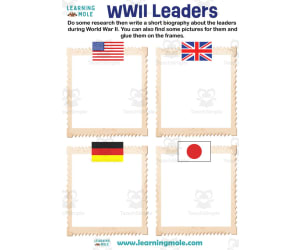
WWII Leaders Activity
Social Studies, History, History: Ancient, History: World, Grade 3, 4, 5, 6, 7, 8, 9, Activities
Activity Introduction An amazing activity designed for the students to learn more about history. WWII Leaders Do you like history? Which topic do you really enjoy about history? Have you ever read an interesting facts about the Vikings? If yes, can you mention them? What do you like most about the Victorian era? Can you name all the Tudors? Have you ever wondered how people used to live in ancient Japan and ancient China? Do you know any interesting facts about ancient Egyptians and the Pharaohs? Have you ever visited South America? What do you know about Incas and Aztecs? Celtic culture was really one of a kind, can you name any of the places that Celts used to live in? Imagine yourself living during the ancient Roman empire, how your life will look like? Ancient Greece was an amazing place to live in. What do you know about ancient Greek life? WWII Leaders Activity The activity is perfect for encouraging the researching skills for the students, while learning more about history. WWII Leaders This friendly designed worksheet is suitable for students at school, homeschooling, and as a group activity. Instructions Do some research then write a short biography about the leaders during World War II. You can also find some pictures for them and glue them on the frames. Format Available in a PDF format.
Author Educational Voice
Tags WWII Leaders Activity, WWII Leaders, WWII, WWII Facts, WWII Facts For Kids, World War Two, World War Two Facts, World War Two Facts For Kids, History, History Facts
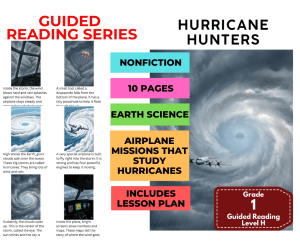
Guided Reading Level H - Hurricane Hunters (with Lesson Plan)
ELA, Resources for Teachers, Reading Comprehension, Reading, Science, Engineering, Technology, Earth and Environmental Sciences, Geography, Social Studies, Grade 1, 2, 3, Worksheets & Printables, Worksheets, Teacher Tools, Centers, Activities, Literacy Readers, Quizzes, Quizzes and Tests, Assessments, Lesson Plans
This Guided Reading Book - Hurricane Hunters (Level H) with lesson plan includes: Guided Reading Color Label (front cover x1) This is a quick way to match the book’s demands to what students can generally handle.. The overall goal is to use the level/color to pick books for several smaller groups. To qualify for a certain level, a student is expected to read a book from that level with about 90–94% accuracy. If a student is consistently accurate and understands, move up a level. If the student is struggling at that level, drop down and add more support. Each student will improve at completely different rates, but it is generally one of the best ways to check progress across the class. DOWNLOAD THE CATALOG TO VIEW ALL GUIDED READING BOOKS AVAILABLE (SORTED LEVELS A-Z) Pre-Reading Question (x1) Teacher asks the prompt aloud, can be while showing the cover or first page. Students share what they already know, or make educated guesses from the cover. Prompt them to use the target vocabulary. Write some of their responses on the board to look back at during the reading. Vocabulary Words (x5) Introduce the five words, best doing it one at a time. Start by saying it, while students repeat and then see if anyone knows what it means before reading further. Read through the meaning and try to briefly connect each word to a picture or gesture so it’s meaningful. Ask students to flip through the book pages and point to where they see each of the vocabulary words. While reading the book pause upon coming across one of the vocab words or read the sentence twice to make sure students understand the word has appeared. Optional: Ask students to raise hands whenever they see/hear one of the new words. Guided Reading Pages (x10) Check the book snapshot (below) for: primary topic - do you need to prep extra reading or intro materials on this? what is taught best - decide on 1-2 bullets to focus on, use the prompt or words provided here for best results. learning goals - what you are checking for students to be able to do after the session, elicit answers using prompts or words provided. key vocabulary (see section above). questions overview - so you know what is coming up and if you need to prep extra materials to assist understanding. Run the lesson You may have already looked at a few of the pages together, but you can show them some of the pictures again first to set meaning. Depending on how much time you have and how familiar your students are with guided reading class, you may want to read the book aloud first with the group first. Students whisper or partner read, while you listen in. If time, do it as a group, one student reading a page each. Use the guided page’s prompts to coach: “Check the picture / does it make sense?” “Point under the words / try the first sound” “Reread the sentence smoothly”. Try to focus more on one student per session (rotating every time), so you can work out if they are ready to move up or need to move down a level. Comprehension Questions (back cover x3) This is your way to check that students didn’t just say the words, but actually understood the text. First, let students answer by pointing to the page/picture and saying a short sentence. After any answer, follow with: “Show me where you found that in the text.” In bigger groups, have partners answer first (10–20 seconds), then call on 2–3 students to share. Differentiation tips: Emerging speakers/struggling readers: oral + pointing On-level: oral in a full sentence Higher: one written sentence or draw + label Book Snapshot Title: Hurricane Hunters Genre: Nonfiction (informational, sequence of events) Subject: Earth Science + Reading (Informational Text) Primary Topic: Airplane missions that study hurricanes Estimated Guided Reading Level (A–Z): H What This Book Teaches Best Defines hurricanes as big storms with lots of wind and rain. Describes how a special airplane flies into a hurricane to learn about the weather. Explains key parts of the storm, including the center called the “eye,” and what it is like. Introduces tools and information-gathering (a “dropsonde,” maps, numbers) used to understand wind and rain. Connects the airplane’s weather information to helping people stay safe on the ground. Learning Goals Students will describe what hurricanes are like using details from the text. Students will explain what the special airplane does to learn about a hurricane’s weather. Students will identify what happens when the plane reaches the center of the storm (the eye). Students will describe how a dropsonde and parachute are used during the flight. Students will explain how the information from the airplane helps people on the ground. Key Vocabulary From the Text hurricanes — very big storms with strong wind and rain. runway — long strip where a plane speeds to take off. dropsonde — small tool that falls from a plane. parachute — cloth that opens to slow something as it falls. eye — the center of the storm. Discussion Prompts Pre-reading question: What do you think a “hurricane hunter” airplane might do during a storm? Comprehension questions: What does the book say hurricanes bring with them? Comprehension questions: What is the eye of the storm like in the text? Comprehension questions: How does the airplane’s information help people on the ground? Printing Tips 1. Best Printing Method (Recommended) “Booklet” Printing (Best if Available) If your printer or PDF viewer supports Booklet Printing , use this. Settings to use: Print mode: Booklet Paper size: Letter or A4 (either works) Orientation: Landscape Print on both sides: Yes Flip on: Short edge Scaling: Fit to printable area Booklet subset: First test: Front sides only Then: Back sides only This will automatically: Pair pages correctly Put the cover on the outside Align everything for folding After printing, fold in half and staple along the spine . 2. If “Booklet” Printing Is NOT Available You can still print this correctly with manual duplex printing . Step-by-step: Open the PDF. Choose Print . Set: Orientation: Landscape Pages per sheet: 1 Print on both sides: Yes Flip on: Short edge Print all pages . Because each PDF page already contains two facing book pages, the result will still fold cleanly into a book. Thousands of Cored Education products are included with your TeachSimple membership. Download links and encyclopedia index available here.
Author Cored Education
Rating
Tags Reading Comprehension, Reading Passages, Reading, Guided Reading, Guided Reading Lesson Plan, Guided Reading Activity, Pre-reading, Science Lesson Plans, Technology, Geography

Sorting Musical Statements | Interactive Musical Games - US Version
Creative Arts, Art, Music, Preschool, Grade 1, 2, 3, Songs, Activities
Sorting Musical Statements | Interactive Musical Games Sorting Musical Statements | Interactive Musical Games is a comprehensive teaching resource designed specifically for young learners in Kindergarten through to Grade 3. This digital game makes learning music both interactive and enjoyable by encouraging players to evaluate musical statements based on their truth value, giving them an immersive understanding of music fundamentals. Modes of Instruction The nature of this activity caters to various modes of instruction: It can be used in a whole group setting where students can collaborate as a team. It serves as an engaging small group activity. An individual homework task that can reinforce lessons taught previously in class. Digital Game Mechanics The digital game operates with intriguing drag and drop mechanics where students must decide whether provided musical statements hold any truth value. To make the experience more enjoyable for young learners, the game features exciting sound effects and immediate feedback on player decisions. Compatibility This resource’s universal compatibility reinforces its inclusiveness ensuring no learner is left out. The tablet version requires housing within articulate mobile player—a free app—while the computer version requires unzipping before launch. Both versions run smoothly without issues whether you're using a projector or a smart board for shared viewing among larger groups. Moreover, detailed instructions are readily available within the PDF document itself taking one step-by-step from download through launch – easy enough even for those who might not consider themselves too tech-savvy! In conclusion, Whether you’re introducing music concepts or looking to reinforce previously taught topics, Sorting Musical Statements | Interactive Musical Games offers reliability when teaching these foundational skills – keeping your fingers tapping while knowledge keeps stacking!
Author Hbmusicsolutions's Shop
Tags Interactive Learning, Music Education, Musical Statements, Truth Value, Drag And Drop

Positive Relationships | SEL Daily Openers/Bellringers and Activity
Special Resources, Social Emotional Learning (SEL), Social Skills, Life Skills, Grade 3, 4, 5, 6, Activities
Positive Relationships | SEL Daily Openers/Bellringers and Activity This is an extraordinary teaching resource focused on the seamless integration of social emotional learning (SEL) into every day classroom routines. Geared towards students in grades 3 to 6, it closely aligns with CASEL for effective development of a positive classroom environment and student relationships. Main Topic: Relationship Skills 'I Can Develop Positive Relationships.' The material provides comprehensive coverage for the whole week, including Lessons, Explanations, and Mental Health Check-Ins. The Teacher Slides are available in both Google Slide Deck and PDF Formats, with five slides allocated for each day's activity . The Student Handbook Rigorously organized over six pages, it punctiliously partitions activities over five days. In conjunction with structured lessons, it aims at imbuing students with requisite relationship skills. Making Friends Social Story – The SEL Activity This is an interactive book/printable designed to guide students about establishing friendships effectively. A flexible resource provided in both full-page and half-page formats based on varied needs/preferences. Note: Diverse other objectives linked to relationship skills like teamwork practice, conflict resolution techniques etc., are offered separately by this resource. Favorable Settings: Whole group instruction Homework assignment Small group cooperative learning scenarios. > The intent behind this tool is not only facilitating academic knowledge but also augmenting empathy levels essential for fostering interpersonal dynamics. Interested Parties please reach out at mrsboniejustteach@gmail.com. We request you to leave a review after use for earning TPT credits (free $$$). Our primary aim remains – simplifying teaching and accelerating student learning!
Author Mrs Bonie Just Teach
Tags SEL, Positive Relationships, Social Emotional Learning, Relationship Skills, Classroom Environment

Summer Ice Cream Shop
Life Studies, Special Resources, Life Skills, Kindergarten, Preschool, Grade 1, 2, 3, Activities
This is a fun activity that children can role-play an ice cream shop.
Author Little Owls Resources
Tags Role-play, Activity, Shop