



3,931 products added recently
Page 8 - Other Experiments
Introduce your students to a range of unique experiments that cover unconventional topics and methods. This collection includes interdisciplinary projects, environmental studies, and innovative demonstrations. By integrating these experiments into your lessons, you can broaden students' horizons and spark curiosity.

 Show filters


Paper Towel Absorbency Test – Scientific Method Lesson
Science, Grade 6, 7, 8, 9, Experiments, Lesson Plans, Presentations, Activities
Paper Towel Absorbency Test - Scientific Method Lesson Included This engaging activity introduces students to the scientific method through an experiment involving a common household material - paper towels. Students will form a hypothesis about which paper towel will be the most absorbent. They will then collect data by placing different paper towel brands into a liquid to see the effect. Your students are provided with clear procedures that will guide them to record their results in a well-organized data table and graph. As a class, data can be compiled and percentages calculated to identify trends. Students learn important data analysis skills as they create graphs to visually represent the results. Educators will appreciate the post-experiment reflection questions that reinforce the purpose and process of the scientific method. This hands-on lab nurtures students' natural curiosity while teaching fundamental experimental design. With its real-world topic and tactile investigation, it motivates learners across various grades and learning styles. After completing the activity, students will better understand how to use observation, critical thinking, and representation of evidence to answer a testable question. Additionally, this resource includes my lesson on the Scientific Method. The lesson includes a detailed overview of what the scientific method is as well as how to implement it.
Author Teach With Fergy
Rating
Tags Scientific Method, Graphing, Test
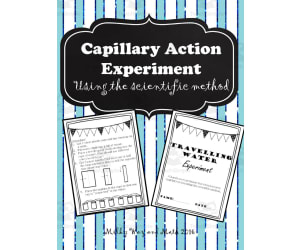
Capillary Action Experiment
, Grade 4, 5, 6, Activities, Experiments
This is an experiment for Capillary Action and the Water Cycle. This resource is packed with everything you need to make your students feel successful in this experiment. This experiment can be implemented with 4th grade students and higher. Any students who are learning about the scientific method will enjoy this experiment. The products included are: A Capillary Action Slideshow Presentation This is an editable 8-slide presentation that will teach students about the role of capillary action within the plant cycle. Each slide has 1-3 sentences, so as to not overwhelm students with an information overload. You will be able to tweak this and rearrange information as needed to fit your students’ needs. A printable Capillary Action Experiment (PDF) The materials you will need for this experiment include: - 7 clear plastic cups -3-4 different food dye colors -Water -6 paper towels This handout will walk you through the procedure as well as provide students with space to document: -Title of the Experiment -Hypothesis -Results -Conclusion A Visual Flow Map This flow map gives students a visual representation of how capillary action words. A word bank is included on this printable. A note-taking page This printable goes along with the slideshow presentation. It is a 2-page printable. It is a great way for students to keep up with the presentation and have saved notes. It is fully editable, so if you tweak the slideshow, you can also go in and tweak your notes page. It is a fill in the blank.
Author The Comprehensive Teacher
Tags Note Taking, Science Experiments, Capillary Action, Scientific Method, Water Cycle, Science Presentation, Editable Slideshow, Procedures

Observation or Inference Worksheet
, Grade 5, 6, 7, Activities, Experiments, Worksheets & Printables, Worksheets
This resource is an Observation or Inference Worksheet. Students will identify each statement as an observation or a reference. Students can add text boxes in PowerPoint to the blank sheet and type in their own definitions. Answer key included.
Author Maude in the Middle
Tags Making Infereences, Science Worksheet, Observation, Predictions, Inferences Worksheet 6, Observation Vs Inference Powerpoint, Inferences Worksheet 6 Answer Key, Observation Vs Inference Worksheet, Observations And Inferences Ppt
Qualitative and Quantitative Photo Observation Activity
, Grade 5, 6, 7, Activities, Experiments
This resource is a Qualitative and Quantitative Photo Observation Activity . There are 6 pictures. For each picture, students will make: - qualitative observation - quantitative observation - an inference
Author Maude in the Middle
Tags Inferences, Observations, General Science, Writing Practice, Quantitative & Qualitative Observations, Quantitave Observation, Which Is A Quantitative Observation?, What Is Qualitative And Quantitative Observation, Quantitative And Qualitative Observation, Qualitative Observations., Which Observation Is Quantitative?, Qualatative Observation, Quantitative Observation Vs Qualitative Observation, Quantitative Observation., A Quantitative Observation, Qualitative Vs Quantitative Observation, Quanitative Observation, Are Observations Qualitative Or Quantitative, Quantitative And Qualitative Observations, What Is A Quantitative Observation In Science, Quantitative Vs Qualitative Observations, What Is A Quantitive Observation, Quantitative Observation?, Qualitative Observation And Quantitative Observation, What Is An Quantitative Observation, Qualitative And Quantitative Observations, What Is Quantitative Observation In Science, Qualitive Observation

Conducting Electricity Sorting Activity
Science, Inventors, Technology, Engineering, Grade 5, 6, 7, Activities, Experiments, Worksheets & Printables, Flashcards, Teacher Tools, Assessments
Conducting Electricity Sorting Activity Unravel the magic of electricity with the Conducting Electricity Sorting Activity . True to its name, it's an interactive educational tool designed to enhance students' understanding and intrigue in electrical conductance. Ideal for 5th to 7th grade science lessons, especially those centered around technology and engineering, this activity seamlessly fits into diverse curriculums. The main aim of this enlightening resource is helping students answer important questions such as: 'What is a conductor? 'What is an insulator? To achieve this, learners will explore 19 illustrated flashcards. Each represents different materials acting as prompts that encourage essential critical thinking. Students must then decide whether each item is a conductor or insulator of electricity. Benefits Galore! The massive benefits stemming from using the Conducting Electricity Sorting Activity include triggering scientific inquiry processes and promoting problem-solving skills — all while fostering teamwork wherever possible. Fitting perfectly for group works in class or individual activities at home, these sorting exercises offer flexible implementation options suited for various teaching styles — from group discussions to self-paced independent research projects. Even formative assessments are easy! A Colorful Learning Arena Cast in PDF Maintaining student interest has never been easier! The visually appealing combination of bright colors with clear instructions not only aids comprehension but also sustains attention levels. This package includes: Definition posters about conductors and insulators, Vibrant flashcards illustrating various materials, Dedicated sorting mats for item segregation according to electrical properties, A convenient answer key for quick self-assessments. Coming in a downloadable PDF format, this ready-to-roll Conducting Electricity Sorting Activity indeed gives you just what you need — Fun-enriched knowledge to stoke scientific curiosity! It's time not just to have your classrooms powered by electricity but also understand how it conducts!
Author Soumara Siddiqui
Tags Electricity, Conductors, Insulators, Sorting Activity
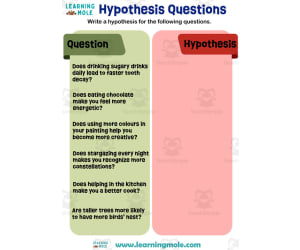
Hypothesis Questions Activity
, Grade 3, 4, 5, 6, 7, 8, 9, 10, Activities, Experiments
Activity Introduction An amazing activity designed for the students to learn more about STEM subjects. Hypothesis Questions Do you like STEM subjects? what is your favorite one? Have you ever tried to plant a seed? If yes, tell us more about it. Or have you ever tried to invent something? If yes, tell us more about it. And how do you think it will help us? Have you ever seen a microorganism under a microscope? What was it? And how it looked like? Mathematics is a marvelous subject. Let' sharpen our brains and solve some equations. Do you like timetable tricks? What is your favorite one? Do you know how to code? Have you ever created an app or a game before? If yes, how was it like? Hypothesis Questions Activity The activity is perfect for encouraging the researching skills for the students, while learning more about this topic. Hypothesis Questions This friendly designed worksheet is suitable for students at school, homeschooling, and as a group activity. Instructions Write a hypothesis for the following questions Does drinking sugary drinks daily lead to faster tooth decay? Does eating chocolate make you feel more energetic? Does using more colours in your painting help you become more creative? Does stargazing every night makes you recognize more constellations? Does helping in the kitchen make you a better cook? Are taller trees more likely to have more birds' nest? Format Available in a PDF format.
Author Educational Voice
Tags Hypothesis Questions Activity, Hypothesis Questions, Hypothesis Questions Facts, Hypothesis Questions Facts For Kids, STEM, STEM Facts, STEM Facts For Kids, Science Activity

Gummy Bear Investigation Lab
, Not Grade Specific, Activities, Experiments
In this lab, students will go through the steps of the scientific method in order to predict what will happen to a gummy bear if it is left for 24 hours in a liquid. Set up several liquids for students to test and ask students to experiment with and ask students to make a prediction of what will happen to the gummy bear if left in the liquid for 24 hours. Students will measure the length of their gummy bear before the experiment and after 24 hours submerged in a liquid. Students will then complete a table that compares their gummy bear's measurement before and after the experiment and answer conclusion questions.
Author Rodriguez's Resources
Tags Gummy Bear, Investigation, Lab, Scientific Method, Predictions, Gummy And The Scientist, Gummy Bear Scientific Method, Gummy Bear Experiment Worksheet, Gummy Bear Lab Scientific Method, Gummy Bear Lab Experiment, Gummy Bear Dissection, Gummy Bear Science Experiment Worksheet

Scientific Inquiry Process | Experiment Writing Pages
, Not Grade Specific, Activities, Experiments, Worksheets & Printables, Worksheets
This resource is a Scientific Inquiry Process Experiment Writing Pages. All you have to do is print and go any time students are gearing up for a science experiment. These pages will help guide students through the process of deciding what materials are needed, making hypotheses and so much more.
Author Rathgeber Resources
Tags Scientific, Experiments, Data Collection, Observations, Hypothesis

Candle Experiment
, Grade 1, 2, Activities, Experiments
Teaching science to our elementary students opens them up to a whole new world of interests, but with a whole new take! They get to learn about the weather and its changes. They get to learn about animals and their offspring. They get to learn about natural wonders, such as volcanoes! There are so many engaging things for students to learn during science. What You Get: This is aCandle Experimentthat is ideal for elementary students! The objective is to see what happens to the material wax when it burns. How To Implement This Resource: The first page will provide you with details about the equipment needed and the method to follow. The bottom of that page will provide a space for students to draw a diagram labeling the candle melting. If you are conducting this experiment with young learners, you can be the one to conduct the experiment since they may not be able to do it safely. If you have adult room helpers, you would be able to form small groups for students to observe the experiment on a closer level. The second page will be a fill in the blank for students to complete about the results of the experiment. I hope you enjoy! Here are links to similar resources in my store: Verbs and Adverbs Chart Addition Using a Number Line Dictionary Work Booklet Percentages of a Number Graphic Organizer Baby Animals Worksheet Counting Sounds Worksheet Check Out More Resources from My Store: Elementary Resources 4 U
Author Elementary Resources 4 U
Tags Science Experiment, Science Fill In The Blank, Candle Experiment, Small Group Science, Whole Group, Reflection Questions

Make Your Own Parachute Activity
, Grade 2, 3, 4, 5, Activities, Experiments
Teaching science to our elementary students opens them up to a whole new world of interests, but with a whole new take! They get to learn about the weather and its changes. They get to learn about animals and their offspring. They get to learn about natural wonders, such as volcanoes! There are so many engaging things for students to learn during science. What You Get: This is a Make Your Own Parachute Activity that is ideal for elementary students! The objective is to design a parachute that can carry an egg to the ground without it cracking. How To Implement This Resource: This is a great experiment that your students will love and learn a lot from. You can decide if you want this to be an in-class experiment or an experiment done at home. If students complete this activity at home, encourage them to document pictures of their experiment . If they are unable to document with pictures, encourage students to make notes about what all their experiment entails. If students complete this activity in the classroom, you will gather all the materials you know you’ll need for this experiment . The main material will be lots of eggs! From there, you will gather materials that you believe students will need to make a great parachute for their eggs. The amount of support you provide students will depend on their age and understanding of the task. I hope you enjoy! Here are links to similar resources in my store: Candle Experiment Missing Verbs Worksheet Writing to Recount Template Electrical Words and Symbols Worksheet Place Value Loop Cards Factors Worksheet for Beginners Check Out More Resources from My Store: Elementary Resources 4 U
Author Elementary Resources 4 U
Tags Science Experiment, Science Activity, At Home Science, In-Class Experiments, Parachute Activity, Whole Group Science, Parachute Activities Elementary, Parachute Lesson Plans Elementary
Quick + Easy Science Experiments
, Preschool, Grade 1, 2, Activities, Experiments, Worksheets & Printables, Worksheets
This is a packet of Quick + Easy Science Experiments . There are 4 experiments included for your little learners. Print these pages, gather your supplies needed and you're all set. Students will love making predictions and reporting their data.
Author Katie Maurice
Tags Science Experiments, Science Worksheet, Small Group, STEM Activity, Magnets, Making Predictions, Cross Curricular