



3,935 products added recently
Page 27 - Science Assessments
Provide comprehensive science assessments covering biology, chemistry, physics, and Earth science. This collection includes lab reports, concept checks, and experimental evaluations. Foster a deeper understanding of scientific principles by using targeted assessments.

 Show filters


Guided Reading Level Q - The Living Rainforest (with Lesson Plan)
ELA, Resources for Teachers, Reading Comprehension, Reading, Animals, Life Sciences, Science, Nature & Plants, Earth and Environmental Sciences, Physics, Grade 3, 4, 5, Worksheets & Printables, Worksheets, Teacher Tools, Centers, Activities, Literacy Readers, Quizzes, Quizzes and Tests, Assessments
This Guided Reading Book - The Living Rainforest (Level Q) with lesson plan includes: Guided Reading Color Label (front cover x1) This is a quick way to match the book’s demands to what students can generally handle.. The overall goal is to use the level/color to pick books for several smaller groups. To qualify for a certain level, a student is expected to read a book from that level with about 90–94% accuracy. If a student is consistently accurate and understands, move up a level. If the student is struggling at that level, drop down and add more support. Each student will improve at completely different rates, but it is generally one of the best ways to check progress across the class. DOWNLOAD THE CATALOG TO VIEW ALL GUIDED READING BOOKS AVAILABLE (SORTED LEVELS A-Z) Pre-Reading Question (x1) Teacher asks the prompt aloud, can be while showing the cover or first page. Students share what they already know, or make educated guesses from the cover. Prompt them to use the target vocabulary. Write some of their responses on the board to look back at during the reading. Vocabulary Words (x5) Introduce the five words, best doing it one at a time. Start by saying it, while students repeat and then see if anyone knows what it means before reading further. Read through the meaning and try to briefly connect each word to a picture or gesture so it’s meaningful. Ask students to flip through the book pages and point to where they see each of the vocabulary words. While reading the book pause upon coming across one of the vocab words or read the sentence twice to make sure students understand the word has appeared. Optional: Ask students to raise hands whenever they see/hear one of the new words. Guided Reading Pages (x10) Check the book snapshot (below) for: primary topic - do you need to prep extra reading or intro materials on this? what is taught best - decide on 1-2 bullets to focus on, use the prompt or words provided here for best results. learning goals - what you are checking for students to be able to do after the session, elicit answers using prompts or words provided. key vocabulary (see section above). questions overview - so you know what is coming up and if you need to prep extra materials to assist understanding. Run the lesson You may have already looked at a few of the pages together, but you can show them some of the pictures again first to set meaning. Depending on how much time you have and how familiar your students are with guided reading class, you may want to read the book aloud first with the group first. Students whisper or partner read, while you listen in. If time, do it as a group, one student reading a page each. Use the guided page’s prompts to coach: “Check the picture / does it make sense?” “Point under the words / try the first sound” “Reread the sentence smoothly”. Try to focus more on one student per session (rotating every time), so you can work out if they are ready to move up or need to move down a level. Comprehension Questions (back cover x3) This is your way to check that students didn’t just say the words, but actually understood the text. First, let students answer by pointing to the page/picture and saying a short sentence. After any answer, follow with: “Show me where you found that in the text.” In bigger groups, have partners answer first (10–20 seconds), then call on 2–3 students to share. Differentiation tips: Emerging speakers/struggling readers: oral + pointing On-level: oral in a full sentence Higher: one written sentence or draw + label Book Snapshot Title: The Living Rainforest Genre: Nonfiction (informational text) Subject: Life Science / Reading (Informational Text) Primary Topic: Rainforest layers, cycles, and why they matter Estimated Guided Reading Level (A–Z): Q What This Book Teaches Best Rainforest location and climate patterns: Tropical rainforests are near the equator and stay warm and rainy year-round. Structure of a rainforest ecosystem: The text explains distinct vertical layers (forest floor, understory, canopy, emergent layer) and what makes each layer different. Earth science connection (water cycle): Transpiration is described as a process that helps form clouds and rain over the forest. Biodiversity and ecosystem balance: Rainforests hold a huge variety of life, and organisms play roles that keep the ecosystem balanced. Why rainforests matter globally: The book connects rainforests to photosynthesis, oxygen/carbon dioxide exchange, carbon storage, rainfall patterns, and climate. Learning Goals Students will describe where tropical rainforests are located and what their climate is like. Students will explain how the rainforest is organized into layers and compare the conditions in at least two layers. Students will describe what happens on the forest floor when leaves, seeds, and fruits decompose. Students will explain transpiration and how it helps create rain over the rainforest. Students will summarize why rainforests are called the “lungs of the planet,” using details from the text. Students will identify reasons the text gives for preserving tropical rainforests. Key Vocabulary From the Text ecosystems — living things and their environment working together. decompose — break down and rot into smaller parts. understory — plant layer below the canopy. transpiration — plants release water vapor from leaves. biodiversity — many different living things in one place. Discussion Prompts Pre-reading question: How might the different rainforest layers change where plants and animals can live? Comprehension questions: What makes the forest floor dark and damp, according to the text? Comprehension questions: How does the text describe transpiration helping rain form over the rainforest? Comprehension questions: Why does the text call rainforests the “lungs of the planet”? Printing Tips 1. Best Printing Method (Recommended) “Booklet” Printing (Best if Available) If your printer or PDF viewer supports Booklet Printing , use this. Settings to use: Print mode: Booklet Paper size: Letter or A4 (either works) Orientation: Landscape Print on both sides: Yes Flip on: Short edge Scaling: Fit to printable area Booklet subset: First test: Front sides only Then: Back sides only This will automatically: Pair pages correctly Put the cover on the outside Align everything for folding After printing, fold in half and staple along the spine . 2. If “Booklet” Printing Is NOT Available You can still print this correctly with manual duplex printing . Step-by-step: Open the PDF. Choose Print . Set: Orientation: Landscape Pages per sheet: 1 Print on both sides: Yes Flip on: Short edge Print all pages . Because each PDF page already contains two facing book pages, the result will still fold cleanly into a book. Thousands of Cored Education products are included with your TeachSimple membership. Download links and encyclopedia index available here.
Author Cored Education
Rating
Tags Reading Comprehension, Reading Passages, Reading, Guided Reading, Guided Reading Lesson Plan, Guided Reading Activity, Pre-reading, Science Lesson Plans, Animals, Plants

Caves Reading Comprehension Passage - Cored Ed Encyclopedia
ELA, Language Development, Resources for Teachers, Reading Comprehension, Reading, Pre-Reading, Writing, Strategies, Earth and Environmental Sciences, Science, Grade 2, 3, 4, 5, Worksheets & Printables, Worksheets, Teacher Tools, Centers, Activities, Writing Prompts, Assessments, Tests, Quizzes and Tests, Quizzes
This caves reading comprehension contains the following: Pre-Reading Trivia Students will write down one thing they already know about the subject and then read five more facts and discuss. These facts are fun, and the students will enjoy learning about the subject before reading more. Reading Passage The text is a high-interest reading passage with set paragraphs, roughly three to four paragraphs long. It contains a variety of themes about the topic, anywhere from history to technology. The passage is between 250 and 350 words in length. Mixed Questions The first question page contains four multiple-choice questions, each with a choice of four answers, and three written response questions that require a sentence or two from the student. Creative Writing In this question, the student will be required to write a five to eight sentence paragraph on a question related to the topic. Extension Activities This page is optional for fast finishers. If there are five to ten minutes left at the end of the lesson, the student can choose one of three activities, each one requiring a different skill. Answer Key There are answers for the multiple-choice questions and three written response questions have sample answers. FULL CATALOG OF DOWNLOAD LINKS AND ENCYCLOPEDIA INDEX HERE Cored Ed Encyclopedia Overview The Cored Ed Encyclopedia is a weekly series of lessons that you can pick up and use right away. These short readings fit into whatever time you have available. Each one includes a warm-up, a reading, and a set of questions, but it’s flexible — you can do just the reading, the full lesson, or skip the writing section if you need to. Each lesson focuses on a single topic so students don’t get lost. The writing is clear but never childish, making it perfect for grades two through five. Topics range from animals and science to history, inventions, and everyday things. No matter the level of the student, everyone should take away at least one new idea or fact from each lesson. The materials are easy to print, easy to explain, and require no setup. They work well for whole-class teaching, partner work, or independent study.
Author Cored Education
Rating
Tags Vocabulary, Spelling, Reading Comprehension, Reading Passages, Cored Encyclopedia, Facts, Reading, Creative Writing, Caves, Earth Science
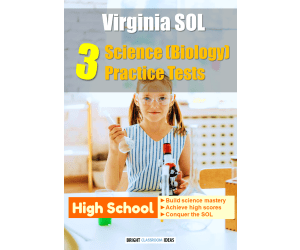
Virginia SOL Pack of 3 Science (Biology) Tests for High School
Science, Grade 9, 10, 11, 12, Assessments, Teacher Tools, Tests, Quizzes and Tests, Worksheets & Printables
Virginia SOL Pack of 3 Science (Biology) Practice Tests for High School Looking for a rigorous, classroom-ready high school biology SOL practice test bundle that truly prepares students for the Biology EOC? This Virginia SOL Biology test prep resource includes 3 full-length, standards-aligned practice tests designed to build mastery, confidence, and test-taking stamina. What’s Included 3 full-length Biology SOL practice tests (45 questions each; 135 total) Multiple-choice questions aligned to BIO.1–BIO.8 standards (full course coverage) Real SOL-style scenarios, data tables, and diagrams in every test Student answer sheets for each test (bubble format for easy grading) Complete answer key with quick-check grids and skill-by-skill breakdowns Score conversion chart aligned to SOL performance bands Class data tracker to monitor student growth across all tests Teacher’s Guide with pacing calendar, reteaching strategies, and differentiation support How It Works in the Classroom This high school biology SOL test prep resource follows a proven 3-step system for maximum impact: Test 1 → Diagnostic to identify gaps (early spring) Test 2 → Mid-prep progress check Test 3 → Final review or full-length test simulation before the EOC Use it for: Whole group test prep Independent practice or assessments Data-driven small group reteaching Sub plans or review days Each test mirrors the real SOL format. For example, Practice Test 1 (page 3) includes experimental design scenarios like drug trials and data-based questions, helping students apply real scientific reasoning skills. Standards & Learning Goals Aligned to Virginia SOL Biology (BIO.1–BIO.8) , including: Scientific investigation & experimental design Chemistry of life (biomolecules, enzymes, pH) Cell structure & function (organelles, transport) Photosynthesis & cellular respiration Genetics, DNA, and inheritance patterns Evolution & natural selection Ecology, energy flow, and human impact Classification & biodiversity Students will: Analyze scientific data, charts, and scenarios Apply higher-order thinking to real-world biology concepts Build confidence and stamina for the Biology SOL test Why Teachers Love It ⭐ No-prep, print-and-go Biology EOC test prep ⭐ Easy grading with compact answer grids for all 3 tests ⭐ Data-driven instruction with detailed skill breakdowns ⭐ Built-in reteaching strategies for 20+ biology topics ⭐ Proven 3-test system that tracks growth and boosts performance Simplify your test prep and help your students succeed with this all-in-one Biology SOL practice test bundle . Download today and confidently prepare your students for the Biology EOC!
Author Bright Classroom Ideas Marketplace
Rating
Tags Virginia, Sol, Science, State Test

Morphology Matrix Builders
Science, Basic Science, Inventors, Theories, ELA, Reading, Reading Comprehension, Writing, Creative Writing, Handwriting, Homeschool Curriculum, Homeschool Templates, Grade 3, 4, 5, 6, 7, Worksheets & Printables, Worksheets, Workbooks, Word Searches, Teacher Tools, Lesson Plans, Quizzes and Tests, Quizzes, Tests, Assessments
Tired of vocabulary lists that are memorized on Thursday and forgotten by Monday? It's time to transform your students from passive memorizers into active "word architects"! Introducing Morphology Matrix Builders —a comprehensive, no-prep resource designed to revolutionize vocabulary instruction in your 3rd, 4th, or 5th-grade classroom. Based on the science of reading and structured literacy principles, this unit shifts the focus from rote learning to deep structural analysis of words. Students will learn that English isn't random; it's a fascinating system waiting to be decoded. By mastering a core set of Greek and Latin roots, prefixes, and suffixes, your students will gain the power to decipher thousands of unfamiliar academic words independently. Watch their confidence, reading comprehension, and test scores soar across all subject areas—from ELA to science and social studies! What's Inside This All-in-One Resource? Part 1: Comprehensive Teacher's Guide (11 Pages): A robust theoretical framework that explains the "why" behind morphological instruction. It covers free vs. bound morphemes, prefix functions (including chameleon prefixes), the power of Greek and Latin roots, derivational vs. inflectional suffixes, and key orthographic rules. This guide will empower you to teach with confidence and expertise. Part 2: Student Workbook (15 Pages): Ten engaging, ready-to-print worksheets that guide students from foundational concepts to complex synthesis. Activities include morphological matching, sentence synthesis, word deconstruction, and creative construction. Worksheets Cover: Prefixes, Suffixes, Greek Roots (bio, phon, graph, photo), Latin Roots (port, tract, spect, struct), Number Prefixes, Elemental Roots, Suffixes of Profession, and more! Includes a final Master Morphologist Assessment to evaluate student mastery. Part 3: Visuals & Teacher Resources (7 Pages): Everything you need to implement this unit seamlessly. Pedagogical Visuals: Three high-quality, printable/projectable anchor charts (Morphology Matrix, Structural Word Anatomy, Greek Root Word Web) to make abstract concepts concrete. Comprehensive Answer Key: Fast, easy grading for all 10 worksheets. 4-Day Pacing & Implementation Guide: A step-by-step, week-long plan ("Matrix Monday," "Word Web Wednesday," etc.) to integrate this unit perfectly into your literacy block. Stop teaching one word at a time. Hand your students the master key to the English language and watch them unlock a world of vocabulary! Keywords: Morphology, Greek and Latin Roots, Prefixes and Suffixes, Vocabulary Instruction, Word Study, ELA, English Language Arts, 3rd Grade, 4th Grade, 5th Grade, Upper Elementary, Reading Comprehension, Structured Literacy, Science of Reading, Orton-Gillingham Aligned, Word Building, Etymology, Printable Worksheets, Digital Download, No Prep, Homeschool. Why Parents/Schools Love It: Goes Beyond Rote Memorization: It teaches students a transferable system for decoding words, fostering true understanding and critical thinking instead of just memorizing for a test. Exponential Vocabulary Growth: By learning one root liketract, students don't just learn one word; they unlock the meaning ofattract,distract,extract,tractor,retract, and dozens more. Boosts Reading Comprehension: When students can break down complex, multi-syllabic words in science and history texts, their overall comprehension and academic performance across all subjects improve dramatically. Comprehensive & "Done-For-You": This isn't just a pack of worksheets. It's a complete instructional unit with a teacher's guide, student activities, visual aids, an answer key, and a pacing guide, saving educators valuable prep time. Builds Academic Independence: It empowers students to become confident "word detectives," equipping them with the skills to tackle challenging new vocabulary without relying on a teacher or a dictionary for every word. Target Student Classes : Based on the explicit text on pages 1, 3, 27, and 33, and the complexity of the concepts, should target: Upper Elementary School: 3rd Grade, 4th Grade, and 5th Grade. The resource is also perfect for Middle School intervention groups who need foundational vocabulary skills, as well as Homeschool parents teaching these grade levels. Copyright/Terms of Use: This Book was copyrighted by Syed Hammad Rizvi. This resource is for personal and single classroom use only. You may not alter, redistribute, or sell any part of this resource. In other words, you may not put it on the Internet where it could be publicly found and downloaded. If you want to share this resource with colleagues, please purchase additional licenses from Teachsimple. Thank you for respecting these terms of use. This product is happily brought to you by Syed Hammad Rizvi
Author Creative Book Store
Rating
Tags Morphology, Vocabulary, WordStudy, ELA, EnglishLanguageArts, Literacy, Reading, Teaching, Teacher, GreekAndLatinRoots
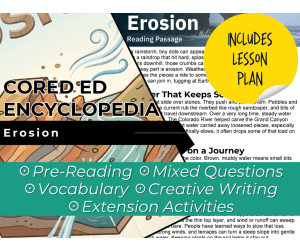
Erosion Reading Comprehension Passage - Cored Ed Encyclopedia
ELA, Reading Comprehension, Reading, Science, Technology, Language Development, Social Studies, Earth and Environmental Sciences, Geography, Life Sciences, Grade 2, 3, 4, 5, Worksheets & Printables, Worksheets, Teacher Tools, Centers, Activities, Writing Prompts, Assessments, Quizzes and Tests, Quizzes, Lesson Plans
This erosion reading comprehension with lesson plan includes: Visualization (on the front cover) Start your lesson by taking a minute to think and share something about the topic. Read the script aloud (slowly), perhaps prepare some music or sound effects. Student close their eyes and let their imaginations wander. Students open their eyes, read the question aloud and give them a few minutes to complete. Ask a few students to share or keep answers until the end to compare with what they learn in the passage. Quick pause—thousands of Cored Education products are included with your TeachSimple membership. Download links and encyclopedia index available here. Pre-Reading Trivia Students will write down one thing they already know about the subject and then read five more facts and discuss. These facts are fun, and the students will enjoy learning about the subject before reading more. Give 1 minute for students to write what they already know (no pressure—best guess is fine). Read the five facts together. After each fact, do ask a student for their opinion, was it surprising? Set a purpose by asking students to highlight/underline one fact they want to learn more about during the reading. Reading Passage The text is a high-interest reading passage with set paragraphs, roughly three to four paragraphs long. It contains a variety of themes about the topic, anywhere from history to technology. The passage is between 250 and 350 words in length. First, ask students to look at the headings and see what they’ll learn about today. What do they know about the topic/heading? First read options: Teacher read-aloud (best for support). Partner reading (paragraph by paragraph). While reading, students underline important details, and vocabulary words they think may come up in the questions section. Mixed Questions The first question page contains four multiple-choice questions, each with a choice of four answers, and three written response questions that require a sentence or two from the student. Students complete the mcqs first independently, then review quickly as a class. For the 3 written responses, try to get students giving the answer with some form of evidence: “I think ___ because the text says ___.” If students get stuck, send them back to check the passage. Vocabulary Questions Practice seven key words from the text in this section across two activities. First section is scrambled words where students will unscramble three words given a clue for each. The second section is a word to meaning matching activity. Before starting, have some students read out words they underlined in the passage. Ask students to say the word and read aloud the sentence(s) around each word. Ask students to do scrambled words and the matching exercise in pairs then go through answers as a class. For the scrambled spelling task, get four pairs to come up to the board and write the words for extra practice with the other student reading out the clue. For the matching task, prompt students to give full sentences: “I matched ___ with ___ because ___.” Creative Writing In this question, the student will be required to write a five to eight sentence paragraph on a question related to the topic. Before starting, ask students write down 3 key ideas they are going to include in their piece. Ask students for ideas to share around the class to help those struggling. Pro writing expectations: 5–8 sentences At least 2 facts or details from the passage At least 2 vocabulary words from the previous page Students read their paragraphs while classmates listen for facts and vocabulary words. Extension Activities This page is optional for fast finishers or to take home. There are several activities, each one requiring a different skill. Do some, do none, do all, completely optional - but you will feel reassured knowing every possibility is planned for. Includes summary writting question and additional facts. Answer Key There are answers for the multiple-choice questions, written response questions have sample answers, vocabulary answers and if there is a summary question then a sample summary will be provided as well. Lesson Plan Included Customized lesson plan for this lesson is included. Lesson Snapshot Title: Erosion Genre: Nonfiction (Informational Text) Subject: Science (Earth Science) / Reading (Informational Text) Primary Topic: How erosion moves Earth materials and changes land Estimated Guided Reading Level (A–Z): N What This Lesson Teaches Best Clearly distinguishes weathering (breaking rock apart in place) from erosion (moving pieces away). (Reading Passage, p. 3) Explains multiple forces that cause erosion— water, wind, waves, ice, and gravity —and what they do to Earth’s surface. (p. 3) Shows how rivers reshape land over time, including how moving water and sediment can help carve deep valleys (Colorado River/Grand Canyon example). (p. 3) Introduces sediment and connects erosion to deposition , explaining how new landforms can build up (beaches, river deltas). (p. 3) Connects science to real-world problem solving by describing ways people can slow soil loss (trees, terraces, keeping plants on soil). (p. 3) Learning Goals Students will explain how erosion is different from weathering using the text’s definitions. Students will identify forces that can cause erosion (water, wind, waves, ice, gravity). Students will describe how rivers move sediment and can change riverbeds and valleys over time. Students will explain what sediment is and how deposition happens when sediment settles. Students will describe at least two ways people can help soil “stay home,” based on the passage. Key Vocabulary From the Text weathering — breaking rock apart where it sits. erosion — moving soil and rock to a new place. sediment — tiny bits of soil and rock that travel. deposition — when sediment settles and builds up land. terraces — steps that slow water on a steep slope. FULL CATALOG OF DOWNLOAD LINKS AND ENCYCLOPEDIA INDEX HERE
Author Cored Education
Rating
Tags Vocabulary, Reading Comprehension, Reading Passages, Lesson Plans, Ela Lesson Plans, Reading Comprehension Lesson Plans, Pre-reading, Geography, Earth Science, Science Lesson Plans
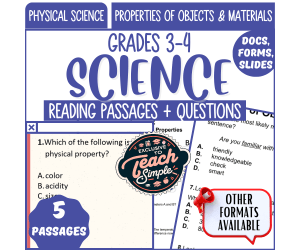
Reading Passages on Properties of Objects and Materials (Google Drive)
ELA, Reading, Reading Comprehension, Language Development, Vocabulary, Common Core, ESL, Physics, Science, Grade 2, 3, 4, Centers, Activities, Assessments, Teacher Tools, Presentations, Tests, Quizzes and Tests, Worksheets, Worksheets & Printables
Reading Passages on Properties of Objects and Materials for Physical Science This comprehensive package Properties of Objects and Materials: Reading Passages Physical Science enables your students to practice reading strategies and learn essential science topics for the week. All of this is made easier by the fact that the bulk of the work is already completed for you. Physical properties and states of matter are the focus of the reading materials. What's inside? Part I Passage 1: Observable Physical Properties of Objects & Materials Passage 2: Measuring Physical Properties Passage 3: Classification of Matter Passage 4: States of Matter Passage 5: Change of Phase Product Info: 28 PAGES (Docs Version: US English with Answers) & 5 FORMS (Self-Grading) & 134 SLIDES Teaching Duration: 2 Weeks Science Reading Comprehension Outline: Designed especially for 3rd and 4th graders, these science reading passages are packed with helpful illustrations and graphs that bring each topic to life. Every lesson is aligned with Common Core standards, so you can feel confident knowing you’re hitting key skills—without needing to prep for hours. Each passage includes a mix of question types, like multiple choice, data analysis, and fill-in-the-blank, giving students meaningful practice while keeping things fresh and fun. The science topics are both exciting and curriculum-based, making them perfect for reinforcing what you're already teaching. These lessons are super flexible—you can use them during whole-class instruction, morning work, independent practice, small groups, homework, or even as no-fuss sub plans or holiday assignments. FULL CATALOG OF DOWNLOAD LINKS HERE Grade 3/4 Links: Physical Science Part 1 - Properties of Objects and Materials Google Docs/Slides/Forms PDF PPT Word Free Supplementary Pack Accompanying Videos Physical Science Part 2 - Position and Motion of Objects Google Docs/Slides/Forms PDF PPT Word Free Supplementary Pack Accompanying Videos Physical Science Part 3 - Light, Heat, Electricity, Magnetism Google Docs/Slides/Forms PDF PPT Word Free Supplementary Pack Accompanying Videos Life Science Part 1 - Characteristics of Organisms Google Docs/Slides/Forms PDF PPT Word Free Supplementary Pack Accompanying Videos Life Science Part 2 - Life Cycles of Organisms Google Docs/Slides/Forms PDF PPT Word Free Supplementary Pack Accompanying Videos Life Science Part 3 - Organisms and Environments Google Docs/Slides/Forms PDF PPT Word Free Supplementary Pack Accompanying Videos Earth Science Part 1 - Properties of Earth Materials Google Docs/Slides/Forms PDF PPT Word Free Supplementary Pack Accompanying Videos Earth Science Part 2 - Changes in the Earth and Sky Google Docs/Slides/Forms PDF PPT Word Free Supplementary Pack Accompanying Videos Earth Science Part 3 - Objects in the Sky Google Docs/Slides/Forms PDF PPT Word Free Supplementary Pack Accompanying Videos For similar products and other frees, do check out Cored Group on TeachSimple .
Author Cored Education
Rating
Tags Science, Elementary, Reading, Comprehension, Vocabulary, Physics, Physical Science, Reading Comprehension Assessments, Science Assessments, Self Assessment
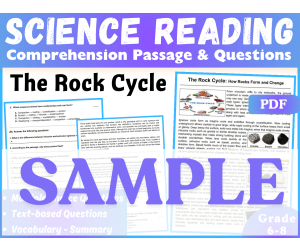
Earth Science Reading Comprehension Passage: The Rock Cycle. SAMPLE
Science, ELA, Reading, Reading Comprehension, Strategies, Resources for Teachers, Earth and Environmental Sciences, Earth Sciences, Grade 6, 7, 8, 9, Writing Prompts, Worksheets & Printables, Centers, Activities, Teacher Tools, Assessments, Quizzes and Tests, Quizzes, Tests
This is a free passage sample from the complete resource. The full version includes everything needed for a complete reading comprehension activity: the passage, multiple-choice questions, short-answer questions, vocabulary matching, a summary-writing task, and a detailed answer key. Download the complete passage resource by clicking on the following links: PDF Fillable PDF Word Docs Google Docs Science Reading Comprehension Passages and Questions: The Rock Cycle (PDF) This very engaging earth science reading passage about The Rock Cycle is designed to bridge the gap between science and literacy through strengthening reading comprehension and sparking scientific curiosity in middle school students. The passage blends English Language Arts skills with accurate science content that supports NGSS classroom practice. Ideal for interdisciplinary learning in ELA and Science. Suitable for Grade 9 review, too! Student Tasks for The Passage: 5 multiple-choice questions targeting main idea, key details, inference, vocabulary in context, and use of evidence 5 vocabulary matching items with clear, student-friendly definitions 5 text-based questions that require citing specific lines or facts 1 summary prompt that asks students to condense central ideas accurately Full answer key for every section FULL CATALOG OF DOWNLOADING LINKS HERE Product Details Length: 5 pages total Grades: 6–8, also suitable for Grade 9 review Use cases: close reading, stations, homework, intervention, test prep, and sub plans Standards support: reinforces informational-text skills and supports NGSS-style sense making through observation, modeling, and clear use of claim, evidence, and reasoning Why Teachers Choose This Set Authentic science content paired with rigorous literacy practice Consistent task structure across all passages for easier planning and smoother student routines Clear, age-appropriate writing that builds confidence without oversimplifying Other Science Reading Collections you May find in the store: 1. Astronomy & Space Science 2. Volcanoes, Rocks, & Mountains 3. Rock Cycle, Soil, & Sinkholes 4. Mars, Glaciers, & Antarctica 5. Water Cycle, Acid Rain, & Wastewater 6. Insects, Animals, & Ecosystems 7. Bioluminescence & Insects 8. Animal Skin, Cats, & T. Rex 9. Human Body and Senses 10. Health & Applied Bioscience 11. Waves, Light, & Imaging 12. Electricity & Energy 13. Motion & Materials 14. Chemistry and Materials Science Use this set to reinforce ELA skills in science, to add literacy to your lessons, and to support independent work. The passages strengthen main idea, evidence use, vocabulary in context, inference, cause and effect, and summary writing. With ready-to-use assessments and complete answer keys, you can provide focused practice that is simple to run and fast to review.
Author Middle & High School - CORED Education
Rating
Tags Middle School, Reading Comprehension, Reading Strategies, ELA, Centers, Reading Passage, Assessments, Vocabulary, Environmental Science, Earth Science

Sunglasses Reading Comprehension Passage - Cored Ed Encyclopedia
ELA, Language Development, Reading Comprehension, Reading, Pre-Reading, Writing, Science, Physics, History, Social Studies, Grade 2, 3, 4, 5, Worksheets & Printables, Worksheets, Teacher Tools, Centers, Activities, Writing Prompts, Assessments, Quizzes and Tests, Quizzes, Lesson Plans
This sunglasses reading comprehension includes: Visualization (on the front cover) Start your lesson by taking a minute to think and share something about the topic. Read the script aloud (slowly), perhaps prepare some music or sound effects. Student close their eyes and let their imaginations wander. Students open their eyes, read the question aloud and give them a few minutes to complete. Ask a few students to share or keep answers until the end to compare with what they learn in the passage. Quick pause—thousands of Cored Education products are included with your TeachSimple membership. Download links and encyclopedia index available here. Pre-Reading Trivia Students will write down one thing they already know about the subject and then read five more facts and discuss. These facts are fun, and the students will enjoy learning about the subject before reading more. Give 1 minute for students to write what they already know (no pressure—best guess is fine). Read the five facts together. After each fact, do ask a student for their opinion, was it surprising? Set a purpose by asking students to highlight/underline one fact they want to learn more about during the reading. Reading Passage The text is a high-interest reading passage with set paragraphs, roughly three to four paragraphs long. It contains a variety of themes about the topic, anywhere from history to technology. The passage is between 250 and 350 words in length. First, ask students to look at the headings and see what they’ll learn about today. What do they know about the topic/heading? First read options: Teacher read-aloud (best for support). Partner reading (paragraph by paragraph). While reading, students underline important details, and vocabulary words they think may come up in the questions section. Mixed Questions The first question page contains four multiple-choice questions, each with a choice of four answers, and three written response questions that require a sentence or two from the student. Students complete the mcqs first independently, then review quickly as a class. For the 3 written responses, try to get students giving the answer with some form of evidence: “I think ___ because the text says ___.” If students get stuck, send them back to check the passage. Vocabulary Questions Practice seven key words from the text in this section across two activities. First section is scrambled words where students will unscramble three words given a clue for each. The second section is a word to meaning matching activity. Before starting, have some students read out words they underlined in the passage. Ask students to say the word and read aloud the sentence(s) around each word. Ask students to do scrambled words and the matching exercise in pairs then go through answers as a class. For the scrambled spelling task, get four pairs to come up to the board and write the words for extra practice with the other student reading out the clue. For the matching task, prompt students to give full sentences: “I matched ___ with ___ because ___.” Creative Writing In this question, the student will be required to write a five to eight sentence paragraph on a question related to the topic. Before starting, ask students write down 3 key ideas they are going to include in their piece. Ask students for ideas to share around the class to help those struggling. Pro writing expectations: 5–8 sentences At least 2 facts or details from the passage At least 2 vocabulary words from the previous page Students read their paragraphs while classmates listen for facts and vocabulary words. Extension Activities This page is optional for fast finishers or to take home. There are several activities, each one requiring a different skill. Do some, do none, do all, completely optional - but you will feel reassured knowing every possibility is planned for. Includes summary writting question. Answer Key There are answers for the multiple-choice questions, written response questions have sample answers, vocabulary answers and if there is a summary question then a sample summary will be provided as well. Lesson Plan Included Customized lesson plan for this lesson is included. Lesson Snapshot Title: Sunglasses Genre: Nonfiction (informational text + support pages) Subject: Science (Light) / Health & Safety Primary Topic: Why sunglasses help and how they evolved Estimated Guided Reading Level (A–Z): Q What This Lesson Teaches Best What glare is and how tinted lenses can “calm down” sharp, shiny light bouncing off surfaces like water, sand, snow, or a car hood. A simple history of eye protection: smoky quartz lenses in 12th-century China and Inuit snow goggles with narrow slits to cut glare. How sunglasses became part of everyday life (experiments with tints; boardwalk sales in 1929; polarized lenses arriving in 1936). What UV light is (invisible but harmful over time) and what UV400 labeling means in the passage (filtering nearly all UVA/UVB up to 400 nanometers). How polarized lenses reduce reflected sparkle off flat surfaces like roads and water, making shapes easier to see. Learning Goals Define glare using details from the passage. Explain how tinted lenses help eyes feel more comfortable in bright sunlight. Describe two early ways people protected their eyes from harsh light. Explain how sunglasses became popular for everyday use using the dates and examples given. Describe what UV light is and what UV400 means in the passage. Explain how polarized lenses help with reflections off water and roads. Key Vocabulary From the Text glare — sharp, shiny light that bounces off surfaces. tinted — made darker, like a shaded window for eyes. quartz — a mineral used like simple dark lenses long ago. ultraviolet — invisible light that can harm eyes and skin over time. polarized — lens type that reduces reflections and sparkle. FULL CATALOG OF DOWNLOAD LINKS AND ENCYCLOPEDIA INDEX HERE
Author Cored Education
Rating
Tags Vocabulary, Reading Comprehension, Reading Passages, Lesson Plans, Ela Lesson Plans, Reading Comprehension Lesson Plans, Reading, Pre-reading, Physics, Sunglasses
Hospital Triage Vocabulary for Travel Nurses
P.E. & Health, Health, Mental Health, Physical Education, Mindfulness, Research, Resources for Teachers, Classroom Management, Community Building, Science, Homeschool Curriculum, Homeschool Templates, Grade 9, 10, 11, 12, Teacher Tools, Lesson Plans, Quizzes and Tests, Quizzes, Tests, Worksheets & Printables, Workbooks, Worksheets, Word Searches, Assessments
Transform your patient communication and elevate your nursing practice with the ultimate guide to culturally sensitive pain assessment. Are you an ESL travel nurse or a nursing educator seeking to bridge the communication gap in a multicultural healthcare setting? This comprehensive 43-page workbook is meticulously designed to equip international nurses with the nuanced English vocabulary and empathetic communication strategies needed for accurate and compassionate patient triage. Move beyond the limitations of the standard "0-to-10" pain scale. This resource delves into the principles of ethnolinguistics and clinical anthropology, teaching you how to navigate cultural differences in pain expression—from stoic patients who minimize their suffering to expressive patients who use vivid metaphors. Through targeted fill-in-the-blank exercises, real-world case studies, and advanced role-play scenarios, you will master the art of building patient trust and ensuring better health outcomes. What's Inside This 43-Page Digital PDF Resource: In-Depth Theoretical Foundation: Understand the linguistics of pain, cultural variations (Stoic vs. Expressive), and the importance of mitigation and functional anchoring. 10 Comprehensive Student Worksheets: Covering topics like sensory adjectives, addressing stoicism, functional pain assessment, traditional remedies, somatic expressions of pain, and pediatric/geriatric considerations. Real-World Case Studies & Triage Scenarios: Follow nurses like Mariya, Diego, and Fatima as they navigate complex patient interactions in diverse settings. Clinical Visual Aids: Includes a Cultural Pain Expressions Framework mind map, a Linguistic Mapping of the 0-10 Scale chart, and a Triage Interview Navigation Flowchart to anchor learning. Complete Teacher/Instructor Resources: Full Answer Keys for all worksheets. A Thematic Grading Guide for deeper assessment. A Teacher Implementation Guide with pedagogical foundations (CLIL). Advanced Role-Play Mechanics with detailed scenarios for "Nurse," "Patient," and "Observer" roles, complete with checklists and debriefing questions. Who is This For? ESL (English as a Second Language) Nurses & Nursing Students Travel Nurses working in diverse cultural environments Nursing Schools & Continuing Education Programs Clinical Educators & Medical English (ESP) Instructors Healthcare institutions focused on improving cultural competency and patient-centered care. Download today and gain the confidence to provide safe, equitable, and compassionate care, regardless of the cultural borders you cross. Keywords: ESL Nurse, Travel Nurse, Cultural Competence, Pain Assessment, Medical English, Nursing Worksheets, Patient Communication, Cultural Sensitivity, Triage Vocabulary, Fill-in-the-blank, Nursing Scenarios, Role-Play, ESP, CLIL, Medical Terminology, Patient-Centered Care, Nursing Education. Why Nursing Educators & Institutions Love It: Comprehensive & Turnkey Solution: This isn't just a worksheet; it's a complete, self-contained educational module with theory, practice, visual aids, answer keys, and a full instructor's guide for implementation. Promotes Real-World Application: The use of realistic case studies, complex dialogue scenarios, and detailed role-play exercises ensures that learners can immediately apply these linguistic skills in a clinical setting. Fosters Critical Soft Skills: It goes beyond simple medical terminology to teach the crucial soft skills of empathy, cultural humility, and adaptive communication, which are essential for modern patient-centered care. Improves Patient Safety & Outcomes: By equipping nurses to perform more accurate assessments, this resource directly contributes to better diagnoses, more appropriate interventions, and a reduction in medical errors stemming from miscommunication. Designed for Adult Learners: The content respects the existing clinical expertise of professional nurses, focusing specifically on bridging the linguistic and cultural gaps they face. Target Audience (Classes/Students) : Based on the highly specific and advanced content, This is a professional development resource for a niche audience. Primary target learners are: ESL (English as a Second Language) Nursing Professionals: Specifically, registered nurses or advanced practice nurses who are not native English speakers and are working, or plan to work, in an English-speaking country (like the US, UK, Canada, Australia). Travel Nurses: This group is explicitly mentioned. They move frequently between different hospitals, regions, and patient populations, making cultural adaptability a critical skill. Students in Medical English / English for Specific Purposes (ESP) Programs: This is a perfect resource for instructors teaching English to healthcare professionals. Continuing Education & Professional Development for Nurses: Hospitals and healthcare systems can use this for in-house training to improve their staff's cultural competency and patient satisfaction scores. University Nursing Programs: This could be used as a supplementary module in university courses focused on transcultural nursing, patient communication, or clinical assessment. Copyright/Terms of Use: This Book was copyrighted by Syed Hammad Rizvi. This resource is for personal and single classroom use only. You may not alter, redistribute, or sell any part of this resource. In other words, you may not put it on the Internet where it could be publicly found and downloaded. If you want to share this resource with colleagues, please purchase additional licenses from Teachsimple. Thank you for respecting these terms of use. This product is happily brought to you by Syed Hammad Rizvi
Author Creative Book Store
Rating
Tags ESLNurse, TravelNurse, CulturalCompetence, PainAssessment, MedicalEnglish, TransculturalNursing, TriageNurse, NursingVocabulary, PatientCommunication, InternationalNurse

Vegetables Reading Comprehension Passage - Cored Ed Encyclopedia
ELA, Language Development, Reading Comprehension, Reading, Pre-Reading, Science, Life Sciences, Health, P.E. & Health, Nature & Plants, Grade 2, 3, 4, 5, Worksheets & Printables, Worksheets, Teacher Tools, Centers, Activities, Writing Prompts, Assessments, Quizzes and Tests, Quizzes, Lesson Plans
This vegetables reading comprehension with lesson plan includes: Visualization (on the front cover) Start your lesson by taking a minute to think and share something about the topic. Read the script aloud (slowly), perhaps prepare some music or sound effects. Student close their eyes and let their imaginations wander. Students open their eyes, read the question aloud and give them a few minutes to complete. Ask a few students to share or keep answers until the end to compare with what they learn in the passage. Quick pause—thousands of Cored Education products are included with your TeachSimple membership. Download links and encyclopedia index available here. COMPANION VIDEO NOW AVAILABLE (EMBEDDED AFTER PREVIEW PICTURES IN PRODUCT DESCRIPTION) Pre-Reading Trivia Students will write down one thing they already know about the subject and then read five more facts and discuss. These facts are fun, and the students will enjoy learning about the subject before reading more. Give 1 minute for students to write what they already know (no pressure—best guess is fine). Read the five facts together. After each fact, do ask a student for their opinion, was it surprising? Set a purpose by asking students to highlight/underline one fact they want to learn more about during the reading. Reading Passage The text is a high-interest reading passage with set paragraphs, roughly three to four paragraphs long. It contains a variety of themes about the topic, anywhere from history to technology. The passage is between 250 and 350 words in length. First, ask students to look at the headings and see what they’ll learn about today. What do they know about the topic/heading? First read options: Teacher read-aloud (best for support). Partner reading (paragraph by paragraph). While reading, students underline important details, and vocabulary words they think may come up in the questions section. Mixed Questions The first question page contains four multiple-choice questions, each with a choice of four answers, and three written response questions that require a sentence or two from the student. Students complete the mcqs first independently, then review quickly as a class. For the 3 written responses, try to get students giving the answer with some form of evidence: “I think ___ because the text says ___.” If students get stuck, send them back to check the passage. Vocabulary Questions Practice seven key words from the text in this section across two activities. First section is scrambled words where students will unscramble three words given a clue for each. The second section is a word to meaning matching activity. Before starting, have some students read out words they underlined in the passage. Ask students to say the word and read aloud the sentence(s) around each word. Ask students to do scrambled words and the matching exercise in pairs then go through answers as a class. For the scrambled spelling task, get four pairs to come up to the board and write the words for extra practice with the other student reading out the clue. For the matching task, prompt students to give full sentences: “I matched ___ with ___ because ___.” Creative Writing In this question, the student will be required to write a five to eight sentence paragraph on a question related to the topic. Before starting, ask students write down 3 key ideas they are going to include in their piece. Ask students for ideas to share around the class to help those struggling. Pro writing expectations: 5–8 sentences At least 2 facts or details from the passage At least 2 vocabulary words from the previous page Students read their paragraphs while classmates listen for facts and vocabulary words. Extension Activities This page is optional for fast finishers or to take home. There are several activities, each one requiring a different skill. Do some, do none, do all, completely optional - but you will feel reassured knowing every possibility is planned for. Includes summary writting question. Answer Key There are answers for the multiple-choice questions, written response questions have sample answers, vocabulary answers and if there is a summary question then a sample summary will be provided as well. Lesson Plan Included Customized lesson plan for this lesson is included. Lesson Snapshot Title: Vegetables Genre: Nonfiction (Informational text) Subject: Science (Life Science: plants, nutrition) / Reading (informational text) Primary Topic: What vegetables are and why they matter Estimated Guided Reading Level (A–Z): N What This Lesson Teaches Best What counts as a vegetable (in this text): Defines vegetables as edible parts of plants people choose to eat, including roots (carrot), leaves (spinach), and flower buds (broccoli). Plant parts and categories: Explains that many vegetables come from soft-stemmed, herbaceous plants rather than woody trees, and that vegetables come in many shapes because plants have many useful parts. Early farming and seed-saving: Describes how people once gathered edible plants from the wild, then began planting and saving seeds (about 10,000–7,000 BC), keeping and sharing plants that tasted better or grew bigger. Science vs. everyday language (tomato debate): Contrasts the botanical definition of “fruit” (seed-bearing part formed from a flower’s ovary) with how “vegetable” often means a savory plant food served with meals, noting a U.S. court decision in 1893 calling tomatoes vegetables for a tax rule. Nutrition and food preservation: States vegetables are usually low in fat and calories, filling because they bring water and fiber, and may contain vitamins/minerals (examples include vitamin A and vitamin C); also notes chilling, freezing, or canning to keep vegetables longer. Learning Goals Students will define a vegetable using examples from the text (root, leaf, bud). Students will describe where many vegetables come from (soft-stemmed, herbaceous plants) and explain what that means. Students will explain how seed-saving helped wild plants become “garden favorites,” using details from the passage. Students will compare the botanical meaning of fruit with the cooking meaning of vegetable, using the tomato example. Students will identify two reasons vegetables can be filling and healthy (water, fiber, vitamins/minerals) based on the text. Key Vocabulary From the Text edible — safe and good to eat. herbaceous — soft-stemmed; not woody. botanists — scientists who study plants. ovary — flower part that can form fruit. fiber — nutrient that helps you feel full. FULL CATALOG OF DOWNLOAD LINKS AND ENCYCLOPEDIA INDEX HERE
Author Cored Education
Rating
Tags Vocabulary, Reading Comprehension, Reading Passages, Lesson Plans, Ela Lesson Plans, Reading Comprehension Lesson Plans, Pre-reading, Science Lesson Plans, Nature And Plants, Health

Droughts Reading Comprehension Passage - Cored Ed Encyclopedia
ELA, Reading Comprehension, Reading, Science, Technology, Social Studies, History, Earth and Environmental Sciences, Life Sciences, Geography, Grade 2, 3, 4, 5, Worksheets & Printables, Worksheets, Teacher Tools, Centers, Activities, Writing Prompts, Assessments, Quizzes and Tests, Quizzes, Lesson Plans
This droughts reading comprehension with lesson plan includes: Visualization (on the front cover) Start your lesson by taking a minute to think and share something about the topic. Read the script aloud (slowly), perhaps prepare some music or sound effects. Student close their eyes and let their imaginations wander. Students open their eyes, read the question aloud and give them a few minutes to complete. Ask a few students to share or keep answers until the end to compare with what they learn in the passage. Quick pause—thousands of Cored Education products are included with your TeachSimple membership. Download links and encyclopedia index available here. Pre-Reading Trivia Students will write down one thing they already know about the subject and then read five more facts and discuss. These facts are fun, and the students will enjoy learning about the subject before reading more. Give 1 minute for students to write what they already know (no pressure—best guess is fine). Read the five facts together. After each fact, do ask a student for their opinion, was it surprising? Set a purpose by asking students to highlight/underline one fact they want to learn more about during the reading. Reading Passage The text is a high-interest reading passage with set paragraphs, roughly three to four paragraphs long. It contains a variety of themes about the topic, anywhere from history to technology. The passage is between 250 and 350 words in length. First, ask students to look at the headings and see what they’ll learn about today. What do they know about the topic/heading? First read options: Teacher read-aloud (best for support). Partner reading (paragraph by paragraph). While reading, students underline important details, and vocabulary words they think may come up in the questions section. Mixed Questions The first question page contains four multiple-choice questions, each with a choice of four answers, and three written response questions that require a sentence or two from the student. Students complete the mcqs first independently, then review quickly as a class. For the 3 written responses, try to get students giving the answer with some form of evidence: “I think ___ because the text says ___.” If students get stuck, send them back to check the passage. Vocabulary Questions Practice seven key words from the text in this section across two activities. First section is scrambled words where students will unscramble three words given a clue for each. The second section is a word to meaning matching activity. Before starting, have some students read out words they underlined in the passage. Ask students to say the word and read aloud the sentence(s) around each word. Ask students to do scrambled words and the matching exercise in pairs then go through answers as a class. For the scrambled spelling task, get four pairs to come up to the board and write the words for extra practice with the other student reading out the clue. For the matching task, prompt students to give full sentences: “I matched ___ with ___ because ___.” Creative Writing In this question, the student will be required to write a five to eight sentence paragraph on a question related to the topic. Before starting, ask students write down 3 key ideas they are going to include in their piece. Ask students for ideas to share around the class to help those struggling. Pro writing expectations: 5–8 sentences At least 2 facts or details from the passage At least 2 vocabulary words from the previous page Students read their paragraphs while classmates listen for facts and vocabulary words. Extension Activities This page is optional for fast finishers or to take home. There are several activities, each one requiring a different skill. Do some, do none, do all, completely optional - but you will feel reassured knowing every possibility is planned for. Includes summary writting question and additional facts. Answer Key There are answers for the multiple-choice questions, written response questions have sample answers, vocabulary answers and if there is a summary question then a sample summary will be provided as well. Lesson Plan Included Customized lesson plan for this lesson is included. Lesson Snapshot Title: Droughts Genre: Nonfiction (informational text with headings) Subject: Earth Science / Life Science / Reading (Informational Text) Primary Topic: What drought is, types, effects, and tracking Estimated Guided Reading Level (A–Z): Q What This Lesson Teaches Best Defines drought as a stretch of time when a region is drier than normal and can last from days to years. Explains types of drought (meteorological vs. hydrological) and describes what changes in streams, reservoirs, and groundwater. Uses concrete signs/evidence of drought (no puddles, dull grass, cracked ground, animals traveling farther, rivers showing more rocks). Connects history to learning: the Dust Bowl in the 1930s and how it led to soil-saving methods and drought indices. Introduces modern monitoring and responses (rain gauges, river sensors, satellites; fixing leaks, reusing water, collecting rain). Learning Goals Students will define drought using the book’s description and time frames. Students will identify signs of drought described in the passage (e.g., puddles, grass, cracked ground, rivers). Students will explain the difference between meteorological drought and hydrological drought using text evidence. Students will describe what happened during the Dust Bowl and why it mattered for tracking dryness. Students will describe ways droughts are monitored today and one way communities can respond. Key Vocabulary From the Text meteorological — related to weather and rainfall or snow. hydrological — related to water in rivers, reservoirs, and underground. groundwater — water stored under the ground. indices — numbers used to compare and track dryness. evapotranspiration — water moving from land and plants into air. FULL CATALOG OF DOWNLOAD LINKS AND ENCYCLOPEDIA INDEX HERE
Author Cored Education
Rating
Tags Vocabulary, Reading Comprehension, Reading Passages, Lesson Plans, Ela Lesson Plans, Reading Comprehension Lesson Plans, Pre-reading, Science Lesson Plans, Geography, Earth Science

Orthographic Mapping Phonics Grids
Science, Basic Science, Inventors, Theories, Life Sciences, Human Body, STEM, Special Resources, Life Skills, Special Education Needs (SEN), Kindergarten, Preschool, Homeschool Curriculum, Grade 1, 2, 3, 4, Worksheets & Printables, Workbooks, Worksheets, Word Searches, Teacher Tools, Lesson Plans, Quizzes and Tests, Quizzes, Tests, Assessments
Unleash the Power of the Science of Reading! The Ultimate Orthographic Mapping Phonics Toolkit for K-2 Are you searching for a rigorous, no-prep phonics resource that aligns perfectly with the Science of Reading (SoR)? Transform your literacy instruction and empower your students to move beyond rote memorization with this comprehensive Orthographic Mapping Phonics Grids workbook. This is not just a collection of worksheets; it's a complete pedagogical system designed to rewire the brain for fluent reading and spelling. Based on the evidence-based principles of orthographic mapping, these worksheets guide students through the crucial process of connecting phonemes (sounds) to graphemes (letters). By explicitly teaching students to segment sounds and map them to their written representations, you will build a solid foundation for decoding, eliminate the habit of guessing, and permanently store words in their sight vocabulary. This massive, 38-page resource is perfect for core instruction, small group intervention (RTI), literacy centers, tutoring, and even for homeschool parents looking to provide research-backed support. WHAT'S INCLUDED: A Comprehensive Educator's Guide (10 Pages): Dive deep into the neuroscience and methodology behind orthographic mapping. This guide explains the "why" with clarity, covering Linnea Ehri's phases of development, the anatomy of a phonics grid, and case studies proving its effectiveness. Teach with the confidence of an expert! Systematic Student Worksheets (18 Pages): A strategically sequenced set of worksheets that build in complexity: Worksheet 1: CVC Words Worksheet 2: Consonant Digraphs (sh, ch, th, etc.) Worksheet 3: Initial Consonant Blends (sl, fr, st, etc.) Worksheet 4: Final Consonant Blends (nd, st, mp, etc.) Worksheet 5: The FLOSS Rule (ff, ll, ss, zz) Worksheet 6: CVCe / Magic E Words (cake, time, rope) Visuals & Teacher Resources (10 Pages): Clear diagrams illustrating the cognitive process of orthographic mapping. A "Tap, Map, Graph" implementation guide. A complete, diagnostic Answer Key with grapheme breakdowns to help you identify phonological vs. orthographic deficits. Keywords for SEO/Tags: Science of Reading, SoR, Orthographic Mapping, Phonics Worksheets, K-2 Phonics, Kindergarten, First Grade, Second Grade, Phoneme Grapheme Mapping, CVC Words, Digraphs, Blends, Magic E, CVCe, Structured Literacy, Reading Intervention, RTI, Special Education, Homeschool, Orton-Gillingham aligned, No Prep, Printable. Why Parents/Schools Love It: Brain-Based & Research-Backed: It's not a fad. This resource is built on the proven neurological science of how children actually learn to read, aligning perfectly with the Science of Reading (SoR). Builds Real Decoding Skills: It systematically teaches students to analyze words by sound, ending the frustrating cycle of guessing based on pictures or first letters. Comprehensive & All-in-One: From a deep-dive educator guide to student worksheets and a full answer key, it provides everything a teacher or parent needs to implement the strategy with confidence, right away. Highly Diagnostic Tool: The unique grid format makes it immediately obvious where a student is struggling—whether it's hearing the sounds (phonological awareness) or knowing the letters (orthographic knowledge). Fosters Independent, Confident Readers: By making the structure of English visible and predictable, these worksheets empower students, reduce anxiety around spelling, and build a solid foundation for a lifetime of fluent reading. Target Student Classes : Based on the clear and systematic progression of phonics skills presented in the worksheets, target educators and parents of students in: Kindergarten: (For the CVC words and introducing digraphs) First Grade: (This is the sweet spot, covering CVC, digraphs, blends, FLOSS rule, and CVCe) Second Grade: (Excellent for review, intervention for struggling readers, or students just beginning to work with more complex vowel patterns) This resource is ideal for reading specialists, interventionists, and special education teachers working with students of any age who have gaps in these foundational skills. Copyright/Terms of Use: This Book was copyrighted by Syed Hammad Rizvi. This resource is for personal and single classroom use only. You may not alter, redistribute, or sell any part of this resource. In other words, you may not put it on the Internet where it could be publicly found and downloaded. If you want to share this resource with colleagues, please purchase additional licenses from Teachsimple. Thank you for respecting these terms of use. This product is happily brought to you by Syed Hammad Rizvi
Author Creative Book Store
Rating
Tags Scienceofreading, Orthographicmapping, Structuredliteracy, Phonics, Sor, Phonemegraphemema, Brainbasedlearning, Readingresearch, Cvcwords, Consonantdigraphs
Television Reading Comprehension Passage - Cored Ed Encyclopedia
ELA, Language Development, Reading Comprehension, Reading, Pre-Reading, Science, Technology, Engineering, History, Social Studies, Grade 2, 3, 4, 5, Worksheets & Printables, Worksheets, Teacher Tools, Centers, Activities, Writing Prompts, Assessments, Quizzes and Tests, Quizzes, Lesson Plans
This television reading comprehension includes: Visualization (on the front cover) Start your lesson by taking a minute to think and share something about the topic. Read the script aloud (slowly), perhaps prepare some music or sound effects. Student close their eyes and let their imaginations wander. Students open their eyes, read the question aloud and give them a few minutes to complete. Ask a few students to share or keep answers until the end to compare with what they learn in the passage. Quick pause—thousands of Cored Education products are included with your TeachSimple membership. Download links and encyclopedia index available here. Pre-Reading Trivia Students will write down one thing they already know about the subject and then read five more facts and discuss. These facts are fun, and the students will enjoy learning about the subject before reading more. Give 1 minute for students to write what they already know (no pressure—best guess is fine). Read the five facts together. After each fact, do ask a student for their opinion, was it surprising? Set a purpose by asking students to highlight/underline one fact they want to learn more about during the reading. Reading Passage The text is a high-interest reading passage with set paragraphs, roughly three to four paragraphs long. It contains a variety of themes about the topic, anywhere from history to technology. The passage is between 250 and 350 words in length. First, ask students to look at the headings and see what they’ll learn about today. What do they know about the topic/heading? First read options: Teacher read-aloud (best for support). Partner reading (paragraph by paragraph). While reading, students underline important details, and vocabulary words they think may come up in the questions section. Mixed Questions The first question page contains four multiple-choice questions, each with a choice of four answers, and three written response questions that require a sentence or two from the student. Students complete the mcqs first independently, then review quickly as a class. For the 3 written responses, try to get students giving the answer with some form of evidence: “I think ___ because the text says ___.” If students get stuck, send them back to check the passage. Vocabulary Questions Practice seven key words from the text in this section across two activities. First section is scrambled words where students will unscramble three words given a clue for each. The second section is a word to meaning matching activity. Before starting, have some students read out words they underlined in the passage. Ask students to say the word and read aloud the sentence(s) around each word. Ask students to do scrambled words and the matching exercise in pairs then go through answers as a class. For the scrambled spelling task, get four pairs to come up to the board and write the words for extra practice with the other student reading out the clue. For the matching task, prompt students to give full sentences: “I matched ___ with ___ because ___.” Creative Writing In this question, the student will be required to write a five to eight sentence paragraph on a question related to the topic. Before starting, ask students write down 3 key ideas they are going to include in their piece. Ask students for ideas to share around the class to help those struggling. Pro writing expectations: 5–8 sentences At least 2 facts or details from the passage At least 2 vocabulary words from the previous page Students read their paragraphs while classmates listen for facts and vocabulary words. Extension Activities This page is optional for fast finishers or to take home. There are several activities, each one requiring a different skill. Do some, do none, do all, completely optional - but you will feel reassured knowing every possibility is planned for. Includes summary writting question. Answer Key There are answers for the multiple-choice questions, written response questions have sample answers, vocabulary answers and if there is a summary question then a sample summary will be provided as well. Lesson Plan Included Customized lesson plan for this lesson is included. Lesson Snapshot Title: Television Genre: Nonfiction (informational text) Subject: Science (Technology) Primary Topic: How television changed from mechanical to digital Estimated Guided Reading Level (A–Z): S What This Lesson Teaches Best How an invention changed over time, from a “spinning disk” experiment to modern screens and signals. Key milestones in television’s development (1925 Selfridges demo, 1927 Farnsworth, 1936 BBC service, late 2000s flat-panels). How pictures can be broken into lines/signals and sent by wire, radio, antenna, cable, or internet. The shift from black-and-white to color broadcasts and how viewers experienced that change over decades. Comparing analog and digital signals as two different ways information travels. Learning Goals Students will describe how early television used a spinning Nipkow disk to scan pictures into lines. Students will identify key people, places, and dates from the passage (Baird, Farnsworth, Selfridges, Alexandra Palace). Students will explain how television changed from mechanical parts to all-electronic systems that made clearer pictures. Students will summarize how TV viewing changed from bulky cathode-ray tubes to flat-panel screens and high-definition images. Students will compare analog and digital signals using details from the text. Key Vocabulary From the Text scan — break a picture into lines to send it. signals — messages that carry picture or sound information. broadcasting — sending TV so many people can receive it. analog — a smooth, continuous wave way of sending. digital — coded bits that travel more cleanly. FULL CATALOG OF DOWNLOAD LINKS AND ENCYCLOPEDIA INDEX HERE
Author Cored Education
Rating
Tags Vocabulary, Reading Comprehension, Reading Passages, Lesson Plans, Ela Lesson Plans, Reading Comprehension Lesson Plans, Pre-reading, History, Social Studies, Social Studies Lesson Plans
Mind Games: How Illusions and Biases Shape Our Reality Reading Passage
ELA, Reading, Writing, Research, Resources for Teachers, Science, STEM, Life Skills, Special Resources, High School, Homeschool Resources, Teacher Tools, Assessments, Lesson Plans, Quizzes and Tests, Worksheets & Printables, Writing Prompts
As a homeschool mom who is passionate about bringing real science into our learning, I created this resource after watching my own kids become fascinated by optical illusions and questioning "how do we really know what we see?" This comprehensive package takes that natural curiosity and channels it into serious academic exploration of how our minds work. I have spent countless hours researching current neuroscience studies to ensure this material meets the rigor your advanced students deserve while remaining engaging and accessible. Whether you are preparing high schoolers/homeschoolers for college psychology courses or diving deep into critical thinking with curious learners, this resource delivers the kind of substantial content that sparks meaningful discussions around your kitchen table or classroom. INCLUDED IN THIS RESOURCE: Comprehensive reading passage that makes complex neuroscience understandable 20 carefully crafted questions that really make students think (not just recall facts) Complete answer key with detailed explanations Five note-taking sheets TOPICS COVERED: How optical illusions reveal the shortcuts our brains take every day Why we believe what we want to believe (confirmation bias explained) The sneaky ways first impressions influence all our decisions How growing up in different cultures literally changes what we see This resource bridges the gap between high school and college-level work beautifully. I designed it specifically for families and educators who want to offer their students/homeschoolers the kind of rigorous, research-based content they will encounter in university psychology and neuroscience courses. The depth and sophistication of the material challenges advanced learners while the clear organization and teaching supports make it manageable for dedicated students/homeschoolers. Whether you are homeschooling through high school or teaching AP-level courses, this resource provides the academic foundation and critical thinking development that sets students/homeschoolers up for success in higher education and beyond. If you and your students/homeschoolers enjoyed this resource, please leave a review. Thank you for your support! Tina - Big Easy Homeschooling Mom
Author Homeschool with Big Easy Homeschooling Mom
Rating
Tags How Optical Illusions Work Educational Resource, Cognitive Biases Lesson Plan High School, Cognitive Psychology, Neuroscience, Visual Perception, Psychology Curriculum, Homeschool Psychology Resources, Perception And Reality Educational Content, Psychology Reading Comprehension Activities, , Neuroscience Curriculum Homeschool

High School Science The Keystone Paradigm Unit
ELA, Reading, Writing, Reading Comprehension, Research, Resources for Teachers, Science, Earth and Environmental Sciences, Homeschool Resources, High School, Teacher Tools, Assessments, Lesson Plans, Quizzes and Tests, Rubrics, Worksheets & Printables, Writing Prompts, Worksheets
Let’s be real: finding science curriculum for a ninth grader that is not fluff feels like a full-time job. Once we hit the high school years, the "nature study" phase is over, and suddenly we are staring down the barrel of complex theories and massive textbooks. I built this unit because I was tired of "busy work" packets. I wanted my own daughter to see that science isn't just a list of facts to memorize—it is a messy, fascinating debate that is still happening right now. INCLUDED IN THIS RESOURCE: Keystone Paradigm Text 30-Year Population Data MacNulty Science Challenge Complete Grading Suite TOPICS COVERED: Trophic Cascade Mechanics Ecosystem Engineering Abiotic vs. Biotic Factors Scientific Model Critiques I will never forget the morning she finally sat at the table, nose deep in the MacNulty critique, and the "aha!" moment hit. Watching her connect the dots on how a wolf can actually shift the course of a river... that is the spark we’re all chasing, right? I designed this to give your student/homeschooler that same intellectual respect while giving you a breather. It is rigorous, it’s deep, and most importantly, it is ready to go. I hope it brings some incredible "lightbulb moments" and lively debates to your house, too. If you and your students/homeschoolers enjoyed this resource, please leave a review. Thank you for your support! Tina - Big Easy Homeschooling Mom
Author Homeschool with Big Easy Homeschooling Mom
Rating
Tags High School Science, Homeschool Science, Ecology Unit, Trophic Cascades, Yellowstone Wolves, Biology Module, Environmental Science, High School Ecology Curriculum, MacNulty Challenge Science, High School Biology Curriculum
Physical Science Reading Comprehension Passage: Gas Laws (Word)
Science, ELA, Reading, Reading Comprehension, Strategies, Resources for Teachers, Chemistry, Physics, Grade 6, 7, 8, 9, Writing Prompts, Worksheets & Printables, Centers, Activities, Teacher Tools, Assessments, Quizzes and Tests, Quizzes, Tests
Physical Science Reading Comprehension Passage and Questions: Gas Laws (Word) This very engaging science reading passage is about gas laws and how gases respond to changes in temperature, pressure, and volume . It explains that gas particles are always moving and create pressure when they collide with the surfaces of a container. The passage introduces Boyle’s Law, Charles’s Law, and Gay-Lussac’s Law through familiar examples such as squeezed balloons, cold car tires, sealed soda cans in the sun, and hot air balloons. It also explains why gas laws are useful in real life, including in tire pressure, pressurized containers, aviation, balloon operation, and medical equipment such as ventilators. This passage is designed to bridge the gap between science and literacy by strengthening reading comprehension while sparking scientific curiosity in middle school students. It blends English Language Arts skills with accurate science content, helping students build background knowledge, understand key concepts, use evidence from the text, and explain scientific ideas clearly. This resource supports science classroom practice while also reinforcing important literacy skills such as main idea, vocabulary, comprehension, and summarizing. Ideal for interdisciplinary learning in ELA and Science. Suitable for Grade 9 review, too! Student Tasks for The Passage: 10 multiple-choice questions targeting main idea, key details, science concepts, comparison, and real-world applications 10 True/False statements to check understanding and address common misconceptions 5 text-based short-answer questions that require students to explain important ideas from the passage 5 vocabulary matching items with clear, student-friendly definitions 1 summary prompt that asks students to condense the central ideas accurately Full answer key for every section Available Formats for this Resource PDF Fillable PDF Google Docs FULL CATALOG OF DOWNLOADING LINKS HERE Product Details Length: 7 pages total Grades: 6–8, also suitable for Grade 9 review Use cases: close reading, stations, homework, intervention, test prep, and sub plans Standards support: Reinforces informational-text skills and supports NGSS-style sense-making by helping students read scientific explanations, connect evidence to key concepts, interpret real-world examples, and explain cause-and-effect relationships in science. Why Teachers Choose This Set Authentic science content paired with rigorous literacy practice Consistent task structure across all passages for easier planning and smoother student routines Clear, age-appropriate writing that builds confidence without oversimplifying Other Science Reading Collections and Topics You May Find in the Store: 1. Astronomy & Space Science 2. Volcanoes, Rocks, & Mountains 3. Rock Cycle, Soil, & Sinkholes 4. Mars, Glaciers, & Antarctica 5. Water Cycle, Acid Rain, & Wastewater 6. Insects, Animals, & Ecosystems 7. Bioluminescence & Insects 8. Animal Skin, Cats, & T. Rex 9. Human Body and Senses 10. Health & Applied Bioscience 11. Waves, Light, & Imaging 12. Electricity & Energy 13. Motion & Materials 14. Chemistry and Materials Science 15. Electromagnetism 16. Acids and Bases 17. Gas Laws 18. Biotechnology 19. Periodic Trends 20. Protists and Fungi 21. Microevolution 22. Blood 23. Chemical Bonding 24. Magnets 25. Muscles 26. Nuclear Chemistry 27. Electromagnetic Devices 28. Epigenetics 29. The Law of Conservation of Mass 30. Atomic Models 31. Isotopes and Ions 32. Light 33. Human-Environment Interaction 34. Theory of Evolution 35. Photosynthesis 36. Origins of Life and Early Earth 37. Gene Expression and Regulation 38. Thermochemistry 39. Allergies 40. Coevolution 41. Birth to Adulthood 42. Cells 43. Entropy and Free Energy 44. The Human Brain 45. Mixtures and Solutions 46. Invertebrates 47. Zoo Animals 48. Biochemistry 49. Animal Behavior 50. Population Ecology ...and many more engaging science reading passages that cover intriguing and important topics designed to spark curiosity and support student learning. Use this passage to reinforce ELA skills in science, to add literacy to your lessons, and to support independent work. The passages strengthen main idea, evidence use, vocabulary in context, inference, cause and effect, and summary writing. With ready-to-use assessments and complete answer keys, you can provide focused practice that is simple to run and fast to review.
Author Middle & High School - CORED Education
Rating
Tags Middle School, Reading Comprehension, Reading Strategies, ELA, Centers, Reading Passage, Assessments, Vocabulary, Chemistry, Physical Science
Guided Reading Level L - All About Cows (with Lesson Plan)
ELA, Resources for Teachers, Reading Comprehension, Reading, Science, Language Development, Life Sciences, Animals, Pre-Reading, Vocabulary, Grade 2, 3, 4, Worksheets & Printables, Worksheets, Teacher Tools, Centers, Activities, Literacy Readers, Quizzes, Quizzes and Tests, Assessments, Lesson Plans
This Guided Reading Book - All About Cows (Level L) with lesson plan includes: Guided Reading Color Label (front cover x1) This is a quick way to match the book’s demands to what students can generally handle.. The overall goal is to use the level/color to pick books for several smaller groups. To qualify for a certain level, a student is expected to read a book from that level with about 90–94% accuracy. If a student is consistently accurate and understands, move up a level. If the student is struggling at that level, drop down and add more support. Each student will improve at completely different rates, but it is generally one of the best ways to check progress across the class. DOWNLOAD THE CATALOG TO VIEW ALL GUIDED READING BOOKS AVAILABLE (SORTED LEVELS A-Z) Pre-Reading Question (x1) Teacher asks the prompt aloud, can be while showing the cover or first page. Students share what they already know, or make educated guesses from the cover. Prompt them to use the target vocabulary. Write some of their responses on the board to look back at during the reading. Vocabulary Words (x5) Introduce the five words, best doing it one at a time. Start by saying it, while students repeat and then see if anyone knows what it means before reading further. Read through the meaning and try to briefly connect each word to a picture or gesture so it’s meaningful. Ask students to flip through the book pages and point to where they see each of the vocabulary words. While reading the book pause upon coming across one of the vocab words or read the sentence twice to make sure students understand the word has appeared. Optional: Ask students to raise hands whenever they see/hear one of the new words. Guided Reading Pages (x10) Check the book snapshot (below) for: primary topic - do you need to prep extra reading or intro materials on this? what is taught best - decide on 1-2 bullets to focus on, use the prompt or words provided here for best results. learning goals - what you are checking for students to be able to do after the session, elicit answers using prompts or words provided. key vocabulary (see section above). questions overview - so you know what is coming up and if you need to prep extra materials to assist understanding. Run the lesson You may have already looked at a few of the pages together, but you can show them some of the pictures again first to set meaning. Depending on how much time you have and how familiar your students are with guided reading class, you may want to read the book aloud first with the group first. Students whisper or partner read, while you listen in. If time, do it as a group, one student reading a page each. Use the guided page’s prompts to coach: “Check the picture / does it make sense?” “Point under the words / try the first sound” “Reread the sentence smoothly”. Try to focus more on one student per session (rotating every time), so you can work out if they are ready to move up or need to move down a level. Comprehension Questions (back cover x3) This is your way to check that students didn’t just say the words, but actually understood the text. First, let students answer by pointing to the page/picture and saying a short sentence. After any answer, follow with: “Show me where you found that in the text.” In bigger groups, have partners answer first (10–20 seconds), then call on 2–3 students to share. Differentiation tips: Emerging speakers/struggling readers: oral + pointing On-level: oral in a full sentence Higher: one written sentence or draw + label Book Snapshot Title: All About Cows Genre: Nonfiction (informational) Subject: Life Science + Reading (Informational Text) Primary Topic: Cow body parts, eating, and farm life Estimated Guided Reading Level (A–Z): L What This Book Teaches Best Explains what cows are (large farm animals; mammals that have fur and give birth to live babies). Teaches how cow body parts help them (strong legs, hard hooves that protect feet; eyes placed on the sides for wide view). Describes what cows eat and how they eat plants (herbivores; tongue wraps around grass; plants like grass, hay, clover). Introduces a key digestion process (food goes to a large stomach; cows bring food back up to chew again—“chewing cud”). Builds understanding of cow family and social life (calf care; calves drink milk with vitamins and minerals; cows live in herds and have “friends”). Learning Goals Students will describe what the book says cows are and where they live. Students will explain how a cow’s hoof helps protect its feet while it walks. Students will identify what cows eat and describe how a cow uses its tongue to pull in grass. Students will explain what “chewing cud” means using the book’s description of digestion. Students will describe how calves are cared for and what the text says about calf milk. Students will describe how cows live together in a herd and how they rest. Key Vocabulary From the Text mammals — animals with fur that give birth to live babies. hoof — hard covering that protects a cow’s foot. herbivores — animals that eat only plants. digesting — breaking down food inside the body. herd — a group of cows living together. Discussion Prompts Pre-reading question: What do you already know about cows living on farms? Comprehension questions: How does the book describe a cow’s hoof and what it does? Comprehension questions: What happens to grass after a cow swallows it, and what is “chewing cud”? Comprehension questions: Why can a cow see almost all the way around its body without turning its head? Printing Tips 1. Best Printing Method (Recommended) “Booklet” Printing (Best if Available) If your printer or PDF viewer supports Booklet Printing , use this. Settings to use: Print mode: Booklet Paper size: Letter or A4 (either works) Orientation: Landscape Print on both sides: Yes Flip on: Short edge Scaling: Fit to printable area Booklet subset: First test: Front sides only Then: Back sides only This will automatically: Pair pages correctly Put the cover on the outside Align everything for folding After printing, fold in half and staple along the spine . 2. If “Booklet” Printing Is NOT Available You can still print this correctly with manual duplex printing . Step-by-step: Open the PDF. Choose Print . Set: Orientation: Landscape Pages per sheet: 1 Print on both sides: Yes Flip on: Short edge Print all pages . Because each PDF page already contains two facing book pages, the result will still fold cleanly into a book. Thousands of Cored Education products are included with your TeachSimple membership. Download links and encyclopedia index available here.
Author Cored Education
Rating
Tags Reading Comprehension, Reading Passages, Reading, Guided Reading, Guided Reading Lesson Plan, Guided Reading Activity, Pre-reading, Science Lesson Plans, Life Science, Animals

Reading Passage 42 Earth, Moon and Sun PDF
ELA, Reading, Reading Comprehension, Science, Earth and Environmental Sciences, Earth Sciences, Common Core, Language Development, Vocabulary, Space, Grade 5, 6, 7, Worksheets & Printables, Worksheets, Assessments, Teacher Tools, Tests, Quizzes and Tests
Free Reading Passage on Earth, Moon and Sun for Earth Science What's inside this free product? Science Reading Comprehension Passage: Earth, Moon and Sun Independent PDF Version: This is the independent PDF version containingone lesson. Product Info: 8 PAGES (US English with Answers) PDF Version Teaching Duration: 90 Minutes Science Reading Comprehension Outline: Introducing a comprehensive resource tailored for 5th and 6th graders, this product offers enriching reading passages supplemented with illustrative pictures and graphs to clarify key concepts. Aligned with the Common Core State Standards (CCSS), it offers a hassle-free approach to teaching, given that the bulk of the preparation is already done for you. The passages present a diverse set of questions – from multiple choice to data analysis and fill-in-the-blanks. This ensures a rich blend of high-interest content and fundamental curriculum-based science themes. With its versatility, you can seamlessly integrate these lessons into various classroom settings, whether it's whole class discussions, morning exercises, independent desk tasks, small group engagements, contingency plans for substitute teachers, regular homework assignments, or even themed activities for holidays. FULL CATALOG OF DOWNLOAD LINKS HERE Grade 5/6 Links: Physical Science Part 1 - Physical and Chemical Properties Google Docs/Slides/Forms PDF PPT Word Free Supplementary Pack Accompanying Videos Physical Science Part 2 - Motion and Energy Google Docs/Slides/Forms PDF PPT Word Free Supplementary Pack Accompanying Videos Physical Science Part 3 - Electricity and Magnets Google Docs/Slides/Forms PDF PPT Word Free Supplementary Pack Accompanying Videos Life Science Part 1 - Cells, Reproduction and Genetics Google Docs/Slides/Forms PDF PPT Word Free Supplementary Pack Accompanying Videos Life Science Part 2 - Human Body Systems Google Docs/Slides/Forms PDF PPT Word Free Supplementary Pack Accompanying Videos Life Science Part 3 - Plant Parts and Ecosystems Google Docs/Slides/Forms PDF PPT Word Free Supplementary Pack Accompanying Videos Earth Science Part 1 - Plate Tectonics and Rock Cycle Google Docs/Slides/Forms PDF PPT Word Free Supplementary Pack Accompanying Videos Earth Science Part 2 - Ocean Exploration and Natural Resources Google Docs/Slides/Forms PDF PPT Word Free Supplementary Pack Accompanying Videos Earth Science Part 3 - Weather and Solar System Google Docs/Slides/Forms PDF PPT Word Free Supplementary Pack Accompanying Videos For similar products and other frees, do check out Cored Group on TeachSimple .
Author Cored Education
Tags Science, Elementary, Reading, Comprehension, Vocabulary, Answers, Physics, Physical Science, Ccss, Common Core

Science Reading Comprehension Passage: How Sound Travels (PDF)
Science, ELA, Reading, Reading Comprehension, Strategies, Resources for Teachers, Physics, Grade 6, 7, 8, 9, Writing Prompts, Worksheets & Printables, Centers, Activities, Teacher Tools, Assessments, Quizzes and Tests, Quizzes, Tests
Physical Science Reading Comprehension Passage and Questions: How Sound Travels (PDF) This very engaging Physical science reading passage is about how sound travels . More specifically, it explains that sound begins with vibrations , moves as a longitudinal wave through a medium such as air, liquid, or solid, and then reaches the ear. It also explains how the eardrum, ossicles, cochlea, auditory nerve, and brain work together so we can recognize pitch and loudness. The passage also corrects the misconception that sound travels fastest in air by explaining that sound often travels faster in solids because their particles are packed closer together. This passage is designed to bridge the gap between science and literacy through strengthening reading comprehension and sparking scientific curiosity in middle school students. The passage blends English Language Arts skills with accurate science content that supports NGSS classroom practice. Ideal for interdisciplinary learning in ELA and Science. Suitable for Grade 9 review, too! Student Tasks for The Passage: 5 multiple-choice questions targeting main idea, key details, inference, vocabulary in context, and use of evidence 5 vocabulary matching items with clear, student-friendly definitions 5 text-based questions that require citing specific lines or facts 1 summary prompt that asks students to condense central ideas accurately Full answer key for every section Available Formats for this Resource Fillable PDF Word Docs Google Docs FULL CATALOG OF DOWNLOADING LINKS HERE Product Details Length: 5 pages total Grades: 6–8, also suitable for Grade 9 review Use cases: close reading, stations, homework, intervention, test prep, and sub plans Standards support: reinforces informational-text skills and supports NGSS-style sense making through observation, modeling, and clear use of claim, evidence, and reasoning Why Teachers Choose This Set Authentic science content paired with rigorous literacy practice Consistent task structure across all passages for easier planning and smoother student routines Clear, age-appropriate writing that builds confidence without oversimplifying Other Science Reading Collections you May find in the store: 1. Astronomy & Space Science 2. Volcanoes, Rocks, & Mountains 3. Rock Cycle, Soil, & Sinkholes 4. Mars, Glaciers, & Antarctica 5. Water Cycle, Acid Rain, & Wastewater 6. Insects, Animals, & Ecosystems 7. Bioluminescence & Insects 8. Animal Skin, Cats, & T. Rex 9. Human Body and Senses 10. Health & Applied Bioscience 11. Waves, Light, & Imaging 12. Electricity & Energy 13. Motion & Materials 14. Chemistry and Materials Science Use this set to reinforce ELA skills in science, to add literacy to your lessons, and to support independent work. The passages strengthen main idea, evidence use, vocabulary in context, inference, cause and effect, and summary writing. With ready-to-use assessments and complete answer keys, you can provide focused practice that is simple to run and fast to review.
Author Middle & High School - CORED Education
Rating
Tags Middle School, Reading Comprehension, Reading Strategies, ELA, Centers, Reading Passage, Assessments, Vocabulary, Physical Science, Physics
Science Reading Passages on Characteristics of Organisms Google Drive
ELA, Reading, Reading Comprehension, Common Core, Life Sciences, Science, Biology, Nature & Plants, Insects, Animals, Grade 2, 3, 4, Centers, Activities, Assessments, Teacher Tools, Tests, Quizzes and Tests, Presentations, Diagrams, Worksheets, Worksheets & Printables
Reading Passages on Characteristics of Organisms for Life Science (Biology) Characteristics of Organisms: Reading Passages Life Science (Biology): This vibrant collection of science reading comprehension passages is an ideal resource for seamlessly integrating science literacy into your classroom. Each intriguing text is accompanied by a diverse set of questions, adding depth and variety to the learning experience. With most of the preparatory work already completed for you, incorporating science into your curriculum has never been easier or more engaging. What's inside? Part 1 - Characteristics of Organisms Reading Passage 1: Animal and Plant Needs and the Environment Reading Passage 2: Environments, Ecosystems, and Organisms Reading Passage 3: Instincts, Behavior, and Survival Reading Passage 4: Plant and Animal Cells Reading Passage 5: Plant Structure, Function, and Survival Reading Passage 6: Animals, Plants, and Energy Reading Passage 7: Animal Needs and Animal Behavior Reading Passage 8: The Five Senses and Survival Product Info: 42 PAGES (Docs Version: US English with Answers) & 8 FORMS (Self-Grading) 207 Slides Teaching Duration: 3 Weeks Science Reading Comprehension Outline: Targeted for students in 3rd and 4th grades, these reading passages are enhanced with illustrations and graphs to elucidate critical points. Each lesson aligns with the Common Core State Standards, allowing you to integrate science reading practice effortlessly, knowing that minimal preparation is needed on your part. Each passage comes with a variety of questions in different formats, including multiple-choice formats, data analysis, and fill-in-the-blanks. The topics covered strike a balance between engaging content and core curriculum-based science subjects. Versatile in application, these lessons are suitable for a variety of settings such as whole-class instruction, morning activities, independent desk work, small group discussions, contingency plans for substitute teachers, homework assignments, or even special holiday-themed tasks. FULL CATALOG OF DOWNLOAD LINKS HERE Grade 3/4 Links: Physical Science Part 1 - Properties of Objects and Materials Google Docs/Slides/Forms PDF PPT Word Free Supplementary Pack Accompanying Videos Physical Science Part 2 - Position and Motion of Objects Google Docs/Slides/Forms PDF PPT Word Free Supplementary Pack Accompanying Videos Physical Science Part 3 - Light, Heat, Electricity, Magnetism Google Docs/Slides/Forms PDF PPT Word Free Supplementary Pack Accompanying Videos Life Science Part 1 - Characteristics of Organisms Google Docs/Slides/Forms PDF PPT Word Free Supplementary Pack Accompanying Videos Life Science Part 2 - Life Cycles of Organisms Google Docs/Slides/Forms PDF PPT Word Free Supplementary Pack Accompanying Videos Life Science Part 3 - Organisms and Environments Google Docs/Slides/Forms PDF PPT Word Free Supplementary Pack Accompanying Videos Earth Science Part 1 - Properties of Earth Materials Google Docs/Slides/Forms PDF PPT Word Free Supplementary Pack Accompanying Videos Earth Science Part 2 - Changes in the Earth and Sky Google Docs/Slides/Forms PDF PPT Word Free Supplementary Pack Accompanying Videos Earth Science Part 3 - Objects in the Sky Google Docs/Slides/Forms PDF PPT Word Free Supplementary Pack Accompanying Videos For similar products and other frees, do check out Cored Group on TeachSimple .
Author Cored Education
Rating
Tags Science, Elementary, Reading, Comprehension, Vocabulary, Common Core, Life Science, Biology, Science Assessments, Reading Comprehension Assessments
Atomic Models: Physical Science Reading Comprehension (Fillable PDF)
Science, ELA, Reading, Reading Comprehension, Strategies, Resources for Teachers, Common Core, Language Development, Physics, Grade 6, 7, 8, 9, 10, Writing Prompts, Worksheets & Printables, Centers, Activities, Teacher Tools, Assessments, Quizzes and Tests, Quizzes, Tests, Literacy Readers
Physical Science Reading Comprehension Passage and Questions for Middle School: Atomic Models (Fillable PDF) This resource explores how scientists’ understanding of the atom changed over time as new evidence became available . Students follow the development of atomic models from Democritus’s early idea of indivisible particles to Dalton’s solid-sphere model, Thomson’s discovery of the electron, Rutherford’s nuclear model, Bohr’s energy levels, and the modern electron-cloud model . It emphasizes how scientific models are revised when new experiments and discoveries provide better evidence . It also introduces important ideas such as electrons, the nucleus, empty space within atoms, energy levels, electron clouds, and probability . This passage is designed to bridge the gap between science and literacy by strengthening reading comprehension while sparking scientific curiosity in middle school students. It blends English Language Arts skills with accurate science content, helping students build background knowledge, understand key concepts, use evidence from the text, and explain scientific ideas clearly. This resource supports science classroom practice while also reinforcing important literacy skills such as main idea, vocabulary, comprehension, and summarizing. Ideal for interdisciplinary learning in ELA and Science. Suitable for Grade 9 review, too! This passage is designed as a fillable PDF , which means students can type their answers directly into the document on any computer or tablet . Each page includes highlighted text fields that show them exactly where to type! Student Tasks for The Passage: 10 multiple-choice questions targeting main idea, key details, science concepts, comparison, and real-world applications 10 True/False statements to check understanding and address common misconceptions 5 text-based short-answer questions that require students to explain important ideas from the passage 5 vocabulary matching items with clear, student-friendly definitions 1 summary prompt that asks students to condense the central ideas accurately Full answer key for every section Available Formats for this Resource PDF Word Docs Google Docs Product Details Length: 7 pages total Grades: 6–8, also suitable for Grade 9 review Use cases: close reading, stations, homework, intervention, test prep, and sub plans Standards support: Reinforces informational-text skills and supports NGSS-style sense-making by helping students read scientific explanations, connect evidence to key concepts, interpret real-world examples, and explain cause-and-effect relationships in science. FULL CATALOG OF DOWNLOADING LINKS HERE Other Science Reading Collections and Topics You May Find in the Store: 1. Astronomy & Space Science 2. Volcanoes, Rocks, & Mountains 3. Rock Cycle, Soil, & Sinkholes 4. Mars, Glaciers, & Antarctica 5. Water Cycle, Acid Rain, & Wastewater 6. Insects, Animals, & Ecosystems 7. Bioluminescence & Insects 8. Animal Skin, Cats, & T. Rex 9. Human Body and Senses 10. Health & Applied Bioscience 11. Waves, Light, & Imaging 12. Electricity & Energy 13. Motion & Materials 14. Chemistry and Materials Science 15. Electromagnetism 16. Acids and Bases 17. Gas Laws 18. Biotechnology 19. Periodic Trends 20. Protists and Fungi 21. Microevolution 22. Blood 23. Chemical Bonding 24. Magnets 25. Muscles 26. Nuclear Chemistry 27. Electromagnetic Devices 28. Epigenetics 29. The Law of Conservation of Mass 30. Atomic Models 31. Isotopes and Ions 32. Light 33. Human-Environment Interaction 34. Theory of Evolution 35. Photosynthesis 36. Origins of Life and Early Earth 37. Gene Expression and Regulation 38. Thermochemistry 39. Allergies 40. Coevolution 41. Birth to Adulthood 42. Cells 43. Entropy and Free Energy 44. The Human Brain 45. Mixtures and Solutions 46. Invertebrates 47. Zoo Animals 48. Biochemistry 49. Animal Behavior 50. Population Ecology ...and many more engaging science reading passages that cover intriguing and important topics designed to spark curiosity and support student learning. Use this passage to reinforce ELA skills in science, to add literacy to your lessons, and to support independent work. The passages strengthen main idea, evidence use, vocabulary in context, inference, cause and effect, and summary writing. With ready-to-use assessments and complete answer keys, you can provide focused practice that is simple to run and fast to review.
Author Middle & High School - CORED Education
Rating
Tags Middle School, Reading Comprehension, Reading Strategies, ELA, Centers, Reading Passage, Assessments, Vocabulary, Physical Science, Physics
Reading Comprehension: Properties of Earth Materials (Presentable PDF)
Science, Earth and Environmental Sciences, Earth Sciences, Common Core, ESL, Language Development, ELA, Vocabulary, Reading Comprehension, Reading, Grade 2, 3, 4, Worksheets & Printables, Worksheets, Assessments, Teacher Tools, Tests, Quizzes and Tests, Diagrams
Reading Comprehension: Properties of Earth Materials for Earth Science Snapshot Genre: Nonfiction Subject: Science (Earth Science) Primary Topic: Earth materials, rocks, soils, and fossils Estimated Guided Reading Level (A–Z): Q What This Teaches Best It introduces the broad field of Earth science by showing that scientists study rocks, minerals, oceans, weather, and objects in the sky. It teaches how Earth materials are used by people, including rocks, minerals, metals, and energy resources from Earth and water. It explains how geologists identify minerals using luster, hardness, color, and streak. It clearly shows how rocks form and change through the rock cycle, including igneous, sedimentary, and metamorphic rocks. It builds understanding of soil composition and fossil formation through weathering, sediment, layers, molds, imprints, and petrified remains. Learning Goals Students will identify several areas of Earth science and the kinds of things each scientist studies. Students will describe how rocks, minerals, and elements are related. Students will explain how geologists use physical properties to identify a mineral. Students will describe how rocks can change from one type to another in the rock cycle. Students will explain how soil forms and why different soil mixtures feel different. Students will describe several ways fossils can form in sedimentary rock. Part 1 - Properties of Earth Materials Reading Passage 1: Earth Science and Earth Materials Reading Passage 2: Earth Materials and Their Uses Reading Passage 3: Minerals Reading Passage 4: Rocks and the Rock Cycle Reading Passage 5: Soils Reading Passage 6: Fossils PRESENTABLE PDF VERSION Run it like a slide show straight from a PDF, with no PowerPoint or extra software needed, just open, project, and teach. Other versions are available in the links list below or in the full catalog. FULL CATALOG OF DOWNLOAD LINKS HERE Grade 3/4 Links: Physical Science Part 1 - Properties of Objects and Materials Google Docs/Slides/Forms PDF PPT Word Free Supplementary Pack Accompanying Videos Physical Science Part 2 - Position and Motion of Objects Google Docs/Slides/Forms PDF PPT Word Free Supplementary Pack Accompanying Videos Physical Science Part 3 - Light, Heat, Electricity, Magnetism Google Docs/Slides/Forms PDF PPT Word Free Supplementary Pack Accompanying Videos Life Science Part 1 - Characteristics of Organisms Google Docs/Slides/Forms PDF PPT Word Free Supplementary Pack Accompanying Videos Life Science Part 2 - Life Cycles of Organisms Google Docs/Slides/Forms PDF PPT Word Free Supplementary Pack Accompanying Videos Life Science Part 3 - Organisms and Environments Google Docs/Slides/Forms PDF PPT Word Free Supplementary Pack Accompanying Videos Earth Science Part 1 - Properties of Earth Materials Google Docs/Slides/Forms PDF PPT Word Free Supplementary Pack Accompanying Videos Earth Science Part 2 - Changes in the Earth and Sky Google Docs/Slides/Forms PDF PPT Word Free Supplementary Pack Accompanying Videos Earth Science Part 3 - Objects in the Sky Google Docs/Slides/Forms PDF PPT Word Free Supplementary Pack Accompanying Videos For similar products and other frees, do check out Cored Group on TeachSimple .
Author Cored Education
Rating
Tags Science, Elementary, Reading, Comprehension, Vocabulary, Science Assessments, Reading Comprehension Assessments, Vocabulary Assessments, Earth Science

Reading Passage 7: Force and Motion (Word)
ELA, Reading, Reading Comprehension, Science, Physics, Common Core, ESL, Language Development, Resources for Teachers, Grade 5, 6, 7, Worksheets & Printables, Worksheets, Assessments, Teacher Tools, Tests, Quizzes and Tests
Free Reading Passage on Force and Motion for Physical Science What's inside this free product? Science Reading Comprehension Passage: Force & Motion Independent Word Version: This is the independent Word version containingone lesson. Product Info: 8 PAGES (US English with Answers) Word Version Teaching Duration: 90 Minutes Science Reading Comprehension Outline: Introducing a comprehensive resource tailored for 5th and 6th graders, this product offers enriching reading passages supplemented with illustrative pictures and graphs to clarify key concepts. Aligned with the Common Core State Standards (CCSS), it offers a hassle-free approach to teaching, given that the bulk of the preparation is already done for you. The passages present a diverse set of questions – from multiple choice to data analysis and fill-in-the-blanks. This ensures a rich blend of high-interest content and fundamental curriculum-based science themes. With its versatility, you can seamlessly integrate these lessons into various classroom settings, whether it's whole class discussions, morning exercises, independent desk tasks, small group engagements, contingency plans for substitute teachers, regular homework assignments, or even themed activities for holidays. FULL CATALOG OF DOWNLOAD LINKS HERE Grade 5/6 Links: Physical Science Part 1 - Physical and Chemical Properties Google Docs/Slides/Forms PDF PPT Word Free Supplementary Pack Accompanying Videos Physical Science Part 2 - Motion and Energy Google Docs/Slides/Forms PDF PPT Word Free Supplementary Pack Accompanying Videos Physical Science Part 3 - Electricity and Magnets Google Docs/Slides/Forms PDF PPT Word Free Supplementary Pack Accompanying Videos Life Science Part 1 - Cells, Reproduction and Genetics Google Docs/Slides/Forms PDF PPT Word Free Supplementary Pack Accompanying Videos Life Science Part 2 - Human Body Systems Google Docs/Slides/Forms PDF PPT Word Free Supplementary Pack Accompanying Videos Life Science Part 3 - Plant Parts and Ecosystems Google Docs/Slides/Forms PDF PPT Word Free Supplementary Pack Accompanying Videos Earth Science Part 1 - Plate Tectonics and Rock Cycle Google Docs/Slides/Forms PDF PPT Word Free Supplementary Pack Accompanying Videos Earth Science Part 2 - Ocean Exploration and Natural Resources Google Docs/Slides/Forms PDF PPT Word Free Supplementary Pack Accompanying Videos Earth Science Part 3 - Weather and Solar System Google Docs/Slides/Forms PDF PPT Word Free Supplementary Pack Accompanying Videos For similar products and other frees, do check out Cored Group on TeachSimple .
Author Cored Education
Tags Science, Elementary, Reading, Comprehension, Vocabulary, Answers, Physics, Physical Science, Ccss, Common Core
Electromagnetic Devices: Physical Science Reading Comprehension (Docs)
Science, ELA, Reading, Reading Comprehension, Strategies, Resources for Teachers, Physics, Grade 6, 7, 8, 9, 10, Writing Prompts, Worksheets & Printables, Centers, Activities, Teacher Tools, Assessments, Quizzes and Tests, Quizzes, Tests
Physical Science Reading Comprehension Passage and Questions for Middle School: Electromagnetic Devices (Google Document) This engaging middle school science resource explores electromagnetic devices and shows students how electricity and magnetism work together in real-world technology. Students learn how electric current creates magnetic fields, why coils and iron cores can strengthen electromagnets, and how controlling electric current allows magnetic force to be turned on, changed, or switched off. This passage is designed to bridge the gap between science and literacy by strengthening reading comprehension while sparking scientific curiosity in middle school students. It blends English Language Arts skills with accurate science content, helping students build background knowledge, understand key concepts, use evidence from the text, and explain scientific ideas clearly. This resource supports science classroom practice while also reinforcing important literacy skills such as main idea, vocabulary, comprehension, and summarizing. Ideal for interdisciplinary learning in ELA and Science. Suitable for Grade 9 review, too! Student Tasks for The Passage: 10 multiple-choice questions targeting main idea, key details, science concepts, comparison, and real-world applications 10 True/False statements to check understanding and address common misconceptions 5 text-based short-answer questions that require students to explain important ideas from the passage 5 vocabulary matching items with clear, student-friendly definitions 1 summary prompt that asks students to condense the central ideas accurately Full answer key for every section Available Formats for this Resource PDF Fillable PDF Word Docs Product Details Length: 7 pages total Grades: 6–8, also suitable for Grade 9 review Use cases: close reading, stations, homework, intervention, test prep, and sub plans Standards support: Reinforces informational-text skills and supports NGSS-style sense-making by helping students read scientific explanations, connect evidence to key concepts, interpret real-world examples, and explain cause-and-effect relationships in science. FULL CATALOG OF DOWNLOADING LINKS HERE Other Science Reading Collections and Topics You May Find in the Store: 1. Astronomy & Space Science 2. Volcanoes, Rocks, & Mountains 3. Rock Cycle, Soil, & Sinkholes 4. Mars, Glaciers, & Antarctica 5. Water Cycle, Acid Rain, & Wastewater 6. Insects, Animals, & Ecosystems 7. Bioluminescence & Insects 8. Animal Skin, Cats, & T. Rex 9. Human Body and Senses 10. Health & Applied Bioscience 11. Waves, Light, & Imaging 12. Electricity & Energy 13. Motion & Materials 14. Chemistry and Materials Science 15. Electromagnetism 16. Acids and Bases 17. Gas Laws 18. Biotechnology 19. Periodic Trends 20. Protists and Fungi 21. Microevolution 22. Blood 23. Chemical Bonding 24. Magnets 25. Muscles 26. Nuclear Chemistry 27. Electromagnetic Devices 28. Epigenetics 29. The Law of Conservation of Mass 30. Atomic Models 31. Isotopes and Ions 32. Light 33. Human-Environment Interaction 34. Theory of Evolution 35. Photosynthesis 36. Origins of Life and Early Earth 37. Gene Expression and Regulation 38. Thermochemistry 39. Allergies 40. Coevolution 41. Birth to Adulthood 42. Cells 43. Entropy and Free Energy 44. The Human Brain 45. Mixtures and Solutions 46. Invertebrates 47. Zoo Animals 48. Biochemistry 49. Animal Behavior 50. Population Ecology ...and many more engaging science reading passages that cover intriguing and important topics designed to spark curiosity and support student learning. Use this passage to reinforce ELA skills in science, to add literacy to your lessons, and to support independent work. The passages strengthen main idea, evidence use, vocabulary in context, inference, cause and effect, and summary writing. With ready-to-use assessments and complete answer keys, you can provide focused practice that is simple to run and fast to review.
Author Middle & High School - CORED Education
Rating
Tags Middle School, Reading Comprehension, Reading Strategies, ELA, Centers, Reading Passage, Assessments, Vocabulary, Physical Science, Electromagnetism