



3,929 products added recently
Page 31 - Science Assessments
Provide comprehensive science assessments covering biology, chemistry, physics, and Earth science. This collection includes lab reports, concept checks, and experimental evaluations. Foster a deeper understanding of scientific principles by using targeted assessments.

 Show filters

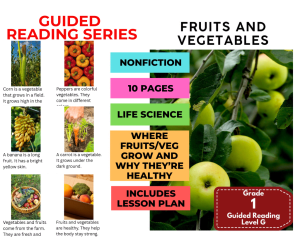
Fruits and Vegetables: Guided Reading Level G with Lesson Plan
ELA, Resources for Teachers, Reading Comprehension, Reading, Science, Language Development, Life Sciences, Health, P.E. & Health, Vocabulary, Kindergarten, Grade 1, 2, Worksheets & Printables, Worksheets, Teacher Tools, Centers, Activities, Literacy Readers, Quizzes, Quizzes and Tests, Assessments, Lesson Plans
This Fruits and Vegetables (level g) guided reading book with lesson plan includes: Guided Reading Color Label (front cover x1) This is a quick way to match the book’s demands to what students can generally handle.. The overall goal is to use the level/color to pick books for several smaller groups. To qualify for a certain level, a student is expected to read a book from that level with about 90–94% accuracy. If a student is consistently accurate and understands, move up a level. If the student is struggling at that level, drop down and add more support. Each student will improve at completely different rates, but it is generally one of the best ways to check progress across the class. DOWNLOAD THE CATALOG TO VIEW ALL GUIDED READING BOOKS AVAILABLE (SORTED LEVELS A-Z) Pre-Reading Question (x1) Teacher asks the prompt aloud, can be while showing the cover or first page. Students share what they already know, or make educated guesses from the cover. Prompt them to use the target vocabulary. Write some of their responses on the board to look back at during the reading. Vocabulary Words (x5) Introduce the five words, best doing it one at a time. Start by saying it, while students repeat and then see if anyone knows what it means before reading further. Read through the meaning and try to briefly connect each word to a picture or gesture so it’s meaningful. Ask students to flip through the book pages and point to where they see each of the vocabulary words. While reading the book pause upon coming across one of the vocab words or read the sentence twice to make sure students understand the word has appeared. Optional: Ask students to raise hands whenever they see/hear one of the new words. Guided Reading Pages (x10) Check the book snapshot (below) for: primary topic - do you need to prep extra reading or intro materials on this? what is taught best - decide on 1-2 bullets to focus on, use the prompt or words provided here for best results. learning goals - what you are checking for students to be able to do after the session, elicit answers using prompts or words provided. key vocabulary (see section above). questions overview - so you know what is coming up and if you need to prep extra materials to assist understanding. Run the lesson You may have already looked at a few of the pages together, but you can show them some of the pictures again first to set meaning. Depending on how much time you have and how familiar your students are with guided reading class, you may want to read the book aloud first with the group first. Students whisper or partner read, while you listen in. If time, do it as a group, one student reading a page each. Use the guided page’s prompts to coach: “Check the picture / does it make sense?” “Point under the words / try the first sound” “Reread the sentence smoothly”. Try to focus more on one student per session (rotating every time), so you can work out if they are ready to move up or need to move down a level. Comprehension Questions (back cover x3) This is your way to check that students didn’t just say the words, but actually understood the text. First, let students answer by pointing to the page/picture and saying a short sentence. After any answer, follow with: “Show me where you found that in the text.” In bigger groups, have partners answer first (10–20 seconds), then call on 2–3 students to share. Differentiation tips: Emerging speakers/struggling readers: oral + pointing On-level: oral in a full sentence Higher: one written sentence or draw + label Book Snapshot Title: Fruits and Vegetables Genre: Nonfiction Subject: Life Science (Plants and food) Primary Topic: Where fruits/vegetables grow and why they’re healthy Estimated Guided Reading Level (A–Z): G What This Book Teaches Best Many foods come from plants , and plants grow in the sun. Examples of fruits and where they grow (apple on a tall tree; banana with bright yellow skin). Examples of vegetables and where they grow (carrot under the ground; corn in a field; peppers in different colors; broccoli looks like a tiny tree). A simple fruit feature: most fruits have seeds inside (watermelon has many small seeds). Health connection: fruits and vegetables are healthy and help the body stay strong. Learning Goals Students will identify what the book says many foods come from. Students will describe where at least one fruit grows (example from the text). Students will describe where at least one vegetable grows (example from the text). Students will explain what the book says about seeds in fruits. Students will explain how fruits and vegetables help the body, using the book’s words. Key Vocabulary From the Text plants — living things that grow in the sun. fruit — food that can grow on a tree. vegetable — food that can grow in the ground. seeds — small parts inside fruits. healthy — good for your body. Discussion Prompts Pre-reading question: What fruits and vegetables do you already know, and where do you think they grow? Comprehension questions: What does the book say many foods come from? Comprehension questions: Where does the book say a carrot grows? Comprehension questions: How do fruits and vegetables help the body, according to the book? Printing Tips 1. Best Printing Method (Recommended) “Booklet” Printing (Best if Available) If your printer or PDF viewer supports Booklet Printing , use this. Settings to use: Print mode: Booklet Paper size: Letter or A4 (either works) Orientation: Landscape Print on both sides: Yes Flip on: Short edge Scaling: Fit to printable area Booklet subset: First test: Front sides only Then: Back sides only This will automatically: Pair pages correctly Put the cover on the outside Align everything for folding After printing, fold in half and staple along the spine . 2. If “Booklet” Printing Is NOT Available You can still print this correctly with manual duplex printing . Step-by-step: Open the PDF. Choose Print . Set: Orientation: Landscape Pages per sheet: 1 Print on both sides: Yes Flip on: Short edge Print all pages . Because each PDF page already contains two facing book pages, the result will still fold cleanly into a book. Thousands of Cored Education products are included with your TeachSimple membership. Download links and encyclopedia index available here.
Author Cored Education
Rating
Tags Reading Comprehension, Reading Passages, Reading, Guided Reading, Guided Reading Lesson Plan, Guided Reading Activity, Pre-reading, Science Lesson Plans, Life Science, Health
Reading Passage 44: Classification of the Sun and Other Stars PPT
Science, Earth and Environmental Sciences, Earth Sciences, Common Core, ESL, Language Development, ELA, Reading Comprehension, Reading, Space, Grade 5, 6, 7, Teacher Tools, Presentations, Activities, Tests, Quizzes and Tests, Assessments
Free Reading Passage on Classification of the Sun and Other Stars for Earth Science What's inside this free product? Science Reading Comprehension Passage: Classification of the Sun and Other Stars Independent PPT Version: This is the independent PPT version containingone lesson. Product Info: 37 Slides (US English with Answers) PPT Version Teaching Duration: 90 Minutes Science Reading Comprehension Outline: Introducing a comprehensive resource tailored for 5th and 6th graders, this product offers enriching reading passages supplemented with illustrative pictures and graphs to clarify key concepts. Aligned with the Common Core State Standards (CCSS), it offers a hassle-free approach to teaching, given that the bulk of the preparation is already done for you. The passages present a diverse set of questions – from multiple choice to data analysis and fill-in-the-blanks. This ensures a rich blend of high-interest content and fundamental curriculum-based science themes. With its versatility, you can seamlessly integrate these lessons into various classroom settings, whether it's whole class discussions, morning exercises, independent desk tasks, small group engagements, contingency plans for substitute teachers, regular homework assignments, or even themed activities for holidays. FULL CATALOG OF DOWNLOAD LINKS HERE Grade 5/6 Links: Physical Science Part 1 - Physical and Chemical Properties Google Docs/Slides/Forms PDF PPT Word Free Supplementary Pack Accompanying Videos Physical Science Part 2 - Motion and Energy Google Docs/Slides/Forms PDF PPT Word Free Supplementary Pack Accompanying Videos Physical Science Part 3 - Electricity and Magnets Google Docs/Slides/Forms PDF PPT Word Free Supplementary Pack Accompanying Videos Life Science Part 1 - Cells, Reproduction and Genetics Google Docs/Slides/Forms PDF PPT Word Free Supplementary Pack Accompanying Videos Life Science Part 2 - Human Body Systems Google Docs/Slides/Forms PDF PPT Word Free Supplementary Pack Accompanying Videos Life Science Part 3 - Plant Parts and Ecosystems Google Docs/Slides/Forms PDF PPT Word Free Supplementary Pack Accompanying Videos Earth Science Part 1 - Plate Tectonics and Rock Cycle Google Docs/Slides/Forms PDF PPT Word Free Supplementary Pack Accompanying Videos Earth Science Part 2 - Ocean Exploration and Natural Resources Google Docs/Slides/Forms PDF PPT Word Free Supplementary Pack Accompanying Videos Earth Science Part 3 - Weather and Solar System Google Docs/Slides/Forms PDF PPT Word Free Supplementary Pack Accompanying Videos For similar products and other frees, do check out Cored Group on TeachSimple .
Author Cored Education
Tags Science, Elementary, Reading, Comprehension, Vocabulary, Answers, Physics, Physical Science, Ccss, Common Core

Guided Reading Level M - Shanghai (with Lesson Plan)
ELA, Resources for Teachers, Reading Comprehension, Reading, Science, Earth and Environmental Sciences, Economics, Social Studies, Geography, Language Development, Grade 2, 3, 4, Worksheets & Printables, Worksheets, Teacher Tools, Centers, Activities, Literacy Readers, Quizzes, Quizzes and Tests, Assessments, Lesson Plans
This Guided Reading Book - Shanghai (Level M) with lesson plan includes: Guided Reading Color Label (front cover x1) This is a quick way to match the book’s demands to what students can generally handle.. The overall goal is to use the level/color to pick books for several smaller groups. To qualify for a certain level, a student is expected to read a book from that level with about 90–94% accuracy. If a student is consistently accurate and understands, move up a level. If the student is struggling at that level, drop down and add more support. Each student will improve at completely different rates, but it is generally one of the best ways to check progress across the class. DOWNLOAD THE CATALOG TO VIEW ALL GUIDED READING BOOKS AVAILABLE (SORTED LEVELS A-Z) Pre-Reading Question (x1) Teacher asks the prompt aloud, can be while showing the cover or first page. Students share what they already know, or make educated guesses from the cover. Prompt them to use the target vocabulary. Write some of their responses on the board to look back at during the reading. Vocabulary Words (x5) Introduce the five words, best doing it one at a time. Start by saying it, while students repeat and then see if anyone knows what it means before reading further. Read through the meaning and try to briefly connect each word to a picture or gesture so it’s meaningful. Ask students to flip through the book pages and point to where they see each of the vocabulary words. While reading the book pause upon coming across one of the vocab words or read the sentence twice to make sure students understand the word has appeared. Optional: Ask students to raise hands whenever they see/hear one of the new words. Guided Reading Pages (x10) Check the book snapshot (below) for: primary topic - do you need to prep extra reading or intro materials on this? what is taught best - decide on 1-2 bullets to focus on, use the prompt or words provided here for best results. learning goals - what you are checking for students to be able to do after the session, elicit answers using prompts or words provided. key vocabulary (see section above). questions overview - so you know what is coming up and if you need to prep extra materials to assist understanding. Run the lesson You may have already looked at a few of the pages together, but you can show them some of the pictures again first to set meaning. Depending on how much time you have and how familiar your students are with guided reading class, you may want to read the book aloud first with the group first. Students whisper or partner read, while you listen in. If time, do it as a group, one student reading a page each. Use the guided page’s prompts to coach: “Check the picture / does it make sense?” “Point under the words / try the first sound” “Reread the sentence smoothly”. Try to focus more on one student per session (rotating every time), so you can work out if they are ready to move up or need to move down a level. Comprehension Questions (back cover x3) This is your way to check that students didn’t just say the words, but actually understood the text. First, let students answer by pointing to the page/picture and saying a short sentence. After any answer, follow with: “Show me where you found that in the text.” In bigger groups, have partners answer first (10–20 seconds), then call on 2–3 students to share. Differentiation tips: Emerging speakers/struggling readers: oral + pointing On-level: oral in a full sentence Higher: one written sentence or draw + label Book Snapshot Title: World Cities: Shanghai Genre: Nonfiction (informational text) Subject: Social Studies (Geography) Primary Topic: Shanghai’s location, waterways, and key city features Estimated Guided Reading Level (A–Z): M What This Book Teaches Best Explains where Shanghai is located and why its place near the Yangtze River Delta and the East China Sea matters. Describes how the Huangpu River functions as a major waterway and supports large ships year-round because the water never freezes. Compares two parts of the city along the river—Pudong’s modern skyline and Puxi’s historic area, including the Bund. Connects landforms to city development by explaining Shanghai’s flat, alluvial plain and limited land. Highlights how waterways and islands shape life and trade, including Suzhou Creek, Chongming Island habitats, and a deep-water port for global shipping. Learning Goals Identify Shanghai’s location on the eastern coast of China using details from the text. Explain why the Huangpu River is important for ships, based on the book’s description. Describe how Pudong and Puxi are different, using evidence from the text. Describe Shanghai’s landform (an alluvial plain) and tell what that means for mountains or hills in the main city area. Explain how islands and waterways support wildlife, neighborhoods, and trade in and around Shanghai. Describe Shanghai’s climate and seasons as stated in the book. Key Vocabulary From the Text vital — very important. waterway — a river or channel ships can travel on. district — a part of a city. alluvial — made from soil rivers leave behind over time. tributary — a smaller river or stream that flows into a larger river. Discussion Prompts Pre-reading question: What places in a city might be built near water, and why? Comprehension questions: Where does the text say Shanghai is located? Comprehension questions: What does the text say makes the Huangpu River important for large ships? Comprehension questions: What details does the book give about Shanghai’s climate and seasons? Printing Tips 1. Best Printing Method (Recommended) “Booklet” Printing (Best if Available) If your printer or PDF viewer supports Booklet Printing , use this. Settings to use: Print mode: Booklet Paper size: Letter or A4 (either works) Orientation: Landscape Print on both sides: Yes Flip on: Short edge Scaling: Fit to printable area Booklet subset: First test: Front sides only Then: Back sides only This will automatically: Pair pages correctly Put the cover on the outside Align everything for folding After printing, fold in half and staple along the spine . 2. If “Booklet” Printing Is NOT Available You can still print this correctly with manual duplex printing . Step-by-step: Open the PDF. Choose Print . Set: Orientation: Landscape Pages per sheet: 1 Print on both sides: Yes Flip on: Short edge Print all pages . Because each PDF page already contains two facing book pages, the result will still fold cleanly into a book. Thousands of Cored Education products are included with your TeachSimple membership. Download links and encyclopedia index available here.
Author Cored Education
Rating
Tags Reading Comprehension, Reading Passages, Reading, Guided Reading, Guided Reading Lesson Plan, Guided Reading Activity, Pre-reading, Social Studies Lesson Plans, Geography, Economics
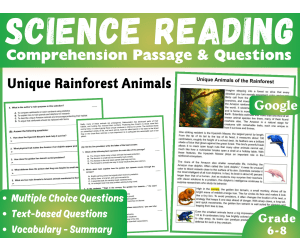
Life Science Reading Comprehension Passage: Rainforest Animals (Docs)
Science, ELA, Reading, Reading Comprehension, Strategies, Resources for Teachers, Life Sciences, Animals, Grade 6, 7, 8, 9, Writing Prompts, Worksheets & Printables, Centers, Activities, Teacher Tools, Assessments, Quizzes and Tests, Quizzes, Tests
Life Science Reading Comprehension Passage and Questions: Unique Rainforest Animals (Docs) This very engaging life science reading passage about Unique Rainforest Animals . It describes several rainforest animals, including the Hyacinth Macaw , Amazon river dolphin , golden lion tamarin , and poison dart frog . The passage explains each animal’s special traits, such as strong beaks, pink coloring, intelligence, climbing ability, warning colors, and toxins. It also explains that many of these animals are threatened by deforestation and hunting , so protecting the Amazon means protecting their habitats. This passage is designed to bridge the gap between science and literacy through strengthening reading comprehension and sparking scientific curiosity in middle school students. The passage blends English Language Arts skills with accurate science content that supports NGSS classroom practice. Ideal for interdisciplinary learning in ELA and Science. Suitable for Grade 9 review, too! Student Tasks for The Passage: 5 multiple-choice questions targeting main idea, key details, inference, vocabulary in context, and use of evidence 5 vocabulary matching items with clear, student-friendly definitions 5 text-based questions that require citing specific lines or facts 1 summary prompt that asks students to condense central ideas accurately Full answer key for every section Available Formats for this Resource PDF Fillable PDF Word Docs FULL CATALOG OF DOWNLOADING LINKS HERE Product Details Length: 5 pages total Grades: 6–8, also suitable for Grade 9 review Use cases: close reading, stations, homework, intervention, test prep, and sub plans Standards support: reinforces informational-text skills and supports NGSS-style sense making through observation, modeling, and clear use of claim, evidence, and reasoning Why Teachers Choose This Set Authentic science content paired with rigorous literacy practice Consistent task structure across all passages for easier planning and smoother student routines Clear, age-appropriate writing that builds confidence without oversimplifying Other Science Reading Collections you May find in the store: 1. Astronomy & Space Science 2. Volcanoes, Rocks, & Mountains 3. Rock Cycle, Soil, & Sinkholes 4. Mars, Glaciers, & Antarctica 5. Water Cycle, Acid Rain, & Wastewater 6. Insects, Animals, & Ecosystems 7. Bioluminescence & Insects 8. Animal Skin, Cats, & T. Rex 9. Human Body and Senses 10. Health & Applied Bioscience 11. Waves, Light, & Imaging 12. Electricity & Energy 13. Motion & Materials 14. Chemistry and Materials Science Use this set to reinforce ELA skills in science, to add literacy to your lessons, and to support independent work. The passages strengthen main idea, evidence use, vocabulary in context, inference, cause and effect, and summary writing. With ready-to-use assessments and complete answer keys, you can provide focused practice that is simple to run and fast to review.
Author Middle & High School - CORED Education
Rating
Tags Middle School, Reading Comprehension, Reading Strategies, ELA, Centers, Reading Passage, Assessments, Vocabulary, Life Science, Rainforest Animals

Science Reading Comprehension Passage 32: Vertebrates PDF
ELA, Reading, Reading Comprehension, Common Core, ESL, Language Development, Spelling, Life Sciences, Science, Grade 5, 6, 7, Worksheets & Printables, Worksheets, Assessments, Teacher Tools, Tests, Quizzes and Tests
Free Reading Passage on Vertebrates for Life Science What's inside this free product? Science Reading Comprehension Passage: Vertebrates Independent PDF Version: This is the independent PDF version containingone lesson. Product Info: 8 PAGES (US English with Answers) PDF Version Teaching Duration: 90 Minutes Science Reading Comprehension Outline: Introducing a comprehensive resource tailored for 5th and 6th graders, this product offers enriching reading passages supplemented with illustrative pictures and graphs to clarify key concepts. Aligned with the Common Core State Standards (CCSS), it offers a hassle-free approach to teaching, given that the bulk of the preparation is already done for you. The passages present a diverse set of questions – from multiple choice to data analysis and fill-in-the-blanks. This ensures a rich blend of high-interest content and fundamental curriculum-based science themes. With its versatility, you can seamlessly integrate these lessons into various classroom settings, whether it's whole class discussions, morning exercises, independent desk tasks, small group engagements, contingency plans for substitute teachers, regular homework assignments, or even themed activities for holidays. FULL CATALOG OF DOWNLOAD LINKS HERE Grade 5/6 Links: Physical Science Part 1 - Physical and Chemical Properties Google Docs/Slides/Forms PDF PPT Word Free Supplementary Pack Accompanying Videos Physical Science Part 2 - Motion and Energy Google Docs/Slides/Forms PDF PPT Word Free Supplementary Pack Accompanying Videos Physical Science Part 3 - Electricity and Magnets Google Docs/Slides/Forms PDF PPT Word Free Supplementary Pack Accompanying Videos Life Science Part 1 - Cells, Reproduction and Genetics Google Docs/Slides/Forms PDF PPT Word Free Supplementary Pack Accompanying Videos Life Science Part 2 - Human Body Systems Google Docs/Slides/Forms PDF PPT Word Free Supplementary Pack Accompanying Videos Life Science Part 3 - Plant Parts and Ecosystems Google Docs/Slides/Forms PDF PPT Word Free Supplementary Pack Accompanying Videos Earth Science Part 1 - Plate Tectonics and Rock Cycle Google Docs/Slides/Forms PDF PPT Word Free Supplementary Pack Accompanying Videos Earth Science Part 2 - Ocean Exploration and Natural Resources Google Docs/Slides/Forms PDF PPT Word Free Supplementary Pack Accompanying Videos Earth Science Part 3 - Weather and Solar System Google Docs/Slides/Forms PDF PPT Word Free Supplementary Pack Accompanying Videos For similar products and other frees, do check out Cored Group on TeachSimple .
Author Cored Education
Tags Science, Elementary, Reading, Comprehension, Vocabulary, Answers, Physics, Physical Science, Ccss, Common Core

Free Reading Passage: Objects in the Sky (Google Forms)
ELA, Reading, Reading Comprehension, Science, Earth and Environmental Sciences, Earth Sciences, Common Core, ESL, Language Development, Vocabulary, Grade 2, 3, 4, Centers, Activities, Assessments, Teacher Tools, Tests, Quizzes and Tests
Free Reading Passage on Objects in the Sky for Earth Science What's inside this free product? Science Reading Comprehension Passage40 : Objects in the Sky Independent Google Forms Version: This is the independent Google Forms version containingone lesson with full answer keys. Product Info: 1 form (US English with Answers) Google Forms Version Teaching Duration: Approximately 90 Minutes Science Reading Comprehension Outline: Targeted for students in 3rd and 4th grades, these reading passages are enhanced with illustrations and graphs to elucidate critical points. Each lesson aligns with the Common Core State Standards, allowing you to integrate science reading practice effortlessly, knowing that minimal preparation is needed on your part. Each passage comes with a variety of questions in different formats, including multiple-choice formats, data analysis, and fill-in-the-blanks. The topics covered strike a balance between engaging content and core curriculum-based science subjects. Versatile in application, these lessons are suitable for a variety of settings such as whole-class instruction, morning activities, independent desk work, small group discussions, contingency plans for substitute teachers, homework assignments, or even special holiday-themed tasks. FULL CATALOG OF DOWNLOAD LINKS HERE Grade 3/4 Links: Physical Science Part 1 - Properties of Objects and Materials Google Docs/Slides/Forms PDF PPT Word Free Supplementary Pack Accompanying Videos Physical Science Part 2 - Position and Motion of Objects Google Docs/Slides/Forms PDF PPT Word Free Supplementary Pack Accompanying Videos Physical Science Part 3 - Light, Heat, Electricity, Magnetism Google Docs/Slides/Forms PDF PPT Word Free Supplementary Pack Accompanying Videos Life Science Part 1 - Characteristics of Organisms Google Docs/Slides/Forms PDF PPT Word Free Supplementary Pack Accompanying Videos Life Science Part 2 - Life Cycles of Organisms Google Docs/Slides/Forms PDF PPT Word Free Supplementary Pack Accompanying Videos Life Science Part 3 - Organisms and Environments Google Docs/Slides/Forms PDF PPT Word Free Supplementary Pack Accompanying Videos Earth Science Part 1 - Properties of Earth Materials Google Docs/Slides/Forms PDF PPT Word Free Supplementary Pack Accompanying Videos Earth Science Part 2 - Changes in the Earth and Sky Google Docs/Slides/Forms PDF PPT Word Free Supplementary Pack Accompanying Videos Earth Science Part 3 - Objects in the Sky Google Docs/Slides/Forms PDF PPT Word Free Supplementary Pack Accompanying Videos For similar products and other frees, do check out Cored Group on TeachSimple .
Author Cored Education
Tags Science, Elementary, Reading, Comprehension, Vocabulary, Answers, Physics, Physical Science, Ccss, Common Core
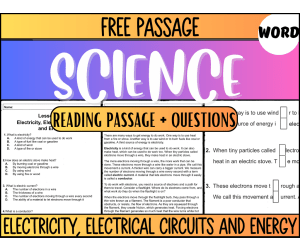
Reading Passage: Electricity, Electrical Circuits, and Energy (Word)
ELA, Reading, Reading Comprehension, Science, Physics, Common Core, ESL, Language Development, Spelling, Resources for Teachers, Grade 2, 3, 4, Worksheets & Printables, Worksheets, Assessments, Teacher Tools, Tests, Quizzes and Tests
Free Reading Passage on Electricity, Electrical Circuits, and Energy for Physical Science What's inside this free product? Science Reading Comprehension Passage12 : Electricity, Electrical Circuits, and Energy Independent Word Version: This is the independent Word version containingone lesson with full answer keys. Product Info: 5 PAGES (US English with Answers) Word Version Teaching Duration: 90 Minutes Science Reading Comprehension Outline: Targeted for students in 3rd and 4th grades, these reading passages are enhanced with illustrations and graphs to elucidate critical points. Each lesson aligns with the Common Core State Standards, allowing you to integrate science reading practice effortlessly, knowing that minimal preparation is needed on your part. Each passage comes with a variety of questions in different formats, including multiple-choice formats, data analysis, and fill-in-the-blanks. The topics covered strike a balance between engaging content and core curriculum-based science subjects. Versatile in application, these lessons are suitable for a variety of settings such as whole-class instruction, morning activities, independent desk work, small group discussions, contingency plans for substitute teachers, homework assignments, or even special holiday-themed tasks. FULL CATALOG OF DOWNLOAD LINKS HERE Grade 3/4 Links: Physical Science Part 1 - Properties of Objects and Materials Google Docs/Slides/Forms PDF PPT Word Free Supplementary Pack Accompanying Videos Physical Science Part 2 - Position and Motion of Objects Google Docs/Slides/Forms PDF PPT Word Free Supplementary Pack Accompanying Videos Physical Science Part 3 - Light, Heat, Electricity, Magnetism Google Docs/Slides/Forms PDF PPT Word Free Supplementary Pack Accompanying Videos Life Science Part 1 - Characteristics of Organisms Google Docs/Slides/Forms PDF PPT Word Free Supplementary Pack Accompanying Videos Life Science Part 2 - Life Cycles of Organisms Google Docs/Slides/Forms PDF PPT Word Free Supplementary Pack Accompanying Videos Life Science Part 3 - Organisms and Environments Google Docs/Slides/Forms PDF PPT Word Free Supplementary Pack Accompanying Videos Earth Science Part 1 - Properties of Earth Materials Google Docs/Slides/Forms PDF PPT Word Free Supplementary Pack Accompanying Videos Earth Science Part 2 - Changes in the Earth and Sky Google Docs/Slides/Forms PDF PPT Word Free Supplementary Pack Accompanying Videos Earth Science Part 3 - Objects in the Sky Google Docs/Slides/Forms PDF PPT Word Free Supplementary Pack Accompanying Videos For similar products and other frees, do check out Cored Group on TeachSimple .
Author Cored Education
Tags Science, Elementary, Reading, Comprehension, Vocabulary, Answers, Physics, Physical Science, Ccss, Common Core
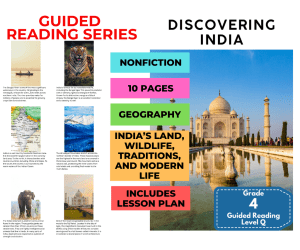
Discovering India: Guided Reading Level Q with Lesson Plan
ELA, Resources for Teachers, Reading Comprehension, Reading, Science, Geography, Social Studies, Technology, History, Life Sciences, Grade 3, 4, 5, Worksheets & Printables, Worksheets, Teacher Tools, Centers, Activities, Literacy Readers, Quizzes, Quizzes and Tests, Assessments, Lesson Plans
This Discovering India (level q) guided reading book with lesson plan includes: Guided Reading Color Label (front cover x1) This is a quick way to match the book’s demands to what students can generally handle.. The overall goal is to use the level/color to pick books for several smaller groups. To qualify for a certain level, a student is expected to read a book from that level with about 90–94% accuracy. If a student is consistently accurate and understands, move up a level. If the student is struggling at that level, drop down and add more support. Each student will improve at completely different rates, but it is generally one of the best ways to check progress across the class. DOWNLOAD THE CATALOG TO VIEW ALL GUIDED READING BOOKS AVAILABLE (SORTED LEVELS A-Z) Pre-Reading Question (x1) Teacher asks the prompt aloud, can be while showing the cover or first page. Students share what they already know, or make educated guesses from the cover. Prompt them to use the target vocabulary. Write some of their responses on the board to look back at during the reading. Vocabulary Words (x5) Introduce the five words, best doing it one at a time. Start by saying it, while students repeat and then see if anyone knows what it means before reading further. Read through the meaning and try to briefly connect each word to a picture or gesture so it’s meaningful. Ask students to flip through the book pages and point to where they see each of the vocabulary words. While reading the book pause upon coming across one of the vocab words or read the sentence twice to make sure students understand the word has appeared. Optional: Ask students to raise hands whenever they see/hear one of the new words. Guided Reading Pages (x10) Check the book snapshot (below) for: primary topic - do you need to prep extra reading or intro materials on this? what is taught best - decide on 1-2 bullets to focus on, use the prompt or words provided here for best results. learning goals - what you are checking for students to be able to do after the session, elicit answers using prompts or words provided. key vocabulary (see section above). questions overview - so you know what is coming up and if you need to prep extra materials to assist understanding. Run the lesson You may have already looked at a few of the pages together, but you can show them some of the pictures again first to set meaning. Depending on how much time you have and how familiar your students are with guided reading class, you may want to read the book aloud first with the group first. Students whisper or partner read, while you listen in. If time, do it as a group, one student reading a page each. Use the guided page’s prompts to coach: “Check the picture / does it make sense?” “Point under the words / try the first sound” “Reread the sentence smoothly”. Try to focus more on one student per session (rotating every time), so you can work out if they are ready to move up or need to move down a level. Comprehension Questions (back cover x3) This is your way to check that students didn’t just say the words, but actually understood the text. First, let students answer by pointing to the page/picture and saying a short sentence. After any answer, follow with: “Show me where you found that in the text.” In bigger groups, have partners answer first (10–20 seconds), then call on 2–3 students to share. Differentiation tips: Emerging speakers/struggling readers: oral + pointing On-level: oral in a full sentence Higher: one written sentence or draw + label Book Snapshot Title: Discovering India Genre: Nonfiction Subject: Social Studies (Geography/Culture) Primary Topic: India’s land, wildlife, traditions, and modern life Estimated Guided Reading Level (A–Z): Q What This Book Teaches Best Key geography facts about India’s location in Southern Asia, nearby borders, and surrounding waters. How landforms shape life in India, including the Himalayan Mountains and the Ganges River. Notable wildlife of India through examples like the Bengal tiger and the Indian elephant. Cultural traditions and everyday life, including spices used in meals and the celebration of Diwali. Modern India today, including transportation (auto-rickshaws) and major cities connected to technology and innovation. Learning Goals Students will describe where India is located and name details about its borders and southern waters. Students will explain how the Himalayan Mountains are described as protecting the inner plains. Students will explain why the Ganges River is important to people and farming in northern India. Students will describe key traits of the Bengal tiger and the Indian elephant using details from the text. Students will identify facts about the Taj Mahal, including where it is and features described in the book. Students will describe examples of Indian culture and modern life mentioned in the text (foods/spices, Diwali, transportation, cities). Key Vocabulary From the Text vast — very large in size. significant — very important. distinctive — easy to notice because it looks different. minarets — tall towers on a monument. diyas — small clay lamps used during Diwali. Discussion Prompts Pre-reading question: What are you hoping to learn about India as you read? Comprehension questions: What warm waters does the text say surround India to the south? Comprehension questions: According to the text, why is the Ganges River essential? Comprehension questions: What does the text say diyas symbolize during Diwali? Printing Tips 1. Best Printing Method (Recommended) “Booklet” Printing (Best if Available) If your printer or PDF viewer supports Booklet Printing , use this. Settings to use: Print mode: Booklet Paper size: Letter or A4 (either works) Orientation: Landscape Print on both sides: Yes Flip on: Short edge Scaling: Fit to printable area Booklet subset: First test: Front sides only Then: Back sides only This will automatically: Pair pages correctly Put the cover on the outside Align everything for folding After printing, fold in half and staple along the spine . 2. If “Booklet” Printing Is NOT Available You can still print this correctly with manual duplex printing . Step-by-step: Open the PDF. Choose Print . Set: Orientation: Landscape Pages per sheet: 1 Print on both sides: Yes Flip on: Short edge Print all pages . Because each PDF page already contains two facing book pages, the result will still fold cleanly into a book. Thousands of Cored Education products are included with your TeachSimple membership. Download links and encyclopedia index available here.
Author Cored Education
Rating
Tags Reading Comprehension, Reading Passages, Reading, Guided Reading, Guided Reading Lesson Plan, Guided Reading Activity, Pre-reading, Social Studies, Geography, History
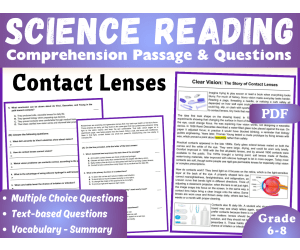
Life Science Reading Comprehension Passage: Clear Vision (PDF)
Science, ELA, Reading, Reading Comprehension, Strategies, Resources for Teachers, Life Sciences, Grade 6, 7, 8, 9, Writing Prompts, Worksheets & Printables, Centers, Activities, Teacher Tools, Assessments, Quizzes and Tests, Quizzes, Tests
Life Science Reading Comprehension Passage and Questions: Clear Vision (PDF) This very engaging life science reading passage about the history, science, and everyday use of contact lenses. It explains how contact lenses developed from early ideas by Leonardo da Vinci, René Descartes, and Thomas Young into practical lenses used today. It also explains how contacts work by bending light so it focuses correctly on the retina , helping correct nearsightedness, farsightedness, and astigmatism . The passage also discusses soft lenses, silicone hydrogel, daily use, safety habits, and future lens technology. This passage is designed to bridge the gap between science and literacy through strengthening reading comprehension and sparking scientific curiosity in middle school students. The passage blends English Language Arts skills with accurate science content that supports NGSS classroom practice. Ideal for interdisciplinary learning in ELA and Science. Suitable for Grade 9 review, too! Student Tasks for The Passage: 5 multiple-choice questions targeting main idea, key details, inference, vocabulary in context, and use of evidence 5 vocabulary matching items with clear, student-friendly definitions 5 text-based questions that require citing specific lines or facts 1 summary prompt that asks students to condense central ideas accurately Full answer key for every section Available Formats for this Resource Fillable PDF Word Docs Google Docs FULL CATALOG OF DOWNLOADING LINKS HERE Product Details Length: 5 pages total Grades: 6–8, also suitable for Grade 9 review Use cases: close reading, stations, homework, intervention, test prep, and sub plans Standards support: reinforces informational-text skills and supports NGSS-style sense making through observation, modeling, and clear use of claim, evidence, and reasoning Why Teachers Choose This Set Authentic science content paired with rigorous literacy practice Consistent task structure across all passages for easier planning and smoother student routines Clear, age-appropriate writing that builds confidence without oversimplifying Other Science Reading Collections you May find in the store: 1. Astronomy & Space Science 2. Volcanoes, Rocks, & Mountains 3. Rock Cycle, Soil, & Sinkholes 4. Mars, Glaciers, & Antarctica 5. Water Cycle, Acid Rain, & Wastewater 6. Insects, Animals, & Ecosystems 7. Bioluminescence & Insects 8. Animal Skin, Cats, & T. Rex 9. Human Body and Senses 10. Health & Applied Bioscience 11. Waves, Light, & Imaging 12. Electricity & Energy 13. Motion & Materials 14. Chemistry and Materials Science Use this set to reinforce ELA skills in science, to add literacy to your lessons, and to support independent work. The passages strengthen main idea, evidence use, vocabulary in context, inference, cause and effect, and summary writing. With ready-to-use assessments and complete answer keys, you can provide focused practice that is simple to run and fast to review.
Author Middle & High School - CORED Education
Rating
Tags Middle School, Reading Comprehension, Reading Strategies, ELA, Centers, Reading Passage, Assessments, Vocabulary, Life Science
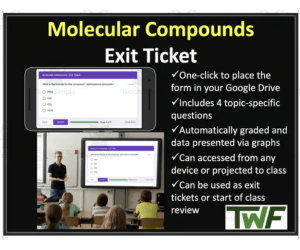
Molecular Compounds - Exit Ticket and Review Activity
Science, Chemistry, Grade 10, 11, 12, Teacher Tools, Assessments
Molecular Compounds - Digital Exit Ticket and Review Activity Assess and enhance student comprehension of core concepts with this interactive exit ticket and review. This digital resource features a series of questions that gauge understanding of essential topics covered in class including; Ionic compounds review, Molecular compounds, Electron sharing, Single, Double, Triple bonds, Naming compounds, Writing formulas, and Diatomic gases. With a single click, this Google Form will be copied into your Google drive for easy access. You will then be able to make any changes you feel necessary and distribute out to your students. With this exit ticket, educators can: Check for student understanding of key areas. Get instant insights into students' grasp of concepts through automatically graded questions and easy-to-read results charts. Identify areas students are struggling with to refine instruction. Incorporate exit ticket data into student grades as a formative assessment . Students are able to: Demonstrate their knowledge of concepts through short answer and multiple choice questions. Get immediate feedback on their responses to support metacognition. Review core ideas before a test or the next class. This digital review resource allows teachers to quickly assess student learning outcomes related to essential principles. The automatically graded Google Form provides data visualizations that highlight comprehension gaps to address. An engaging way to end or begin a class while promoting understanding without adding to your workload as a teacher.
Author Teach With Fergy
Tags Chemical Reactions, Molecular Compounds, Electron Sharing, Naming Molecular Compounds, Molecular Compound Formulas, Diatomic Gases

Reading Passages on Plate Tectonics and Rock Cycle (Word)
ELA, Reading, Reading Comprehension, Science, Earth and Environmental Sciences, Earth Sciences, Common Core, ESL, Language Development, Vocabulary, Grade 5, 6, 7, Diagrams, Teacher Tools, Tests, Quizzes and Tests, Assessments, Worksheets, Worksheets & Printables
Reading Passages on Plate Tectonics and Rock Cycle for Earth Science Plate Tectonics and Rock Cycle: Reading Passages Earth Science - Engage students with captivating reading passages on circuits, electricity, and energy sources. These lessons are designed to simplify science assessments and ignite your students' passion for learning. CCSS aligned, this pack enhances student understanding, ensures test readiness, and brings science to life. Science Reading Comprehension Outline: Looking for a ready-to-use science resource that keeps your 5th and 6th graders engaged and learning? This pack is designed just for you! Each reading passage is paired with colorful illustrations and easy-to-read graphs to help students grasp key science concepts with confidence. Aligned with Common Core standards, the resource includes a variety of question types—multiple choice, data analysis, and fill-in-the-blank—so your students get well-rounded practice in both reading and science skills. Best of all, it’s flexible and easy to use. Whether you’re leading a whole class lesson, planning a sub day, assigning homework, or setting up a quiet morning task, these no-prep activities fit right in. They also work great for small groups, independent desk work, or even as quick review pages during the holidays! What's inside? Part 1 - Plate Tectonics & Rock Cycle Reading Passage1: Plate Tectonics Reading Passage2: Rock Cycle Erosion and Deposition Reading Passage3: Properties of Rocks and Minerals Reading Passage4: Geological Time Product Info: 26 PAGES (Word version with Answers) Teaching Duration: Approximately 2 weeks FULL CATALOG OF DOWNLOAD LINKS HERE Grade 5/6 Links: Physical Science Part 1 - Physical and Chemical Properties Google Docs/Slides/Forms PDF PPT Word Free Supplementary Pack Accompanying Videos Physical Science Part 2 - Motion and Energy Google Docs/Slides/Forms PDF PPT Word Free Supplementary Pack Accompanying Videos Physical Science Part 3 - Electricity and Magnets Google Docs/Slides/Forms PDF PPT Word Free Supplementary Pack Accompanying Videos Life Science Part 1 - Cells, Reproduction and Genetics Google Docs/Slides/Forms PDF PPT Word Free Supplementary Pack Accompanying Videos Life Science Part 2 - Human Body Systems Google Docs/Slides/Forms PDF PPT Word Free Supplementary Pack Accompanying Videos Life Science Part 3 - Plant Parts and Ecosystems Google Docs/Slides/Forms PDF PPT Word Free Supplementary Pack Accompanying Videos Earth Science Part 1 - Plate Tectonics and Rock Cycle Google Docs/Slides/Forms PDF PPT Word Free Supplementary Pack Accompanying Videos Earth Science Part 2 - Ocean Exploration and Natural Resources Google Docs/Slides/Forms PDF PPT Word Free Supplementary Pack Accompanying Videos Earth Science Part 3 - Weather and Solar System Google Docs/Slides/Forms PDF PPT Word Free Supplementary Pack Accompanying Videos For similar products and other frees, do check out Cored Group on TeachSimple .
Author Cored Education
Rating
Tags Science, Elementary, Reading, Comprehension, Vocabulary, Answers, Ccss, Common Core, Earth Science

Science Reading Comprehension Physical & Chemical Properties Fillable
Science, Physics, Common Core, Reading Comprehension, Reading, ELA, Resources for Teachers, ESL, Language Development, Vocabulary, Grade 5, 6, 7, Worksheets & Printables, Worksheets, Centers, Activities, Tests, Quizzes and Tests, Teacher Tools, Quizzes, Assessments
Reading Comprehension Passages on Physical and Chemical Properties for Physical Science Physical & Chemical Properties Reading Passage1: Measuring Matter: Mass, Volume, and Density Reading Passage2: Physical and Chemical Properties of Matter Reading Passage 3: Physical and Chemical Changes in Matter Reading Passage4: Atoms, Elements, and Compounds Reading Passage5: Chemicals: Helpful and Harmful FILLABLE PDF VERSION Worksheet-style pages, but with type-in answer boxes so students can complete and save their work digitally. Other versions are available in the links list below or in the full catalog. Snapshot Genre: Nonfiction Subject: Physical Science Primary Topic: properties, changes, and structure of matter Estimated Guided Reading Level (A–Z): W What This Teaches Best Shows how to measure matter using mass, volume, and density, including formulas, cubic centimeters, milliliters, and a graduated cylinder. Teaches students to distinguish physical properties from chemical properties using examples such as buoyancy, conductivity, solubility, and flammability. Explains physical and chemical changes in matter, including melting, boiling, evaporation, condensation, mixtures, solutions, suspensions, and combustion. Builds foundational chemistry knowledge about atoms, elements, compounds, subatomic particles, and how the periodic table is organized. Connects chemistry to everyday safety by explaining acids, bases, neutral substances, pH testing, and safe handling of chemicals. Learning Goals Students will describe matter as anything that has weight and takes up space. Students will measure or calculate mass, volume, and density using the units and formulas given in the text. Students will identify and compare physical properties and chemical properties of matter using examples from the text. Students will explain the difference between physical changes and chemical changes using evidence from the lesson examples. Students will identify the parts of an atom and explain how elements and compounds are related. Students will classify substances as acidic, basic, or neutral and describe why some chemicals must be handled carefully. FULL CATALOG OF DOWNLOAD LINKS HERE Grade 5/6 Links: Physical Science Part 1 - Physical and Chemical Properties Google Docs/Slides/Forms PDF PPT Word Free Supplementary Pack Accompanying Videos Physical Science Part 2 - Motion and Energy Google Docs/Slides/Forms PDF PPT Word Free Supplementary Pack Accompanying Videos Physical Science Part 3 - Electricity and Magnets Google Docs/Slides/Forms PDF PPT Word Free Supplementary Pack Accompanying Videos Life Science Part 1 - Cells, Reproduction and Genetics Google Docs/Slides/Forms PDF PPT Word Free Supplementary Pack Accompanying Videos Life Science Part 2 - Human Body Systems Google Docs/Slides/Forms PDF PPT Word Free Supplementary Pack Accompanying Videos Life Science Part 3 - Plant Parts and Ecosystems Google Docs/Slides/Forms PDF PPT Word Free Supplementary Pack Accompanying Videos Earth Science Part 1 - Plate Tectonics and Rock Cycle Google Docs/Slides/Forms PDF PPT Word Free Supplementary Pack Accompanying Videos Earth Science Part 2 - Ocean Exploration and Natural Resources Google Docs/Slides/Forms PDF PPT Word Free Supplementary Pack Accompanying Videos Earth Science Part 3 - Weather and Solar System Google Docs/Slides/Forms PDF PPT Word Free Supplementary Pack Accompanying Videos For similar products and other frees, do check out Cored Group on TeachSimple .
Author Cored Education
Rating
Tags Science, Elementary, Reading, Comprehension, Vocabulary, Physics, Physical Science, Printables, Worksheets, Reading Passages
Eco-Intelligence:The Science of Winter Survival & Climate Adaptation
Winter, Seasons, Holiday & Seasonal, Science, Earth and Environmental Sciences, Earth Sciences, Environmental Science, Geology, Space, STEM, Homeschool Curriculum, Homeschool Templates, Grade 2, 3, 4, 5, 6, Worksheets & Printables, Workbooks, Worksheets, Teacher Tools, Assessments, Lesson Plans, Outlines, Presentations, Rubrics, Literacy Readers
Discover the ultimate Groundhog Day reading comprehension activity with this engaging Eco-Intelligence Interactive Literacy Kit, which is perfect for blending science and literacy within the confines of your classroom or homeschool setup. The 40-page digital resource looks into winter survival, climate adaptation, and animal behavior as highly interesting topics: Groundhog Day, Valentine's Day main idea passages, and science regarding hibernation. Merging in some nature's seasonal cycles-phenology-with important reading skills for elementary students, such as determining main ideas versus supporting details, vocabulary building, structures of compare and contrast, and thematic synthesis. They will love the "Anchor & Abstract" methodology that anchors abstract concepts like photoperiodism, metabolism, and ethology to holidays they know well. This Kit is full of sample texts, cloze, sorting activities, visual literacy, paragraph shrinking techniques, and exercises on conservation tasks. It reworks folklore into rigorous STEM education. Ideal for 3rd grade reading comprehension worksheets, 4th grade science units, Valentine's Day classroom activities, and Groundhog Day crafts with a twist: increase the level of engagement for your students while aligning them to Common Core standards for non-fiction reading and biological sciences. Download immediately upon purchase of this printable PDF today for instant access to neuro-inclusive, multidisciplinary lessons. Why Parents/Schools Love It: Multidisciplinary Engagement: Blends science topics like hibernation, photoperiodism, animal adaptation with literacy skills like main idea, vocabulary, text evidence, translating holiday topics into meaningful STEM learning that holds kids’ interest without sacrificing academic content. Neuro-Inclusive Design: Follows principles of 'Anchor & Abstract' which utilizes visual aids to meet the needs of learners suffering from dyslexia or those facing difficulties in terms of Executive Functions. Holiday-Relevant Rigor: Reframes Groundhog Day and Valentine's Day in terms of biology and nature, skipping over "fluff" and still providing holiday-relevant learning objectives—great in an already existing unit of instruction in early February about predicting the weather, animal behaviors, and protecting nature. Ready to Use Activities - Several types of activities such as sorting strategies, a cloze activity with a passage, a paragraph shrinking activity, and a highlighting protocol are available in CTL. Proven Skill Building: Assists students in progressing from memorization to abstract thematic comprehension, nurturing neural pathways for ultimate comprehension, along with real-world practice for projects creating environments for wildlife. Target Classes/Students : From the analysis of the 40-page document, which is summarized in its introduction of various teaching methods, in-depth discussions of chronobiology, metabolic sciences, the science of biological courtship, and the teaching of literacy themes, followed by the various exercises, activities, and aids in the latter portion of the document, it is clear that the document is intended for elementary school-level students in Grades 2-5, particularly with the emphasis on Grades 3 and 4, as it addresses the transition from the "Learning to Read" to the "Reading to Learn" approach, which is in line with the cognitive developmental level of the subject matter, utilizing words of higher tiers, cause and effect, as well as cognitive elements of main idea determination, among others, which is intended for Grades 2 as a foundational introduction, intensive synthetic exercises in Grade 5, and can therefore find its place in a heterogeneous or special educational model that emphasizes neuro-accessibility. Copyright/Terms of Use : Book Copyright by Syed Hammad Rizvi. This resource is intended only for personal and single classroom use, and you may not alter, redistribute, or sell the resource in any form. In other words, you cannot put it on the Internet, where it can be found and downloaded by the public freely. If you need to share this file with your colleagues, please consider buying additional licenses from Teachsimple. Thanks for respecting the terms of use! This product is happily brought to you by Syed Hammad Rizvi
Author Creative Book Store
Rating
Tags GroundhogDayActivities, ValentinesDayWorksheets, WinterSurvivalScience, ElementaryLiteracyKit, HomeschoolResources, ReadingComprehension, MainIdeaPassages, AnimalAdaptation, HibernationScience, Photoperiodism
Snails Reading Comprehension Passage - Cored Ed Encyclopedia
ELA, Language Development, Reading Comprehension, Reading, Pre-Reading, Writing, Science, Animals, Life Sciences, Strategies, Grade 2, 3, 4, 5, Worksheets & Printables, Worksheets, Teacher Tools, Centers, Activities, Writing Prompts, Assessments, Quizzes and Tests, Quizzes, Lesson Plans
This snails reading comprehension includes: Visualization (on the front cover) Start your lesson by taking a minute to think and share something about the topic. Read the script aloud (slowly), perhaps prepare some music or sound effects. Student close their eyes and let their imaginations wander. Students open their eyes, read the question aloud and give them a few minutes to complete. Ask a few students to share or keep answers until the end to compare with what they learn in the passage. Quick pause—thousands of Cored Education products are included with your TeachSimple membership. Download links and encyclopedia index available here. Pre-Reading Trivia Students will write down one thing they already know about the subject and then read five more facts and discuss. These facts are fun, and the students will enjoy learning about the subject before reading more. Give 1 minute for students to write what they already know (no pressure—best guess is fine). Read the five facts together. After each fact, do ask a student for their opinion, was it surprising? Set a purpose by asking students to highlight/underline one fact they want to learn more about during the reading. Reading Passage The text is a high-interest reading passage with set paragraphs, roughly three to four paragraphs long. It contains a variety of themes about the topic, anywhere from history to technology. The passage is between 250 and 350 words in length. First, ask students to look at the headings and see what they’ll learn about today. What do they know about the topic/heading? First read options: Teacher read-aloud (best for support). Partner reading (paragraph by paragraph). While reading, students underline important details, and vocabulary words they think may come up in the questions section. Mixed Questions The first question page contains four multiple-choice questions, each with a choice of four answers, and three written response questions that require a sentence or two from the student. Students complete the mcqs first independently, then review quickly as a class. For the 3 written responses, try to get students giving the answer with some form of evidence: “I think ___ because the text says ___.” If students get stuck, send them back to check the passage. Vocabulary Questions Practice seven key words from the text in this section across two activities. First section is scrambled words where students will unscramble three words given a clue for each. The second section is a word to meaning matching activity. Before starting, have some students read out words they underlined in the passage. Ask students to say the word and read aloud the sentence(s) around each word. Ask students to do scrambled words and the matching exercise in pairs then go through answers as a class. For the scrambled spelling task, get four pairs to come up to the board and write the words for extra practice with the other student reading out the clue. For the matching task, prompt students to give full sentences: “I matched ___ with ___ because ___.” Creative Writing In this question, the student will be required to write a five to eight sentence paragraph on a question related to the topic. Before starting, ask students write down 3 key ideas they are going to include in their piece. Ask students for ideas to share around the class to help those struggling. Pro writing expectations: 5–8 sentences At least 2 facts or details from the passage At least 2 vocabulary words from the previous page Students read their paragraphs while classmates listen for facts and vocabulary words. Extension Activities This page is optional for fast finishers or to take home. There are several activities, each one requiring a different skill. Do some, do none, do all, completely optional - but you will feel reassured knowing every possibility is planned for. Includes summary writting question. Answer Key There are answers for the multiple-choice questions, written response questions have sample answers, vocabulary answers and if there is a summary question then a sample summary will be provided as well. Lesson Plan Included Customized lesson plan for this lesson is included. Lesson Snapshot Title: Snails Genre: Nonfiction (informational text with support pages) Subject: Science (Life Science) Primary Topic: Snail traits, habitats, and how they survive Estimated Guided Reading Level (A–Z): S What This Lesson Teaches Best What snails are (gastropods, “belly-footed” mollusks) and how they move using a strong foot on the bottom of their bodies. How snail body parts work, including the mantle making the shell, tentacles with tiny eyes, and a radula that scrapes food with many tiny teeth. How snails live in many habitats (mostly ocean; also land and freshwater), including near shore, on reefs, and in deep, dark water. How snails stay safe and survive tough conditions by pulling into their shell, becoming dormant, and sometimes sealing the opening with mucus or an operculum. How scientists use evidence (shell growth spirals and silvery trails) to study snails and understand how they live in so many places. Learning Goals Explain what “gastropods” means and how snails move using a strong foot. Describe how a snail’s mantle helps make and grow its shell. Identify what a radula is and how it helps a snail eat. Describe how land and freshwater snails avoid drying out and handle hot or cold weather. Use details from the passage to describe where snails live (near shore, reefs, deep water, and moist land places). Key Vocabulary From the Text gastropods — “belly-footed” animals that move using a strong foot. mantle — a flap of skin that makes the shell. radula — a scraper with many tiny teeth for eating. dormant — resting and not active for a while. operculum — a little door that can seal a shell opening. FULL CATALOG OF DOWNLOAD LINKS AND ENCYCLOPEDIA INDEX HERE
Author Cored Education
Rating
Tags Vocabulary, Reading Comprehension, Reading Passages, Reading, Creative Writing, Reading Strategies, Writing Prompts, Lesson Plans, Snails, Life Science

Insects, Animals, & Ecosystems: Reading passages (FILLABLE PDF)
Science, ELA, Reading, Reading Comprehension, Strategies, Resources for Teachers, Life Sciences, Animals, Insects, Nature & Plants, Grade 6, 7, 8, 9, Writing Prompts, Worksheets & Printables, Centers, Activities, Teacher Tools, Assessments, Quizzes and Tests, Quizzes, Tests
Insects, Animals, & Ecosystems: Reading Comprehension Passages (FILLABLE PDF) This engaging and fillable collection of life science reading passages about Insects, Animals, & Ecosystems is designed to bridge the gap between science and literacy through strengthening reading comprehension and sparking scientific curiosity in middle school students. Each passage blends English Language Arts skills with accurate science content that supports NGSS classroom practice. Ideal for interdisciplinary learning in ELA and Science. Suitable for Grade 9 review, too! These worksheets are designed as fillable PDFs , which means students can type their answers directly into the document on any computer or tablet . Each page includes highlighted text fields that show them exactly where to type! What Is Included? There are (3) informational passages: Ecosystems: Webs of Life and Change Insects: Small Creatures, Giant Impact Unique Animals of the Rainforest Student Tasks for Each Passage: 5 multiple-choice questions targeting main idea, key details, inference, vocabulary in context, and use of evidence 5 vocabulary matching items with clear, student-friendly definitions 5 text-based questions that require citing specific lines or facts 1 summary prompt that asks students to condense central ideas accurately Full answer key for every section Available Formats for this Resource Word Docs Google Docs FULL CATALOG OF DOWNLOADING LINKS HERE Other Science Reading Collections and Topics You May Find in the Store: 1. Astronomy & Space Science 2. Volcanoes, Rocks, & Mountains 3. Rock Cycle, Soil, & Sinkholes 4. Mars, Glaciers, & Antarctica 5. Water Cycle, Acid Rain, & Wastewater 6. Insects, Animals, & Ecosystems 7. Bioluminescence & Insects 8. Animal Skin, Cats, & T. Rex 9. Human Body and Senses 10. Health & Applied Bioscience 11. Waves, Light, & Imaging 12. Electricity & Energy 13. Motion & Materials 14. Chemistry and Materials Science 15. Electromagnetism 16. Acids and Bases 17. Gas Laws 18. Biotechnology 19. Periodic Trends 20. Protists and Fungi 21. Microevolution 22. Blood 23. Chemical Bonding 24. Magnets 25. Muscles 26. Nuclear Chemistry 27. Electromagnetic Devices 28. Epigenetics 29. The Law of Conservation of Mass 30. Atomic Models 31. Isotopes and Ions 32. Light 33. Human-Environment Interaction 34. Theory of Evolution 35. Photosynthesis 36. Origins of Life and Early Earth 37. Gene Expression and Regulation 38. Thermochemistry 39. Allergies 40. Coevolution 41. Birth to Adulthood 42. Cells 43. Entropy and Free Energy 44. The Human Brain 45. Mixtures and Solutions 46. Invertebrates 47. Zoo Animals 48. Biochemistry 49. Animal Behavior 50. Population Ecology ...and many more engaging science reading passages that cover intriguing and important topics designed to spark curiosity and support student learning. How to Use These PDFs Click on the highlighted area to start typing your answer. Move to the next question by clicking in the next highlighted box. When you are finished, close the document and select SAVE so your answers stay recorded. If you want to keep a blank copy for later, choose Save As and give your completed version a new name. Product Details Length: 14 pages total Grades: 6–8, also suitable for Grade 9 review Use cases: close reading, stations, homework, intervention, test prep, and sub plans Standards support: reinforces informational-text skills and supports NGSS-style sense making through observation, modeling, and clear use of claim, evidence, and reasoning Why Teachers Choose This Set Authentic science content paired with rigorous literacy practice Consistent task structure across all passages for easier planning and smoother student routines Clear, age-appropriate writing that builds confidence without oversimplifying Use this set to reinforce ELA skills in science, to add literacy to your lessons, or to support independent work. The passages strengthen main idea, evidence use, vocabulary in context, inference, cause and effect, and summary writing. With ready-to-use assessments and complete answer keys, you can provide focused practice that is simple to run and fast to review.
Author Middle & High School - CORED Education
Rating
Tags Middle School, Reading Comprehension, Reading Strategies, ELA, Centers, Reading Passage, Assessments, Vocabulary, Life Science, Insects
Reading Passage 7: Pushing and Pulling Forces Google Slides
Science, Physics, Common Core, Resources for Teachers, ESL, Language Development, ELA, Reading Comprehension, Reading, Grade 2, 3, 4, Presentations, Teacher Tools, Tests, Quizzes and Tests, Activities, Assessments
Free Reading Passage on Pushing and Pulling Forces for Physical Science What's inside this free product? Science Reading Comprehension Passage7 : Pushing and Pulling Forces Independent Google Slides Version: This is the independent Google Slides version containingone lesson with full answer keys. Product Info: 27 SLIDES (US English with Answers) Google Slides Version Teaching Duration: 90 Minutes Science Reading Comprehension Outline: Targeted for students in 3rd and 4th grades, these reading passages are enhanced with illustrations and graphs to elucidate critical points. Each lesson aligns with the Common Core State Standards, allowing you to integrate science reading practice effortlessly, knowing that minimal preparation is needed on your part. Each passage comes with a variety of questions in different formats, including multiple-choice formats, data analysis, and fill-in-the-blanks. The topics covered strike a balance between engaging content and core curriculum-based science subjects. Versatile in application, these lessons are suitable for a variety of settings such as whole-class instruction, morning activities, independent desk work, small group discussions, contingency plans for substitute teachers, homework assignments, or even special holiday-themed tasks. FULL CATALOG OF DOWNLOAD LINKS HERE Grade 3/4 Links: Physical Science Part 1 - Properties of Objects and Materials Google Docs/Slides/Forms PDF PPT Word Free Supplementary Pack Accompanying Videos Physical Science Part 2 - Position and Motion of Objects Google Docs/Slides/Forms PDF PPT Word Free Supplementary Pack Accompanying Videos Physical Science Part 3 - Light, Heat, Electricity, Magnetism Google Docs/Slides/Forms PDF PPT Word Free Supplementary Pack Accompanying Videos Life Science Part 1 - Characteristics of Organisms Google Docs/Slides/Forms PDF PPT Word Free Supplementary Pack Accompanying Videos Life Science Part 2 - Life Cycles of Organisms Google Docs/Slides/Forms PDF PPT Word Free Supplementary Pack Accompanying Videos Life Science Part 3 - Organisms and Environments Google Docs/Slides/Forms PDF PPT Word Free Supplementary Pack Accompanying Videos Earth Science Part 1 - Properties of Earth Materials Google Docs/Slides/Forms PDF PPT Word Free Supplementary Pack Accompanying Videos Earth Science Part 2 - Changes in the Earth and Sky Google Docs/Slides/Forms PDF PPT Word Free Supplementary Pack Accompanying Videos Earth Science Part 3 - Objects in the Sky Google Docs/Slides/Forms PDF PPT Word Free Supplementary Pack Accompanying Videos For similar products and other frees, do check out Cored Group on TeachSimple .
Author Cored Education
Tags Science, Elementary, Reading, Comprehension, Vocabulary, Answers, Physics, Physical Science, Ccss, Common Core

Horses Reading Comprehension Passage - Cored Ed Encyclopedia
ELA, Reading Comprehension, Reading, Pre-Reading, Language Development, History, Social Studies, Geography, Life Sciences, Science, Grade 2, 3, 4, 5, Worksheets & Printables, Worksheets, Teacher Tools, Centers, Activities, Writing Prompts, Assessments, Quizzes and Tests, Quizzes, Lesson Plans
This horses reading comprehension with lesson plan includes: Visualization (on the front cover) Start your lesson by taking a minute to think and share something about the topic. Read the script aloud (slowly), perhaps prepare some music or sound effects. Student close their eyes and let their imaginations wander. Students open their eyes, read the question aloud and give them a few minutes to complete. Ask a few students to share or keep answers until the end to compare with what they learn in the passage. Quick pause—thousands of Cored Education products are included with your TeachSimple membership. Download links and encyclopedia index available here. Pre-Reading Trivia Students will write down one thing they already know about the subject and then read five more facts and discuss. These facts are fun, and the students will enjoy learning about the subject before reading more. Give 1 minute for students to write what they already know (no pressure—best guess is fine). Read the five facts together. After each fact, do ask a student for their opinion, was it surprising? Set a purpose by asking students to highlight/underline one fact they want to learn more about during the reading. Reading Passage The text is a high-interest reading passage with set paragraphs, roughly three to four paragraphs long. It contains a variety of themes about the topic, anywhere from history to technology. The passage is between 250 and 350 words in length. First, ask students to look at the headings and see what they’ll learn about today. What do they know about the topic/heading? First read options: Teacher read-aloud (best for support). Partner reading (paragraph by paragraph). While reading, students underline important details, and vocabulary words they think may come up in the questions section. Mixed Questions The first question page contains four multiple-choice questions, each with a choice of four answers, and three written response questions that require a sentence or two from the student. Students complete the mcqs first independently, then review quickly as a class. For the 3 written responses, try to get students giving the answer with some form of evidence: “I think ___ because the text says ___.” If students get stuck, send them back to check the passage. Vocabulary Questions Practice seven key words from the text in this section across two activities. First section is scrambled words where students will unscramble three words given a clue for each. The second section is a word to meaning matching activity. Before starting, have some students read out words they underlined in the passage. Ask students to say the word and read aloud the sentence(s) around each word. Ask students to do scrambled words and the matching exercise in pairs then go through answers as a class. For the scrambled spelling task, get four pairs to come up to the board and write the words for extra practice with the other student reading out the clue. For the matching task, prompt students to give full sentences: “I matched ___ with ___ because ___.” Creative Writing In this question, the student will be required to write a five to eight sentence paragraph on a question related to the topic. Before starting, ask students write down 3 key ideas they are going to include in their piece. Ask students for ideas to share around the class to help those struggling. Pro writing expectations: 5–8 sentences At least 2 facts or details from the passage At least 2 vocabulary words from the previous page Students read their paragraphs while classmates listen for facts and vocabulary words. Extension Activities This page is optional for fast finishers or to take home. There are several activities, each one requiring a different skill. Do some, do none, do all, completely optional - but you will feel reassured knowing every possibility is planned for. Includes summary writting question and additional facts. Answer Key There are answers for the multiple-choice questions, written response questions have sample answers, vocabulary answers and if there is a summary question then a sample summary will be provided as well. Lesson Plan Included Customized lesson plan for this lesson is included. Lesson Snapshot Title: Horses Genre: Nonfiction (informational text) Subject: Life Science / Social Studies (human–animal history) Primary Topic: Horse features, domestication, and partnership with people Estimated Guided Reading Level (A–Z): R What This Lesson Teaches Best Describes horses as domesticated equines (Equus ferus caballus) with single hard hooves. Explains how horse ancestors changed over millions of years from many-toed to one-toed runners. Uses archaeology clues (tooth wear from a bit; Botai culture evidence) to explain early domestication. Shows how trained horses affected human travel and power, including chariots and the development of different breeds. Highlights horse social behavior and communication (ear turns, tail swishes, shifts of weight) as part of partnership. Learning Goals Identify key physical features of horses described in the passage (hoof, muscle, equine). Describe how horse ancestors changed over time, using details from the text. Explain what clues archaeologists found that suggest humans guided horses with a bit. Describe how horses helped people with travel and power long ago (such as chariots). Explain how people created different breeds by choosing traits like strength, speed, or calm temperaments. Describe how horses communicate and stay watchful using body signals mentioned in the passage. Key Vocabulary From the Text domesticated — tamed to live and work with people. equine — related to horses. ancestors — family members from long ago. archaeologists — scientists who study the past using evidence. temperaments — typical behaviors, like calmness or energy. FULL CATALOG OF DOWNLOAD LINKS AND ENCYCLOPEDIA INDEX HERE
Author Cored Education
Rating
Tags Vocabulary, Reading Comprehension, Reading Passages, Lesson Plans, Ela Lesson Plans, Reading Comprehension Lesson Plans, Pre-reading, Social Studies Lesson Plans, Life Science, Science Lesson Plans
Inca Empire Reading Comprehension Passage - Cored Ed Encyclopedia
ELA, Reading Comprehension, Reading, History, Social Studies, Science, Geography, Technology, Pre-Reading, Language Development, Grade 2, 3, 4, 5, Worksheets & Printables, Worksheets, Teacher Tools, Centers, Activities, Writing Prompts, Assessments, Quizzes and Tests, Quizzes, Lesson Plans
This Inca Empire reading comprehension with lesson plan includes: Visualization (on the front cover) Start your lesson by taking a minute to think and share something about the topic. Read the script aloud (slowly), perhaps prepare some music or sound effects. Student close their eyes and let their imaginations wander. Students open their eyes, read the question aloud and give them a few minutes to complete. Ask a few students to share or keep answers until the end to compare with what they learn in the passage. Quick pause—thousands of Cored Education products are included with your TeachSimple membership. Download links and encyclopedia index available here. Pre-Reading Trivia Students will write down one thing they already know about the subject and then read five more facts and discuss. These facts are fun, and the students will enjoy learning about the subject before reading more. Give 1 minute for students to write what they already know (no pressure—best guess is fine). Read the five facts together. After each fact, do ask a student for their opinion, was it surprising? Set a purpose by asking students to highlight/underline one fact they want to learn more about during the reading. Reading Passage The text is a high-interest reading passage with set paragraphs, roughly three to four paragraphs long. It contains a variety of themes about the topic, anywhere from history to technology. The passage is between 250 and 350 words in length. First, ask students to look at the headings and see what they’ll learn about today. What do they know about the topic/heading? First read options: Teacher read-aloud (best for support). Partner reading (paragraph by paragraph). While reading, students underline important details, and vocabulary words they think may come up in the questions section. Mixed Questions The first question page contains four multiple-choice questions, each with a choice of four answers, and three written response questions that require a sentence or two from the student. Students complete the mcqs first independently, then review quickly as a class. For the 3 written responses, try to get students giving the answer with some form of evidence: “I think ___ because the text says ___.” If students get stuck, send them back to check the passage. Vocabulary Questions Practice seven key words from the text in this section across two activities. First section is scrambled words where students will unscramble three words given a clue for each. The second section is a word to meaning matching activity. Before starting, have some students read out words they underlined in the passage. Ask students to say the word and read aloud the sentence(s) around each word. Ask students to do scrambled words and the matching exercise in pairs then go through answers as a class. For the scrambled spelling task, get four pairs to come up to the board and write the words for extra practice with the other student reading out the clue. For the matching task, prompt students to give full sentences: “I matched ___ with ___ because ___.” Creative Writing In this question, the student will be required to write a five to eight sentence paragraph on a question related to the topic. Before starting, ask students write down 3 key ideas they are going to include in their piece. Ask students for ideas to share around the class to help those struggling. Pro writing expectations: 5–8 sentences At least 2 facts or details from the passage At least 2 vocabulary words from the previous page Students read their paragraphs while classmates listen for facts and vocabulary words. Extension Activities This page is optional for fast finishers or to take home. There are several activities, each one requiring a different skill. Do some, do none, do all, completely optional - but you will feel reassured knowing every possibility is planned for. Includes summary writting question and additional facts. Answer Key There are answers for the multiple-choice questions, written response questions have sample answers, vocabulary answers and if there is a summary question then a sample summary will be provided as well. Lesson Plan Included Customized lesson plan for this lesson is included. Lesson Snapshot Title: Inca Empire Genre: Nonfiction (informational passage) Subject: Social Studies (History) / Reading (Informational Text) Primary Topic: Cusco, roads, quipu records, terraces, legacy Estimated Guided Reading Level (A–Z): S What This Lesson Teaches Best How Cusco grew from a small kingdom into a larger Inca state in the 1400s under a leader named Pachacuti, and how the state was called Tawantinsuyu (the Realm of the Four Parts). How Inca engineers built a wide road system with stairs cut into rock and bridges, plus storehouses and resting places that helped the empire spread across western South America. How the Inca kept records without an English-like alphabet by using a quipu (cords with knots and colors for counts and notes). How terraces were used on hillsides to hold soil and water for crops like potatoes and corn, and how work was organized by the state as a kind of tax. How the empire ended after conflict and Spanish conquest, while people and culture continued (Quechua still spoken; terraces and stone places remain). Learning Goals Describe how Cusco changed in the 1400s and name the Inca state described in the passage. Explain how roads, bridges, and storehouses helped the Inca move messages, supplies, and armies. Explain what a quipu is and what it could record, based on the text. Describe what terraces are used for and how they helped farming on hillsides. Identify what happened in the 1500s that led to the end of the empire and one way Inca life continued afterward. Key Vocabulary From the Text Tawantinsuyu — the Inca state called the Realm of the Four Parts. chasquis — runners who carried messages from stop to stop. quipu — cords with knots and colors for records. terraces — flat steps that hold soil and water. storehouses — places along routes that kept needed supplies. FULL CATALOG OF DOWNLOAD LINKS AND ENCYCLOPEDIA INDEX HERE
Author Cored Education
Rating
Tags Vocabulary, Reading Comprehension, Reading Passages, Lesson Plans, Ela Lesson Plans, Reading Comprehension Lesson Plans, Pre-reading, History, Social Studies Lesson Plans, Geography
Volcanoes Reading Comprehension Passage - Cored Ed Encyclopedia
ELA, Language Development, Reading Comprehension, Reading, Pre-Reading, Earth Sciences, Earth and Environmental Sciences, Science, Geography, Social Studies, Grade 2, 3, 4, 5, Worksheets & Printables, Worksheets, Teacher Tools, Centers, Activities, Writing Prompts, Assessments, Quizzes and Tests, Quizzes, Lesson Plans
This volcanoes reading comprehension with lesson plan includes: Visualization (on the front cover) Start your lesson by taking a minute to think and share something about the topic. Read the script aloud (slowly), perhaps prepare some music or sound effects. Student close their eyes and let their imaginations wander. Students open their eyes, read the question aloud and give them a few minutes to complete. Ask a few students to share or keep answers until the end to compare with what they learn in the passage. Quick pause—thousands of Cored Education products are included with your TeachSimple membership. Download links and encyclopedia index available here. Pre-Reading Trivia Students will write down one thing they already know about the subject and then read five more facts and discuss. These facts are fun, and the students will enjoy learning about the subject before reading more. Give 1 minute for students to write what they already know (no pressure—best guess is fine). Read the five facts together. After each fact, do ask a student for their opinion, was it surprising? Set a purpose by asking students to highlight/underline one fact they want to learn more about during the reading. Reading Passage The text is a high-interest reading passage with set paragraphs, roughly three to four paragraphs long. It contains a variety of themes about the topic, anywhere from history to technology. The passage is between 250 and 350 words in length. First, ask students to look at the headings and see what they’ll learn about today. What do they know about the topic/heading? First read options: Teacher read-aloud (best for support). Partner reading (paragraph by paragraph). While reading, students underline important details, and vocabulary words they think may come up in the questions section. Mixed Questions The first question page contains four multiple-choice questions, each with a choice of four answers, and three written response questions that require a sentence or two from the student. Students complete the mcqs first independently, then review quickly as a class. For the 3 written responses, try to get students giving the answer with some form of evidence: “I think ___ because the text says ___.” If students get stuck, send them back to check the passage. Vocabulary Questions Practice seven key words from the text in this section across two activities. First section is scrambled words where students will unscramble three words given a clue for each. The second section is a word to meaning matching activity. Before starting, have some students read out words they underlined in the passage. Ask students to say the word and read aloud the sentence(s) around each word. Ask students to do scrambled words and the matching exercise in pairs then go through answers as a class. For the scrambled spelling task, get four pairs to come up to the board and write the words for extra practice with the other student reading out the clue. For the matching task, prompt students to give full sentences: “I matched ___ with ___ because ___.” Creative Writing In this question, the student will be required to write a five to eight sentence paragraph on a question related to the topic. Before starting, ask students write down 3 key ideas they are going to include in their piece. Ask students for ideas to share around the class to help those struggling. Pro writing expectations: 5–8 sentences At least 2 facts or details from the passage At least 2 vocabulary words from the previous page Students read their paragraphs while classmates listen for facts and vocabulary words. Extension Activities This page is optional for fast finishers or to take home. There are several activities, each one requiring a different skill. Do some, do none, do all, completely optional - but you will feel reassured knowing every possibility is planned for. Includes summary writting question. Answer Key There are answers for the multiple-choice questions, written response questions have sample answers, vocabulary answers and if there is a summary question then a sample summary will be provided as well. Lesson Plan Included Customized lesson plan for this lesson is included. Lesson Snapshot Title: Volcanoes Genre: Nonfiction (Informational text) Subject: Science (Earth Science) Primary Topic: What volcanoes are, how they form, and safety clues Estimated Guided Reading Level (A–Z): P What This Lesson Teaches Best What a volcano is (more than a “mountain”): Explains a volcano as an opening/vent or crack in Earth’s crust where hot melted rock, ash, and gases escape from an underground storage place called a magma chamber. Magma vs. lava: Defines melted rock as magma underground and lava once it reaches open air. How volcanic ash forms and spreads: Describes eruptions that toss bits of magma into the sky, cooling into tiny sharp pieces called volcanic ash that can fall like gritty snow and cover wide areas. Why volcanoes form where they do: Connects volcano locations to Earth’s outer layer being broken into huge moving plates (pulling apart or sliding under another), and also to “hot spots” that can form island chains such as Hawaii. Warning signs and community safety: Notes that rising magma can cause small earthquakes, ground swelling, or changes in gases and heat, and that these clues help communities decide when to close roads or move to safer places. Learning Goals Students will explain what the text says a volcano is and where the material comes from. Students will describe the difference between magma and lava using the passage’s definitions. Students will identify one way volcanic ash forms and describe what it is like when it falls. Students will describe how moving plates and hot spots help explain where volcanoes form. Students will list warning signs in the passage that may happen as magma rises. Students will explain how scientists’ observations can help communities stay safer. Key Vocabulary From the Text crust — Earth’s hard outer layer. magma — melted rock below Earth’s surface. lava — melted rock after it reaches open air. eruptions — times when a volcano sends material out. plates — huge moving pieces of Earth’s outer layer. FULL CATALOG OF DOWNLOAD LINKS AND ENCYCLOPEDIA INDEX HERE
Author Cored Education
Rating
Tags Vocabulary, Reading Comprehension, Reading Passages, Lesson Plans, Ela Lesson Plans, Reading Comprehension Lesson Plans, Pre-reading, Science Lesson Plans, Earth Science, Social Studies Lesson Plans

8th Grade Science Diagnostic Assessment & Review System
Science, Grade 8, Assessments, Teacher Tools, Lesson Plans, Worksheets & Printables
Start the year with a clear picture of student readiness using this 8th grade beginning of year science assessment and targeted skills system. With a 50-question diagnostic worth 114 points , scoring and analysis tools, instructional grouping support, 11 targeted follow-up practice pages , scientific reading passages, CER tasks, and complete explained answer keys, this resource helps teachers move from assessment results to focused instruction. Designed as a complete Assess → Analyze → Group → Review → Reteach system, this Grade 8 science resource emphasizes the reasoning demands students need as they prepare for high school science. Students analyze multi-step problems, real-world scenarios, data tables, experimental setups, scientific models, graphs, reading passages, and Claim-Evidence-Reasoning tasks across Life Science, Physical Science, Earth & Space Science, and Scientific Practices & Reading . What’s Included This 8th grade science assessment and review system includes: ✅ 50-question beginning-of-year science diagnostic ✅ 114 total assessment points ✅ Life Science questions ✅ Physical Science questions ✅ Earth & Space Science questions ✅ Scientific Practices & Reading questions ✅ Multiple-choice questions ✅ Short-answer questions ✅ Diagram and model interpretation ✅ Data tables ✅ Graph reading ✅ Multi-step reasoning tasks ✅ Scientific scenarios ✅ Vocabulary-in-context questions ✅ Claim-Evidence-Reasoning (CER) tasks ✅ 2 short scientific reading passages ✅ Evidence-based reading questions ✅ Pedigree interpretation ✅ Natural selection and adaptation analysis ✅ Finch selection data ✅ Cladogram interpretation ✅ Predator-prey data ✅ Periodic table patterns ✅ Chemical equation reasoning ✅ Conservation of mass data ✅ Velocity-time graph analysis ✅ Wave anatomy ✅ Transverse and longitudinal wave comparison ✅ Electromagnetic spectrum interpretation ✅ Seafloor-spreading model ✅ Spreading-rate calculation ✅ Star life-cycle model ✅ Atmospheric CO₂ graph analysis ✅ Experimental design and reliability ✅ Mean and outlier analysis ✅ Two-series graph interpretation ✅ Answer recording sheet ✅ Quick-reference answer key ✅ Skill-by-skill scoring chart ✅ Strand analysis tool ✅ Secure, Developing, and Needs Support performance bands ✅ Individual Student Performance Profile ✅ Whole-class data tracker ✅ Suggested instructional groups ✅ 11 targeted follow-up science practice pages ✅ “Key Concept” refresher on every follow-up page ✅ “Extension” task for students who are Secure ✅ All-new follow-up practice with no repeated assessment questions ✅ Reading-for-evidence follow-up practice ✅ CER writing follow-up practice ✅ Complete answer keys ✅ Suggested short-answer responses ✅ Suggested reading-response answers ✅ Completed visual and diagram answers ✅ Sample CER responses ✅ Short “why” explanation for every assessment item ✅ Partial-credit guidance Part 1 contains 50 rigorous mixed-format questions worth 114 total points . The Teacher Guide recommends two 45-minute sessions and explains that the diagnostic emphasizes multi-step reasoning, evidence-based conclusions, data tables, experimental setups, model interpretation, and reading scientific text for evidence. Part 2 turns student responses into actionable data with an answer recording sheet, quick-reference key, skill-by-skill scoring chart, strand analysis, performance bands, individual student profiles, a whole-class data tracker, and suggested instructional groups. Part 3 includes 11 ready-to-assign targeted follow-up pages with all-new practice. Every page includes a concise Key Concept refresher and an Extension task, and the set includes dedicated pages for Reading Science for Evidence and CER Writing . Part 4 provides correct answers for all 50 questions, explanations of why answers are correct, suggested responses for short-answer and reading tasks, completed diagrams, sample CER responses, and partial-credit guidance. How It Works in the Classroom Use this 8th grade beginning of year science assessment during the first weeks of school to identify what students retained from prior science learning, how well they reason through multi-step problems, and where instruction should begin. The resource follows a practical five-step system: 🔎 Assess — Students complete the 50-item mixed-format science diagnostic 📊 Analyze — Score by skill and strand to identify patterns and gaps 👥 Group — Form targeted instructional groups based on shared needs 📝 Review — Assign focused follow-up practice by strand or skill 🎯 Reteach — Use complete explanations, worked visuals, and model CER responses to support next steps The Assess → Reteach System chart on page 2 of Part 1 directly connects each stage to the matching component of the four-part resource. The same page summarizes the 50 questions, 114 points, broad format range, four reporting areas, two scientific reading passages, and suggested administration time. Use this resource for: ⭐ Beginning-of-year science assessment ⭐ 8th grade science diagnostic ⭐ Middle school science pre-assessment ⭐ Back-to-school science review ⭐ High school science readiness ⭐ Science readiness check ⭐ Formative assessment ⭐ Small-group planning ⭐ Science intervention ⭐ Targeted reteaching ⭐ Data-driven instruction ⭐ Skill-based grouping ⭐ Independent follow-up practice ⭐ Science stations ⭐ CER practice ⭐ Reading in science ⭐ Text-evidence practice ⭐ Graph and data interpretation ⭐ Multi-step science reasoning The Scoring at a Glance chart on page 2 of Part 2 breaks the assessment into four strand totals: Life Science /31, Physical Science /40, Earth & Space Science /24, and Scientific Practices /19 , for 114 total points . It also defines three performance bands: Secure (80%–100%) , Developing (50%–79%) , and Needs Support (below 50%) . The Student Performance Profile on page 15 of Part 2 gives teachers a one-page strand snapshot with space for strengths, focus areas, assigned Part 3 practice pages, and group placement. The Class Data Tracker on page 16 provides a whole-class view so teachers can scan columns for class-wide gaps and rows for individual grouping needs. Standards & Learning Goals This eighth grade science diagnostic assessment reviews foundational science concepts and advanced scientific reasoning across four major areas: 🌱 Life Science — levels of biological organization, homeostasis, interacting body systems, pedigrees, mutations, natural selection, evolution, adaptations, selection pressure, inheritance, cladograms, common ancestry, predator-prey relationships, biodiversity, ecosystem resilience, and evolution CER reasoning ⚛️ Physical Science — periodic table patterns, atomic number, protons, groups and periods, valence electrons, periodic trends, balancing chemical equations, conservation of mass, open and closed systems, exothermic and endothermic reactions, velocity-time graphs, Newton’s second law, kinetic energy, potential and kinetic energy transformations, wave anatomy, transverse and longitudinal waves, wavelength and frequency, electromagnetic spectrum, and wave-energy transfer 🌎 Earth & Space Science — seafloor spreading, magnetic stripes, evidence for plate tectonics, mantle convection, spreading-rate calculations, star life cycles, gravity and orbits, light-years, tides, atmospheric CO₂ trends, and Earth-and-space CER reasoning 🔬 Scientific Practices & Reading — reliable experimental design, repeated trials, control groups, identifying experimental flaws, graph analysis, comparing data series, calculating means, identifying outliers, reading scientific texts for evidence, connecting evidence to science concepts, drawing evidence-based conclusions, and reading-based CER Students demonstrate understanding through varied science tasks rather than one question type. The diagnostic includes a pedigree , finch beak-depth data , cladogram , natural-selection sequence , predator-prey table , periodic table model , Group 1 reactivity data , open-versus-sealed reaction mass data , velocity-time graph , wave anatomy model , wave-type comparison , electromagnetic spectrum , seafloor-spreading diagram , seafloor age data , Sun-like star life cycle , atmospheric CO₂ graph , bacteria-growth comparison graph , and repeated-trial data analysis. The Skill-by-Skill Scoring Chart on pages 11–13 of Part 2 helps teachers pinpoint specific gaps instead of relying only on one overall score. Skills include homeostasis, pedigrees, mutations, natural selection, selection data, cladograms, adaptation, biodiversity, periodic patterns, valence electrons, balancing equations, conservation of mass, exothermic and endothermic reactions, motion graphs, Newton’s second law, kinetic energy, wave anatomy, wave types, electromagnetic spectrum, seafloor spreading, tectonic evidence, spreading rates, star life cycles, gravity and orbits, experimental reliability, identifying flaws, mean and outlier analysis, reading for evidence, and reading-based CER. A particularly valuable feature is the integration of science literacy . Part 1 includes two short scientific texts with evidence-based questions. Students read “Why Antibiotics Can Stop Working” to connect mutation, survival, reproduction, and antibiotic resistance to natural selection, and “Healing the Ozone Layer” to analyze evidence connected to CFC reduction and ozone recovery. Why Teachers Love It ✨ Move beyond a single test score. Results can be analyzed by strand and individual skill, helping teachers see exactly where students are secure and where review is needed. ✨ Prepare students for high school science reasoning. The Teacher Guide explicitly emphasizes multi-step problems, evidence-based conclusions, data tables, experimental setups, model interpretation, and scientific reading—the kinds of demands students increasingly encounter in advanced science coursework. ✨ Turn assessment data into an instructional plan. The scoring tools connect results to performance bands, student profiles, instructional groups, and targeted follow-up practice instead of leaving teachers with a stack of completed tests. ✨ Measure both science knowledge and reasoning. Students do more than recall vocabulary. They interpret models, calculate rates, compare data, explain mechanisms, evaluate evidence, analyze graphs, and justify conclusions. ✨ Integrate science and reading skills. Two short scientific passages ask students to cite evidence, connect text details to science concepts, interpret measured changes, and construct evidence-based responses. ✨ Use relevant scientific topics for reading practice. Students analyze antibiotic resistance and ozone-layer recovery, connecting real scientific evidence to natural selection, environmental change, and evidence-based reasoning. ✨ Strengthen evolution and natural selection understanding. Students work with finch data, beetle camouflage, selection pressure, adaptation, inheritance, cladograms, mutations, and CER reasoning. ✨ Build readiness for chemistry concepts. Students interpret periodic table patterns, atomic numbers, valence electrons, reactivity trends, balanced equations, conservation of mass, and exothermic versus endothermic reactions. ✨ Strengthen physics reasoning. Students analyze velocity-time graphs, apply F = m × a , reason about kinetic energy, explain potential-to-kinetic energy transformations, interpret wave features, compare transverse and longitudinal waves, and analyze the electromagnetic spectrum. ✨ Connect Earth science models to quantitative reasoning. Students interpret seafloor spreading, use age-and-distance data to calculate a spreading rate, analyze magnetic-stripe evidence, and connect mantle convection to plate movement. ✨ Support data-driven small groups. Part 2 includes suggested instructional groups that help teachers sort students by shared gaps and connect them to matching Part 3 practice. ✨ Differentiate with clear performance bands. Use Secure, Developing, and Needs Support ranges to guide enrichment, targeted practice, or foundational small-group reteaching. ✨ Assign only the review students need. The 11 targeted follow-up pages include: Cells & Genetics Review Evolution & Adaptation Review Ecosystems Review Atoms & Reactions Review Forces, Energy & Motion Review Waves Review Plate Tectonics & Earth Systems Review Space Science Review Experimental Design & Data Review Reading Science for Evidence Review CER Writing Review The Practice Page Menu on page 2 of Part 3 directly matches common student difficulties to specific follow-up pages, making targeted assignment faster. ✨ Refresh key concepts before practice. Every targeted page includes a concise Key Concept section. For example, the Atoms & Reactions page reviews atomic number, groups, periods, conservation of mass, and exothermic versus endothermic reactions before students begin fresh practice. ✨ Extend learning for students who are already secure. Every follow-up page includes an Extension task that pushes students into explanation, application, prediction, argument, or investigation design. ✨ Use fresh follow-up practice instead of repeating the diagnostic. Part 3 explicitly provides all-new practice so students can demonstrate understanding with new examples and situations. ✨ Teach students how to read science for evidence. The dedicated Reading Science for Evidence Review page includes a new passage about a warming mountain lake and changing trout and bass populations. Students identify evidence, explain biological relationships using the text, connect the passage to life science, and generate a testable follow-up question. ✨ Build stronger Claim-Evidence-Reasoning responses. CER appears throughout the diagnostic and receives its own targeted follow-up page. At Grade 8, students are expected to connect specific evidence to a named scientific principle rather than simply restating the data. ✨ Make grading more manageable. Part 4 provides correct answers, short explanations of why, suggested responses for open-ended and reading items, completed diagrams, sample CER responses, and partial-credit guidance. ✨ Use completed diagrams for faster checking. The Completed Diagrams Quick View on page 2 of Part 4 points teachers to fully worked versions of the pedigree, cladogram, natural-selection model, periodic table, wave anatomy, wave types, electromagnetic spectrum, seafloor spreading, and star life cycle. ✨ Score open-ended work more consistently. Part 4 explains that multi-part items can receive point-by-point partial credit and that CER and reading items should be evaluated for a reasonable claim, specific text or data evidence, and reasoning that links them. ✨ Keep the instructional loop connected. Assessment, analysis, grouping, targeted review, science literacy practice, reteaching, and answer support are designed as one coordinated system rather than disconnected activities. Start the year knowing what students understand, how well they reason through complex science tasks, and what they need next with this 8th grade beginning of year science assessment . Download this complete middle school science diagnostic and targeted review system to assess readiness, analyze results by strand and skill, create focused instructional groups, assign specific follow-up practice, strengthen science reading and CER writing, and support reteaching with complete explained answer keys. Perfect for teachers searching for an 8th grade science diagnostic assessment , beginning-of-year science review, middle school science pre-assessment, back-to-school science assessment, eighth grade science review, high school science readiness, Life Science review, Physical Science review, Earth and Space Science review, Scientific Practices assessment, genetics, pedigrees, natural selection, evolution, cladograms, ecosystems, periodic table, chemical reactions, conservation of mass, Newton’s laws, forces and motion, energy transformations, waves, electromagnetic spectrum, plate tectonics, seafloor spreading, star life cycles, experimental design, graph analysis, reading science for evidence, CER practice, science intervention, small-group science planning, data-driven instruction, or targeted science reteaching.
Author Bright Classroom Ideas Marketplace
Rating
Tags Science, Assessment, Worksheet, Back To School, Review

Life Science Reading Comprehension Passage: Goosebumps (Docs)
Science, ELA, Reading, Reading Comprehension, Strategies, Resources for Teachers, Life Sciences, Biology, Grade 6, 7, 8, 9, Writing Prompts, Worksheets & Printables, Centers, Activities, Teacher Tools, Assessments, Quizzes and Tests, Quizzes, Tests
Life Science Reading Comprehension Passage and Questions: Goosebumps (Docs) This very engaging life science reading passage about goosebumps and why humans still get them. It explains that goosebumps happen when tiny muscles attached to hair follicles tighten and pull hairs upright. In furry animals, this reaction helps trap heat and can make the animal look larger when threatened. In humans, the reflex is mostly vestigial , meaning it is a leftover from ancestors who had more body hair. The passage also explains how goosebumps connect to the sympathetic nervous system , adrenaline , strong emotions, music, fear, cold, and even scientific research on stress and feelings. This passage is designed to bridge the gap between science and literacy through strengthening reading comprehension and sparking scientific curiosity in middle school students. The passage blends English Language Arts skills with accurate science content that supports NGSS classroom practice. Ideal for interdisciplinary learning in ELA and Science. Suitable for Grade 9 review, too! Student Tasks for The Passage: 5 multiple-choice questions targeting main idea, key details, inference, vocabulary in context, and use of evidence 5 vocabulary matching items with clear, student-friendly definitions 5 text-based questions that require citing specific lines or facts 1 summary prompt that asks students to condense central ideas accurately Full answer key for every section Available Formats for this Resource PDF Fillable PDF Word Docs FULL CATALOG OF DOWNLOADING LINKS HERE Product Details Length: 5 pages total Grades: 6–8, also suitable for Grade 9 review Use cases: close reading, stations, homework, intervention, test prep, and sub plans Standards support: reinforces informational-text skills and supports NGSS-style sense making through observation, modeling, and clear use of claim, evidence, and reasoning Why Teachers Choose This Set Authentic science content paired with rigorous literacy practice Consistent task structure across all passages for easier planning and smoother student routines Clear, age-appropriate writing that builds confidence without oversimplifying Other Science Reading Collections you May find in the store: 1. Astronomy & Space Science 2. Volcanoes, Rocks, & Mountains 3. Rock Cycle, Soil, & Sinkholes 4. Mars, Glaciers, & Antarctica 5. Water Cycle, Acid Rain, & Wastewater 6. Insects, Animals, & Ecosystems 7. Bioluminescence & Insects 8. Animal Skin, Cats, & T. Rex 9. Human Body and Senses 10. Health & Applied Bioscience 11. Waves, Light, & Imaging 12. Electricity & Energy 13. Motion & Materials 14. Chemistry and Materials Science Use this set to reinforce ELA skills in science, to add literacy to your lessons, and to support independent work. The passages strengthen main idea, evidence use, vocabulary in context, inference, cause and effect, and summary writing. With ready-to-use assessments and complete answer keys, you can provide focused practice that is simple to run and fast to review.
Author Middle & High School - CORED Education
Rating
Tags Middle School, Reading Comprehension, Reading Strategies, ELA, Centers, Reading Passage, Assessments, Vocabulary, Life Science, Biology

Kites Reading Comprehension Passage - Cored Ed Encyclopedia
ELA, Language Development, Resources for Teachers, Reading Comprehension, Reading, Pre-Reading, Writing, Strategies, Science, Physics, Grade 2, 3, 4, 5, Worksheets & Printables, Worksheets, Teacher Tools, Centers, Activities, Writing Prompts, Assessments, Tests, Quizzes and Tests, Quizzes
This kites reading comprehension contains the following: Visualize on the Cover (Teacher Read Aloud Script) Start your lesson by taking a few moments to visualize the topic and share thoughts or feelings about it. Pre-Reading Trivia Students will write down one thing they already know about the subject and then read five more facts and discuss. These facts are fun, and the students will enjoy learning about the subject before reading more. Reading Passage The text is a high-interest reading passage with set paragraphs, roughly three to four paragraphs long. It contains a variety of themes about the topic, anywhere from history to technology. The passage is between 250 and 350 words in length. Mixed Questions The first question page contains four multiple-choice questions, each with a choice of four answers, and three written response questions that require a sentence or two from the student. Vocabulary Questions Practice seven key words from the text in this section across two activities. First section is scrambled words where students will unscramble three words given a clue for each. The second section is a word to meaning matching activity. Creative Writing In this question, the student will be required to write a five to eight sentence paragraph on a question related to the topic. Extension Activities This page is optional for fast finishers or to take home. There are several activities, each one requiring a different skill. Do some, do none, do all, completely optional - but you will feel reassured knowing every possibility is planned for. Includes summary writting question. Answer Key There are answers for the multiple-choice questions, written response questions have sample answers, vocabulary answers and if there is a summary question then a sample summary will be provided as well. FULL CATALOG OF DOWNLOAD LINKS AND ENCYCLOPEDIA INDEX HERE Lesson Snapshot Title: Kites Genre: Nonfiction (informational text) Subject: Science (Forces & motion) / Reading (Informational Text) Primary Topic: How kites fly and how people use them Estimated Guided Reading Level (A–Z): O What This Lesson Teaches Best Explains what a kite is and how it stays connected to the ground with a long line. Teaches how wind and forces affect flight, naming lift , drag , and gravity and describing how they work together. Shows how parts of a kite (like a bridle and tail ) help it face the wind and stay steady. Builds understanding of history and change over time by describing how kites were used long ago in Asia and for serious jobs. Connects kites to modern uses and ideas (cameras, antennas, and exploring tethered kites for wind power). Learning Goals Students will describe what a kite is made of and how it is held to the ground. Students will explain, using the text’s words, how wind can create lift and how drag and gravity act on a kite. Students will identify how a bridle and a tail help a kite fly steadily. Students will retell two ways kites were used long ago besides play. Students will describe one way changing the kite’s angle or the line length can change its movement. Key Vocabulary From the Text tethered — tied or connected so it cannot fly away. bridle — small set of strings that helps face wind. surface — the outside part wind flows around. gravity — force that pulls things downward. inventors — people who create new ideas or tools. Cored Ed Encyclopedia Overview The Cored Ed Encyclopedia is a weekly series of lessons that you can pick up and use right away. These short readings fit into whatever time you have available. Each one includes a warm-up, a reading, and a set of questions, but it’s flexible — you can do just the reading, the full lesson, or skip the writing section if you need to. Each lesson focuses on a single topic so students don’t get lost. The writing is clear but never childish, making it perfect for grades two through five. Topics range from animals and science to history, inventions, and everyday things. No matter the level of the student, everyone should take away at least one new idea or fact from each lesson. The materials are easy to print, easy to explain, and require no setup. They work well for whole-class teaching, partner work, or independent study.
Author Cored Education
Rating
Tags Vocabulary, Spelling, Reading Comprehension, Reading Passages, Reading, Creative Writing, Reading Strategies, Writing Prompts, Physics, Kites

Walkie-Talkies Reading Comprehension Passage - Cored Ed Encyclopedia
ELA, Language Development, Reading Comprehension, Reading, Pre-Reading, Science, Social Studies, History, Technology, Physics, Grade 2, 3, 4, 5, Worksheets & Printables, Worksheets, Teacher Tools, Centers, Activities, Writing Prompts, Assessments, Quizzes and Tests, Quizzes, Lesson Plans
This walkie-talkies reading comprehension with lesson plan includes: Visualization (on the front cover) Start your lesson by taking a minute to think and share something about the topic. Read the script aloud (slowly), perhaps prepare some music or sound effects. Student close their eyes and let their imaginations wander. Students open their eyes, read the question aloud and give them a few minutes to complete. Ask a few students to share or keep answers until the end to compare with what they learn in the passage. Quick pause—thousands of Cored Education products are included with your TeachSimple membership. Download links and encyclopedia index available here. Pre-Reading Trivia Students will write down one thing they already know about the subject and then read five more facts and discuss. These facts are fun, and the students will enjoy learning about the subject before reading more. Give 1 minute for students to write what they already know (no pressure—best guess is fine). Read the five facts together. After each fact, do ask a student for their opinion, was it surprising? Set a purpose by asking students to highlight/underline one fact they want to learn more about during the reading. Reading Passage The text is a high-interest reading passage with set paragraphs, roughly three to four paragraphs long. It contains a variety of themes about the topic, anywhere from history to technology. The passage is between 250 and 350 words in length. First, ask students to look at the headings and see what they’ll learn about today. What do they know about the topic/heading? First read options: Teacher read-aloud (best for support). Partner reading (paragraph by paragraph). While reading, students underline important details, and vocabulary words they think may come up in the questions section. Mixed Questions The first question page contains four multiple-choice questions, each with a choice of four answers, and three written response questions that require a sentence or two from the student. Students complete the mcqs first independently, then review quickly as a class. For the 3 written responses, try to get students giving the answer with some form of evidence: “I think ___ because the text says ___.” If students get stuck, send them back to check the passage. Vocabulary Questions Practice seven key words from the text in this section across two activities. First section is scrambled words where students will unscramble three words given a clue for each. The second section is a word to meaning matching activity. Before starting, have some students read out words they underlined in the passage. Ask students to say the word and read aloud the sentence(s) around each word. Ask students to do scrambled words and the matching exercise in pairs then go through answers as a class. For the scrambled spelling task, get four pairs to come up to the board and write the words for extra practice with the other student reading out the clue. For the matching task, prompt students to give full sentences: “I matched ___ with ___ because ___.” Creative Writing In this question, the student will be required to write a five to eight sentence paragraph on a question related to the topic. Before starting, ask students write down 3 key ideas they are going to include in their piece. Ask students for ideas to share around the class to help those struggling. Pro writing expectations: 5–8 sentences At least 2 facts or details from the passage At least 2 vocabulary words from the previous page Students read their paragraphs while classmates listen for facts and vocabulary words. Extension Activities This page is optional for fast finishers or to take home. There are several activities, each one requiring a different skill. Do some, do none, do all, completely optional - but you will feel reassured knowing every possibility is planned for. Includes summary writting question. Answer Key There are answers for the multiple-choice questions, written response questions have sample answers, vocabulary answers and if there is a summary question then a sample summary will be provided as well. Lesson Plan Included Customized lesson plan for this lesson is included. Lesson Snapshot Title: Walkie-Talkies Genre: Nonfiction (informational text) Subject: Science & Technology (Informational Reading) Primary Topic: How walkie-talkies work, history, and clear communication Estimated Guided Reading Level (A–Z): P What This Lesson Teaches Best Explains how a walkie-talkie works as a handheld two-way radio that switches from listening to sending when the talk button is pressed. Builds understanding of shared communication rules , including that only one radio can transmit at a time and messages stay “short and clear.” Introduces a simple history of portable radios , from early military use (including a “packset” and the Motorola SCR-300) to later helpers on job sites. Highlights how word choice matters when people share the air, connecting clear/kind words to teamwork and getting things done. Uses comparisons and descriptive language (e.g., “scratchy,” “like a distant whisper,” “lighter than a deck of cards”) to help readers picture sound and size. Learning Goals Students will describe what a walkie-talkie is and what it can do (send and receive messages). Students will explain what happens when the talk button is pressed and why the radio listens most of the time. Students will identify at least two ways early walkie-talkies differed from many walkie-talkies today. Students will describe why teams keep messages short and clear when using walkie-talkies. Students will use evidence from the text to explain what “over” means in walkie-talkie talk. Key Vocabulary From the Text antenna — the part that sticks up to help signals travel. channel — a shared path where people hear the same messages. portable — easy to carry from place to place. transmit — send a message through the air. rugged — strong and built to last. FULL CATALOG OF DOWNLOAD LINKS AND ENCYCLOPEDIA INDEX HERE
Author Cored Education
Rating
Tags Vocabulary, Reading Comprehension, Reading Passages, Lesson Plans, Ela Lesson Plans, Reading Comprehension Lesson Plans, Pre-reading, Science Lesson Plans, History Lesson Plans, Technology

Science Revision for Grade 1
Science, Grade 1, Assessments, Teacher Tools, Worksheets, Worksheets & Printables
For younger students, this Grade 1 Science Worksheet is ideal. It covers important science subjects with 30 easy and enjoyable activities. The five senses, living and non-living objects, plants, animals, weather, and materials will all be explored by the kids. Writing and sketching can be used for any of the easy activities. No other materials or images are required. Each activity encourages thinking and builds science vocabulary. Students sort, match, circle, label, and write answers. The worksheet helps children understand the world around them. It supports observation, prediction, and classification skills. The format is clear and child-friendly. Teachers can use this worksheet in class, for homework, or during revision. It saves time and fits well with any science unit. An answer key is included for easy checking. This is a ready-to-use, no-prep resource. Try it with your students and see how they enjoy learning science through fun tasks. It's a great way to keep young minds active and curious!
Author Bright Classroom Ideas Marketplace
Rating
Tags Science, Revision, Grade 1